




Abstract
Japanese prime ministers have traditionally been seen as consensus-builders, lacking flair, charisma and the skills to be anything other than reactive leaders, constrained by a political system which privileged a strong bureaucracy and Liberal Democratic Party structures. Recent literature has, however, begun to explore prime ministerial agency, considering the ways in which Japanese prime ministers have been able to demonstrate stronger leadership not only because of an expansion of their power resources in the core executive and the party, but also because of their individual leadership skills, style and personal attributes. Drawing on studies which have highlighted the impact of Japanese prime ministerial agency, this article uses the Leadership Capital Index (LCI) alongside insights from crisis management literature to explore the latter months of Abe Shinzō's premiership. It considers the ways in which personal factors interacted with institutional and situational factors in shaping Abe's political authority during the final year of his prime ministership, with a particular focus on the pandemic period. It asks why, when Abe had otherwise been considered one of post-war Japan's strongest and most decisive leaders, did he fall short during the Covid-19 crisis? To what extent did his personal skills and leadership style help or hinder his ability to lead during the crisis? The article suggests that the LCI offers insights into ways in which, and why, Abe's apparently strong leadership skills went missing in action during the global pandemic.
Keywords
Introduction
Recalling the overall aims of this special issue, this and the next article focus respectively on the role of the Japanese and UK prime minister as an individual. Specifically, we are interested in how, and to what extent, a prime minister's individual skills, style and personality impact upon their leadership and how the personal attributes of Japanese/UK prime ministers in the 21st century can be measured and evaluated. The two articles consider which elements of a Japanese/UK prime minister's set of skills, relations and reputations have become more or less important in the 21st century, and why.
Mishima (2019: 100) argued that the Japanese prime minister – previously seen as the weakest leader in advanced democracies – now ‘often dominates national policy making’. But this has not been a uniform or universal transformation, and while some Japanese prime ministers have taken advantage of their enhanced powers, others have displayed much less dominance over the policy-making process. In this regard, Takenaka’s (2019) study of the structural factors that lay behind the gradual expansion of Japanese prime ministerial powers since the 1990s highlights the importance of a prime minister's managerial skills. Citing the ‘poor management’ of Abe 1.0 and Hatoyama, Takenaka (2019: 868) stresses that the presence of ‘effective institutions’ does ‘not enable all prime ministers to manage their administrations effectively’. Similarly, Uchiyama (2010) emphasises the need to consider both the institutional resources and the ‘resources based on personal qualities’ when exploring differences in prime ministerial leadership styles. These qualities include such aspects as ‘policy knowledge, judgement, ability to act and personal popularity’ (Uchiyama, 2010: 157).
Although some Japanese prime ministers have been singled out in the literature for being able to influence policy to a greater extent than others, the notion of strong prime ministerial leadership in Japan really came to the fore with Koizumi Junichirō's premiership. Book-length studies of Koizumi, notably Uchiyama (2010), explored aspects of Koizumi's personal style and skills to identify the secrets of his relative success. Uchiyama called him the ‘pathos prime minister’, who appealed to the electorate's emotions with dramatic, simple phrases. His was a top-down, strong leadership buoyed up by the highest levels of popular support at over 80 per cent at the beginning of his prime ministership. His adept use of television and print media further characterised his personal style and communication method, and highlighted his populist stance. Nonetheless, there was a tendency to view Koizumi as a one-off, an exception (Envall, 2008) – until, that is, Abe Shinzō made a comeback in 2012 after his first, largely unsuccessful, outing as prime minister in 2006–2007. This, in turn, prompted a reconsideration of the nature of Japanese prime ministerial leadership, which re-opened space for ideas about prime ministerial agency. Most notably, Burrett's work (2016) on Japanese prime ministers applied the Leadership Capital Index (LCI) developed by Bennister et al. (2015) and challenged the dominant view that ‘strong leadership is the antithesis of Japanese cultural preferences for consensus and conformity’ (Burrett, 2016: 50). Burrett’s (2017) later article focusing on Abe's return to power in 2012 used Elgie’s (2015) transaction analysis to compare how and why Abe's leadership style changed between his first and second time in office. Other studies also considered leadership skills, vision and style as factors in Abe's fall and rise (Envall, 2011; George Mulgan, 2018).
Following on from Burrett's approach, this article explores the latter part of Abe's premiership using the LCI alongside insights drawn from crisis management literature and recent studies of global pandemic leadership. It considers the ways in which personal factors interacted with institutional and situational factors in shaping Abe's political authority during the final year of his prime ministership, with a particular focus on the pandemic period. It asks why, when Abe had otherwise been considered one of post-war Japan's strongest and most decisive leaders, did he fall short during the Covid-19 crisis? To what extent did his personal skills and leadership style help or hinder his ability to lead during the crisis? The article takes the view that leaders (and their personal skills and qualities) matter. This is at odds with Hoshi and Lipscy’s (2021) overview of Abe's time in office which argues that there was nothing particularly unique about Abe and his government, but that what they put in place was a model that can be replicated by other leaders. For them, apart from the ‘good fortune’ that Abe enjoyed in the form of supporting factors (such as a collapsed opposition, the absence of domestic and international shocks and the relative absence of foreign policy crises), the structures that Abe inherited and developed during his premiership are there to be exploited by future prime ministers (Hoshi and Lipscy, 2021: 18–21). While there is certainly a consensus that Abe 2.0 left the kantei (Prime Minister's Office) in a much stronger position than when he took power, the argument in this article is that a leader's individual style, beliefs and personality are nonetheless an important influence on decision making and policy outcomes. As Takenaka puts it: ‘the purchase of a great set of pots does not make you a good cook. You need skill as well’ (Takenaka, 2019: 868).
When Abe began his second term as prime minister in 2012, he possessed relatively high levels of leadership capital, which helps to explain his success and longevity in office. By 2020, his capital began to decline (along with his health), leading ultimately to his resignation. As Burrett’s (2017: 420) analysis highlighted, the recovery of Abe's personal psychology and health after his first fall from power in 2007 contributed significantly to his ability to return to office revitalised in 2012. By mid-2020, however, amid the stress of the global pandemic, his health issues had returned. Abe himself admitted in his resignation speech that he had lost a lot of his ‘energy and strength’ and that ‘poor health should not influence political decisions’ (Guardian, 2020). But it was not just his health that was failing by this stage, and he was also being roundly criticised for a failure to communicate effectively, empathise and lead during the crisis. The next section sets out the methodological approach of the article, before moving onto an assessment of Abe's final year in office.
Evaluating leadership: The leadership capital index, pandemic leadership and ‘Abe studies’
The LCI, as developed by Bennister et al. (2015), measures the extent of political office-holders’ ability to effectively obtain and wield authority. They define the leadership capital as ‘aggregate authority composed of three dimensions: skills, relations and reputation of a leader’ (Bennister et al., 2015: 417), with 10 criteria distributed across the dimensions as follows: Skills (1): Political/policy vision; communicative performance.
Skills (2): Personal poll rating relative to rating at most recent election; longevity (time in office); (re)-election margin for the party leadership.
Relations: Party polling relative to most recent election result; levels of public trust in leader; likelihood of credible leadership challenge within next six months.
Reputation: Perceived ability to shape party's policy platform; perceived parliamentary effectiveness.
Methodologically, the LCI can provide a ‘snapshot’ of a leader's stock of authority at a particular point, but when applied recurrently over the course of a leader's incumbency, it helps show the ebb and flow of their political authority over time ‘within a trajectory of acquisition, expenditure and inevitable depreciation’ (Bennister et al., 2015: 417). The LCI has been applied broadly across several case studies, including Japan. For example, Burrett (2016) used the LCI to evaluate the strengths and weaknesses of the nine prime ministers who held office between 2000 and 2015, considering the reasons for the short tenures of the ‘revolving door’ prime ministers and the rather longer tenure of Koizumi. This article draws upon Burrett's approach, adopting the changes that she made to some of the LCI criteria to better fit the Japanese case (for example, the inclusion in the ‘relations’ category of a new criteria ‘working relations with the bureaucracy’). Rather than adopting the scoring system of the original LCI analysis, the article follows Worthy and Bennister’s (2021) study of Theresa May's leadership capital in which they adopt a qualitative approach to chart the changes in her premiership from a position of dominance to one of defence. In particular, they focus on the mechanisms by which May experienced a ‘steep capital loss’ from her first dominant phase, through the second phase (retreat) to the third phase (unravelling). In a similar way, though over a longer time span, Abe's premiership might be seen to echo May's trajectory through three periods: dominance (up to 2015), consolidation versus challenges (up to 2019) and rapid unravelling.
The fact that the final year of Abe's incumbency saw him having to deal with the Covid-19 global pandemic enables us to gauge his leadership skills during a time of crisis, and to investigate whether the improved personal skills demonstrated in the early part of his (second) prime ministership prepared him sufficiently for dealing with the crisis. This in turn allows us to draw on a further body of literature – that of crisis management in general, and pandemic leadership studies specifically – to identify and evaluate the particular skills demanded of a leader during a global crisis, and to explore the extent to which Abe possessed and deployed such skills.
The crisis management literature highlights the fact that people turn to their individual leaders (rather than institutions) during times of crisis for guidance, re-assurance and stability. A leader's (inter-)personal skills are therefore tested most during times of crisis: In times of crisis, citizens look at their leaders: presidents and mayors, local politicians and elected administrators, public managers, and top civil servants. We expect these policy makers to avert the threat or at least minimize the damage of the crisis at hand. They should lead us out of the crisis; they must explain what went wrong and convince us that it will not happen again. (Boin et al., 2005: 1)
They propose five key stages of ‘crisis leadership’, of which the first three are most relevant to the case study presented in this article: (1) sense making (making sure that policy makers get a firm grasp on what is going on and what might happen next); (2) decision making and coordinating implementation (shaping the overall direction and coherence of the collective efforts to respond to the crisis); (3) meaning making (actively shaping the public understanding of the crisis); (4) accounting and ending (achieving closure of the crisis); and (5) learning (drawing lessons, undertaking reform of existing institutions, politics and practices where necessary) (Boin et al., 2005: 140). By combining the LCI categories listed above with analysis of Abe's sense making, decision making and meaning making, the article sets out the strengths and weaknesses of Abe's leadership during the pandemic.
During Covid-19, the international spotlight certainly fell on the world's leaders, with assessments and comparisons of leadership skills. Indeed, the pandemic produced a mini-boom of academic analysis of leadership focusing on such aspects as responsible leadership, communication, trust and so on. Some argued for the need for ‘charismatic leadership’ to solve problems in ‘situations of ambiguity and crisis’ (Antonakis, 2021: 210), while others looked at the reasons for national variations in Covid-19 responses (Capano et al., 2020), and at the lessons that could be drawn from the initial responses of governments during a period of deep uncertainty (Boin et al., 2020). Maak et al. (2021: 80) offered some early typologies of leadership during the pandemic, highlighting the problems arising from narcissism and ideological rigidity, against the more positive practices of compassion, open-mindedness and integrative thinking. The role of gender and gendered communication also gained considerable attention, amid observations that leaders such as Jacinda Ardern, Angela Merkel and Mette Frederiksen had out-performed their male counterparts (Garikipati and Kambhampati, 2021; Wilson, 2020). The article draws on aspects of this crisis management literature to highlight aspects of Abe's pandemic leadership style, particularly relating to his communication skills, an area where he appeared to fall short.
The final body of literature on which this article draws is ‘Abe Studies’. Abe's leadership has generated considerable academic interest and he has had mixed reviews. In his ascendancy, Abe was described variously as an iconoclast (Harris, 2020), strong, ambitious, decisive (George Mulgan, 2018), pragmatic (Zakowski, 2021) and displaying a presidential style (Fukushima, 2020). Several studies focus on his leadership style and skills and are therefore useful here to provide a snapshot of how Abe deployed his leadership capital before the pandemic. For example, George Mulgan’s (2018) assessment of Abe's personal leadership capacity and personal resource factors argues that he stands alongside Nakasone and Koizumi as a conviction politician with a clear ideological agenda and policy objectives. She describes him as ‘industrious and articulate’, strategic and pragmatic. In terms of his communication skills, one of his strengths was the ‘use of sloganeering and the political “marketing” of his ideas’ (George Mulgan, 2018: 63). Harris (2020) has provided the most comprehensive study yet of all aspects of Abe's political career, with some very useful insights into his leadership skills and style. For example, he notes that Abe's political instincts meant that he was ‘conciliatory, willing to compromise […] and able to govern […] by being a competent flexible administrator’ (Harris, 2020: 322). Burrett’s (2016) analysis of Japan's prime ministers from Mori through to the first three years of Abe 2.0 shows that Abe 2.0 scored second only to Koizumi on the LCI (Burrett, 2016). In her subsequent article she argues that Abe 2.0 demonstrated improved political skills, personal psychology and health, as well as better use of the media than during his first time in office (Burrett, 2017). That said, while Abe was seen as having a ‘coherent personal and policy narrative’, it is institutional and contextual factors rather than changes in his personal skills that better explain his improved performance the second time around (Burrett, 2017: 402). With that caveat in mind, the next section considers how Abe's leadership capital fared during the global pandemic.
Evaluating Abe's leadership in crisis in 2020
Abe's second stint as prime minister was bookended by a national crisis in 2012 and a global crisis in 2020. He returned to power in the aftermath of the triple disaster, along with what he referred to as ‘national difficulties’ in the form of foreign policy challenges from China and North Korea, and domestic problems including the slump in the economy, declining birth rates and an ageing population (Harris, 2020: 183). His rhetoric in the run-up to his leadership campaign referred to the need to tackle these crises head on, and much of his appeal lay in his determination to rejuvenate Japan and his conviction that he was the man to get the job done. This personal conviction in returning to the leadership role was born out of his belief that it was ‘his role and his fate to restore and enrich the power of the nation of Japan’ (Harris, 2020: 187).
In September 2020, Abe left office on health grounds during a different sort of crisis – the global pandemic. In their study of political leadership during the 2008–2011 financial crises, Boin et al. (2012: 119) note the central importance of leaders: changes are ‘decided upon, packaged, and sold by leaders’ rather than institutions, thus ‘crises place the deeds and thus the personalities, styles and competencies of individual officeholders in sharp focus’. In Abe's case, and despite his earlier zest for taking on challenges head-on, he left office as a ‘lame-duck’ prime minister seen as deficient in the communication and management skills needed during Covid-19.
Media headlines and commentaries of Abe's handling of the crisis as it played out did not present him in a good light. Abe was seen to have ‘fumbled’ (Mark, 2020), or ‘botched’ Japan's coronavirus response (Wallace and Pugliese, 2021: 117), his leadership was ‘feeble’ (Kingston, 2020a), or worse still ‘missing in action’ (George Mulgan, 2020), and he was ‘uncharacteristically diffident while veering between being over-hasty and too slow in his policy decisions’ (George Mulgan, 2020). 1 The criticisms were many, but tended to coalesce around the following issues: the indecision on whether or not to postpone the Tokyo Olympics and Paralympics originally scheduled for 2020, the prioritisation of economic growth, delay in declaring a state of emergency, shortages of PCR tests and personal protective equipment (and a general lack of support for medical institutions), the mask distribution policy, 2 Abe's ‘stay home’ Twitter appeal, 3 the ‘Go To’ travel campaign (Chief Cabinet Secretary Suga's initiative to revitalise domestic tourism) and the sudden and abrupt announcement of school closures. To be fair, not many world leaders received an exemplary score card for their performances, but Abe's government seemed to perform badly in international surveys, despite the fact that the number of Covid-19 cases was much lower in Japan than in other countries. 4
By focusing on the skills, reputation and relations aspects of the LCI, the next section illustrates Abe's journey from strong and confident leader to ‘lame-duck’ prime minister – in other words charting how the previously mighty Abe fell from power. There is a particular emphasis on the categories that fall under ‘Skills 1 and 2’, especially policy vision, communication and polling, since these areas demonstrate most strikingly the difficulties he faced in his final few months in office.
Skills 1
Political/policy vision
In the initial stages of his time in office, Abe was well-known for his grand policy pronouncements, including plans for Japan's national revitalisation, Abenomics, the Three Arrows and so on. Indeed, Mikuriya (2020) describes Abe as having been good at ‘creating a feeling of doing’ (i.e. political performance irrelevant to actual achievement). During the pandemic, however, given the uncertainty and fast-moving situation, Abe understandably retreated from grand plans or visions, as did leaders in other countries, to deal with the immediate crisis response. Putting grand policy visions aside then, we can nonetheless consider Abe's pandemic policies in terms of his crisis leadership skills, in particular his ‘sense making’ and ‘decision making’.
Crisis decision making is, by necessity, top down. As Boin et al. (2005: 38) explain: once a crisis becomes manifest, policy makers must make sense of the unfolding events in order to limit the damage they may cause … They need to decide which signals to heed, which to ignore, and how to make sense of a threat that has already materialized and that calls for an immediate response.
The role that leaders play in a crisis is also critical, ‘not as all-powerful decision makers but rather as designers, facilitators, and guardians of an institutional arrangement that produces effective decision-making and coordination processes’ (Boin et al., 2005: 64; emphasis ours).
In Japan's case, the Covid-19 response was led by the prime minister and his office along with the prime minister's liaison meeting, which made for a ‘flat and speedy’ decision-making process (API, 2021: 3). The main challenge for all leaders in facing the pandemic was to try to control the spread of infection against the economic damage that would ensue from a lockdown or state of emergency. The Asia Pacific Initiative's (API) comprehensive report on Japan's Covid-19 response suggests a number of areas of good practice relating to the government's decision making in the initial stage of the pandemic, including good coordination with the expert panel on infectious diseases, the amendment of the special measures act to ‘control the crisis under the rule of law’ and the repatriation of Japanese citizens from Wuhan (API, 2021: 20–22).
As the pandemic progressed, however, Abe's role as ‘designer, facilitator and guardian’ faltered in a number of ways. First, Abe's absence and silence became particularly noticeable. For many commentators, his leadership during the pandemic was ‘mostly reactive, invisible and indecisive’ (Suzuki and Murakami, 2020). For example, very few press conferences were led by Abe himself, and he was criticised for ceding too often to the experts in response to questions from the media. His leadership was seen as misguided at best, missing at worst. With regard to the decision making about the ‘Go To Campaign’, for example, Mikuriya notes that ‘only Nishimura Yasutoshi, Minister of Economic Revitalization, and Secretary of State Suga were at the table, and the Prime Minister had no presence at all’ (Mikuriya, 2020). Second, those decisions that Abe is considered to have been most closely involved with (and which he stated were made ‘on his own’) were roundly criticised, such as the sudden decision to close schools, and his mask distribution policy. As explained below, these were partly due to poor communication, but also due to Abe's failure to coordinate with his expert panel and with the bureaucrats whose task it was to roll out the policies.
Communicative performance
In the years before the pandemic, while Abe was deemed an ‘underwhelming performer’ by Burrett (2016: 50), others considered him to be a ‘dynamic public communicator’ (George Mulgan, 2018: 64). But unlike Koizumi's short, impromptu interviews, Abe preferred ‘choreographed appearances’ to avoid having to improvise or respond to difficult questions (George Mulgan, 2018: 66). 5 One of the lessons Abe learned since his first time in office was how to better control his media strategy, for example for damage limitation purposes during controversies or scandals (Carlson and Reed, 2018), but he was also criticised for attempting to take too much control over the messages and for eroding press freedom (Hoshi and Lipscy, 2021).
Abe's communication style during the pandemic (as with other world leaders) came under scrutiny, given the need for clarity and reassurance. It is worth exploring in detail, since it points to one of Abe's biggest leadership fails. Boin et al. (2005: 69) demonstrates how some leaders succeed, and others fail, in ‘shaping people's understanding of a crisis and thus in building public support for their policies’. In a crisis, leaders need to excel in their communication by ‘offering a persuasive storyline explaining what happened, why, what the repercussions are, how it can be resolved, who can be relied upon to do so and who is to blame’ (Boin et al., 2005: 69). The expectation is that leaders will ‘provide a believable and authoritative account, which promises a way out of the crisis’ (Boin et al., 2005: 71). Similarly, Ueno and Watanabe’s (2020: 72–81) three conditions for good government in crisis management also refer to the importance of good communication skills: the ability to explain; to take responsibility; and to be responsive to public anxiety. In their view, Abe failed in all three areas.
Abe's communicative performance was roundly criticised as the pandemic evolved, failing to score well against Boin et al.'s measures. One example was the seeming lack of urgency, and his downplaying of the pandemic in the early stages. This could perhaps be seen as an example of what Boin et al. (2005: 87) call ‘masking’ – a device used to conceal the gravity of a situation ‘for the purposes of buying time or political credit’, but it has to be followed by ‘substantive remedial actions to avoid any backlash’. In Abe's case, downplaying the pandemic may have been done for the purpose of buying time on whether or not to proceed with the hosting of the Olympics or avoiding the introduction of policies that would impact on economic growth, but once the seriousness and extent of the pandemic became clear, the ‘remedial actions’ were found wanting.
Dada et al.’s (2021) study of speeches by world leaders during the pandemic has identified recurring themes (economics / financial relief; social welfare and vulnerable populations; nationalism, responsibility and paternalism; and emotional appeals). They found differences in rhetoric largely according to sex, demonstrating how male leaders tended to use more war metaphors and aggressive language than their female counterparts. Dada's study does not include Japan, but a review of Abe's press conferences on Covid-19 from February to September (a total of nine plus his resignation statement) provides some examples of Abe's use of ‘fighting talk’. For example, his 29 February 2020 press conference (when he announced school closures) referred to ‘fighting an enemy hard to see’, and to a ‘hard and trying battle’ (Abe, 2020a). Thereafter, the press conferences in March and April contained an average of three references to the invisible battle/frontlines of the fight against the virus, the need to join forces to prevail in the battle, etc., but by May the tone had switched more to looking to the future (e.g. economic revitalisation) while maintaining the guard against the virus. 6 Miura (2020) also considers the ‘leadership gender gap’ that became apparent during the pandemic, arguing that although Abe did not demonstrate the same ‘harmful masculinity’ as Presidents Trump, Bolsonaro or Lukashenko, he nonetheless ‘enjoyed the privilege of being exempt from accountability’ (e.g. for not holding a press conference early enough or sufficiently frequently, or avoiding clear explanations) by virtue of gender disparities in Japan.
Other aspects of Abe's communication style came under the spotlight and called into question Abe's ability to ‘communicate clearly and effectively to maintain cohesion and gain the support of the people’ (Boin et al., 2005: 140). While Murayama (2020) notes Abe's use of some warlike expressions such as ‘the adversary you can't see’ and defeating/overcoming the virus, she mainly takes issue with his use of rhetorical devices such as hedging and indirect expressions on the one hand, and (overly) energetic/positive language on the other. 7 Kingston (2020a) is critical of Abe's mixed messages, ‘stressing the need for social distancing to lessen transmission but in the same breath endorsing business as usual’. Also a source of concern was Abe's failure to appear at press conferences, and the gaps between his press conferences. Tajima (2020) criticises the fact that despite the spread of infection in Japan since the first outbreak in mid-January, Abe did not hold a press conference until the end of February and that was a brief 36 minutes, with limited time for questions and insufficient explanations of policy and decision making. His performance during the Q&A after the press conferences has also come in for criticism, given that all the questions were submitted and nominated in advance, and that Abe simply read out answers prepared by his advisers. The API’s (2021: 11–16) report on Japan's response to Covid-19 is also critical of various aspects of Abe's communication style and content, ranging from the brevity of his press conferences, his ambiguity on failures with Covid-19 testing systems and the lack of explanation for school closures.
Evaluations of effective leadership during the pandemic considered the degree of empathy and compassion that was communicated by different leaders, finding that support levels were higher for those leaders who demonstrated genuine empathy and understanding of the impact of the pandemic on ordinary people's lives (Dada et al., 2021; Maak et al., 2021). Abe's inability to connect with the public became a focal point of the criticism. His attempt to empathise with the public during the period of the state of emergency also backfired, with his ‘at-home-with-Abe’ tweet subject to ridicule (see Katayama, 2020a; Kingston, 2020a). The compassion and empathy displayed by Jacinda Ardern (who famously ‘Zoomed’ a message to fellow New Zealanders from her home dressed casually in a sweatshirt) was a far cry from the image of Abe's privileged lifestyle as per his ‘stay home’ Tweet.
Internal communication was also a problem, and Abe seemed to show an inability or unwillingness to deal with the barrage of information coming to him from various quarters. In the UK, Johnson's decisions were frequently justified with assurances that the government was ‘following the science’ at every step. For his part, Abe was accused at certain times of blindly following expert opinion, and at others of making ad hoc, unilateral decisions with no apparent consultation with others, let alone the scientists (Katayama, 2020b). The school closure decision is one example of the latter. In Katayama's view: the political process of listening to the knowledge of experts, integrating it with other factors such as economy and finance, and launching it as a concrete measure was lacking. It meant that Abe was not able to have a proper dialogue with the experts. (Katayama, 2020b: 86–88)
Communication and coordination between the government, the LDP and its coalition partner the Kōmeitō also suffered, alongside a perceived lack of support for prefectural governors whose own communication styles and decisiveness were praised by the public (API, 2021: 16; Wallace and Pugliese, 2021: 110).
Skills 2
Personal poll rating
As Uchiyama notes in this special issue, leadership success in Japan in the last 20 years has been driven to a large extent by personalisation, with strong figures like Koizumi and Abe demonstrating the power of high ratings in the opinion polls. Abe's (NHK) poll ratings, as with all his predecessors, began well when he came into office (in his case at over 60 per cent) and gradually declined. After the passing of the controversial security legislation in 2015, his approval ratings fell to below 40 per cent but recovered over the following 12 to 18 months, levelling off in the 50 per cent region until hitting a low of 35 per cent in the wake of the anti-terror legislation in July 2017. After 2017, Abe's support rates levelled out in the 40 per cent region, but during the pandemic his popularity declined, hitting 34 per cent before his resignation (NHK, 2022). After his resignation announcement the numbers surprisingly increased, so that he left office in September on a relative ‘high’, perhaps out of sympathy for his health issues (NHK, 2022). 8
Hoshi and Lipscy (2021: 13; Uchiyama, 2019) note that the Abe government made skilful choices about the timing of controversial legislation to enable such recoveries in approval ratings, and Kohno (2021) argues that it was the loss (and subsequent re-gain) of the conservative vote in the wake of scandals that accounts for Abe's rebound in popularity. Nonetheless, the overall decline in approval ratings over the time of his premiership supports the observation that ‘all prime ministers leave office less popular then when they began. Most have ups and downs […] but in the end the trend is inexorably downwards’ (Bennister et al., 2015: 428).
The top three reasons given in Figure 1 for disapproval of the Abe cabinet (that is, ‘I cannot expect/hope for good policy’, ‘I cannot trust his [Abe's] personality’ and ‘it does not have the ability to get things done’) are worth highlighting since they speak directly to LCI categories of policy/vision, trust (of Abe himself) and (parliamentary) effectiveness.
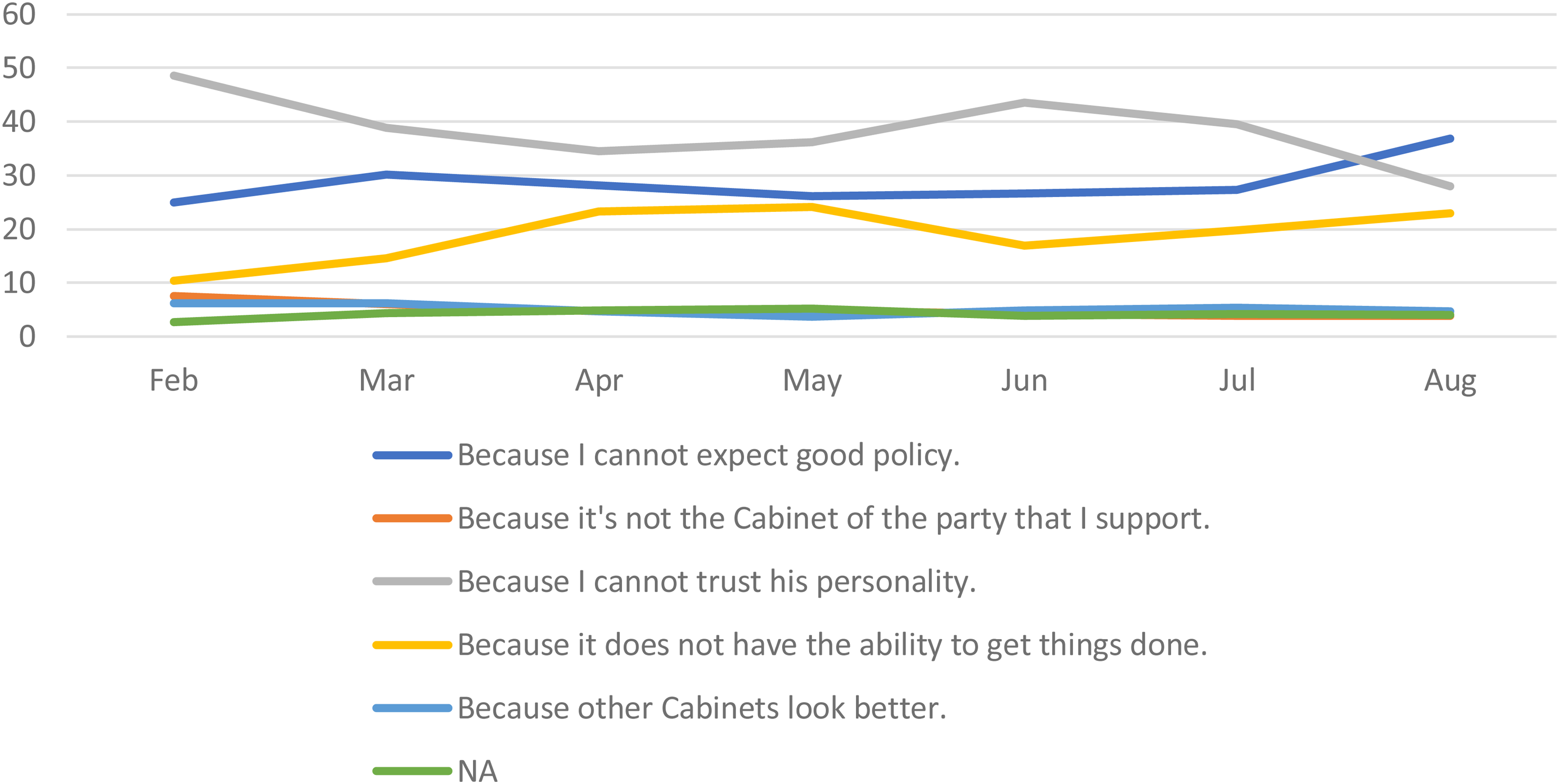
Why do you disapprove of the Abe cabinet?
Similar results can be seen in the regular Jiji polls, which also included questions about leadership, trust and policy expectations. In May 2020, the top reasons for disapproval were ‘I cannot trust the prime minister’ (41.4 per cent), ‘I cannot have expectations’ (38.9 per cent) and ‘there is no good policy’ (29.2 per cent). But the polls also show the public's dilemma in the sense that there were no perceived viable alternatives for government/leadership (‘no other suitable person’ at 23.9 per cent).
Longevity: Time in office
The introduction to this special issue pointed to the political stability brought about under Abe's (second) prime ministership – itself an unusually lengthy period term marked by a bolder leadership style than Abe had displayed during his first brief and rather chaotic term of office in 2006–2007. Abe naturally scores highly in this aspect given that he managed to achieve his personal goal of becoming the longest-serving Japanese prime minister. But longevity raises the bar in terms of the expectation of greater achievements and impact (Theakston, 2013: 230, cited in Worthy and Bennister, 2021).
Abe's legacy is still being scrutinised, but thus far the evaluations are mixed. Hoshi and Lipscy (2021: 3) argue that Abe's government represented the clearest example of a move away from the 1955 system, with ‘a strong prime minister with centralized authority, careful management of public opinion, the strategic use of elections for party discipline, and a focus on policies with broad, popular appeal’. Harris (2020: 310–314) sees Abe's successes in his record on economic growth (the longest period of growth since 1945), and his globalisation strategy (seen in trade deals, and opening up to foreign goods, capital, workers and visitors, including tourism). On the downside, and as Abe himself highlighted during his resignation statement, there were his failures to revise the Constitution, to secure a peace treaty with Russia and to resolve the North Korea abductions issue (Abe, 2020). But he fell short in other policy goals, not least the ‘under-achievement’ of Abenomics (Harris, 2020: 320–321), and his inability ‘to reverse the underlying causes of national decline’ (Harris, 2020: 326). 9 He might be seen to have inverted the notion that former PM Tony Blair pronounced that you begin at your least capable and end at your most capable (Heffernan, 2005: 643, cited in Bennister in this issue). In Abe's case, he appeared much more capable at the beginning than at the end of his (second) time in office.
Re-election margin for the party leadership
For much of Abe's period in office, he capitalised on the fact that there were very few, if any, viable contenders for power within the LDP, running unopposed in the 2015 leadership race, for example. To a large extent, this was of his own making and demonstrated his ruthless side. For example, Fukushima (2020) refers to his ‘strong-arm tactics’ in quashing any internal challengers. Similarly, Abe was able to ‘overcome intraparty divisions’ by marginalising potential opponents such as Ishiba Shigeru (Hoshi and Lipscy, 2021: 7; see also Wallace and Pugliese, 2021). He also timed lower house elections to maintain popular support and quell signs of intraparty challenges. For example, he used the 2014 election to push forward on his plans to postpone the consumption tax hike, on which he was being challenged within the party (Hoshi and Lipscy, 2021: 16).
Relations
Party polling and likelihood of credible leadership challenge
The fragmentation of the opposition meant that the LDP outperformed all other parties throughout Abe's premiership. It was therefore the ebbs and flows of LDP approval/disapproval ratings themselves which were the more important barometer of the public mood, particularly when read alongside Cabinet approval ratings. Yoda (2021) put Abe's ‘premium’ (that is, the difference between Cabinet and LDP approval) at around 10 to 20 percentage points for most of his time in office. By August 2020, however, he was no longer a ‘net asset’ (Wallace and Pugliese, 2021: 115), with NHK polls showing an approval rate of 34 per cent for the Abe cabinet, against an approval rate of 35.5 per cent for the LDP (compared with, for example, a Cabinet approval rating of 64 per cent and an LDP approval rating of 37.8 per cent in January 2013) (Real Politics Japan, 2022b).
As noted above, one of the characteristics of Abe's time in his government was his seemingly unassailable grip on power and the lack of alternative LDP leadership contenders. In addition, the ‘collapsed opposition’ meant that there was little in the way of a viable alternative to the LDP in the 2014 and 2017 elections (see Pekkanen et al., 2016, 2018), and the Abe government seemed to have filled the void of a missing opposition by adopting ‘progressive policies, stealing the thunder of opposition rivals’ (Fukushima, 2020).
Before the pandemic, and given the strength of his position, it was assumed that Abe would complete his term as LDP leader, and therefore prime minister, until 2021. Abe's series of ‘missteps’ from the beginning of the pandemic brought that assumption into question, and signs began to emerge from within LDP circles in June that support for him was falling away, with behind-the-scenes manoeuvring by LDP Secretary General Nikai Toshihiro (Bosack, 2020). At around the same time, Abe's health was beginning to suffer, and by July he was ‘giving fewer clear directives’ and ‘moving away from the center of policymaking’ (Shimada, 2020).
Working relations with the bureaucracy
The Abe government's control over the bureaucracy has been well documented (Hoshi and Lipscy, 2021; Takenaka, 2021). For some, this was part of his presidential style of power consolidation in the kantei, which included ‘controlling the career path of senior government bureaucrats, by imposing more political appointees on government agencies, and by strengthening the kantei through adding both individual hires and institutional functions’ (Fukushima, 2020). While Abe's earlier pragmatism could be seen in the way that he sought ‘the cooperation of the bureaucracy in the service of effective government’ (Burrett, 2017: 417), he nonetheless maintained firm control, gradually building up resentment within the bureaucracy (Wallace and Pugliese, 2021: 113). Abe's working relations with the bureaucracy deteriorated during the pandemic as communication faltered, leading to clashes over policy (for example, with the Ministry of Health) and he embarked on a series of ad hoc, impromptu decisions without consultation with ministries or expert panel (API, 2021: 22; Wallace and Pugliese, 2021: 113). For example, Abe placed much reliance on key individuals within the kantei who masterminded some of the policies that ultimately failed, for example the ‘Abenomask’ and Tweet policies (API, 2021: 18). In sum, while the pandemic demanded that the kantei take a strong, central role in crisis management, in the case of the Abe government the top-down decision making was made at the cost of good working relations with the bureaucracy whose task it was to implement the various measures.
Reputation
Perceived ability to shape party's policy platform and parliamentary effectiveness
There is a broad consensus in the literature that Abe 2.0 had learned the lessons of 1.0 in terms of his ability to build a strong, loyal leadership team and that power ‘lay primarily with formal and informal advisers around the Prime Minister, rather than in the ministries or the government backbenches (Harris, 2020: 189; see also Burrett, 2017; George Mulgan, 2018). In this way, he was able to control the party's policy platform until the latter part of his premiership. He enjoyed some legislative success (including the controversial security and secrecy legislation), with the passage rate of cabinet-submitted legislation on a par with that of previous LDP governments (see Hoshi and Lipscy, 2021: 7). This was achieved partly due to the LDP's strength in numbers (having won a series of landslide election victories in 2012, 2014 and 2017) which in turn saw an end to the ‘twisted Diet’ and the divisions of the previous decade. Overall, Abe's second government developed a reputation for its ‘competent management and discipline centered on a core group of officials in the Cabinet Office’ (Hoshi and Lipscy, 2021: 12).
Yet during the crisis, it was noted that the advantages that could have accrued from the centralisation of power, that is the ability to act boldly and quickly, failed to materialise and ‘politics and the executive branch of government failed to function properly’ (Mainichi, 2020). Wallace and Pugliese (2021: 108) also point to the failure of Abe and his government to lead a focused response in the early stages, with ‘little coordination of the collection, analysis and sharing of critical information and public communications’ and ‘bureaucratic silos and parallel task forces’. Abe's ad hoc decision making and ill-conceived policies (for example, the household support system) led to divisions with the coalition partner Kōmeitō and further weakened governmental effectiveness.
In addition, while so-called ‘Teflon premier’ Abe had managed to ride the storm of scandals earlier in his premiership (Kingston, 2020b), by 2020 some of these had returned to the agenda, in addition to new scandals relating to the funding of the Cherry Blossom party, the arrest of a former appointee Akimoto Tsukasa and Abe's favouritism of public prosecutor Kurokawa Hiromu (Kingston, 2020b; Wallace and Pugliese, 2021: 110–112). Kyodo News (2020) suggested that while Abe's earlier success with his economic policies had helped to keep him from harm, this was no longer the case in 2020 when the economy was hard hit by the pandemic and mistrust of Abe was building (see Wallace and Pugliese, 2021: 110).
Concluding thoughts
Abe's fall from power in 2020 was in some ways reminiscent of 2007. His ‘political tin ear’ appeared to have returned in 2020 and the last few months of his premiership were marked by his health struggles and ‘poor leadership’ 10 (Krauss and Pekkanen, 2012: 187). Applying the leadership capital index, specifically by taking a qualitative approach, the article assessed each aspect of Abe's personal leadership style and skills to identify the mechanics of his fall from power. Combining the LCI with insights from crisis management literature enabled us to provide a more structured and nuanced explanation of the reasons for his downfall. In particular, it helped to highlight the specific areas in which Abe's personal leadership skills fell short of public expectations and led to difficulties with the LDP, his expert panels and bureaucrats. Aspects of his leadership style, which had drawn praise earlier, particularly on his return to power in 2012, seemed to weaken considerably as the pandemic developed. The article demonstrated three areas in particular where Abe's performance suffered: political vision (sense making), communicative performance (meaning making) and control over policy making (decision making and coordination). While other institutional and structural factors were certainly also at fault (see API, 2021), Abe's personal skills lacked the strength needed during the crisis, leading ultimately to a fall in popular support from which he could not recover.
The election of Suga, Abe's right-hand man for so many years and a supposed ‘safe pair of hands’, recalled the ‘caretaker’ governments of the post-Koizumi period, and his brief period in office was hampered by poor handling of the ongoing Covid-19 response despite the successful hosting of the Tokyo Olympics. Since his election in 2021, Prime Minister Kishida has also faced the many challenges of the ongoing pandemic, in addition to internal pressures from, amongst others, former PM Abe. Despite the relative power that the prime minister's office has accrued over the last two decades (as discussed elsewhere in this special issue), it still seems that without a strong(er) leader at the helm, Japanese politics may return to business as usual with a frequent turnover of short-lived prime ministers.
Footnotes
Declaration of conflicting interests
The author(s) declared no potential conflicts of interest with respect to the research, authorship, and/or publication of this article.
Funding
The author(s) disclosed receipt of the following financial support for the research, authorship, and/or publication of this article: This work was supported by the Economic and Social Research Council, (grant number ES/S014187/1).
