



Abstract
This article considers UK prime ministers as leaders of their political parties. It evaluates the extent to which the three trends identified by Uchiyama in this issue, in relation to Japanese prime ministers, are replicated in the case of UK prime ministers. First, to what extent is the Japanese trend towards increasing party centralisation replicated within the UK Labour and Conservative parties? Second, to what extent is the Japanese trend of reduced factional influence and lower rebellion rates replicated in the case of the UK Labour and Conservative parties? Finally, is the association between leadership personalisation and party leadership security – i.e. how an approval rating of below 30 per cent will act as a trigger for the removal of an incumbent Japanese prime minister – replicated in the case of the UK Labour and Conservative parties?
Keywords
Introduction
It is acknowledged that political leadership is interactionist and involves the agency of the individual politician within the context of their structural environment (Elgie, 1995). On the one hand, the skills and competencies of political leaders (their agency) can influence outcomes and will fluctuate (on leadership capital, see Bennister et al., 2015). On the other hand, circumstances evolve and can be constraining – for example, the fallouts of the global economic crisis of the late 2000s or the Covid-19 pandemic of 2020 onwards (or Brexit within the UK context). As such, perceptions of political leadership effectiveness involve assessing ‘skills in context’ (Theakston, 2002).
There is, however, a tendency towards assessing leadership from a national, or governmental, perspective (Helms, 2005) and thus under-estimating the party leadership context. This article considers how the party leadership environments of UK Prime Ministers have evolved – and have been centralised – and how this compares to the case of Japanese Prime Ministers in recent decades, as discussed by Uchiyama in the preceding article of this special issue. It does so in relation to the three themes identified within the introduction to this special issue, which implied that the party leadership context to prime ministerial leadership is best understood in relation to party centralisation, internal cohesion and leadership security. It considers the conclusions that Uchiyama reached in relation to those aforementioned themes in the Japanese context: (a) that there has been a trend towards further party centralisation, thus ensuring that the power of the executive has been enhanced vis-a-vis their own backbench representatives; (b) that this has reduced the importance of intra-party factionalism and lowered intra-party dissent; and (c) that an environment that facilitates stronger and more directive prime ministerial leadership has coincided with the growth in the personalisation of politics, in which prime ministerial approval ratings have come to determine leadership survival prospects (Burrett, 2016).
Given the significance of the mid-1990s electoral reforms to Japanese party politics (Machidori, 2005), the comparisons that will underpin this article operate within a similar time frame, even though no equivalent reforms exist within the UK setting. As such, the article will assess the party leadership dimension of prime ministerial leadership with reference to two Labour prime ministers (Tony Blair 1997–2007 and Gordon Brown 2007–2010) and three Conservative prime ministers (David Cameron 2010 −2016, Theresa May 2016–2019 and Boris Johnson since 2019).
Party centralisation
On the first theme identified by Uchiyama in this issue, it is clear that the electoral reforms of the 1990s would contribute to a greater centralisation of the party organisation, thus facilitating a ‘top-down’ approach to the ‘policy process’, as evidenced in the Koizumi premiership (2001–2006) (Shinoda, 2013: 6–8; for a LDP focus on party adaptation to the electoral reforms, see Krauss and Pekkanen, 2004, 2011). When we consider UK prime ministers in relation to party centralisation, it is clear that similar trends exist.
Within UK party politics, a clear historical distinction was said to exist between the Conservative and Labour parties in an organisational sense. The Conservatives placed considerable power and autonomy in the hands of their party leader and could thus be viewed as a top-down elitist oligarchy. Conservative party leaders had more latitude in terms of policy formulation including the manifesto, and thereby the construction of their political (electoral) strategy. In contrast, the Labour Party could be viewed as a bottom-up plural democracy. Power was said to be dispersed within their federal structures, between the National Executive Committee (NEC) and the Annual Conference, who together were responsible for the formulation of policy, alongside the parliamentary Labour Party (PLP), whose responsibility was the implementation of policy (Heppell, 2013: 130–132).
The rise of New Labour and the leadership of Blair (1994–2007) coincided with a period of leadership centralisation within the Labour Party (Minkin, 2014). This represented part of the modernisation process that the Labour Party had been incrementally pursuing since the leadership tenure of Neil Kinnock (1983–1992) (Quinn, 2004; Russell, 2005). Modernisation represented a reaction to the democratisation agenda associated with the opposition era of 1979 to 1983, during which a process of dispersing power had empowered the activist base but had created a perception of ideological extremism and internal division, culminating in a landslide general election defeat in 1983 (Quinn, 2004).
The 1990s involved processes of organisational change that would aid leadership autonomy. The mantra of democratisation would be exploited as the modernisers expounded the value of ‘one member, one vote’ (OMOV). This enabled them to move away from delegatory democracy (thus limiting the influence of active and radical delegates), and towards representative democracy, at a time when the more moderate membership was more likely to support the leadership (Russell, 2005). That shift saw Blair rely on membership ballots to endorse the changes he deemed necessary – i.e. his reforms to Clause IV in 1995 and on the draft election manifesto in 1996. When placed within the wider context, Blair was seeking to dilute the influence of the Annual Conference and the NEC in policy formulation (Shaw, 2004: 58).
Blair reinforced his position just as the Labour Party regained office in 1997, through his Partnership in Power (PIP) reforms. These would create an impression of increased membership participation, but the reality was one of greater leadership independence. Although nominally permitting input from the membership in terms of policy and priorities, the modernisers established an agenda-controlling role for the leadership. This allowed the leadership, as gatekeepers, to frame the proposals and to steer the debate, so that the Annual Conference was effectively left as a rubber stamp for the preferences of the leadership (Minkin, 2014).
On the balance that parties must strike between, on the one hand, participation and accountability, and on the other hand, the need to demonstrate firm and effective leadership, it was clear where Blair stood (Shaw, 2004: 53). He sought to expand his leadership autonomy by weakening the constraining power of his internal critics and he did so to such an extent that the term ‘control freaks’ would become attached to the Blairite modernisers (Shaw, 2004: 52–58). That Blair had done so by methods that seemed to be participatory, and thus aided their legitimacy, led Seyd and Whiteley to speak of a ‘veneer of democracy’ that was ‘disguising centralisation and control’ (Seyd and Whiteley, 2002: 176). Ultimately, these changes towards greater party centralisation aided Blair as prime minister between 1997 and 2007 and, to a lesser extent, Brown between 2007 and 2010.
Their impact was noted by the Conservatives when they were in opposition. When we consider the position of Conservative prime ministers this century, it is important to note that they operate within the context of the internal party reforms from the opposition era (1997–2010) onwards. These were initiated under the leadership tenure of William Hague (1997–2001) as part of the ‘fresh future’ reform agenda. These reforms created a unified and codified constitution, which brought together three separate parts of the party – its professional and voluntary wings as well as the parliamentary party – which alongside other reforms, served to centralise power around the leadership in the following ways (Dorey et al., 2011). First, the legal autonomy that constituency associations had previously held was lost and they were brought under the control of the central party. Second, the power to arrange the Annual Conference, previously under the control of the National Union, was removed, and was brought under the influence of a subcommittee linked to the office of the party leader (Dorey et al., 2011). Finally, the leadership mirrored the techniques of New Labour by encouraging membership participation to gain consent for decisions already taken – e.g. the ballot that served to legitimise the leadership position to rule out joining the single European currency for a specified period of time. However, while the rhetoric was about democratisation, the ability to determine policy and shape political strategy remained firmly in the hands of the leadership – their power and autonomy was thus retained (Dorey et al., 2011). As such, if constraints were to exist upon the leadership of Conservative prime ministers after 2010 (Cameron, May and Johnson), they would not emerge due to any checks and balances within the organisational structures of the party, or the way in which power is located and exercised within the party.
That both parties engaged in processes of democratisation designed to imply a decentralisation of power, while actually seeking to centralise power, leads to the following question: why? This could be explained by the shift away from partisanship and voter choice being shaped by traditional class cleavage, and towards a valance-based theory of voting behaviour. Valence-based voting – which suggests that voter perceptions of party competence are (in part) conditioned by their perceptions of party leaders – has changed the way in which parties construct their election campaigns (Clarke et al., 2009). Personality-driven campaigning is about image and symbols as much as it is about content and policy, and as such leaders have come to personify their parties. Personalised campaigning aids parties as it provides them with a means of an ‘informational shortcut’ to voters, with the personal strengths of leaders acting as a heuristic device to help voters with limited interest in politics to make their voting decision. If perceptions of leaders are central to voter choice – as evident from research on the 2005, 2010 and 2015 general elections (see Clarke et al., 2009, 2016; Whiteley et al., 2013) – then that could have been an incentive for parties to create the institutional arrangements that enable their leaders to have the autonomy to project themselves as strong leaders.
Establishing an appropriate government–party relationship had been a key motivator for Blair so that he would not be undermined by his own party, in the way that previous Labour prime ministers had been (Shaw, 2004: 52). That Blair saw his own party as an obstacle to, rather than a vehicle for, effective prime ministerial leadership (Buller and James, 2012) is evident from his memoirs, when he admitted: I had read up on previous governments, I had noted the destabilising factor was the relationship between the party and government. When the party was called upon to exercise real power, there immediately came about a dangerous tension between activists and ministers in which the two always ended up divided from each other […]. They moved with remarkable speed into inhabiting separate political cultures. The result was an increasing disillusionment with the government from the party, which quickly communicated itself to the public. (Blair, 2010: 101)
However, enhancing the autonomy of leaders by centralising their control over their parties and maximising their organisational autonomy was to be no guarantee of internal cohesion in the case of New Labour. Avril notes that Blair's ‘command and control approach’ designed to ‘entrench’ his leadership position, would ‘generate powerful counter-movements’ as a response to his ‘heavy-handed’ approach to party management 1 (Avril, 2016: 9). For both Labour and Conservative leaders, moves towards greater party centralisation, made in opposition, would run hand in hand with increasing parliamentary dissent when in office (Heppell, 2013: 132–135).
Internal cohesion
On the second theme, Uchiyama in this issue argued that the trend in Japanese politics has been towards less intra-party factionalism and greater legislative cohesion and lower dissent levels (Hamamoto, 2018: 246). However, this has clearly not been replicated in the case of UK prime ministers over the last two and half decades, be they Labour or Conservative.
When considering the issue of party management or discipline and ideological conflict, British political science has traditionally cited the classic study of Rose (1964), which argued the following. The Conservatives, with their emphasis on pragmatism and loyalty, alongside their aversion to ideology, were defined as a party of non-aligned tendencies, whereas the Labour Party was characterised by the existence of ideologically motivated factional groupings (Rose, 1964). Given that the rebellion rate of the Labour administrations of 1974 to 1979 was 20 per cent – significantly larger than, for example, the rebellion rate of just one per cent of the Conservative administration of 1955 to 1959 – the Rose distinction became accepted as carrying some validity (Heppell, 2019: 91).
However, in recent decades the distinction between tendencies and factions seems less valid. Rebellion rates have increased significantly within the Conservative Party. For example, the Major administration of 1992 to 1997 had a rebellion rate of 13 per cent and this was higher than the rebellion rate of the first Blair administration of 1997 to 2001 (at eight per cent). Thereafter, in the 21st century, both governing parties have experienced significant increases in internal dissent – the rebellion rate for the Labour administrations of 2001 to 2005 was 21 per cent and for the 2005 to 2010 it was 28 per cent; and during the Cameron-led coalition administration the rebellion rate (for the Conservatives only) was 25 per cent (Heppell, 2019: 91). As the trend across both Labour and Conservative parties is towards increasing rebellion, it raises issues about the extent to which rebellion rates matter, and the factors that explain why rebellion rates have increased so much since the turn of the century.
On the issue of the extent to which rebellions matter, it is important to note that how rebelliousness is interpreted will be dependent upon circumstances. Majorities matter. The Blair and Brown administrations had very large or comfortable majorities. Labour backbenchers in the two parliamentary terms of the Blair era, when the Labour government had a majority of 179 in the 1997 to 2001 Parliament, and a majority of 167 in the 2001 to 2005 Parliament, were rebelling as a gesture rather than to exercise power and influence. As they could not realistically stand in the way of the government and their objectives, Blair could hold a dismissive mindset towards his backbench parliamentarians. Moreover, the Labour Whips’ Office could turn to many Labour parliamentarians of that era and say that they owed their seats to the electoral success that had been provided by Blair's leadership. However, that sense was not as pronounced in the 2005 to 2010 Parliament, as the majority was reduced from 167 to 66. Although still a comfortable working majority, it did require the leadership and the Whips’ Office to demonstrate greater sensitivity to the views of their own parliamentarians (Cowley, 2007; Cowley and Stuart, 2014).
The level of prime ministerial autonomy vis-a-vis parliament and their own backbenchers may have been relatively high for Blair and Brown, but the circumstances of Cameron, May and Johnson (initially) were significantly different. From an era of Labour prime ministers with massive or comfortable majorities across the last three parliaments, there were to follow three Conservative prime ministers across three parliaments, forced to operate in constraining circumstances. First, Cameron became prime minister of a coalition government between May 2010 and May 2015. Second, he then briefly led a Conservative government with a tiny majority of 12 between May 2015 and July 2016, before the Conservative Party leadership and prime ministership passed to May in 2016, and she governed under these parliamentary circumstances until the general election of June 2017. Finally, she led a minority administration in the 2017 to 2019 Parliament, which in the latter stages saw the Conservative Party leadership and prime ministership pass over to Johnson in July 2019. Across these three parliaments, governing party backbenchers were not necessarily gesturing when rebelling, but doing so as they could (depending upon the issue and the behaviour of the opposition parties) exercise power and influence (Heppell, 2019). The general election of December 2019 ended this era of governments without stable majorities, as Johnson led the Conservatives to victory with a comfortable majority of 80 (Cutts et al., 2020).
The parliamentary arithmetic had significant consequences for Cameron, May and initially Johnson. With the rate of internal party dissent increasing, the result was a significant rise in the number of times in which the government experienced parliamentary defeats. Across 10 years as prime minister, Blair had only experienced four parliamentary defeats, and across three years as prime minister, Brown suffered only three, which was broadly comparable to the rates of defeats suffered by Thatcher (four across the 1979 to 1990 period) and Major (six across the 1990 to 1997 period). In coalition, Cameron suffered six parliamentary defeats between 2010 and 2015, and as a minority government leader he experienced three defeats in the 2015 to 2016 period. When May inherited his small majority mid-way through the 2015 to 2017 period, she went onto to experience no defeats, but once she fell into a minority administration after the general election of 2017, the rate of parliamentary defeats was to rapidly increase. Between June 2017 and July 2019, she was to experience 33 parliamentary defeats, and then Johnson was to suffer 12 parliamentary defeats inside his first four months as prime minister (Heppell, 2019: 90–98; Xu and Lu, 2021).
Those parliamentary defeats reflect both the parliamentary arithmetic in the 2010–2015, 2015–2017 and 2017–2019 Parliaments and the increasing propensity for dissent that actually predates these three Parliaments. This leads to the following question: what factors explain the trend towards increasing parliamentary indiscipline, which has characterised both the Labour and Conservative parliamentary parties this century? We can offer the following two explanations:
The issue of the UK's membership of the European Union had for a long time contributed to growing rebellion rates (Cowley and Norton, 1999; Lynch and Whittaker, 2013). That perception would be intensified by the difficulties that May would experience in attempting to negotiate and then implement a Brexit deal – the so-called Withdrawal Agreement and associated Political Declaration – through a Parliament in which no majority existed for any variant of Brexit (Russell, 2021). The outcome of a logjammed Parliament was governmental paralysis, as the repeated parliamentary rejections (involving large Conservative rebellions) of the proposed Withdrawal Agreement resulted in a delay to the intended timeline for exiting the EU – from the end of March to the end of October 2019, and then to the end of January 2020 (Hayton, 2022). From this emerged the decision of Johnson to engineer a general election in which he sought a mandate to implement the terms of the amended Withdrawal Agreement that he had secured with the EU. Here Johnson was able to exploit both Brexit fatigue amongst voters, and the misalignment between the remain instincts of the Labour Party and the leave sentiment amongst parts of their traditional vote base. As such, Johnson was able to penetrate the ‘Red Wall’ of Labour constituencies and thus bulldoze his way to a parliamentary majority on the mantra of ‘Get Brexit done’, securing for himself and the Conservatives a comfortable parliamentary majority of 80 (Cutts et al., 2020). Various prime ministers have shown significant limitations in terms of their management of their own parliamentarians. For example, Blair antagonised his parliamentary ranks due to his autocratic leadership style and his tendency for ‘dropping fully formed policies on them and expecting automatic and whole-hearted support’ (Cowley, 2007: 27). Brown was not immune to criticism in relation to his methods for securing internal cohesion: Seldon and Lodge note that his ‘graceless management’ of his fellow parliamentarians would ‘exacerbate’ the difficulties that his ‘dysfunctional’ Whips’ Office were already facing (Seldon and Lodge, 2010: 107, 257). Cameron has also been criticised for his limitations vis-a-vis internal party management: Norton noted the damaging impact of his over-reliance on a ‘coterie of trusted and like-minded advisors’ and his ‘tendency to determine policy’ without consulting his own parliamentarians (Norton, 2015: 485).
Not only is the first of these drivers specific to the UK context, but the second of these drivers does not correspond to the recent experiences in the Japanese context. Burrett implied that Abe paid ‘close attention’ to the issue of party management (Burrett, 2016: 48). This was made easier, Mishima suggests, by the ‘growth of non-factional backbenchers’ – where previously virtually all LDP parliamentarians would be aligned to factions, the ‘hollowing’ out of the traditional control by factions created the space for the likes of Koizumi and Abe to emerge, neither of whom were a ‘faction boss’ (Mishima, 2019: 110). Critically, when placing the issue of factions or cohesion within the context of leadership selection, Mishima (2019: 111) also noted how leaders can now advance to the leadership without the same reliance upon factional blocks, which explains how, as Burrett argues, Abe was able to remake the LDP ‘in his own image’ (Burrett, 2016: 48).
Leadership security
When considering the party leadership-followership dynamic for Japanese prime ministers, Uchiyama in this issue identified the importance of the increasing personalisation of politics 2 (Rahat and Kenig, 2018) – i.e. the electoral appeal of parties is increasingly influenced by the image and performative skills of their leader. From this he concluded that the survival prospects of the incumbent Japanese prime ministers are increasingly shaped by their approval ratings. Here the research of Burnett is illuminating. She identified how, for example, Koizumi had a significantly longer prime ministerial tenure than normal (2001 to 2006) and Abe likewise after 2012, because the trigger to get them to step down was not present because their parties could see that voters were sufficiently satisfied by their leadership performance
By that, Burrett (2016: 43) suggested the following:
An approval rating of above 40 per cent provides the basis for ongoing support and leadership security; An approval rating of between 30 and 39 per cent leads to doubts emerging about their continuance in office; and An approval rating lower than 30 per cent acts as a trigger for a leadership change.
To what extent can a similar trigger be said to be evident in relation to UK prime ministers? Figures 1–5 provide an overview of the satisfaction ratings of each of the last five UK prime ministers across their tenures, and indicate that the distinctions that Burrett (2016) identifies above do carry some validity in the UK context. Figure 1 demonstrates that Blair remained well above 40 per cent between May 1997 and March 2003 when no significant speculation about a challenge to his leadership existed; such speculation developed in the period from March 2003 onwards as he was in the 30 to 40 per cent range, and only briefly did he dip below 30 per cent during 2006 (on the decline in the popularity of Blair, see Evans and Andersen, 2005). The position of Brown was considerably weaker (see Figure 2), as he was only briefly above 40 per cent (in the early stages of his tenure). Thereafter, as speculation about a possible challenge came to dominate in 2008 to 2009 (Quinn, 2012: 86–94), his satisfaction ratings were either in the 30 to 40 per cent range or dipping below 30 per cent. Cameron did not dip below the 30 per cent range (see Figure 3) but was within the 30 to 40 per cent range more than he was above 40 per cent, although no significant speculation about his position was noted (Seldon and Snowden, 2015: 520). May saw her satisfaction ratings collapse after the general election campaign of 2017 (see Figure 4), and thereafter she hovered in the 30 to 40 per cent range; and when she dipped below 30 per cent, it did indeed coincide with an unsuccessful attempt by May's own parliamentarians to remove her via a confidence motion (Roe-Crines et al., 2021). Despite the tests to his leadership credentials set by first the Brexit negotiations and second the Covid pandemic (Ward and Ward, 2021), Johnson secured stronger satisfaction ratings than both Cameron and May, although they were to dip considerably in the latter stages of 2021, falling below the 30 per cent threshold, with this culminating in a confidence motion which he survived in June 2022.
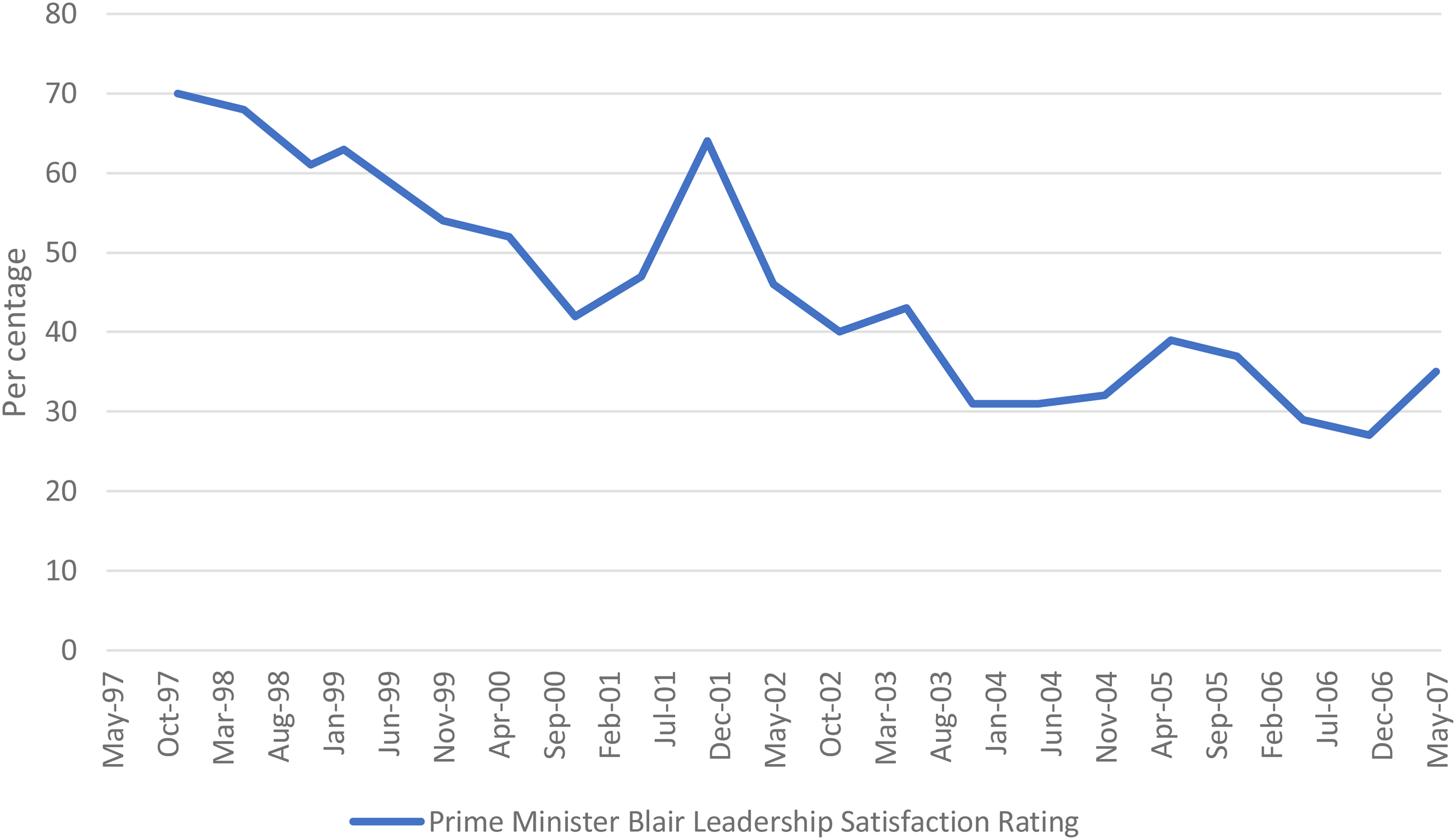
Blair's leadership satisfaction ratings 1997–2007. Source: IPSOS-MORI (2022).
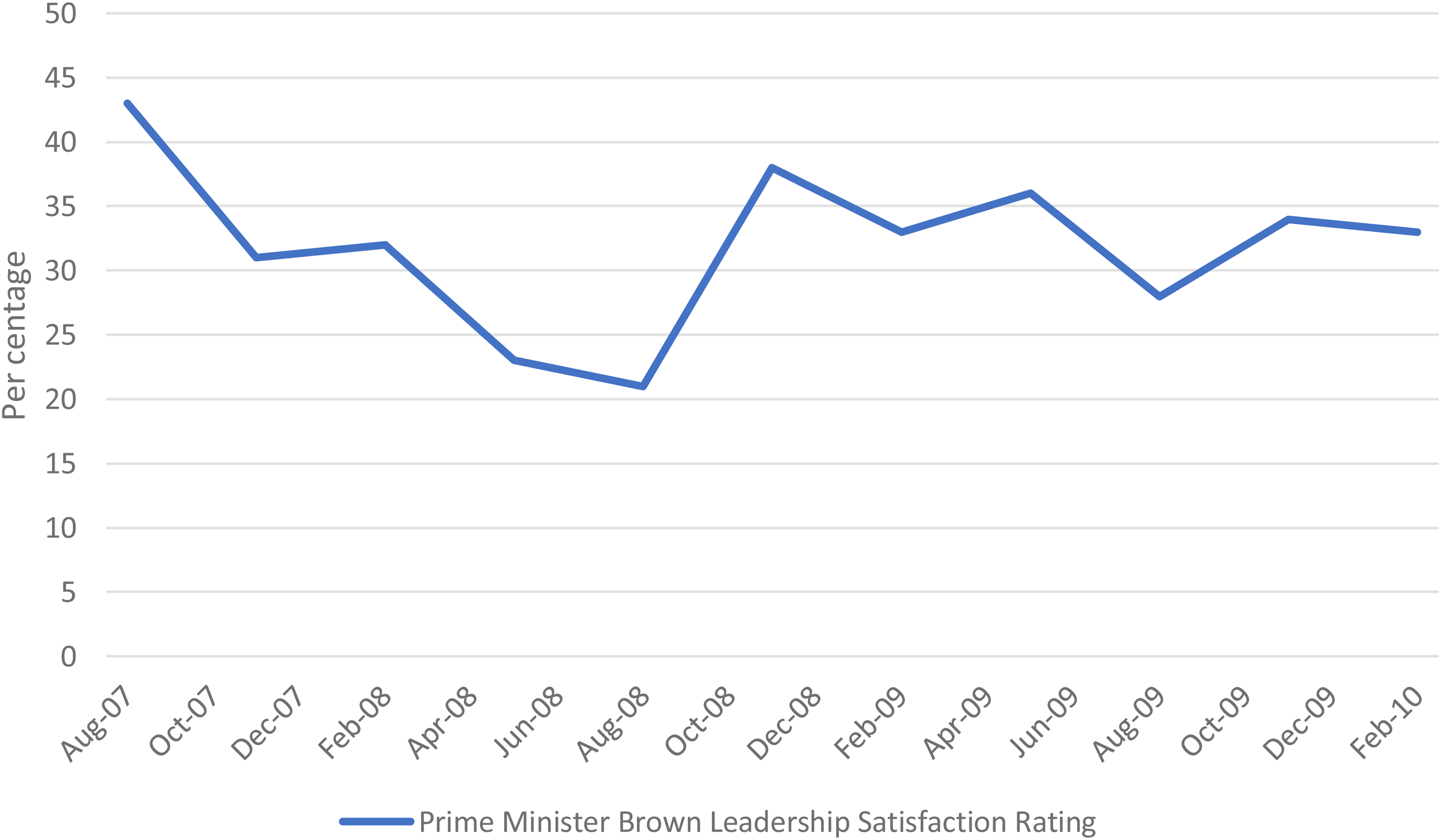
Brown's leadership satisfaction ratings 2007–2010. Source: IPSOS-MORI (2022).
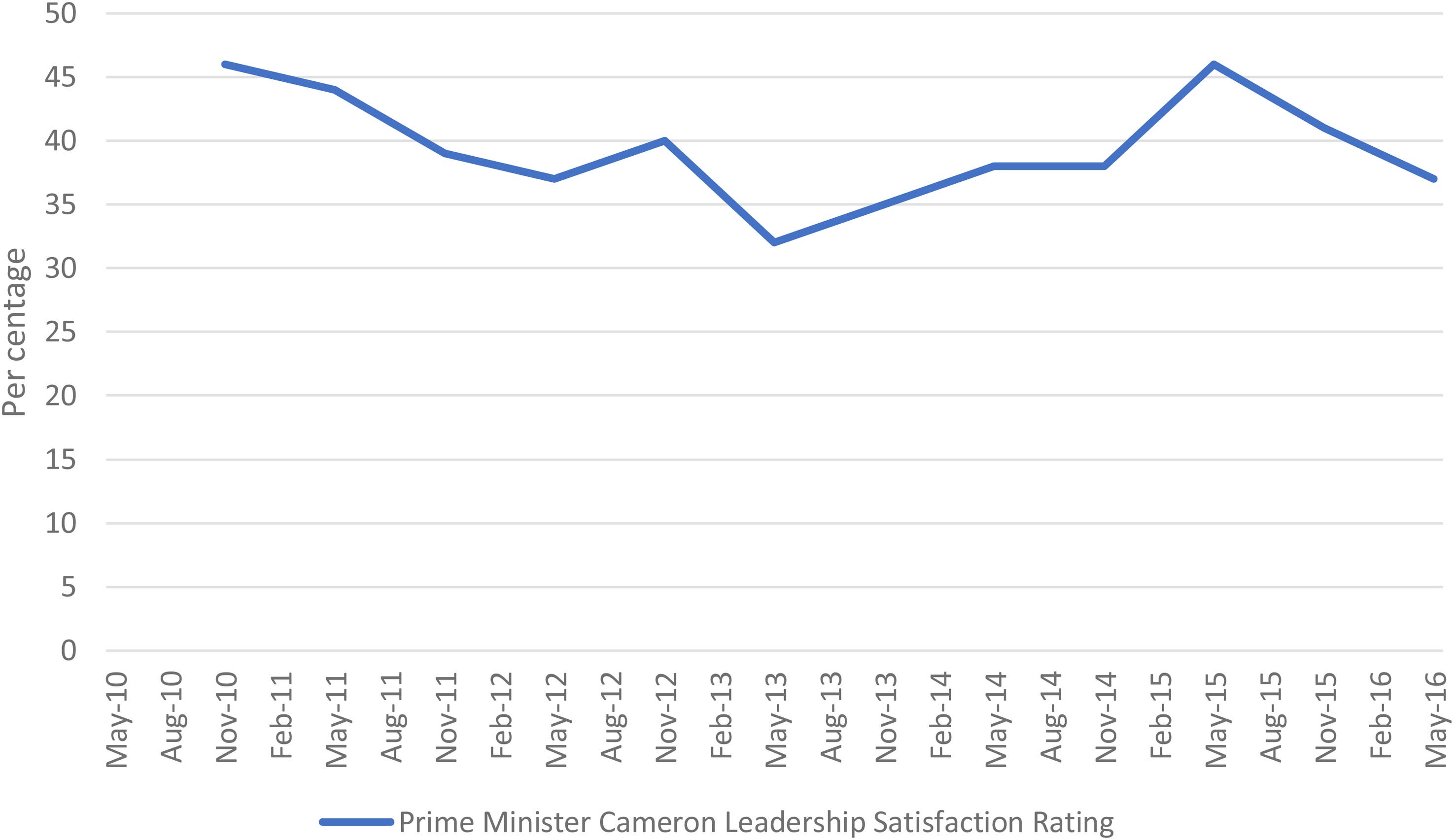
Cameron's leadership satisfaction ratings 2010–2016. Source: IPSOS-MORI (2022).
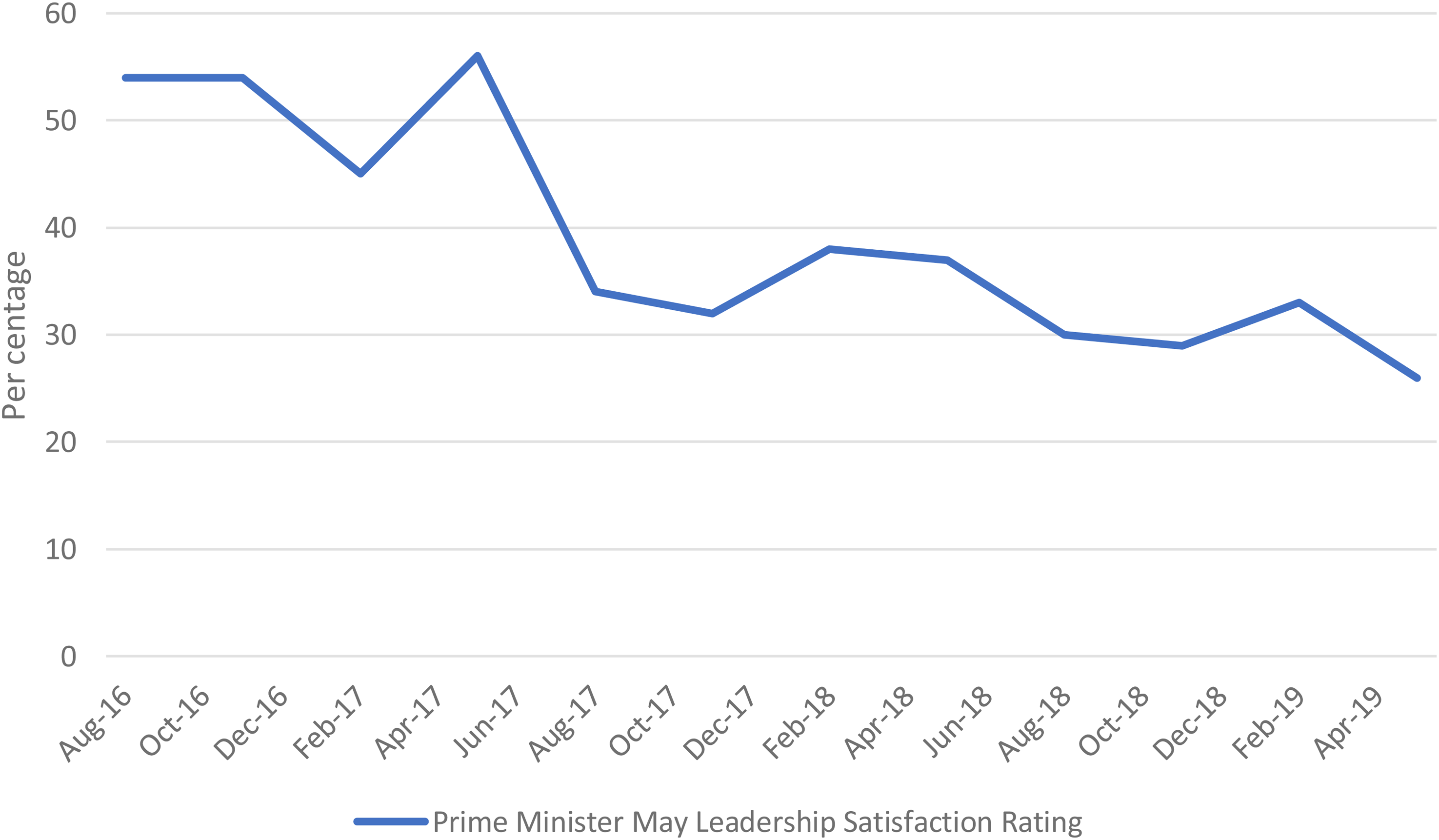
May's leadership satisfaction ratings 2016–2019. Source: IPSOS-MORI (2022).
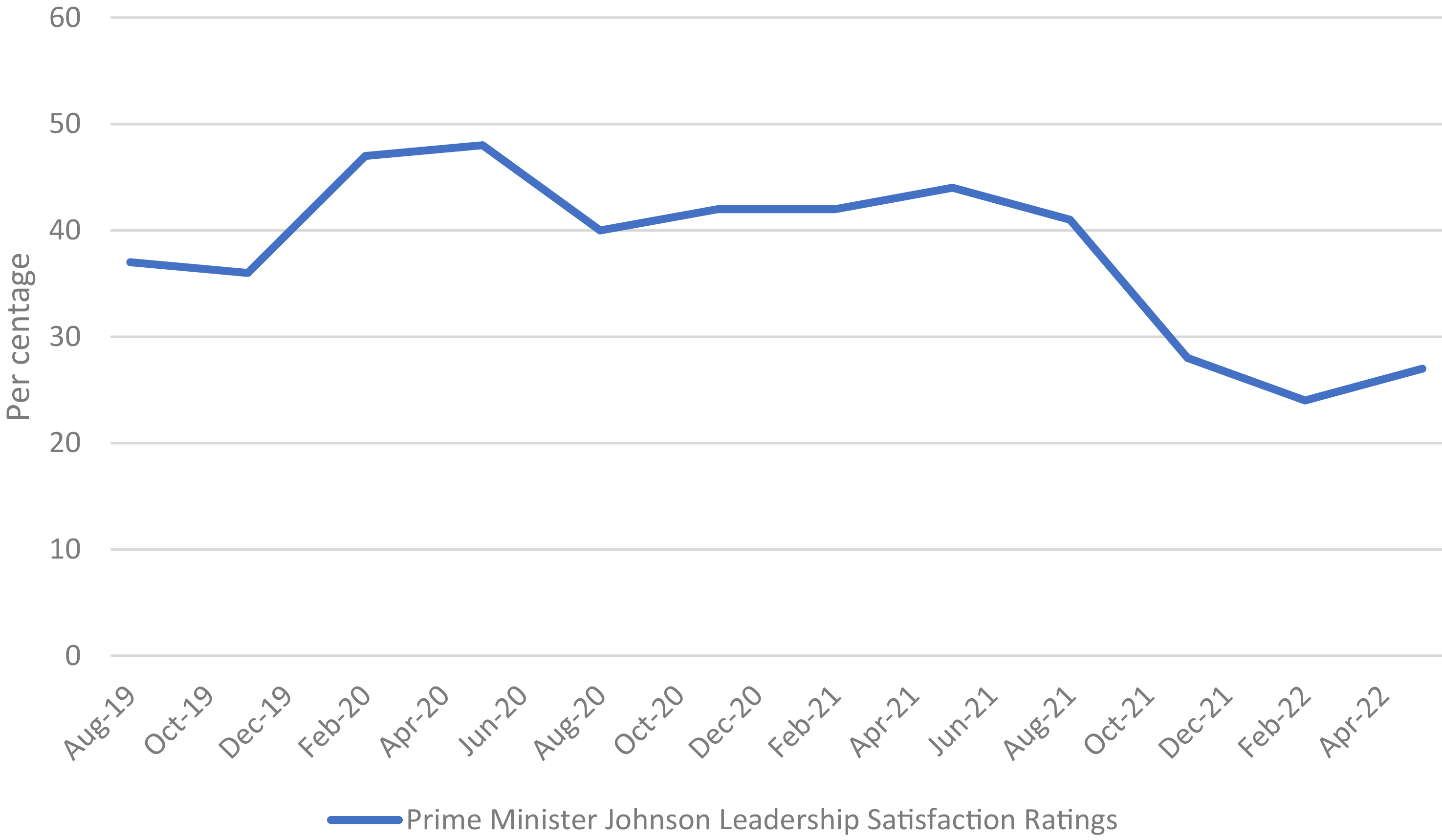
Johnson's leadership satisfaction ratings 2019–2022. Source: IPSOS-MORI (2022).
This appraisal creates a comparative conundrum. If the Burrett thesis on Japanese prime ministers applies in terms of satisfaction ratings, then both Brown and May should have experienced shorter tenures than they did – i.e. Burrett (2016: 43) notes that all Japanese prime ministers who lasted only a year or so in office had approval ratings dropping below 30 per cent. The answer to this conundrum lies in the procedures for evicting leaders of the two parties – i.e. it is procedurally difficult, but not impossible, to evict an incumbent party leader when in office. That disincentives to forcibly evict do exist may explain why weakened prime ministers, for example Brown and May, remain in office for as long as they do.
The way in which both parties elect, and seek to eject, their leaders has evolved and changed over the last 40 years, and those reforms have been justified under the mantra of democratisation (Quinn, 2012: 2–3). In terms of electoral procedures, the Labour Party moved, in 1981, from a parliamentary ballot system for leadership election to a tripartite Electoral College, made up of elected representatives (30 per cent of the vote), constituency Labour party members (30 per cent) and affiliated trade unionists (40 per cent). This was reformed in 1993, making the three tranches equal in terms of weighting but also moving from the block vote to a one member, one vote ballot in the CLP and trade union sections (Quinn, 2012: 61–62). Blair was elected via the Electoral College system in 1994 and had a majority within each component part. Brown did not need to be elected by the Electoral College as he was the only candidate to pass the nominations threshold in 2007 when Blair resigned as leader of the Labour Party, thus allowing him to inherit to the leadership of the Labour Party and become prime minister without an election (Quinn, 2012: 64).
The electoral procedures of the Conservative Party have also evolved over time. Prior to 1965, they had no formal procedures and a new party leader emerged via processes of consultation amongst elites, and between 1965 and 1998 they elected their leader via a parliamentary ballot (Quinn, 2012: 36–38). A new two-stage hybrid system was then created in which parliamentarians engage in eliminative ballots and then present the leading two candidates to their membership to select from in a one member, one vote ballot. Cameron was elected via this system in 2005, when the Conservatives were in opposition, and Johnson was elected via this system to become leader of the Conservative Party and also prime minister in mid-2019 (Jeffery et al., 2022). May won the parliamentary eliminative ballots stage in the Conservative Party leadership election of 2016, but this did not proceed to the membership ballot as her opponent, Andrea Leadsom, withdrew her candidature (Jeffery et al., 2018).
With respect to the removal of incumbent party leaders, we can distinguish between two methods. The first method is a procedural attempt to remove the incumbent, and the second method is non-procedural in that informal pressures are applied to the incumbent to get them to resign the leadership, thus creating a vacancy.
When we consider UK Labour prime ministers this century (Blair and Brown), the procedural means to remove them would be via a challenger provision. 3 To formally challenge either Blair or Brown, the challenger would need the backing of 20 per cent of the PLP – for example, in the 2001–2005 Parliament, there were 412 Labour parliamentarians, so the threshold for a challenge to Blair was 83. When we consider UK Conservative Prime Minsters this century – i.e. Cameron, May and now Johnson – the procedural means to evict is via a confidence motion, not a formal challenger provision (the Conservatives used to have a challenger provision in their procedures, between 1975 and 1998, and it was famously used in the process that led to the resignation of Margaret Thatcher in 1990). The confidence motion procedure operates in the following way. It can be initiated when 15 per cent of the parliamentary Conservative Party request one. In order for the incumbent to survive the confidence motion, they only need to secure a majority (Quinn, 2012: 97–101). Only two confidence motions have been activated against Conservative prime ministers. First, there was a confidence motion against May in late 2018. The threshold in a then 317-strong parliamentary party was 47 and once this was passed May successfully overcame a confidence motion challenge by 200 votes to 117 in late 2018 (Roe-Crines et al., 2021). More recently, in June 2022, Johnson faced a ballot of his 359 strong parliamentary party and he survived by 211 to 148 votes.
Quinn has implied the procedures that political parties construct matter because they provide us with an insight into the costs to the party in seeking to change the leadership. Quinn (2012: 18–20) argues that three types of (negative) costs apply if a formal challenge or confidence motion is initiated. The first cost is financial in that seeking to remove the incumbent and activating a leadership election, involving balloting members, will involve a financial cost that could be better spent in alternative ways. The second cost is the decision cost, or the time costs associated with running a leadership election. Whether it is was the Electoral College for Labour, or the two-stage Conservative selection system, both are constructed in a way that should or could take a few months to complete – as opposed to the old parliamentary ballots system that could take around a couple of weeks to complete. The third cost relates to disunity, as party leadership elections involve rival candidates disparaging their colleagues rather than their political opponents, and prolonged campaigning periods risk allowing the party to appear divided (Quinn, 2012: 18–20).
Quinn then implies that a cost–benefit analysis will be applied by parliamentarians seeking to remove the incumbent party leader (Quinn, 2012: 18–20). Some procedures would appear to disincentivise attempted coups more than others. For example, consider the thresholds for initiating a formal challenge. When Thatcher was challenged in 1990, only a challenger, and a seconder, was needed for a ballot to proceed (Quinn, 2012: 38). That was tightened up during the remainder of the Conservatives’ time in office prior to 1997, as a 10 per cent challenger threshold was initiated (Quinn, 2012: 38). In comparison to both Thatcher and, to a lesser extent, Major, both Blair and Brown benefitted, with a 20 per cent challenger threshold, from stronger procedural obstacles more than their Conservative counterparts (Quinn, 2012: 82–94). Conservative prime ministers since 2010 have also been more procedurally secure than Thatcher or Major, as the threshold for initiating the confidence motion was also higher at 15 per cent. Another factor that can act as a disincentive for removing the incumbent is the power imbalances between those seeking removal and the incumbent. For example, when Brown was prime minister, the hurdle to initiate a challenge was very high at 20 per cent – e.g. meaning you needed the support of 71 out of 356 Labour parliamentarians in the 2005–2010 Parliament – but, in reality, we can discount a further 100-plus who are those holding ministerial office and appointed by Brown, who for reasons of political ambition (and risk assessment) are incentivised to continue to back the incumbent. If we discount those holding ministerial office – e.g. making it around 250 backbenchers – then getting 71 to back a challenge will amount to around 28 per cent. Another disincentive for challengers to Blair or Brown was that the Labour Party procedures actually incentivise risk for challengers – i.e. they have to enter at the start of the parliamentary ballots; they cannot join at the second ballot stage after a stalking horse candidate has undermined the political capital of the incumbent (Quinn, 2012: 82–94). Add these obstacles to Quinn's costs theory – financial, time and disunity – and then the reasons why Blair avoided a formal challenge after Iraq, and how Brown survived through the multiple governing difficulties that Labour experienced in the 2008–2010 period, becomes clear (Quinn, 2012: 18–20, 82–94).
Should we accept the Quinn costs theory acting as a disincentive to seeking to remove the incumbent party leader / prime minister? It may be valid to say that higher challenger / confidence motion thresholds make it harder to evict; it does not mean that parties will not activate these procedures, as evidenced from the attempt to unseat May in late December 2018 (Roe-Crines et al., 2021). However, whereas no UK prime minister has been formally – i.e. procedurally – driven out of office by their own parties since Thatcher in 1990, it is clear that both Blair (in 2007) and May (in 2019) were informally pressurised into stepping down from the party leadership and the premiership.
Therefore, when placing these observations within a wider context, we can argue that the trend towards forced but informal or non-procedural evictions is one consequence of UK political parties moving towards tougher eviction hurdles. But we can also note that another consequence of tougher eviction hurdles has been increasing party management difficulties – i.e. the increase in backbench rebellions identified earlier in the article. For example, the increase in parliamentary dissent in the parliamentary Labour Party in the early 2000s could be linked to irritation at their difficulty in successfully challenging Blair (post-Iraq) or that Brown was so difficult to remove despite his evident prime ministerial limitations (Heppell, 2013: 139–142).
Conclusion
When we consider the party dimension of prime ministerial leadership, and we attempt to identify the trends in relation to party centralisation, internal cohesion and leadership security, the following emerges when comparing UK and Japanese prime ministers:
The trend towards increasing party centralisation that has been geared towards facilitating stronger and more effective prime ministerial leadership within Japanese politics has been replicated for UK prime ministers for both parties. Both the Labour and Conservative parties used time in opposition to reconsider their organisational structures, whereupon they initiated changes that would remain in place during their eras in government. Both parties in opposition spoke the rhetoric of democratisation, which implied a dispersal of powers, which masked the reality of increasing centralisation around the party leader (Heppell, 2013: 130–132). The trend away from intra-party factionalism and towards greater internal cohesion that has been evident for Japanese prime ministers has not been replicated for UK prime ministers, and this difference applies to both parties, when in office. On the issue of internal party cohesion within the Labour and Conservative parties, we can note the following. It could be argued that greater leadership autonomy was the logical consequence of greater party centralisation, and as such, one outlet for backbenchers to express their frustration at their marginalisation has been via their parliamentary behaviour. From the 2001 Parliament onwards, Prime Ministers Blair, Brown, Cameron, May and Johnson would all find themselves suffering an increasing level of intra-party rebellion and government defeats (Heppell, 2013: 132–135, 2019: 91–98; Xu and Lu, 2021). That trend existed irrespective of the parliamentary dynamics that different prime ministers faced, be that they governed with massive or stable majorities (Blair, Brown and currently Johnson), coalition (Cameron) or small majorities (Cameron and May) or no majority (May and initially Johnson). The trend towards the personalisation of prime ministerial leadership differs for Japanese and UK prime ministers when we consider their leadership security. Whereas a clear correlation exists between approval ratings for incumbent Japanese prime ministers and their ability to hold onto office – with an approval rating above 40 per cent sustaining them, between 30 and 39 per cent undermining but not removing them necessarily and one below 30 per cent acting as trigger for a change – the situation for UK prime ministers is complicated by the party leadership eviction procedures that exist. There are significant procedural obstacles – or disincentives – to challenging incumbent party leaders when in office. This is evident from the fact that Labour backbenchers were willing to publicly vilify Brown in the 2008 to early 2010 period, but were unwilling or unable to challenge him, which served only to undermine his leadership capital – they could undermine but not remove. Equally, May was persistently undermined by her own Conservative backbenchers, but although they did mount a formal means to evict – via a confidence motion vote in late 2018 – they were unable to remove her, with her eventual resignation coming on the back of electoral humiliation at the 2019 European Parliamentary elections, and not the formal eviction procedure (Seldon and Newell, 2019).
The cumulative effect of these trends is that increasing party centralisation is reinforcing the personalisation of the UK prime minister, as leaders increasingly trump parties/manifestos/policies in how voters engage with the political and electoral process. The ability of prime ministers to project an image of strong leadership is, however, increasingly compromised by internal dissent (i.e. formally via backbench rebellion and informally via criticism through the media). Although the trend towards increasing internal dissent could be attributed to the increased level of party centralisation, it could also be aligned to the increasing difficulties that exist in terms of formally evicting party leaders.
Footnotes
Declaration of conflicting interests
The author(s) declared no potential conflicts of interest with respect to the research, authorship, and/or publication of this article.
Funding
The author(s) disclosed receipt of the following financial support for the research, authorship, and/or publication of this article: This work was supported by the Economic and Social Research Council (grant number Economic and Social Research Council and Arts).
