




Abstract
This article shows what were/are the features of Japanese prime ministers as party leaders, as well as how and why these features have changed over the last 20 years. It focuses on three dimensions: party centralisation, internal cohesion and leadership security. On party centralisation, the electoral reform of 1994 introduced a single-member district system into the House of Representatives, or Lower House. This reform ended intra-party competition within the LDP that had existed under the multi-member system and since then the party has become much more centralised. On internal cohesion, the electoral reform has provided the prime minister with a powerful instrument to control the party: the power of endorsement. On leadership security, prime ministers like Koizumi Junichirō and Abe Shinzō were successful in restraining rebels and securing their leadership by effectively using the power of endorsement along with the power of appointment. However, a considerable number of prime ministers in the 21st century have had short tenures of about one year. While the personalisation of politics has made the position of popular prime ministers more secure, it has made unpopular prime ministers highly vulnerable.
Keywords
Introduction
According to Heppell in this special issue, prime ministerial leadership as party leaders can be analysed along three dimensions: party centralisation, internal cohesion and leadership security. This accompanying article will show what were/are the features of Japanese prime ministers as party leaders, as well as how and why these features have changed over the last 20 years, by focusing on these dimensions. Heppell and I address three questions in our articles. On party centralisation, how is power dispersed within the governing party? On internal cohesion, how effective are prime ministers as party leaders at maintaining internal party cohesion? On leadership security, how can prime ministers be removed by their own parties while in office?
As the Liberal Democratic Party (LDP) has governed since 1955 except for short periods in 1993–1994 and 2009–2012, this article mainly refers to the LDP as the governing party, with a focus on Prime Ministers Koizumi Junichirō and Abe Shinzō and their governments’ strength and longevity. I will make supplementary reference to the Democratic Party of Japan (DPJ), which was in power from 2009 to 2012.
The electoral reform of 1994 greatly affected the organisational structure of the LDP. Thus, in the following sections, I will explain the three dimensions of the LDP leadership in the pre-reform and post-reform eras respectively. Then, I will present several case studies to show how the LDP leadership has been changed.
Three dimensions of party leadership
Party centralisation: Pre-reform era
The LDP was formed in 1955 by merging the then two major conservative parties: the Liberal Party and the Democratic Party. The organisation of the LDP, which developed in the latter half of the 20th century, was characterised by its fragmented structure (Krauss and Pekkanen, 2011). Thus, power was dispersed within the party rather than centralised around the leader.
First, because factions in the LDP were semi-autonomous, the power of the prime minister was usually based on a coalition of factions. This situation kept the prime minister from promoting policies that some factions would oppose (Bouissou, 2001). Balance between factions needed to be considered during cabinet formation, and the prime minister could not allocate governmental and party positions such as ministers at her/his will.
Secondly, the LDP Diet members obtained political resources like money and votes on their own. In other words, such resources were not concentrated at the centre of the party, but rather diffused among individual members. As for money, politicians received contributions directly from business corporations, trade associations and so on, and raised funds by holding parties. Electoral campaigns were conducted through personal bases such as the kōenkai (supporters’ associations). Since sanctions by means of withdrawing resources were not effective for members who were not dependent on the party for resources, it was difficult for party leaders to control them. Thus, LDP politicians had a considerable degree of autonomy.
It is worth noting that these two features were mainly caused by the multi-member district system of the House of the Representatives, or Lower House, which had been introduced in 1925. Since the LDP ran plural candidates in one district under this electoral system, there was intense intra-party competition in most of the districts: the LDP candidates had to compete with each other in a single district (Rosenbluth and Thies, 2010). Thus, the candidates could not depend on the party for their campaigns, and they came to depend on the factions. For the same reason, they had to establish their own personal bases.
As a result of the fragmented structure of the LDP, along with the departmental structure of the central government where the civil servants were influential (see Shinoda in this special issue), Japanese prime ministers in this era were generally unable to exert strong leadership as they wished. Scholars pointed out that Japanese prime ministers were passive leaders whose main role was coordination between various actors (Hayao, 1993; Richardson, 1997).
Instead, initiative in policymaking mainly resided in the hands of the civil servants and related rank-and-file politicians called zoku politicians: politicians who specialise in certain policy areas and have a great influence on policymaking in these areas.
Party centralisation: Post-reform era
The situation changed greatly after the electoral reform was legislated in 1994. The electoral system of the House of Representatives was changed from a multi-member district (MMD) system to a mixture of a single member district (SMD) system and a proportional representation (PR) system. 1 This reform has had several effects on Japanese politics.
First, factions in the LDP began to be deprived of their power. Since factions had grown through intra-party competition created by the MMD system, the end of such competition meant that factions lost one of their raisons d’être.
Secondly, the power of the party executive vis-à-vis backbenchers was enhanced. While there is a rather high probability that a candidate without party endorsement can be elected in an MMD, it is more difficult for a candidate to be elected without the endorsement of a large party like the LDP in an SMD and PR system. Thus, party leaders, who have the power to decide the endorsement of candidates, are more likely to exert more power on rank-and-file politicians in an SMD system than in an MMD system (Takenaka, 2006). 2
Thus, the electoral reform made the LDP more centralised than before. Along with administrative reforms that took effect in 2001 that reinforced prime ministers’ leadership over the bureaucracy, it made Japanese prime ministers much more influential in decision-making (Burrett, 2016; Rosenbluth and Thies, 2010). The case of the Koizumi administration (2001–2006) clearly shows the extent to which the LDP was centralised and the power of the party leader strengthened. I will present the case study in a later section.
Internal cohesion: Pre-reform era
The policymaking in the pre-reform era had a consensual and bottom-up character, positioning factions and backbenchers like zoku politicians as influential actors. As the policies made in this way included most of the relevant actors’ preferences before they were submitted to the Diet, very few politicians rebelled against the prime minister in the Diet during most of the pre-reform era (Figure 1). 3
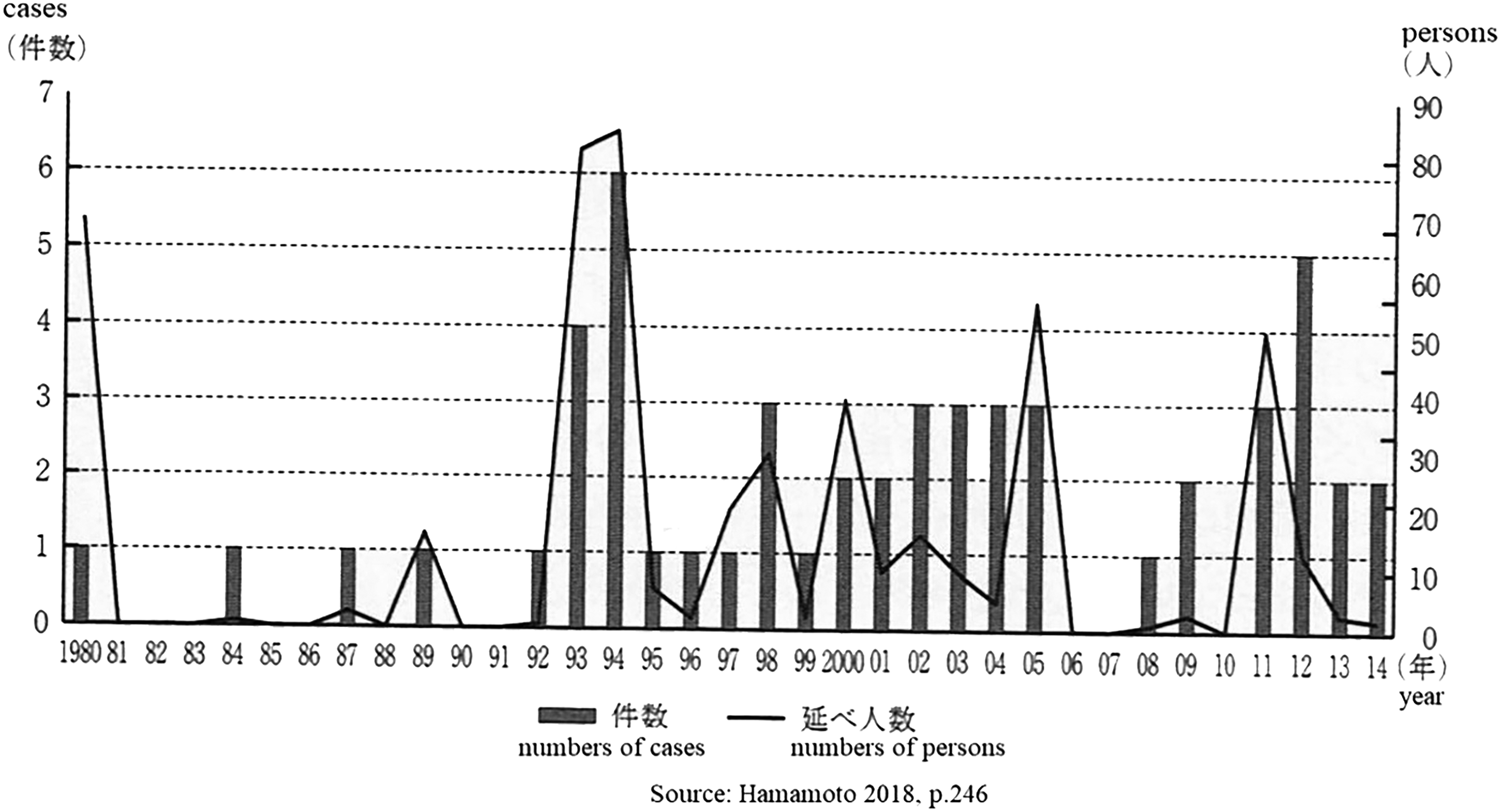
The numbers of LDP rebels in the House of Representatives (1984–2014).
As mentioned above, the LDP had a fragmented structure during this era. This structure necessitated a consensual and bottom-up policymaking system to make policies smoothly when the prime minister had no effective instrument to control the party. LDP politicians in this era did not rebel because they were unable to do so; they just did not need to rebel.
Internal cohesion: Post-reform era
The electoral reform affected the internal cohesion of the LDP as well as party centralisation. The reform provided the prime minister with a powerful instrument to control the party, namely the power of endorsement, that is, the power to endorse official candidates of the party at national elections. Though the prime minister as a party leader had this power before the electoral reform, the reform made the power far more effective. The effect of this power is also typified by the case of the Koizumi administration that will be presented below.
Another instrument that can be utilised by the prime minister to control the party is the power of appointment, which is the power to allocate the government and party posts to politicians.
Prime Minster Abe was most skilful at using this power (Burrett, 2016: 48). His leadership was fragile in his first period in office (2006–2007), but by learning to use the power of appointment he became a much stronger leader in his second period in office (2012–2020). His position was stabilised to the extent that he was able to stay in power for more than seven years. The latter section of this article analyses his skill in making political appointments along with other reasons for his longevity.
Thus, relying on the powers of endorsement and appointment, Koizumi and Abe were successful in restraining rebellion. How successful other prime ministers can be in following suit depends on the degree to which they have leadership capital, as well as the ability to use these powers and popularity among voters.
Party centralisation and internal cohesion of the Democratic Party of Japan (DPJ)
The DPJ itself is the product of the electoral reform. As Duverger (1954) argues, the SMD system tends to cause a two-party system. The electoral reform in Japan brought about a party realignment, and promoted the birth of a new opposition party, the DPJ (Schoppa, 2011).
When it took power in 2009, the DPJ attempted to establish a centralised decision-making system by creating the National Policy Unit. However, the party was ideologically too diverse, including politicians from various parties from centre to left. It lacked sufficient cohesion to realise centralised decision-making and the DPJ split up over the consumption tax issue and lost power in 2012.
Leadership security: Pre-reform era
In the pre-reform era, LDP leaders (specifically, party presidents) were generally elected according to the factional logic. To win the party presidential election, every politician who wanted to be a party president and prime minister tried to make a coalition of factions including their own. The candidate who was successful in making a winning coalition was usually elected party president. Thus, the position of the party president was based on a coalition of factions. As competition between the factions was fierce, the position of the party president tended to be unstable. This is one of the major reasons why the tenure of the party president was generally short. With the exception of Nakasone Yasuhiro (1982–1987), the length of tenure of the Japanese prime ministers during and after the 1970s was about two years on average.
Another reason for short tenure is that the length of the term of the party president is fixed and re-election is limited. The length of the term was two or three years, and re-election was limited to two consecutive terms until recently. 4 This means the prime minister must face a party presidential election periodically even if there was no viable challenger. These two factors – factional competition and fixed term – made the position of the prime minister as a party leader extremely vulnerable.
Leadership security: Post-reform era
As mentioned above, the position of the party president became more stable as a result of the electoral reform. In fact, two of the prime ministers in the 21st century served for very long periods. Koizumi served five years and five months, and Abe (second administration) served seven years and eight months. In the meantime, the other LDP prime ministers in this era had very short tenures. Abe (first administration, 2006–2007), Fukuda Yasuo (2007–2008) and Asō Tarō (2008–2009) all served just one year. The average tenure of the DPJ prime ministers was also about a year: Hatoyama Yukio (2009–2010), Kan Naoto (2010–2011) and Noda Yoshihiko (2011–2012).
This phenomenon relates to the personalisation of politics. Since the electoral reform, the image of the leader as ‘the face of the party’ has become crucially important. If the party has a very popular leader, the chances for the party’s candidates to win will increase. While party members need a popular leader for their re-election, they often try to oust an unpopular leader. If the leader lacks popularity among voters, it is more likely that viable challengers will appear and one of them will win. Thus, unpopular prime ministers tend to have short tenures (Nyblade, 2011). As Burrett (2016) shows, party presidents with high scores of leadership capital index, especially reputational scores, tend to have a longer tenure. 5
As long as the prime minister is popular, her/his position is stable. Koizumi and Abe were able to serve for long periods because they kept high popularity ratings throughout their tenure. They basically continued to enjoy approval ratings of more than 40 per cent throughout their tenure. However, once the prime minister loses popularity, the situation becomes fluid, and her/his position is very likely to be challenged. For the other prime ministers with short tenures, their approval ratings rapidly dropped to under 30 per cent within a year after they assumed power (Burrett, 2016: 43).
In sum, while popular prime ministers have a good chance of serving for long periods, unpopular prime ministers tend to have a short tenure, owing to the personalisation of politics.
Case studies
In the following sections, three case studies are presented. First, the case of Koizumi shows how he strengthened leadership through controlling the party with the leverage given to him by the electoral reform. Secondly, the case of the second Abe government shows how he succeeded in securing leadership with his skills including effective usage of the power of appointment. Thirdly, the case of the TPP (Trans-Pacific Partnership) Agreement that was struck under the Abe Government shows what a skilful prime minister can do now that would have been difficult in the past.
Strong prime minister Koizumi
How the LDP has become centralised is best shown by the case of the Koizumi administration. As soon as Koizumi Junichirō became prime minister in April 2001, he undertook various reforms along neoliberal lines, calling them ‘Koizumi’s Structural Reforms’ (Uchiyama, 2009a, 2010). Privatisation of the postal services was the most notable case among them because it caused fierce conflict between Koizumi and postal zoku politicians, and because the former won, contrary to the then conventional wisdom that the prime minister was usually weak.
Privatisation of the postal services was once on the agenda for administrative reform under the Hashimoto administration. Prime Minister Hashimoto Ryūtarō was said to be in favour of privatisation, and the interim report of the Administrative Reform Council (ARC) of August 1997 proposed the privatisation of postal life insurance and preparation for the privatisation of postal savings. It was met with vehement opposition from the Ministry of Post and Telecommunication (now the Ministry of Internal Affairs and Communications), postal zoku politicians in the LDP, the postmasters’ association, the postal workers’ union and the Social Democratic Party (one of the governing parties back then). The Headquarters for Administrative Reform of the LDP and the Conference for Administrative Reform of the Governing Parties confirmed that the government should continue to oversee postal services in November, and thus, references to privatisation were withdrawn from the final report of the ARC issued in December 1997. Finally, it was decided that the Postal Services Agency should be established in 2001, and that it should be reorganised into a state-managed corporation, Japan Post, in 2003. It was also confirmed that its employees should be given the status of civil servants.
Koizumi, who had been eager to privatise postal services, tried to overturn this course. After he was re-elected as LDP president in September 2003, he began to pour his energies into postal services privatisation. The main arena where this was discussed was the Council on Economic and Fiscal Policy (CEFP), so the planning process was insulated from the influence of postal bureaucracy and zoku politicians to some degree. In September 2004, the Basic Policy for Postal Services Privatisation was approved by the CEFP and subsequently by the cabinet. It stated that:
the postal services should be privatised in 2007; four companies should be established to be in charge of post office counters, mail, savings and insurance respectively, and they should be put under a share-holding company; employees should not be given the status of civil servants; all the stocks of savings and insurance companies should be sold in 10 years; and stocks of the share-holding company should be sold, but more than a third of its stocks should be owned by the government.
The postal service privatisation bills were drafted based on this policy, and submitted to the Diet in April 2005. However, there were strong opponents in the LDP, and the bills were amended in June. The amendments included, for example, an item that enabled the share-holding company to continue to hold the stocks of savings and insurance companies. When these amendments were approved by the Executive Council of the LDP, which had operated under a unanimity rule without vote, a majority rule and vote was introduced for the first time. Five members clearly opposed it.
The bills were put to the vote in the House of Representatives in July. They passed by a narrow margin as 37 members of the LDP voted against them, and 14 were absent. In August, the House of Councillors, or Upper House, voted down the bills as 22 members of the LDP rebelled. Koizumi dissolved the House of Representative immediately, and a general election was held the next month. What deserves attention in this election is the fact that the LDP did not endorse those who voted against the postal bills and ran other candidates, or ‘assassins’, in their districts. Thirty-three ex-LDP candidates (mainly postal services zoku) who had rebelled ran as independents in the single-member districts or formed new parties.
The result was an overwhelming victory for the LDP, which secured 296 seats of 480. Faced with these results, those members of the House of Councillors who had rebelled changed their minds, and the bills were passed by the Diet in October, with LDP members unanimously consenting. Thus, the postal services were privatised in October 2007. Koizumi’s case shows how strong Japanese prime ministers can be in the new institutional environment.
As for the power of endorsement, the effect of the power is also typified by the developments after the so-called ‘postal election’ in 2005 mentioned above. Figure 1 shows that rebels against the prime minister suddenly disappeared just after the election (Hamamoto, 2018: 246).
This situation can be analysed from the perspective of the Bayesian probability theory. Whether a politician rebels or not depends on the relative benefit (benefit minus cost) s/he expects from her/his rebellious behaviour. If s/he expects that her/his rebellion will bring about greater cost than benefit, s/he will give up the idea of rebelling. The expected value of the cost is calculated by multiplying the cost that sanctions force her/him to pay (for example, the possibility of re-election will fall greatly without endorsement) by the subjective probability that such sanctions will actually be taken. 6
At first, such subjective probability for each politician was very low, and hence s/he rebelled easily. Since Koizumi was undertaking structural reforms that many zoku politicians did not support, the numbers of rebels were relatively high before 2006 during the Koizumi administration. As Heppell argues in this special issue, this can also be attributed to the increased level of party centralisation and top-down policymaking. However, faced with Koizumi’s ‘assassins’ strategy in the 2005 election, s/he revised her/his subjective probability upwards. This highly raised the expected value of her/his cost of rebellion, and rebellious activity against Koizumi vanished.
After the election, Koizumi introduced several policies that would previously have been impossible to implement due to heavy opposition from zoku politicians and bureaucrats. To name some cases, he successfully cut medical treatment fees by 3.16 per cent in the FY 2006 budget; a substantial reduction that could not have been done before. 7
Explaining Abe’s longevity
The longevity of Abe’s second government – seven years and eight months – is remarkable. He is the longest serving prime minister in Japan’s political history. This section explains why he was able to govern for so long.
First, as mentioned above, Abe’s skill in making political appointments greatly strengthened his influence over the government and the LDP, enabled him to introduce policies as he wished and stabilised his position (Burrett, 2016). This is best exemplified by the case of a reduced tax rate within the consumption tax. When the consumption tax rate was to be raised from 8 per cent to 10 per cent, the LDP’s coalition partner, Kōmeitō, insisted on introducing a reduced tax rate for food. However, the then head of the LDP’s Tax Research Commission, Noda Takeshi, did not support it. Abe was keen to support Kōmeitō’s position so he dismissed Noda from the post and appointed another politician who was obedient to Abe. Resistance against the reduced tax rate ceased, and it was introduced smoothly.
Abe also exerted strong influence over the civil service and other public bodies through the power of appointment. In March 2013, just after he took power, he appointed Kuroda Haruhiko as Governor of the Bank of Japan and tasked him with introducing massive quantitative easing, which was a pillar of Abe’s economic policy, known popularly as Abenomics. Kuroda’s predecessor, Shirakawa Masaaki, was replaced because he was critical of massive quantitative easing. Since Kuroda’s appointment, he has launched various measures for massive easing known as ‘Kuroda’s bazooka’.
In August of the same year, Abe appointed Komatsu Ichirō as Head of the Cabinet Legislation Bureau (CLB). Although the heads of the CLB were conventionally selected from senior officials of the bureau, Abe chose Komatsu – a former diplomat. The reason Abe broke the convention was that he was so keen to introduce the ‘security legislation’ which would enable the Self-Defence Forces to exercise the right of collective self-defence. The CLB’s formal interpretation of the Constitution was that the exercise of the right of collective defence was banned by the Constitution, so Abe needed to choose its new head from outside of the bureau to reverse this interpretation.
In addition, Abe set up the Cabinet Bureau of Personnel Affairs in 2014, which manages appointments of senior civil servants. This greatly increased Abe’s influence over the bureaucracy (Shinoda in this special issue; Makihara, 2016; Takenaka, 2021).
Secondly, Abe was adept at utilising leadership capital such as popularity and his majority in the Diet. 8 While Abe kept enjoying relatively high approval ratings on average, these ratings fluctuated. When he pushed his expansionary economic policies, known as Abenomics, the ratings tended to become higher. In contrast, they tended to drop when he attempted the introduction of controversial policies such as the security legislation. Knowing this, Abe emphasised Abenomics for a period after he took power. This raised his approval ratings as high as nearly 70 per cent. Using his popularity as leverage, Abe was very successful in top-down policymaking. Although Abe’s pet policies were ideologically driven, exemplified by constitutional amendment, he pushed expansionary economic policy at first. He also put Abenomics forward when he faced national elections, all of which he won. It provided him with further leadership capital in the form of the LDP’s majorities.
Meanwhile, controversial policies like the State Secrecy Law of 2013 and the security legislation in 2015, which lowered approval ratings, were introduced between national elections. This means that Abe consumed the leadership capital he had accumulated through Abenomics on promoting his favourite ideologically right-wing policies.
In other words, Abe repeated cycles of accumulating and consuming leadership capital. 9 Whereas he accumulated leadership capital in the form of approval ratings by emphasising Abenomics before elections, he consumed it on introducing controversial policies after elections. This skilful use of leadership capital is one of the keys to Abe’s longevity.
Thirdly, the eclectic nature of Abe’s policies helped him to gather a wide range of voters on the ideological spectrum. Although the core supporters of Abe were mainly right-wing voters, Abe also introduced centrist or centre-left policies, such as the empowerment of women and the reform of working practices. So, he retained traditional LDP supporters by emphasising conservative or right-wing agendas, such as constitutional amendment, while at the same time expanding his support base by bringing in centrist and centre-left policies supported by workers and women. It can be said that Abe succeeded in ‘broadening his wing to the left’. In addition, Abe adopted not only neoliberal policies such as deregulation and agricultural reform, but also traditional conservative policies such as increasing budgets for public works.
Thanks to this eclectic nature of the Abe government, various voters were able to see in Abe what they wanted to see. Conservative or right-wing voters strongly supported Abe because of his ideological policies. Progressive voters who preferred structural reform appreciated Abe’s reformist stance. Traditional conservative voters also had confidence in Abe. Ordinary voters who did not have any interest in ideological policies benefitted from Abenomics. Thus, his eclectic nature worked as the glue to bring together various voters around him.
Fourthly, the opposition camp was fragmented. The DPJ, which had been in power from 2009 to 2012, was divided into the Party of Hope (whose current successor is the Democratic Party for the People) and the Constitutional Democratic Party just before the election for the House of Representatives in 2017. There were (and still are) several opposition parties such as the Japan Innovation Party, the Communist Party, Reiwa Shinsengumi and the Social Democratic Party. Because of this fragmentation, the opposition parties were unable to present themselves as a viable alternative to the governing LDP-Kōmeitō coalition. That is why the governing coalition won all the elections contested by the Abe government.
The Trans-Pacific Partnership agreement
Abe’s strength as a prime minister is best shown by the case of the Trans-Pacific Partnership (TPP) Agreement. The original TPP was a trade agreement signed in 2016 between 12 countries: Australia, Brunei, Canada, Chile, Japan, Malaysia, Mexico, New Zealand, Peru, Singapore, Vietnam and the US.
Agricultural liberalisation in Japan has been one of the most important issues in recent multilateral trade negotiations. In previous negotiations, Japan was reluctant to open its agricultural markets because of the influence of the agricultural lobby – agricultural zoku politicians and interest groups (Nōkyō, agricultural cooperatives) – in the agricultural policy process (Uchiyama, 2009b). However, in the process of TPP negotiations, the Japanese government was willing to open its agricultural markets to foreign rice, beef, pork and dairy products. 10 This change in the Japanese government’s attitude to agricultural liberalisation shows that Abe’s leadership was strong enough to overcome the resistance of the agricultural lobby (Davis et al., 2019; Miura, 2020).
The TPP negotiations were formally started in March 2010 by Australia, Brunei, Chile, New Zealand, Peru, Singapore, Vietnam and the US. Following Malaysia, Mexico and Canada, Japan expressed its intention to join the negotiation in March 2013 under the Abe government. The negotiations reached agreement in principle at a ministerial meeting held in October 2015, and the agreement was signed in February 2016 by the above-mentioned 12 countries.
However, soon after US President Donald Trump took office, he signed an executive order to withdraw from the agreement in January 2017. As the original agreement would not come into effect because of the US withdrawal, the remaining countries started negotiations again for a new agreement. They reached agreement in principle in November 2017, and the new agreement, the Comprehensive and Progressive Agreement for Trans-Pacific Partnership (CPTPP), was signed in March 2018. It took effect in December of that year.
What is notable in the negotiation process of the TPP/CPTPP is the fact that Abe was very successful in containing the influence of the agricultural lobby (Asia Pacific Initiative, 2022). One of the key factors for Abe’s success was the creation of TPP Headquarters within the Cabinet Secretariat. The main locus of agricultural policymaking had been the Ministry of Agriculture, Forestry and Fisheries (MAFF), where the agricultural lobby had a greater voice. In contrast, most of the decisions on the TPP were made at the TPP Headquarters, which enabled Abe to prevent the agricultural lobby from exerting influence on the policymaking process. For example, although negotiations on rice imports at an earlier stage were under the remit of MAFF’s Vice-Minister for International Affairs, this jurisdiction was later moved to the Deputy Chief Negotiator in the TPP Headquarters. It is said that sometimes MAFF was not allowed to join meetings when important decisions were made (Miura, 2020: 230).
In addition, the newly created Cabinet Bureau of Personnel Affairs provided Abe with leverage to make the agricultural bureaucracy obedient. The power of endorsement and appointment given to the prime minister as the LDP president was an effective instrument in influencing the agricultural zoku LDP members. Abe was also skilful in appointing important positions in the LDP decision-making organs. He appointed Nishikawa Kōya, a member of the cadre of the agricultural zoku, as chair of the TPP committee of the LDP. This strategy was called ‘controlling zoku by zoku’ (Nishikawa, 2017: 28).
It is also worth noting that Japan took a leading role in the negotiations for the CPTPP. Japan’s traditional stance in foreign policy had been generally passive, usually following the US lead, and characterised by Kent Calder (1988) as a ‘reactive state’. However, the case of the CPTPP demonstrates the opposite. Without Japan’s initiative, the CPTPP would never have been concluded. Thus, Japan can now be regarded as a ‘proactive state’. The same kind of proactiveness can be seen in Abe’s advocacy of his Free and Open Indo-Pacific vision, which US President Joe Biden is now supporting. This international proactiveness reflects the augmented prime ministerial leadership under the Abe government.
Conclusion
This article has analysed the leadership of Japanese prime ministers in the context of their parties, focusing on three dimensions: party centralisation, internal cohesion and leadership security. On party centralisation, it is important to note the single-member district system, which was introduced into the House of Representatives by the electoral reform of 1994. As the reform ended intra-party competition within the LDP that had existed under the multi-member system, the party has become much more centralised.
On internal cohesion, the electoral reform has provided prime ministers with a powerful instrument to control the party: the power of endorsement. Effectively using this power along with the power of appointment, prime ministers like Koizumi and Abe were successful in restraining rebellion. On leadership security, though the position of the prime minister as a party leader should have been reinforced by the electoral reform, a considerable number of the prime ministers in the 21st century have had short tenures of about a year. The personalisation of politics has made the position of unpopular prime ministers highly vulnerable. Nevertheless, Abe stayed in power for a remarkably long period of time. This can be attributed to four factors: his skill in making political appointments, his skilful use of leadership capital, the eclectic nature of his government and fragmentation of the opposition camp. Abe’s strength as a party leader is best shown by the case of the TPP.
In the following article in this special issue, Heppell explores UK prime ministers in the context of party leadership. In the process, he highlights several noteworthy similarities and differences with the Japanese case explored above. These range across the dimensions of increased party centralisation resulting in increased levels of intra-party rebellion, and greater procedural obstacles to challenging incumbent party leaders and prime ministers.
Footnotes
Declaration of conflicting interests
The author(s) declared no potential conflicts of interest with respect to the research, authorship, and/or publication of this article.
Funding
The author(s) disclosed receipt of the following financial support for the research, authorship, and/or publication of this article: This work was supported by the Economic and Social Research Council (grant number ES/S014187/1).
