



Abstract
Alongside the focus on prime ministers within an institutional setting, it is important to recognise the significance of individual skills, styles and personality. Differing individuals will have differing performative skill levels and different leadership styles. The premise that leadership analysis should focus on the interaction between the political skills of the leader and the institutional environment in which they are operating is one that has gained some traction in contemporary political leadership scholarship. This article concentrates on the impact of the individual on the office, considering first the agent-centred approaches to prime ministerial study and applying the interactive model of leadership capital to the contemporary UK premiership, drawing some comparisons with Japan. Focusing on the three components of leadership capital – skills, relations and reputation of the individual in office – can give us a broader picture of the trajectory of prime ministerial leadership. Individual action, perceptions of the incumbent, decision making and style can all impact on the prime minister in office in the 21st century.
He doesn’t have a plan, he doesn’t know how to be prime minister, and we only got him in there because we had to solve a certain problem, not because he was the right person to be running the country.
Dominic Cummings on Boris Johnson, July 2021 (BBC, 2021)
To his most vehement critics, he is worse than a clown: a charlatan who lied his way to the top, who endangers democracy and traffics in racism, and who believes in nothing but his own advancement.
Tom McTague, The Atlantic, June 2021
Introduction
Prime ministers are often presumed to be powerful. How they use that potential power and authority will depend on many things: the resources available, the operating context and the personal skills, attributes and individual style of each incumbent. Although the structural resources, operating context and personal style all interact with each other in office, this article is primarily concerned with the impact of individual agency on our understanding of the contemporary prime minister. In contrast to the Japanese prime minister, who has traditionally been viewed as a consensus builder and a weak leader constrained by institutional pressures, the UK prime minister has been able to impose a personal imprint on the role (Envall, 2008, 2011; George Mulgan, 2000; Uchiyama, 2010). This narrative shifted somewhat as scholarly and popular attention focused upon the differences between Abe 1.0 and Abe 2.0, particularly in terms of the ‘strengthened executive position of the prime minister and Japan’s more proactive role in the world’ (Dobson and Rose, 2019: 127; see also Burrett, 2017; Shinoda, 2000). While Abe was providing a more stable Japanese premiership between 2012 and 2020, the UK was experiencing a less stable period of prime ministerial leadership with three prime ministers, one coalition and a minority government in these eight years.
In considering the role of agency, this article first seeks to explore how a prime minister’s individual skills, style and personality impact upon leadership, and how the personal attributes of UK prime ministers in the 21st century can be measured and evaluated. To do this, I apply a leadership capital analysis to consider three core political leadership components and apply them to contemporary UK prime ministers (Bennister et al. 2015, 2017). Vignettes and authoritative sources relating to contemporary prime ministers from Tony Blair to Boris Johnson are used with some reference to Japanese prime ministers. Utilising this approach can help us to identify any commonalities or divergence in leadership strengths or weaknesses, longevity and impact in office between Japan and the UK.
Agency, context and dependency
Is there indeed a ‘right’ person to run the country or an ideal set of skills necessary to fulfil the role of prime minister? Robert Blake’s checklist of prime ministerial qualities included: courage, tenacity, determination, firm nerves, clarity of mind, a thick skin (or at least the lack of great sensitivity), not being worried too much by ‘scruples and doubts’, tact, the ‘power to manage men’, and the ‘absence of an original mind’. (Theakston, 2007: 40)
Peter Hennessy (1995: 92) described the ideal prime minister as: a kind of grotesque composite freak – someone with the dedication to duty of a Peel, the physical energy of a Gladstone, the detachment of a Salisbury, the brains of an Asquith, the balls of a Lloyd George, the word-power of a Churchill, the administrative gifts of an Attlee, the style of a Macmillan, the managerialism of a Heath, and the sleep requirements of a Thatcher.
Each prime minister brings their own personal attributes to the position. Such approaches are largely based on an ‘ideal type’ analysis. On personal skills, it is a gathering of characteristics to fit a constructed view of a position that has no job description. Therefore, the yardstick becomes the previous incumbents and the skills they deployed in office. Despite such historical semi-fixation with the occupants over the past 300 years, exploration of prime ministerial qualities – and the impact on the office – is much less well developed than in the field of presidential studies in the United States. Similarly, in Japan, historical context has defined prime ministerial occupants as weak, reactive leaders, constrained by a political system which privileged a strong bureaucracy and (for most of the post-war period) Liberal Democratic Party structures (Maruoka and Rose, 2022; Mishima, 2019).
Personal skills cannot be taken in isolation, as when evaluating contemporary prime ministerial skills, context and circumstance always intervene. Indeed, the route to the highest office does not ensure that the potentially best qualified (by whatever measure) makes it to the top. Equally, those who occupy party leadership positions and present themselves as potential prime ministers may not be the best suited, but rather the result of party faction battles in Japan or compromise candidates in the UK.
Once in office, comparison of the occupants across time has provided an interesting means to evaluate individual performance. Norton advanced four types of prime ministers: innovators, reformers, egoists and balancers (Norton, 1988, in Bennister, 2012). Similarly, Kavanagh (1990) distinguished between two types: prime ministers who were mobilisers, task-orientated leaders and decision-makers, as opposed to expressive prime ministers, who sought cohesion amongst diverse groups. Rankings based on expert surveys have gained some traction (Theakston and Gill, 2021) and such exercises can also provide some interesting comparative material (see Weller, 2018). In Japan, the ability to influence policy has been substantially constrained – largely due to a context that viewed ‘strong leadership [as] the antithesis of Japanese cultural preferences for consensus and conformity’ (Burrett, 2016: 50). This has placed the Japanese prime minister as one of the weakest leaders in advanced democracies (Maruoka and Rose, 2022; O’Malley, 2007; Strangio et al., 2013). As Japan has seen some strengthening of the office under Koizumi Junichirō and Abe Shinzō, with agency factors coming to the fore and some hint of a more stable leader-centred approach, the UK premiership has seen a period of turbulence. Since Blair left office in 2007, four prime ministers have occupied Number 10 in a 14-year period which included a coalition and minority government. Though not at the levels of the Japanese revolving-door premiership, the UK premiership has certainly become a more unstable political office.
We can therefore perhaps move beyond a debate based on ideal type prime ministers and concentrate on the agency in office – the personal imprint, style and attributes that impact on decision making and preferences. The sheer flexibility of the office of prime minister gives the office and the incumbent a strong potential towards being dominant. The British prime minister has ‘surprising freedom to be and do what he or she wants’ (Seldon, 2021: 146). As former Cabinet Secretary Gus O’Donnell observed: They [prime ministers] can take unto themselves informal powers. They can announce that something is in their remit. They can just decide they’re going to do something and they are able to have that power, even if there is no constitutional backing for it (Cited in Seldon, 2021: 146).
Blick and Hennessy (2019), in pointing out the flaws of the UK’s constitution, draw attention to the potential for prime ministerial agency: ‘They [prime ministers] have considerable general latitude for involving themselves in any subject that attracts their interest’. The job itself has not become impossible, rather it is ‘only the way incumbents have chosen to act in office; not because of any inherent unworkability in their office’ (Seldon, 2021: 328). In conversation with Peter Hennessey (2014: 215), David Cameron admitted how his style may impact on operating arrangements in Number 10: I think I was determined to try and make it a little bit more formal and structured than it had been under my two immediate predecessors. Not necessarily because I had some sort of deep view that there was ever a perfect kind of Cabinet government, not that, just that I’m a fairly structured person. I like meetings to start on time, finish on time.
While institutional analysis of the role, power and functions of the prime minister have held a particular sway in scholarly work, there has been a flowering of studies on prime ministerial agency in recent times, often drawing on the influential work of Fred Greenstein and Stephen Skowronek, in efforts to supplant presidential evaluations into the prime ministerial sphere. 1 Debate has centred on the extent to which leaders are truly dominant or are actually constrained by the office (Blick and Jones, 2010). Such discussion often leads to a lack of nuance as authority, skills and achievement are shaped by institutional location, relations and an incumbent’s operating context (Laing and McCaffrie, 2013). In certain situations, a leader can bring ‘unity, direction and control’, particularly when ‘political capital and governing capacity are combined’ (Weller, 2018: 246). Yet they rarely do, and even the supposed dominance of long-serving leaders such as Blair and Thatcher was episodic and temporary (Bennister and Worthy, 2017). Therefore, force of agency, personality and individualised approaches may indeed have their limits in a parliamentary democracy. As there is little agreement on the skills and qualities necessary for the job – and the skills required to actually become prime minister are so very different from those required in office – the agency debate has in many ways been as unsatisfactory as the structural debate.
The conduct of any prime minister is shaped by a bundle of political or personal assets, though they are not always deployable or helpful (Hargrove and Owen, 2003; Helms, 2016). Given this, the abilities and capabilities inoffice are, in some senses, merely ‘narrow strategic options’ and ‘the prime minister should be conceived of as a strategic actor operating within a strategically selective context’ (Byrne and Theakston, 2019: 338). Context further shapes authority. Harold Wilson (1977: 23) wrote of the ‘unrealistic assumption that everything was static’ for any one prime minister. Prime ministerial power is a ‘contingent and moveable feast’ shifting between and within premierships (Heffernan, 2005: 615). One study of prime ministers since the 1970s concluded that most leaders, most of the time, have been reactive and ‘battered by events’ (Theakston, 2012: 234). Premierships frequently ‘zig zag’ as successive leaders define themselves against their predecessor (Blick and Jones, 2010). Gordon Brown was keen to distance himself from Blair, and Boris Johnson has at times acted as if the Conservative party came into office in 2019 not 2010, so keen has he been to reset the dial on his own terms. There is also ‘variety within the lifetime of a single premiership’, due to deliberate action or ‘changed circumstances’ (King, 1991: 43). There can be ‘shifts in style during particular tenures’, with leaders such as Thatcher and Blair empowered or weakened at different points (Blick and Jones, 2010: 123). Though Koizumi is often compared to Blair in terms of his youthful outlook as an effective communicator with high personal poll ratings (see Maruoka and Rose, 2022; Uchiyama, 2010), Abes two tenures as prime minister show how Japanese prime ministers can also shift during tenures or, in Abe’s case, from one tenure to another. Indeed, commentators noted the ‘good fortune’ that Abe inherited in terms of context and circumstance in his second term, and that he left Kantei in a better shape too (see Manuoka and Rose, 2022).
Theresa May’s first two years in office are a striking example of just how much a single premiership can change, as her position went from dominance to defence in the space of 10 months. During May’s dramatic time in office, she appeared to have the capacity and resources for action, but this ebbed away (Worthy and Bennister, 2021). Decisions such as May’s calling of an early election in June 2017 – or Gordon Brown’s hesitation over whether to call an early general election in October 2007 – caused irreparable damage to public image and depleted political authority as a strong, competent prime minister (Atkins, 2015; Atkins and Gaffney, 2020: 295). Manuoka and Rose (2022) demonstrates the impact of Shinzo Abe’s unilateral decision making over Covid-related school closures.
Leadership capital
Seldon (2021: 166) argues that possessing political capital is essential for being an effective prime minister. However, the elusive quality of political capital is not owned solely by the incumbent; it is gifted or loaned by others, and generated or depleted in response to circumstance.
To capture a broader scope of prime ministerial agency, I utilise leadership capital as a framework of analysis. Leadership capital adds a constructivist approach, drawing on Bourdieu and Renshon (see Bennister et al., 2017) as both sociological and psychological guides. Perceptions matter, though Byrne et al. (2020) acknowledge that decision making may be dependent upon a prime minister’s position in political time, the prime minister can be empowered or diminished by how they are viewed or perceived. Leadership capital applications are rooted in the interactionist approach to political leadership (Elgie, 1995, 2015); it is the impact of the individual on the leadership environment, while the operating context impacts on the leader, which determines capacity for agency. So, relationships and the inevitable ‘court’ politics of prime ministers matter beyond individualised action (see Rhodes, 2013). Furthermore, leadership capital captures the ebb and flow of leaders in office based on three core components: skills, relations and reputation. Leadership capital captures the aggregate of political resources. Whereas Byrne et al. (2020) utilise Skowronek to divide the context of regimes into vulnerable, reconstructive etc., leadership capital considers the fluctuation within regimes.
The Leadership Capital Index (LCI) has been applied broadly across several case studies, including Japan (Bennister et al., 2015, 2017; Helms, 2016; Worthy and Bennister, 2021). For example, Burrett (2016) used the LCI to evaluate the strengths and weaknesses of the nine Japanese prime ministers who held office between 2000 and 2015, considering the reasons for the short tenures of the ‘revolving door’ prime ministers and the rather longer tenure of Koizumi (Manuoka and Rose, (2022). In this article, I use the core components to capture a broad scope. 2 I examine skills, relations and reputations in turn to understand comparative prime ministerial agency in the 21st century.
Skills
The impact of personality and character on the office is a far less developed aspect of prime ministerial study. Here, we are less interested in the ideal type approach, based on matching skills and qualities to a vague or constructed job description, than in what the attributes are that incumbents have shown in post.
Richards (2019) has pointed out that Kenneth Clarke was better qualified to be Conservative party leader compared to William Hague, and Yvette Cooper a better bet to lead the Labour party than Jeremy Corbyn. Jeremy Hunt undoubtedly had a greater array of ‘prime ministerial’ skills than Boris Johnson, but lost out when the Conservative party chose their new leader in 2019. Indeed, the occupants in office differ considerably in terms of experience, questioning how important ministerial learning may be to success as prime minister. Theresa May and Gordon Brown, having coveted the position, both came to the role with substantial experience in a single cabinet role, yet were perceived as not being up to the job. Blair and Cameron had no ministerial experience (see Garnett, 2021) before becoming prime minister, although both had experience as opposition leader before becoming prime minister, unlike Major, Brown, May and Johnson. As Dominic Cummings suggests, if you were to choose a politician to be prime minister, it would not be Johnson (BBC, 2021). Assessments by many politicians, commentators and academics indicate that he fails to meet any of the skills requirements seemingly necessary to be effective in post: ‘To many, Johnson is a clown—the embodiment of the demise of public standards and the face of international populism, post-truth politics, even British decline itself’ (McTague, 2021).
Prime ministers enter office with a set of personal skills, but these are often honed in the political skirmishes required to get to be leader of the party, and in winning a general election. Such skills will of course differ from the leadership skills required – and indeed utilised and occasionally developed – once in office. Those without general election campaign experience have seemingly struggled when in office, as ‘take-over’ prime ministers tend to be short-lived in office (Worthy, 2016, 2018). Similarly, in Japan an ability to navigate LDP factional politics to not only get the party presidency, but remain there, is the key to becoming prime minister, though the regular presidential re-election requirement places much more power in the hands of the party factional leaders in Japan and partly explains the higher turnover levels, even allowing for more recent reforms (see Uchiyama, 2022).
The first act of a new prime minister in the UK, after visiting the monarch, is to speak outside Number 10 Downing Street. This tends to set the vision and theme for the premiership. More likely it creates the prime ministerial narrative by which a political vision may be judged. Tony Blair spoke of a ‘new dawn’, while Gordon Brown, keen to define himself against his predecessor, spoke of ‘a new government with new priorities’. David Cameron wanted to pursue a ‘new politics where the national interest is more important than the party interest’ in coalition in 2010, trumpeting the Big Society. Subsequently, on winning a majority in 2015, his vision did not include any mention of an EU referendum as he wanted to ‘bring our country together’ and to ‘govern as a party of one nation’. Theresa May also had two Number 10 speeches; in an effort to reach beyond Brexit she spoke of ‘fighting against the burning injustice that, if you’re born poor, you will die on average nine years earlier than others’ and supporting the ‘just-managing’. By 2017, her ambition for a minority government was less expansive, aiming that ‘no one and no community is left behind’ and seeking to bring ‘certainty’. Boris Johnson first floated his nebulous aim to ‘level up across Britain’ in July 2019, but his ambition then was to simply fulfil exiting the EU formally, at whatever cost. By December 2019, with a resounding election victory, Johnson claimed to be leading a ‘people’s government’ to ‘unite and level up the country’. In each of these first words as new prime ministers, the vision is based on soundbites that seek unity and togetherness, and construct some kind of shared purpose after either intra-party division or election battles. However, few, if any, of these prime ministers have met the ambitions set out in their opening addresses to the nation. Rather, ‘one nation’ leadership – ‘the strongest myth in British political culture’ (Atkins and Gaffney, 2020: 299) – is constructed as a narrative to present an image of the prime minister as healer. Prime ministers have been swift to pivot away from such rhetoric once in office. For instance, May’s attempts to appear strong on Brexit and call an election to disarm her opponents were ‘antithetical – indeed fatal – to her healer persona’ (Atkins and Gaffney, 2020: 306). The Japanese equivalent would be the speech on appointment, for instance Suga in September 2020 (on taking over from Abe) expressed his vision for society as ‘Self-help, mutual help, public help, and kizuna [bonds]’. 3
Communication is ever more at the heart of prime ministerial leadership. It is even more an ‘obligation’ for prime ministers, demanded by the media in times of crisis (Garnett, 2021: 126). The contemporary prime minister – through global financial crisis (GFC) (Brown), inconclusive election (Cameron), Brexit (May) and Covid (Johnson) – is under pressure to be the national communicator. Also, persuading sometimes sceptical cabinet colleagues, parliamentarians and others of a course of action requires considerable communicative skills. The performative skill is in engaging with a wide range of audiences on multiple platforms. Performing in the role requires not only frontstage oratory in the public eye, but also backstage engagement. Those around the prime minister need to know what direction he or she is heading and to be able to speak to others with prime ministerial authority. But the frontstage is essential in establishing and strengthening a leader’s capital. Thatcher may have lowered her voice to appear less shrill, John Major had his ‘soap box’, Blair an ‘authentic’ mug of tea. Communication is not just (and perhaps even less so these days) about the actual words – images can connect and define, from Thatcher on a tank to Johnson on an excavator. Here we see the celebritisation of the prime minister – some can rise to this, others less so.
It has become increasingly important to present an ‘image’ of what prime ministerial leadership ‘looks like’. This may differ from the academic or historian's view of what a prime minister looks like. On Johnson, ‘People are more patient with him, they are more forgiving of him, because he’s not a typical politician’ (McTague, 2021). McTague stresses how important constructed perceptions are to Johnson: ‘But Johnson very clearly appreciates the importance of shaping perceptions. To him, the point of politics – and life – is not to squabble over facts; it’s to offer people a story they can believe in’. Here this is the very modern, personalised prime minister creating, shaping and riding the narrative to their own advantage – the ‘imperial’ premiership (Rutter, 2020). This is in fact the very opposite of Heifetz on ‘teaching reality’ whereby ‘the essence of exercising leadership is about disappointing people at a rate they can stand, rather than merely office-holding’ (Heifetz, 1994, cited in Bennister et al., 2017: 3). This was exposed most recently in the response to the Covid pandemic when the prime minister’s messaging appeared contradictory, vague and misleading in contrast to ‘other countries, [where] the politicians with reputations intact or enhanced are notable for their plain and honest speaking and frank discussion of the difficulties of policy making, for facing problems squarely, and treating the public as adults’ (Newton, 2020: 509). Though Johnson was not the only one to struggle with the messaging, Abe left office as a ‘lame-duck’ prime minister ‘deficient in the communication and management skills needed’ at the time (Mauoka and Rose, 2022). Manuoka and Rose highlight in particular how his ‘at home with Abe’ tweet image backfired and exposed his lack of empathy during the Covid crisis.
We therefore see an emphasis on skills that are more ephemeral, and less based on competence, in 21st century prime ministers. Boris Johnson is a communicator, but in campaign mode – always seeking to gain an advantage or create division – rather than as a unifying prime minister. Theresa May, though, was neither a convincing campaigner nor a good prime ministerial communicator. In office she struggled to network and do the persuasive, consensus-building work necessary for a leader in such a precarious position: ‘And this sums up one of Theresa May’s problems as a leader: she leads by telling people what she’s decided, rather than involving them in the process of making that decision’ (Usherwood, 2019). Image or perceptions, projected onto prime ministers, partially define them and produce a downward trust spiral which in turn they struggle to emerge from, for example Brown as bad-tempered, Cameron as detached, May as stubborn, Johnson as self-centred.
Relations
Prime ministers cannot govern alone. How do they relate to others in cabinet or key players outside the immediate circle? How about senior officials, both political and bureaucratic? What about the media, party officials (in their own party and outside) and senior parliamentarians? They also seek to build trust. Each can strengthen (or erode) leadership capital.
Reliance on key confidants helps shape the representation. Prime ministers need such confidants in the ‘court’ to provide support, though they may sometimes appear to be heavily under the influence of their aides, in reality prime ministers are in contro (Blick, 2013). If the advisors become too damaging for the prime minister, they get moved on; Damian McBride for Gordon Brown, Andy Coulson for Cameron, Nick Timothy for Theresa May, Dominic Cummings for Boris Johnson. Alastair Campbell was forced to resign as Blair’s key media advisor in Number 10 in 2003. Further back, Bernard Ingham was crucial to Margaret Thatcher’s media profile, as was Craig Oliver to David Cameron. Prime ministers can bring their own people into Number 10, they can even empower them to direct the civil service as Blair did with Jonathan Powell and Alastair Campbell but prime ministers retain the ultimate power to dismiss. Other key relations exist around the prime minister; Cherie Blair was deemed to be influential, and Carrie Johnson also appeared to wield much unofficial influence over Johnson, Marcia Williams was a powerful gatekeeper and confidant toHarold Wilson, Anji Hunter for Blair, and Kate Fall for Cameron (see Weller, 2018). In Japan, Abe had a seemingly unassailable grip on power with a lack of alternative LDP leadership contenders, though working relations with the bureaucracy deteriorated during the pandemic (Maruoka and Rose, 2022).
Such patronage, in terms of who advises the prime minister, is not just based on who is best suited or closest to the prime minister. Political and contextual reasons shape appointments. For instance, Blair’s ongoing feud with Brown would divide advisors and policy units into Blairite or Brownite. Thatcher famously asked ‘Is he one of us?’ before making appointments. Attitudes to Europe dominated Conservative prime ministerial appointments under Major, Cameron and May. Then, under Johnson, many advisors were recruited directly from the Vote Leave campaign.
Relationships with the Cabinet Secretary have a different dynamic, as the prime minister inherits the most senior civil servant to work with. However, the prime minister does have a role in the appointment of new Cabinet Secretaries, involving formal interviews (IfG, n.d.). If it becomes obvious that a Cabinet Secretary is not necessarily compatible with the prime minister, a change or early retirement may follow. In contrast to the United States, this most senior of bureaucrats does not change with a change of government. However, turnover has increased in recent years. Blair had three Cabinet Secretaries. The role was divided into three in 2011, and also became National Security Advisor with Mark Sedwill in 2017. Sedwill only served as Cabinet Secretary for two years (compared to the record 22 of Maurice Hankey from 1916 to 1938). 4 The diminution of the bureaucratic UK Cabinet Secretary stands in contrast to the elevated status and political power of the Chief Cabinet Secretary (CCS) in Japan, which combines the duties of the chief of staff, the director of policy and the official spokesperson at 10 Downing Street (Shinoda, 2022). The position is also a route to the premiership – two former CCSs, Abe Shinzō and Fukuda Yasuo, became prime minister without any other cabinet experience, and CCS Suga Yoshihide succeeded Abe without LDP factional affiliation.
While there may be many other members of the court or network that prime ministers have relations with, cabinet members are perhaps the most problematic. After all, in the UK party system any cabinet member is a potential rival for the top job. Prime ministers therefore need to decide whether to have key rivals in the Cabinet or outside, have them close or excluded. Most significant in this relationship is the Chancellor of the Exchequer. Thatcher had constant difficulties with her Chancellors, and Major’s whole premiership was defined by competing Cabinet forces undermining his authority. Blair and Brown were bitter rivals, though Brown himself was essential to the New Labour project. Cameron and Osborne were much closer, though Osborne was never a threat to Cameron’s leadership. May and Hammond had a similar policy outlook when embattled over Brexit. Johnson lost his Chancellor, Sajid Javid, early in a botched attempt to neuter his influence (vetoing special advisor appointments).
Prime ministerial agency is not just about policy decision making but importantly about who to surround yourself with. The prime minister can of course decide who is in and out of the inner circle. Prime ministers can decide to neutralise challengers, and manage cabinet rivals using the tool of the reshuffle. Blair claimed to hate cabinet reshuffles, Brown struggled to break free from the plots against him from within the Cabinet, Cameron was constrained by the Coalition prior to 2015. May had to contend with an unprecedented revolving door of ministers (see IfG, n.d.), and so was unable to establish a strong team around her. Boris Johnson’s reshuffles have been limited in scope, having expunged the alternative voices in his brief first spell as prime minister before the December 2019 election. His compliant cabinet was chosen for loyalty over competence. Electoral reform in Japan provided prime ministers with a powerful instrument to control the party: the power of endorsement. Effectively using this power along with the power of appointment, prime ministers like Koizumi and Abe were successful in utilising enhanced candidate selection powers to constrain party rebellion (Uchiyama, 2022).
Therefore, agency is not just about policy decisions made, but a whole range of relational aspects – patronage, people management, persuasion, image, trust building and so on.
Reputation
The third component of leadership capital concerns reputation. This is not just prime ministerial legacy, but the extent to which the leader has shaped the policy platform and effectively achieved outcomes, managed parliamentary obstacles, navigated interest groups and so on. What did they achieve? How did they cope with setbacks and crises? Did they enhance or diminish their reputation? And, ultimately, how were they remembered and what legacy did they leave? It also reflects perceived authority. Leaders’ words and deeds are constantly monitored and assessed. Followers, observers and critics alike all try to distil a ‘narrative’ about what a leader ‘is really like’ from the pattern of that leader’s behaviour and its observable impact (Bennister et al., 2015: 423).
Blair, Brown and Cameron have all published memoirs, attempting to shape the representation of their own legacy; these are of course partisan and selective accounts. But there is a wider impact on the public sphere, policy environment, culture and the office that can be assessed. It may be the case that a prime ministerial career ends in failure. Even dominant prime ministers such as Blair and Thatcher were ‘fading giants’, whose popularity and authority were on a downward trajectory (Bennister and Worthy, 2017). Denver and Garnett’s (2012: 71) meta-analysis of opinion-polling data found that ‘it is certainly the case that all prime ministers leave office less popular then when they began’. Tony Blair (2020) himself reflected that ‘It is an irony of political leadership that you often start at your most popular, but least capable and end at your most capable but least popular. Because all leaders learn on the job’. ‘Most have ups and downs … but in the end the trend is inexorably downwards’ (Bennister et al., 2015: 428). Considering the polling data from Ipsos Mori (see Figure 1), we see that this is reflected in the gradual fall in net approval ratings for prime ministers since 1979, though with some notable fluctuations in between. With the exceptions of Koizumi and Abe, the extremely high turnover rate for Japanese prime ministers suggests that fluctuations in popularity can add to the institutional vulnerability of prime ministers, therefore they have less time to develop a leadership capital trajectory in office.
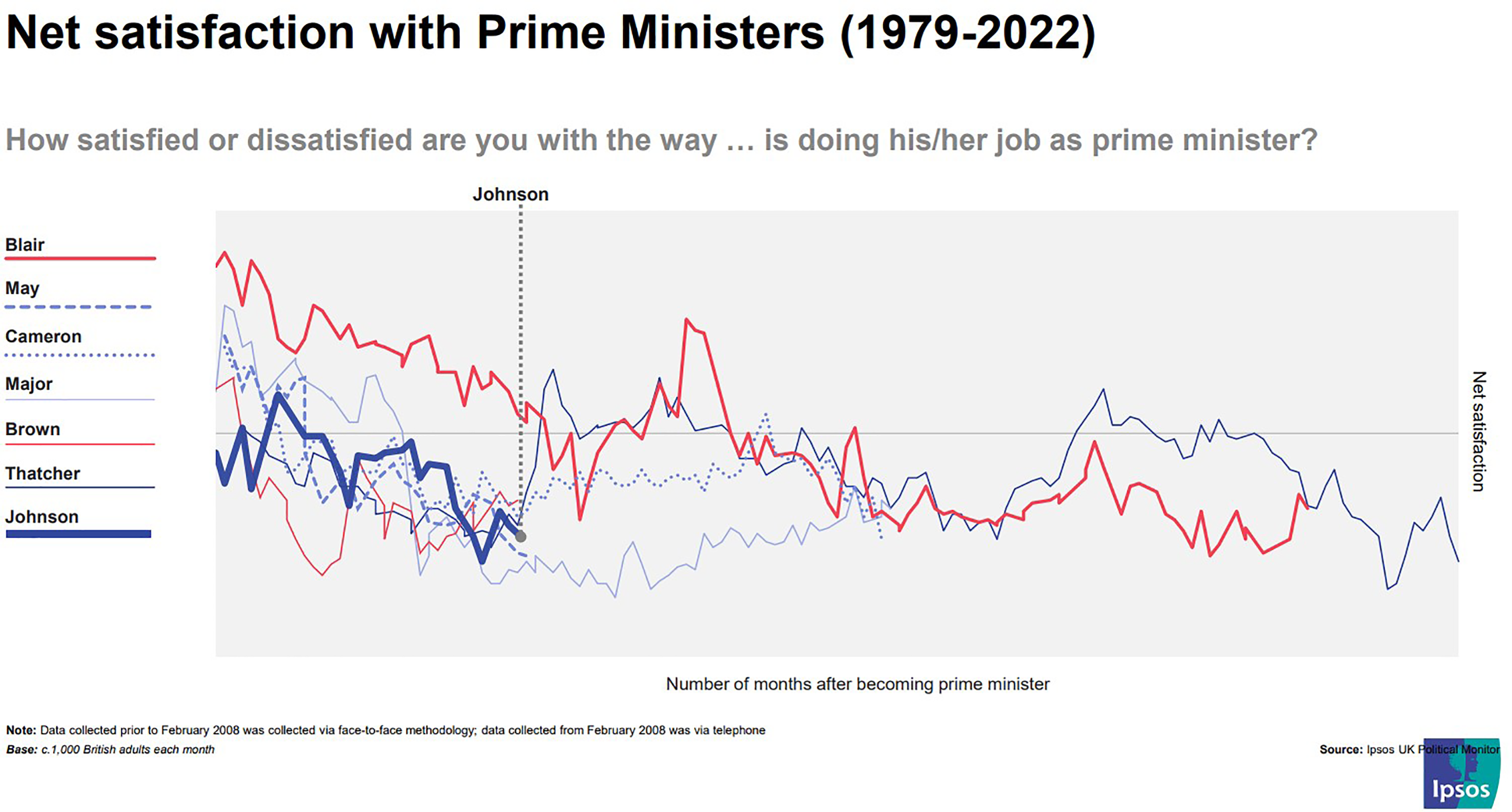
Net satisfaction with Prime Ministers (1979-2022).
Weller (2018: 239) presents a parsimonious approach to measuring prime ministerial success – longevity, control over government, ability to introduce the preferred programme. Of course, prime ministers may be hampered by a range of contextual constraints, as mentioned earlier, beyond their influence that can impact on the government’s ability to achieve outcomes and manage the political agenda.
Prime ministers can enter office with seemingly limited ambitions but build capital over time, achieve things and then get re-elected. Thatcher’s achievements were extensive and her impact as prime minister considerable. On reshaping the public sector, privatisation, council house sales, foreign policy, confronting trade unions and so on, Thatcher drove policy forward over time. However, her premiership had to grow from a weak position, and weak opposition subsequently emboldened her personalised agenda. Major had less room for manoeuvre to make tangible achievements. Blair, like Thatcher, had greater scope, but right from the start of his tenure. Brown floundered in establishing a distinctive policy platform. Cameron and May were both constrained in terms of establishing their own policy agendas. Even some of the policy achievements of the Cameron premiership (such as same-sex marriage legislation) depended on other political actors. For May, beyond Brexit it is hard to identify domestic policy achievements. Even Johnson, empowered by the first decent electoral majority since 2005, was swiftly blown off course by the pandemic response and then ‘partygate’ at the very time when his premiership should have been at its most authoritative. Since Blair left office, only Cameron has been re-elected as prime minister and then he lasted only a year.
Reputations are often defined by key events and policy failures. These may be personal preferences of the incumbents. Having established an untouchable aura, both Thatcher and Blair lost the relational aspect of governing. Convinced that their reputational ability would place them on the right path, they had become autonomous actors with an increasingly fragile basis upon which to exercise their particular brand of dominant leadership (Bennister and Worthy, 2017: 140). Longevity in office afforded the opportunity to establish clear policy programmes, captured as Thatcherism, and Blairism or New Labour, but such personalised leadership positions can implode, for example Thatcher chose to drive through the poll tax, Blair faltered over Iraq. Thereafter, no ‘Brownism’, ‘Cameronism’ or ‘Mayism’ emerged to reflect any personalised agenda. As such, each was defined more by their response to events: the GFC, the coalition and implementing austerity, EU referendum fallout and so on. Although the austerity programme and Brexit were driven by party political imperatives and were to a great extent self-inflicted, there were strongly personalised prime ministerial aspects to both; decisions made by David Cameron as prime minister therefore had a significant impact. Boris Johnson’s response to Covid will certainly define his time in office. While his victory in 2019 seemed to insulate him from the type of personal criticism Abe faced in Japan (not least due to Johnson being hospitalised with Covid), his approval ratings did unravel over time when related to a dysfunctional Downing Street operation which was exposed by rule-breaking parties during periods of lockdown (see Figure 1). Meanwhile Abe’s missteps over the pandemic had a significant impact on his standing.
Rebellions, internal opposition in the party and a resurgent opposition party can erode parliamentary capital for prime ministers. Defeats on flagship issues on the floor of the House of Commons can eat into the authority and indeed reputation of a prime minister. Prime ministerial accountability can, however, be an irritant to a prime minister, even with a decent majority; for instance, Cameron and Johnson were both publicly placed under scrutiny in summer recall debates on Syria and Afghanistan respectively. May could not avoid continual scrutiny over the Brexit negotiations on the floor of the House and her multiple defeats were particularly damaging to her standing. In Japan, rebellions virtually vanished following Koizumi’s ‘assassins’ strategy of partisan endorsements (Uchiyama, 2022).
Prime ministers are also accountable via weekly Questions to the Prime Minister (PMQs) and occasional Liaison Committee appearances, presenting a chance to put pressure on the prime minister – even though PMQs is more of a symbolic arena for accountability (Johnson was noticeably reluctant to appear before the Commons Liaison Committee, avoiding appearances early in his premiership). Acting Liberal Democrat leader Vince Cable’s jibe to Brown in 2007 stuck – ‘the prime minister’s remarkable transformation in the past few weeks – from Stalin to Mr Bean’ – emphasising how far Brown’s stock had fallen in only a few weeks (Hoggart, 2007). PMQs is also the arena for the Leader of the Opposition to show prime ministerial credentials. Cameron was able to establish these against a flagging Brown, while Cameron, May and Johnson all faced a less formidable opponent in Jeremy Corbyn across the despatch box (Bennister and Worthy, 2021). The structurally weak position of the opposition in the Japanese Diet means that prime ministers are challenged inside the party in factional battles, rather than outside (see Inoguchi, 2008; Masuyama and Nyblade, 2004).
Conclusion
This article has utilised the three components of leadership capital as a lens to examine 21st century prime ministers. The approach draws on Bourdieu’s notion of symbolic capital. I argue that this locates prime ministerial study more firmly in the arc of political leadership study. The recent scholarly works marking 300 years of the UK prime minister have added a rich layer of historical analysis and a new depth of understanding of the office. However, each individual brings different attributes to the post, their influence and impact on the office itself vary and the decisions taken may alter from one to the next.
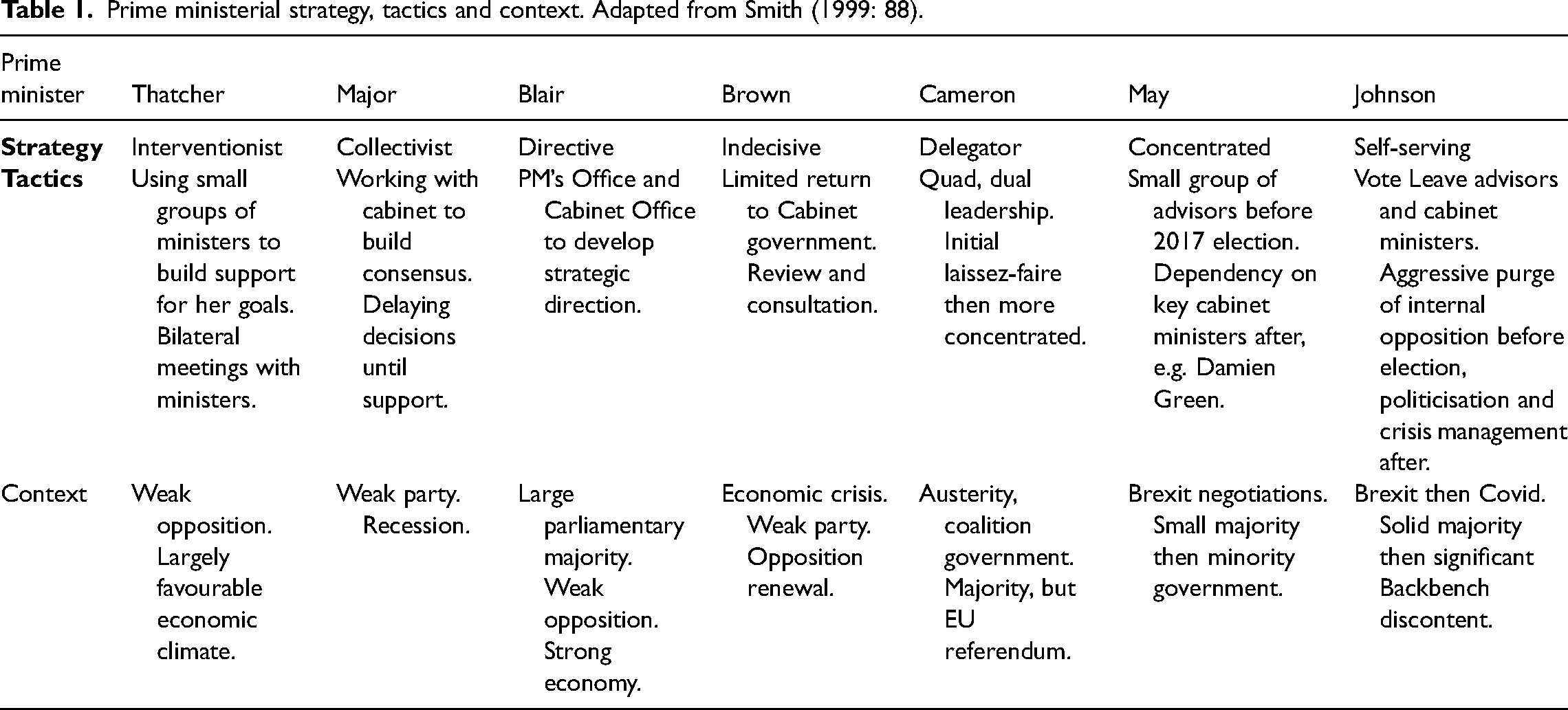
Ever more so, the degree to which prime ministerial behaviour aligns with a prototypical characterisation influences the extent to which it can draw symbolic capital from an audience (Atkins and Gaffney, 2020; Ball et al., 2021). For Theresa May, characterisation was determinantal to building this symbolic capital. For Boris Johnson, the performative aspect was critical to his party leadership in 2019 and continued in office. However, as Ball et al. (2021) note: ‘The traits [for Johnson] that connect the public and the private, however, are an eagerness to please audiences, an unwillingness to confront bad news, an excessive optimism and an eschewing of detail and rigor in working practices’. The difficulty for Johnson, exposed by the Covid crisis, was that as leading actor, when the crisis hit, he was not aligned with his audience. We can summarise prime ministerial strategy, tactics and context for each prime minister since Thatcher (see Table 1). Though a blunt instrument, it highlights the strategic approaches of each to governing.
Prime ministerial strategy, tactics and context. Adapted from Smith (1999: 88).
The dramaturgy of political leadership (Ball et al., 2021) is an apt approach for 21st century prime ministers, acting out multiple personas, seeking validation and audience applause. Skills are therefore tailored towards the presentational and performative – rather than the persuasive, detailed and considered action. Relations favour groupthink, promoting affirming advisors, rather than promoting diverse, challenging views. Reputation is tilted towards narrow political gains, rather than longer-term outcomes.
Prime ministers in office in the 21st century have overseen an obviously turbulent period in UK political history, with four prime ministers occupying Number 10 after Blair between 2007 and 2019 and four general elections taking place. Such a turnover of prime ministers has been accompanied by voter volatility, exit from the EU, a strengthened Scottish Nationalist Party north of the border and the response to the global pandemic. By examining 21st century prime ministers with an emphasis on agency and decision making, we can see that individual action has had an impact on foreign policy and the UK’s place in the world (for example Blair on Iraq, Brown on GFC, Cameron, May and Johnson on the relationship with the EU).
Manuoka and Rose (2022) conclude that ‘Abe’s personal skills lacked the strength needed during the Covid crisis, leading ultimately to a fall in popular support from which he could not recover’, suggesting that personal strengths can have an impact on the office even though it has been traditionally weak in Japan. Overcoming the structural constraints is possible, as the contemporary case studies in Japan demonstrate with Koizumi and Abe. There is indeed evidence that the executive office has strengthened and there are signs of mediatisation and personalised leadership that would be advantageous to a strong personality – it may be there to grasp.
Japanese prime ministers do have to deploy a different set of political skills to get to the top and stay there. Their relations are more formalised and more limited than in the UK, and involve very different key actors – in particular party factions. On reputation, they have different levers to pull, but are more vulnerable and liable to short-term pressures. Stability is still largely located in the bureaucracy, rather than the executive branch.
The UK may be inching towards executive vulnerability similar to the experience of Japan, in that by relying on weaker, short-term electoral bonds, prime ministers become more exposed to electoral volatility and popularity fluctuations. The evidence that Japanese prime ministers may have utilised personalisation to strengthen their positions may be limited following the downfall of Abe. The evidence that the UK has returned to a more stable position based on a personalised leadership may also be a premature assessment.
Footnotes
Declaration of conflicting interests
The author(s) declared no potential conflicts of interest with respect to the research, authorship, and/or publication of this article.
Funding
The author(s) disclosed receipt of the following financial support for the research, authorship, and/or publication of this article: This work was supported by the Economic and Social Research Council and Arts and Humanities Research Council Social Sciences-Humanities UK-Japan Connections Grant [ES/S014187/1].
