




Abstract
Culture change in organizations may affect employees and change agents are often a forgotten resource; their perspective is often overlooked in research. The aim of the study was to illuminate experiences of being a change agent in order to improve residential care of older people. Interviews were performed with 15 change agents who participated in a large culture transformation in residential care for older people. The study followed COREQ guidelines and content analysis was used to interpret the text. The analysis revealed that the change agents felt chosen when they accepted the challenge to become a change agent, but they also felt that transferring the message to co-workers was demanding. Conflicting demands about measuring care and aggravating circumstances to implement change were described. The results indicate that change agents benefit from preparation for the role itself as they have a great responsibility on their shoulders. In making the process more successful, all co-workers should be involved in the change process from the beginning.
Introduction
Populations around the world are rapidly ageing, which means increased demands for long-term care. 1 The most vulnerable older persons with multiple diseases require most formal care and support. 2 It is a great challenge for societies to provide the quality of care needed. It has been shown that through a culture change it is possible to achieve desirable goals and improve quality within nursing home organizations. 3 , 4 To understand the function of an organization, it is important to study the culture of the organization. 5 Organizational culture may be defined as ‘a complex set of values, beliefs, assumptions, and symbols’ that define the way of conducting the activity. 6 A culture of high performance is dynamic and amenable to change and focuses continuously on attaining excellence. 7
Managers have a central role in organizational change and the best chance to succeed with change is when the immediate manager is involved and act as a driving force. 8 Middle managers have, because of their unique position between upper and lower levels in the organization, a crucial role in implementing and sustaining of radical change. 9 Strategic planning together with a strong and explicit leadership is crucial in succeeding to implement culture change. 7 Culture change may be described as a journey with different stages of change. 10 Those who are going to stage-manage the change on a grassroots level are often called ‘change agents’. Change agents are persons who give rise to renewal and improvement by getting others engaged in the change. They help members of a group or organization to interpret their situation and formulate a strategy to address desirable changes. 11 According to Massey and Willams, 12 change agents are often a forgotten resource and their perspective has often been overlooked in research. The competence and capacity of the change agent is crucial to the success of implementation of a change process. Their specific capacities include to develop co-workers’ motivation and to energize them.
Bellot 13 interviewed licensed nurses about their experiences of an implemented cultural change in nursing homes aiming to improve both quality of care and quality of work life. They described lack of information about the change and difficulties understanding it and what it was connected to. They also described the cultural change as something additional to their jobs, not a part of their jobs. Lack of time limited their participation in planning and implementing the changes, which affected their commitment to the change. Smollan 14 reported that healthcare personnel describe that organizational change may result in negative reactions on the physiological, behavioral, affective, and cognitive levels. They describe that the change is characterized by inadequate processes and uncertainty. The change also causes extra workload, deteriorating relationships, and fear of further change. Bamberger et al. 15 found in their review an association between organizational change and increased risk of mental ill-health.
According to Bellot, 13 adequate staffing, teamwork and collaboration were described as key elements in the change process. Nyström et al. 16 examined strategies to facilitate implementation of a large system transformation aiming to improve quality of care for older people. Facilitating strategies were to use regional improvement coaches, regional strategic management teams, national quality registries, financial incentives and annually revised agreements. Complementary strategies were interactive learning sessions, intense communication, monitoring and measurements, and active involvement of various experts and older people. A review by Bird et al. 17 showed that interventions in long-term residential facilities, such as education about person-centered care, are useless if no support in the organization is provided. A study by Shier et al. 4 showed that in order to achieve sustainable improvements in nursing homes, interventions should cover many aspects of residents’ care, permeate all levels of an organization, be theoretically anchored and last for a long time.
Studies about change agents and the facilitator role mostly describe sets of skills and personal qualities. The change agent is not just a passive recipient of a role; they are playing an active part in determining their own role behavior. Therefore, understanding how the roles of change agents are created in healthcare organizations is of significance. 18 The experience of being a facilitator or a change agent and what the process of being a change agent means, is sparsely studied. 19 Studies of culture change in care for older people are rare and studies about experiences of being a change agent in residential care are not found. Since culture change in organizations is a very common part of the public sector nowadays, it is important to deepen the understanding of change agents’ implementing experiences, as they are key persons in the activity. It is of great importance to continually develop and improve care for older people, but care providers’ participation, health and the need for a sustainable work environment shall not be ignored. The aim of the study was to illuminate experiences of being a change agent in order to improve residential care of older people (RCOP).
Method
This study is part of a larger project, the so-called ‘Journey of learning’, in municipal care for older people in a small town in the north of Sweden. The project was focusing on an implementation of a learning and changing process aiming to, through cultural change, contribute to a better life for sick older people, an improved work environment for staff and more efficiently managed activity. Five goal areas were identified: a coherent care, a preventive and rehabilitating way of work, a good dementia care, a good medical treatment and a good end-of-life care. To implement the cultural change in an appropriate manner, quality councils were established in each RCOP setting as a part of the management system for systematic quality work in older people care. 20 The quality council’s task was to analyze, plan, follow up, encourage and show opportunities in the work towards the goals. The quality councils also had a cohesive function for the quality of residential care, focusing on value creation for the residents. In this large implementation project, the members of the quality councils are viewed as change agents. This study follows the Consolidated Criteria for Reporting Qualitative Research (COREQ) checklist. 21
Context/implementation
The cultural change was implemented in all residential care for older people (RCOP) settings in the municipality with a start date of 2016. In RCOP settings, care is provided 24/7 and the residents rent their own apartments. The staffing levels at the two randomly chosen RCOPs were 0.33 per place on weekdays and 0.27 in weekends. At the time of the study, the national average staffing level at residential care facilities for older people on weekdays was 0.29. Three or four care providers were on duty during the day on weekdays, two in the evenings. At night, one care provider was on duty. At weekends, staffing levels were lower.
The quality councils had been established with the role of getting their co-workers motivated for the change, hence the concept ‘change agents’ was used. All members of the quality councils at two randomly chosen RCOP settings (of 21 available residences) were, through an information letter, asked for participation in the present study. The units under study housed a total of 95 residents with dementia diseases and other extensive disabilities. The managers at the units selected 6–7 change agents besides themselves, who were highly engaged and motivated in their work. All change agents had participated in three workshops at the time of the interviews. The workshops were held in a separate place from their workplace, gathering all members of the quality councils from all RCOP settings (n = 21), their managers and other stakeholders. In total, 150–200 change agents participated in the workshops. During the first workshop, which lasted for two days, the goals that were formulated in order to achieve a culture where the residents could ‘Live life as best as possible’ were introduced and discussed. Workshops 2 and 3 (which lasted one day each) were adapted to the change agents’ needs for knowledge. Different subjects were in focus and lectures were given by knowledgeable persons in the area of focus, i.e. what is good palliative care, how to prevent falls and malnutrition, and reflections about how to reach goals. During these days the change agents were given the opportunity to meet, discuss and co-create knowledge, inspire and support each other. They also evaluated the work they had done at their workplace so far. After the workshops, the change agents went to their own workplaces, and continued to work together in their quality councils on how to implement changes and transfer them to their co-workers. In that way, they were supposed to spread rings on the water at their own workplaces, according to their mission.
Participants
After receiving information about the study, all 16 change agents agreed to participate. However, one change agent went on sick leave and therefore 15 change agents participated in the study. The change agents had different occupations and included: seven enrolled nurses (EN), two registered nurses (RN), one physiotherapist (PT), one occupational therapist (OT), two head managers (HM) and two assistant managers (AM). Age ranged from 28–64 years (m = 50 years). The mean level of the participants’ work experience was 22.5 years in healthcare and 11 years at the unit under study. All but one of the participants were women.
Data collection
Individual and semi-structured interviews were performed with each change agent about one year (2017) after the cultural change began to be implemented. The researchers had not met the participants before conducting the interviews. GS performed eight interviews and EEL performed seven. An interview guide in line with the aim of project ‘Journey of learning’ was developed by the authors. The interview guide consisted of four main questions, which focused on the role of change agents and their work. The interviews were audio recorded and performed in a secluded room adjacent to the unit. The interviews lasted between 26 and 79 minutes, with a mean value of 51 minutes.
Data analysis
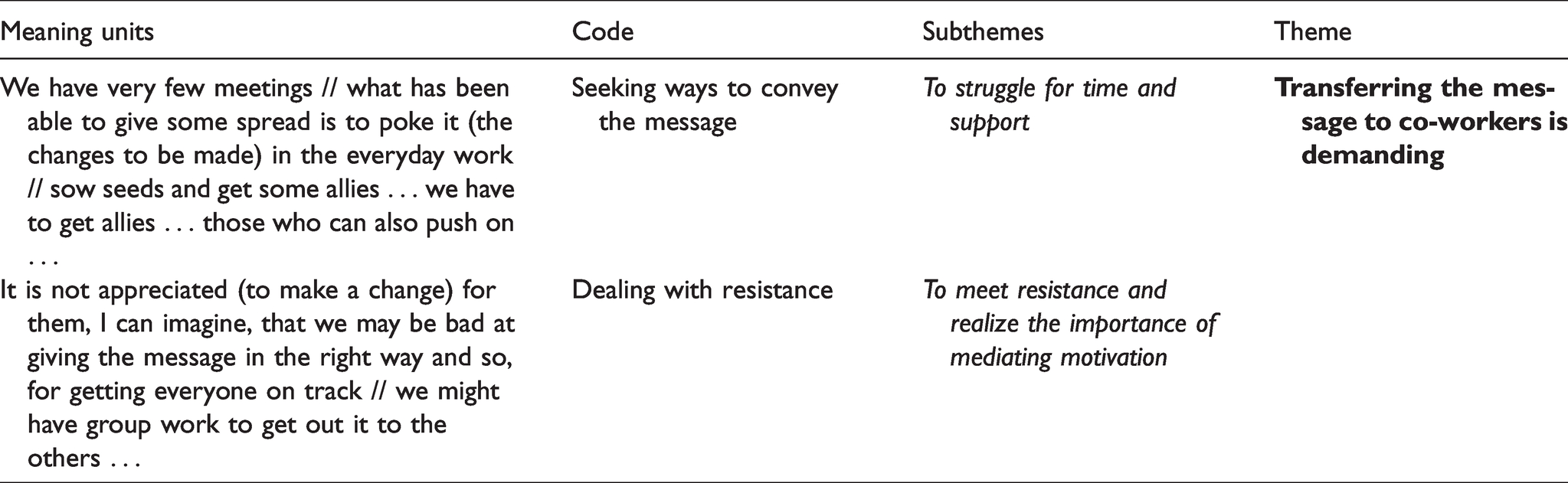
The interviews were transcribed and analyzed using qualitative content analysis. Content analysis involves open coding of data and searching for common themes by grouping data with similar meanings together. 22 Qualitative content analysis focuses on subject and context. The method underscores variation, for example similarities within and differences between parts of the interview text. Content analysis may be used to analyze descriptive, latent and interpretative content. 23 The analysis began with reading and rereading the interview texts to get an overall impression of their meaning. In line with the aim of the study, meaning units were then condensed and coded. The coded text was then sorted into groups with related content. Thereafter the text was abstracted into subthemes, which then were sorted and abstracted into themes.cf.23 Examples of the analysis process are provided in Table 1.
Examples of the analysis process of one of the themes.
Ethics
The study was ethically approved (Dnr 2015/179-31Ö). The Declaration of Helsinki and General Data Protection Regulation was used as an ethical platform. The participants were given verbal and written information about the study and gave their written consent. The printed interviews and the recordings were stored in two different locked cabinets, to which only the authors had access.
Findings
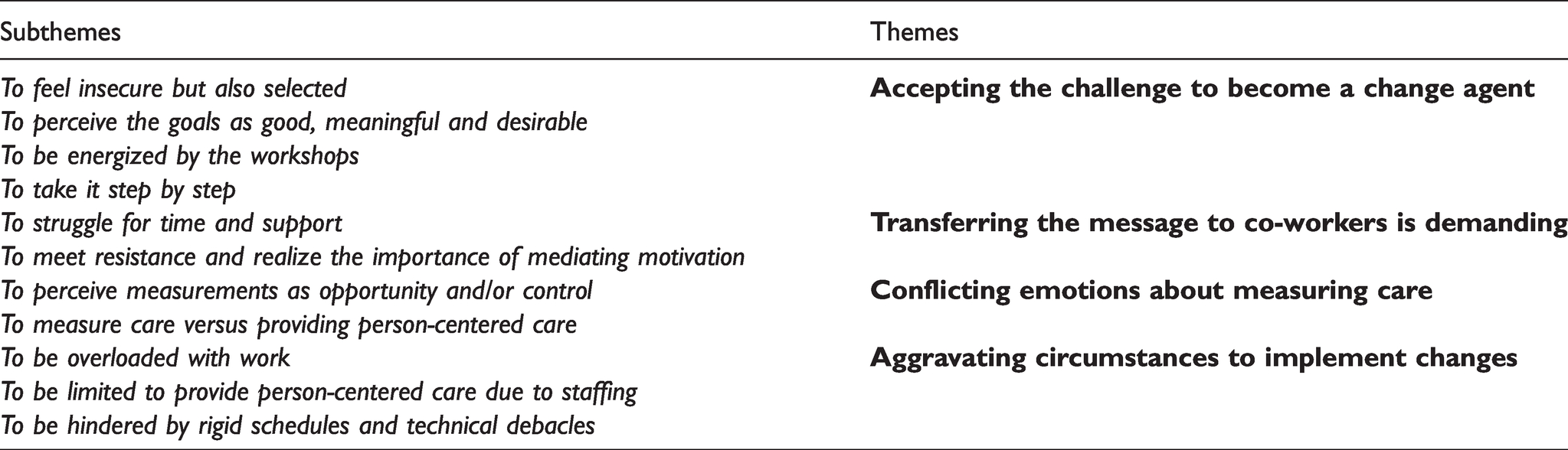
The analysis revealed four themes and 11 subthemes (see Table 2), which were considered to reflect the participants’ experiences. The themes and subthemes are derived from the interviews. The identified subthemes (n = 11) are written in italics for clarity.
Overview of subthemes and themes.
Accepting the challenge to become a change agent
To feel insecure but also selected
None of the change agents knew what the ‘journey of learning’ was when they approved participation, which also included being a member in the quality council at their own RCOP setting. Some felt confused and did not really understand their role. Some expressed that despite doubt and fear of maybe not being able to manage this assignment, they decided to accept. Overall, it was seen as a privilege to participate; they felt chosen. Being involved and able to contribute to make it better for the residents was described as motivating, fun and important. When they asked me about this role (I said) yes, then I really felt like God how nice, because I really like the old ones and like to do things for them so I thought it would be really fun (11).
To perceive the goals as good, meaningful and desirable
The change agents described the journey of learning as a unique venture with the overall goal that the residents should be able to live the best life possible. The goal was described as being clear and the advantage was the person-centered approach that would permeate all the work. They described that now something is happening that can really matter. The journey of learning benefits the resident’s life as well as the co-workers’ job satisfaction. It is like a ‘little fresh breeze coming in and at least trying with something // in a big organization’. (12)
To be energized by the workshops
The change agents described the workshops as very inspiring and energizing. They were inspired by invited lecturers from other parts of the country and films that show good examples of how to successfully develop residential care. They also got inspiration and ideas from each other as they were given the opportunity to meet change agents from other RCOP settings in the municipality.
On the workshops, they also reported the ‘homework’ they had received at the last meeting, e.g. presenting photos on various activities that had been carried out at their workplace or displaying a poster describing what has happened since last time and/or what they will continue to work with. We have made a poster about what we have done, what we should continue working with and in what ways we should do it yes yes. (14)
To take it step by step
The message from the workshops inspired and guided the work of the change agents in the quality councils at their own RCOP settings. The collaboration between the members was described to work well and everyone’s voice was heard. They saw their quality improvement work as a long-term journey, realizing that it was not possible to embrace too much at once. We try to take things in stages and not work on too many things at once. (1)
Transferring the message to co-workers is demanding
To struggle for time and support
The change agents tried to come up with ideas on how to achieve the goals set and how to transfer these goals to co-workers. Getting the co-workers ‘on the train’ was a challenge. The change agents tried to squeeze in to transfer the quality improvements to be processed at team meetings, coffee breaks and in everyday work. It was hard to get the time. It was also described that the RNs in the quality council were important in supporting the improvement work. It was described that RNs commitment varied. A similar picture of the managers was described. In some cases, managers were considered too far from reality and did not have the skills to understand how to enforce the goals to the ENs. Our managers are too far from reality; they do not really know what we are doing on the floor // you can feel that they do not understand our reality. Now maybe they say they understand but I feel that they don’t. (6)
To meet resistance and realize the importance of mediating motivation
When ENs in the quality council tried to convey the message to their co-workers, they were often confronted with the fact that the quality improvement work came from the top, and that was not popular. Whether it was about care plans, or other activities that were to be implemented, there was often a lot of discussions and questioning. Some change agents described that the culture was not so inclined to change and many were rooted in old habits and routines. The change agents described that some co-workers argued that certain things to be launched were not considered meaningful. As change agents, they sometimes felt torn between being a change agent and a co-worker. Sometimes it was talked about what was decided to do behind their back. It was very hard. I went from there (a meeting with the co-workers) because I thought I should not take this personally so I went away yes … but this we should be able to discuss with each other (the co-workers) but I said it is this that should be implemented // and then I mean … you come in a seat like you are in between. (9) Thus I do not know how to be able to make it more appreciated in some way. (1)
Conflicting emotions about measuring care
To perceive measurements as opportunity and/or control
The change agents described that in the quality council, everyone felt that it was fruitful to have control of the quality of care through getting some figures on the care provided. This was agreed on by some co-workers who were delighted to get figures on, for example, increased number of care plans. But they were also met by co-workers who were afraid of the results of the measurements and saw it as threatening, and more a means of control than an opportunity to see what could be improved. And it is a bit so you think you are experiencing the results (as control), you cannot either see that you have gone from 32% to 78% (completed care plans) you only see that it is still 22% (left to do). (3)
To measure care versus providing person-centered care
Change agents also conveyed that carrying out general measurements, with instruments that were blunt and standardized, could interfere with the goal of person-centered care. There could be a conflict between person-centered care and good statistics. The night fast is such a thing you have to think ethically about, is it ethically to force anyone to eat that does not want, that is, if (the person) sleeps or wakes up in the morning and is not hungry or does not want anything // should I wake someone who sleeps (to get good statistics), should I? (8) All the activities that we must expose them for, some do not even want to (participate) but we still are supposed to activate them // one of the residents purely opposed and he said I do not have the strength, please stop, I just don’t … so we left it (and got bad statistics). If the resident does not want to, well than it is not consistent with living life as best possible. (1) But, for example, can’t a person be able to age anymore? (it seems like that sometimes), (an aging person) must not lose weight, must not say no, say I do not want to be involved, I just want to sleep all day, why must I get up, why do I have to get up and eat when I don’t feel hungry, why do I have to go out and take a walk when I can’t bear, such stuff. (8)
Aggravating circumstances to implement changes
To be overloaded with work
Often it was not appreciated when the quality councils came up with ‘new’ assignments to perform and the change agents met complaints from their co-workers that duties were added and nothing was removed. The change agents also reflected about the fact that they all were supposed to do so much more than the things that would make life as good as possible for the residents, they should, among other things, have time to clean and wash. Their workload was burdening and the goals set were described as Great visions that it is too big … this journey of learning … it will be too much for us. (9) We have to reduce something else, remove something to feel that we have time for this (improvement work), // but the very goal of the journey seems to me as we all think it is quite right, it is in line with what we want to do in residential care // but it comes into conflict // there is not really time for us to do all this. (11)
To be limited to provide person-centered care due to staffing
Change agents conveyed that insufficient staffing made it difficult to provide the care needed to make sure that the residents were able to live the best life possible. After all there must be enough staff if you want to have person-centered care … if everyone should lie in their beds before the night staff arrives // it will not be person-centered … it will be staff-centered. (6) We have this budget, which we should also keep, so we have very clear frames here. (13)
To be hindered by rigid schedules and technical debacles
The change agents described that a schedule change, which was introduced shortly after the start of the learning journey, slowed down the work. They were used to making their own schedules. Now the work schedules were set outside the RCOP setting by administrators who did not have the knowledge to adopt the schedules to the workload. A majority also described the change as negative for their private lives; it gave more weekend duties and less influence over working time. This schedule change raised agitation and anger among all ENs. It took power and energy from everything the learning journey required of them. You try to be positive and pep-talk co-workers (to contribute to the quality improvement) and then … then just backwards (comes the schedule change) now you will work more on the weekend // it turned into a tough climate to carry on positive development. (5) It is good with computer-assisted tools, but they must work // it always take a long time, the sweat starts to flow and so on and then I get an error message, another error message and another error message from the system // it should be possible to fix this in this world of IT literacy. (7) I would like it (the programs) to hang together // and all (documentation) around one resident to be cohesive (exists in one program). (15)
Discussion
The results show that being a change agent in order to improve RCOP was challenging and demanding in different ways and on different levels, involving both positive, negative and conflicting feelings about goals, transferring the message to co-workers and the use of quality indicators.
The results reveal that the change agents were accepting of the challenge to become a change agent, despite feelings of insecurity. They were unsure about the role, some felt confused and doubted their ability. However, they felt selected, motivated and accepted the role; to be a change agent was described as an important task. Specht et al. argue that it is important to appoint change agents who are motivated because they can constitute a useful bottom-up approach for buffering the negative effects of change. 24 Change agents must have a lot of competencies to manage their role. For example, they should be skilled in communication to motivate and inspire commitment in co-workers. They should also be able to cope with uncertainty and ambiguous situations. 25 The change agents in the present study felt selected and were motivated but they did not receive any training ahead of their mission. Tucker et al. 18 argue that the role of the change agent needs to be thought out in advance of their selection and then the management needs to engage in and support the role of change agents. It is reasonable to believe that the change agents in our study had benefited from preparation and continuous support for the role itself.
In the present study, the change agents were supposed to collaborate in teams, so-called quality councils, in order to process the changes towards the stipulated goals. Kotter 26 writes about the ‘powerful guiding coalition’ which strives towards a common goal when transforming an organization. Therefore, it is of great importance to, as a first step, build an appropriate assembled team in the changing process. According to Senge, 27 team learning starts with a dialogue, that is, the team members’ ability to collaborate together with an open mind. If the team cannot develop, the organization does not develop either. The change agents in the present study described that the teamwork in the quality councils worked well but that it was difficult to mediate decisions taken to their co-workers. Winroth 28 writes that all co-workers must be interested, motivated and engaged and willing to reach the goals in a changing process. The results in the present study show that the workshops were very inspiring and energizing. However, when back at their RCOP setting the results reveal that the change agents perceived that transferring the message to co-workers was demanding. Magnusson 29 writes that to bring about change and development, the best results are usually achieved by involving all concerned. It is usually more effective to educate the whole team instead of a few individuals. Angelöw 30 writes that the starting point of a change process is that as many co-workers as possible should be involved. All co-workers should be able to formulate problems, discuss suggestions of change and to be part of planning the time frame. Otherwise, a feeling of alienation may rise, which may cause resistance to change and low degree of engagement. From this, it is reasonable to suggest that an alternative way to get all co-workers ‘on the train’ could have been to engage all concerned at the RCOP setting in the journey of learning at once.
The results of the present study reveal that the change agents met resistance from their co-workers. Resistance to change is, among other things, caused by different interests among employees and management, 31 a general distrust towards the change and its initiator, fear of not being involved, feelings of unsafety about new tasks, 30 and a perception of that the change is too work- and resource-intensive. Resistance to change may be defeated by promoting functional communication including all staff levels, providing support from leaders, training and education. 32 , 33 Open cultures characterized by flexibility, cohesion, trust and open systems may decrease any limitation in the ability to adjust to change processes. 34 Change agents in the present study sometimes also felt torn between being a change agent and a co-worker and feelings of being excluded from the work team were described. A review by McCormack et al. 35 shows that it is important that change agents are embedded in the context, accessible and connected with the work team, and Specht et al. 24 argue that change agents also need to receive favorable feedback from the work team. In order to support and motivate co-workers to make quality improvements it is important to offer opportunities for change agents to connect with their co-workers. A suggestion is to schedule more time beforehand to meet one another in order to get mutual understandings of the work to be done.
The results reveal that the change agents described conflicting emotions about measuring care – all changes were supposed to be measured. The change agents sometimes regarded the measurement as an opportunity to monitor changes and visualize them, but sometimes they felt that measurements were used as a form of control. In Sweden and other countries, the control model ‘New Public Management’ rules public economy. The goal with the model is increased control of costs and efficacy in government control business, which include various measurements. A disadvantage with the model is that results are not always easy to measure; nursing care for example is provided as an obvious part of healthcare staff’s work tasks even if it not always is documented as ‘work’ that may be measured. Control has become more important than ‘production’ itself in government control business. 36 In the present study, results show that measuring care with standardized instruments was conveyed to sometimes interfere with the goal of person-centered care. Grabowski et al. 37 argue that if quality of care is a strong complement to quality of life, then culture change models should improve quality of care, for example, by offering a more person-centered care, hopefully comprising greater resident autonomy. The change agents in the present study requested to measure more ‘soft data’ about what a good life is for each resident. A reflection is that it is important to measure and evaluate outcomes of an intervention, but when measurements affect the possibilities to provide person-centered care, the idea behind the ‘journey of learning’ fades away.
The results reveal that the change agents perceived aggravating circumstances to implementing changes: an overload with work, insufficient staffing, lack of trained co-workers, unwanted schedule change and technical debacles. Zimmerman et al. 38 argue that the efforts of quality improvements in nursing homes face several serious challenges. Traditional organizational structures, staffing levels, and resources constrain the staff’s ability to provide individualized, resident-focused care to this complex population. The ability to deliver individualized, high-quality care is impeded by the lack of consistent, well-trained workers. Lopez 39 concludes that if culture changes are to be implemented with successful results, the management must have sufficient resources in the form of, among other things, personnel. This is in line with Willis et al., 40 who point out that any effort made to promote culture change needs to tailor strategies to suit particular organizational contexts and subgroup conditions. A reflection is that when change agents, together with their co-workers, are overloaded with work and the resources they need in their work are missing or not working, the conditions for change obviously deteriorate.
Methodological considerations
When planning, performing and compiling the study, we have complied with the standards for establishing trustworthiness stated by Lincoln and Guba, 41 that is, dependability, credibility, confirmability and transferability. We used content analysis, a method of analysis which was considered appropriate to the collected data. The strength of the study is that the interviews were descriptive, expressive and rich. One risk when using content analysis is that the text is broken down in too small pieces and then loses its wholeness and overall meaning. 22 Therefore, it was important to read the whole text several times to keep it in mind during the analysis. It should be noted that the change agents sometimes narrated difficult circumstances, e.g. when they felt resistance from their co-workers. Narrating such difficult situations may generate a troubled conscience about not managing the role as change agents. However, they narrated freely about both good and difficult situations.
Conclusions
The results of the study point to the fact that the change agents had benefited from preparation for the role itself as they had a great responsibility put on their shoulders. Although the workshops arranged to support the change agents during the learning journey were very inspiring and energizing, transferring the message to co-workers was nevertheless demanding. It is important to support and motivate change agents through appropriate design of the culture change. Therefore, it is possible that the planning and implementation of the culture change would have been more successful if all co-workers had been involved, not only change agents. If not all co-workers can be involved, time is needed to be scheduled in beforehand in order to facilitate discussions at the workplace in order to achieve a mutual understandings of the work to be done. Management at all levels have a great responsibility to take on in change processes, not to forget the need for resources. It is also important to carefully contemplate what factors in the change process should be measured in order to tone down the feeling of being controlled. When planning, launching and implementing a change process, management must ensure the quality of the process and optimize the conditions, and, at the same time, prevent all kind of barriers along the road, otherwise the conditions for change deteriorate and organizational learning will never occur.
Footnotes
Acknowledgement
We would like to thank the participants in the study who narrated freely about their roles as change agents.
Conflict of interest
The authors declare thar there is no conflict of interest.
Funding
The authors have declared the following funding source: Stiftelsen Rönnbäret.
