




Abstract
Background:
In the current context, associated with the increase in longevity, there is a greater need for institutionalization of old people in search of formal support. The direct care workers of institutionalized older people, who work at day care centers and residential homes, are at risk of being victims of occupational psychosocial risks. There are several psychological complaints of these workers, highlighting the need to develop a mental health promotion program aiming at job satisfaction of direct care workers, improving their provision of care at work and quality of life.
Aim:
The StressadaMente program is a mental health promotion program for direct care workers of institutionalized older people in day care centers and residential homes. This article aims to describe the StressadaMente program and to evaluate the level of satisfaction of the direct care workers with the program.
Methods:
The program was implemented in two day centers/residential homes, enrolling 25 participants, and comprised one session per week, with 90 min per session, during 7 weeks. Sociodemographic information of direct care workers was collected. The assessment protocol comprised a satisfaction questionnaire of the program.
Results:
In general, the program was evaluated as “very good” and “excellent” by 9.5% and 90.5% of the participants, respectively. These results may indicate that mental health promotion intervention seems to encourage new skills and changes to a better practice, prevent adverse effects of caregiving by improving the mental health of professionals.
Introduction
With the increase in the population over 65 years of age, there is a greater demand of institutionalization of older people in residential homes or in day care centers. 1 The formal support is still scarce and poorly trained for this type of service provision.2,3
The day care center is a social response, which consists of providing a set of services that contribute to the maintenance of the elderly in their socio-family environment. The residential structure for elderly people is a collective accommodation, delivering social support activities and nursing care. 4
Formal support is provided, among others, by direct care worker, 5 and according to the World Health Organization, 6 they should be supervised by a professional staff (e.g. nurse, social worker). They are fundamental for the quality of life of older people, and the relationship between these caregivers and care recipient is the central aspect of well-being. 7
The work performed by direct care workers of institutionalized older people is not always easy. According to Brown and Stetz, 8 their work requires a continuous effort at cognitive, emotional, and physical level, often unrecognized and inadequately rewarded. These workers must be aware of the needs of the older people; know how to deal with different diseases, cognitive symptoms or social problems, personality characteristics, family, and contextual aspects; and support the basic daily activities such as hygiene and feeding. 9 This brings new and diversified challenges to direct care workers and to institutions. 1 According to the study conducted by Barbosa et al., 10 the results suggest the need to develop integrated intervention programs with direct care workers that aim not only to promote specific knowledge and skills in the context of dementia care, but also the development of strategies that promote self-care and the management of stress and emotional overload. They reported that the main difficulties of the direct care workers are interaction/communication with older people, ignorance about diseases, lack of time and lack of human resources in the facilities, the emotional and physical impact of work, the difficulty of work organization, and the planning of activities and the interaction with the family of the older people. 10 These professionals seem to be exposed to emotional exhaustion and psychopathological syndromes. 11
According to Sequeira, 9 the negative elements associated with care process are conceptualized as overload and stress and result in symptoms such as tension, frustration, isolation, depression, anxiety, fatigue, anger, family conflict, guilt, emotional changes, among others. Segerstrom and Miller 12 refer to the act of caring as being such a complex issue that the resulting stress alters the immune system leading to disease.
Allied to all this, the care of demented older people, and knowing that about 60% of the institutionalized elderly have a dementia, 10 is particularly challenging and has consequences for the caregiver, such as high levels of stress and physical overload 13 are often the promoters job dissatisfaction 14 and may lead to the onset of burnout syndrome. Burnout is one of the types of the stress response and has been described as a psychological condition that involved a prolonged response to chronic stressors in the job. 15 It is a state of physical, emotional, or mental exhaustion, which occurs when an individual doubts about his/her own competence and performance. 16
However, there has been limited research evaluating the association between stress associated with burnout among direct care workers and nursing staff in long-term care facilities. 17 In the last years, there is an increased interest in psychosocial risks at work, as well as psychological complaints reported by professionals who care for old people.18,19
In consonance with all these, these professionals also seem to have lack of knowledge, attitude, and discernment about the patients and their needs; in other words, there is a diversity of patients, who require specific care, that reinforce the need of educational support for these workers, particularly in the area of dementia. 20
According to the World Health Organization, 21 the National Occupational Health Program (PNSOC) for 2013/2017 22 of the Portuguese General Health Direction (DGS), 22 Ministry of Health, contemplates that health promotion should more often be implemented in the workplace, in particular through “healthy diets and physical activity of workers, and the promotion of mental and family health.” 22
Barbosa et al. 10 refer that the training programs developed in the last years for direct care workers have, as main focus, the information and acquisition of knowledge and skills in the topic of dementia. However, topics such as stress and emotional overload of these professionals remained poorly addressed. The same authors emphasize the need to develop programs that aim to improve strategies that promote self-care and stress management.
Interventions aiming the direct care workers are crucial to their well-being, but also to the well-being of the residents of the institutions and their families. 7 According to Paulos, 23 the interventions should focus on two components: (1) Technical training: aging process, health/disease concepts, nutrition, hygiene, locomotion, medication, functionality, and social resources available; (2) Behavioral training: conflict management, stress management, coping strategies, communication facilitation techniques, teamwork, coping with death, and bereavement.
Therefore, considering what has been described above, the development of a program that promotes the mental health of direct care workers appears as an emerging need in Portugal, and the program “StressadaMente” intends to contribute in this area.
A mental health promotion program has been developed and implemented in groups of direct care workers of institutionalized older people to promote the mental well-being and work satisfaction of direct care workers, hopefully improving their quality of life and a more adequate and effective formal care.
This article has the following main objectives: (1) to describe the StressadaMente intervention program and (2) to evaluate the satisfaction with StressadaMente intervention program.
Methods
The StressadaMente program
Direct care workers need initial and continuous training of skills to better serve their clients. Being considered a relational job, stress control is fundamental for a good performance. 24 Considering the type of work of direct care workers, stress and burnout syndrome should be prevented by avoiding excessive overtime; providing attractive working conditions, changing methods of care in order to avoid routine tasks, investing in developing a career, recognizing the importance of continuing training, providing social support to work teams and increasing the participation of direct care workers in decision-making. 25 So, there is increasing evidence that training of direct care workers, in geriatric mental health, can help to better understand the illness and needs of residents and thus improve working conditions and satisfaction as well as quality of life of the older people. 26
The psychoeducational interventions can contribute to reduce the wear and tear of direct care workers, but according to Barbosa et al., 27 more work is needed to determine the extent of its benefits. A psychoeducational intervention based on person-centered care can positively affect the communicative behaviors of direct care workers with older people with dementia. 28
The StressadaMente Program was developed based on previous literature, aiming to promote mental health and reduce levels of stress and burnout in a work context, for direct care workers of institutionalized older people in day care centers/residential homes. It is a 7-week program, with one session of 90 min per week, aiming to (1) provide knowledge about aging, mental health and dementia; (2) develop skills to manage professional conflict between direct care workers; (3) promote the sharing of feelings and work experiences; (4) develop skills to reduce stress; and (5) promote mental health.
The program was organized in group sessions, since, according to Guerra and Lima, 29 “The main split in the definition of a group arises from the theoretical framework that governs it.” From the sociological point of view, the influences of social forces are in groups and the groups are in the same social forces.
Discussion was used throughout the sessions as a way of sharing experiences and information and clarifying doubts. Dementia issues were emphasized since dementia is one of the leading causes of admission of older people in day care centers/residential homes 30 and affects at least 80% of the residents. 31 Most people are institutionalized in an advanced stage of dementia, when the behavior and psychological symptoms are more significant, 30 imposing great demands on direct care workers who provide care to these residents.
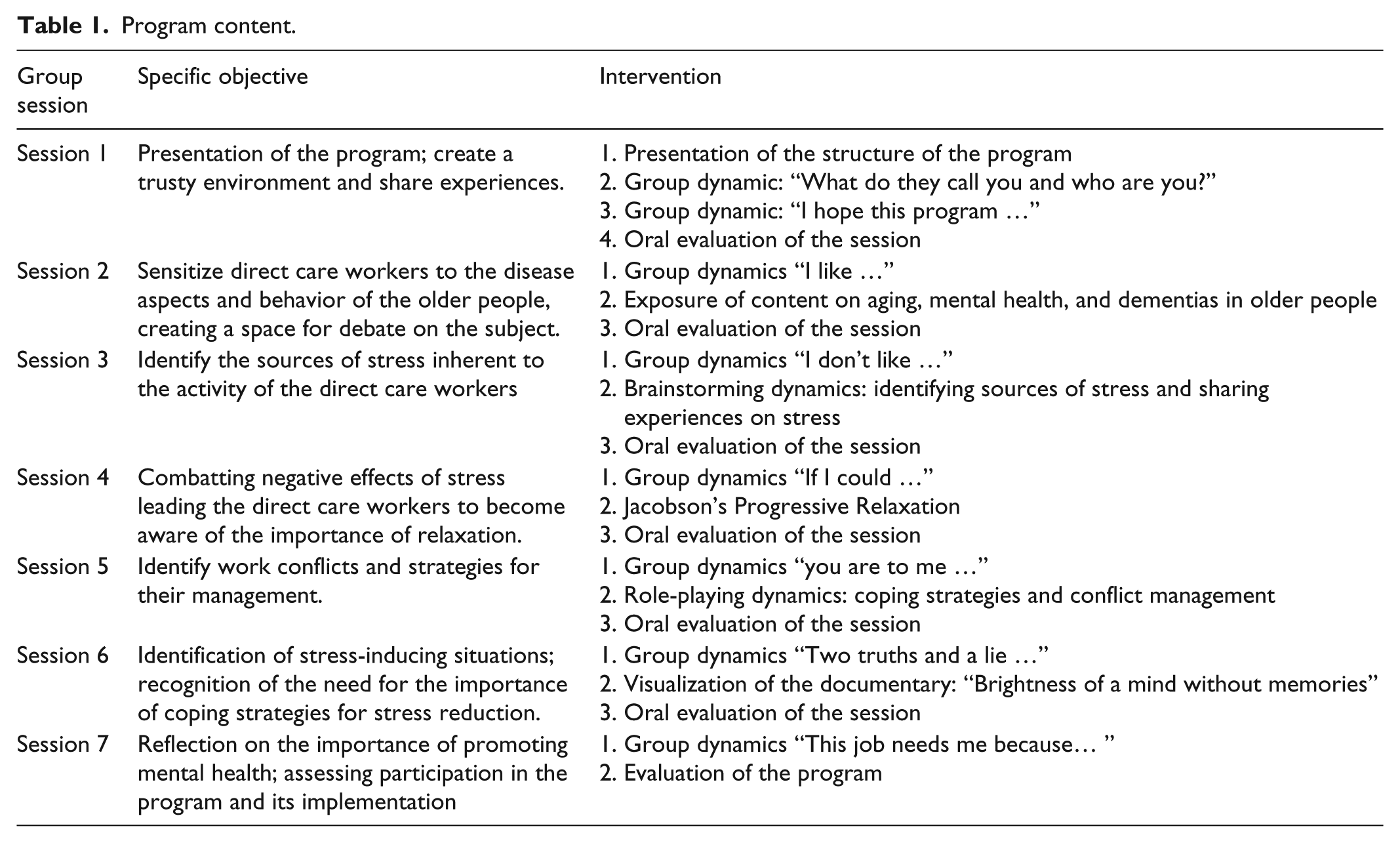
Seven sessions were designed for the program and, although the structure of each of the sessions is similar, the pedagogical methods and techniques defined for their implementation varied according the themes and objectives. To achieve the objectives defined for each session, the techniques used were brainstorming, relaxation technique, role-playing, a visualization of a documentary (with topics about aging issues, mental health, and dementia), group dynamics, and guided discussion.
Brainstorming was used to explore the creative potential of the person involved. This methodology aims to privilege the discussion, stimulating the expression of doubts and experiences of stress and his personal and relational meaning.
Relaxation, specifically Jacobson’s progressive relaxation technique, was also used because it is considered a “biologically antagonistic to stress response, which can be learned and converted into an important personal resource in order to counter the negative effects of stress,” 32 contributing to the reduction of health problems associated with stress. 33
Following Del Prette and Del Prette 34 and Otero, 35 we used role-playing to achieve psychoeducational and therapeutic goals, creating situations for development of a certain role. 36 This technique is very useful because it confronts the person with similar situations to the real ones but in a more protected way, allowing that the group suggests corrections to the performance. In this way, the person will have the opportunity to develop this role more quickly than in the real situation.
Visualization technique using a documentary was also used to identify and cope with situations that induce stress. Group dynamics was also used since it is a valuable instrument in working with groups and their applicability has increased considerably in the professional and personal development. The expositive method was used in almost all the sessions, allowing the transmission of various contents and relevant information on stress issues, burnout, aging process, and disease.
Sessions
The seven sessions feature the following topics: (1) explanation of aging, mental health and dementia issues in older people, (2) identification of stress sources, (3) combating the negative effects of stress and raising awareness of relaxation, (4) recognition of the importance of coping strategies for stress reduction, and (v) coping strategies and conflict management.
Each session is divided into three moments: I—Start: presentation of the session with information about the specific topic and objectives; II—Development: operationalization of planned activities for the session; and III—Finalization: synthesis of the session, highlighting the most relevant topics. In every session, a dynamic group will be carried out in order to provide greater personal knowledge and to create a trustworthy work environment.
The program content is given in Table 1.
Program content.
Participants
The professional who implements the program is a nurse expert in mental health and psychiatry who work in a Health Unit, supporting institutions in the neighborhood. The selection of participants was by convenience and lay on the identification of institutions with favorable conditions to implement and follow up the program and availability of primary care workers. The selection of four institutions in the same geographical area, with similar type of services and users, allow us to implement “StressadaMente” Program in two of them, keeping two others as comparison for future study.
The inclusion criteria of direct care workers were (1) they have been working in the institution for 6 months or more, (2) they develop functional tasks directly with the older people, and (3) they give informed consent to participate in the program. The exclusion criteria were (1) not working directly with old people, (2) work for less than 6 month in the institution, and (3) did not want to participate.
Direct care workers were invited to participate in the study, after a brief explanation of the program and main objectives. After the verification of inclusion criteria, 29 direct care workers were enrolled. Two participants were in sick leave, one resigned, and another finish the job contract. The final sample comprises 25 participants who completed the entire program although only 21 fulfill the satisfaction form.
The study was approved by the Ethics Committee of the Instituto de Ciências Biomédicas Abel Salazar—Universidade do Porto (ICBAS-UP)—number 187/2017. All eligible direct care workers signed the informed consent following the ethical aspects of confidentiality and voluntary participation.
Intervention
The implementation of the program took place between October and December 2017. Considering the homogeneity of the groups, an effort was made to ensure compliance with the workplace. In the same institution, two groups were established, one composed by the direct care workers of the day care centre and another by the direct care workers of the residential homes. The program was implemented during working hours by a mental health expert nurse, in all groups, to reduce the researcher bias.
Assessment of satisfaction with the intervention program
To evaluate the satisfaction to participate in the StressadaMente program and its implementation, a satisfaction questionnaire (Supplemental Appendix 1) was filled by participants in the last session of the program. It consists in eight questions in a 5-point scale (1—not satisfied, 2—not very satisfied, 3—satisfied, 4—very satisfied, 5—totally satisfied) and a final question about the overall evaluation of the program (1—insufficient, 2—sufficient, 3—good, 4—very good, 5—excellent).
Results
The 21 direct care workers are all females, married (90.5%), and with a mean age of 42.5 years (standard deviation (sd) = 9.7 years). Regarding education level, 8 (38.1%) participants have 9 years of education and another 8 (38.1%) 10–12 years. The majority of the participants (71.4%) have specific training and 52.5% do not have professional qualification in the area of gerontology/geriatric. The median length of service as a direct care worker is 31 months (interquartile range (IQR) = 88.5 months). Regarding working time at the institution where they work now, the participants present a median of 12 months (IQR = 60 months).
The sociodemographic and professional characteristics of the participants are presented in Table 2.
Sociodemographic and professional characteristics of the participants.

sd: standard deviation; IQR: interquartile range.
All participants reported being “very satisfied” or “totally satisfied” in all the dimensions evaluated. The duration of the program was the dimension with lower percentage of “totally satisfied” (61.9%). All direct care workers have verbally expressed the need to increase the duration of training. In general, the program was evaluated as “very good” and “excellent” by 9.5% and 90.5% of the participants, respectively (Table 3).
Description of the level of satisfaction of the participants.

Discussion
The results of this questionnaire reflect the importance of training direct care workers and intervene promoting mental health in a work context. Zimmerman et al. 7 verified that the lack of adequate training is associated with high levels of stress, overload, and job dissatisfaction in formal caregivers. As in a study carried out by Pereira, Marques 1 with 40 direct care workers from three residential structures for the elderly, the results also suggest the need not only to develop training programs for formal caregivers of elderly people in order to acquire skills to deal with the difficulties encountered in the study but also to use coping strategies aimed at reducing the levels of psychological distress and anxiety among direct care workers, contributing to the reduction of anxiety and improvement in the quality of care provided to institutionalized older people. The results of the Satisfaction Questionnaire point to the need to develop intervention programs with direct care workers not only to promote specific knowledge in the context of dementia care but also to develop strategies that promote mental health, in particular stress management and emotional overload.
Analyses showed (Table 3), in general, that the majority of participants consider it an excellent program that may indicate that one can achieve effective and motivational results for stress management by adapting/changing behaviors and attitudes, promoting a healthy and functional adjustment to the requirements imposed by care for the institutionalized older people. These results are in agreement with the study carried out by Figueiredo et al. 37 in their work “Psychoeducational support to family and formal caregivers of old people with dementia,” since they concluded that after psychoeducational support, family and formal caregivers felt more competent in solving problems and more capable of meeting the demands of everyday life in other spheres of life; therefore, this type of intervention facilitates the development of coping mechanisms and potentiates the prevention of stress and overload associated with the care of people with dementia.
The StressdaMente Program seems to have an adequate content to the proposed objectives as 90.5% of the direct care worker reported to be very satisfied with the contents and classify them as relevant to their work. They considered to have acquired new skills (71.4%) and believe that it would contribute to make changes in the practice (76.2%). However, many of the participants complain about the duration of the program (61.9%) as being too short.
There are some limitations in this study that need to be addressed, such as (1) The reduced number of participants; (2) the high level of dropout, associated with job absence, and (3) the satisfaction questionnaire was not tested. For these reasons, the conclusions need to be carefully analyzed.
Conclusion
Given the specific role of direct care workers of attendees of day care centers or institutionalized older people, there are several psychological complaints, highlighting the need to develop a mental health promotion program aiming job satisfaction and increasing quality of life which hopefully will be reflected in more adequate and effective formal care.
The efficacy of the psychoeducational approach to caregiver families is recognized (e.g. Moyle et al. 26 ); however, this approach has been poorly studied in formal caregivers despite its potential to improve caregiver knowledge and acceptance of the disease, expand its repertoire of stress management strategies, and improve the expression of ideas and emotions. 38
The study presented in this article describes StressadaMente and the level of workers’ satisfaction with the program and also identify possible improvements to its implementation. The StressadaMente program intends to contribute to increase quality of life and reduce stress and burnout in these workers. Throughout the sessions of the program, direct care workers verbally expressed the importance of its implementation because, according to their opinion, their work is physically and psychologically highly demanding. Thus, they reported that with the implementation of this type of mental health promotion programs, they would be given the opportunity to share feelings and work experiences in order to identify the sources of stress inherent to their job, developing conflict management skills and stress reduction.
The program seems relevant and suitable, and in the next future, we will evaluate its effectiveness. One of the changes we will introduce is its duration allowing more sessions to further work the emotional stress.
Summing up we strongly recommend implementing this type of programs to a larger population encompassing several institutions to promote mental health stress management, since it is one of the most common complaints in this professional group. To promote mental health in work context for direct care workers of older people in care should be considered a health priority.
Supplemental Material
Appendix_1 – Supplemental material for StressadaMente: Mental health promotion program for direct care workers of older people
Supplemental material, Appendix_1 for StressadaMente: Mental health promotion program for direct care workers of older people by Margarida Figueiredo, Laetitia Teixeira and Constança Paúl in SAGE Open Medicine
Footnotes
Acknowledgements
The authors would like to thank the direction and the direct care workers team from the Centro Social da Paróquia de Nogueira, Centro Social da Paróquia de Ferreiros, Casa do Povo de Tadim, and Colégio Nossa Senhora das Graças for the participation in the study.
Declaration of conflicting interests
The author(s) declared no potential conflicts of interest with respect to the research, authorship, and/or publication of this article.
Ethical approval
Ethical approval for this study was obtained from Ethics Committee of the Instituto de Ciências Biomédicas Abel Salazar—Universidade do Porto (ICBAS—UP)—number 187/2017.
Funding
The author(s) disclosed receipt of the following financial support for the research, authorship, and/or publication of this article: This research was supported by the PDGG, ICBAS-UP.
Informed consent
Written informed consent was obtained from all subjects before the study.
Supplemental material
Supplemental material for this article is available online.

References
Supplementary Material
Please find the following supplemental material available below.
For Open Access articles published under a Creative Commons License, all supplemental material carries the same license as the article it is associated with.
For non-Open Access articles published, all supplemental material carries a non-exclusive license, and permission requests for re-use of supplemental material or any part of supplemental material shall be sent directly to the copyright owner as specified in the copyright notice associated with the article.
