




Abstract
During clinical practice, students become acquainted with the key work tasks associated with their professions. Students need more support from healthcare educators during clinical practice learning, particularly in challenging situations. This study aimed to describe healthcare educators’ experiences of challenging situations during clinical practice placements. A qualitative study design was used to collect data through interviews with ten healthcare educators from two higher education institutions. The data were analyzed with inductive content analysis. The SRQR reporting guidelines were used to improve the transparency of the study. Educator reactions commonly involved emotional, goal-oriented and pedagogical support towards their students. The interviewed educators felt that mentors – when facing a challenging situation during clinical practice – are tasked with creating an atmosphere that supports student learning. Students faced challenges that were related to self-evaluation, goal-oriented activities, and their attitudes towards feedback. The building of a safe clinical learning environment involves collaboration between students, their clinical mentors and educators.
Introduction
Clinical practice constitutes a significant share of the studies within nursing programs at European higher education institutions. 7 During clinical practice, students – under the supervision of mentors – become acquainted with the key work tasks associated with their professional field. 35 A central task of mentoring is student orientation, which includes supporting students in applying theoretical knowledge to the clinical setting. 13 Although the majority of clinical practice placements occur without problems, challenging situations can arise from time to time. Previous accounts of mentors’ experiences of clinical practice have reported that challenging situations are related to a student’s poor orientation, lack of learning abilities, and weak motivation. 15 In addition, language difficulties and cultural differences between culturally and linguistically diverse students can increase the number of challenging situations, 24 while strong anxiety and fear, 33 mental health problems, 3 and poor interaction skills 15 have also been linked to the occurrence of challenging situations. These instances may also be related to the bullying of students by mentors, which qualifies as mental abuse and detrimentally affects a student’s motivation as well as professional growth. 10
The resolution of a challenging situation requires that it is identified at an early stage and that healthcare educators are involved. This strategy includes discussing perceived grievances with the student and determining the extent to which the student is aware of the problem (Chunta 2016). A student who recognizes and acknowledges how his or her behavior contributed to the situation is an important part of a positive solution. Resolving challenging mentoring situations requires honest and open feedback, along with time and effort from the mentor, student (Chunta 2016) and healthcare educator. Challenging situations have been reported to increase fear, anxiety, anger, a sense of guilt, burn out and stress among mentors. 3 Moreover, challenging clinical practice situations have commonly been studied from the mentor’s perspective; 15 for this reason, it would be beneficial to describe how healthcare educators experience, and respond to, challenging situations. A healthcare educator is a staff member at a higher education institution who has completed a master’s or doctoral degree education, has a certain amount of working experience in the healthcare sector and, in some countries, pedagogical education.25,26 According to how healthcare education is structured, the educator is responsible for providing high-quality education, ensuring a safe and professional clinical practice experience, and being involved in the learning process through which students develop clinical skills. However, recent evidence has shown that the role of healthcare educators is diminishing in clinical practice, while mentors have an increased responsibility to support students during clinical practice.29,32 For example, there are no longer adequate resources for an educator to visit students during half-term or final evaluations, which means that mentors are entirely responsible for the students during this period of their studies. 36
In European healthcare education, a mentor is a professional (e.g. registered nurse) who is qualified to guide students in clinical practice based on his or her education and work experience. 7 The mentor needs to cooperate with the healthcare educator and the educational organization to ensure high-quality clinical training. 14 Mentors of clinical practice students act as role models to strengthen the development of student competence and professional growth. 9 The mentor must have motivation, the ability to support a student’s learning process, and the ability to provide constructive feedback in an atmosphere that is conducive to learning. 34 Successful mentoring positively impacts a student’s professional growth and desire to stay in the field of healthcare. 11 The healthcare educator is expected to participate in the planning of mentoring practice, be involved in student guidance meetings, assess learning outcomes, and act as a pedagogical expert. Students reported that educators are important for fostering students’ critical thinking skills and can be turned to for effective reflective discussions during clinical practice. 17 A healthcare educator is responsible for monitoring the learning process, should be able to apply various guidance methods to support students, and helps students reflect on their learning and competence levels. 4
Accounts of mentor experiences have shown that they need more support from healthcare educators, particularly in challenging situations. 31 Healthcare educators are an important part of clinical practice because they are able to resolve challenging situations and provide crucial support to students and mentors. A search of previously published literature did not identify any accounts of healthcare educators’ experiences of challenging situations during clinical practice. For this reason, this study aimed to describe healthcare educators’ experiences of challenging situations during clinical practice. The presented results may better describe educators’ role in challenging situations and, as such, will help other educators understand how these challenges can be addressed. The research may also provide insight into how educators perceive the issue of challenging situations during clinical practice, as well as clarify their willingness and competence to support students in their learning process.
Methods and design
The study applied a qualitative descriptive research design, which is commonly used when the collected data represent human experiences. 18 The authors were searching for new knowledge, which was expressed as participants’ beliefs and perceptions. This type of approach is supported by critical realism with the constructivist philosophical background, which allows for the existence of multiple realities.27 A qualitative design was likely the best approach given that the research was conducted to describe healthcare educators’ experiences of challenging situations. 5 The content was also evaluated using Standards for Reporting Qualitative Research (SRQR) to further improve the transparency of the research. 28
Participants
The inclusion criteria for study participation were being professionally qualified to act as a healthcare educator (minimum of 60 ECTS credits in pedagogical education and a master’s degree from a higher education institution), experience in guiding students in clinical practice, employment at a higher education institution, and personal experiences of dealing with challenging situations. The ten interviewees were between 40–66 years old (average 56 years) and had 9–30 years (average 17 years) of work experience as healthcare educators. The professional backgrounds of the participating educators included nursing, midwifery, along with public health, mental health, and emergency nursing. The interviews lasted an average of 46 minutes.
Data collection
The participants were recruited through purposive sampling by a contact person (staff of human resources management) at the higher education institution, who sent an invitation email and the contact details of the research coordinator (KK). The contact person collaborated with the researcher (KK), and made sure to not share participants’ email details without their explicit consent. The volunteer participants contacted the researcher to agree a place and time for the interview. The participants met with the researcher, either remotely or face-to-face (KK), in a neutral and quiet place according to their own preferences. The first interview was used as a pilot test and, based on a positive result, was integrated into the total collected data. All of the interviews were conducted by the same researcher (KK). The data were collected through individual, open-question interviews which were related to the research aim described above. More specifically, the interviews were guided by two themes: healthcare educators’ experiences of challenging situations during clinical practice, and the actions taken by educators or in collaboration with other parties (e.g. students or their mentors). The healthcare educators represented two Finnish higher education institutions and were interviewed during December 2017 and April 2018. Data collection ended once data saturation was achieved. 18
Data analysis
The data were analyzed using inductive content analysis. 19 Briefly, the interviews were recorded and transcribed, after which the material was anonymized and read through several times by one researcher (KK). The initial data search concentrated on original expressions corresponding to the research question, which were reduced to 181 codes. Expressions that covered the same content were grouped to form 66 sub-categories, which were further organized into 16 categories. During the final stage of analysis, these 16 categories were organized into three main categories based on similarities in content. 19 The analysis was conducted by one researcher (KK) who continuously discussed the work with other researchers to ensure that the entire group was in agreement about the interpretations (KK, JJ, KM).
Ethical issues
Research permits were obtained in accordance with the licensing practices of Finnish higher education. 30 Every participant received a cover letter which described the purpose, voluntary nature and confidentiality of the research, after which written consent to participate in the study was obtained from each participant. The researcher (KK) who collected the data did not have any direct connection to the participants or organizations involved in this research. The interview material was only available to two researchers (KK, JJ) of this study and, prior to data analysis, was coded so that no participant could be directly or indirectly identified from the data. The data were stored as encrypted files that will be permanently destroyed after the reporting of this study. 8
Results
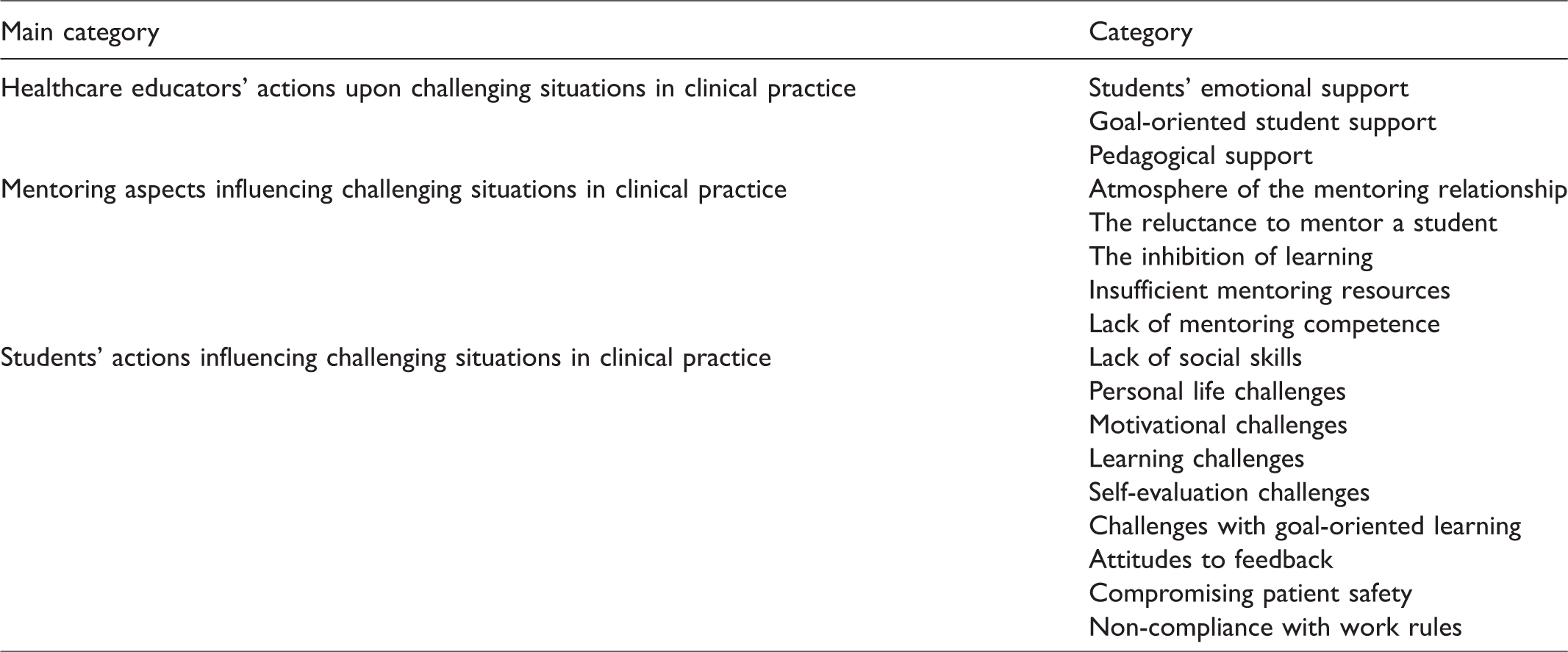
Healthcare educators’ experiences of handling challenging mentoring situations in clinical practice were classified into three main categories: healthcare educators’ actions upon challenging situations in clinical practice, mentoring aspects influencing challenging situations in clinical practice, and students’ actions influencing challenging situations in clinical practice (see Table 1).
Classification of educators’ experiences of challenging situations based on content analysis.
Healthcare educators’ actions upon challenging situations in clinical practice
Based on the analyzed interviews, healthcare educators’ actions in clinical practice situations were described in terms of students’ emotional support, goal-oriented support and pedagogical support. Educators who provided students with emotional support made an effort to be approachable so that students felt supported in challenging situations; the ultimate goal of supporting students was encouraging and empowering them during the clinical practice. In most cases, the educator encouraged the student by focusing on the student’s experiences of success. Goal-oriented support actions comprised reviewing and discussing the learning objectives with students. These discussions helped the healthcare educators gain an overview of which goals had been realized and ideas for how to proceed in the clinical practice. The educators felt that providing students with continuous feedback about the set learning goals throughout the clinical practice is an important way to support student learning. Support from the inter-professional community meant that educators could expect external guidance, e.g. multiple interested parties and/or the healthcare organization, when facing a challenging student. One of the interviewed educators described this set of actions by stating: It is essential to concretize and realize the goals of students. Also, the context should be considered, and some situations require that students can discuss their experiences once per week. These support measures can help students achieve their goals through small specific steps. (Interviewee 4) It is essential to listen to all parties, then you have to be kind of fair and conciliatory. (Interviewee 3)
Mentoring aspects influencing challenging situations in clinical practice
The main category of mentoring aspects influencing challenging situations in clinical practices was described in terms of the following categories: atmosphere of the mentoring relationship; the reluctance to mentor a student; the inhibition of learning; insufficient mentoring resources; and lack of mentoring competence. Difficulties caused by the atmosphere of the mentoring relationship usually were focused around a central misunderstanding between the mentor and the student. Educators shared that this misunderstanding was usually shaped by one of the following aspects: a mentor’s difficulty in positively interacting with students with different personalities; reflecting on past misunderstandings; and incompatible personal chemistry. Furthermore, a mentor’s negative attitude can manifest as ignoring the student or having an arrogant or discouraging attitude towards the student, while a mentor’s misbehavior included instances in which the mentor had used offensive language behind the student’s back. In addition, there were instances in which the mentor had excluded the student from the work community by referring to them as a ‘student’ rather than using their name. One interviewee described this set of challenges as: For example, the clinical practice will not progress properly if a common tune between mentor and student is not found, if interactions with the mentor do not function well, and/or if the student has to ask other students for help or to reflect on their progress. (Interviewee 4) Not all mentors really want to mentor. Some are assigned to be mentors in their work community and may be indifferent to it and – in some cases – even demonstrate a negative attitude. (Interviewee 8) Now there have been certain cases in which there is large staff turnover in a clinical practice and the students must get into the role of a healthcare professional prematurely. (Interviewee 3)
Students’ actions influencing challenging situations in clinical practice
Students’ actions influencing challenging situations in clinical practice were explained by their lack of social skills, personal life challenges, and motivational problems. Students also faced learning challenges with self-evaluation difficulties, goal-oriented learning, and having certain attitudes to feedback. In some cases, students compromised patient safety and did not comply with work rules. A student’s lack of social skills manifested as interactive challenges, more specifically, poor interaction skills with the patient and/or a lack of teamwork skills.
The participating healthcare educators reported that deficient social skills usually manifested as inappropriate behavior, rude or threatening comments, and the targeting of student mentors, patients, or healthcare educators. In some cases, educators reported having difficulties with student’s mental well-being, which would affect their day-to-day mental state and ability to cope with practice. In some cases, students faced the loss of a loved one or challenges linked to their personal relationships. Student fatigue, especially during long internships, was reported to be a challenge to their learning and performance. Educators also discussed motivational challenges, which were related to a lack of interest in clinical practice. For example, a student did not show interest in the content related to care during their clinical practice. Healthcare educators described that certain students had sufficient skills for the clinical practice period, but showed no interest in learning: There will always be those students who want to leave the healthcare field. This can be really challenging, but students who have completed a clinical training may realize that the reality of healthcare can differ from their prior expectations. (Interviewee 9)
Challenges for student learning mainly included language difficulties for culturally and linguistically diverse students, which caused challenging situations during the clinical practice placement. These students also had difficulties in articulating themselves in the Finnish language, which is a requirement of patient work, mentoring and working in the clinical setting. One educator described the language challenges as: Language skills are a big deal if (the culturally and linguistically diverse) student does not have sufficient Finnish language skills. In this case, the student cannot understand their mentor or patient. (Interviewee 1)
Other types of learning challenges were related to evaluation and feedback. According to the educators, students’ challenges with self-evaluation most commonly concerned the inability to self-evaluate, along with having unrealistic expectations. For example, a student might not have been able to identify his/her incompetence or had wanted to perform a work assignment without a clear idea of how the task should be performed. Other students may have been overly demanding regarding their competence development, or could not reliably gauge how their competence had changed over the clinical practice period. One healthcare educator stated: The student wants to do things a certain way and is not able to acknowledge their inability to perform the task in this way. In such situations, asking a mentor or educator for help is essential … (Interviewee 1) Some students do not recognize a shortage in their skills even though they received clear feedback about the issue several times in clinical practice. (Interviewee 4) The student has left to change the syringe by herself, although it is clearly instructed that all matters related to the medication or fluid treatment of newborns are done under the supervision of a nurse. (Interviewee 10)
Discussion
This study aimed to describe healthcare educators’ experiences of challenging situations with their students during clinical practice. Healthcare educators’ experiences of challenging student mentoring situations were related to three different areas: their own actions, mentoring aspects, and students’ actions. The current study is relevant because the proportion of students with learning challenges is increasing on a global level, 37 and scholars have emphasized that professionals involved in teaching must be able to identify learning challenges to support student learning. 16 The continuous monitoring and evaluation of students, along with collaboration between professionals, is crucial to successfully support and guide students with learning challenges, while a positive clinical practice atmosphere, encouragement by educators, and viewing learning challenges as a unique opportunity can help students openly discuss their experiences with learning challenges. 1
Healthcare educators’ actions during challenging mentoring situations included emotional, goal-oriented, and pedagogical support. Healthcare educators strive to be approachable, openly listen to multiple parties and reflect on events from multiple perspectives to clarify which aspects were involved in the situation. Listening and discussing are important in identifying challenges (Chuntan 2016). The ability to listen and discuss is a key part of identifying and resolving challenges, while students should also be encouraged to reflect on their own behaviors. 22 Research from Juntunen et al. 15 also revealed that student mentors adopt an understanding attitude, are willing to help and support students, and try to highlight positive issues in challenging situations. Discussion has also been promoted as a solution to challenging situations, as communication between the involved parties may open up new perspectives that can be used to find a common understanding. 20
Based on the findings of the current study, mentoring competence seems to be associated with how the challenging situation was resolved and provoked. A motivated mentor who can effectively interact with students supports the development of student competence, 34 while inappropriate mentor behavior can – in the worst-case scenario – significantly hinder a student’s professional growth and development. 10 Healthcare educators also reported the student–mentor relationship, the student’s admission to the work community, and mutual respect and trust to be critical components of clinical practice success. A mentor’s primary task is to teach students the skills they will need in the healthcare profession by helping students integrate their theoretical knowledge into their clinical competence. In this study, educators reported that mentors sometimes recognized a student’s unsafe activities but did not discuss the issue with the student. Under these types of circumstances, mentors should be able to make difficult decisions; for example, they have the authority to extend or reject the clinical practice if the student does not achieve the set goals. 12 In such types of cases, the involvement of healthcare educators is essential, not only for student learning purposes, but also for ensuring patient-care quality and safety. Moreover, ensuring that each mentor has completed the necessary educational prerequisites and has sufficient mentoring competence can improve their confidence and ability to manage challenging situations during clinical practice. 23
In this study, the language difficulties that may occur among students with immigrant backgrounds were found to affect patient work, mentoring, and/or the patient-care work environment, as well as situations related to mentoring. Strengthening students’ language skills is important for successful mentoring 24 as well as good academic performance. 2 Other common challenges identified in this study were related to mentoring practices, which subsequently impact student learning outcomes. As there is limited research about challenging situations from the student’s perspective, future research should investigate students’ experiences of challenging clinical practice situations and how both mentors and educators can support students. In addition, the presented results highlighted the need for further cooperation between healthcare educators, student mentors and educational organizations in how clinical practice should be organized and monitored.
Trustworthiness of the study
The strengths and limitations of the study are discussed according to Lincoln and Guba’s evaluative criteria for the validity and reliability of qualitative research.6,19,21 The trustworthiness of the study was ensured by the methodological rigor of the preparation, organization and reporting phases. More specifically, the authors carefully identified the research gap and gained a theoretical understanding of the studied concepts prior to data collection. The research question was set to represent participants’ experiences of challenging situations during clinical practice as closely as possible, while the data collection method was chosen based on previous evidence of the topic and the research question. The researcher (KK) responsible for interviewing the participants had pre-tested the interview guide prior to data collection and has expertise in conducting qualitative research study. Objectivity was strictly maintained throughout the interviews, i.e. the researcher did not try to influence participants’ accounts of their experiences. The research question drove the interviews, while data saturation was closely followed. This study included a small number of participants from two organizations in one country. Despite the small number of participants, data saturation was achieved. Data were collected from all participants during one interview, and the data collection process was carefully documented. The data analysis process involved more than one researcher to ensure objectivity. The results were reported systematically with the aim of presenting clear logic while answering the research question. Quotations from the interviews were provided to improve the of the research. 6
Conclusions
The presented research describes healthcare educators’ experiences of challenging situations during clinical practice. According to the interviewed educators, challenging mentoring situations can negatively affect students’ clinical practice progress, academic success, and professional growth. Educators have a responsibility to ensure the readiness of students to enter clinical work, provide student mentors with information about students’ backgrounds and learning process, and to be available to collaborate with students and their mentors during the clinical practice. Hence, the avoidance of challenging situations requires effort and resources from both mentors and healthcare educators. The results revealed that every mentor must be adept at using pedagogical techniques to help students cope with challenging clinical practice situations. For this reason, mentors with low motivation should not be forced into a position with such a high degree of responsibility, and they should be offered mentoring education to enhance their mentoring competence. Finally, further cooperation between healthcare educators and mentors can be expected to improve the early intervention and prevention of challenging mentoring situations.
Footnotes
Acknowledgement

Conflict of interest
The authors declare that there is no conflict of interest.
Funding
This research received no specific grant from any funding agency in the public, commercial, or not-for-profit sectors.