



Abstract
Background
Near-peer mentoring is a process where a mentor is close to the social, professional, or age level of the mentee. Near-peer mentors are better able to interact with and understand the struggles of students.
Objective
The aim of the programme was to increase confidence of students in the final year examination.
Methods
Following a needs analysis of final-year medical students, a near-peer mentoring programme was designed using peer-assisted learning framework. In the programme conducted between November 2019 and March 2020, trained Internal Medicine junior residents were assigned to students grouped according to the examination domains they most needed improvement in. Pre- and post-intervention data on students’ confidence in each of the examination domains using a 5-point Likert scale (1: Not confident at all and 5: Very confident), mock examination scores and feedback on the programme were collected.
Results
Fifty-one students were enrolled. Thirty-one students completed the post-programme survey, of which 71.0% felt more confident in the final year examination. Of the twenty-eight students who completed both the pre- and post-programme survey, 78.6%, 78.6% and 60.7% of them showed an increase in confidence in the communications, physical examination and history component of the examination, respectively. There was no association found between confidence level and examination performance.
Conclusion
A personalized near-peer mentoring programme is effective in increasing confidence of students in examinations and serves as a platform for residents to hone their skills as mentors. Its role as part of the medical school curriculum is worth exploring.
Introduction
Final-year medical students expressed a lack of confidence and high stress levels after changes to the format of their final-year medical examination. The evidence on the effect of confidence on examination performance has been mixed. Some studies indicated that confidence is a strong predictor of performance 1 as it is positively associated with more effort and a higher value placed in education.2,3 Other studies reported no correlation between confidence and examination scores. 4 The lack of correlation may be due to the difficulties assessing these complex relationships. 5 Building medical students’ confidence is likely to play an important role in the examination performance of students, and mentoring is a way to achieve that. 6
Studies have also shown that greater academic stress is associated with poorer examination performance. 7 Providing more individual subject-specific tutoring and improving testing-taking skills have been suggested to reduce stress. 8 A personalized near-peer mentoring programme was developed to complement faculty teaching; it also serves as a training opportunity for Internal Medicine residents to take up an educational role.
Near-peer mentoring happens when a mentor is close to the social, professional, or age level of the mentee. 9 Near-peer mentors understand the struggles and hence are better able to interact with medical students. Medical students value learning from near-peer mentors because of their recent experience with similar educational materials. 10 The mentoring process also helps near-peer mentors by improving teaching and communication skills which are essential competencies for junior doctors 11 and promoting knowledge acquisition. 12 Near-peer teaching programmes that are developed and delivered by junior doctors supplement the undergraduate teaching programme and ultimately help to improve students’ performance. 13
The benefits of personalized feedback have been reported in various studies; they include better academic performance and greater satisfaction as compared to collective feedback.14,15 Individual attention given to mentees while they receive feedback is preferred, 15 although this is understandably difficult to achieve in the setting of large group tutorials or didactic teaching. Smaller group tutorials have been found to help students better retain knowledge and skills and develop self-motivation through enhancing student–faculty and peer–peer interaction. 16
Hence, a personalized near-peer mentoring programme was developed with the primary aim of increasing medical students’ confidence level for their clinical examination; it also hopes to provide a mentor to students beyond the clinical examinations.
Methods
A total of 54 final-year medical students out of a class size of 56 students were enrolled in this programme conducted between November 2019 and March 2020. 12 near-peer mentors – alumni of the medical school, were recruited from the Internal Medicine Residency Programme. This study has been approved by the Institutional Review Board.
A needs analysis was conducted on final-year medical students prior to the start of the programme; it included data on students’ confidence levels in the various final-year examination domains (Physical Examination, History Taking and Communications) using a 5-point Likert scale (1: Not confident at all, 2: Somewhat not confident, 3: Neutral, 4: Somewhat confident and 5: Very confident), and their stress levels over final exams using a 3-point Likert scale (1: Not stressed out at all, 2: A little stressed out and 3: Extremely stressed out). Mock examination scores were also collected prior to the start of the programme.
A near-peer mentoring programme was designed with a peer-assisted learning framework, 12 utilizing the data collected from the needs analysis. Incorporating the values of social and cognitive congruence in mentoring, Internal Medicine junior residents were trained and assigned to a group of students who were grouped based on the examination domains they most needed improvement in.
The programme consisted of a series of small group tutorials with at least one tutorial session held per month. The focus of the tutorials was on the specified weaker domains of which the students have expressed their weakness in – 4 students were assigned to the History group, 21 students were assigned to the Physical Examination group, 20 students were assigned to the Communications group and 9 students were assigned to the Undifferentiated group; the students in the Undifferentiated group did not have any particular domains which they felt they were weaker in. These students were then further divided into smaller groups of 4–5 students with an assigned mentor. The mentors had the flexibility of exploring other domains after domains assigned to them have been sufficiently covered. The students were assessed at each tutorial session using an assessment rubric like the one used in their final-year examination. Figure 1 shows the programme outline. Flowchart showing the programme outline.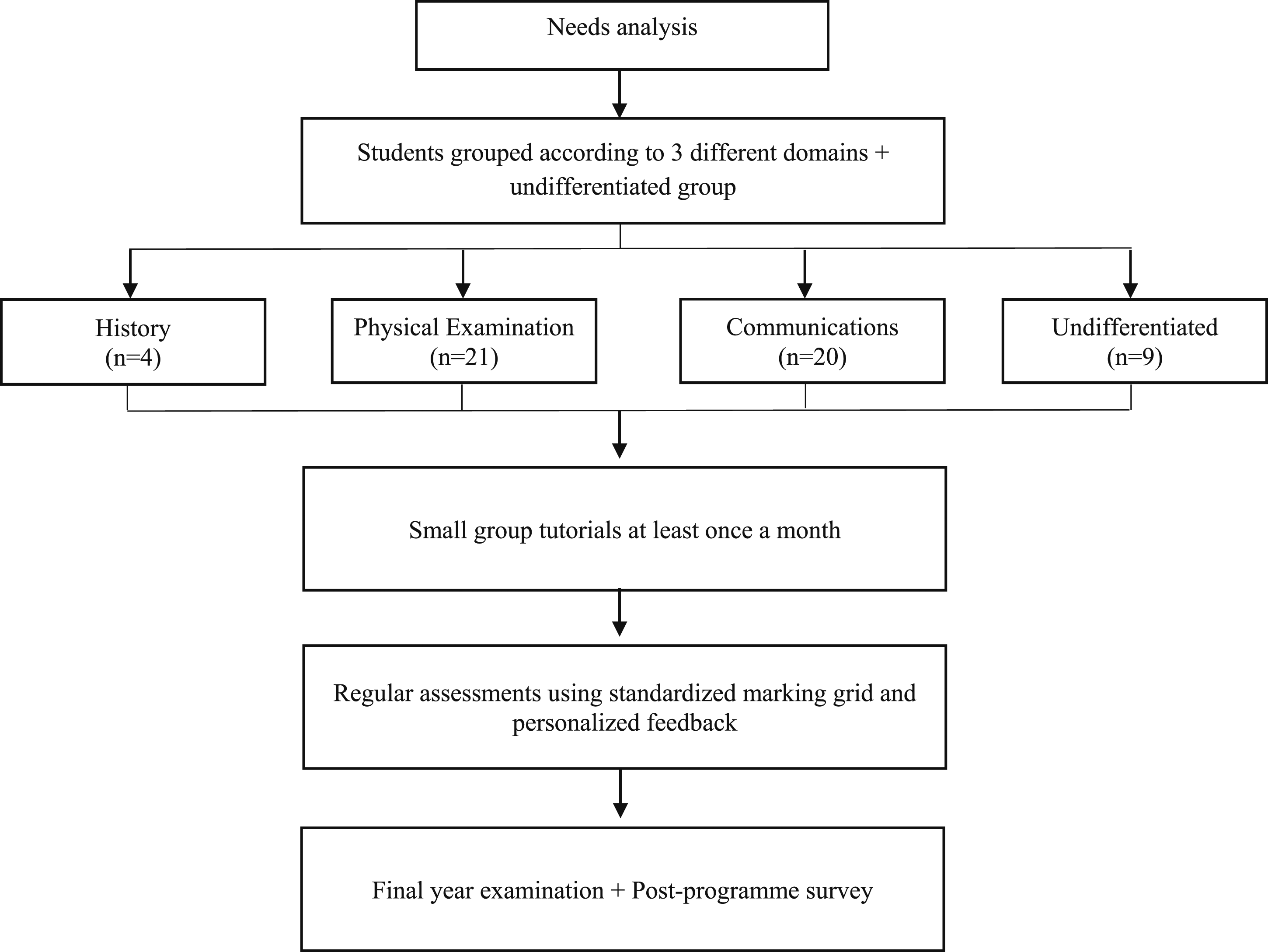
Mentors were provided with a programme guide which included objectives to cover for the various domains, the assessment rubric and guidelines on giving feedback based on the Describe-Express-Specify-Consequences (DESC) model. A training session was conducted for the mentors prior to the start of the programme – mentors also had the opportunity to have any of their concerns addressed.
Similar to the pre-intervention needs analysis, post-intervention data was collected on students’ confidence levels in each of the examination domains (Physical Examination, History Taking and Communications) using a 5-point Likert scale (1: Not confident at all, 2 :Somewhat not confident, 3: Neutral, 4: Somewhat confident and 5: Very confident). Feedback on the programme from both mentors and students, and students’ feedback about their mentors were also collected. Fisher’s exact test was used to analyse the students’ confidence levels in various examination domains and their mock examination scores.
Results
Pre-Programme and Post-Programme Analysis
Out of the 54 students enrolled in the programme, 51 completed the needs analysis. 51 students (100%) reported being stressed out by the final-year examinations; they gave a score of at least 2 out of 3 (3 being extremely stressed out) when asked to rate their stress levels.
Of the 51 students, 28 completed both the needs analysis and the post-programme survey. The majority of the students indicated an increase in confidence levels across three examination domains – 78.6%, 78.6% and 60.7% of them showed an increase in confidence in the Communications, Physical Examination and History component of the examination, respectively. The percentage of students having confidence levels scores 4 (somewhat confident) or 5 (very confident) out of a 5-point scale for the Communications domain increased from 25.0% (mean score 2.93 ± 0.77) pre-programme to 75% (mean score 3.86 ± 0.80) post-programme. The percentage of students having confidence levels scores 4 (somewhat confident) or 5 (very confident) out of a 5-point scale for the Physical Examination domain increased from 25.0% (mean score 2.89 ± 0.83) pre-programme to 85.7% (mean score 4.00 ± 0.77) post-programme. The percentage of students having confidence levels scores 4 (somewhat confident) or 5 (very confident) out of a 5-point scale for the History domain increased from 64.3% (mean score 3.39 ± 0.88) pre-programme to 92.9% (mean score 4.14 ± 0.52) post-programme.
Of the 28 students, 25 were assigned groups based on their specified weaker domains and 92.0% of them had improvements in the domains they were tutored in.
Confidence Level and Examination Performance
An analysis was conducted on the 44 students who gave their mock examination scores to evaluate the relationship between confidence and performance in the mock examination. For the History component of the examination, 66.7% (18 out of 27) of the students who had scores of ≥ 4/5 (somewhat confident/very confident) passed the History component of the mock examination compared to 64.7% (11 out of 17) of the students who had scores of ≤ 3/5 (neutral/somewhat not confident/not confident at all) (p = 1.00). For the Physical Examination component of the examination, 69.2% (9 out of 13) of the students who had scores of ≥ 4/5 (somewhat confident/very confident) passed the Physical Examination component of the mock examination compared to 58.1% (18 out of 31) of the students who had scores of ≤ 3/5 (neutral/somewhat not confident/not confident at all) (p = 0.74). For the Communications component of the examination, 100.0% (11 out of 11) of the students who had scores of ≥ 4/5 (somewhat confident/very confident) passed the Communications component of the mock examination compared to 93.9% (31 out of 33) of the students who had scores of ≤ 3/5 (neutral/somewhat not confident/not confident at all) (p = 1.00). There was no significant relationship between confidence level and performance in the different components of the mock examination.
Feedback from Mentors and Mentees
Quotes from students on how they have benefited from the programme.

Of the 12 mentors, 66.7% did not feel confident mentoring prior to this programme. 50% felt more confident to mentor after this programme and 100% indicated that they were keen to participate in other mentoring programmes. Feedback about the mentors were obtained from the students and passed on to the mentors to help them identify areas of improvement.
Discussion
Near-peer teaching programmes benefit both mentees and mentors. 13 Teaching juniors and peers is an essential competency for junior doctors. 11 Our programme has shown in an overall increase in confidence levels of students in the various examination domains; however, we did not find an association between confidence and examination performance.
The strengths of our near-peer teaching programme include having medical students receive highly individualized feedback through small group teachings, as well as nurturing a mentor–mentee relationship that outlives the programme. Small group teaching enables greater interaction between the students and mentors, allowing for increased opportunities to share and reflect upon their learning experiences. 17
Medical students see residents as valuable and important clinical mentors as they spend more time with residents than faculty members during their clinical postings. 11 Small group teachings in our programme allowed students to each have the opportunity to practise cases in the examination domains they were weak in, providing sufficient time for students to ask questions, have their concerns addressed and receive valuable individualized feedback.
The programme also has the added advantage of mentors being alumni of the medical school who have been through the curriculum and were better able to relate to the problems, anxieties and stressors experienced by the medical students, providing useful advice and guiding the students through the final-year examination. The students found it easier to approach their mentors and are less averse to making mistakes in front of them during practice sessions. Both students and mentors also appreciated the flexibility of the programme; they were able to schedule tutorials with increased spontaneity and increase the number of tutorials as required by the students. The programme also cultivated an interest in teaching and mentoring and refined the teaching and mentoring skills amongst the participating residents with the feedback provided to them.
One of the limitations of this programme is the short duration of 5 months; the mentors found it difficult to explore examination domains other than the one assigned to the group. The programme also lacked sufficient training for the participating residents – some did not feel confident enough as mentors. Participation in the surveys and sharing of examination scores were voluntary, which resulted in missing responses despite reminders. This may contribute to selection bias during analysis of the data. During the programme duration, students were not restricted from other educational interventions – this may be a confounder in the improvement in confidence level scores.
Moving forward, it will be interesting to see if further extending the programme to allow mentors to cover more examination domains in greater depth and for the mentor–mentee relationships to grow will lead to sustained and improved confidence. The optimal duration of the programme remains to be determined. Mentoring workshops could be conducted to build confidence of mentors and equip them with teaching and mentoring skills which are important in the residency programme.
Conclusion
A personalized near-peer mentoring programme is effective in increasing confidence of students in examinations. It also serves as a platform for mentors to develop an interest in and learn more about teaching and mentoring. The role of a resident-developed near-peer mentoring programme complementing faculty teaching by being integrated into the curriculum of medical schools is worth exploring.
Footnotes
Acknowledgements
We would like to thank the mentors for their time and effort in this mentoring programme.
Author contributions
AFY conceived and designed the programme, collected and analysed the data and wrote the manuscript. RX conceived and designed the programme and edited the manuscript. WF conceived and designed the programme and edited the manuscript.
Declaration of Conflicting Interests
The author(s) declared no potential conflicts of interest with respect to the research, authorship, and/or publication of this article.
Funding
The author(s) received no financial support for the research, authorship, and/or publication of this article.
Ethical approval
This study has been approved by IRB.
Informed Consent
Not applicable.
Trial Registration
Not applicable.
Availability of data
The datasets analysed during the current study are available from AFY.
