



Abstract
Liking it or not, ready or not, we are likely to enter a new phase of human history in which artificial intelligence (AI) will dominate economic production and social life—the AI revolution. Before the actual arrival of the AI revolution, it is time for us to speculate on how AI will impact the social world. In this article, we focus on the social impact of generative LLM-based AI, discussing societal factors that contribute to its technological development and its potential roles in enhancing both between-country and within-country social inequality. There are good indications that the US and China will lead the field and will be the main competitors for domination of AI in the world. We conjecture that the AI revolution will likely give rise to a post-knowledge society in which knowledge per se will become less important than in today's world. Instead, individual relationships and social identity will become more important. So will soft skills, including the ability to utilize AI.
With the advent of generative large language model (LLM)-based artificial intelligence (AI) tools such as ChatGPT from OpenAI and Gemini from Google, it is natural to wonder about the social impact of this technology. In the remainder of this paper, we will refer to generative LLM-based AI simply as GenAI, although we note that this term is often applied to include generative technologies such as image generation models like DALL-E. The main objective of this paper is to explore, tentatively, the social impact of GenAI.
While the question of the social impact of GenAI is undoubtedly important, any answers must be tentative and speculative at this point. We are still in the early stages of GenAI and may need to wait years, perhaps even decades, to understand fully its social implications. However, drawing from our experiences with past technologies in history, our current understanding of GenAI, empirical knowledge about the social world, and sociological reasoning, we can engage in preliminary and speculative discussions. We offer our account below.
We believe that the social impact of GenAI will be enormous, with the potential to revolutionize not only the production of goods and services but also to alter fundamentally the organization of human societies and the nature of daily life. Indeed, this technology holds the potential to increase inequality significantly both between and within countries, and we will discuss each of these in turn. As we explore these topics, we must keep in mind the speculative nature of our analysis, given the limited knowledge currently available about this technology and its capabilities. In writing this article, we draw inspiration from the ambition and style of Daniel Bell's (1973) pioneering book The Coming of Post-industrial Society. Bell's work, published long before the actual arrival of the digital age, serves as a model for our discussion of the future implications of GenAI as an emerging transformative technology.
Because the potential social impact of GenAI is too vast to be comprehensively discussed in a single article and our current knowledge and ideas about this emerging technology are still evolving, we will focus and structure our discussion as follows. First, we begin by exploring some factors conducive to GenAI technology. Then, we use this context to discuss how these factors are shaping the global race, particularly between the US and China, to develop GenAI technology and theorize about implications of this race for cross-society inequalities. Next, we examine how the increasing use of GenAI could alter occupational structures and increase income inequality within countries that adopt the technology. Finally, we conclude by situating GenAI in the larger historical context of economic production, contrasting the ways in which inequality has been generated in economic activities and transmitted intergenerationally in the past and what may happen in the future.
GenAI growth factors
To understand the social impact of GenAI, it is useful first to explore the factors promoting the development of this technology. This discussion will help us anticipate which countries might dominate GenAI production—the main factor in determining which nations will bear what economic and sociopolitical consequences—and the rate at which different populations could experience changes in their occupational structure.
The scaling factor
The first thing to recognize is that GenAI is a technology, not a scientific discovery. Technology is characterized by two prominent features: cumulativeness and communality. First, technology is cumulative, so any new technological improvement adds to the extensive reservoir of existing technology. Except for rare instances of secrecy or loss of knowledge, the accumulation of technological inventions grows with time. Second, technology is communal, in that a new invention benefits not just the inventor, but an entire community. While certain technological advances are sometimes protected as intellectual properties by families, companies, or nations, it is the “best” technology within a community that matters, not the average individual's own technology. Technology is thus communal and inherently shared. Here, the “community” can be defined as a nation-state, a subnational region, or a cluster of nations that share the same language, culture, or political system. In the context of GenAI, the size of this community, which we term the scaling factor, is crucial: larger is better. We propose four reasons for this.
First, the size of the community is a relevant factor to the development of GenAI technology. In the past, technological invention often stemmed from hard work and trial and error rather than being scientifically derived (Bell, 1973). While it is unlikely that any given invention was the result of a purely random event, it is reasonable to assume that, all else being equal, a larger group of people engaged in technological exchange would result in more trials and errors, thereby increasing the likelihood of producing a significant invention for the community. 1 For example, while ancient China did not have science in the same sense in which it is understood in contemporary terms, it excelled in technology, largely owing to its vast population that facilitated numerous trials and errors. Sharing of information within this population was further enabled by China's longstanding written culture. 2 Today, technological advancements are based on modern science rather than simply trial and error. Thus, it takes a sufficiently trained labor force to develop GenAI technology, but relative to a smaller population with similar levels of education, a larger population can more easily afford a critical mass of scientifically trained workers to meet the demand.
Second, the larger the community, the more cost effective it is to develop GenAI technology. This principle is a derivative of the classic economic concept known as economies of scale, which suggests that larger production levels allow for lower costs per unit. Developing GenAI technology requires significant investment in both the latest computer hardware and in the software implementation of sophisticated data-processing algorithms. A private firm can surmount these cost barriers only in a sufficiently large market. This is especially pertinent due to the “non-rivalry good” (Romer, 1990) nature of GenAI: in essence, the consumption of GenAI technology by additional consumers does not diminish its availability or value for others. Once the technology is developed, the incremental cost for adding additional users is miniscule compared to the enormous cost of developing the technology. 3 Consequently, firms operating in very large markets can afford the high initial costs associated with developing GenAI technology because they can later recuperate the huge cost from a very large number of consumers. Due to the near-zero marginal cost of consumption and the availability of the internet as a mechanism for delivering the technology, a larger community facilitates the consumption of GenAI technology.
Third, due to the first key feature of technology—cumulativeness—GenAI technology should exhibit a pattern commonly observed in both scientific and technological fields: cumulative advantages. As we have explained, firms serving very large markets are likely to initiate GenAI technology development, as they are well positioned to absorb its high costs. However, even after the technology matures and becomes replicable by other firms, those who pioneered it may retain an intrinsic advantage—a cumulative advantage. 4 This cumulative advantage arises for two reasons. The first is that the knowledge and skills users develop for one GenAI implementation are not perfectly transferable to new GenAI implementations. That is, once an individual or firm invests time into becoming familiar with a given GenAI firm's product, there is a bigger cost to transitioning to new ones. Second, the interactions users have with GenAI interfaces are themselves crucial data for improving the technology. Thus, pioneer firms are able to differentiate their products further from those of competitors by taking advantage of user data. Of course, “first movers” in the GenAI space are not guaranteed an advantage—their innovations could be replicated and improved upon by resource-rich competitors. 5 However, the factors described here can lead to a scenario where once successful, these communalities continue to thrive in a self-reinforcing fashion.
Fourth, large and literate communities are proficient in generating substantial amounts of data. Human history hitherto has witnessed three major technological revolutions: the agricultural (ca. 10,000 BCE), industrial (ca. eighteenth century CE), and information technology (ca. late twentieth century CE) revolutions. We are about to experience a fourth technological revolution, the AI revolution. Whereas agriculture depended on land and climate, industry on capital, and information technology on human capital, AI relies on vast quantities of data for training and fine-tuning (while still relying, to some extent, on human capital). A society that is both large in population and adequately prosperous can afford both human resources and data.
In summary, this section has established the crucial role of the scaling factor in the development of GenAI technology. Economic inefficiency, pragmatic challenges, and a lack of sufficient data are significant hurdles for small societies in developing this technology. Interestingly, the importance of the scaling factor, once critical in agricultural technology but diminished during the industrial era, has regained prominence in the current AI revolution marked by the advent of GenAI technology.
Corpus specificity and language specificity
GenAI systems can generate useful human-like text responses because they are trained on a corpus—a very large collection of texts—as input. Therefore, any GenAI implementation is necessarily corpus specific. In other words, the technology is as good as the corpus that enables it. This reliance on a specific corpus inherently limits GenAI's capabilities. For example, GenAI's accuracy in recounting historical events is confined to the extent and accuracy of the training data about historical events. This means that historical events that are not well documented due to reasons like neglect, controversial evidence, or political censorship will not be accurately represented in the model's responses. Moreover, different corpora can lead to different outputs. This is particularly important when considering the cultural and political context of the corpus. In diverse or international contexts, different corpora could reflect varying narratives and biases, leading to different responses.
Gender and racial biases in existing English-based GenAI technology have been documented (Eloundou et al., 2024; Joyce et al., 2021; Kantharuban et al., 2024; Sun et al., 2023). For example, ChatGPT responses vary based on the race and gender associated with usernames (Eloundou et al., 2024) and LLMs may generate racially stereotypical recommendations even when a user has not explicitly revealed their race (Kantharuban et al., 2024). Differences across languages can also be great (Luo et al., 2023). The same question posed in English might yield a different response when asked in Chinese, reflecting the distinct narratives and contexts inherent in each language. As argued by Kantharuban et al. (2024), “LLMs produce responses that reflect both what the user wants and who the user is”.
To understand the role of the language used in AI prompts, we experimented with OpenAI's ChatGPT-4 in December 2023. We asked ChatGPT-4 a series of identical questions in four languages: English, Chinese, Japanese, and Burmese. Besides varying languages, we also changed the user's ethnic identity, such as Chinese or Japanese. Some of the questions we asked were political and cultural. For example, one was about a prominent political leader, and another was about the word “dragon”. The experiment yielded the following findings.
For concepts and facts that are agreed on across national boundaries, such as scientific terms and discoveries, there is no difference across languages used. For concepts that vary by culture, such as table manners, language matters less than user's identity.
6
For concepts that convey distinctive meanings within languages, such as the word “dragon”, input language matters, regardless of self-identification.
7
For terms and concepts that carry different meanings depending on political system or country, language figures prominently. Users get very different answers when politically sensitive terms or concepts are input into ChatGPT in Chinese instead of English. This is surprising because we used the same GenAI system—ChatGPT-4. The dissimilarities between answers to questions asked in English and those asked in minor languages such as Burmese are relatively small (although some answers are not even coherent or comprehensible). We surmise that ChatGPT responses in minor languages draw on English-language corpora.
These last three points arise as a derivative of GenAI's corpus specificity, i.e. language specificity, because GenAI requires corpora of training data, which exist only in specific languages. While GenAI technology is, in theory, capable of translating user input into different languages, it performs best in the original language of the training data, such as English, because many expressions are unique to particular languages and thus cannot be easily translated into other languages. In other words, translation technology is inherently subject to performance limitations. Consequently, even with identical algorithmic implementations, a GenAI model's responses can vary depending on the corpus language as input.
Because corpora fed into GenAI technology are text data in specific languages, languages have an impact on the final GenAI products, through what we called earlier the “scale factor”. The larger the scale, the more important a language is. We note that, however, a language is not necessarily limited to a single country, such as English, which is spoken in many countries and places that were former colonies of Great Britain. Conversely, multiple language may be spoken in a country, for example, English and French are both official languages in Canada, and there are many official languages in India.
As such, an important factor in the production of GenAI technology is the size of a population speaking a given language. Such population sizes vary greatly. In Figure 1, we list the most commonly used languages in the world, with the top being English (at 1.3 billion), followed by Chinese (at 1.1 billion). Although India is currently the most populous country in the world, Hindi ranks third in language usage.
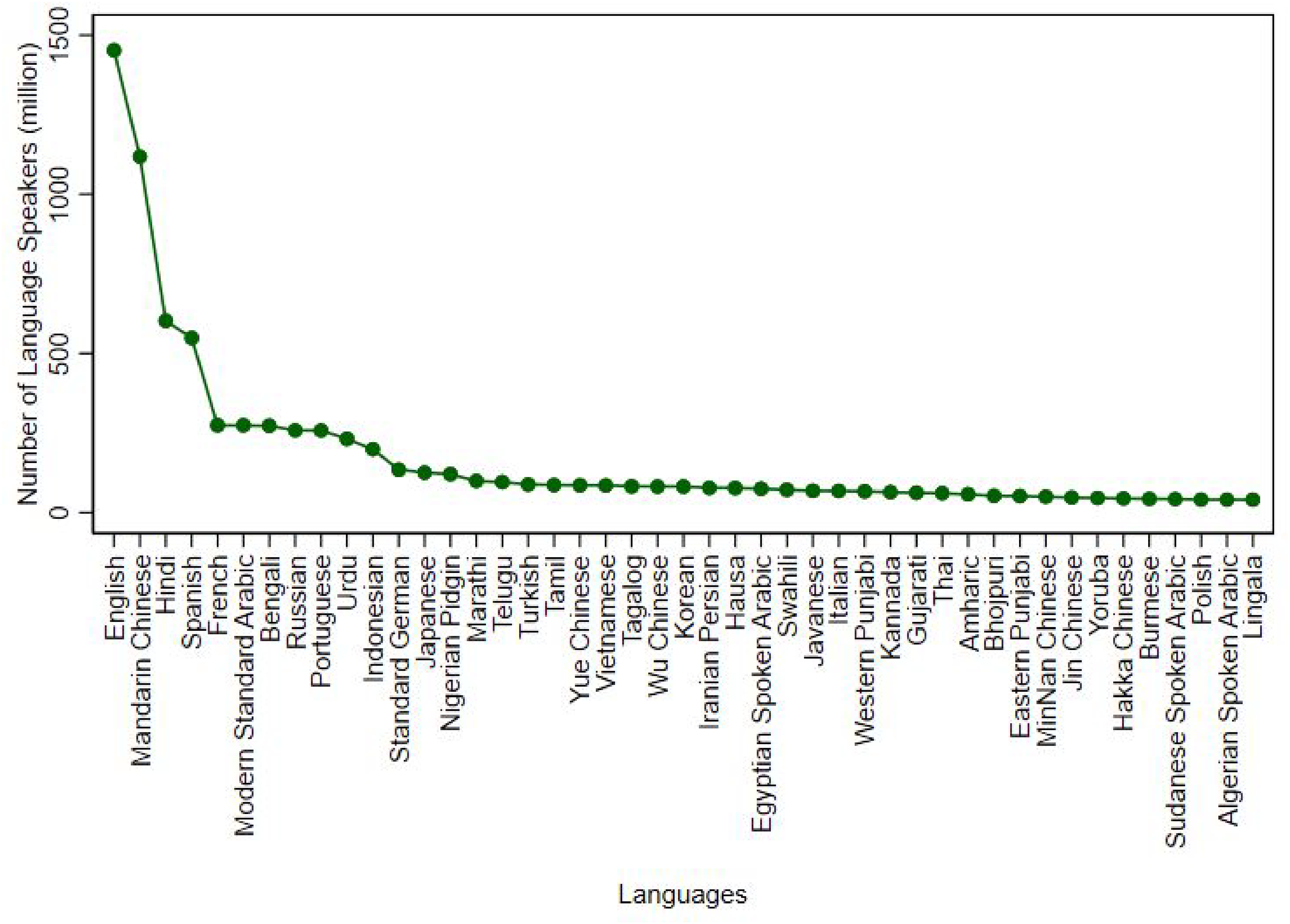
Population size by language.
Like many other social and natural phenomena in the world (Newman, 2005), the distribution of language use is highly skewed, following the “power law” distribution. Few languages, such as English and Chinese, are spoken by a large fraction of people in the world, while most languages are spoken by very few people. In Figure 2, we present a graph illustrating the fit of population size of language use to the power law, which exhibits a Pareto coefficient of
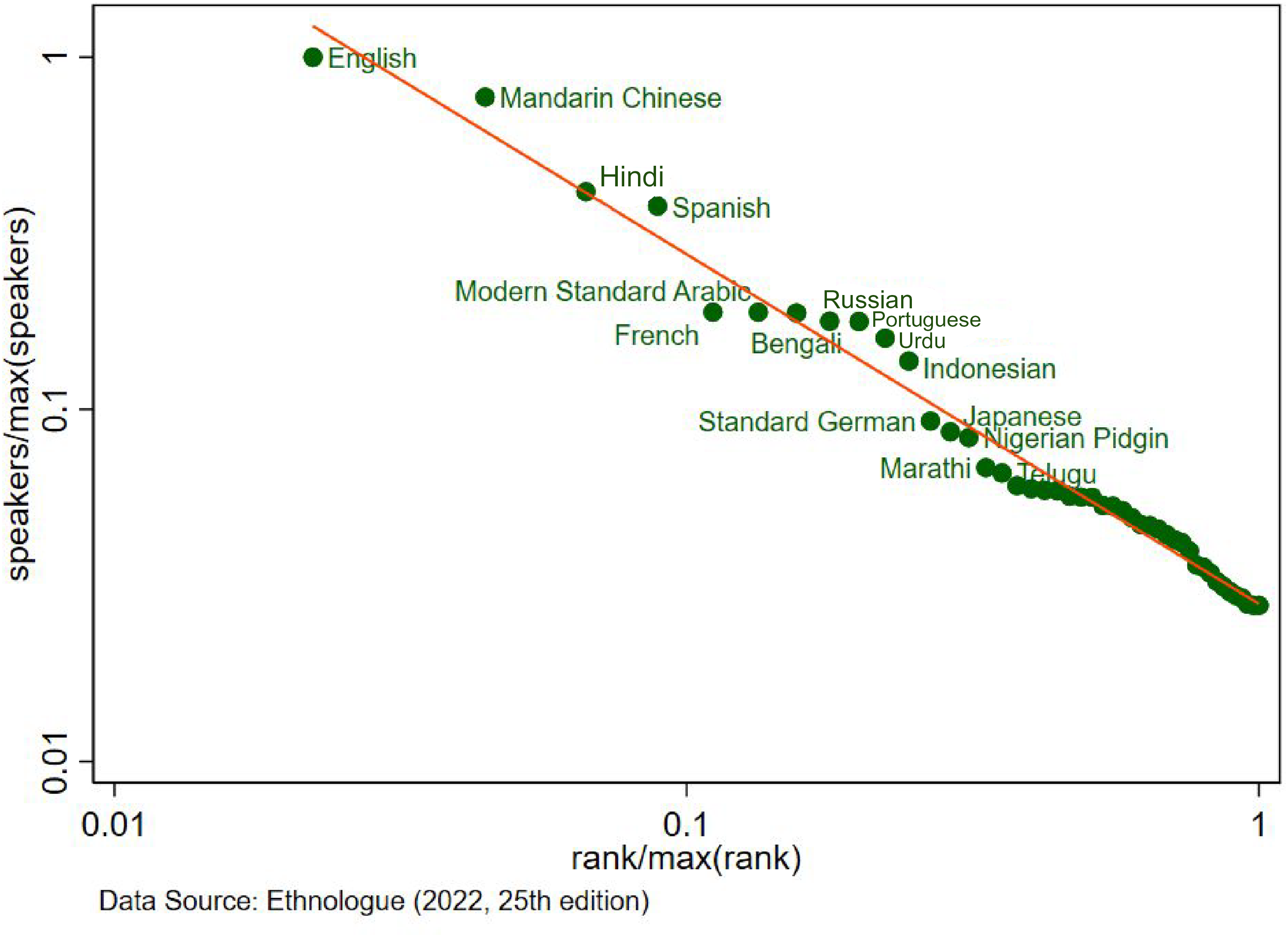
Power law distribution of population size by language.
As an additional complication, the size of the population speaking a given language does not perfectly predict text data available in that language. For example, while Hindi is the third most spoken language, a significant portion of the Hindi-speaking population remains illiterate and thus cannot produce text (Statista, 2024). In addition, because a large fraction of the educated elites in India is educated in English and communicates in English, Hindi text information does not match its ranking in spoken languages. In terms of newspaper and magazine publications, for example, Hindi ranks fourth; in terms of books, it does not belong to the top 12 (Lobachev, 2008). As such, corpus and language specificity will tend to create advantages for linguistic communalities with large and sufficiently educated populations.
Between-country inequality
As alluded to in the discussion above, it is not clear that we should think about advantages or disadvantages of developing GenAI at the country level. After all, the scaling factor and the specificity of corpora creates advantages and disadvantages for linguistic and sociocultural communities, which may or may not align with country boundaries. However, for our discussion of the race in GenAI technology, it is still useful to treat nations as meaningful units of analysis.
The investment in and rise of GenAI technology are attributable to its perceived potential to increase economic productivity. As GenAI technology becomes more fully developed in the future, we expect meaningful changes in the distribution of the technology. Current GenAI business-to-business models take the form of subscription-based enterprise software—that is, firms adopting GenAI in their workplace are paying monthly or yearly fees to GenAI providers such as OpenAI. As the technology improves and firms adjust their strategies around it, they might reduce employment levels and increasingly automate tasks. Effectively, this can be understood as a form of outsourcing whereby a firm uses a cheaper third-party alternative to perform some of its tasks, increasing its own profits but also that of the service provider. When work is outsourced to a different country, the money that would have been kept within the nation is lost. This is particularly relevant in the case of GenAI because companies leading the development of these tools are concentrated in only a few countries and are thus likely to capture a significant share of the money generated by the technology.
In addition to economic concerns, there are sociocultural factors that could fuel between-country inequality. Namely, the need for large corpora systematically disadvantages people speaking minor languages, as they may be subject to the cultural and political domination of the countries developing GenAI systems. The content produced by GenAI tools is based on the data those tools are trained on and will thus reflect the attitudes and ideas encoded in those texts and images. For example, around 60% of the training data used for OpenAI's ChatGPT-3 came from the Common Crawl (Brown et al., 2020), a web archive with petabytes of data crawled from the internet. An estimated 46% of documents in the Common Crawl data have English as their primary language and were likely laden with the values of the English-speaking generators of the data (Common Crawl, 2024).
In the decades following World War II, the main theme in world politics has been the celebration of national independence and self-determination (Jackson, 2000), free from colonization. The arrival of GenAI as a result of the AI revolution now presents a risk to reverse this secular trend, as it may force small countries to be dependent again on dominant ones. In other words, the advent of the AI revolution is likely to increase between-country inequality, favoring large countries with advanced AI technology and disadvantaging small countries lacking independent AI technology. The US–China geopolitical tension and conflict, in particular, could lead to technological competition in the world, making other countries technologically dependent on them.
GenAI technology also presents challenges to the current legal systems globally. It has long been accepted that each state has the sovereignty to issue laws within its territory (see, for example, Laski 1929). However, as we discussed before, GenAI technology will necessarily transcend national boundaries. National differences in such legal domains as data privacy, political censorship, and cross-border data flows will have to be resolved for GenAI to be shared cross-nationally. At the current time, Europe could be considered a global leader in data regulation: measures such as the European Commission's A European Strategy for Data and the General Data Protection Regulation work together to establish a unified, regulated data market within the EU with the dual goals of ensuring Europe's global competitiveness and data sovereignty (European Commission, 2024). By contrast, the US lacks a federal framework for data regulation, but several states have enacted comprehensive data regulation such as California's Privacy Rights Act and Connecticut's Personal Data Privacy and Online Monitoring Act. Notably, while only five states had strong data privacy regulations by the end of 2023, 14 more states have signed privacy legislation into law and these are all set to be effective by the beginning of 2026 (International Association of Privacy Professionals, 2024). Meanwhile, the People's Republic of China (PRC) is becoming a significant force in global data regulation. Over the last five years, it has enacted several laws, such as the Cybersecurity Law (CSL), Personal Information Protection Law (PIPL), Data Security Law (DSL), and Measures for Cross-border Data Transfer Security Assessment. These laws aim to build a centrally controlled data governance system, restricting cross-border data flows for national security and public interest reasons and reflecting an increasingly restrictive approach to data regulation (Arroyo et al., 2023). In addition to facilitating the Chinese government's restriction of cross-border data flows, they have helped stimulate innovation within the country by contracting with Chinese AI firms to process valuable government surveillance data, helping improve their algorithms. For example, Beraja et al. (2022) argue this collaboration between the public and private sector “may have contributed to Chinese firms’ emergence as leading innovators in facial recognition AI technology”.
The case of the US and China
If the rise of GenAI is likely to exacerbate between-country inequality, one important question is which countries are likely to be leaders in the development of these tools and thus enjoy advantages over others. Several scholars and industry leaders have argued that the United States and China are poised to dominate the space, leveraging their extensive resources and strategic investments in AI research and development (see, for example, Harvard Kennedy School, 2021; Lee, 2018). We examine these two countries in relation to the GenAI growth factors outlined above.
For reasons discussed earlier, the US and China benefit from having large populations that use the English and Chinese languages. Additionally, vast amounts of written works are published in these two languages. For example, of the 918,964 book titles published worldwide in 1995, the largest number of titles was in English—200,698 titles, 21.84% of the total—followed by Chinese—100,951 titles, 10.99% of the total (Lobachev, 2008). Closely related to these figures is the two countries’ dominance in book production. In 2015, China published 470,000 books and the US published nearly 339,000, with the United Kingdom lagging at a distant third with 173,000 books (International Publishers Association, 2016). Thus, the US and China enjoy advantages in accessing very large corpora available in English and Chinese for training GenAI systems.
In terms of technological prowess, the US is a leader in GenAI innovation and an originator of the technology. While the exact origin of artificial intelligence is contested, it is clear that US universities played a key role in its creation. Some trace GenAI technology back to Alan Turing—a mathematician trained in the University of Cambridge and Princeton University—whose 1950 paper “Computing Machinery and Intelligence” (Turing, 1950) explores the mathematical possibility of artificial intelligence and establishes a framework for how to build and test these machines. A few years later, the University of Dartmouth organized the Dartmouth Summer Research Project on Artificial Intelligence, a historic conference where top researchers tested some of Turing's ideas and discussed their visions of the field (Science in the News, 2017). The development of neural networks, which are crucial to the statistical training of GenAI models, was also born out of research conducted in US universities, sometimes with funding from government organizations such as the Defense Advanced Research Projects Agency of US (McKinsey & Company, 2018; Science in the News, 2017).
In recent decades, state-of-the-art research on GenAI technology has also been carried out by US-based companies. Indeed, the chess computer Deep Blue, which famously won a chess match against world champion Garry Kasparov in 1996, was initially developed at Carnegie Mellon University but completed at IBM Research. Years later, Google DeepMind—a British-American research lab—used their innovations in neural network models to win a game of Go against a professional player. Google has also developed products that make significant advances to the field of molecular biology and has published over a thousand papers on GenAI research. It is also credited with the creation of transformers, a deep learning architecture that is used in the majority of LLMs. Finally, OpenAI—supported by a large investment from Microsoft in 2019—rose as a prominent leader in the space. Their products include several language models, most famously ChatGPT-3 and ChatGPT-4 which power the popular chatbot and virtual assistant, ChatGPT, which launched in November 2022 and reached 100 million users by January of the following year. OpenAI helped catalyze the “AI boom”, characterized by exponential growth in investments in specialized AI companies such as OpenAI and Anthropic and tech giants with a large footprint in the AI space such as Meta, Apple, Alphabet, Amazon, and Microsoft.
Industry leaders in the GenAI space are predominantly concentrated in the US, but China is emerging as a formidable competitor to the US (Lee, 2018; Li et al., 2021; Modern War Institute of US, 2019; The Nation, 2023).
9
The AI industry in China is rapidly developing and includes prominent companies such as Alibaba, Baidu, ByteDance, and Tencent. More generally, the sustained and rapid economic development of China since the initiation of its economic reforms in 1978 has significantly boosted its advances in science and technology (Xie et al., 2014). Notably, by 2020, China had overtaken the US in terms of the volume of scientific papers produced (White, 2021). An important aspect of China's science and technology advances has been artificial intelligence, which the government has incorporated into its national agenda since 2006 (Wilson Center, 2017) while making it an explicit goal to become a global AI leader in its 13th and 14th five-year plans (Luong and Fedasiuk, 2022). Given these developments, it is possible that China could close the gap with the US in GenAI technology. Below, we delve into several key factors that are working in China's favor in the realm of GenAI technology.
A large population and human capital base. Currently, China's population is approximately 1.4 billion, over four times the size of the US population. While the per capita income in China (US$13,000 as of 2021) is considerably lower than that in the US (US$70,000 as of 2021), the production of college-educated workers in China has been increasing rapidly. In 2019, the number of such individuals was more than double that of the US, with 4 million in China compared to 2 million in the US, as illustrated in Figure 3. A higher proportion of these degrees in China are in science and engineering fields compared to the US (Xie et al., 2014). Specifically, according to one observer, “China… has a large pool of skilled workers. About 1.4 million engineers qualify annually, six times as many as in the United States, at least a third of them in AI” (The Nation, 2023). Favorable market conditions for AI workers. The Chinese labor market highly rewards workers with technical training who are working in technical fields. This contrasts with the labor market in the US, where the highest earnings typically go to practitioners in professions such as law, medicine, and business (Xie et al., 2014). Strong government role in promoting and investing in AI. The Chinese government prioritizes the development of science and technology as a national strategy to compete internationally and invests heavily in emerging technologies such as AI (Xie et al., 2014). As described above, China has viewed AI as a national priority for over a decade and incorporated it into its five-year plans (Modern War Institute of US, 2019). Concentrated and targeted funding to both academic institutions and private businesses developing AI will likely accelerate the development of GenAI technology there. According to one estimation, Chinese companies received 48% of global AI venture capital investment in 2017, surpassing the 38% received by US companies (Modern War Institute of US, 2019). In addition to financial resources, the Chinese government has adopted more lenient policies regarding data sharing with AI developers in order to accelerate technological advancement (Beraja et al., 2022; Brookings Institution, 2022). In contrast, concerns about legality and individual liberties in the US and Europe have prevented governments from granting AI companies the same level of data access as seen in China (Brookings Institution, 2022). The large number of computer scientists and engineers of Chinese descent in the AI field. Based on last name identification, it has been found that among publications in the top 100 AI journals and conferences, the proportion of authors with Chinese names nearly doubled from 23.2% in 2006 to 42.8% in 2015 (Hoover Institution, 2018). A significant portion of these authors are based in the US, either as students or visiting scholars from China, immigrants from China, or as native-born Chinese Americans. They are likely to collaborate with counterparts in China due to cultural affinity (Wang et al., 2012). According to a study from the Harvard Business Review (2021), China has become the dominant player in publishing research papers in the field of AI, accounting for 27.68% of publications in 2017 (37,343 papers), surpassing any other country in the world.
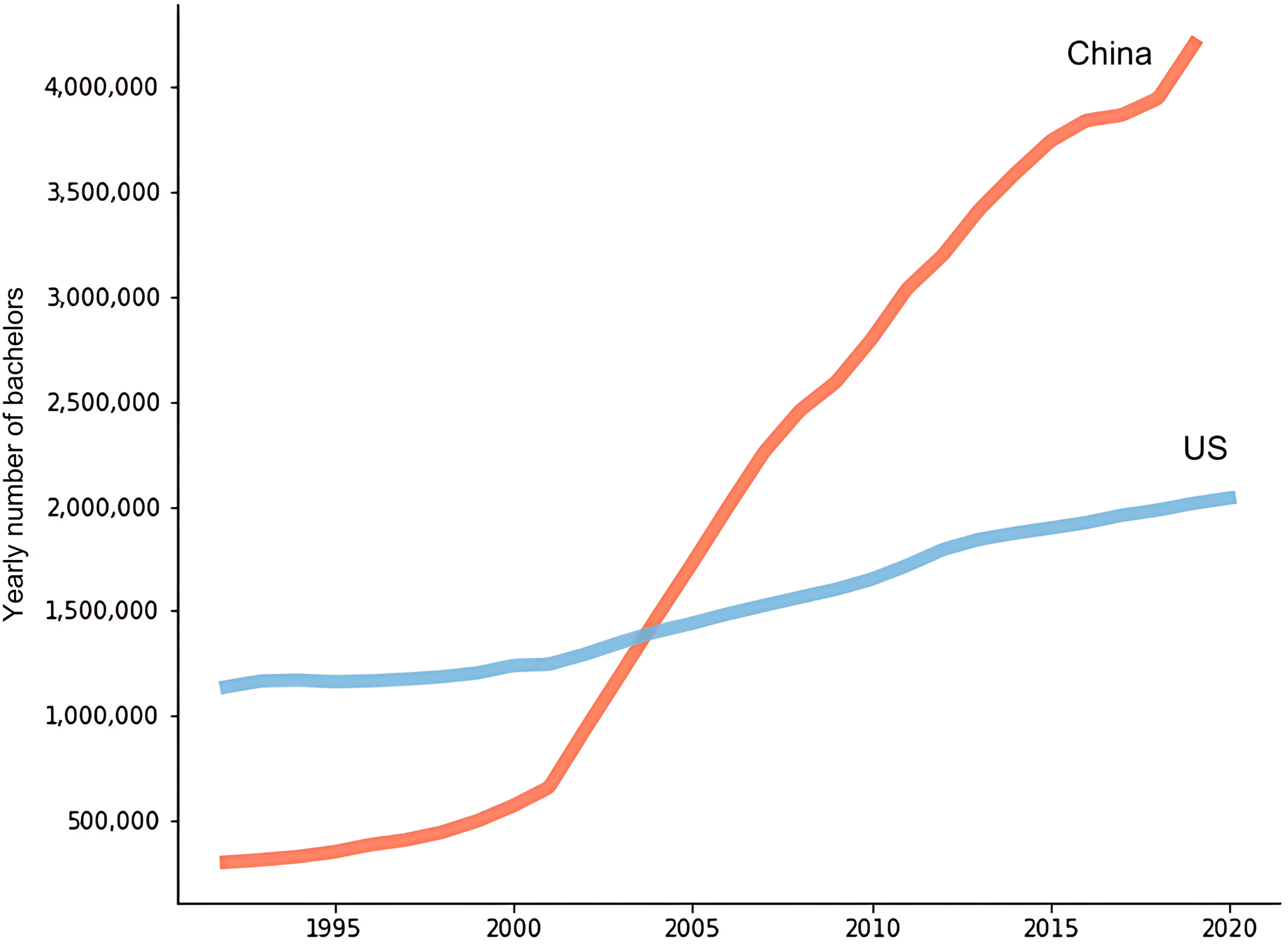
Trends in production of bachelor's degrees 1991–2019, the US and China compared.
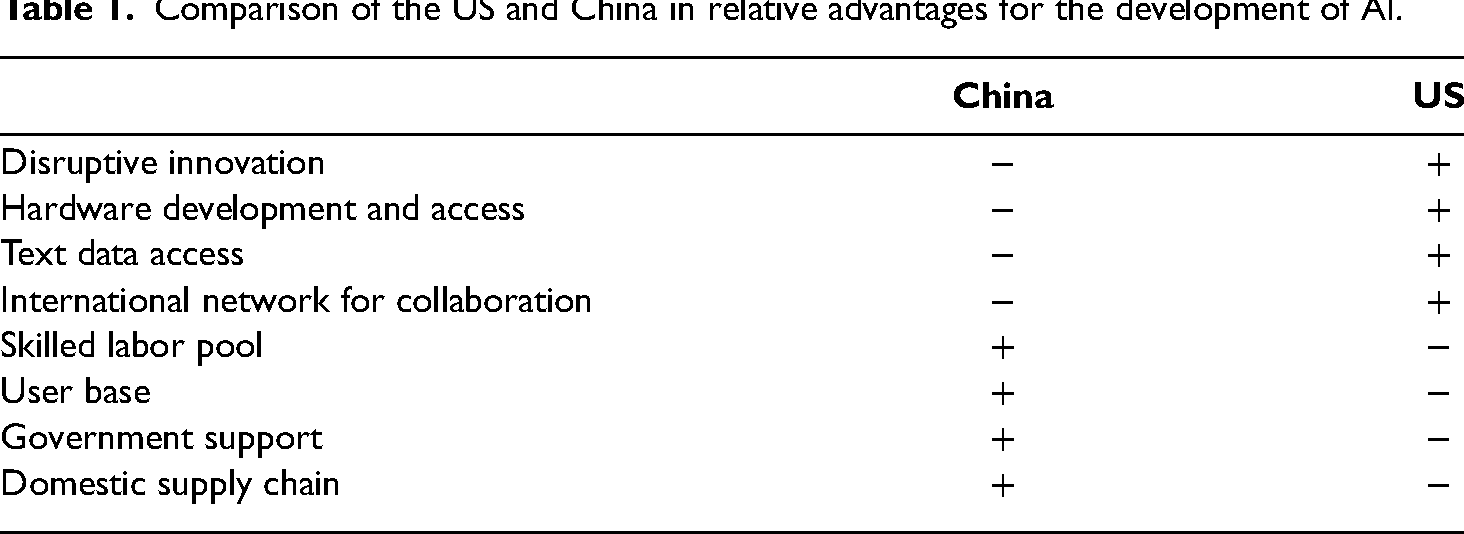
Of course, China also faces challenges in developing GenAI technology. We highlight three prominent ones. First, among the contributions made by Chinese researchers in the field of AI, incremental advancements constitute a significant proportion. Although there are indeed some innovative achievements, disruptive innovations are relatively less common. (Harvard Business Review, 2021). Second, China is now facing US-led restrictions on importing the most advanced computer chips needed for AI deployment (The Nation, 2023). Third, China has a certain gap compared to the US in accessing the necessary amount of text data (Lobachev, 2008). Can Chinese firms simply use English sources for their GenAI implementation? This is unlikely, given China's commitment to a different political system and ideology. On many political and social topics, Chinese perspectives differ, or there is a preference to remain silent. The use of English sources could lead GenAI vendors to be at odds with the ideologically laden government.
Regarding their relationships with other technologically advanced countries, the US and China are positioned quite differently in the AI technology sector. Despite holding a large number of important patents, the US does not manufacture many of the essential components, such as advanced computing chips, for AI technology, and instead relies on international suppliers (Harvard Kennedy School, 2021; The Nation, 2023). While the reliance is underpinned by an international network that has been, to date, stable, the country has enacted policies such as the CHIPS and Science Act in 2022, aiming to incentivize domestic chip manufacturing and strengthen the American semiconductor supply chain. Thus, the US might slowly reduce its dependence on other countries to manufacture essential GenAI components (National Science Foundation, 2023). In contrast, China, facing potential technological blockades from the US and other advanced nations, strives to develop all necessary components domestically (Brookings Institution, 2022; Hoover Institution, 2018; The Nation, 2023). However, in the specific area of computer chip manufacturing, China has yet to succeed in producing high-speed chips required for advanced AI (The Nation, 2023).
Comparison of the US and China in relative advantages for the development of AI.
Beyond technological development, the Chinese population is significantly more receptive to the use of AI compared to Americans. A cross-country survey on attitudes toward AI revealed that 78% of Chinese respondents endorse the statement “Products and services using artificial intelligence have more benefits than drawbacks”, ranking the highest globally in this regard. In contrast, only 35% of Americans agree, placing them much lower in comparison (Ipsos, 2022). Combined with China's lower legal barriers to data usage, this higher public acceptance of AI could lead to a substantially faster rate of AI adoption in China compared to the US in the future.
The impact on the occupational structure
Having discussed the potential for GenAI to generate between-country inequality and why China and the US could emerge as leaders in the space, we now turn to an exploration of how this technology could increase inequality within countries, through disruptions in the labor market and changes in the occupational structure.
Three lines of defense for high-status jobs
One pattern we see across multiple professional fields is that, as workers advance through their careers, their roles change in three ways: (1) tasks performed by people in more senior roles tend to be more varied and involve softer skills (e.g. leadership, communication); (2) where applicable, these roles have greater exposure to the public or are more likely to involve personal contact with clients; and (3) the work they produce becomes associated with a personal, unique identity. As an example, someone may enter the early stages of an academic career as a research assistant. While research assistants can participate in research projects, their tasks are often well defined, such as cleaning and analyzing data using statistical software, reading and summarizing academic work for literature reviews, etc. For these tasks, one research assistant may be a good substitute for another one. Individuals who progress through an academic career might eventually become professors, directors of research centers, or administrators within a university. These senior roles might include some of the same responsibilities that the research assistant is tasked with (e.g. reading academic works), but these represent only a small share of the full set of tasks these individuals perform in a given week. Thus, advancing in an academic career usually increases the variety of tasks these professionals do on a daily basis and increases the amount of exposure to students or scientists within their academic community and potentially the general public. Additionally, the work of senior academics is deeply intertwined with their unique name and professional identity, giving it a sacrosanct quality. For instance, research labs are frequently named after the principal investigator, symbolizing the connection between the scholar's identity and their work.
This can be summarized by a simple substitutability principle for AI job replacement: if a worker can be easily substituted by another worker, he or she has a high likelihood of being replaced by AI. We highlight these three features of senior roles—task variation, human interaction, and personal identifiability—because all three reduce worker substitutability. As described in the National Bureau of Economic Research's (2018) task-based framework for automation, GenAI automates tasks previously done by humans but not necessarily jobs. For this reason, many workers might use GenAI in their workplace to handle or speed up some of their tasks without necessarily being replaced by this technology. In our earlier example, a research assistant can be easily substituted, but a professor or a lab director is not. Similarly, senior attorneys at law firms continue having the day-to-day tasks of practicing law (many of which might become automated) but are also tasked with bringing in new clients and are involved with all aspects of the business.
GenAI is set to continue improving at exponential rates—indeed, the rate at which AI is improving in key tasks relative to human performance is accelerating (Hutson, 2022). As such, these models will rapidly improve in their performance of existing tasks and expand the set of tasks they can perform, becoming increasingly attractive to employers. Crucially, task-based automation means that workers in jobs that involve a diverse range of tasks are less likely to be displaced in the short term because it is more likely that some of their tasks will remain non-automated. This is especially true if some of their job responsibilities involve communicating with and managing other people (“soft skills” work), as employers might be slower to automate these tasks.
With ongoing advancements in Generative AI (GenAI), a significant portion of tasks currently performed by senior professionals, such as professors or senior attorneys, could eventually be automated. Additionally, AI has the potential to enhance soft skills in various ways—for instance, by tailoring communication to align with an individual's social position or personality. Would this lead to major layoffs for workers in these roles? It is impossible to say for certain, but it seems that the exposure to clients serves as a second insulating factor preventing automation. These jobs are part of a broader category of roles that we expect will maintain a human premium—that is, people will be willing to pay to have the job be completed by a human. In the case of an attorney, even if many of the tasks related to handling a case can be automated, those who can afford it might still prefer face-to-face communication with a human lawyer. Indeed, recent studies show consumers prefer human customer service representatives to chatbots (Forbes, 2019), human doctors to medical artificial intelligence (Yun et al., 2021), and human counselors to machine services (Ma et al., 2022). The last few decades of tax accounting technology and trends provide evidence of the human premium in action: although 40 million Americans use technology such as TurboTax to file taxes (ProPublica, 2019), a report by the IRS shows that American taxpayers in income brackets above US$75,000 are more likely to use a paid tax return preparer (Internal Revenue Service, 2022).
To summarize, workers in senior roles have twofold protection: first because of the diversity of tasks they are expected to perform and second because their experience and expertise makes them competitive in the eyes of customers willing to pay a human premium.
The threat of deprofessionalization
An important note is that, as soon as a task or service is effectively automated, the use of GenAI will represent the cheaper option—in the case of TurboTax, for example, the service is free for roughly 37% of taxpayers (TurboTax, 2023). For a consumer to pay the human premium, the worker hired should provide a service that is, in some way, superior to what GenAI can provide. In a world where many legal services might be automated, a consumer seeking legal representation may still seek a human attorney, but this will be less likely to be the case for those seeking an entry level associate with little experience, who may not represent a large enough improvement to the GenAI service to warrant the additional cost. Selective senior lawyers who have already built a reputation for their expertise remain highly competitive and can charge a human premium, but those who are only starting out or have not achieved the same level of success face a higher threat.
As a result, workers performing lower-level roles in these professions are vulnerable because they do not enjoy the protections afforded to high-status workers. Instead of disappearing professions, we may observe disappearing ladders—jobs that used to mark the culmination of a progression through an occupational ladder of increasingly higher-level occupations. While high-level positions are protected from full automation, the traditional rungs (paralegal, research assistant, etc.) are not. The disappearing of ladders is not in itself a new development—for years, social scientists have documented the shrinking share of the American adult population that is in the middle income bracket (for a review, see Pew Research Center, 2015) and the polarizing of the US labor market into high-wage and low-wage jobs (Autor et al., 2006). However, the rise of GenAI could accelerate this trend, threatening jobs in middle and upper-middle income strata and pushing Americans further into the two extremes of the income distribution.
In the absence of traditional occupational ladders and assuming senior level roles remain in demand, how will these positions be filled once current senior workers exit due to retirement? One possibility is deprofessionalization—a large reduction in the number of workers specially trained and skilled to perform specific tasks—a phenomenon we have seen in other occupations throughout history. A classic example is painting, which was once regarded as skilled labor and had a well-established occupational ladder where aspiring painters underwent rigorous apprenticeships under master artists. However, as societal attitudes and needs toward art changed, along with the development of photographic and later video-recording technologies, the occupational ladder largely disappeared. Aspiring painters today have to build their portfolios through a combination of formal education, independent practice, and personal projects, investing their own resources, both time and money, to create a body of work that showcases their abilities. This example provides some evidence of deprofessionalization; although professional painters still exist, those aspiring to obtain that role must train and create projects without compensation, often treating it as a hobby outside of their main source of income. While it might seem improbable at this moment that jobs in accounting, medicine, or law could take a similar path, just as the invention of photography deprofessionalized portrait painters, new technologies such as GenAI could lead to such drastic occupational restructuring.
Implications for higher education
Resource inequality among institutions of higher education is known to have been rising (Xie, 2014). The penetration of GenAI in colleges and universities will likely further intensify institutional inequality. This is because today's teaching functions of colleges and universities can be performed by GenAI in the future, as knowledge can be stored, retrieved, and taught by GenAI. Most higher education instructors may not be able to compete with GenAI for effectiveness and thoroughness in teaching known knowledge. In addition, the arrival of the AI revolution may dramatically reduce the demand for college-level knowledge, because knowledge per se will be no longer as valuable as today in the labor market, a topic to be discussed in the next section. At the same time, college affordability has become a key issue in the US (Baker, 2024) and institutions seeking to reduce costs could turn toward GenAI technology to provide student instruction. Indeed, over the last few decades, universities have dramatically increased the use of part-time, adjunct instructors to reduce expenses (Bettinger and Long, 2010), and the use of GenAI would represent a next step in their effort to increase efficiency. Thus, we might see a deprofessionalization of college teachers in the near future.
However, the value of elite and highly prestigious universities will remain high or even increase in the new AI-dominant era. We conjecture this to be true for three reasons. First, with the widespread use of AI technology to manufacture goods and provide services, new technology creators and new knowledge producers, who are likely to be employed by elite universities and are highly differentiated from each other, will be highly valued. Second, elite universities will likely shift their instructional emphasis from imparting known knowledge to knowledge creation, creative use of AI, and the improvement of non-cognitive (soft) skills. Third, with education of knowledge being secondary, human relationships and social identity will become increasingly important. Universities can fulfill the needs for human bonding among students and give them a strong sense of social identity and belonging, but universities with primarily online instruction or without a robust student community residing near campus may be less equipped to provide this. In the end, we may see an enhanced role for elite universities and fierce competition for first-rate researchers, but the demand for traditional classroom instruction and for ordinary teachers could decline.
The potential role of organized labor
The displacement of middle-income jobs by AI could be resisted by organized labor. A historic example of this was the 2023 Writers Guild of America (WGA) strike, one of the longest labor disputes in the history of US entertainment. Union leaders representing more than 11,000 screenwriters sought to increase payment and job security for writers and explicitly demanded limits to the use of AI for entertainment content production. The eventual agreement between the WGA and the Alliance of Motion Picture and Television Producers contractually prevents the use of LLMs to write scripts or to use GenAI output as source material and prohibits use of writers’ material as training data, effectively reducing the possibility for screenwriting to become automated in the near future.
The WGA strike began just months after OpenAI released ChatGPT and represented one of the first large-scale labor conflicts between human workers and GenAI. However, organized labor and collective-bargaining agreements have long played a role in protecting workers from displacement due to technological advances. One early example comes from the railroad industry, which underwent a rapid transition from steam to diesel locomotives in the decades following World War II. The new diesel-based technology completely restructured the railroad work force and eliminated the need for firemen who tended the fire to power a steam engine. However, the Brotherhood of Locomotive Firemen and Enginemen was a strong union that protected firemen by demanding that firemen be included in diesel crews (Klein, 1990). While the union eventually lost a long legal battle to railroad companies that rendered the fireman's job as no longer necessary, they were able to protect these jobs for 26 years after railroads fully transitioned to diesel, allowing many firemen to seek training to become railroad engineers or employment elsewhere (Chicago Tribune, 2021). Similarly, the development of technologies such as letter sorting machines, optical character readers, and barcode sorters affect clerks and mail handlers in the postal service, but the American Postal Workers Union fought for a “no layoff” contract clause that prevented these workers from losing their jobs (Rubio, 2020).
While these examples illustrate the power of collective bargaining, successfully preventing or alleviating job displacement has historically depended on strong labor unions and strong federal labor regulations upholding workers’ rights. Yet, in the US, union membership peaked in 1950 and steadily declined in the decades that followed (US Department of the Treasury, 2023), leaving many workers today with relatively less bargaining power to counter the effects of GenAI-induced automation. In addition, a more globalized economy has made it easier for companies to outsource labor to other countries, further weakening worker power. Nevertheless, the share of Americans approving of unions in 2022 and 2023 hovered around 70%, higher than it has been since the 1960s (Gallup, 2023). The labor movement also saw historic wins in 2023, with workers participating in the largest number of strikes in recent history (Economic Policy Institute, 2024). It is thus possible that we will see a resurgence of the labor movement that could prevent or at least slow down job losses.
In contrast to the US, unions in China operate under a vastly different framework, primarily organized under the All-China Federation of Trade Unions (ACFTU), which is closely aligned with the Chinese Communist Party (Zhang, 2024). Unlike independent unions in Western contexts, the ACFTU serves as a state-sanctioned entity that often strikes a balance between addressing workers’ grievances and supporting government economic goals. Still, growing dissatisfaction among members has promoted the ACFTU to become more responsive to workers and some grassroot labor organizations have emerged (Chan, 2020). It is thus possible that organized labor may prevent or ameliorate labor shocks produced by GenAI in China, but the centralized and state-controlled nature of its labor system may hamper these efforts.
The big picture
Economy types and associated characteristics.
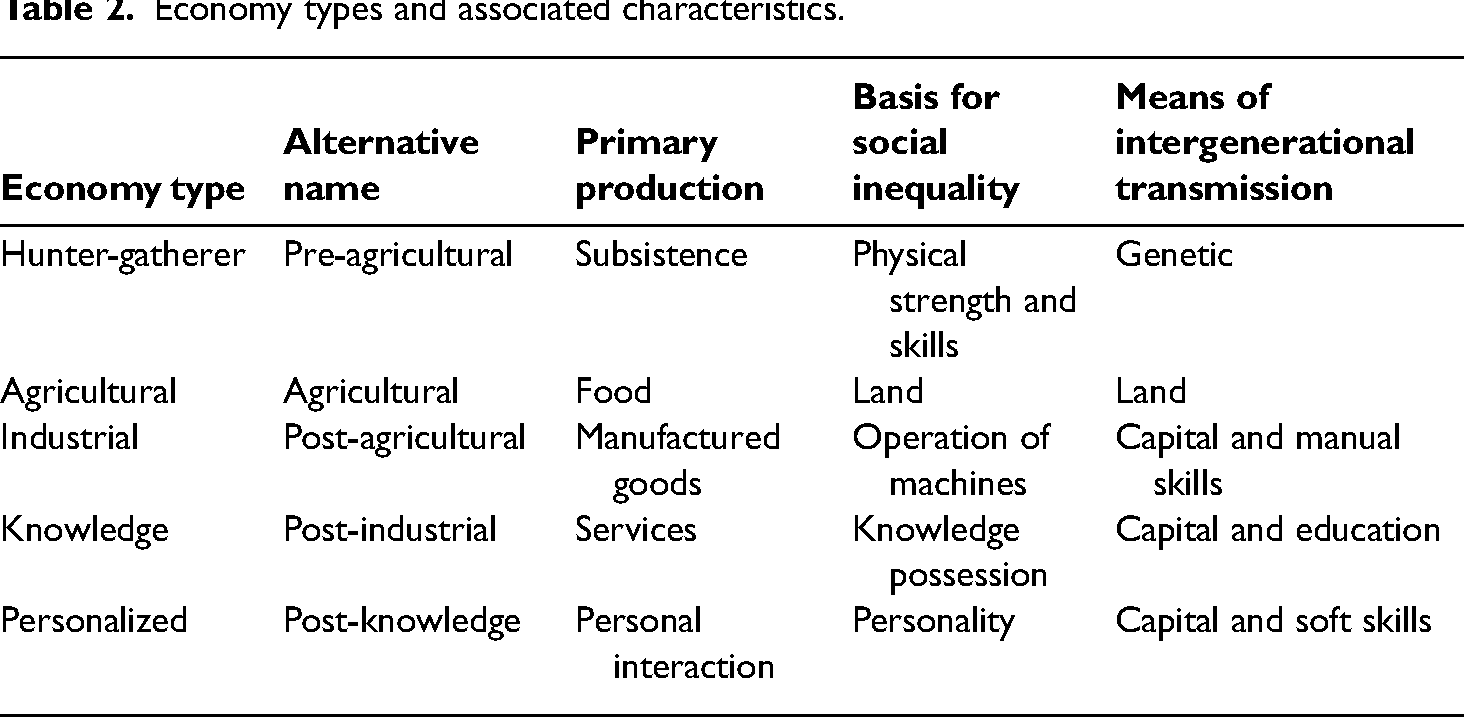
As far as we know, social inequalities have always existed in every human society, including the most primitive ones. However, the primary basis for social inequality has evolved alongside technological advancements. In a hunting and gathering economy, social inequality existed but was less pronounced than in later economies (Smith et al., 2010; Smith and Codding, 2021). Wealth and status were based on individual differences in food yield, which largely depended on “considerable strength and stamina, visual acuity, and other aspects of good health” (Smith et al., 2010). Production was for immediate subsistence, as there was no storage of food, and mobility was high, preventing people from staying in one place for long. As a result, there was little accumulation of wealth or possessions (Smith et al., 2010) and the transmission of social advantages and disadvantages was thus limited, primarily occurring through genetics and luck.
Following the agricultural revolution, the agricultural economy became characterized by permanent settlement, human organization, and the rise of inequality (World Economic Forum, 2018). With the advent of agriculture, humans began to own private property, the most significant of which was land. As agricultural production is heavily dependent on land, land ownership became the primary basis for social inequality; intergenerational transmission of social advantages and disadvantages took the form of land inheritance. Later, the industrial revolution brought along machines that replaced human and animal power as the main sources of production (Bell, 1973; Stearns, 2020). In the industrial economy, manufactured goods become abundant, improving the standard of living beyond subsistence for the first time in history (Clark, 2007). For a relatively small number of capitalists, ownership of capital became a source of income, known as property income (Piketty, 2014). For most people, however, operation of machines formed the basis of labor income. Intergenerational transmission of social advantages and disadvantages in this economy thus took the form of skill transfers and capital inheritance.
Most recently, we have been experiencing a post-industrial economy known as the knowledge economy. This concept is extensively discussed by Bell in his landmark 1973 book The Coming of Post-industrial Society. The primary output of the knowledge economy is services. Much of the routine work is replaced by computers, and knowledge becomes increasingly important. This is evident as many professional services, such as in the legal, health, financial, and educational sectors, require specialized knowledge. Consequently, parents are strongly incentivized to invest in their children's education as a form of intergenerational transfer. Of course, for the small minority who are wealthy, capital remains an important factor.
Now, as AI technology continues to grow, we may arrive at a post-knowledge economy that will bring with it new forms of intergenerational transmissions of inequality. We conjecture that GenAI will render the possession of knowledge less important in the labor market. Not only the manufacturing of goods but also the provision of services will be automated by AI-powered machines so most people may not need to work many hours, as machines can perform tasks on their behalf. If the production of these technologies continues to be concentrated in a few countries, this could increase the economic dependence of smaller countries on nations like the US and China and potentially lead to pernicious forms of cultural domination. In addition to between-country inequality, social groups within countries could also become deeply divided, with a tiny minority occupying elite positions and working long hours while the vast majority contribute little directly to the production of goods and the provision of services. This could bring with it a problem of disappearing ladders, where traditional occupational career paths are disrupted, and the labor market becomes even more deeply polarized.
In the future AI economy, what might matter the most? For a small minority, capital and ownership of AI technology as means of production will remain important and will be passed on to the next generation. For workers already in high-status positions, the diversity of tasks they are expected to perform, their high exposure to clients, and the fact that their work may be uniquely associated with their personal identity will serve as job protections. Workers in low-income positions who perform manual or person-to-person service jobs will also face a less immediate threat from AI and might not experience the shocks of this economic transition as acutely. However, many workers in middle-income jobs are already feeling the impact of these new technologies and are at higher risk of replacement. For these workers, personality and soft skills might begin to play outsized roles for their labor market outcomes. Workers exposed to GenAI are likely to be valued for how effectively they use AI (their “Artificial Intelligence Quotient”, as coined by Qin et al., 2024) and how they present themselves to others. Social, as well as personal, identity will be paramount. So will be personal ties. Soft skills, including the ability to utilize AI, will become extremely important. Thus, much of the intergenerational transmission of social status may take the form of these soft skills.
Conclusion
GenAI will most likely grow in importance and fundamentally transform humanity in ways we cannot fully anticipate at this point. Given the potential for these new tools to exacerbate the already growing levels of inequality in countries like the US and China, it is of utmost importance to create policies that regulate these technologies and counteract their possibly harmful distributional effects. In 2024, the US Department of Labor announced a new set of principles meant to provide guidance for employers seeking to adopt GenAI technology to “enhance job quality and protect workers’ rights” (Department of Labor, 2024). Although such guidance is a useful step, designing effective policies to guide the GenAI transition is hard to do at the federal level given that each industry—and indeed, each firm—will have very particular automation needs, making their actions hard to regulate. Organized labor could also play a crucial role in minimizing job losses and shielding workers from some of the more harmful effects of automation, but the labor movement faces steep challenges such as right-to-work laws and anti-union tactics from employers that make organizing difficult. To ensure a smoother transition into the AI economy, countries would be well advised not just to regulate GenAI technology but also to strengthen their laws protecting unions to ensure a healthy balance of power.
There is a scale factor to the development of GenAI technology, affording large countries advantages relative to others. The US and China are currently the leaders in the GenAI space and will continue to leverage their advantages over smaller countries. Given the corpus specificity and associated language specificity of GenAI technology, the two countries will provide services to other countries with content reflecting different political systems and cultures. We anticipate fierce competition between the US and China for dominance of GenAI technology, as the stakes are high—indeed, global.
We speculate about the forthcoming arrival of a post-knowledge society as a result of the AI revolution. If products and services can be readily provided by AI-powered machines, we anticipate large-scale displacement of jobs. Displacement is particularly likely to occur for workers who are now considered the middle class, such as teachers, accountants, clerks, computer programmers, engineers, editors, doctors, and lawyers. Workers both at the very top and at the bottom of the social hierarchy are less likely to be displaced. Knowledge and hard skills will become less important, but soft skills will increase in importance. In this future AI-driven society, people will care less about the material conditions (such as quality) of products and services, as they will be little differentiated due to AI, but more about who provides products and services. In other words, personal identity will gain significance. In shopping for products and services, people will be swayed less by objective criteria than by personal subjective tastes. Individuals and companies will be successful not for meeting other people's material needs but their psychological needs—making them happy and satisfied.
As with the other technological advances described earlier, GenAI has the potential to boost economies and increase standards of living by reducing the costs of goods and services and allowing workers more time to pursue personal interests, engage in creative endeavors, and contribute to their communities. However, as we argue in this paper, this technology is also poised to increase between and within-country inequality if the transition to an AI-driven society is not managed carefully. Proper government regulation is crucial to ensure ethical standards, mitigate risks, and foster an inclusive environment where the benefits of AI are widely shared.
Footnotes
Acknowledgments
We are grateful to Wen Liu, Gou Wu, and Dean Minello for their excellent research assistance and to Qing Huang, Shiyuan Li, and Yuqi Nie for their proofreading. The ideas expressed herein are those of the authors.
Contributorship
Yu Xie conceived the paper. Both authors did research and contributed to the writing of the paper and approved the final version of the manuscript before publication.
Declaration of conflicting interests
The authors declared no potential conflicts of interest with respect to the research, authorship, and/or publication of this article.
Funding
The research was partially supported by the Paul and Marcia Wythes Center on Contemporary China and Office of Population Research at Princeton University.
