



Abstract
China has undergone extensive changes since its transition from the socialist era to the reform era in 1978. It is said there was a revival of traditional gender ideologies in the reform era. Nonetheless, individuals’ socioeconomic status improved greatly, and according to cohort replacement theory and interest- and exposure-based theories, this should imply progress in gender attitudes. Drawing on nationwide repeated cross-sectional data from the 2010–2015 Chinese General Social Survey (N = 44,900), this study explores changes in gender attitudes in relation to cohort in China. Sex-stratified hierarchical age–period–cohort cross-classified random-effects models are used to (a) explore cohort differences in attitude for four gender norm dimensions (ability and work dimensions in the public sphere and division of labor and marriage dimensions in the private sphere), and across three cohort groups, that is, the “war baby” (born 1926–1948), the “pre-reform baby” (born 1949–1977), and the “reform baby” (born 1978–1995) groups, and (b) examine how cohort differences in relation to each attitude have been modified by socioeconomic status and demographic characteristics, and how men’s and women’s gender attitudes are influenced in different ways by these factors. The results reveal the uneven pace of development toward egalitarian gender ideologies in China, with respondents being more supportive of egalitarianism in the public sphere than in the private sphere. Although the movement toward greater gender egalitarianism in the public sphere started from the pre-reform baby cohort, the movement in the private sphere began to emerge only in the reform baby cohort. Additionally, the sex gap in gender attitudes widened and peaked in the reform baby cohort. Women’s attitudes were influenced to a greater extent by socioeconomic and demographic factors than men’s.
Introduction
Gender ideology, which is sometimes termed gender attitudes, gender-related attitudes, or attitudes about gender, is used to describe an individual’s level of support for gender equality. Various studies have approached this question from different perspectives, including the division of work (both paid and unpaid) based on the notion of gendered “separate spheres” (Davis, 2007; Davis and Greenstein, 2009), and people’s views on men, women, and alternative gender identities (Philips, 2001). Gender ideologies in China became markedly different when the country transitioned from the pre-reform era to the reform era (Bian, 2002; Wu, 2019). A number of studies on shifts in gender attitudes between the two eras have revealed signs of a return to traditionalism (the “backlash” thesis), for example, declining egalitarianism in gender attitudes in recent male cohorts (Pimentel, 2006), an increased domestic orientation among recent female cohorts (Zuo, 2014), and a return to traditional attitudes toward marriage (Xu, 2016). However, both men’s and women’s socioeconomic status, based on their employment and education, have shown significant improvement in the reform era, and this, according to cohort replacement theory and interest- and exposure-based hypotheses, predicts progress toward more egalitarian gender attitudes. This study intends to understand this paradox by examining the cohort patterning of gender attitudes among Chinese adults, and the socioeconomic and demographic variations that influence “the cohort patterning”.
Previous findings supporting the backlash thesis are interesting and suggestive. Changes in a given outcome can be attributed to three types of causal effects (Glenn, 2005): age, period, and cohort. However, the backlash thesis confuses the period effect (such that the backlash thesis applies to nearly all social and demographic groups in China) with the cohort effect (such that the backlash thesis only applies to the more recent cohorts) and the age effect (such that the backlash thesis reflects the developmental aging process). There has been insufficient research on disentangling cohort effects on gender attitudes from age and period effects in China. Until age, period, and cohort effects are estimated simultaneously, our understanding of the backlash thesis remains incomplete.
The number of gender ideology studies in China is substantial and growing. However, our understanding of changes in gender attitudes remains incomplete. First, to date, very little research has analyzed changes in gender ideologies across a variety of domains. Previous studies have explored shifts in gender norms by constructing one or two indexes from several attitudinal items (Shu and Zhu, 2012) or simply by using a single year of data (Liu and Tong, 2014). Although these studies directly capture attitudinal changes as a whole, they are inefficient in facilitating a more nuanced understanding of changes in gender norms in China. As will be elaborated below, this is an important oversight in gender ideology research. Second, to detect changes in gender attitudes from the pre-reform era to the reform era, taking sex and cohort into account is essential. This study analyzes 70 birth cohorts (born 1926–1995) from a comprehensive nationally representative survey (N = 44,900), and extends the previous literature by examining sex and cohort differences in attitudes for four gender norm dimensions (ability and work dimensions in the public sphere, and division of labor and marriage dimensions in the private sphere), and across three cohort groups: the “war baby” (WB, born 1926–1948), “pre-reform baby” (PB, born 1949–1977), and “reform baby” (RB, born 1978–1995) groups. Third, although much literature has documented the strong association between individuals’ socioeconomic status/demographic characteristics and their gender attitudes, little evidence on how men and women are influenced differently by these factors in China exists. This study contributes to the literature by examining how cohort differences in relation to each attitude have been modified by socioeconomic and demographic characteristics and how men’s and women’s gender attitudes are influenced in different ways by these factors. This study also speaks to the backlash thesis, which generally holds that the gender inequality gap is widening in post-reform China.
Changing gender ideologies
Gender ideologies in the Western world
Recent research suggests that progress in gender equality differs between the public realm of work and the private realm of family (Pepin and Cotter, 2018). Correspondingly, there is a public–private split in gender attitudes (Scarborough et al., 2019). However, despite great gender convergences in both the public sphere (Blau and Kahn, 2017; Goldin, 2014; Juhn and McCue, 2017) and the private sphere (Altintas and Sullivan, 2016; Bianchi and Milkie, 2010; Fahlén, 2016), the period from the mid-1990s to the early 2000s represents a lost decade in the history of the gender revolution in the USA, given that the level of gender egalitarianism appears to have been much lower than the upward trends that emerged in the 1960s would have predicted (Shu and Meagher, 2017). The gender revolution had stalled, and this was reflected in both the public and private spheres. In the public sphere, specific indicators of the conservative turn were as follows: the gender pay gap had been arrested; there was a slower decline in occupational sex segregation; there was a slower increase in women’s labor force participation; and there was a slower convergence of gender-segregated college majors (Blau and Kahn, 2017; Charles, 2011; England, 2010). In the private sphere, gender egalitarianism advanced at a much slower pace: there was little change in dyadic heterosexual dating behaviors (England, 2010) and only a minor improvement in terms of men’s participation in domestic tasks; the lion’s share of the housework and childcare was still being done by women (Coltrane, 2000; Lachance-Grzela and Bouchard, 2010). In addition, outside the USA, several other Western countries showed signs that the gender revolution had stalled there as well (Grunow et al., 2018; Knight and Brinton, 2017; Van Egmond et al., 2010).
Changes in gender ideologies partly contributed to the stalling of the gender revolution in the Western world. Traditional gender ideologies reflect the gendered “separate spheres” model, in which men are career-oriented in the public sphere and women are family-oriented in the private sphere, whereas egalitarian gender ideologies reflect a situation in which men and women are equally breadwinner and caregiver. Gender essentialism refers to the deeply embedded and widely shared cultural beliefs that men and women are innately and fundamentally different in interests and skills (England, 2010). However, when blended with feminist principles of gender equality, this can turn into a form of “egalitarian essentialism” (Charles and Grusky, 2004; Cotter et al., 2011). The rise of egalitarian essentialism—a “separate but equal” gender ideology (Charles, 2011; Charles and Bradley, 2002)—is viewed as one possible factor that contributed to stalling the gender revolution (Cotter et al., 2011). However, although extensive literature has documented changing gender ideologies in the Western world, little research using nationally representative samples exists on how gender ideologies in both the public sphere and the private sphere have changed in China.
China in the reform era: A return to traditionalism?
From the pre-reform era to the reform era, Chinese women’s roles in the public and private spheres have experienced a transformative shift. In the pre-reform era, the socialist state held that the key approach to women’s liberation was their equal participation in production outside of the household (i.e., in the public sphere), on the basis of which women could control their lives without subjecting themselves to the traditional patrilineal and patriarchal family system. Along with the intensified socialization of household tasks, the strong influence of socialist gender egalitarian propaganda led to women’s near-total labor force participation (Parish and Busse, 2000). The conventional Confucian gender norms that required women to stay at home were repudiated, and new spaces were created for women in the public sphere. As a result, in the pre-reform era, people’s attitudes toward women’s role in the public sphere were more progressive than attitudes toward their role in the private sphere. In revisiting two female ideals of the pre-reform era (female model workers and “iron girls”), later studies showed that these female ideals seldom challenged traditional gender roles (Hershatter, 2000; Honig, 2000). Empirical research has also revealed that the socialist state made great progress in gender equality in the public sphere but little in the private sphere (Zuo and Bian, 2001).
In 1978, China entered the reform era. Changing ideologies have ambiguous implications for gender equality. On the one hand, much of the socialist gender discourse was undone and the original belief that women’s emancipation should result from their participation in nondomestic labor was rejected (Jacka, 1990). An ideological shift from the Marxist gender egalitarian ideology to the rejuvenated Confucian patriarchal tradition took place in the reform era (Ji et al., 2017). Long-held beliefs about “appropriate” gender divisions were revived, for example, “women inside the home and men outside the home”, and women’s traditional role in the private sphere was reemphasized. Therefore, some research points out that the marked withdrawal of state efforts to promote gender equality contributed to women’s increasingly marginalized status in the reform era (Jacka, 2013).
On the other hand, economic reform brought considerable gains for both men and women. Leading changes occurred in areas such as education and paid work (Wu and Zhang, 2010). As such, people in the reform era may have displayed more egalitarian gender attitudes due to improved educational attainment and better labor market outcomes (the mechanisms will be discussed in the next section). Together, these two points suggest an unclear picture of the cohort trends in egalitarian gender attitudes among contemporary Chinese adults.
Past research on trends in gender attitudes has provided an informative set of theoretically grounded hypotheses with regard to sources of change in such attitudes, and these can be grouped into two levels: the macrolevel dynamic that focuses on the cohort replacement effect, and the microlevel mechanism that focuses on individual characteristics (Brewster and Padavic, 2000). Following this framework, the present research extends previous research on gender attitudes by exploring cohort changes and individual-level variations in gender attitudes across several dimensions.
Cohort changes and individual-level variations in gender attitudes
Cohort replacement theory assumes that attitudes developed during childhood tend to persist over a person’s life course and predicts that belief trends result from the ongoing replacement of older cohorts by younger ones whose members have largely different childhood experiences and subsequent attitudes (Alwin, 1990; Brooks and Bolzendahl, 2004). Changes in gender attitudes are part of a larger process of changes in the belief system. Thus, in relation to gender ideology, cohort replacement theory refers to changes in gender ideology that take place when more recent cohorts age into the adult population and replace previous more traditional cohorts, resulting in a population-level shift in attitudes (Davis and Greenstein, 2009). Empirical research reveals more egalitarian gender attitudes in recent cohorts than previous ones, indicating the crucial role of cohort replacement in driving changes in gender attitudes (Brewster and Padavic, 2000; Brooks and Bolzendahl, 2004; Ciabattari, 2001). Additionally, some research reveals a wider sex gap in egalitarian gender attitudes in more recent cohorts as compared with previous cohorts (Brewster and Padavic, 2000; Ciabattari, 2001).
With regard to microlevel mechanisms, previous gender ideology research has its roots mainly in interest- and exposure-based theories. Interest-based theories assume that individuals favor egalitarian ideologies when their interests benefit from gender equality (Bolzendahl and Myers, 2004). As such, women, whose interest structures are based on hegemonic gender beliefs that are less favorable, are expected to be more interested in challenging gender traditionalism than men (Van Egmond et al., 2010). Exposure-based theories argue that exposure to pro-egalitarian ideas and situations will lead to an (intensified) embracement of gender egalitarianism (Bolzendahl and Myers, 2004). Both interest- and exposure-based theories have made many consistent and robust predictions about individual-level variations in gender attitudes. Socioeconomic status, family structure, and demographic characteristics are all closely related to gender attitudes (Brooks and Bolzendahl, 2004). Of interest in this study are an individual’s socioeconomic and demographic characteristics, including education, employment status, party membership, marital status, family structure, and hukou (household registration status).
Both types of theory suggest that education and employment are positively related to egalitarian gender attitudes. From an exposure perspective, education has an enlightening effect because it challenges gender stereotypes and cultivates new male and female ideals (Brewster and Padavic, 2000). From an interest point of view, education can change interest structure in that better-educated individuals, particularly women, are likely to continue to devote themselves to the public sphere, accumulate human capital in the labor market and, thus, have a strong desire for gender equality (Bolzendahl and Myers, 2004). In a similar vein, employed women are more likely to embrace egalitarian gender ideology than those who are unemployed, because the former group would benefit more from the improved working environment and have greater exposure to egalitarian gender culture.
Other than examining the effect of differences in education and employment on gender attitudes, this study also examines the influence of party membership, marital status, family structure, and hukou on the same. Members of the Chinese Communist Party (CCP) may be more eager to embrace egalitarian gender attitudes than nonmembers, due to the legacy of the party’s influential gender egalitarian discourses in the pre-reform era. Empirical research shows that gender role stereotypes are reinforced after people enter marriage (Brooks and Bolzendahl, 2004; Van Egmond et al., 2010) and transition into parenthood (Endendijk et al., 2018). A large household size may also imply conservative gender attitudes. In addition, residents with urban hukou are more exposed to egalitarian culture and, thus, are more likely to embrace gender equality. For instance, recent research shows that urbanization greatly reduces the number of household tasks women have to perform, even for women who have not obtained urban hukou after adjusting for selection effects (Luo and Chui, 2019a). Thus, urban residents are expected to hold more egalitarian gender attitudes.
Multidimensionality of gender attitudes
Recent research points out that although operationalizing gender ideology as a unidimensional construct ranging from traditional to egalitarian prevails in the literature, this approach is problematic, given that gender attitude changes are more complex than a single continuum with traditionalism at one end and egalitarianism at the other. Indeed, some countries can promote gender equality in the public sphere and limit it in the private sphere at the same time (Yu and Lee, 2013). Recent research suggests viewing gender ideology as a multidimensional concept (Grunow et al., 2018; Pepin and Cotter, 2018; Scarborough et al., 2019).
Thus, instead of constructing a single gender attitude index, this study takes the multidimensionality of gender attitudes into account. This approach has several strengths. First, by dissecting gender attitudes, more comprehensive tests of changes in gender ideologies for different dimensions can be provided. Second, such an analytic strategy allows for a more detailed exploration of sex differences for various gender attitude dimensions and enables the examination of whether gender attitude changes for each dimension follow the same trend. Third, employing this type of analytic strategy echoes the recent claims that gender ideology research needs to analyze changes in gender ideology by dimension, because gender itself is multidimensional and the pace and degree of change varies (Pepin and Cotter, 2018).
Method
Data
This study is based on an analysis of the 2010, 2012, 2013, and 2015 waves of the Chinese General Social Survey (CGSS), one of the earliest representative ongoing survey projects in China. The CGSS adopts a multistage stratified sampling design, with county-level units as the primary sampling units and community-level units (including neighborhood and village committees) as the secondary sampling units. Within each community, 25 households are randomly sampled, and in each household, one adult aged 18 or over is randomly selected to serve as the respondent. This study does not add an upper limit for age, so that the age range can be as large as possible. The CGSS data yield several benefits. First, the large sample size allows an investigation of both cohort changes in gender attitudes and individual-level heterogeneities in gender attitudes. Second, they offer a comprehensive set of indicators for gender attitudes, making it possible to test the uneven changes in gender attitudes across various domains. The four cross-sectional waves of data were pooled. A small proportion (about 0.5%) of the cases had missing values for covariates and were dropped. The average number of respondents for the 2010, 2012, 2013, and 2015 waves was around 11,000. The overall sample size was 44,900.
Dependent variables
Gender attitudes were measured according to four dimensions: two dimensions related to attitudes in the public sphere and two related to attitudes in the private sphere. The public sphere variables included attitudes toward women’s equal ability and toward men’s and women’s right to work during job shortages. Respondents were asked whether they agreed that “men are born more competitive than women” (the ability dimension) and “women should be laid off first during a job shortage” (the work dimension). The private sphere variables included questions about the traditional division of labor and marriage norms. The two variables were as follows: “men should be career-oriented and women family-oriented” (the division of labor dimension) and “a good marriage is better for a woman than a good job” (the marriage dimension). Although all dimensions measured gender attitudes, the ability, division of labor, and marriage dimensions measured essentialist ideologies in particular. The agreement was measured on a 5-point scale: “completely disagree”, “somewhat disagree”, “neither agree nor disagree”, “somewhat agree”, and “completely agree”. These items were recoded when necessary so that higher values indicated more egalitarian attitudes. As mentioned above, rather than combining these measures into a single gender norm index, we examined each gender attitude separately, mainly because more recent research suggests viewing gender ideology as a multidimensional concept and deconstructing it (Grunow et al., 2018; Yu and Lee, 2013), and also because gender ideology in the pre-reform era clearly had different emphases in relation to public and private spheres.
Covariates
The first key variable was the respondent’s sex (1 = female; 0 = male). Cohort was measured in two forms. First, in the descriptive section, the sample was divided into 70 cohorts according to the respondents’ birth years, but with two exceptions: 210 respondents who were born before 1926 were coded as the 1926 cohort and 187 respondents who were born after 1995 were coded as the 1995 cohort to ensure sufficient sample sizes for each cohort group. Eventually, 70 cohort groups ranging from 1926 to 1995 were obtained. Second, in the modeling section, respondents were grouped into three cohort groups: the WB cohort (born 1926–1948), the PB cohort (born 1949–1977), and the RB cohort (born 1978–1995).
Due to insights from a previous systematic review on gender ideology (Davis and Greenstein, 2009), socioeconomic and demographic factors were adjusted for. These included the respondent’s age, education, employment status, party membership, marital status, family structure, hukou, survey year, and region. Age was reported in the single survey year. Education was a continuous variable and was centered on the cohort means because of the different meanings of years of schooling across cohorts. Employment status was measured by a dummy variable (1 = employed; 0 = unemployed). Party membership was a dichotomous variable (1 = CCP member; 0 = nonmember). Marital status was a dummy variable (1 = married/cohabiting; 0 = single/divorced/separated/widowed). Family structure was captured by two variables: number of children and household size. Hukou was a dummy variable (1 = urban; 0 = rural). Period was measured as survey years from 2010 to 2015. Region was coded as a set of dummies: “south mountainous area” (reference category), “inland area”, “coastal area”, “northeast area”, and “megacity”.
Analytic strategy
The linear dependency among age, period, and cohort (i.e., period = cohort + age) makes disentangling the confounding influences of age, period, and cohort effects difficult. Despite critiques of its ad hoc assumptions and sensitivity to model parameterizations (Bell and Jones, 2015, 2018; Fosse and Winship, 2019), the hierarchical age–period–cohort cross-classified random-effects model (HAPC-CCREM) (Yang and Land, 2006, 2008) is the current standard for attitudinal research (Piotrowski et al., 2019). The HAPC-CCREM takes into account the embeddedness of respondents in repeated cross-sectional surveys within a time period by birth cohort cross-classified matrix. To minimize dependency, the present study treats cohort as the level 1 characteristic and single-year age groups and periods as level 2 characteristics. The level 1 model takes the following form

Here, i refers to individuals within j age groups and k years, and X denotes the vector of covariates, including education, employment status, party membership, marital status, family structure, hukou, and region. The slope coefficients,
The level 2 model takes the following form

Here,
The analysis proceeded in three steps. First, cohort profiles in each egalitarian gender attitude were represented graphically for the full sample and subsamples by sex. Second, the HAPC-CCREM with only age, period, and cohort effects was fitted for the full sample and by sex. Third, the sex-stratified HAPC-CCREM with socioeconomic and demographic factors was fitted for each attitudinal item.
Results
Table 1 presents the means and standard deviations of relevant variables for the total sample and by cohort groups. In general, the WB cohort were in their late adulthood during the survey time, the PB cohort were in their middle adulthood, and the RB cohort were in their young adulthood. Thus, fewer WB respondents had paid work but most PB and RB respondents were employed at the time of the survey. The average years of schooling increased across the WB, PB and RB cohorts (6.41, 9.37 and 12.77 years, respectively). The respondents’ average number of children showed a declining trend across successive cohorts (3.13, 1.69 and 0.70, respectively). The proportion of urban hukou holders was nearly the same for the three cohorts. The average household size, measured by the number of family members cohabiting with the respondent during the survey time, was 2.28 for the WB cohort and 3.18 for the RB cohort.
Descriptive statistics of sample characteristics.
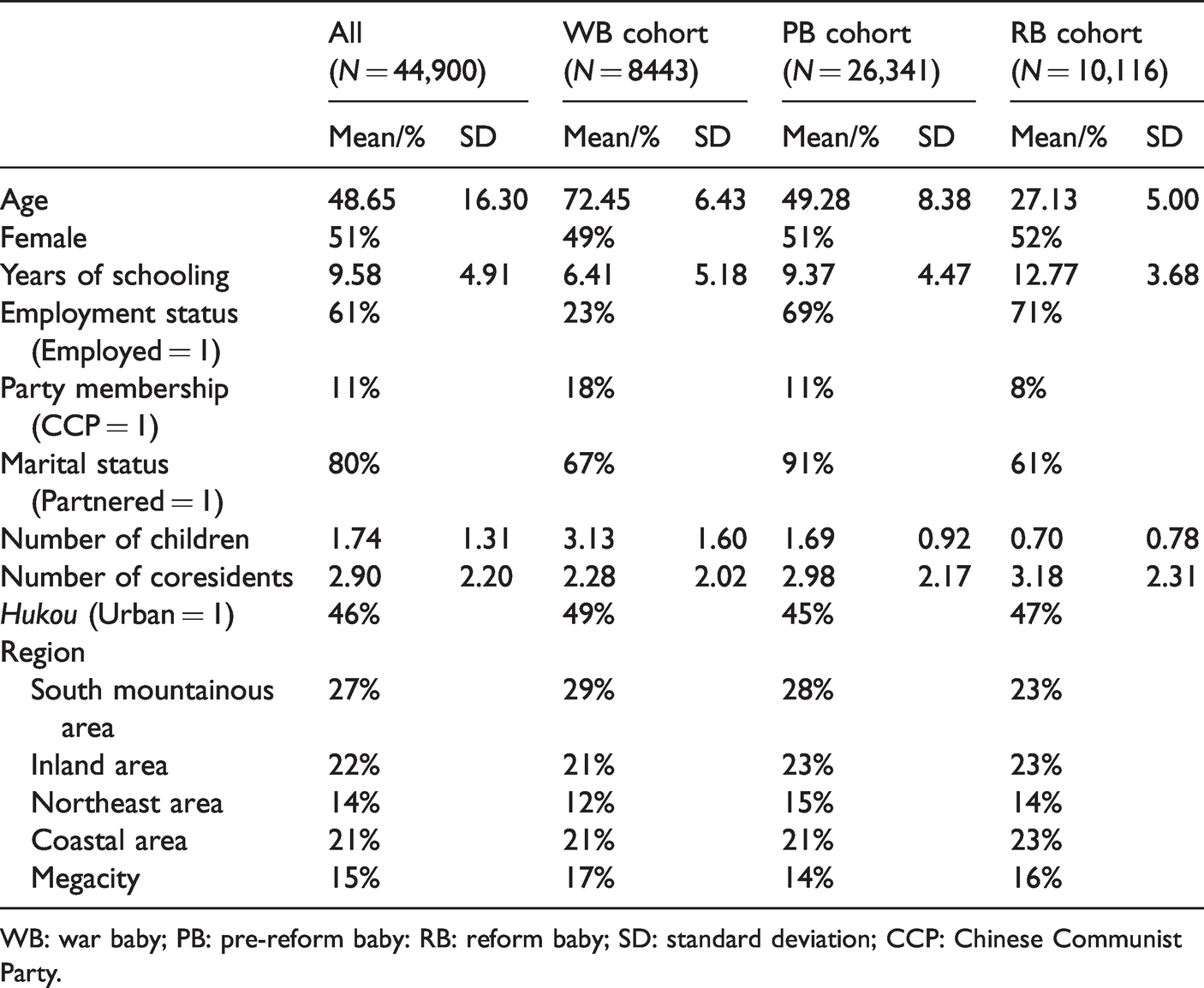
WB: war baby; PB: pre-reform baby: RB: reform baby; SD: standard deviation; CCP: Chinese Communist Party.
Figure 1 shows the mean values of each gender attitude by birth cohort. The two red vertical lines (color online) refer to 1949, when the People’s Republic of China (PRC) was formally founded, and 1978, when comprehensive social reforms (also known as reform and opening-up) were implemented. The two lines also categorize the respondents into three cohorts: WB cohort (born 1926–1948), PB cohort (born 1949–1977) and RB cohort (born 1978–1995). Gender attitudes were measured for the four dimensions mentioned above: ability, work, division of labor, and marriage.
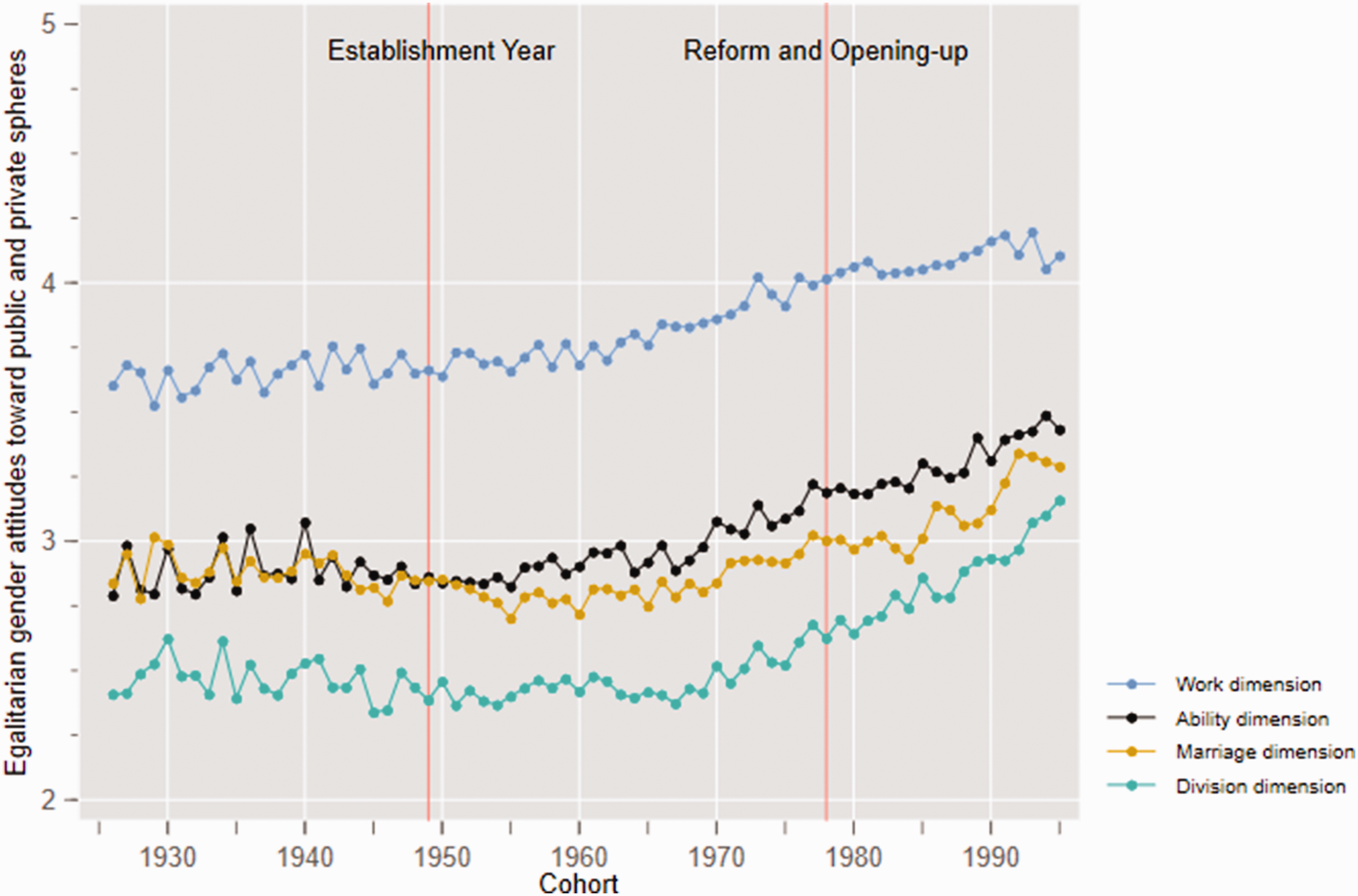
Cohort profiles of four gender attitudes in Chinese adults (born 1926–1995).
Several interesting findings were revealed. First, Chinese adults scored higher for the two gender attitudes in the public sphere (the work and ability dimensions) than the two attitudes in the private sphere (the marriage and division of labor dimensions). This finding is consistent with attitudinal changes in other countries, for example, Japan (Piotrowski et al., 2019). Second, compared with the WB cohort, the PB cohort displayed a clear upward trend in egalitarian gender attitudes in the public sphere (the work and ability dimensions) but few changes in the private sphere (the marriage and division of labor dimensions), suggesting that radical gender discourses in the pre-reform era caused dramatic changes in women’s lives in the public sphere but limited changes in the private sphere. Third, although cohort changes for the work dimension leveled off slightly in the RB cohort, egalitarian gender attitudes in the private sphere progressed rapidly for this same group. Adults born in the reform era evidently show a continued upward trend of holding more egalitarian attitudes for the marriage and division of labor dimensions. This might be due to individuals’ improved socioeconomic status.
Failing to consider sex differences in gender attitudes might create a misleading impression. Figure 2 shows sex-stratified scatterplots with Lowess curves depicting cohort trends for each gender attitude. Figures 2a and 2b display cohort profiles of attitudes in the public sphere, and Figures 2c and 2d display cohort profiles in the private sphere. The impression is that men’s gender attitudes progressed slowly across successive cohorts, whereas women’s egalitarian gender attitudes, particularly those for the ability, work, and division of labor dimensions, advanced rapidly from previous cohorts to more recent cohorts.
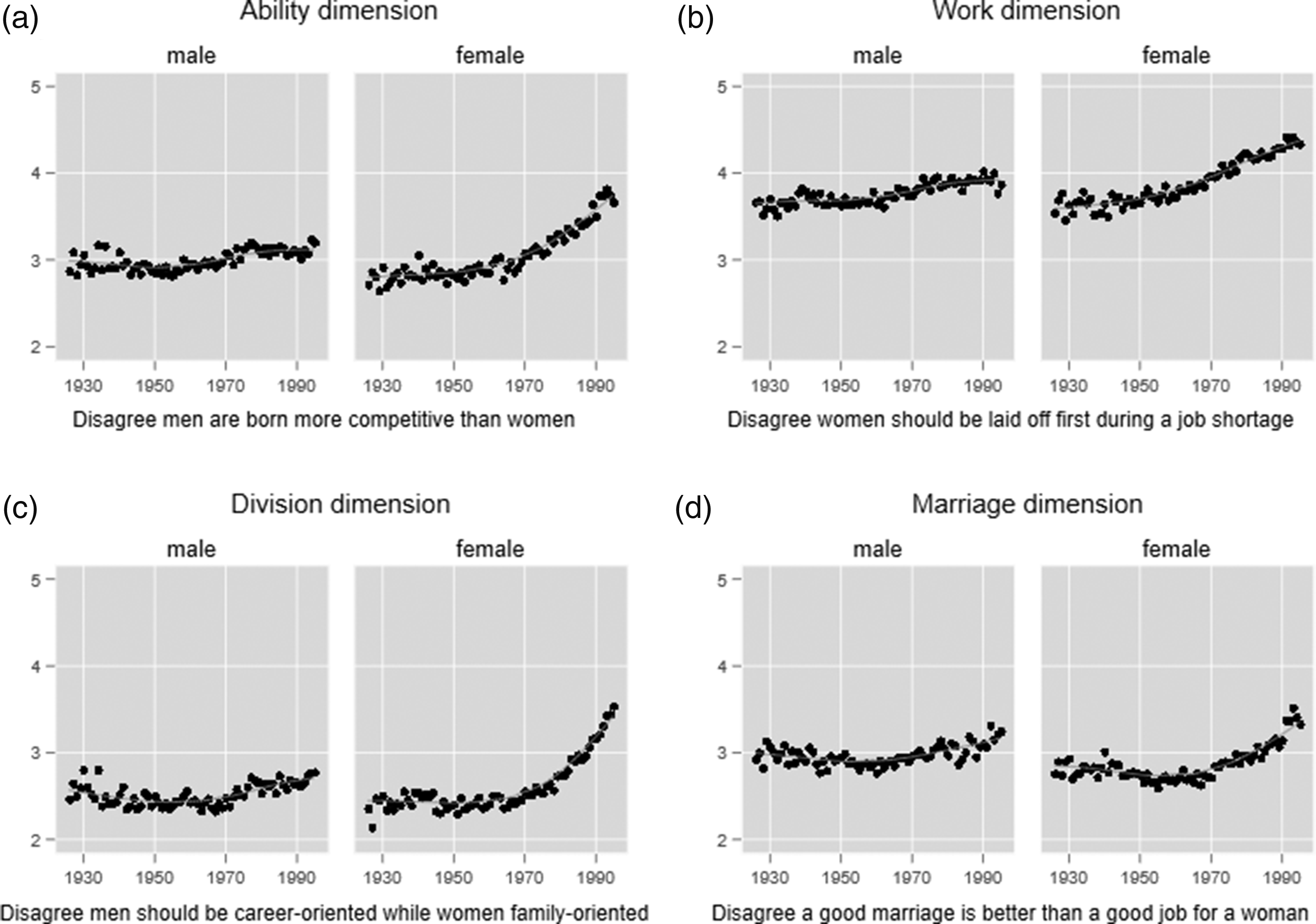
Lowess curves depicting cohort profiles of four gender attitudes in Chinese men and women (born 1926–1995). (a) Ability dimension, (b) work dimension, (c) division of labor dimension and (d) marriage dimension.
First, Figure 2a shows that men’s attitudes for the ability dimension were quite stable from the 1930s cohort to the 1970s cohort. The movement toward an egalitarian attitude for this dimension starts around the 1975 cohort. The cohort replacement effect is more apparent for women, particularly for women born after 1960. The average disagreement rate increases from 2.85 for the 1960 female cohort to 3.66 for the 1990 female cohort.
Second, Figure 2b shows cohort dynamics in relation to attitude for the work dimension. The rate of disagreement with the argument that women should be laid off first during a job shortage increases from the earliest male cohort level of 3.67 to the most recent cohort level of 3.87, whereas for the female cohorts, it increases from 3.52 to 4.34. Therefore, the increment is much stronger for women than for men. The ability and work dimensions are the two for which women’s attitudes become increasingly egalitarian across successive cohorts, beginning with the earliest cohorts, who came of age when the CCP began to liberate women by encouraging them to participate in production activities.
Third, turning to the private sphere, which comprises the division of labor and marriage dimensions in which the essentialist ideology is the most likely to prevail, Figures 2c and 2d show that cohort patterns are largely similar for men and women. The PB cohort does not seem to hold more egalitarian attitudes for these dimensions compared with the WB cohort. Radical change occurs only in the RB cohort, particularly as far as women are concerned. In conclusion, both men and women born in the reform era hold more egalitarian attitudes with regard to the private sphere than those born in the war era and the reform era.
To confirm the preliminary findings from the descriptive analysis and further examine cohort patterns in relation to gender attitudes for each dimension, a series of multilevel models were estimated for men and women separately. The first set of models (“baseline models”) considered only the cohort effect in relation to gender attitudes after adjusting for age and period effects. The second set of models (“full models”) estimated the cohort effect net of age and period as well as the effect of socioeconomic and demographic factors including education, employment status, party membership, marital status, family structure, hukou, and region on gender attitudes.
Table 2 reports empirical estimates for the baseline models for cohort differences in relation to four gender attitudes, using the PB cohort as the reference group. Consistent with the descriptive results, estimates of the HAPC-CCREM show that net of age and period effects, compared with the PB cohort, the WB cohort holds significantly weaker egalitarian gender attitudes in the public sphere (the ability and work dimensions), but the PB and RB cohorts are no different when it comes to attitudes in the private sphere (the division of labor and marriage dimensions), indicating that the influence of the Maoist gender discourse was stronger in the public sphere than in the private sphere. However, there are sex differences. Whereas WB cohort men are less egalitarian only for the work dimension relative to PB cohort men, WB cohort women are less egalitarian for both the ability and work dimensions relative to PB cohort women. Cohort differences for the work dimension between the PB and WB cohorts are more apparent for women than men (−0.187 vs. −0.054).
Unstandardized coefficients for hierarchical age–period–cohort cross-classified random-effects models of gender attitudes in the public and private spheres (baseline models).
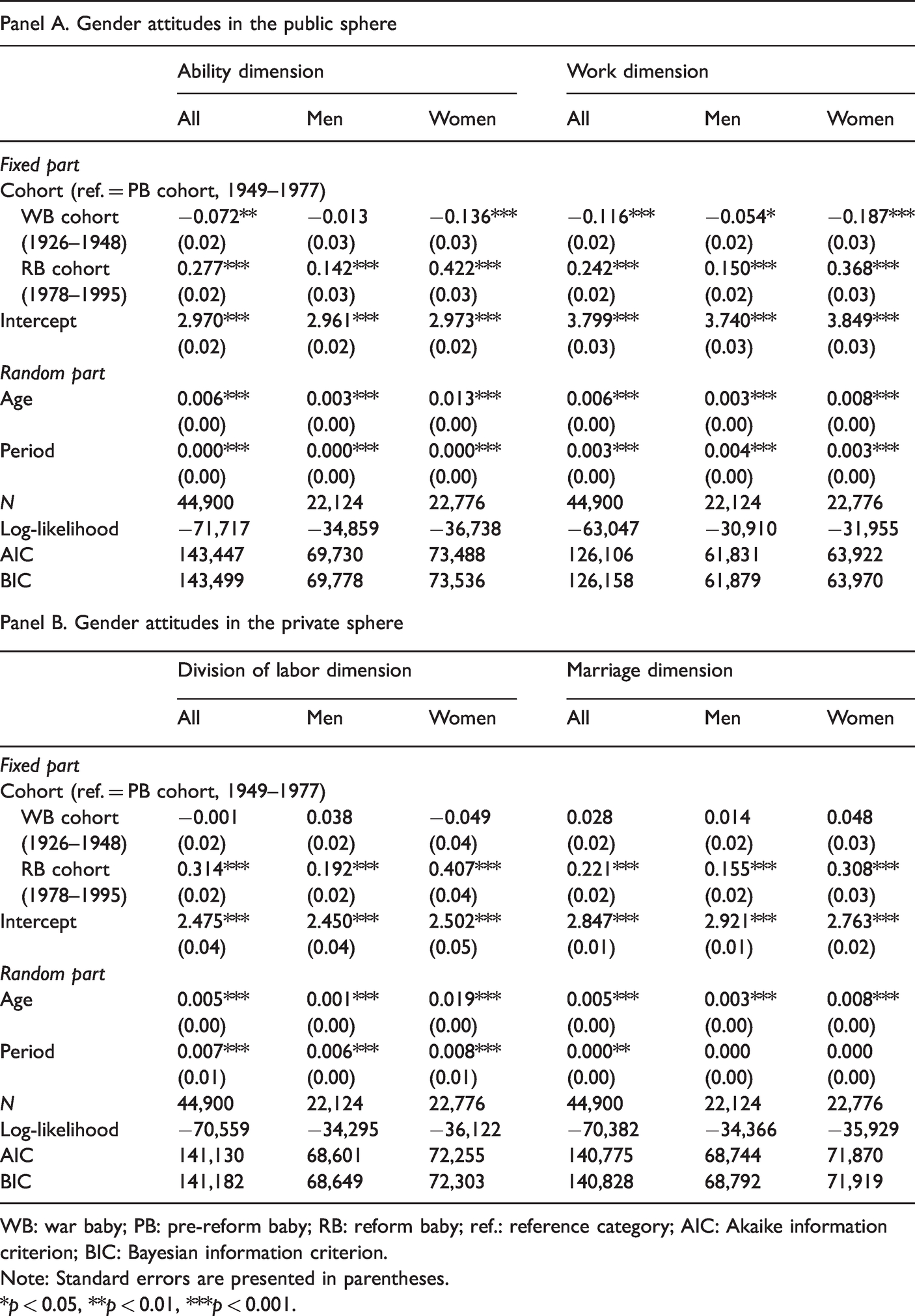
WB: war baby; PB: pre-reform baby; RB: reform baby; ref.: reference category; AIC: Akaike information criterion; BIC: Bayesian information criterion.
Note: Standard errors are presented in parentheses.
*p < 0.05, **p < 0.01, ***p < 0.001.
Adults born in the reform era have become more egalitarian in all gender attitudes compared with their predecessors. Relative to the PB cohort, the RB cohort’s attitudes are more egalitarian not only in the public sphere but also in the private sphere. The magnitude of cohort differences in attitudes in the public sphere becomes more significant (RB–PB vs. PB–WB). Additionally, the gaps between the RB and PB cohorts in the division of labor and marriage dimensions are greater for women than for men. Indeed, compared with men, women are more egalitarian in relation to all four gender attitudes, regardless of the cohort group.
Next, to explore how cohort differences in relation to gender attitudes can be explained by sociodemographic characteristics and other related variables, a set of HAPC-CCREMs with covariates are estimated. Table 3 presents sex-stratified estimates for each attitude. Adding these covariates explains WB women’s lagged status in attitude for the ability dimension, to the extent that their attitude toward ability is not significantly different from PB women’s attitude. However, compared with the PB cohort, both WB men and women are less egalitarian in attitude for the work dimension even after adding these covariates. Approximately 27% of cohort differences can be explained by socioeconomic and demographic factors for women but almost none can be explained for men. Adjusting for socioeconomic status, demographic factors, and regional variations, WB men become more egalitarian in attitude for the division of labor dimension relative to PB men, and WB women become more egalitarian in attitude for the marriage dimension relative to PB women, suggesting that gender inequality in the private sphere persisted if not worsened in the pre-reform era. Turning to differences between the RB and PB cohorts, the results from the full models show that, net of controls, both RB men’s and RB women’s gender attitudes are still more egalitarian relative to PB men’s and PB women’s attitudes for all dimensions.
Unstandardized coefficients for hierarchical age–period–cohort cross-classified random-effects models of gender attitudes in the public and private spheres (full models).
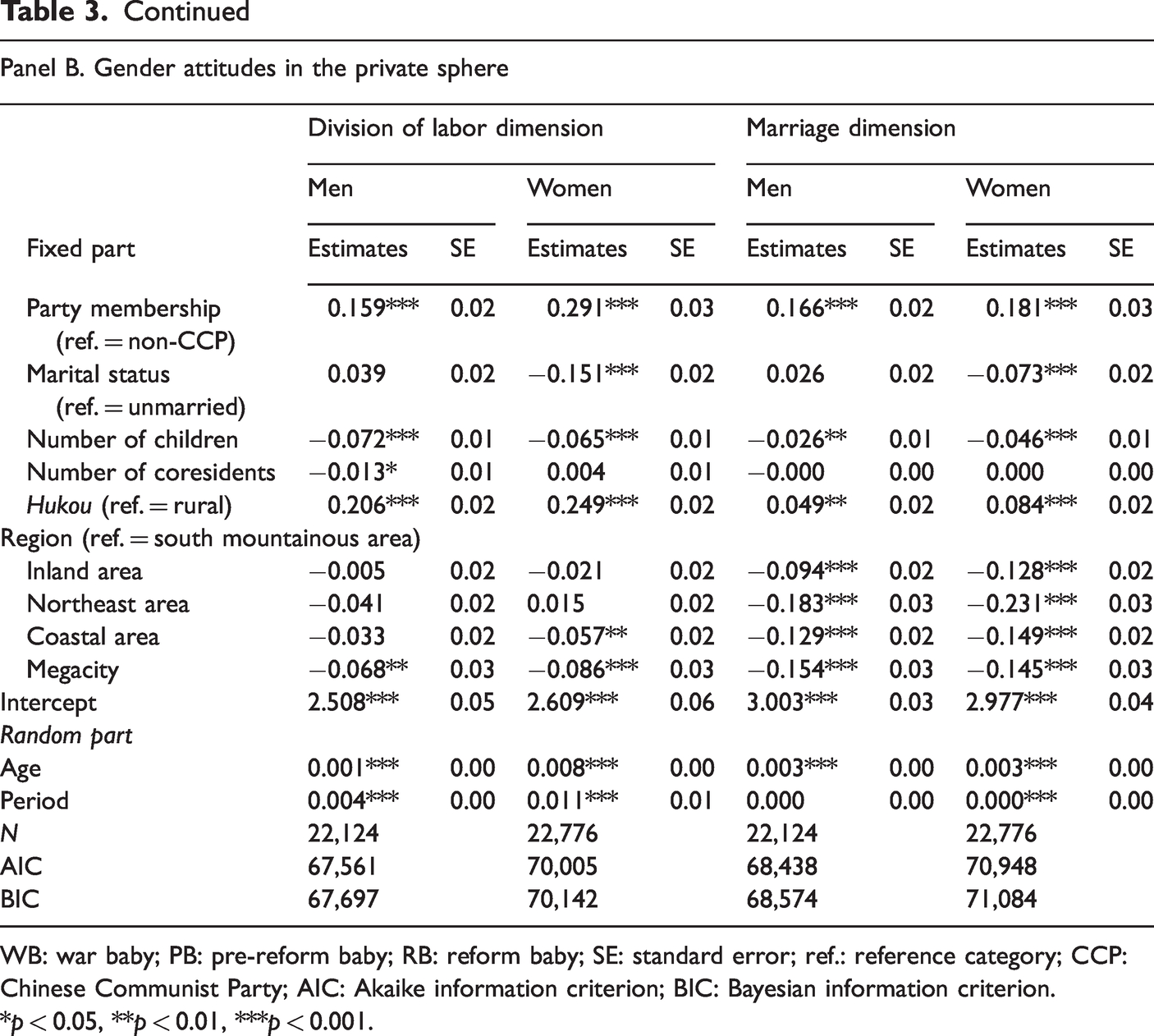
WB: war baby; PB: pre-reform baby; RB: reform baby; SE: standard error; ref.: reference category; CCP: Chinese Communist Party; AIC: Akaike information criterion; BIC: Bayesian information criterion.
*p < 0.05, **p < 0.01, ***p < 0.001.
In general, socioeconomic and demographic factors reduce the magnitude of cohort differences for women but not for men (except in the division of labor dimension). Adjusting for all these important factors, more years of schooling predict more egalitarian attitudes, regardless of attitudinal dimensions and sex, albeit with the progressive effect of education being stronger for women than for men. Overall, employed women recorded higher egalitarian scores compared with their unemployed counterparts, whereas the opposite was true for men. Among both female and male CCP members, their gender attitudes for all dimensions were more egalitarian than nonmembers’ attitudes. Marital status appears to be significantly associated with women’s conservative gender attitudes. Adults with more children are consistently less egalitarian for all attitudinal dimensions, regardless of the respondent’s sex. Nonetheless, a large household size is not always associated with traditional gender attitudes. Both men and women with urban hukou hold more egalitarian attitudes than rural residents and, again, this association is stronger for women than for men. As for regional variation, it does not appear that more economically developed regions correspond to more egalitarian gender ideologies. In contrast, empirical results seem to suggest that more economically developed regions embrace more conservative gender ideologies across all gender norm dimensions.
Discussion
Drawing on data from the CGSS for 2010–2015, this study explored cohort changes in relation to gender attitudes in China. Sex-stratified HAPC-CCREMs were used to (a) explore cohort changes in attitude for four gender norm dimensions (ability and work dimensions for the public sphere, and division of labor and marriage dimensions for the private sphere) in three cohort groups, namely, WB, PB, and RB, and (b) examine how cohort differences in relation to each gender attitude were modified by socioeconomic and demographic characteristics. Several findings were obtained.
With regard to the general distribution or aggregate level of gender attitudes, Chinese adults expressed more egalitarian attitudes in the public sphere (the ability and work dimensions) and more essentialist attitudes in the private sphere (the division of labor and marriage dimensions). Gender attitudes in the private sphere measure an individual’s understanding of the traditional separate spheres model and the relative importance of marriage and a job for women. The weaker egalitarian gender attitudes in the private sphere suggest the persistence of both the gendered division of labor and traditional marriage norms, which view marriage as the single most important channel for women’s upward mobility. These findings are consistent with findings in Western countries, where more progress has been made in the public sphere than in the private sphere (Pepin and Cotter, 2018). In China, the dissimilar strengths of gender attitudes in the public and private sphere are related to the socialist movement in the pre-reform era.
With regard to the pace of the movement toward a progressive ideology, overall, the results revealed rapid progress in gender attitudes in the public sphere and slow progress in the private sphere. Specifically, with regard to cohort differences between WB and PB adults, the results from the HAPC-CCREM showed that, adjusting for age, period, and socioeconomic and demographic characteristics, cohort differences between WB and PB women’s attitudes for the ability dimension diminished, cohort differences for the work dimension remained the same for both men and women, and cohort differences between WB and PB individuals’ attitudes in the private sphere reversed. The uneven pace of progressive gender ideologies in the PB cohort is expected. In China, the Maoist movement helped women make great progress in the labor market, although the traditional division of household labor has never been fundamentally challenged (Zuo and Bian, 2001). Therefore, it might be that the early efforts of the pre-reform era state to emphasize women’s equal participation in production outside the household contributed to the faster movement toward gender equality in the public sphere, whereas the minimal effort with regard to changing women’s traditional roles within the household contributed to the slower movement toward gender equality in the private sphere.
Turning to cohort differences between RB and PB adults for each attitudinal dimension, the results showed that net of all other important factors, the RB cohort expressed an increasingly strong desire for gender equality not only in the public sphere but also in the private sphere. Whereas rapid cohort progress in the public sphere was more related to Maoist gender ideology and its legacy, cohort progress in the private sphere was more related to indirect social forces such as improved education and continued urbanization. In the present study, although the employment rate was largely similar in the PB and RB cohorts (69% vs. 71%), there was a clear gap between the two groups with regard to the total number of years of education (9.37 vs. 12.77). Broadly, socioeconomic and demographic variations were consistent across dimensions: adults who held urban hukou, received more years of schooling, were CCP members, and had fewer children reported more positive gender attitudes than those who held rural hukou, had fewer years of education, were not CCP members, and had more children. Additionally, employment was significant as well. Whereas employed men generally reported more conservative attitudes, employed women held more progressive gender attitudes across all dimensions. Note that these factors only explained part of the cohort progress in gender attitudes.
In addition, consistent with studies from other countries, which have found that men move more slowly toward nontraditional views than women (Choe et al., 2014), Chinese adults displayed sex differences in the cohort patterns of gender attitudes. Chinese men displayed a weaker overall level of attitudes for all gender attitude dimensions compared with women and the pace of their movement toward progressive gender norms was also much slower than that of women; the cohort changes for the ability and division of labor dimensions showed some progress as far as PB males were concerned, but such positive changes seemed to reach a plateau in the RB cohort (Figure 2), creating a stark contrast with their female counterparts. These findings might suggest that Chinese men’s embracing of gender equality has stalled. Hence, this study echoes previous findings indicating that men view egalitarian gender ideologies less favorably than women (e.g., Brooks and Bolzendahl, 2004), which to some extent supports the interest-based theory that attributes the sex gap in gender ideologies to women’s greater benefit from egalitarianism vis-à-vis that of men.
Previous research suggests there has been a backlash against the gender equality movement in China. The backlash thesis is incomplete in that previous studies fail to disentangle age, period, and cohort effects. The finding that the trend toward greater acceptance of gender equality has stalled among younger men echoes the backlash thesis; this was evidenced by, for example, an increasing sex gap with regard to the division of household labor in which the share of housework undertaken by men was greatly reduced in the RB cohort (Zhang, 2017). Nonetheless, this study also counters the backlash thesis in that it revealed a strong upward trend toward egalitarianism in both the public sphere and private sphere among younger women. Other recent studies lend further support to this finding. For instance, recent research shows that women who married in the late-reform era are less likely to “do gender” through doing more housework to display their femininity compared with older married women (Luo and Chui, 2019b). When compared with those of previous studies, the inconsistencies in the conclusions drawn in this study are related to different indicators for gender equality, research design (in terms of both the observation window and the study sample), and statistical methods.
Moreover, the effect of socioeconomic and demographic variations on gender attitudes appears to be largely similar for men and women. However, these factors played a much more positive role in promoting women’s gender attitudes than men’s. Consequently, to further promote gender equality, enhancing women’s socioeconomic status is crucial. Nonetheless, it is worth noting the fact that there is an increasing sex gap in attitudes across successive cohorts (to the extent that this gap has peaked in recent cohorts) because the gender revolution is never complete without men’s efforts.
This study has several limitations. One limitation is that like most other age–period–cohort analyses, it cannot fully address the identification problem (Bell and Jones, 2018), despite the use of the HAPC-CCREM. This study purposefully selected a cohort-based perspective because of the short observation window of the data and because repeated cross-sectional research design is limited in examining the life course trajectories of egalitarian gender attitudes. Related to this point, because this study relied on repeated cross-sectional data, certain measures such as employment status captured only a snapshot of a single moment in time and, thus, could not reflect the aging process and its dynamic association with gender attitudes. A third limitation is that although this study covered four gender norm dimensions, it did not consider gender norms in relation to mothers in the labor market. Gender attitudes toward working mothers are important in that they measure the competing ideals of the public sphere, which emphasizes women’s “higher-order” needs such as self-realization and self-reliance, and the private sphere, which emphasizes women’s interdependence (Pepin and Cotter, 2018).
To conclude, this study revealed the uneven pace of development toward egalitarian gender ideology in China. Compared with adults born before 1949, cohorts born in the pre-reform era showed a much stronger desire for gender equality in the public sphere than early cohorts and such desire appeared increasingly stronger for cohorts born thereafter. Only after China entered the reform era, when substantial structural changes occurred, did the movement toward an egalitarian ideology in the private sphere began to emerge. These findings provide evidence for the profound influence of the Maoist egalitarian gender discourses on gender equality in the public sphere, but also of their limited influence in the private sphere. Additionally, this study showed that although men’s and women’s cohort patterns of gender attitudes were largely similar, women’s degree of acceptance of gender equality was greater and their attitudes changed at a faster pace. Consequently, the sex gap in egalitarian gender ideology peaked in the most recent cohort. The widening sex gap highlights the importance and urgency of further changing men’s gender attitudes.
Footnotes
Declaration of conflicting interests
The author(s) declared no potential conflicts of interest with respect to the research, authorship and/or publication of this article.
Funding
The author(s) disclosed receipt of the following financial support for the research, authorship, and/or publication of this article: This work was supported by the National Social Science Foundation of China (Grant No. 20CRK007).