




Abstract
Following policy feedback theory, this article argues that normative policy feedback mechanisms also operate at the workplace level, where employees are expected to adapt their beliefs to the specific policy context in which they are embedded. Specifically, it considers employees’ gender ideologies and their association with two prominent workplace-level diversity policies: voluntary women’s quotas and mentoring programmes. Partial proportional odds models are estimated employing a unique German linked employer–employee dataset (2018/19) incorporating 2445 employees and 82 workplaces. Findings indicate that voluntary women’s quotas implemented in workplaces are associated with more egalitarian gender ideologies among employees. This clear pattern was not detected for mentoring programmes. No gender differences were discovered, suggesting that normative policy feedback effects in the workplace are present equally among women and men. In conclusion, the findings indicate that policy feedback mechanisms operate not only at the national but also at the workplace level.
Introduction
Female employment rates have risen in most western societies over the last few decades. Despite this development, women continue to bear the primary responsibility for childcare and caregiving (Gangl and Ziefle, 2015; Grunow et al., 2018). This imbalance reinforces enduring gender inequalities in the labour market. Prevailing ideals around gender roles in work and caregiving are a key determinant of the way labour is divided within partnerships and families (Begall et al., 2023; Cotter et al., 2011; Davis and Greenstein, 2009). These ideals exist in the form of gender ideologies – that is, widely held, socially constructed beliefs about the appropriate roles of men and women in society (Davis and Greenstein, 2009; Grunow and Veltkamp, 2016; Zoch and Schober, 2018). The term ‘traditional gender ideologies’ refers to individual-level beliefs that support the gendered division of paid and unpaid labour and are rooted in the notion that men and women inherently possess different roles in society, which align with ‘gendered separate spheres’ of life (Davis and Greenstein, 2009: 88, 89). According to the concept of gendered separate spheres, men are associated primarily with the public sphere, which encompasses paid work, politics and societal leadership, whereas women are relegated to the private sphere, which includes homemaking, childrearing and domestic responsibilities (Davis and Greenstein, 2009). The persistence of traditional gender ideologies is one reason for the enduring gender inequalities in the labour market (Begall et al., 2023; Cotter et al., 2011). By contrast, the term ‘egalitarian gender ideologies’ refers to ‘beliefs embracing equal and shared contributions to these spheres by men and women’ (Grunow and Veltkamp, 2016: 7).
Feminist and sociological scholars have long highlighted that national-level policies reflect and legitimize norms of how unpaid care work and paid work should be allocated, promoting specific models of care linked to moral expectations and ideals about how individuals should behave (Kremer, 2007; Pfau-Effinger, 2004, 2012). Hence, national-level policies establish a cultural and normative framework in which belief systems such as gender ideologies develop (Grunow and Veltkamp, 2016; Zoch, 2021, Zoch and Schober, 2018).
According to the policy feedback literature, which highlights how policies shape attitudes and behaviours at the individual level (Campbell, 2012; Svallfors, 2010), policy changes can exert (normative) policy feedback effects whereby individuals adapt their behaviour, attitudes and ideologies (Bicchieri, 2017; Gangl and Ziefle, 2015; Svallfors, 2010; Zoch and Schober, 2018). Most policy feedback research focuses on national-level policies, and particularly work–family policies, but less is known about how normative policy feedback effects on employees’ gender ideologies come about at the level of the workplace.
However, individuals are embedded not only in distinct country-specific policy contexts but also in workplace environments that vary both in their policies, histories and demographic compositions and in their gender inequalities (Abendroth et al., 2017; Tomaskovic-Devey and Avent-Holt, 2019). Some workplaces have implemented gender diversity policies as a key tool in the effort to promote gender equality in the workplace. Most research on diversity policies aims to measure their success in terms of increased diversity in the management ranks or lower wage disparities (Kalev et al., 2006; Leslie, 2019; Peters et al., 2020). Furthermore, studies have explored employees’ responses – especially their resistance – to, and the unintended consequences of, such policies (Leslie, 2019; Risberg and Corvellec, 2022). Less is known about how diversity policies affect employees’ gender ideologies. As these policies present employees with new opportunities, while at the same time establishing a broader normative idea of valuing women’s competencies and skills at work, they might trigger normative policy feedback effects. Hence, building on the policy feedback literature and normative policy feedback processes (Campbell, 2012; Gangl and Ziefle, 2015; Grunow et al., 2018), this article explores whether gender diversity policies in the workplace – specifically voluntary women’s quotas and mentoring programmes – are associated with employees’ gender ideologies. Studying policy feedback dynamics at the workplace level is especially important because key resources, such as pay and authority, are distributed within workplaces (Tomaskovic-Devey and Avent-Holt, 2019). The allocation of these resources is influenced by the decision-making of supervisors and managers, which, in turn, is shaped by prevailing gender ideologies (Abendroth et al., 2017; Acker, 2006). Thus, understanding how the workplace context in which individuals are embedded can shape their gender ideologies is crucial to finding strategies to diminish barriers to women’s opportunities for mobility, higher pay and authority in the labour market. Furthermore, it helps to explain why gender inequalities in the labour market are so persistent despite women’s high educational attainment.
This article makes three key contributions. First, it extends policy feedback research by shifting the focus from the national to the workplace level. It explores whether workplace diversity policies are associated with employees’ gender ideologies, suggesting that normative policy feedback operates at the workplace level as well. Second, by exploring whether employees’ gender ideologies vary with the specific workplace context in which they are embedded, this article contributes to organizational inequality research, which focuses on how workplaces shape differences between employees in terms of the resources, rewards and respect accorded to them (Abendroth et al., 2017; Acker, 2006; Tomaskovic-Devey and Avent-Holt, 2019). Finally, it expands the literature on diversity policy effectiveness, which has primarily focused on career and income outcomes (e.g. Kalev et al., 2006; Zimmermann and Collischon, 2023).
We use cross-sectional data from the German Linked-Employer-Employee-Panel B3 (LEEP-B3; Marx et al., 2020). First, differences in employees’ gender ideologies are compared between workplaces that have and workplaces that have not implemented voluntary women’s quotas and mentoring programmes. Second, to explore differences between the gender ideologies of employees in workplaces that have recently implemented these policies and the gender ideologies of employees in workplaces with longstanding gender diversity policies, information on how long these policies have been in place is used.
Voluntary women’s quotas and mentoring programmes are the most commonly reported diversity policies in the sample on which this article is based and are well-researched in the literature (e.g. Kalev et al., 2006). These policies are often combined into a summary index to assess their additive effects on outcomes like the intra-workplace gender wage gap (Bächmann et al., 2020; Zimmermann and Collischon, 2023). By contrast, the present article treats them as two unique diversity policies, as they differ in terms of their implementation. Women’s quotas directly influence hiring and promotion, while mentoring programmes offer mentees guidance to navigate the workplace (see ‘Differences in normative policy feedback’). Hence, their respective associations with employees’ gender ideologies will be analysed separately.
Gender ideologies
Traditional gender ideologies can be conceptualized as individual-level support for a gendered division of paid and unpaid work, which is rooted in the belief that these spheres should be distinctly separated (Davis and Greenstein, 2009). Thus, they incorporate beliefs about the relative importance of men’s versus women’s careers and whether women or men are better equipped to succeed in paid work or unpaid care work (Davis and Greenstein, 2009). These ideologies are constructed over time within a distinct country context constituting specific national-level policies and a broader gender culture that influence individuals’ experiences and preferences (Gangl and Ziefle, 2015; Grunow et al., 2018; Pfau-Effinger, 2004, 2012).
Recent research has shown that gender ideologies not only vary across societies but that they are also often multidimensional – that is, individuals’ beliefs are often neither exclusively egalitarian (dual-earner/dual-carer model) nor exclusively traditional (male breadwinner/female homemaker model) (Begall et al., 2023; Grunow et al., 2018; Knight and Brinton, 2017). For instance, support for a dual-earner model, where both partners participate in the labour market, does not necessarily align with support for the equal sharing of housework and care work between women and men (Düval, 2023; Grunow et al., 2018; Knight and Brinton, 2017). Thus, individuals may support gendered separate spheres in one domain (public or private) and gender equality in another. Over the last few decades in Europe, traditional ideologies supporting strictly gendered separate spheres have increasingly been replaced by more egalitarian or ‘egalitarian essentialist’ beliefs (Begall et al., 2023: 181; Grunow et al., 2018: 52; Knight and Brinton, 2017).
Thus, gender ideologies are seldom unidimensional; rather, they more often reflect complex and nuanced beliefs about the roles of women and men (Düval, 2023; Grunow et al., 2018; Knight and Brinton, 2017). As a result, research has shifted from viewing gender ideologies as purely unidimensional to embracing a multidimensional approach that acknowledges variations between egalitarian and traditional beliefs (Grunow et al., 2018; Knight and Brinton, 2017).
Furthermore, gender ideologies are not static, but rather may change; for example, as a result of life events such as transition to parenthood or employment and policy changes (Bolzendahl and Myers, 2004; Steiber and Haas, 2012; Zoch and Schober, 2018). Moreover, gender ideologies vary both across and within countries (Begall et al., 2023; Grunow et al., 2018; Hamjediers, 2021; Zoch, 2021) as well as across workplaces (Peters et al., 2020). Germany offers a unique context due to its former division into the German Democratic Republic (East Germany) and the Federal Republic of Germany (West Germany) (Zoch, 2021; Zoch and Schober, 2018). East Germany had a tradition of promoting female and maternal labour market participation with high access to public childcare, whereas West Germany promoted the traditional male breadwinner model (Zoch, 2021). Since reunification in 1990, gender ideologies in both regions have slowly converged, though eastern Germans still hold more egalitarian views, particularly regarding maternal employment (Zoch, 2021). Thus, compared with other countries, Germany exhibits considerable within-country variation in gender ideologies (Grunow et al., 2018; Hamjediers, 2021; Pfau-Effinger, 2004; Zoch, 2021).
Only a few studies have examined gender ideologies multidimensionally and explored cross-national differences (e.g. Begall et al., 2023; Grunow et al., 2018; Knight and Brinton, 2017). Using latent class analysis, these studies show that gender ideology profiles are similar across European countries but that their size varies across country contexts (Begall et al., 2023; Grunow et al., 2018; Knight and Brinton, 2017). For instance, Grunow et al. (2018) found that 75% of all respondents of the 2008 European Values Study in Sweden held egalitarian ideologies, meaning that they supported a dual-earner/dual-carer model, compared with only 46.5% in western Germany. Overall, purely traditional beliefs around strictly separated gender spheres (male breadwinner/female homemaker model) have become less prevalent (Knight and Brinton, 2017) and constitute only a small minority in all countries (Grunow et al., 2018). However, Grunow et al. (2018) found that western Germany stood out, as it had the highest share of respondents with a traditional gender ideology profile.
Policy feedback theory
Policy feedback theory asserts that policies induce feedback effects that may entail attitudinal and behavioural adaptations at the individual level (Campbell, 2012; Svallfors, 2010). Policies may incorporate a normative framework that signals to citizens what the ‘desirable state of affairs’ is and thus determine their actions (Svallfors, 2010: 120). The policy feedback literature describes two causal mechanisms: (a) psychological and preference adaptations via role exposure (micro-level) and (b) normative anchoring through norm-setting and cultural diffusion effects (macro-level) (Bicchieri, 2017; Campbell, 2012; Gangl and Ziefle, 2015; Zoch and Schober, 2018). The micro-level perspective considers how individuals and their life courses are affected by policy changes that provide for new roles and practices in a country. The degree to which individuals are exposed to these new roles will influence their preferences; for example, the division of paid and unpaid labour (Gangl and Ziefle, 2015). Normative policy feedback via role exposure depends on the extent to which individuals are affected by these changes in their life course trajectories (Gangl and Ziefle, 2015; Zoch and Schober, 2018).
On the macro level, normative anchoring through norm setting describes the mechanism by which national-level policies establish a broader normative framework to which individuals’ behaviours, attitudes and beliefs will adapt, as policies may promote specific regimes, such as care and gender regimes (Gangl and Ziefle, 2015; Grunow et al., 2018; Pfau-Effinger, 2004, 2012). Policies signal which roles are appropriate and desirable for individuals, thereby providing opportunities for and imposing constraints on individuals’ behaviours, as they are normatively expected to follow these guidelines (Grunow and Veltkamp, 2016; Kremer, 2007; Pfau-Effinger, 2004, 2012). Thus, norm setting affects not only the individuals targeted by these policies but also society as a whole (Gangl and Ziefle, 2015). Furthermore, normative policy feedback may occur through cultural diffusion, where individuals adapt their preferences and attitudes because they observe changed behaviours in others that become the ‘new normal’, thereby modifying the role perceptions and expectations of others (Bicchieri, 2017; Gangl and Ziefle, 2015). This process will be detectable more in the medium and long run, as observed changes in the behaviour of others must first be internalized before role perceptions and preferences change accordingly (Gangl and Ziefle, 2015).
Drawing on policy feedback theory, Gangl and Ziefle (2015) showed that the subjective work commitment of mothers in Germany decreased in response to successive reforms of parental leave during the 1990s and early 2000s – especially the reform in 1992 that extended the duration of leave to 3 years – and that changed preferences appear to have delayed mothers’ labour market re-entry, especially their return to full-time employment. Furthermore, they found that extended parental leave evoked not only role exposure but also norm setting and processes of cultural diffusion: not only mothers who had a child during this period of policy change in Germany but also childless women and women with completed fertility histories adapted their work commitment (Gangl and Ziefle, 2015). Moreover, Ellingsæter et al. (2017) found that policy changes in childcare services (availability, fees and entitlement) in Norway substantially shifted mothers’ attitudes towards and acceptance of formal childcare across all socioeconomic groups.
Changes in gender ideologies have been mainly attributed to the replacement of older generations with younger ones, that differ in their attitudes due to broader societal changes, including policy reforms (e.g. Cotter et al., 2011). More recent studies, however, highlight how policy changes can prompt individual gender ideology adaptations in the short-term (Unterhofer and Wrohlich, 2017; Zoch and Schober, 2018). For example, Germany’s 2005 childcare reform expanded formal childcare, fostering more egalitarian gender ideologies among western German mothers regarding maternal employment, while eastern German, non-college-educated mothers adopted more traditional views (Zoch and Schober, 2018). Furthermore, the introduction of the so-called ‘daddy months’ in 2007 increased fathers’ leave uptake and led to more egalitarian gender ideologies among grandparents whose sons became fathers after the reform (Unterhofer and Wrohlich, 2017).
Normative policy feedback at the workplace
Normative policy feedback should also operate at the workplace level, as individuals are embedded not only in country-specific policy contexts but also in distinct workplace contexts. These contexts vary in terms of their human resource strategies, the demographic composition of the workforce and whether diversity policies are in place (Abendroth et al., 2017; Peters et al., 2020; Tomaskovic-Devey and Avent-Holt, 2019). Diversity policies are implemented to eliminate social-group-based discrimination by recognizing, accepting and promoting diverse workforces. These policies and practices serve as essential signals and have symbolic meaning, as they highlight that diversity is an important organizational goal and is valued in the workplace, thereby setting guidelines for the expected behaviours of the employees (Bowen and Ostroff, 2004; Risberg and Corvellec, 2022).
Role exposure
Role exposure should occur, as diversity policies expose women to new work roles and improved opportunities for professional success. Such policies provide career development tools that are especially created to promote women’s professional achievements. As a result, women take on new tasks that they might not have previously thought attainable, which could result in increased job commitment and more work-oriented preferences (Bolzendahl and Myers, 2004). Furthermore, if women perceive that their role in paid work offers new and legitimate opportunities, they might adapt their perceptions of the appropriate roles for women in paid and unpaid work (see Bolzendahl and Myers, 2004; Gangl and Ziefle, 2015). Diversity policies may also increase women’s upward mobility in new workplace roles (e.g. Abendroth et al., 2017; Kalev et al., 2006), thereby also increasing horizontal and vertical social interactions between women and men along the occupational hierarchy. On the one hand, as men with a high occupational status interact with high-status women, they have more experiences with women as peers rather than only as subordinates. On the other hand, men with a low occupational status will have more interactions with women in managerial and supervisory roles. These social exchange relationships and status inconsistencies can reduce gender stereotyping (e.g. Abendroth et al., 2017; Peters et al., 2020), and as gender ideologies are shaped by experiences with new roles (i.e. role exposure), both women’s and men’s ideologies should be affected by women working at higher occupational levels (Bolzendahl and Myers, 2004).
Adapted work-role and private-role preferences due to policy changes at the workplace have been shown for fathers in Germany, whose inclination to reduce their working hours was heightened when formal, universal and transparent work–family policies were present at the workplace (Bernhardt and Bünning, 2020). Similarly, implementing family-friendly workplace policies elicits policy feedback among men, who are more likely to reduce their working hours after becoming fathers, especially when flexible work arrangements are widely used (Abendroth and Lükemann, 2023). Moreover, previous evidence based on a survey experiment conducted in the United States suggests that the presence of supportive policies at work determines whether women prefer a more egalitarian or a traditional relationship arrangement (Pedulla and Thébaud, 2015). In the same way, policies that support women’s careers should affect their perceptions of their role in paid work and their work-related preferences.
Normative anchoring via norm setting and cultural diffusion
Diversity policies embed in the workplace the idea that women and men are equally qualified and suitable for (higher-level) positions historically associated with men. Hence, implementing such policies involves setting a broader norm whereby women and men have equally valuable skills. Observing improved career prospects for women and the organization’s commitment to gender equality likely boosts women’s work aspirations. Thus, employees in such workplaces are confronted with a normative framework that not only supports but also actively promotes women’s role in paid work.
Besides their normative-signalling impact, voluntary women’s quotas and mentoring programmes likely change individuals’ perceptions of the anticipated behaviour of and role expectations towards women. This is the case because these policies can increase the share of women in upper management and break down gendered stereotypes about women’s and men’s capabilities and performance (Abendroth et al., 2017; Bolzendahl and Myers, 2004). Thus, employees in such environments experience a workplace culture where gender is less salient for matching individuals to positions. These policies also lift more women into managerial positions, creating female role models that can empower other women in the workplace to advance in their careers. Moreover, women’s increased upward mobility implies that women as a group are equally qualified and equipped for jobs with greater authority, countering stereotypes of incompetence in authority positions (Ridgeway, 1991). Therefore, women might question men’s superiority at work and redefine their perceptions of women in the public sphere, thereby promoting more egalitarian gender ideologies. Moreover, women’s career success demonstrates that adequately managing career and family is not mutually exclusive (Bolzendahl and Myers, 2004). Others in the workplace experience the changed actions of women who gain more power in the upper ranks of the hierarchy or advance in their careers more generally. Hence, cultural diffusion should occur, as beliefs about women’s work commitment, ambition and capabilities are contradicted, thereby leading to new, internalized role expectations and anticipated behaviour of women (e.g. Bolzendahl and Myers, 2004).
In summary, diversity policies should entail processes of role exposure and normative anchoring via norm setting and cultural diffusion. Thus, building on the policy feedback literature, the following hypotheses are proposed:
Unintended normative policy feedback
Previous research has highlighted that diversity policies may have unintended consequences, as employees might object to the policy-induced changes to the workplace rules and regulations, and this might lead to a backlash or resistance among the workforce (Kalev et al., 2006; Leslie, 2019; Risberg and Corvellec, 2022). Diversity policies may suggest that women need additional assistance and are not capable of reaching certain positions in the workplace by themselves (Kalev et al., 2006; Leslie, 2019). Thus, women using formal policies may be viewed by others as benefiting from reverse discrimination. They are then at risk of further marginalization (Leslie, 2019). Therefore, policy feedback may occur in an unintended direction, as diversity policies created solely for women may highlight group differences and raise issues of unfairness because they contradict beliefs about meritocracy in the workforce, and this perceived unfairness may lead to a backlash (Kalev et al., 2006; Leslie, 2019).
Processes of resistance and backlash against diversity policies are probably strongest immediately after their implementation, as employees who are not the intended beneficiaries may fear that their position at work is threatened by these changes. However, this resistance and backlash might subside over time. In addition, because it takes time for women’s new behaviours to be noticed and absorbed by others, the impact of women’s changed actions brought about by role exposure, from which cultural diffusion emerges, is likely to manifest over time (Bicchieri, 2017; Gangl and Ziefle, 2015; Zoch and Schober, 2018). Normative policy feedback effects might therefore be time-lagged (see Gangl and Ziefle, 2015). Hence:
Differences in normative policy feedback
Voluntary women’s quotas and mentoring programmes differ in their proximity and visibility, two aspects that can predict the intensity of normative policy feedback effects (Ellingsæter et al., 2017; Zoch and Schober, 2018). Following Ellingsæter et al. (2017), ‘Visibility concerns the degree to which a policy is salient to mass publics. Proximity concerns . . . the extent to which it will affect people’s lives in immediate, concrete ways’ (p. 152). Women’s quotas, which apply to all new hires and promotions, are highly visible and proximal, directly intervening in workplace decision-making and providing institutionalized legitimacy for women’s claims to career advancement. By contrast, the proximity and visibility of mentoring programmes are more limited, as this policy does not directly impact strict rules and regulations at the workplace. Rather, mentoring programmes provide employees with additional assistance to navigate the workplace, but mentors do not necessarily help mentees to climb the organizational ladder (Hoskin and Whiley, 2023). Furthermore, voluntary women’s quotas and mentoring programmes send different signals to employees and supervisors. Voluntary women’s quotas are often implemented due to failure on the part of management to promote women to higher authority positions. By contrast, mentoring programmes provide women with additional training, possibly signalling to employees and supervisors that, without this help, women cannot compete with men, which may feed into essentialist stereotypes. Previous research indicates that goals for the hiring and promotion of women are effective at increasing the share of women in management positions (Kalev et al., 2006) and mitigating pay differences (Peters et al., 2020), whereas mentoring programmes have been found to be only modestly effective or not effective at all (Kalev et al., 2006; Peters et al., 2020). Hence:
Voluntary women’s quotas and mentoring programmes, aimed at advancing women’s careers, affect women and men differently. Thus, as women are the target group of these policies, role exposure should apply mainly to them. By contrast, both women and men should be affected by normative anchoring. Although the analyses cannot disentangle the two mechanisms, comparing the associations between employees’ gender ideologies and these policies by gender can give clues about which mechanisms are present.
The German case
Germany’s historically strong reinforcement of the male breadwinner/female homemaker model (Gangl and Ziefle, 2015; Grunow et al., 2018) makes it an intriguing context for studying gender ideologies. Until 2007, parental leave policies supported this model, offering up to 36 months of leave and allowances for the first 24 months after childbirth. In 2007, the parental leave system was adapted, reducing well-compensated leave to 12 months for the primary caregiver and introducing a paid leave quota of two additional months (‘daddy months’) for the secondary caregiver (Gangl and Ziefle, 2015). This was part of a broader shift in work–family policies that aimed to promote the dual-earner/dual-carer model (Gangl and Ziefle, 2015; Grunow et al., 2018). However, strong institutional support for a traditional female homemaker model persists. For instance, married couples can opt for joint taxation with full income splitting (Ehegattensplitting), incentivizing part-time work for women, and with a shortage of childcare for children under 3, it is difficult for mothers to return to work full-time (Grunow et al., 2018). In 2023, 50% of women in Germany worked part-time, a rate higher than the EU average and among the highest of the 27 member states (Eurostat, 2023).
In recent decades, the German government has enacted laws to combat gender discrimination and inequalities in the labour market and promote female employment and representation in management, pressuring companies to advance gender equality (Peters et al., 2020). For instance, the 2006 General Equal Treatment Act (AGG) prohibits discrimination based on gender, sexual orientation, race, religion, age, or disability, allowing employees to claim damages for discrimination. Since 2015, a 30% gender quota has been mandatory for supervisory boards of listed companies. Additionally, the Act on Equal Participation of Women and Men in Leadership Positions (FüPoG), introduced in 2015 and tightened in 2021, requires around 3500 companies to set targets for increasing women’s representation in leadership roles.
At the same time, many German workplaces have voluntarily promoted equal opportunities by implementing gender diversity policies, such as targeted promotion of women, mentoring programmes and work–family policies (Bächmann et al., 2020; Zimmermann and Collischon, 2023). By 2016, over 40% of workplaces had adopted at least one gender equality policy, up from 24% in 2004 (Zimmermann and Collischon, 2023). Collective agreements and works councils also foster gender equality by ensuring compliance with statutory requirements like the AGG and promoting workplace equality. 1 Research shows that gender diversity policies more effectively reduce gender pay gaps in workplaces with collective agreements or works councils (Zimmermann and Collischon, 2023).
Data and methods
Based on policy feedback theory, we argue that workplace diversity policies shape employees’ gender ideologies through policy feedback effects. To test our hypotheses, we use cross-sectional data from the German LEEP-B3, which links survey data with administrative records of the German Federal Employment Agency provided by the Institute for Employment Research (IAB) (Marx et al., 2020). Workplaces with at least 500 employees subject to social security payments (monthly earnings of more than 450 euro) stratified by industry in eastern and western Germany were drawn from the administrative records of the BA. Next, employees were randomly selected. Comparing the data in terms of key characteristics (industry, enterprise size, workforce composition) with the distribution of employees and employers in the German labour market based on data from the IAB showed that they are representative of large enterprises and their workforces for these key characteristics (see Marx et al., 2020). Another unique feature of LEEP-B3 is the linkage of surveys and highly reliable administrative data to provide detailed information, for example, on employees’ tenure or the share of women in the workplace (Marx et al., 2020). 2 LEEP-B3 Wave 3 conducted in 2018/19 was used for the analyses, as it contains information on the implementation of diversity policies and also on how long these policies had been in place. The dataset contains information on 3028 employees nested in 83 workplaces (Marx et al., 2020). One workplace was excluded because none of its employees had participated in the survey. In addition, 139 employees at other workplaces were excluded because their respective employers had not participated in the survey, and therefore no employer information could be linked for these employees. This resulted in a sample comprising 82 workplaces and 2889 employees. The number of employees in the sample was reduced by a further 13.8% after excluding employees with missing information on the dependent variables, demographic characteristics (3.1%) and job characteristics (5.5%). 3 The final sample thus comprised 82 workplaces with 2445 employees. The analyses are based on a two-level, clustered, cross-sectional sample of employees nested in workplaces. Acknowledging this limitation, the results of our analyses are interpreted as empirical associations rather than causal effects.
Dependent variables
To operationalize gender ideologies, three attitudinal measures were used that capture employees’ gender role attitudes towards joint or separate public and private spheres, namely: attitudes towards (1) female employment, (2) maternal employment and (3) the gendered division of labour. Employees could indicate on a five-point Likert scale ranging from 1 (completely disagree) to 5 (completely agree) how much they agreed or disagreed with the following statements, which have been widely used in the literature to operationalize gender ideologies (Cotter et al., 2011; Grunow et al., 2018; Zoch, 2021):
Men and women should both contribute to the household income (female employment);
A pre-school child is likely to suffer if his or her mother works (maternal employment);
It is better for everyone if the men work and the women stay home to care for the children and the household (gendered division of labour).
The items on maternal employment and the gendered division of labour were reverse coded so that high values captured egalitarian views for all three items. Employees were assigned to one of three groups: those who indicated low agreement with the statement (i.e. responses ‘completely disagree’ and ‘mostly disagree’) were assigned to the ‘traditional ideologies’ group, which is the reference category (traditional = 0); those who indicated moderate agreement with the statements (i.e. responses ‘neither agree nor disagree’ and ‘mostly agree’) were assigned to the ‘moderate egalitarian’ group (moderate egalitarian = 1); and those who indicated high agreement (‘completely agree’) were assigned to the ‘egalitarian ideologies’ group (egalitarian = 2). 4
These items were analysed separately, as previous research has shown that gender ideologies may be ambivalent (e.g. Grunow et al., 2018; Knight and Brinton, 2017). The correlation matrix (Table A1 in the supplemental material) and Cronbach’s alpha (0.58) confirmed our decision, as correlations between the three items were modest and the internal consistency of the three items as measured by Cronbach’s alpha was low. 5 Descriptive statistics for the dependent variables are shown in Table A2.
Independent variables
HR managers were shown a list of measures to promote gender equality and asked whether their organizations had implemented any of them. The two most commonly reported measures were (1) voluntary women’s quotas, including targeted hiring and promotion of women through preferential appointment, and (2) support for women through mentoring programmes and networking groups.
The data provide information on the use of these policies and when they were implemented. In 2018/19, 32 workplaces in the sample had a women’s quota, and 50 did not. Furthermore, the time since implementation ranged from 1 to 25 years, with a mean of 10 years. Twenty-three workplaces used mentoring programmes, and 59 did not. The time since policy implementation varied between 1 and 24 years, with a mean of 8.6 years. It was decided to combine workplaces with more than 14 years since implementation for mentoring programmes and 15 years and longer for voluntary women’s quotas, as case numbers dropped substantially afterwards. Not applying this cut-off produced equivalent results. Descriptive statistics for the independent variables are presented in Table A3.
Control variables
Common individual characteristics that have been shown to impact gender ideologies were controlled for (see Grunow et al., 2018; Knight and Brinton, 2017; Zoch, 2021). Models captured the age of the youngest child (0 = No children) to depict employees’ family life phase, the number of children living in the household (0 = No children), partnership status (0 = Single) and whether the respondent’s partner was employed (0 = No partner or not employed). Furthermore, as gender ideologies change across the life course as individuals gain life experience (Davis and Greenstein, 2009), employees’ age and age squared were accounted for. Employees’ tenure in the current workplace in years based on administrative data, and their educational attainment measured by the CASMIN classification of education (0 = Low education), were also controlled for. Contractual working hours and the logarithm of hourly wages were included to capture employees’ labour market involvement and position, which create opportunities for role exposure and exposure to feminist or egalitarian ideas (e.g. Bolzendahl and Myers, 2004). Employees’ gender and parenthood status was also controlled for, with fathers as the reference category. Furthermore, the industry sector to which the workplace belonged and whether it was located in eastern Germany (reference category) or western Germany were included as covariates. Finally, to account for the possibility that differing accountability structures drive policy feedback effects (Kalev et al., 2006), models include information on whether the workplace had a diversity manager or diversity team.
Analytical strategy
As the dependent variables had three ordinal categories (0 = traditional; 1 = moderate egalitarian; 2 = egalitarian), multivariate partial proportional odds (PPO) models, a special case of generalized ordinal logistic models, were used to evaluate how diversity policies in the workplace related to employees’ gender ideologies towards female employment, maternal employment and the gendered division of labour (Williams, 2006). PPO models were favoured over ordinal logistic regressions, as the Brant test assessing the parallel lines assumption that underlies the more familiar ordinal logistic regression suggested that some of the variables violated this assumption (Williams, 2006). 6 PPO models relax only the proportional odds assumption where appropriate and are thus more efficient than the more constrained proportional odds model (Williams, 2006). This allows the coefficients to differ for each cutpoint where the parallel lines assumption is violated. Positive coefficients indicate that an increase in the explanatory variable is associated with a higher likelihood of being in a higher category than the current reference category. First, the associations of the binary (yes/no) measures for voluntary women’s quotas and mentoring programmes with employees’ gender ideologies were estimated. Next, the associations between the time that had elapsed since the implementation of the respective policies and employees’ gender ideologies was investigated (see Tables A4 and A5). To at least partially account for employees’ workplace clustering, clustered robust standard errors at the workplace level were applied in all models.
Results
The multivariate results for the respective associations of voluntary women’s quotas and mentoring programmes with employees’ gender ideologies will be discussed separately. For ease of interpretation, results will be presented as average marginal effect plots derived from the PPO models estimating the respective associations of voluntary women’s quotas and mentoring programmes with employees’ gender ideologies. The average marginal effect plots display the probabilities of employees belonging to the traditional, moderate egalitarian or egalitarian gender ideology groups in workplaces with diversity policies compared with employees in workplaces without such policies (horizontal reference line).
Voluntary women’s quotas
Figure 1 displays the predicted values of gender ideologies towards female employment associated with voluntary women’s quotas, based on the calculation of predictive margins. Differences between workplaces that had implemented voluntary women’s quotas compared with workplaces that had not (reference category) are statistically significant if the confidence intervals do not overlap the horizontal reference line. 7 The markers display the percentage point (pp) difference (y-axis) between the predicted probability of belonging to the traditional, moderate egalitarian or egalitarian (x-axis) gender ideology categories. On average, employees in workplaces with voluntary women’s quotas were 1.5 pp less likely to hold traditional gender ideologies towards female employment compared with employees in workplaces without such a policy. Furthermore, they were 3.8 pp more likely to state that they completely agreed with the statement that women and men should both contribute to the household income.
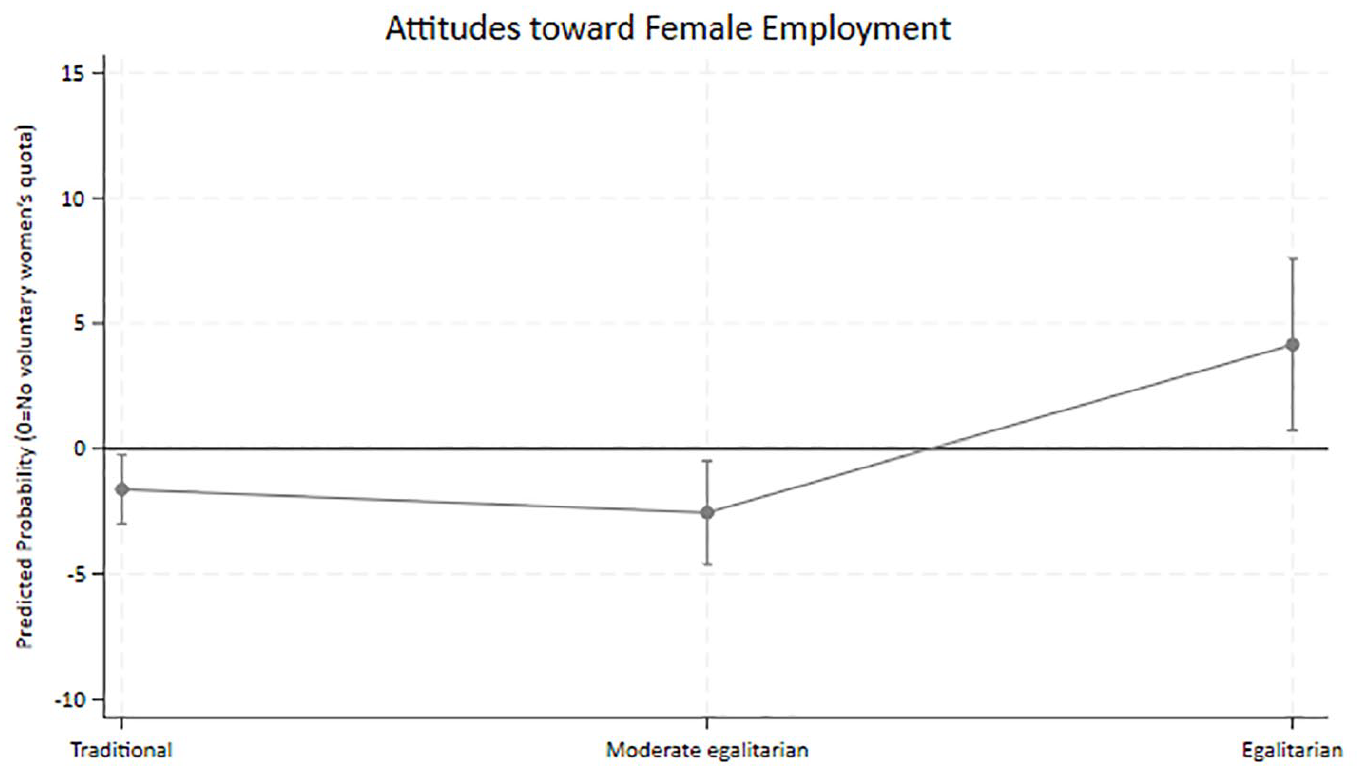
Association of voluntary women’s quotas and gender ideologies towards female employment.
Results for the association of voluntary women’s quotas with employees’ gender ideologies towards maternal employment (Figure 2) show that employees in workplaces with women’s quotas were less likely than their counterparts in workplaces without such a policy to hold traditional (5.6 pp) or moderate egalitarian (1.3 pp) ideologies. Furthermore, they were 6.9 pp more likely to completely disagree with the statement that a pre-school child is likely to suffer if his or her mother works.
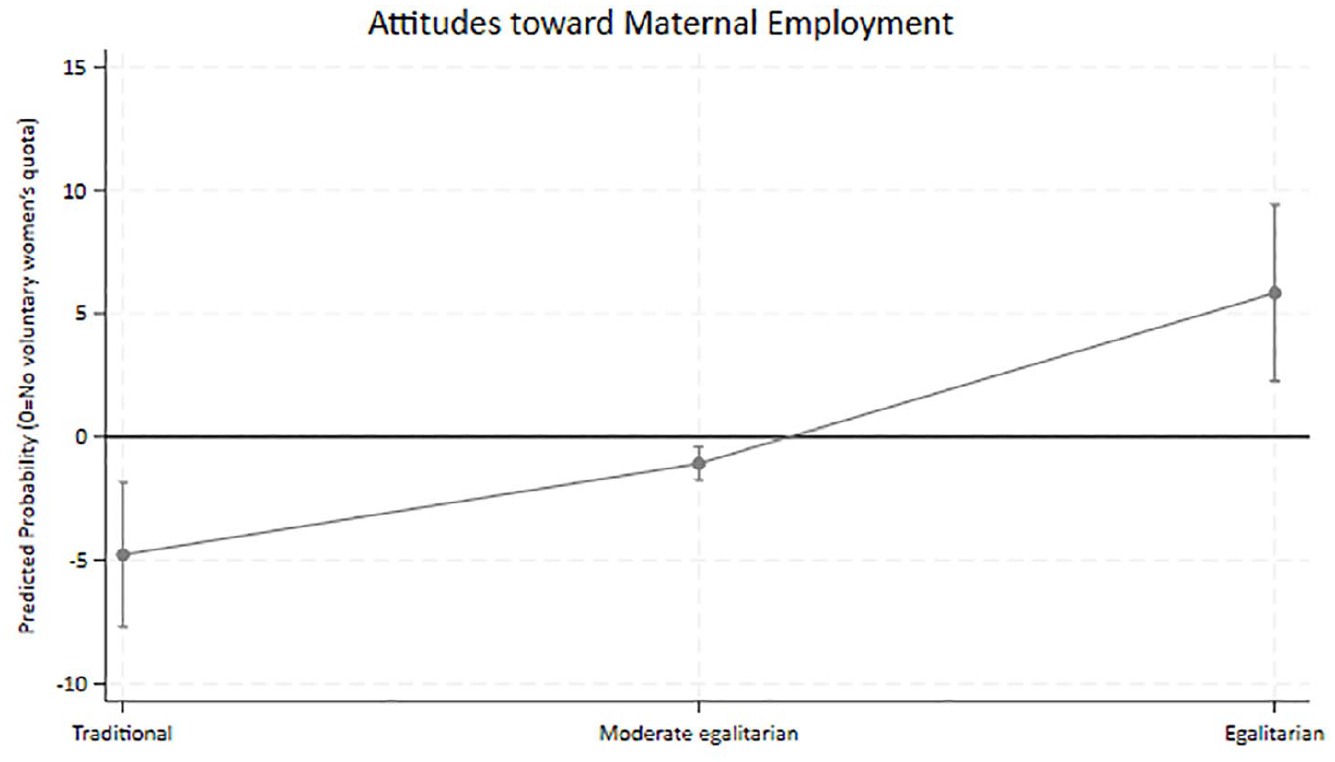
Association of voluntary women’s quotas and gender ideologies towards maternal employment.
Finally, Figure 3 shows that employees in workplaces that had implemented a women’s quota were 4.4 pp less likely than their counterparts in workplaces without such a policy to have traditional and 4.7 pp less likely to have moderate egalitarian ideologies towards the gendered division of labour. Furthermore, they were 9 pp more likely to completely disagree with the statement: ‘It is better for everyone if the men work and the women stay at home to care for the children and the household’.
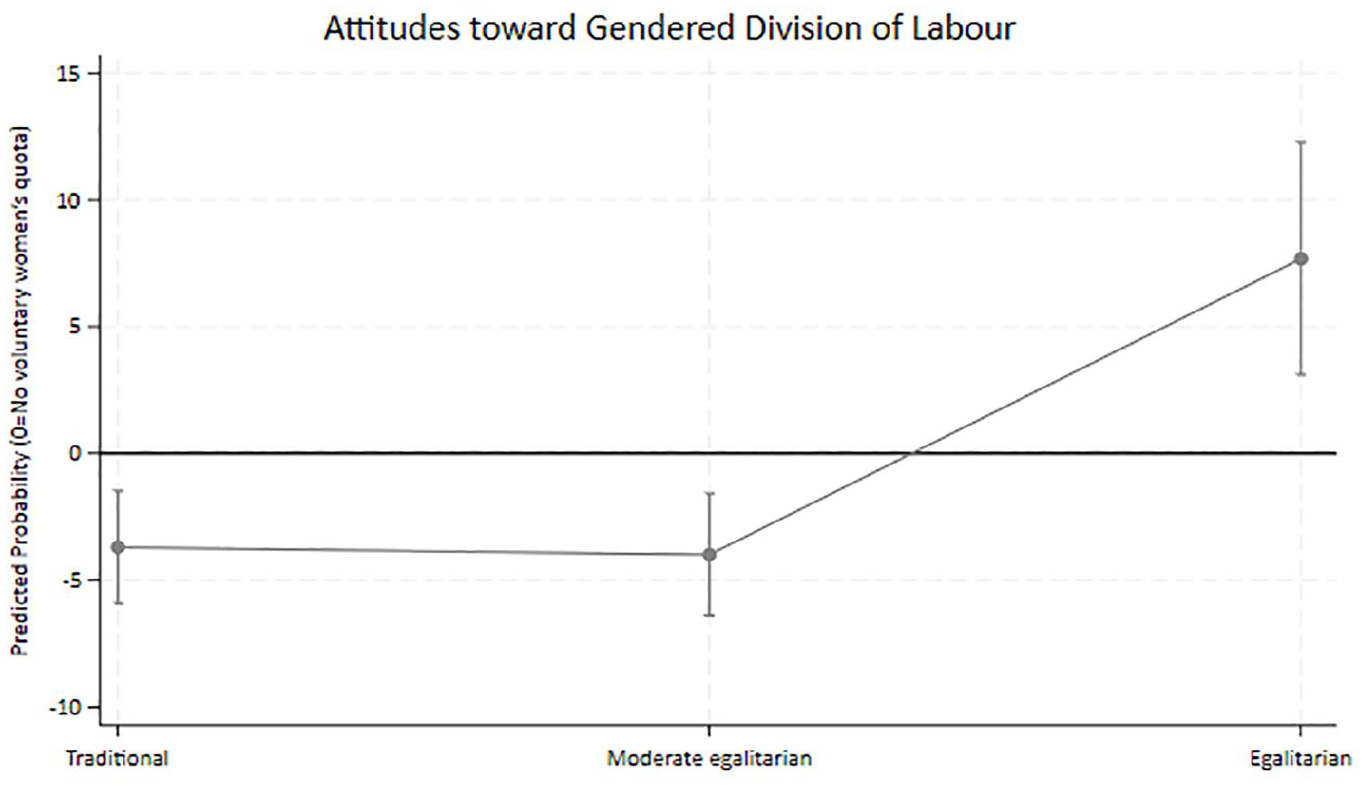
Association of voluntary women’s quotas and gender ideologies towards the gendered division of labour.
In summary, in line with Hypothesis 1a, results of the analysis of the association between voluntary women’s quotas and gender ideologies show that employees had a statistically significantly higher likelihood of holding more egalitarian gender ideologies if their workplaces used voluntary women’s quotas, and that this was the case for all three observed gender ideology dimensions: female employment, maternal employment and the gendered division of labour.
Estimates revealed that a longer elapse of time since the implementation of a women’s quota was associated with a higher likelihood of holding more egalitarian gender ideologies (see Models 4, 5 and 6 in Table A4). Again, this was the case for all three observed gender ideology items. Employees in workplaces in which this policy had been in place for more than 3 years had a higher likelihood of holding egalitarian gender ideologies than had employees in workplaces without such a policy and employees in workplaces where this policy had been implemented more recently (see Figures A1–A3 in the supplemental material). These findings support Hypothesis 2a, which postulated that the longer a voluntary women’s quota has been in place, the more likely employees are to hold egalitarian gender ideologies.
Mentoring programmes
Contrary to the assumption in Hypothesis 1b, the statistically non-significant coefficients in Models 1, 2 and 3 in Table A5 suggest that mentoring programmes are not associated with employees’ gender ideologies. Similarly, contrary to the assumption in Hypothesis 2b, the time that had elapsed since the implementation of this policy does not appear to have been associated with employees’ gender ideologies towards either maternal employment or the gendered division of labour (Models 5 and 6 in Table A5). However, the association between employees’ gender ideologies towards female employment and the time that had elapsed since the implementation of the mentoring programme was statistically significant (Model 5 in Table A5).
Figure 4 shows that employees in workplaces in which a longer time had elapsed since the implementation of a mentoring programme had a higher likelihood of holding more egalitarian gender ideologies compared with employees in workplaces without such a policy. This difference was statistically significant if mentoring programmes had been in place for at least 3 years. Furthermore, employees were less likely to hold moderate egalitarian or traditional gender ideologies if their workplace’s mentoring programme had been in place for more than 5 years. In sum, these results are only partially in line with Hypothesis 2b, as they suggest a positive association only between the time that had elapsed since the implementation of the mentoring programme and gender ideologies towards female employment.
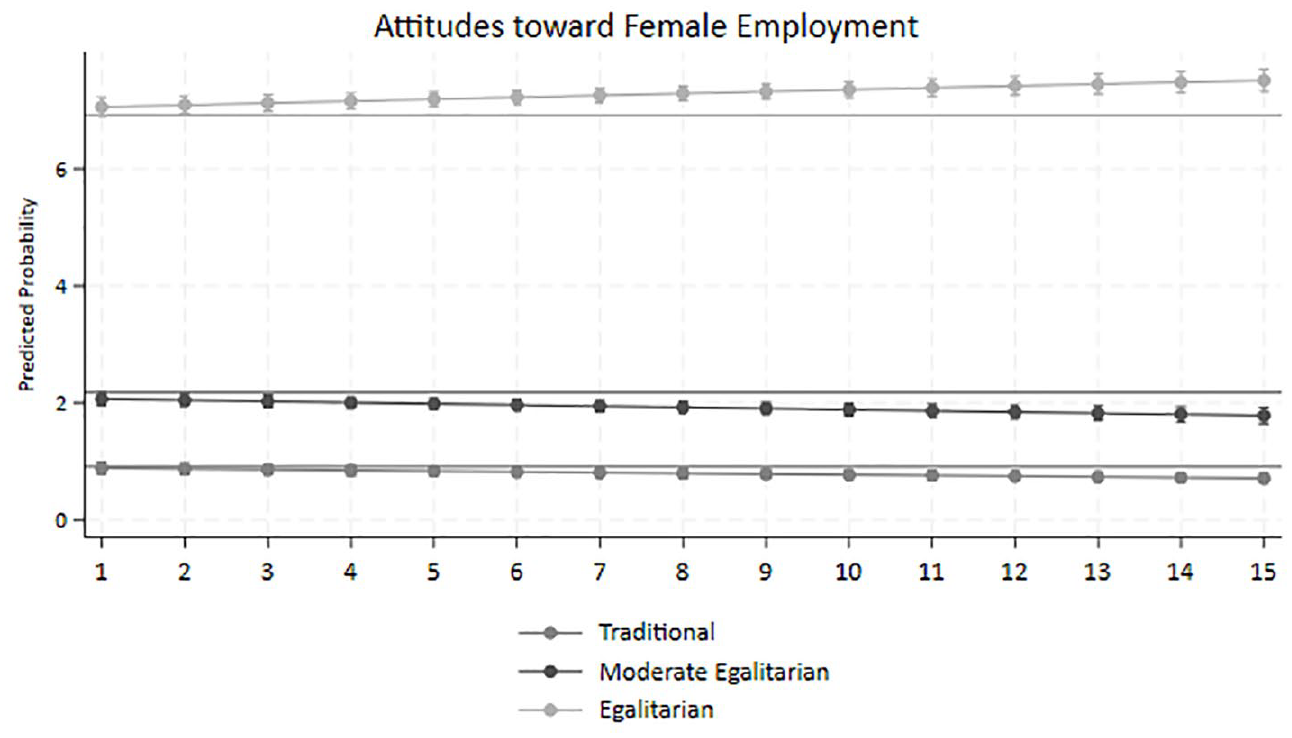
Association of the time since implementation of mentoring programmes and gender ideologies towards female employment.
Differences in normative policy feedback effects across diversity policies and genders
As the intensity of normative policy feedback effects has been shown to be predicted by their visibility and proximity, it was hypothesized that these effects would be more pronounced for voluntary women’s quotas than for mentoring programmes (Hypothesis 3). In line with that hypothesis, results did indeed reveal a more pronounced association between voluntary women’s quotas and employees’ gender ideologies than between mentoring programmes and employees’ gender ideologies.
To test Hypothesis 4, which postulated that the associations of voluntary women’s quotas and mentoring programmes with employees’ gender ideologies would be more pronounced for women than men, models were estimated separately (Table A6 and Table A7). Results for men resemble the overall findings for the association between voluntary women’s quotas and employees’ gender ideologies. For women, the results differ marginally, suggesting that, among women, there is no association between voluntary women’s quotas and gender ideologies towards female employment. One explanation for this could be that – based on LEEP-B3 Wave 3 data – women, on average, already hold more egalitarian beliefs towards female employment (mean 1.75) compared with men (mean 1.51).
Results for men regarding mentoring programmes likewise resemble the overall main findings. For women, the results differ from the overall findings in one aspect: the association between mentoring programmes and gender ideologies towards female employment was also statistically significant and positive for the binary (yes/no) measure. In sum, contrary to Hypothesis 4, results do not indicate that normative policy feedback effects are more pronounced for women than for men. Rather, the findings suggest that diversity policies in the workplace elicit similar policy feedback effects among women and men.
Robustness checks
Several robustness checks were performed to ensure the validity of the core findings. First, one concern could be that workplaces whose employees hold egalitarian gender ideologies are more likely to implement diversity policies. If this was the case, the present results would be driven by reverse causality – that is, they would capture the fact that more egalitarian gender ideologies in the workforce lead to diversity policy implementation and not vice versa. In this case, the association between diversity policies and employees’ gender ideologies would be statistically significant even if workplaces had only recently implemented such policies. However, looking at the association of the time since policy implementation and employees’ gender ideologies, one can see that employees’ gender ideologies did not differ between workplaces that had recently implemented these policies or that did not have them at all (see Figure 4 and Figures A1–A3). This sensitivity analysis provides additional support for the hypotheses formulated based on policy feedback theory. Nevertheless, the possibility that dynamics of reverse causality are of additional importance cannot be ruled out.
A second concern could be that implementing diversity policies signals a workplace’s commitment to gender equality, thereby possibly attracting employees with egalitarian beliefs. Hence, the finding that employees in workplaces with diversity policies hold more egalitarian gender ideologies might simply result from this self-selection process. However, analyses including only employees who were already working in the workplace before the policy was implemented produced equivalent results. This suggests that the present results were not driven by the self-selection of employees with egalitarian gender ideologies into workplaces with such policies.
Third, controls for the share of women in the workplace and the gender of the immediate supervisor were included, as these demographics could influence employees’ gender ideologies. To examine whether public sector affiliation influenced the results due to more formalized procedures, analyses were restricted to private sector workplaces. Finally, analyses were limited to western German workplaces to account for differing histories of female and maternal employment in East and West Germany. In all robustness checks, the results (available on request) remained stable.
Discussion and conclusions
Drawing on policy feedback theory (Campbell, 2012; Gangl and Ziefle, 2015; Grunow et al., 2018), this article explored the respective associations of voluntary women’s quotas and mentoring programmes with employees’ gender ideologies. The results of the analyses of German linked employer–employee data suggest that diversity policies are associated with higher probabilities of holding egalitarian gender ideologies. Thus, this article contributes to the policy feedback literature by highlighting that just as national-level policies shape gender ideologies (Gangl and Ziefle, 2015; Grunow et al., 2018; Zoch and Schober, 2018), so too do workplace-level diversity policies.
Employees in workplaces with voluntary women’s quotas had a higher probability of holding more egalitarian gender ideologies than those in workplaces without such a policy. This relationship was detected for all three observed gender ideology dimensions: female employment, maternal employment and the gendered division of labour. Furthermore, the findings revealed a tendency towards more egalitarian gender ideologies among employees in workplaces in which this policy had been in place for at least three years. Following policy feedback theory, two causal mechanisms could explain this difference: an individual-level mechanism operating through role exposure, or a macro-level mechanism operating through normative anchoring via norm setting and cultural diffusion. Voluntary women’s quotas expose women to new work roles and career opportunities that they may not have previously considered feasible or appropriate (role exposure). Moreover, they signal that women are a valuable part of the workforce and emphasize that gender equality is a crucial workplace goal, thereby engendering a more egalitarian workplace culture (norm setting; e.g. Bowen and Ostroff, 2004). Finally, the observation and internalization of women’s changed behaviours and new roles at work due to women’s quotas may lead to adapted expectations regarding women’s future roles and behaviours (cultural diffusion). Hence, adding to the diversity policy literature, the findings show that besides decreasing gender segregation in authority positions and reducing wage gaps (Kalev et al., 2006; Peters et al., 2020), voluntary women’s quotas are also associated with more egalitarian gender ideologies among employees.
By contrast, the results for mentoring programmes are less consistent. Employees in workplaces that used mentoring programmes did not differ in their gender ideologies compared with employees in workplaces without such a policy. The policy feedback literature highlights that not all policy changes give rise to normative policy feedback effects (Campbell, 2012; Svallfors, 2010). However, the analysis of the association between the time since policy implementation and employees’ gender ideologies revealed that employees in workplaces in which mentoring programmes had been in place for at least 5 years were more likely to hold egalitarian gender ideologies towards female employment than were employees in workplaces without such a policy. This might be an indication that normative policy feedback processes in response to mentoring programmes are lengthier.
Mentors can provide valuable career advice, but this often includes strategies to navigate discrimination or conform to masculinized norms of the ideal worker (Hoskin and Whiley, 2023; Kalev et al., 2006). Consequently, mentoring (or ‘men-toring’) programmes have been criticized for maintaining and reproducing the patriarchal status quo (Hoskin and Whiley, 2023: 1317; McDonald and Westphal, 2013). Hoskin and Whiley (2023) propose an alternative mentoring approach, femme-toring, rooted in critical feminist and femme theory, which seeks to challenge rather than reinforce masculine behaviours and traditional ideal worker norms. Furthermore, mentors should receive training to address gender stereotypes and unconscious biases, as these are often unintentionally transmitted to mentees (Hoskin and Whiley, 2023; McDonald and Westphal, 2013). Finally, mentoring programmes must be integrated into a broader organizational strategy aimed at promoting gender equality, which includes assigning responsibility for workplace diversity, promoting flexible work arrangements and fostering a shift in workplace culture (Kalev et al., 2006). Mentoring programmes can play a pivotal role in advancing gender equality if the focus is shifted from individual adaptation to systemic change.
Overall, the present findings underscore the fact that voluntary women’s quotas have stronger normative policy feedback effects on employees’ gender ideologies than do mentoring programmes. Relatedly, research has highlighted that when it comes to increasing managerial diversity and lowering wage disparities, targeted hiring and promotion policies are more efficient than mentoring programmes (Kalev et al., 2006; Peters et al., 2020). Thus, as women’s quotas intervene in the formal rules and regulations for promotion, they subvert organizational inertia and can mitigate resistance among managers, who often act as gatekeepers for achieving diversity (Kalev et al., 2006).
The present results suggest, further, that voluntary women’s quotas engender role exposure and normative anchoring processes, as both women and men were found to have a higher likelihood of holding more egalitarian gender ideologies if that diversity policy had been implemented in their workplaces. It can thus be concluded that changing rigid workplace cultures, including gender ideologies that place greater value on the role of men in paid employment, requires decisive diversity measures to break down these stereotyped views.
Despite these insights, the study has limitations. First, as the analyses were based on cross-sectional data, no claims can be made regarding causality. Although the additional robustness checks suggest that the results were not driven by reverse causality or by employee self-selection, more research is needed that follows the same workplaces and employees over time. This would also enable the further disentanglement of the normative feedback effects of role exposure and normative anchoring. Additionally, the data, while covering large workplaces with more than 500 employees employing around 20% of German workers, are not representative of all German workplaces. Finally, the data indicate whether workplaces had implemented voluntary women’s quotas or mentoring programmes and how long these policies had been in place. Future research with more detailed information on the specific framework and implementation strategies of these policies could provide deeper insights into their impact on employees’ gender ideologies.
Despite these limitations, the present study contributes to the literature on how normative policy feedback shapes individuals’ beliefs by focusing on workplaces as another vital policy context. As gender ideologies shape individuals’ (and employers’) work- and family-related decision-making and behaviour, they contribute to – or mitigate – gendered inequalities both at work and at home. The results underscore the fact that diversity policies not only change structures and formal regulations at the workplace. Additionally, they are associated with more egalitarian workplace cultures that likely equalize access to workplace resources and rewards and enable women to advance in their careers. These findings can therefore help in understanding how workplace characteristics influence employees’ gender beliefs and can provide valuable insights into transforming workplaces to promote gender equality and create workplace cultures that empower both women and men.
Supplemental Material
sj-docx-1-wes-10.1177_09500170251336989 – Supplemental material for Gender Ideologies and Workplace Diversity Policies: Are Voluntary Women’s Quotas and Mentoring Programmes Associated with Employees’ Gender Ideologies?
Supplemental material, sj-docx-1-wes-10.1177_09500170251336989 for Gender Ideologies and Workplace Diversity Policies: Are Voluntary Women’s Quotas and Mentoring Programmes Associated with Employees’ Gender Ideologies? by Eileen Peters and Anja-Kristin Abendroth in Work, Employment and Society
Footnotes
Funding
The authors disclosed receipt of the following financial support for the research, authorship, and/or publication of this article: The research was made possible with funding from the German research Foundation as part of the project ‘Organizational Inequalities and Interdependencies between Capabilities in Work and Personal Life: A Study of Employees in Different Work Organizations’ (grant no. 373090005). Opinions expressed here reflect only the authors’ views.

Supplemental material
Supplemental material for this article is available online.
Notes
References
Supplementary Material
Please find the following supplemental material available below.
For Open Access articles published under a Creative Commons License, all supplemental material carries the same license as the article it is associated with.
For non-Open Access articles published, all supplemental material carries a non-exclusive license, and permission requests for re-use of supplemental material or any part of supplemental material shall be sent directly to the copyright owner as specified in the copyright notice associated with the article.
