




Abstract
This article contributes to the literature on gender role attitudes and the reproduction of occupational sex segregation by investigating how attitudes towards women’s voluntary childlessness relate to the embeddedness of individuals in sex-typed occupations. While previous studies have found that more favourable attitudes are more common among women than men, they have not established why this is so. We argue that the differing allocation of men and women to sex-typed occupations carries gender-specific pressures towards gender-role congruence, which are likely to shape the perceived costs of motherhood and, hence, attitudes towards female childlessness differently. We test this argument by drawing on European Social Survey data. Findings show that women with more favourable attitudes are most likely to work in male-dominated occupations and hold high-status positions, highlighting the enduring force and differentiated saliency of gender beliefs across sex-segregated occupations. We discuss the implications for the reproduction of occupational sex segregation.
Keywords
Introduction
Occupational sex segregation is sustained by gender role attitudes (Chesters, 2021), intended as beliefs and expectations about the roles best suited to men and women across different spheres in society (Lietzmann and Frodermann, 2021). Research on the reproduction of occupational sex segregation has been widely concerned with the ways career orientations underpin segregation when individuals, especially women, choose occupations that reflect gender stereotypical expectations about family roles (Bass, 2015; Cech, 2013, 2016; Knight and Brinton, 2017). Some researchers have argued that women anticipate their maternal role in terms of the difficulties they will encounter in juggling motherhood with employment and, as a result, self-select into occupations that are supposed to accommodate work–family balance issues more easily – mainly female-dominated occupations (Cech, 2016; Charles and Grusky, 2005; Torre, 2019). Evidence in this regard is, however, mixed (see, for example, Bass, 2015; Cech, 2013; Thébaud and Taylor, 2021), suggesting that the influence played by gender beliefs about family roles has yet to be fully explored and understood when it comes to the reproduction of occupational sex segregation.
In this regard, one research avenue that deserves further exploration concerns the ways in which occupational sex segregation elicits gender role attitudes that emphasise the construction of womanhood as motherhood (Shapiro, 2014). While it is acknowledged that sex-typed occupations carry normative beliefs about gender-stereotypical attributes (i.e. widely shared understandings of how men and women should behave) that can shape a woman’s maternal choices (e.g. delaying motherhood in male-dominated occupations, as seen in Mumford et al., 2023 and Shreffler, 2017), there is limited understanding of how individuals’ embeddedness in sex-typed occupations shapes attitudes towards other women’s maternal preferences. Or, in other words, how such attitudes are responsive to work experiences across sex-typed occupations. Yet, gaining this knowledge is essential, and that is the aim of this article, which studies employees’ attitudes towards women’s voluntary childlessness 1 – that is, whether individuals approve or not of women who choose not to have children – and their relation to occupational sex segregation.
Female social identity and value have been historically and traditionally defined through motherhood, mainly on the basis of the assumption that being a mother is the most desirable and fulfilling role for all women (Gillespie, 2003; Koropeckyj-Cox and Pendell, 2007b; Preisner et al., 2020; Ridgeway and Correll, 2004). Attitudes that conflate the necessity of motherhood with the definition of the adult female – what Russo (1976) calls the ‘motherhood mandate’ – contribute to shaping social norms about women’s subordinate position in the labour market and the undervaluation of female work across occupations, thus fuelling processes of occupational sex segregation. In fact, such attitudes are at the core of the representations of what is deemed to be gender-appropriate work for women, which usually involves stereotypically feminine traits such as caring and nurturing (Charles and Grusky, 2005; Chesters, 2021), and from which it is usually implied that women lack job and career commitment due to an overinvestment in their maternal role (Benard and Correll, 2010; Heilman, 2012). As a result, gaining knowledge on how individuals’ work experiences across sex-typed occupations sustain – or challenge – such stereotypical representations of female identities that are detrimental to women’s work is a fundamental step in the process of undermining occupational sex segregation.
Looking specifically into attitudes towards women’s voluntary childlessness is particularly pertinent for several reasons. Recent years have seen a growing trend among women choosing to remain childless, thus challenging dominant constructions of femininity (Gillespie, 2003; Merz and Liefbroer, 2012; Shapiro, 2014). Studies have examined the characteristics and reasons for those who do not become mothers – whether voluntarily or involuntarily – and, to a smaller extent, the individual, cultural and structural drivers behind attitudes towards female childlessness (Ashburn-Nardo, 2017; Gillespie, 2003; Koropeckyj-Cox and Pendell, 2007a; Miettinen and Szalma, 2014). One notable finding is that women appear to have more favourable attitudes than men towards women who do not become mothers (Koropeckyj-Cox and Pendell, 2007a, 2007b; Merz and Liefbroer, 2012; Rijken and Merz, 2014). An explanation that has been suggested for this is that due to the difficulties they experience in combining work and family, women perceive the higher costs of being a parent compared with men (Koropeckyj-Cox and Pendell, 2007a). However, research remains inconclusive about the drivers behind this gendered pattern. We argue that this is because studies have overlooked the fact that the perceived costs of motherhood are embedded in the sex-segregated occupational structure and the way it endorses the saliency of motherhood to women’s identity and role in society, in line with our aim to examine to what extent individuals’ work experiences across sex-typed occupations affect their gender attitudes.
Building on this premise, we analyse the dynamics behind women’s more favourable attitudes considering the structural gender inequalities embodied by occupational sex segregation in terms of the congruence expected from men and women between their job roles and their stereotypical gender roles in society. Drawing on role congruence theory (Eagly and Diekman, 2005; Eagly and Karau, 2002), we contend that women experience specific pressures towards gender-role congruence in their job roles according to the sex-typed character of their occupation (male-dominated, female-dominated, gender-neutral) and the occupational status of their job (high status versus low status) – two important aspects that characterise occupational sex segregation. These pressures are likely to shape their perceived costs of motherhood and to make their attitudes towards female childlessness vary accordingly.
We test this argument within the European context using data from the European Social Survey (ESS rounds three and nine) on a sample of 23 countries. Childlessness is a rising phenomenon in Europe, having increased consistently and in similar ways across many European countries despite their cultural diversity (Beaujouan et al., 2017; Tanturri et al., 2015). Moreover, although a relevant stream of literature on childlessness and related attitudes exists for Anglo-Saxon countries – especially the United States, and to some extent Australia and the United Kingdom – Europe as a case study has been less often explored (Tanturri et al., 2015).
Our findings show that women with more favourable attitudes are those who are incongruent with their job role; that is, women who work in male-dominated occupations, especially when they hold high-status positions. We interpret these results in light of research on role traps, tokenism and occupational minorities (Kanter, 1977; Taylor, 2010; Wajcman, 2013) and suggest that these women are expected to perform like men to succeed in their occupation, making motherhood less salient for their identity and more costly for their careers. In this sense, the findings highlight the enduring force and differentiated saliency of gender beliefs across sex-segregated occupations (Ridgeway and Correll, 2004), rather than a break in such beliefs that could potentially contribute to undermining occupational sex segregation. Thus, they bear important implications for understanding the role of stereotypical representations of female identities in the reproduction of occupational sex segregation, which we discuss in the concluding part of the article.
What leads women to hold more favourable attitudes towards female voluntary childlessness?
Both cultural and structural aspects of gender roles and relations in society may encourage women to show more favourable views on female childlessness (Koropeckyj-Cox and Pendell, 2007a, 2007b; Merz and Liefbroer, 2012; Miettinen and Szalma, 2014; Rijken and Merz, 2014). Women often feel strong pressures to engage in motherhood due to both biological deadlines and social expectations (Agrillo and Nelini, 2008; Preisner et al., 2020). Once they have children, and are subject to constant social scrutiny, women may feel pressure to provide intensive mothering, especially if they are working mothers (Christopher, 2012; Edgley, 2021; Hays, 1996), and this may trigger stress and a sense of sacrifice. Indeed, within the family, the transition to motherhood usually coincides with an increase in their share of the housework (Yavorsky et al., 2015), frequently combined with a reduction in the time spent in paid labour (Zhou, 2017). This is due to the unequal distribution of childcare responsibilities among heterosexual couples, which remains prevalent in most countries (Craig and Mullan, 2011). Conflicting cultural constructions of the ideal mother and worker may also trigger great difficulties for women when it comes to combining family life with paid work (Blair-Loy, 2003; Christopher, 2012). In the workplace, they may incur the so-called ‘motherhood penalty’, which leads to lost wages and reduced opportunities for career advancement because of employers’ conflicting views regarding family and employment (Fuller, 2018). In fact, stereotypes about mothers being less committed and competent than other types of workers may lead to discrimination, even when women have invested heavily in their careers and regardless of their human capital and the value they generate for the firm (Benard and Correll, 2010). Taken together, these aspects may generate an awareness of the social disadvantages of motherhood among women, encouraging them to hold a greater acceptance of female childlessness (Koropeckyj-Cox and Pendell, 2007b; Merz and Liefbroer, 2012). This is likely to be especially the case when women engage in paid work (Christopher, 2012; Edgley, 2021; Wood and Newton, 2006), but it does not necessarily imply that women workers have to be mothers in order for them to be aware of such disadvantages.
A sociological explanation for why individuals differ in their attitudes is that they are embedded in various social structures imbued with ideologies – including gendered ideologies – that provide different constraints and opportunities likely to influence how individuals interpret themselves and others as occupants of such structures (Ridgeway and Correll, 2004; Valet, 2018). When looking at labour market structures, most studies on childbearing perceptions and behaviours account for the role of such structures simply by differentiating between working and nonworking individuals, hence treating employment as merely an additive statistical control (Zhou, 2017). The qualitatively different work experiences of men and women in the labour force are not considered, particularly regarding the processes of occupational segregation, which can activate gendered ideologies through hegemonic cultural beliefs and expectations about stereotypical gender roles according to the sex composition of occupations (Ridgeway and Correll, 2004; Taylor, 2010). Indeed, sex-typed occupations are imbued with meanings regarding workers’ gender attributes and identities and carry normative beliefs about what each sex should want and do. These can shape individual perceptions of the appropriateness of men and women in their job roles within the occupation (Kugelberg, 2006; Simpson, 2004; Taylor, 2010), based on the congruence expected between men’s and women’s job roles and their stereotypical gender roles in society. In turn, expectations to engage in gender-typical work roles and to show gender-typical attributes through participation in gender-segregated occupations (e.g. leadership in male-dominated occupations, nurturance in female-dominated occupations), may lead to judgements about whether individuals fit into such roles or not and trigger adverse job outcomes (del Carmen Triana et al., 2024).
On this basis, individual work experiences across sex-typed occupations may play an important role in shaping attitudes towards women’s childlessness. Sex-typed occupations are likely to endorse the saliency of motherhood to women’s identity and roles differently through congruency expectations, and to shape, in this way, the awareness of the social disadvantages – or costs – of motherhood among women, leading them to express greater acceptance of female voluntary childlessness. We explore this argument by drawing on role congruity theory (Eagly and Diekman, 2005; Eagly and Karau, 2002), which we present in the next section alongside the crux of our analysis.
Occupational sex segregation and variations in attitudes towards female voluntary childlessness
According to role congruity theory, individuals in sex-segregated occupations experience gender-specific pressures to achieve congruence between their job roles and stereotypical gendered roles in society, such that the greater the overlap between a person’s perceived characteristics – in this case, gender – and a job role, the greater the perceived aptitude in that role (Brown et al., 2014; Cejka and Eagly, 1999). Whereas conformity with the predominant ideal attributes is usually encouraged and rewarded with higher social acceptance, incongruity can result in negative perceptions, prejudice, or even backlash and discrimination (Brown et al., 2014; Preisner et al., 2020). This dynamic plays out differently across gendered expectations: masculinity can be reproduced in a wide range of spheres – especially in employment (Piesner et al., 2020) – whereas parenthood is socially considered a necessary part of the adult female identity (Gillespie, 2003), to the point that women are expected to be primarily caretakers of children and the household, with paid work being only a secondary aspect of their social roles and identity. We contend that this can create conflict with job expectations, leading to judgement about whether one fits into a job role or not and potentially intensifying job role incongruity for working women, hence their perceived costs of motherhood, but in different ways depending on the sex-typed character of individuals’ occupation (male-dominated, female-dominated, gender-neutral) and the occupational status of their job (high status versus low status).
Differences across sex-typed occupations
In female-dominated occupations (e.g. nurses, school teachers, social workers), incongruity and related negative effects are less likely to be observed. In fact, these are occupations where a feminine role and identity are most likely to be valued because of their overlap with the ideal of maternal behaviour, where working environments are frequently perceived as more supportive in terms of balancing employment and motherhood, potentially reducing the likelihood of expected work–family conflicts (Bass, 2015; Cech, 2016; Charles and Grusky, 2005), and where high-status positions are less frequent and often under-rewarded because of their association with traditionally feminine traits.
It is instead in male-dominated occupations (e.g. craft workers, machine operators, engineers), where women are in the minority and may be required to fill a traditionally masculine job role or execute a masculine-stereotyped task, that job role incongruity may become greater for women. Here, women are more likely to be perceived as out of place and to be expected to perform like men – and hence appear incongruous with respect to their expected gender attributes – if they do not want to be judged as not fitting with their job role. In these cases, they risk not only being penalised for enacting what they are proscribed from being, but also risk backlash if they are considered to have failed to meet prescribed expectations (Ashburn-Nardo, 2017; Taylor, 2010). Moreover, the potential incongruity and the strain between work and family obligations may, in turn, increase the chances of experiencing negative treatments and adverse outcomes on the job (Brown et al., 2014; Perrone et al., 2005). Male-dominated occupations usually have a working culture dominated by ‘masculinity’, which implies time-demanding work norms, a separation between employment and social reproduction, and fewer possibilities for work to accommodate caregiving responsibilities, especially given that pregnancy and motherhood are not as common as in female-dominated occupations (Bass, 2015; Taylor, 2010; Torre, 2018; Wood and Newton, 2006). On this basis, given their higher risk of experiencing job role incongruity, women working in these types of occupations are more likely to express favourable attitudes towards female voluntary childlessness, possibly reflecting greater perceived costs of motherhood (Hypothesis 1).
Differences across occupational statuses
The stigmatisation women face in male-dominated occupations is presumably greater when they occupy high-status positions (e.g. CEOs, surgeons), as advancement in most high-status careers usually requires exhibiting highly valued and rewarded masculine-stereotyped characteristics, behaviours and capacities (e.g. power, leadership, extensive time availability), and it is most often regarded as incompatible with motherhood (Kugelberg, 2006; Rudman et al., 2012; Taylor, 2010; Wood and Newton, 2006).
By achieving high-status positions, women signal masculine agentic traits (e.g. competence, ambition, competitiveness) and break both organisational and societal expectations that traditionally link them to low-status job roles (Rudman et al., 2012). In other words, stereotypical gender expectations are further violated by women’s incongruence between their ascribed gender characteristics (as women), their achieved job status (as high-status professionals) and the characteristics – stereotypically male – required for such job status (Ridgeway, 2001; Rudman et al., 2012). Moreover, signalling such traits is regarded as unnatural for women, opposed to dominant discourses of womanhood and the ideas of what it means to be feminine. These ideas are associated with the image of the ideal mother and cast societal expectations of symbolic motherhood virtually over all women (Cutcher, 2021; Edgley, 2021), which hold even if women who want to succeed in high-status job roles are often required to place their careers at the centre of their lives and potentially give up motherhood (Edgley, 2021). Put differently, women will still be judged against these stereotypical gendered ideas of femininity even when they do not have children and even when they are highly committed to their careers (Cutcher, 2021). Women in high-status positions demonstrate awareness of this in instances where they construct motherhood in opposition to professional legitimacy and success and as a subject of fear (Thébaud and Taylor, 2021), such as when they perceive that motherhood would put an end to their careers, or that childlessness is a precondition for promotion and professional achievement (Edgley, 2021; Wajcman, 2013; Wood and Newton, 2006).
On this basis, we expect the enactment of status hierarchies to further foster stereotypical gender expectations (Ridgeway, 2001), and for this to be especially true in male-dominated occupations rather than in female-dominated ones, because this is where high-status job roles differ most from female stereotypical gender roles and are therefore more likely to elicit further penalties and backlash (Rudman et al., 2012). Accordingly, this higher risk of experiencing incongruity with respect to occupational status on top of occupational domain is likely to lead women in high-status positions in male-dominated occupations to perceive higher costs of motherhood, and hence to express more favourable attitudes towards female voluntary childlessness (Hypothesis 2).
Data and methods
Data
The data used in this study are drawn from rounds three (2005–2006) and nine (2017–2018) of the ESS. The ESS is a biennial, cross-sectional, multi-country survey representative of all persons aged 15 and over, and collects information on attitudes and behaviour in up to 31 European countries, making it a particularly valuable dataset for this study. Rounds three and nine include a question on attitudes towards childlessness; hence, we rely on these two survey waves, which we merge into a cumulative dataset. We integrate survey data with administrative sources to attain country-level information considered relevant for our study (sex segregation by occupation and childcare arrangements).
Measures
Attitudes towards childlessness
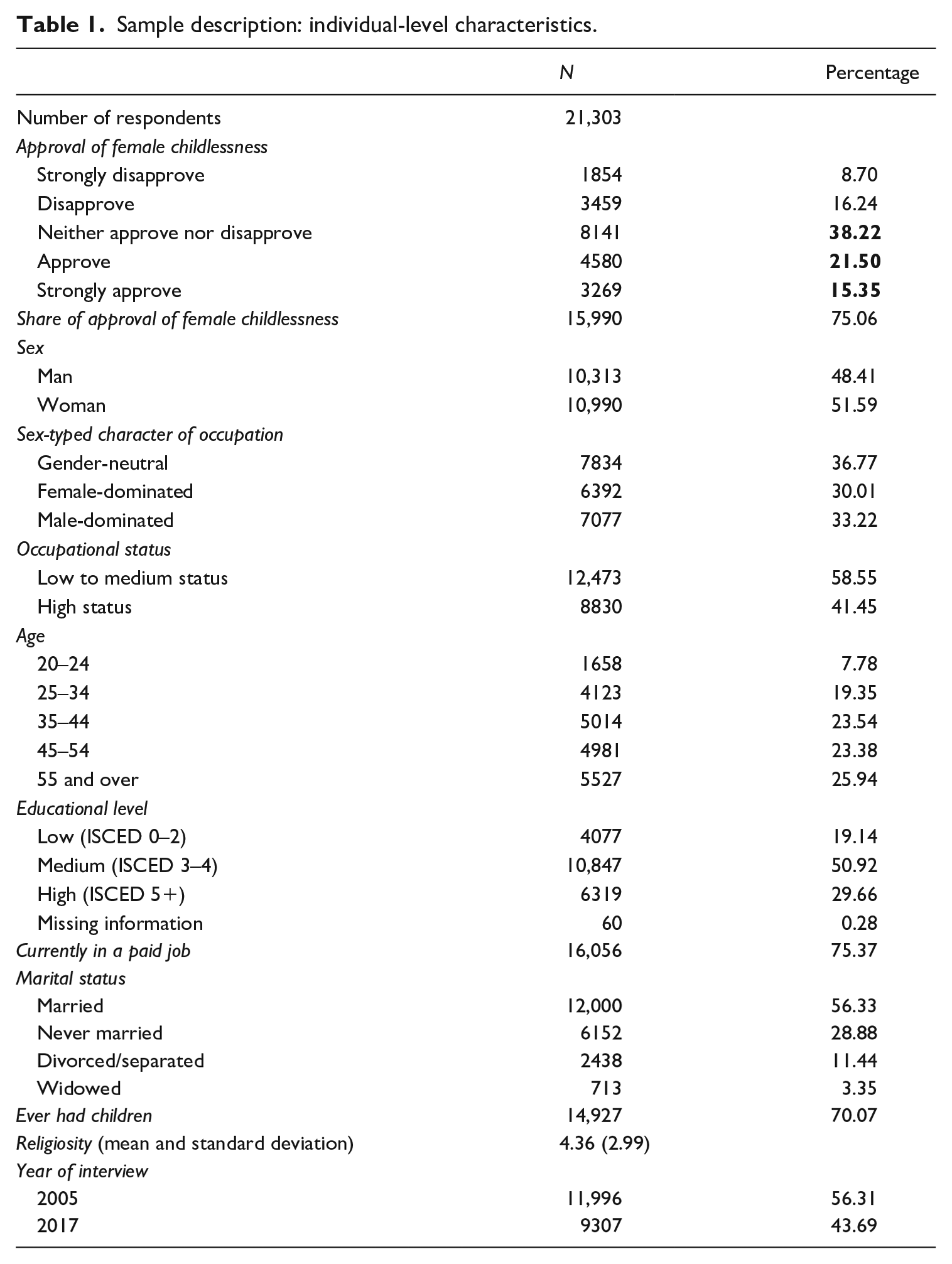
Attitudes are measured with the question: ‘How much do you approve or disapprove if a woman chooses never to have children?’ using a scale from 1 (strongly disapprove) to 5 (strongly approve). To enhance the interpretability of the results, we use a dichotomised version of the variable: approving (collapsing: ‘strongly approve’, ‘approve’, ‘neither approve nor disapprove’) or not approving (‘strongly disapprove’ and ‘disapprove’) of voluntary childlessness. Table 1 includes the distribution of both the original variable and the dichotomised version we rely on.
Sample description: individual-level characteristics.
Sex-typed character of the respondent’s occupation
Using official statistics data on employment in Europe (data from ILOSTAT), we calculate the level of gender representation by occupation for each country and survey year (2005 and 2017). Occupations are identified using the two-digit level International Standard Classification of Occupations (ISCO) code (ISCO-88 code in 2005 and ISCO-08 code in 2017). Following the literature (Torre, 2019), we define an occupation as female-dominated if women’s representation is 66.6% or above, male-dominated if women comprise less than 33.3% and gender-neutral otherwise (between 33.3% and 66.5%). We then match this information with the respondent’s current occupation, or their most recent one if they were not currently working.
Occupational status
We create a dummy variable indicating whether the respondent was employed in a high-status (i.e. high-skilled) or low–medium-status (i.e. low-to-medium-skilled) job. To do so, we rely on the hierarchical structure of the ISCO classification and used the ISCO code (ISCO-88 code in 2005 and ISCO-08 code in 2017) of the respondent’s main current or most recent job. High-status jobs refer to managers, professionals and associate professional/technical occupations (so-called major groups 1 to 3); low–medium-status jobs refer to clerical support workers, sales and service workers, skilled manual jobs, and administrative, trade and personal occupations (medium status: major groups 4 to 8), as well as elementary occupations (low status: major group 9).
Control variables
We include a series of control variables that, according to the literature, might be associated with either labour market inequality or attitudes towards childlessness. At the individual level, we control for age, marital status (married, single, separated or divorced, widowed), level of education (lower secondary and below: International Standard Classification of Education (ISCED) levels 0–2; secondary: ISCED 3–4; tertiary and above: ISCED 5+), current employment status (in paid work or not), whether the respondent had ever had children and level of religiosity (0–10 scale). At the country level, we control for the aggregate use of formal childcare arrangements and the level of gender equality in the country. Information on childcare is retrieved from the EU-SILC survey (European Union Statistics on Income and Living Conditions; Eurostat data) and refers to the share of children under the age of three years in formal childcare arrangements. As a measure of gender equality in each country, we rely on the EU Gender Equality Index developed by the European Institute for Gender Equality (EIGE). This is a composite index, ranging from 0 to 100, that measures equality in eight domains: the labour market position of men and women; gender inequality in financial resources; education; allocation of time; the share of women in key public and private organisations; health inequality; intersecting inequality (including gender and family type, age, country and disability); and violence against women.
Sample
We merge rounds three and nine of the ESS, yielding approximately 34,500 respondents with valid information regarding their approval or disapproval of a woman’s choice not to have children. As we are interested in investigating the role of occupational sex segregation, we exclude those who had never been in a paid job (approximately 3000 respondents) or had worked less than three months in their lifetime (excluding 2400 respondents). We also drop individuals currently inactive on the labour market (for instance, due to retirement) for a period longer than four years (approximately 7000 respondents). 2 This is because, after a longer period spent outside the labour force, individuals’ self-reported retrospective information on occupational characteristics may be affected by recall bias, which may also make it difficult to disentangle the effect of past and present conditions on declared attitudes (Fehring and Bessant, 2009). Likewise, the overall levels of occupational sex segregation and of mobility across sex-typed occupations may have changed over time (Torre and Jacobs, 2021), affecting the reliability of the matching between the information retrieved at the country level for each survey year on the sex-typed character of occupations and the occupation in which the respondent worked in the period prior to leaving the labour force. For another 332 respondents, information on the occupation type is unavailable, leaving us with a sample of 21,303 individuals living in 23 countries, 3 who were currently or recently employed, and for whom we know the occupation in which they were employed. Tables 1 and 2 provide the sample description.
Sample description: country-level characteristics.
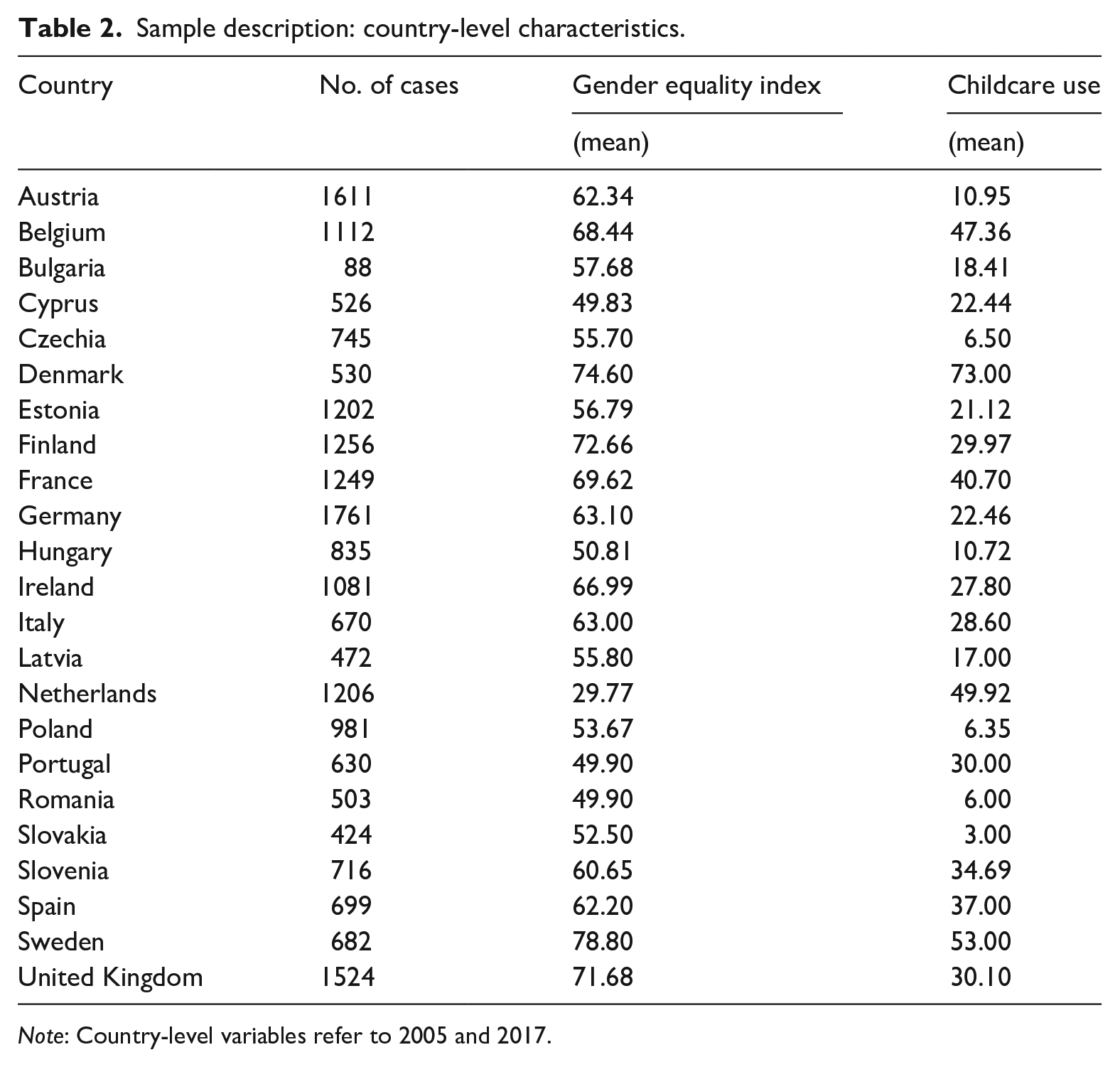
Note: Country-level variables refer to 2005 and 2017.
Methods
We employ a multilevel logit regression model. Multilevel modelling allows us to consider the hierarchical structure of the data (i.e. individuals nested in countries) by accounting for individuals as well as country-specific characteristics. This means that we can consistently handle within-country effects on attitudes at the individual level (i.e. individuals living in one country are likely to be more culturally similar than individuals living in two different countries). Likewise, we can control for variability at the country level; that is, the extent to which attitudes at the individual level may vary across countries due, for example, to context-specific cultural differences. To investigate Hypothesis 1, we ran a multilevel logit model, including an interaction between the sex of the respondent and the sex-typed character of the respondent’s occupation. We include, as control variables, a set of individual- and country-level factors as described in the Measures section. To investigate Hypothesis 2, we focus on individuals in male-dominated occupations, and we ran a second multilevel logit model including an interaction term between the sex of the respondent and their occupational status (i.e. skill level). This model includes the same set of individual and country-level control variables mentioned earlier.
The regression results for both sets of models are reported in terms of odds ratios. For the interaction terms, we also report the results in terms of the change in the predicted probabilities (see figures in the main text), and we apply the Wald test to formally assess whether they are statistically different from each other, instead of focusing exclusively on whether the effects are statistically significant in the regression models. In fact, in the case of nonlinear models (here logit models), the interpretation of nonlinear interaction effects among categorical variables, when based solely on the significance of the effect, might be misleading (Mize, 2019). Moreover, directly statistically testing the difference in the predicted probabilities across sub-groups via the Wald test allows us to avoid relying on visual inspection of such differences based on the overlap of 95% confidence intervals, a practice that could be misleading as well (Goldstein and Healy, 1995; Knol et al., 2011). We also conduct several robustness checks to ensure that our results remain consistent across different statistical models. These include variations in the scale of the outcome variable, using both the original five-point scale (with an ordinary least squares (OLS) model or an ordinal model) and a dichotomised version with a logit model (our preferred specification). Additionally, our findings hold when applying a country fixed-effects model instead of a multilevel model. Further details can be found in the Supplemental Material and the Robustness Checks sections.
Results
Descriptive overview
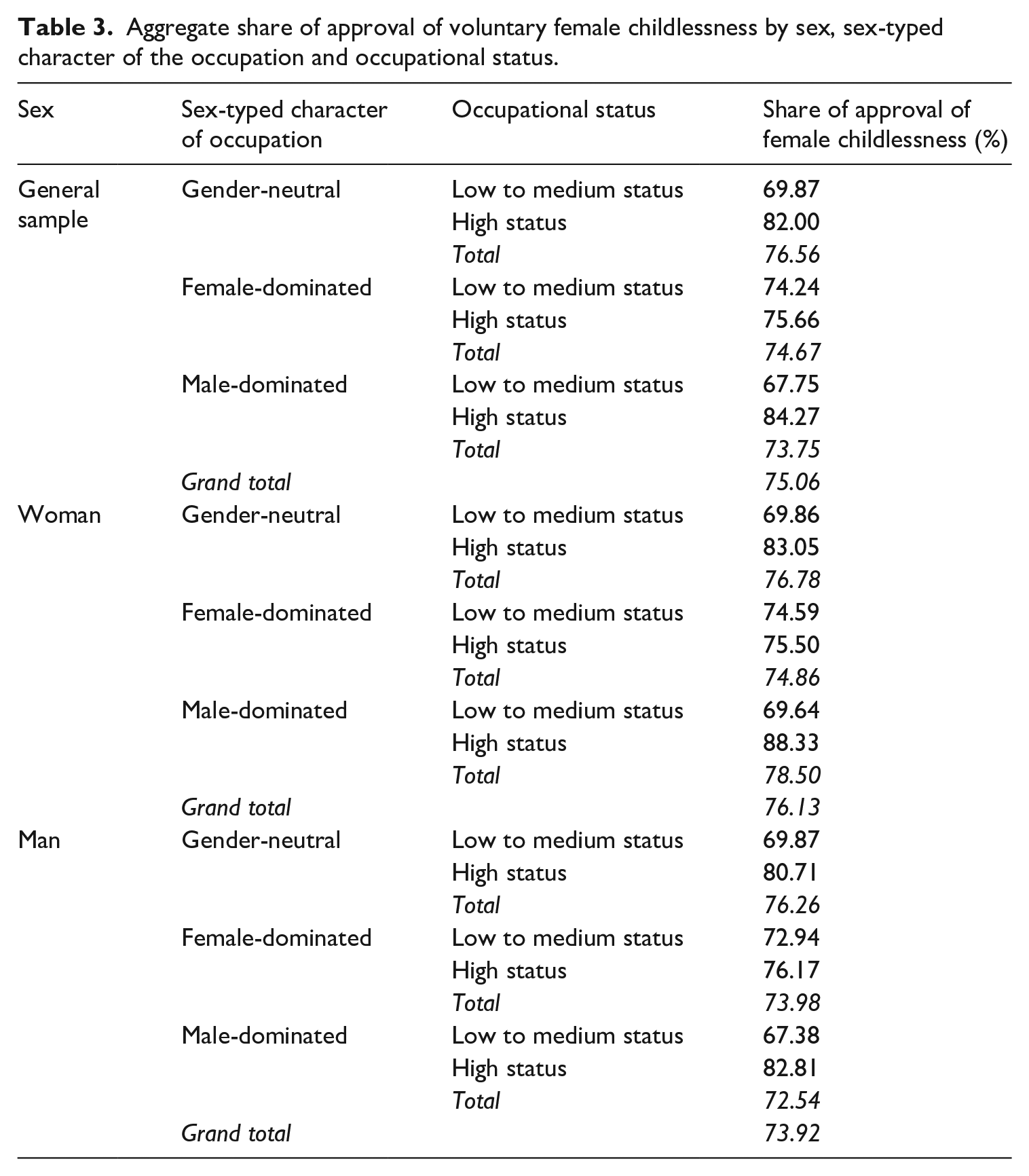
Our descriptive results (Table 3) show generally high levels of approval of women’s voluntary childlessness (75.06% of respondents), with women showing more favourable attitudes than men (76.13% approval among women and 73.92% among men; p-value of chi-squared test < 0.001). Examining sex-typed occupations, the highest approval rate in the general sample is in gender-neutral jobs (76.56%), whereas the lowest is in male-dominated occupations (73.75%), with female-dominated occupations in between the two (74.67%). However, we observe interesting gender differences among workers in male-dominated occupations. Whereas among women the level of approval is higher when they work in male-dominated occupations than for those working in gender-neutral or female-dominated occupations (78.50% compared with 76.78% and 74.86%, respectively), the contrary is true for men: men in male-dominated occupations show a lower level of approval than men in gender-neutral or female-dominated occupations (72.54% compared with 76.26% and 73.98%, respectively). High-status workers report higher levels of approval than low-status workers, among both men and women. In all these cases, the difference in the level of approval between high-status and low-status workers is greater in gender-neutral and male-dominated occupations, while no statistically significant differences were found among individuals in female-dominated occupations (p-value from chi-squared test = 0.232).
Aggregate share of approval of voluntary female childlessness by sex, sex-typed character of the occupation and occupational status.
Multivariate analysis
The results from our multilevel logistic model (Model 1 in Table 4) confirm that women are more likely than their male counterparts to approve of women’s voluntary childlessness (odds ratio = 1.334, p < 0.01). Moreover, the chances of approving women’s voluntary childlessness are lower among individuals in male-dominated occupations (odds ratio = 0.846, p < 0.01) and in female-dominated occupations (odds ratio = 0.952, not statistically significant) than among those in gender-neutral occupations. However, when examining the interaction term between sex and the sex-typed character of the occupation, we find a higher likelihood of favourable attitudes among women in male-dominated occupations compared with men (odds ratio = 1.238, p < 0.05), whereas no significant effect is found for women in female-dominated occupations.
Approval of voluntary female childlessness. Multilevel logit model.
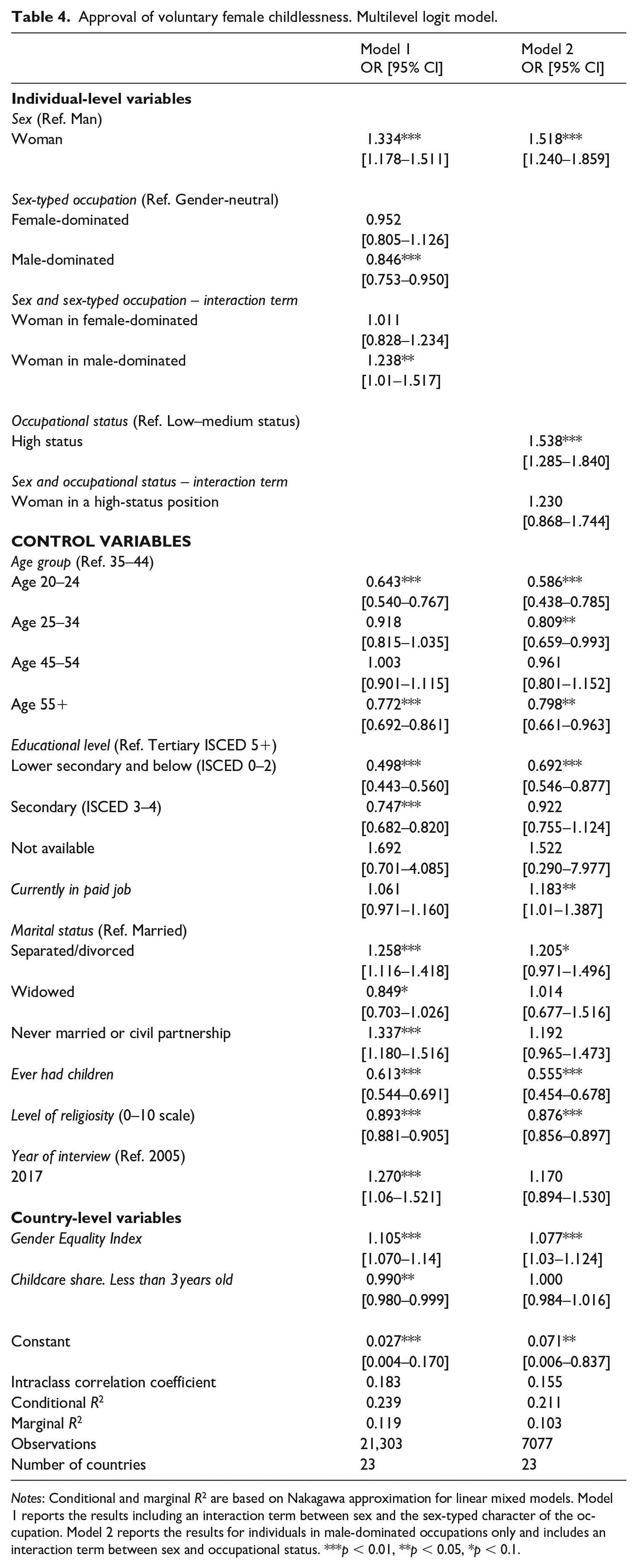
Notes: Conditional and marginal R2 are based on Nakagawa approximation for linear mixed models. Model 1 reports the results including an interaction term between sex and the sex-typed character of the occupation. Model 2 reports the results for individuals in male-dominated occupations only and includes an interaction term between sex and occupational status. ***p < 0.01, **p < 0.05, *p < 0.1.
For a better understanding of the relationship between respondent’s sex, sex-typed occupations and attitudes towards voluntary childlessness, we estimated the predicted probabilities of approving female childlessness according to the sex-typed character of an individual’s occupation, by sex. Results (Figure 1) confirm that gender differences clearly increase in male-dominated occupations. Whereas the difference in the probability of approving female childlessness between men and women is approximately four points in gender-neutral (predicted probability of 74.49% among men and 78.50% among women) and female-dominated sectors (predicted probability of 73.76% among men and 77.99% among women), it almost doubles among workers in male-dominated sectors (71.98% among men and 79.11% among women). In all three cases, the observed differences in probabilities are statistically significant 4 (p-value of Wald test < 0.001). Overall, the results support Hypothesis 1, and show that women in male-dominated occupations (i.e. women whose job roles are incongruent with gender norms) express more favourable attitudes towards female voluntary childlessness.
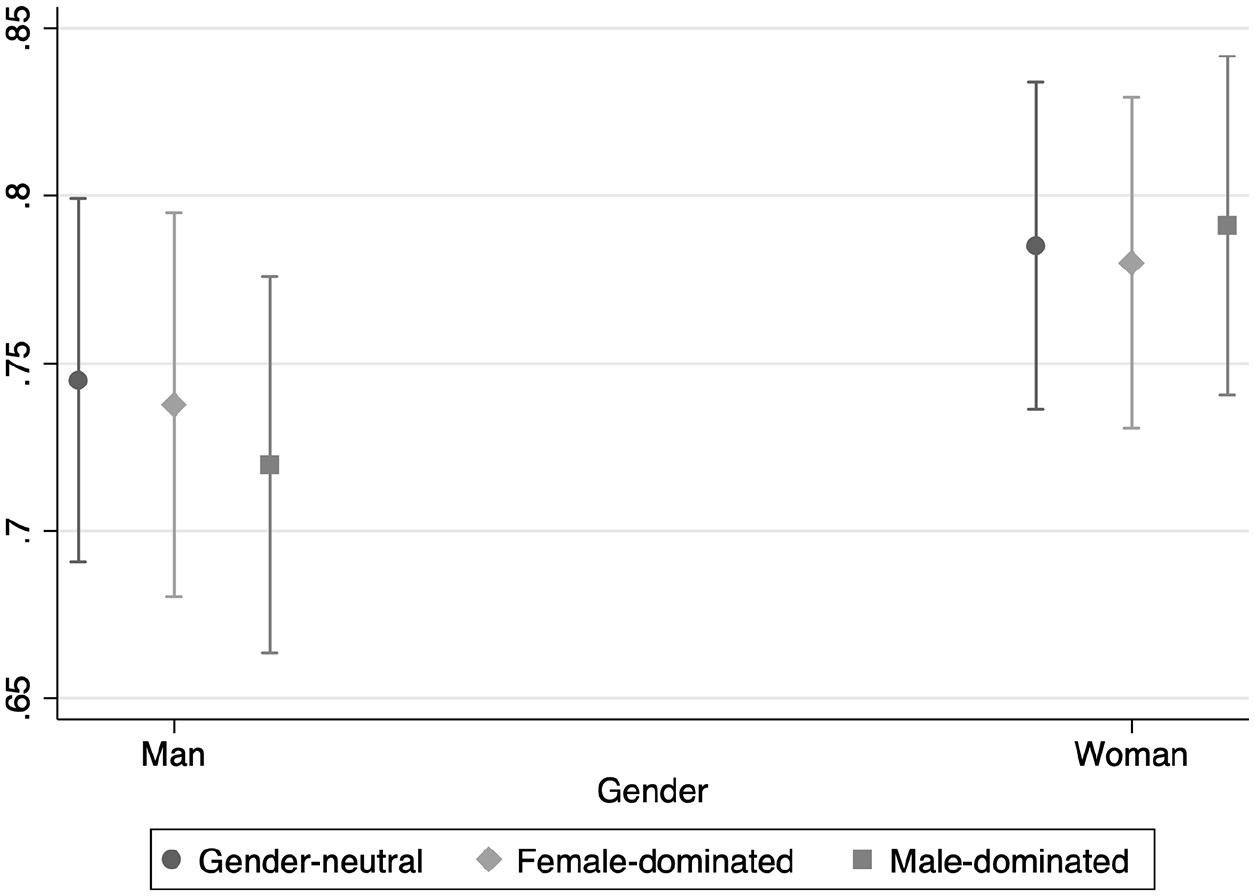
Approval of female childlessness. Predicted probabilities according to the sex-typed character of the respondent’s occupation, by sex.
To further investigate our research hypotheses, we stratify the analysis by sex-typed occupations to look exclusively at individuals in male-dominated occupations and introduce into our models an interaction term between the sex of the respondent and the respondent’s occupational status (i.e. skill level). Regression results (Model 2 in Table 4) show that among individuals in male-dominated occupations, those who hold high-status positions are more likely to accept female voluntary childlessness (odds ratio = 1.54, p < 0.001). This is in line with other studies that indicate that individuals in high-status positions tend to show more progressive attitudes (Craig and Mullan, 2011; Eicher et al., 2016; Merz and Liefbroer, 2012). However, the interaction term between the respondent’s sex and occupational status is not significant, suggesting that men and women do not differ in this regard.
Though the interaction term is not statistically significant, a closer look at differences by occupational status within male-dominated occupations in terms of predicted probabilities (Figure 2) shows that there are variations within gender groups. Women in high-status positions have a predicted probability of approving female voluntary childlessness (0.852) that is higher than, and statistically different from, that of women in low-status positions (0.773; p-value of t-test < 0.001). This suggests that if women’s incongruence with respect to their occupational domain (working in a male-dominated occupation) contributes to differentiating attitudes between men and women, women’s further incongruence in terms of their occupational attainment (holding a high-status position within male-dominated occupations) contributes to differentiate attitudes within women. Accordingly, results from the regression model do not support Hypothesis 2, but the results in terms of predicted probability suggest that, when occupational status is considered, heterogeneity among women is more relevant than gender differences in predicting which groups are most likely to have favourable attitudes. For this reason, we can say that women showing more favourable attitudes are those in male-dominated occupations, especially those holding high-status positions.
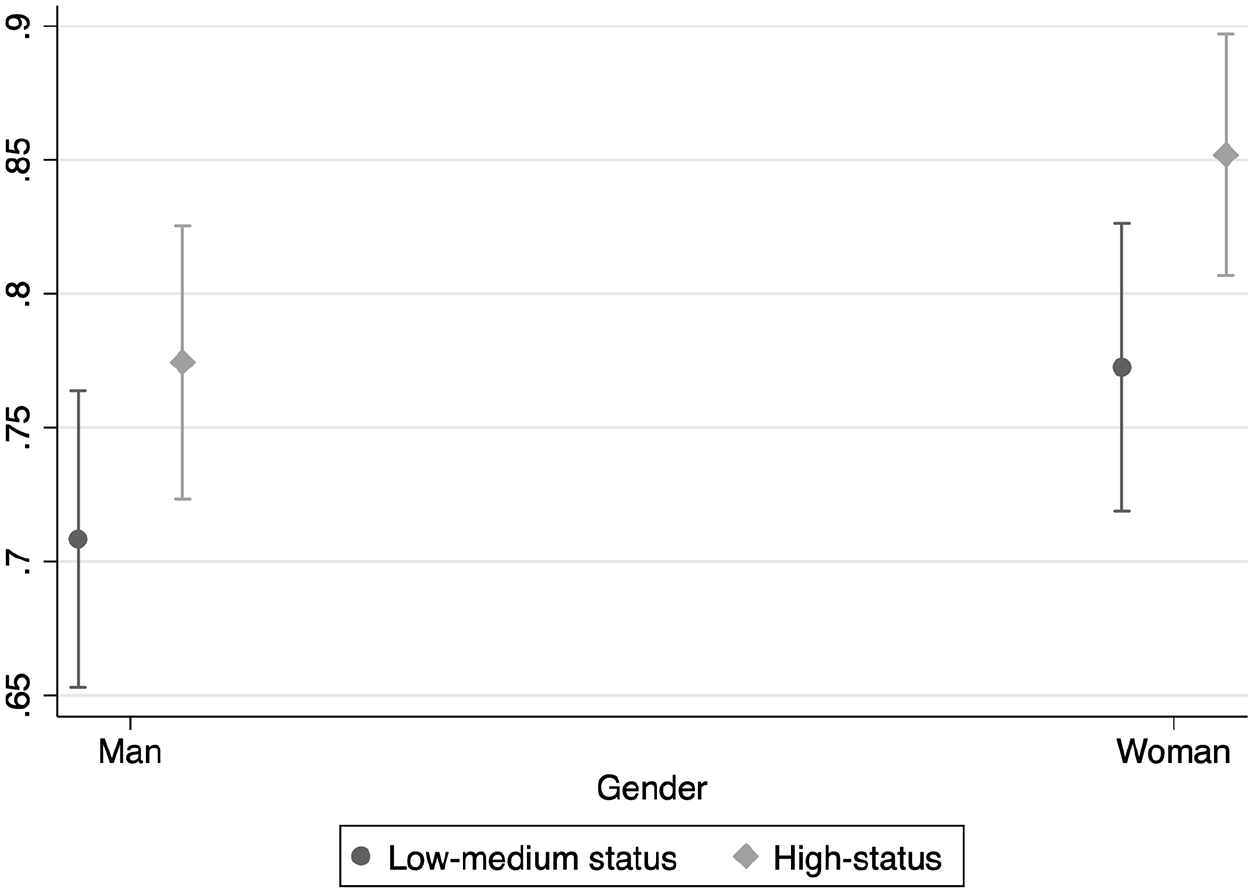
Approval of female childlessness by sex-typed character of the respondent’s occupation. Individuals in male-dominated occupations. Predicted probabilities for occupational status by sex.
The effects of the control variables in both models are broadly consistent with findings from previous research (Koropeckyj-Cox and Pendell, 2007b; Merz and Liefbroer, 2012; Rijken and Merz, 2014). The likelihood of approving a woman’s choice not to have children is lower among parents, older respondents, those with a lower level of education, and religious individuals. Interestingly, younger respondents (under the age of 24 years), though less likely to be parents than older individuals, tend to be less inclined to approve of female childlessness. Respondents who live in more egalitarian countries – measured in terms of the Gender Equality Index – are more likely to approve of a woman’s choice to remain childless. The same holds for individuals interviewed in 2017 rather than in 2005, consistent with previous research showing that non-normative demographic behaviours have become increasingly accepted over time due to the secularisation of contemporary societies.
Finally, we employed a multilevel modelling approach to account for country differences. For both models, the relatively low intraclass correlation coefficients (ICC = 0.183 for Model 1, and ICC = 0.155 for Model 2; Table 4) – which represent the proportion of between-country variation in the total variation (i.e. 18.3% and 15.5%, respectively), or, in other words, the extent to which observations on the outcome variable depend on country-level differences – suggest that this pattern is consistent across countries despite contextual variation.
Robustness checks
We ran several robustness checks (available in the Supplemental material). Instead of using a dichotomous indicator of voluntary childlessness approval, we estimated both a linear and an ordinal model using the original five-point scale (from ‘strongly disapprove’ to ‘strongly approve’) (Supplemental Tables A1 and A2), and the results remain substantively unchanged. We also tested alternative approaches to coding the neutral category (‘neither approve nor disapprove’) from the original five-point scale when dichotomising our outcome variable. First, by excluding it from our dichotomous indicator, which again led to substantively unchanged results (Table A3). Second, by retaining it versus all other points (collapsing ‘approve’, ‘strongly approve’, ‘disapprove’ and ‘strongly disapprove’), which led to insignificant results on our main independent variables (Table A4), suggesting that our choice to bundle it with the approval category is unlikely to have affected our findings. We tested a more fine-grained coding of occupational status, distinguishing among three groups: high-, medium- and low-status jobs. Results (Figure A1) confirm that for both genders the most relevant difference is between high-status jobs versus all other jobs, as we observed no differences between low and medium status among women, and only a slight gradient by occupational status among men. Since educational level might be correlated with selection into sex-typed occupation and occupational status, potentially causing estimation bias, we excluded education as a control variable (Tables A5 and A6) and again observed no substantial variations in our main results. Diverging levels of occupational sex segregation across countries may act as confounders, with some countries driving the observed effect of segregation on the gender gap in attitudes. We therefore re-ran the analysis, including the Moir and Selby-Smith indicator of gender segregation (WE index), as a country-level control variable (Tables A7 and A8). In this case as well, the estimated coefficients of our key independent variables remain virtually unchanged, which indicates that the relationship we find between these variables and attitudes towards female voluntary childlessness reflects a pattern shared by the European countries included in our study regardless of their specific levels of segregation. Different fertility levels across countries may affect between-country variation; hence, we included in our models the total fertility rate (TFR) in each country as an additional country-level control variable. Once more, results remained virtually unchanged (Table A9). Finally, we ran country-level fixed-effects models as an alternative empirical strategy to multilevel modelling in order to more generally control for the effect of unobserved characteristics that are fixed within each country, such as cultural beliefs. Our results again remained unchanged (Tables A10 and A11). Accordingly, we retained the multilevel modelling approach to remain consistent with existing literature on this topic.
Discussion and conclusion
This study focuses on attitudes towards female voluntary childlessness and examines the occupational dynamics behind women’s more favourable attitudes, analysing how such attitudes vary across sex-typed occupations. The crux of the argument is that sex-typed occupations exert gender-specific pressures, which expose women and men differently to the risk of incongruence between their job roles and stereotypical gender roles in society, depending on the worker’s occupational domain and status. Such pressures and the risk of incongruence they generate are likely to shape perceptions of the disadvantages associated with motherhood, thereby influencing attitudes towards female voluntary childlessness.
Consistent with our expectations, we found that women who are incongruent in their job roles show more favourable attitudes. This is particularly true for women working in male-dominated occupations, especially those holding high-status positions. We argue that this reflects the costs associated with hegemonic gender beliefs experienced in their occupational context. These women are expected to perform like men in order to succeed in their job role and are exposed to the belief that motherhood can undermine their legitimacy in that role, potentially making motherhood less salient for their identity and more costly for their careers. This interpretation is supported by scholarship examining how occupational structures convey hegemonic beliefs about which gendered traits are seen as necessary for success, and how this leads to sanctions against those who challenge them (Cejka and Eagly, 1999; Cutcher, 2021; Heilman, 2012). Research on role traps shows how women in male-dominated and high-status positions adapt to and survive the pressures in their occupational environments by distancing themselves from expected stereotypical feminine traits (Kanter, 1977; Wajcman, 2013; Wood and Newton, 2006) – in this case, those related to motherhood. This reflects a strategy women adopt to succeed in their job role and reduce the risk of being judged as incongruent, which could jeopardise their legitimacy in that role and, consequently, their careers. This explanation also aligns with research on occupational minorities (Taylor, 2010), tokenism (Kanter, 1977) and studies in social psychology highlighting women’s awareness of how gender salience contributes to the disadvantages they are more likely to experience in the work domain (Gutek et al., 1996). As a numerical rarity in sex-segregated occupations, and due to the workplace effects of the dominant gender beliefs associated with those occupations, women are more likely to recognise areas of collective disadvantage linked to gender-based stereotypes and mistreatment – particularly those related to motherhood.
These findings hold important implications as they highlight the enduring force and differentiated saliency of gender beliefs across sex-typed occupations and the ways they sustain occupational sex segregation (Ridgeway and Correll, 2004). If women who show more favourable attitudes towards female voluntary childlessness are those who are highly incongruent in their job role – which we interpret as the result of their having to endure the negative costs associated with the hegemonic gender beliefs they experience in their male-dominated occupational contexts – can we consider that such favourable attitudes embody the potential to break the stereotypical representations of female roles and identities that undermine the valuation of women’s work and sustain the reproduction of occupational sex segregation?
We suggest that the answer to this question is no. In light of our findings and arguments, such favourable attitudes appear to reflect hegemonic gender beliefs and stereotypical models of gender identity that permeate contemporary male-dominated occupations. Because exhibiting masculine traits is expected for advancement in most male-dominated, high-status jobs, women who hold positive views of the choice not to engage in motherhood – the most stereotypically feminine trait – do not necessarily challenge the hegemonic male culture in such jobs; rather, their attitudes may conflate with it, reflecting alignment rather than resistance. In this sense, the stereotypic construction of womanhood as based on motherhood emerges as a persistent focal point in women’s work experiences in male-dominated occupations, where the need to distance themselves from it likely stems from the tensions created by women’s involvement in job roles that do not align with feminine, mothering aspects. To break such stereotypical representations, which are detrimental to women’s work and sustain occupational sex segregation, women must be granted full legitimacy to pursue jobs and high-status positions in male-dominated occupations, and stereotypical gender beliefs and self-conceptions need to be systematically targeted. This also involves men, whose dominance and performance in positions of power contribute to upholding male occupational cultures.
This question and these reflections are especially relevant, considering that although women are gaining entry into male-dominated occupations in increasing numbers and are expected to expand their presence in high-status masculine domains, women in these fields still represent a numerical minority in the labour market due to the persistent dynamics of devaluation, discrimination and social control, which make it difficult for them to remain in such fields over the course of their careers, as shown by research on occupational mobility (Torre and Jacobs, 2021), on occupational sex segregation over the life course (Guinea-Martin et al., 2018) and on closure mechanisms across a number of male-dominated occupations (Glass et al., 2013; Ibáñez and García-Mingo, 2022; Thébaud and Taylor, 2021).
These issues call for future research avenues, as also highlighted by some limitations of our study. Scholarship on gender-stereotypical career decisions prior to entering employment suggests that not having feminine-typed self-conceptions may be more relevant to women who choose male-dominated occupations than low adherence to traditional gender beliefs per se (Cech, 2013). We cannot assess whether this is also the case for the attitudes of people who already are in employment as our data do not include detailed information about individual preferences and gender self-conceptions, nor do they contain retrospective information about individual gender attitudes. As a result, we cannot establish if and to what extent attitudes towards women’s voluntary childlessness may convey women’s personal gendered self-conceptions. However, this reflects a broader limitation in the current state of research, which is the lack of a comprehensive understanding of self-expression as a mechanism of sex segregation (Cech, 2013; Charles and Bradley, 2009) – that is, the extent to which gender-stereotypical self-conceptions and their interaction with cultural gender beliefs translate into self-expressive choices that reproduce occupational sex segregation. Yet, our findings remain significant despite this limitation, as they establish a pattern showing that women’s more favourable attitudes towards female voluntary childlessness align with stereotypical gender identity models and hegemonic gender beliefs embodied within specific sex-typed occupations (i.e. male-dominated occupations), hence providing a significant step forward in the debate. In this regard, they indicate directions for future research, which should further explore the interactions between gendered self-conceptions and dominant gender norms within sex-typed occupations, by collecting and analysing data containing a broad array of indicators on gender roles and attitudes at both the individual and the occupational levels, especially from a longitudinal perspective. Likewise, the lack of detailed information in our data regarding respondents’ career trajectories and workplace practices means we can only observe the current, or most recent, occupation. Future research should examine potential variability in attitudes due to mobility across sex-typed occupations and organisational structures throughout individuals’ careers. Finally, we examine the European situation at the aggregate level; however, changing gendered parenthood norms may co-occur with other cultural developments that vary across societal contexts. Future research should address the role of unobserved country-level characteristics related to gender culture, which may influence individuals’ gender attitudes over time.
Despite these limitations, our study contributes significant insights to the debate on gender attitudes and the reproduction of occupational sex segregation. It underscores the importance of further inquiring into the relationship between gender role attitudes and the reproduction of occupational sex segregation by focusing not only on how attitudes formed during socialisation affect occupational orientations and choices at labour market entry – as most existing research has done – but also on how individuals’ attitudes respond to work experiences across sex-typed occupations that differently endorse the saliency of hegemonic gender beliefs, and on how these two aspects interact. Likewise, our study highlights the importance for future research of disentangling the multiple imbrications between hegemonic gender beliefs and individual self-conceptions that may sustain the reproduction of occupational sex segregation. Occupational sex segregation is an enduring system of inequality in which cultural and structural aspects overlap greatly; the insights provided by this study underscore the complexity and importance of inquiring into these imbrications.
Supplemental Material
sj-docx-1-wes-10.1177_09500170251348821 – Supplemental material for Gender Role Attitudes and the Reproduction of Occupational Sex Segregation: An Analysis of Attitudes towards Women’s Voluntary Childlessness in Europe
Supplemental material, sj-docx-1-wes-10.1177_09500170251348821 for Gender Role Attitudes and the Reproduction of Occupational Sex Segregation: An Analysis of Attitudes towards Women’s Voluntary Childlessness in Europe by Valeria Insarauto and Danilo Bolano in Work, Employment and Society
Footnotes
Data availability

Funding
The authors disclosed receipt of the following financial support for the research, authorship, and/or publication of this article: The work by Danilo Bolano was supported by funding from the European Union – NextGenerationEU – under the National Recovery and Resilience Plan, Enlarged Partnerships ‘Consequences and Challenges of Ageing’, within the research programme Age-It (Ageing Well in an Ageing Society, PE8B83C22004800006).
Supplemental material
Supplemental material for this article is available online.
Notes
References
Supplementary Material
Please find the following supplemental material available below.
For Open Access articles published under a Creative Commons License, all supplemental material carries the same license as the article it is associated with.
For non-Open Access articles published, all supplemental material carries a non-exclusive license, and permission requests for re-use of supplemental material or any part of supplemental material shall be sent directly to the copyright owner as specified in the copyright notice associated with the article.
