



Abstract
Extensive research has found hostility between the political parties in the United States. While it is generally accepted that the parties perceive threats from each other, there is little empirical research investigating whether these perceived threats exist among the public. This article utilizes social identity theory and intergroup threat theory to examine relationships between partisan media use and perceived symbolic and realistic threats from the opposing political party. Using cross-sectional data from the Cooperative Congressional Election Study, we ran mediation models. We found that the use of in-group media is associated with higher levels of both the symbolic and realistic threats that emanate from the opposing political party. We also examine whether these two types of threats are related to political engagement in the form of political participation. Our results reveal that symbolic threats are associated with engagement, while realistic threats are not. Finally, we examined a full moderated mediated model where media use predicts engagement through our two types of threats. Implications and areas for future research are discussed.
Several political communication scholars have examined the extent to which media use leads to higher or lower levels of political engagement (Choi, 2022; Dilliplane, 2011; Wojcieszak et al., 2016). This line of inquiry has primarily shown that media use can both increase and decrease levels of political engagement. Indeed, several studies have shown that the use of digital media (Chadha et al., 2012), traditional media (McLeod et al., 1999), and partisan media (Choi, 2022; Dilliplane, 2011) increases engagement. For instance, Dilliplane (2011) found that partisan media was associated with higher levels of political participation. Similarly, Choi (2022) found that MSNBC use was associated with political participation. However, other studies have shown an opposite pattern, suggesting that under certain circumstances, media use may be associated with lower levels of engagement. For example, Dilliplane (2011) found that consuming partisan media favoring the political opposition depressed political participation. These studies highlight the need to continue examining the conditions under which the use of different media outlets is associated with higher or lower levels of engagement.
One line of inquiry that has sought to explain the relationship between media use and political engagement involves examining potential mediating variables that link media consumption to engagement levels. For instance, Eveland and Scheufele (2000) looked at how knowledge gaps mediated the relationship between news use and disparities in political engagement. Relatedly, scholars have investigated mediators in the context of partisan news use and political participation. Wojcieszak and colleagues (2016) examined cognitive, affective, and attitudinal mediators to understand how partisan media influences political engagement. They found that one’s understanding of issues, anger, positive emotions, and political attitude strength all mediated the relationship between like-minded news exposure and political engagement. By contrast, research has demonstrated that using out-group partisan media could suppress political engagement through attitudinal ambivalence (Hmielowski & Nisbet, 2016). 1
Another line of inquiry that could explain the variability in political engagement due to partisan media use involves considering perceived threats as potential mediators—the focus of this work. The logic of social identity theory (SIT) would suggest that individuals view out-group members as more threatening than in-group members (Hogg et al., 2017). Previous empirical research has found that partisan media amplifies these perceptions by presenting the out-party as dangerous or harmful (Berry & Sobieraj, 2014), which can increase threat perceptions and, in turn, increase political engagement as in-group members seek to defend their in-group’s values and identity (Choi, 2022; Gil de Zúñiga et al., 2012; Tang & Willnat, 2023). Conversely, we surmise that out-group media contact may reduce perceived threats. Research has previously shown that positive out-group media contact can decrease perceived realistic threats from out-party members (Christ & Kauff, 2019; Lin & Haridakis, 2022). Ultimately, findings from previous research suggest that the effect of media use on engagement could be mediated by perceived threats.
In this article, we extend the extant work on media use, perceived threats, and political engagement by assessing whether symbolic and realistic threats serve as mediating variables between partisan news use and political engagement. Utilizing SIT (Hogg et al., 2017; Tajfel & Turner, 1986) and intergroup threat theory (Stephan et al., 2015), we build on previous work that has shown use of in-group media and out-group face-to-face contact could increase the levels of perceived threat relative to out-group members (Christ & Kauff, 2019; Pettigrew et al., 2011), while out-group media contact is associated with lower levels of perceived threats from out-party members (Lin & Haridakis, 2022). Specifically, we attempt to replicate and extend Lin and Haridakis’s (2022) work by examining the correlation between partisan media use and symbolic and realistic threats. We do this by assessing the interaction between the use of both conservative and liberal media and people’s party identification. We then examine whether perceived levels of symbolic and realistic threats are associated with people’s level of political participation. Finally, we investigate a moderated mediated model that assesses whether the indirect relationships between partisan media use through both symbolic and realistic threats on political participation vary by people’s party identification.
Literature review
Social identity and intergroup threat
Scholarship on SIT suggests that individuals categorize themselves and others based on shared group identities, creating in-groups defined by commonalities and out-groups distinguished by differences (Tajfel & Turner, 1986). According to SIT, individuals identify with their in-group and strive for positive distinctiveness, which is grounded in a desire to see their group as superior to others to enhance their self-esteem (Hogg, 2016). This drive for positive distinctiveness is a central motivational factor in SIT (Hogg, 2000), often driving individuals to adopt in-group norms and view in-group members as more trustworthy and favorable than out-group members (Hogg, 2016; Hogg et al., 2017). Identification with the in-group becomes especially salient when the group’s identity is perceived to be under threat. When these threats to the in-group arise, specifically from identified out-groups, individuals are more likely to engage in behaviors that protect and reinforce their group’s status and identity, which could include seeking information that supports their views (Fleischmann et al., 2013; Stroud, 2010). Hence, the motivational nature of social identity, rooted in the desire for positive distinctiveness and the need to protect the in-group from threats (Hogg, 2000, 2016), provides the foundation for understanding intergroup bias and conflict (Tajfel & Turner, 1986).
An idea related to SIT is intergroup threat theory. While the social identity perspective emphasizes the role of group membership in shaping self-concept and driving in-group favoritism (Tajfel & Turner, 1986), intergroup threat theory focuses on how perceived threats from out-groups can intensify negative attitudes and behaviors toward those groups (Rios et al., 2018; Stephan & Stephan, 2000). In this study, we leverage both theories to develop our hypotheses. Specifically, we utilize SIT to provide a foundation for understanding the motivation behind intergroup bias. Moreover, we utilize intergroup threat theory to predict how specific threats can amplify these biases as a product of media use. We also utilize this perspective to assess how these perceived threats may influence political engagement. We aim to offer a more comprehensive understanding of the dynamics that drive intergroup relations by utilizing these two perspectives.
Essentially, intergroup threat theory suggests that individuals may perceive the out-group as intending or having the capacity to harm the in-group (Stephan et al., 2015; Stephan & Stephan, 2000). This perception is often driven by negative stereotypes about the out-group and heightened anxiety in interactions between the groups (Rios et al., 2018). Intergroup threat theory focuses on two types of threats: symbolic and realistic. Symbolic threats refer to the perception that the in-group’s cultural values, beliefs, or norms are at risk from opposing groups, who may undermine the in-group’s identity by challenging, altering, replacing, or dismantling these core aspects of their social or cultural framework (Stephan et al., 2015). Conversely, realistic threats refer to concerns of physical harm or the loss of power/resources to out-groups. Realistic threats may include perceived threats regarding warfare, aggression, loss of political or economic power, lack of access to education, or destruction of property (Stephan et al., 2015). Taken together, extant research shows that symbolic and realistic threats are two separate concepts when utilizing techniques such as factor analysis (Kachanoff et al., 2021; McKeown & Taylor, 2017). As such, scholarship rarely conflates the two and treats them as unique concepts.
Media use and perceived threats
One area of inquiry ripe for examination is tied to the correlations between partisan media use and people’s levels of perceived symbolic and realistic threats. Broadly, scholars have linked the use of partisan media to perceived symbolic and realistic threats from out-groups such as immigrants (Xing, 2019). As outlined above, per SIT, individuals pull a large part of their self-concept from their group memberships, and they are motivated to maintain a positive social identity favoring their in-groups over out-groups (Hogg, 2000, 2016; Tajfel & Turner, 1986). By consistently portraying the in-group as virtuous and the out-group as dangerous (Berry & Sobieraj, 2014; Covert & Wasburn, 2007), partisan media taps into the fundamental psychological need for positive distinctiveness (Hogg, 2000). When partisan media repeatedly emphasize the threats posed by political out-groups, they not only reinforce in-group loyalty but may heighten the perceived symbolic and realistic threats from the out-party, as posited by intergroup threat theory.
The root of why the use of these media could lead people to see groups as being greater or lesser threats is tied to how political groups are portrayed in the media. Generally, partisan media portray groups differently depending on whether they associate with their preferred beliefs or represent the opposing party (Baum & Groeling, 2008; Berry & Sobieraj, 2014). To maintain viewership and garner clicks, partisan media portray the in-group’s values and power to constantly be at risk due to threats posed by the out-group (Willnat, Shi, de Conick, et al., 2023). This strategic framing aligns with the tenets of intergroup threat theory, where the perception of threat from an out-group—whether to physical security (realistic threat) or cultural identity (symbolic threat)—can lead to increased hostility and defensive actions. While in-group members are often championed as wise and rational, out-group members are painted as dangerous and misguided, posing a threat to the in-group’s values (Berry & Sobieraj, 2014). In a content analysis of liberal and conservative partisan magazines, Covert and Wasburn (2007) found that both sources depicted the opposition as a threat and encouraged political engagement among readers. Furthermore, Ali and Altawil (2023) found that content from both MSNBC and Fox News portrayed out-groups in a way that may lead to hostility toward political out-groups.
The way in- and out-groups are covered could then shape people’s attitudes toward the political opposition, reinforcing the SIT-driven need for positive distinctiveness and the intergroup-threat theory response to threats by way of hostility between groups. Extensive political communication research has found that partisan media use is linked to hostile feelings toward the opposing party or affective polarization (Levendusky, 2013). Specifically, selective exposure scholars have found that media that favor one’s political in-group are associated with negative feelings toward political out-groups (Stroud, 2010; Trilling et al., 2017). Partisan media often contain perceived threats from the out-group, as they often frame the out-group as a danger to the in-group’s values and existence, consistent with intergroup threat theory. Kim (2023) extended this line of inquiry by finding a relationship between partisan media use and moral identification with partisan in-groups and against partisan out-groups, showing that partisan media use was associated with hostility toward oppositional presidential candidates. This hostility can be understood through the lens of SIT, where heightened in-group identification leads to stronger negative reactions against out-groups, specifically when perceived as threatening. Regarding threats, some studies have specifically examined the correlations/effects of conservative media use on the perceived threats associated with immigrant populations, a key out-group in US political discourse. Conservative media outlets tend to present more negative portrayals of immigrants (Fryberg et al., 2012). This supports intergroup threat theory’s prediction that exposure to threat-laden content will increase perceived threats and associated hostility. Thus, it makes sense that the use of these outlets has generally been shown to be associated with hostility toward immigrants from Mexico (Conzo et al., 2021; Gil de Zúñiga et al., 2012) and China (Willnat, Ogan, Shi, 2023). Extending this research, experimental evidence indicated that exposure to Fox News’ immigration coverage was associated with perceived symbolic and realistic threats from immigrants among Republicans and Independents (Willnat, Shi, de Conick, 2023). Taken together, the extant literature suggests that in-group media does more than reflect pre-existing biases; it also actively shapes perceived threats by aligning with the motivational aspects of SIT and the threat-focused aspects of intergroup threat theory. This integrated perspective helps explain why in-group partisan media use may correlate with and causally influence heightened perceptions of symbolic and realistic threats tied to out-groups.
In addition to looking at in-group media, we also examine the correlation between out-group media (i.e. media that favors one’s political out-group or political opposition) and perceived threat. Specifically, we examine whether exposure to out-group media may reduce perceived threats as individuals are exposed to perspectives from the other side. The underlying logic regarding this relationship draws from contact theory, which suggests that contact with out-group members, including through media representations, can reduce perceptions of threat (Christ & Kauff, 2019). The contact hypothesis posits that contact with out-group members will allow people to look past stereotypes, which often fuel symbolic and realistic threats, but instead view these members as individuals rather than representatives of a threatening group (Rios et al., 2018). Much research has shown that cross-cutting media contact—viewing media content that is biased against one’s political views (Goldman & Mutz, 2011)—has been effective at reducing intergroup hostility (e.g. Warner, 2018). Recent research on out-group exemplars in media provides a more nuanced understanding of this process. Indeed, out-group exemplars, or media portrayals of out-group members that highlight their individuality and complexity, can significantly shape perceptions of these groups (Gonzalez et al., 2017). Extending this line of inquiry, Muradova and Arceneaux (2021) found that portrayals of the average out-group member garner empathy with the out-group. Indeed, intergroup contact, whether direct or mediated through such exemplars, has been shown to be effective not only at reducing prejudice between groups but also in increasing trust and forgiveness (Christ & Kauff, 2019). From an intergroup threat perspective, contact with these out-groups via media exemplars could lead to lower perceived threats as audiences will see similarities between themselves and out-group members, thus reducing general threats (Pettigrew et al., 2011). Pettigrew and colleagues (2011) further note that even indirect contact through positive media portrayals can reduce prejudice. Specific to our study, Lin and Haridakis (2022) assessed the correlations between out-group media contact quantity and both realistic and symbolic threats. While their study found no correlations for symbolic threats, they found that consuming quality out-group media was associated with lower perceived realistic threats from out-party members. 2 Taken together, these findings suggest that for in-group members (Republicans using conservative media), media use should be associated with higher perceived threats. In contrast, for out-group members (Democrats), we expect media to be associated with lower perceived threats. Conversely, we expect a similar relationship but in the opposite direction among Republicans and Democrats for liberal media. Hence, we propose the following hypotheses:
Perceived threats and political participation
Beyond looking at predictors of perceived threats, we also examine whether these threats are associated with political engagement, drawing on both SIT and intergroup threat theory. As outlined above, SIT posits that individuals are motivated to maintain a positive identity within their in-group (e.g. Hogg, 2016; Tajfel & Turner, 1986). When a group’s identity is perceived as under threat, individuals may conduct behaviors to restore or protect that identity (Fleischmann et al., 2013). In this work, we look to political engagement as a possible strategy to mitigate threats to one’s in-group identity. Similar relationships have been found in extant literature, showing that people become politically active when they feel their group’s status, resources, or values are at risk (Fleischmann et al., 2013). Relatedly, intergroup threat theory suggests that perceived threats, whether symbolic or realistic, can motivate action to defend one’s group identity (e.g. McKeown & Taylor, 2017). Realistic threats are often tied to tangible outcomes, such as policy changes (Ke, 2022), which may prompt individuals to engage politically to counter these threats. Conversely, symbolic threats challenge one’s values or beliefs, which can spur political engagement to maintain their way of life (Off, 2023).
Previous empirical research supports the notion that threat perceptions increase political engagement. For instance, Campbell (2003) found that a realistic threat from an unfavorable policy change spurred participation, as senior citizens wrote more letters to elected officials when the future of social security was uncertain. Similarly, in a field experiment, a fictional letter from a lobbying organization threatening an abortion policy change with undesirable outcomes prompted more donations to the organization compared to a letter that shared opportunities for favorable abortion policies (Miller & Krosnick, 2004). Recently, Off (2023) found that in Sweden, young men who perceive feminism as a symbolic threat were more likely to support radical-right voting, linking feminist attitudes and issue salience to political behavior. Research has also examined whether realistic and symbolic threats are related to political engagement. Indeed, Kachanoff et al. (2021) found that realistic threats generally predicted a willingness to adhere to restrictive and non-restrictive public health behaviors related to COVID-19. Finally, McKeown and Taylor (2017) found that symbolic threat was associated with political engagement. Considering the findings of extant research and the theoretical tenets of SIT and intergroup threat theory, we predict that symbolic and realistic threats will be associated with political engagement. Therefore, we pose the following hypotheses:
Mediated moderated model
The literature up to this point highlights a communication process in which the use of conservative and liberal media will lead to higher or lower levels of engagement through perceived levels of symbolic and realistic threats from the out-group. Previous research has shown that use of these perceived in-group media sources should be associated with more significant perceived threats from out-party members (Willnat, Shi, de Conick, et al., 2023), while contact with the opposing side via challenging media content should be associated with lower perceived threats (Christ & Kauff, 2019; Pettigrew et al., 2011). Moreover, perceived threats have been shown to correlate with higher levels of political engagement (McKeown & Taylor, 2017; Miller & Krosnick, 2004). Research has also shown that these perceived threats can serve as mediating variables in communication process models (Lin & Haridakis, 2022). Moreover, McKeown and Taylor (2017) found that perceived symbolic threats mediated the relationship between intergroup contact and political engagement. Hence, we believe that positive indirect relationships should exist between in-group partisan media and participation through perceived threats. At the same time, there should be negative indirect relationships for out-group content. That is, we would expect a positive indirect relationship for Fox News among Republicans, and a negative indirect relationship among Democrats and vice versa for liberal news use. Hence, we propose our final hypotheses:
Methods
This work utilizes data collected during the 2020 presidential election as part of the 2020 Cooperative Congressional Election Study (CCES, see full details of the study methodology at https://cces.gov.harvard.edu/). Specifically, we utilized data from the Kent State Team Module. The panel data was collected in two waves, with the pre-election wave (N = 1000) collected between 29 September 2020 and 2 November 2020, and the post-election wave (N = 842) collected between 8 November 2020 and 14 December 2020. The measures utilized in this work were only available in Wave 1 of data collection. Hence, our analyses include only Wave 1 participants. The polling firm YouGov provided the sample. YouGov utilizes a sample-matching procedure, wherein they initially oversample and then create a final sample that matches national population characteristics. From the oversample, the final sample was generated from a sampling frame using benchmarks from large, high-quality probability samples. YouGov’s sample-matching procedure has been empirically compared to random sampling procedures and exhibits minimal selection bias (Ansolabehere & Schaffner, 2017). Participants were sample-matched using frames that matched respondents on gender, age, race, education, party identification, ideology, political interest, voter registration, and voter turnout. YouGov provided sample weights based on propensity scores created via age, gender, race/ethnicity, years of education, and ideology. Of the 1000 total participants, 710 were included in the final set of analyses after removing missing data. The descriptive statistics reported below are all unweighted.
Independent variables
Media use
We included three items to assess both liberal and conservative media use. Each item included the same 6-point scaling structure ranging from (0) never to (5) multiple times a day. For
Moderating variable
Party identification
Party identification was measured in Wave 1 with one item. The item asked respondents to indicate their party affiliation and the strength of that affiliation. The corresponding scale ranged from (0) strong Democrat to (6) strong Republican (M = 2.681; SD = 2.231). 3
Mediating variables
Symbolic threat
To measure perceived symbolic threats from the out-party, participants were asked the political party they agreed with more. They were then presented with the following statements: “The values and beliefs of the Democratic/Republican party regarding immigration policy are not compatible with those of my political party”; and several statements beginning with “the values and beliefs of the Democratic/Republican party regarding . . .” and listed several political issues. These included health care reform, foreign policy, economic and trade policy, abortion, and same-sex marriage. The corresponding scale ranged from strongly disagree (0) to strongly agree (4). Scores to these six items were averaged together to create our measure of perceived symbolic threats from the out-party (M = 2.958; SD = 0.956; α = 0.93).
Realistic threat
To measure perceived realistic threats from the out-party, participants were asked about the political party with which they agreed more. They were then presented with the following statements about the out-party: “Democrats/Republicans are threatening my political party’s influence”; “Democrats/Republicans are threatening the power of my political party”; “Democrats/Republicans are a threat to the policies of my political party.” Responses to each item ranged from strongly disagree (0) to strongly agree (4). Scores to these three items were averaged together to create our measure of perceived realistic threats from the out-party (M = 2.675; SD = 1.158; α = 0.95).
Dependent variable
Political engagement
To measure political participation, we summed together responses to a series of statements where participants indicated whether they engaged in a series of political activities. Participants were presented with six indicators of political participation and told to select all the behaviors they engaged in during the election. The behaviors included attending a local political meeting, putting up a political sign, working for a candidate or campaign, attending a protest, march, or demonstration, contacting a public official, and donating money to a candidate, campaign, or political organization. If a participant marked a behavior, it was given a score of 1. If they didn’t mark a behavior, it was given a score of 0. These behaviors were then summed together to create a measure of political participation that ranged from 0 (did not engage in any behaviors) to 6 (engaging in all of the behaviors) (M = 1.032; SD = 1.407; α = 0.71).
Control variables
In our models, we also included a set of control variables. We included measures of age (M = 51.884; SD = 16.458), sex (54.8% female), and race (76.5% white, non-Hispanic) in our analyses. Education was measured with a single item. Respondents were asked, “What is the last grade or class you completed in school?” Ordinal response options were coded 0-5 in ascending order from “No High School” to “Post Graduate Training or School” (M = 2.863; SD = 1.497; median = 3 (3 = some college)). Income was also included, which was measured with one item using a 16-point scale that ranged from less than 10,000 dollars a year to more than 500,000 dollars a year (M = 6.821; SD = 3.515; median = 7 (7 = $60,000–$75,999)). Political interest was assessed by asking participants to rate how frequently they consume news that ranged from (0) hardly at all to (3) most of the time (M = 2.409; SD = 0.846). We also included two additional media use measures in our models as control variables. Local media use was measured with one item using a 6-point scale ranging from (0) never to (5) multiple times a day, asking respondents how often they consumed news from a local news organization (e.g. local newspaper or local TV news) (M = 2.720; SD = 1.601). Non-partisan media use was measured in Wave 1 with one item using the same scale as local media use. To measure this concept, respondents were asked how often they consumed media from a news organization that did not favor a particular political party (e.g. CBS News) (M = 2.466; SD = 1.694).
Analysis strategy
We utilized Mplus (V8) to test our hypotheses. To test our hypotheses, we utilized ordinary least squares (OLS) regression to assess the correlations between partisan media use and perceived levels of symbolic and realistic threats from the out-party and whether these correlations varied based on party identification, using statistical weights in all of our analyses. We utilized negative binomial regression to examine the correlations between our two assessments of perceived threat and our measure of political participation. We utilized this modeling strategy, given that participation was assessed with a count variable (Greene, 2008). Moreover, the nature of these data suggests that the negative binomial model is more appropriate than a Poisson model. Variance is important to consider as negative binomial regression accounts for count data that exhibit higher dispersion (variance) than would be assumed by a Poisson model (Land et al., 1996). To handle this overdispersion, the negative binomial model includes an extra parameter that adjusts the variance independently from the mean, providing a more accurate picture of the data (Cameron & Trivedi, 2013). Hence, this modeling strategy is more appropriate than utilizing OLS regression or a Poisson model for our analyses tied to participation. These two modeling strategies were combined when looking at our full mediated/moderated model, illustrated in Figure 1. 4
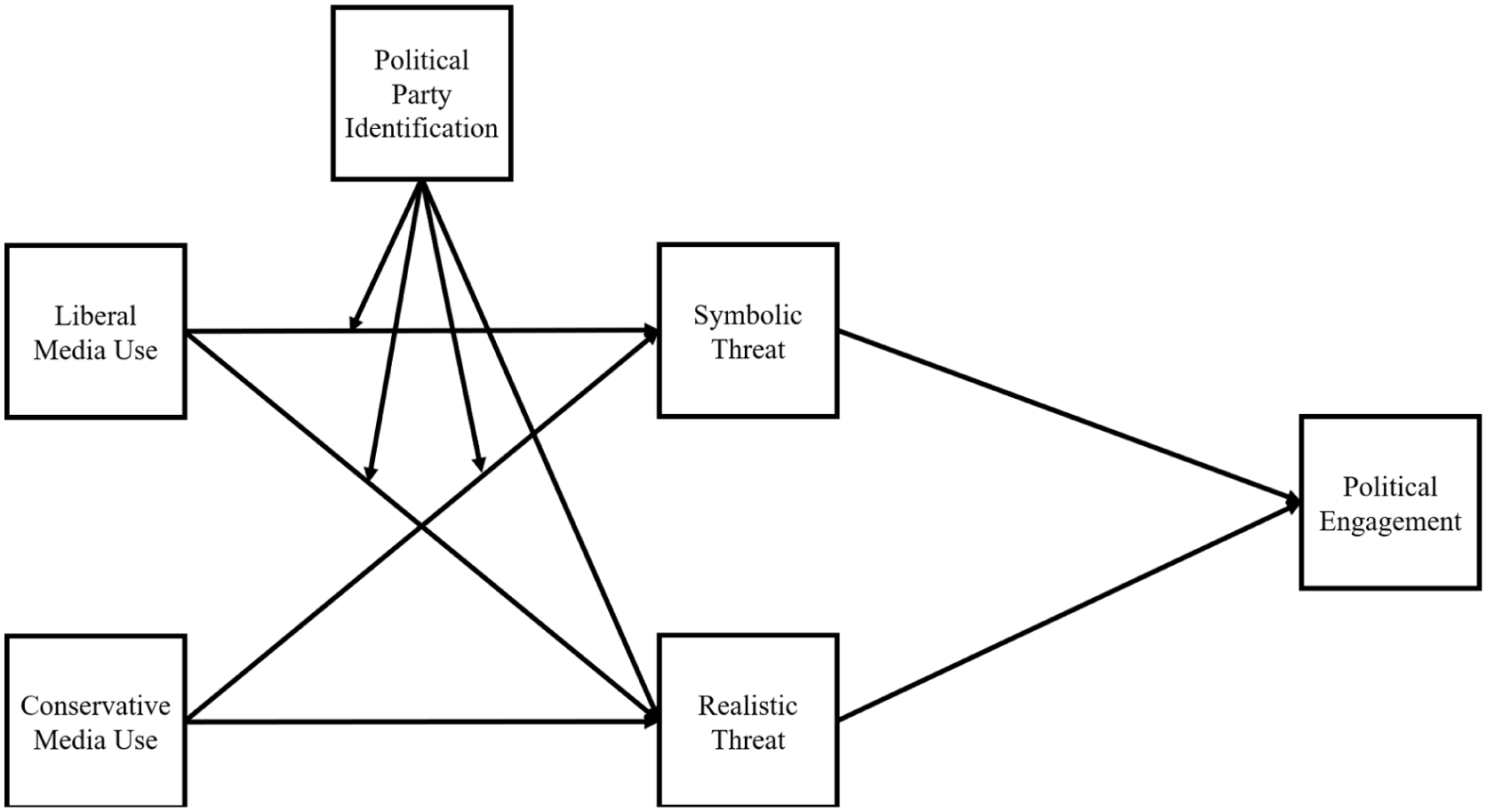
Proposed mediated moderated model.
Results
We begin with the results assessing the correlations between media use and perceived threats from the opposing party. H1 predicted that in-group news use would be associated with higher levels of perceived symbolic and realistic threats. By contrast, H2 predicted that using out-group media would be associated with lower levels of both threats. Before looking at the specific correlations of interest, our results found statistically significant interactions between conservative media use and political identification on both types of threats. 5 That is, our test revealed that the relationship between conservative media use and both symbolic (b = 0.107 (0.085, 0.129)) and realistic threats (b = 0.122 (0.091, 0.155)) varied by party identification. When looking at these same interactions for liberal media, our results once again revealed that the correlations for liberal media varied by party identification for both symbolic (b = −0.106 (−0.131, −0.083)) and realistic threats (b = −0.110 (−0.142, −0.077)). The findings support the proposed hypotheses when looking at what these relationships look like when probing the interactions. Indeed, in-group media use was associated with higher levels of both types of threats. Our results showed that conservative media use was associated with higher symbolic and realistic threats among Republicans (see Table 1). Our results revealed that the use of liberal media was associated with higher levels of both symbolic and realistic threats among Democrats (see Table 1). Hence, these findings provide support for H1. These results also revealed support for H2. Across both types of media and both types of threats, our results revealed that conservative media use among Democrats was associated with lower levels of both symbolic and realistic threats from out-party members (see Table 1). Similarly, liberal media use among Republicans was associated with lower levels of both types of threats. Hence, these findings revealed support for our second hypothesis.
Media use by party identification on threats.
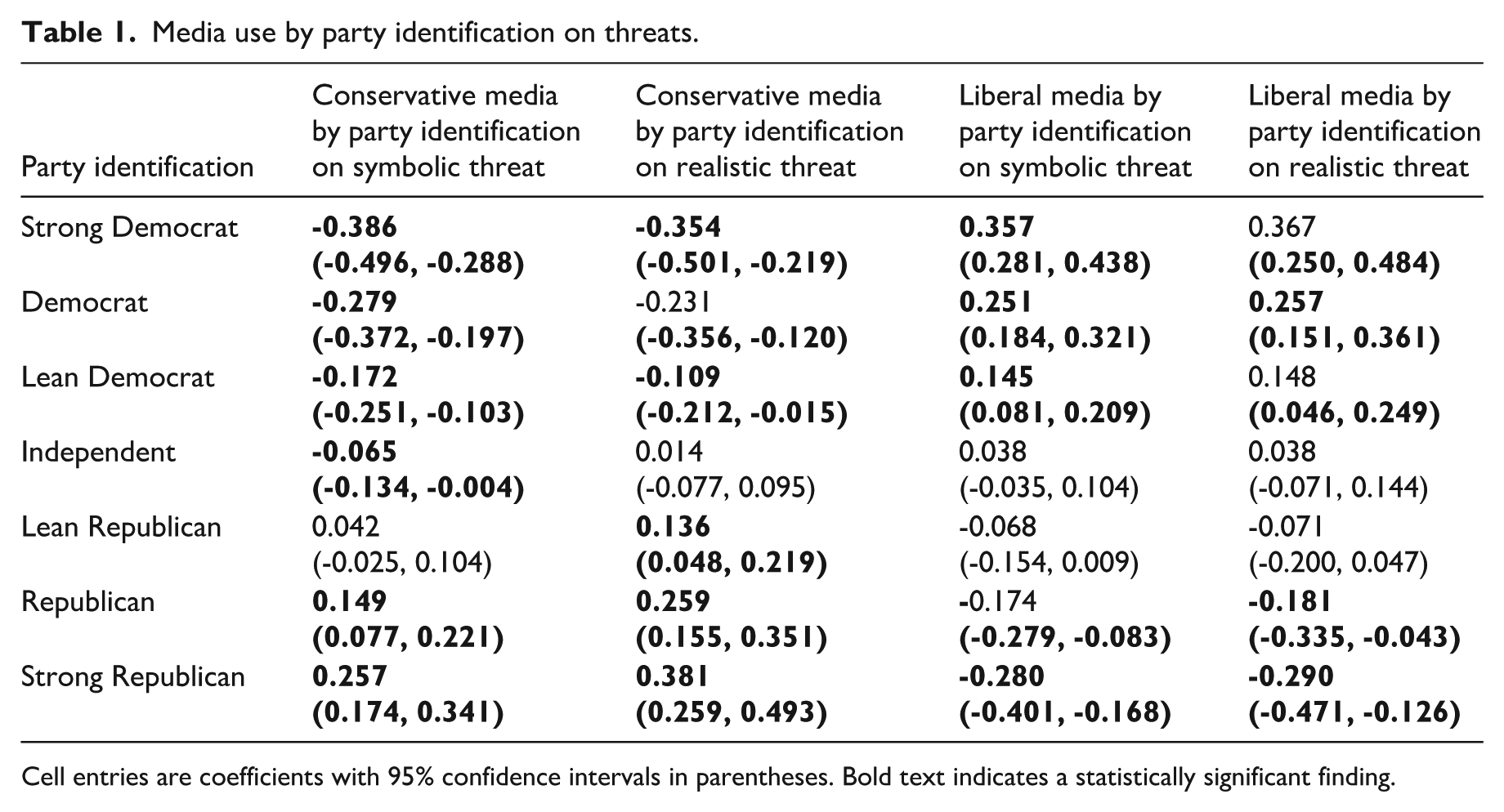
Cell entries are coefficients with 95% confidence intervals in parentheses. Bold text indicates a statistically significant finding.
Next, we turn to our hypotheses that predicted a relationship between perceived symbolic (H3a) and realistic (H3b) threats to political engagement. Results from our analysis revealed that perceived symbolic threats (b = 0.189 (0.026, 0.354)) were positively associated with political engagement, but realistic threats (b = −0.029 (−0.152, 0.102)) were not. These results support H3a, but not H3b (see Table 2).
Regression model predicting outcomes.
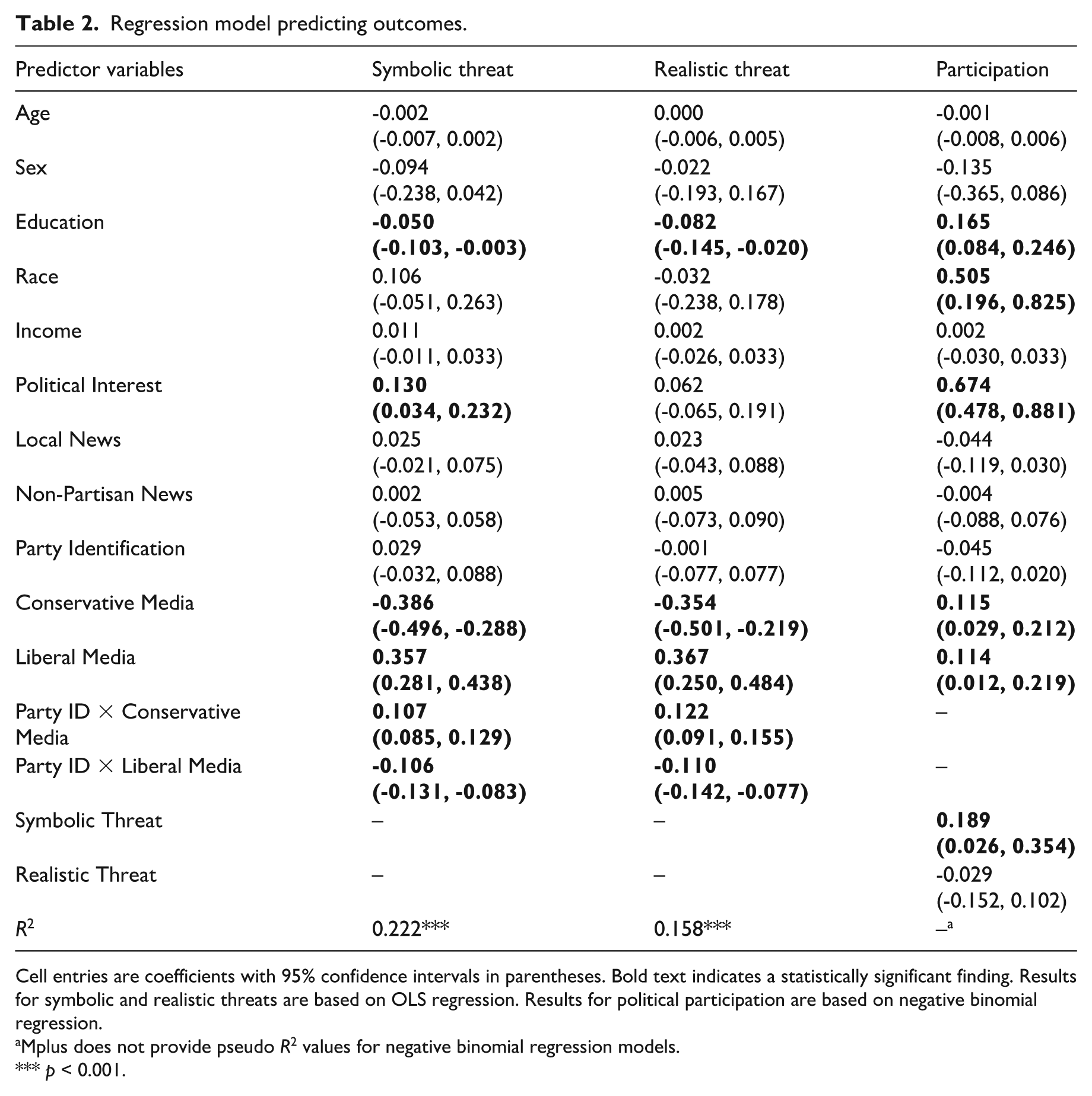
Cell entries are coefficients with 95% confidence intervals in parentheses. Bold text indicates a statistically significant finding. Results for symbolic and realistic threats are based on OLS regression. Results for political participation are based on negative binomial regression.
Mplus does not provide pseudo R2 values for negative binomial regression models.
p < 0.001.
H4 predicted that there would be a positive indirect relationship between in-group media use (e.g. Republicans’ use of conservative media and Democrats’ use of liberal media) on participation through higher levels of both symbolic and realistic threats. Beginning with perceived symbolic threats as a mediator, our model revealed significant indirect relationships between in-group media and engagement. Indeed, conservative media use was associated with higher levels of engagement through symbolic threats among Republicans (see Table 3). We found the same pattern of results for liberal media among Democrats (see Table 3). In essence, in-group media use was associated with higher levels of engagement, which supports H4a. By contrast, our findings did not reveal statistically significant indirect relationships for either media type on engagement through realistic threats. Hence, our results did not reveal support for H4b.
Conditional indirect relationships.
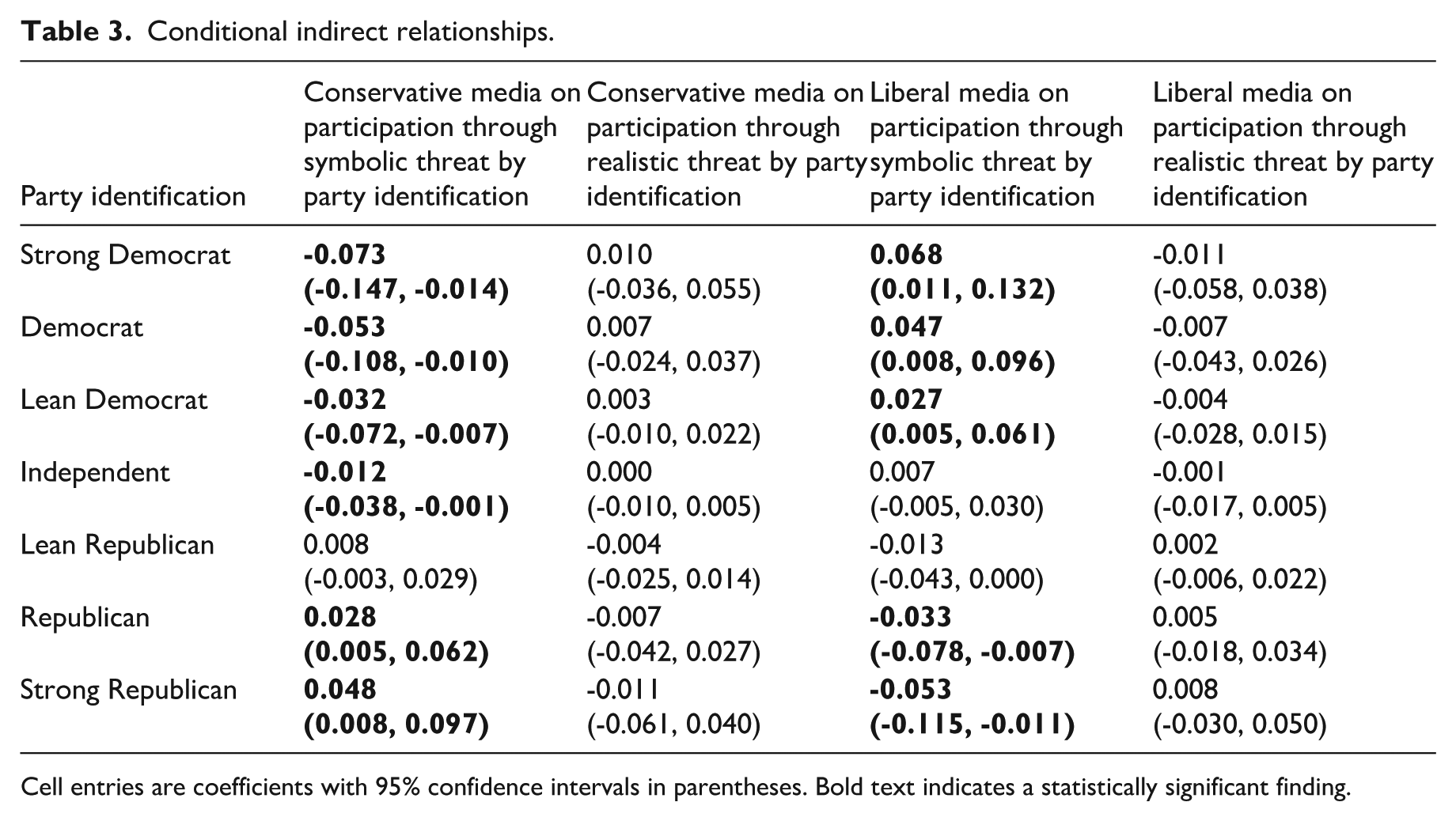
Cell entries are coefficients with 95% confidence intervals in parentheses. Bold text indicates a statistically significant finding.
When looking at the results associated with H5, our analyses revealed a similar pattern of findings. For H5, we proposed that there would be negative indirect relationships between out-group media use (e.g. Republicans’ use of liberal media and Democrats’ use of conservative media) on participation through lower levels of both symbolic and realistic threats. Our results again revealed statistically significant findings through symbolic threats. In this situation, liberal media use was associated with lower levels of engagement through symbolic threats among Republicans (see Table 3). We found the same pattern of results for conservative media among Democrats (see Table 3). In essence, out-group media use was associated with lower levels of engagement, which supports H5a. By contrast, our findings did not reveal statistically significant indirect relationships for either media type on engagement through realistic threats. Hence, our results did not reveal support for H5b.
Discussion
The findings from our results revealed support for several of our proposed hypotheses. First, our results supported the proposed interactions for conservative and liberal media with party identification on both perceived levels of symbolic and realistic threats. The interpretation of these results suggests that in-group partisan media was associated with perceived realistic and symbolic threats. In contrast, the use of challenging media was associated with lower levels of symbolic and realistic threats. Second, our results found that symbolic threats were associated with political engagement. Our results did not find that realistic threats were associated with engagement. Finally, we found support relative to the conditional indirect relationships through symbolic but not realistic threats. Specifically, in-group media was associated with higher levels of political engagement through symbolic threats, while out-party media was associated with lower levels of engagement through lower perceived threats.
We believe that our findings make three contributions to the extant literature. First, our study expands the literature on the effects of partisan media use, as our results suggest that like-minded partisan media use is associated with perceived symbolic and realistic threats among both liberals and conservatives. Previous work has suggested that quality out-group media use is associated with lower perceived realistic threats from out-party members (Lin & Haridakis, 2022). More specifically, extant research has shown that consumption of liberal-leaning media was unrelated to perceived threats, but conservative media was associated with greater perceived threats (De Coninck et al., 2021). Merging these two lines of inquiry, our findings—that in-group and out-group media are correlated in opposite directions based on extant beliefs—highlight the mixed bag that comes with partisan media use. On the one hand, using in-group media can lead people to see the out-group as a threat, which could lead people to believe it is acceptable to break norms tied to politics (Braley et al., 2023). On the other hand, using in-group media may increase engagement, which scholars have normatively viewed as a preferred outcome (Dalton, 2008). By contrast, hearing content from the other side may allow people to see commonalities they share with out-groups, thereby lessening the perceived threats between groups. However, not perceiving the other side as the enemy could decrease political engagement. Future studies should continue examining this mixed bag to determine whether costs tied to increased animosity are worth higher levels of engagement or whether the benefits of decreasing out-group animosity outweigh the lower levels of political engagement among the public.
Second, our article contributes to the literature on perceived partisan threats and political participation. Crucially, the work at hand stresses the importance of separating symbolic and realistic threats, as our results support previous work that found they function differently (Kachanoff et al., 2021). From the perspective of SIT, symbolic threats often arise from perceived challenges to the in-group’s values, norms, and identity, which can trigger a strong emotional response and motivate individuals to engage in actions that defend the group’s status (Tajfel & Turner, 1986). As such, our findings support the assumptions of SIT, as we found that symbolic threats are associated with political participation, as individuals may perceive participation as a way to protect or advance their group’s identity. Similarly, intergroup threat theory posits that symbolic threats heighten intergroup hostility, often leading to actions to reduce the threat to one’s in-group (Stephan & Stephan, 2000). Our results therefore affirm McKeown and Taylor’s (2017) 6 study, which found that perceived symbolic threats are associated with political participation, while realistic threats are not. Indeed, this was true when we tested both the direct relationship between perceived threats and participation and when we allowed for perceived threats to serve as a mediating variable between media use and political participation.
Before moving forward, we would like to elaborate on the meaning and importance of perceived symbolic threats. As outlined above, symbolic threats involve perceived threats from an out-group regarding one’s values and beliefs (Stephan & Stephan, 2000). Although not specified in our theoretical argument and not aligning with the tenets of intergroup threat theory, we believe that symbolic threats may be inherently tied to one’s moral compass, which research has found to be a more closely held identity than one focused on partisan beliefs (Rapp, 2016). Hence, it may be that our findings surrounding symbolic threats are more indicative of a moral gap in the United States along party lines (Tappin & McKay, 2019) brought on by partisan media use, an avenue worth examining in future research. By demonstrating that symbolic threats, rather than realistic threats, are more strongly linked to political engagement, we extend intergroup threat theory by suggesting that symbolic threats may be a stronger predictor of political mobilization, especially in polarized environments where identity-based conflicts are prominent. Our findings also speak to aspects of SIT by underscoring the role of perceived symbolic threats in driving political behavior, suggesting that future research should further explore how group identity protection motives translate into different forms of political action. Thus, the results herein complement past empirical evidence and provide theoretical insights into the nuanced ways that different types of threats influence political engagement.
Finally, our article adds to work that has examined whether media use contributes to political engagement by introducing perceived threats as a potential mediating variable. While a robust set of findings shows that partisan media use is associated with political participation (Choi, 2022; Dilliplane, 2011; Wojcieszak et al., 2016), the role of mediating variables relative to this relationship remains limited. By integrating intergroup threat theory, we argue that partisan media use can heighten perceptions of symbolic threats by emphasizing out-group narratives that challenge in-group values and identity. Indeed, this work expands Wojcieszak and colleagues’ (2016) findings that revealed emotions and attitude strength mediated the relationship between media use and political engagement. Our article expands this line of research by finding a correlation between partisan media and political participation through perceived symbolic threats but not realistic threats. Ultimately, our results reinforce that perceived symbolic threats to group identity, amplified through partisan media, could motivate political engagement as individuals seek to protect or advance their in-group’s position (Tajfel & Turner, 1986). These results suggest that perceived threats spurred by partisan media use are an important variable to consider in the relationship between partisan media use and political participation, extending our theoretical understanding of how identity-based concerns drive political behavior.
As with any research, this study has weaknesses that may have affected our results. First, these are cross-sectional data. As such, despite a mediation model assuming a causal relationship between variables, we cannot assess the causal direction between these variables with these data. To this end, future research should experimentally examine the effect of specific messages on perceived symbolic and realistic threats. Second, our media measures are more general in measuring media content and do not ask about specific outlets or programs. Indeed, these measures ask about media characterized as liberal instead of asking about the use of specific outlets (e.g. Fox News) or specific programs (e.g. All In with Chris Hayes). While this approach puts less onus on the participant to recall specific information, research shows that participants accurately recall source-specific news consumption (Dilliplane et al., 2013). Compared to general media measures, source-specific questions had higher predictive validity of political behavior (Dilliplane et al., 2013). Therefore, future research could consider utilizing more specific outlet- or program-based questions to measure the use of conservative and liberal media content. Third, in this work, we consider out-group media to be media with a general bias against the consumer’s political leaning (e.g. conservative media use for liberals, liberal media use for conservatives). That said, there may be pundits making conservative arguments on liberal media or liberals offering views on conservative media. However, these guests may not be given a reasonable amount of time to answer questions, might be asked questions more aggressively, or may be there to serve as an example of what the opposing group’s values look like. Thus, even if the display of ideas in conservative and liberal media occurs, the proportion of content on ideological outlets would still mean that these outlets tend to emphasize liberal or conservative views.
Conclusion
These findings suggest that the media could play a role in people’s perceived threats from the opposing party, which may impact their political engagement. Political campaigns may already be privy to this relationship, as they emphasize that the out-group gaining power threatens democracy. This suggests they are looking to get people on their side engaged with the political process, using any available tactic. However, this strategy could have negative effects on society. Indeed, emphasizing these threats could contribute to people seeing the out-group as the enemy (Tang & Willnat, 2023; Willnat, Shi, de Conick, et al., 2023), which may lead them to believe that extreme measures are needed to keep the out-group out of power (Braley et al., 2023). Scholarship shows that perceived out-party threats are associated with anti-social behavior, such as fueling prejudice toward out-groups (Crawford, 2014) and a propensity for participating in (Jahnke et al., 2022) or supporting (McKeown & Taylor, 2017) political violence. Therefore, political operatives should consider whether increases in engagement from this rhetoric are worth the cost of creating these divisions among the two parties.
Supplemental Material
sj-docx-1-ctp-10.1177_20570473251392624 – Supplemental material for They’re threatening us: Partisan media use, perceived threats, and political engagement
Supplemental material, sj-docx-1-ctp-10.1177_20570473251392624 for They’re threatening us: Partisan media use, perceived threats, and political engagement by Brittany Shaughnessy, Jay D Hmielowski and Michael A Beam in Communication and the Public
Footnotes
Author’s Note
Brittany Shaughnessy is now affiliated to New Mexico Higher Education Department, Santa Fe, NM, USA.

Funding
The authors received no financial support for the research, authorship, and/or publication of this article.
Declaration of conflicting interests
The authors declared no potential conflicts of interest with respect to the research, authorship, and/or publication of this article.
Supplemental material
Supplemental material for this article is available online.
Notes
Author biographies
References
Supplementary Material
Please find the following supplemental material available below.
For Open Access articles published under a Creative Commons License, all supplemental material carries the same license as the article it is associated with.
For non-Open Access articles published, all supplemental material carries a non-exclusive license, and permission requests for re-use of supplemental material or any part of supplemental material shall be sent directly to the copyright owner as specified in the copyright notice associated with the article.
