




Abstract
While many Americans support the right to protest, increased animus has recently been directed at protesters themselves, often along partisan ideological lines and in partisan media content. However, there is a lack of research on attitudes toward treatment of protesters in the context of political violence and selective exposure to likeminded partisan sources of information. This study finds that a significant, positive relationship exists between self-identified Republicans and thinking that disruptive protesters deserve to be “roughed up,” while identifying as a Democrat produced a negative relationship in the same circumstance. Likewise, consumption of conservative partisan media was found to have a positive relationship with the idea of “roughing up” disruptive protesters, while liberal partisan media was found to have a negative relationship. However, selective exposure to attitude-affirming media only had a significant impact among self-identified Democrats, in the sense that Democrats’ selective exposure to left-leaning media was associated with less support for “roughing up” disruptive protesters.
Introduction
In February 2016, Donald Trump responded to a disruptive protester at a campaign rally in Las Vegas, Nevada, saying he would like to, “punch him in the face” and lamented the passage of the “old days” when he would have been, “carried out in a stretcher” (Corasantini & Haberman, 2016, para. 2–3). Afterwards, the former president was accused of condoning violence in response to counter-protesters at the “Unite the Right” rally in August 2017 and nation-wide protests following the death of George Floyd (Cathey & Keneally, 2020). Much of the animus of Trump and conservative media outlets have been directed at left-leaning protesters who engage in disruptive protest tactics or are perceived as such, which is emblematic of a long-running trend of elite-driven political polarization (McCarty et al., 2006). These divisions have also been represented in cable news and other forms of politically opinionated media (Levendusky, 2013) at a time of increasing political polarization (Bishop, 2009; Levendusky, 2009; Mason, 2015).
Recent public unrest over politics suggests that divisions between average Americans are growing, with some scholars warning about increasing support for political violence (Kalmoe & Mason, 2019, 2022). Concurrently, an increasingly fragmented media environment has resulted in a significant body of research on selective exposure, that is, consuming media that confirms existing political beliefs and attitudes (Stroud, 2014). Some scholars have found evidence that partisan media, and by extension motivated reasoning, can provoke endorsements of political violence (Chan, 2020). Given recent concerns over the health of American democracy following the violent insurrection attempt on 6 January 2021, and partisan disagreement over its seriousness, it is imperative to examine exactly how wide partisan divisions are among the public and to what extent the media has a role in making these divisions even wider.
Kalmoe and Mason (2019, 2022) emphasize that most Americans do not explicitly endorse outright political violence, and others have critiqued the idea that support for political violence is increasing (Lelkes & Westwood, 2017; Westwood et al., 2022). Additional research has found that even most partisans do not support political violence, while those who do possess exaggerated perceptions of out-group partisans’ own support for violence (Mernyk et al., 2022). However, in their conception of how partisanship manifests itself beyond dislike or disagreement with opposing partisans (what they call “lethal partisanship”), Kalmoe and Mason (2019) find that somewhere between 40% and 60% of partisans express views that rationalize harm against members of the out-party, an idea that takes influence from Bandura et al.’s (1996) concept of “moral disengagement.” We theorize that Trump’s vocal support for disruptive protesters being roughed up during political rallies, but more importantly public support for these statements, are tantamount to the concerning levels of “moral disengagement” investigated by Kalmoe and Mason (2019) and others (Cassese, 2021; Gotowiec, 2019; Soares et al., 2018).
Past research has examined public attitudes toward protest movements, media portrayals of protests, and differences in how liberal and conservative protests are perceived in the United States (Chan & Lee, 1984; Kinder & Kiewiet, 1981; McLeod & Detenber, 1999; Prior, 2007; Weaver & Scacco, 2013). Recent work by Hsiao and Radnitz (2020) has found that Republicans disproportionately perceive higher levels of violence among disagreeable protesters. Soares et al. (2018) have also investigated relative levels of moral disengagement expressed by Portuguese demonstrators and the law enforcement officials who used force against them during anti-austerity protests. Yet no existing research has attempted to build up upon Kalmoe and Mason’s (2019, 2022) work on lethal partisanship, and more specifically moral disengagement, by examining partisan differences in public attitudes about how protesters should be treated and the role that partisan selective exposure could have in that process.
Using 2016 American National Election Studies (ANES) survey data, we find that Republican respondents believe that disruptive protesters are more deserving of being “roughed up” than their Democratic counterparts, as well as a positive relationship between conservative partisan media outlets and this same belief that disruptive protesters deserve to be “roughed up.” Moreover, this negative association remained significant among Democrats engaged in selective exposure to left-leaning media, but not for Republicans engaged in selective exposure to right-leaning media.
Literature review
“Roughing up” support in relation to political violence and moral disengagement
Incidents of political violence in the United States are not new (Kleinfeld, 2021). Although the 1960s and 1970s saw increasing left-wing political violence (e.g. the Weather Underground), recent political violence in the United States has largely been attributed to right-wing groups or individuals. Further evidence has suggested that modern conservatism is associated with political violence given that it is predisposed to absolutist, dogmatic values that prioritize, “. . . loyalty, authority, and sanctity” (Webber et al., 2020, p. 109). Recently, Forscher and Kteily (2020) examined public support for the alt-right, a far-right group known for taking in part in collective violence. Based on nationally representative survey data, they found that alt-right supporters were more likely than both non-alt-right Trump voters and non-Trump voters to be higher in authoritarianism, biased against minority groups, supportive of white identitarian collective action, and distrustful of mainstream media. Using a mixture of mobile location data, public social media metadata, and precinct-level election data from the 2016 presidential election, Van Dijcke and Wright (2021) found that increased political isolation, proximity to local chapters of extremist groups (e.g. the Proud Boys), and engagement with alternative social media sites like Parler were associated with active participation in the 6th January insurrection. Cichocka et al. (2022) also found that, among Polish respondents in their multi-country study, belief in immigration restrictions as a means of racial self-preservation was associated with justifying collective violence against minority groups. However, the primary focus of the present study is not direct support or intent to commit political violence per se, but rather partisan attitudes that would act as a precursor to political violence.
Kalmoe and Mason’s (2019) conception of “lethal partisanship” investigates the dangerous expression of partisanship that includes outright political violence, but also includes feeling less sympathy over the death of out-partisans (“schadenfreude”) and rationalizing harm against out-partisans (“moral disengagement”). Their findings reveal that strength of partisan identity and trait aggression were associated with all three facets of lethal partisanship. With respect to moral disengagement (which was itself positively correlated with violent attitudes), trust in Fox News was not significantly associated with it but MSNBC was significantly negatively associated with moral disengagement. It was also said that, “. . . positive feelings for Trump may be related to an increased acceptance of harassment of outgroup partisans in public” (p. 28), which is particularly relevant to the present study given the possibility of there being some partisan component to increased acceptability of harassment or intimidation of others during a public event.
It should be said that these public displays of harassment could also be construed as forms of incivility. Although it is generally accepted that incivility involves a violation of perceived norms, there is an ongoing scholarly debate concerning which norm violations can be considered instances of incivility (Bormann et al., 2022; Muddiman, 2017). As noted by Stryker et al. (2016), rude language or interactions can certainly be constituted as forms of political incivility, but rudeness alone is not sufficient to conceptualize incivility (see also Papacharissi, 2004). Stryker and colleagues concluded that their participants generally agreed that non-issued-based threats, refusals to listen to an opponent, and disrespect constituted incivility, while there was less consensus that attacking the substance of an issue or opponent’s position could be considered incivility. Bormann and colleagues have also theorized that violating norms of exchanging accurate information (“information norm”), good faith attempts at comprehensibility (“modality norm”), responding directly to opponents’ claims without interfering in understanding (“process norm”), mutual trust (“relation norm”), and recognizing the context in which an exchange of ideas is taking place (“context norm”) all constitute different forms of incivility. Gervais (2014) found that consumption of both uncivil political media and like-minded uncivil partisan media has translated into a greater propensity for real-life expressions of incivility. Conversely, a series of experiments by Druckman et al. (2019) revealed that exposure to like-minded uncivil partisan media resulted in participants feeling less negatively toward the opposing party.
Edwards and Arnon (2021) note that public support for state force or violence against public demonstrators varies depending on perceptions of how non-violent or violent the demonstration is perceived to be, finding that demonstrations attributed to opposing partisans were not perceived as more violent but that both left and right-leaning participants were generally more supportive of repression of demonstrators belonging to the opposing party. However, concerning the media and partisan selective exposure’s role in partisans’ reaction to footage of political violence broadcast via news media, work done by Bosilkov (2021) in the context of Macedonian politics finds that media coverage of right-wing members of parliament violently attacking their left-wing counterparts actually led to depolarizing effects among partisans, even as right-wing identity and lack of trust in the media were both associated with greater affective polarization. Additional research on strategies for reducing political violence has found that correcting partisans’ overestimates of the out-party’s support for politically motivated violence and persuading partisans to imagine interacting with members of the out-party can reduce levels of support for political violence (Mernyk et al., 2022; Warner & Villamil, 2017). Yet, taking influence from Kalmoe and Mason’s (2019, 2022) work on lethal partisanship, it stands to reason that there is a middle ground between negative feelings toward opposing partisans and outright support or endorsements of political violence against the other side. We argue that public support for former President Trump’s support for harassment and intimidation against disruptive counter-protesters who attended his rallies is an example of this kind of middle ground, which itself shares parallels with a subset of Kalmoe and Mason’s (2019) conception of lethal partisanship, that is, moral disengagement.
The concept of “moral disengagement” originates with Bandura et al. (1996), which is itself rooted in social cognitive theory. In general, individuals avoid behaving in ways that contradict their own moral standards due to social or self-imposed sanctions that are invited as a result. However, these sanctions against one’s own behavior can be dismissed or minimized if the behavior in question can be re-framed as a moral imperative (“moral justification”), re-worded using “euphemistic language,” contrasted with more reprehensible actions (“advantageous comparison”), blamed on social pressures (“displacement of responsibility”), attributed to the collective rather than to one’s self (“displacement of responsibility”), re-contextualized as not causing harm or even being a net benefit (“disregarding/distorting the consequences”), reinterpreted as harming individuals who are perceived as less than human (“dehumanization”), or blamed on coercion by opponents (“attribution of blame”) (pp. 365–366). Calls by former President Trump to harass or physically intimidate others would seem to share commonalities with these mechanisms that characterize moral disengagement, in particular the use of euphemistic language. Furthermore, additional research has also investigated the use of hyper-masculine language by Trump as an attempt to assert dominance, project strength, and establish himself as authentic on the national political stage (Neville-Shepard & Neville-Shepard, 2021; Smith & Higgins, 2020). Empirical findings presented by Powell et al. (2018) suggest that Trump’s perceived hyper-masculinity relative to Hillary Clinton during the 2016 Presidential Election could have explained his victory.
Along with Kalmoe and Mason (2019, 2022), additional research on moral disengagement has been done in the context of political polarization/violence (Cassese, 2021; Gotowiec, 2019). Cassese (2021) found that opposing partisans were more likely to rate their own party as more human than the out-party and that dehumanizing the out-party was more prevalent among participants with stronger partisan identities. Looking more directly at moral disengagement alongside importance attributed to common moral characteristics (i.e. moral identity) and trait aggression, Gotowiec (2019) found that there was no significant difference between liberals and conservatives in their levels of moral disengagement, moral identity, or trait aggression. However, results from a follow-up experiment within this same study revealed that as moral identity increased, so did moral disengagement, which was itself a precursor to traits associated with likelihood of harming individuals with different moral or political values than themselves. In this subset of existing literature on moral disengagement and politically motivated divisions, little to no moral disengagement research has dealt with treatment of protesters though a study by Soares et al. (2018) is one notable exception. Through in-depth interviews conducted with demonstrators and police officers involved in anti-austerity protests in Portugal, Soares and colleagues found the two sides had fundamentally different views about legitimate use of force during public protests. In the case of police, the maintenance of public order and liberty took precedence over the right to protest, and thus use of force was seen as legitimate response when these values were under threat. In the case of the demonstrators, the right to protest was perceived as not subject to regulation by the state and antithetical to the state’s claims of legitimate use of force, given that state powers were derived from the citizenry.
Public opinion and media coverage of protests
Americans have expressed different attitudes toward a variety of social movements since the civil unrest of the 1960s (Herrnson & Weldon, 2014), with various motivations having been contrasted as potential key factors in the public’s attitude toward protest movements and protesters themselves (Kinder & Kiewiet, 1981; Lau et al., 1978; Sears et al., 1980). The media’s pivotal role in social movements makes activists deeply attuned to news coverage (Andrews & Caren, 2010). However, research has historically shown that the news media often displays biases against protest movements or refrains from covering them at all (Chan & Lee, 1984; Gitlin, 1980). Gamson and Wolfsfeld (1993) have pointed out that this imbalanced power dynamic has led to a contentious relationship between protest movements and the media, but they claim that social movements are more dependent on media than the other way around. Accordingly, activists need media because the publicity will help them mobilize the public, validate their importance, and expand the scope of their conflict, but the threshold for accomplishing this goal is high and often favors movements with a more formalized structure (Andrews & Caren, 2010; Gamson and Wolfsfeld, 1993).
Journalistic norms and routines affect how protests are covered and framed. In protests stories, the “protest paradigm” describes the news media’s tendency to portray protest movements as deviant (Gitlin, 1980), which provides a template for how to write about protests in the news that includes practices like relying on official sources of information and invoking public opinion when reporting (McLeod & Detenber, 1999; McLeod & Hertog, 1998). Demonstrations that fit within this paradigm often act as a form of spectacle in news coverage, especially when the event involves violence, in turn satisfying the common news values of novelty and conflict (Rich, 2009).
Issues concerning the accuracy of protest coverage fit more broadly into questions of objectivity in journalism generally. Recently, there has been greater recognition and scholarly interest in the role of emotive tone in news, or what is sometimes referred to as an “emotional turn” in journalism (Beckett & Deuze, 2016; Wahl-Jorgensen, 2020). Scholars such as Beckett and Deuze (2016) argue the centrality of emotion in the production and consumption of news is rooted in economic, technological, and behavioral factors that reflect the current digital media landscape. As noted by Kotisova (2019), “[e]motions simply are present in journalistic narratives” (p. 3) and have been for some time, even in so-called “hard news” stories. At the same time, others have theorized that an increased emotional tone in news can partly explain disinformation and other “information disorders” that eventually lead to increased political polarization and dysfunction (Serrano-Puche, 2021). Analysis of in-depth interviews with far-right individuals whose comments on online news website were deleted by moderators revealed that their political fears over immigration shaped their worldview and that this perspective was lacking in what they believed was inaccurate coverage in mainstream media, in turn leading them to seek alternative sources of information (Ihlebæk & Holter, 2021). In addition, evidence suggests that news sources originating online (e.g. Buzzfeed) are more likely to include emotions in their coverage than traditional and even alternative media outlets, at least in the case of reporting on the ALS Ice Bucket Challenge in 2014 (Kilgo et al., 2020).
It is worth noting that protest movements are not inherently liberal or aim to disrupt the status quo. Conservative movements have aggressively organized around anti-gun control policy and nationalist causes with ties to white supremacy (Cathey & Keneally, 2020). Weaver and Scacco (2013) examined news about the Tea Party move from Fox News, CNN, MSNBC, and, as a neutral point, AP News. The comparison supported evidence of an alignment between ideological orientation and Tea Party stories. MSNBC portrayed the Tea Party as “idiots” and used a marginalization frame most frequently when covering Tea Party protests. In contrast, the frequency of marginalization in Fox News was far fewer than others, while the AP News followed the regular norms of conventional journalism.
Selective exposure
As defined by Stroud (2014), selective exposure refers to the “. . . motivated selection of messages matching one’s beliefs” (p. 1). As Stroud (2014) notes, selective exposure as a means of reducing cognitive dissonance and reinforcing the psychological benefits of only consuming attitude-affirming messages (e.g. motivated reasoning) originated as explanatory factors for this phenomenon (Kunda, 1990; Lazarsfeld et al., 1948). Some scholars have previously cast doubt on the existence or prevalence of selective exposure (Kinder, 2003; Prior, 2007), but an increasingly fragmented media landscape has renewed interest in selective exposure in recent years (Arceneaux et al., 2012). Also, it is important to note that preference for attitude-affirming information is conceptually distinct from selective avoidance of messages that contradict one’s beliefs. While Stroud (2014) notes that these two different constructs can function similarly and scholars have used the two terms interchangeably, others like Johnson et al. (2011) have found that selective exposure was common among politically knowledgeable individuals with strong partisan affiliations who relied on political websites for information, but that this same cohort did not selectively avoid counter-attitudinal information when coming across it online. Selective avoidance as it is properly understood in the existing literature is not the primary focus of the present study—rather, “selective exposure” here is explicitly defined and operationalized as purposely choosing like-minded content.
While the nature of selective exposure is still heavily contested, scholars have found evidence of its existence or related phenomena (Iyengar & Hahn, 2009; Stroud, 2007, 2008); Arceneaux et al. (2012) found that forcing individuals to watch counter-attitudinal programming led to less trust in the news media overall (aka oppositional media hostility), but that that the ability to choose attitude-affirming or apolitical content (i.e. selective exposure) reduced this effect. This would seem to suggest that selective exposure can reduce political polarization or its antecedents, although conflicting evidence suggests that a “high choice” media environment coupled with the proliferation of increasingly partisan media outlets leads to increased selective exposure (Iyengar & Hahn, 2009; Messing & Westwood, 2012; (Stroud, 2008, 2010); With respect to counter-attitudinal information exposure, Casas et al. (2022) note that evidence of its relationship with increased polarization is inconclusive, as their own study revealed that incentivizing exposure to information that participants did not agree with failed to result in greater ideological or affective polarization. At the same time, Hameleers and van der Meer (2020) found evidence of motivated reasoning in their participants’ evaluation of partisan news media even in instances where individuals forcibly exposed to counter-attitudinal information presented as a credible fact-checking source. Algorithms and news recommendations have also been found to reinforce the incentive for news consumers to consume news they already agree with, and as a result consume fewer reputable mainstream sources of information (Bryanov et al., 2020). However, Peterson and Kagalwala (2021) suggest that part of the polarization reinforced by this kind of high-choice media environment is rooted in partisan individuals’ lack of exposure to counter-attitudinal information, and that exposure to this kind of information that subverts their biases against it can effectively reduce pre-existing hostilities they associate with it.
As noted by Guess et al. (2018), selective exposure to agreeable information allows for the possibility of exposure to both misinformation and disinformation. The kind of ideological bias likely to be found in news that is highly agreeable to partisans has been found to be one of the defining features of disinformation in a systematic review of the existing literature on disinformation (Damstra et al., 2021). As many scholars have established, mis- and disinformation are distinct concepts—misinformation characterizes content that is inaccurate without willfully harmful intent, while disinformation involves information that is intentionally misleading and designed to credibly cause harm in some way (Freelon & Wells, 2020). Recent research on COVID-19-related misinformation has highlighted its contribution to vaccine hesitancy and support for other behaviors meant to mitigate the effects of the pandemic (Kim et al., 2020; Rocha et al., 2021; Romer & Jamieson, 2021). Mis and disinformation scholars have proposed a variety of potential remedies for inoculating individuals against false information, such as fact-checking falsehoods, though various individual-level factors associated with exposure to or belief in falsehoods speak to the need for potential solutions to be multi-faceted (Lewandowsky & Van Der Linden, 2021; Scheufele & Krause, 2019).
Regardless of the exact causal relationship between selective exposure and political polarization, as well as mis/disinformation’s role in this relationship, others have focused more directly on the exact cause of selective exposure and avoidance. Cardenal et al. (2019) revealed that the direct relationship between social media as a gateway to information and selective exposure was non-significant across their entire sample, but that this same relationship was significant and positive among left-leaning users. Furthermore, they also found that exposure to news via Google decreased selective exposure, relative to when users would directly visit a news website. Alongside Cardenal et al.’s (2019) insight about the moderating effects of political ideology, other factors such as social identity (e.g. age) and social endorsements or recommendations have been identified as influential (Knobloch-Westerwick et al., 2005; Knobloch-Westerwick & Hastall, 2010). Those with high levels of group status and generally preferred positive news about their own in-group, but the self-esteem of those in low status groups was bolstered by negative coverage about out-group members. This would also seem to corroborate findings that suggest selective exposure to like-minded messages actually contributes to a stronger, more coherent sense of political identity, while consumption of counter-attitudinal messages decreases it (Knobloch-Westerwick & Meng, 2011). In the case of social endorsements, Knobloch-Westerwick et al. (2005) found that consumers of online news didn’t simply gravitate toward the like-minded and avoid the counter-attitudinal—explicit and implicit content recommendations also influenced selective exposure. Messing and Westwood (2014) have argued that endorsements of news messages from users’ trusted ties on social media have a greater impact on selection than the political leanings of the content in question, echoing previous research suggesting that social media exposes users to views and messages they would otherwise disagree with (Flaxman et al., 2016; Heatherly et al., 2017). While some like Arceneaux et al. (2012) have highlighted the possibility of selective exposure attenuating political polarization, others like Barnidge et al. (2020) have found that more extreme political opinions are associated with selective exposure and that the extremity of one’s political views increases chances of a perceived media bias or hostile media effect.
Previous research has examined the relationship between selective exposure and specific protest/social movements (Aruguete & Calvo, 2018; Melki & Kozman, 2021), reiterating findings by Stroud (2008, 2009, 2010) and others suggesting a general preference for attitude-affirming messages and an avoidance of counter-attitudinal information. However, these studies focus on the 2019 Lebanon protests, the 2014 “Umbrella Revolution” in Hong Kong, and other specific protests associated with a particular ideology or political valence. Thus far, no existing studies have examined partisan selective exposure in the context of treatment toward disruptive protesters as a facet of moral disengagement. With previous research on moral disengagement, media framing of protest, and selective exposure in mind, we propose the following research questions:
RQ1. What is the relationship between partisan affiliation and a belief that disruptive protesters are more deserving of being “roughed up?”
RQ2. What is the relationship between partisan media and a belief that disruptive protesters are more deserving of being “roughed up?”
RQ3. What is the association between partisan selective exposure and a belief that disruptive protesters are more deserving of being “roughed up?”
Methods
The 2016 ANES Time Series Study dataset was used to investigate our research questions. All variables used were taken from both online and face-to-face versions of the ANES pre-election survey (N = 4270) and ordinal logistic regression was used to analyze the data. Because β coefficients from an ordinal regression cannot be interpreted as they would for a linear multiple regression, odds ratios (OR) were generated—an OR greater than 1 represents a higher likelihood of an association between the variables of interest, while an OR less than 1 represents a lower likelihood of an association (ORs equal to 1 represent no association).
Dependent variable
To gauge respondents’ attitudes toward disruptive protesters and by proxy their relative levels of moral disengagement related to treatment of disruptive protesters, the ANES variable “Roughing up protestors” (POLVIOL_ROUGHUP) was used as part of the analysis. In this survey question, respondents were asked, “When protestors get ‘roughed up’ for disrupting political events, how much do they generally deserve what happens to them?” (1 = Not at all, 2 = A little, 3 = A moderate amount, 4 = A lot, 5 = A great deal).
Independent variables
To measure respondents’ political partisan identity, the ANES summary measure for Party ID (1 = Strong Democrat, 2 = Not very strong Democrat, 3 = Independent Democrat, 4 = Independent, 5 = Independent Republican, 6 = Not very strong Republican, 7 = Strong Republican) was used as a measure of partisan affiliation.
To account for partisan media use in the present study, two separate continuous variables were created based on responses to the ANES media use questions in the pre-election face-to-face CASI/Web survey which covered a variety of both news outlets and entertainment programming from television, radio, the internet, and print media. When provided the full list of different news outlets and programs, respondents were asked which of the following they consumed regularly, that is, at least once a month (0 = not selected, 1 = selected). Using these responses, continuous variables for “Liberal Media” and “Conservative Media” were created. For Liberal Media, each of the following sources/programs were counted if they were consumed within the last month: All in with Chris Hayes, Jimmy Kimmel Live!, the Larry Wilmore Show, Anderson Cooper 360, The Rachel Maddow Show, the Late Show with Stephen Colbert, Morning Edition (NPR), All Things Considered (NPR), Marketplace (NPR), Fresh Air (NPR), the Thom Hartman Program, Huffington Post, Buzzfeed, the New York Times (online or print), the Washington Post (online or print), and The Guardian. Because these individual media variables were combined into a single index for “liberal media,” tests were conducted to confirm an acceptable level of reliability across all items (KR-20 = .849, M = 1.356, SD = 2.241). For Conservative Media, each of the following sources/programs were counted if they were consumed within the last month: The Sean Hannity Show (TV), The Kelly File, On the Record with Greta Van Susteren, The O’Reilly Factor, The Rush Limbaugh Show, The Sean Hannity Show (Radio), The Glenn Beck Program, The Mark Levin Show, The Savage Nation, The Hugh Hewitt Show, The Mike Gallagher Show, The Bill Handel Show, The Schnitt Show, Fox News (Web), and the Wall Street Journal (online or print). Like the “liberal media” variable, individual media variables were combined into a single “conservative media” index and tests confirmed an acceptable level of reliability (KR-20 = .864, M = 0.796, SD = 1.566).
Finally, taking influence from Stroud (2010), two separate interaction terms were created to represent Selective Exposure as a means of addressing RQ3. First, the original ANES “Party ID” variable was recoded into separate dummy variables for Democrat and Republican. Respondents who chose 1, 2, or 3 on this scale were classified as “Democrat,” while those who chose 5, 6, or 7 were classified as “Republican.” Respondents who identified as true Independents (4) were coded as neither Democrats nor Republicans. Using these new dichotomous variables to represent partisan affiliation, the two interaction terms were created—one to represent Democrats who only consumed liberal media (Democrat × Liberal Media) and one to represent Republicans who only consumed conservative media (Republican × Conservative Media).
Control variables
To control for demographic and other socioeconomic factors, several control variables were included in each model used to test RQ1–RQ3. The ANES summary variable for Age was used here, which split responses into 13 distinct age cohorts coded in ascending order (1 = Age group 18–20 . . . 13 = Age group 75 or older). Gender (1 = male, 0 = female), Race (1 = white, 0 = non-white), Income (1 = under $5000 . . . 28 = $250,000 or more), and Education (1 = less than 1st grade . . . 16 = doctorate degree) were also used as controls.
Results
The pre-election sample (N = 4270) used here comprises US adults aged 18 years or older, with the mean age of participants being 47.92 years old, although the most common age cohort selected by respondents was the “55–59” group. Nearly a quarter (22.4%) of participants possessed a bachelor’s degree—the next most frequent education cohorts in our sample included those with “some college” (21%) and a high school diploma/GED (19%). Women made up a majority (52.2%) of our sample. The top three most common income groups in our sample included those who made $5000 or less (6.4%), $80,000–$89,999 (5.4%), and $30,000–$34,999 (5%). Thirty-four percent of respondents identified as Democrats, 28.8% as Republicans, and 32% as Independents. 1
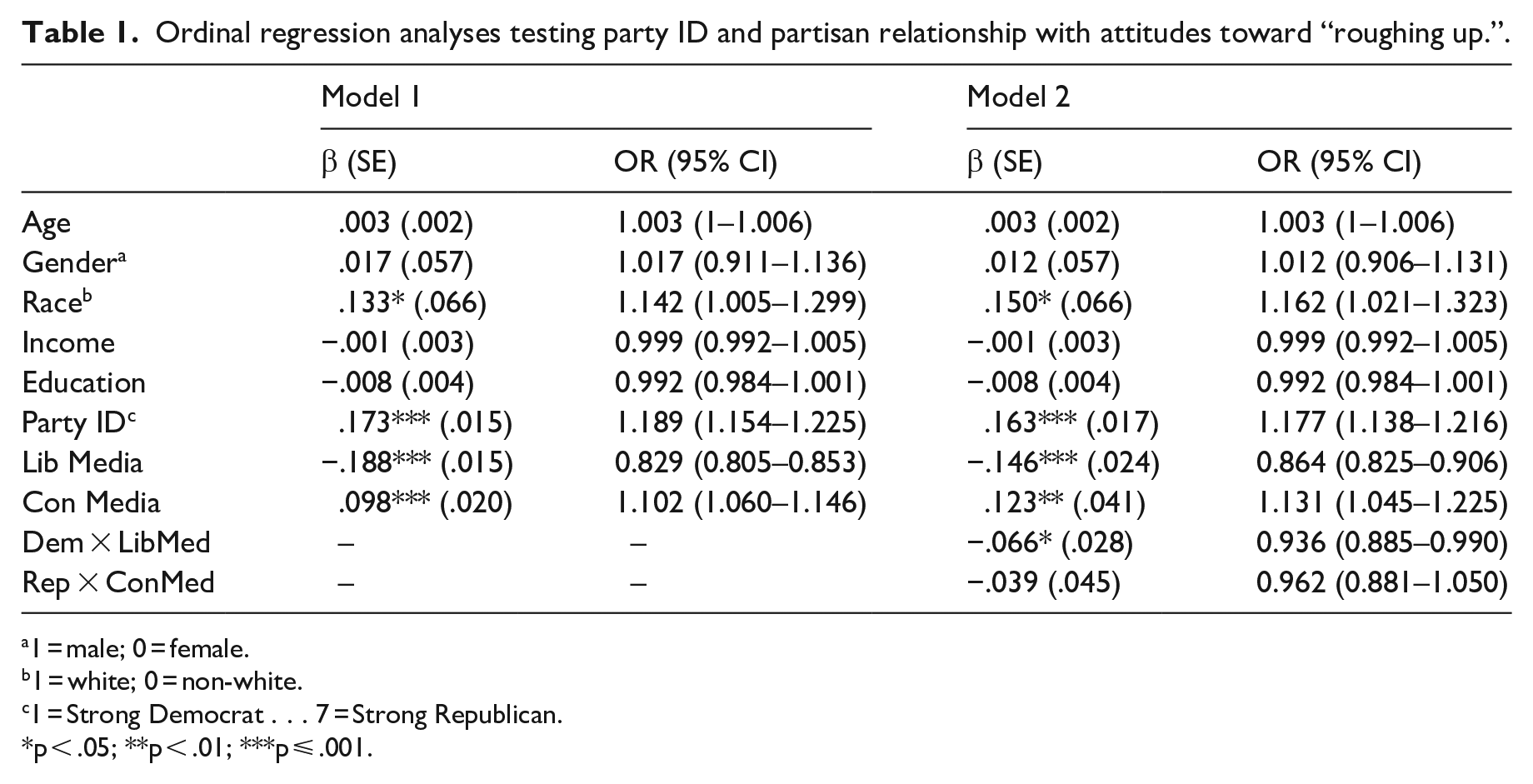
With respect to RQ1 and RQ2, the “Model 1” column in Table 1 displays the results from an ordinal regression testing 1) the relationship between partisan affiliation (Democrat or Republican) and “roughing up protesters” and 2) the relationship between partisan media (liberal and conservative) and “roughing up protesters.”
Ordinal regression analyses testing party ID and partisan relationship with attitudes toward “roughing up.”.
1 = male; 0 = female.
1 = white; 0 = non-white.
1 = Strong Democrat . . . 7 = Strong Republican.
p < .05; **p < .01; ***p ⩽ .001.
When controlling for demographic variables, Party ID had a statistically significant positive relationship with a belief that disruptive protesters deserve to be roughed up (β = .173, p ⩽ .001, OR = 1.189 (95% CI: 1.154, 1.225)). Because Republican identity acts at the reference category for Party ID (1 = Strong Democrat . . . 7 = Strong Republican), identifying as a Republican and the belief that protesters are deserving of being “roughed up” are positively associated with one another. The directionality of this relationship was mirrored with respect to conservative media—consumption of conservative media was positively associated with “roughing up” support (β = .098, p ⩽ .001, OR = 1.102 (95% CI: 1.060, 1.146)). Conversely, liberal media was negatively associated with “roughing up” support (β = −.188, p ⩽ .001, OR = 0.829 (95% CI: 0.805, 0.853)). Race was statistically significant and positively associated (β = .133, p < .05, OR = 1.142 (95% CI: 1.005, 1.299)) with “roughing up” support which, given that “White” acts of the reference category, demonstrated that respondents who identified as white were more likely to report “roughing up” support. In this model, age, gender, income, and education were not statistically significant.
RQ3 is addressed in the results shown in the “Model 2” column of Table 1. Party ID remained significant and positively associated with “roughing up” support (β = .163, p ⩽ .001, OR = 1.177 (95% CI: 1.138, 1.216)). The main effect of liberal media and conservative media consumption remained significant in the same direction as shown in “Model 1.” However, concerning the question of selective exposure’s impact of attitudes toward disruptive protesters, only the Democrat × Liberal Media interaction term was significant (β = −.066, p < .05, OR = 0.936 (95% CI: 0.885, 0.990)). Right-leaning selective exposure had no statistically significant relationship with the dependent variable (β = −.039, p = .385, OR = 0.962 (95% CI: 0.881, 1.050)). Race remained positively associated with “roughing up” attitudes (β = .150, p < .05, OR = 1.162 (95% CI: 1.021, 1.323)), while age, income, education, and gender remained non-significant.
Discussion
Political unrest in the United States and statements about protesters made by Donald Trump served as the impetus for two broad questions guiding the present study—are there partisan differences in the kind of moral disengagement necessary to endorse physical aggression against disruptive protesters and what if any role does consumption and/or selective exposure to partisan media have in this process? Recent research on the idea of political and social “sorting” has found that the amount of ideological and interpersonal overlap between Republicans and Democrats has been shrinking in recent decades (Bishop, 2009; Levendusky, 2009; Mason, 2015; McCarty et al., 2006). Could attitudes toward treatment of disruptive protesters provide new insights into partisan antipathy and moral disengagement about harm directed at the out party?
Results from the present study would suggest that this is a definite possibility, given the existence of a positive relationship between self-identified Republicans and a belief in protesters being “roughed up,” as well as a positive relationship between conservative-leaning media and the “roughing up the protester” ethos. Furthermore, we found that the more liberal-leaning programs/outlets respondents consumed, the less likely they were to believe in disruptive protesters being “roughed up.” This is a noteworthy contribution to the literature and challenges previous studies finding symmetrical levels of moral disengagement and partisan antipathy between strong partisans on either side of the aisle (Kalmoe & Mason, 2019; Mernyk et al., 2022). Instead, our results seem to suggest that a further partisan cleavage could exist between partisans in the United States that is reflected both in partisan identity and consumption of partisan media—namely, those who identify with the Republican party or those that consume the partisan media ostensibly in support of its party platform show greater support for something approximating moral disengagement. Furthermore, both standalone consumption of left-leaning partisan media and selective exposure to attitude-affirming partisan media by Democrat-identifying respondents was negatively associated with “roughing up” support. Previous literature has suggested that imagined contact with opposing partisans and correcting misperceptions about their levels of support for political violence could effectively reduce attitudes and behaviors associated with moral disengagement (Mernyk et al., 2022; Warner & Villamil, 2017). In the context of treatment toward unnamed, disruptive protesters, the results presented here suggest that left-leaning partisan identity and consumption of left-leaning partisan media, separately and together, are associated with a lack of support for “roughing up” protesters. At the same time, the relationship between right-leaning selective exposure to information and attitudes toward protesters was non-significant, which warrants further investigation in future studies.
The present study is not without limitations. First and foremost, caution should be used to interpret the full implications of these results given that they rely on cross-sectional data and cannot make any causal claims concerning the relationships tested in the research questions presented here. Further efforts at testing these novel findings in experiments and/or through time-series analysis 2 should be pursed in future research. Second, it is reasonable to question whether or not these findings are a feature of the tumultuous political landscape at the time these data were collected. However, it is worth noting that the data analyzed here were collected in the lead-up to the 2016 US presidential election, far before the nation-wide protests throughout the summer of 2020 and the attempted insurrection on January 6th at the US Capitol. Around the time these survey data were collected, it is possible that similar events in 2014 that resulted in Ferguson, Missouri in reaction to the death of Michael Brown would have been fresh in the minds of the electorate at the time and respondents in this ANES survey. Yet continued public demonstrations and political divisions in the country have grown since the events of Ferguson; it is equally arguable that the results presented here signal a trend extending to our present movement and beyond, toward further fragmentation and moral disengagement along partisan lines. In addition, the use of a single-item index for attitudes toward protesters and as a proxy for moral disengagement should be acknowledged as a limitation. Alongside the “roughing up” question, the 2016 ANES survey included a question concerning direct support for political violence, but otherwise only included items concerning respondents’ own involvement in protest activities and did not include the kinds of measures of moral disengagement used by Kalmoe and Mason (2019) and others. Finally, further caution should be exercised with these results given the question wording associated with the “roughing up” question used as our sole dependent variable here. While it is implicit in the question wording that the “protester” in question is not affiliated with a particular political party or ideology, it is possible that respondents interpreted the hypothetical “protester” belonging to a particular group, especially given the high-profile nature of Donald Trump’s public condemnation of disruptive protesters at his political rallies during the 2016 campaign cycle which seems to have served as inspiration for the original ANES question. At the same time, the lack of any direct reference to a particular protester or their political affiliations arguably demonstrates the kind of partisan sensitivity associated with questions surrounding treatment of protesters. Future research in this area should attempt to form more explicit questions and multi-item indexes that attempt to measure moral disengagement in the context of attitudes toward protest and collective action.
Overall, the results here present a novel, if unsettling, finding given the current state of US politics. Clear differences between the two major political parties and those who identify as Republicans or Democrats do not inherently result in negative consequences (American Political Science Association. Committee on Political Parties, 1950), but fundamental differences about civil treatment of fellow citizens exercising their constitutionally protected right to protest, albeit disruptively, would seem to not bode well for the state of a well-functioning democracy. Furthermore, the role of partisan media in further fanning the flames of these divisions arguably poses a threat to the democratic norms of the United States, especially at a time when a global pandemic and growing skepticism about the legitimacy of elections will continue to pose significant challenges for American citizens. From a normative standpoint, the results outlined here should serve as a cautionary tale for those seeking to deepen the divisions between themselves and their political opponents, as well as an important opportunity for political communication scholars to further understand how much more deeply divided Americans can be and the potential factors in explaining those divisions.
