




Abstract
A limited but growing body of research has explored the role of media and communication in cultivating engaged citizens in the new and established democracies in Sub-Saharan Africa. Using representative data from the World Values Survey, this study advances the existing research by examining the differential gains model across four countries that differ in terms of democratization, including Kenya, Nigeria, Ethiopia, and Zimbabwe. Findings suggest that the moderating effect of political talk on the association between news use and political engagement likely varies across countries that differ in terms of democratization. Specifically, we find support for the differential gains model across all forms of political engagement in Kenya, limited support in Nigeria and Ethiopia, and no support for the model in Zimbabwe. Implications for theory and suggestions for future inquiry are discussed.
Keywords
Over the last few decades, democracy in Sub-Saharan Africa has shown much promise and recorded considerable progress. In Kenya, for instance, a transition from single- to multiparty politics in 1991 paved the way for competition and representation. In South Africa, universal suffrage was granted in 1994 with the end of apartheid, and in Nigeria, the military handed over power to a democratically elected government in 1999. These advances were accompanied by changes in the media environment, including liberalization of broadcast media, private ownership of media outlets, and increased access to political information (Tettey, 2001).
The relationship between media use and political participation has been well documented. Research indicates that exposure to public affairs information and persuasive political content in the media are key to stimulating political interest and participation (Hayes & Lawless, 2015; Moeller et al., 2014). Political talk is also a crucial variable in that mix. In fact, political talk is reported to be an effective and empowering tool for political mobilization and democratic participation (Eveland & Hively, 2009; Eveland & Thompson, 2006; Gil de Zúñiga et al., 2019). Political talk has also been theorized to amplify the relationship between news consumption and political participation, according to the differential gains model (M. C. Nisbet & Scheufele, 2004; Scheufele, 2002). As such, news audiences should be more likely to participate politically if they also engage in political talk with others, compared to news users less involved in political talk.
Although studies have found evidence to support the differential gains model, the support is overwhelmingly based on western political contexts that tend to be established democracies. Little attention has been given to whether or not the differential gains model holds up in less democratized and non-western societies featuring different media systems and unique obstacles to participation (Harding, 2020). This is important as some scholars have suggested that the effect of political talk as theorized in the differential gains model may vary depending on attributes of the political/democratic (Su & Xiao, 2020) and media context (Brundidge et al., 2014). This study therefore tests the differential gains model in the emerging democratic context of Sub-Saharan Africa.
This study examines the extent to which political talk may amplify the effect of news use on political participation in emerging democracies. Using data from the World Values Survey, we examine whether there are variations in support for the theorized model in settings featuring varying levels of democracy, including electoral democracies and hybrid regimes (i.e., Kenya and Nigeria) and authoritarian systems (i.e., Ethiopia and Zimbabwe). Findings not only add to the existing scholarship on the influence of political information and communication on political behavior, but also highlight how these are enhanced or constrained by the political context within which citizens access information, interact, and act politically.
Information and communication as antecedents of participation
Political participation refers to specific behaviors carried out by private citizens with the goal of influencing the political system (Brady et al., 1995). Such acts may influence the political system either indirectly, for instance, through the election of office holders who formulate policy, or directly, through demands for policy change. Political participation may take the form of involvement in institutional, state-sanctioned processes such as election campaigns, voting, and referenda (Lamprianou, 2013; van Deth, 2014). However, individuals may also influence the polity using noninstitutional, often contentious activities such as protest and demonstrations which seek to challenge the status quo (Tarrow, 2022).
Participation is considered to be an essential ingredient of democratic governance, as well as an avenue for holding elected leaders accountable and advancing democracy (Michels & De Graaf, 2010). As such, research has explored potential predictors of citizen participation in democratic activities, including access to resources. According to the resource perspective, access to resources which may be material (e.g., income), informational (e.g., education, media exposure), or relational (e.g., social capital) may enable individuals to overcome obstacles to political participation (e.g., Brady et al., 1995; Isaksson, 2014).
Access to political information through the news media in particular has garnered substantial interest, with growing evidence pointing to virtuous effects of news media consumption on political engagement (de Vreese & Boomgaarden, 2006; Kruikemeier & Shehata, 2017). For instance, considerable research indicates consuming news via traditional media can enhance forms of political participation, including voting (e.g., Moeller et al., 2014) and campaign participation (e.g., Holt et al., 2013; Thorson et al., 2017). Furthermore, accessing political information via social media platforms can enhance participation in both institutional (Bond et al., 2012; Haenschen, 2016) and contentious forms of politics (Bennett & Segerberg, 2012; Castells, 2015; Manacorda & Tesei, 2020).
Research also indicates that news media consumption can enhance cognitive antecedents of political participation, including political knowledge (Fraile & Iyengar, 2014; de Vreese & Boomgaarden, 2006; Moeller & de Vreese, 2019) and internal political efficacy (Hoffman & Thomson, 2009; Tewksbury et al., 2008). Taken together, evidence continues to accumulate regarding the benefits of news media information for an actively engaged citizenry. Research has also demonstrated that discussing public affairs with others is related to involvement in diverse types of institutional and unconventional participation (e.g., Eveland & Hively, 2009; Kwak et al., 2005). Moreover, frequent discussion of political issues can also enhance political engagement by increasing citizens’ public affairs knowledge as well as knowledge of participatory opportunities (Eveland, 2004; Eveland et al., 2005; Eveland & Thompson, 2006). Indeed, political discussion has been identified as a strong predictor of political participation across diverse political contexts (Gil de Zúñiga et al., 2019).
Political communication and engagement in Sub-Saharan Africa
Although much research has established the link between news use and participation, scholars have also noted that the existing research has primarily been conducted in the United States and Europe and reflects the realities of citizens in Western democracies (Blumler, 2015; Boulianne, 2019). Less work has explored the influence of various forms of political communication on the democratic preferences and behaviors of citizens in Sub-Saharan African countries. This may be partly due to the fact that many African countries have only experienced democratization, competitive elections and campaigns, and the development of mass media systems in the last few decades.
The wave of transitions to democracy seen in Africa in the 1980s and 1990s was accompanied by a commensurate increase in media development, liberalization of the news media, and increased access to political information through the media (Karam, 2018; Popoola, 2017). These developments in the media and political environment also heightened the need for politicians and parties to communicate with constituents about policy. Accordingly, there has been an increase in the quantity of research studies examining the influence of news media access and consumption on political behavior within these emergent democracies. The existing body of research suggests that media consumption can enhance participation in political activities. For instance, traditional news use (e.g., newspaper reading, radio news) has been linked to conventional forms of participation such as voting and political campaign participation in countries as diverse as Nigeria and Kenya (e.g., Adegbola & Gearhart, 2019; Adegbola et al., 2022), Mali (e.g., E. C. Nisbet, 2008), Mozambique (e.g., Aker et al., 2017) as well as in multicountry studies (e.g., Kuenzi & Lambright, 2011). Specifically, these studies indicate that news use is likely to enhance participation, even if the effect is modest. Therefore, the following hypothesis will be tested:
H1: News consumption will be positively associated with various forms of political participation across (a) Kenya, (b) Nigeria, (c) Ethiopia, and (d) Zimbabwe?
Differential gains from news media consumption
Although exposure to news media information can enhance public affairs knowledge and participation in political activities, the effects on audiences may not be equal. Specifically, the differential gains model hypothesizes that interpersonal political discussion among citizens amplifies the impact of news consumption on political participation, such that news audiences who also engage in frequent political conversation would report higher levels of political knowledge and participation compared to news consumers who engage in political discussion less frequently (Hardy & Scheufele, 2005; Scheufele, 2002).
Existing research indicates that engaging in political discussions with others helps individuals to synthesize information gained from the news, integrate new information with existing knowledge, and make connections among people, organizations, and policy (Eveland & Hively, 2009). Furthermore, political talk helps individuals to gain added perspective about public affairs and provides additional information about engagement opportunities, which in turn enhances their potential to act upon media information (M. C. Nisbet & Scheufele, 2004; Scheufele, 2002). In fact, the differential gains model theorizes an interaction effect of news consumption and discussion such that political discussion bolsters the effect of news use on political engagement.
Although some studies have found evidence to support the core prediction of the model, others have found mixed results that suggest a more nuanced explanation. For instance, there is evidence that the relationship between news consumption and democratic engagement is stronger among individuals who frequently discuss politics compared to those who engage in political conversations less frequently, both in the United States (Martin, 2016) and in South Korea (Hyun & Kim, 2015). Similar evidence for differential gains has been found for US consumers of news via mobile phones who also engage in political discussion in person or online (Yamamoto & Nah, 2018).
Conversely, Reichert and Print (2017) found no evidence for a moderating effect of discussion on news consumption among a sample of Australians, while Brundidge et al. (2014) found that among US audiences exposed to counter-attitudinal news, engaging in political discussion may actually weaken the effect of news on engagement. In a comparative study of Japan, Taiwan, and China, Su and Xiao (2022) found that support for the model may differ as a function of differences in culture and democratic advancement, among other unique differences across the selected countries. The current study extends this line of thinking by testing the core hypothesis of the model across different political contexts in Sub-Saharan Africa.
Specifically, we expect that the influence of political discussion as a moderator of the relationship between news consumption and political participation likely varies across societies featuring different levels of democratization. This may be explained in part by differences in the attributes of media information available to citizens, quality of political conversation in less democratic countries, as well as the presence of obstacles to participation. Moreover, these differences reflect both individual and societal factors which could explain differences in the moderating effect of political discussion across democratic or undemocratic societies.
Regarding the attributes of media information, Scheufele (2002) theorizes that a lack of mobilizing information in the news may explain why news consumption alone may have limited effects on participation. Furthermore, we suspect that given the tendency for state control of media in less democratic countries (Stier, 2015), including the prohibition of information that has the potential to threaten the status quo (Hale, 2013), the media in such societies are likely to advance pro-government narratives and unlikely to feature content that promotes meaningful, potentially noninstitutional forms of participation (Walker & Orttung, 2014). Citizen conversation based on such uncritical information may do little to amplify news effects on participation.
Regarding the quality of political discussion, the act of dialogue among citizens and between citizens and elected leaders performs functions necessary for democratic government. For instance, political discussion supports citizen efforts to persuade and mobilize other citizens for political action while contributing to policy making. Starr (2008) describes this as “a system of government by discussion” in which public discourse is reflected in news and public affairs, and subsequently shapes policy (p. 37). Yet, the potential for free and unconstrained discussion that translates into political action is likely to be limited in less democratic societies, given the opposition to expressions of dissent or political speech that may threaten the regime (Young, 2019). This may entail that even individuals who frequently discuss public affairs may be less likely to express their true political views (e.g., Chia, 2014). In other words, the quality of political discussion in undemocratic societies may limit its potential benefits for citizen participation.
Finally, less democratic countries tend to feature fewer opportunities for citizen participation in political decision-making while presenting more obstacles to widespread participation. Recent studies have noted how practices ranging from corruption to unfair electoral processes (e.g., Agerberg, 2019) and authoritarian policies that limit the political choice of citizens can discourage turnout (e.g., Croke et al., 2016), especially among the most informed and sophisticated citizens who also tend to be the most involved. In other words, less democratic societies tend to be characterized by less access and higher costs of participation, which may act as obstacles to participation even for individuals who frequently discuss public affairs.
Therefore, this study examines the core hypothesis of the differential gains model across four countries in Sub-Saharan Africa having different levels of democratization, including Kenya, Nigeria, Ethiopia, and Zimbabwe. Before discussing the differences among the selected countries, it is important to acknowledge some of the shared challenges and issues prevalent in countries across the region. These include electoral fraud and violence, limited press and political freedoms, and antidemocratic practices, including political clientelism and vote buying, all of which could cause political disengagement (Agerberg, 2019; Croke et al., 2016), and have fueled concerns about democratic retreat in Sub-Saharan Africa (Cheeseman & Smith, 2019; Linzer, 2020). These challenges are prevalent, even as the majority of African countries operate authoritarian or hybrid regimes that have failed to fully transition to democracy (IDEA, 2019).
We operationalize levels of democracy based on the ratings of independent organizations, including the Economist Intelligence Unit (EIU) and the Varieties of Democracy Institute (V-Dem), both of which publish annual democracy reports. These organizations develop ratings of democracy based on diverse indicators, including the freeness, fairness, and competitiveness of elections in multiparty systems, independence of the judiciary and rule of law, press freedom, respect for civil liberties, among others. Based on these ratings across multiple indicators, countries are subsequently categorized into regime types.
For instance, the Democracy Index (EIU, 2022) categorizes countries into full democracies (i.e., fully functional with minor issues), flawed democracies (i.e., meet the basic requirements of democratic governance, but feature significant problems such as low levels of participation), hybrid regimes indicative of serious weaknesses in democratic processes and institutions, and authoritarian regimes where democratic governance is mostly or completely nonexistent. These categories largely overlap with and mirror the V-Dem classification of countries as liberal democracies, electoral democracies, electoral autocracies, and closed autocracies. While these ratings are not absolute, they are based on objective indicators, public opinion data, and data provided by local and international experts (EIU, 2022; V-Dem Institute, 2023). The individual countries and their unique attributes relevant to the theorized model are discussed below:
Since gaining independence in 1963, Kenya has made important strides in democratic advancement. For instance, the country introduced multiparty elections in 1992, and has since held regular, competitive elections (Rutten, 2000). Kenya has been viewed as one of the more stable democracies in Africa, and while recent elections have been marred by outbreaks of political violence and irregularities (Dercon & Gutierrez-Romero, 2012), the country appears to have advanced from those setbacks and is classified as an electoral democracy (V-Dem Institute, 2023). Yet, the press in Kenya is classified as “partly free” (Freedom House, 2022), and there remain major challenges to democratic consolidation (EIU, 2022). For instance, there have been instances of political corruption and abuse of power, and the media remain subject to laws designed to stifle expression (Reporters Without Borders [RSF], 2022).
Nigeria returned to democratic rule in 1999 after nearly two decades under military rule. Despite holding regular elections, elections are often characterized by irregularities, voter intimidation, and allegations of fraud (Daxecker et al., 2019; Oyewole & Omotola, 2019). The exception was in 2015 when elections widely believed to be free and fair resulted in the defeat of the incumbent for the first time in the nation’s history (Lewis & Kew, 2015). Although military era laws designed to stifle the media remain in place and harassment of journalists is commonplace (Ekwunife et al., 2021; Uwazuruike, 2020), Nigeria features a robust media system with a reputation for adversarial coverage of politics and public affairs. Recent democracy rankings classify Nigeria as a hybrid regime and electoral autocratic system (EIU, 2022; V-Dem Institute, 2023).
After assuming the position of prime minister in 2018, Abiy Ahmed promised to reform the electoral system and took steps to improve press freedom, including releasing several journalists from prison. Yet, the initial promise of reform has given way to concern as elections continue to be plagued by security issues and registration problems, raising doubts about the legitimacy of the process (Zuber, 2022). There has also been an uptick in the use of security forces to harass opposition party figures, journalists, and citizens (Freedom House, 2022). Ethiopia is now estimated to have one of the highest populations of jailed journalists (2021) and is categorized as an “authoritarian regime” (EIU, 2022).
Since the 1980s, Zimbabwean politics was dominated by the Mugabe-led party, ZANU-PF, which muzzled political opposition, media, and other forms of dissent. While the military coup of 2017 and subsequent election led to new optimism regarding democratization in Zimbabwe, such hopes have been dampened (Ndlovu-Gatsheni & Ruhanya, 2020). In addition to the ZANU-PF maintaining power, political corruption remains widespread as well as intolerance of political dissent. In fact, Magaisa (2019) contends that “while Mugabe may have departed, the system that he created and presided over for 37 years remains intact and in control” (p. 147). Zimbabwe is categorized as an authoritarian regime (EIU, 2022). While the media environment in Zimbabwe is increasingly diverse with a few independent news outlets and community radio stations, state-controlled media organizations such as the “Zimbabwe Broadcasting Corporation” (ZBC) and “Zimpapers” remain the most influential for news production and distribution (RSF, 2022).
Given the variations in democratization seen in the four countries of interest, we explore potential differences in the moderating effect of political discussion on the relationship between news consumption and participation. Specifically, this study examines whether the differential gains hypothesis will receive greater support in more democratized countries (e.g., Kenya) compared to less democratized countries (e.g., Zimbabwe). Moreover, we examine the extent to which the theorized moderation relationship may differ for distinct types of political participation (e.g., protest, voting) across the different countries. Therefore, the following research question guides the study:
RQ1. Is interpersonal political discussion a statistically significant moderator of the relationship between news use and political participation in (a) Kenya, (b) Nigeria, (c) Ethiopia, and (d) Zimbabwe?
Method
This study adopted and analyzed data from the World Values Survey (WVS), wave 7. The survey features data from over 70,000 respondents who are drawn from 50 countries, including four countries from Sub-Saharan Africa (i.e., Nigeria: n = 1237; Kenya: n = 1266; Ethiopia: 1230; and Zimbabwe: n = 1215). The samples are the most recent wave of the WVS which started in 2017 and closed in 2021.
In all four countries, respondents were selected using clustered, stratified, multistage probability sampling. The first stage involved selecting secondary sampling units, including Local Government Areas and counties, after which primary sampling units (e.g., wards) within each county were selected. Subsequently, sampling proportional to the population began at a random starting point in each sampling unit and selecting every fourth residential household for in-person interviewing. For households having multiple adults, interviewers used the Kish grid procedure to determine who would be interviewed among those available.
In Nigeria and Kenya specifically, additional steps were put in place to ensure the safety of interviewers and enhance access to respondents. These efforts include relying on police escorts in certain regions and pairing female interviewers with male enumerators. In Kenya, field work (i.e., interviewing) began on 17 May 2021, through 10 June 2021. In Nigeria, interviewing began on 19 December 2017 and ended on 26 January 2018. In Ethiopia, data collection commenced on 17 February 2020 and ended on 19 March 2020. Finally, data collection in Zimbabwe began on 11 February 2020 and concluded on 23 March 2020.
Prior to analysis, examination of the data revealed outliers that could potentially skew the results. These outlier cases were reviewed, discussed among the co-authors, and removed. Furthermore, data indicative of non-response (e.g., refused to answer, don’t know) or that were not valid were removed. Finally, key indicators and measures relevant to the study were recoded to ensure that higher numeric values reflect higher levels of the variables of interest.
Measures
Independent variables
Political discussion
A single item was used to measure how often the respondents discuss politics with their friends and family (1 = frequently to 3 = never). Responses were reverse coded prior to analysis (Kenya: M = 1.90, SD = 0.68; Nigeria: M = 1.93, SD = 0.70; Ethiopia: M = 1.78, SD = 0.60; Zimbabwe: M = 1.62, SD = 0.64).
News consumption
News media consumption was measured by asking respondents how frequently they use a variety of media platforms to access public affairs information, including newspapers, TV news, radio, internet, and social media such as Facebook and Twitter (1 = daily to 5 = never). Responses for each country were reverse coded and then combined to form a media consumption index (Kenya: α = .67, M = 3.96, SD = 0.89; Nigeria: α = .78, M = 3.11, SD = 1.16; Ethiopia: α = .75, M = 2.67, SD = 1.06; Zimbabwe: α = .72, M = 2.58, SD = 1.10).
Dependent variables
Political participation
Political participation was assessed by examining both voting and non-voting political behaviors.
Voting turnout was measured using two items. Participants were asked how often they vote in elections at local and national levels (1 = always to 3 = never). The items were reverse coded and combined to form a measure of voting for each country prior to analysis (Kenya: r = .85, M = 2.36, SD = 0.72; Nigeria: r = .93; M = 2.36, SD = 0.72; Ethiopia: r = .91, M = 1.97, SD = 0.81; Zimbabwe: r = .92, M = 2.39, SD = 0.77).
Non-voting political behavior was assessed using 12 items reflecting both online and offline political activities. To determine whether these items reflect distinct dimensions of the latent construct, a principal components analysis was conducted using oblique rotation due to the expected correlations among the indicators. The analysis yielded a two-factor solution reflecting (a) institutional, state-endorsed forms of participation, including campaign activities, as well as (b) unconventional, contentious forms of participation. Both factors explained 54% of the observed variance. Two items were removed due to cross loading.
Campaign participation was assessed using five items. Respondents were asked about the frequency of their engagement in activities, including (a) contacting government officials, (b) encouraging others to take action about political issues, (c) encouraging others to vote, (d) searching for information about politics and political events, and (e) encouraging others to take any form of political action (1 = have done to 3 = would never). The items were reverse coded prior to analysis and combined into an index for Kenya (α = .78, M = 1.92, SD = 0.56), Nigeria (α = .80, M = 1.79, SD = 0.56), Ethiopia (α = .75, M = 1.25, SD = 0.38), and Zimbabwe (α = .72, M = 1.55, SD = 0.48).
Unconventional participation was assessed using five items asking how often respondents had performed activities, including (a) signing a petition, (b) joining in boycotts, (c) attending peaceful demonstrations, (d) joining unofficial strikes, and (e) signing online petitions (1 = have done to 3 = would never). The items were reverse coded prior to analysis and combined into an index for Kenya (α = .81, M = 1.67, SD = 0.54), Nigeria (α = .77, M = 1.49, SD = 0.48), Ethiopia (α = .71, M = 1.31, SD = 0.39), and Zimbabwe (α = .72, M = 1.35, SD = 0.42).
Control variables
Control variables included four demographic items and political interest. Demographic variables assessed were gender, age, income, and education. Males and female respondents were represented nearly evenly in the sample, including in Kenya (female: 49.4%), Nigeria (female: 48.8%), Ethiopia (female: 49.4%), and Zimbabwe (female: 50.6%). Furthermore, Kenya (M = 30.74, SD = 10.07), Nigeria (M = 32.56, SD = 12.12), and Ethiopia (M = 31.93, SD = 1.70) had similar mean ages, compared to Zimbabwe (M = 39.15, SD = 16.36).
Income was measured by categorizing respondents into one of 10 groups, with group 1 being the lowest income group and group 10 being the highest income group. On average, respondents fell into the fourth income group (Kenya: M = 4.60, SD = 2.03; Nigeria: M = 4.41, SD = 2.01; Ethiopia: M = 4.38, SD = 2.24), except in the case of Zimbabwe (M = 3.46, SD = 2.18). The average Kenyan respondent had some secondary education (M = 3.31, SD = 1.70), compared to the other countries where respondents had primary education on average (Nigeria: M = 2.59, SD = 1.89; Ethiopia: M = 2.02, SD = 1.86; Zimbabwe: M = 2.45, SD = 1.33).
Political interest was also included as a control variable. Respondents were asked to indicate the extent of their interest in politics ranging from 1 = very interested to 3 = not at all interested. The items were reverse coded prior to analysis (Kenya: M = 2.47, SD = 1.04; Nigeria: M = 2.58, SD = 1.16; Ethiopia: M = 2.00, SD = 1.07; Zimbabwe: M = 2.29, SD = 1.05).
Partial correlation matrix of key variables (Ethiopia).
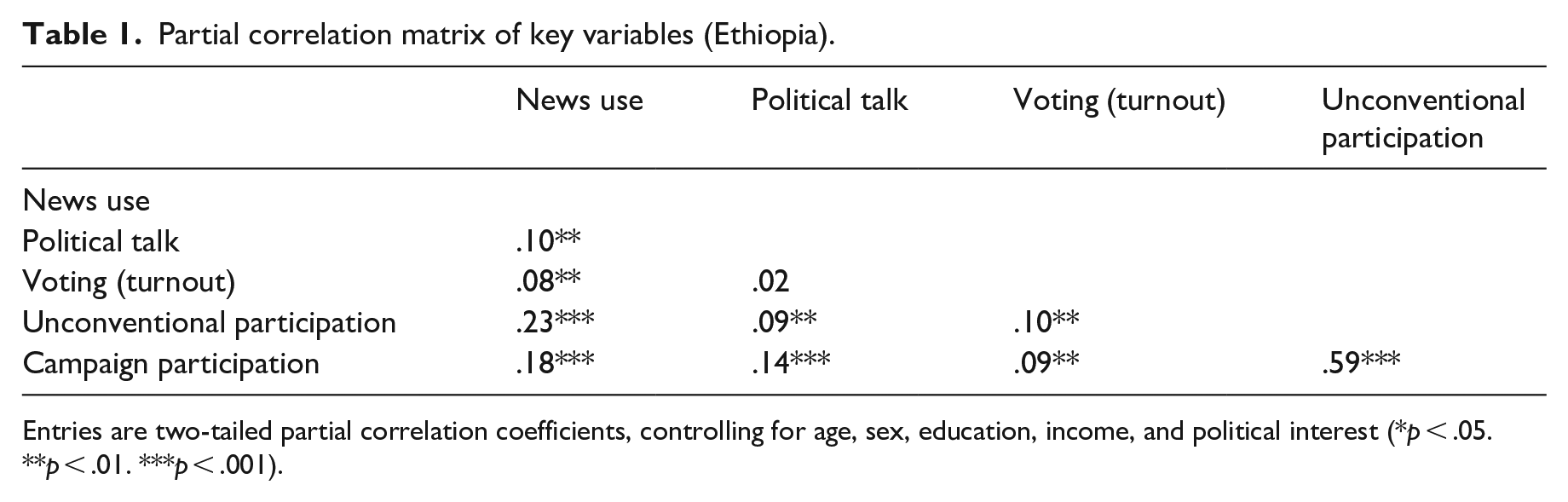
Entries are two-tailed partial correlation coefficients, controlling for age, sex, education, income, and political interest (*p < .05. **p < .01. ***p < .001).
Partial correlation matrix of key variables (Kenya).
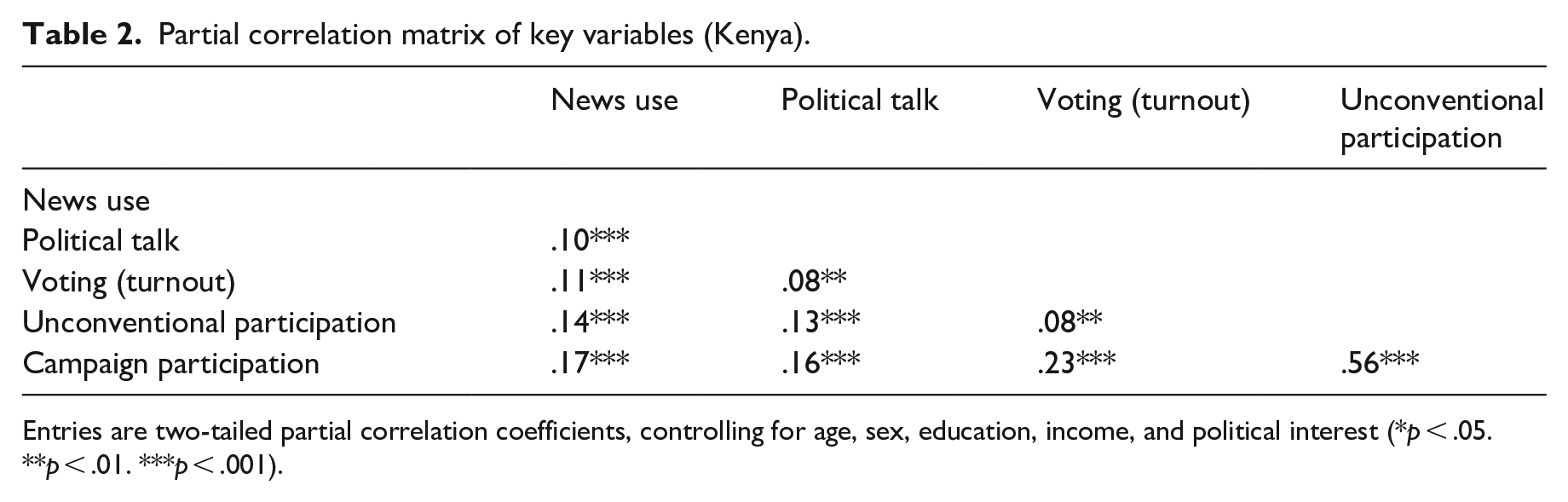
Entries are two-tailed partial correlation coefficients, controlling for age, sex, education, income, and political interest (*p < .05. **p < .01. ***p < .001).
Partial correlation matrix of key variables (Nigeria).
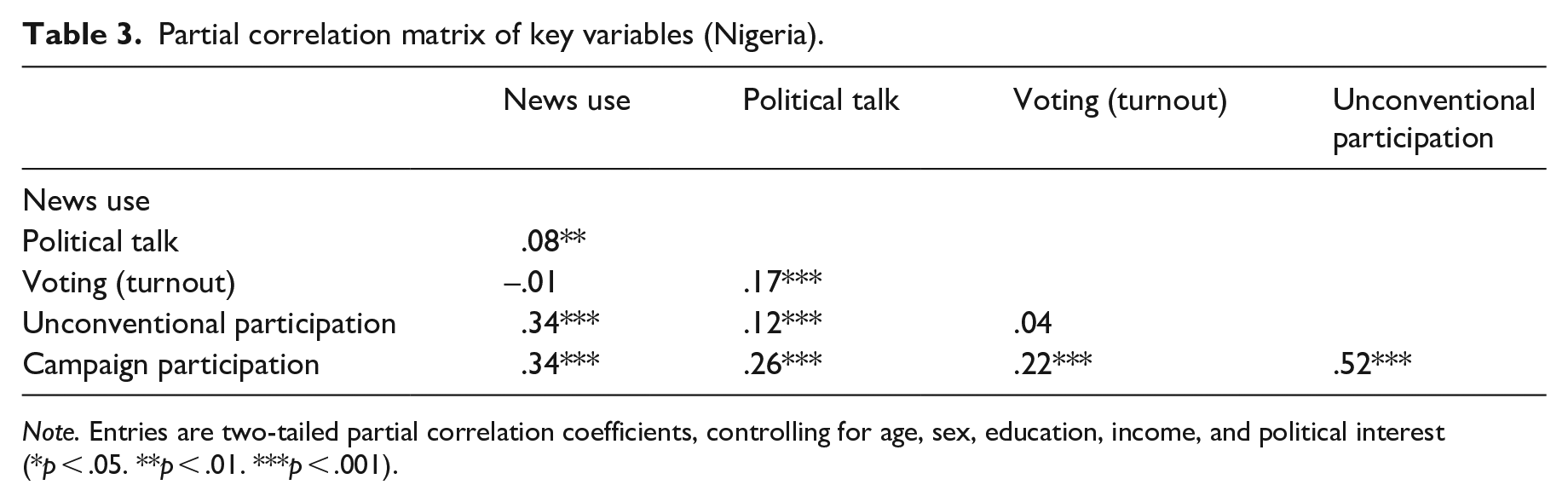
Note. Entries are two-tailed partial correlation coefficients, controlling for age, sex, education, income, and political interest (*p < .05. **p < .01. ***p < .001).
Partial correlation matrix of key variables (Zimbabwe).
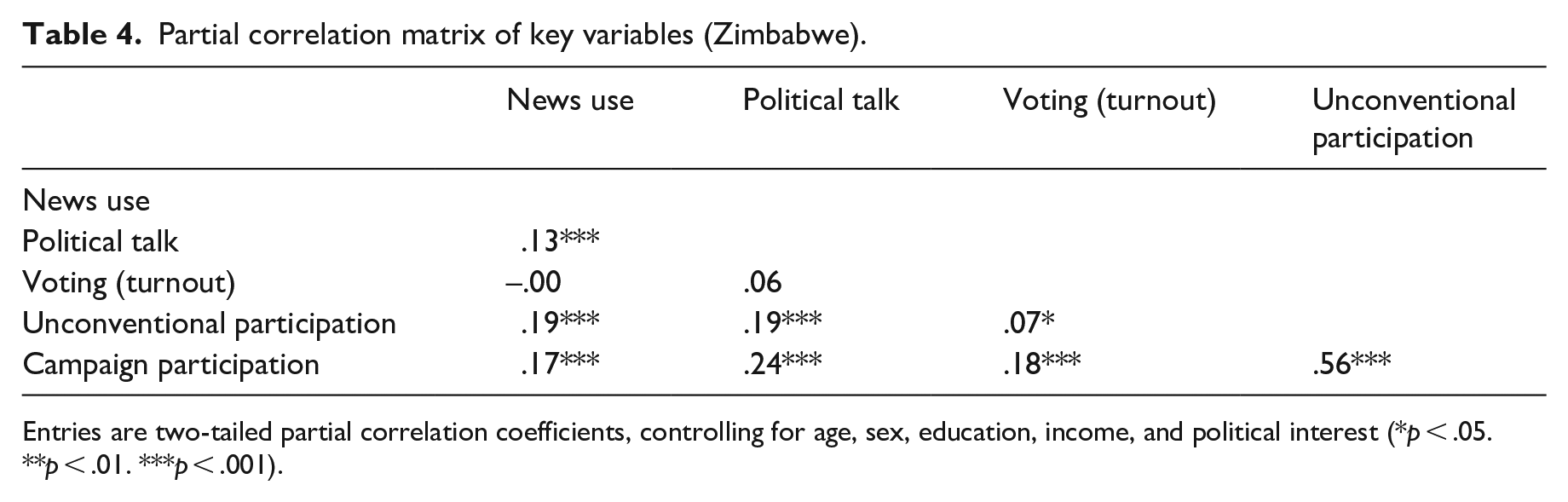
Entries are two-tailed partial correlation coefficients, controlling for age, sex, education, income, and political interest (*p < .05. **p < .01. ***p < .001).
Regression examining differential gains from news use and political engagement across selected countries.
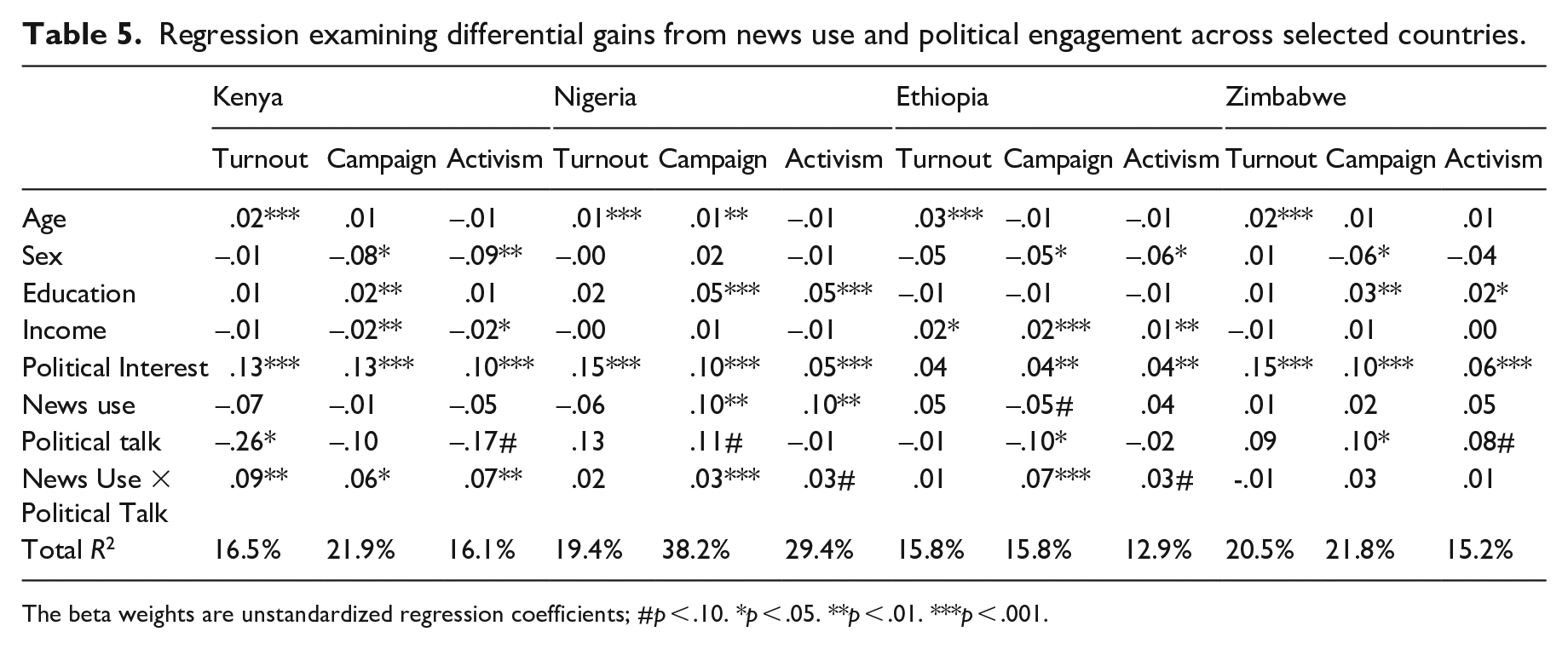
The beta weights are unstandardized regression coefficients; #p < .10. *p < .05. **p < .01. ***p < .001.
Analysis
To examine the differential gains model across the selected countries in this study, we used Andrew Hayes’s process macro for conditional process analysis. The relationships of interest were tested by regressing the various participatory outcomes (i.e., voting, campaign, and unconventional participation) on news consumption while specifying interpersonal political discussion as a moderator. Control variables were entered into the model as covariates.
Results
H1 hypothesized that news consumption is positively related to various types of political participation in (a) Kenya, (b) Nigeria, (c) Ethiopia, and (d) Zimbabwe. In the case of Kenya, the relationship between news consumption and various forms of political participation was nonsignificant (Voting: β = –.07, p = .21; Campaign participation: β = –.01, p = .90; Unconventional participation: β = –.05, p = .30). Regarding Nigeria, the relationship between news consumption and voting was nonsignificant (β = –.06, p = .24). However, news consumption was a positive and statistically significant predictor of campaign participation (β = .10, p = .003) and unconventional forms of participation (β = .10, p = .002).
Regarding Ethiopia, the relationship between news consumption and various forms of political participation was nonsignificant (Voting: β = .05, p = .47; Campaign participation: β = –.05, p = .09; Unconventional participation: β = .04, p = .18). Finally, in the case of Zimbabwe, news consumption was not a positive predictor of political participation (Voting: β = .00, p = .99; Campaign: β = .02, p = .47; Unconventional: β = .04, p = .12). Therefore, the hypothesis received substantial support in Nigeria (H1b), but not in Kenya, Ethiopia, or Zimbabwe (H1a, c, d).
RQ2 asked whether interpersonal political discussion significantly moderates the relationship between news use and political participation in (a) Kenya, (b) Nigeria, (c) Ethiopia, and (d) Zimbabwe. In the case of Kenya, political discussion was a positive, significant moderator of the relationship between news use and voting (β = .09, p = .004). At low levels of political discussion frequency, the relationship between news use and voting was nonsignificant (β = .03, p = .29); however, the relationship between news use and voting was statistically significant at moderate (β = .09, p < .001) and high levels (β = .15, p < .001) of political discussion frequency (see Figure 1). As seen in Figure 2, political discussion was a positive, significant moderator of the relationship between news use and campaign participation (β = .06, p = .01). The relationship between news use and campaign participation was strongest at high levels of political discussion (β = .14, p < .001) compared to moderate (β = .10, p < .001), and low levels (β = .06, p = .004). As seen in Figure 3, political discussion was also a positive, significant moderator of the relationship between news use and unconventional forms of participation (β = .07, p = .002). At low levels of political discussion frequency, the relationship between news use and unconventional participation was statistically nonsignificant (β = .04, p = .09). However, at moderate and high levels of political discussion frequency, there was a positive, significant relationship between news use and contentious participation (β = .09, p < .001 and β = .14, p < .001, respectively).
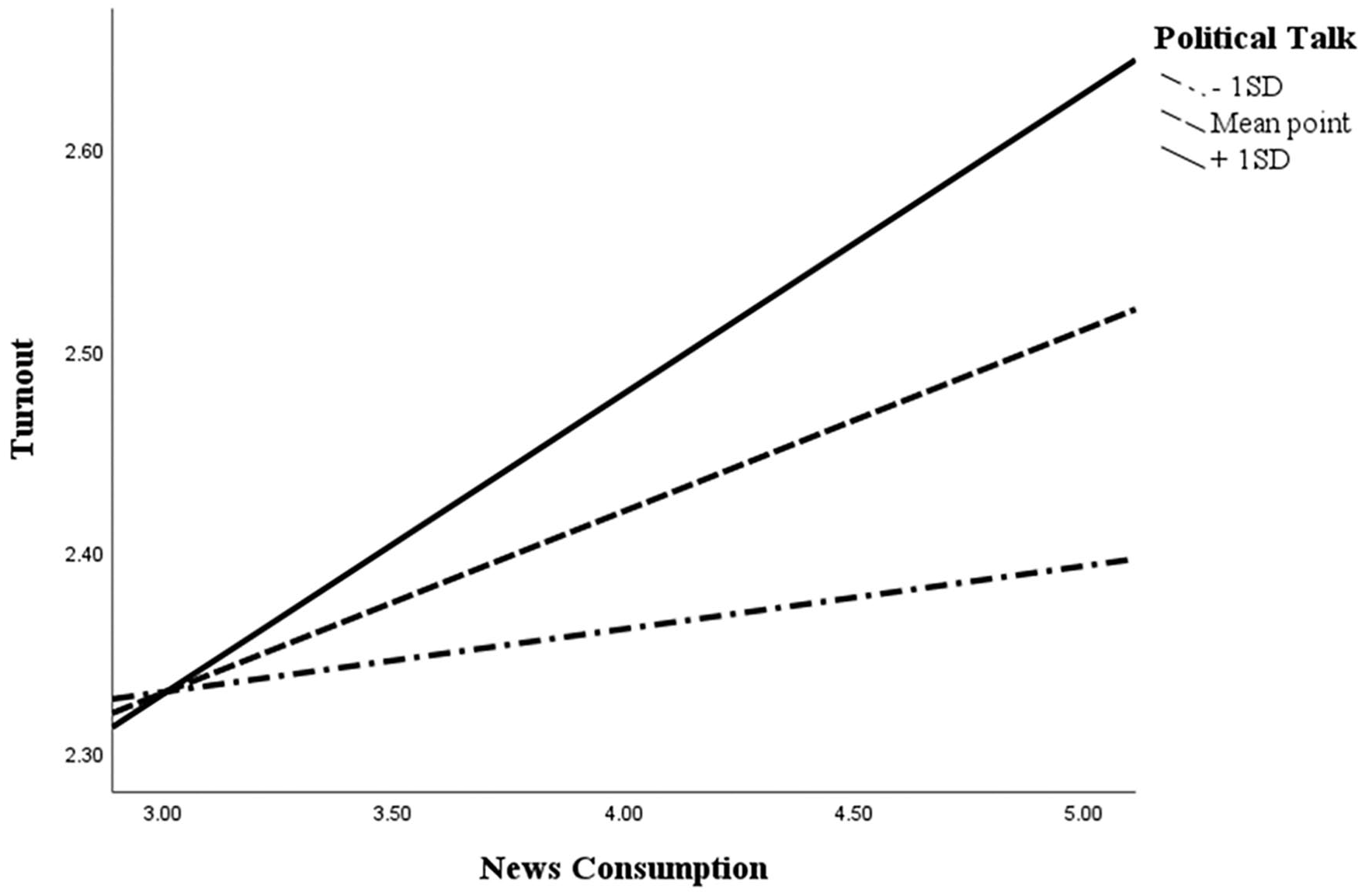
Interaction effect of news use and political talk on voting turnout in Kenya.
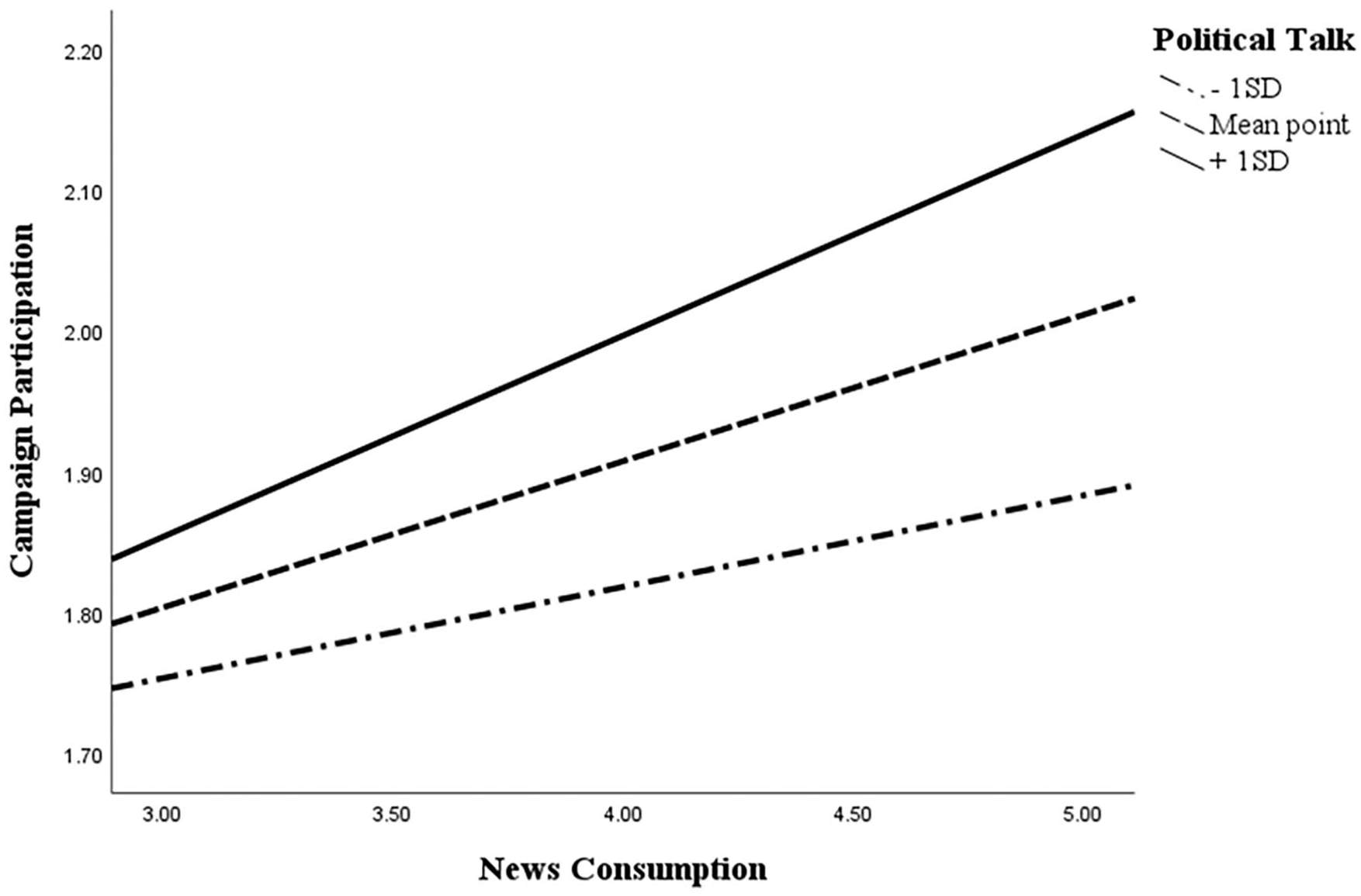
Interaction effect of news use and political talk on campaign participation in Kenya.
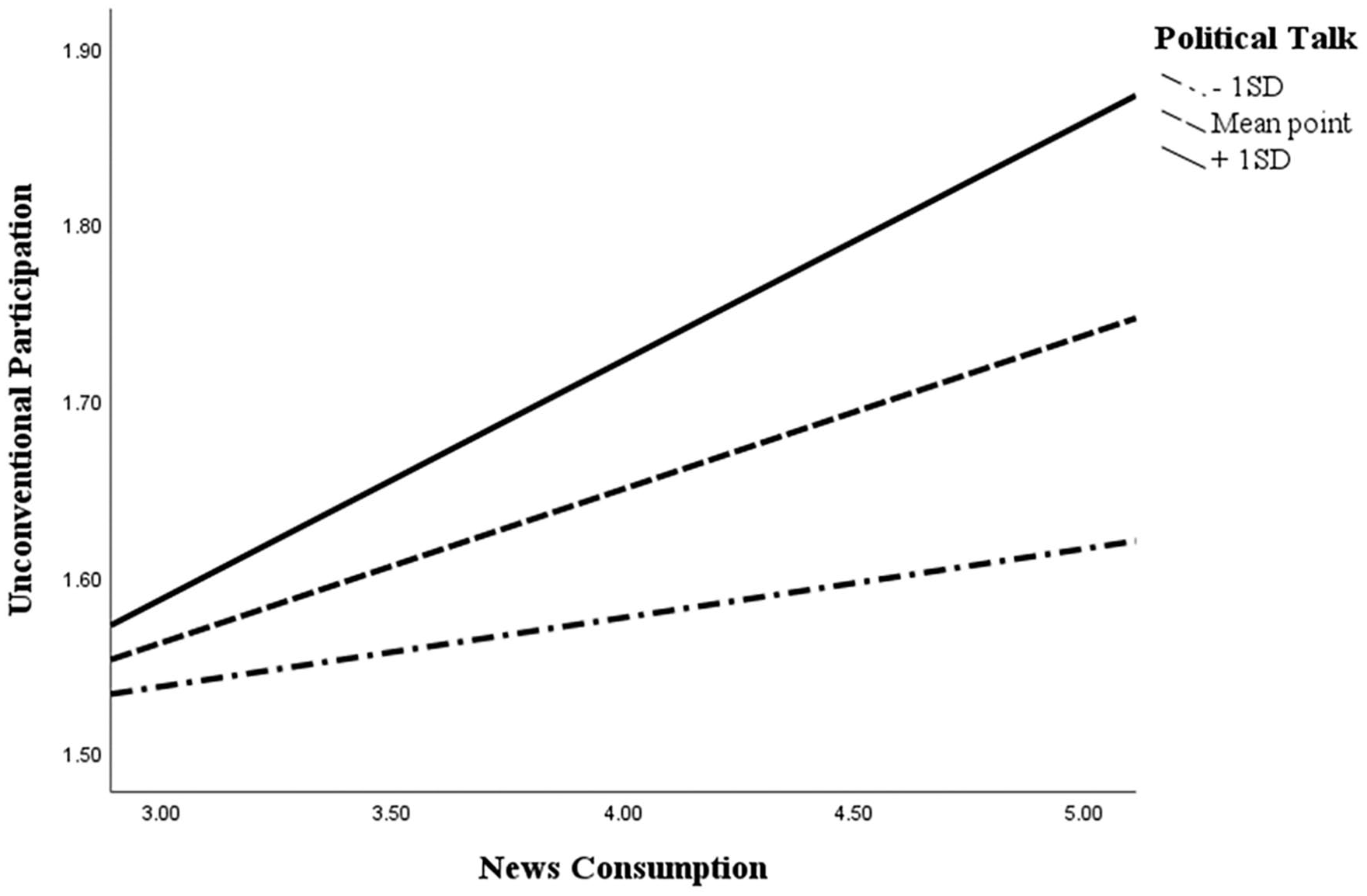
Interaction effect of news use and political talk on unconventional participation in Kenya.
In the case of Nigeria, political discussion was not a significant moderator of the relationship between news use and voting (β = .02, p = .39). Regarding contentious forms of politics, the moderating effect of political discussion on the relationship between news use and participation was only significant at the .10 level (β = .03, p = .08). News use was a significant predictor of contentious participation at low (β = .13, p < .001), moderate (β = .14, p < .001), and high (β = .16, p < .001) levels of political discussion frequency. Similarly, regarding campaign participation, the moderating effect of political discussion on the relationship between news use and participation was only significant at the .10 level (β = .03, p = .07). News use was a significant predictor of campaign participation at low (β = .14, p < .001), moderate (β = .16, p < .001), and high (β = .18, p < .001) levels of political discussion frequency.
In the case of Ethiopia, political discussion was not a significant moderator of the relationship between news use and voting (β = .01, p = .77). Regarding contentious forms of political participation, the moderating effect of political discussion on the relationship between news use and participation was only significant at the .10 level (β = .03, p = .09). News use was a significant predictor of contentious participation at low (β = .08, p < .001), moderate (β = .09, p < .001), and high (β = .11, p < .001) levels of political discussion frequency. As seen in Figure 4, however, political discussion was a positive, significant moderator of the relationship between news use and campaign participation (β = .07, p < .001). The relationship between news use and campaign participation was strongest at high levels of political discussion (β = .12, p < .001) compared to moderate (β = .07, p < .001), and low levels (β = .03, p = .04).
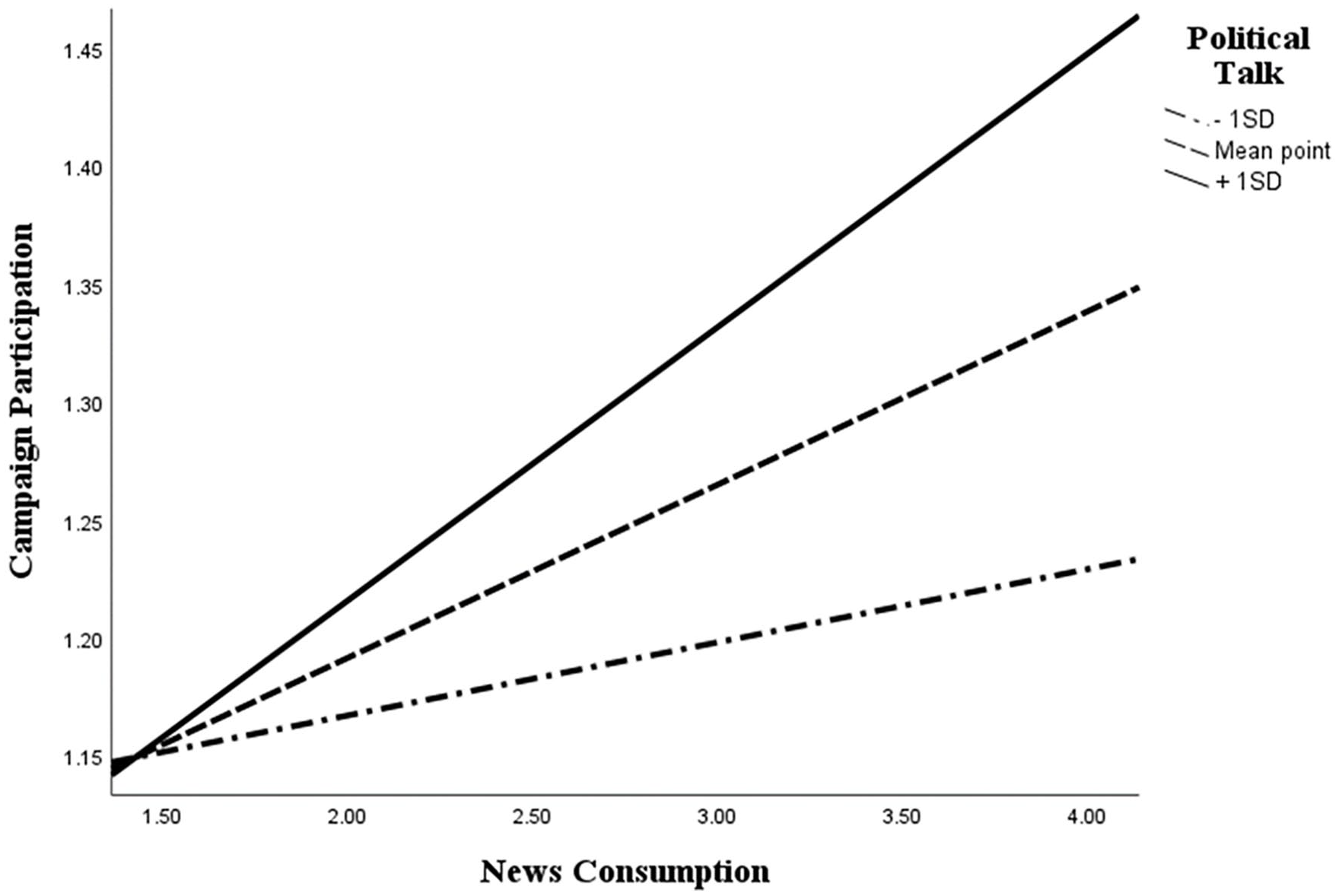
Interaction effect of news use and political talk on campaign participation in Ethiopia.
In the case of Zimbabwe, political discussion was not a significant moderator of the relationship between news use and voting (β = –.01, p = .83). Regarding contentious forms of political participation, political discussion was not a significant moderator of the relationship between news use and participation (β = .01, p = .37). Furthermore, political discussion did not moderate the relationship between news use and campaign participation (β = .03, p = .14).
Discussion
Building upon the theoretical grounding of differential gains model, this study examines the relationship between news consumption and participation as well as how the moderating effect of political discussion on the relationship between news use and participation varies across select sub-Saharan countries (Kenya, Nigeria, Ethiopia, and Zimbabwe). Overall, findings point to weak or nonsignificant associations between news consumption and participation across the various countries. However, the results also suggest that political discussion is likely to play a much stronger role in amplifying the effects of news use on participation in more democratized countries than in less democratic countries. In other words, the contribution of political discussion to news media effects on participation may depend on the political context.
Regarding the association between news consumption and participation, our findings depart from prior research and seem to indicate limited participatory benefits of news consumption. These findings raise questions regarding the quality of news media information available to citizens in the selected countries and how well the media perform their role of cultivating an informed, engaged, and mobilized citizenry (Kalyango & Eckler, 2010; Moehler & Singh, 2011). The exception to this finding seems to be in Nigeria where news use was positively related to both campaign and unconventional participation.
The finding that news use is associated with higher levels of campaign and contentious forms of participation but not voting, may reflect not only the media and political system in Nigeria but also the political situation at the time of data collection. First, despite its history of military rule and state interference in media operations, Nigeria features a vibrant media that has a reputation for playing a critical, adversarial role (Daramola, 2006), which can also have a mobilizing effect on citizens. However, it is also important to note that the time of data collection in Nigeria coincides with the eruption of protests against police brutality, also tagged the #EndSARS campaign (Ojedokun et al., 2021). The campaign which started online gained global attention and gave rise to large-scale offline protests and policy changes. This period also marked the onset of campaign activities for the 2019 elections, and rising agitation about poverty and economic difficulty under the Buhari administration (Slater, 2018). These grievances and political activities occurring at the time may partly explain the findings in Nigeria.
Regarding differential gains from news use, we find support for the hypothesis in Kenya for all three forms of participation, including voting, campaign involvement, and unconventional forms of participation such as protest. That is, news consumers who also engaged in frequent political discussion were more likely to participate in diverse political activities compared to news consumers who engaged in political discussions less frequently. As the most democratized of the selected countries according to metrics such as the Democracy Index (EIU, 2022) with widespread access to online information (Kemp, 2022), Kenya features a political environment that supports diverse forms of political action by citizens. Yet, this is not the case in many other settings.
In Nigeria, results showed only limited support for the theorized model. That is, political discussion appears to exert only marginal effects on the relationship between news use and participation. Moreover, this was only the case for election campaigns and unconventional participation. One explanation for these findings is that despite Nigeria’s vibrant media system and access to information, electoral fraud and widespread distrust of election results remain and may constitute obstacles to voting specifically (Aluaigba, 2016; Casimir et al., 2013). Indeed, this is consistent with the downward trend that has characterized voter turnout in Nigeria over the last two decades (Institute for Democracy & Electoral Assistance, 2021).
Findings in Ethiopia were similar to that of Nigeria, with results showing limited support for the model. Political discussion significantly strengthened the relationship between news use and campaign participation, and to a lesser extent, unconventional participation. In our view, these findings reflect the challenges and obstacles to true participation that remain despite recent attempts at political reform by Prime Minister Abiy Ahmed. Specifically, increased suppression of political dissent, state censorship of the press, and violence against journalists may not only limit mobilizing interaction among citizens, but also create an environment that does not facilitate widespread participation.
Finally, in the case of Zimbabwe, political discussion was not a significant moderator of the relationship between news use and any of the forms of participation examined. This is not surprising given the history of authoritarianism and limited participatory opportunities in Zimbabwe. These findings may also reflect the dominant feeling that citizens are excluded from meaningful political decisions (Nyama & Mukwada, 2023), and a pattern of engagement by older, less educated, low-income citizens motivated by ethnic politics (Citizens in Action Southern Africa, 2022) while more sophisticated and informed but disillusioned citizens disengage politically (Croke et al., 2016).
For the most part, our findings reinforce the notion that political discussion and news use as a predictor for political participation plays a more robust role in democratized countries than less democratized countries, given that democracy is a precondition to human rights which political expression is a byproduct of. Indeed, less democratic countries are likely to feature more obstacles to widespread participation, as well as non-informational factors that may shape political behavior, including ethnic voting and political clientelism (Cheeseman et al., 2020).
Overall, the results of this study offer several contributions to the literature. First, this study adds to the body of research that explores news media and communication influences on political participation. Furthermore, this study examines the differential gains model and its applicability across non-Western settings that vary substantially with respect to levels of democratization. More importantly, the findings of this study lend credence to calls for theorizing and research that accounts for variations in context. This is especially important given the variety and vast shades of democracy seen in countries across Sub-Saharan Africa.
Although this study makes important contributions to the literature, our study is limited in a number of ways. First, this study is limited in terms of its scope. While Sub-Saharan Africa is the broader context, we have only examined four out of more than 40 countries within the region. Another limitation has to do with our reliance on secondary data, including the use of single items to measure key variables and discrepancies in the measurement of key variables, with some measured on a 3-point scale (e.g., political discussion) while others were on a 5-point scale (e.g., news use). These discrepancies in measurement could limit the possibility for comparability between variables. Perhaps more importantly, multilevel modeling involving multicountry data would be required to determine whether the patterns seen in our findings are systematically attributable to specific macro-level independent variables, such as press freedom or level of democracy. Future studies should integrate variables that are more relevant to the emerging democratic contexts (e.g., political trust, perceptions of election integrity) to explore how these may influence citizen participation.
