




Abstract
Drawing on a survey of 1,386 South Korean young adults, this study finds that news curation mediates the association between social media news use and political efficacy and participation. Analysis also reveals that political interest moderates the relationship between news curation and political efficacy and participation, with politically less interested people being more influenced by news curation than politically more interested people. The finding has significant implications as to how to rekindle young adults’ political involvement. This study contributes to the existing literature about social media’s impact on news consumption, by conceptualizing “news curation” as a unique method of engaging with social media and by illuminating its effects on democratic engagement.
Keywords
The common consensus acknowledges that political engagement, such as voting, campaign volunteering, and attending political rallies, has been on the decline (Henn & Foard, 2012; Yamamoto et al., 2017). Furthermore, the decreasing use of news media by young adults raises concerns about their disinterest in politics (Mitchell et al., 2016). Given the strong link between news media use and political involvement (Strömbäck & Shehata, 2010), the declining interest in news media among young adults may result in reduced political engagement.
However, this trend may be significantly influenced by digital media. Younger individuals are more active users of digital media compared with older generations (Adgate, 2021), and research consistently demonstrates a positive link between digital media use and political participation (Boulianne, 2020; Ohme, 2019). The greater use of social media by younger citizens could offset the decline in their use of traditional news media. In fact, on social media quite many young adults encounter news, express their opinions, discuss politics, and participate in political activities (Winter et al., 2015). For instance, in South Korea, one out of five young adults in their 20s regularly uses social media for information purposes (Kim, 2014), and 79% of South Korean adults use social media for news sources (Korea Press Foundation, 2024). Social media also may provide an opportunity for users to develop civic skills and acquire political knowledge (Kim et al., 2020; Valenzuela et al., 2012).
This study is centered on how young adults employ social media for political engagement. Even young adults who may not have a prior interest in politics can gain access to political information through their social media, potentially igniting their political curiosity. From a theoretical standpoint, this study aims to expand Park and Kaye’s (2018) study, which found that curatorial news use on social media is significantly correlated with increased levels of political knowledge, internal political efficacy, and engagement in both offline and online political activities. According to them, news curation involves users participating in news-related activities, including assessing, commenting on, and sharing curated news content via social media (Park & Kaye, 2018). Although the article sheds light on the role of news curation in the political process, still we do not know clearly how news curation works in leading social media users to political participation. The current study aims to deepen our understanding about the implications and roles of news curation by focusing on three aspects.
First, we examine the mediating role of news curation between social media news use and political efficacy and participation to illuminate the mechanism by which news curation works in the political process. This is based on the possibility that passive social media news users can turn into active news users with the unique interface and features of social media platforms (Mihailidis & Viotty, 2017). Second, we examine the moderating role of political interest between news curation and political efficacy and participation, to examine whether news curation can have different effects between politically less motivated people and politically motivated people. Finally, this work focuses on the young adults represented by the age group of 18–25. Concentration on the young adult group is especially significant as most individuals in this age group are first-time voters and start participating in political processes.
Using original survey data collected from 1,386 young adults aged between 19 and 25 in South Korea, this research aims to enhance our understanding of the political roles of news curation among young citizens in the context of social media.
Literature review
Research context—social media in South Korea
In South Korea, social media serve as prominent channels for news and information, but the ecosystem is distinctive, influenced heavily by domestic platforms alongside major American platforms. South Korea’s news consumption landscape is led by local portals like Naver and Daum. These platforms not only aggregate news but also provide email, shopping, and search services, creating a central hub that attracts a large share of online traffic. For instance, Naver is accessed by 65% of users for news, while Daum is used by 38%—figures that far surpass those for American social media platforms such as Facebook and X (Reuters Institute, 2024).
Among South Korean youth, there is a trend toward using social media more for entertainment and socializing rather than traditional news consumption (Statista, 2024). Many young users turn to YouTube, Instagram, and KakaoTalk (the country’s most popular messaging app) for video content and personal interactions. KakaoTalk, in particular, is pivotal, functioning not only as a messaging service but also as a platform for political and news content (Reuters, 2023).
In this nation, traditional news outlets and social media play distinct roles. Broadcast news, which has experienced a resurgence since the Covid-19 pandemic, maintains a level of trust and formality not usually associated with social media, where information is more user-driven and can be subject to misinformation (Kim, 2021). Trust in news on social media is low, reflecting concerns about the quality of information shared on these platforms (Reuters Institute, 2019).
News curation in social media
Traditionally, news engagement was measured through “news exposure”—the frequency of news consumption—and “news attention”—the focus dedicated to specific types of news. However, these measures are limited in capturing the diverse interactions enabled by social media, such as sharing, discussing, and personalizing news content. In response, Choi et al. (2013) introduced a two-dimensional model of news use: news internalizing (receiving news from producers) and news externalizing (sharing news for others). Yet, this framework does not fully address today’s dynamic social media environment, where users do not merely share content but reinterpret, reframe, or analyze it according to their perspectives (Goode, 2009).
Social media significantly extends the means for everyday citizens to interact with news content beyond traditional media exposure (Bruns & Highfield, 2012; Pew Research Center, 2024). Social media use for news is defined by the immediacy and accessibility it offers, enabling real-time information sharing and rapid news dissemination (Hermida, 2010). Unlike passive news consumption, social media users may casually share articles that resonate with them (Wong & Burkell, 2017) or provide immediate reactions and surface-level opinions (Hermida et al., 2012). Social media platforms further allow users to participate in both the production and consumption of news, fostering interactivity and user-generated content that blurs the lines between journalists and ordinary users (Newman et al., 2022). Of course, this also raises concerns about the spread of misinformation and the reliability of news sources, as content on social media can be difficult to verify and lacks traditional gatekeeping mechanisms (Tandoc et al., 2018).
Distinct from general social media news use, news curation involves an active, reflective engagement with news, where users assess, reinterpret, and share content in a more structured and intentional way. Park and Kaye (2018) define news curation as a participatory approach in which users respond creatively to news, engage with others, and share content with personal commentary or analysis. This activity includes reposting articles with added perspectives, summarizing news, or posting opinions, aligning with Thorson and Wells’s (2016) concept of “curated flows,” which refers to the intentional selection, framing, and dissemination of information.
In operational terms, scholars typically measure general social media use by asking respondents about the frequency and duration of their social media activities (e.g., Correa et al., 2010; Verbeij et al., 2021). Social media news consumption is usually measured with the frequency of accessing news on social media, the types of news content consumed, and the specific social media platforms used for news (e.g., Konitzer et al., 2021; Pew Research Center, 2024). Social media news curation in this study is measured through users’ activities such as summarizing news, posting links with personal annotations, and commenting on or debating political issues. 1 These behaviors go beyond mere news sharing, reflecting a deeper engagement that can enhance news literacy and encourage active citizenship (Lane, 2020). By curating news, users are not only expressing themselves but are critically evaluating and presenting information, which contributes to their understanding of political discourse.
Social media platforms provide users with tools that support news curation, such as comment sections, reaction buttons, and sharing options, which facilitate active participation (Halpern & Gibbs, 2013; Vaccari & Valeriani, 2015). Through these tools, users can create original commentary or even counter-narratives to mainstream media content, highlighting the role of personal agency in news curation. For example, while some may simply like or share news posts, others go further, adding nuanced interpretations or questioning the veracity of content, thus engaging in news literacy practices (Powers, 2010).
News curation on social media diverges from traditional and strategic forms of curation. “Traditional media curation” involves editorial decisions by established outlets, guided by professional standards. In contrast, “strategic curation” often serves specific agendas, as seen in politicians’ or influencers’ intentional use of information to shape public opinion (Thorson & Wells, 2016). Social media news curation is user-driven, where individuals, not institutions, select and interpret information, reflecting a more grassroots approach to information dissemination.
News curation may promote news literacy, by helping users develop skills to critically assess information, recognize biases, and engage thoughtfully with political issues. While passive scrolling and casual exposure to news can lead to superficial understanding, active curation may foster an engaged and informed audience. A recent study indicates that even minimal interactions, such as sharing news, can boost users’ perceived knowledge and confidence (Ward et al., 2023). All in all, we argue that news curation serves as a gateway for users to deepen their political engagement and develop a critical perspective on current events.
Political news curation and political engagement
This study first examines the relationship between news curation and political efficacy and participation. To do this, we first need to understand that news curation function as both an active form of news engagement and a passive form of online political participation. Recent scholarship underscores that curating news content on social media enables users to engage meaningfully with political information while also contributing to broader online political discourse (Edgerly, 2017; Thorson, 2020). News curation involves the deliberate selection, organization, and dissemination of information, which can deepen users’ understanding of issues and reinforce their identities as informed citizens (Edgerly, 2017). News curation engages users by encouraging them to reflect on and critically evaluate the relevance and credibility of information before sharing it (Thorson, 2020). This active engagement with news encourages users to think critically about political matters, thus enhancing internal political efficacy and fostering a sense of agency within the political sphere (Vraga & Tully, 2015).
News curation also functions as a passive form of online political participation. News curation, which involves selecting, organizing, and sharing news articles on social media, allows individuals to engage with political discourse without the active involvement typically associated with traditional political activities, such as attending rallies or voting. This form of participation can be considered “passive” because it does not require high levels of effort or direct advocacy but still influences public opinion and information dissemination (Theocharis et al., 2015). By sharing news, users play a role in amplifying certain narratives or framing issues in ways that reflect their personal perspectives or social affiliations. Research also shows that even low-effort engagement, such as sharing political news or articles, contributes to the visibility of political issues and shapes public opinion, thereby acting as a form of “low-cost” political participation (Theocharis & van Deth, 2018). This type of passive engagement can still enhance political knowledge and interest by exposing individuals and their networks to diverse perspectives and critical issues (Vaccari & Valeriani, 2015).
Internal political efficacy
Political efficacy is a well-established concept frequently used in the realm of political communication. Internal political efficacy refers to an individual’s belief in their own ability to understand and participate effectively in political processes (Gil de Zúñiga et al., 2017). News consumption plays a pivotal role in shaping individuals’ political efficacy. Exposure to news media not only provides citizens with information about political events and issues but also affects their political knowledge and engagement (Prior, 2013). As individuals consume news from diverse sources, they are more likely to develop a nuanced understanding of political matters, enhancing their ability to participate effectively in the democratic process. Exposure to particular news topics can shape the salience of issues for the public and subsequently impact political efficacy (Sáez & Alonso-Muñoz, 2018). These findings suggest that news consumption can empower individuals by increasing their political awareness and encouraging them to take a more active role in the political sphere. Considering that the process of news curation provides a better chance to understand the political process, this study poses the following hypothesis:
Political participation
When individuals acquire knowledge about and develop an interest in critical issues, political causes, and social movements, they tend to become active participants in related activities (Ksiazek et al., 2010). To put it differently, news consumption not only facilitates learning but also encourages citizens to engage in political matters. Furthermore, exposure to user-generated content and the act of self-expression are linked to increased online and offline political involvement (Kushin & Yamamoto, 2010).
Social media platforms are renowned for their ability to mobilize citizens, kickstart protests, and generate interest in political and social causes (Valenzuela et al., 2012). They are considered advantageous for fostering political engagement because news curation involves the identification of critical issues within the existing political discourse, the gathering of relevant information on those issues, the analysis and verification of this information, and ultimately the dissemination of curated news content to others (Park & Kaye, 2018). Thus, involvement in news curation may serve as a catalyst for political participation.
This research views news curation as a process demanding deep engagement in news processing and thoughtful analysis, all of which contribute to increased political involvement (Cho et al., 2009). Accordingly, the present study expects that so long as users expose themselves to news and current affairs through social media, the participatory effects of news curation should be positive.
News curation as a mediator
To deepen the understanding of how news curation on social media enhances political efficacy and participation, it is essential to consider the cognitive processes involved, such as cognitive effort and digital literacy. By engaging in news curation, users not only acquire information but also actively process, interpret, and prioritize news content, a cognitive activity that fosters a sense of personal agency and efficacy (Monzer et al., 2020). Cognitive engagement involves not just consuming information but critically reflecting on it, which can increase users’ confidence in their knowledge and understanding of political issues, thereby contributing to internal political efficacy (Eveland, 2004).
Cognitive factors, such as digital literacy, would provide insights into the mechanisms by which news curation drives political efficacy and participation. Digital literacy is particularly significant as it equips users with the skills necessary to evaluate information sources, verify facts, and detect misinformation (Mihailidis & Viotty, 2017). Studies show that digitally literate users engage more critically with news content, which is linked to both higher efficacy and a greater likelihood of political participation (Kahne & Bowyer, 2018). Considering that news curation resembles digital literacy and entails cognitive effort (Park & Kaye, 2018), it has the potential to bridge social media news use to political efficacy and participation.
Moreover, news curation can be influenced by the gradual increase in platform familiarity and user engagement. As users adapt to social media’s informational ecosystem, they experience a natural progression from passive content consumption to more active forms of engagement. Social learning theory (Bandura, 1977) supports this progression, as users observe others in their network sharing and curating news, which encourages them to adopt similar behaviors. This transition from passive to active engagement is not only behaviorally but also cognitively transformative, reinforcing efficacy by allowing users to exercise control over the information they distribute and discuss.
The literature further shows that habitual social media use can condition users to engage more deeply with political news (Vraga & Tully, 2015). This repetitive interaction with news content creates a feedback loop where political efficacy and participation reinforce each other. Cognitive engagement, shaped by factors such as digital literacy and news curation, is thus integral to transforming news curation into a politically empowering activity. When users engage in high-effort cognitive processes like verifying information or contextualizing news within broader social and political frameworks, they not only enhance their political knowledge but also increase their likelihood of active participation (Chaffee & Schleuder, 1986). Therefore, the following hypotheses are posed:
Gil de Zúñiga et al.’s (2017) hypothesis on the relationship between internal efficacy and political participation (wherein internal efficacy at an earlier stage is positively associated with political participation later) is also instructive here. Following this framework, news curation can be seen as directly enhancing users’ sense of efficacy by requiring them to actively engage with content. Over time, this sense of efficacy may facilitate political participation by making individuals feel competent and empowered to partake in civic discourse and actions. Thus, this study proposes that news curation on social media not only fosters internal political efficacy but also establishes a pathway where efficacy acts as a mediator between curation and participation, underscoring the cyclical nature of engagement and its political impact.
Moderating role of political interest
Political interest is a foundational factor shaping engagement with and interpretation of political information, influencing how individuals select, process, and act on news content (Moeller & de Vreese, 2013). Individuals with high political interest typically seek out news content actively, contributing to their existing knowledge base and reinforcing their engagement in political matters (Strömbäck & Shehata, 2019). This aligns with the selection effects model, which suggests that people high in political interest are more likely to seek news (Strömbäck & Shehata, 2019).
Social media provides a platform where curatorial activities—such as sharing, annotating, and commenting on news—are commonplace. These actions require cognitive engagement and often involve additional research or reflection (Park & Kaye, 2018). When individuals participate in curating political content, they exercise cognitive effort that can heighten interest in the subject matter (Park & Kaye, 2018). This process aligns with cognitive engagement theories, which posit that deliberate engagement with information not only improves understanding but can also increase interest in a given topic (Arens & Watermann, 2017).
For individuals with lower initial political interest, engaging in news curation may serve as a novel and cognitively engaging activity that could spark newfound interest and facilitate deeper involvement. According to the mere exposure effect (Zajonc, 1968), individuals who have not been repeatedly exposed to political news may be more susceptible to engaging meaningfully with it when they encounter it, especially in a curatorial context where they must actively interpret and organize content. Likewise, Petty and Cacioppo’s (1986) Elaboration Likelihood Model (ELM) supports the notion that individuals less familiar with a topic may be more open to engaging deeply when exposed in a manner that demands active processing, such as through curatorial activities. Thus, those who are less politically interested may experience curatorial activities as a motivational trigger, prompting political engagement they might otherwise avoid.
For young adults, a group often characterized by lower political engagement, social media presents unique opportunities to curate and interact with news content in ways that traditional media does not facilitate (Strömbäck & Shehata, 2010). Given that curatorial activities involve personal investment and a measure of cognitive effort, these activities may enhance political interest and participation, particularly among those who were previously disengaged (Mihailidis & Viotty, 2017). News curation, then, can be seen as a valuable entry point into political engagement for those with limited prior interest:
Method
Data collection
Data were gathered through an online survey conducted among young adults in South Korea between May 1 and May 30, 2021. This survey was administered in collaboration with a research firm, Social Research, specializing in surveys, possessing demographic and email data for over 100,000 South Korean adults. The sample group was then stratified based on gender, and a total of 4,000 potential respondents between the ages of 19 and 25 were chosen. Subsequently, the selected participants were sent an email containing the survey’s URL. The email invitation included an estimated time for survey completion and information on how to enter a drawing for one of ten $10 gift cards as a token of appreciation for their participation. A reminder email was dispatched ten days after the initial survey request. Ultimately, the survey was completed by 1,386 respondents, resulting in a response rate of 34.7%.
Dependent variables
Internal political efficacy
For the assessment of internal political efficacy, statements were drawn from the study by Craig et al. (1990), which focused on the validation and reliability of political efficacy items used in the 1987 National Election Studies pilot study: (a) “I consider myself to be well qualified to participate in politics,” (b) “I feel that I have a pretty good understanding of the important political issues facing our country,” and (c) “I think that I am as much as informed about politics and government as most people.” An index was constructed by averaging the answers on a 7-point agree–disagree scale (α = .90, M = 3.78, SD = 2.34).
Political participation
To assess respondents’ political participation, a modified version of the Index of Civic and Political Engagement, originally developed by The Center for Information & Research on Civic Learning and Engagement (Andolina et al., 2003), was employed. In relation to online political participation, respondents were queried about the frequency of their engagement in specific online activities during the past month, using a 7-point scale (1 = never, 7 = regularly). These activities included (a) contacting a politician through email or social media, (b) endorsing an online petition, (c) making an online campaign donation, and (d) volunteering for an online campaign (α = .81, M = 3.34, SD = 2.10).
To evaluate offline political participation, respondents were questioned about their participation in specific offline activities during the preceding month using a 7-point scale (1 = never, 7 = regularly). These activities encompassed: (a) displaying a campaign sticker, banner, or button; (b) contacting or sending a letter to an elected public official; (c) attending a political meeting, rally, or speech, (d) volunteering for a political party or a candidate, (e) making financial contributions to political campaigns or candidates, and (f) joining groups involved in actions aimed at political reform (α = .80, M = 2.95, SD = 2.68).
Independent variables
Social media news use
Participants were inquired about their frequency of engaging in the following activities during the last month: (a) receiving political news links from friends or family, (b) receiving political news links from news organizations or individual journalists they follow or subscribe to, (c) receiving political news links from other organizations or public figures they follow or subscribe to, and (d) clicking on links to political news stories that other users have shared on social media. A 7-point scale, ranging from never to very frequently, was utilized for responses. These responses were averaged to establish an index (α = .83, M = 3.49, SD = 1.90).
Social media news curation
Drawing upon Park and Kaye (2018), news curation was evaluated by inquiring about the frequency of the following activities during the past month: (a) writing and posting a summary of political news for others to read; (b) posting or reposting political news links accompanied by their own thoughts or comments; (c) posting comments, questions, or information in response to political news stories that they read; and (d) commenting on political news comments that others have posted. Responses were rated on a 7-point scale, varying from never to very frequently, and then averaged to construct an index (α = .80, M = 3.00, SD = 2.26) (Table 1).
Partial correlations among media use and democratic engagement variables.
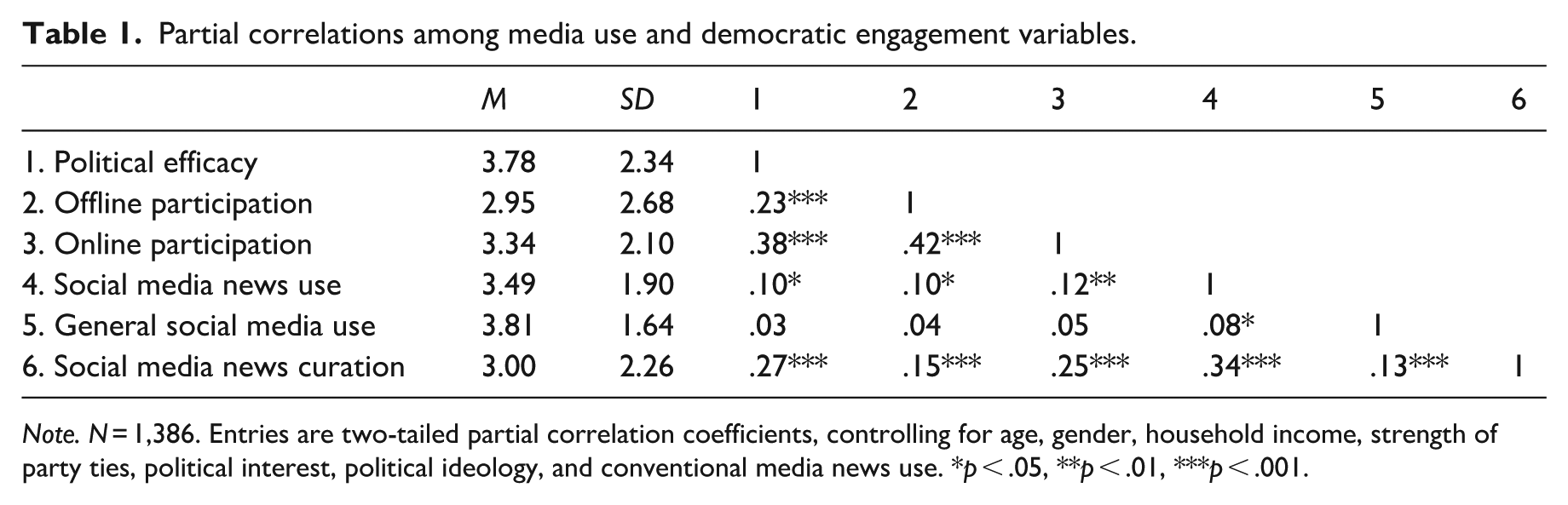
Note. N = 1,386. Entries are two-tailed partial correlation coefficients, controlling for age, gender, household income, strength of party ties, political interest, political ideology, and conventional media news use. *p < .05, **p < .01, ***p < .001.
Control variables
To gauge general social media use, participants were queried with the question: “How much time do you typically spend on social media a day?” Respondents provided their answers on a 7-point scale, ranging from less than 30 minutes to more than 3 hours (M = 3.81, SD = 1.64, median = more than 1 hour and up to one and a half hours).
Respondents were asked to report how many days in the past week they engaged with five distinct types of traditional media: (a) network television news, (b) local television news, (c) printed newspapers, (d) radio news, and (e) web-only news sites. Their responses spanned from 0 to 7 days per week, and these values were averaged to establish a traditional media use index (α = .83, M = 3.47, SD = 2.06).
Strength of party ties was evaluated using a 7-point scale, ranging from very weak to very strong (M = 4.28, SD = 2.50). Both local and national political interest were measured on a 7-point scale, with 1 indicating not interested at all and 7 representing very interested. The responses were averaged to construct a political interest index (KR−20 = .63, M = 3.65, SD = 2.39).
Political ideology was assessed on a 5-point scale, with 1 indicating very liberal and 5 representing very conservative. The responses were grouped into three categories to establish a political ideology index: 1 for moderate, 2 for liberal or conservative, and 3 for very liberal or very conservative (M = 1.45, SD = .92).
The analysis incorporated several sociodemographic variables, including gender, age, and annual family income. Participants reported their gender (52.8% females) and their age as of their last birthday (M = 22.60, SD = 2.04). Annual family household income for 2016 was chosen from a 9-point scale ranging from 1 (less than $20,000) to 9 (more than $100,000) (median = $40,000 ~ $49,999).
Data analysis
To examine the hypotheses, this study conducted a series of hierarchical ordinary least squares (OLS) regressions, where the independent variables were introduced into the model in sequential blocks. These measures were introduced in a specific order: sociodemographics, political attributes, media consumption, social media news curation, and the interaction terms involving news curation and political interest. To mitigate potential issues linked to multicollinearity in the moderation analysis (H4), the means were centered before being utilized to create the interaction terms (Jaccard et al., 1990).
To test the hypothesis that news curation mediates the relationship between social media news use and political outcomes (H3a and H3b), we conducted two mediation analyses using Hayes’ Process Macro (Model 4), with social media news use as the independent variable, news curation as the mediator, and each of the following as dependent variables: political efficacy and political participation. To test the mediating role of internal political efficacy between news curation and political participation, we also used Hayes’ Process Macro (Model 4).
Results
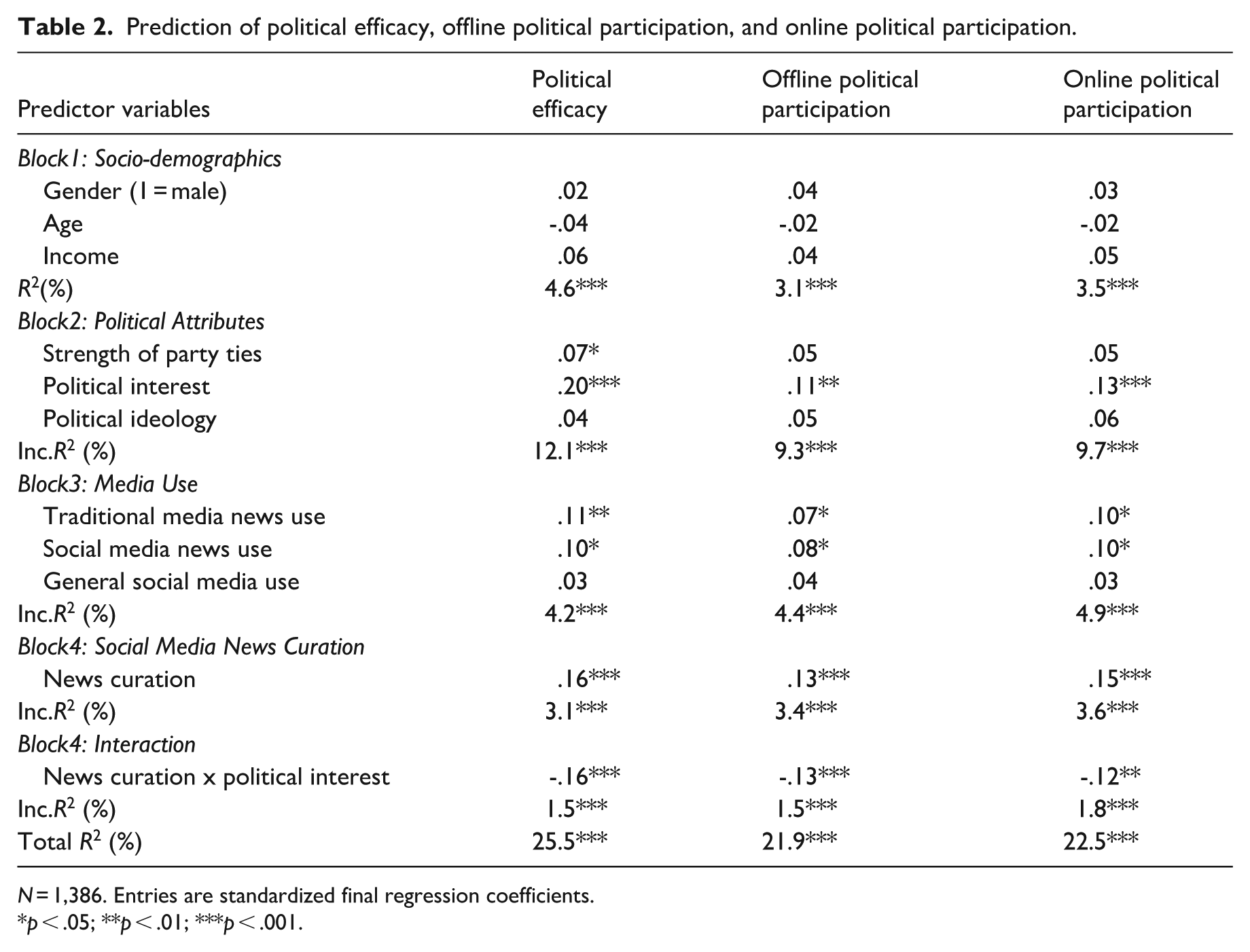
H1 posits that there is a positive correlation between news curation and political efficacy. This hypothesis receives support, as it is evident that respondents who engage more actively in news curation via social media tend to experience a heightened sense of political efficacy (β = 0.16, p < .001) (Table 2).
Prediction of political efficacy, offline political participation, and online political participation.
N = 1,386. Entries are standardized final regression coefficients.
p < .05; **p < .01; ***p < .001.
H2 anticipates a positive relationship between news curation on social media and political participation. H2 receives support as news curation on social media demonstrates a positive association with both offline (β = 0.13, p < .001) and online political participation (β = 0.15, p < .001). This indicates that engaging in news curation on social media contributes to various forms of political participation (household income for 2016 was chosen from (Table 2).
H3a and H3b postulate that news curation serves as a mediator in the relationship between social media news use and political efficacy and participation. The indirect effect of social media news use on political efficacy through news curation was significant, β = 0.16, with a 95% bootstrapped confidence interval [0.00, 0.18], p < .001. This finding suggests that news curation partially mediates the relationship between social media news use and political efficacy, supporting H3a.
The indirect effect of social media news use on offline political participation through news curation was significant, β = 0.08, with a 95% bootstrapped confidence interval [0.01, 0.07], p < .05. The indirect effect of social media news use on online political participation through news curation was significant, β = 0.09, with a 95% bootstrapped confidence interval [0.02, 0.10], p < .05. These results indicate that news curation mediates the relationship between social media news use and political participation, aligning with H3b.
The indirect effect of social media news curation on offline political participation through internal political efficacy was significant, β = 0.13, with a 95% bootstrapped confidence interval [0.04, 0.22], p < .01. The indirect effect of social media news curation on online political participation through internal political efficacy was also significant, β = 0.16, with a 95% bootstrapped confidence interval [0.11, 0.34], p < .001. These results indicate that internal political efficacy mediates the relationship between social media news curation and political participation, aligning with H3c.
H4 predicts that political interest functions as a moderator in the relationship between news curation and democratic attributes, such as political efficacy and online and offline political participation. The interaction between political interest and social media news curation has a notable effect on political efficacy (β = –0.16, p < .001), offline political participation (β = –0.13, p < .001), and online political participation (β = –0.12, p < .01). These findings indicate that social media news curation plays a more substantial role in motivating individuals with lower levels of political interest to engage in the political process compared with those with stronger political interests (Table 2).
Discussion
In today’s social media landscape, there is a fertile opportunity for citizens to voice their political views and actively participate in democratic processes. This study expands upon existing literature on social media’s role in news consumption by focusing on news curation as a distinctive mode of using social media and delving into its influence on democratic engagement. News curation accentuates the reworking and reinterpretation of published information, going beyond mere reporting of current events, and as such, it requires more active and motivated involvement than traditional news exposure or news attention (Park & Kaye, 2018). The findings of this study underscore the importance of news curation as an influential mechanism in the political process, particularly for young adults’ engagement through social media.
The finding of the positive association between news curation and political efficacy aligns with findings regarding news use through traditional media (e.g., Gil de Zúñiga et al., 2012; McKinney & Chattopadhyay, 2007). Curatorial actions, like commenting on political news or restructuring various political news stories, entail mental engagement with relevant news, and as a result promote political efficacy. In addition, social media’s highly interactive nature, combined with its simplicity for organizing and connecting similar topics, can enhance users’ political competence as they express themselves. This study also finds a strong positive association between news curation and political participation. Unlike earlier work that emphasizes the role of news exposure or news attention (e.g., Strömbäck & Shehata, 2010), our findings highlight curation as a unique form of engagement that encourages users to reframe, reinterpret, and share news in ways that deepen their political efficacy and participation. It appears that this is because news curation relates to physical and behavioral involvement in news-related activities beyond mere mental motivation (Seitzinger, 2014). It is a goal-oriented and engaging action, distinct from general news browsing on social media. Therefore, the act of news curation offers more opportunities for political engagement than simply reading news on social media.
This research’s significant discovery beyond Park and Kaye (2018) includes the mediating role of news curation. The mediation analysis shows that news curation acts as a dynamic process through which individuals engage with and internalize political information acquired from social media. The indirect connections through news curation indicate that passive social media news consumers can become active news curators (Mihailidis & Viotty, 2017; Vraga & Tully, 2015) who evaluate, comment on news, and share their curated content. This transition can occur easily since social media allow users to conveniently engage in responding to, commenting on, and aggregating news (Kietzmann et al., 2011). With the development of interactive features on social media, it is expected that news curation actions will grow, benefiting the development of democratic attitudes and behaviors among social media users. While social media news curation may not drastically transform existing patterns of political participation, it can facilitate the creation of new pathways for engagement. Thus, this mediation process, facilitated by social media news curation, establishes a crucial link between the social media sphere and the cultivation of political engagement.
Another notable finding of this study is that the relationship between social media news curation and political participation become stronger among those with lower political interests than those highly interested in politics (H4). The implication of this finding is that news curation can serve as a low-barrier entry into political engagement for individuals with low political interest. For individuals with limited interest in politics, the act of summarizing news articles, commenting on news posts, or engaging in discussions on political topics may serve as a means of exploration and learning (Thorson, 2020). In other words, news curation can provide an accessible means for those on the periphery of political life to gradually increase their involvement in politics. Particularly, young adults with lower levels of political interest, traditionally considered less likely to engage in political activities, are shown to be more influenced by news curation. This demographic, often seen as disengaged from traditional political mechanisms, may find social media platforms and news curation practices as convenient entry points into the political arena.
While the hypotheses proposed in the study are supported by the data, there remains a need for further elucidation regarding why news curation might be more significant for individuals with lower levels of political interest. One possible explanation for this phenomenon could be related to the concept of a ceiling effect among those who already possess a high level of political interest (Gil de Zúñiga et al., 2012). It is conceivable that individuals who are already deeply interested in politics may engage in news curation activities as part of their routine involvement in political discourse and activities. In contrast, those with lower levels of political interest may find news curation on social media to be a gateway to increasing their engagement with political issues.
The focus on young adults aged 18–25 is another key strength of this study, recognizing the significance of this age group as first-time voters and participants in political processes. The findings suggest that social media, through news curation, can play a pivotal role in cultivating political engagement among a demographic that may not have had prior interest in politics. The findings underscore the importance of news curation on social media as a key driver of young adults’ engagement in politics. By actively curating and sharing political content on social media platforms, individuals not only enhance their own political efficacy and participation but also contribute to a more informed and politically active society. This has broader implications for democracy, as engaging young adults in political processes early on may contribute to the development of informed and active citizens.
Overall, the findings of this study have far-reaching implications for our understanding of the intricate relationship between social media, news curation, and political engagement among young adults. The initial concern regarding the decline in traditional political activities and disinterest in news media among this demographic has been addressed by uncovering the transformative role of social media, particularly through the lens of news curation. Our findings shed light on the nuanced roles of social media news curation in the democratic process.
We also would like to point out several practical implications of this study. Given the influence of news curation on political participation, news organizations could leverage curatorial practices by providing tools that facilitate responsible sharing and contextualization of content. For instance, embedding guidance on how to interpret and share news responsibly could enhance users’ news literacy, encouraging them to engage in informed curation practices that resist misinformation (Tandoc et al., 2018). In addition, educators and policymakers focused on digital literacy could use our findings to develop curricula that emphasize the importance of news curation as a pathway to political engagement. Educators might promote curation as a civic skill that not only fosters news literacy but also builds confidence in political discourse. Such initiatives could prove particularly effective among young adults, who, as shown in this study, can benefit from curation as a means of cultivating political efficacy and engagement.
Limitations and future research
The research is geographically confined to South Korea, limiting its generalizability to other cultural contexts. In addition, the cross-sectional nature of the data restricts the establishment of causal relationships. However, our findings open avenues for future research, urging scholars to explore similar dynamics in diverse cultural contexts and employ longitudinal designs to enhance our understanding of the causal relationships uncovered in this study.
While this study demonstrates the potential of news curation on social media to enhance democratic citizenship, it is important not to overly extrapolate the implications of news curation. In the context of political efficacy, offline and online political participation as the outcome measures, the political attributes category makes the most substantial contribution to the explained variance. Although the additional R-squares introduced by the social media news curation component are statistically significant for all three outcome variables, the magnitude of change is relatively modest: political efficacy (3.1%), offline political participation (3.4%), and online political participation (3.6%). These results suggest that social media news curation contributes to citizen engagement to a limited degree. Future research could further explore news curation by encompassing other forms of news-related activities on social media.
Footnotes

Funding
The author received no financial support for the research, authorship, and/or publication of this article.
Declaration of conflicting interests
The author declared no potential conflicts of interest with respect to the research, authorship, and/or publication of this article.