




Abstract
How is journalism practiced in the social media era? What are the values and significance of journalistic professionalism in the changed situation? This article addresses these issues through a case study. It takes The Paper, an online news outlet in Shanghai, as a case and analyzes its coverage of the capsizing accident of the cruise, The Oriental Star, on Yangtze River in June 2015. This case shows that news production in the social media era is taking the form of dynamic interactions that involve both professional journalists and the public; media organizations are no longer the primary authoritative interpreter of news events; the values and significance of news are constantly reconstructed with public’s participation; the accelerated pace of news production and circulation subverts the institutionalized news production procedures and routines; and there is an intense tension between journalists who value professional control and the general public who cherish instant participation. Drawing inspiration from Bauman’s work, the authors strive to not only characterize the changes in journalism as “liquid journalism” but also explore the contemporary significance of the ideas and discursive practices of journalistic professionalism.
More than 10 years ago, Lu and Pan (2002) examined the dynamics of articulation between discursive practices of journalism and news media reforms in China. Pulling together empirical materials from extensive fieldwork, they demonstrated that, even though journalistic professionalism only appeared as highly situated fragments of ideas and expressions, the discourse was opening some ideational space for the reforms to advance. Today, journalistic professionalism and its embodied practices are facing renewed challenges from both within and beyond the trade.
To discuss journalistic professionalism and its relevance today, we must first address this issue: What are the social implications of the emerging forms of communication brought about by new technologies and media convergence? Or, what are the unique challenges to journalism in the midst of such changes? To Mark Poster (2001), digital technologies have brought new forms of communication that are unprecedented; the discontinuity from the pre-digital era may be imagined as analogous to the shift from a hydroelectric plant to the Internet. To Henry Jenkins (2006), the matter is media convergence, which “is more than simply a technological shift.” Rather, it “alters the relationship between existing technologies, industries, markets, genres, and audiences” and “involves both a change in the way media is produced and a change in the way media is consumed” (pp. 15–16). Advancing a similar line of arguments, Jensen (2010) gives a more emphasis on role switching in networked communication by saying that digital media are making “information accessible to people, and people accessible to information providers.” Furthermore, he argues, networked media allow a critical mass of people to become senders—to both raise and answer questions, one-on-one and collectively, synchronously as well as asynchronously, … On the Internet, social actors themselves constitute open-ended sources of information, or dynamic databases of sorts. (pp. 50–51)
This body of the literature calls for attention to the fact that new technologies have been reshaping journalism. They are incubating challenges to the established practices in the news industry as well the core principles of journalistic professionalism which are based upon the normative principles of liberal democracy and sociological principles of division of labor; they have also ignited much discussion of the “crisis of journalism” (Carlson, 2011; Li, 2015; Zelizer, 2015). From another vantage point, Alexander, Breese, and Luengo (2016) state, “the Internet has exerted its force not only as technology but also as narrative, as a culture structure inspiring faith as an ‘agent of change’.” It is “liberating us from the stifling effect of an anti-democratic, professional elite” (p. 5). In such a media environment, some have argued, “random acts of journalism” or “participatory journalism” become prevalent; to practice these acts, “(A)ll you need is a computer, an Internet connection, and an ability to perform some of the tricks of the trade” (Lasica, 2003, p. 73). Emerging from such changes, as Bruns (2011) argues, is a new model, the one that “may be better described as collaborative news curation by user communities” (p. 121).
This article presents a case study on how these changes in news making may have posed challenges to newsvalue judgments and news production practices in journalism. The case is the coverage of the accident of the Oriental Star cruise capsizing on Yangtze River by The Paper, an online-only news outlet in Shanghai. 1 The accident, the ensuing search and rescue efforts, and the eventual identification of 442 deaths captivated the whole country for more than 2 weeks. The Paper’s coverage unfolded in real-time interactions between professional news making by its editorial staff and the “random acts of journalism” by members of the public. It highlighted the characteristics of “collaborative news curation” as a new model of news production: de-linking the process of news production from organizational and bureaucratic structures, opening it to dynamic and individualized acts of the online public and constantly reshaping the news contents that were never stabilized into a “final” text. In addition, The Paper’s coverage did not grow out of a fermenting process; rather, it burst in an explosion that juxtaposed the unfolding events with the internal organizational tensions. With journalists and members of online publics all participating in the reproduction, re-interpretation, and re-dissemination as active nodes of a network, new materials and frames of reference were being brought out, which shaped rapidly changing public discussions. Included in the process were strong criticisms of The Paper for its original reporting by members of the public and some of its own reporters, leading to the biggest crisis that the outlet faced since its launch. One of its reporters even thought that it would have “a huge irreparable negative consequence” (Interview #1).
This case thus provides a unique site for us to examine the ongoing changes in news production related to its placement in a media convergence environment. Using this analysis, we may explore and reflect on the characteristics and significance of journalistic professionalism.
Challenges to journalistic professionalism
To Schudson (1995), reporting as an occupation is an invention of the nineteenth century, a result of and a contributor to a democratic market society and an urban commercial consciousness. But it has evolved a life of its own and a unique self-consciousness. (p. 94)
Arguably, at the core of this unique self-consciousness is journalistic professionalism, which is a foundation of modern journalism. It stipulates expectations of the necessary knowledge and training, and provides foundations for rules and procedures of doing the job, the criteria and exemplars of professional excellence, and internal mechanisms of self-regulation and autonomy (Pan & Lu, 2003).
In the research on journalistic professionalism, some have employed quantitative methods to measure journalists’ professional beliefs and social status (e.g. Johnstone, Slawski, & Bowman, 1976; Weaver & Wilhoit, 1984); others have focused on the news-making process and the application of shared how-to as well as normative knowledge in the process (Gans, 1980; Gitlin, 1980; Tuchman, 1978). Whichever approach is adopted, when taking “the frame of journalism as a profession” (Zelizer, 1993), one presumes the relevance of issues such as journalistic group cohesion, professional power, and the cultural resonance in the claims to occupational authority. A key issue is the professional struggle over jurisdiction. Here, the professional field is “as a terrain of competition” where “a primary tactic in the struggle (is) to define ‘who is a journalist’.” This struggle may “simultaneously sharpen and blur the lines between professional ‘insiders’ and paraprofessional ‘outsiders’” (Schudson & Anderson, 2008, pp. 94–95).
In other words, first, as other knowledge producers (Gieryn, 1983), journalists build their professional community by setting up, articulating, and striving toward their occupational goals; they also formulate an occupational ideology to justify the goals and the prescribed procedures to achieve them. Second, the community of journalists is constructed by journalists’ practices, including their discursive practices of boundary work (Gieryn, 1983) and collective interpretations (Zelizer, 1993). It is through the interplay between the “local” and “durable” modes of interpretation that, when in the midst of rapid social changes, journalists are able to (re-)establish their professional authority, (re-)negotiate their tradition, form collective memories, share interpretations that transcend the present moment, and write histories of their trade (Zelizer, 1993).
Constructing professional authority involves building a connection between a profession and their work and implementing professional jurisdiction in specific work activities (Abbott, 1988). In other words, struggle over the journalistic jurisdiction means more than conflicts in the “interpretative” or “rhetorical” domains; it requires inscribing conceptions and definitions into practices of work routines. It involves contentions between professional and non-professional lay publics, as well as that among professions differentiated by the system of division of labor. In the workflow and the “assembly line” of news production, points of contention may be at the moments of making a newsvalue judgment, in the routines or activities to deal with the pressure of deadline, in activities to forge and use source–journalist relationships, and in the reactions or anticipated reactions from audiences.
In sum, journalistic professionalism and its discursive practices change together with the development of the journalism as a trade, which involves journalism adapting to tensions and contentions in changing societies and revealing interpretive richness in varying historical contexts. But the “crisis discourse” of journalism in the new media era, as Zelizer (2015) points out, seems to suggest that the present crisis is taking journalism off its track, and to some, eroding the very foundation of journalistic professionalism. More than 10 years ago, when the Internet barely entered the so-called Web 2.0 era, some scholars foresaw fundamental changes brought about by this new technology, claiming that it would create a whole new social and cultural condition for news production. News organizations, it was argued, must adopt and adapt to new technologies, develop new organizational structures for media convergence, create new modes of storytelling, and adjust the relationship between news producers and audience (Deuze, 2004).
Clearly, these changes, in either descriptions or advocacy, pose serious challenges to the cornerstones of journalism, including the routine practices that Tuchman (1978), for example, so aptly depicted in her classic study, as well as the professional values and occupational boundaries. They raise a series of questions that call for research exploration. For example, what kinds of public services should journalism provide when digital technologies allow affordance for individual selectivity? Should there be deliberation among peers, as well as with members of the public, on how to share the privilege of professional autonomy allotted to journalists? Should news reports go beyond the principles of balance and objectivity, and be more inclusive, subjective, and reflective of multiple perspectives? (Deuze, 2005). “(I)n an era of cell phone, camera phone, and blog, jurisdictional questions will be legion,” how should journalistic claims to authority be articulated? (Schudson & Anderson, 2008, p. 98).
This article, by treating the selected case as a “hot moment” (Zelizer, 1993) during the momentous changes, explores how new forms of communication associated with new technologies and media convergence may affect the professional beliefs, boundaries, routines, and jurisdiction of journalism. The empirical materials came from the second author’s 9-month fieldwork at The Paper and in-depth interviews conducted in this period. In addition, both authors followed the whole process of the accident as a news event, conducted a number of formal and informal in-depth interviews while the event was unfolding, and collected the related materials, including news articles, blog posts, and comments on two key social media platforms, Weibo and WeChat. 2 The Appendix lists the 10 interviewees whom we interviewed formally in connection to the case. All the interviewees consented to the authors to use their responses and comments for this research but only pseudo-names are used to maintain their anonymity.
Covering the Oriental Star accident
The case started on 2 June 2015. At 3:09 a.m., The Paper released a report. It was the breaking news about a cruise which had capsized on the Yangtze River: A cruise named Oriental Star encountered a suddenly formed tornado in the evening of June 1st and capsized in the Damazhou Waterway in Jianli County of Jingzhou, Hubei Province. There are 458 people on board, including 406 domestic tourists, 5 members of the travel agency staff, and 47 crewmembers. Due to strong storm in the area, search-and-rescue efforts are facing tremendous difficulty. Casualties are unknown at the present moment.
Following this initial item, The Paper started an extensive ongoing coverage. It provided detailed obtainable information on the passengers, gathered images of the scene from various media outlets, including a simulation of the capsizing provided by CCTV, the state-owned national TV network. It also used data-based graphics to show the process that had led to the accident and its aftermath events, and discussed issues such as early warning mechanisms on natural disasters, rescue strategies, and cruise operation on the Yangtze River. On 2 June, it released an HTML5 video with this text: An unexpected disaster has put more than four hundred lives in danger; the whole country is worried … We pray for everybody on that ship, may you return safely.
In the midst of intensive wall-to-wall coverage, in the early morning of 4 June, The Paper reported that, Guan Dong, a diver from the Wuhan-based Naval University of Engineering, saved a 65-year-old passenger and a 21-year-old crewmember Chen Shuhan. The report described the scene in these eye-witnessed details: Chen Shuhan was too stressed to use the diving gear when he saw Guan Dong. As he was losing oxygen rapidly, Guan Dong took off his own heavy diving gear and put it on Chen. Accompanied by two other divers, Chen was returned to safety successfully at around 15:06. Without his heavy gear, Guan Dong was swept to the deep water by an undercurrent. But he managed to get out. When he surfaced, his eyes were red, and his nose was bleeding.
Later that night, ZT, a reporter from The Paper, released a picture on his WeChat Moments. It was a close-up shot of a diver in full diving gear. He was clearly exhausted but his eyes were wide open and gazed into distance with determination. In the text accompanying the image, ZT commented, it was this picture that “rescued us from the brink of despair over and over again.”
The next day, this picture became the boot screen of The Paper’s APP mobile application client (see Figure 1), with the text at the lower half: “Thank you for swimming through the Water of Grief countless times.”
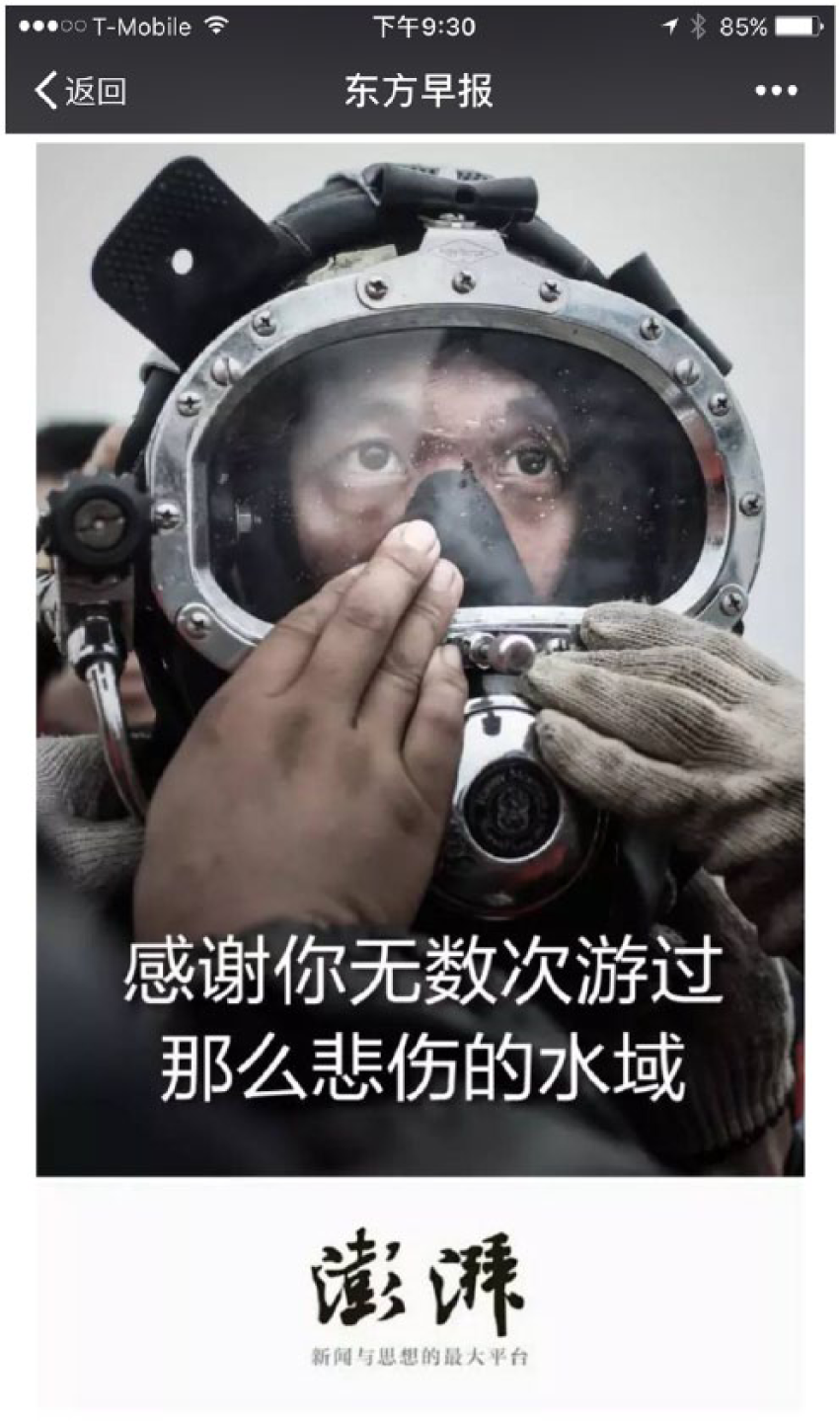
The boot screen of The Paper’s APP client, “The Water of Grief.”
On the same day, a by-lined article with the same title (referred to thereafter as “The Water of Grief”) was posted by The Paper’s WeChat official account. It took the form of a “reporter’s note,” saying that the Oriental Star had capsized in “this water of grief”; “everybody has to place their hope on the divers”; and “we may never know the divers’ names, but I remember every moment they have touched my heart.”
This post was forwarded by numerous people and got many “likes” on WeChat Moments. The Newrank, a renowned social media assessment company, reported on 6 June that the post, accompanied by the picture, had “caused a sensation on WeChat Moments.” It was ranked the first in The Newrank’s ranking list with more than 240,000 views and 5280 likes. Another new media assessment service provider, The Indexmedia, released the data it had gathered by noon on 6 June. It showed that this post had had “more than 100,000 views and 4784 likes.” The Paper’s offline partner, the Oriental Morning Post, also posted the article through its WeChat official account, and by 6 June, it had received 11,278 views and 179 likes. By that time, 72 hours after the accident, while the capsized Oriental Star had finally been righted, most of the passengers and crewmembers had not been located.
Our interviews revealed the process that had led to the release of “The Water of Grief” post. A mid-level manager (Interview #1) informed us that the release of the boot screen was decided on after a discussion among the leadership via WeChat. There were objections right from the beginning. He was strongly against using the image because in his view, the face of the diver in full diving gear was too sensational, and the headline such as “Thank you for swimming through the ‘Water of Grief’ countless times” and “Click like to the rescuers” deviated from factual reporting. Others disagreed. Another interviewee, also a mid-level manager, thought that there would not be any survivor had there not been efforts of the rescue workers. They should be praised for their heroism (Interview #2). There were also those who disapproved of the idea of “giving a like” on WeChat, saying that it was improper, given that the fate of more than 400 people remained unknown. Finally, the CEO of The Paper, Qiu Bing, decided to release the image and the article without the setting of “giving a like.”
In the aftermath, another mid-level manager (Interview #3) thought that using the image as the boot screen might be a bit too sensational, but given the gravity of the disaster and the uncertainty at the time, the editorial decision was not improper. He cited positive feedback on WeChat Moments as evidence. However, online objections soon emerged in the midst of the sharp contrast between sensational media reports and the thickening pessimistic mood as the window for finding survivors was closing rapidly. One article posted by an account named The Sharp Tongue started its rapid dissemination. It was entitled, “Ten Disgusting Headlines on the Oriental Star Accident.” Among those identified include The Paper’s “The Water of Grief.” The author commented, “Sincere emotion is only a little step away from sensationalism. The most important thing right now is that the ship and the truth are still under the water. It’s too early to say thank you.” 3
More official accounts on WeChat’s public platform voiced their criticisms. In the evening of 5 June, a very popular official account Wang Qiangqiang released a post with the headline “Thank you for wiping the hopelessly dirty floor countless times”:
4
The Water of Grief” from The Paper is really touching indeed. “We may never know the divers’ names, but I remember every moment they have touched my heart.” But, do you know the names of all the victims? Do you remember the tear that their families shed? There is no accountability, no questioning, and nobody forced to resign. All we can have are eulogies, admiration, touching moments, and tender feelings. Why do all these sentimental pieces only make me feel so cold? … I still remember that a few years ago, journalists were discussing how to report disasters and victims to minimize additional potential harms to the families. Now, the practice is to report only the state-orchestrated magnificent rescue operations and artificially manufactured warm and fuzzy atmosphere. Where are the journalistic professional ethics? The Paper touted itself to be the biggest online platform of news and opinions, but now it shows some tendency to become the biggest online platform to cleanse news and opinions.
Within minutes, the post went viral. In less than an hour, it was removed by the online censor. But it soon re-surfaced via another official account on the public platform. The removing and re-surfacing went on and on. Some journalists also started to criticize The Paper’s coverage of the accident. One WeChat post said, Thank you for having tried to wipe clean such a dirty floor. I know that your fate is not in your own control. They want to control everything, entrap the truth as well as the desire for truth, and let free only power.
However, such criticisms failed to get The Paper’s attention. In the evening of 5 June, the WeChat official account of The Paper published an article under the byline of “Accident Report Team of The Paper.” It gathered several rescue scenes, pointed out that the rescue had been following the principle of “the supreme priority of saving life,” and praised the search and rescue personnel’s tireless efforts. It used an online comment as the title: “My child, don’t cry. I’m back in mother’s embrace of the Yangtze River.” This line was from a poem written in the voice of a victim of the accident, a passenger on the capsized cruise, a member of a group of senior-citizen tourists. This poem depicted an elderly expressing her regret for not having been able to bid goodbye to her child, comforting her child by saying that the waves of Yangtze River was “gentle” and asking the child to “take good care of your child and spend more time with your loved one” (see Figure 2).
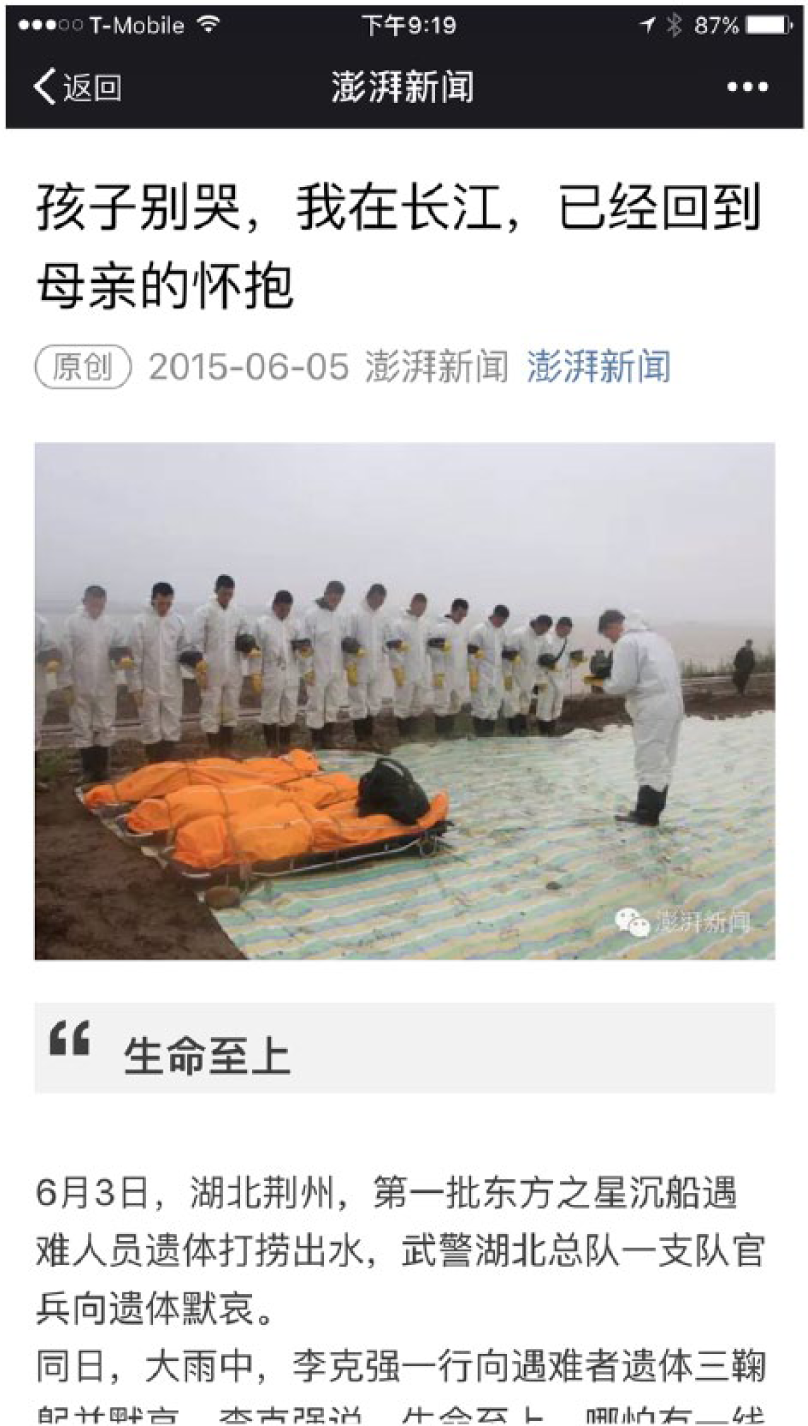
The Paper’s report “Back in Mother’s Embrace” on 5 June.
By 7 June, this report had received more than 100,000 page views and 1094 “likes.” However, different from “The Water of Grief” article, which started with positive feedback, this report faced harsh criticism from netizens immediately. In one of the earlier forwards of this post, the person commented, “What a screwed-up world this is!” Soon after that, a journalist also forwarded the article with a comment “The headline is stupid. It might be out of good intention, but it’s just not the right way to comfort others.”
The netizens’ antipathy toward this article soon grew into general criticisms of The Paper’s coverage as a whole. At 8:31 a.m. on 6 June on Weibo, an account identified as Professor Wu Fei at the College of Media and International Culture at Zhejiang University released a post saying, I was asked if the language in these reports was from someone who had been trained in journalism schools, or unique to certain media outlets or individuals, or something welcomed by readers. My answer was “I don’t know.” But I do know one thing: The news app of The Paper will not be in my mobile phone anymore.
This post was forwarded 466 times and received 150 comments and 245 “likes” by 10 June. The view critical of The Paper’s sensationalist coverage of the accident was widely shared among social media users. One user said, “Expressing grief is necessary, but this hypocritical way of expressing grief is disgusting. It is not based on patriotism. It shows utter disrespect for the deceased.” Another said, “I once thought The Paper was a news outlet with some integrity. After reading these articles, which are more disgusting than some Party mouthpiece newspapers, I can only say ‘Shit!’ and uninstall the app.” 5
Even more intense criticisms came from journalistic peers. A famous journalist, Song Zhibiao, published an article on his own WeChat official account entitled “Qiu Bing and his ‘Mother on the River’.” In a sarcastic and highly personal tone, he criticized The Paper’s CEO Qiu Bing directly: Qiu Bing is not a mindless manufacturer of “touching sentiment.” He first identified some “water of grief” that “people had swam through over and over again,” and then personified and sanctified it. With the eternal political metaphor of “mother,” Qiu re-constructed the logic of death and used the language of “touching” to give the disaster a silver lining. … Qiu Bing and his news outlet are clearly more shrewd operators in manufacturing “being touched.” They not only follow set guidelines, but also innovate: they observe and imitate the real grief of human beings, so as to make bionics products on the assembly line of manufacturing “being touched.” Qiu Bing almost succeeded, as shown by the wide circulation of “The Water of Grief” picture. … He failed eventually, because the guidelines to manufacturing “moving China” met with barriers, as people became aware of the fact that the “being touched” series were equipped with ideological mufflers.
Internally at The Paper, few had anticipated the negative reactions. Many staff members did not even realize that the widely condemned “Back in Mother’s Embrace” headline was from The Paper. When we asked a mid-level staff member about how the headline came about, he was astonished and said that he had noticed many criticisms the night before and some of the criticisms were even from his friends and relatives, but he said that he had never imagined that such headline could have come from his own news organization: “On the way to my office, I was wondering, which f** idiotic news outlet did such a stupid thing?” (Interview #1) He immediately contacted his supervisor, who also expressed disbelief.
In interviews, two mid-level managers (Interviews #1 and #2) tried to account for the “Back in Mother’s Embrace” coverage by pointing to gatekeeping mechanisms of the WeChat official account of The Paper. One of them told us that on the night of 5 June, there were different opinions in the managerial team of the WeChat official account. But it was late at night. The two senior editors in charge of the account received the preview of the article but did not see anything alarming. Another person commented (Interview #4), Actually, on the night when the “Back in Mother’s Embrace” article came out, I expressed my concern to the two editors, but they didn’t think there was anything inappropriate and didn’t do anything. Then, controversy arose and we were in big trouble.
Interview #1 thought the controversy caused by the “Back in Mother’s Embrace” report was “the biggest crisis since The Paper’s launching” and was the result of “self-destructive behavior.”
In the morning of 6 June, journalist ZT posted a screenshot of The Paper’s boot screen via his WeChat Moments. It had no diver, only a headline in white block font against black background saying, “Condolences to all the victims of the Oriental Star cruise accident.” This image showed the basic visual for the HTML5 video to mark the end of the traditional 7-day mourning period. On the first screen, juxtaposed on the black background are four lines of text in white thick block font: At 21:28 pm on June 1st 2015, the Oriental Star cruise capsized. Up to now, 406 have been confirmed dead. 36 remain missing.
Following that image are four photographs: The Oriental Star before capsizing, the grieving families of the victims, the firefighters in mourning, and the sky lantern ignited by families. The last screen was in similar black-and-white layout with the text in white block font saying simply, “Condolences to all the victims of the Oriental Star cruise accident.” Threading the images is the recording of a cello playing John Williams’ Suit from Memoirs of a Geisha for Cello and Orchestra: Syauri’s Theme. Compared with other media outlets that released elaborate HTML5 videos on this day, as Interview #1 pointed out, this media production was too primitive, falling far short of The Paper’s brand name. The second author observed in the editorial office that there was an extended internal discussion on the design of the HTML5 video. But given that there were different opinions on what to do on this occasion and the pressure caused by the two controversial reports was intense, the desire to avoid any further public criticism loomed large and the editors in charge decided hastily to scrap all the poetic captions and go for the minimalist style.
From news production to news curation
From this overview of how The Paper covered the Oriental Star accident, we can see a broad picture of an emerging pattern of news production and its characteristics in China, where the mediated communication environment is increasingly shaped by new technologies.
First, the multi-directional and nonlinear flows of information among various nodes of digital networks are replacing the unidirectional flow of information from professional journalists to their audience. Empowered by social media, members of the public also become actors in news production and enabling agents of communication. As a result, the traditional mode of news production as industrialized undertakings by a group of newsworkers in bureaucratic organizational settings is being replaced by a decentralized one that involves multiple actors in multiple locations. Indeed, such Internet-enabled interactions among various players are increasingly a decisive factor influencing the logic and direction in organized news reporting (Oputu, 2014).
During reporting of the accident, The Paper’s newsroom was attempting to respond to such changes. As one of its reporters (Interview #5) said, the editors using “Back in Mother’s Embrace” title for a WeChat or Weibo post should be “a permissible trial.” Given the vast unknowns and possibilities associated with digital transformations in journalism, there should be incentives for finding our ways in trials and errors. Another mid-level manager countered (Interview #3), one cannot simply say that the two reports were “mistakes” of The Paper. Yes, “The Water of Grief” was a little sensational and “Back in Mother’s Embrace” was controversial, but as of The Newrank’s data showed, both yielded “very high pageviews.” “Doesn’t pageview number mean something?” Another interviewee who is a member of the team operating The Paper’s official WeChat account also said, we are extremely influential in WeChat platform, and very active in Weibo as well. We’ve always maintained high standards of rigor and factuality of news reporting; that means not to be sensational, not to follow what’s popular; rather, we strive toward accurate, speedy, and rational reporting.
In the same interview, he also said, “more views and forwards are indications of professional quality” (Interview #9). These interviews show that these journalists recognized the potential tensions between the sets of criteria, and the much-needed efforts to address the potential tension got overshadowed by the pressure to react quickly on the Internet.
Every player in the accident coverage, including The Paper, the ruling party’s propaganda agencies, social media account owners, and others, is an active node of an information network; they consume as well as generate news contents, constituting a network of instant interactions among multiple modes (Castells, 2000). As illustrated by the two moments discussed in the previous section, the chain reactions in such network could lead to an exponential outburst of information very rapidly, reproducing and amplifying every defect or mistake in a news product. Journalists had to confront the flood of public criticism head on. As one editorial staff member at The Paper said (Interview #1), all of sudden, you find that everyone of your WeChat friends, your colleagues or elders, your buddies or alums of your high school or university, your child’s teachers and the parents of other kids in your child’s class, they are all cursing and re-sending the same post.
That pressure, he said, he could never have expected.
The party’s propaganda and state’s Internet control agencies, together with various interest groups, exert pressure on news organizations from outside. The Internet did not open up more space for hard news or investigative reporting; in some ways, it has made it easier to pressure news organizations. As one reporter from The Paper said, when he was working at the Oriental Morning Post, there were not nearly as many instant reader’ feedback nor were there as many instructions from the party’s propaganda administration. At The Paper, both increased (Interview #1).
Second, social media become open platforms for news practitioners, individuals, or institutions that were the subjects in news stories, and the publics with diverse views to confront one another directly. These direct engagements often shift or even reverse the vantage point of an ongoing news story and its value orientation, questioning or even undermining the professional credential or credibility of a news outlet, making follow-up coverage of an ongoing story extremely difficult. While such direct engagements might have the benefit of opening up public discussions, it also puts tremendous pressure on news organizations. As one employee of The Paper said (Interview #4), I’ve developed a sense from my years of doing news work and this sense has been made more acute in the Internet age: Whenever there is a public event of some significance, netizens need to find a venue to let out some steam. At such a moment, I’d be extra cautious. In the immediate aftermath of the Oriental Star accident, I repeatedly remind members of my team that we need to be extremely careful to avoid any misstep, factual inaccuracy or ethical mishap. Still, The Paper committed a blunder. I just didn’t anticipate the blunder to happen in the reports by the official WeChat and Weibo accounts.
In addition, among media critics are experts and specialists from various sectors; there are also “We Media” operators and Internet celebrities with huge followers. Some of these people are former reputable journalists. They move easily across the boundaries of professional and non-professional news workers, not only blurring the boundaries but also undermining the traditional journalistic authority that is based on establishing and nurturing source–journalist relationships to assure factual accuracy. Traditionally, journalistic excellence and credibility of news outlets are built upon privileges in news sources to help journalists obtain and verify information. This is a critical divide between professional and non-professional newswork. Today, all news sources may face the public directly and Internet users scattered across the globe, especially those users who are supported by a team and technical know-hows, may cross-validate information. In brief, news organizations may no longer be authoritative interpreters of news events, and news is now (re)constructed collectively with broad public participation.
Third, mobile social media have not only made the dissemination, sharing, and discussion of news at a much faster pace and a much broader scope, but they have also brought changes to the workflow of news production and the language of newspaper layout. Facing the rapid circulation of massive amounts of information enabled by new network technologies, the traditional newswork routines such as mentoring and apprenticeship, assignments structured by news beats, bureaucratic gatekeeping processes, and peer evaluation of each other’s craftsmanship become increasingly untenable. As a result, many venues that journalists used to rely on to express their professional authority and maintain their professional jurisdiction are fading away, being dissolved, or marginalized. Some online models of newsmaking such as Vice News could even be designed as deliberate subversions of traditional journalism (Lu & Zeng, 2015).
Reflecting this general trend, several interviewees from The Paper commented that, in the social media era, information flow has been quickened significantly. So does news production. Otherwise, news consumers will “vote with their feet.” Two separate interviewees told us independently (Interviews #6 and #7) that the front-page headline must change in every 3 hours; at the same time, a huge amount of information must be made available via original reporting and aggregating from multiple sources. This was unthinkable in the past when the front-page headline was the all-night work of the night-shift senior editor of the newsroom and the Chief Editor. A deputy director of a department of The Paper told us, The Paper has completed its transformation from its print past of the Oriental Morning Post. But many of our colleagues have stayed behind in their mentality of newsmaking. Sometimes I urge them not to copyedit their piece endlessly. The reason is simple: While we have the affordance of revising and editing a piece endlessly with digital tools, your piece gets buried rapidly by wave after wave of new pieces in a continuous flow. What’s the point? (Interview #8)
In other words, the routines of newswork dominant in the industrial age of newspaper printing are being overturned by the new model. The Paper publishes its news on its website and mobile app, as well as its official Weibo and WeChat official account. One news staff member (Interview #9) told us, on each weekday, two people run the Weibo account, one for each of the two shifts; one or two people run the WeChat account. At weekend, we have one person to operate each everyday. Usually, the person in charge can make a decision; during particularly sensitive period or on a likely sensitive topic, approval from the head of the department will be sought. …
As to the number of Weibo posts, “it varies, depending on situations; more break news, more posts; usually, one post every 40 to 60 minutes.” As for WeChat, due to the design feature of the platform, “As all other accounts on the public platform, The Paper can only release one item per day with several pieces of articles together.”
Such rhythm and the corresponding gatekeeping procedures have made journalists always in a rush. The accelerated pace of news production has not only made news “decay” rapidly in value but also increased the workload of the journalists considerably. A former employee of The Paper said (Interview #10) that one should not view online news as being made via copy and paste. As a matter of fact, it will take a large portion of a journalist’ working hours simply to refresh webpages. After getting a lead, the journalist has to develop a story very quickly while verifying all factual details. This is high intensity work. On the Internet, with multiple actors floating around, any defect could be detected immediately; and these actors could out of their respective interests put pressure on a news organization for such defect.
The case analyzed in this article is a clear demonstration of the tension between the jurisdictional control by the journalistic professional community, on one hand, and open access and participation, on the other, in the new media era (Lewis, 2012). While the affordance of the practices such as crowdsourcing has unleashed a vast capacity in information production, it has also brought out the potential for the public to engage in in-depth and pointed evaluations of news and journalistic craftsmanship. They often play an active participant role in news production and sharing, subverting the bureaucratic routines and hierarchies in traditional news production. Toward this model of news production, there is a process of forming a “symbiotic relationship” (Palmer, 2013; Wenger, 2014) among news organizations, career journalists, citizen journalists, and active members of the general public.
What is shown by the case of The Paper is a new model of news production that has been called collaborative “news curation” (Bruns, 2011; Rosenbaum, 2013). It refers to the idea that collecting, aggregating, arranging, and exhibiting information have become key activities of and skills needed in newsmaking. It represents a distinct model of information handling compared with the one captured by the imagery of “gatekeeping” (Bruns, 2011). It contrasts sharply with the professional control (Lewis, 2012) and is setting in motion new modes of news representations and access of the Internet era.
Liquid journalism and re-appraisal of journalistic professionalism
In the world over, journalism is changing and the Internet has brought out activities that are subverting not only the known notions of journalism but also the occupational ideology built upon it. They have problematized the basic issues such as what is news, who reports news and how, and what are the functions of news; they have also tossed the accepted occupational beliefs, work routines, boundaries, and authority of jurisdiction into a sphere of remaking. These changes are unsettling and destabilizing, indicated by the sensational claim that “Editor-in-Chief is dead” in the new media era (Chen, 2014). Facing such a condition, professional journalists and journalism studying scholars must ask themselves some tough questions: Will user-generated content replace the specialized craft of news production? Is journalism as an idea, a craft, and an industry collapsing? If the Internet is popularizing, “the skills of assessing, crafting, editing, and disseminating news, turning them into everyone’s basic skills of free expression” (Chen, 2014, p. 206), does it mean that the journalistic professional community is to be dissolved, or that it will be compelled to share the newsmaking field with other social and cultural collectives? If so, who will take on the social responsibilities of the traditional journalism and how?
These questions point to challenges facing not only journalism but also our understanding of news as a social category in our society (Zelizer, 2015). To better appreciate the potentials embodied in these challenges, we may appropriate the notion of “melting the solids” from Bauman’s (2000) exposition of “liquid modernity.” While he is talking about long-term and macroscopic historical movements, his points that changes comprise the process of “liquefaction,” namely, softening and melting the known, stabilized, and rigid codes, patterns, and configurations, or things that may be “fetters and manacles” (p. 5), for individual emancipation, and that such a process is one of liberation for us to reflect on or rethink the “old concepts” that have shaped our self-narrative, are very useful for us to think about the present state of journalism.
Following Bauman, we may think of liquidity as a permanent feature of journalism that once escaped our analytical attention, and probably more fruitfully, as the present state of journalism that is defined by continuously emerging opportunities for innovations. We may use “liquid journalism” to characterize this state. Integrating the observations from our case study with a growing body of literature on changing journalism inspired by Bauman’s idea (e.g. Hua & Tsang, 2011; Jaakkola, Hellman, Koljonen, & Väliverronen, 2015; Rublescki & Silva, 2012; Widholm, 2016), we may describe “liquid journalism” in the following senses.
The first feature of “liquid journalism” is the liquid identity of journalists. Scholars have noted that with new media technologies, citizens can scan all kinds of information sources for topics that matter to them (Deuze, 2008). Both the “monitorial citizen” model (Schudson, 1999) and the model of an engaged, cosmopolitan citizenry (Beck, 2000) expect and value such citizenship competence. As a result, a defining feature of the emerging digital culture is that media users or consumers of news are also producers of public information. Using Bauman’s lingo, the identity and role of journalists are no longer stable; it is open, flexible, and constantly switching across situations. For example, in a study of news coverage of Hurricane Katrina, Robinson (2009) observed that journalists assumed the roles of hero, witness, and watchdog in order to assert their authority to tell the story. Online, citizen journalists had the opportunity to rewrite that story and recast both journalists and themselves in the narrative. From the case of The Paper’s coverage of the Oriental Star accident, we also saw the multiple roles that journalists played and how the role switching between professional journalists and netizens was an integral part of the unfolding of the news event. Such flexibility in the multiplicity of roles has been made particularly noticeable with the speed of information flow, the ease of switching among sites for information sharing (e.g. among different WeChat groups), and correspondingly, the high frequency of switching between different roles (e.g. information producer, disseminator, and consumer) and sites.
The second feature of liquid journalism is the liquid professional community in journalism. Today, professional journalists and members of the public no longer have clearly drawn stable boundaries; rather, they transgress the leaky divide in both directions. The collaborative news curation between career and citizen journalists and the diffused mode of information control may be reshaping the institutionalized power structure of traditional journalism. Although the case in Robinson’s (2009) study is very different from the one reported in this article, she also observed, as we do, that news production is an open field that is populated by journalists, their sources, as well as individual citizens and representatives of citizen groups. In another study, Robinson and DeShano (2011) reported that while bloggers and career journalists from local media formed two differential groups, they developed shared beliefs that transcend the boundaries separating them through online sharing of information. They shared the beliefs in socially responsible missions, access to information, and informal notions of professionalism. In essence, we see mutual influences of the two groups in reconfiguring the goal of newsmaking, criteria of practices, and the occupational ideology of journalism.
Viewed more broadly, the notion of liquid journalism means that journalism is in the midst, as well as a part of what Bauman (2005) calls “liquid modern society.” That is, individuals change their behaviors faster than their behaviors get solidified into habits and routines. In general terms, the liquid modern life does not maintain its shape and keep itself in the same orbit for a long period of time. Specific to journalism, liquid life prompts journalists to behave in the way they do, otherwise they are kicked out, refused to print or fired, because they do not fit. On the other hand, by playing this game, journalism reinforces this liquid modern way of life. (Deuze, 2007, p. 673)
In the latter sense and taking a rosier view of citizenship as part of the liquid modern life, Deuze (2008) declares, such a liquid journalism truly works in the service of the network society, deeply respects the rights and privileges of each and every consumer-citizen to be a maker and user of his own news, and enthusiastically embraces its role as, … an amplifier of the conversation society has with itself. (p. 848)
Taking a different approach, we may start with this premise: With the proliferation of digital technologies, new forms of communication are emerging. Correspondingly, both citizens and journalists are reshaping their respective roles. Against this backdrop, we should expect changed “expectations for journalists, understandings of information authority, and levels of productive reciprocity and contiguity of content” (Robinson, 2009, p. 810); we should also expect the emergence of adaptive efforts on the part of journalists in an age when anyone can know and anyone can disseminate information.
Historically speaking, the notion of journalists as professionals is highly ambiguous (Hallin, 2000). Journalism, as an occupation intricately articulated with each specific political system and the corresponding ideology, does not conform to the same model of professionalism (Pan & Lu, 2003). Articulating journalistic professionalism in China has been an integral part of the reforms that started in the late 1970s. It played an emancipatory role in the press reforms, in which journalists devised innovative actions to reconfigure the rigid party propaganda system (Pan, 1997). As the veteran journalist Lu Yuegang observed perceptively, the emergence of journalistic professionalism in contemporary China has been part of the large project of reshaping the discourses on public life during the reforms; it has been part of the journalist community trying to redeem itself by appealing to rationality and populism. This is quite different from the developing of professionalism as part of the progressive movement in the United States (Hallin, 2000; Schudson, 1978). But we see a shared appeal to public interests, albeit articulated in very different ways. Looking forward, in both the United States and China, journalistic professionalism as a discourse must be open and dynamic; it is not, despite the historical coincidence in the US context, tied to print media or any particular media form. It needs to be a discursive resource from which journalists draw inspiration on how to accomplish their roles in society, their professional community, and the articulation of this community with society at large.
The case analyzed in this article shows that with social media platforms and public participation in newsmaking, journalism is changing; in collaborative news curation, each individual, journalist or citizen, is a node of the network of dynamic (re)configuration, impacting one another, reshaping or even shattering any existing form or template that structures information gathering, presentation, and delivery. This dynamic also has its constructive aspect, namely, it is a system of discursive practices to continuously articulate the ideas of journalistic professionalism and the corresponding practices in changed and changing historical situations. As long as the basic ideas, such as factuality, public service, and common empirical basis to wage political contention and conduct public life, continue to inject life to such a dynamic and inspire people to participate in information production and dissemination, journalistic professionalism, as a constellation of ideas and discursive practices, will remain a valuable resource for social progress and have general theoretical relevance to research on journalism.
Footnotes
Appendix
Information of key interviews
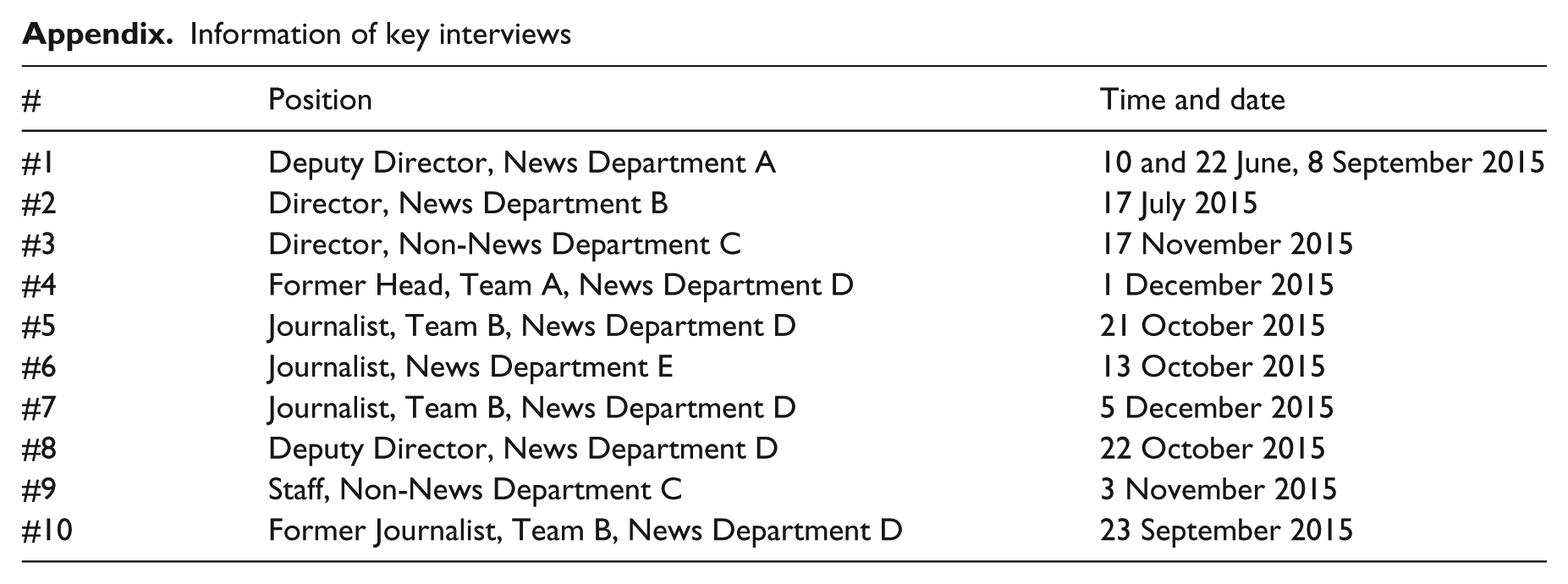
| # | Position | Time and date |
|---|---|---|
| #1 | Deputy Director, News Department A | 10 and 22 June, 8 September 2015 |
| #2 | Director, News Department B | 17 July 2015 |
| #3 | Director, Non-News Department C | 17 November 2015 |
| #4 | Former Head, Team A, News Department D | 1 December 2015 |
| #5 | Journalist, Team B, News Department D | 21 October 2015 |
| #6 | Journalist, News Department E | 13 October 2015 |
| #7 | Journalist, Team B, News Department D | 5 December 2015 |
| #8 | Deputy Director, News Department D | 22 October 2015 |
| #9 | Staff, Non-News Department C | 3 November 2015 |
| #10 | Former Journalist, Team B, News Department D | 23 September 2015 |
Acknowledgements
Translated by the authors from the Chinese version originally published in Journalism and Communication (Xinwen yu Chuanbo Yanjiu), 2016, No. 7, pp. 24–46. The authors wish to thank Professor Zhongdang Pan for his comments on an earlier version of this article and his contribution on the English translation and also Professor Yusi Liu, Professor Min Zhao, Dr. Cecilia Te Hu, and Mr. Xing Ge for their contribution to the English translation of this article.