




Abstract
In this article, we test the relationships between Twitter and Facebook use on mobile phones and political conversation with offline and online political participation, as well as online expressive communication. Our findings show that using Twitter on mobile phones is associated with a higher likelihood for both online and offline political participation, as well as online expressive communication. Using Facebook is associated with a higher likelihood for online expressive communication only. The key contribution of this article is to show empirical differences between the relationships of social media and social networking on mobile devices with political participation and online expressive communication. Public social media apps, such as Twitter, bring mobile communication back into the public realm of a (albeit diffused) broadcast-like channel. Mobile Twitter adds to the affordances of mobility, networked connectivity, and the publicness of social media.
In Latin America and the Caribbean, less than half, 46.7% of the region’s population has used the Internet at least once per year (Internet.org, 2015). In terms of overall volume, the majority of mobile telephony takes place in developing countries (International Telecommunication Union (ITU), 2013). At the same time, 2 billion people globally have the Internet access through a smartphone, with projected growth to 4 billion by the end of the decade (The Economist, 2015). Along with expanding access, the telecom industry has invested heavily in infrastructure and reducing the cost of mobile data significantly in recent years (The Economist, 2015). These trends make it critical to study mobile technology in developing nations, such as Colombia in the Andean region of South America, which we examine in this study. Colombia is ideal for a case study of the early adoption of smartphones and relationships with forms of political participation and expressive communication. Of the 26 nations in Latin American and the Caribbean, Colombia ranks third (behind Brazil and Mexico) in terms of smartphone adoption and second only to Mexico in terms of mobile Internet connectivity (eMarketer, 2015).
Donner (2008) notes that, a wider dialogue about the adoption of mobile communication technology in developing countries contributes to a more holistic cross-cultural understanding of mobile device use. Regardless of platform, frequency of social media and networking application use continues to grow quickly, providing different ways for people around the world to engage in social and political activities that matter to them (Nielsen & NM Incite, 2012). In this study, we investigate how frequency of using Twitter and Facebook on mobile phones is associated with political participation and online expressive communication in Colombia. Our aim is to address the gap in theoretical development on mobile communication outside of the United States.
Individuals are spending more time with social media and social networking using mobile apps on smartphones than ever before. The social networking platform Facebook has become a mobile media platform in its own right, as a form of locative media and a “trans-mobile” space (Goggin, 2014; Lambert, 2013). As of 2012, when the data for this study were collected, more than 488 million of Facebook’s monthly users accessed the site through mobile devices, over half of the total monthly active users worldwide at that time (Protalinski, 2012). In the case of Twitter, more than 79% of the platform’s 320 million monthly active users are outside of the United States and 80% of its total users are active from mobile devices (Twitter, Inc., 2016).
Early mobile communication research focused in three areas: the impact of mobile phones, mobile phone usage, and social relations between mobile phone users (Donner, 2008). More recent scholarship highlights the necessity to place mobile communication within its broader social contexts. Building on work by Campbell and Kwak (2011b) addressing network characteristics, mobile communication, and offline political participation, we explore relationships between forms of strong and weak tie political talk, frequency of mobile Twitter and Facebook with offline and online political participation, as well as online expressive communication. Using a representative sample of urban adults in Colombia, this research contributes to a greater cross-cultural understanding of the early impacts of the adoption of smartphones and expanding availability of mobile Internet access in a non-US context. We contribute to a growing body of literature on smartphone use in countries in which broadband access is only now increasing rapidly, as well as to scholarship on the different affordances of Twitter and Facebook, in their mobile app forms, to political participation and online expressive communication.
Mobile social media and networking
Along with the global adoption of mobile phones, mobile-enabled communication practices are increasingly integrated into daily life, with impacts at macro and micro scales (Ling & Horst, 2011). Individuals all over the world are increasingly going online from mobile devices. Mobile broadband has emerged as the “primary driver,” bringing individuals online (Internet.org, 2015, p. 11). Much of this usage is through forms of social media (Humphreys, 2013, p. 22). The volume of mobile data doubled around the world over the course of 1 year, from 2012 to 2013, with the rate of mobile broadband subscriptions growing at approximately 45% per year (Ericsson, 2013). By 2015, according to ITU estimates, there were 3.5 billion mobile broadband subscriptions worldwide (ITU, 2015b).
The majority of mobile phone users in Latin America utilize prepaid services, which have been critical to the diffusion of the technology (The World Bank, 2012). In the case of prepaid mobile phone services, users obtain a phone and continually recharge the minute credit on their phones, for example, by purchasing phone cards. Related to this trend, mobile technology use is now surpassing fixed broadband in developing countries. As a result of persisting income inequality, fixed broadband is still out of reach for many in the developing world, including in Colombia, where fixed broadband is 20% more affordable for the country’s top 20% of the population than for the bottom 20% (ITU, 2014). Mobile broadband in developing countries is cheaper than fixed broadband services. Furthermore, globally postpaid mobile broadband is the most affordable type of Internet access, while prepaid computer-based broadband access is the most costly (ITU, 2013).
By 2014, 38% of Colombian households had fixed Internet broadband access, with 52.6% of the country’s population using the Internet (ITU, 2015a). At the same time, according to the ITU, there were 113.1 mobile phone subscriptions per 100 residents in the country (ITU, 2015a). Wireless mobile broadband access has been growing, reaching 45.1 mobile broadband subscriptions per 100 residents in 2014 (ITU, 2015a).
Compared to the traditional fixed Internet-based social web, “mobile social media,” including both networking (e.g. Facebook) and media (e.g. Twitter) functions, have been loosely conceptualized (Humphreys, 2013). Humphreys (2013) addresses the challenges of drawing clear boundaries for mobile social media due to the rapid advancement of mobile technology and the integration of different social media functionalities into mobile devices. Mobile social media in early days were mainly focused on location-based services, what scholars have termed “locative media” (Lambert, 2013; Licoppe, 2013). Some well-known examples are Dodgeball, Foursquare, and Yelp. 1 The purpose of these location-based mobile services is to assist individuals to find necessary resources near their geographical locations. These days, the boundaries of computer-mediated communication have blurred and include diverse mobile forms of cross-platform applications such as Facebook, Twitter and, YouTube.
Thus, while widespread in practice, mobile social media and networking platforms are relatively new concepts, such as the mobile technical hardware and software platforms that necessitate it. Humphreys (2013) defines the concept of “mobile social media” as “software, applications, or services accessed through mobile devices that allow users to connect with other people and to share information, news, and content” (p. 21). However, as Murthy (2012) writes, scholars need to distinguish between social networking applications, such as Facebook, and social media ones, such as Twitter, whose open publicness, enable “user-generated news” and afford the potential for social connections with individuals who are not known outside the digital realm (i.e. Twitter followers). In fact, Murthy (2012) suggests that Twitter and other types of microblogging represent a “demotic turn” in which “ordinary people are able to break news, produce media content, or voice their opinions publicly” through the event-driven medium (p. 1064). On the other hand, Facebook users generally set their profiles to varying degrees of private and user connections are bidirectional (boyd & Ellison, 2008).
In contrast to Facebook’s focus on connections with those known outside the digital realm, Twitter is a social media platform, which allows users to post short microblog posts of up to 140 characters. Murthy (2012) defines “microblogging” as having three dimensions: (1) profiles are public from which users broadcast messages that are both concise and public, (2) messages are aggregated in a public format, and (3) users are able to subscribe (in the case of Twitter to “follow”) the posts of others but short of “blocking” an undesired follower, a user cannot control who subscribes to their posts (p. 1061). The key aspects of this conceptualization are the broadcast nature of the medium combined with the brevity of posts, both of which afford the potential within a mobile media context to be used as a tool for political participation (see Tufekci & Wilson, 2012). It should further be noted that an important component of Twitter posts is that they are indexed and searchable through the use of hashtags, which are marked with hash symbol “#.”
Most of the time, in the context of developing nations, it is cheaper and more convenient for individuals to use mobile phones than fixed broadband to interact and send messages to one another (Donner & Gitau, 2009). Thus, we address the conceptual gap in literature on varying forms of social applications by focusing on mobile social media as conceptually distinct from social networking. Given the different levels of publicness of Twitter as a form of mobile social media 2 and Facebook as a form of mobile social networking in this research, we explore potential for differences between the two platforms. We will now overview recent literature on political talk, tie strength, social media, and political participation, which we extend theoretically into the realm of mobile communication.
Political talk, tie strength, and political participation
In this section, we review literature on two aspects of political talk: (1) intensity or frequency of conversation and (2) variance of political talk with an individual’s strong and weak social ties. We then consider how online and offline political participation, as well as online expressive communication, may be related to political talk with strong and weak ties. In foundational literature, Granovetter (1973) writes that the strength of a social tie is a “combination of the amount of time, the emotional intensity, the intimacy (mutual confiding), and the reciprocal services which characterize the tie” (p. 1361). According to Granovetter (1983), stronger ties indicate more homogenous individuals, whereas weak ties are more heterogeneous and thus, more open to transmitting information through and between social networks. Weak ties are perceived as bridges between social networks by diffusing information more widely and strengthen social cohesion at the macro social scale. Past research on political talk with strong ties shows a related increase in various measures of political participation (Eveland & Hively, 2009; Pan, Shen, Paek, & Sun, 2006). For example, within the context of the 2000 US presidential election, Pan et al.(2006) found that “mobilizing political talk,” as form of deliberation, was positively related to civic and campaign participation (p. 315). In contrast, Mutz (2002, 2006) found that while talk with likeminded others tends to increase one’s own participation, heterogeneous discussion networks tend to decrease political participation.
Beyond providing additional channels for interpersonal communication and affecting the strength of social ties, the utilization of mobile phones may also facilitate contacts with those who hold views that differ from one’s own, or heterogeneity of discussion. Along the same lines, Mutz and Mondak (2006) have shown that talking about politics with close family and friends may be consequentially different from talking with co-workers because co-workers tend to be more different from us than our closer contacts. In research into the relationships between online and offline network size, as well as strong and weak tie discussion, in the United States, Gil de Zúñiga and Valenzuela (2011) find positive relationships for all variables. Their findings show the strongest association is between weak tie talk and civic engagement.
Thus, based on previous literature we ask the following research questions about the relationship between both forms of political talk with offline political participation, online political participation, and online expressive communication:
RQ1. How is strong tie political talk related to political participation and online expressive communication?
RQ2. How is weak tie political talk related to political participation and online expressive communication?
Mobile communication, social media, and political participation
Social interactions and communications within strong and weak tie networks can be greatly facilitated via mobile communication. A study by Campbell and Kwak (2011a) showed network size and heterogeneity moderate the relationship between “mobile-based discourse” and offline political participation. Another study by Kim & Hopke (2011) provided empirical evidence to support this argument, indicating that the use of mobile phone had strong, positive main effects on facilitating offline communication with weak ties, communication with strong ties, and political media use among adults in Colombia. The study also confirmed that low-income individuals were more willing to communicate frequently with others with different opinions than people whose socioeconomic status was high. As for political participation, the more low-income people in Colombia used mobile phones for political mobilization, the more they watched various media to follow up with political information (Kim & Hopke, 2011).
Research has shown that mobile phone-enabled political discourse is positively related to offline political participation (Campbell & Kwak, 2011b). Additionally, past research on use of mobile communication technologies for social mobilization has indicated a positive relationship to political participation (e.g. Rheingold, 2008; Rojas & Puig-i-Abril, 2009). At the same time, much has been made of the use of social media and social networking technologies in the 2011 Arab Spring revolutions in the Middle East and other recent political mobilizations. In the case of Egypt, Tufekci and Wilson (2012) find that those who use social media (conceptualized to include both Twitter and Facebook) were more likely to have attended the first day of demonstrations. In research on the relationship between social media use and social protest within the context of widespread demonstrations in Chile about educational policy, the environment, and post-2010 earthquake reconstruction, Valenzuela (2013) finds a positive relationship between social media use and various forms of protest behavior, including attending demonstrations and meeting with authorities. He theorizes that social media, not accounting for channel, amplifies traditional protest activities. Furthermore, research by Gil de Zúñiga, Molyneux, and Zheng (2014) indicate an indirect but positive relationship between using social media for social purposes and political participation. Their results also showed using social media for news had a direct effect on offline political participation (Gil de Zúñiga et al., 2014). In the context of China, Wei (2014) finds that political talk, smartphone use, and mobile microblogging were positively associated with online civic engagement.
As discussed above, there has been little research on how these dynamics are manifested with mobile Twitter and Facebook, and possible empirical differences between them, while mobile broadband is increasingly accessible globally. In the case of Colombia, basic access to mobile technology has diffused widely, while mobile broadband services are emerging as important mechanisms for the Internet access. However, questions remain as to how social media and networking platforms are put into practice in the context of mobile communication and the potential affordances for traditional offline, as well as online political participation. Thus, we predict the following:
Hypothesis 1a. Frequency of mobile Twitter use will be positively related to offline and online political participation.
Hypothesis 1b. Frequency of mobile Facebook use will be positively related to offline and online political participation.
Mobile social connectivity: new avenues for expressive communication
Research on mobile technology has shown that access to mobile phones is associated with the strengthening of social ties (Ito, 2005; Ling, 2008; Ling & Yttri, 2002). Initial research in this area showed that mobile phones were primarily used to maintain pre-existing relationships, thus reinforcing interpersonal communication with one’s strong ties. For example, in her research on the use of mobile communication technologies in Japan, Matsuda (2005) finds that users engage in selective sociality with a small circle of individuals with whom they have strong ties. Past literature on mobile communication suggests a range of social affordances, including increased cohesion with an individual’s strong ties, or family and friends (Ling, 2008). Licoppe (2004) argues that mobile phones enable “connected” management of one’s social relationships (p. 135).
Mobile phones are part of the new media shift toward “networked individualism” and increased connectedness (Rainie & Wellman, 2012). Within a structure of networked individualism, each person can be switching between ties and their social networks (Wellman, 2002). That is, place is removed from social ties with “social closeness” no longer necessitating “physical closeness” (Wellman, 2002, p. 4). Pearce (2011, 2013) argues that mobile devices could help reduce the digital divide in developing countries. Mobile social media offer “the means of media production, distribution, and consumption on the same device” (Humphreys, 2013, p. 23). These types of social affordances could be related to more expressive forms of mobile-based communication. Thus, we predict the following:
Hypothesis 2a. Frequency of mobile Twitter use will be positively related to online expressive communication.
Hypothesis 2b. Frequency of mobile Facebook use will be positively related to online expressive communication.
Study context
Colombia’s political system can be characterized as that of a formal democracy in which regular elections are held. A traditional conservative-liberal party divide has evolved in recent years into a multiparty system with certain parties representing the right (supporting, for example, free trade and a strong military, e.g. Partido de la U, Conservative Party), others representing the political center (which seek social reforms, e.g. Partido Liberal, Partido Verde), and others the left (proposing a wider role for government, protecting Colombian production and land redistribution, e.g. Polo Democratico Alternativo). The press in Colombia tends to be closely tied to big business interests and can be described as a market-based press with a “weak legacy of media pluralism” (Waisbord, 2008, p. 3).
For most of its independent life, Colombia has been a country where violence has played a critical role as a conflict resolution mechanism. A failed peace process with the Fuerzas Armadas Revolucionarias de Colombia (FARC), Colombia’s oldest and most important guerrilla group, influenced the presidential election in 2002. Then, Alvaro Uribe, a right-wing politician who promised that guerrillas would be defeated through the use of force, was elected president (and reelected for a second 4-year term in 2006). While president, Uribe escalated the governmental offensive against the leftist rebels and negotiated a peace process with paramilitary groups, sending some of their members to prison while leading others to reorganize themselves into emerging outlaw groups.
In 2010, Uribe’s former defense minister and Partido de la U candidate, Juan Manuel Santos, was elected president, by defeating Antanas Mockus from the Partido Verde (Green Party). Despite the popularity of the governing party at that time, Partido Verde successfully used new media to mobilize independent voters, becoming a viable candidacy, despite its ultimate loss in the second electoral round. Since elected, Santos has distanced himself from Uribe moving the Partido de la U closer to the center and initiating a peace process with the FARC. Uribe and some members of Partido de la U have left this party to create a new coalition under the name Centro Democratico.
In recent years, Colombian politicians, such as the Partido Verde’s Mockus, have become adept at using new media tools, particularly Twitter, in order to engage in political debates and critique each other, thus making the Colombian twittersphere a place of lively political discourse and therefore an ideal context in which to study the relationships between mobile social media, mobile social networking, political participation, and online expressive communication.
In the case of Colombia, the majority of the population has access to at least basic mobile connectivity, with 89% of adults living in urban areas reporting having access to a mobile phone in 2012. This was an increase of 8% over the 2010 figure of 81% (Rojas & Mazorra, 2011). In terms of usage, while there is overall stability in terms of voice use, we also see important increases in access to information and relational uses including online social networks and microblogging applications (Rojas & Mazorra, 2011). In terms of mobile Internet access, 22.7% of adults living in urban areas reported using the Internet from a mobile phone in 2012, compared to 15% in 2010 (Rojas & Mazorra, 2011). For Twitter, the number of users among the urban adult population in Colombia stands at 11.3%. This compares to 15% of online adults in the United States who reported they used Twitter as of early 2012 (Smith & Brenner, 2012).
As the figures above indicate, the proportion of the Colombian population with mobile Internet access is comparatively low. Yet, given that global trends in mobile telephony reveal the medium as a relatively more affordable means of networked connectivity than fixed broadband service, as well as the emerging nature of mobile social platforms, in this study we examine the divergent relationships of Twitter and Facebook to traditional offline political participation, online political participation, and online expressive communication. The boundaries between activities previously constrained to fixed network connectivity are merging with mobile phone usage in the form of smartphones and other handheld mobile devices. The “always on” nature of mobile connectivity (Turkle, 2012), as discussed above, is bringing the Internet to everyday life around the world, opening new avenues for research in the context of mobile communication practices. Thus, as Ling and Horst (2011) suggest research is needed on these emerging forms of mobile communication within the “broader communicative ecologies” of daily life on a global scale. Developing mobile communication theory from the perspective of the Global South can enrich understanding of mobile practices more generally (Ling & Horst, 2011, p. 372).
Methods
Data
This study relies on national survey data collected from 29 August to 17 September 2012, in 10 cities in Colombia, by the Universities of Wisconsin and Externado de Colombia and Deproyectos Limitada, as part of their biennial study of communication and political attitudes in Colombia. The sample was designed to represent Colombia’s adult urban population; 75% of Colombia’s 46 million inhabitants live in urban areas (DANE, 2012).
Survey respondents were selected using a multi-step stratified random sampling procedure that selected households randomly, based on city size and census data. Once the number of households was allocated for a given city, a number of city blocks were selected randomly according to housing district and strata. Then, individual households were randomly selected within each block. Finally, the study used the “adult in the household who most recently celebrated a birthday” technique to identify an individual respondent at random. Up to three visits were made to each household (if needed) to increase participation in the survey. A local professional polling firm collected the data, and 1031 face-to-face completed responses were obtained for a response rate of 83%. 3 Since our interest is in the relationships between mobile social media and social networking with political participation and online expressive communication, we limited the sample to individuals who reported using the Internet on a mobile phone. The data were filtered by a question that asked whether respondents used a mobile phone to navigate the Internet (n = 223). All subsequent descriptive statistics and analyses are reported for this group. 4
Measures
Independent variables
Our study includes two sets of predictor variables. First for political talk, measures of both strong and weak tie forms of political conversation are included. Second, we include predictor variables to measure frequency of mobile Facebook and Twitter use.
Strong tie political talk
In this study, we include two measures of political talk similar to measures Gil de Zúñiga and Valenzuela (2011) use to measure strong and weak tie discussion about public affairs. The first of these concepts is strong tie political talk. It is measured on a 0- to 6-point scale, with 0 being “Never” and 5 being “Frequently.” Respondents were asked how frequently they talk about politics and comment on the news with (1) their family and (2) their friends (M = 2.72, standard deviation (SD) = 1.40, r = .60).
Weak tie political talk
To measure respondents’ level of political conversation with more diverse network ties (Mutz, 2006), such as within workplaces, the second political talk concept addresses heterogeneous political talk. It is also measured on a 0- to 5-point scale, with 0 being “Never” and 5 being “Frequently.” Respondents were asked how frequently they talk about politics and comment on the news with (1) their neighbors and (2) their co-workers and classmates (M = 2.08, SD = 1.48, r = .38).
Frequency of mobile Facebook use
This concept is measured with a single item, asking respondents how often they review their Facebook or another social networking site on their mobile phone. It is measured with a 6-point scale, with 0 being “Never” and 5 being “Frequently” (M = 3.01, SD = 1.99).
Frequency of mobile Twitter use
Mobile Twitter use is measured with single item, asking participants how often they use Twitter on their mobile phones. It is measured on a 6-point scale, with 0 being “Never” and 5 being “Frequently” (M = 1.51, SD = 2.03).
Dependent variables
This study includes three outcome variables: offline political participation, online political participation, and online expressive communication.
Offline political participation
This concept was measured using a dichotomous scale, with 0 being “No” and 1 being “Yes.” Participants were asked to answer whether or not they engaged in the following political activities during the previous 12 months: (1) attended a political demonstration, (2) attended a public meeting in their city, (3) participated in a local municipal council, (4) signed a petition, (5) worked for a political movement or party, (6) donated money or other objects to a political party or movement, (7) attended a social or political protest, and (8) protested by blocking a street. These eight items were combined using mean values for each individual item into an index for traditional offline political participation on a range between 0 and 1 (M = .12, SD = .21, Kuder-Richardson 20 reliability = .80). The distribution is positively skewed (skewness = 1.93) and is thus also leptokuric, meaning having a highly peaked distribution with a kurtosis score of 3.17 (Hayes, 2005). In order to address the skew in the data, we conducted a square root transformation (Howell, 2007; Tabachnick & Fidell, 2007). After the transformation, the skew decreased to 1.03 and a kurtosis score of −0.31. The square root adjusted offline political participation dependent variable was used in subsequent analyses.
Online political participation
Online political participation was measured using a 6-point scale, with 0 being “Never” and 5 being “Frequently.” Respondents were asked how often they engage in the following political activities on the Internet: (1) make a contribution to a political campaign, (2) volunteer for a social or political campaign, and (3) support political protests, such as sharing information about a political protest online, discussing a political protest in online forums, and so on. These three items were combined using the mean values for each individual item to create an index for online political participation on a range between 0 and 5 (M = .79, SD = 1.31, Cronbach’s α = .88). This variable is also positively skewed (skewness = 1.71) with a kurtosis score of 2.07. In order to address the skew in the data for this variable as well, we conducted a square root transformation. After the transformation, the skew decreased to .97 and a kurtosis score of −0.57. The square root adjusted online political participation dependent variable was used in subsequent analyses.
Online expressive communication
This concept was assessed with a 6-point scale, with 0 being “Never” and 5 being “Frequently.” Participants were asked how often they engage in the following expressive activities online: (1) comment on news and opinion columns that appear in the press online, (2) participate in online discussion forums, (3) contribute content to sites, such as YouTube or Google Video, and (4) maintain their own Web page or blog. The four items were combined using the mean values for each individual item to create an index for online expressive communication on a range between 0 and 5 (M = 1.54, SD = 1.43, Cronbach’s α = .79). This variable has a lower degree of skewness, with a score of .79, and a negative kurtosis score of −.39, meaning the distribution is flatter than a normal distribution (Hayes, 2005). No transformation was necessary for this variable.
Control variables
Given the importance of contextualizing mobile phone use, we control for political interest, overall media consumption, and other demographic factors (Campbell & Kwak, 2011a). Thus, key demographic and general media use variables were also included in the analyses as controls: gender, age, educational level, social stratum, personal ideology, political interest, and attention to news. For gender, the study included 52% males and 48% females (a dummy variable of males coded as 0 and females coded as 1). The average age of respondents was 32.39 years (SD = 11.84). Educational level was measured on an 8-point scale from 1 (“None”) to 8 (“Post-Graduate”) (M = 5.97, SD = 1.24). Social stratum was measured based on respondent’s energy stratum. Residences in Colombia are classified by strata from 1 (“Low”) to 6 (“High”) for the purposes of assigning utility rates, with higher strata having access to more services. Participants were asked to answer, “What is the energy stratum of this residence?” (M = 3.35, SD = 1.14).
Personal ideology was measured using a 10-point scale, with 0 being “Left,” 5 being “Center,” and 10 being “Right” (M = 5.42, SD = 1.68). Political interest was measured on a 6-point scale, with 0 being “None” and 5 being “A lot.” An index for political interest was created using three items, asking respondents’ level of interest in the following: (1) local and regional politics, (2) national politics, and (3) international politics (M = 2.25, SD = 1.59, Cronbach’s α = .93). Attention to news was measured using a series of items asking how much attention respondents pay to the follow types of news: (1) international news, (2) news about public order and internal conflict, (3) national political news, (4) news about their city, and (5) news about corruption (M = 3.49, SD = 1.15, Cronbach’s α = .86).
Statistical analysis
To test our hypotheses, ordinary least squares (OLS) regression models were performed. All the analyses were conducted using SPSS 20.0. In addition, measures of tolerance and variance inflation factor (VIF) were examined to look for potential collinearity issues between the independent variables. Tolerance measures the extent to which how much variance within predictor variables is unique to each variable, where high scores indicate low collinearity (Hayes, 2005). All values were found to be within acceptable ranges.
Results
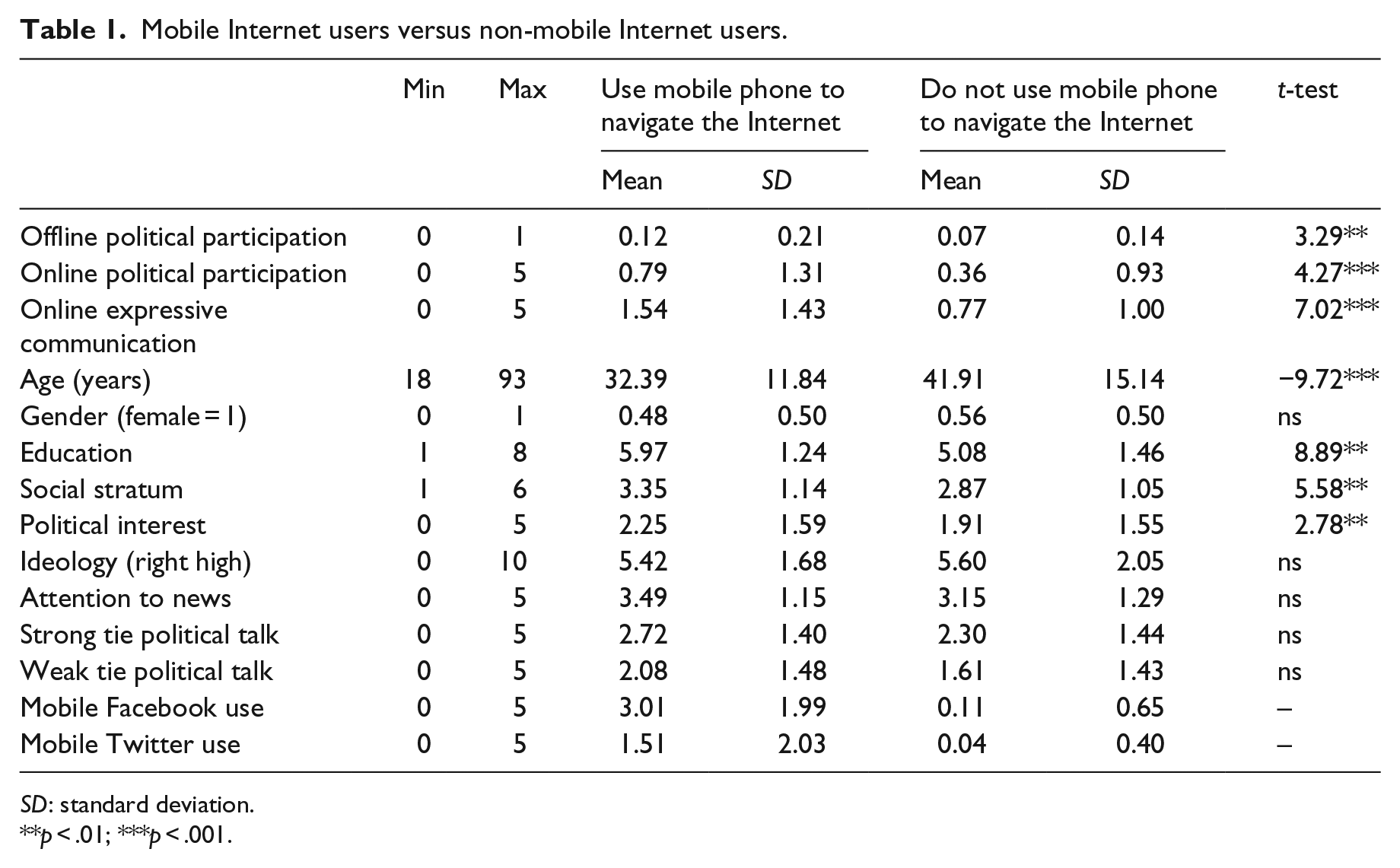
Table 1 shows, compared to other respondents in the study, those who use a mobile phone to navigate the Internet tended to be slightly more participatory both offline (M = 0.12 for respondents who use the Internet on their mobile phone, M = 0.07 for those who do not, t = 3.29, p < .01) and online (M = 0.79 compared to M = 0.36, t = 4.27, p < .001), as well as in respect to online expressive communication (M = 1.54 compared to M = 0.77, t = 7.02, p < .001). In addition, those who use the Internet on their mobile phone tended to be younger (M = 32.39 for respondents who use Internet on their mobile phone, M = 41.91 for those who do not, t = −9.72, p < .001), had a higher level of formal education (M = 5.97 compared to M = 5.08, t = 8.89, p < .01), ranked higher on social stratum (M = 3.35 compared to M = 2.87, t = 5.58, p < .01), and showed slightly higher levels of political interest (M = 2.25 compared to M = 1.91, t = 2.78, p < .01). No significant differences were found between the two groups in ideology, attention to news, and political talk.
Mobile Internet users versus non-mobile Internet users.
SD: standard deviation.
p < .01; ***p < .001.
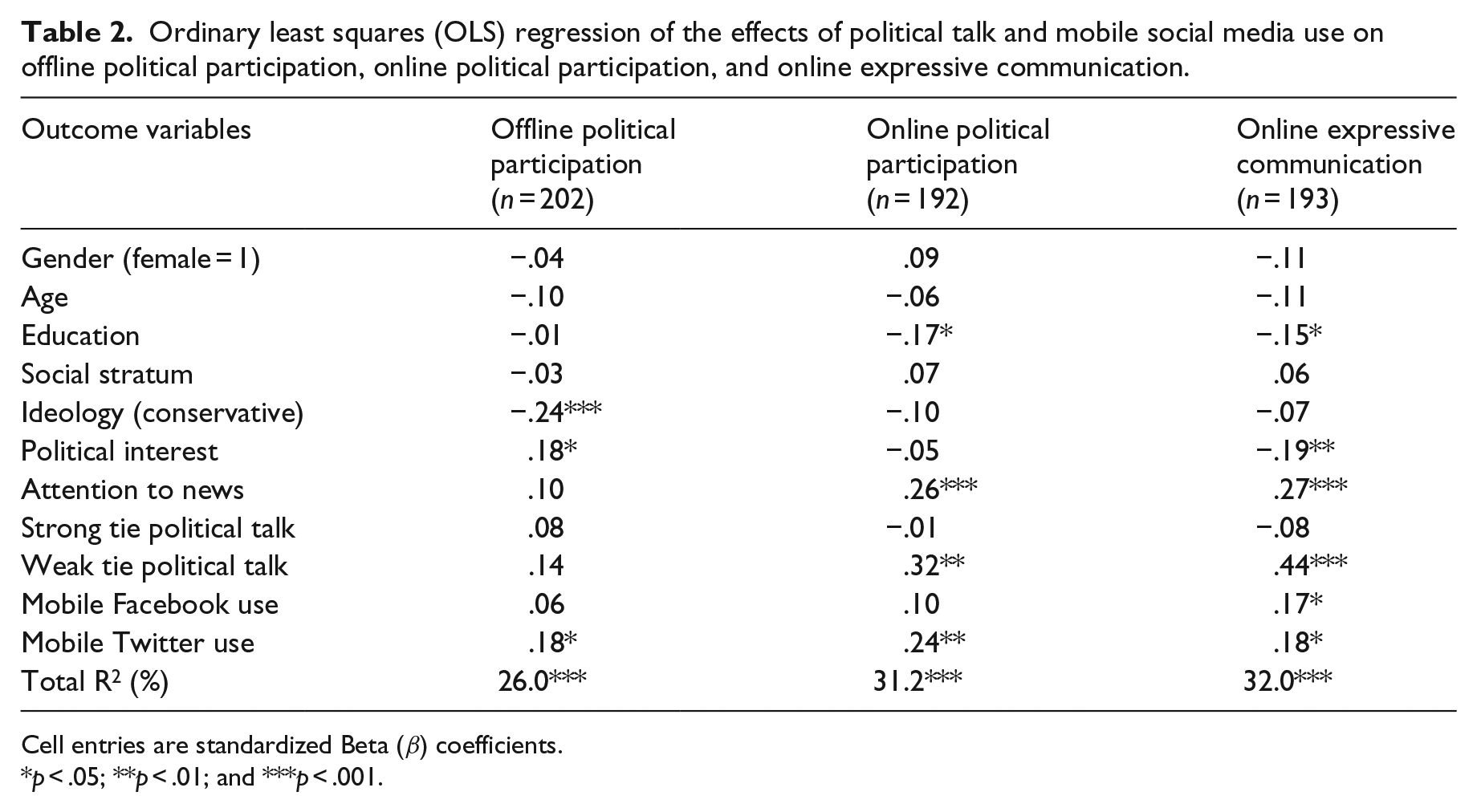
Table 2 shows the results of three OLS regressions examining the relationship between political talk and mobile Twitter and Facebook use with offline political participation, online political participation, and online expressive communication. Our findings show that weak tie political talk with co-workers and neighbors is related to online political participation as well as engaging in online expressive communication activities, while the results for strong tie political talk are not significant on all DVs, offline political participation, online political participation, and online expressive communication. In regard to emerging forms of Internet-based political participation, there was a significant main effect of weak tie political talk on online political participation (β = .32, p < .01). Finally, in terms of political talk, there was a main effect for weak tie political talk on online expressive communication (β = .44, p < .001). Individuals who show high levels of talk with neighbors and co-workers, weaker ties, are more likely to participate in online political activities and online expressive communication.
Ordinary least squares (OLS) regression of the effects of political talk and mobile social media use on offline political participation, online political participation, and online expressive communication.
Cell entries are standardized Beta (β) coefficients.
p < .05; **p < .01; and ***p < .001.
As for using Twitter on a mobile phone, there was a main effect for frequency of mobile Twitter use on all three outcome variables: offline political participation (β = .18, p < .05), online political participation (β = .24, p < .01), and online expressive communication (β = .18, p < .05). In contrast, using Facebook or another social networking site on a mobile phone is not significantly associated with offline nor online political participation. However, our findings show a significant main effect for frequency of mobile Facebook use on the likelihood of engaging in online expressive communicative activities, such as maintaining a blog or posting a video to YouTube (β = .21, p < .05). In other words, using Twitter on mobile phones is associated with a higher likelihood for online and offline political participation, as well as online expressive communication. In contrast, using Facebook or another social networking site on a mobile phone is associated with higher likelihood for online expressive communication only. Thus, hypothesis 1a, as well as hypotheses 2a and hypotheses 2b are supported. Hypothesis 1b is not supported.
Discussion
Our findings show that using Twitter, a form of microblogging, on mobile phones among the urban adult population in Colombia is associated with a higher likelihood for both online and offline forms of political participation, as well as online expressive communication. Using Facebook on the other hand, a form of social networking, on mobile phones is associated with a higher likelihood for online expressive communication only. This study addresses Ling and Horst’s (2011) call to contextualize mobile communication within the media ecologies of daily life (p. 372), as well as Martin’s (2014) one for research into mobile media and political participation. As mobile broadband service becomes more accessible globally, scholarship must attend to the implications for simultaneously networked and mobile communicative practices. Theory must keep pace with types of use, no easy task.
Mobile social media are bringing mobile communication back into the public realm of a (albeit diffused) broadcast-like channel. That coupled with the obvious that the technology affords communication while in movement can serve as a powerful tool for political action, as research on social platforms in contexts of social and political contention suggests (Tufekci & Wilson, 2012; Valenzuela, 2013). Thus, mobile Twitter adds to the affordances of mobility, networked connectivity, and the publicness of social media. It holds the potential to bring mobile phones back into the realm of public (micro) broadcast-oriented media, as opposed to private one-to-one communication technologies (Campbell & Kwak, 2011a).
In contrast, our study suggests that mobile Facebook, with its quasi-public/private nature, diverges from mobile Twitter in its relationship to forms of political participation and is positively related only to online expressive communication activities, such as participating in online discussion forums or having a personal blog. Unlike mobile Facebook, mobile Twitter is specifically designed as a platform to broadcast regular streams of information to audiences beyond an individual’s one-on-one direct social network.
The main limitations of our study are the small portion of the Colombian population that used the Internet on a mobile phone and that used the microblogging platform Twitter at the time the data were collected in 2012. The limited number of participants who used Twitter on a mobile phone resulted in a somewhat skewed measurement for frequency of mobile Twitter use (skewness = .85), generating in a less than optimal measure. Hence, given the emerging nature of mobile Internet adoption in a Colombian context, more research is needed to further examine the affordances of mobility for social networking and social media applications beyond Facebook and Twitter. In addition, research must also be sensitive to socioeconomic differences in access and possible “new” digital divides between those with access to smartphones and those without access to mobile broadband, while being mindful that within the context of developing countries users are often skipping fixed broadband access and using the Internet for the first time on mobile devices (Humphreys, 2013) and the possible theoretical implications of this digital leap (Pearce, 2013).
As smartphones and mobile broadband continue to diffuse, future research should move beyond questions of access and frequency of use to how individuals are employing these platforms for expressive and political, as well as social, purposes. We suggest that mobile social media applications such as Twitter, which we examine in this study, can provide users with different avenues of political participation. Given the differences between individuals who use the Internet on a mobile phone, as compared to those who do not, our results pertain to a relatively more politically active segment of the Colombian population. These findings indicate that using social media on mobile devices widens the participation gap that already exists between those who use mobile broadband and those who do not. In the case of mobile Facebook use, these effects could be limited by the expressive nature of the platform’s dominant usage. In showing empirical differences between mobile social media and mobile social networking, this article supports theorizing of substantive conceptual distinctions between the two types of social platforms.
In conclusion, we theorize a mobile Twitter effect in which those who use Twitter to microblog on a mobile phone are exposed to more real-time political content and current event-driven news via the platform, extending “socially mediated publicness” into the realm of mobile communication (Baym & boyd, 2012). It follows that they may be more likely to engage in forms of online political participation, regardless of their level of political conversation through being drawn into breaking news and events, some of which are political, in real-time as they happen. Mobile phones also enable real-time offline participation, from tweeting pictures from a demonstration to commenting on breaking news. What is unique about Twitter, and by extension, other forms of microblogging via mobile phones, is the public nature of this type of use of what has historically been conceptualized as a private, one-to-one communication medium, the mobile phone.