




Abstract
This study examines how media use for news can relate to expressive and collective participation through the mediating role of political talk and internal and external political efficacy. Based on two cross-sectional analyses and one autoregressive analyses of the data obtained from a two-wave panel survey during the 2012 presidential campaign in South Korea, this study finds that political talk and internal political efficacy mediate the association between news attention and expressive participation, while external political efficacy does not. Political talk and internal political efficacy jointly mediate the impact of news attention on expressive participation. The analysis also reveals that social media news attention and internal political efficacy play a bigger role in connecting news attention and political participation than traditional news attention, external political efficacy, and political talk.
Keywords
The theoretical development of political engagement has been centered on identifying the mediating variables between informational media use and political participation. For example, the cognitive mediation model highlights the role of news elaboration (McLeod, Scheufele, & Moy, 1999), and the communication mediation model (Shah, Cho, Eveland, & Kwak, 2005; Shah et al., 2007) stresses the role of political talk. The O-S-R-O-R (Orientations-Stimulus-Reasoning-Orientations-Response) model posits that the effect of news media use on political engagement is mediated by political reasoning and psychological variables (Cho et al., 2009; Jung, Kim, & Gil de Zúñiga, 2011).
But the nuanced mechanisms underlying the relationship between news use and political engagement still remain under-explored. This study, by focusing on different types of news use and political efficacy, expands the O-S-R-O-R model. This study examines the specific roles of traditional media use for news, social media use for news, political talk, internal and external political efficacy, and expressive and collective participation. Social media are quite different from traditional media in that they have unique affordances that can facilitate a variety of political behaviors. For example, social media can serve as an important platform of social and political information (Barthel, Shearer, Gottfried, & Mitchell, 2015), opinion expression (Gil de Zúñiga, Molyneux, & Zheng, 2014a), and connection with individuals, groups, and institutions that have political influence (Gil de Zúñiga, Copeland, & Bimber, 2014b). Therefore, social media’s political impact should be different from that of traditional news media.
This study also investigates what different roles two theoretical dimensions of political efficacy play in the political engagement process. Prior research focused on either internal political efficacy (e.g., Chan & Guo, 2013) or external political efficacy (e.g., Vitak et al., 2011) or used confounding items to measure political efficacy (e.g., Wang, 2007). While internal political efficacy means the competence of acting effectively in the political realm, external political efficacy refers to the belief that government and politicians are responsive to citizens’ needs and wishes (Ginsberg, 1982). Considering that external efficacy is closely related to political trust (Balch, 1974; Gamson, 1968), its political impact is expected to differ significantly from that of internal political efficacy.
In addition, this study makes a theoretical distinction between expressive and collective participation and incorporates the two modes of participation into a single mediation model. To investigate how news attention influences political talk and internal and external political efficacy, and subsequently results in engagement in expressive and collective participation, this study relies on national data from a two-wave panel survey during the 2012 presidential campaign in South Korea.
Media use and participatory culture in South Korea
From the early 1960 to the early 1990s, the public sphere of South Korea was suffocated by authoritarian regimes. People had to remain muted because the dictatorial regimes prevented people from expressing their voices. On top of that, major media organizations maintained close connections with the political power, failing to function as an open public sphere. Government-controlled network TV stations and conservative newspapers served as “state institutions” (Chang, 2009; Nam, 2006; Park & Jang, 2001).
Since the late 1990s, citizens began to take advantage of new media technologies to produce their own content, discuss public issues, and mobilize other citizens in democratic activities (Chang, 2008; Kim, 2006; Park, 2017). They employed the Internet as a tool to develop alternative journalism and mobilize social movements, challenging the establishment (Joyce, 2007). From around 2005, citizens have started using social media to express their voices. South Korea is one of the most connected nations in the world with high broadband penetration rates (98.5%) 1 and a tech savvy population. Facebook is used by 27.9% (approximately 14 million as of 2016 June) 2 of the population. About 10% of Koreans use Twitter. In today’s Korean politics, social media are widely used by individuals and civic groups to disseminate information, spark up debates, and organize collective actions (Hsu, Park, & Park, 2013; Park, 2016).
Especially, social media have shown their political power in many elections since the late 2000s. For example, during the 2011 Seoul mayoral election, social media users played a crucial role in helping Park Won-soon, a political neophyte, to beat the ruling-party-backed competitor who was a former judge. In this process, ordinary individuals gained confidence in their ability to engage in politics (Park, 2014). Therefore, it is logical to speculate that Korean citizens’ perceived internal political efficacy has increased along with the wide use of social media in the political process.
On the contrary, ordinary individuals’ trust in legacy media such as TV and newspapers is declining drastically every year (Kang, 2005; Kwak, 2012). Koreans’ trust in the government and the political system also has been very low for decades and still remains low (Edelman Trust Barometer, 2016). This is partly because of the bad memory people experienced during the authoritarian era. But more than that, the low level of political trust is related to the increasing tension between citizens and ruling elites because the most recent two governmental administrations have taken various actions to suppress online expression and collective action of citizens (Park, 2016). Therefore, compared with the increasing internal political efficacy, Koreans’ external political efficacy seems to remain low.
Thus far, the mediation models of political communication have been applied mostly to Western countries. This research will contribute to expanding the mediation models by applying the models to the social context of low-trust in traditional media and an explosive use of social media. In addition, this research will advance the O-S-R-O-R model by comparing the roles of internal political efficacy and external political efficacy and will provide some ideas for democratic development.
Mediation models in political communication
The communication mediation model contends that informational media use and political talk largely channel the effects of individual orientations on political learning and participatory behaviors (McLeod et al., 2001; Shah et al., 2007; Sotirovic & McLeod, 2001). The relatively simple models of communication mediation in the 1990s and early 2000s have become more sophisticated by adding information processing via the Internet. The citizen communication model (Shah et al., 2005) asserts that online pathways to participation complement offline pathways of information and conversation. Cho et al. (2009) and Jung et al. (2011) proposed the O-S-R-O-R model, identifying political reasoning and psychological orientations as important mediators between news consumption and political participation.
This study draws on the aforementioned models, but it has a greater focus on political talk and political efficacy because this study aims to pinpoint the mediating roles of those two variables based on the O-S-R-O-R model. Developed from the communication mediation model and the O-S-O-R model (Markus & Zajonc, 1985; McLeod, Kosicki, & McLeod, 1994/2002), the O-S-R-O-R model provides a useful framework that helps explain the pathways in which media use relates to various participatory behaviors. However, the O-S-R-O-R model does not distinguish internal political efficacy from external political efficacy, which are conceptually different between each other. Furthermore, the model does not take into account various modes of participation. With this reasoning in mind, this study incorporates two modes of political efficacy (internal and external) and two categories of political participation (expressive and collective) into a theorized mediation model.
As “the most immediate attitudinal explanation of political action” (Wolfsfeld, 1986, p. 108), political efficacy has two theoretical dimensions: internal and external political efficacy. Internal political efficacy indicates feelings of self-competence to understand and participate effectively in politics. External efficacy refers to the perception of the responsiveness of political officials or government to citizens’ demands and needs (Craig, Niemi, & Silver, 1990; Hoffman & Thomson, 2009; Morrell, 2003).
Participatory democracy theorists (Mason, 1982; Pateman, 1970; Thompson, 1970) regard internal political efficacy as a pivotal booster of political behavior. As one acquires perceptions of self-competence, one is more likely to participate in politics. On the contrary, mobilization of support theorists (Weissberg, 1975; Wright, 1976) contend that political participation is enhanced by “inducing citizens to believe the government is responsive to their own needs and wishes” (Ginsberg, 1982, p. 182). The more the people believe their efforts to influence the government will be rewarded with success (high external efficacy), the more likely they will be to engage in such efforts (Karp & Banducci, 2008; Kriesi, 1995). Although internal political efficacy and external political efficacy are closely related as both refer to perceived capabilities to successfully perform political actions, it is necessary to clarify how each type of political efficacy plays a unique role in the political engagement process.
Political participation has been defined as activity that has the intent of influencing the selection of governmental personnel or government action (Verba & Nie, 1972/1987; Verba, Schlozman, & Brady, 1995). This classic definition is based on the assumption that citizens directly take part in the political decision making (Nagel, 1987). However, today the action repertoire available to citizens is explicitly multidimensional. Particularly, the Internet provides news opportunities for political participation that were not previously available (Oser, Hooghe, & Marien, 2013), such as signing online petitions. Reflecting today’s situation, recent studies have introduced diverse types of political participation: for example, voting/consumer participation/party activity/protest activity/contacting officials (Teorell, Torcal, & Montero, 2007), offline versus online participation (Zheng & Pan, 2016), expressive forms of participation (Pan, Shen, Paek, & Sun, 2006; Polat, 2005), conventional versus unconventional participation (Bourne, 2010), and discursive participation (Cook, Delli Carpini, & Jacobs, 2007).
In expanding the O-S-R-O-R model, this study is concerned mainly with expressive and collective political participation. Expressive participation is a form of participation that entails the public expression of political thoughts (Boyle et al., 2006). Endersby and Towle (2014) regarded political expressive behavior as the public display of opinions or support for a candidate or policy through bumper stickers, yard signs, or t-shirts. The Internet, particularly social media, offers easy and convenient tools for citizens to get involved in expressive forms of political participation, such as e-mail, instant messaging, and discussion boards (Gibson & Cantijoch, 2013). Expressive behaviors engage people in dynamic processes of political involvement (Eveland & Cortese, 2004; Jung et al., 2011). In short, expressive political participation composes an important sub-dimension of political participation. Expressive participation reflects more diverse range of participatory opportunities that are increasingly becoming prevalent due to the spread of social media.
A solitary individual is often powerless to make an impact on society. However, when people band together and exercise a collective action toward a common goal, substantive changes become possible (Chan, 2014). Individuals feel more empowered when they try to influence those in power through various collective actions than when they act alone (Le Bon, 1908). Usually collective participation takes place at a large scale beyond expressive behaviors. Compared with expressive participatory behaviors, collective participatory actions generally require more time, energy, and commitment (Bennett & Segerberg, 2012). Attending a rally, participating in a demonstration or a protest, and joining a civic activist group are instances of collective participation (Bennett, Breunig, & Givens, 2008; Bennett, Foot, & Xenos, 2011).
Direct effects of traditional and social media use
“News is what people talk about, and news makes people talk” (Anderson, Dardenne, & Killenberg, 1994, p. 37). Research consistently reports a positive association between news consumption and political discussion (Kim, Wyatt, & Katz, 1999; Koch, 1994). News use also stimulates individuals’ perception that they are cognizant of political affairs, which encourages internally efficacious feeling about politics (Hoffman & Thomson, 2009; Kenski & Stroud, 2006; McLeod et al., 1999; Semetko & Valkenburg, 1998). Traditional media use also promotes external political efficacy (Newhagen, 1994; Pinkleton, Austin, & Fortman, 1998).
Just like traditional media, social media can provide individuals with information on pertinent political affairs that can engender further political talk. News use on social media can afford greater “expressive potential” among users because they can easily comment on, like, or share news posts they receive for others to see (Gil de Zúñiga et al., 2014a). Given diverse affordances of social media such as accessibility, convenience, and low costs, social media use for news should also lead to individuals’ increased competence about their political action (Gil de Zúñiga et al., 2014a; Kim, Chen, & Gil de Zúñiga, 2013). In other words, social media could enhance internal efficacy by providing useful information to citizens and by making them less embarrassed about their political competence.
Social media use for political information could help the increase of external efficacy because they enable citizens to interact easily with public officials, consequently holding them accountable. But social media are considerably different from traditional media. Social media content often spoofs traditional media tones, points out social and political inconsistencies, and emphasizes issues and events that are largely ignored by the establishment (Atkinson, 2005; Poell & Borra, 2012). This is especially true in South Korea, where many mainstream media outlets align with the ruling groups and citizens are increasingly seeking alternative means of expression through social media (Kim, 2015; Park, 2014). Therefore, it is also possible that exposure to social media content does not necessarily boost external political efficacy:
H1. Both traditional and social media use for news are positively associated with political talk.
H2a. Traditional media use for news is positively associated with both internal and external political efficacy.
H2b. Social media use for news is positively associated with internal political efficacy.
RQ1. Is social media use for news positively or negatively associated with external political efficacy?
Direct effects of political talk and political efficacy
Lin (2006) claimed that “citizens who engage in interpersonal discussion about politics with a great number of fellow citizens are more likely to have confidence in their ability to make sense of and to get involved in the political process” (p. 9). Discussions about political issues help individuals to gain mobilizing information, thereby increasing their willingness to get involved in the political process (Hardy & Scheufele, 2005). Indeed, studies have shown that political discussion is positively related to internal political efficacy (Fishkin & Luskin, 1999; Min, 2007). Political discussion also was found to predict external political efficacy, the belief in the responsiveness of government institutions and politicians because talking about politics often includes information about how to access political structures and the understanding of political structures fosters the feeling of effectiveness in the political realm (Zhou, 2009).
Political talk functions as an antecedent for political engagement (Jankowski & Van Selm, 2000; McLeod et al., 1996). Information sharing among citizens through interpersonal communication sufficiently accounts for political participation (Gil de Zúñiga, Jung, & Valenzuela, 2012; Klofstad, 2007; McLeod et al., 1999). Online political talk also plays a crucial role in encouraging political participation (Shah et al., 2005; Valenzuela, Kim, & Gil de Zúñiga, 2012):
H3. Political talk is positively associated with both internal and external political efficacy.
H4. Political talk is positively associated with both expressive and collective participation.
Individuals with a high level of internal efficacy perceive changes as coming primarily from their own actions (Rotter, 1966). On the contrary, externally efficacious people see changes as coming mainly from the government responsiveness (de Moor, 2016). Therefore, with regard to political activities that require substantial efforts, internal political efficacy is expected to play a better role than external political efficacy. Indeed, studies have shown that internal political efficacy is an important predictor of participation in collective activities such as attending protests (Corcoran, Pettinicchio, & Young, 2011; Klandermans, Van der Toorn, & Van Stekelenburg, 2008; Van Zomeren, Postmes, & Spears, 2008) as well as conventional participation such as voting (Finkel, 1985; Morrell, 2003; Rudolph, Gangl, & Stevens, 2000):
H5. Internal political efficacy is positively associated with both expressive and collective participation.
Citizens who consider government to be responsive will consider participation to be more effective and consequently they will become more likely to participate (Kriesi, 1995). Several studies have documented a positive relationship between feelings of external efficacy and electoral participation, which can be considered the expressive form of participation (Finkel, 1985; Ginsberg, 1982; Pollock, 1983; Van Zomeren et al., 2008).
But with regard to collective political participation, external efficacy may not play a crucial role because external efficacy has been closely linked to feelings of trust in political authorities (Balch, 1974; Rosenblatt, 2015) and generalized support for the political system (Iyengar, 1980). When people have enough trust toward the government or politicians, they do not have to make an additional effort to show their political messages (Johnson & Kaye, 2013; Paige, 1971). According to resource mobilization theory, participation in a social movement is seen as the result of rational decision processes whereby people weigh the costs and benefits of participation (Gamson, Fireman, & Rytina, 1982; Snow, Zurcher, & Ekland-Olson, 1980). Considering the high cost of collective participation and the close connection between external efficacy and political trust, external efficacy might not be enough to motivate people to engage in heavy-commitment-requiring political actions:
H6. External political efficacy is positively associated with expressive participation.
Mediating effects of political talk and political efficacy
Research consistently shows that both offline and online political talk mediate the effects of news media use on participation (Cho et al., 2009; McLeod et al., 1999; Shah et al., 2005; Shah et al., 2007). This is because news provides the necessary context and content of political issues, which facilitates subsequent conversations about political affairs and eventually political talk can spur political engagement. Regarding social media, Gil de Zúñiga et al. (2014a) found a positive relationship between social media use for news and political expression, which in turn influences offline and online participation:
H7. Political talk mediates the effect of news attention on both expressive and collective participation.
Political efficacy is a function of news media use and positively predicts political participation. The sequential order of the mediating process from news use to political engagement through political efficacy has been supported by past studies (e.g., Brunsting & Postmes, 2002; Jung et al., 2011). C. S. Park (2014) found that internal efficacy mediates the impact of news use on offline and online participation. For efficacious people, social media offer several advantages over other media in terms of accessibility, diversity, and breadth of information, which can mobilize political action by stimulating various motivational, cognitive, and affective aspects of internal political efficacy, which in turn can lead to greater participation (Chan, 2014). Based on the literature, this study expects that the impact of news attention leads to expressive participation via the mediating role of internal political efficacy:
H8. Internal political efficacy mediates the relationship between news attention and expressive and collective participation.
However, from the literature, it is not certain whether external political efficacy will mediate the impact of news use on expressive participation because external efficacy concerns mainly what people believe about the government’s responsiveness rather than how much people perceive themselves as highly efficacious to get involved in political matters (Craig, 1979). Also, considering that external political efficacy is expected to have a null or negative association with collective participation as mentioned earlier, this study does not expect external efficacy to play a mediating role between news use and collective participation.
Comparison of relative impacts of major variables
This study also compares the relative impacts of major variables on expressive and collective participation. By doing so, we can have a better understanding about the roles of each component in the political process:
RQ2. Of traditional news attention, social media news attention, political talk, internal political efficacy, and external political efficacy, which variable best explains expressive and collective participation?
Methods
Data collection
This study relied on Web-based survey data of 800 people conducted during the presidential election in South Korea. To assure the representativeness of the sample, data were collected via a stratified quota sampling method. Before doing stratification, this study constructed a sampling frame based on the 2012 voter registration data of the Korea Election Management Commission (2013). This process was done together with a survey research firm, which has the demographic and e-mail information of more than 3 million Korean adults. Out of the frame, a total of 2000 voters were selected using a 4-way cross-classification system (age × gender × education × income). A total of 800 participated in the first survey during 16–30 September 2012 (response rate = 40%). All respondents who completed the first wave were invited to a subsequent survey in December of 2012. A total of 413 participated in the second survey. The panel retention rate was 51.6%. Participants were offered US$5 incentives in each wave.
Measurement
News attention
The following wording was used for attention measures: “For information about the presidential campaign, how much attention have you paid to each of the following media during the past week?” Respondents indicated their level of attention to four types of traditional news sources (network TV, national newspapers, radio, current affairs magazines) and three types of social media (Facebook, Twitter, YouTube) on a 5-point scale (1 = not at all, 5 = very much). Based on the result of scale validation of factor loadings, responses to network TV, national newspapers, and radio were combined into an index of traditional news attention—Wave 1: α = .71, M = 2.30, standard deviation (SD) = 1.05; Wave 2: α = .74, M = 2.34, SD = 1.12. Responses to Facebook, Twitter, and YouTube were averaged to create an index of social media news attention—Wave 1: α = .75, M = 2.63, SD = 1.03; Wave 2: α = .73, M = 2.65, SD = 1.24.
Political participation
Respondents were asked how often during the last month they engaged in the following activities: (1) posted political opinions on public Internet spaces (e.g. blogs, online discussion boards); (2) forwarded a political or election message via e-mail to others except friends, family, and acquaintances; (3) displayed a campaign sticker on cars; (4) wrote a letter or e-mail about the campaign to news media; (5) signed a petition; (6) attended a political meeting; (7) attended a protest for a political cause; (8) recruited people for a political project online; and (9) joined a civic group working for a fair campaign. Responses were coded on a 4-point scale (1 = not at all, 4 = frequently). Based on the result of scale validation of factor loadings, (1), (3), and (4) were summed up to create an index of expressive political participation (Wave 1: α = .83, M = 4.98, SD = .59; Wave 2: α = .79, M = 5.01, SD = 1.20). Items (6), (7), (8), and (9) were summed up to create an index of collective political participation (Wave 1: α = .80, M = 5.28, SD = .81; Wave 2: α = .70, M = 5.48, SD = .98).
Political talk
Respondents were asked how often during the last week they talked about politics or the campaign with family, friends, or acquaintances (1) face to face, (2) over the phone, (3) via e-mail, and (4) via online messenger services. Responses were coded on a 5-point scale ranging from 1 (not at all) to 5 (very much). In each wave, an index was constructed by averaging responses—Wave 1: α = .72, M = 2.36, SD = 1.49; Wave 2: α = .73, M = 2.54, SD = 1.38.
Internal political efficacy
This study tapped three items drawn from ANES (American National Election Studies): (1) I consider myself to be well qualified to participate in politics, (2) I feel that I have a pretty good understanding of the important political issues facing our country, and (3) I think that I am as much as informed about politics and government as most people. Responses were coded on a 5-point agree–disagree scale and averaged to construct an index—Wave 1: α = .71, M = 3.28, SD = .66; Wave 2: α = .75, M = 3.41, SD = .67.
External political efficacy
Three items from ANES were used: (1) I don’t think public officials care much about what people like me think; (2) The government is not concerned about the general public’s interest, and (3) If public officials are not interested in hearing what the people think, there is really no way to make them listen. Responses were coded on a 5-point scale and averaged to create an index—Wave 1: α = .75, M = 2.46, SD = .85; Wave 2: α = .78, M = 2.49, SD = .87.
Control variables
Demographics included gender (Wave 1: male = 51.0%; Wave 2: male = 52.6%), age (Wave 1: M = 39.18, SD = 10.71; Wave 2: M = 38.66, SD = 9.34), education (both Wave 1 and 2 median = some college), and household income (both Wave 1 and 2 median = US$40,000–US$49,999). This study also controls for political orientations, which have been found to relate to political participation. Political interest was assessed on a 5-point scale by asking respondents how much they are interested in (1) local politics and (2) national politics (Wave 1: Spearman-Brown ρ = .65, M = 3.04, SD = 1.03; Wave 2: ρ = .67, M = 3.10, SD = 1.08). Ideological extremity was measured using a 3-point scale (1 = moderate, 2 = liberal or conservative, 3 = very liberal or very conservative; Wave 1: M = 1.53, SD = .65; Wave 2: M = 1.60, SD = .68). For political trust, following three items were assessed on a 5-point agree–disagree scale: (1) I can generally trust public officials who run our government to do what is right, (2) The people in government do not waste the money we pay in taxes, and (3) When the government leaders make statements to the South Korean people on the media, they are usually telling the truth (Wave 1: α = .82, M = 2.13, SD = .73; Wave 2: α = .81, M = 2.07, SD = .71). Political interest, political extremity, and political trust were measured only once in Wave 1 because they are believed to be stable (Cohen, Vigoda, & Samorly, 2001).
Analytic procedure
Partial least squares (PLS) was used to empirically evaluate the theoretical model in this study. PLS can simultaneously test the measurement model (relationships between indicators and their corresponding constructs) and the structural model (relationships between constructs) (Hulland, 1999). Both PLS and covariance-based structural equation modeling (SEM) rely on manifest variables, such as people’s responses on a topic to estimate a given latent variable. However, compared with covariance-based SEMs, PLS provides more accurate coefficient results with smaller sample sizes than covariance-based SEMs (Mayfield & Mayfield, 2012). PLS also can test a complex model that contains multiple independent and dependent variables, providing greater and more nuanced evidence for relationships between variables (Howson & Urbach, 2005). Following such reasoning, this study decided to use the PLS approach because PLS is beneficial in setting up a complex model like the case in this study.
There are two important criteria of the measurement model that must be examined to determine model adequacy in PLS: convergent and discriminant validity (Gefen, Straub, & Boudreau, 2000). Convergent validity is the extent to which a measure correlates positively with alternative measures of the same construct. Convergent validity can be assessed using three criteria—indicator reliability, composite reliability, and average variance extracted (AVE). To meet measure adequacy, the first two metrics should be higher than .70 (Chin, 1998; Lohmöller, 1989) and the AVE score should be greater than .50 on a 0–1 scale (Hair, Sarstedt, Ringle, & Mena, 2012).
To test discriminant validity, item cross-loadings and the Fornell–Larcker criterion must be examined. Conceptually, cross-loadings are similar to factor analysis factor scores. In order to be considered to have appropriate cross-loadings, an item should load at least .707 on the intended construct (Chin, 1998; Lohmöller, 1989). The Fornell–Larcker criterion compares the square root of the AVE values with the latent variable correlations. The square root of each construct’s AVE should be greater than its highest correlation with any other construct (Fornell & Larcker, 1981).
Once model adequacy has been determined, the strengths and relationships between latent variables should be examined via structural model testing. Demographics and political orientation variables were included as control variables in the model testing.
Mediation hypotheses were tested by PLS bootstrapping. PLS uses each bootstrap subsample to estimate the underlying PLS path model. The bootstrap bases are the measurements of each construct. Using the latent variables scores directly for the bootstrap procedure means fixing the bootstraps of the measurement model and therefore not considering their variance. Hence, using PLS bootstrapping is a more conservative test than the fixing of the measurement model in the Hayes Macro (Nitzl, Roldan, & Cepeda, 2016; Sosik, Kahai, & Piovoso, 2009).
Results
Scale validation in the measurement model
In both Wave 1 and Wave 2, all loadings were above .70 for their intended factors and below .30 for other factors, suggesting good indicator reliability. The composite reliabilities of all factors ranged from .73 to .91, which exceed the recommended threshold value of .70. In addition, all latent variables indicated good AVE scores. Hence, all three conditions of convergent validity were met. The discriminant validity criteria were also satisfied (Table 1). 3
Assessment of convergent validity (Waves 1 and 2).
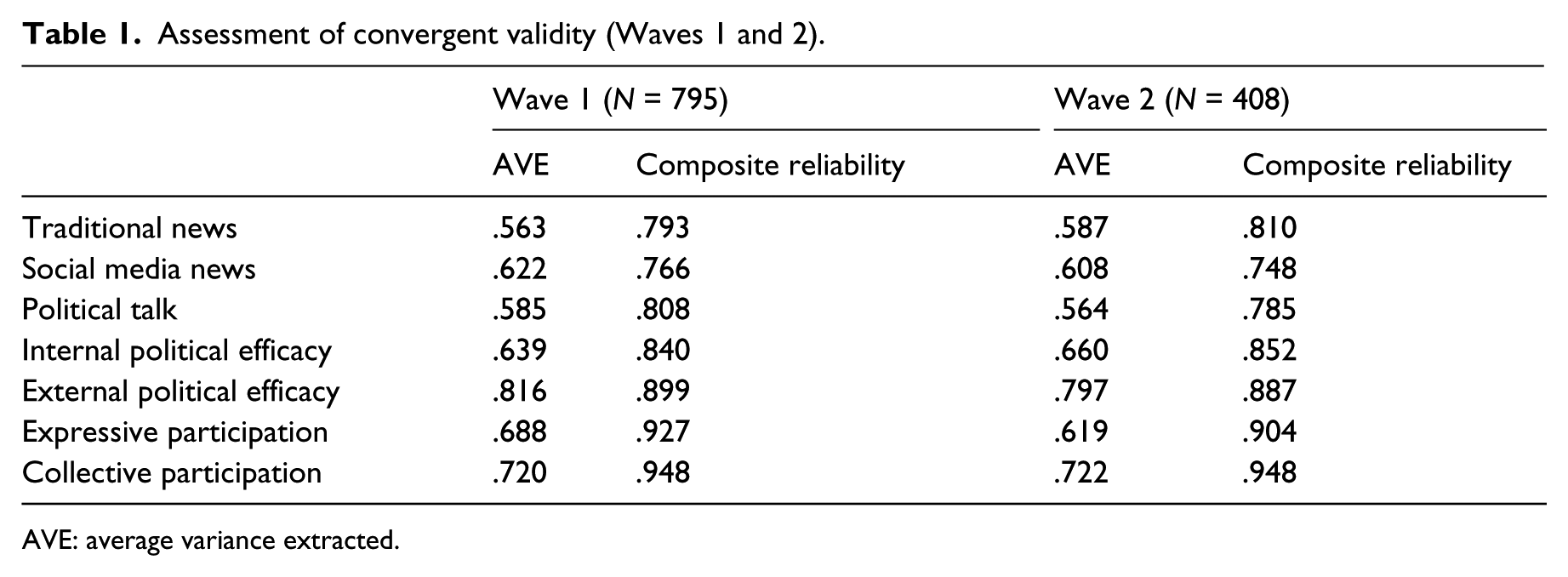
AVE: average variance extracted.
Structural model testing
Direct effects of traditional and social media use
H1 predicts a positive association between news attention and political talk. The hypothesis is supported (for traditional media—Wave 1: β = .31, Wave 2: β = .34, autoregressive: β = .30; for social media—Wave 1: β = .27, Wave 2: β = .28, autoregressive: β = .35). H2a is also supported. The analysis exhibits a positive association between traditional news attention and internal political efficacy (Wave 1: β = .14; Wave 2: β = .14; autoregressive: β = .21), and a positive association between traditional news attention and external political efficacy (Wave 1: β = .09; Wave 2: β = .08; autoregressive: β = .14). The results provide a strong support for the causal influences postulated in the autoregressive model.
News attention via social media predicts internal efficacy (Wave 1: β = .20; Wave 2: β = .21; autoregressive: β = .28; H2b), but not external efficacy (RQ1). Political talk is positively and significantly related to both internal (Wave 1: β = .16; Wave 2: β = .16; autoregressive: β = .20; H3) and external efficacy (Wave 1: β = .08; Wave 2: β = .08; autoregressive: β = .16; H3).
Direct effects of political talk and political efficacy
Political talk has a positive association only with expressive participation (Wave 1: β = .20; Wave 2: β = .22; autoregressive: β = .25), partially supporting H4. Internal political efficacy predicts both expressive participation (Wave 1: β = .31; Wave 2: β = .31; autoregressive: β = .36) and collective participation (Wave 1: β = .08; Wave 2: β = .08; autoregressive: β = .19). Thus, H5 is supported. The analysis also reveals a positive link between external political efficacy and expressive participation (Wave 1: β = .12; Wave 2: β = .12; autoregressive: β = .20), supporting H6.
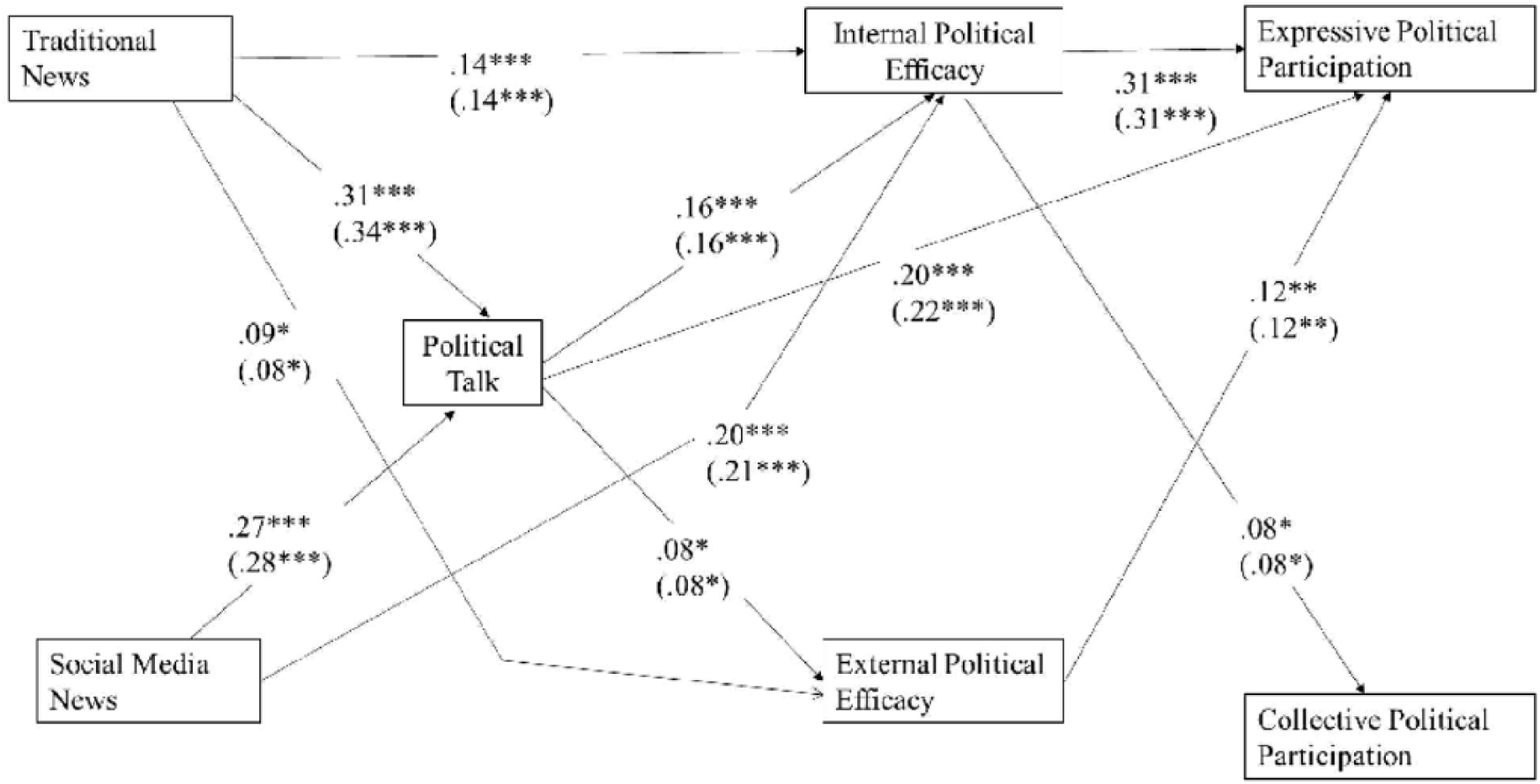
Direct relations (Wave 1: N = 795; Wave 2: N = 408; numbers in parentheses indicate coefficients in Wave 2).
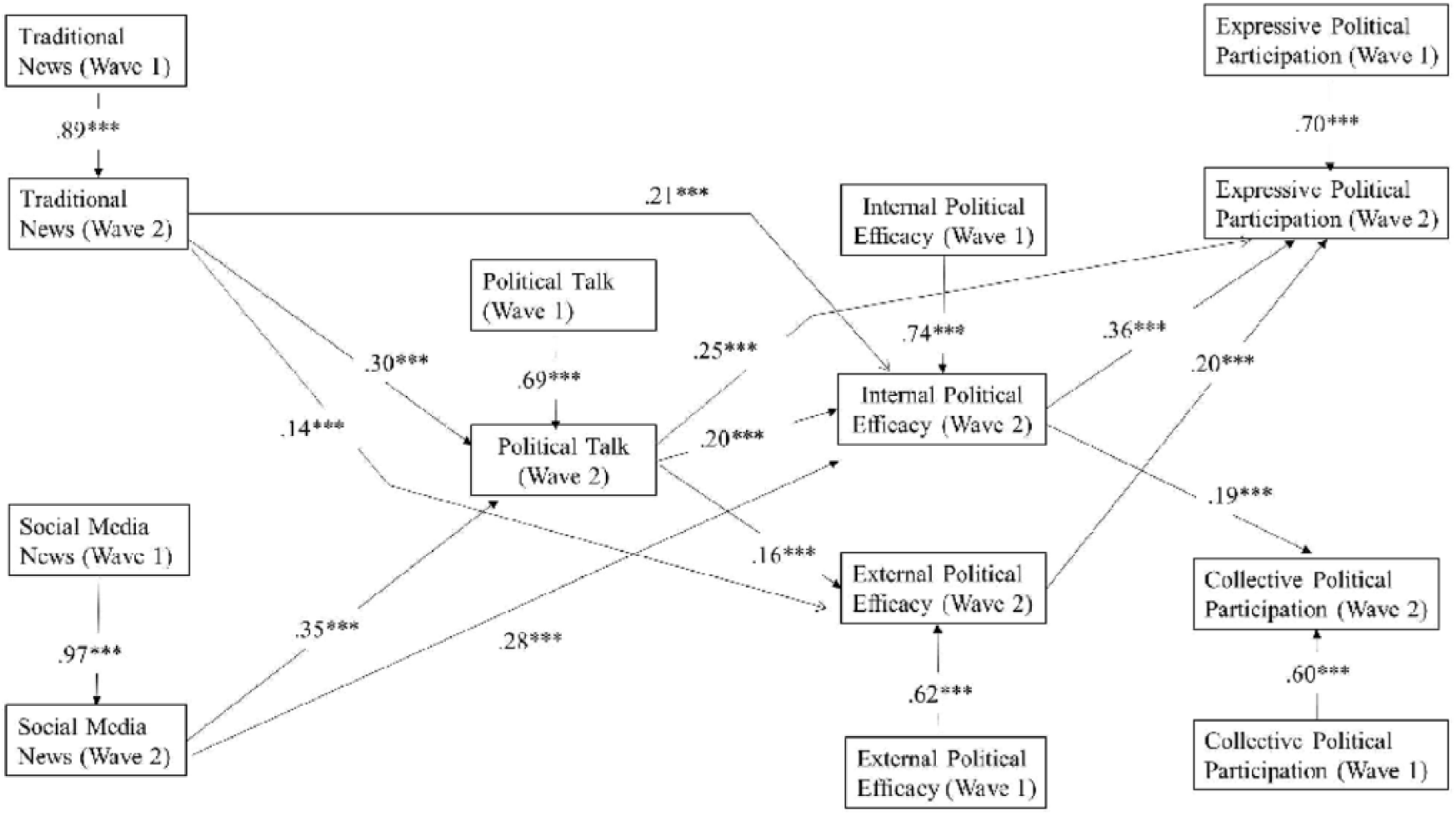
Direct relations (autoregressive model).
Mediating effects of political talk and political efficacy
To test mediating effects, a series of bootstrapping for each model (number of bootstrap samples is 1500) were performed. H7 predicts that political talk mediates the impact of news attention on expressive and collective participation. The analysis finds a mediating role of political talk between news attention and expressive participation (traditional news attention: t = 2.46, p < .05 (Wave 1), t = 2.84, p < .01 (Wave 2), t = 2.72, p < .01 (autoregressive); social media news attention: t = 2.84, p < .01 (Wave 1), t = 2.17, p < .05 (Wave 2), t = 2.54, p < .05 (autoregressive)). Political talk does not mediate the association between news attention and collective participation. Therefore, H7 receives partial support.
H8 predicts that that internal political efficacy mediates the impact of news attention on expressive/collective participation. The indirect effect between traditional news attention and expressive participation through internal efficacy is significant (Wave 1: t = 3.81, p < .001; Wave 2: t = 3.00, p < .01; autoregressive: t = 2.29, p < .05). Internal efficacy also mediates the relationship between social media news attention and expressive participation (Wave 1: t = 3.27, p < .01; Wave 2: t = 2.47, p < .05; autoregressive: t = 3.55, p < .001). Internal political efficacy does not mediate the association between news attention and collective participation. Therefore, H8 is partially supported. External efficacy does not mediate the relationship between news attention and expressive or collective participation.
Political talk and internal political efficacy jointly mediate the relationship between traditional news attention and expressive participation (Wave 1: t = 2.91, p < 01; Wave 2: t = 3.14, p < 01; autoregressive: t = 3.12, p < .01) and the association between social media news attention and expressive participation (Wave 1: t = 2.88, p < .01; Wave 2: t = 2.75, p < .01; autoregressive: t = 3.04, p < .01). The results indicate that one who consumes news gets more involved in political talk with others and, as a result, feel competent about their political action. Eventually, the person ends up participating in political processes. However, political talk and internal efficacy do not play a joint mediating role between news attention and collective participation.
Results of importance-performance matrix analysis
A PLS analysis identifies the relative importance of constructs in the structural model by extracting estimates of the direct, indirect, and total relationships. Importance-performance matrix analysis (IPMA) also extends these PLS results with another dimension, which includes the actual performance of each construct (Volckner, Sattler, Hennig-Thurau, & Ringle, 2010). In this process, IPMA determines which variable shows relatively high levels of importance and performance. 4
The IPMA results reveal that internal political efficacy is the most important in explaining expressive and collective participation (Tables 2 and 3). Internal efficacy shows considerably higher performance scores than external efficacy in both Waves 1 and 2. Social media news attention also shows a relatively high level of performance and importance. The results indicate that internal political efficacy and social media news attention play a more crucial role in motivating citizens to engage in political processes than other constructs in this study.
Total effects and index values for the IPMA of political participation (Wave 1, N = 795).
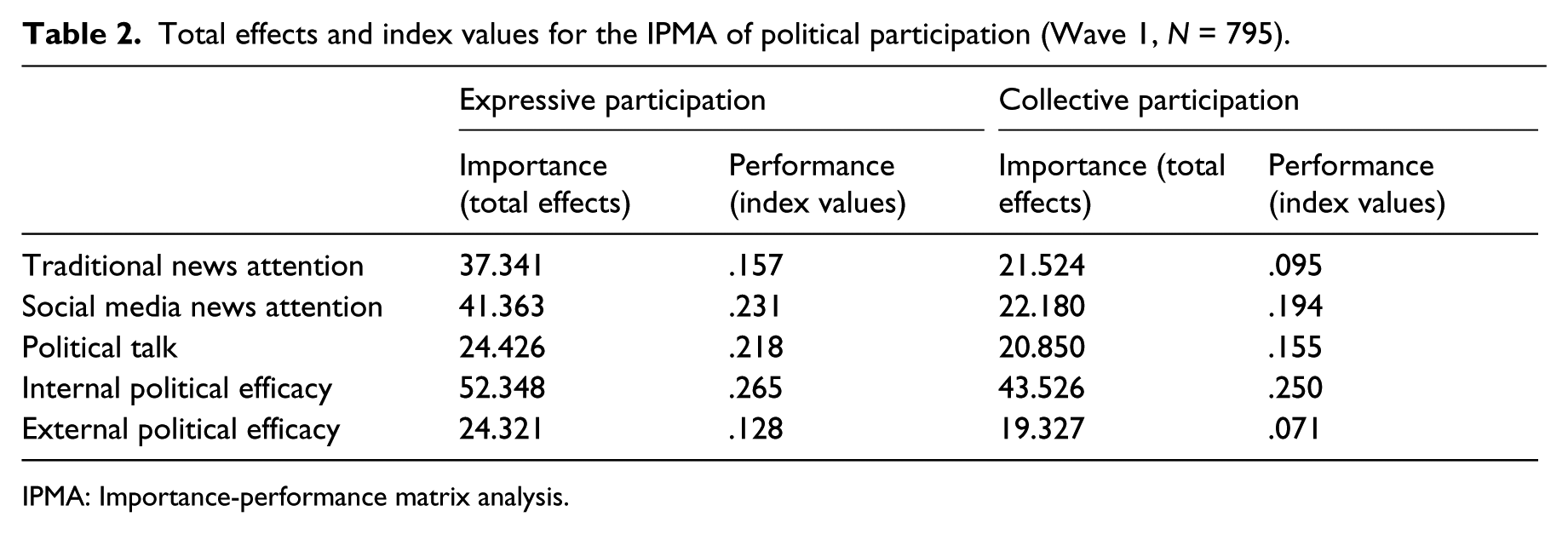
IPMA: Importance-performance matrix analysis.
Total effects and index values for the IPMA of political participation (Wave 2, N = 408).
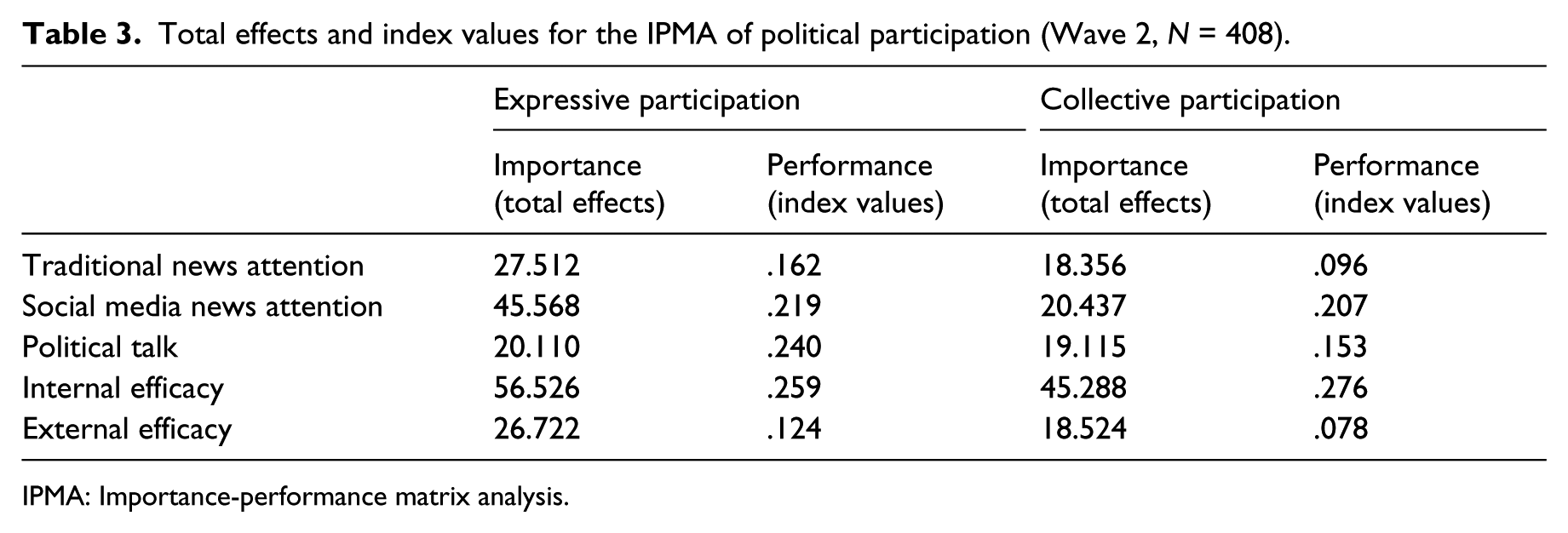
IPMA: Importance-performance matrix analysis.
Discussion
To expand prior mediation models in political communication, this study examined the interconnection between news attention, political talk, internal and external political efficacy, and expressive and collective participation. In three aspects, this study makes a significant contribution to the study of media and political communication.
First, the present research makes a significant theoretical advance in the O-S-R-O-R model by unpacking the nuanced pathways by which political efficacy connects news use and political participation. The analysis finds that internal efficacy plays a mediating role in connecting citizens’ news use and expressive forms of political participation, while external efficacy does not. This study also finds that internal efficacy predicts both expressive and collective participation, while external efficacy predicts only expressive participation.
The different roles of internal and external efficacy seem to stem from their conceptual differences. While internal efficacy mostly concerns the degree of influence that people perceive to be able to exert due to their own ability, external efficacy concerns the degree of influence people perceive to be able to exert due to the actual functioning of the political system (Caprara, Vecchione, Capanna, & Mebane, 2009). For this reason, internal efficacy can have important consequences for political action, ultimately resulting in engaging in social change (Semetko & Valkenburg, 1998). Indeed, internal efficacy turns out to be the most crucial component in the IPMA analysis. On the contrary, political trust is a precondition for external efficacy (Lees-Marshment, 2009). If externally efficacious people have substantial trust toward politicians and/or government, they do not necessarily need to make additional efforts to engage in cost-demanding activities.
Although the findings speak to the central role of internal political efficacy in bridging news use and political participation, that is not the whole story. The analysis also reveals a joint mediating effect by political talk and internal efficacy. In other words, media use for news triggers people to engage in political discussion and to feel more efficacious about their political belief, and such heightened political talk and internal efficacy result in engagement in expressive forms of political participation. Drawing on a panel survey, this study demonstrates a clear pathway from news attention to political talk (the first mediator) and internal efficacy (the second mediator) and to expressive participation. The discovery of chains of causality is not only important for confirming the O-S-R-O-R model, but it also represents an important step toward promoting political participation in democracy.
Second, this study identifies the increasing role of social media in the political process. In all three models, the coefficient connecting social media and internal efficacy is higher than the coefficient linking traditional media to internal efficacy. Also, the IPMA analysis shows that social media plays a much more important role than traditional media. This study shows evidence that social media are increasingly replacing the role of traditional media in the political process.
An active use of social media for political information may be better in enhancing internal political efficacy and triggering participation than passive reception of mostly unsolicited political messages through traditional media. This speculation is particularly true in South Korea, where mainstream media are losing citizen trust (Kang, 2005; Kim & Johnson, 2009; Park, 2014) and people are increasingly taking advantage of social media for political information and action (Kim & Park, 2012).
Finally, by conceptualizing expressive activities as a distinct form of political participation, this study clarifies the nature of the final outcome of news use. Previous studies have regarded participation as a simple combination of online and offline participation or a combination of civic and political participation, failing to consider the expressive and collective nature of participatory behaviors. The current research provides a conceptual distinction between expressive forms of participation and collective forms of participation and considers them both legitimate outcomes in their own right. The expressive/collective framework is useful because it reflects different levels of citizen commitment to political action. In general, collective participation requires more time, cost, and efforts than expressive participation does. By separating expressive forms of participation from general forms of participation, this study successfully illuminates the nuanced mechanism by which news use results in expressive participation through the mediating role of internal political efficacy.
Limitations and future research
Although the data generally support the proposed model of this study, the results bring up several points to be discussed. First, recent studies are suggesting new dimensions of political efficacy, such as political information efficacy (Kaid, McKinney, & Tedesco, 2007) and collective efficacy (Velasquez, 2012). Collective efficacy refers to the belief that a group can be effective in a given situation (Bandura, 2001) and is closely related to collective forms of participation (Velasquez, 2012). Political information efficacy, which refers to the voter’s confidence in his or her own political knowledge and its sufficiency to engage in the political process (Kaid et al., 2007), also can be considered another important variable that can explain the impact of media use on political participation. Particularly, considering that today’s citizens, by taking advantage of social media, engage in more diverse forms of participatory behaviors than before (Boulianne, 2015; Fuentes-Bautista, 2012), it is necessary to examine the impact of various dimensions of political efficacy on different types of political participation.
Second, future studies can test the interplay between internal and external political efficacy. Gamson (1968, 1971) contended that when low political trust is combined with high levels of internal political efficacy, individuals are rallied to action. Given that external efficacy is closely related to political trust (Balch, 1974), the examination of the interaction of internal and external efficacy would add a meaningful outcome to political communication. Finally, because efficacy beliefs strongly depend upon perceptions of the political context (Bandura, 1982; Lee, 2010), caution is needed in interpreting the findings. While South Korea is one of the well-wired societies on the planet, its citizens’ grievances against politicians and government are relatively high and external political efficacy remains low. Comparative studies can help in proposing a more generalized model that explains the interconnection between news use, political efficacy, and political participation.
Conclusion
The present research made theoretical advances upon the effects of news use on political participation by (a) explicating separate roles of internal and external political efficacy, (b) incorporating expressive and collective forms of participation into one single mediation model, and (c) distinguishing the different impacts of social media and traditional media use. This study shows that as people consume news via traditional and social media, they are more likely to talk about politics and feel competent about their ability to influence politics, and subsequently political talk and internal political efficacy lead to expressive participation.
Footnotes

3.
Tables of construct correlations, square root of average variance extracted (AVE), factor loadings, and cross-loadings are available upon request.
4.
The first step in an importance-performance matrix analysis (IPMA) test is to identify a target construct and to calculate total effects and performance values. The importance of a latent variable is calculated from the variables’ total effect. The next step is to obtain the performance values of the latent variables in the Partial least squares (PLS) path model. To make the results comparable across different scales, a performance scale ranging from 0 to 100 is used: 0 represents the lowest and 100 the highest performance. Finally, to acquire index values, rescaling the latent variables is required based on the following computations: Subtract the minimum possible value of the latent variable’s scale from an estimated data point and divide this data point by the difference between the minimum and maximum data points of the latent variable’s scale
where Yij represents the ith data point (i.e. i = 3 with respect to the latent variable score of the third observation in the data set) of a specific latent variable in the PLS path model. This procedure results in rescaled latent variable scores on a scale of 0–100. The mean value of these rescaled scores of each latent variable produces the index value of their performance. A higher value means a latent variable’s better performance.