




Abstract
This case study analyzes protest signs displayed during the period of January to August 2023 by civil society demonstrators opposing the proposed judicial reform in Israel. Through the social identity theory theoretical framework, we explored how these signs serve as a collective tool for enhancing in-group identification. In total, 437 signs collected through various means were qualitatively analyzed via inductive and deductive thematic analysis. The results elucidated how the direct or implied referencing “us” and/or “them” in protest signs functioned as a mechanism to enhance in-group identification: (a) forging group identity and virtuous attributes, (b) delineating group desires and aversions, (c) building group resilience via ethos and history, and (d) strengthening group coherence. We conclude that the act of bearing protest signs and the content therein not only represent social empowerment but also powerfully symbolize the inherent collective strength of an emerging, resilient, and steadfast civil society committed to liberal democratic ideals.
Introduction
Since January 2023, Israel has witnessed extensive protests throughout the country in reaction to the governing administration’s substantial efforts to overhaul the judiciary (Staff, 2023b). The suggested reform, termed the “judicial reform” by its advocates and labeled the “legal revolution” by its critics, encompasses a proposed set of alterations to Israel’s judicial system and power dynamics. Its main aim is to restrict the judiciary’s impact on legislation and public policy by limiting the Supreme Court’s ability to conduct judicial reviews, assigning control over judicial appointments to the government, and curbing the influence of its legal advisors (Sharon, 2023). The government’s attempts to overhaul the judiciary of Israel have ignited significant controversy within the country, drawing sharp criticism not only from government opposition leaders but also, and perhaps mainly, from civil society organizations that include professionals and citizens from all segments of Israeli society. Among these are activists, retired senior public servants, former and current security service officials, representatives of Israel’s financial sector, prominent business personalities, economists, legal experts, as well as members and leaders in the academic community (Keller-Lynn, 2023; Shimoni et al., 2023; Staff, 2023b; Weissberg & Eretz, 2023). The opposers perceive the proposed judicial reform as an attempt to establish an authoritarian regime that poses a significant threat to Israel’s democratic order regarding civil rights, marginalized populations, and freedom of speech, as well as critical opposition and gatekeeping (Fuchs, 2023). Their concerns have garnered international support from political, legal, and economic figures and organizations (Maor, 2023; Pinkas, 2023), especially following similar political changes in countries such as Poland and Hungary that seem to have a worrying effect on civil society and the welfare state (Koreh, 2023; Korolczuk, 2023).
Large-scale demonstrations have been occurring since 7 January 2023 in multiple cities and on main roads and intersections across the nation, starting with an initial turnout of about 20,000 protestors that grew over the following weeks to a nationwide total of 400,000 participants (about 5% of the Israeli population: CBS, 2022) every weekend, predominantly centered in the city of Tel-Aviv (Gradstein, 2023; Peleg et al., 2023). As the reform progressed, Israeli society experienced a growing polarization between those who support the reform and those who oppose it (Keller-Lynn, 2023). In fact, the polarization intensified to such an extent that a recent poll revealed that around 58% of Israelis are concerned about the prospect of a civil war due to the judicial reform crisis (Cohen, 2023). To date, the judicial reform opposition’s massive, persistent, non-violent protests and civil disobedience primarily consisted of grassroots demonstrations organized at the local level involving former officials and intellectuals as speakers (Joffre, 2023; McKernan & Kierszenbaum, 2023). To communicate their desire for strong democratic governance, their discontent with the current state of affairs, and their concerns regarding the envisioned future of the Israeli state, the protesters prominently displayed the Israeli flag, sang the national anthem in unison, chanted resistance slogans, and carried a diverse range of original homemade signs (Staff, 2023a; Starr & Breuer, 2023). Simultaneously, a few counter-demonstrations in support of the judicial reform also occurred (Ynet, 2023).
This study aimed to analyze the content of the signs displayed by the protestor group opposing the judicial reform and to explore how these signs serve as a collective tool for enhancing in-group identification. Our chosen emphasis on demonstration signs is rooted in the notion that protest sign construction can serve as collective meaning-making action frames (Weber et al., 2018). Specifically, such signs can be vehicles of delineating a social problem and its causal agents, of proposing potential solutions, and of inspiring others to act (Benford & Snow, 2000). Previous research has examined protest signs from diverse theoretical viewpoints and across varying political contexts, including events like Women’s Rights Marches (Akhtar et al., 2021; Bahrudin & Bakar, 2022; Webber et al., 2018), and other human rights concerns (Ben-Said & Kasanga, 2016; Wildermuth et al., 2014). In the Israeli context, protest signs played a prominent role in the summer 2011 demonstrations, which centered on economic concerns. Some argue that these concerns also reflected a deeper fear that the values and practices of liberal democracy were under threat (Rosenhek & Shalev, 2013). The profound polarization evident in Israeli society between two distinct groups: the proponents and opponents of the judicial reform (Cohen, 2023; Keller-Lynn, 2023) created an interesting dynamic between the groups. This situation has inspired us to examine the utilization of protest signs in the collective act of enhancing in-group identification, a central component in group dynamics (Tajfel, 2010). Our research is primarily guided by social identity theory (SIT), which places in-group identification at its core.
Theoretical background: social identity theory
SIT asserts that society arranges itself hierarchically into distinct social groups that maintain power and status relationships among them (Tajfel, 1978, 2010). Inclusion within a specific group (referred to as a social category) grants individuals a social identity—a significant conceptualization of self—encompassing both a description and an assessment of associated attributes. Through identifying with the group, people share grievances, a sense of self-efficacy, cynicism, or other emotions (van Stekelenburg et al., 2011). Simultaneously, self-defined social identities depend on the presence of others within the context; thus, when individuals view themselves from a social identity perspective rather than a personal one, their interactions become centered around their respective in-group (“us”), while interactions with out-group members (“them”) revolve around intergroup relationships (Tajfel, 2010).
From this standpoint, any assault on the values and norms of the in-group is prone to evoke feelings of threat, consequently linking in-group favoritism with hostility toward out-groups (Mullen et al., 1992; Sidanius & Kurzban, 2003; Tajfel, 1978, 2010). Under such circumstances, the “us” versus “them” distinction can drive disadvantaged groups to engage in collective action, like protest participation. Robust group identification predicts heightened self-efficacy and increased group obligation and commitment, thereby increasing the likelihood of engaging in protest activities (Stryker et al., 2000; Stürmer et al., 2003; van Stekelenburg et al., 2009; van Zomeren et al., 2008). Within the context of political psychology, the importance of group identification intensifies, as it commonly transforms into a politicized identity specifically oriented toward engaging in a political power struggle against authorities within the public domain (Kelly & Breinlinger, 1996). This evolution from group identification to political power struggle shifts the political aspect into a personal identity endeavor (Klein et al., 2007). In this shift, individuals move from focusing on political affiliations or group-based ideologies to a deeper exploration of individual self-conception and autonomy. As a result, individuals’ identities become less shaped by external social forces and more self-directed (see Drury & Reicher, 1999). In practical terms, this might manifest in a stronger emphasis on personal agency, self-expression, and the pursuit of individual goals, rather than simply adhering to group expectations or political allegiances.
The current study
Israel is commonly regarded as an established democracy (Arian, 2015; Gal & Benish, 2017), notably defined as a welfare state committed to maximizing equality of opportunity. It is also distinguished by strong civic engagement and social capital (Oser, 2010). Notwithstanding, growing threats to this characterization have also been observed (Katz & Gidron, 2022). Since its first years of independence, Israel’s democratic vision was already rooted in the ability to build a strong and wide civil society. For example, freedom of association is enshrined in various legal frameworks, such as the Basic Law: Human Dignity and Liberty, highlighting the importance of forming political parties, non-profit organizations, and trade unions as essential components of a vibrant civil society and a robust democracy (Kabalo, 2006). Consequently, civil society has played a pivotal role in defining the boundaries of government authority since Israel’s inception, underscoring its significance and its symbiotic relationship with the state in the pursuit of a robust democracy.
In this paper, we refer to civil society, in contrast to merely third-sector organizations, with the intention of conveying a broader and less formally structured movement (Powell, 2007). This encompasses a diverse range of institutions, organizations, networks, and individuals, all of which can form fertile communities and social groups for generating new ideas and engaging in decision-making and policy formulation (Biekart & Fowler, 2022; Yishai, 2003). Given the aforementioned recent unrest in the Israeli socio-political field, the current exploration has scholarly relevance as an illustration of civil society’s emergence during an acute democratic crisis, particularly in light of analogous concerns about democratic shortcomings worldwide relating to judicial independence, media freedom, and anti-corruption initiatives (Buxton, 2005; Casert, 2023; Cavanaugh & Hughes, 2016; Korolczuk, 2023). While the protest signs carried by demonstrators are largely original and homemade, contributing to their subjective nature, within the socio-political context in which they are presented, they hold a collective purpose. This study will examine how individual protest signs collectively function to enhance in-group identification among demonstrators.
Method
The research methodology used was a qualitative investigation data (protest signs) collection over a specific time period, and two forms of thematic analysis (both inductive and deductive) were the means of data analysis. Thematic analysis is a search for themes that are either deductively or inductively identified as being important to the description of the phenomenon (Rice & Ezzy, 1999). This method provides an accessible, flexible framework for identifying, analyzing, and reporting patterns across qualitative data. Each theme reflects an important aspect of the research questions (Braun & Clarke, 2006).
Data source
The data source comprised 437 original, handmade signs displayed by protesters during demonstrations in Israel from January to August 2023, in response to the government’s significant efforts to reform the judiciary. The signs that were collected were written in Hebrew text and contained a range of one word to a maximum of four sentences (with or without an accompanying picture); on average, the text of the signs consisted of 1–10 words and most signs included text only, and a minority consisted of text with images accompanying them. Importantly, since all of the signs were exhibited openly to the public, the collection and analysis method complied with the usage and ethics terms and conditions for the data sources.
Data collection
As the exhibition of signs was in public, and individuals at different locations and at different times often exhibited the same signs, and most of the signs also appeared on various social media networks, there was no way to definitively determine from whom each sign originated. Thus, no formal demographic characteristics could be obtained regarding the individuals exhibiting the signs. For data collection, we used convenience sampling, a sampling method frequently used in both qualitative and quantitative studies (Etikan et al., 2016), as well as in specific studies analyzing demonstration signs (Akhtar et al., 2021; Bahrudin & Bakar, 2022; Weber et al., 2018). In the first step of data collection, signs were collected by the researchers through their taking pictures of signs while observing demonstrations. The second step involved collecting images of demonstration signs shared on social media platforms, primarily Facebook and Instagram. These images were sourced from the authors’ feeds, their acquaintances and relatives’ feeds, and designated Facebook groups focused on demonstrations and opposition to the judicial reform. These methods of data collection were chosen for their popularity and accessibility. First, most signs were presented at large demonstrations, providing a relatively diverse sample across various subgroups, including different ethnicities, political affiliations, ages, genders, and so on. The second method of analysis, utilizing Facebook and Instagram, allowed us to access signs that may not have been noticed or displayed during the demonstrations. Having attended numerous demonstrations across various locations and times, we found that only a small number of new signs—though conceptually similar to those observed in person—were identified on these platforms. However, we opted not to collect signs from TikTok or Twitter, as it is primarily used by much younger individuals, whereas Facebook and Instagram offered a broader demographic. The saturated final sample comprised 437 unique signs exhibited in Israel during the period of January–August 2023 in protests opposing the proposed judicial reform.
Data analysis
The method of analysis chosen for this study was a hybrid approach of qualitative methods of thematic analysis that incorporated both the data-driven inductive approach of Boyatzis and the deductive a priori template-of-codes approach outlined by Crabtree and Miller (Boyatzis, 1998; Crabtree & Miller, 1999). These two forms of data analysis were considered most relevant due to the juxtaposition of knowledge concerning SIT and means of enhancing in-group identification found in the literature, and the dearth of scientific examination of this knowledge.
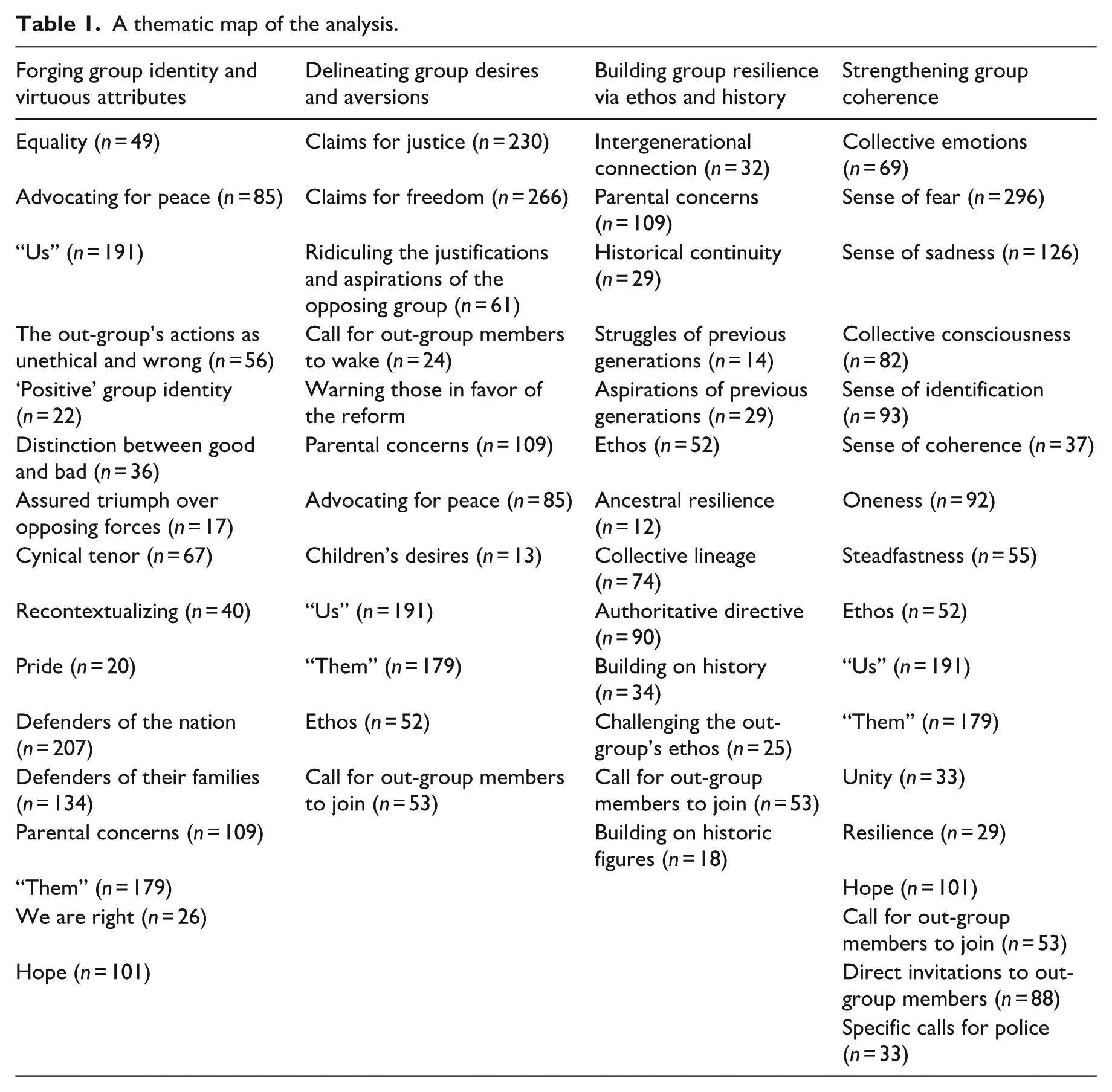
The general analysis process was inspired by Braun and Clarke’s (2006) six-step approach, incorporating both deductive and inductive methods as key analytical strategies. In the first phase (familiarization), the researchers immersed themselves in the data, reading each interview multiple times and recording initial thoughts. In the second phase (generating initial codes), relevant data segments were coded and compiled into a separate document by each researcher. The deductive thematic analysis began in this phase with explanatory assumptions and/or provisional definitions of something to be explained (Fereday & Muir-Cochrane, 2006). Accordingly, initial elements of SIT were searched for, such as distinct social groups maintaining power dynamics. The researchers examined how individuals’ interactions were centered around their in-group (“us”) while their interactions with out-group members (“them”) revolved around intergroup relationships. Moreover, the deductive analysis examined how metaphorical labels from the literature (e.g. Tajfel, 1978, 2010; van Stekelenburg et al., 2011) were aligned with the meaning represented in the collected sign data. Per the protocol of such an approach, the hypothesis or definition was then compared with the data and when they did not match, modifications were made. Inductive analysis was also conducted as a means of the early modification process. Inductive thematic analysis refers to simultaneously comparing all incidents observed for all signs and then arriving at a category label (Fereday & Muir-Cochrane, 2006). This approach was employed to investigate how the protestors opposing the judicial reform utilized signs as a collective tool to bolster in-group identification. This involved examining the underlying basis for using signs in this manner. Inductive thematic analysis was also utilized to identify any ideas within the signs that diverged from the elements of SIT. During the third phase (searching for themes), the researchers shared their individually generated codes and then met to collaboratively analyze and organize them into broader potential themes. All three researchers independently identified the same overarching themes in terms of content, reaching a consensus on their categorization with ease. This facilitated phase 4 (reviewing themes), where themes were reviewed for coherence and irrelevant or redundant patterns were discarded, leading to a slightly refined thematic map. By phase 5 (defining and naming themes), the themes were refined through a joint discussion and shaped into coherent narratives, with their names adjusted for clarity. The final outcomes revealed four primary themes, all of which aligned with elements of in-group/out-group dynamics. The themes shed light on how the inclusion of “us” and/or “them” references in protest signs operated as a means to bolster in-group identification (forging group identity and virtuous attributes; delineating group desires and aversions; building group resilience via ethos and history; and strengthening group coherence). The main component themes, sorted into four domains, are outlined in Table 1. It is important to emphasize that, although the themes are presented as distinct, they are not mutually exclusive or dichotomous (see Graneheim & Lundman, 2004). Similarly, some signs may be represented in more than one theme. In the final phase (producing the report), concise and logical accounts of participants’ experiences were written, supported by vivid quotes. Translations of participant quotes from Hebrew to English were carefully reviewed for accuracy, and the final analyses extended beyond description to offer deeper interpretations.
A thematic map of the analysis.
Findings
The basis upon which the protest signs enhanced in-group identification primarily stemmed from the perception of the prevailing state of affairs as a threat to civil liberty. This notion was exemplified in signs such as “Beware, dictatorship ahead!” or others that delineated the dire nature of the prevailing circumstances through evocative expressions such as “Welcome to the dark side of the moon” and “One can already see the darkness at the end of the tunnel.” To underscore the gravity of the situation, certain signs incorporated citations from biblical narratives, leveraging the authoritative potency of historical and ethical frameworks, as exemplified by the quote, “And Cain said to Abel, ‘We are brothers,’ and he killed him.” The latter, alongside signs like “The government of Israel against the people of Israel,” expresses not only the perceived imminent danger of the present state of affairs but also the origin of the threat, distinctly demarcating between “us” and “them.”
As will be demonstrated below, our analysis generated four main themes that elucidate how referencing “us” and/or “them” in protest signs functioned as a mechanism to enhance in-group identification: (a) forging group identity and virtuous attributes, (b) delineating group desires and aversions, (c) building group resilience via ethos and history, and (d) strengthening group coherence.
Forging group identity and virtuous attributes
To establish a collective identity, a selection of signs delineated which individuals comprised the “us” group. Written in both Hebrew and Arabic, one sign proclaiming, “We are all equal human beings” exemplified this approach by demarcating the boundaries of the protestors’ in-group comprising those individuals who wish and advocate for equal rights and peace. In addition to conveying a humanistic, pluralistic, and peace-oriented message that embraces all individuals as equals, this statement also aims to challenge the perceived efforts of government judicial reform supporters to impose rigid in-group/out-group boundaries that promote a “dictatorship” ideology. Such actions are seen as violating the fundamental rights to freedom and equality enshrined in Israel’s Declaration of Independence. The linguistic coalescence reflected in that sign symbolizes unity: the consolidation of various individualistic voices under the common pluralistic identity of the protesting “us.” In an alternative portrayal of the “us” group, a paradigm of virtue is projected, as evidenced by a sign proclaiming, “We are the light and we shall win.” Conversely, signs directed toward the leaders and supporters of the judicial reform considered part of the out-group depicted their actions as unethical and wrong via sentiments such as “Shame!,” “History shall not grant absolution to your deeds!,” and “Ultimately, all of you shall be held to account!” These signs depicted a distinct demarcation between the “good” and “bad” groups, affirming the righteousness of the protesting side and implying an assured triumph over opposing forces.
The motivation to depict a “positive” group identity, sometimes in direct contrast to the out-group, may also be a counter-reaction to the opposing party’s efforts to project an unfavorable identity on the protestors. In this regard, some signs adopt a cynical tenor, utilizing quotations attributed to officials, including ministers and even the Prime Minister himself, who have referred to the protestors as anarchists: “I am a proud anarchist” and “Behind every protester stands an anarchist husband.” This approach subverts the pejorative label offered by the out-group by recontextualizing it within a tone of pride. By doing so, the protestors redefine the notion of an “anarchist” or a “group of anarchists” as proud, family-oriented defenders of their nation fighting a perceived authoritative threat, rather than mere anti-institutional rebels.
Notwithstanding, asserting group identity and virtue in protest signs may not have been enough to sufficiently characterize in-group identification. A proportion of signs also addressed the in-group’s desires and aversions.
Delineating group desires and aversions
The in-group’s collective aspirations were manifested in the protesters’ signs, such as those proclaiming “freedom for all” and “justice for all,” while other signs challenged and ridiculed the justifications and aspirations of the opposing group, particularly the government that asserted the legitimacy of a judicial overhaul by virtue by having achieved a 64/120 majority in the Israeli Knesset. See, for example, the following sentiment: “My friend resides in a 120-tenant building, with 64 in favor of urinating in the lobby and 56 against. He wonders, does the majority decide?!.” These kinds of signs also appeal to those within the out-group to engage in thoughtful reflection and potentially reconsider their stance. Similarly, certain signs specifically targeting out-group members supporting the reform, appeared to prompt them to awaken and acknowledge that their alignment with the elected government’s goals has resulted in an undesirable outcome, stating: “Those who vote while sleeping wake up with a dictatorship.”
The in-group’s desires were also depicted through a prism of parental concern, notably by projecting what they firmly wished to avoid via the use of declarations such as “Our children will not be raised in a dictatorship.” Furthermore, the yearning for an environment conducive to the flourishing of the in-group’s children found poignant expression in signs held by children and adolescents partaking in the protest, such as “You grew up in a democracy, we want the same!,” “Let us grow up in peace,” and “When I grow up, I dream of still having rights.” The meta-message of these types of signs is the collective aspiration for a nurturing and democratic environment in which future generations can thrive. Moreover, by fostering cross-generational participation in group inclusion, the protestors’ signage may have, intentionally or unintentionally, contributed to fortifying the in-group’s resilience.
Building group resilience via ethos and history
One notable source of generating in-group resilience is the notion of intergenerational connection, extending from forebears to progeny, as signified by the proclamations: “I am here for our children” and “My grandparents did not come here from Morocco to serve another king.” Such narratives evoke a sense of historical continuity, wherein the struggles and aspirations of previous generations contribute to the determination of the present. Moreover, the invocation of ethos was also heightened when this ancestral resilience was extended beyond individual families to encompass the collective lineage of the community that, together, form the in-group. A profound illustration of the usage of both ethos and history was captured by a sign that may allude to the childhood game “Simon Says”; leveraging the persona of the visionary leader of the Zionist movement, Theodor Herzl, its message of “Herzl says: Do not give up!” appeared to provide an authoritative directive that effectively bolsters the group’s resilience.
Interestingly, the protestors employed both ethos and history similarly in their approach toward out-group members. For instance, a sign featuring an image of Menachem Begin, a respected former Israeli Prime Minister associated with the right-wing (similar to the governing administration), accompanied by the statement “Even Begin would have rebelled,” conveys the notion that the current situation is not in harmony even with the ethos of the out-group. This strategic use of historical figures enhances the persuasive impact of the message, reinforcing the enduring vision and values passed down through generations. When directed at out-group members, this technique not only strengthens the in-group’s resilience by affirming its “right path,” but also invites out-group members to join the in-group by invoking the legacy of their admired leader.
Strengthening group coherence
Another set of signs focused on the group’s collective emotions. Signs declaring “I feel like crying,” “I am scared,” and “It is my country, and I will cry if I want to” strongly articulated a sense of fear and sadness that may have resonated with the in-group collective consciousness, heightening the members’ sense of identification and coherence. Nonetheless, within this spectrum of emotions, some signs fortified the group’s cohesiveness through empowering messages of oneness and inspired steadfastness. These signs echo the ethos of unity and resilience, resonant with convictions such as “Rise, WE will win!” and “Everything will be O.K. Until then—we are here!.” These declarations function as beacons of hope and perseverance, invigorating the spirit of unity and underscoring the endurance of the group’s unified front amid adversity. Other signs, aimed at the out-group, eroded the perceived cohesion and confidence in their leadership, proclaiming: “Even those who you thought were on your side are not on your side—you have lost your way.” This declaration urges a reevaluation of the out-group members’ course and a potential alignment with the protestors’ group; simultaneously, it appeared to indirectly invite new members to the in-group by generating suspicion of the opposing position(s) and by offering fellowship among those aligning themselves with the protestors’ group. This technique seemed to aim to strengthen overall in-group unity. Finally, the demonstrators extended direct invitations to others, such as members of the police force, to unite with their cause and to serve the in-group rather than the out-group through signs like: “Cops, resist!” or juxtaposed images of civilians and the Israeli Minister of National Security, respectively, labeled “Citizens” and “Criminal” alongside text that read: “Dear policeman, remember you swore to protect citizens from criminals?” Such appeals reinforce the in-group’s cohesiveness by attempting to ensure the safety of the protesters in scenarios in which the police could be confronted with the dilemma of either backing the government or protecting the protesters. By inviting the police to align with the protesters, these signs aim to reduce confrontation and promote solidarity, positioning law enforcement as potential allies rather than adversaries, which enhances both group unity and safety.
Discussion
The purpose of this study was to investigate how protest signs functioned as a collective tool to enhance in-group identification in the context of the January to August 2023 civil society protest of judicial reform in Israel. Our analysis revealed that in-group identification was anchored by the interpretation of the current state of affairs (i.e. the “judicial reform”) as a grave threat to Israeli democracy and as a national, as well as personal, existential danger. The interpretation of the judicial reform as a threat also reflected the socio-political polarization of Israeli society by representing those who opposed the reform, in contrast to those who initiated and/or supported it (see Keller-Lynn, 2023). Simultaneously, this messaging appeared to communicate that the in-group members’ perception of the government’s credibility has been shaken and their trust lost due to the predicted undermining of previously established long-term commitments in favor of newly proposed or enacted initiatives produced by the out-group. The polarization between these support versus opposition groups, along with a heightened sense of threat in the backdrop, resulted in an “us” versus “them” dynamic, necessitating individuals to choose their group identification. This aligns with the SIT principles underscoring the current research that emphasize that feelings of threat to one’s group norms and values will draw individuals together (Mullen et al., 1992; Sidanius & Kurzban, 2003; Tajfel, 1978, 2010) particularly when there is a sense of existential threat (Hogg et al., 2010).
Notwithstanding, while use of signs to frame the judicial reform as a threat created awareness of perceived danger, doing so may not suffice to initiate or sustain prolonged protests over 9 (or more) consecutive months. To achieve that, individuals must both perceive a continuing threat and be drawn into participating in the protesting in-group. This act of drawing people to identify with the in-group using protest signs was evident in our findings. Our analysis identified four key mechanisms through which protestors’ signs attempted to enhance in-group identification: (a) forging group identity and virtuous attributes, (b) delineating group desires and aversions, (c) building group resilience via ethos and history, and (d) strengthening group coherence. SIT posits that group inclusion establishes a social identity that shapes individuals’ self-conception and guides their behavior as in-group members distinct from out-group members (van Stekelenburg et al., 2011). According to the theory, groups gain psychological reality only when defined in relation to other groups. To attain a positive social identity, group members are motivated to think and act in ways that establish or preserve a positive distinction between their group and relevant out-groups (Hornsey, 2008). Based on our current study, protestors’ signs enhanced in-group identification by: delineating group membership criteria and associated beliefs and behaviors (i.e. forging group identity and virtuous attributes), specifying shared aspirations and preferences while highlighting what to oppose (i.e. delineating group desires and aversions), and reinforcing group cohesion by increasing the sense of obligation and unity among in-group members (i.e. strengthening group coherence). Furthermore, these elements found even stronger grounding in a robust group ethos and historical context (i.e. building group resilience through ethos and history), potentially further facilitating individuals’ identification with the group and sense of being part of a larger whole. Indeed, a group’s cumulative historical experiences have been argued to shape its social ethos, guiding the interpretation of new group experiences through recurring historical patterns, thereby exerting a significant influence on intergroup relationships (Bar-Tal, 2000). In line with SIT, by consistently delineating the boundaries between the in-group and the out-group, in-group identification becomes more distinct and straightforward.
From this perspective, engaging in collective action, such as protesting against the judicial reform (Stryker et al., 2000; Stürmer et al., 2003; van Stekelenburg et al., 2009; van Zomeren et al., 2008), becomes increasingly appealing and, in some cases, perceived as obligatory for individuals who identify with the in-group. This appealing “pulling force” into the group (i.e. power) fosters mutual interdependency among members, reinforcing group cohesion. This dynamic aligns with Emerson’s (1962) assertion that one’s power to influence others is linked to control over resources or actions that others value or see as a resource. In this context, “value” or “resources” encompass not only economic goods but also social rewards, such as a favorable reputation or social support from other in-group members. Accordingly, the findings of our study suggest that identification with the in-group can be regarded as a potentially significant value for its members, as the use of protest signs bestows a shared sense of belonging, meaning, identity, and virtue (i.e. resources), that fosters a unified vision and ethos, and engenders a profound sense of unity. As long as the members of the protesting in-group appreciate its values, their mutual dependence on other in-group members will be maintained, and the in-group’s power will be viewed as distinct from the out-group (and perhaps also distinct from the police and governmental organizations). In our case study, such in-group identification may have bolstered engagement in acts of protesting against the judicial reform.
Another factor influencing in-group interdependence is each side’s access to external “value” or alternatives (Blau, 1964; Emerson, 1976; Homans, 1958). In this relational framework, an actor’s power over another increases when they can find value through interactions with alternative actors (Bar-Nir & Gal, 2011; Molm et al., 2001). As power is based on perception, the power disparity among actors arises from their perceptions of what they can gain from their counterparts compared to their perceptions of available alternatives (Kim et al., 2005). Therefore, to maintain group cohesion, in-group members must perceive the out-group as an undesirable or unsuitable alternative. As our findings demonstrated, the signs held by in-group members frequently denigrated the out-group, attributing to them ill or wrong intentions and values that were perceived as posing an existential threat to the in-group. This strategy, according to SIT, also serves as a means to attract out-group members (e.g. citizen supporters of the judicial reform, police officers, and government officials) by positioning the in-group as a worthy alternative and offering values lacking in their current position (Spears, 2011). This can potentially expand the in-group’s size, diminish the perceived strength of the threatening out-group, and increase the probability of protection from the out-group (e.g. a situation in which the police must “choose” between the government and the protestors) (Kim et al., 2005).
Limitations
The first limitation pertains to the data collection methods, which included in-person photos of protest signs at demonstrations, as well as those sourced from Facebook and Instagram. While these methods yielded a rich and saturated sample, it is possible that signs posted by younger Israelis were missed if they appeared on TikTok, Twitter or other platforms we did not include, potentially introducing some bias. Second, since our analysis relied solely on protest signs, we cannot make definitive claims about the original intent and motivation of the individuals who created them. Instead, we can only infer their purpose based on existing literature on group dynamics within the context of social protests. Furthermore, our decision to analyze the signs through the relatively binary framework of in-group/out-group dynamics, specifically within the context of SIT, has guided our interpretation of the data. However, this focus may have overlooked other potential dimensions, such as more dialogical aspects or alternative theoretical approaches. In addition, we cannot ascertain the objective impact of these signs on in-group and out-group members, as we did not conduct direct interviews or measurements of their effects. Hence, it is highly advisable for future research to conduct both quantitative and qualitative examinations of these effects; doing so may not only validate our theory-based assertions but also offer fresh insights into the impact of protest signs during periods of heightened civil unrest, a global concern of increasing significance (Koreh, 2023; Korolczuk, 2023). Another potential limitation pertains to the dynamic nature of the events under study. Since this study was conducted, and its manuscript prepared, while Israel was still in the midst of the judicial reform debate, protests continue to unfold, and the situation remains in flux with the emergence of new legislation and political developments. Therefore, it is advisable to conduct a longitudinal analysis to comprehensively track and better understand the role of protest signs and their impact across this evolving process. Finally, while not the primary focus of this study, it could also be beneficial to explore in-group and out-group dynamics by analyzing the signs displayed by supporters of the judicial reform.
Practical implications
The analysis of protest signs offers several practical implications whose importance lies in the recognition of their pivotal role as a means of expression in civil society actions. At the individual level, the use of signs enables concerned citizens to articulate their subjective opinions and emotions in response to significant socio-political events, thereby serving as both an empowering and a practical tool. On the broader level, it is worthwhile for political and social leaders, especially government officials, to closely attend to the content of these signs, as they serve as a vital means of conveying the group’s perspective on current affairs, as well as its anxieties, concerns, and desires. Assuming the presence of a willing listener, heeding the messages conveyed by these signs offers an important opportunity for fostering mutual understanding and genuine dialogue that could potentially alleviate the widening socio-political divide evident not only in Israel but also in other societies experiencing polarization.
Conclusion
Our findings offer insight into a case study of protest signs used during a period of civil unrest due to perception of a significant democratic and possibly existential threat proposed by the 2023 judicial reform initiative in Israel. These findings relate to the fundamental question posed by SIT: how social groups with perceived limited structural power collectively mobilize to challenge and alter a societal system that puts them at a disadvantage (Tajfel, 2010). Our interpretation of the collected protest signs through the lens of the SIT suggests that through their signs, individual demonstrators align themselves with their in-group through several identifiable mechanisms and encourage others to join it. By doing so, such protest signs not only signify empowerment but also serve as a potent symbol of the collective strength inherent in an emerging, resilient, and unwavering civil society, and its liberal democratic vision.
Footnotes

Ethical considerations
The authors declare that all ethical standards have been followed.
Funding
The authors received no financial support for the research, authorship, and/or publication of this article.
Declaration of conflicting interests
The authors declared no potential conflicts of interest with respect to the research, authorship, and/or publication of this article.