




Abstract
Issues of race and ethnic diversity have emerged as important consideration in campaigning and developing political advertising. This study examines the moderating effect of the strength of ethnic identity for Hispanic and non-Hispanic White voters. The results of the between-subject factorial design indicate that non-Hispanic White individuals with strong ethnic identities hold more favorable attitudes toward a political candidate that advocates against same-sex marriage than non-Hispanic Whites with weak ethnic identities. Non-Hispanic White individuals with strong ethnic identities also expressed greater intentions to vote for and perceptions of similarity to the anti-same-sex marriage candidate. Conversely, Hispanic individuals with strong ethnic identities hold more favorable attitudes toward a political candidate that supports same-sex marriage than Hispanic individuals with weak ethnic identities. Findings show that the degree to which racial/ethnic members affirm their racial/ethnic affiliations influence their voting proclivities when facing a religiously controversial and morally framed social issue such as same-sex marriage.
Keywords
As US racial/ethnic diversity escalates, it would be in politicians’ best interests to be informed about the impact that the race/ethnicity of a political candidate is likely to have on multicultural audiences. Political candidates face increasing complications in communicating their positions favorably in today’s climate given the complex nature of contemporary social conflicts and identity politics—that is, issues that have particular importance for racial/ethnic minorities, lesbian, gay, bisexual, and transgender (LGBTQ+) communities, and religious individuals (Walters, 2018). Aside from race/ethnicity, religion also has the propensity to arouse strong sentiments in voters (Evans, 2014).
In many respects, the American public is becoming less religious; however, religious commitment remains relatively stable for 77% of all American adults (Leins, 2017; Pew Research Center, 2015). Given its potential impact, it benefits political candidates to understand the effects that advertising themselves and their positions in a religious context can have on racial/ethnic groups, particularly when referencing a religiously controversial issue like same-sex marriage. Studies have found mere racial/ethnic categorization, as biologically defined, to have no behavioral, psychological, or social implications ipso facto. As such, an important consideration in this study is the strength of ethnic identification in the political advertising contexts (Phinney, 2005).
This study moves beyond examining the impact of the mere presence versus the absence of religion in political ads and instead extends existing research by examining, via experimental design, the effect religious-political ads have on a candidate’s image and viability when used to promote or denounce same-sex marriage to the nation’s largest racial/ethnic groups. These findings specifically examine responses from Hispanics and Whites who either strongly or weakly affirm their racial/ethnic membership.
Religion, race, and identification
Religion is a potent social force with understandable allure. In a chaotic and unpredictable world, religious principles remain stable and provide peace (Iancu & Balaban, 2013). Religion offers adherents a worldview they can confidently believe in, a conviction that their religion is singularly true (Kinnvall, 2004), faith in an otherworldly higher power (Idinopulos & Wilson, 1998), forgiveness from past indiscretions (Visaticki, 2017), and the promise of eternal salvation potentially attainable through prayer and supplication (Bainbridge, 1995). Despite inherently harmonious attributes, however, religion’s proclivity as a lens for meaning makes it a continual source of conflict.
Liberal politicians and media, for instance, largely frame pro-same-sex marriage arguments along the lines of deficient access to fundamental rights (Moscowitz, 2013), and decry intolerance from the Christian right (Beinart, 2017). The Christian right, however, regards the left’s views on same-sex marriage as abhorrent and divergent from America’s “Judeo-Christian roots” (Meacham, 2009) and frequently justifies their stance along the lines of religion and morality (Moscowitz, 2013).
Not surprisingly, “religion” has become synonymous with “right-wing” in contemporary political discourse (Bruenig, 2014). Over four decades, Republicans exerted significant efforts to cement the support of Christian values (Green, 2016). During that time, in a period that started with the sexual revolution of the 1960s, the Christian right made “sexual immorality”—same-sex marriage, divorce, adultery, out-of-wedlock pregnancy, and so on—a major point of contention (Merritt, 2016). Meanwhile, Democrats went in the opposite direction, embracing gay-rights activism and secularists, often at the expense of “values voters,” to transparently separate church and state (Green, 2016; Iancu & Balaban, 2013). Counter to conventional wisdom, however, most Democrats are people of faith (Coons, 2017), and the Democratic Party is replete with leaders who embrace both faith and politics.
Democratic politicians: religious or secular?
In modern democracies, cues related to the race/ethnicity and religion of politicians have been directly related to the attitude of the voters toward candidates and electoral processes. Meyer and Boyle (2021) explored how the ethnicity and party affiliation of political candidates form perceptions and vote choices among people of all races and ethnicities. They found support that Black Democrats were considered more liberal than White Democrats. Contrariwise, Black Republican candidates were just as conservative—and Hispanic Republicans even more conservative—than White Republican candidates. Likewise, discussed how Latinas focus on the intersectional identities associated with their gender and ethnicity in the political campaign messages and found that ethnic identity played an important role in election campaigns. Several other studies paid attention to the use of religious, ethnic, and racial cues in election campaigns over the years and the implications of these influences on the health of democratic developments across the globe.
Historically, liberals of the 1950s and 1960s looked to the moral inspiration of the Rev. Martin Luther King Jr. (Coons, 2017). A non-exhaustive list of Democratic politicians of faith includes Jimmy Carter, a Southern Baptist deacon who famously taught adult Sunday school while successfully campaigning for the 1976 presidential election (Green, 2016); Jesse Jackson, an ordained Baptist minister and renowned civil rights activist who won multiple primaries in 1984 and 1988 as a candidate for the Democratic presidential nomination (Jackson, 2001); Al Gore, a Southern Baptist who attended Vanderbilt University’s divinity school as well as its law school before becoming a two-term vice president (Williams, 2017); and Bill Clinton, the former president who has frequently expressed his faith in Southern Baptist theology while utilizing its oral tradition (Williams, 2017). In addition, 80% of the 242 Democrats elected to serve in the 115th Congress are Christian, 28 are Jewish, three are Buddhist, three are Hindu, two are Muslim, and one is Unitarian Universalist (Pew Research Center, 2017). Only one, Rep. Kyrsten Sinema, D-Ariz, was the sole member of Congress to identify as religiously unaffiliated (Pew Research Center, 2017). Ecological validity exists for politicians of faith on either side of the aisle to advertise their attributes and their beliefs through the frame of faith.
Framing same-sex marriage: the potential for a religious sub-frame
In the battle for legitimacy, framing emphasizes specific aspects of reality (D’Angelo, 2017). Frames are introduced by politicians, journalists, advertisers, and pressure groups who determine and transmit storylines that shape social realities (Chomsky & Barclay, 2010; Trumbo, 1996). These social actors intentionally and unsuspectingly, make certain interpretations central and relay certain facts while underreporting others (Pan & Kosicki, 1993; Scheufele, 2004; Zamith et al., 2013). This is known as framing, the advocacy of certain ideas that are socially shared and which tend to persist over time from sources with broad authority, and which encourage certain kinds of audience processing of information. Equivalent material has been found to derive drastically dissimilar responses from people based on how an issue is presented (Cacciatore et al., 2012).
Same-sex marriage frames traditionally take two extreme positions, one side being religious conservatives (i.e. the morality frame) and the other gay rights activists (the equality frame) (Moscowitz, 2013). The morality frame is utilized by opponents of same-sex marriage in a manner that positions same-sex marriage as a threat to traditional religion and values (Baunach, 2011). However, the equality frame is used by those who support same-sex marriage and likens same-sex marriage to a civil rights issue (Baunach, 2011).
While these narratives are convenient, they represent problematic and mechanistic framing (e.g. God vs gays), casting proponents into two fixed opposing sides that silences moderate perspectives, while overlooking other theological perspectives (Moscowitz, 2013). For instance, there is an emerging subframe that articulates that religion can be used as a basis to support same-sex marriage (DeLaet & Caufield, 2008). For example, Barack Obama opined that supporting same-sex marriage is in line with his faith (Grant, 2012). He stated that his understanding had evolved, and he sees his religion as a basis for allowing same-sex couples to get married, and that the Golden Rule is an important part of Christianity that can advocate for gay rights (Grant, 2012). This subframe that fully embraces same-sex marriage through religious morality is gaining momentum with politicians and clergy (Goodstein, 2017).
Framing of issues related to different religious and ethnic communities has been one of the plausible explanations for the post-1965 changes in the political behavior of White Americans. It could be argued that several political shifts in the United States and across the world were driven by a change in the ethnic and racial considerations by the major political parties and a subsequent media framing (Ostfeld, 2019). For example, an increasing influence of minorities, especially Hispanics, in the Democratic Party resulted in several changes related to the future of minority ethnic groups in the party. Ostfeld (2019) found that White Democrats decreased their support of the party with an increase in Democratic outreach to Hispanics. Thus, framing of issues has a potential implication for different groups belonging to a political party.
The question arises as to the impact politicians have when using this frame on certain demographics. From a social constructivist viewpoint, audiences play a role in framing, actively interpreting, and discussing public events, but ultimately relying on media and advertised messages to provide frames that guide their interpretations and discussions (Price et al., 2005). Two groups of consequence politically are Hispanics and Whites.
Hispanics, given their increasingly prominent role in local, regional, and national politics and their status as one of the largest ethnic-racial minority groups in the United States, continue to grow in political relevance. Hispanics constitute 17.4% of the total population of the United States or 55.4 million people (Krogstad, 2016). Hispanics are also no longer constrained to conventional US locations such as the Southwest or Miami but have migrated to rural areas throughout the country (Lichter, 2012). Hispanics’ substantial size, dispersion, and youth reflect their growing ability to decisively influence the outcome of statewide elections, and the selection of the Democratic presidential and vice-presidential candidates as well (Rodolfo et al., 1996). Hence, the voting proclivities of Hispanics have considerable consequences for the future of American electoral politics (Bowler et al., 2006).
The growth of Hispanics as a demographic has also increased the number of Hispanic political candidates. Hood and Mckee (2015) contend that although a clear majority of racial/ethnic minority candidates run as Democrats, in recent years a nontrivial number of minority candidates have won Republican Party nominations in high-profile elections (i.e. governor and US Senate). When it comes to minorities running for office there is a debate in the literature on whether or not they face a backlash or not from White voters. Extant research has found contradictory results (Meyer & Woodard, 2017; Niven, 2017). Race, religiosity, and political ideology are all examples of social identities.
The social identity theory of intergroup political behavior
Over the years, scholars have investigated whether citizens group themselves as belonging to different religious, ethnic, social, and political groups (Huber, 2022). Social identity theory (SIT) is a useful tool to understand this phenomenon, which is explained in the literature as “that part of the individual’s self-concept which derives from their knowledge of their membership of a social group (or groups) together with the value and emotional significance attached to that membership” (Tajfel, 1981, p. 255). Based on the assumptions of the social identification theory, several scholars in political communication argued that citizens generally have a sense of emotional proximity to certain groups in all societies: they hold in-groups in high esteem by cultivating positive emotions toward them while outgroups are treated negatively, and citizens tend to develop adverse sentiments or antagonism toward specific out-groups.
However, these arguments should be cautiously interpreted, as modern democracies thrive on the existence of a multiplicity of public spheres having various groups living together and working for the overall well-being of society. Huber (2022) argued that political parties connect with different social groups during electoral processes, and this connection could be effectively understood by using cleavage theory as a starting point. In addition, political and civic cleavages are likely to change with the passage of time due to the mercurial nature of partisan attachments of assorted ethnic groups and demographic changes in a society (Huber, 2022). We, however, believe that SIT still provides a useful lens to understand the attitudes and behaviors of social and ethnic groups in a society. Several recent studies also confirm that group loyalties and social identities are key factors in shaping political attitudes and behavior (Huber, 2022; Tilley, 2015).
A key proposition of SIT (Tajfel, 1974; Tajfel & Turner, 1986) is that social identities (e.g. race/ethnicity) represent key aspects of self-definition (Schmitt et al., 2007). Social identity is an extension of one’s ego to include feeling a part of a group (Miller & Shanks, 1996). Under SIT, identity encapsulates people’s sense of themselves as unique, disparate individuals but it also describes communal identities where individuals embrace the interests of each social group they identify with as their own. A central premise of SIT states that people have an innate need to attain and maintain a positive social identity to facilitate a positive self-concept (Hogg, 2004). When unfavorable intergroup comparisons occur, individuals perceive a negative social identity (Shinnar, 2008). In such instances, individuals either strive to leave their existing group and join another, more positively distinct group, or they attempt to make their existing group more positively distinct. As such, Hispanic individuals in the United States may seek to reinforce positive ethnic identification and distinctiveness (Phinney, 1990; Tajfel, 1974, 1981; Tajfel & Turner, 1986) by electing a member of their ethnic ingroup to office.
For Whites, situations where they have had to be cognizant of their place as members of a specific racial/ group, although increasing, are less frequent than in ethnic minority groups (Phinney, 1992). Hence, White individuals historically have been disinclined to think of themselves as a single, specific, homogeneous, ethnic group that operates as a collective unit. Accordingly, White individuals have been found less likely to use racial cues as salient aspects of their identity or for self-description (Smedley & Bayton, 1978).
In light of the preceding discussion, the following hypotheses are proposed:
H1a. Hispanic voters, in comparison to White voters, will have a more favorable attitude toward, H1b greater likelihood of voting for, and H1c greater perception of similarity to a co-ethnic (i.e. same ethnic background) candidate than a candidate that does not share their ethnic background.
The moderating role of ethnic identity
Phinney (2005) defines ethnic identity as “a self-constructed understanding of oneself in terms of one’s cultural and ethnic background and the attitudes and feelings associated with that background” (p. 189). Research indicates that minorities with strong ethnic identities tend to exhibit ingroup, same-race favoritism in mediated and interpersonal interactions (Appiah, 2004). Weak ethnic identifiers have been found to possess attitudes and behaviors that are not strongly tied to their own ethnic culture, which may even resemble dominant, mainstream White culture (see Appiah, 2004). Academic literature found sufficient evidence that religious, racial, ethnic, and gender identities influence attitudes about others and help develop an understanding of the group’s features, attitudes, and behaviors (Gershon & Monforti, 2019). Berinsky et al. (2020) argue that group and ethnic identity can supplement in-group relationships and out-group distrust while making decisions in elections. This is one of the reasons why political candidates generally announce that their policy agenda would favor minority racial or ethnic groups’ political and civic interests to cajole and influence voters belonging to different ethnic identities during elections. Political leaders generally use positive ethnic appeals to create a common ground and persuade non-White voters to vote for them in the United States.
For nearly all major demographic subgroups of Hispanics, support for same-sex marriage has grown by 20 percentage points or more since 2006 (Lopez & Cuddington, 2016). Potential reasons for these changes include nationwide initiatives to maintain same-sex marriage rights (Pew Research Center, 2008), the rising visibility of LGBT Latino celebrities, and prominent mainstream television shows like “Glee,” “Grey’s Anatomy,” “The Office,” and Spanish-language reality shows and telenovelas which feature LGBT Latino characters (GLAAD Univision, 2014, 2016). Collectively, these may have helped counteract negative stereotypes about being gay and mitigated concerns about same-sex marriage. In addition, an estimated 1.4 million, or 4.3%, of US Hispanics consider themselves lesbian, gay, bisexual, or LGBT, comprising a substantial portion of the LGBT population, who also live in Hispanic, as opposed to LGBT, communities (Kastanis & Gates, 2013). Under conditions where contact is closer and more frequent, or where relationships are deeper and more meaningful, it seems feasible that Hispanic individuals with strong ethnic identities may be more accepting of same-sex marriage than those with weak ethnic identities. In addition, same-sex marriage rights and their parallels to Hispanics’ struggle for immigration reform, maybe more salient and might elicit more awareness and compassion from Hispanics with strong ethnic identities than those with weaker ethnic identities. Strong ethnic identities also imply a certain level of agency in pursuing outcomes that would benefit one’s racial/ethnic ingroup. Consequently, strong ethnically-identifying Hispanics might be more inclined to mobilize and vote and to support a candidate espousing a shared worldview.
Elias et al. (2016) found that Whites with strong ethnic identities are more likely to engage in microaggressions directed toward lesbians, gays, and bisexuals regardless of their race/ethnicity than Whites with weak ethnic identities. This phenomenon was not replicated by Hispanics or African Americans. Their findings support and extend existing research. Rowe et al. (1994), for instance, found that certain typologies of White individuals with strong levels of White racial identity and White consciousness display authoritarianism and social dominance tendencies. These attributes show strong positive correlations with hypermasculinity and anti-lesbian and gay attitudes (e.g. Altemeyer, 1981, 1998, 2002; Basow & Johnson, 2000; Whitley & Lee, 2000). Corenblum and Stephan (2001) found a significant and positive relationship between increases in Whites’ strength of ethnic identity and perceived outgroup threat. In short, strong ethnically identifying Whites may view any disruption to traditional marriage and heterosexual relationships as an ideological threat and may react negatively when encountering a political candidate that advocates on its behalf. We contend, therefore, that a strong White ethnic identity should potentially also lead to higher levels of anti-same-sex marriage attitudes than Whites with weaker ethnic identities.
Consequently, we propose three-way interactions such that the strength of ethnic identity moderates the relationship between political advertisements’ religious frame (pro-same-sex marriage vs anti-same-sex marriage) and voter’s race/ethnicity on their (H2a) attitudes toward a political candidate, (H2b) intentions to vote for a candidate and (H2c) perceptions of similarity to a candidate.
Method
Design
The experiment used a 2 (Candidate race/ethnicity: White vs Hispanic) × 2 (Religious frame: pro-same-sex marriage vs anti-same-sex marriage) × 2 (Candidate affiliation: Republican vs Democrat) between-subject factorial design. The dependent variables were: (1) attitude toward the candidate, (2) intention to vote for the candidate, and (3) perceptions of similarity with the candidate.
Participants
Data for this experiment was collected using Qualtrics, a validated method of recruiting participants and conducting experiments. Using purposive sampling, online invitations were sent out to a national proprietary panel of participants who were offered a small financial incentive in the form of in-store cash vouchers in exchange for their participation. Participants took the survey via an online link and could use any computer or digital device. Participants were required to self-identify as non-Hispanic White or Hispanic, be at least 18 years old, and currently reside in the United States while being eligible to vote in their respective states. Consistent with the 2010 US Census, US-based Hispanic/Latino self-identifiers were categorized as members of an ethnic group, capable of any racial classification, and non-Hispanic White identifiers as members of a distinct racial category. No other ethnic groups besides Whites (n = 172) and Hispanics (n = 162) were included in the sample. Participants ranged in age from 18 to 90 years (M = 40.76, SD = 15.46), and overall, 56.9% (n = 190) of the sample was comprised of females (see Table 1).
Descriptive statistics for Hispanic and non-Hispanic White participants.
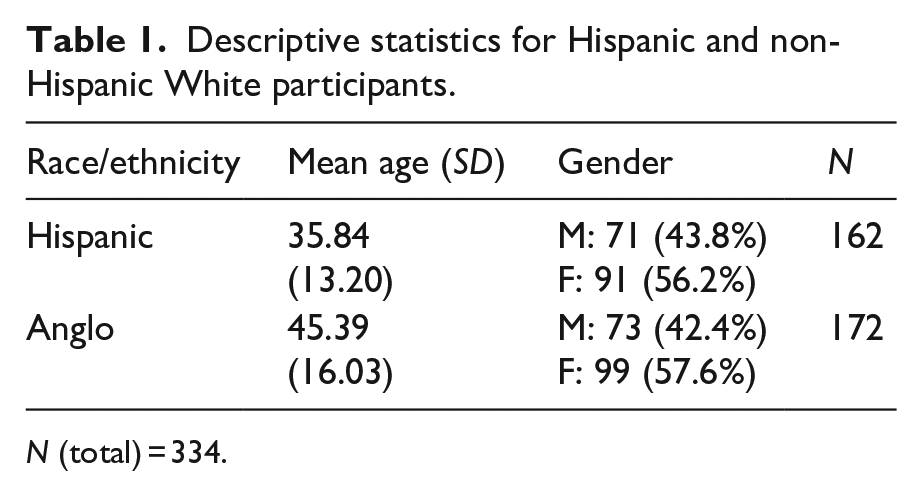
N (total) = 334.
An a priori power analysis was performed for the proposed analysis of covariance (ANCOVA) using the G*Power software. To achieve a power of 95% with a Cohen’s f effect size of 0.18 (small to medium effect) and type 1 error rate of 0.05, the required sample size was 327, which is below this study’s sample size of 334 (see Lentz et al., 2018).
Procedure
In operationalizing this study, a single hypothetical political candidate running for office, who could be perceived as either White or Hispanic by participants, was used. Utilizing the same candidate image was done to control for confounding variables.
Manipulation checks
Pretest participants were asked to identify the race/ethnicity of the proposed candidate based solely on his visual depiction and without any associating name. An independent sample T-test was performed comparing the mean scores of both White (M = 2.25, SD = 1.24) and Hispanic (M = 2.04, SD = 1.07) pretest groups to analyze their opinions about the race/ethnicity of the selected candidate. Results indicate no significant difference (t = −.634, p > .05) between these two groups’ perceptions of the race/ethnicity of the candidate. Likewise, no significant differences exist while evaluating the selected candidate on likability by Whites (M = 4.5, SD = 1.28) and Hispanics (M = 4.8, SD = 1.25); (t = .597, p > .05), trustworthiness by Whites (M = 4.29, SD = 0.99), Hispanics (M = 4.40, SD = 1.19); (t = .346, p > .05), or credibility by Whites (M = 4.58, SD = 1.31), Hispanics (M = 4.84, SD = 1.14); (t = .360, p > .05). The ethnicity of the selected candidate was also made prominent through both a White and Hispanic name. Anthony Brown was the name used to identify the candidate as White, whereas Antonio Moreno was the name used to identify the candidate as Hispanic.
Stimuli development
The experimental stimuli were presented in the form of a contemporary online political ad, created by a professional graphic designer (see Appendix 1 and Appendix 2).
White candidate conditions
The race of the White candidate was communicated through the name Anthony Brown and the candidate’s affiliation as Republican or Democratic was made evident through the Republican or Democratic logo. In addition, a 4-point political agenda of core values were included for each.
Hispanic candidate conditions
The ethnicity of the Hispanic candidate was communicated through the name Antonio Moreno and the candidate’s affiliation and political agenda was identical to the White conditions.
Moral framing manipulations
Participants exposed to pro-same-sex marriage morally and religiously framed political ads saw the following message under the heading “My values”: I accept same-sex marriage provided it lies within the confines of a committed, loving, monogamous, lifelong, Christ-centered relationship. Acceptance of same-sex marriage strengthens the very meaning of love and happiness as intended by God. Furthermore, children raised by same-sex couples have an equal chance of being raised in a religious, loving, and moral fashion as children of traditional families. Marriage, through Christ, is an essential force in our society because it makes you become a better person. Therefore, I support not only traditional marriage but also same-sex marriage.
Participants exposed to anti-same-sex marriage religiously framed political ads saw the following: I do not accept same-sex marriage even if it lies within the confines of a committed, loving, monogamous, lifelong, Christ-centered relationship. Acceptance of same-sex marriage undermines the very meaning of love and happiness as intended by God. Furthermore, children raised by same-sex couples do not have an equal chance of being raised in a religious, loving, and moral fashion as children of traditional families. Marriage, through Christ, is an essential force in our society because it makes you become a better person. Therefore, I support traditional marriage but not same-sex marriage.
Measurement instruments
Attitude toward the candidate
An index was created by averaging the mean scores of nine 7-point semantic differential scales, including negative/positive, not for me/for me, not appealing/appealing, and not likable/likable (M = 3.97, SD = 1.72). The coefficient alpha showed evidence of high reliability (α = .97). These scales were adapted for this study from Appiah (2006).
Voting intention
Respondents were asked about their likelihood of voting for the candidate on a single 7-point item “Think about the candidate. What is the likelihood that you would vote for this individual?” Past studies have adopted this same item to measure voting intention (e.g. Campbell & Monson, 2008; Wald & Calhoun, 2011).
Perceived similarity with the candidate
Participants rated their degree of similarity or perception of being the same as the candidate in terms of overall lifestyle, culture, appearance, and basic values (M = 3.53, SD = 1.80) (Whittier, 1989). A coefficient alpha showed evidence of high reliability (α = .88).
Ethnic identity
The well-known Multi-Group Ethnic Identity Measure Phinney (1992) scale was modified for this study. Two sample items of the 14 that were used are, “I have a lot of pride in my ethnic group and its accomplishments” and “I have a strong sense of belonging to my own ethnic group.” Responses to the 14 items were averaged and then split at the median, to create two groups representing relatively strong (>4.97, n = 160) and relatively weak ethnic identity (<4.97, n = 174) (e.g. Appiah, 2004; Elias et al., 2016). A coefficient alpha showed evidence of satisfactory reliability (α = .95).
Controlling for demographic differences
Demographic variables included as covariates were age, education, religiosity, political affiliation (e.g. “generally speaking, do you usually think of yourself as a Republican, Democrat, Independent, or other” on a (1) strongly Democrat to (7) strongly Republican continuum), political ideology (e.g. Extremely liberal—Extremely conservative), and personal and household income.
Results
For hypothesis testing purposes, ANCOVAs were conducted. Post hoc analyses for all research questions utilized Fisher’s Least Significant Difference (LSD) pairwise comparisons. The LSD was used to create confidence intervals for all pairwise differences between factor level means while controlling the individual error rate to a significance level you specify. Candidates’ affiliations were collapsed for the analyses.
H1a predicted that Hispanics, in comparison to White voters, would have a more favorable attitude toward a co-ethnic candidate than one that does not share their ethnic background. ANCOVA results, with age, gender, education, political identification, political ideology, and personal and household income as covariates, failed to reveal a significant interaction effect for participant race by candidate race (F (1, 300) = 2.17, p = .141, partial η2 < .007) on attitude toward the candidate. H1a was not supported.
H1b predicted that Hispanics in comparison to White voters would be more willing to vote for a co-ethnic candidate, than one that does not share their ethnic background. ANCOVA results, incorporating covariates, failed to reveal a significant interaction effect for participant race by candidate race (F (1, 300) = 1.085, p = .30, partial η2 < .01) on voting intentions. H1b was not supported.
H1c predicted that Hispanics in comparison to White voters would be more likely to perceive themselves as similar to a co-ethnic candidate, than one from a different ethnic background. ANCOVA results, again incorporating the same covariates, revealed a significant interaction for participant race by candidate race (F (1, 300) = 5.75, p < .05, partial η2 < .01) on perceived similarity with the candidate.
Surprisingly, however, one-way ANCOVAs (F (1, 144) = 1.56, p = .21, partial η2 = .01) indicated that Hispanics did not perceive a statistically significant greater degree of similarity with a Hispanic candidate (M = 3.96, SD = 1.84) than a White candidate (M = 3.61, SD = 1.74), despite the fact that the means were in the predicted direction. In addition, (F (1, 151) = 4.44, p < .05, partial η2 = .03) Whites perceived greater similarity with a White candidate (M = 3.64, SD = 1.80) than a Hispanic candidate (M = 3.08, SD = 1.75). Despite significant findings, H1c was not supported.
Attitude toward the candidate
As H2a predicted, ANCOVA results revealed a significant three-way interaction between 2 (Participant race: White vs Hispanic) × 2 (Political candidate’s same-sex marriage stance: pro-same-sex vs anti-same-sex marriage) × 2 (Strength of Ethnic Identity: Strong vs Weak) on attitudes toward a political candidate (F (1, 293) = 12.15, p < .01, partial η2 = .04). Two-way analyses indicate that the interaction effect between 2 (Same-sex marriage stance: pro-same-sex marriage vs anti-same-sex marriage) × 2 (Strength of Ethnic Identity: Strong vs Weak) was significant for both Whites (F (1, 147) = 8.04, p < .01, partial η2 = .05) and Hispanics (F (1, 139) = 5.00, p < .05, partial η2 < .04.
Simple effect analyses using LSD indicated that Hispanics with strong ethnic identities (M = 5.27, SD = 1.24) demonstrated significantly more favorable attitudes toward a pro-same-sex marriage candidate as opposed to Hispanics with weak ethnic identity (M = 3.67, SD = 1.43, p < .05). Conversely, Whites with strong ethnic identities (M = 4.58, SD = 1.92) demonstrated more favorable attitudes toward an anti-same-sex marriage candidate than Whites with weak ethnic identity (M = 3.02, SD = 1.51, p < .05). H2a was supported (Table 2).
Mean and standard error scores for strong and weak ethnic identifying Hispanics and non-Hispanic White participants.
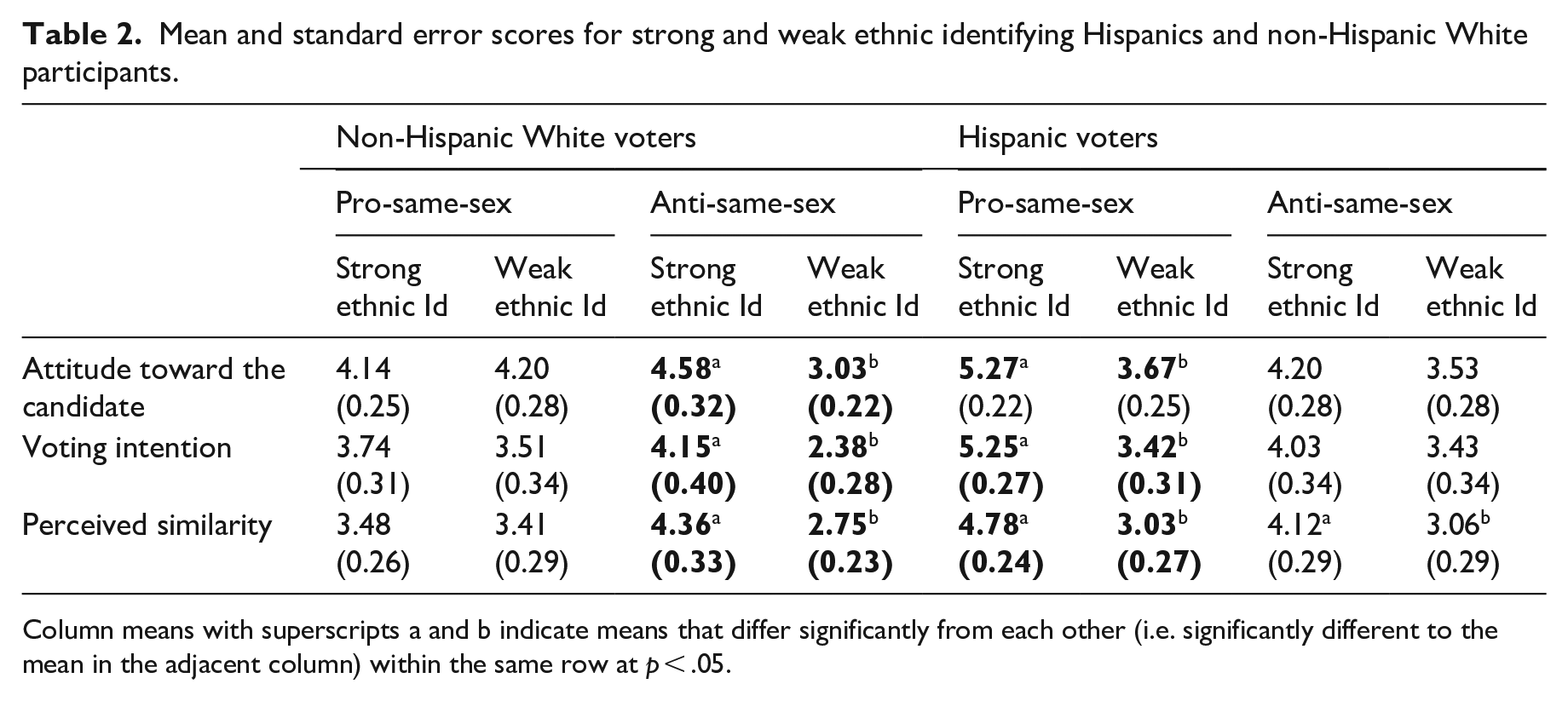
Column means with superscripts a and b indicate means that differ significantly from each other (i.e. significantly different to the mean in the adjacent column) within the same row at p < .05.
Voting intention
As H2b predicted, ANCOVA results revealed a significant 3-way interaction between 2 (Participant race: White vs Hispanic) × 2 (Political candidate’s stance: pro-same-sex vs anti-same-sex marriage) × 2 (Strength of Ethnic Identity: Strong vs Weak) on intentions to vote for a candidate (F (1, 293) = 9.58, p < .01, partial η2 = .03). Two-way results indicate that the interaction effect between 2 (Political candidate’s stance: pro-same-sex vs anti-same-sex marriage) × 2 (Strength of Ethnic Identity: Strong vs Weak) was significant for both Whites (F (1, 147) = 4.51, p < .05, partial η2 = .03) and Hispanics (F (1, 139) = 5.60, p < .05, partial η2 < .04).
Simple effect analyses indicated that Hispanics with strong ethnic identities (M = 5.25, SD = 1.63) demonstrated significantly greater intentions to vote for a pro-same-sex marriage candidate as opposed to Hispanics with weak ethnic identity (M = 3.42, SD = 1.61, p < .05). Conversely, Whites with strong ethnic identities (M = 4.15, SD = 2.41) demonstrated significantly greater intentions to vote for an anti-same-sex marriage candidate than Whites with weak ethnic identity (M = 2.38, SD = 1.77, p < .05). H2b was supported.
Perceived similarity
Finally, as H2c predicted, ANCOVA results revealed a significant 3-way interaction between 2 (Participant race: White vs Hispanic) × 2 (Political candidate’s same-sex marriage stance: pro-same-sex marriage vs anti-same-sex marriage) × 2 (Strength of Ethnic Identity: Strong vs Weak) on perceived similarity to a candidate (F (1, 293) = 6.99, p < .01, partial η2 < .02). Two-way results indicate that the interaction effect between 2 (Political candidate’s stance: pro-same-sex vs anti-same-sex marriage) × 2 (Strength of Ethnic Identity: Strong vs Weak) was significant for Whites (F (1, 147) = 5.76, p < .05, partial η2 = .04) but not for Hispanics (F (1, 139) = 2.31, p = .13, partial η2 < .02).
Simple effect analyses indicated that Hispanics with strong ethnic identities (M = 4.78, SD = 1.61) demonstrated significantly greater perceptions of similarity toward a pro-same-sex marriage candidate as opposed to Hispanics with weak ethnic identity (M = 3.03, SD = 1.31, p < .05). Conversely, Whites with strong ethnic identities demonstrated greater perceptions of similarity toward an anti-same-sex marriage candidate (M = 4.36, SD = 1.98) than Whites with weak ethnic identity (M = 2.75, SD = 1.59, p < .05). Unexpectedly, Hispanics with strong ethnic identities had greater perceptions of similarity toward an anti-same-sex marriage candidate (M = 4.15, SD = 2.03) than Hispanics with weak ethnic identities (M = 3.04, SD = 1.54). Overall, however, H2c was supported.
General discussion
The current study explored whether Hispanics were more likely than Whites to exhibit significantly greater preferences and support for a co-ethnic political candidate in US Senate elections than a candidate of a different race/ethnicity. Results reveal that neither Hispanic nor White individuals displayed differences in their attitudes toward a candidate or in their intentions to vote for a candidate based on the candidate’s race/ethnicity. Whites, however, unlike Hispanics, perceived more similarity to a co-ethnic candidate than one from a different racial/ethnic background. These findings may be cause for optimism, as neither Hispanics nor Whites appear to base their political attitudes or voting intentions solely on a candidate’s race/ethnicity. Hispanic and White voting behaviors and attitudes appear to be issue-dependent. Findings also demonstrate that the degree to which racial/ethnic members affirm their racial/ethnic affiliations influence their voting proclivities when facing a religiously controversial and morally framed social issue such as same-sex marriage.
Whites with strong ethnic identities were found to hold significantly more favorable attitudes, greater voting intentions, and perceived greater similarity to an anti-same-sex marriage candidate than Whites with weak ethnic identities. However, Hispanics with strong ethnic identities held significantly more favorable attitudes, greater voting intentions, and perceived greater similarity with a pro-same-sex marriage candidate than Hispanics with weak ethnic identities. These results offer implications for SIT.
A major contention of SIT is that individuals’ social category membership represents important aspects of their self-definition (Schmitt et al., 2007). Individuals who perceive a threat to the positive distinctiveness of their valued ingroup identity by an outgroup will seek to protect their ingroup’s distinctiveness (Jetten et al., 2004). Schmitt et al. (2007) postulate that members of high-status groups who feel entitled to their higher status, engage in deliberate attempts to maintain rank; attempting to extinguish efforts by lower-status groups striving to become more prominent, as in the case of gay men or lesbians seeking the legal right to marry. For heterosexual Whites who are strong ethnic identifiers, attempts made by same-sex individuals to attain marriage rights may diminish the positive distinctiveness of marriage and may pose a symbolic threat to White heterosexual identities. Hispanic and other racial/ethnic minority groups do not represent high-status groups in the United States and consequently may not feel as threatened by other lower-status groups seeking to advance.
The US Census Bureau estimates that racial/ethnic minorities will make up a majority of the US national population by 2042 (Lichter, 2012). This projected demographic shift, along with the Supreme Court’s ruling that paved the way for same-sex couples to marry nationwide (Liptak, 2015), threatens numerous social norms within the country, particularly for a White population that has long relied on traditional values to uphold a position of preeminence. Rapidly evolving cultural norms and an increasing perception of their membership in a dwindling racial/ethnic group are increasingly difficult to ignore, causing many Whites to perceive that the prestige they once held may now be eroding. Arguably, White individuals who may be the most conscious of the privilege and positive distinctiveness of their racial/ethnic ingroup status may be those with strong White ethnic identities (Elias et al., 2016). Corenblum and Stephan (2001) found a correlation between Whites’ increases in their ethnic identity and perceived out-group threat.
One of the unexpected findings of the study was that strong ethnic identifying Hispanics perceived greater similarity with anti-same-sex marriage candidates than weak Hispanic ethnic identifiers. Strong identifiers also perceived greater similarity with pro-same-sex marriage candidates than weak Hispanic identifiers. In short, strong ethnic Hispanic identifiers seem to see greater degrees of similarity between themselves and anyone that is advocating a political message than weak ethnic identifiers. This may speak more to the agency of strong ethnic identifying Hispanics than anything else but it may also represent a confluence of willing activism and ideological ambiguity. For candidates disavowing same-sex marriage, some Hispanics may retain elements of a “machismo” culture that allows for identification with those that hold anti-same-sex marriage views. For the other independent variables, however, attitude toward the candidate and voting intentions, strong ethnic Hispanic identifiers did not differ statistically from weak ethnic Hispanic identifiers. Future studies could examine in more detail why strong ethnic identifiers perceived similarity with both pro-same-sex political candidates and anti-same-sex candidates to a significantly greater degree than weak ethnically identifying Hispanics.
Limitations
The results of this study should be approached with caution. This study is limited by the use of the electronic experimental method. The use of an electronic experiment creates a limitation of participants to those with both computer and Internet access. This may not be a representative national sample as it does not represent a random sampling of the population, only those who opted in for Qualtrics’ panels. A significant limitation of a single experimental design is the question of generalizing the findings to other participants and societies because the studies are underpowered. In such situations, different results might be observed for a general population. Besides, the experiment was conducted only once and included a small sample. Scientific research develops generalizations from an entire line of research including multiple replications. To increase the generalizability of our findings, it is reasonable to argue that these findings could be more effective if more studies are conducted using similar contexts but in different societies to gain external validity (generalizability). We suggest that scholars replicate such studies across subjects and societies using different experimental designs as well. As a diverse population of researchers is interested and multiple replication studies are conducted, the evidence will be strengthened without compromising on internal validity.
However, Ansolabehere and Schaffner (2014) compared opt-in Internet panel samples to national samples acquired through random digit dialing of landlines and cell phones. Using a total survey error approach, they found that an opt-in Internet panel produced estimates that are as accurate as a telephone survey. Future studies may use larger sample sizes and include more sounds in their experimental methods.
In addition, the theoretical contribution of our study should also be interpreted with caution. We relied on social identification theory, but our results did not support the argument that Hispanics were more likely than Whites to show greater preferences and support for a co-ethnic political candidate, as both ethnic groups would support the candidate from their own ethnic group. Future studies can use theoretical lenses such as cleavage theory or democratic participant theory to explain the attitudes and behavior of various ethnic, religious, and social groups.
