




Abstract
We examined the influence of news media literacy, focusing on knowledge of the media industry, on media trust in Vietnam—a distinctive media environment subject to governmental control and ownership. Results from 307 survey responses (N = 307) indicated that knowledge of media categorizations negatively predicted multiple dimensions of media trust. In addition, online newspapers, the only media category that can legally produce “hard” news in Vietnam, acquired the highest public trust among media categories. Theoretically, we contributed to the literature on news media literacy in the era of globally declining media trust, specifically yielding insights into news media literacy and media trust in a non-Western setting with a unique media system controlled and owned by its government. Practically, our results suggested that Vietnam needs widespread media literacy education and enhancement programs to foster citizens’ media literacy, particularly knowledge of the media industry. News media organizations and journalists, on the contrary, may employ various strategies to build trust among their audience, including being transparent about their categorization and governing body, harnessing social media platforms, and devising sections to promote media literacy in the media. We argue that our approach and findings can be applied to study the media in authoritarian contexts or countries where the media are strictly governed. Implications, limitations, and suggestions for future research were further discussed.
Both academia and the industry have been increasingly focusing on news literacy, particularly news quality and credibility (Maksl et al., 2015; Tully et al., 2022; Vraga et al., 2012). News literacy, a narrowed area of media literacy, plays a vital role in navigating the public in a risky media environment and educating media consumers on how to critically approach the media (Al & Zou’bi, 2022; Tully et al., 2022). Digital media literacy has been found to help people distinguish between mainstream news content and false sources (Guess et al., 2020). As a result, their trust in mainstream media may not decrease (Ognyanova et al., 2020). While the impact of news literacy on news trust is widely investigated, only a few (Ashley et al., 2010) have probed into the association between knowledge of the news industries (e.g. media ownership and types of organization) and news credibility. Knowledge of the news industry is a prominent construct of news media literacy (Maksl et al., 2015). It is similar to the context construct in the five core domains of news literacy (Tully et al., 2022). Context is a conceptualization of the news industry and concerns the influences of social institutions (e.g. media ownership, the government, and media-related legal frameworks) on news organizations’ operations (Shoemaker & Reese, 2014).
We thus examine the relationship between media consumers’ knowledge of the news industry and news trust in Vietnam, a country with a government-owned and -controlled media system. Investigating the subject in the context of Vietnam fills various literature gaps. First, international data in news literacy, which sheds light on the differences in regulation and freedom of the press in different countries, are urgently needed (Tully et al., 2022). Second, research on factors influencing trust in the news has primarily been conducted in the United States (Gronke & Cook, 2007; Ladd, 2011) and other Western countries, thus limiting the generalizability of findings within other contexts (Tsfati & Ariely, 2014). News credibility in Asian nations, particularly, has not been comprehensively studied (Zhang et al., 2019). We, therefore, adhere to the calls for the de-Westernization in media scholarship (Dutta & Pal, 2020; Tran & Diep, 2022; Waisbord & Mellado, 2014). Third, we also test the validity of the latest media trust framework of Strömbäck et al. (2020), which conceptualizes news media trust in different dimensions based on concepts of media.
Results will further provide news publishers with recommendations to improve their credibility among the public. Since trust in the news media has been declining worldwide (Bridges, 2019), scholars and practitioners can learn which factors impact media consumers’ perception of news and news organizations to develop strategies to restore audiences’ trust. From that, media houses and other institutions may adjust their approaches to educating the public and enhancing news literacy. Moreover, insights into the complexity of media trust and media knowledge in Vietnam can be applicable to studying similar media systems in authoritarian regimes or those that are under strict governmental control. We, in that sense, treat Vietnam as a case study to explore.
While the concepts of credibility (i.e. being trustworthy) and trust (i.e. a belief in trustworthiness) may be distinct (Mayer et al., 1995), in the realm of media research, “media trust,” “media credibility,” and “media trustworthiness” are interchangeable (Engelke et al., 2019; Otto & Köhler, 2018; Tsfati & Cappella, 2003). We thus interchangeably use media trust and media credibility in our study. On the contrary, news literacy and media literacy are indeed not equivalent. The news media environment in Vietnam, nevertheless, is complex and legally defines news differently from other countries; we will later discuss these complexities in our literature review. We henceforth use the term “news media literacy” to capture news literacy/media literacy and focus particularly on knowledge of the news media industry.
The state of news media in Vietnam
Vietnamese media is fundamentally government-owned and -controlled. Vietnam’s 2016 Press Law (Press Law No. 103/2016/QH13), along with 19 other legal documents, regulates news ownership. According to the law, all news outlets must register under a specific owner, which can be a government organization, a communist party organization, or a social, religious, or political group at the provincial level or higher (Nguyen & Bui, 2019). The law also allows associations, termed sociopolitical, sociopolitical-professional, or socio-professional organizations, to own media entities. These associations are seen as having less government control and high fragmentation (Nguyen & Bae, 2023).
Online media sites that produce news and “journalistic alike information products” are primarily categorized into four different groups, that is, online newspapers (báo điện tử), specialized sites of online newspapers (chuyên trang báo điện tử), e-magazines (tạp chí điện tử), and aggregated information sites (trang thông tin điện tử tổng hợp). The law describes online newspapers as journalistic products that use writing, images, and sounds transmitted on the network environment, including electronic newspapers and electronic magazines (e-magazines). A specialized site of online newspapers, meanwhile, is an information website on a particular topic consistent with the principles and purposes of the electronic newspaper. It has a domain name under the domain name specified in the electronic newspaper’s operating license. E-magazines are journalistic products that post specialized articles, are published periodically, and are transmitted on the network environment. An aggregated information site is a journalistic information product of an agency, organization, or enterprise that provides general information, posts access links to press sources, or quotes verbatim and accurately press sources according to the provisions of intellectual property law. The fundamental difference between these categories is their ability to produce journalistic products and content types, such as hard news or soft news. Hard news focuses on serious, current events with significant impact, for example, politics, international affairs, and business. Soft news, on the contrary, deals with lighter topics that entertain or inform individuals about lifestyle, celebrities, arts, and culture (Newman et al., 2016).
Vietnamese policymakers have recently expressed increased concerns about the privatization of newspapers, as well as the “newspaper-ization” of e-magazines and aggregated information sites since these organizations, principally, are not legally allowed to produce “hard” news (HN, 2022). Specialized sites of online newspapers and e-magazines can produce “soft” news or news related to their specializations. Meanwhile, aggregated information sites are merely permitted to aggregate news and information from other sources. Similar to Vietnam, the rise in the privatization and commercialization of news media worldwide is indeed perceived as troublesome since news coverage has gradually turned to align with the interests of the elites and focuses on stories that generate profit rather than informing the public (Ashley, 2019).
Moreover, the Vietnamese government restricts private ownership of news media. Loopholes (e.g. fragmented policies), however, allow international magazines (e.g. Her World, Harper’s Bazaar, and Elle) to legally operate, as well as create a surge in information-independent websites (Nguyen & Bae, 2023). The situation mirrors that of China where media commercialization and market forces, which generally depart from the State’s instructive, have diversified media outlet types (Luo, 2015; Stockmann, 2012). With these ambiguities, Vietnam’s media environment is considered less strict than Singapore, one of its Southeast Asian neighbors (Lehmann-Jacobsen, 2017). The media landscape in Vietnam, nevertheless, may arguably foster the rise of aggregated news sites and tabloidization, which puts online news information management in disarray (Duong, 2016). The Vietnamese government has been responding by issuing multiple regulations and revised decrees in 2008, 2013, and 2017 to control the new players (Nguyen & Bae, 2023).
Vietnam is currently executing its press restructuring plan (i.e. press development and management planning) until 2025 (Ministry of Information and Communication (MIC), 2019). The approved plan aims to create government-backed multimedia outlets to shape public perceptions and control information narratives within and beyond the country’s borders (Nhan Dan, 2019). In addition, re-organizing the press system nationwide has been argued to improve the performance and diversity of the press, as well as distinct regulatory frameworks for media organizations categorized by their functions (e.g. political, scientific research, and entertainment; Luu, 2018). The plan is, nevertheless, perceived as limiting newspapers as it requires them to operate under governmental agencies to publish “hard” or breaking news (Reuters, 2023).
Fundamentally, because media organizations need to register for a government-approved license to publish information, the government has the power to change or provoke organizations’ licenses to limit the publication of information. Zing News, now Znews, is a prominent example. The MIC changed its initial license from an online newspaper to an e-magazine, which limits the types of information it could legally publish (i.e. from hard and breaking news to soft news; Nguyen, 2020). Later, Znews’ operating license was revoked for 3 months for posting articles that did not meet the principles and purposes mentioned in the license and having the sign of “newspaper-ization” of e-magazines (An Khue, 2023; MIC, 2023).
Blurred lines between the definitions of media organizations, as a result, generate confusion among the public, leading to Vietnamese media consumers’ misled perceptions and assessments of online news organizations. News literacy enhances media consumers’ savviness and ability to distinguish information quality (Hobbs, 2010; Livingstone, 2004). Hence, highly literate individuals (i.e. people with decent knowledge about legal frameworks and policies in journalism) may be able to determine the forms of media organizations and the types of information those organizations can (legally) produce. Such a unique context of the media industry offers a promising opportunity to examine Vietnamese audiences’ knowledge of media ownership and their trust in different aspects of the media.
Media literacy and knowledge
Media literacy refers to the ability to access, analyze, evaluate, and communicate various messages from the media (Hobbs, 2008). Media literacy is not only about skills development but also the acquisition of knowledge in media content patterns, effects, and the media industry (Christ & Potter, 1998). While there has not been a universal definition for media literacy (Hobbs & Jensen, 2009; Potter, 2010), the literature suggests that media education helps individuals to think critically and evaluate news analytically (Tobias, 2008). As a result, they become savvy news consumers and producers who can differentiate between low- and high-quality information (Hobbs, 2010; Livingstone, 2004).
The cognitive model of media literacy (Potter, 2004) and the news media literacy measurements (Maksl et al., 2015) both emphasize the significance of media knowledge. These scholars posit five “knowledge structures” in news media literacy, including learning about media content (e.g. trends in news coverage), industries (e.g. news media ownership), effects (e.g. agenda-setting), the real world, and self (Maksl et al., 2015; Potter, 2004). Generally, the model concentrates on news values and news-making processes; the influence of media economics, ownership, and control on its content; and the outcome of news exposure, both positive and negative (Maksl et al., 2015). Structures of knowledge interact with individuals’ needs and cognitive abilities to digest news information and construct meaning (Potter, 2004). That is when they become media-literate.
Knowledge indeed plays a critical role in predicting various consequences of news media literacy, for example, conspiracy theories rejection, media trust, or, broadly, citizen competency (Amazeen & Bucy, 2019; Ashley, 2019; Craft et al., 2017; Kahne & Bowyer, 2017; Mihailidis & Thevenin, 2013; Newman, 2018). Nevertheless, the measurements of media literacy often rely on beliefs and attitudes toward the media (Potter & Thai, 2019), but not on fact-based knowledge tests. Meanwhile, its examination approaches are inconsistent and lack focus on media industries, particularly media ownership (Amazeen & Bucy, 2019; Maksl et al., 2015; Vraga et al., 2015). Individuals who have little knowledge of news production, the media industry, and how media are regulated might have lower levels of trust in news media (Firmstone et al., 2022). We thus put our focus on fact-based and legal knowledge of the news media industry.
Media context, conceptualized as the social, economic, and legal environment in which news is produced, has been contemporarily recognized as one of the five core elements of news literacy (Tully et al., 2022). News literacy demands critical analysis of context, that is, news media structures and institutions (Ashley, 2019). The approach emphasizes understanding the social construction of news, information selection processes, and the broader context in which news operates. Based on gatekeeping theory (Shoemaker & Vos, 2009) and the influential hierarchy model (Shoemaker & Reese, 2014), context demonstrates the impact of news organizations (e.g. ownership), social institutions (e.g. government), and social systems (e.g. political system and legal frameworks) on news production and content. Several legal and political structures, for instance, can shape the environment in which news is gathered, processed, and disseminated, potentially reflecting via news content (Ashley, 2019). It further warrants the need to examine individuals’ fact-based knowledge of the news media industry.
Furthermore, regarding digital media literacy, users have five criteria for evaluating internet information credibility, that is, accuracy, authority, objectivity, currency, and coverage (Alexander & Tate, 1999; Fritch & Cromwell, 2001; Meola, 2004). The assessment of the authority of a website or a news site is to acknowledge who authors the site and its affiliation(s). Verifying news authorship thus influences news credibility negatively; the less individuals check news sites’ authorships, the more they perceive the site as credible (Choi & Lim, 2019). In an iterative model proposed by Fritch and Cromwell (2001), verifying a website’s author and/or institutional identity enhances the overall perception of its cognitive authority. Media literacy promotion thus bolsters individuals’ proficiency in differentiating between false and mainstream news content (Guess et al., 2020). As individuals tend to obtain news or information from news aggregators, news authorship verification warrants academic attention (Choi & Lim, 2019). Nevertheless, limited research (Ashley et al., 2013; Maksl et al., 2015) has been conducted to investigate knowledge related to the institutions producing news, awareness regarding the potential impact of such content, and perceived control over news media influences. Users with high levels of news media literacy indeed have a basic comprehension of media content and industries and believe they can control media influence (Vraga et al., 2015).
Given the extraordinary characteristics of the media landscape in Vietnam (i.e. a government-owned and -controlled news system), we examine public knowledge of the media industry in Vietnam, focusing on public knowledge of media ownership, control, and legal frameworks regulating what type(s) of media organizations can produce “news.” Media ownership is about who owns and runs media organizations and their functions, while media control focuses on the larger power umbrella that regulates the media system. Meanwhile, media categorization questions audiences’ knowledge about media types and their ability to produce which information types. The findings respond to the need for diverse data on new literacy (e.g. knowledge about the news media industry) in contexts with distinct regulations, media business models, and freedom of the press (Newman, 2018). As argued earlier, Vietnam’s media system has complex and unique laws and regulations. Examining Vietnamese audiences’ knowledge of these three dimensions (i.e. media ownership, media control, and media categorization) can reveal the current state of news literacy and contribute to the literature, particularly on the theoretical frameworks of news literacy, its measurements, and its influence on media trust. News literacy can help audiences navigate complicated media environments, for instance, distinguishing news from other types (e.g. misinformation). Hence, results can be helpful for scholars and practitioners to propose solidly informed guidelines for receptive audiences (Tully et al., 2022).
RQ1. How knowledgeable are Vietnamese news media consumers about (a) the categorizations of media organizations, (b) media ownership, and (c) media control as defined by the laws of the country?
Media trust
Media trust, which is the opposite of distrust or media skepticism, is often used interchangeably with concepts of media credibility and media trustworthiness (Engelke et al., 2019; Otto & Köhler, 2018; Tsfati & Cappella, 2003). The growing diversity of media options in the digital age (Prior, 2007; Van Aelst et al., 2017) presents certain hindrances for traditional news media and their capacity to maintain trust. Competition increases from a wider range of information sources, while the presence of alternative media may challenge the perceived objectivity of mainstream news (Ladd, 2011). Moreover, social media and virtual platforms have replaced the gatekeeping roles of traditional news and become alternatives for public engagement by political actors (Groshek & Koc-Michalska, 2017). Further compounding trust issues, disinformation and misinformation deluge the public sphere (Egelhofer & Lecheler, 2019; Kavanagh & Rich, 2018). These countless hurdles present an urgent need for examining, establishing, and sustaining public trust in news media.
One of the problems in understanding and measuring media trust is the reliance on either a single indicator or too many broad indicators as common conceptualizations of media trust are lacking (Engelke et al., 2019; Fisher, 2016). These issues present a challenge as the object of trust and the concept of “news media” become ambiguous (Tsfati et al., 2022), particularly in high-choice media environments where the notion of news media is more complex than it was in the past. The issue of conceptual ambiguity in news media trust is due to the employment of unspecific measures in most operational-level research (Tsfati et al., 2022). Although studies utilizing these broad conceptualizations have produced valuable insights and are beneficial for comparative research (Hanitzsch et al., 2018; Tsfati & Ariely, 2014), they do not include the various dimensions where media trust can exist. These levels range from trust in news media in general to trust in different types of media (Fawzi et al., 2021; Strömbäck et al., 2020), especially in distinct media systems.
Several efforts to develop and validate a multidimensional measurement scale for media trust have been made, suggesting that trust in news media has four separate dimensions based on journalistic practices (Kohring & Matthes, 2007) or should be considered as a single-factor measure when utilized as a variable (Yale et al., 2015). As the news media concept is more complex and has multiple partly overlapping facets, the latest scholastic attempt posits that media trust should look at the significant variability to which trust refers, such as institutions, organizations, media practitioners, or the news reported in diverse platforms (Strömbäck et al., 2020). In addition, individuals may have distinct ideas about what they trust when responding to inquiries about news media trust (Daniller et al., 2017; Ladd, 2011). Studies have shown that it is increasingly difficult to discern what individuals think when they trust news media (Daniller et al., 2017), explicitly concerning news media in general.
We further adopt the measurements of media trust in five aspects, that is, general trust in the media, trust in different media types, trust in media brands, trust in journalists, and trust in media content, as proposed by Strömbäck et al. (2020). We operationalize trust in media brands as trust in media organizations (1) to make it contextually more relevant and applicable and (2) to indicate media organizations as a whole, not by a specific brand. Strömbäck et al.’s (2020) model is rather suggestive in dimensions and should be adjusted according to different news media settings.
Previous studies have indeed indicated different levels of trust in different types of media worldwide. Across four countries (i.e. Brazil, India, the United Kingdom, and the United States), people tend to trust traditional news media more than news found on social media, search engines, or messaging apps (Mont’Alverne et al., 2022). Such findings were specifically applicable to the United States where trust in local and national news organizations surpasses trust in social media (Gottfried & Liedke, 2022). In European countries, public broadcasters are particularly trusted, with studies showing high trust in public television (Fotopoulos, 2023; Welker, 2009). Traditional print media also enjoys some trust, with regional and national newspapers garnering more trust than online magazines (Welker, 2009). Based on the 2016 Vietnamese Press Laws, we explore media organizational categories following their legal capability to produce news or aggregate information, including (1) online newspapers, (2) specialized sites of online newspapers, (3) e-magazines, and (4) information aggregation sites. We expect that news media consumers in Vietnam trust the four media categories differently.
RQ2. Do Vietnamese audiences have significantly different levels of trust in online newspapers, specialized sites of online newspapers, e-magazines, and information aggregation sites?
News trust and literacy
Limited literature has suggested the relationship between news media literacy and trust in varied mechanisms. News media literacy can lead to higher knowledge about media practices, as well as online civic and political engagement (Jeong et al., 2012; Kahne et al., 2012). Therefore, exposure to news media literacy information can increase trust in news stories’ credibility and the media (Vraga et al., 2012). It enhances media consumers’ perception of news credibility and media objectivity. Higher news media literacy also enhances the critical news information process (Kong et al., 2021), news consumption and skepticism, and knowledge about current events (Maksl et al., 2015). Individuals who are news literate have higher skepticism and can employ cognitive reflection to recognize the truth in news content (De Paor & Heravi, 2020; Maksl et al., 2015).
Different types of media ownership result in various perceptions of media trust (Zhang et al., 2019), which depends on individual characteristics, for example, news media literacy (Maksl et al., 2015; Pornpitakpan, 2004). Scholars posit that the audience tends to trust state-controlled media, primarily those from Asian countries, more than market-oriented media (Xu, 2012; Zhang et al., 2014) for various reasons. For instance, audiences believe that government-owned news organizations are more prestigious, provide higher quality products, and serve the public interest (Liu & Bates, 2009; Tsfati & Ariely, 2014; Zhang et al., 2014). Furthermore, officials’ media publicity symbolizes nationalistic achievement and leadership in particular contexts, such as authoritarian settings (Jaros & Pan, 2018).
On the contrary, others have suggested that the more knowledgeable audiences are about the media industry, including media ownership, the more skepticism and less trust they have toward news messages (Ashley et al., 2010). State-controlled media, hence, often receive less reliance due to their assumed bias reports (Gehlbach & Sonin, 2014) as it would manipulate information and hinder audiences from making informed decisions (Djankov et al., 2003). Thus, market-oriented media may offer less biased, more accurate, and more knowledgeable coverage thanks to the privatization offering diverse incentive mechanisms and attracting competent professionals (Djankov et al., 2003; Estrin et al., 2009; Megginson, 2010; You et al., 2018). Due to the inconsistency in previous findings, we propose two RQs to explore the relationship between news media consumers’ knowledge of the news media industry and their trust in different dimensions of media trust. We further examine the relationship between knowledge and different news media organizations categories as they are prominent areas in the Vietnamese government’s press restructuring plan and efforts to differentiate which media organizations can legally produce hard news and other types of information to control the quality.
RQ3a. How does knowledge of the news media industry influence (a) general media trust, (b) trust in media content, (c) trust in journalists, and (d) trust in media organizations?
RQ3b. How does knowledge of the news media industry influence trust in (a) online newspapers, (b) specialized sites of online newspapers, (c) e-magazines, and (d) aggregated information sites?
Method
Data collection
Data for the study were collected via a Qualtrics survey in which respondents had to provide consent before participating. The questionnaire received approval from the institutional review board (IRB) at Louisiana State University and takes about 12 to 15 minutes to complete. The target population was Vietnamese aged 18 and above. They were recruited via convenience sampling (e.g. via social media) and snowball sampling. Pilot data collection began in March 2023 and the survey was officially closed in December 2023.
We prepared 150 gift cards, each of which was worth 20.000 VND (i.e. approximately US$0.82), as incentives for the respondents. Respondents had the option (i.e. it was not mandatory) to provide their email addresses in a separate Qualtrics survey. The first 100 respondents who completed the survey and entered their email addresses would automatically receive a gift card. Other respondents, if elected, would be entered into a random lottery for the rest of the gift cards. Participants’ email addresses were deleted after the gift cards were distributed. A convenient sample of 307 qualified responses was received (N = 307). Responses qualified for data analysis were those (1) fully completed and (2) passed all quality and concertation checks. Furthermore, we mindfully assessed and excluded, if needed, responses that had a straightlining percentage score > 0.80.
Sample
The average age of the sample was 28.75 (Median = 26, SD = 9.32). About two-thirds (205 respondents, 66.78%) of the respondents were female while 97 respondents (24.41%) were male. Respondents in the sample were relatively well-educated. Only two respondents (0.65%) had not finished high school. On the contrary, 234 respondents (76.21%) obtained at least an undergraduate degree and 52 respondents (16.93%) had a graduate degree. About one-third of the respondents (115 respondents, 37.46%) were studying and/or working in journalism, media, mass communication, or related fields, for example, advertising, public relations (PR), or marketing. Respondents also reported their monthly income based on an 11-level scale (0 = < 2,000,000 VND (i.e. about US$82.47) to 10 = > 20,000,000 VND (i.e. about US$824.66; M = 5.55, SD = 3.75). According to the General Statistics Office of Vietnam, in the second quarter of 2023, the average monthly salary of Vietnamese people was 7,000,000 VND, which was approximately equivalent to income = 3 on the 11-level monthly income scale. Descriptive statistics for respondents’ demographics are provided in Table 1; the average income range was based on statistics from the General Statistics Office of Vietnam (GSO, 2023).
Demographic characteristics of the sample.
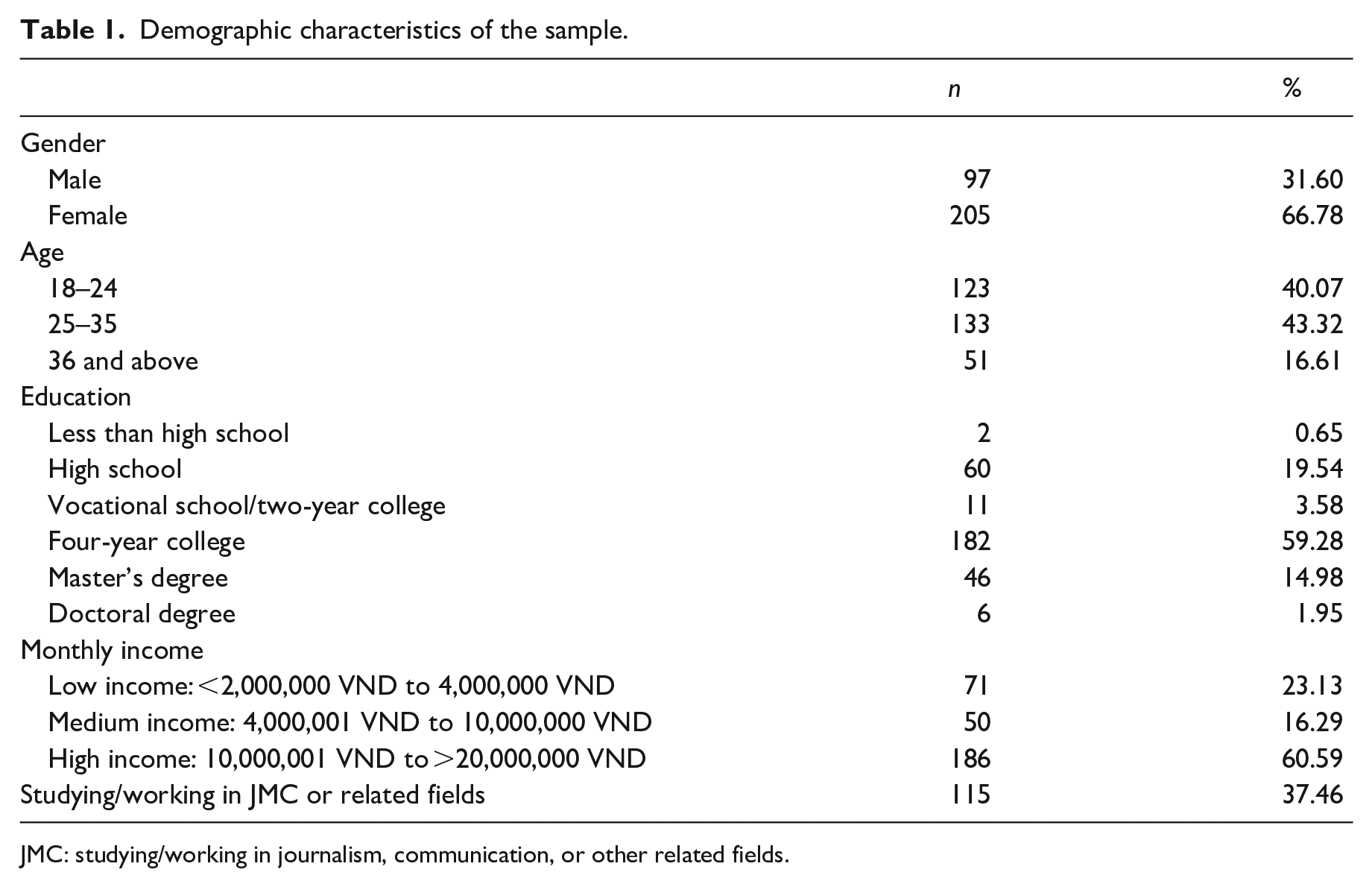
JMC: studying/working in journalism, communication, or other related fields.
Measurements
Media trust
Adapted from the studies by Strömbäck et al. (2020) and Williams (2012), respondents’ media trust consisted of five dimensions, that is, general trust in the media (Trust; M = 3.21, SD = 1.45, ω = 0.81), trust in media content (TrustC; M = 3.23, SD = 1.08, ω = 0.83), trust in journalists (TrustJ; M = 3.22, SD = 1.09, ω = 0.86), trust in media organizations (TrustO; M = 3.28, SD = 1.17, ω = 0.89), and trust in media categories (TrustT). As introduced in the literature review, Vietnamese Press Law categorizes online media sites that produce news and “journalistic alike information products” into four different categories, that is, online newspapers, denoted as T1 (M = 3.58, SD = 1.04, ω = 0.82); specialized sites of online newspapers, denoted as T2 (M = 3.15, SD = 1.13, ω = 0.87); e-magazines, denoted as T3 (M = 3.18, SD = 1.02, ω = 0.86); and aggregated information sites, denoted as T4 (M = 2.86, SD = 1.31, ω = 0.90). Each of these dimensions was measured via four seven-level Likert-type scale questions (0 = Strongly disagree to 6 = Strongly agree) asking if respondents believed that the media in general, media content, journalists, media organizations, and each media category in Vietnam was “fair,” “able to tell the whole story,” “accurate,” and “able to separate facts from opinions” when reporting news.
In the questionnaire, each of the media categories was represented by respective media organizations to ensure that the knowledge test was not compromised. For example, to gauge respondents’ trust in online newspapers, the questions referred to their trust in Tuổi Trẻ and VnExpress, which are by law online newspapers, instead of directly asking about online newspapers. Items employed to measure media trust can be found in Appendix 2 (see Supplemental Material). Table 2 provides reliability statistics, descriptive statistics, and factor loadings for each of the dimensions.
Reliability statistics, descriptive statistics, and factor loadings for each of the dimensions of media trust.
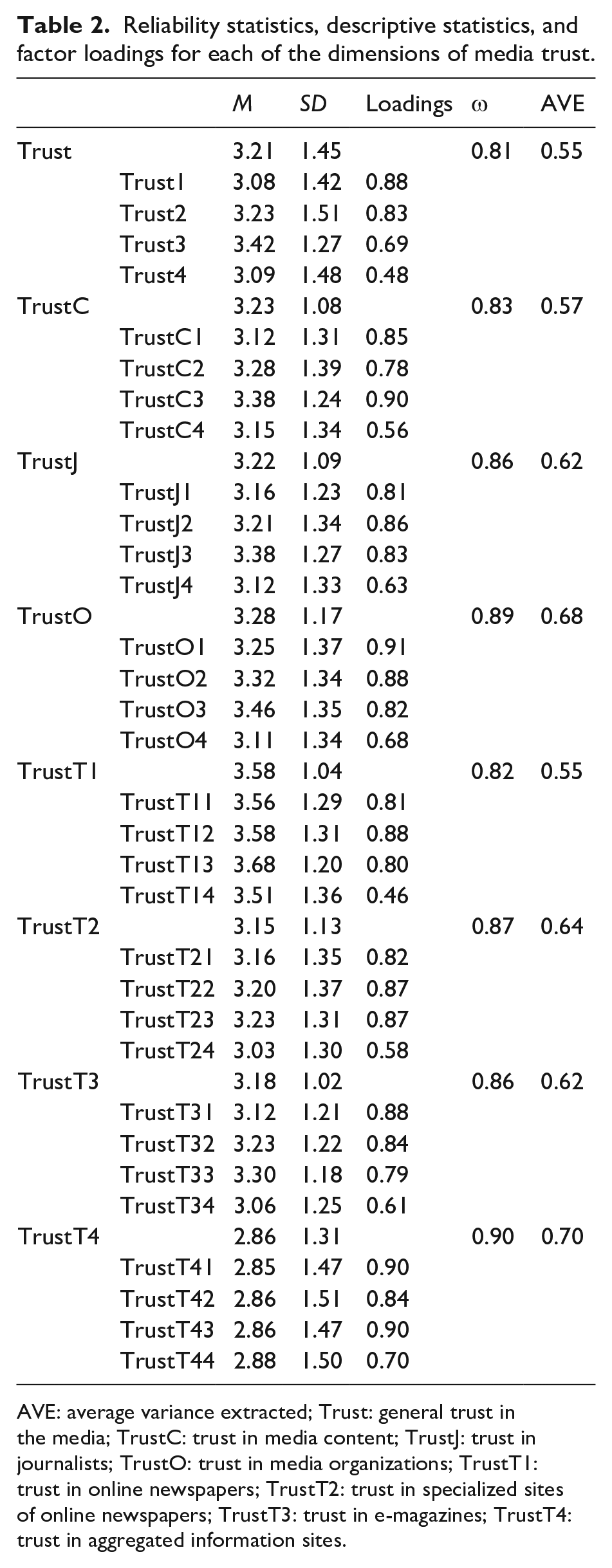
AVE: average variance extracted; Trust: general trust in the media; TrustC: trust in media content; TrustJ: trust in journalists; TrustO: trust in media organizations; TrustT1: trust in online newspapers; TrustT2: trust in specialized sites of online newspapers; TrustT3: trust in e-magazines; TrustT4: trust in aggregated information sites.
Knowledge of the media industry
Knowledge of the media industry consisted of three dimensions. Knowledge of media categorizations (KnowC) was measured via eight multiple-choice questions. These questions tested whether respondents could precisely identify the categories of eight media organizations. Respondents scored one point for each correct answer; the scale hence ranged between 0 and 8 and was converted into a seven-level scale (0 to 6; M = 3.33, SD = 1.44) for equivalent comparison with the other dimensions of knowledge of the media industry. Eight Vietnamese media organizations were randomly selected to feature in the questionnaire from an exhaustive list and based on their readership, with two representing each media category. They were Tuổi Trẻ and VnExpress, representing online newspapers; Khởi Nghiệp Trẻ and Du Lịch, representing specialized sites of online newspapers; Zing News and Sao Star, representing e-magazines; and Kênh14 and Soha, representing aggregated information sites. Random selection was employed to (1) avoid biases of or familiarity with the news organizations selected and (2) enhance the diversity of media ownership.
Knowledge of media ownership (KnowO; M = 2.66, SD = 1.68) and knowledge of media control (KnowL; M = 3.27, SD = 1.31) were seven-level scales, each based on six multiple-choice questions about respondents’ general knowledge of media laws in Vietnam, as well as media organizations’ legal permission and responsibilities. These questions were generated from legal documents released by the Vietnam MIC, as well as media organizations’ registered permits and registration claims on their websites as of 4 October 2022 (MIC, 2024). A similar method had previously been employed to measure knowledge about the media industry (Ashley et al., 2010; Maksl et al., 2015).
Controlling variables
Apart from respondents’ demographic characteristics, including age, gender, education, income, and whether they were studying and/or working in journalism, media, mass communication, or related fields (e.g. advertising, PR, or marketing), we also surveyed their exposure to online news media by adapting and adjusting measurements from Goyanes (2020), Ku et al. (2019), and Newman et al. (2022). We identified three primary sources of online news in Vietnam, including online mainstream media and subsidiaries of those mainstream media (e.g. official social media pages or YouTube channels; ExpM; M = 3.43, SD = 1.33), social media platforms (e.g. Facebook, YouTube, TikTok, or Zalo; ExpNM1; M = 4.08, SD = 1.28), and the general internet (e.g. search engines, blogs, or emailed newsletters; ExpNM2; M = 3.76, SD = 1.21). The first category was considered mainstream news sources while the latter two categories were considered non-mainstream news sources. Measurement was based on a seven-level Likert-type scale ranging from 0 = Never (about 0%) to 6 = Always (about 100%).
Results
RQ1 questioned Vietnamese media consumers’ knowledge about (a) the categorizations of media organizations, (b) media ownership, and (c) media control as defined by the laws of the country. Results from a within-subject repeated measures analysis of variance (ANOVA) indicated that media consumers in Vietnam, in general, were significantly more knowledgeable about media categorizations (M = 3.33, SD = 1.44) and media control (M = 3.27, SD = 1.31) in the country than media ownership (M = 2.66, SD = 1.68) although the law has unmistakably stated that Vietnamese media is fundamentally government-owned and -controlled; F (2, 918) = 19.07, p < 0.001, η2 = 0.04 (see Table 3 and Figure 1).
Respondents’ knowledge of the media industry.
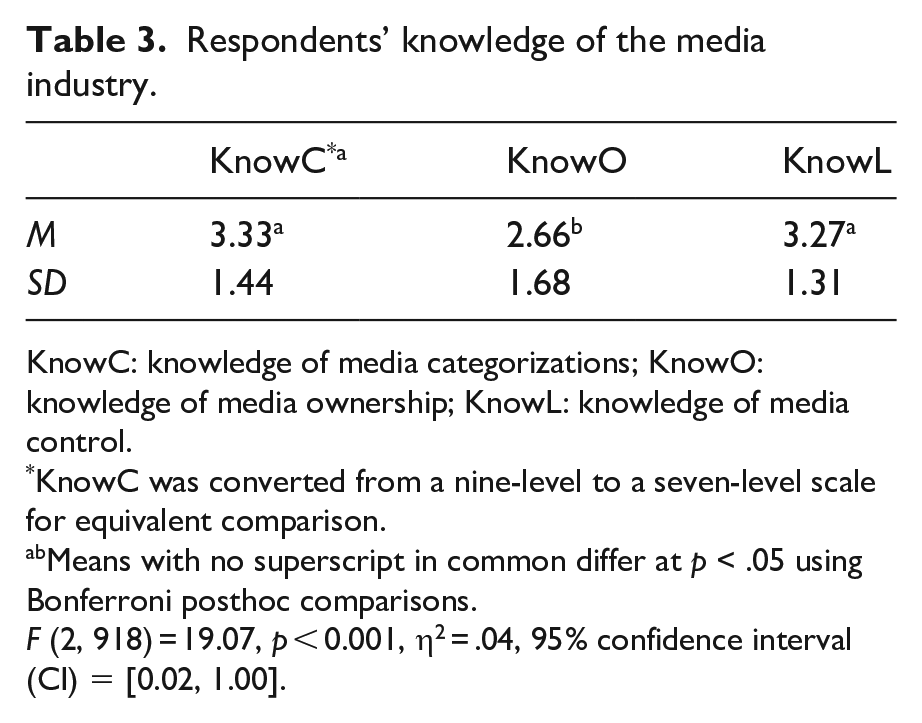
KnowC: knowledge of media categorizations; KnowO: knowledge of media ownership; KnowL: knowledge of media control.
KnowC was converted from a nine-level to a seven-level scale for equivalent comparison.
Means with no superscript in common differ at p < .05 using Bonferroni posthoc comparisons.
F (2, 918) = 19.07, p < 0.001, η2 = .04, 95% confidence interval (CI) = [0.02, 1.00].
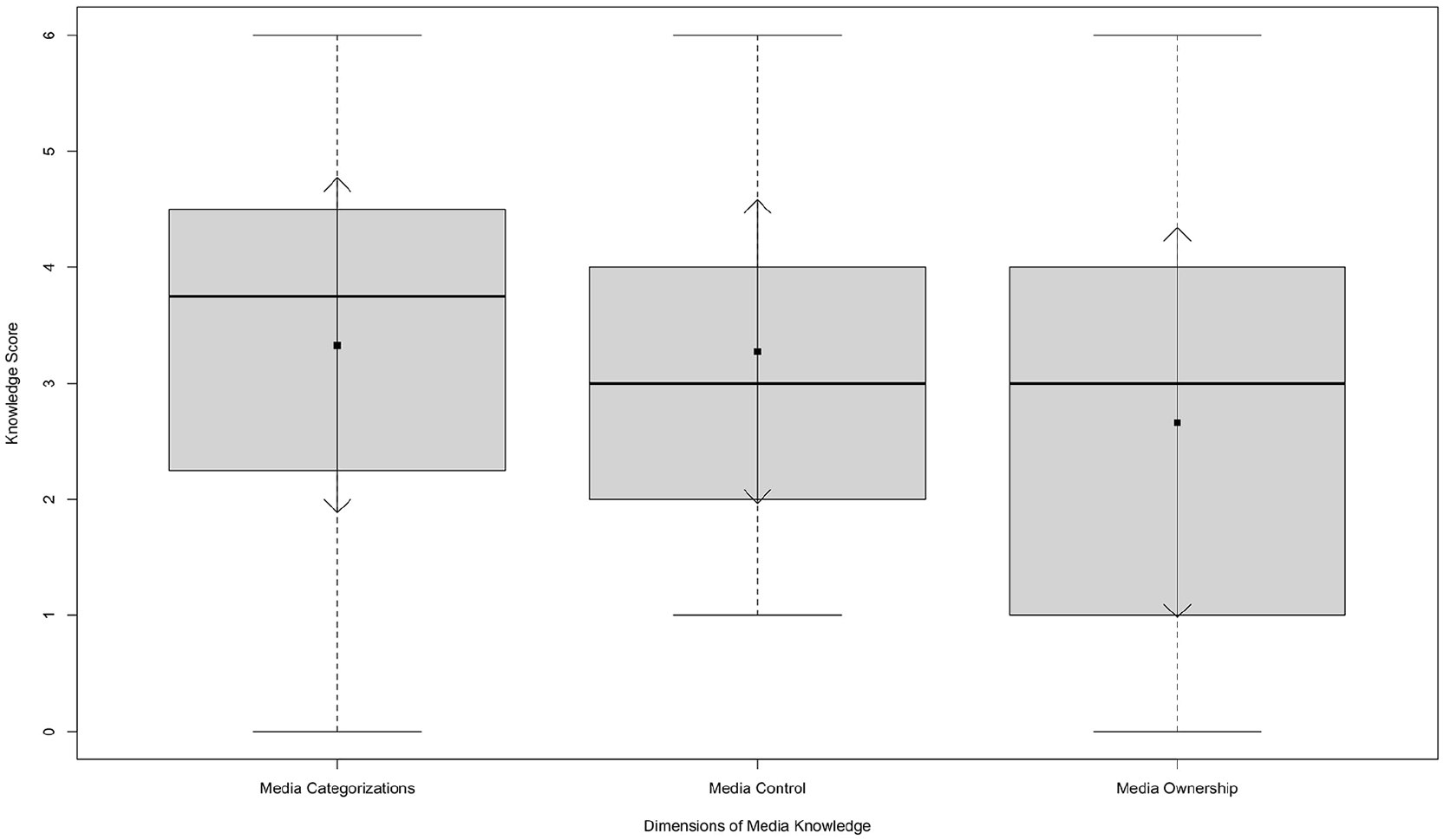
Respondents’ knowledge of the media industry; square points and arrows represent means and standard deviations by means, respectively.
RQ2 focused on the differences in Vietnamese media consumers’ trust in the four media categories (i.e. online newspapers, specialized sites of online newspapers, e-magazines, and aggregated information sites). Results from another within-subject repeated measures ANOVA suggested that there were indeed statistically significant differences in the levels of trust in the four media categories; F (3, 1,208) = 22.93, p < 0.001, η2 = 0.05 (see Table 4 and Figure 2). Respondents trusted online newspapers (M = 3.62, SD = 0.99) significantly more than specialized sites of online newspapers (M = 3.19, SD = 1.09), e-magazines (M = 3.22, SD = 0.96), and aggregated information sites (M = 2.90, SD = 1.28; see Figure 2).
Respondents’ trust in the four media categories.
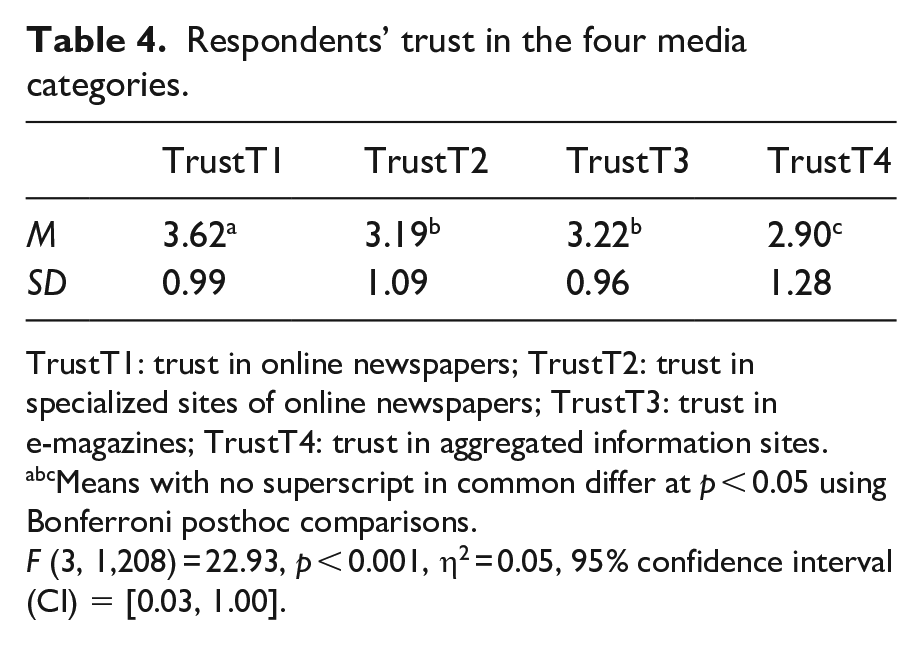
TrustT1: trust in online newspapers; TrustT2: trust in specialized sites of online newspapers; TrustT3: trust in e-magazines; TrustT4: trust in aggregated information sites.
Means with no superscript in common differ at p < 0.05 using Bonferroni posthoc comparisons.
F (3, 1,208) = 22.93, p < 0.001, η2 = 0.05, 95% confidence interval (CI) = [0.03, 1.00].
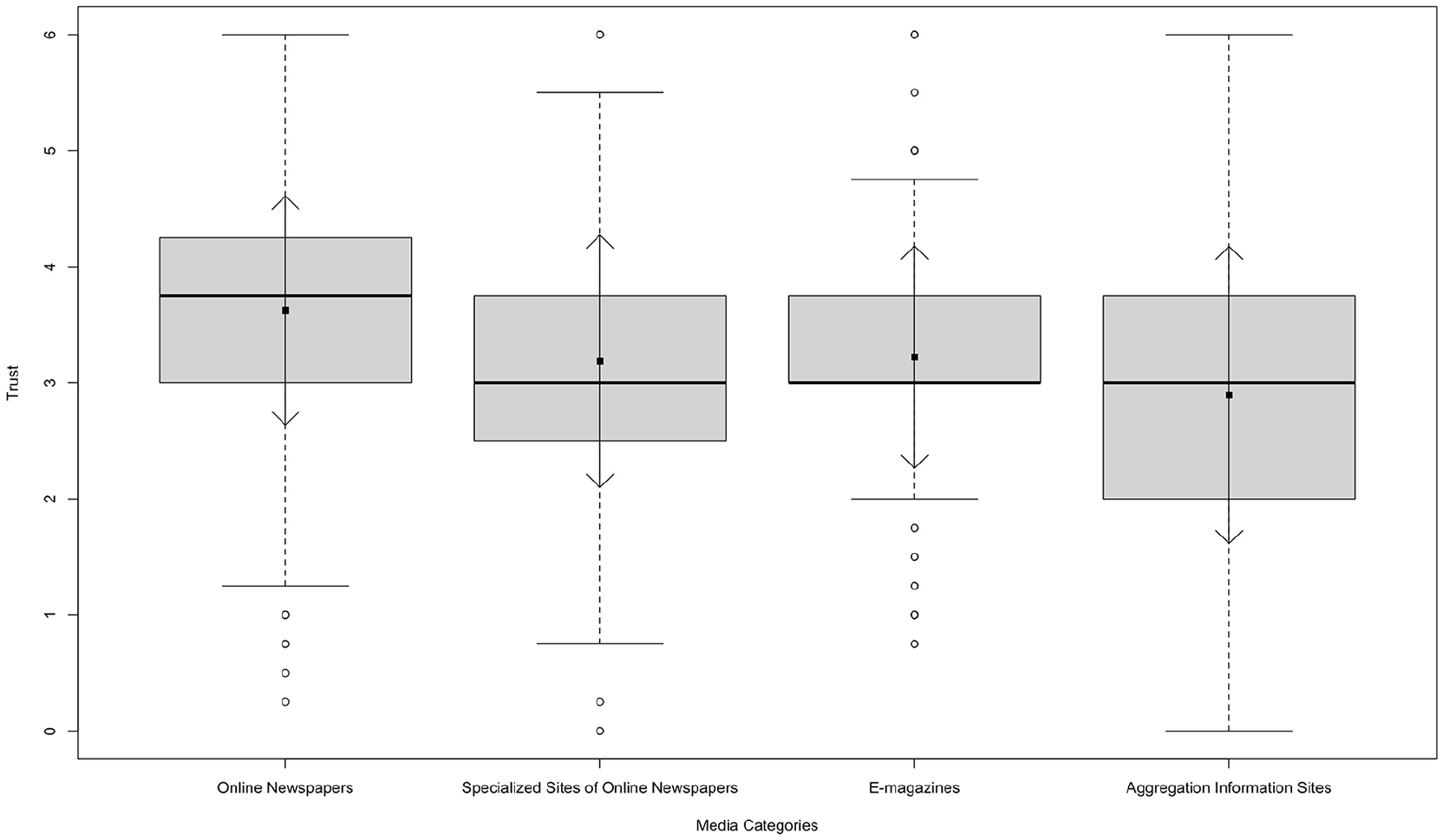
Respondents’ level of trust in the four media categories; square points and arrows represent means and standard deviations by means, respectively.
RQ3a questioned the predictive power of knowledge of the news media industry on (a) general media trust, (b) trust in media content, (c) trust in journalists, and (d) trust in media organizations. Furthermore, RQ3b questioned the predictive power of knowledge of the news media industry on news media consumers’ trust in (a) online newspapers, (b) specialized sites of online newspapers, (c) e-magazines, and (d) aggregated information sites. We employed structural equation modeling (SEM) to investigate these two RQs. In our estimated structural model, the three dimensions of knowledge of the media industry (i.e. KnowC, KnowO, and KnowL) acted as single-indicator exogenous factors, while the eight dimensions of media trust (i.e. Trust, TrustC, TrustJ, TrustO, TrustT1, TrustT2, TrustT3, and TrustT4) acted as endogenous factors. Since factors representing media trust were fundamentally constructed from the same questionnaire, for the purpose of the analysis, indicators with similar wording had their error terms correlated (Brown, 2015). Furthermore, we entered respondents’ demographic characteristics (i.e. age, gender, education, income, and whether they were studying and/or working in journalism, media, mass communication, or related fields) and exposure to online news media (i.e. exposure to online mainstream media and subsidiaries of those mainstream media, exposure to news on social media platforms, and exposure to news on the general internet) as single-indicator exogenous factors. Model fit indices indicated good fitting; χ2 (588, 302) = 980.73, p < 0.001; comparative fit index (CFI) = 0.95, root mean square error of approximation (RMSEA) = 0.05; standardized root mean square residual (SRMR) = 0.03. The suggestion for a “relatively good” maximum likelihood (ML)-based estimation by Brown (2015), Hu and Bentler (1999), and Kline (2023) was CFI ⩾ 0.95, RMSEA ⩽ 0.06, and SRMR ⩽ 0.08. The correlation matrix of the latent factors is provided in Appendix 1 (see Supplemental Material).
Among the three dimensions of knowledge of the media industry, only knowledge of media categorizations (KnowC), controlling for the effects of the other predictors, had statistically significant associations with dimensions of media trust. It was negatively associated with general trust in the media (Trust; b = –0.15, β = –0.17, z = –2.48), trust in journalists (TrustJ; b = –0.11, β = –0.16, z = –2.22), trust in media organizations (TrustO; b = –0.11, β = –0.13, z = –1.99), trust in specialized sites of online newspapers (TrustT2; b = –0.14, β = –0.18, z = –2.59), and trust in aggregated information sites (TrustT4; b = –0.16, β = –0.18, z = –3.02).
Such results (see Tables 5 and 6) suggested that as Vietnamese media consumers became more knowledgeable about the way news institutions in Vietnam were categorized (i.e. higher scores of KnowC), they increasingly had less trust in virtually all aspects of the media. KnowC, on the contrary, did not have a statistically significant connection with trust in media content (TrustC; b = –0.08, β = –0.11, z = –1.60), trust in online newspapers (TrustT1; b = –0.02, β = –0.03, z = –0.46), and trust in e-magazines (TrustT3; b = –0.07, β = –0.10, z = –1.49). The other two dimensions of knowledge of the media industry, that is, knowledge of media ownership (KnowO) and knowledge of media control (KnowL), meanwhile, were not significantly associated with any of the dimensions of media trust.
Unstandardized regression coefficients of the predictors on general media trust, trust in media content, trust in journalists, and trust in media organizations.
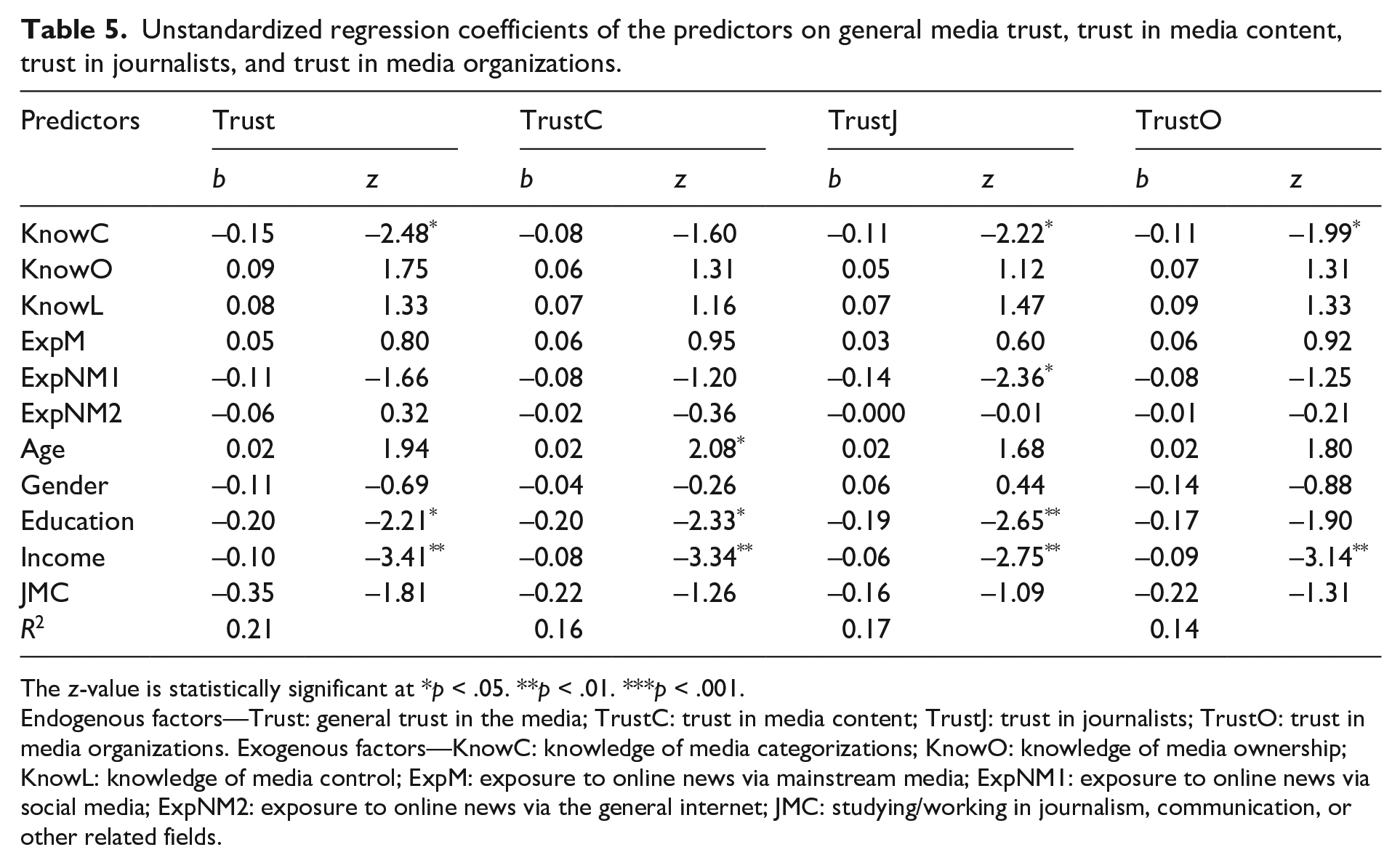
The z-value is statistically significant at *p < .05. **p < .01. ***p < .001.
Endogenous factors—Trust: general trust in the media; TrustC: trust in media content; TrustJ: trust in journalists; TrustO: trust in media organizations. Exogenous factors—KnowC: knowledge of media categorizations; KnowO: knowledge of media ownership; KnowL: knowledge of media control; ExpM: exposure to online news via mainstream media; ExpNM1: exposure to online news via social media; ExpNM2: exposure to online news via the general internet; JMC: studying/working in journalism, communication, or other related fields.
Unstandardized regression coefficients of the predictors on trust in online newspapers, trust in specialized sites of online newspapers, trust in e-magazines, and trust in aggregated information sites.
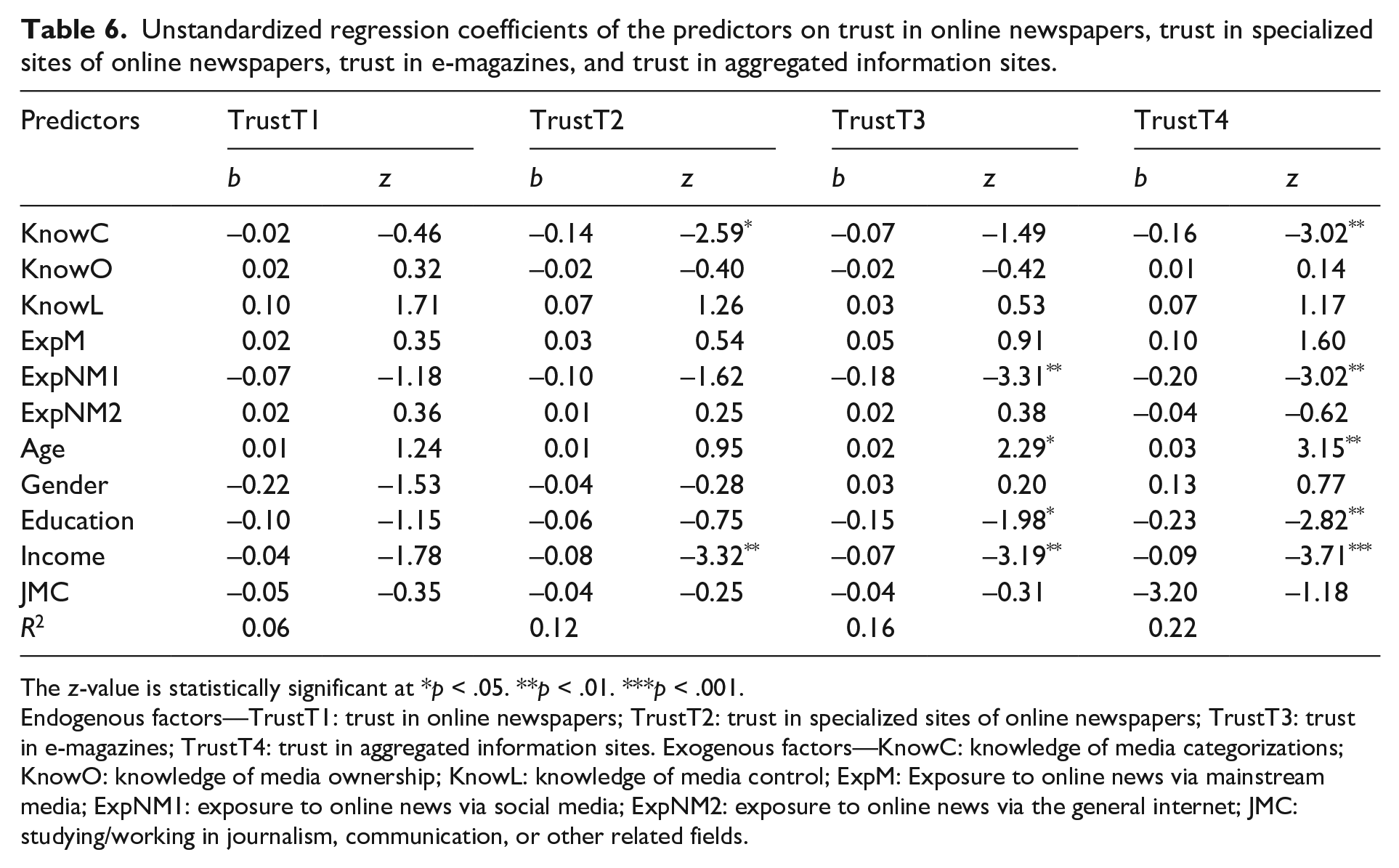
The z-value is statistically significant at *p < .05. **p < .01. ***p < .001.
Endogenous factors—TrustT1: trust in online newspapers; TrustT2: trust in specialized sites of online newspapers; TrustT3: trust in e-magazines; TrustT4: trust in aggregated information sites. Exogenous factors—KnowC: knowledge of media categorizations; KnowO: knowledge of media ownership; KnowL: knowledge of media control; ExpM: Exposure to online news via mainstream media; ExpNM1: exposure to online news via social media; ExpNM2: exposure to online news via the general internet; JMC: studying/working in journalism, communication, or other related fields.
Regarding the controlling factors, increased exposure to news on social media platforms (ExpNM1) was significantly connected to decreased trust in journalists (b = –0.14, β = –0.18, z = –2.36), trust in e-magazines (b = –0.18, β = –0.23, z = –3.31), and trust in aggregated information sites (b = –0.20, β = –0.20, z = –3.02). As for demographic characteristics, age significantly and positively influenced Vietnamese news consumers’ trust in media content (b = 0.02, β = 0.18, z = 2.08), trust in e-magazines (b = 0.02, β = 0.20, z = 2.29), and trust in aggregated information sites (b = 0.03, β = 0.23, z = 3.15).
Education and income, on the contrary, significantly and negatively predicted media trust. Education had statistically significant and negative relationships with general trust in the media (b = –0.20, β = –0.17, z = –2.21), trust in media content (b = –0.20, β = –0.18, z = –2.33), trust in journalists (b = –0.19, β = –0.19, z = –2.65), trust in e-magazines (b = –0.15, β = –0.15, z = –1.98), and trust in aggregated information sites (b = –0.23, β = –0.18, z = –2.82). Higher income, meanwhile, was significantly associated with lower trust in general trust in the media (b = –0.10, β = –0.29, z = –3.41), trust in media content (b = –0.08, β = –0.28, z = –3.34), trust in journalists (b = –0.06, β = –0.23, z = –2.75), trust in media organizations (b = –0.09, β = –0.27, z = –3.14), trust in specialized sites of online newspapers (b = –0.08, β = –0.26, z = –3.32), trust in e-magazines (b = –0.07, β = –0.25, z = –3.19), and trust in aggregated information sites (b = –0.09, β = –0.28, z = –3.71). Vietnamese news consumers with better socioeconomic status, hence, seemed to have significantly less trust in the country’s public media.
Discussion
This study is one of the initial efforts to examine various elements related to media trust and literacy, particularly in the context of a government-owned and -controlled media system. The results, which are based on a convenient and snowball sampling, are nevertheless exploratory and suggestive rather than generalizable. First, it investigates the influence of news media literacy, focusing on knowledge of media structures and ownership, on media trust in the era of declining media trust worldwide. Second, the results yield insights into news media literacy and media trust in a non-Western setting with a unique media system controlled and owned by its government. As we treated Vietnam as a case study, our approach and findings can be applied to other authoritarian contexts or countries where the media are strictly governed. Third, we examined a newly proposed conceptualization and operationalization of media trust by Strömbäck et al. (2020), thus providing intriguing results and potentially suggesting directions for future research.
Among the four categories of media organizations, online newspapers, the only news outlets that can legally produce hard news in Vietnam, acquired the highest public trust. Trust in online newspapers was significantly higher than in the other three media categories, supporting previous findings that audiences tend to believe publicly owned media and their websites (online newspapers, in our case), as well as local and national news organizations, than online magazines or private media (in our case, outlets related to commercialized organizations such as aggregated information sites; Fotopoulos, 2023; Gottfried & Liedke, 2022; Welker, 2009). Aggregated information sites received the least trust from the audiences perhaps because they do not produce news themselves but collect and publish information from other sources. Such practices make these sites be perceived as tabloids that have low publication quality and cause turmoil in online information management (Duong, 2016). The results suggested that the types of media may be influential on consumers’ media trust. Furthermore, these results can be further explained when knowledge of media categorizations is at play.
Vietnamese news consumers possess a moderate understanding of media ownership and control, indicating their likelihood to acknowledge the government’s control over and ownership of the press. Nevertheless, among the three dimensions of media knowledge, the knowledge score for media ownership was the lowest and below average. Such a result suggests that audiences are either not aware of or hold misconceptions about government agencies or corporations operating media outlets. Despite being readily available on media outlets’ websites, information about media ownership is rarely reviewed by the Vietnamese public. The result based on a seven-level self-reporting survey question asking whether respondents checked for the information (e.g. using Google search) while completing the knowledge test or not (0 = Not at all to 6 = For every question; M = 1.20, SD = 1.54) revealed that 156 respondents (50.81%) did not at all attempt to look up the information while answering the questions.
Regarding the three dimensions of media knowledge (i.e. knowledge of media categories, media ownership, and media control), knowledge of media categorizations negatively predicts dimensions of media trust, except for trust in online newspapers and e-magazines. The finding indicates that the more knowledge Vietnamese audiences have about how media organizations are categorized, the less they trust the media, particularly specialized sites of online newspapers and aggregated information sites. These findings are consistent with previous studies suggesting that people are more skeptical and have less trust in the media as they have more knowledge of the media industry (Ashley et al., 2010). Nevertheless, the relationship is not significant for online newspapers and e-magazines, perhaps because government-owned newspapers are viewed as more prestigious and high-quality than other forms of publication (Liu & Bates, 2009; Tsfati & Ariely, 2014; Zhang et al., 2014).
The other two dimensions of media knowledge, however, did not have statistically significant relationships with media trust. The result is contradictory to prior findings suggesting that literacy of media ownership heightens media skepticism, an opposing notion of media trust (Ashley et al., 2010). In the context of Vietnam where the prevalent argument is that the public’s lack of trust in the media is due to government ownership and control, such a statistically insignificant result is indeed meaningful and substantial. Individuals are often assumed to distrust state-controlled media due to suspected bias and manipulation (Djankov et al., 2003; Gehlbach & Sonin, 2014). Meanwhile, market-oriented media, driven by profit and competition, are perceived as more objective and reliable (Djankov et al., 2003; Estrin et al., 2009; Megginson, 2010; You et al., 2018). Our findings, perhaps, supported this idea. Understanding media trust in strictly controlled systems thus requires examining factors beyond government control and the complexities of media trust.
As for the controlling variables, frequent exposure to news on social media lessened trust in journalists, e-magazines, and aggregated information sites. Social media fuels negative views of journalism. People often encounter criticism accusing journalists of bias or favoring powerful figures. Some individuals believe that journalists prioritize getting attention over accuracy; journalists, consequently, are believed to manipulate stories to serve particular agendas (Mont’Alverne et al., 2022). Furthermore, younger individuals with higher socioeconomic status tend to have less trust in the media.
Practically, our results suggest that Vietnam needs widespread media literacy education and enhancement programs to foster citizens’ media literacy, particularly knowledge of the media industry as citizens’ current understating of the country’s media industry is relatively poor. Since journalism is often perceived as a watchdog and the Fourth Estate of society, media laws and regulations, as well as media literacy, should be mandatory in civil courses and journalism modules, both in high schools and higher education. For ordinary citizens, familiarity with the media industry fosters comprehension of the information they consume, who is behind the news they read daily (i.e. media types and their functions), and which qualities to expect from the news. For journalists, understanding the media industry is to understand their roles and responsibilities in producing news (i.e. what types of news they can produce and what strategies to stay relevant, yet legal, in a strictly governed media system to deliver quality and helpful information).
On the contrary, news media organizations can build trust by focusing on both public image and the quality of journalism. Journalists can harness social media platforms for personal branding purposes and defend their works as audiences’ exposure to information on social media may lessen trust in journalists. Furthermore, media organizations can clarify their categorization by specifying their governing body and functions (e.g. on their website), thus providing the audiences with necessary information. Media outlets can also have particular sections to promote media literacy (e.g. explain news production and educate readers about media regulations). It should be a win-win situation for both the audience and media organizations as they would share the same understanding of how the media work. Nevertheless, as complex as the conceptualization of trust, building trust in news media includes nuanced processes that require a multifaceted approach. As aggregated information sites seem to receive negative perceptions from audiences, one potential approach for these curated content platforms to consider is implementing a quality control system for filtering news content from external sources. The procedure should ensure the accuracy, reliability, and credibility of the information presented to users.
We also evaluated the viability of a novel multidimensional approach to measuring trust as proposed by Strömbäck et al. (2020). To comprehensively understand trust in the media, the factor of trust must be examined across different levels of news production. We addressed the issue of problematic measurements of media trust, which have previously been too broad or unspecific (Daniller et al., 2017; Tsfati et al., 2022), by incorporating various aspects of media trust recommended by scholars (Fawzi et al., 2021; Strömbäck et al., 2020). Our results contributed to the literature, particularly on the measurements of media trust since media trust differs based on what respondents think about the media, whether it is a specific platform, specific news source, or the media in general (Daniller et al., 2017; Mont’Alverne et al., 2022). Future research may adopt the theoretical frameworks examined in our study to measure media trust, given that different media types, platforms, and news content have varying impacts on trust (Skovsgaard et al., 2016; Tsfati & Cappella, 2003; Webster, 2014).
Limitations and future research
Our results were based on a convenient sample with a relatively limited number of respondents collected via a survey, whose cross-sectional nature may impact the generalizability and predictive power of the findings. Affordable high-quality surveying services, nonetheless, are lacking in Vietnam. We thus decided to rely on this sample and take an exploratory approach to understand media trust and its determinants, treating Vietnam as a unique yet understudied case study. Our results, thus, are meaningful and significantly contributed to media trust scholarship. Future studies can expand the sample size, employ quota sampling, and take comparative approaches for better generalizability and to comprehensively understand the influences of different factors on media trust.
We also recognize several limitations of our study that warrant further investigation. First, we merely examine the facet of media ownership in news media literacy since media ownership by the government is a unique characteristic of the media landscape in Vietnam, especially when compared to the majority of Western countries. Future studies can examine knowledge of the media industry related to other attributes depending on the countries being researched or contextual elements. Other dimensions of news media literacy, such as news productions, can be further investigated. Second, we did not consider other factors (e.g. culture and politics) that have been proposed to impact media trust. Future research may include more aspects of news media literacy and influential factors of media trust to have a more comprehensive understanding of the relationship between news media literacy and media trust. Finally, the study lacks comparative power as it merely investigates the media system in Vietnam. To address the issue, based on this study’s findings and methodological framework, future comparative studies may include more countries that share similar characteristics of politics, culture, and media to have more generalizable findings.
Supplemental Material
sj-docx-1-ctp-10.1177_20570473241269064 – Supplemental material for Investigating the relationship between knowledge of the media industry and media trust in a government-owned and government-controlled media system
Supplemental material, sj-docx-1-ctp-10.1177_20570473241269064 for Investigating the relationship between knowledge of the media industry and media trust in a government-owned and government-controlled media system by Huu Dat Tran and Pham Phuong Uyen Diep in Communication and the Public
Footnotes
Data availability
The dataset used in this study may be available upon request.
Declaration of conflicting interests
The author(s) declared no potential conflicts of interest with respect to the research, authorship, and/or publication of this article.
Funding
The author(s) disclosed receipt of the following financial support for the research, authorship, and/or publication of this article: The study received financial support from the Manship School of Mass Communication, Louisiana State University via the 2023 Patricia Kay Benoit Research Award.
Ethical approval
The methodology and questionnaire employed in this study received approval from the institutional review board (IRB) at Louisiana State University, Submission IRBAM-22-1160.
Informed consent
Informed consent was obtained from all individual participants included in the study. Identifying information of individual participants was not included in the publication.

Supplemental material
Supplemental material for this article is available online.
Author biographies
References
Supplementary Material
Please find the following supplemental material available below.
For Open Access articles published under a Creative Commons License, all supplemental material carries the same license as the article it is associated with.
For non-Open Access articles published, all supplemental material carries a non-exclusive license, and permission requests for re-use of supplemental material or any part of supplemental material shall be sent directly to the copyright owner as specified in the copyright notice associated with the article.
