




Abstract
Conspiracy theories flourish in the wide-open media of the digital age, spurring concerns about the role of misinformation in influencing public opinion and election outcomes. This study examines whether news media literacy predicts the likelihood of endorsing conspiracy theories and also considers the impact of literacy on partisanship. A survey of 397 adults found that greater knowledge about the news media predicted a lower likelihood of conspiracy theory endorsement, even for conspiracy theories that aligned with their political ideology.
False, misleading, and exaggerated information in general, and conspiracy theories in particular, can flourish in the digital media landscape. In the digital age of democratized information, they are more readily available than ever. The broad array of news and information outlets that offer competing versions of truth and the ease with which dubious stories are widely and rapidly shared through social media—a concern during the 2016 US presidential election campaign—can make it challenging for audiences to sort the good from the bad and have led to calls for increased news media literacy education. Questions about the reliability of news reports and problems with selective exposure are not new (Iyengar & Hahn, 2009; Prior, 2003), and the Internet has only further muddied the waters. It is also not new that social interactions affect the dissemination of news, and social media have become central to how people encounter news, whether indirectly from friends or from news organizations on social media (Hermida, Fletcher, Korell, & Logan, 2012). Social media sites such as Twitter help rumors spread among homogenous sets of partisan individuals but do not necessarily help with the correction of false information (Shin, Jian, Driscoll, & Barr, 2016). Misleading posts are often more popular than posts with accurate information, as was the case with Facebook posts containing information about Zika virus in 2016 (Sharma, Yadav, Yadav, & Ferdinand, 2017).
Conspiracy theories are attempts to explain events or practices in terms of actors secretly abusing their power to accomplish their own goals (Sunstein & Vermeule, 2009; Uscinski & Parent, 2014). Personal psychological needs for consistency and control often motivate the reasoning that can lead individuals to endorse misinformation and conspiracy theories (Festinger, 1957; Kunda, 1990). Unrelated and unresolved events and practices can be more easily understood when viewed in the context of a compelling narrative that fits with one’s preexisting beliefs. Partisan ideology has been found to play a role in the motivated reasoning that goes into conspiracy theory endorsement (CTE); liberals and conservatives alike are prone to endorsing theories that fit with their preexisting views (Miller, Saunders, & Farhart, 2015). Overall, the endorsement of conspiracy theories is a problem for a self-governing democratic society, where individuals are asked to make informed decisions. The spread of misinformation runs counter to these goals.
Meanwhile, an emerging body of work in news and media literacy suggests that individuals with higher levels of literacy are better positioned to navigate the endless flow of media messages and to become more engaged, empowered, and critical news consumers (Ashley, Maksl, & Craft, 2013; Ashley, Poepsel, & Willis, 2010; Fleming, 2015; Hobbs, 2010; Maksl, Ashley, & Craft, 2015; Maksl, Craft, Ashley, & Miller, 2016; Mihailidis, 2012; Vraga, Tully, Kotcher, Smithson, & Broeckelman-Post, 2015). News media literacy is rooted in the idea that democratic self-governance relies on an informed citizenry. Thus, the broad aims of news media literacy are to empower news consumers to seek useful and accurate information so that they may make informed decisions related to the political and social structures of society. Susceptibility to, much less endorsement of, conspiracy theories generally runs counter to these goals. Good electoral decisions and good policymaking can be elusive in the face of a misinformed public that holds fast to false beliefs, which is arguably worse than a merely uninformed public that simply lacks any knowledge on topics related to public affairs. Thus, understanding the relationship between news media literacy and conspiracy theory endorsement (CTE) helps clarify the definition of news media literacy and evaluate its usefulness as a means to dispel the false beliefs contained in conspiracy theories and improve the conditions of democratic citizenship. Given that CTE is to a large extent rooted in misinformation and biased processing of information, how may news media literacy, which is a basic type of citizen competence, mitigate individuals’ proclivity toward endorsing conspiracy?
Conspiracy theories, misinformation, and motivated reasoning
Conspiracy theories have emerged regarding a wide range of major events in American life, from the assassination of John F. Kennedy to the moon landing to the existence of aliens to the idea that 9/11 was an “inside job” (Sunstein, 2014). Sunstein and Vermeule (2009) define conspiracy theory as “an effort to explain some event or practice by reference to the machinations of powerful people, who attempt to conceal their role” (p. 205). Uscinski and Parent (2014) offer a few examples of such machinations in their definition of conspiracy: a “secret arrangement between two or more actors to usurp political or economic power, violate established rights, hoard vital secrets, or unlawfully alter government institutions” (p. 31). Conspiracy theories can occasionally be true, but most of the time they overestimate the competence of official actors, who are thought to be capable of carrying out secret nefarious actions despite evidence that such actions are rarely kept as secrets in an open society (Sunstein, 2014).
Despite popular conceptions, CTE is not the sole province of the proverbial nut-job. Writing in The Conversation, political communication scholar R Kelly Garrett (2016) notes the following: “Research into misperception, rumor, and conspiracy theory suggests that even reasonable individuals can reach conclusions that don’t align with the best available evidence.” Ultimately, he points out that anyone can be prone to embrace claims for which there is little evidence, and to defend those claims in the face of contradictory evidence. This is particularly likely when stakes are high, when outcomes are hard to explain or accept, or when a claim is consistent with one’s political values.
The power of a compelling narrative and one’s preexisting biases are often no match for conflicting information. Anyone can embrace a conspiracy theory, but there is some individual-level predisposition to acceptance of conspiracy theories: Research suggests that the best predictor of CTE seems to be the acceptance of other conspiracy theories (Sunstein, 2014).
Research examining the related phenomena of misinformation, false beliefs, misperceptions, and conspiracy theories has become popular in the 21st century across a range of fields including medicine, public health, psychology, and political communication. Some scholars include conspiracy theories as part of a broader domain of misinformation (Lewandowsky, Ecker, Seifert, Schwarz, & Cook, 2012; Miller et al., 2015) or a broader domain of false beliefs (Sunstein & Vermeule, 2009). However, others consider conspiracy theories as if they were the same as any other type of public opinion, which is always formed through a mix of information and predisposition on the part of the opinion holder (Zaller, 1992). Oliver and Wood (2014) point to “conspiracism” as a specific form of public opinion “motivated by specific political messages and individual predispositions” (p. 953). In this view, conspiracy theories are political explanations tied to invisible forces, feature compelling narrative structures, and are appealing to individuals who are predisposed to be attracted to such explanations. “Specifically, conspiracism is animated less by misinformation, paranoia, or political mistrust, and more by attributional proclivities that are commonly expressed in supernatural and paranormal beliefs” (Oliver & Wood, 2014, p. 953). In this sense, misinformation may play a role in the formation and endorsement of conspiracy theories, but conspiracy theories are distinct because of the role of individual proclivities that determine whether such a theory will be endorsed.
In an overview of misinformation research, Lewandowsky et al. (2012) found “copious evidence about people’s inability to update their memories in light of corrective information” and showed “how worldview can override fact and corrections can backfire” (p. 123). Personal biases can be too strong to allow individuals to challenge misinformation that feels good, and attempts to correct misinformation may lead to stronger endorsement of incorrect information, known as the “backfire effect.” For example, in one often-cited study, Johnson and Seifert (1994) demonstrated the uselessness of information in the face of a compelling narrative: Subjects gave incorrect reasons for the cause of a warehouse fire (paint in a storage room) even when provided with conflicting information (the storage room was empty). In other words, the effects of false information can linger. The public correction of false claims can actually have the opposite of the intended effect and reinforce the original incorrect information, a phenomenon referred to as “belief echoes” by Thorson (2016). While the consistency of a specific “backfire effect” is unclear (e.g. Wood & Porter, 2016), previous research has demonstrated how various cognitive biases, including partisan ideology, pose barriers to correcting misinformation (Kuklinski, Quirk, Jerit, Schwieder, & Rich, 2000; Nyhan & Reifler, 2010).
Two types of cognitive processes, directional and accuracy, have been found to motivate reasoning (Kunda, 1990). Research indicates that directional motivated reasoning—driven by an individual’s personal goals and which seeks a particular conclusion that fits with prior beliefs—is the primary mechanism by which CTE occurs. In contrast, reasoning motivated by accuracy goals seeks to arrive at an accurate conclusion whatever it is. Directional motivated reasoning is linked to theories of cognitive dissonance (Festinger, 1957), which is the tendency for individuals to prefer consistency in their beliefs and opinions and to act to eliminate any perceived inconsistency. Along these lines, Kunda (1990) proposed that when one wants to draw a particular conclusion, one feels obligated to construct a justification for that conclusion that would be plausible to a dispassionate observer. In doing so, one accesses only a biased subset of the relevant beliefs and rules. (p. 493)
Subsequent research in a range of fields has identified a connection between belief in conspiracy theories and “the need for cognitive closure” (Bessi et al., 2015, p. 10). Taber and Lodge (2006) suggest that “motivated skepticism” explains the biased information processing that often takes place when evaluating arguments; their research found strong evidence of a “prior attitude effect” where arguments that fit with preexisting beliefs are seen as stronger than arguments that run contrary to those beliefs.
Research consistently shows that a person’s political ideology, knowledge, and trust play a role in CTE. One recent study focused on the role of motivated reasoning and examined the impact of ideology and political knowledge on CTE (Miller et al., 2015). Researchers found that more knowledgeable conservatives were more likely to endorse conspiracy theories that made their liberal rivals look bad. For liberals, there was no relationship between knowledge and endorsement. Overall, low knowledge did not necessarily lead to endorsement. High political knowledge, especially for conservatives, was found to help rationalize one’s point of view.
At a time when the social consequences of our collective decision-making can be far-reaching, as with climate change, terrorism, and public health, addressing the misinformation flooding the Internet takes on greater urgency. For example, the democratization of information through Web 2.0 has allowed patients to take a more active role in their healthcare, which has decided benefits. However, the prevalence of misinformation online, such as the conspiracy theory regarding a link between vaccines and autism, has the negative consequence of leading some people to avoid childhood vaccinations despite the widespread and well-documented benefits provided by vaccinations (Kata, 2012). Thus, the potential impact of false beliefs that arise from CTE is significant. Researchers who have studied the social impact of CTE have found that individuals who are exposed to such theories are less likely to engage in politics or to alter their behavior in ways that could help solve a known problem (Jolley & Douglas, 2014b). Specifically, “learning” that global warming is a hoax makes people less likely to want to decrease their carbon footprint (Jolley & Douglas, 2014b), and exposure to anti-vaccination information reduces intention to vaccinate (Jolley & Douglas, 2014a). Individuals in these studies felt powerless in the face of conspiracy theories, and their social engagement suffered as a result.
Despite the strong evidence of individuals’ susceptibility to misinformation and the problems that result, Lewandowsky et al. (2012) caution against the defeatist position that human cognition is simply flawed beyond hope. Rather, they argue, misinformation can be combatted by developing skepticism and with strategies such as debiasing. “Skepticism can reduce susceptibility to misinformation effects if it prompts people to question the origins of information that may later turn out to be false” (p. 120). “Debiasing,” which uses repeated retractions of bad information and an emphasis on simple facts, can reduce susceptibility to misinformation by affirming an individual’s worldview and identity in the face of threatening or conflicting evidence. In sum, conspiracy theories rely on a combination of misinformation typically in the form of a political explanation as well as individual proclivities toward types of explanations based on powerful, invisible forces working to violate some established rule or norm. Endorsement of conspiracy theories is widespread among the public, but such theories can potentially be refuted through increased skepticism and debiasing.
The meaning and promise of news media literacy
Researchers are beginning to address the role media literacy, and specifically news media literacy, may play in countering or dampening the effects of misinformation and, therefore, in mitigating CTE. Definitions of media literacy in the research literature vary in the emphasis they place on a number of factors, but typically reference an ability to analyze, evaluate, and process mediated messages, as well as the creative or production skills necessary to self-expression and participation in democratic life (see Fleming, 2015; Maksl et al., 2015; Vraga et al., 2015 for overviews). Approaches to media literacy education, for example, have sometimes been categorized as “protectionist” or “empowering” (Hobbs & Jensen, 2009), reflecting different assumptions about potentially negative effects of media messages and positive aspects of media creation and consumption (Potter, 2010).
Potter’s (2004) cognitive theory of media literacy specifies a number of influences on the perception, selection, and interpretation of media messages, culminating in a model of media literacy as a combination of an individual’s knowledge about media, motivations, and needs related to media consumption and the intellectual abilities he or she brings to the tasks of analysis and interpretation. Relative to other conceptualizations of media literacy, Potter’s (2004) model places greater emphasis on the “conscious processing of information” and “preparation for exposures” to messages necessary to be considered media literate (p. 68). With knowledge in five domains, media content, media industries, media effects, the real world, and the self, people are much more aware during the information-processing tasks and are, therefore, more able to make better decisions about seeking out information, working with that information, and constructing meaning from it that will be useful to serve their own goals. (Potter, 2004, p. 69)
The model suggests that individuals draw on their “knowledge structures” to interpret the media messages they counter, and that their ability to do so is related to attributes of their “personal locus,” including needs and motivations for media use. The notion that knowledge about how media messages are created could be relevant to reducing susceptibility to conspiracy theories is supported by a meta-analysis of 51 studies of media literacy interventions that found a link between media literacy education and greater ability to distinguish the media world from the real world, as well as a greater awareness of media influence (Jeong, Cho, & Hwang, 2012). Media literacy training is also linked with increased perceptions of credibility and trust in news media (Vraga et al., 2012) and was found to help reduce perceptions of media bias (Vraga, Tully, & Rojas, 2009). Moreover, Kahne and Bowyer’s (2017) research demonstrates that young people who had exposure to media literacy education were significantly more likely than young people without such exposure to be guided by accuracy motivation when making judgments about controversial political claims; media literacy essentially helped young people to override the pull of prior beliefs, or directional motivation, in making such judgments.
Potter’s (2004) cognitive approach to media literacy has been adapted in research conceptualizing and testing measures of news media literacy (e.g. Maksl et al., 2015, 2016; Vraga et al., 2015). News media literacy refers to an ability to access, analyze, and interpret news messages; it is conceived as an ability to discern what information is trustworthy for the purposes of effective political participation and the exercise of self-governance (e.g. Maksl et al., 2016). Following Potter’s theorizing, a news media literate person would draw on her knowledge of the news media industry, according to her personal needs, motivations, in interpreting the news messages she encounters. The News Media Literacy (NML) scale, then, consists of a set of knowledge items—News Media Knowledge Structures (NMKS)—and two subscales—Need for Cognition (NFC) and Media Locus of Control (MLOC)—representing the “knowledge structures” and “personal locus” components of Potter’s model. The NML scale has been validated in studies involving high school students (Craft, Ashley, & Maksl, 2013; Maksl et al., 2015), college students (Ashley, Maksl, & Craft, 2017; Maksl et al., 2016), and adults (Vraga et al., 2015). While previous research has demonstrated that all three components of NML contribute to differentiating people according to their level of news media literacy (Craft et al., 2013), the NMKS index and NFC scale have yielded the strongest and most consistent results.
Research has demonstrated links between news media literacy and skepticism, trust, and credibility, findings that underscore how knowledge and motivations for news consumption shape understandings of news and, therefore, may shape how conspiracy narratives are interpreted or endorsed. High news media literacy, as measured by the NML scale, was also found to be positively related to news skepticism (Maksl et al., 2015), while learning about news media ownership was related to lower evaluations of news credibility (Ashley et al., 2010). Assessments of the credibility of news sources were found to depend on media skepticism and political cynicism and not the type (professional, citizen, partisan, or non-partisan) of news source (Carr, Barnidge, Lee, & Tsang, 2014). News media literacy has also been found to correlate with lower trust in politics (Ashley et al., 2017).
News media literacy also positively correlates with knowledge of current events and intrinsic motivation for news consumption (Maksl et al., 2015)—findings that bear on the likelihood an individual might encounter news about conspiracy theories and how he or she would process news from different types of news sources. These findings are also in line with previous research demonstrating that greater skepticism about the news media led to less exposure to non-mainstream, online news sources considered less reliable (Tsfati, 2010); that NFC moderates the relationship between skepticism and exposure to mainstream news media such that for people with extremely low NFC, skepticism resulted in less exposure (Tsfati & Cappella, 2005); and that individual differences in NFC lead to differences in motivations to consume news as well as how much is learned from it (David, 2009).
Finally, and significantly for this study, research suggests that motivated reasoning plays a role in news media literacy specifically. For example, students in media courses who watched an educational news literacy video more critically evaluated a political news program (Vraga & Tully, 2015). In an experiment in which the educational news literacy message was embedded in an explicitly partisan context, the message was “more effective in reinforcing media literacy beliefs” particularly when the partisanship was congruent with the subjects’ own political ideology (Tully & Vraga, 2017, p. 158).
The research literature reviewed here connects media literacy and news media literacy to a number of factors with the potential to influence susceptibility to CTE. News media literacy is about fostering a skeptical disposition and a critical attitude toward news content as well as its production and distribution. Thus, we expect individuals with high levels of news media literacy to be more resistant to conspiracy theories than those with low literacy levels. We pose the following hypothesis:
H. NML will mitigate individuals’ proclivity toward conspiracy theories such that each of the three NML subscales—NFC (H1a), MLOC (H1b), and NMKS (H1c)—is negatively related to levels of CTE.
Given the political character of CTE and the role of motivated reasoning in how people interpret news, we also want to explore whether the impact of news media literacy on the inclination to endorse such theories differs according to political ideology. With that in mind, we posed these research questions:
RQ1a. Is the relationship between NML and CTE the same for liberals and conservatives?
RQ1b. Does the relationship between NML and CTE hold for conspiracy theories that are congruent with an individual’s political ideology?
Method
We conducted a web survey using the Amazon Mechanical Turk system to recruit participants. 1 We sought and obtained institutional review board approval for this study.
Sample
We recruited 397 participants using Mechanical Turk in spring 2016; respondents were paid 50 cents for a complete response. While scholars have critiqued the use of Mechanical Turk for generating samples that are not representative of the US population, participants recruited through the service tend to be more diverse than the college student samples widely used in research (Berinsky, Huber, & Lenz, 2012; Buhrmester, Kwang, & Gosling, 2011). Indeed, our sample was more diverse than typical college samples, but was slightly younger, more educated, more White, and more likely to have middle incomes than the United States, according to demographics reported by the Census Bureau. 2 These differences were minor.
These demographic similarities notwithstanding, our sample skewed more liberal than the US population as a whole. Of the 397 participants, 195 (49.1%) considered themselves liberal, somewhat liberal, or very liberal, and 126 (31.7%) considered themselves conservative, somewhat conservative, or very conservative. The remaining 76 participants (19.1%) considered themselves to be moderate. Because conspiracy theories are politically charged, this difference could have implications for the analysis.
Independent variable
NML was measured with the three-component construct developed by Craft et al. (2013). The first component, mindful versus automatic thought processing, was measured using a five-item NFC scale (α = .861, M = 3.54, standard deviation (SD) = .84). Items included statements such as “I prefer to do something that challenges my thinking abilities rather than something that requires little thought” and “I prefer complex to simple problems.” The second, MLOC, which assesses how much an individual perceives herself to be in control of media influences, was measured using a six-item scale (α = .654, M = 3.45, SD = .60). MLOC included statements such as “If I am misinformed by the news media, it is my own behavior that determines how soon I will learn credible information” and “I am in control of the information I get from the news media.” Finally, the third component, NMKS, gauges how much individuals know about the institutions that produce news, how news is produced, and what effects might occur as a result of news consumption. This was measured by presenting respondents with 16 multiple-choice questions, each of which had a correct answer (α = .791, M = 9.98, SD = 3.35). Questions included knowing whether most American news media are for-profit businesses, that politics tend to be covered like horse races instead of focusing on in-depth issues, and that people who watch more television news tend to think the world is more violent than it really is. An index was computed by summing the number of correct answers for each respondent. Because the NML scale incorporates both knowledge items scored as correct or incorrect and latent concepts measured with Likert-type scales, it cannot be treated as a single measure in data analysis. Therefore, our analyses separately explored each subscale’s effect on CTE.
Dependent variable
CTE was measured by presenting respondents with a number of possible conspiracy narratives and asking the extent to which they believed those narratives to be true. The conspiracy theory narratives presented were adapted from other conspiracy theory research (e.g. Miller et al., 2015; Oliver & Wood, 2014) and included a balance of narratives associated with both conservative and liberal perspectives. For example, one conservative conspiracy theory addressed whether Barack Obama was definitely, probably, probably not, or definitely not born in the United States; a liberal conspiracy theory addressed whether vaccines are related to autism. (See Appendix 1 for the complete list of these items.) Items were coded on a 4-point scale so that a higher score meant greater endorsement of conspiracy theories (1 = definitely not true, 2 = probably not true, 3 = probably true, and 4 = definitely true). We included five conservative conspiracy narratives and five liberal narratives; the order was randomized in the administration of the survey. We created an overall CTE score for each set (conservative narratives, α = .737, M = 1.79, SD = .64; liberal narratives, α = .737, M = 2.08, SD = .61) and treated each as a separate dependent variable in the analysis.
Political ideology was measured using a 7-point Likert-type scale measure (1 = very liberal to 7 = very conservative). In the analysis addressing the first research question, political ideology was recoded into a dummy variable and moderates were excluded.
Demographics
Age, gender, educational attainment, household income, and ethnicity were measured to use as statistical controls used in all the analyses. Although ethnicity was measured using many categories, we dummy-coded the variable into White and non-White in the analysis (0 = White, 1 = non-White).
Results
The hypothesis predicted that those with higher NML would be less likely to endorse conspiracy theories. We tested this hypothesis using hierarchical linear regression. Specifically, we ran two regressions, one predicting endorsement of conspiracy theories associated with the conservative perspective and one predicting endorsement of conspiracy theories associated with the liberal perspective. Controlling for both demographics and political ideology, the three NML subscales together explained about 11% of the variance in endorsement of conservative conspiracy theories (see Table 1). Individually, just one of the three subscales—NMKS (β = −.34, t(381) = −7.53, p < .001)—was a significant predictor of conservative CTE. Specifically, those with more knowledge about the media system were less likely to endorse conservative conspiracy theories. In the model predicting endorsement of liberal conspiracy theories, the three NML subscales explained 8% of the variance while controlling for demographics and political ideology (see Table 1). Individually, only the NMKS subscale was a significant predictor of liberal CTE (β = −.32, t(381) = −6.05, p < .001). Greater knowledge of the news media system, therefore, is related to decreased endorsement of liberal conspiracy theories. These results, then, support H1c, which predicted a negative relationship between NMKS and CTE. H1a and H1b, which predicted negative relationships between the NFC and MLOC and CTE, were not supported. These results offer strong support for the conclusion that increased knowledge of the structure and routines of news media systems is related to decreased endorsement of both liberal and conservative conspiracy theories while controlling for political ideology and other demographic variables.
Summary of NML models predicting conspiracy theory endorsement (N = 397).
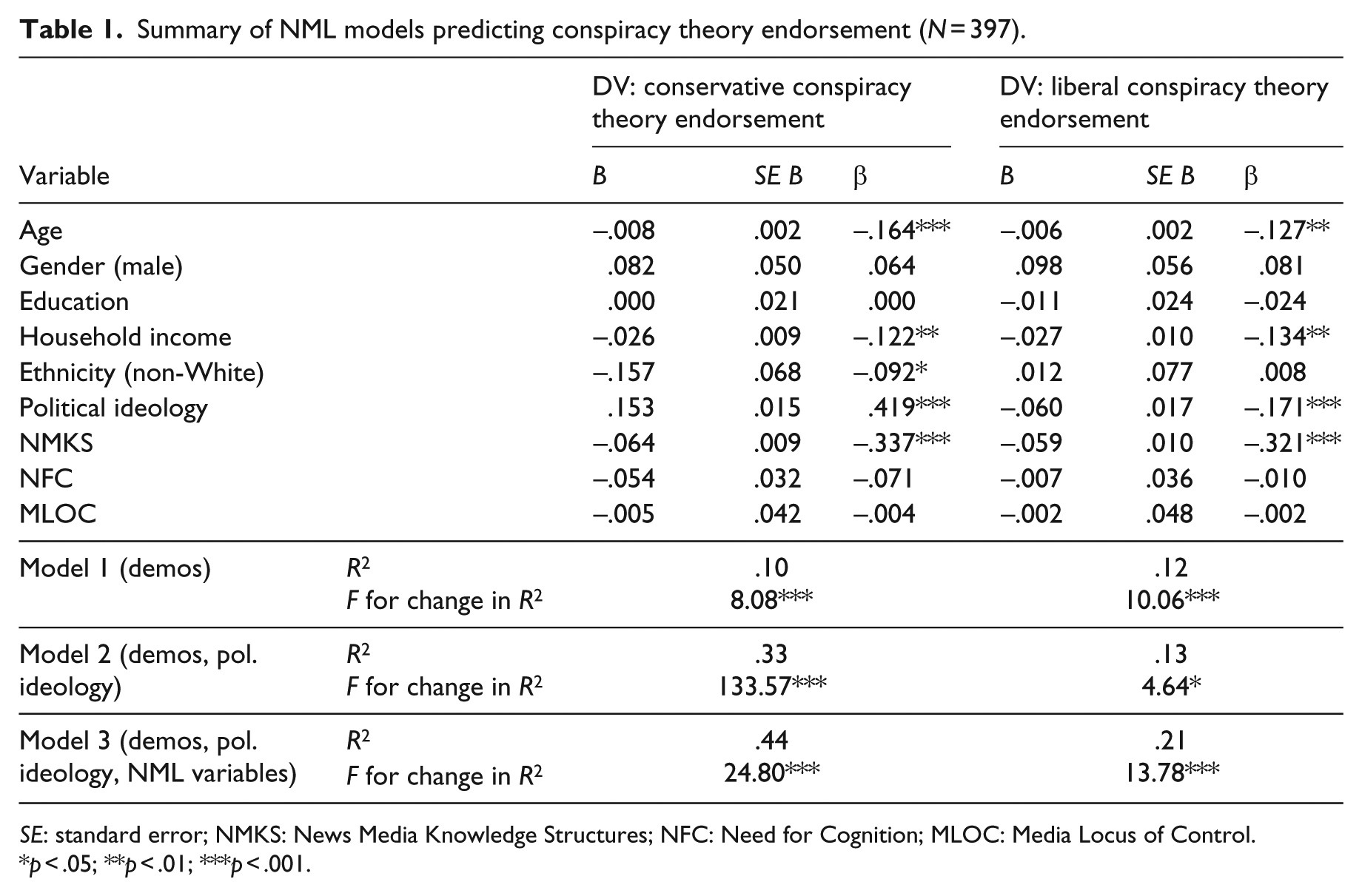
SE: standard error; NMKS: News Media Knowledge Structures; NFC: Need for Cognition; MLOC: Media Locus of Control.
p < .05; **p < .01; ***p < .001.
Summary of effects of NML variables on endorsement of conspiracy theories congruent and non-congruent with political ideology.
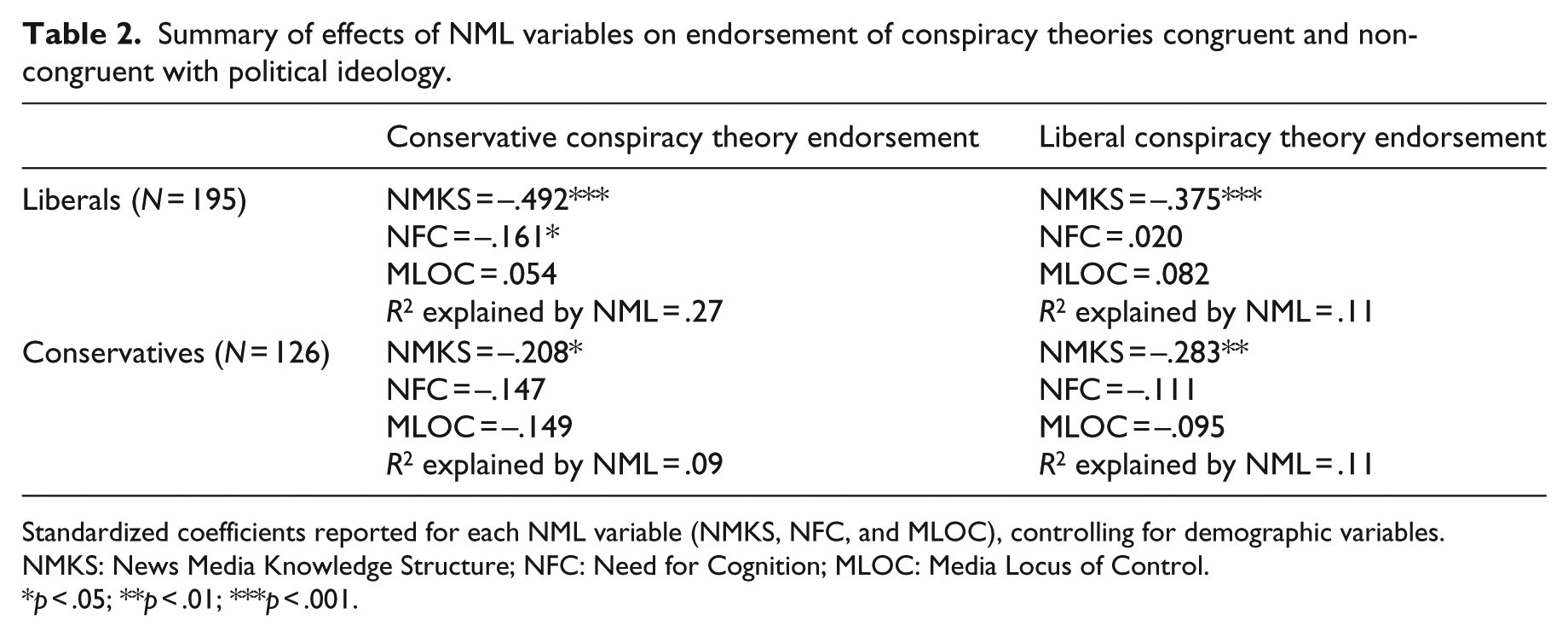
Standardized coefficients reported for each NML variable (NMKS, NFC, and MLOC), controlling for demographic variables.
NMKS: News Media Knowledge Structure; NFC: Need for Cognition; MLOC: Media Locus of Control.
p < .05; **p < .01; ***p < .001.
The research questions address whether the relationship between news media literacy and CTE is similar for conservatives and liberals and whether that relationship holds even when conspiracy theories align with one’s political ideology and are, therefore, as the literature suggested, likely to have greater appeal. To answer the first research question, we first sought to establish that respondents were more likely to endorse conspiracy theories that were congruent with their personal political ideologies. We conducted analysis of covariance (ANCOVA) to compare mean CTE scores among the respondents in each ideological group, controlling for demographics. To do so, we dummy-coded the political ideology variables so that respondents who said they were conservative, slightly conservative, or very conservative were recoded as 1, while those who said they were liberal, somewhat liberal, or very liberal were recoded as 0. Responses originally recorded as 4, meaning neither conservative nor liberal (n = 76), were excluded from the analysis, leaving 321 respondents. We found that conservatives more strongly endorsed conservative conspiracy theories (M = 2.17, standard error of mean (SEM) = .05) than liberals (M = 1.50, SEM = .04), and the difference was significant (F(1,307) = 112.86, p < .001). Likewise, liberals more strongly endorsed liberal conspiracy theories (M = 2.09, SEM = .04) than conservatives (M = 1.94, SEM = .05), and the difference also was significant (F(1,307) = 5.13, p < .05). Next, to explore whether the relationship between NML and CTE held regardless of political ideology and in the same direction we had hypothesized for the sample as a whole, we conducted separate analyses for liberals and conservatives for each type (liberal or conservative) of conspiracy theory (Table 2). The effect of NMKS on endorsement of liberal conspiracy theories was significant and negative for both liberals (β = −.38, t(190) = −4.96, p < .001) and conservatives (β = −.28, t(122) = −3.06, p < .01). In other words, for both conservatives and liberals, more knowledge of the news media system related to decreased endorsement of liberal conspiracies. The effect of NMKS and NFC on endorsement of conservative conspiracy theories was significant and negative for liberals (NMKS, β = −.49, t(190) = −7.63, p < .001; NFC, β = −.16, t(190) = −2.63, p < .01). Among conservatives, only the effect of NMKS on conservative CTE was significant, and it was negative. (β = −.21, t(122) = −2.30, p < .05). In other words, though not all components of NML have an effect on CTE, the results do show that one component—NMKS—mitigates the endorsement of conspiracy theories even when those theories are congruent with political ideology.
Discussion
These findings indicate that individuals who give credence to conspiracy theories know comparatively little about how the news media work. The greater one’s knowledge about the news media—from the kinds of news covered, to the commercial context in which news is produced, to the effects on public opinion news can have—the less likely one will fall prey to conspiracy theories. Indeed, those theories can have considerable allure. As comprehensive and compelling narratives, conspiracy theories are almost by definition “good” stories, which makes literacy regarding the practices, values, and commercial pressures that shape the news into “good” stories all the more important.
Consistent with prior research using the NML measure, NMKS, and not NFC or MLOC, largely accounted for the findings (Ashley et al., 2017; Maksl et al., 2015, 2016). This is somewhat surprising, particularly with regard to NFC, as resisting or countering conspiracy theory messages would seem to require cognitive effort, and previous research suggests that NFC moderates the relationship between skepticism and news exposure. Also, a psychological need for consistency and control of the kind MLOC addresses is part of what motivates an individual to buy into a conspiracy theory. The NFC and MLOC subscales are meant to capture the “personal locus” component of Potter’s (2004) model of media literacy. While in previous research both NFC and MLOC were found to contribute to distinguishing people according to their level of news media literacy (Craft et al., 2013), the results reported here, and weak or inconsistent findings in previous research, suggest these measures may not be capturing the aspects of the personal locus most relevant to news media literacy and/or that refinements to the model are needed, particularly in theorizing the relationship between the knowledge structures and personal locus components.
Nevertheless, that knowledge about the news media alone can help blunt the appeal of conspiracy theories is encouraging to those seeking ways to improve the ability of news consumers to navigate a complex media environment and participate in civic life. Bolstering a news consumer’s knowledge is more easily accomplished than trying to alter the more difficult to change psychological traits he or she brings to the consumption of news. Enhancing news media literacy—with a focus on building NMKS—could, like the “debiasing” practice (Lewandowsky et al., 2012) and the cultivation of norms of accuracy (Kahne & Bowyer, 2017) established in previous research, be part of an effective strategy for combatting the spread of conspiracy theories and misinformation and their negative byproducts, such as reduced social and political engagement. These findings also align with previous research showing that greater news media literacy is related to greater news skepticism and current events knowledge, which underscores this point.
The political character of conspiracy theories, the strong pull of motivated reasoning, and the fact that people often use a partisan lens when choosing, consuming, and sharing news would seem to create a challenging context for news media literacy to have any impact on CTE. While our findings confirm that people across the political spectrum tend to endorse conspiracy theories that resonate with their political views, the findings also demonstrate that greater news media knowledge can mitigate that tendency regardless of political stance and even for conspiracy theories congruent with that stance. One implication of that finding, at the risk of oversimplifying matters, is that greater news media literacy works by increasing skepticism, but not the kind of motivated skepticism, Taber and Lodge (2006), among others, have shown leads to biased information processing and, perhaps, endorsement of conspiracy theories congruent with one’s political beliefs. This also is in line with Kahne and Bowyer’s (2017) findings that “media literacy learning opportunities that aim to promote accurate judgment of truth claims” played a positive role in prompting accuracy—and not directional—motivation to judge political claims.
Our findings do, however, reveal some asymmetry between liberals and conservatives. Overall, the strength of the relationship between political ideology and CTE is greater for conservatives than liberals. Whether these findings represent differences between liberals and conservatives generally, liberal and conservative conspiracy theories, or some combination is not clear and cannot be concluded from these data. Possible explanations, ripe for future research, include that the differences are a function of differences in the relative rhetorical power of liberal and conspiracy theories generally, or the theories used in this study specifically; relative differences in how familiar the theories are and, therefore, how often they have been discussed or debunked in news coverage; and the fact that conservative theories may be especially resonant during a liberal president’s administration, as was the case when this study was conducted. Future avenues for research also might include determining the prevalence of conspiracy theory “news” across different types of news sources and gathering data on participants’ exposure to various sources as well as how much trust they place in them. In addition, previous research regarding perceptions of NML messages suggests the need to consider the media environment (Vraga & Tully, 2016), particularly the political context (Tully & Vraga, 2017), and not only the messages themselves, “to truly understand their effects and potential for encouraging critical news consumption” (Vraga & Tully, 2016, p. 319).
Asymmetry also was evident in the finding that NMKS was a stronger (negative) predictor of CTE for liberals than for conservatives. This was the case for theories associated with liberal perspectives as well as those associated with conservative perspectives. While the data reported here support no definitive conclusion regarding the reason for such a difference, this result is consistent with Miller et al.’s (2015) study in which the relationship between political knowledge and endorsement of conspiracy theories was significant and positive for conservatives, but not liberals. Moreover, that Miller et al. found high knowledge conservatives endorsed theories that reflected poorly on their liberal rivals is consistent with Kahne and Bowyer’s (2017) findings that the influence of directional motivation—the desire to “win” an argument—was greater for those with more knowledge. Media literacy, however, led to greater influence of accuracy motivation—the desire to know what is accurate regardless of partisan preference—in judging political claims. What this means for news media literacy—specifically news media knowledge—is that greater knowledge could backfire, if it is aimed at bolstering partisan arguments rather than getting to the truth of the matter. Future research needs to further explore whether and how news media literacy might relate to activating an orientation toward, or motivation for, accuracy.
The findings here are also consistent with research showing the positive relationship between news media literacy and certain types of political engagement, including knowledge about current events, political activity (e.g. voting, campaigning, writing letters), and internal political efficacy (the belief that one’s personal actions can have an impact on the political system; Ashley et al., 2017). News media literacy is positively related to being an informed participant in the political system, and endorsement of conspiracy theories runs counter to informed participation. More complicated is the fact that news media literacy has also been associated with lower levels of political trust (Ashley et al., 2017), and low trust is associated with CTE (Miller et al., 2015). Further investigation is needed to tease out the relationships among news media literacy, political trust, and CTE.
Since these data were gathered and analyzed, the role of fake news, spread widely and rapidly through social media, in (mis)informing the American electorate has come under intense scrutiny, prompting calls for Facebook and other social media platforms to help curb its dissemination. The extent to which the prevalence of such news—which in its mix of exaggeration and falsehoods and its partisan slant bears a strong resemblance to the conspiracy theories addressed in this study—contributed to an election outcome is difficult to measure. Nevertheless, the relationship between news literacy and endorsement of conspiracy theories demonstrated here strongly suggests that greater news literacy can help undercut the influence of fake news, even when that “news” aligns with one’s political ideology.
Footnotes
Appendix 1
Items used in constructing the conspiracy theory endorsement variable.
1.
Amazon’s Mechanical Turk is a web service where requesters can post small tasks, called Human Intelligence Tasks, that can be completed through crowdsourcing, or outsourcing, to members of a large community who are paid small amounts of money for completing the micro-tasks.
2.
The median age of our respondents was 37.9 years; the median age of the US population is 37.2 years (U.S. Census Bureau, 2011a). Our sample was 45.3% male; males make up 49.2% of the US population. Four in 10 participants (42.6%) have bachelor’s degrees, compared to 20.5% of the US population; 15.1% of our sample have a graduate degree, whereas the population is 12% (U.S. Census Bureau, 2015). Regarding income, 28% of our participants have household incomes less than US$30,000 a year, compared to 28.6% in the population; 46.1% of our samples’ household incomes range between US$30,000 and US$70,000 a year, compared to 32.2% in the US population (U.S. Census Bureau, 2014). About 14.1% of our sample earns between US$70,000 and US$100,000 a year; it is the same for the general population. Finally, 11.9% of our sample have household incomes of above US$100,000, compared to 24.7% of the population. Our sample is 82.6% White; non-Hispanic Whites make up 72.4% of the US population (U.S. Census Bureau, 2011b). Our sample is 7.8% Black; the US population is 12.6% Black.