




Abstract
Despite the abundance of studies exploring athletes’ self-presentation on social media, there is a notable scarcity of research focused on the self-presentation performances of disabled athletes within these digital spaces. This study investigates the self-presentation performances of disabled athletes representing Turkey in international competitions, on Instagram. By employing a netnographic approach, 645 highlighted stories from the Instagram of 5 athletes (female = 3 and male = 2) were subjected to analysis. The findings of the study reveal a distinction: Female athletes tend to emphasize their on-stage performances, whereas male athletes direct attention to their off-stage performances. In their on-stage performances, athletes gravitate toward showcasing posts related to awards earned from competitions. Conversely, in their off-stage performances, they opt to highlight familial and interpersonal relationships. This study has determined that disabled athletes prefer to highlight their on-stage performances on Instagram. This platform functions as a realm of validation for their accomplishments.
Introduction
In the past, traditional media such as television played a primary role in shaping the portrayal of athletes. However, with the emergence of social media and user-generated content, athletes have gained more control over how they can be perceived (Mitchell et al., 2024). Instagram, a photo-sharing social networking site (SNS), is popular among a wide spectrum of society (Burton et al., 2024; Jackson & Luchner, 2018). Instagram’s emphasis on visual content has also influenced self-presentation performances. Instagram has facilitated a shift from the traditional “self-presentation” performance, which was controlled by conventional mass media, to individuals having control over it. This online platform is structured to allow feedback on self-presentation by prioritizing and encouraging visual posts, and it provides users with filters to both control their own image and appeal to specific target audiences (Hernández-Serrano et al., 2022). Disabled athletes are increasingly utilizing social media platforms such as Instagram to represent themselves and to include viewers in disability counter-narratives that resist dominant disabled stereotypes (Pullen et al., 2023).
According to Goffman (2002), individuals present themselves in two distinct ways, much like actors in a theatrical performance, with the intention of shaping how others perceive them. The frontstage and backstage performances individuals offer in their daily lives can vary based on their surroundings and societal positions. Self-presentation is defined as the deliberate shaping of individuals’ behaviors to intentionally control the impressions formed by observers about them (Goffman, 2002). Self-presentation is not only the goal-oriented effectiveness of controlling knowledge for impacting the perceptions shaped by onlooker, but it also encompasses the behavioral patterns through which individuals strive to convey certain information about themselves and their own image to others (Schlenker & Wowra, 2003). Self-presentation indicates a category of motivation within human behavior, wherein these motivations are partly individuals’ enduring inclinations but are contingent upon situational factors to manifest. Specifically, motivations for self-presentation are activated by the evaluative presence of others and by the information that others possess about an individual’s behavior (Baumeister & Hutton, 1987). According to Goffman, numerous verbal and nonverbal cues are employed by actors to influence observers’ perceptions of an individual’s identity (whether it pertains to their real self or ideal self; Goffman, 2002). Therefore, self-presentation is classified into frontstage and backstage, as a result of this distinction. Goffman (2002) underscores that self-presentation constitutes an ongoing process involving intricate negotiations between two distinct performances, underscoring that each of these performances may encompass multiple presentation strategies pursued through a continuous cycle of interpreting audiences, objectives, and contexts. As Goffman (2002) explicates, such unique self-presentation dynamics typically manifest in two discernible manifestations of daily life: frontstage and backstage “performance.” Frontstage performances transpire when individuals are in the presence of others or an audience, thereby prompt-ing a heightened awareness of the impressions they evoke in others’ minds. In contrast, backstage performances occur in the absence of an audience or in the presence of a more familiar audience. Consequently, individuals tend to exhibit greater authenticity in such situations (Goffman, 2002). Goffman’s distinction underscores the multidimensional images of the self. In Goffman’s differentiation between frontstage and backstage, the real self encompasses the attributes an individual possesses, whereas the ideal self embodies the attributes an individual aspires to possess (Higgins, 1987).
Disabled athletes, aiming to overcome the exclusion they often face in social life, manage their self-presentation performances on Instagram. This also leads disabled athletes to make use of social media platforms such as Instagram within the framework of both self-assertion and enabling the recognition of their achievements. In contrast to athletes typically considered “able-bodied,” disabled athletes tend to emphasize showcasing more sports-related content, or on-stage performances, as a means to forefront their identities (Mitchell et al., 2021; Yenilmez Kacar, 2024).
Instagram has allowed athletes with a platform to share and sustain their everyday lives and social relationships, creating a conducive environment for self-presentation (Sheldon & Bryant, 2016). While athletes’ self-presentations were traditionally managed by conventional media outlets, contemporary social media platforms like Instagram have enabled athletes to establish, manage, and present their public personas and brands (Geurin-Eagleman & Burch, 2016). Through platforms like Instagram, athletes have gained the opportunity to create, curate, and showcase their public personalities and brands. In addition to their on-stage performances that reflect their athletic identities, athletes also share photographs from their personal and private lives, which are often referred to as behind-the-scenes moments (Geurin-Eagleman & Burch, 2016).
Disabled athletes shape their self-presentation performances to overcome various challenges they encounter in social life, to assert themselves, and to serve as role models for other disabled athletes in their surroundings (Pack et al., 2017). They express not viewing themselves solely through the lens of their disability, while simultaneously using their achieved successes to foster a sense of acceptance. This process involves defining objectives and cultivating a distinct identity that encompasses pride, ultimately aimed at creating a positive impact within the community of disabled athletes (Pack et al., 2017).
According to data from the Ministry of Youth and Sports in Turkey, there are a total of 48,729 athletes registered within the federations for visually impaired, physically disabled, special-needs, and hearing-impaired individuals. The Turkey Special Athletes Sports Federation holds the highest number of registered disabled athletes with 22,312, placing it in the leading position among the federations. The Turkey Hearing-Impaired Sports Federation secures the second position with 11,572 licensed athletes, followed by the Turkey Physically Disabled Sports Federation with 8510 and the Turkey Visually Impaired Sports Federation with 6335 licensed athletes. These athletes, representing the federations for visually impaired, physically disabled, special needs, and hearing-impaired individuals, achieved remarkable success in 2022, winning a total of 203 medals in European and world championships (TRTHaber, 2023). In Turkey, disabled athletes have gained international recognition through their achievements. These athletes, who are closely followed and admired in Turkey, also have a significant following on their Instagram accounts.
In Turkey, social media platforms have created a highly conducive space for disabled athletes to present themselves and their identities. From the era when disabled athletes were overlooked in traditional mass communication channels, a transition has occurred into a new period where disabled athletes introduce themselves through social media platforms (Pate & Hardin, 2022). This study examines the performance of disabled female athletes in Turkey who participate in international sports events in presenting themselves on Instagram. The objective of this study is to broaden the existing literature on the self-presentation performances of disabled athletes, which is also limited globally. This study aims to examine whether the on-stage and off-stage performances displayed by disabled athletes on Instagram vary by gender, whether disabled athletes prioritize on-stage or off-stage performances on Instagram, and what constitutes the focal point of their performances. The highlighted stories shared on the Instagram accounts of disabled athletes in Turkey were analyzed using a netnographic approach in this research.
Athletes’ self-presentation on social media
Self-presentation emerges as critically significant due to users extensively sharing personal information about themselves with other users on social media platforms (Coche, 2017; Kim & Chock, 2015). The contemporary popularity of social media platforms has rendered them significant spaces for self-presentation. The unique capabilities of these platforms offer opportunities to enhance self-presentation behaviors. Particularly, social media provides diverse arenas for self-presentation, expands the role others can play in an individual’s self-presentation, and broadens the audience while simultaneously providing less information about the composition of that audience (DeVito et al., 2017; Weathers et al., 2014). Social media platforms have introduced an entirely novel approach to self-presentation, and this cyber-social tool has provided a fresh realm for analyzing personality and identity (Demir & Ayhan, 2022; Mehdizadeh, 2010).
Marshall contends that within the presentation of our digital realm, Goffman’s original theory’s supports and apparatuses are now translated into online-generated profiles, visuals, and messages (Marshall, 2010, p. 40) Furthermore, he contends that social media platforms constitute a construction of characters for a form of personal performance ritual. He characterizes social media practitioners as being acutely aware of a potential audience and defines social media engagement as the “careful cultivation and production” of the self (Marshall, 2010). At this juncture, social media platforms have enabled individuals, particularly public figures like athletes, to go beyond the confines of established personal traditional rituals and begin showcasing their behind-the-scenes performances. All traditional points of departure for self-presentation encompass relatively formal performances or what Goffman termed as frontstage performances. Through social media platforms, athletes have embraced a novel and increasingly intimate dimension of performance, focusing on their daily lives and offering an insider’s perspective. As a result, they have begun presenting Goffman’s backstage performance as well (Lebel & Danylchuk, 2014). Performance is a crucial component within the identity of any publicly recognized individual. Conventionally, the primary performance of professional athletes revolves around their roles as sports competitors, extending to nonverbal aspects like interviews and endorsements/sponsorship approvals (Marshall, 2010). On social media platforms, athletes’ behind-the-scenes performances reflect aspects of their identity beyond their athlete persona, aiming to cultivate a more favorable image among unfamiliar individuals (DeAndrea & Walther, 2011).
Numerous studies have been conducted examining self-presentation on social media platforms, encompassing both frontstage and backstage performances. These studies have not only directly scrutinized frontstage and backstage performances but also conducted comparisons based on gender. Athletes employ images that highlight their athletic prowess and athlete identity on social media platforms and simultaneously use photographs that reflect their behind-the-scenes performances (Shreffler et al., 2016). Athletes highlight behind-the-scenes performances on social media networks (Frederick & Clavio, 2015) and also share posts that blur frontstage and backstage performances (Pate et al., 2014). The conducted studies have identified variations in self-presentation performances of athletes based on gender (Lebel & Danylchuk, 2012), as well as the influence of gender, nationality, and culture on divergences in athletes’ self-presentation performances on social media platforms (Xu et al., 2023).
Athletes with disabilities and self-presentation on Instagram
Disability constructs itself as a prerequisite for a life worth living, thus devaluing anyone perceived as “disabled.” This hegemonic ideology develops toward a “logic of practice” by reducing the complexity of lived bodies to symbolic binaries (abled/disabled) through the cultural embrace of its lived complexity (Silva & Howe, 2019). Ableism refers to a belief system, process, and network of practices that produce a specific type of self and body (bodily standard) as perfect, species-typical, and therefore essential and fully human. Disability, consequently, is conceived as a diminished state of being human (Campbell, 2001). Disabled individuals are generally defined as individuals with conditions perceived by society as disabling, including but not limited to, invisible disabilities, chronic health issues, psychiatric conditions, as well as physical, sensory, and intellectual impairments (Bogart & Dunn, 2019). The contemporary social interpretations of the body are multifaceted and, in some cases, paradoxical. Looking at the realm of sports, on one hand, there is a global trend toward (normalized) physical self-optimization, while on the other hand, there is a struggle to ensure acceptance of (bodily) diversity triggered by claims of social inclusion (Giese & Ruin, 2018).
Disabled athletes are increasingly utilizing social media platforms like Instagram to perform their self-presentation and engage with narratives that challenge dominant disability stereotypes, aiming to resist disability narratives (Pullen et al., 2023). Through posts generated by disabled athletes on social media platforms, these athletes’ own presentations can help mitigate disability-related stereotypes by dispelling negative assumptions. In contrast to the typical content of healthy athletes that tends to focus on personal lifestyle, the majority of visual content by disabled athletes depicts them engaging in sports or fitness-related activities. By sharing content portraying physical competence and elite skills, disabled athletes are capable of reshaping the narrative to encourage recognition of disabled athletes’ abilities. Through depicting sports and exercise participation on social media platforms, these disabled athletes potentially contribute to alleviating disability stereotypes, aiming to foster a more accepting and inclusive culture (Mitchell et al., 2021). Through user-generated posts on Instagram, disabled athletes can alleviate stereotypes related to disability by presenting their own narratives, thereby dispelling negative assumptions. In comparison to the typically personal and lifestyle-focused content of able-bodied athletes on social media, the majority of visual content produced by disabled athletes can depict them engaging in sporting or fitness-related activities. By publishing content that showcases physical capabilities and elite talents, disabled athletes can potentially alter the narrative to encourage recognition of their abilities. Paralympic athletes, through the portrayal of sports and exercise participation on social media platforms, also contribute to the alleviation of disability stereotypes, aiming to create a more accepting and inclusive culture (Mitchell et al., 2021, 2023).
Disabled athletes do not perceive themselves as having lost anything or being defined solely by their disabilities through the selves they project on social media platforms. The self-presentation performances created here strive to craft an identity that is imbued with the enhancement of quality of life through sports, fostering acceptance, purpose, and a sense of pride (Pack et al., 2017). Disabled athletes use social media platforms to blur the line between backstage and frontstage performances, offering glimpses into their private moments, and simultaneously circumventing the lack of representation in traditional mass media outlets (Pate et al., 2014). Instagram has become a significant performance space for disabled athletes. The concept of “Cripvertising,” proposed by Pullen et al. (2023), is an important term used to define the self-presentation performances of disabled athletes on Instagram. Cripvertising represents how disabled athletes, especially female disabled athletes, portray themselves on social media by emphasizing traditionally attractive qualities such as beauty, femininity, and empowerment. Many of these disabled athletes act as brand ambassadors, endorsing products and brands with feminized and stylized images to increase their visibility in accordance with societal gender norms, utilizing the platform’s commercial features (Beermann & Hallmann, 2024; Pullen et al., 2023).
Instagram provides disabled athletes the opportunity to share their own experiences related to disability rather than relying on descriptions provided by healthy individuals through traditional media sources. This highlights Instagram’s potential to become the next locus of power within social media platforms. Consequently, the utilization of Instagram by disabled athletes to depict Olympic and Paralympic movements holds significance. Given Instagram’s potential to influence societal beliefs, it can be employed as an effective tool to enhance awareness of the Paralympic and disability movements (Mitchell et al., 2023). This study is particularly significant within the context of sports, aiming to broaden the literature concerning disabled athletes’ self-presentation on Instagram, specifically within the Turkish context. As the features of social media platforms evolve, the self-presentation performances of disabled athletes also undergo transformations. Notably, there is limited literature concerning athletes’ self-presentation in Turkey, and there is an absence of any research specifically focused on the self-presentation of disabled athletes. In this regard, this study holds importance as the first investigation centered on the self-presentation of disabled athletes on Instagram in Turkey, thereby contributing to the expansion of a literature that is similarly sparse in other countries.
Method
This study aims to examine the self-presentation performances of disabled athletes competing in international events on Instagram, specifically representing Turkey. In this context, the Instagram stories of five disabled athletes from Turkey, who possess the highest number of followers on the platform and participate in international events, have been analyzed in terms of both frontstage and backstage performances. Within the study,
In this study, the “highlighted stories” shared on the Instagram accounts of disabled athletes in Turkey were examined through the use of netnographic methodology. The study focused on Instagram stories, as they can encompass both “natural” and “professional” content. In this research, an analysis was conducted on the “images” shared by athletes in their stories. The study did not include an examination of the words used in the images or images where no text was present. This approach aimed to provide the most comprehensive assessment of athletes’ self-presentation performances. The sample included the top five athletes with the highest number of followers on Instagram. These athletes consist of individuals engaged in various sports disciplines. In addition, their inclusion in the sample stems from their status as the top five athletes with the highest number of followers on Instagram. The Instagram stories of the athletes, posted up until September 1, 2023, and identified as highlights, were analyzed. The analyses were conducted between September 1st and September 5th, 2023. In the study, September 1, 2023, was randomly selected as the date of analysis. The posts of athletes up to this date were examined for the study. The netnographic approach employed in the study is utilized across various disciplines for investigating the internet and social media networks, and it stands as a crucial tool for exploring social media platforms that reflect individuals’ everyday experiences and cultural intricacies (Kozinets, 2002, 2020). Netnography, beyond its scientific purpose of comprehending culture and society through manifestations in social media, also delves into the power of corporations, individuals, and groups within today’s technology-driven social world. In the realm of social media research, netnography questions how political, institutional, and personal influence transformation is affected, challenged, and empowered by technological devices, networks, and applications. Through netnography, an exploration is conducted to present the universe’s technophilia and technophobia in a clear and understandable manner, avoiding technological determinism for a sort of shared evolution between individuals and innovations. This inherent axiological emphasis of netnography also examines whether the research can lead to better decisions (Kozinets, 2015). Netnography, examining online communities within social media platforms, is at times mistakenly conflated with content analysis or thematic analysis due to the inclusion of quantitative data. However, according to Kozinets, one of the founders of netnography, it is defined as a more individual-centered, personal, social, and emotionally relevant vector, distinct from content analysis or thematic analysis.
Netnography is one of the significant methods used to examine online communities. Platforms with a worldwide active user base like Instagram are important social networks for studying online communities. Netnography is employed to analyze the visuals created by online communities on Instagram (Ayhan & Demir, 2022; Demir & Ayhan, 2022; Demir & Baloğlu, 2024). Netnography, which has been utilized as a significant tool in recent years to observe the behaviors of online communities in both participatory and nonparticipatory manners, has been employed in numerous studies (Demir & Ayhan, 2022; Demir & Baloğlu, 2024). Netnography is also acknowledged as an important method because it allows for the analysis of athletes’ postings on online networks and facilitates the creation of categories and subcategories.
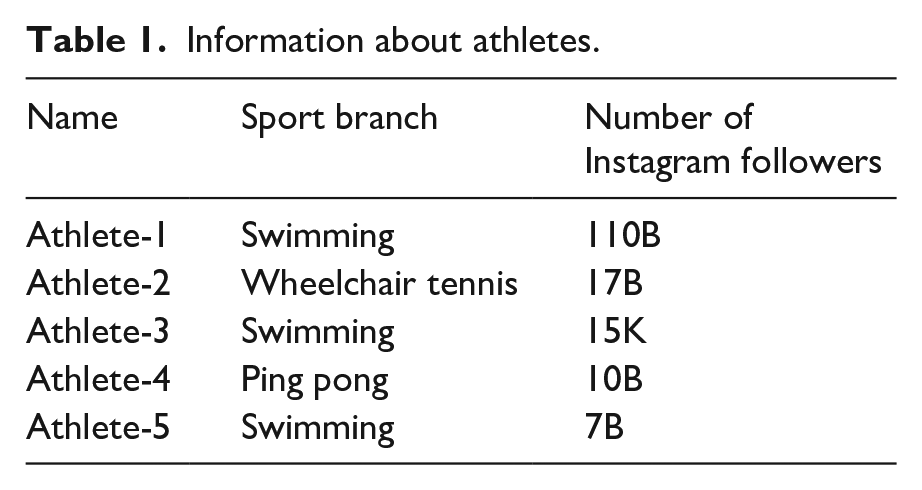
In this study, the 645 prominent stories of 5 disabled athletes (female = 3 and male = 2) were examined using the netnographic method with MAXQDA 20 software. The ages of these athletes range from 17 to 30 years. These athletes represent Turkey in sports such as swimming, ping pong, and wheelchair tennis. The number of followers for these athletes varies between 7K and 110K on Instagram. Collectively, these five athletes are followed by a total of 159K users on Instagram (Table 1). The study focused on athletes whose Instagram profiles are public, as social media platforms provide opportunities for anyone to join and view photos without prior notice. MAXQDA is a qualitative analysis program that facilitates the qualitative analysis of various data types, including text and visuals, by allowing them to be categorized (Rädiker & Kuckartz, 2022).
Information about athletes.
The analyzed 645 stories were categorized into two main categories, drawing on Goffman’s distinction between frontstage and backstage performances in his theory of self-presentation (Table 2). The frontstage performances consist of 389 posts that reflect the athletes’ sporting personalities, showcasing their engagement in sports or formal uniforms. The backstage performances encompass 256 posts related to the athletes’ private lives, including aspects such as family, friends, nature/travel, and personal selfies.
Distribution of performance contents.

Various criteria were applied when examining athletes’ frontstage and backstage performances. First, in the frontstage posts, photographs containing equipment reflecting athletes’ athletic identity, related to their sports, or symbolizing the sports they engage in were categorized under this classification. In the case of backstage performances, images were included that depict athletes’ personal lives unrelated to their sports, without featuring any actions or equipment associated with their sports. Given that social media networks are public domains, they allow athletes to integrate both their on-stage and off-stage performances. Accordingly, in the study, performances where athletes showcase moments outside of their athlete persona are evaluated as “backstage” performances.
Findings
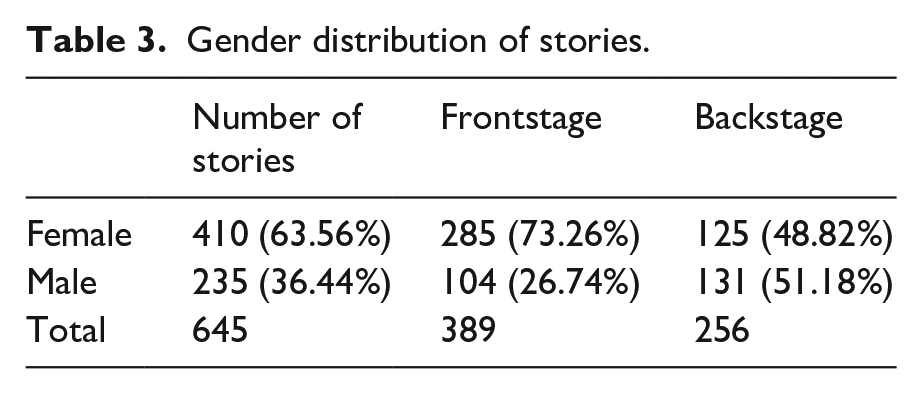
In the study, out of the five athletes whose Instagram accounts were examined, three are female athletes, and two are male athletes. These athletes are collectively followed by a total of 159K people on Instagram. Among the total of 645 posts shared by the athletes, 410 were posted by female athletes, and 235 were posted by male athletes.
Table 3 presents the distribution of posts by gender of the athletes whose Instagram accounts were examined. Upon examination of the table, it is observed that female athletes prioritize on-stage (n = 285) performances, whereas male athletes tend to emphasize backstage (n = 131) performances more. This gender-based differentiation indicates that female athletes prefer to convey their on-stage performances to other users, whereas male athletes exhibit an approach where the boundaries between their on-stage and backstage performances become blurred.
Gender distribution of stories.
In the study, athletes’ performances were grouped into various categories based on their posts, including on-stage and backstage performances. Under the “Awards” category of on-stage performance, photos shared by athletes depicting the awards they received in various competitions are included. In the “Sports” category, there are photos showing the athletes’ main disciplines (such as swimming). Under the “Individual Training” category, photos related to the athletes’ training sessions in their leisure time, which are not part of competitions, are included. In the “Competition Moments” category, photos taken of athletes during competitions are featured (Table 4).
Distribution of stage performances by content.
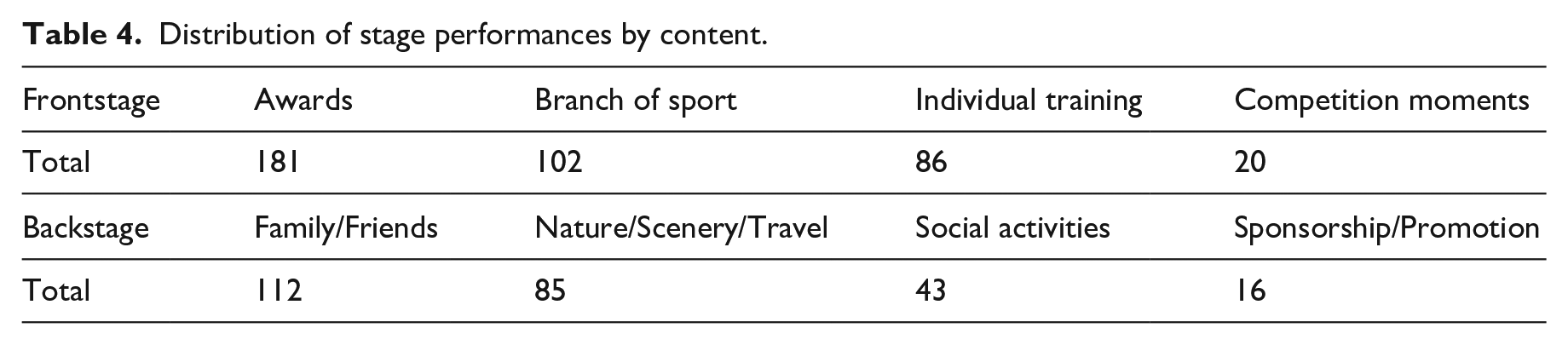
Looking at the photos in the category reflecting backstage performances, the “Family/Friends” category includes photos of athletes with individuals identified as family members or friends. Under the “Nature/Scenery/Travel” category, there are posts shared by athletes about the places they have visited. In the “Social Activities” category, there are photos of athletes participating in social events, education, and speaking engagements. The “Sponsorship/Promo-tion” category comprises posts in which athletes individually promote sponsored products.
When examining the distribution of disabled athletes’ on-stage and off-stage performances based on content, it has been determined that athletes primarily emphasize their on-stage performances with the awards they have won in competitions (n = 181). On the other hand, in their off-stage performances, athletes highlight posts (n = 112) that depict their relationships with family and friends. While athletes choose to sustain their on-stage performances with success stories, they also emphasize their relationships in their off-stage performances by showcasing their social lives.
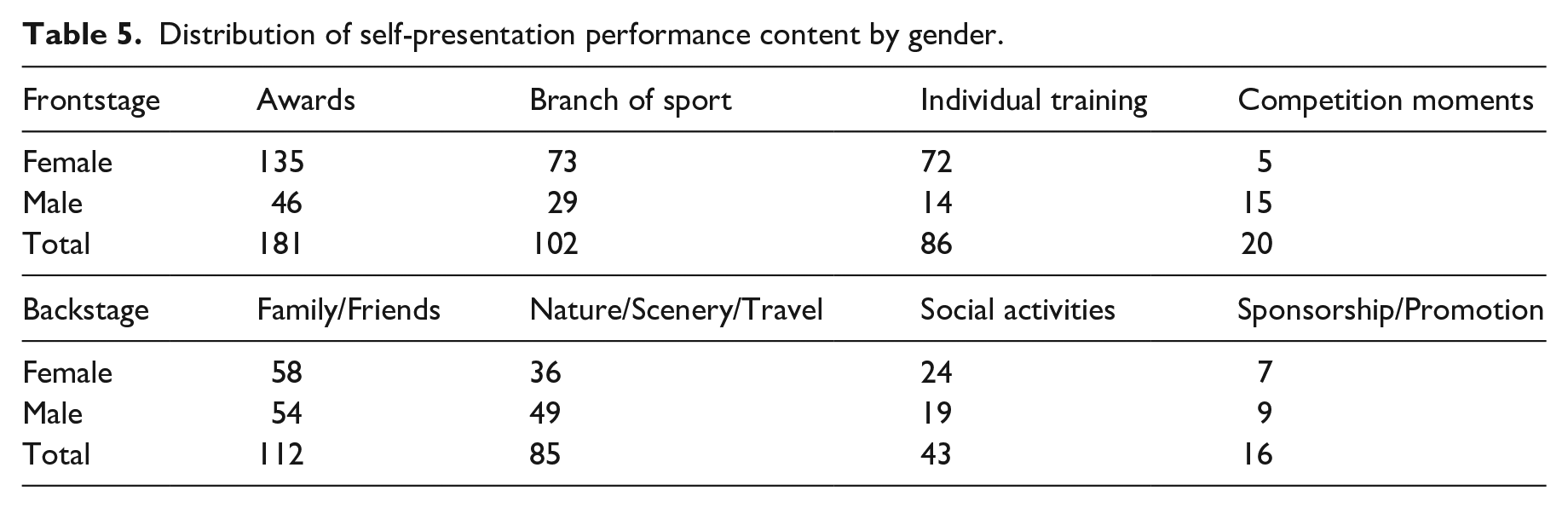
Table 5 presents the distribution of disabled athletes’ Instagram self-presentation performance contents by gender. Upon examining the distributions, it can be observed that both female and male athletes predominantly prefer to share content related to awards in their on-stage performances. In addition, within the male athletes’ group, there is an inclination to emphasize imagery captured during competitions. Regarding off-stage performances, it is evident that female and male athletes share posts depicting family and friend relationships almost equally. However, male athletes tend to share content related to nature/scenery/travel more than their female counterparts.
Distribution of self-presentation performance content by gender.
Conclusion
Ableism has critically contributed to the understanding of disability in society (Kafer, 2013). This perspective is based on the assumption that human bodies should appear and function in certain ways, which fundamentally stems from the concept of norms that emerged in the industrialization era (Davies, 2006). As a result, individuals with different functionalities are excluded from access and participation in society. This ableist normativity not only concerns disabled individuals but also pertains to elderly individuals and those with different heights and weights. Therefore, what requires critical attention is not disability but rather ableism (Cocq & Ljuslinder, 2020).
Online self-presentation has become a significant aspect of online social interaction, wherein numerous factors such as social context and social culture exert their influence. Within this context, individuals on social media platforms have the ability to construct their self-presentation not only based on positive attributes but also by showcasing a combination of positive and negative traits (Lee-Won et al., 2014). Social media platforms provide individuals with the opportunity to control how they present themselves to followers or other individuals on these networks (Marshall, 2010; Mehdizadeh, 2010). It is known that on social media, disabled individuals have transformed from mere consumers of media content to content creators by sharing stories and photos (Pearson & Trevisan, 2015). In recent years, social media has been acknowledged as a significant platform for challenging stereotypes in body presentation at the intersection of gender (McGillivray et al., 2021). Recently, Paralympic sports content has been influential in promoting the idea that gender and disability should be normalized in society (Pullen & Silk, 2020). This situation has encouraged the emergence of a celebrity culture that popularizes disabled athlete figures.
The increased use of social media platforms like Instagram has made online self-presentation more important for prominent individuals and groups in society. Especially for athletes, Instagram offers various opportunities to blend their on-stage and off-stage self-presentation performances. Athletes can showcase their self-presentation on Instagram by displaying their professional sports careers, engaging in advertising, similar to their on-stage performance, as well as sharing their personal lives to exhibit their off-stage performance with other users (Bae et al., 2023; Tiryaki & Karakuş, 2023).
This study examines the self-presentation–related posts of disabled athletes on Instagram. Disabled athletes are increasingly utilizing social media platforms like Instagram to engage in self-presentation performances and interact with narratives that challenge dominant disability stereotypes (Pullen et al., 2023). Based on this assumption, the 645 Instagram posts of five athletes participating in international sports events in Turkey were analyzed, taking into consideration Goffman’s distinction between frontstage and backstage performances. In this study, it was determined that female athletes, among those whose Instagram posts were examined, preferred to emphasize their frontstage performances, whereas male athletes preferred to highlight their backstage performances. This observation indicates an attempt to overcome suppressed roles of women, particularly in patriarchal societies like Turkey, through Instagram, suggesting a means of empowerment (Kavasoğlu & Koca, 2022). On the other hand, the focus of male athletes on their backstage performance also indicates that males may have a lesser need to prove themselves as “athletes” than female athletes (RQ1). This gender-specific differentiation can be evaluated within a cultural context, and it demonstrates that the presentation of self-performance on social media platforms may vary according to gender norms (Tiryaki & Karakuş, 2023).
In this study, (RQ2) the Instagram posts of examined disabled athletes were categorized into various subgroups based on their frontstage and backstage performances. Specifically, within the scope of this study, athletes demonstrated various frontstage performances, including awards, the specific sports they engage in, their primary disciplines, individual training, and competition. Conversely, when considering the backstage, it was observed that athletes portrayed various performances reflecting their personal lives, such as interactions with family/friends, travel experiences, social activities, and sponsorship/promotion (Li et al., 2021). Disabled athletes prefer to highlight photos of their award-winning moments, symbolizing their achievements. This tendency indicates a need to overcome societal prejudices against disabled athletes and to assert their accomplishments as a measure of success (Lebel & Danylchuk, 2014). On the other hand, when examining the backstage performances, the prominence of posts related to personal life, such as family/friend interactions, underscores the emphasis on personal relationships (Geurin-Eagleman & Burch, 2016).
When examining the distribution of athletes’ frontstage and backstage performances by gender, it was found that both male and female athletes emphasize “awards” in their frontstage performances, while male athletes give more importance to photos taken during competitions. In contrast to other studies (Tiryaki & Karakuş, 2023; Xu & Armstrong, 2019), this study revealed that female athletes prefer to highlight their frontstage performances. This underscores the variability in self-presentation performances between disabled athletes and nondisabled female athletes. It also demonstrates that male athletes prefer to highlight their athletic performance and convey a competitive nature. On the other hand, when looking at the backstage performances, both female and male athletes emphasize personal relationships such as family and friends (RQ3).
This study is significant for being one of the pioneering research efforts to examine the self-presentation performances of disabled athletes on Instagram, both globally and in Turkey. The study identifies that disabled athletes utilize social media to prove themselves and overcome barriers. Athletes emphasize their self-presentation performances by highlighting photos aimed at breaking down various biases and creating role models. In future studies, a comparative analysis of self-presentation performances of disabled athletes globally and in Turkey could be conducted, and the relationship between their presentations on social media platforms such as Twitter (X) and their self-presentation could be explored.
Footnotes
Funding
The author(s) received no financial support for the research, authorship, and/or publication of this article.
