




Abstract
An important Russian strategic disinformation campaign, early in the Ukrainian war, contended that the United States was involved in clandestine biological weapons development in Ukraine under the sign “biolabs.” Depending on the platform, the propaganda messaging appeared differently. This study uses a multi-modal approach, featuring Image Plotting, to study the waves of messaging related involved in the biolabs campaign including both the qualitative analysis of text and the analysis of the images. Each platform includes a clear visual and textual strategy which align with known Russian strategies and multi-modal campaign operations.
On May 28, 2022, PressTV, a division of Iranian state media covered an important finding by Igor Kirillov, Chief of the Russian Radiation, Chemical, and Biological Defense: United States facilities were the origin of Monkey Pox (PressTV, 2022). The evidence presented was the presence of much-maligned “biolabs.” What these biolabs do, why they are responsible for the spread of a dangerous infection was only explained as a “strange coincidence” (PressTV, 2022). The image shared to fasten the meaning of the story is that of a grainy microscope photograph with some large, dark oval cells and large, transparent circular cells about to make contact. While the graphic added no meaningful information to the story it set the tone through its use of scientific authority (microscopy) and the ominous look of the large oval cells. Outlandish claims play to the audience as this accusation is not coverage of Monkeypox or infectious disease research generally, but just one more chapter in an ongoing disinformation campaign.
This article advances a multi-platform study of a single disinformation campaign operating in February and April 2022 which supposed that the United States operated a clandestine biological weapons program in Ukraine through what were called “biolabs.” Word play is the game. Propaganda in this space internationally used the term to refer to a vast conspiracy of a United States–led biological weapons program. Early accounts deploying these arguments were associated with Qanon, a movement in the United States which interprets the world as being riddled with evil actions by forces aligned with the government of the United States (Ling, 2022). Included with early stories was a map of Russian airstrikes in Ukraine, which was then reinterpreted by a Qanon believer to be a map of something, the something biological weapons installations. It is important to keep in mind that in this initial phase of the argument, the essential argument came in the interpretation of a graphic which was circulating within a community which prefers images. This aligns with Marwick and Partin’s (2022) analysis of the mechanics of Qanon conspiracy theory circulations, which rely on the interpretation of graphics (especially collages) within that community. Weeks later, domestic United States interpretations of the theory intentionally obfuscated the meaning of that term using it to invoke the potential horror of biological weapons which would be flatly denied, only to then turn back and say that they used the term to refer to the dangers of Russian attacks on agricultural pathology laboratories. Any attempt to clarify or engage with this sleight of hand was presented as proof of the duplicity of the United States. This amounts to a version of classic comedy sketch “Who’s on First” with the intention to change the course of a conflict.
Early strategic study reviews of the Russian disinformation effort around their attack on Ukraine suggest that the state of cyber conflict has changed. Instead of Russia seemingly controlling the cyber dimension of the war, they were almost always behind, suffering from a chronic lack of planning, inadequate cultural context, and a hardened Ukraine that was experienced fending off attacks on material assets and influence operations (Lewis, 2022). While this explanation serves in the Ukrainian context, there is also the story of the influence operation in the United States which was moderately effective.
The biolabs argument is a fruitful site for analysis because it was raised and abandoned, which offers closure and analytical leverage as facticity is available. By summer 2022, the theory had morphed from the heroic destruction of biolabs with pathogens to stories where those laboratories continued to exist and now served different purposes (Quinn, 2022). This article engages the specific circulation of images in the early phase of the conflict in Ukraine from an image first perspective. Putting the circulation of images first is an important evolution in the analysis of propaganda which offers both significant conclusions for the topic at hand and methodology.
Social media strategy
Social media are not free floating, the ways that particular platforms are designed co-productively constrain and enable messaging; people designing campaigns think about this deeply. This is related to but distinct from the role of social affordances which calls for mapping the capacities of new technology to communication behaviors (Wellman et al., 2003). Social affordances offer important conceptual resources for understanding how and why people might, depending on their circumstances, communicate. At the same time, social affordances driven research may focus too much on software and a particular set of western cultural contexts (Costa, 2018). It is particularly important to include other theories of affordance, especially those that foreground non-consumers and non-Westerners. Imagining the possible uses of social media vectors in the battlespace maps onto how other practitioners and researchers understand imagined affordances (Nagy & Neff, 2015). This is particularly useful as it can create space for incomplete knowledge and abductive reasoning, which are essential for circumstances where our knowledge cannot ever be complete. We will not have meaningful access to meetings within major social network companies, much less strategic planning sessions of hostile state actors. In combination with established methods such as those described in this paragraph, this article contends that methods particularly tuned for understanding the domain of strategic practice are essential for studies of information warfare, especially where sensibilities about design pervade in both fields (Oberg, 2018). The trend for several years in communication research has been to emphasize creative understandings of behavior. It would benefit our understanding of conflict to grant these practitioners the same grace as we do YouTubers.
It is an established idea that media planners work multi-modally, across platforms. TikTok and Twitter host different content. Effective strategy would use each platform with the best possible fit for the affordances they imagine to be there. To this point, the literature has either denied this option or focused on creative work elsewhere. This would offer an alternative explanation for the lack of cross-platform strategic influence operations, which to this point have been understood as rare because of military organizational challenges and technical issues (Katagiri, 2022), as inter-platform trial balloons (Lukito, 2020), or to focus on the ways that users reconstruct diffuse propaganda into “evidence collages” which could be used like a propaganda pro-drug (Krafft & Donovan, 2020).
To better understand the context of these methodological choices, we need to understand the stability (or lack thereof) of Russian strategy, the propensity to reverse Western values rhetoric, and the failure of Western imagined affordances in cyber.
Tactical opportunism
There are three key types of Russian operations that we need to understand as key tools: sock puppets, junk news, and legacy media cooption. Beyond efforts to create simple sock puppets, more complex synthetic persona creation efforts which have created problematic individuals (as in the case of the synthetic person Jenna Abrams) and entire groups (Xia et al., 2019). By cultivating complex personas, the effects of campaigns become that much more complex as they interplay with audiences on a deeper level. In creating Jenna Abrams, Russian actors focused on creating a likable, warm persona while delivering news commentary over a period of years through an avatar that was capable of functioning as an opinion-leader (Xia et al., 2019, p. 1659). Advanced sock puppets like Abrams follow best practices in impression management and communication, they are evidence that Russian operators think like extremely competent communication and media professionals.
Junk news operations publish junk. They are chasing poorly designed advertising campaigns. In a longitudinal study, Bradshaw et al. (2020) found that this deceptive content existed in equal measure with legitimate journalism in coverage during 2016, and less in 2018. Agenda-setting research suggests that Russian state media sources set the agenda for some major United States–based junk news purveyors (Wilbur, 2021). Worse yet, the Twitter algorithm tends to increase the proportion of junk news in the feed (Bandy & Diakopoulos, 2021). Junk news links are an effective way for Russian state media to introduce new frames and arguments into the information ecology, this is also known as information laundering (Klein, 2012).
Co-opting fringe groups, particularly those in any given country that are aligned with the reactionary right via what is known to be state media is a documented Russian tactic (Tromblay, 2018, pp. 192–193). Reactionary movements are more likely to take a zero-sum view of the world, with the far right in the United States being especially likely to subscribe to a zero-sum world view (Davidai & Ongis, 2019). Aligning with an external power that does not have the best interests of the country makes sense if you view an internal partisan loss as absolute. Unlike online media, successfully co-opting a television news source gives an attacker access to a concentrated and durable audience which maybe the most important vector for polarization (Muise et al., 2022). Extreme claims made as a part of these efforts are a part of an intentional strategy, in Russian terminology as cited by Johnson as “sensational denunciation” which then land differently depending on the transmission vector (Jonsson, 2019, p. 75). The battlespace with Russian offers an attackers advantage as defense requires intercepting many attacks and the best defenses (such as civics and communication education) are politically difficult (McGeehan, 2018).
Reversing Western values discourses
Strategy can also be derived through the positioning of messaging. While overarching discourse is framed around a “responsibility to protect” (R2P) which might justify Russian action, particularly in Georgia and Ukraine (in 2014), the actual discourse in the communication campaigns focus on delegitimizing the other side (Pupcenoks & Seltzer, 2021). From this we can infer that this is a zero-sum communication game, which allows Russian operations a level of plasticity to take incoherent positions between campaigns, as their strategic objective is to delegitimize the other side (Pupcenoks & Seltzer, 2021, p. 772). By manipulating the rhetorical framing of responsibility inherent in human rights and humanitarian intervention discourse to justify the needs of Russian statecraft, the Russians delegitimize transnational institutions writ large. Consider the communication pragmatics of answering the Russian appeal to responsibility (R2P) discourse—denial of Russian R2P discourse becomes circular and focused on the victimization of Russia (Shatzer, 2022).
Western strategic planners operate by their own rhetorical frames, and in the context of this research domain, their own imagined affordances often focus on supposed Western engineering superiority and local conceptions of security. Russia is committed to ongoing hybrid warfare against the West, it is not a dying empire; choices are made to meet ad hoc objectives and not necessarily as a part of a single grand plan (Tromblay & Stewart, 2018). Schadlow (2020) has argued that hybrid warfare does not refer to a particular feature of what Russia does but offers a strategic vocabulary absent from discourse in the United States, notably the perpetual production of unpeace, continuous active destabilization. If persistent, continuous low-level conflicts that are not wars are features of the world, we need a term to effectively describe them, hybrid war is a reasonable one. Hybrid warfare as Renz and Smith (2016) argue, may obscure more than it reveals as information warfare strategies are not new (USSR operations were more ideologically coherent than Russia today) and discussions of hybrid warfare attribute coincidences to Russian genius, thus concepts of hybrid warfare are “one convenient umbrella.” To make the subtext clear, the umbrella term is often too convenient.
The failure of cyber and the imagined affordances of the West
Strategic analysis of Russia all too often loses perspective, using the framings of dominant western powers to explain Russian tactics and strategy (Fridman, 2019). Our analysis must go both ways. Assumptions about how “dying empires” act, depend on a stable category of empires, and a set of known narrative parameters for how those transformations take place. Communication research in international relations and security studies proceeds from the assumption that descriptions of the nature of states and systems are themselves persuasive activities focused on the actor itself (Hariman & Beer, 1996). Describing another power as a dying empire could be rhetorical projection of a state’s own feelings of insecurity. Soft power is an important concept in the strategy of the United States but is not seen as such internally, cultural contact and economic integration are seen as elements of the world, not strategic choices. At the same time, soft power is not neutral as a descriptive term. Convincing a dominant player that their victories are just part of the world is easy as it naturalizes, and extends their perception of power. It is a rhetorical choice for researchers and planners in the West to see their assumptions about culture, finance, and power as natural features of the world. On the contrary, Russian perspectives do not allow for contextual factors like soft power to exist outside war and the broader struggle for a Russian world where soft power seems increasingly hard when the entire range of forms of coercive economic pressure are considered (Shatzer, 2022, p. 139). Jonsson’s (2019) framing captures this in the perception that the color revolutions were dimensions of continuing conflict from the west which are part of a broader extension of holistic Soviet theories of war.
Rhetorical frames in how we understand conflict are co-productive with organizational cultures. When planners in the United States and European Union focus on technical cyber rather than information as the domain of conflict, it increases the priority on raw mechanical capacity over more contextual strategic thinking (Thompson, 2020, p. 185). Cyber, as a rhetoric, is insidious as it is seemingly apolitical. Western actors are often trapped in their own constellation of imagined affordances where their supposed material superiority is undercut by the ordinary professionalism of their Russian counterparts. Stories which grant too much depth and diabolical genius to Russian strategic plans speak to the world of Western planners more than anything. Because there is not a great deal of tactical flexibility, we are offered a somewhat reduced burden in understanding the core of Russian operations.
Data and analytical methods
Using CrowdTangle, a data set of biolabs related posts on Instagram, Facebook, and Reddit was compiled to show the differences in media texts between platforms. CrowdTangle provides specific data for each platform, Reddit for example is organized thematically, which is information provided for that platform but not for Facebook. Evidence of popularity will be taken from CrowdTangle internal metrics as of June 13, 2022. The date of evidence included in the CrowdTangle is 1 year before the final pull date (June 13).
Facebook and Instagram are especially hard to study. There are conceptual risks as we are accessing an asset (CrowdTangle) that cannot be externally validated (Restrepo et al., 2022). This study is an attempt to study a coordinated disinformation campaign, even if there are flaws in the data, the simple cue which organized the disinformation campaign reduces search ambiguity and the local partisan charge (right wing sources in the United States are aligned with the story) would make it less likely that the firms involved would be manipulative. It would be appropriate for a study of the circulation of images to focus on the places where images are the coin of the realm, thus we study Instagram and not Twitter.
The search window was set well before the window of the attack on Ukraine, which provides a baseline for what we might expect; in this case, the term “biolabs” was not generally in use except for the description of a consumer product, and even then, it was isolated. Extreme burstiness of the signal is also a strong clue as to the story spreading inorganically, especially when the cascades involve deep structures or root nodes (Rosenfeld et al., 2020). This study focuses on the top 25 posts per platform due to the sharp decrease in interactions (exponential decline) after the head of the distribution.
The analysis of the text shared is straight forward and requires situating text in context, which has been established in the literature review. Supplementing this, it is important to understand how the images (moving and still both) shaped the story. Imagery increases the effect of disinformation by providing an index of reality (Hameleers et al., 2020). To explore the visual relationships, the collage-based methods developed by Lev Manovich and team for the analysis of cultural images offer crucial leverage (Manovich, 2013; Ushizima, 2012). The implementation of these methods required manually scraping the images located by CrowdTangle and then processing them via a software library written for R designed to replicate and expand the affordances of the earlier plugins for ImageJ (image plot and image montage) (Faltesek et al., 2021; Manovich et al., 2014; Manovich & Giachino, 2012). Image collages are presented as evidence in this study, these are low resolution with reduced alpha values to produce transparency.
There are important methodological challenges in the use of Image Plotting as a method. In the context of this study, the selection of surface images can be a powerful reading strategy as they would speak to the real experience of flow of a user, and the ways that a strategic planner might imagine how users would flow through their media day. Depths, rather than surfaces, are handled through conventional media criticism. Cultural analytics, as a field of communication, has to this point been defined by experimentation, which presents a challenge in the validation of scales and techniques. Methods like red-blue divergence can offer an alternative to methods that call for the close reading of particular images which can map other important meta-data like date or popularity (Chmielecki, 2021). Plots using complexity methods (general simplicity of the image calculated as the relative capacity of the image to be compressed) are derived from empirical research in cognitive psychology by Mayer, both as a researcher and software developer (Mayer, 2022; Mayer & Landwehr, 2018). We can consider complexity as valanced and relative to the photoset, these are more and less, rather than direct linear effect measurements. In a photoset where most images are of a certain complexity we can Image plots offer an orienting resource for how users might encounter the flow of images as they scroll with the selected image variables intended to open the data for exploration and analysis, while providing psychological insight which trends much closer to a direct result. Given that there is no baseline and the number selected aligns with what readers can perceive and overview metrics in the data, it is a reasonable choice. What this selection of methods offers is something closer to what a strategic planner would actually have available in their scope of work.
The story of biolabs on Facebook is highly concentrated. The actual traffic in the story is highly concentrated near the top of the distribution in just a few posts. Notably, of the top 25 posts, all but two are dedicated to spreading the theory, the peak can be seen clearly in the context of all posts (Figure 1).
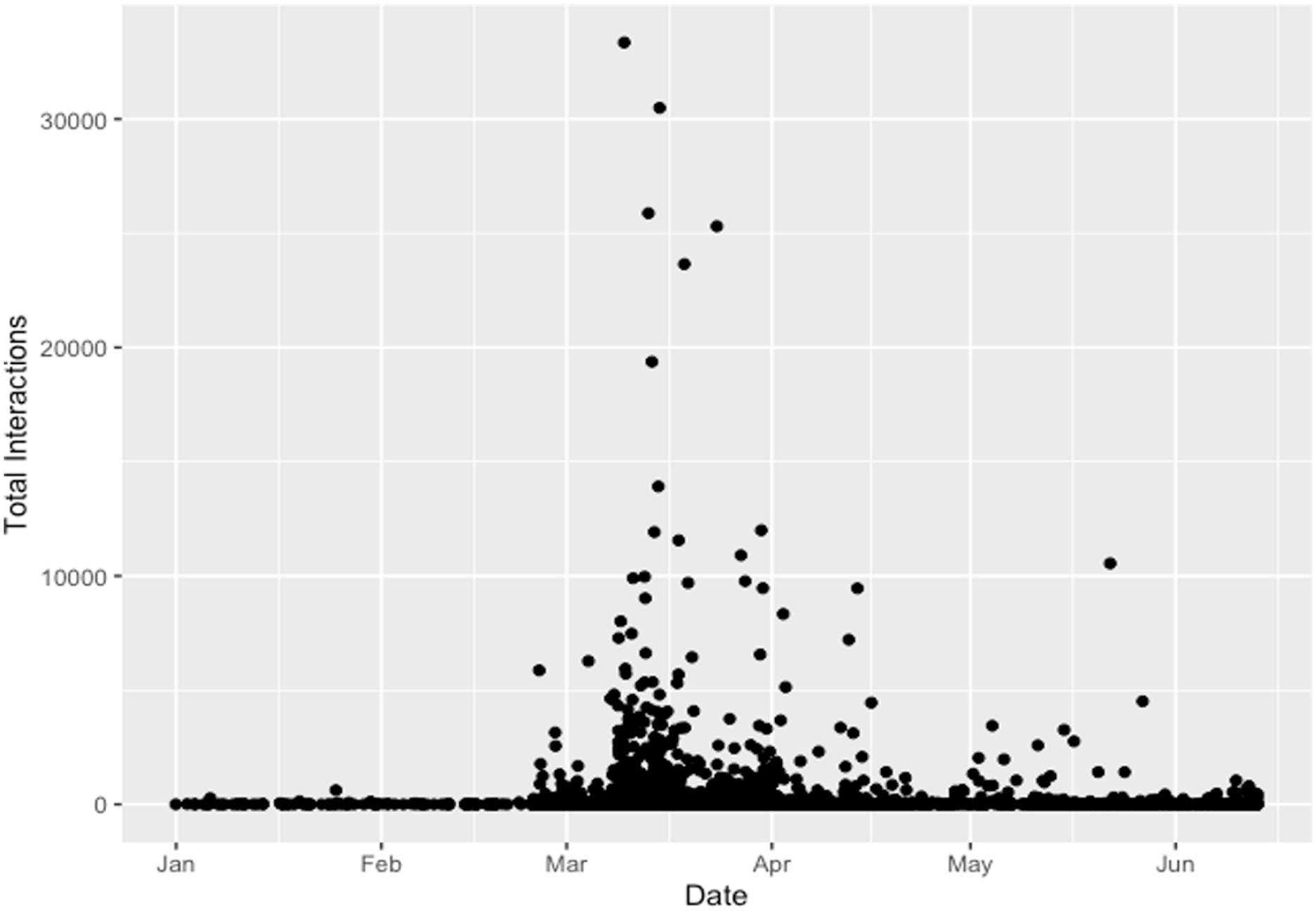
Date, total interactions as reported by Facebook systems. Note that dates are provided in months, inferences drawn in this article suppose waves or clusters of arguments, not absolute days.
Earliest of the popular stories was posed by T-House offering commentary on Victoria Neuland’s testimony as the equivalent of Iraq War propaganda, ‘“. . . to blame the other guy for what they’re planning to do themselves.” Is she talking about Russian techniques or the cause for #IraqWar? #biolabs”‘ (T-House, 2022). Without engaging in extensive analysis, the comments that follow the article support for the interpretation that the testimony somehow dispositively supports one side. In this text, we see an image shared of a woman testifying before Congress and providing a reasonable answer which is then reframed as evidence of the global American conspiracy in the text around the story.
The landmark story is by Tucker Carlson (2022), on March 10, which consists of a 10-minute video where Carlson works to decontextualize factual claims by the administration and other news agencies as acts concealing the ostensible failure of the west to dismantle non-existent Soviet stockpiles. The invitation to engage in speculation came from Ambassador Nuland’s testimony. Any elaboration offered by Ambassador Nuland would be taken as a reason to accept the entire Russian claim as a form of reverse-induction. As a form of speculative journalism, any opening of possibility allows the viewer to assume the truth of entire constellations of speculative facts. His monologue concludes: And how should we feel about all this? Insulted—but also very concerned. There is absolutely a story here, a story that matters, clearly, that is why they are lying about it (Carlson, 2022).
Framing the conclusion of the story in terms of feelings is essential. At stake is not the testimony of the Ambassador, but several minutes of inuendo and intrigue presented as possible facts. The purpose of the package and the story is not to engage the facticity of the claim but to encourage distrust in public institutions and other media agencies. Even if you discover the factual information, the framing of the story invites his listener to be forever offended because in the first case they were not treated with respect they believe they are due. Delivering the evidence to refute the story is ineffective as that only confirms that they were hiding something in the first place, and in the psychic life of a conspiracy theory, the infinite regress of the hidden knowledge of the conspiracy plotter is essential (Dean, 2002). The viewer is confused by word play around “biolabs” which is all someone else’s fault.
In the context of a burst, this is clearly most and first. Carlson began the cascade which then is modulated further by Tulsi Gabbard who is then amplified by Sean Hannity. The Gabbard (2022b) argument consists of the claim that the United States maintains dangerous “biolabs” in places including Ukraine and that the United States both needs to be the lead actor securing such a cease fire and then must account for clandestine programs around the world (a claim echoed in other state-based propaganda). These claims serve to delegitimize Western support of Ukraine, cast Ukraine as a satellite state of the United States which plays into the Russian narrative, and to vilify the United States on a global level. Absurdly, the focus of the call for cease fire is not even those who are shelling sensitive facilities. Centering Ukraine as an actor would not fit with the larger structure of Russian propaganda and with the pressure of the advance off, Russian sources would be able to provide actual evidence for the core claims of the conspiracy. The focal point must always be the United States.
Carlson, Hannity, and Gabbard are the key posters in the peak. By March 15, the innuendo has expanded to include articulations of the COVID laboratory accident theory to the biolabs story, which Gabbard (2022c) shares with a full-block video of Tucker Carlson. Hannity became involved as Gabbard began to tussle with Senator Romney which is noisy and the argument declined at that point.
In the later part of the wave, we can a smaller bubble near the end of the month (near the line for the start of April). These stories represent a shift. Instead of holding the initial line, the claim morphs to include Ukrainian biolabs as part of the broader constellation of Hunter Biden and George Soros stories by multiple sources (Firstpost, 2022; Hannity, 2022; HILL TV, 2022). Narrative consolidation allows the story to end gracefully, this was not a new story but one episode of the Hunter Biden show. Resolving the biolabs story is neither necessary or desirable, the mystery of the conspiracy is the goal.
On April 3, Xinhua deployed an automated voice news release featuring an interview with a journalist in Pakistan claiming that all United States facilities around the world are part of a global clandestine biological weapons program (China Xinhua News, 2022). This argument answers the narrative collapse argument by contending that Russian forces had in fact recovered dispositive evidence of the United States worldwide bioweapons program with the fact that such claims are not believed as evidence of the depth of the conspiracy. Another source amplified this same story with a meme on April 13 (WE ARE CHINA, 2022). While less melodramatic than the consolidation of the biolabs story into the Hunter Biden story, the propaganda function is the same as the initial Russian claim: the United States is the bad actor.
In the intermedia context, the ways that the dominant images shared in the flow of the feed likely restrict the possible negotiated and oppositional readings by locking in a particular image. The typical opening strategy for image plotting is to compare mean red and blue values in a field of images. In RGB color, values that are high in both red and blue are likely to be white or bright, lower values are darker. Once red and blue are stabilized, the viewer can quickly infer green values. This allows viewers to begin to isolate particular color families in the field. There are 24 images in this collage as one of the posts was purely text (Figure 2).
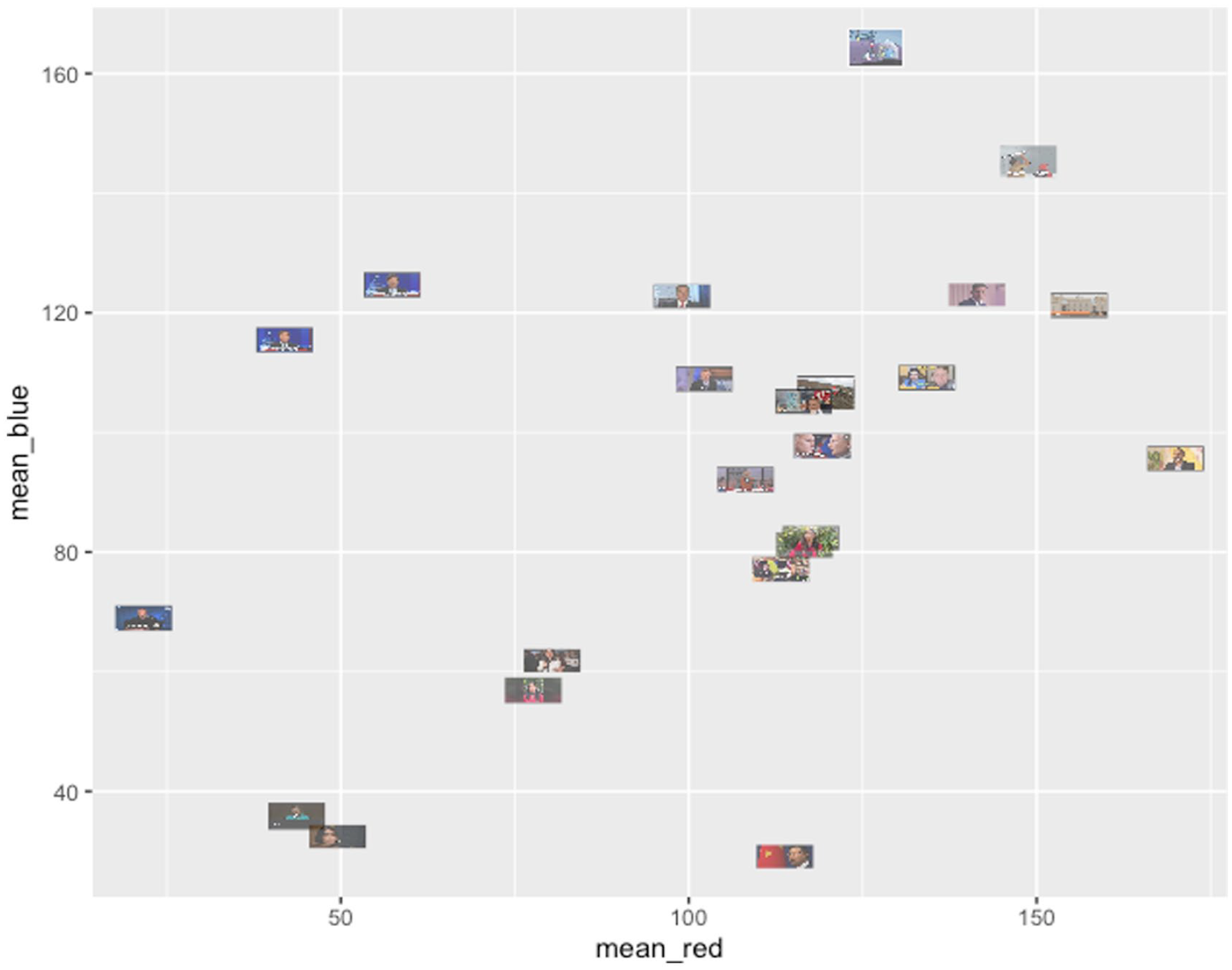
Facebook, mean red/mean blue.
The range of the images is truncated to avoid empty space, values near zero red/zero blue would be pure green images, very high values in both categories tend to be pure white images. The red-blue distribution can be helpful for isolating common motifs (such as news backgrounds), extremely dark images, image macros or other text stills, and portraiture. Red-blue distributions are valuable for orienting our research to a photoset. The brightest images in the set are the two memes, both of which support the biolabs claim. Across the collage, the use of journalistic image framing is apparent. Since there is no visual evidence to present the dominant news feature is the talking head interview. We can consider additional context by comparing total interactions to image complexity as calculated by ImageR (Barthelme et al., 2022; Figure 3).
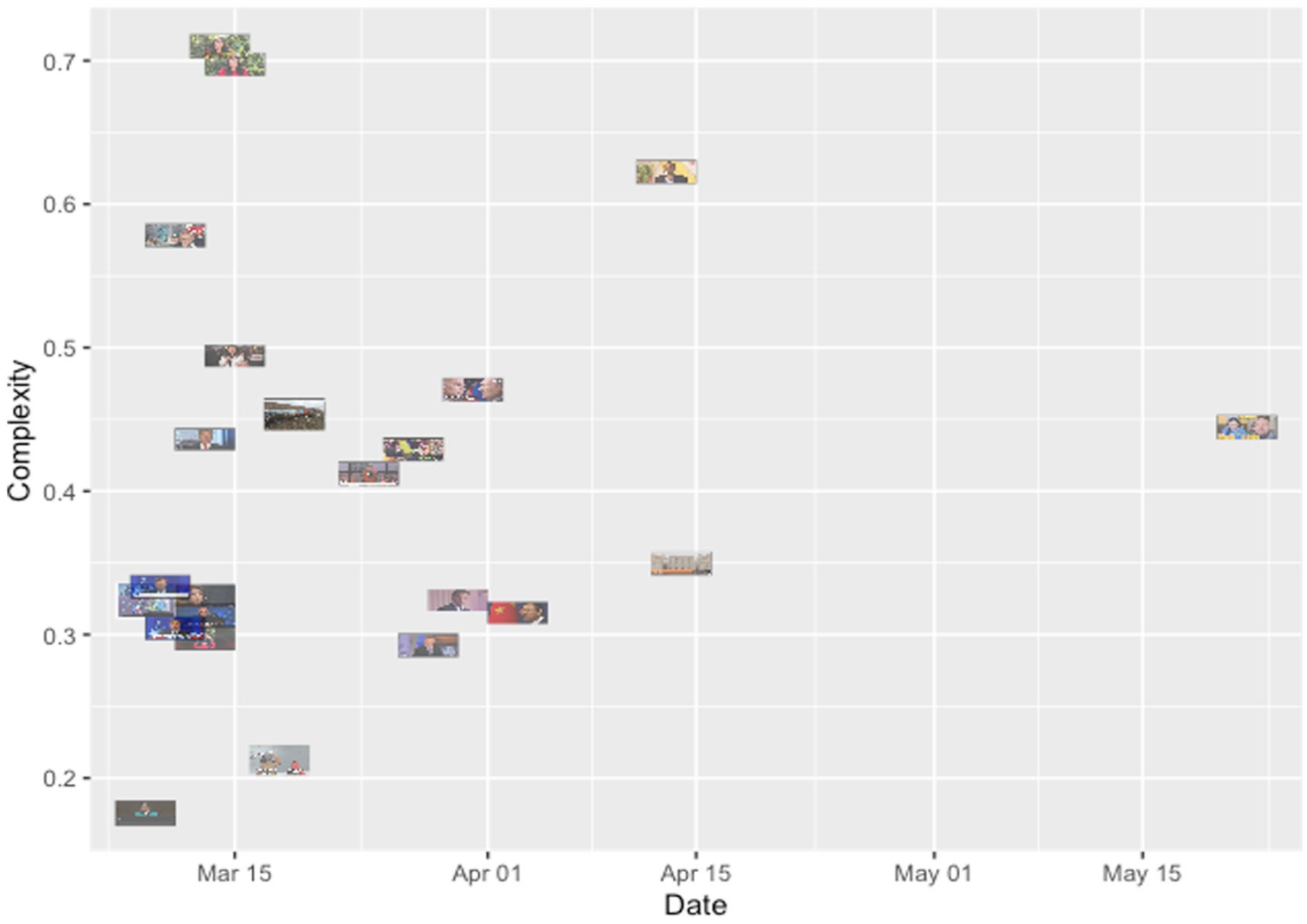
Date to complexity. Due to range truncation, axis ticks by the fortnight.
Image complexity is revealing as there are clusters of news-like images appearing near key dates. Later images which are not part of the core speculative story tend to have higher visual complexity or far lower, as in the case of a meme pictured near the x-axis. Multimodality would further enforce the preferred reading of the story as casting doubt on the West. If we consider the images of Gabbard selected by news organizations they all have a lower complexity profile than those from her original image. Richer images index as primary source material.
News styled images predominated the upper region aside from the pro-Ukrainian image of a helicopter tail featuring, what is translated by the original poster as Russian for “To Berlin” (“My Country? Europe,” 2022). This image and those of Representative Gabbard stand in contrast to the core visual logic. Many of the images presented in this region (unlike those to come) are still-frames from television news broadcasts that were included in the social flow. The multi-modal user case for this effort is to provide to a viewer a full-block of opinion journalism intended to provide emotional framing for factual slight-of-hand, the aesthetic of news.
Notably, the story of biolabs begins earlier and more directly on Instagram with a distinct visual logic. A debunker appears before the primary signal on March 2 (Interesting Engineering, 2022). An initial montage of red and blue can reveal essential differences between the designs. The figural logic of the images comes from the decision by the posting agent to focus on stills, which further is an element in text-based image macros. The content shared on Instagram was intended for this platform (Figures 4 and 5).
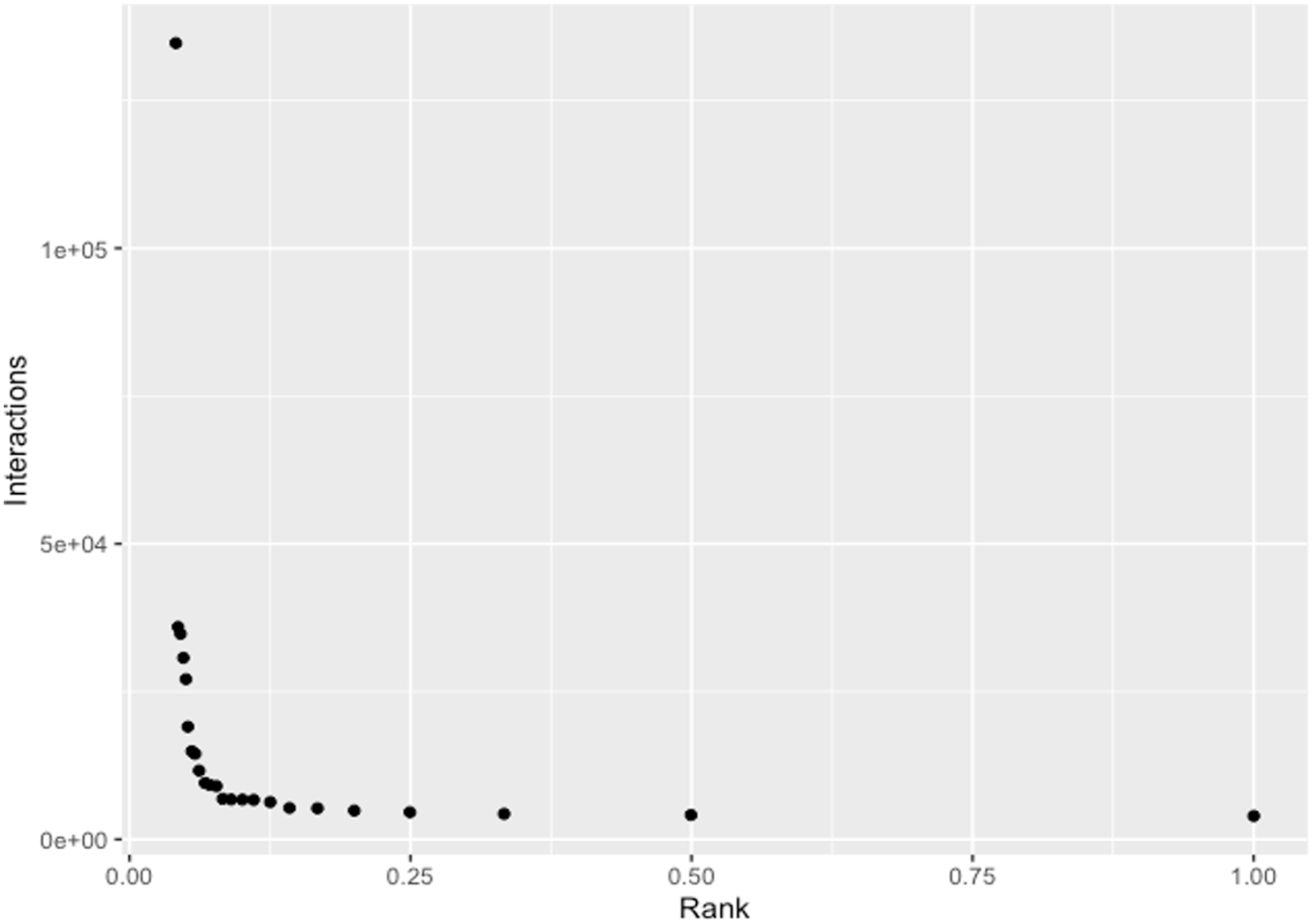
Instagram, interactions/ranks.
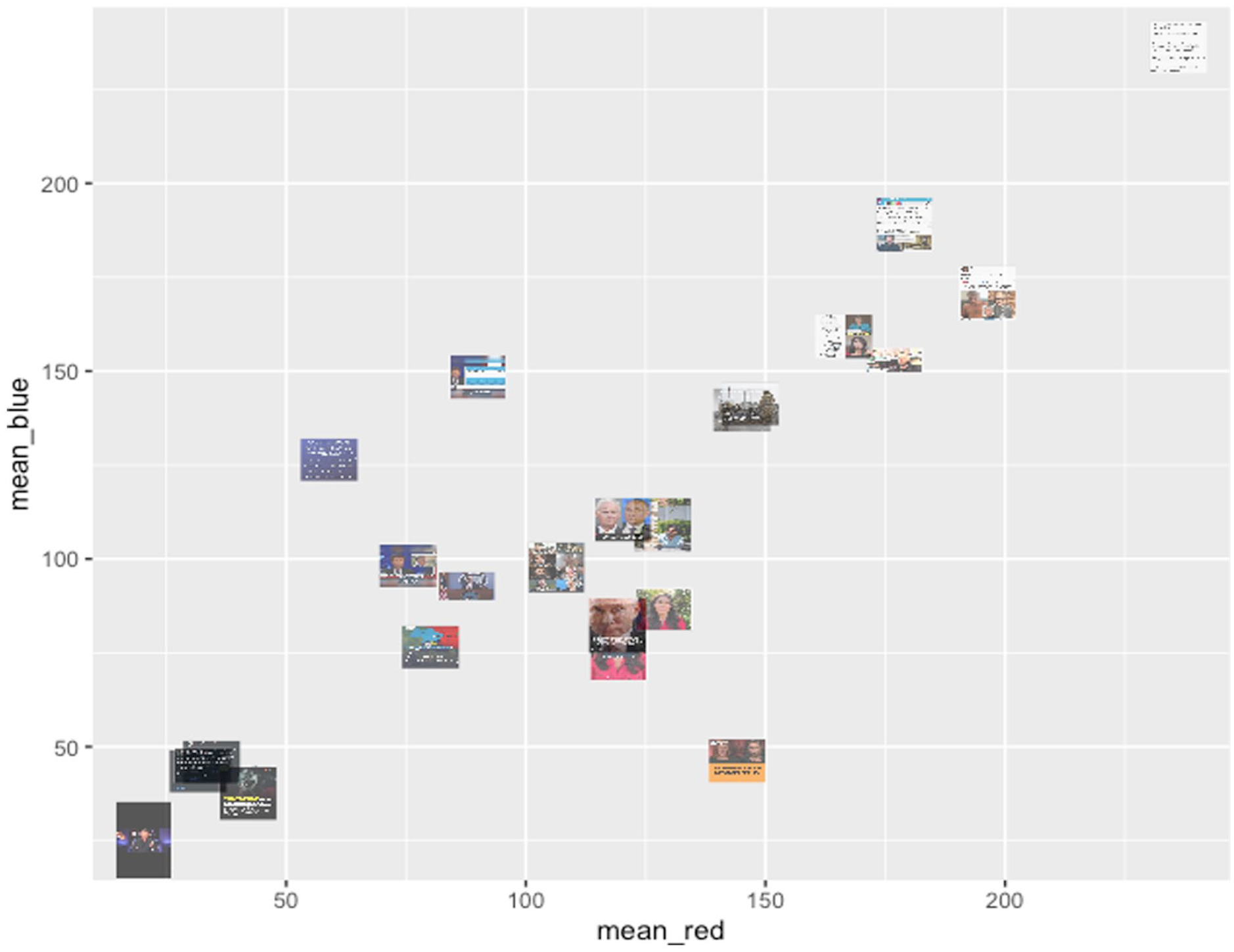
Instagram, mean red/mean blue.
Consider the launching point for the bioweapons argument on Instagram: a stock image of a person in a gasmask with super-imposed text (“OpIndia,” 2022). The gasmask in question appears to be a Russian issue GP5. Gasmask images like these are typically associated with video game cosplay, denoting danger and drama. In longform in the post text, a full news release offering the narrative of Russian soldiers disarming dangerous biological weapons labs appears a full day before partisan media in the United States. It is a heavy-handed opener for the campaign which fits with expectations for these kinds of operations. There is no semiotic contingency here, just defense against American toxic aggression (Figure 6).
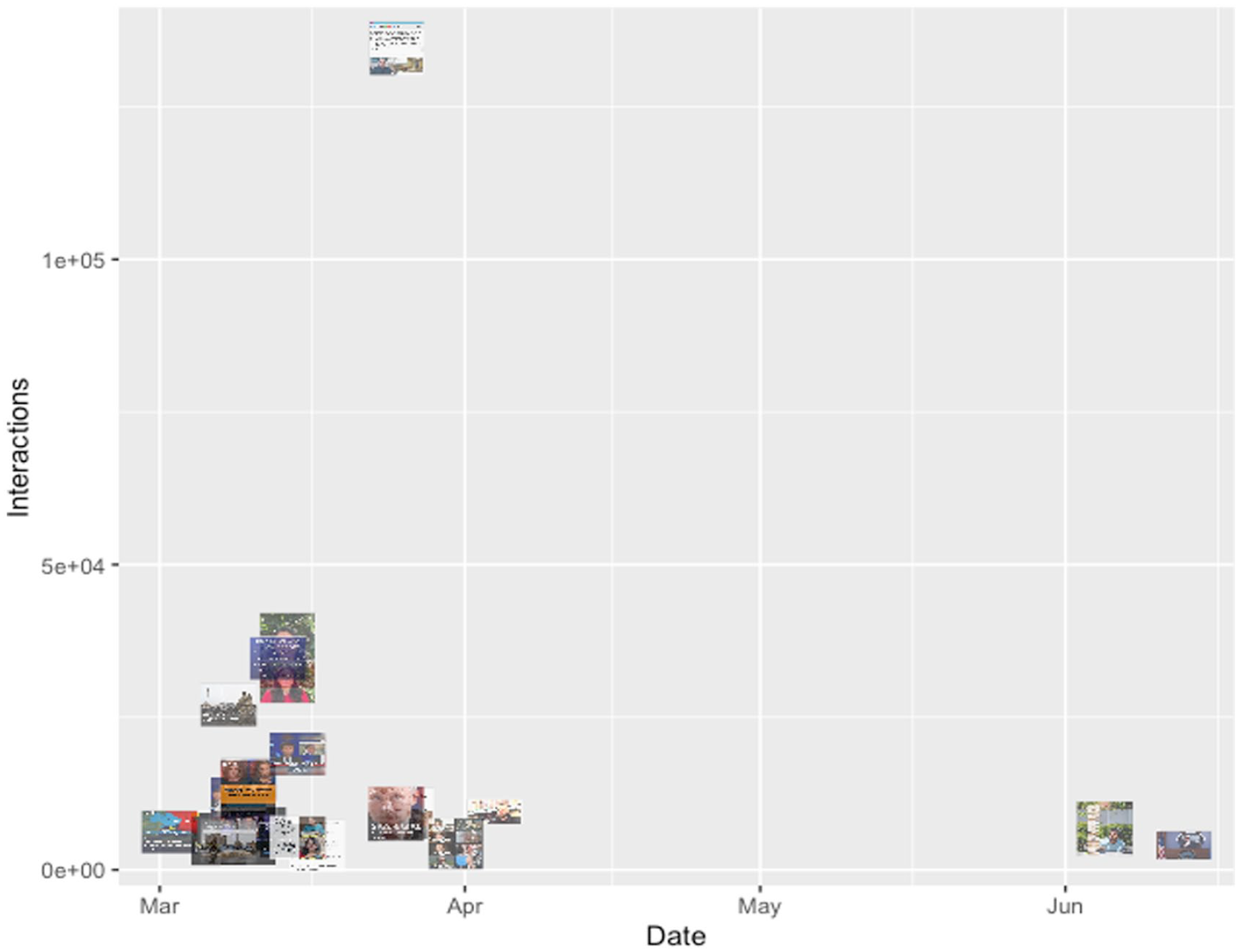
Date/interactions (total).
The news image vernacular that circulated widely on Facebook does not dominate on Instagram. Instead, we see closely zoomed still shots overlayed with Helvetica. Unlike Facebook we see active debunking in the head of the distribution, such as the close-up image of President Putin with super-imposed text in the lower left quadrant (Figure 7).
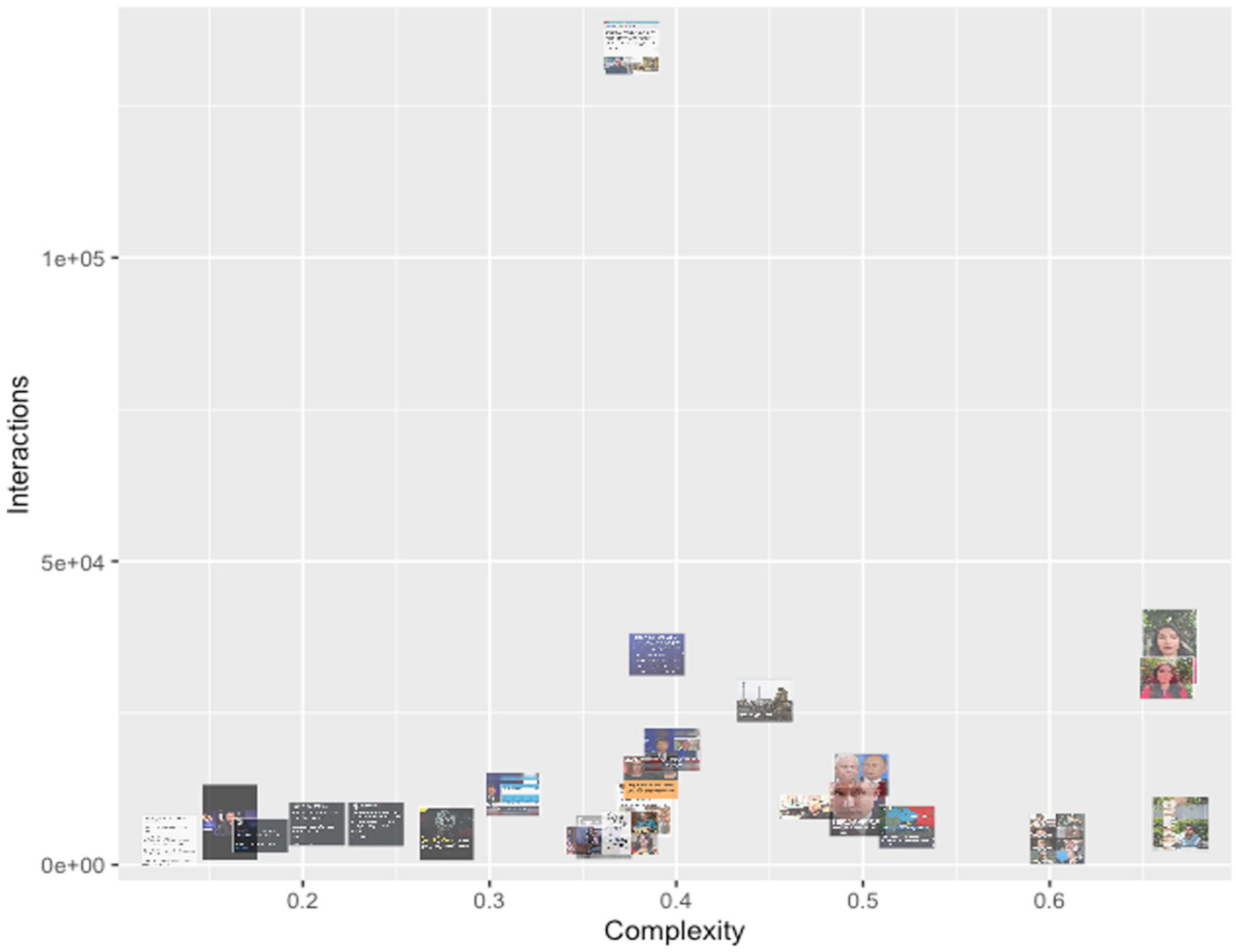
Instagram, complexity/interactions.
Popularity to complexity analysis shows a distribution across the spectrum with posts tending to present contemporary Instagram aesthetics on the right with text focused offerings on the left. In terms of performance, the like/comment ratio z-score (which standardizes the relationship of interaction patterns where we might see divergence in activity) for this post is .46, which is reasonable. High z-score posts include a Jenga tournament in the “biolab” quad at Harvard (3.95) and the gasmask post (1.67) that launched this wave on Instagram (Harvard, 2022; “OpIndia,” 2022) This particular method is employed here as a check against error or manipulation, such as a bot-supported post. It is odd that Hunter Biden play netted so many likes. For comparison purposes, there is no correlation between page follows at post launch and interactions (.233, p .284) which is troubling given that pages with far larger audiences somehow received far lower interaction rates. Removing these outlier points is reasonable (Figure 8).
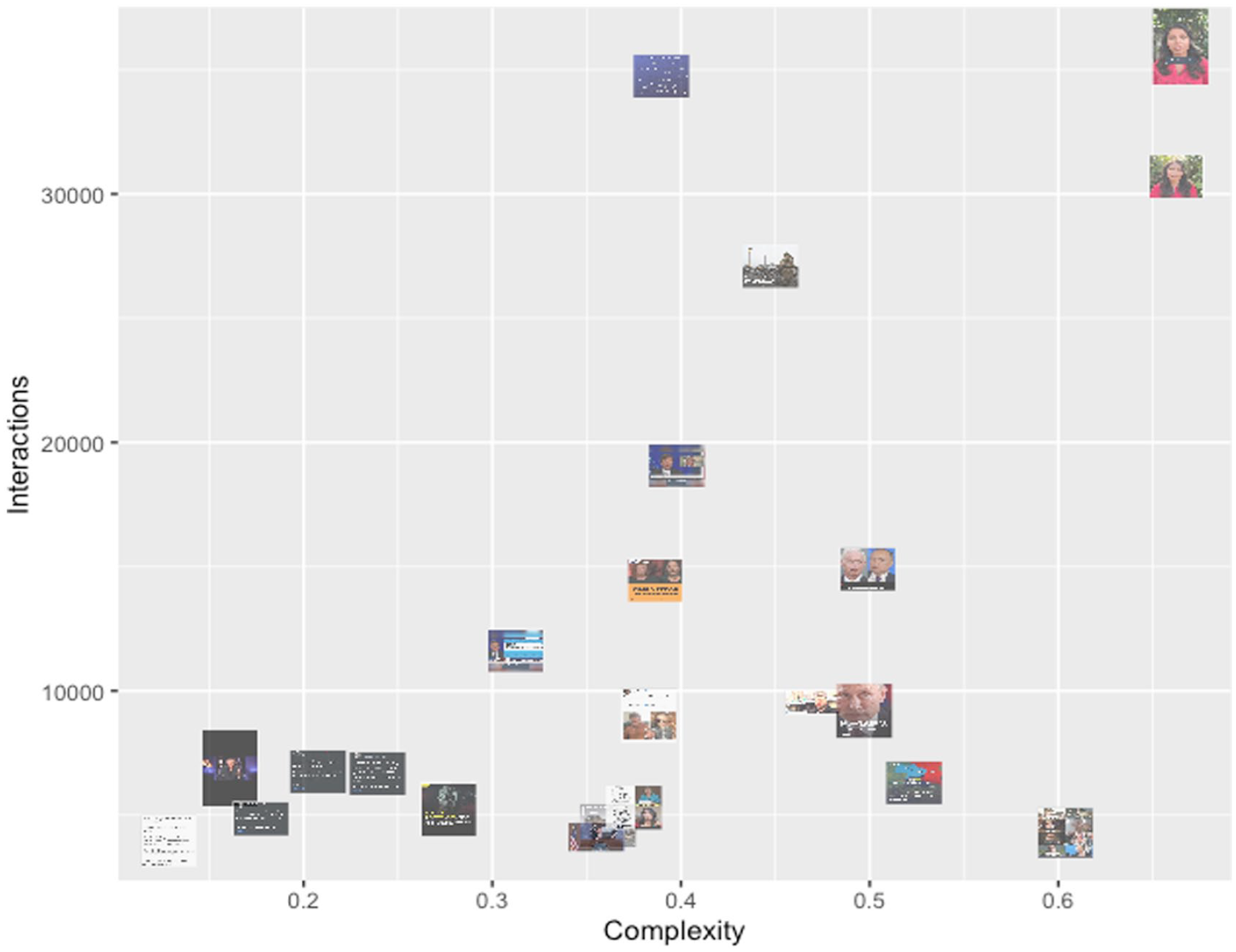
Instagram, complexity/interactions minus Daily Mail.
Higher complexity scores were associated with higher interactions. After removing the Jenga picture and the suspicious post from the Daily Mail, the correlation between image complexity and sharing is real (.539, p. 01). Images with robust depth of field are shared more.
A similar two pulse structure can be seen on Instagram as well with a primary argument cluster and the narrative consolidation cluster behind it. If we omit the Hunter Biden post, the number two post is a text stack by Tulsi Gabbard (2022a) walking back her earlier claims, arguing that she was misunderstood and that she never meant to imply that there were biological weapons involved. This begs the question as the rhetorical priority of the biolabs story depends on manipulating the context of the term and is a unique to Instagram assets. At this point the focus would begin to turn onto the labs themselves rather than the United States.
One particular subset to note, which did not appear at all on Facebook, are screenshot posts from Truth Social. These appear in the lower right, near midline of complexity for the distribution and are from a single poster. Kaitlin Tiffany has described the screen shot post as the “chaos agents of the internet” (Tiffany, 2021). Cultural motives for screenshotting vary, but their general impression is proximal to intimacy, someone sends you a screenshot of something you are not supposed to see. In the context of bioweapons propaganda screenshotting, this is included in the framing of the message attacking both Instagram parent Facebook (Meta) and the enterprise of fact-checking. Rather than being brought to you to embarrass someone, these are treasured nuggets imported around authority figures. Serving a double function these posts make the basic arguments of the biolabs argument while serving as an advertisement to leave Instagram. While not directly requesting that users continue their conversations on a different platform (as has been documented in anti-vax discourse) these posts serve as off-ramps to the place where red checks (as opposed to Twitter blue checks) rule (Restrepo et al., 2022). This is the primary function strategy of the account in question which has been omitted to protect the privacy of a user who appears to style themselves a micro-influencer.
Bloomberg Business (2022) directly connected state propaganda efforts early using an image macro. Fox News (2022) proper, rather than Carlson or Hannity, covered Senator Ron Johnson’s argument that “Putin’s War Crimes” were the real threat. Direct live video from Ukraine offered compelling, personal answers to the disinformation (Baldieri, 2022) Vice took a more direct path using a classic image macro format with Putin’s face and in Helvetica, “Russia was losing the in information war. Then Fox News stepped in” (Vice News, 2022). What is interesting is that included text of this story is a complex reading of the statement of the Russian Armed Forces supporting narrative consolidation around Hunter Biden. The image referenced in the Vice commentary does not appear in the versions of the datasets used in the primary research here as the interaction volume as the debunker had eight times the traffic of the conspiracy. Of course, the suspicious Daily Mail post which amplified the signal of the claim had 10 times the yield of the debunker. Other claims based on the word of Kirillov include claims that the United States was testing AI developed biological technologies (a sort of super soldier serum) on Ukrainians and that Monkeypox is a United States biological weapon (PressTV, 2022; Russia Today, 2022). These claims fall well-below the threshold for inclusion in this study.
The selection of Tulsi Gabbard providing an Instagram-reel ready monologue offers similar, though less robust meaning. Kyle Chayka (2022) dubbed this the first “TikTok War” because of the presence of these forms of evidence. Both in the direct testimony of people on the ground and in closely shot still images with clear short textual arguments are ultra-directive for the audience. Although a few memes appear, they are clearly not the focal point. A poorly designed eight-panel meme situating Putin as a martyr to the capitalist West did not perform well because it wasn’t good. Meme communities have a meta-reflective focus, their primary social function is in recirculating content for vernacular criticism, having a taste in memes is more important than the rhetorical function of the meme itself (Literat & van den Berg, 2019).
On Instagram the Biolabs argument looked like direct testimony with clear non-news like visuals accompanied by image macros that functioned to deliver the propaganda claims in short, unvarnished bursts, but also as meta-arguments to leave the platform entirely.
Unlike Facebook and Instagram which feature affinity-based feeds, Reddit is organized by communities of interest known as Subreddits accompanied by secondary feeds for “news” and “popular.” A very limited number of posts achieve the level of making the front-page of Reddit. The difference between the platforms is stark. Of the top one-hundred posts on Reddit about biolabs only 10 feature a shared image and 12 are native videos that might be screen captured. On Reddit the decline from the top posts is intense, and those top posts are debunkers (Figure 9).
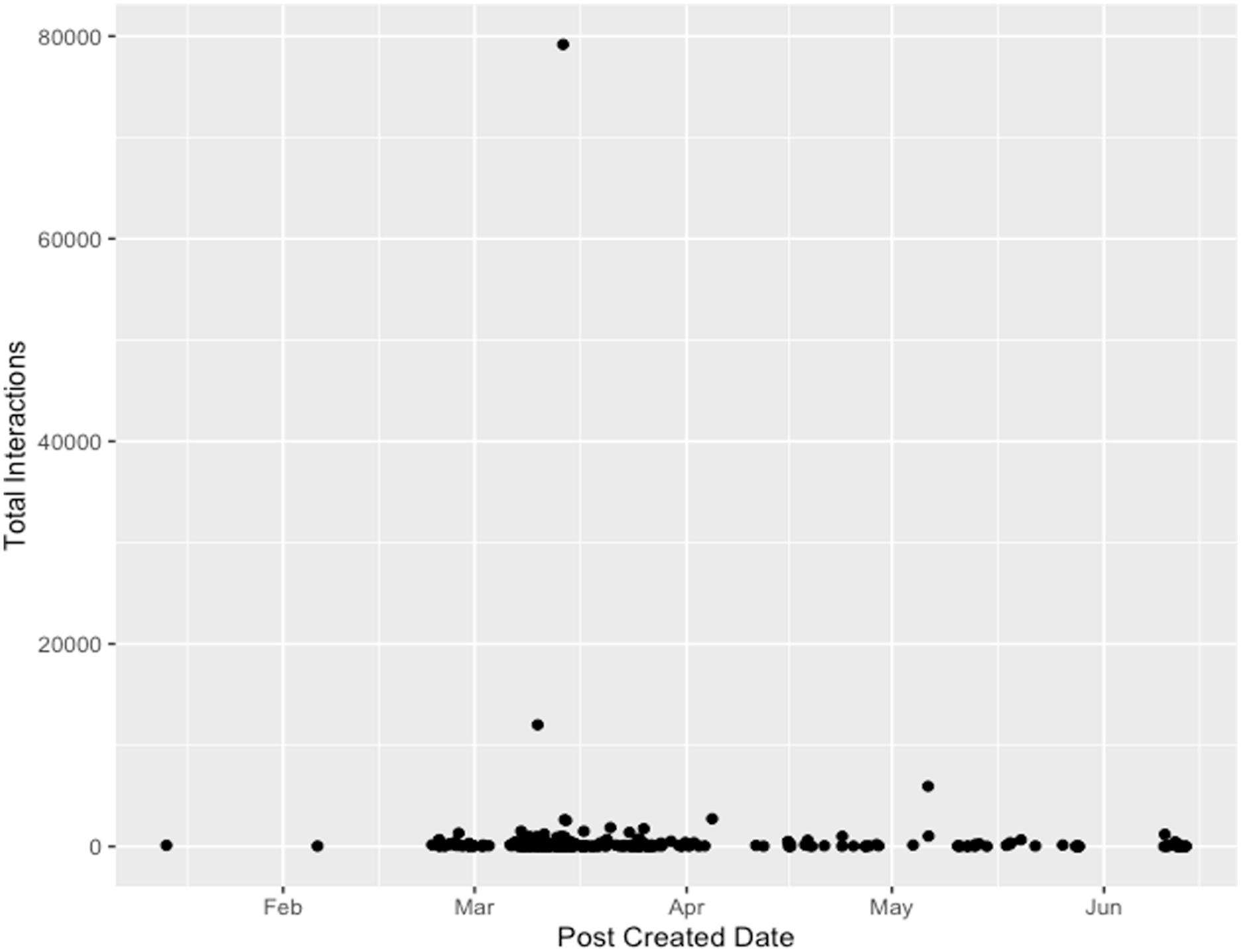
Reddit, date/interactions.
The top posts on Reddit were not articulated to images and were debunkers. The first piece of misinformation was delivered as ninth most popular by a user on a Donald Trump fan forum followed by posting on r/conspiracy further developing the theory (Figure 10).
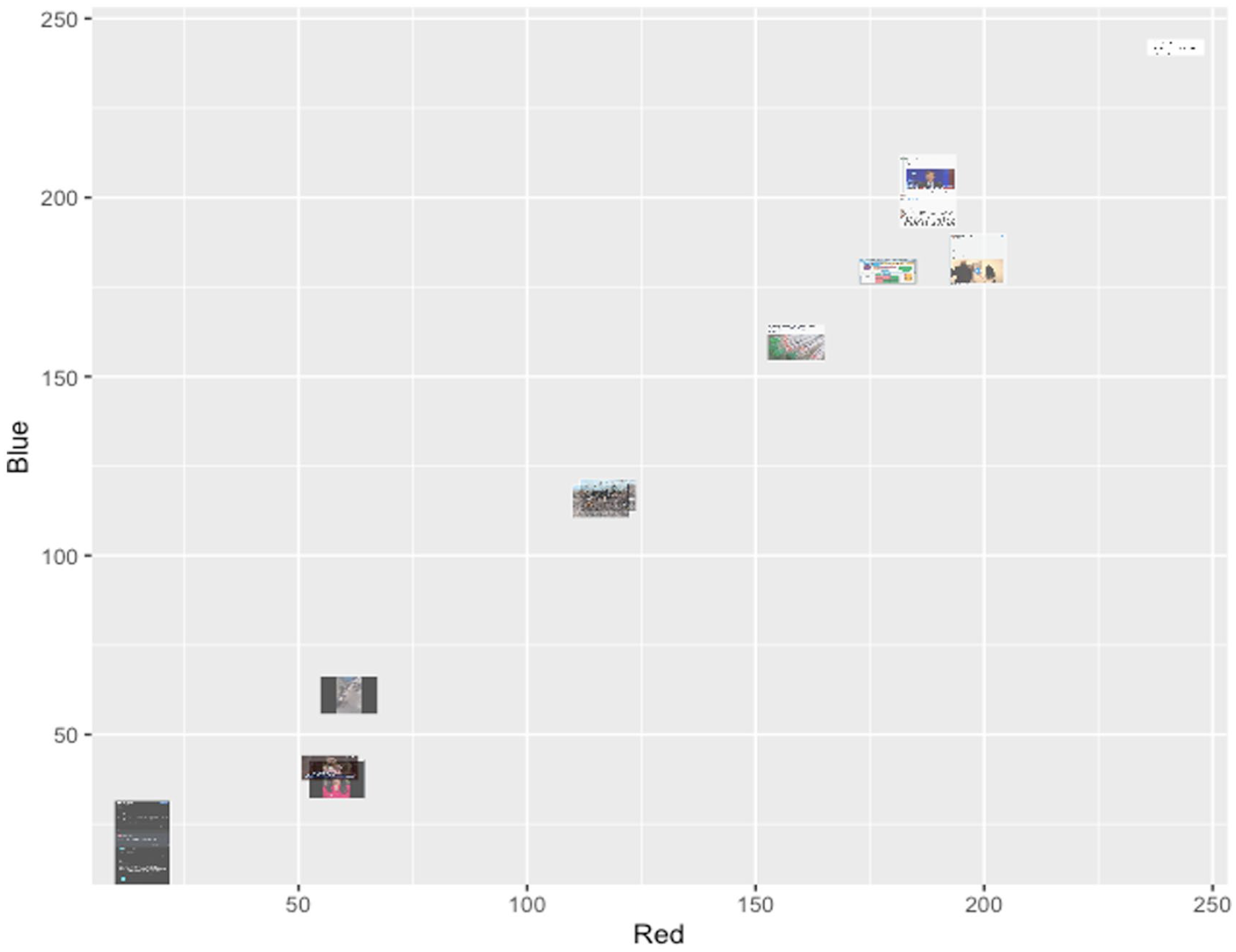
Reddit, mean red/mean blue.
Clusters are not apparent in this field. Instead note the sparsity of graphics, instead of a visual experience, even as image macro. The images that appear here are far more diverse including US Representative Greene presented as a form of critique, a graphic produced by a Redditor on r/Conspiracy claiming to show the structure of the conspiracy, visual jokes, and direct evidence in the form of a video claiming to show a man fearful of bird-based US bioweapons poisoning pigeons (butcher_of_the_world, 2022; UkraineWarVideoReport, 2022). On face, it is clear that the biolabs argument did not play well on Reddit.
Analysis of Reddit would call for a closer reading of the functions of the Subreddits. It important to recognize that Subreddits exist because of the continuous cultivation of moderators who, in combination with platform affordances, produce an identity for the forum (Massanari, 2017; Squirrell, 2019). Reactionary communities form and are reinforced on Reddit through the continuous recirculation of identity affirming discourse (Gaudette et al., 2021). The analysis of the main page level of Reddit seems to support a thesis of inoculation against disinformation or at least blocking via concerted signal boosting. The situation on r/Conspiracy is different.
Nine of the top 25 biolabs posts originated on r/Conspiracy. It is important to see the date to interaction rate plot which shows an important point: the biolabs story starts on this subreddit before anything else in this study. As an origin point for the biolabs story the claim is that the sub found a US Embassy website. The most popular post articulates biolabs together with weapons as a justification for pre-emptive war against a belligerent Ukraine asking “You don’t think if Mexico or Canada was pulling that crap that the US wouldn’t do something about it?” (War_Criminal__, 2022). The second most popular post from this era contained the image seen in the main plot of what the sub asserts to be a translated organizational chart, translated from Russian by the poster, of the biolabs conspiracy, which now features the United Nations, the Democratic Party, and several Universities in the United States (gnilognirg, 2022). In other forums the sort of evidence collage and community narration demonstrated here is a form of world building that produces what are ostensibly facts (Marwick & Partin, 2022). The users explain in this status post why their sub continues to exist, possibly as “honeypots” to lure and trap extremists, but more deeply as “proofreaders” who would be kept around to support the conspiracy (Relentless_Sloth, 2022). r/conspiracy is actively producing a community logic with forms of evidence creation. Intermedia effects from this effort would be to create a stable signal which would compel coverage by others (Figure 11).
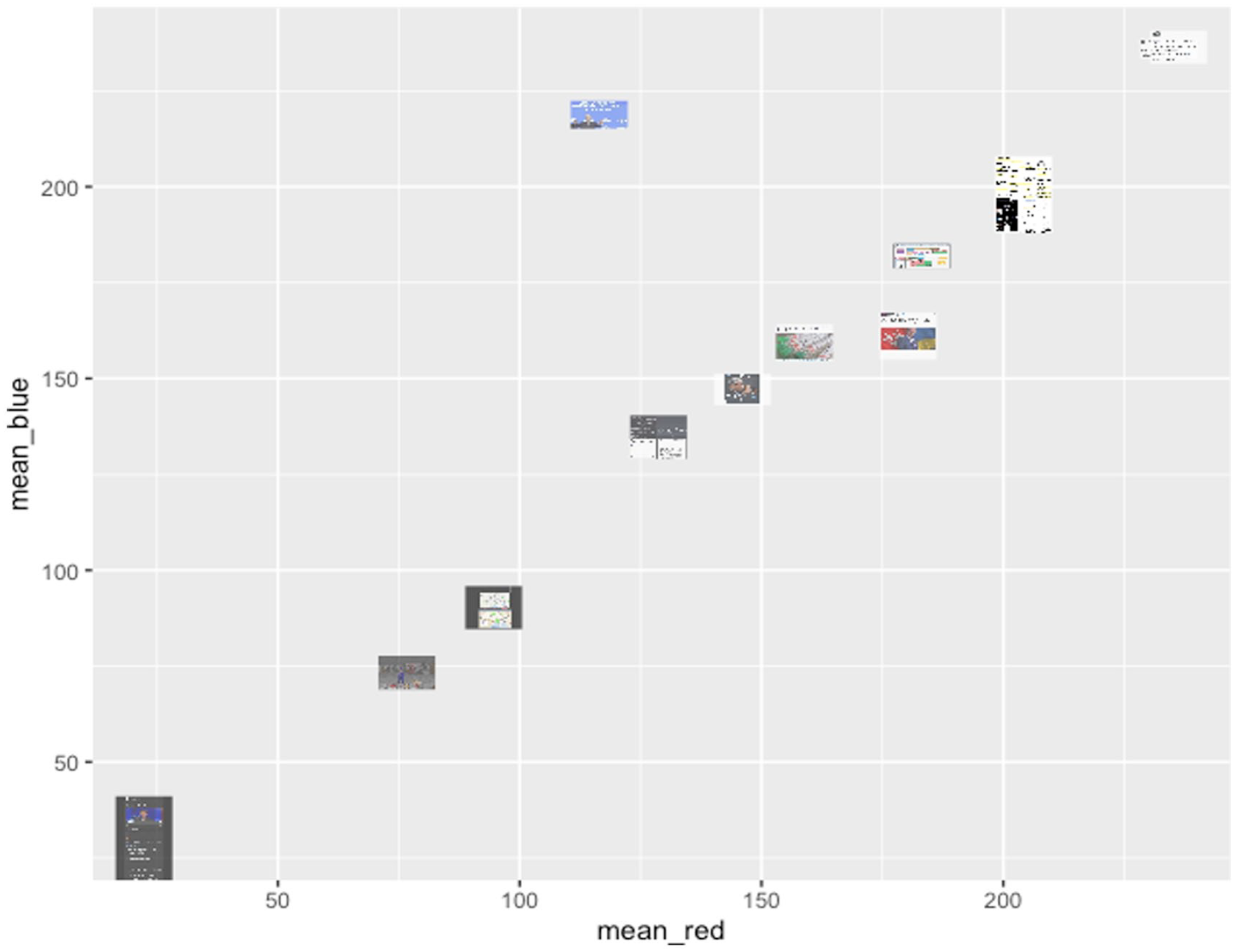
r/Conspiracy, mean red/mean blue.
These images are all of those that were shared as primary assets in r/conspiracy that would likely have rendered an image in the feed rather than text. These images are high contrast. The collection includes several collages and several were already deleted by the users. Protecting the integrity of the delete decision is important. Instead of seeing r/conspiracy as a collection of news assets that are being recirculated, we should view this forum as a news source in itself. It would make sense that a group, engaged in elaborate storytelling would favor text and specialized forms of images. Group narration holds that participation in the group is itself a form of belonging. The mechanics of their group continuously elaborate and create additional social code which can continuously weave in additional content from Russian sources. If each subreddit is a functionally a source on its own, the function of r/conspiracy would be junk news. Other forums, such as r/TopMinds then in reacting to the signal produced provide internal intermedia effects, while the reactions on the outside may be significant as well. The TopMinds post in this dataset is a screenshot presented as a look into the world of r/conspiracy where a commentator attributes the collapse of the biolabs story to the conspiracy, not the campaign collapsing (PorridgeCranium2, 2022). Taking a look beyond the top 25 posts the other 21 posts in the top 100 provide forms of evidence for the conspiracy however compared to the power of the debunking signal at the top.
Campaign structure
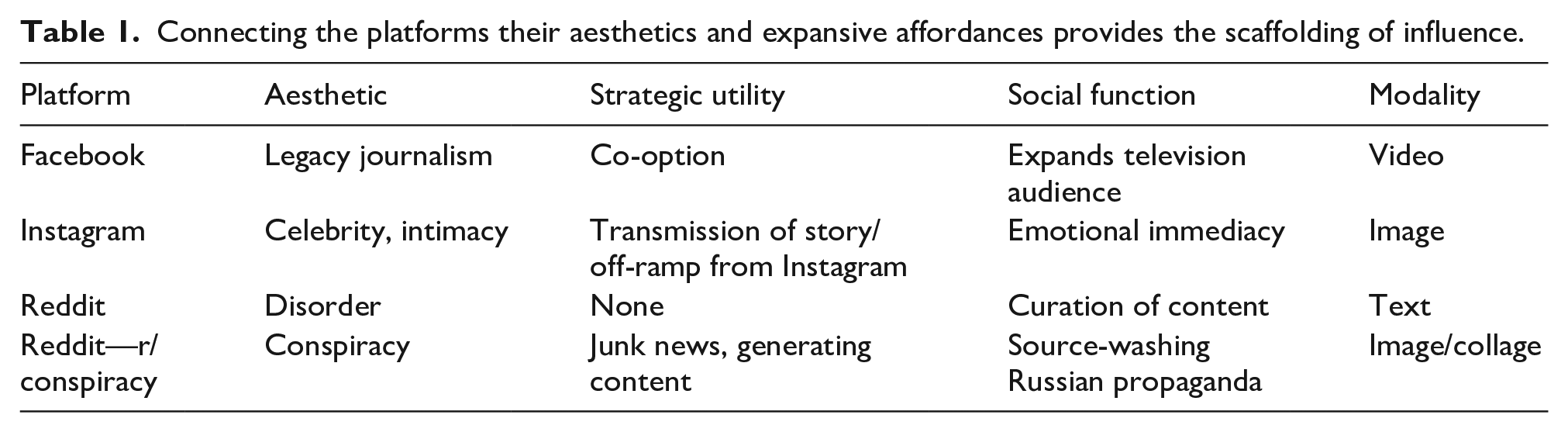
Each platform carried distinct content related to the core argument, with Facebook and Instagram being important vectors for disinformation. While we might expect more platform-to-platform flow, the results were distinctive for each platform. Between Facebook and Instagram, the kinds of images shared and arguments were distinctive and tailored to the platform. Successful disinformation on Facebook was structured as a reinforcement of legacy media sources. Messaging on Facebook took the form of news screenshots from partisan sources, as well as content from the legacy sources themselves, activating existing messaging pathways. Instagram disinformation appeared to be an earnest selfie-soliloquy, using the visual conventions of an Instagram Reel. At the same time, unlike Facebook, debunkers following Instagram’s visual conventions were clearly present. The other key use of Instagram included an effort to advertise a remote in-group on another platform. What is striking is that on a macro level, Reddit was actively combating disinformation. At the same time, focused efforts within r/Conspiracy may have been a source for generating the conspiracy theory in the first place. Instagram successfully diffused content to a general audience while the successful Facebook content was intended to articulate a new propaganda claim into a mature ecosystem. In terms of what this means for future directions, Instagram is clearly a critical site for future research. Reddit on the whole was less distinctive, Reddit within a known conspiracy sub-reddit served that function, and Facebook was a repeater of cable television. Image circulations between Instagram and TikTok will be especially important for future research, as platform to platform movement is a critical new research domain (Wu et al., 2021) (Table 1).
Connecting the platforms their aesthetics and expansive affordances provides the scaffolding of influence.
From a campaign design perspective, the already co-opted legacy sources did not lead the story, this was done via junk news which forced the story into the ecosystem. The story then collapsed under the weight of its own kernel of truth, word play around the term biolabs. In the later phase, the narrative is consolidated into the all-consuming melodrama (Figure 12).
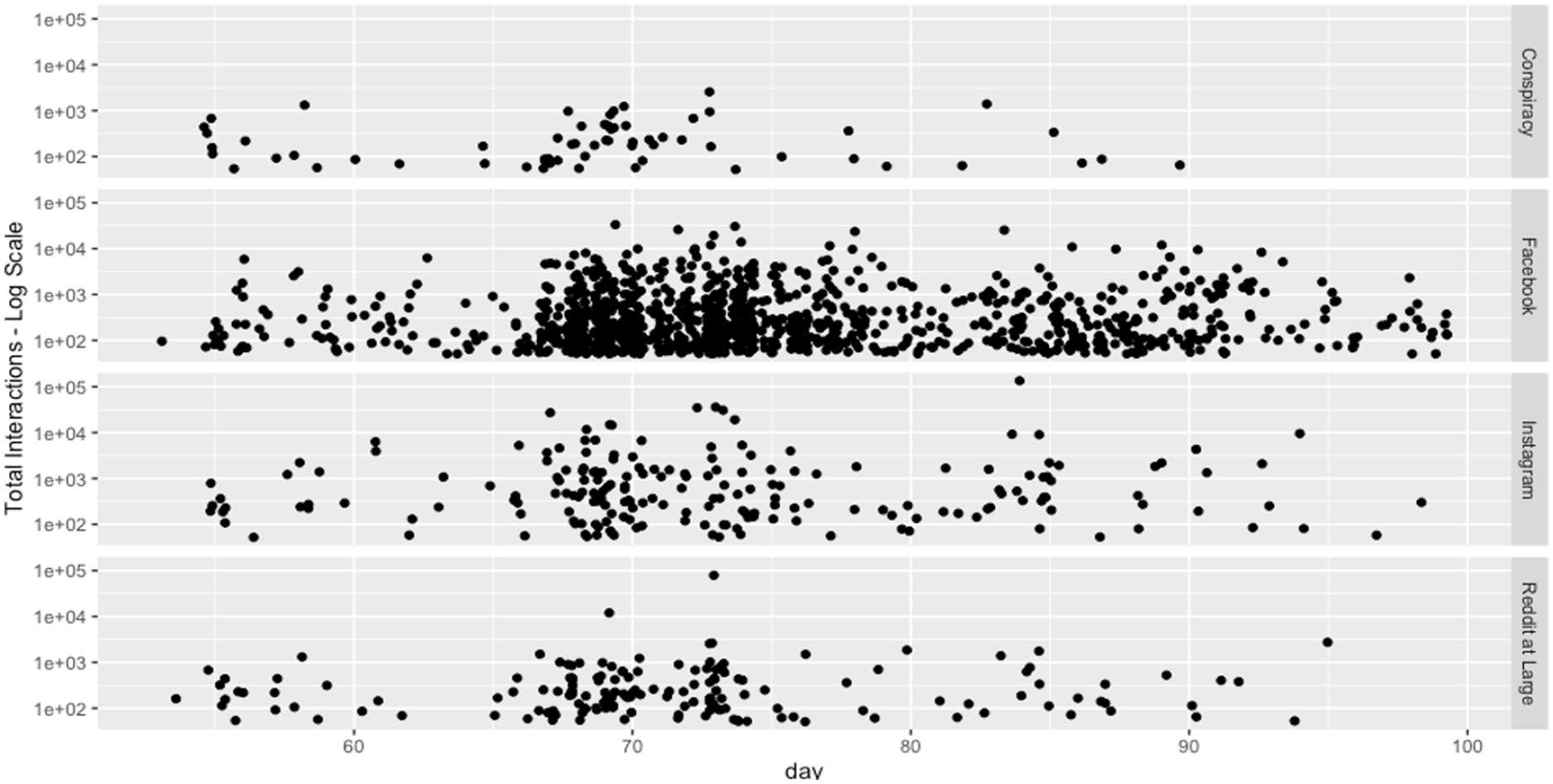
Influence timeline.
The bi-modal structure of the argument is apparent on Facebook, Instagram, and r/Conspiracy, while Reddit peaks at the original debunker. While Facebook had a higher volume of stories, the greatest peak in popularity was on Instagram. The last uptick near the end of the distribution are uptakes of the story in secondary national contexts (such as Romania) or new fabulations (Monkey Pox is part of the US Bioweapons Program). Once again, we the affordances of the platform itself come into sharp relief.
The argument is consistent across platforms while distinct in platform specific ways. At best the argument is intended to cast doubt on the United States and Ukraine as potentially risky, dishonest actors. In the most extreme versions, the United States is the villain deploying biological weapons around the world.
Returning to our core research question: why was this effort less effective? In a very real sense this propaganda did work, it was transmitted across media systems in the United States and eventually underwent narrative consolidation into the core propaganda campaign against the United States. What did not happen was a mass movement to end support for Ukraine or the defection of key political officials (McConnell, Romney) in the Republican party to the Russian side. At the same time, this did serve to offer a new story of American villainy. While r/Conspiracy did function as a concentrated site for the argument, on a macro-level Reddit was inoculated because of active debunking. Beyond the Gabbard content, the aesthetically aligned debunking on Instagram surrounded the story. By March 15, Gabbard was attempting to counter punch against Romney and to work from the sandbags of the initial claim. The frame of the story had irreparably shifted, no longer was it a revelation about the fictional United States biological weapons program, it was an exchange about Russian duplicity.
Surely a wry attacker could have wrapped Mitt Romney into the conspiracy or engaged in more specific cultural work to promote another voice in the Republican party who might have forced President Biden to throttle back. This misses a key idea: Russian operations are not games of five-dimensional chess. The lack of a deep game of future anticipation would confirm what was established in the literature base, that propaganda efforts are opportunistic, and that image driven platforms should feature prominently in further research.
Footnotes
Appendix 1
For the purposes of credit and replication, the following tables include the direct links and impression counts for each element used in an image transformation. Some of the links, especially with Reddit, have changed since the analysis was conducted (a span of 10 months). To replicate the research conducted in this article, with images you capture, please consult the tutorial for an image plotting method, such as ImagePlotX.
