



Abstract
This study sought to analyze Ukraine’s innovative use of Twitter (X) during the Russia–Ukraine War while identifying which Ukrainian innovations may diffuse among diplomatic institutions, thereby impacting the practice of diplomacy. Through an extensive literature review of 90 digital diplomacy studies, the study mapped 14 factors that may facilitate or inhibit the adoption of digital innovations in diplomacy. Using these factors, the study identified four Ukrainian innovations which may be widely adopted by diplomats including lobbying big tech CEOs, using memes and humor to narrate events, and utilizing celebrity Ambassadors. The study also identified one innovation that may not be adopted by diplomats—crowdfunding weapons procurement online. The study discusses the impact of each Ukrainian innovation on diplomatic practices and digital publics. By identifying factors that impact the adoption and diffusion of innovative technologies among diplomats, and demonstrating how such innovations impact diplomacy, the study addresses an important lacuna in digital diplomacy research.
Introduction
Recent years have seen the accelerated digitalization of diplomacy. By digitalization this study refers to a long-term process in which digital technologies impact the norms, values, and working routines of diplomats and their institutions (Manor & Huang, 2022). Notably, the digitalization of diplomacy has not advanced in a linear fashion, with diplomats increasingly using more sophisticated technologies. Digitalization is actually shaped by a confluence of two events: a shock to the international system and the emergence of an innovative digital technology.
The Russia–Ukraine War is unusual as this external shock was marked by the innovative use of existing technologies, namely, social networking sites (SNSs). Since the beginning of the War, Ukraine has employed SNS in innovative ways to obtain diverse diplomatic goals, ranging from Big Tech boycotts of Russia to crowdfunding weapons procurement. Ukraine’s innovative use of SNS raises two important questions. First, will other ministries of foreign affairs (MFAs) emulate Ukraine’s digital activities? As we argue in the following sections, innovative uses of digital technologies often diffuse among MFAs, giving rise to new norms and practices. The second and subsequent question is how Ukraine’s innovative use of SNS will impact diplomacy more broadly in terms of norms, practices, and processes? This study sought to answer these questions by identifying and analyzing those Ukrainian innovations that may diffuse among diplomats.
Notably, this study adopts a new approach by contending that just as innovative digital technologies reshape diplomacy, so can innovative uses of existing technologies. To analyze the possible diffusion of Ukrainian innovations among MFAs, the study uses a new matrix of 14 factors that either facilitate or inhibit digital innovation in diplomacy, a matrix compiled specifically for this study through an extensive literature review of 90 digital diplomacy studies (see Appendix 1).
The first section of this study introduces the factors that can facilitate or inhibit digital innovation in diplomacy. Next, the study introduces the SNS tactics pioneered by Ukraine. In the following sections, each innovation is analyzed using a matrix of 14 factors. Finally, the study discusses how these innovations may impact the practice of diplomacy.
Theoretical framework—the (constant) digitalization of diplomacy
The digitalization of diplomacy has led diplomats to adopt a host of digital technologies ranging from SNS to mass messaging applications, blog sites, big data analysis, and virtual platforms such as Zoom (Adler-Nissen & Eggeling, 2022; Bjola & Holmes, 2015; Cornut, 2022). In this study, we contend that the digitalization of diplomacy is shaped by a confluence of events: an external shock to the international system and the emergence of an innovative technology.
The digitalization of diplomacy began circa 2012 and was marked by diplomats’ use of digital technologies to create virtual ties by establishing virtual Embassies (Metzgar, 2012; Pamment, 2013). However, a confluence of events—the 2011 Arab Spring and the mass proliferation of SNS—facilitated a transition from “virtual diplomacy” to “digital diplomacy” in which diplomats eagerly embraced SNS while establishing social media empires spanning dozens of accounts across numerous platforms (Bjola & Holmes, 2015; Cull, 2013; Hocking & Melissen, 2015; Mazumdar, 2024; Sotiriu, 2015).
Soon, another confluence of events, the 2014 Crimean Annexation and the proliferation of digital disinformation, led to yet another shift from “digital diplomacy” to “data diplomacy” (Boyd et al., 2019). The use of fake news sites, trolls, and bots during the 2014 Annexation, the 2015 Brexit referendum and the 2016 US elections all impacted the digitalization of diplomacy as MFAs now used data analysis to counter disinformation (Bjola & Pamment, 2018; Manor & Yarchi, 2023).
Diplomacy’s digitalization altered again thanks to a third confluence of events marked by the external shock of the COVID-19 pandemic and diplomats’ use of virtual meeting platforms such as Zoom (Moral, 2023; Zaharna & Huang, 2022). Although Zoom was not a new technology when COVID-19 erupted, it was new among diplomats, who were used to interacting physically with counterparts (Bjola & Coplen, 2022). Yet with the advent of quarantines and lockdowns, diplomatic negotiations increasingly took place virtually, leading to the current practice of “hybrid diplomacy” which blends virtual and physical activities (Adler-Nissen & Eggeling, 2022; Bjola & Coplen, 2022; Bjola & Coplen, 2023).
This study contends that Russia’s 2022 invasion of Ukraine may yet again reshape the digitalization of diplomacy thanks to an external shock, the Russia–Ukraine War, and Ukraine’s innovative use of an existing technology, namely, SNS. This assertion rests on the fact that innovative uses of digital technologies diffuse among MFAs. As such, Ukraine’s use of SNS may soon be emulated by other MFAs. This study is the first to both map Ukraine’s SNS innovations and critically evaluate how these may refashion the practice of diplomacy while impacting diplomats, diplomatic institutions, and the publics of diplomacy. As such, this study focuses both on the field of public diplomacy, defined here as direct communication with foreign peoples, with the aim of affecting their thinking and that of their governments (Malone, 1985, p. 199), as well as the broader practice of diplomacy.
Notably, before one can assess the broader impact of Ukraine’s innovative uses of SNS, they must first examine if there are factors that facilitate or inhibit diplomats’ adoption of digital technologies. By identifying such factors, one may determine which Ukrainian innovations could diffuse among MFAs and which may not. To identify such factors, we conducted an extensive literature review of 90 digital diplomacy studies published between 2010 and 2024. To our knowledge, this is the first study to conduct such an extensive review and only the second study to identify factors that impact the diffusion of innovations in digital diplomacy (Al-Muftah et al., 2018), which are discussed next.
Factors that facilitate digital innovation
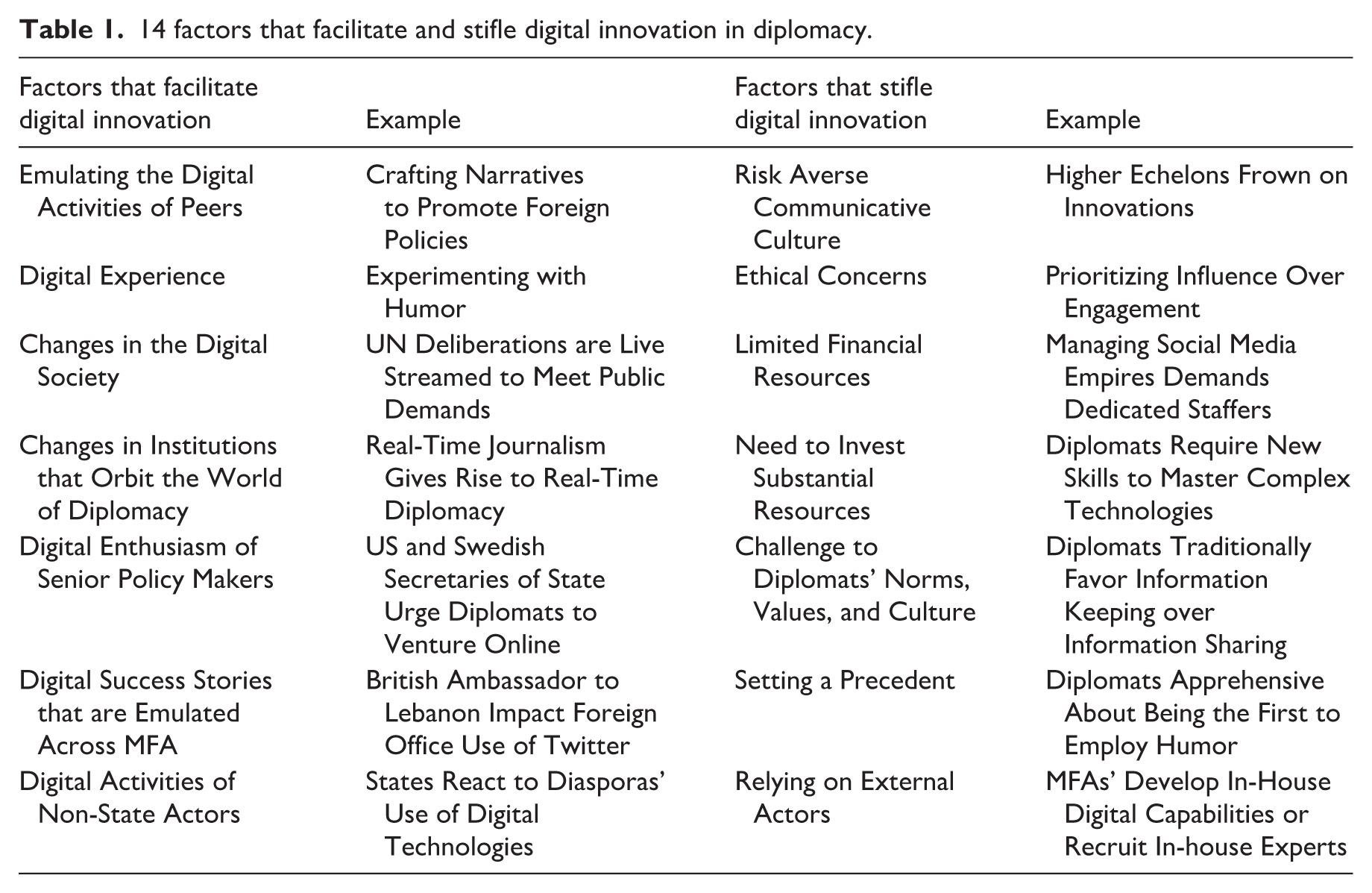
Digital Diplomacy studies have identified seven factors that facilitate digital innovation in diplomacy. The first, identified in 70 studies, is diplomats’ propensity to emulate the digital activities of their peers. Indeed, diplomats often mimic their peers’ digital practices, and it is in this way that innovative uses of digital technologies diffuse among MFAs, altering diplomatic practices. This is not surprising as numerous studies have found that MFAs and diplomats follow one another on SNS (Manor & Segev, 2023; Sevin & Manor, 2019), while diplomats regard their peers as a source of digital inspiration (Manor, 2016; Manor & Kampf, 2022).
Numerous digital practices have diffused among MFAs thanks to mimicry, including MFAs’ use of SNS, blogs, and websites to craft appealing strategic narratives through which state policies may be communicated (Horbyk & Orlova, 2023; Natarajan, 2014; Oloo, 2023; Wu & Sevin, 2023); diplomats’ attempt to counter negative digital narratives spread about their states (Erpul, 2023; Triwibowo, 2023; Vila Seoane, 2023) and diplomats’ use of SNS to craft a unique online brand that attracts digital followers (Lee & Shahin, 2023; Repnikova & Chen, 2023; Zhang & Tang, 2024). Metaphors such as “Networked Diplomacy” and “Dialogic Diplomacy” also diffused among diplomats and facilitated digital innovations. For instance, when practicing “Networked Diplomacy,” diplomats leveraged digital technologies to create transnational networks with NGOs and civil society organizations (Clarke, 2015; Park & Lim, 2014; Seo, 2013) while “Dialogic Diplomacy” led diplomats to integrate online comments into the policy formulation process (Manfredi-Sánchez & Smith, 2023; Metzgar, 2012; Zaharna et al., 2013).
The second factor is digital experience. 52 digital diplomacy studies indicate that diplomats master the use of digital technologies through trial and error or digital experimentation. Numerous scholars have argued that MFAs with a risk-prone communicative culture are more likely to experiment with new digital technologies and employ technologies in innovative ways (Al-Muftah et al., 2018; Bjola & Coplen, 2023; Copeland, 2013; Xu, 2024). Such was the case with SNS, which were originally used to counter the digital recruitment efforts of terror groups ( Hallams, 2010; Hayden, 2012; Pamment, 2013). Yet once diplomats gained experience in using SNS, they realized that they could communicate directly with foreign populations while bypassing gatekeepers such as media institutions. SNS thus enabled diplomats to directly shape foreign populations’ perceptions of world events (Bjola & Jiang, 2015; Guo & Qin, 2025; Rankawat, 2023). One innovation that has recently garnered attention from scholars is diplomats’ experimentation with humor and pop-culture references to attract digital followers and shape perceptions of world events (Boatwright & Pyle, 2023; Chernobrov, 2022, 2024; Horbyk & Orlova, 2023; Zhang & Tang, 2024).
Importantly, digital experience is at times shaped by the activities of individual Embassies or individual diplomats (Triwibowo, 2023). When these successfully experiment with digital technologies, they become “success stories” that are emulated across MFAs (Engtoft Meldgaard & Fletcher, 2024). The third factor to facilitate digital innovation is thus “success stories,” which alter an MFA’s attitude toward digital technologies.
47 studies have found that changes in the digital society facilitate digital innovations, with diplomats altering their digital practices in response to the activities of connected individuals (Manor & Huang, 2022). For instance, diplomats were eager to embrace SNS once these platforms were used by digital publics to learn about world events (Cull, 2013; Hallams, 2010; Hayden, 2012). Similarly, MFAs followed digital publics onto newer platforms such as Snapchat and TikTok (Fjällhed et al., 2024; Williamson & Kelley, 2012). Moreover, once individuals embraced the social media norm of transparency (Bauman & Lyon, 2013), they also came to demand greater transparency from diplomats (Hocking & Melissen, 2015; Wichowski, 2015), leading to the live-tweeting of diplomatic summits and live-streaming of UN deliberations. Digital innovations in diplomacy are thus often driven by attempts to meet the desires and expectations of digital publics (Oloo, 2023; Rashica, 2022).
The fifth factor identified in 39 digital diplomacy studies is changes in institutions that orbit the world of diplomacy. For example, whole-of-government approaches to digital technologies can impact diplomats’ activities. Government-wide digital initiatives, such as leveraging digital platforms for public engagement, facilitated diplomats’ interactions with digital publics (Al-Muftah et al., 2018; Golberg & Kaduk, 2011; Khatib et al., 2012). Similarly, changes to media institutions facilitate digital innovation (Causey & Howard, 2013). Journalists’ use of SNS to narrate world events in near-real time accelerated the speed of diplomacy as diplomats had to comment on or frame world events as they unfolded (Gallennius & Akil, 2024; Moral & Marco, 2023; Seib, 2012).
The sixth factor is support from heads of state, foreign ministers and higher echelons in MFAs (Zytoon & Husain, 2023). 19 digital diplomacy studies have concluded that the digital enthusiasm of heads of state and foreign ministers leads to higher levels of digital experimentation among diplomats. This has been true in the cases of China, India, Russia, Sweden, and the US (Adesina, 2017; Al-Muftah, 2018; Cull, 2013; Moral, 2024; Pamment, 2013; Rankawat, 2023).
The seventh and final factor, identified in 8 digital diplomacy studies, is the use of digital technologies by non-state actors such as NGOs, rebel groups, terrorist groups, and diasporas (Bos & Melissen, 2019; Erpul, 2023; Melissen & Caesar-Gordon, 2016). Studies have linked states’ use of digital technologies to the online activities of critical diasporas (Manor & Adiku, 2021; Rana, 2013; Stien, 2011), while studies also show that the digitalization of rebel groups and terrorist organizations leads to digital collaborations between states such as the online activities of the Global Coalition against Daesh (Bjola & Pamment, 2018).
Factors that stifle digital innovation
Only 16 digital diplomacy studies have identified factors that limit or stifle digital innovation in diplomacy-a major lacuna which this study begins to address. The first factor to stifle digital innovation, identified in 11 articles, is a risk-averse communicative culture (Copeland, 2013) or a culture that is highly hierarchical and bureaucratic in which diplomats are dissuaded from experimenting with digital technologies (Al-Muftah et al., 2018; Comor & Bean, 2012; Triwibowo, 2023; Xu, 2024).
The second factor, identified in 11 studies, is ethical concerns. For instance, contending with online criticism may create ethical dilemmas as diplomats wish to engage with SNS users on the one hand but also hope to divert attention from contentious policies, on the other (Comor & Bean, 2012; Copeland, 2013; Ogawa, 2013; Zaharna & Rugh, 2012). Indeed, responding to digital criticism may only stoke further criticism while ignoring public criticism can undermine trust between diplomats and digital publics (Manor, 2016; Manor & Kampf, 2022; Triwibowo, 2023). The fear of digital criticism soon raises the question: whether diplomats should view digital publics as stakeholders or trolls? (Lee & Shahin, 2023; Manor & Kampf, 2022; Triwibowo, 2023).
The third and fourth factors, addressed in 7 studies, relate to resources (Al-Muftah et al., 2018). For example, MFAs have learned that managing SNS empires is a costly endeavor that demands dedicated staffers who author online content and specialized training for diplomats (Archetti, 2012; Gallennius & Akil, 2024; Hocking & Melissen, 2015). MFAs must commit even greater resources if they wish to leverage sophisticated technologies, such as using big data analysis to inform policymaking, given the need to invest in hardware, software, and in developing advanced technical skills (Xu, 2024).
The fifth factor relates to diplomats’ culture (Wiseman, 2024). Diplomacy, as a profession, is marked by long-standing traditions encoded into diplomatic protocol. According to 6 digital diplomacy studies, innovations that challenge diplomats’ norms or culture may be rejected (Bjola & Manor, 2022). For instance, diplomatic norms traditionally favored information keeping over information sharing. The demand to conduct transparent diplomacy was thus viewed as a challenge to diplomats’ culture (Wichowski, 2015).
The sixth and seventh factors are setting a precedent and relying on external actors. Diplomats may avoid using digital technologies in a way that sets a precedent. Studies indicate that diplomats may be apprehensive about being the first to innovate the use of digital technologies be it by responding to online criticism (Khatib et al., 2012) or using humor and levity to comment on crises (Chernobrov, 2022). This is because innovative usage of digital technologies often generates news headlines, attracting unwanted attention (Manor, 2016; Manor, 2019). Moreover, MFAs may be apprehensive about being reliant on external actors or outsourcing digital activities to companies or software experts (Manor & Kampf, 2022). Innovations that require the aid of external actors may be rejected by diplomats who still adopt a club mentality as they prefer to interact with other diplomats (Heine, 2016). Table 1 below includes the 14 factors that can facilitate or stifle digital innovation in diplomacy.
14 factors that facilitate and stifle digital innovation in diplomacy.
Methodology
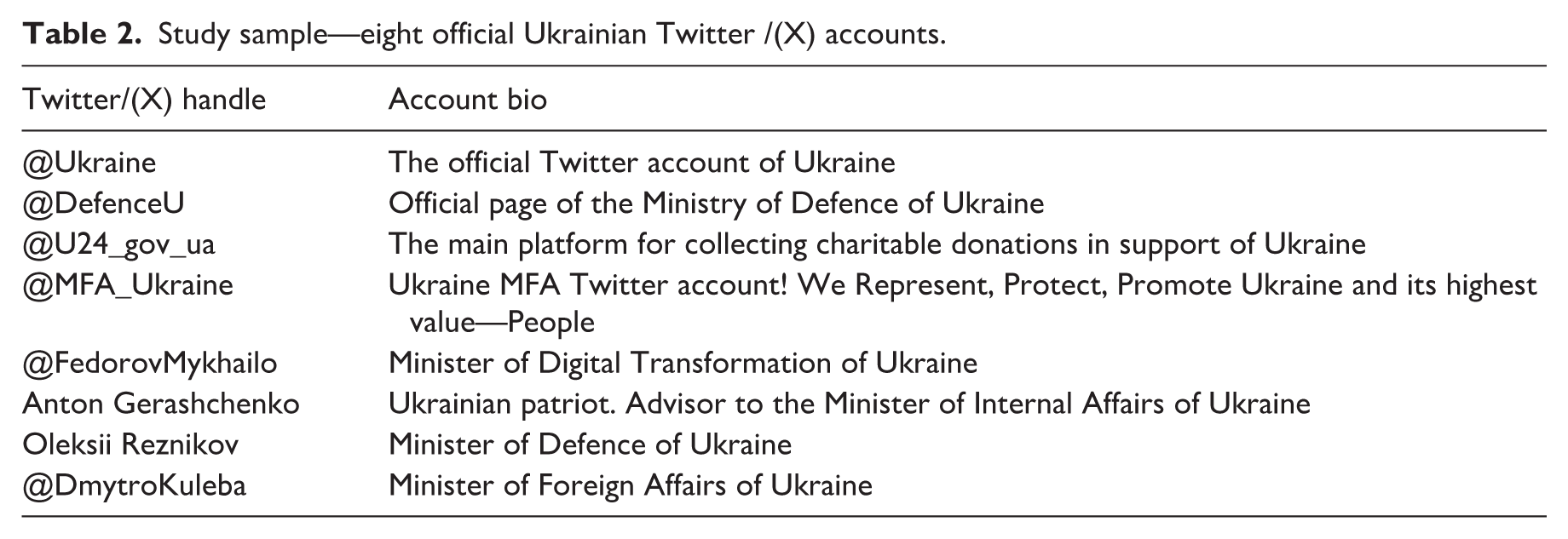
In the first stage of analysis, we sought to identify innovative uses of SNS by Ukraine. We refer to innovative uses as “tactics” and define them as “diplomats’ attempts to wield digital tools to reach large online audiences, to author online content that may go viral, and to amass a sizable online following” (Bjola & Manor, 2018). To this end, we reviewed tweets published by 8 official Ukrainian accounts (see Table 2). We focused on Twitter/(X) as studies have shown that MFAs are more active on Twitter, especially during crises (Kampf et al., 2015) and given that MFAs follow each other on Twitter/(X), allowing for the diffusion of digital innovations (Manor & Segev, 2023).
Study sample—eight official Ukrainian Twitter /(X) accounts.
Study sample
We visited the 8 Ukrainian SNS accounts at six-week intervals between February 2022 and May 2023. During each visit, we analyzed the 100 most recently published tweets. Altogether, 2,023 tweets were reviewed. In each visit, we identified innovative tactics focusing on innovations in content (e.g., pop-culture memes), innovations in outreach (e.g., crowdfunding drones), and innovations in communicators (e.g., using celebrity ambassadors). Our sample included both institutional and individual Twitter/(X) accounts (e.g., Ukraine’s foreign minister) given that digital innovation can stem from senior policymakers. Our sample also included numerous government ministries given that during crises, states may adopt a whole-of-government approach to digital communications (Golberg & Kaduk, 2011; Stein, 2011).
We identified four Ukrainian innovative tactics. We then analyzed which of these tactics may be adopted by other MFAs. We did this by creating a scale measuring each tactic based on the 7 factors that facilitate digital innovation and the 7 factors that inhibit it (as presented above). Each Ukrainian tactic was reviewed using these 14 factors, while receiving a score of + 1, 0, or -1 for each factor. A score of + 1 indicated that a tactic was related to a factor that facilitates digital innovation (e.g., enthusiasm of senior policy makers). A score of -1 meant that a tactic was related to a factor that inhibits innovation (e.g., risk-averse communicative culture). A score of 0 meant that the factor was not relevant to this tactic. Next, each tactic received a cumulative score based on all 14 factors (such as + 1 or -2). A positive cumulative score suggests a relatively high chance that a Ukrainian tactic will be adopted by other diplomatic actors, as the tactic was related to more factors that facilitate innovation than that inhibit innovation. A negative cumulative score suggests a relatively low chance that a tactic will diffuse among other MFAs.
Case study selection and limitations
Notably, “wartime diplomacy” differs from “peacetime diplomacy,” as during wars, states use digital technologies to legitimize the use of military force through Image War strategies (Yarchi, 2019; Yarchi & Boxman-Shabtai, 2025) and rally international support. This study evaluates Ukraine’s “wartime diplomacy” on Twitter/(X). Ukraine’s situation is unique, as the nation finds itself fighting for its very existence. Thus, our analysis and discussion may be most relevant to similar scenarios in which states embroiled in war seek to leverage digital technologies. However, the literature review suggests that innovations adopted during crises may become integral to diplomacy even after the crisis has passed. For instance, virtual summits adopted during the COVID-19 pandemic have become staples of contemporary diplomacy (Bjola & Coplen, 2023). As such, although our analysis is limited to “wartime diplomacy,” our discussion is relevant to the broader practice of diplomacy.
Findings
As soon as the Russia–Ukraine War started, Ukrainian diplomats and leaders turned to SNS to condemn Russia’s aggression and demand that the international community pressure Russia into halting its advance (Kaneva, 2023). Ukraine also adopted a host of innovative SNS tactics, which are presented below.
Tactic 1: open letters to tech CEOs
From the outset of the War, Ukraine’s Minister of Digital Transformation tweeted open letters to Tech CEOs, including Apple, Meta, and PayPal, as seen in Image 1 below. The underlying logic of this tactic was to rally support from SNS users and, in so doing, exert public pressure on Tech companies to exit the Russian market. Some letters were in fact re-tweeted tens of thousands of times. Moreover, several letters were featured in news articles, exerting further pressure on Tech companies to boycott Russia. The Minister of Digital Transformation also used SNS to publicly appeal to tech moguls and enlist their aid, as was the case with Elon Musk’s decision to supply Ukraine with StarLink units.
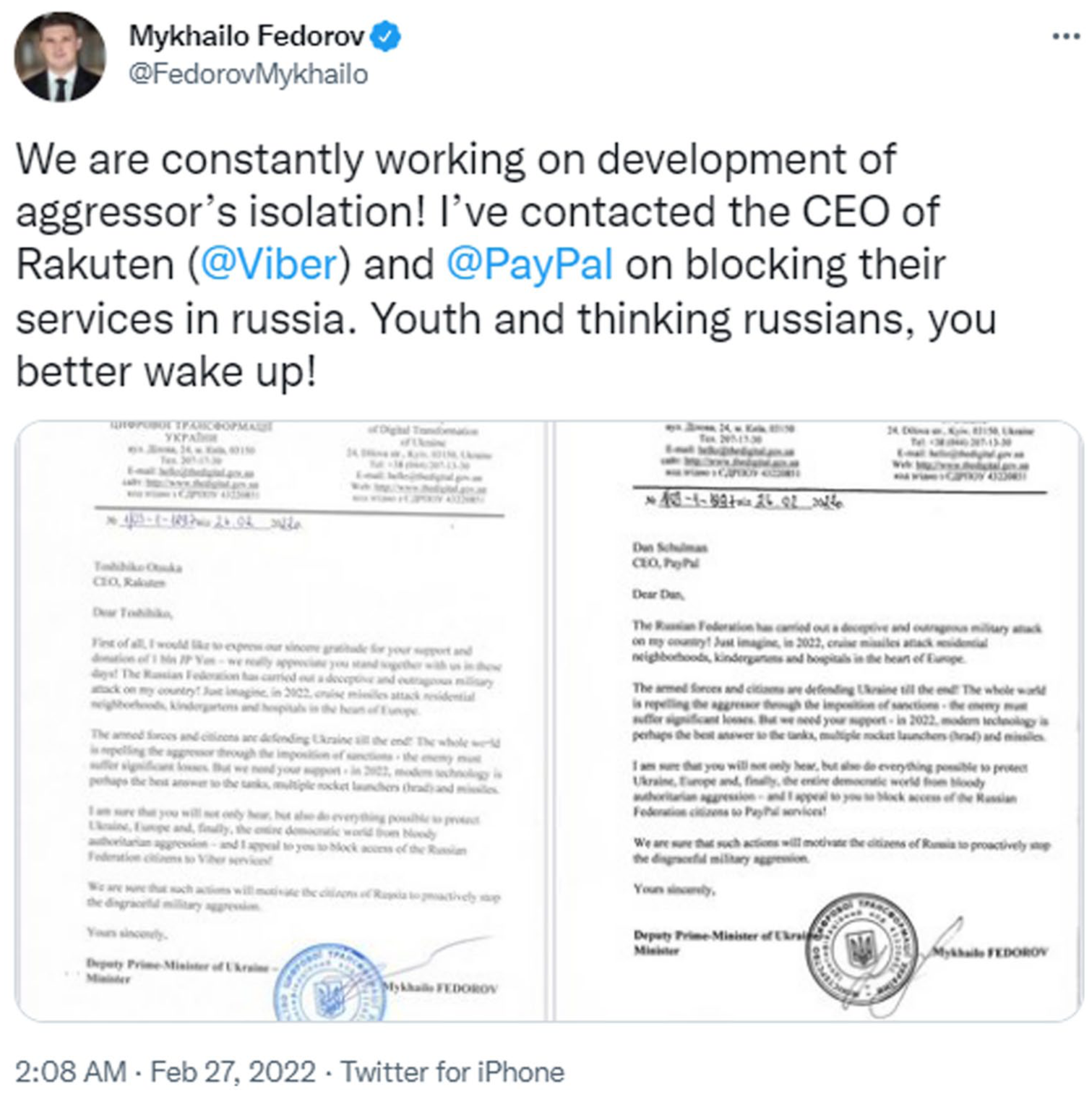
Open letters to tech CEOs.
Tactic 2: a crowdfunded war
Once the War erupted, Ukraine used SNS to list details of bank accounts through which users could donate to its War effort, as shown in Image 2. Tweets were used to crowdfund humanitarian aid (e.g., generators, ambulances) and weapons such as drones. Later, Ukraine launched “UA24,” a dedicated website and Twitter/(X) account that raised more than US$300 million toward humanitarian aid and building Ukraine’s “Army of Drones.” This website allows visitors to earmark donations toward the purchase of specific weapons. The logic underpinning this tactic may have been to create a more profound relationship between Ukraine and SNS users, who were no longer passive spectators of the War but active stakeholders who helped defend Ukraine.
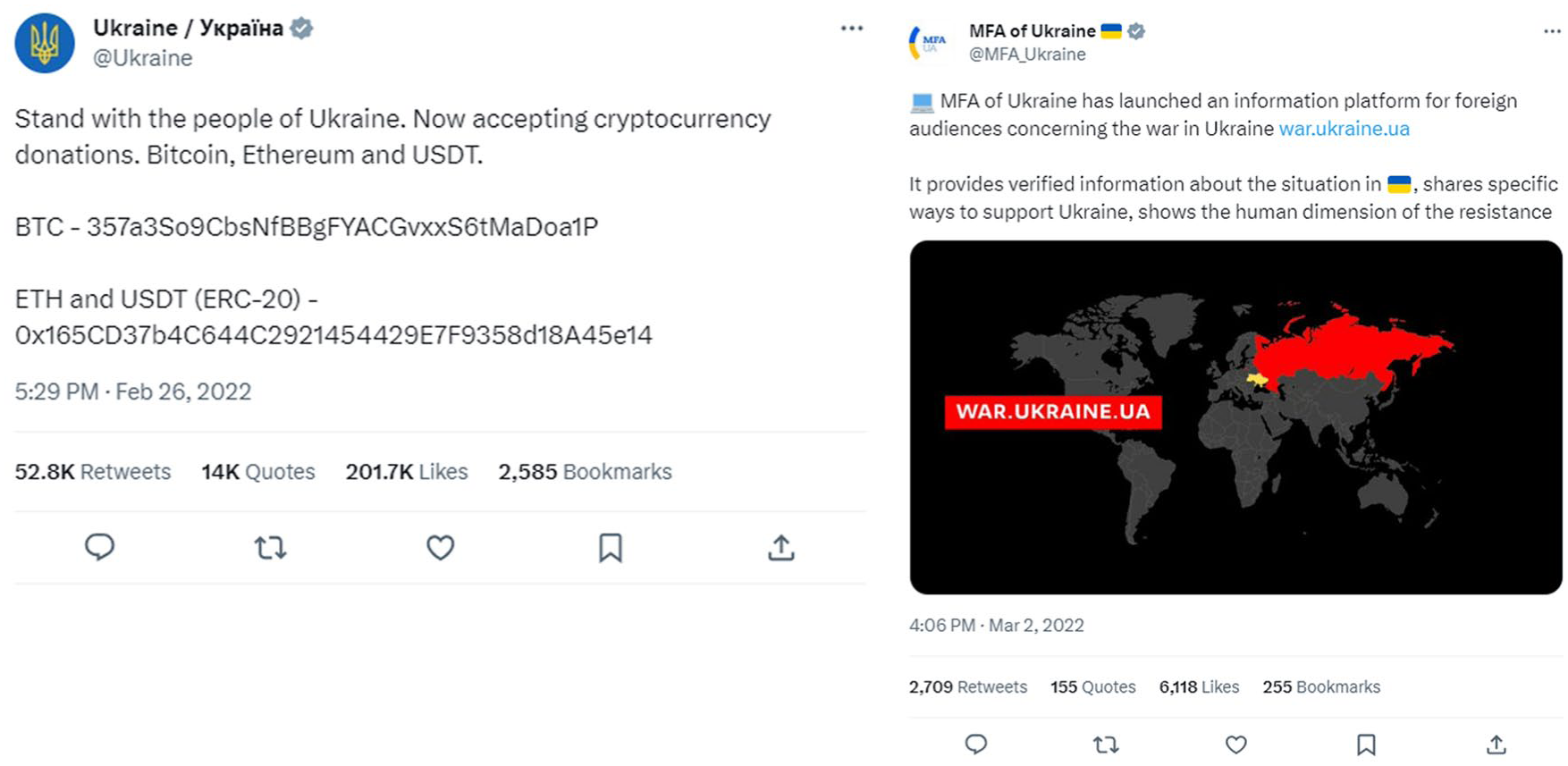
Crowdfunding aid.
Tactic number 3: radicalized humor
Ukrainian accounts have used humor and pop-culture references to obtain virality and retain the attention of SNS users and news outlets. Through memes and pop-culture references, Ukraine created a moral dichotomy pitting a heroic and virtuous President Zelensky opposite a tyrannical and villainous Vladimir Putin bent on global domination, as seen in Image 3 below (Horbyk & Orlova, 2023; Manor, 2023). However, over time, Ukraine has embraced a form of “Radicalized Humor.” By “Radicalized Humor”, we refer to a process in which diplomats increasingly use violent and graphic visuals as source material for humorous content on SNS. This “Radicalization” sees diplomats and MFAs mock and ridicule death and suffering. We contend that humor becomes “Radicalized” as diplomats continuously seek to retain the attention of SNS users. Yet SNS users quickly become accustomed to new forms of violence and diplomats must then use more graphic images to meet new thresholds of excitement. Studies have indicated that social media algorithms increasingly expose users to more radicalized content as new thresholds for excitement must be reached (Smith-Ruiu, 2022). We argue that this very same logic underpins Ukraine’s use of humor.
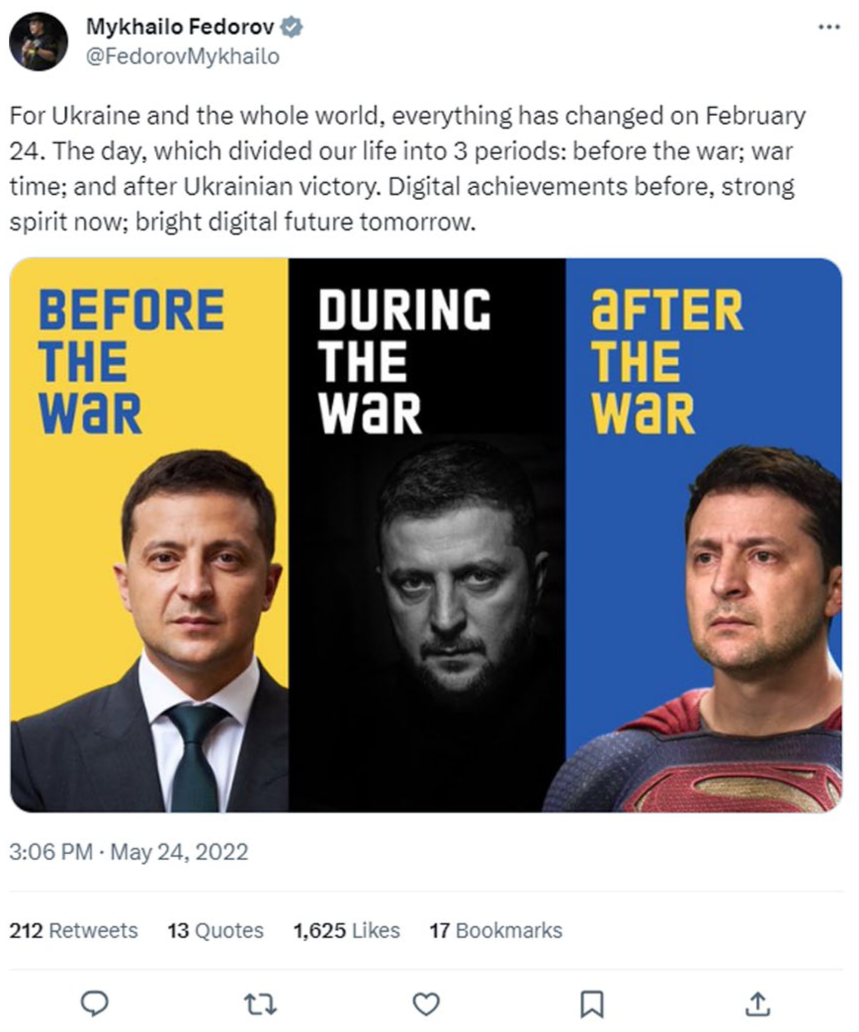
Memes and virality.
Tactic 4: appointing digital ambassadors
Ukraine has appointed a host of “digital ambassadors” to aid with crowdfunding efforts. Three of the earliest ambassadors included Star Wars actor Mark Hamill shown below in Image 4, singer Barbra Streisand, and historian Timothy Snyder. The use of digital ambassadors may be indicative of a keen understanding of the logic of SNS as each ambassador has their own digital following. Through these three different digital ambassadors Ukraine could reach large and diverse groups of SNS users. The fact that all three Ambassadors are American is emblematic of the logic that Ukraine must retain financial and military support from the US and, subsequently, from NATO.
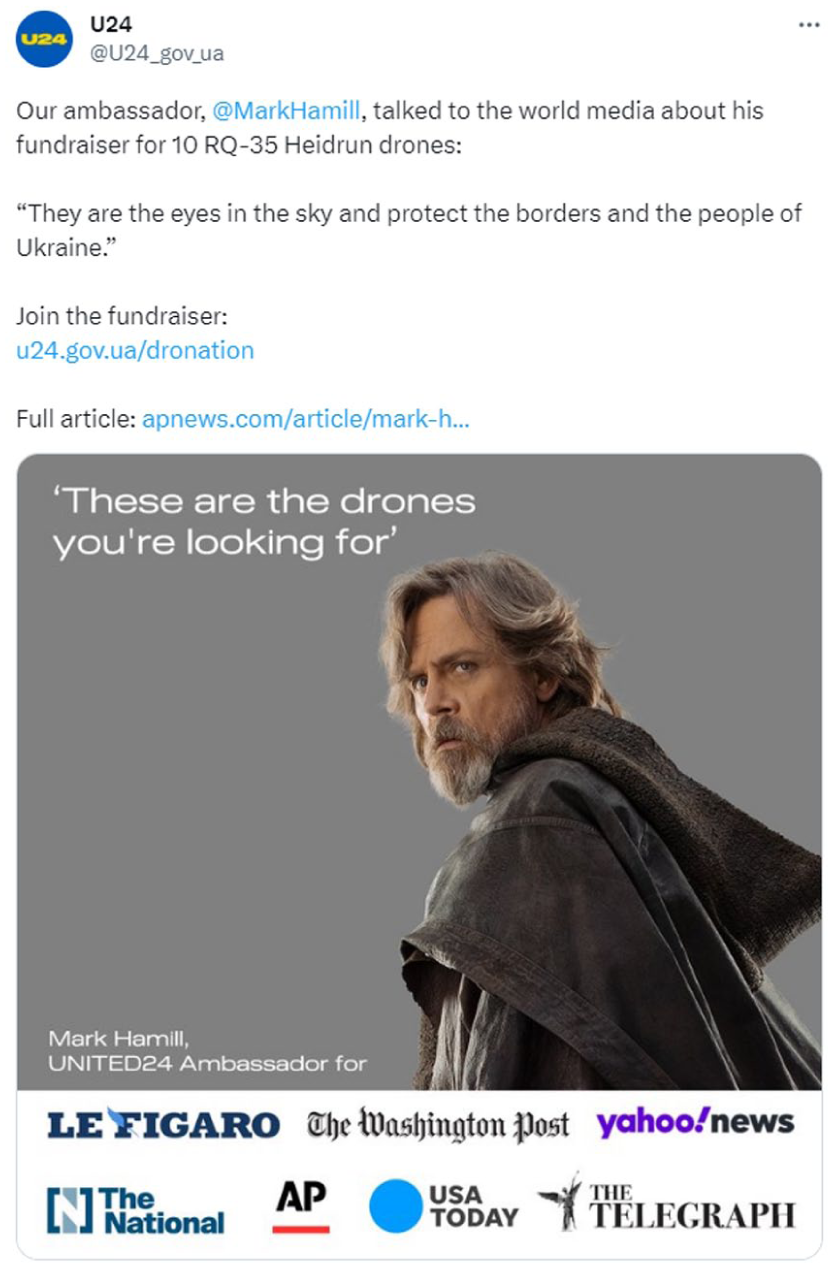
Ukraine’s digital ambassadors.
We examined the likelihood of Ukraine’s tactics being adopted by other MFAs, based on the factors that facilitate and inhibit digital innovation in diplomacy. The scores of each tactic are presented in Table 3.
Analysis of Ukraine’s innovative tactics.
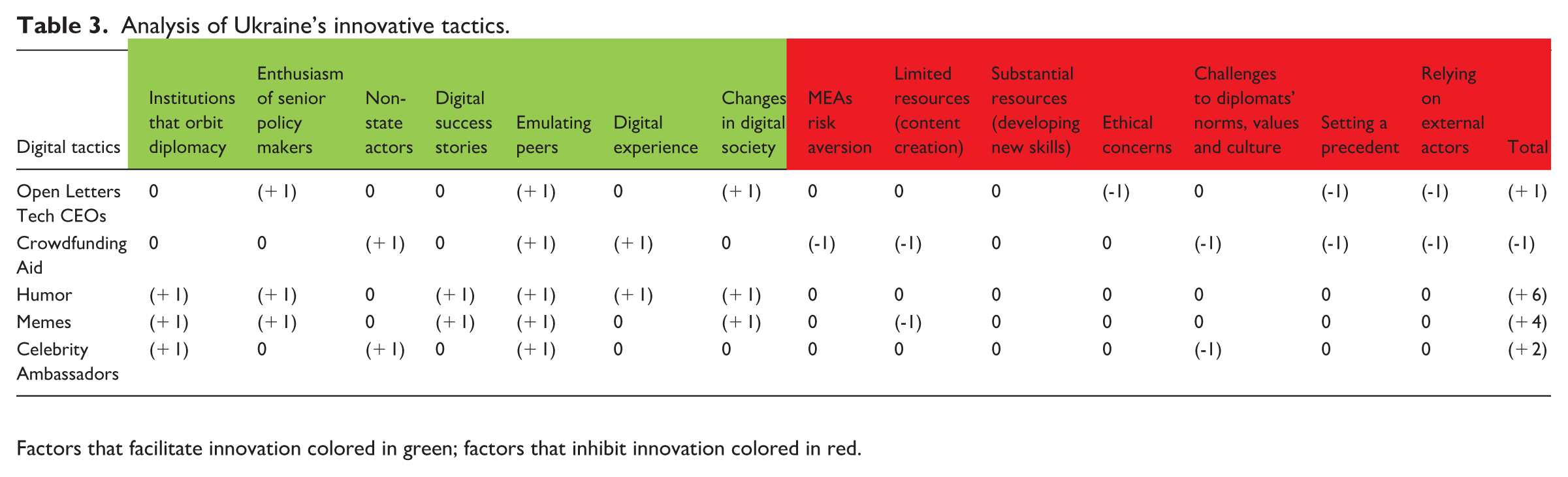
Factors that facilitate innovation colored in green; factors that inhibit innovation colored in red.
Tactics that MFAs may choose not to emulate
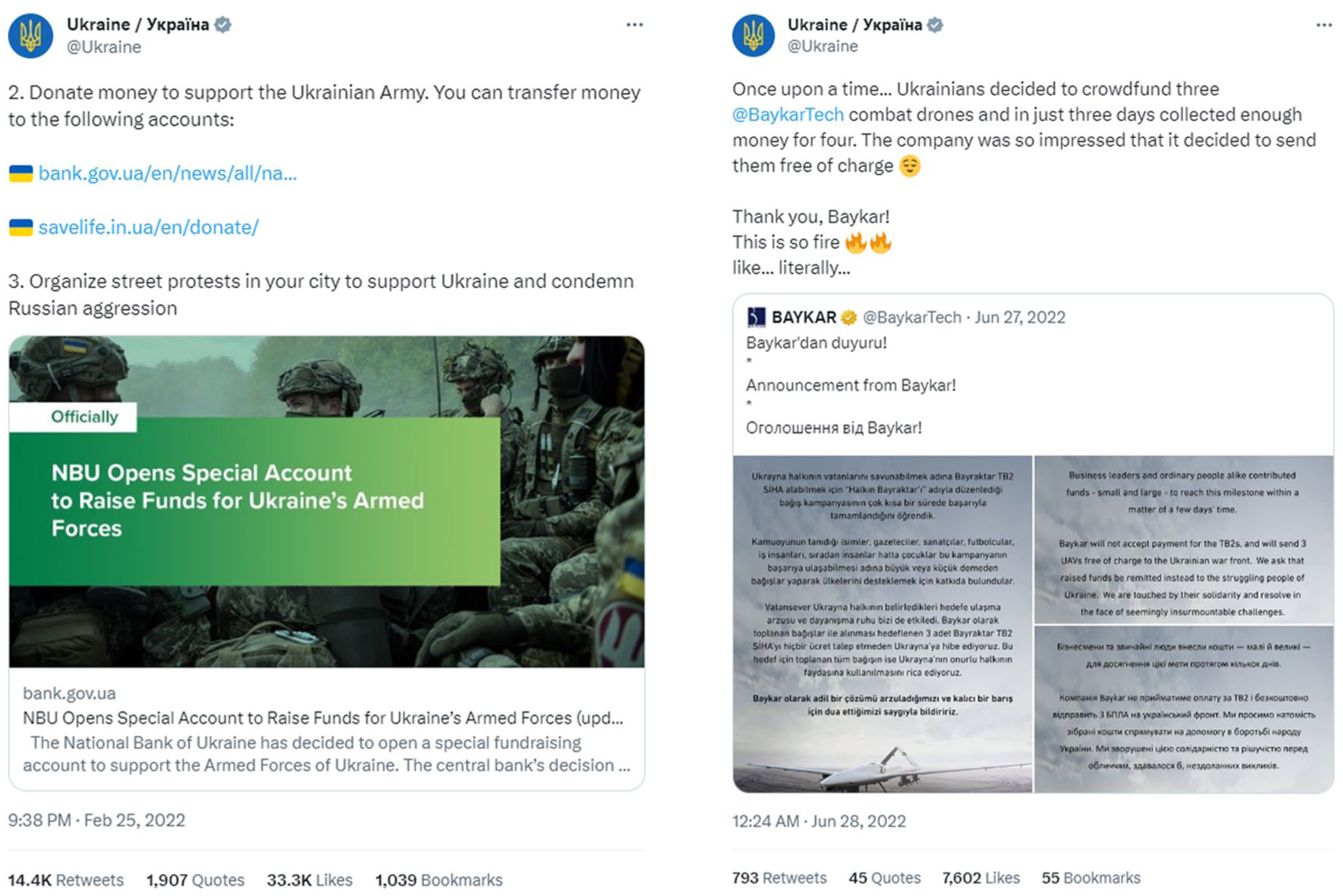
Ukraine crowdfunds aid.
This tactic was associated with four factors that facilitate digital innovation. First, non-state actors routinely crowdfund aid online, including NGOs, civil society organizations and diasporas which support infrastructure projects in their origin country through crowdfunding (Dickinson, 2020). Other MFAs have also used SNS to crowdfund aid, including Moldova and Poland, which raised funds to support Ukrainian refugees (Manor, 2023). Finally, this innovation is based on diplomats’ previous experience of collaborating with digital stakeholders as part of “Networked Diplomacy” (Zaharna et al., 2013).
However, this tactic was also associated with five factors that inhibit innovation. First, crowdfunding weapons may raise ethical concerns among diplomats, especially using tweets to recruit foreign fighters that will combat enemy troops as shown above. In such instances, diplomats are transformed into recruitment officers who must increase the digital appeal of war while “selling” the experience of battle as opposed to selling foreign policies (Wang & Huang, 2023).
Second, this tactic may also challenge diplomats’ norms and values regarding the role that publics play in diplomacy. Soliciting funds alters the essence of digital relationships between diplomats and connected publics. Once money changes hands, this relationship becomes transactional and is transformed into one of donors and beneficiaries. This may generate new demands from SNS followers such as receiving reports detailing how their money was spent. Ultimately, diplomats would find themselves engaging in donor relations as opposed to public engagement.
Third, this tactic is dependent on the willingness of external actors, or SNS users, to donate funds. Fourth, and most importantly, MFAs who embrace this tactic may set a dangerous precedent as non-state actors may soon follow suit, be it rebel groups or terrorist organizations. This tactic may thus lead to the proliferation of wars and conflicts across the globe. The possibility of setting a precedent would dissuade risk averse MFA from adopting this tactic. For all these reasons, we argue that crowdfunding arms on SNS will likely not diffuse among MFAs. 1
Tactics that may be emulated by other MFAs
The tactic of open letters to CEOs was associated with two factors that inhibit innovation. First, this tactic is dependent on SNS users and virality. A letter demanding that a Tech CEO boycott a country must be shared tens of thousands of times and garner media attention to exert public pressure on a company. Second, this successful Ukrainian tactic has set a precedent: for the first time in history Silicon Valley has chosen sides in a war. Tech companies did not boycott Russia following its Annexation of Crimea, or its bombing campaigns in Syria. The decision to boycott Russia could represent a turning point in the role that Tech giants play in international affairs. As such, we expect that the tactic of open letters to tech CEOs will have long-term implications for diplomacy.
One implication is that Silicon Valley could choose to side with the aggressor in a future war. Similarly, there are intractable conflicts in which there is no clear victim and aggressor. How will Big Tech choose sides in these instances? The answer may lie with a new type of diplomatic activity- winning over the “hearts and minds” of Tech CEOs. Indeed, future wars may be determined by diplomats’ ability to manage and leverage relationships with Tech CEOs such as Elon Musk. This desire to curry favor with Tech CEOs may also alter power relations between states and Silicon Valley. Fearing future boycotts, diplomats may strive to establish friendly ties with Tech companies as is already evident in the establishment of Embassies to Silicon Valley where diplomats are tasked with managing ties with Tech companies. This is an important occurrence as Embassies always reside near seats of global power (Engtoft Meldgaard & Fletcher, 2024). Fear of Tech boycotts may even stifle national attempts to regulate Big Tech in terms of content moderation and data usage.
Importantly, tech boycotts are just as damaging to societies as financial sanctions imposed by states. Presently, Russian citizens cannot earn money through the gig economy (Volt, Uber), sell their products to a global consumer base (eBay) or use Amazon cloud services for their startups. Thus, Tech boycotts can be a powerful weapon during conflicts and war. Moreover, support from Silicon Valley can prove influential even on the battlefield, as shown by the Ukrainian military’s ability to wage networked warfare thanks to Musk’s StarLink units. The new power and influence of Silicon Valley may further solidify Big Tech’s role as diplomatic actors that shape international affairs. 2
Humor was also associated with two factors that inhibit innovation. Humor may elicit a negative backlash from digital publics if used callously (Manor, 2019) and so risk-averse MFAs may think twice before utilizing humor online. Moreover, humor and satire may challenge diplomats’ norms and values, especially if humor is used in ways that violate diplomatic norms, as has been the case with Chinese diplomats who employ humor as part of their abrasive “Wolf Warrior Diplomacy” (Zhang & Tang, 2024).
Diplomats’ use of humor on SNS is not, in itself, innovative. What is innovative is Ukraine’s use of “Radicalized Humor,” or increasingly graphic humor, to retain SNS users’ attention and interest over a long period of time as shown in image 6. During prolonged wars, tweets must continuously seize the attention of users who are always scrolling onto the next post. Our analysis found that Ukraine’s humor became increasingly violent over time, to the point where humor was used to celebrate death and destruction. This is best demonstrated through a series of tweets published by the Ukrainian Defence Ministry depicting Ukrainian attacks on Russian troops and armored vehicles. These tweets varied in tone and violence, as the examples below show.
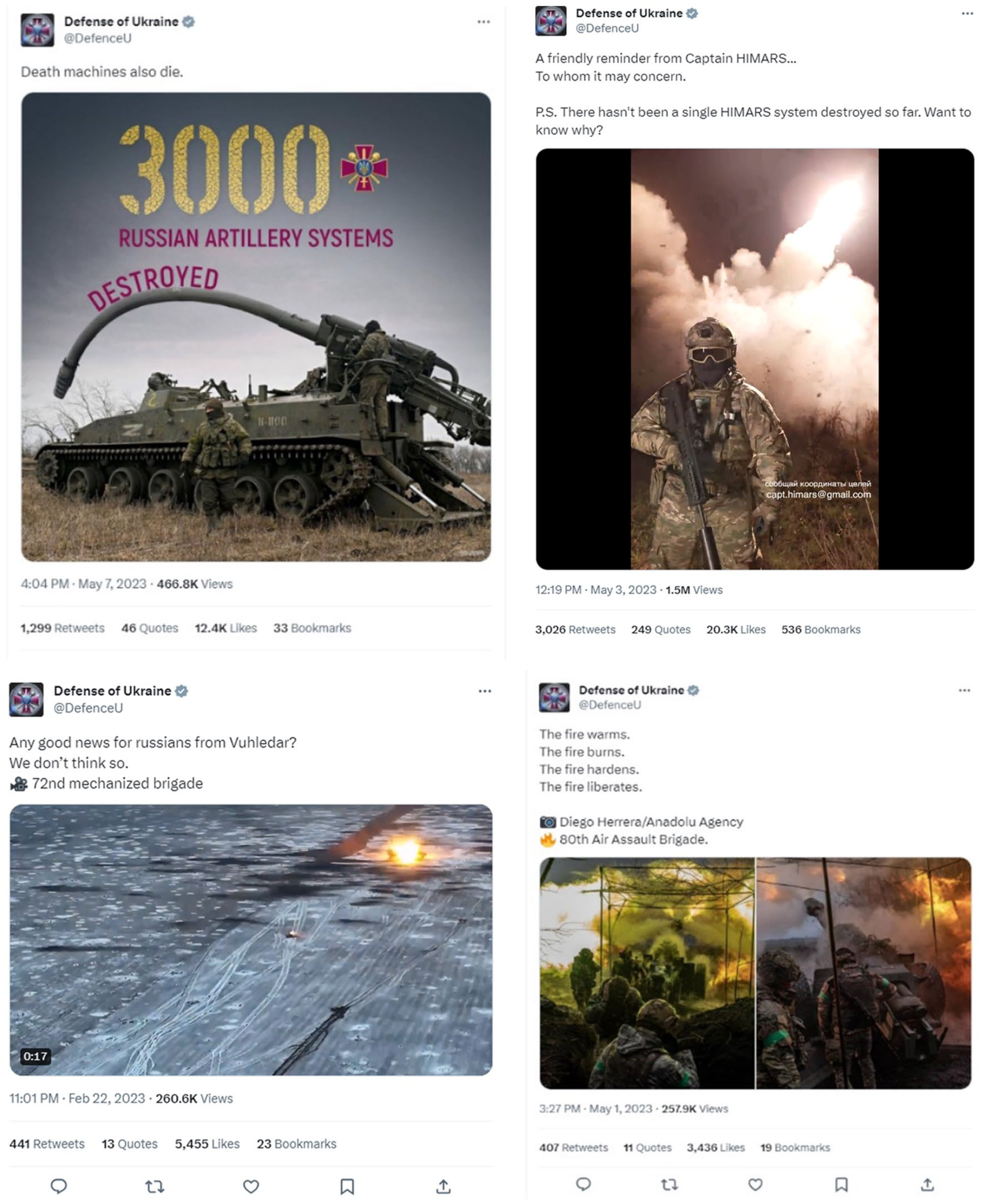
Mocking death and destruction.
Other tweets depicted an appetite for destruction by combining videos of military attacks with rock music. One such video, showing Russian casualties and deaths, was accompanied by the Lou Reed song “Perfect Day.” Finally, some tweets tended toward fetishizing war by expressing romantic sentiments toward weapons, as exemplified in image 7 below.
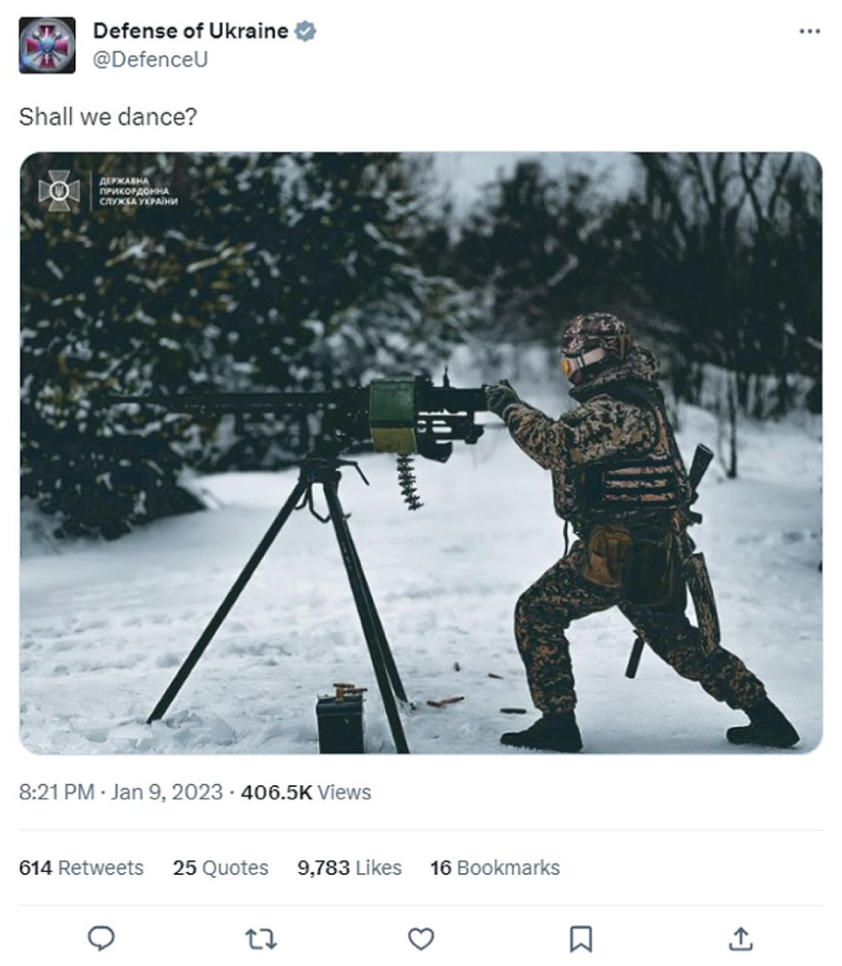
The love of war.
The tactic of “Radicalized Humor” may be emulated by other MFAs in future wars as they too will need to retain public interest over a long period of time. However, “Radicalized Humor” will have a detrimental impact on diplomacy. Through humor, satire, and the fusing of rock music with scenes of deaths and destruction, war itself becomes “funny.” Pain and human suffering are replaced by punch lines and “zingers.” Moreover, war itself is beautified through the aesthetic dimension of these “Radicalized” visuals. Such visuals could have a cumulative effect where wars are no longer seen as a regrettable last resort, but as a natural solution to tensions between states (Jackson, 2019). The adoration and beautification of war may also broaden public support for wars while diminishing support for diplomats’ efforts to resolve conflicts through negotiations. 3
Table 3 indicates that pop-culture memes may also diffuse among MFAs. Our analysis indicates that memes were used to portray the Russia–Ukraine War as an epic struggle between good and evil by drawing on popular culture be it Marvel films, or the Lord of the Rings trilogy (Manor, 2023). However, Ukraine’s memetic warfare reduces the complexity of international conflicts and promises simple fixes to wicked problems. The Russia–Ukraine War is a complex geo-political conflict involving the interests of many states. Yet this complexity is lost in memes which suggest that like Marvel films the War is simply a battle between heroes and villains. Moreover, these memes also imply that the War will end in a resounding victory for good over evil, generating unrealistic expectations among SNS users that could be shattered if the War ends in a diplomatic settlement. This could cause SNS users to feel cheated and some may even consider diplomats as obstacles that prevented the triumph of good over evil. All this could translate into diminished faith in diplomats and thier work. 4
Ukraine’s digital ambassadors are unique as they have been appointed solely to the digital realm and not the physical world. Their main task is to use their digital presence to bolster online support for Ukraine and help with crowdfunding efforts. One example is Professor Timothy Snyder, a digital ambassador who uses Twitter/(X) to draw attention to the suffering inflicted on Ukrainian civilians. In one recent tweet, Snyder shared the story of a boy killed in a Russian missile attack. In another tweet, Snyder shared a news story focusing on Russia’s abduction of Ukrainian children. Snyder has written numerous books on the dangers of tyranny and the threats it poses to global freedom and by lending his digital support to Ukraine, Snyder also lends his moral authority. Snyder’s tweets create a moral contrast between Russia, which is committing genocidal war crimes, and Ukraine, valiantly fighting for its freedom. These moral contrasts are important as morality may breed legitimacy for Ukrainian policies (Horbyk & Orlova, 2023; Quelch & Jocz, 2009).
A second prominent digital ambassador, singer Barbra Streisand, has used her Twitter/(X) account to help finance ambulances and medical equipment. In one tweet, shown below in Image 8, the singer holds an embroidered shirt she received from the U24 platform stating, “you can see the patterns of Ternopil Oblast—where my paternal grandparents came from in Ukraine.” The singer added that such shirts could be obtained by donating to the U24 platform. This tweet is important because it creates a personal link between the singer and Ukraine. In this way, Streisand’s life story becomes entwined with Ukraine’s story and fans of the singer may also become fans of Ukraine.
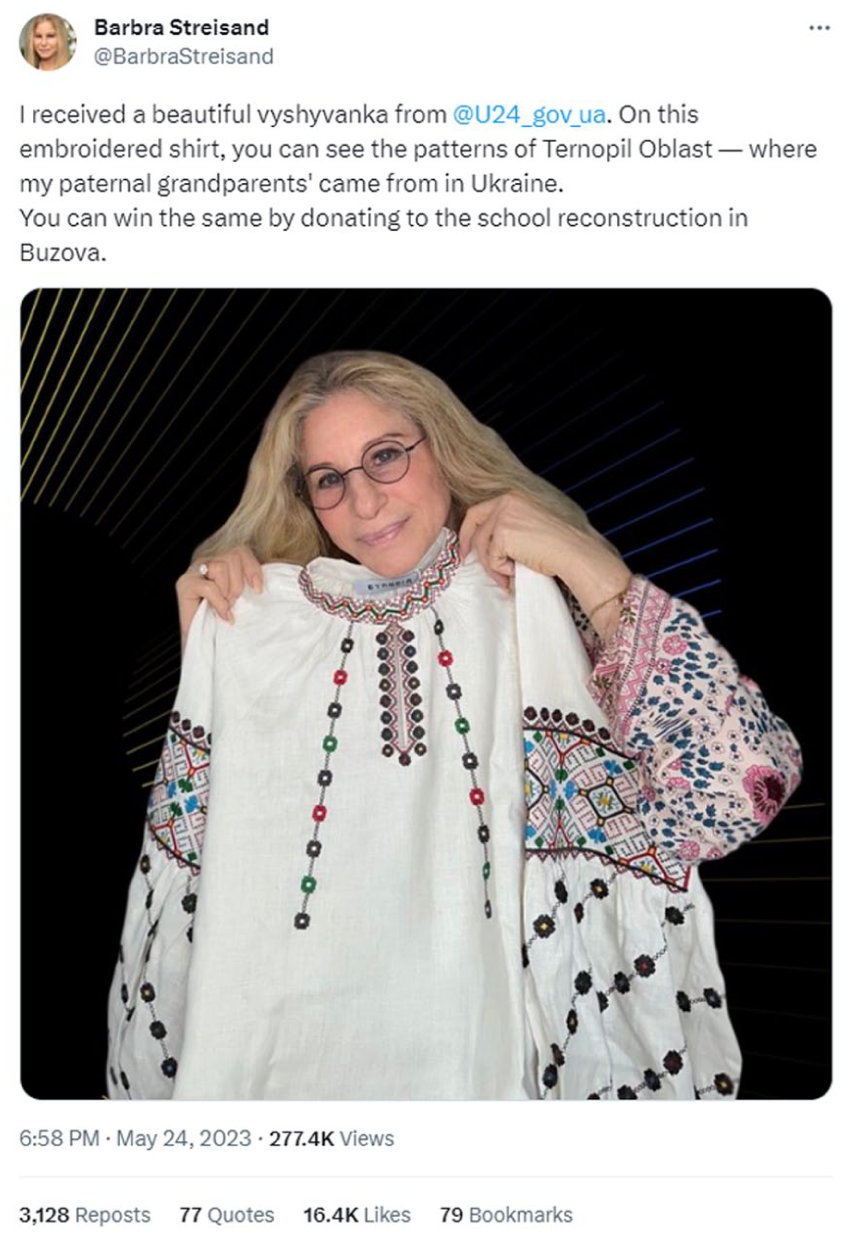
Streisand’s personal link.
Notably, this tactic was associated with two factors that inhibit digital innovation: ethical concerns and setting a precedent. The reason lies in Ukraine’s third digital ambassador, Star Wars movie star Mark Hamill. Although Hamill has used Twitter/(X) to raise funds for humanitarian aid, he has become the face of Ukraine’s effort to create an “Army of Drones.” According to a tweet by the U24 platform, Hamill helped raise more than US$1.5 million for the purchasingof reconnaissance drones. In addition to calling on Twitter/(X) users to donate to the “Army of Drones,” Hamill has tweeted media interviews in which he explained to journalists why Ukraine cannot win the War without drones.
Haill’s crowdfunding efforts are problematic as reconnaissance drones may be used to pinpoint the location of Russian targets and are thus offensive weapons. Therefore, Hamill is directly soliciting funds to arm Ukraine. This may raise substantial ethical concerns among diplomats as celebrity ambassadors have traditionally been used to help support humanitarian causes, such as UNICEF’s Goodwill Ambassadors. Even more problematic is the fusing between Hamill’s fundraising efforts and his pop-culture persona. The U24 website has a section dedicated to the Army of Drones. Packed with Luke Skywalker images, the website reads “These are the drones you’re looking for”—a clear reference to the Star Wars quote “These
We assert that the use of celebrity ambassadors to raise funds for weapons, and the fusing of pop-culture such as Star Wars with real world wars, is especially problematic, as evident in Ukraine’s use of the term “dronate,” a combination of donate and drone. “Dronating” may constitute a form of “complicity without accountability,” as SNS donors would become complicit in acts of war but would not be held accountable for how their “dronated” weapons are used and whether they are used in ways that violate international law. Moreover, Star Wars fans who are eager to gain the approval of their hero or obtain a coveted poster signed by Luke Skywalker, may “dronate” and become participants in a war, yet without deliberating the moral and political implications of their actions. This promotes a blasé attitude toward war in general, and the arming of states in particular; a mind-set that could limit diplomats’ ability to raise support for negotiated settlements to conflicts.
Finally, through posters, shirts, and the invocation of Star Wars, Ukraine and Hamill are commodifying war. The War in Ukraine has become a commodity that can be bought and sold through SNS and dedicated websites. The commodification of war presents its own challenges to diplomacy as war becomes subject to the logic of capitalist marketplace, a market that all too often masks transactions taking place—in the case of Ukraine, shirts and posters in exchange for drones. Moreover, the logic of the capitalist marketplaces encourages financial judgments as opposed to normative or moral ones. Therefore, Ukraine’s commodification may lead societies to judge wars though SWOT models (strengths, weaknesses, opportunities, threats) rather than ethical and normative deliberations. We therefore conclude that MFAs may adopt Ukraine’s digital tactic but will most likely limit the activities of digital ambassadors to humanitarian aid. 5
Conclusions
This study sought to examine the long-term implications of Ukraine’s innovative uses of Twitter/(X). The study argued that just as innovative technologies shape diplomacy’s digitalization, so may innovative uses of existing technologies such as SNS. To do so, the study employed a new matrix of 14 factors which scholars have identified as either facilitating or inhibiting digital innovations in diplomacy. The study’s analysis suggests that Ukraine’s innovative Twitter/(X) tactics may diffuse among MFAs and impact the practice of diplomacy in profound ways.
First, Ukraine’s tactic of open letters to Tech CEOs may result in diplomats and MFAs vying over the support of Big Tech companies and Tech moguls. The desire to curry favor with Tech CEOs may stifle national attempts to regulate Big Tech as nations fear Tech boycotts. Moreover, Tech moguls may follow Musk’s precedent and actively influence military conflicts, adding another layer of complexity to the diplomatic management of conflicts and wars. Second, Ukraine’s tactic of “Radicalized Humor,” if adopted by other MFAs, may broaden public support for wars, increase the appeal of wars as a method for resolving disputes between states and may also diminish public support for diplomats’ efforts to end conflict through negotiated settlements.
In addition, the use of pop-culture memes to narrate conflicts may generate unrealistic expectations among digital publics as memes reduce the complexity of crises and promise easy fixes to wicked challenges. The long-term implication may be reduced faith in diplomats and diplomacy which may come to be regarded as obstacles that prevent the triumph of good over evil. Finally, the fusing of pop-culture with war through celebrity Ambassadors may lead digital publics to become parties to war without deliberating the moral implications of such actions. “Pop Wars”, or MFAs use of pop-culture to sell and commodify wars, may mask the true nature of digital interactions whereby autographed memorabilia are sold to finance weapons of war. War itself thus becomes masked while its horrid nature is left out of sight and out of mind.
Taken together, Ukraine’s innovative SNS tactics may profoundly impact diplomats, diplomatic institutions, and the publics of diplomacy altering the very essence of relationships between diplomats, connected individuals and third parties such as Big Tech. As such, this study illustrates the importance of analyzing the long-term implications of digital innovations in diplomacy; an analysis which may now be undertaken by additional scholars using the innovative matrix of 14 factors introduced in this study.
Future studies may seek to identify additional factors that stifle digital innovation in diplomacy, an important lacuna identified in this study. Scholars may also continue to investigate the online fusing of pop-culture, celebrity culture and war, a recurring theme identified in this study. Finally, scholars may broaden this study’s scope of inquiry by identifying non-war-related digital innovations that may diffuse among MFAs altering the practice of diplomacy in profound ways.
Footnotes
Appendix 1
Digital diplomacy studies included in literature review.
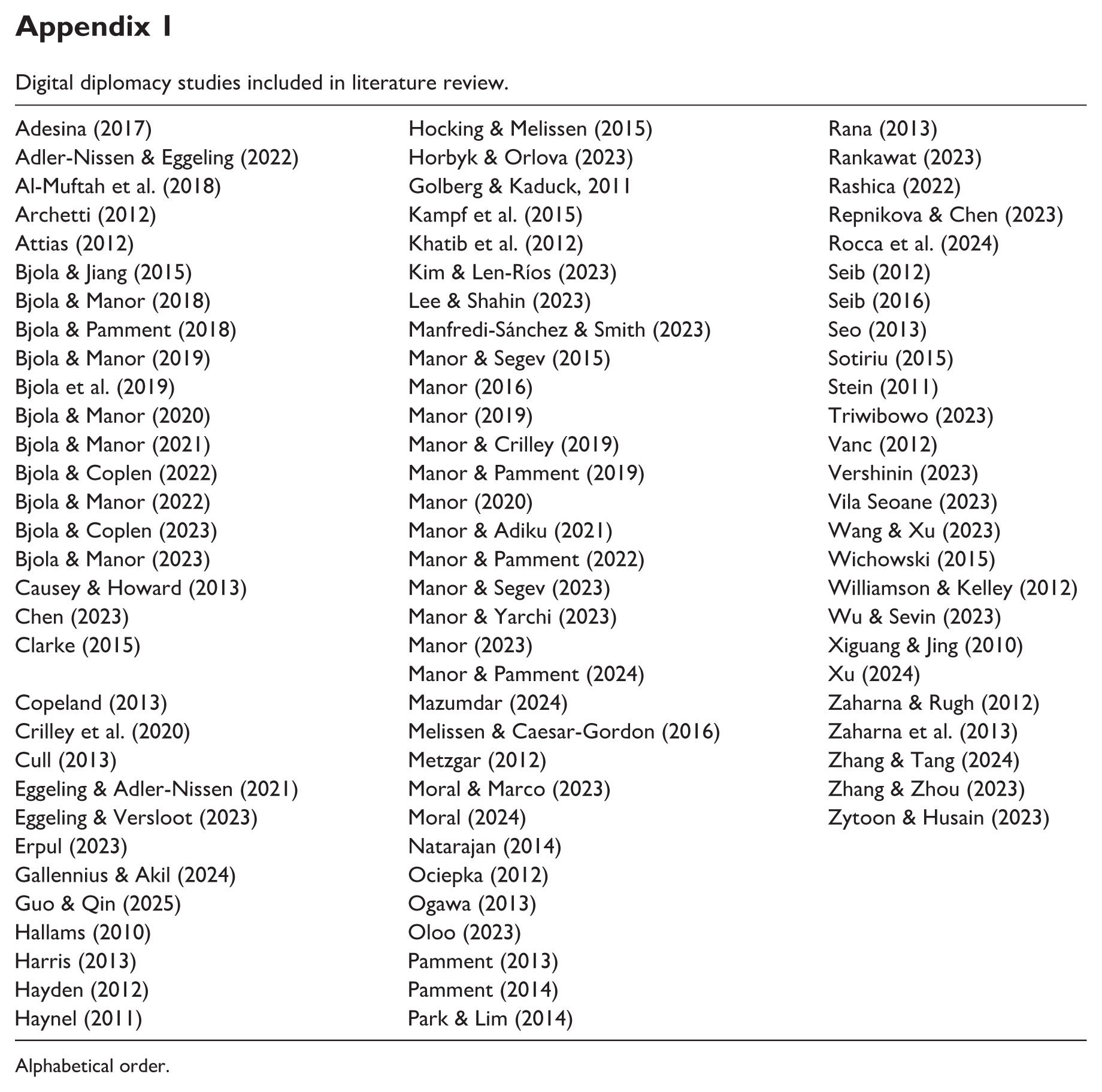
Alphabetical order.
Declaration of conflicting interests
The authors declared no potential conflicts of interest with respect to the research, authorship, and/or publication of this article.
Funding
The authors received no financial support for the research, authorship, and/or publication of this article.
