




Abstract
In this article, I investigate the relationship between social movements and corporate social networking sites, by looking at content produced by Occupy Chicago on Twitter and Facebook during the protests of May 2012. Through an analysis of social media posts and activists’ documents, I identify the functions that these platforms perform for the movement. My findings show a very limited importance of content that expresses the identity of the movement, spreads alternative news, and criticizes mainstream media, while the preponderance of protest reporting suggests that activists use social networking sites mainly to communicate “what they do,” rather than “who they are.” I argue that the lack of identity-content is the result of the incompatibility between the decentralized political processes of Occupy and the individual-centric nature of social networking sites. I also suggest we need to rethink the relationship between social movements’ identities and media strategies in light of a changed media environment.
The role of digital technologies and social network sites (SNS) has been at the forefront of most media commentary and a fair amount of the academic research that followed the events of 2011, from the Arab Spring to Los Indignados to Occupy Wall Street (OWS), protest movements have been analyzed through the lenses of their communication practices and their reliance on platforms like Facebook and Twitter.
In this article, I approach the use of corporate SNS in the Occupy movement as an adaptive response (Rucht, 2004) to the new media environment. While movements have historically had difficult relationships with media, I argue that the transition to the web 2.0 has further transformed the media space that movements need to confront to reach out to the public, giving rise to what I term the “logic of relevance.” In the article, I focus on one occupation movement that developed in 2011—Occupy Chicago (OC) 1 —and analyze its social media content production. I investigate the functions that SNS content performs for OC through an analysis of the tweets and Facebook posts produced by its official accounts and of activists’ documents. In contrast to other studies (e.g. Penney & Dadas, 2013), my research is not concerned with the social media accounts of individuals in the movement: what I investigate is the collective dimension of SNS usage and how using SNS challenges the internal life of social movements.
My findings show a very limited importance of content that expresses the identity of the movement, spreads alternative news and criticizes mainstream media, while the preponderance of protest reporting suggests that activists use social media mainly to communicate “what they do,” rather than “who they are.” In an attempt to adapt to corporate SNS, OC encountered a fundamental incompatibility: that between the decentralized political processes of Occupy and the individual-centric nature of social media. The lack of identity-content is thus the result of the tension between the need to adapt to SNS and mainstream media and the principles of horizontalism upheld by Occupy.
My analysis also indicates that—contrary to more optimistic accounts—the technologies of the web 2.0 exacerbate the challenges of participation and inclusion that characterize decentralized social movements. I thus argue that we might need to rethink movements’ priorities and strategies in response to changing media environments, and how such strategies might generate political tensions within movements. I also suggest that we should better conceptualize the relationship between horizontal political practices, multiple identities, and SNS.
From the problem of access to the logic of relevance: social movements in the corporate web 2.0
Social movements have historically faced significant difficulties in their relationship with mainstream media (e.g. Gitlin, 1980). Media attention to protest is never a given (Kolb, 2005, p. 106). When some media coverage is generated, social movements often find their ideas ridiculed or depoliticized (Atton, 2002, p. 11) or reframed to be more in line with the mainstream (Benford & Snow, 2000; Kolb, 2005). And coverage often privileges instances of violence (Juris, 2008). But because access to mainstream media is important for movements in order to become known and attractive to the larger public, social movements have historically adopted different approaches to deal with mass media. Rucht (2004) identifies four patterns in the relationship between movements and mainstream media: abstention, attack, adaptation, and the search for alternatives. This last option—that of creating alternative media—has been extensively investigated in the literature (see Downing, 2008), especially after the emergence of Internet-based technologies and the rise of Indymedia (Independent Media Center, IMC) (Juris, 2005; Pickard, 2006; Wolfson, 2014).
Created by global justice movement activists in anticipation of the Seattle demonstrations of 1999, the IMC network has been a great example of how Internet technologies enhance social movements’ possibilities to organize effectively, engage in transnational networks of protest, and reach out to a (potentially) global audience. The Internet has changed the rules of the game of collective action, reduced communication costs for activists, and reduced opportunities of free-riding (Chadwick, 2006, p. 141); by reversing the traditional top-down models of communication, the Internet also allowed groups and individuals to speak for themselves, without the need of mass media mediation, thus altering the relationship between social movements and other actors (Chadwick, 2006; Ford & Gil, 2001). As underlined by Lievrouw (2011), Internet-based communications have become tools for coordination, platforms to produce and distribute content, and terrain for emerging forms of hacktivism (pp. 167–173).
Not only did Internet technologies allow for better coordination and organization (Earl & Kimport, 2011), they also became instrumental “for expressing and circulating activists’ interests, values and symbolic representations of issues” (Lievrouw, 2011, p. 156). In this sense, the Internet has been a formidable response to the problem of access that characterized the relationship between social movements, mainstream media, and the public: for the first time, activists could bypass mass media to present their views directly to the public.
Today’s media landscape is profoundly different from that in which Indymedia was created. The emergence of user-generated content and the technologies of the web 2.0 gave rise to hybrid media systems (Chadwick, 2013) and dramatically increased access to media production and distribution for individuals and groups, resulting first and foremost in an abundance of content available online. But contrary to the more optimistic expectations, the end of scarcity did not bring about more equality (McChesney, 2005, p. 17). Although now many more people have the possibility to create their own content, there are profound asymmetries between “hubs” of intensely accessed and linked content that essentially render the rest of the web invisible (Barabasi, 2002); very little resemblance of democracy, fairness, or equality can be found online (Barabasi, 2002, p. 56; Hindman, 2008).
Since today the possibility of publishing one’s views is a given, only a few clicks away, the real question now concerns whether one’s content will ever be found and whether it will become visible. In the age of abundance, the key problem is relevance. One can have access, and thus express one’s opinion, but there is no guarantee that such opinion will become relevant to the larger public. This is especially true for the actors that wish to use the web to further their political agenda, since the relevance of their content is crucial for their action (Neumayer & Stald, 2014, p. 120). As Barassi (2015) explains, “the immediacy of information flows leads to information overload and this impacts upon the visibility and reach of collective messages,” thus forcing social movements to “become productive communicators” and “keep up with the pace of information flows” (p. 82). But it is also possible that the abundance of content will end up downplaying the political meaning of that content. For instance, Dean (2005) argues that one of the key features of communicative capitalism is “the morphing of message into contribution” (p. 58): in the current media ecology, it is the sheer abundance and circulation of content that are important, not the meaning of that content.
The shift from the problem of access to the logic of relevance is amplified by a process of re-centralization of the Internet: while access meant the possible coexistence of numerous sources of content, relevance shifts us back to the predominance of a few, large hubs—mostly corporate based (McChesney, 2013). This alters the playing field in which social movements have to compete for attention and it is in this light that we should interpret their choice of relying on corporate SNS such as Facebook and Twitter.
Occupy and corporate SNS
The Occupy movements were immersed into and contributed to a heterogeneous web of media (Costanza-Chock, 2012), where websites, mailing lists, blogs, microblogs (including the highly influential “I am the 99%” Tumblr), print publications, wikis, livestreaming apps, leaflets, hand gestures, posters, and banners coexisted. But crucial for both the Occupiers and for the literature that has analyzed the movement (among many, Bennett & Segerberg, 2013; Castells, 2012; Gerbaudo, 2012; Juris, 2012) were corporate SNS, chiefly Facebook and Twitter.
Occupy’s reliance on Facebook and Twitter is not surprising, given that corporate SNS are the undisputed protagonists of the web 2.0. They offer the strategic advantage of allowing movements to have access to a broad range of people, especially those they would not otherwise encounter (Gerbaudo, 2012, p. 148). Bennett and Segerberg (2013) theorized the centrality of SNS for organizing and for the personalization of protest, which are at the core of their notion of connective action. Some even argued enthusiastically that SNS represent a political model for contemporary movements, due to their alleged horizontality (Hardt & Negri, 2011); others described SNS as a space of autonomy (Castells, 2012).
But besides being key players both on the Internet and in the media sphere, Facebook and Twitter are commercial platforms. Users—and social movements—can use these platforms for free, but they are not in control of these platforms nor can they own them. Within these platforms, explicit and implicit structures influence what kind of content becomes relevant for different users. Such structures are the result of the interplay between platform-specific features (i.e. the retweet function, the Like button, the hashtag, the algorithms) and the shared, collective practices that have emerged around them (Van Dijck & Poell, 2013).
Social movements can use corporate SNS, but they cannot change how SNS operate. While users are certainly free to post any sort of content (e.g. without using a hashtag), abiding to the rules of the game of SNS increases the chances that such content will be found, seen, and shared by other users (or even mainstream media). In short, users who wish to make their content visible, and thus relevant, need to pay attention to how content is arranged on SNS and adapt their behavior accordingly. By centralizing a lot of the attention on the web and by influencing how users behave in creating content (Marwick & boyd, 2011), SNS have become powerful gatekeepers in the web 2.0.
The limitations of corporate SNS have been widely discussed in Occupy. OWS openly criticized Facebook for its commercial nature and potential for surveillance; activists discussed using existing non-commercial platforms (e.g. Diaspora) or building ad-hoc ones (Captain, 2011; Castells, 2012, p. 175; Roos, 2011; Valentine, 2012). In my case study, OC, activists acknowledged that most of their organization and outreach efforts took place via SNS, prompting them to publicly say, “If you do not have a Twitter or Facebook, due to their insidious privacy policies and contribution to surveillance culture, simply make a fake, temporary Facebook or Twitter account, use it to get involved, and then delete it” (OC, 2012a). Despite their reservations, Occupy movements everywhere overwhelmingly relied on Facebook and Twitter to distribute their content, in an attempt to gain relevance.
But alongside the valid criticism of corporate SNS that focuses on their corporate nature and surveillance capabilities (Andrejevic, 2007, 2013; Fuchs, 2011), I suggest we also consider the possibility that the use of social media might be actively shaping the kind of content that activists create, and possibly also the processes through which this content is created. Using Rucht’s (2004) terminology, I thus argue we should investigate whether and how Occupy chose to adapt to corporate SNS in order to be relevant. In particular, I propose to investigate what kind of content has been created on Occupy’s SNS accounts, what functions it performs for the movement, and whether the use of specific platforms might have an impact on the content created through its use.
OC and the “Chicago Spring”
Originating in New York City in September 2011, the Occupy Movement rapidly spread across different cities in the United States and around the world. In this article, I limit my analysis to the social media activities of the Occupy movement in Chicago in May 2012. The prospect of the city of Chicago hosting both a NATO (North Atlantic Treaty Organization) and a G8 2 meeting in May 2012 encouraged the movement to plan an entire month of mobilization in the city, with events that gathered activists from all over the United States: the May Day demonstrations, the People’s Summit (12–13 May), and the counter-NATO meeting (20–21 May). Choosing this time period allowed me to focus on a time of high mobilization, when content production was, presumably, more intense and more time-sensitive, and to study the movement in its peak of activity and visibility.
The organizational structures of OC were similar to the structures developed by OWS, although without a physical encampment. OC held two General Assemblies (GAs) per week; its procedures included voting and the approval of a proposal required a supermajority of 90%. Like other Occupy groups, in addition to the GAs—which, as OC activists admit, became less and less populated—the movement created a number of working groups and committees (OC, 2012a). In a guide to the Chicago Spring, OC activists stress that their “communication is largely based through [sic] the internet” (OC, 2012a). Their resources include Google Groups, mailing lists, Facebook, and Twitter. The website of OC also hosted some forums that were shut down after May 2012 due to low participation and spamming. Within the movement, yet autonomous, was The Occupied Chicago Tribune, a print and online alternative publication.
Research design
Although SNS have been at the center of many analyses of the Occupy movements (notably, Bennett & Segerberg, 2013; Castells, 2012; Gerbaudo, 2012), only a few studies (e.g. Gaby & Caren, 2012; Mercea, 2013) focus on the actual content published by the social media accounts of the Occupy movements. The goal of this article is thus to understand the function that social media perform for OC, by looking at the content created on Facebook and Twitter. To do so, I employ a qualitative content analysis of the official social media content produced by OC; the updates, collected daily throughout the month of May 2012, form a dataset of 5108 elements (405 from Facebook, 4703 from Twitter), originating from six accounts managed by three groups in the movement (see Table 1). My analysis does not focus on individual accounts, because my interest lies in the production of media content that “officially” represents the movement. The unit of analysis is the single entry, including the content it links: for Facebook, this means status updates, pictures, videos, shared events, and so on; for Twitter, original tweets, direct replies, retweets.
Sources of SNS content.
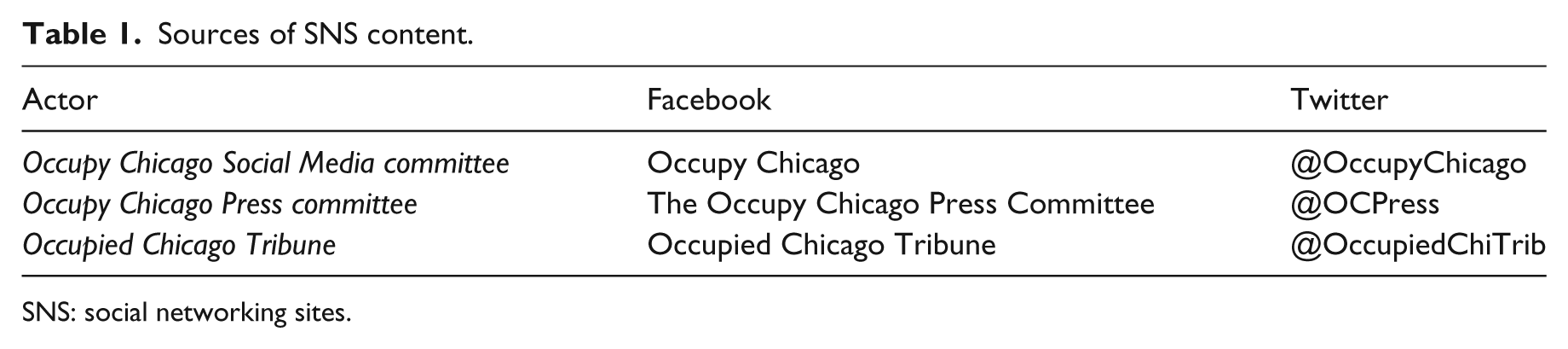
SNS: social networking sites.
Building on Stein (2009) and incorporating the suggestions of Poell and Borra (2011), I developed a 10-category content analysis methodology, shown in Table 2.
Categories for content analysis.
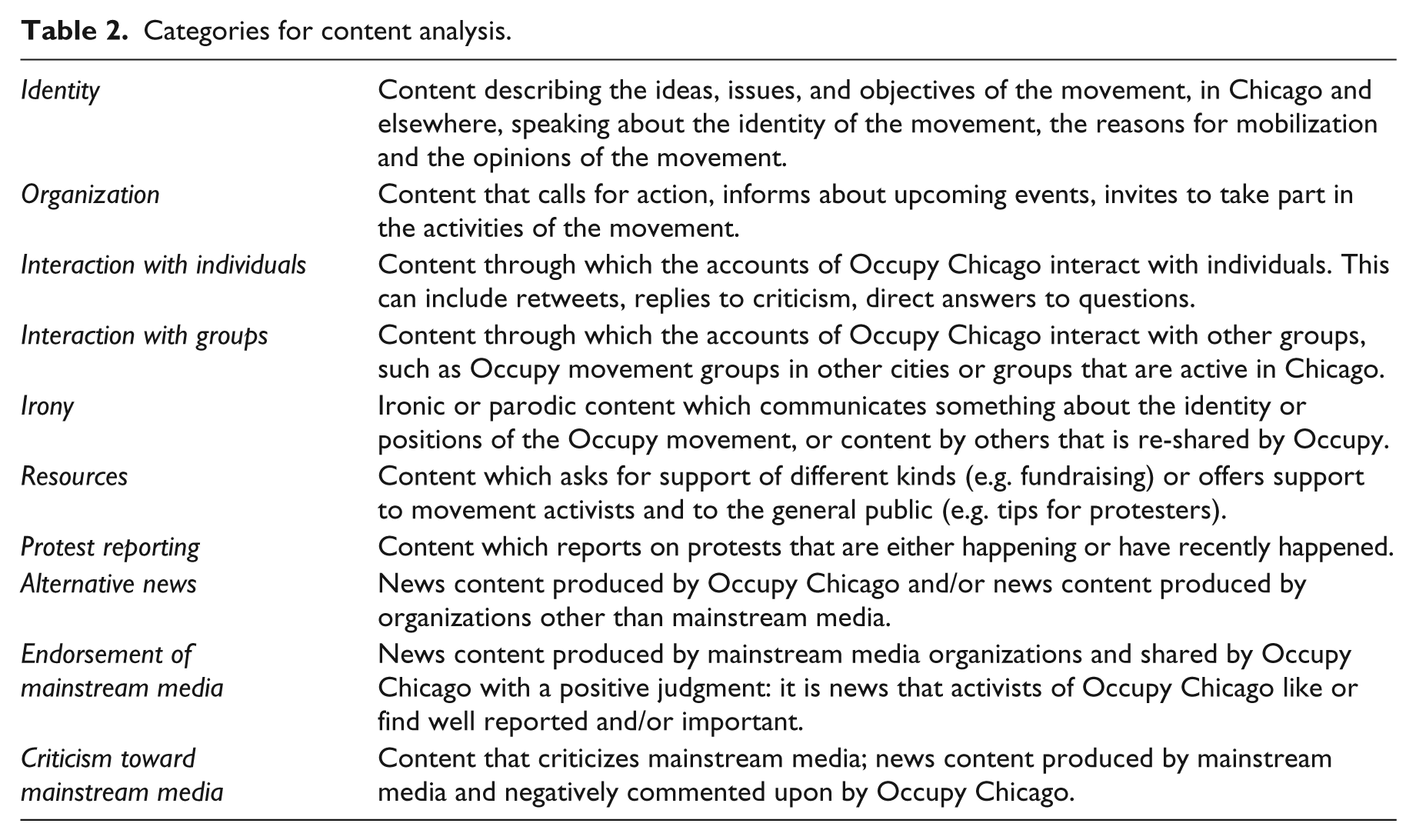
The content analysis assesses the functions that social media perform for OC and whether there are differences between the content published on Facebook and on Twitter. The results of the content analysis are supplemented by the observation of forums and discussion groups of OC, personal communications with activists, and secondary literature on other Occupy groups.
Results
The results of the content analysis are shown in Figure 1, which displays the distribution of the 10 categories (in percentages). 3 The first category by magnitude is “protest reporting”—content that describes actions and protest events—which constitutes 38% of all the content.
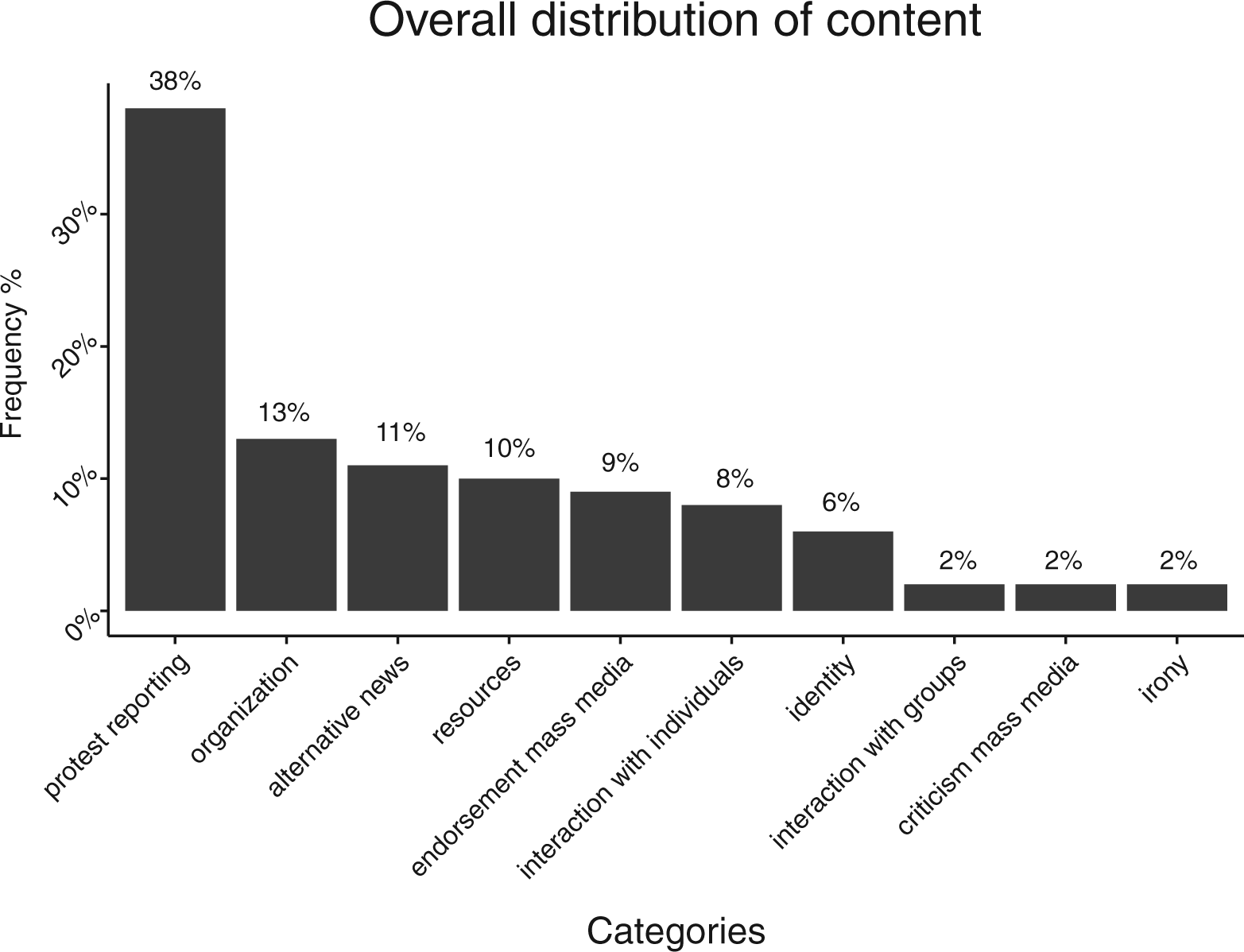
Distribution of SNS content across categories (N = 4975).
The second category is that relative to information about upcoming events and calls for active participation: “organization” accounts for 13% of the content. The third most frequent type of content is “alternative news,” which includes news produced by the movement and all actors other than mainstream media (11%). The fourth category is “resources,” that is, information on resources needed or shared by the movement, which totals 10% of the content. “Organization” and “resources” together account for almost a quarter of the total content, thus lending support to the idea that SNS are heavily used by contemporary movements to serve their organizational needs (Bennett & Segerberg, 2013; Gerbaudo, 2012).
Three findings are remarkable. First, most striking is the small amount of identity-related content, that is, content which expresses the ideas and the motivations of the movement, which only accounts for 6% of the postings, suggesting that such content is marginal in OC’s social media accounts. Even ironical content, potentially related to expressive needs, is negligible, since it is only 2% of the posts. The low percentage of identity-content is similar across Twitter and Facebook, respectively, 6% and 5%. This finding is particularly striking given the emphasis placed on identity-building in many scholarly accounts of social movements’ media practices. For instance, Lievrouw (2011) underlined that “media and ICTs are the means for expressing and circulating activists’ interests, values, and symbolic representations of issues” (p. 156). However, this does not appear to be the case for OC’s social media.
Second, the frequency with which mainstream media content is posted (“endorsement of mainstream media”) outweighs the instances of “criticism towards mainstream media”: 9% and 2% of the content, respectively. Mainstream media content is posted only slightly less frequently than alternative news (which is 11% of the content). I return to these two findings below.
One of the hypotheses of this article is that the features of SNS platforms provide users with implicit and explicit structures that greatly influence the type of content that users produce on such platforms.
Indeed, my findings suggest that there are striking differences in the type of content that is overall produced on Facebook and Twitter. As Table 3 shows, reposting mainstream media content is the most important function on Facebook (28%), while it is less significant on Twitter (chi-square = 200.7, df = 1, p < 0.01). Similarly, the most popular content on Twitter, protest reporting (40%) is less important on Facebook (14%) (chi-square = 104.16, df = 1, p < 0.01). Furthermore, the other most prominent categories on Facebook are organization (22%) and alternative news (17%); organization is also the second most frequent category on Twitter (12%), followed by resources (10%) and alternative news (10%). These findings suggest a simple, yet important conclusion—activists use different types of technologies differently. Yet, interpreted through the lenses of the logic of relevance, this also means that activists strategically adapt to the different affordances of SNS in an effort to maximize the relevance of their content.
The distribution of categories on Facebook and Twitter.
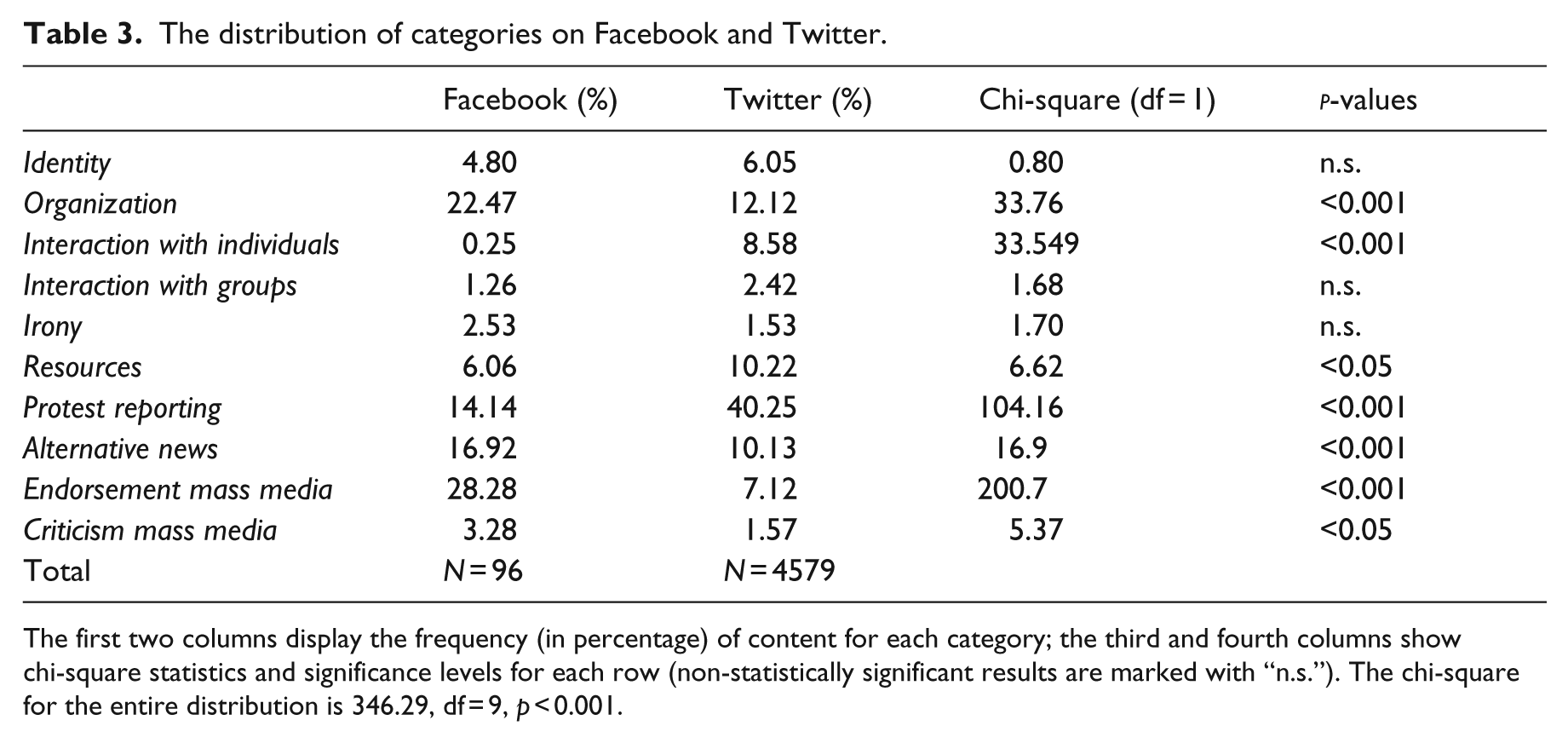
The first two columns display the frequency (in percentage) of content for each category; the third and fourth columns show chi-square statistics and significance levels for each row (non-statistically significant results are marked with “n.s.”). The chi-square for the entire distribution is 346.29, df = 9, p < 0.001.
Occupy and the media: going mainstream?
Occupy has been outspoken in its criticism of mainstream media. As OWS activist Justin Wedes explained, “we could never rely on the mainstream media to depict us fairly. And we wanted to be the most go-to, responsible, accurate depictors of what is happening in this space” (Goodman & Moynihan, 2012, p. 260). OC Press Committee activists also begin their guide, “Occupy the Media! Press Relations 101,” by stating, “corporate media is owned by the 1%, and will ultimately protect their interests at any cost” (OC Press Committee, 2012a, p. 4).
In light of these concerns, it is quite striking that while reposted mainstream media content accounts for 9% of the overall content, the content that openly criticizes mainstream media is almost negligible, at only 2%. Although not exclusively, a large amount of this endorsed mainstream media content is related to the coverage of OC and connected issues. This should therefore be interpreted in light of the overall media strategy of OC.
Like many movements in the past (cf. Gitlin, 1980), Occupy had a complicated relationship with mainstream media. On one hand, in line with Rucht’s (2004) notion of attack, activists were very vocal in criticizing mass media for their coverage—especially of the protests in New York City—which they described as “a fickle, ornery beast” (Writers for the 99%, 2011, p. 167). Occupiers lamented, at first, a lack of coverage (Writers for the 99%, 2011, p. 168); later, they criticized the “condescending or dismissive” frame employed in the coverage (Writers for the 99%, 2011, p. 169). Activists also claimed that mainstream media serve the needs of corporations by keeping the public fearful and misinformed (New York City General Assembly, 2011). Fear was also the main component of the coverage of the NATO protests in Chicago (Activist1, personal communication, May 2013).
On the other hand, despite criticizing mainstream media and emphasizing the strategic role of their alternative media production and of social media accounts, Occupy activists seem to have developed tactics to deal with corporate media attention. Occupy groups typically set up a committee in charge of Press Relations; training was also available for activists who volunteered their name as potential interviewees for mainstream media. One of the major sources of misunderstanding between Occupy groups and reporters was related to Occupy’s declared leaderlessness. However framed—in OC the catchphrase was “we are not a leaderless movement, but a movement of leaders” (OC Press Committee, 2012a, p. 30)—the absence of permanent spokespeople for the movement created some tension with the media, that were looking for some “official” voices from the movement (see Terranova & Donovan, 2013). Such difficulties are not new, as exemplified by Freeman’s critique of the “star system” that characterized feminist movements (Freeman, 1972) and Gitlin’s account of movement “celebrity” (Gitlin, 1980). In OC, the challenge of matching media attention and the choice of not appointing a spokesperson was met by training the activists who volunteered to talk to the media. The OC Press Committee, for instance, held a specific training for the NATO protests and included a section dedicated to suggested talking points in their public relations (PR) guide (OC Press Committee, 2012a, p. 29). Although the talking points are clearly marked as not representing the “official word of Occupy Chicago,” they are described as “a reference for anyone who would like to speak to the press, or anyone, else, about Occupy Chicago” (OC Press Committee, 2012a, p. 29). They include the motivations and goals of Occupy, the organizational structures of the movement in Chicago, and the relationship with the police and organized labor.
Besides training activists, the OC press committee also used more traditional PR strategies and tried to address the issue of officiality, for instance, by issuing official press releases and organizing press conferences. Press releases were written and edited by the members of the Committee over their listserv and required three approvals within the committee to be sent out to the media 4 (OC Press Committee, 2012a, p. 29). Press conferences, frequently held together with other organizations involved in the NATO protests, featured one rotating member of the committee as representative of OC.
These tactics were probably implemented at the requests of activists. On the OC forums, in fact, there are records of discussions about the necessity of a consistent “communication strategy,” especially regarding Chicago-based mainstream media. In such discussions, activists also argue in favor of nominating a spokesperson with the authority to respond to the press on the basis of shared talking points (Occupy Chicago Press Liaison Forum, 2011).
While press conferences are only one aspect of the movement’s relation with the media, there is further evidence to believe that, despite their open criticism, OC still tried to play by the rules of mainstream media. The OC Press Committee guide cited above gives further indication of this. For instance, the guide suggests that “the media should be invited to well-planned events that are ‘newsworthy’,” which they define as involving “big numbers, flashy signs & banners, interesting street theater […]” (OC Press Committee, 2012a, p. 23). The general recommendation is that “[i]f we invite the media to an event, they should be able to walk away with the visual elements they need to put together a good story” and that “[w]e want to stay away from sending out releases about 15-person single-issue protests, with people in every-day clothes carrying signs” (OC Press Committee, 2012a, p. 23). This shows that OC tried to adapt (Rucht, 2004) to mainstream notions of newsworthiness—such as those already described by Ryan (1991) and Gamson and Wolfsfeld (1993), thus signaling that they attached some importance to generating mass media coverage, which they then endorsed by reposting it.
Considering OC’s mainstream media strategy as a whole can shed light on the results of the content analysis, which show that the content criticizing mainstream media is outweighed by the amount of mass media content that the movement reposts. The fact that mainstream media content constitutes over 40% of the content posted by the accounts of the OC Press Committee, as can be seen in Figure 2, indicates that this was a deliberate strategy. In fact, OC’s PR guide can once again serve as an indication, because it recommends collecting mass media coverage of movement actions: “[o]nce you’ve found your clips, post them to your facebook page and tweet them. If you get coverage of an event or action before it starts, it can help get people excited and drive them out for the event” (OC Press Committee, 2012a, p. 23). Thus mainstream coverage seems important for OC also as a way of motivating potentially sympathetic viewers and readers. This is probably why such media content is so prominently featured on the movement’s social networking accounts.
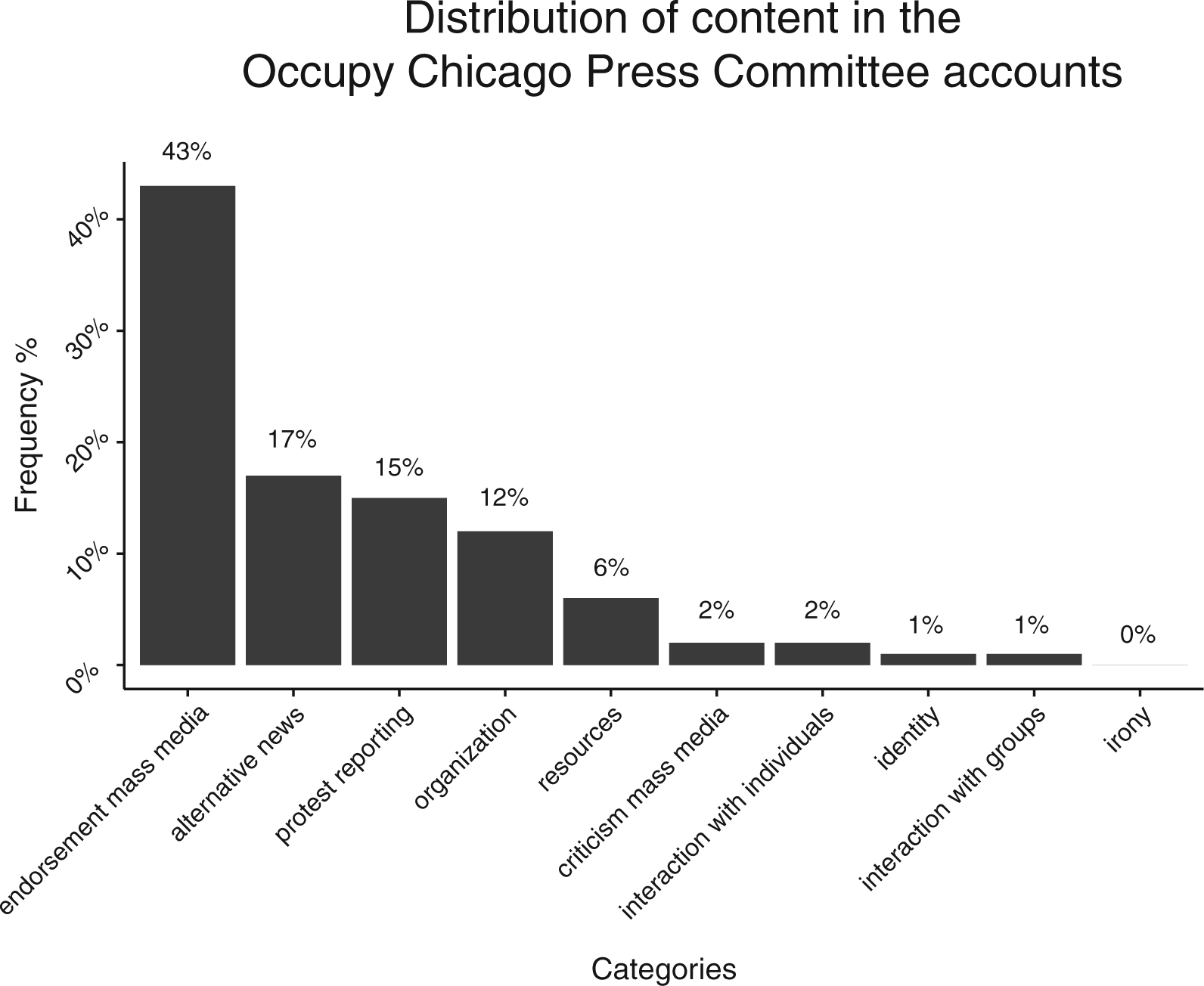
Distribution of SNS content across categories in the Occupy Chicago Press Committee accounts (N = 473).
“What we do,” not “who we are”: protest reporting and the lack of identity-content
Almost 40% of the social media content produced by OC during the Chicago Spring is devoted to protest reporting. Although protest reporting is less intense on Facebook than on Twitter (14% vs 40%), its presence on Facebook clearly points to the significance of this content beyond the specific affordances of Twitter. Its importance is twofold. First, protest reporting serves organizational needs. The decentralized (and often disorganized) processes in the Occupy movement make the task of organizing large crowds even more complex. During actions and demonstrations, protest reporting on social media can help activists understand what is happening and inform the participants about potential problems, changes of plan, or obstacles, as in this tweet: “People divided. This march headed down 25th and Michigan headed east” (OC, 2012b). This organizational aspect of protest reporting is more prominent on Twitter, because the platform—through the hashtags—makes it possible to sort content thematically, thus giving a clearer structure to the feed, which helps activist to share and find information quickly.
Most importantly, however, I argue that OC uses protest reporting to present itself to the public, as evidenced by this tweet, which includes the link to a livestream: “Crowd is chanting ‘No war but class war’ at the #ftp march #ochi #nato—http://t.co/Ugi4rrhZ (7:01pm)” (OC, 2012c). Through protest reporting, activists of Occupy can say something about “what they do,” their actions, and their protests, as they happen. Protest reporting allows them to become an authoritative source about “what they do” and to be the ones that break the news about the movement.
Saying something about “what you do” might also be a good response to the inability of saying something about “who you are,” which is signaled by the limited amount of content related to identity that I find. This lack of identity-content is the result of the peculiar interaction between the politics of Occupy, the processes of media content production in the movements and the features of corporate SNS—particularly their individual-centric and exclusionary nature.
To explain the difficulty of this interaction, I turn to the tensions which arose in Occupy Los Angeles (OLA) (Terranova & Donovan, 2013). In OLA, the committee in charge of SNS was rather closed; this created the tensions that led to the formation of a radical-anarchistic group named “Occupy LA Anti-Social Media” (OLAASM). OLAASM criticized the media committee for being non-transparent, non-inclusive, and autocratic, thus not abiding to the principles of consensus and participatory decision-making (Occupy Los Angeles Anti-Social Media (OLAASM), 2012). However, what is evident in the OLA social media management crisis is that another kind of closure and insulation developed directly from the structure of SNS, rather than from the activists’ actions. As Donovan explains, […] the way that social networks are structured with a single point of entry posed a bigger problem: who has the password? Because you need a password to communicate through those channels, the passwords were vigorously guarded from people who were deemed provocateurs. An elaborate set of rules and requirements developed around access to these passwords, specifically for the Occupy LA Facebook and Twitter accounts, which have tens of thousands of followers. (Terranova & Donovan, 2013, p. 300)
These remarks echo Fenton and Barassi’s (2011) description of corporate SNS as “self-centered media production practices” (p. 181). As Hui and Halpin (2013) state, “Facebook’s very existence relies largely on the presupposition of individualism, as the primary unit in Facebook is always the individual’s Facebook profile” (p. 106). Although slightly different from the individual profile, the creation of Facebook pages (and of Twitter accounts) follows the same logic: there is—in Donovan’s terms—“one single point of entry,” guarded by a password; the content that gets published from such account inevitably comes to be considered “official” (see Kavada, 2015, p. 882), thus transforming a variegated movement like Occupy into a unified single voice—that of the SNS accounts.
Similar issues emerged in the Google Group discussions of OC. In a thread about ‘Censorship on Facebook’, one activist argued that despite having a no-censorship policy on individuals’ posts on their pages, “[t]here should be policies created and enacted that all facebook admins or individuals with access to the twitter should have to follow.” (Occupy Chicago Google Group, 2011) Another activist from the Social Media committee replied, “we have to make sure we are disseminating correct information. if it comes from us, our official facebook or twitter, it has to be accurate and reflect the o pinion [sic] of the movement” (Occupy Chicago Google Group, 2011). However, the processes that might ensure that the movement’s opinions are reflected in its social media content were not specified. My interactions with OC activists were unfortunately not very helpful in understanding them. My questions regarding internal processes of content creation were answered with this limited description: “[w]e coordinate via email and some other tools like Hootsuite 5 to schedule and prioritize the information we share. It’s not a perfect system and mistakes happen but in general it works” (Activist2, personal communication, May 2013).
Overall, the fact that some of the tensions over internal democracy in the movement ended up being expressed as a sort of “tyranny of the password” reveals both the importance that the movement attached to their social media content and the inherent difficulties of using corporate social media in an open, decentralized, and—ultimately—democratic way (see also Mattoni, 2013). For instance, OLA tried to have the GA decide what content would be promoted on SNS, only to end up having no time to hold that kind of discussion—thus further delegating these decisions to a “small group of admins, who were routinely insulted by other members of Occupy LA who accused them of pushing a ‘reformist agenda’” (Terranova & Donovan, 2013, p. 300). OWS activists also struggled with the creation of participatory mechanisms in the management of their social media accounts, as Gerbaudo (2012, p. 130) chronicles. Yet, despite a certain proclaimed reflexivity in the management of social media, activists of OWS created competing Twitter accounts and websites (Activist3, personal communication, May 2013), for which they fought through legal means, too (Moynihan, 2014).
The reason why so little identity-content is created through the social media accounts of OC lies in the fundamental incompatibility between the open, collective, decentralized, and consensual decision-making processes of Occupy—which are not just mechanisms, but values of the movement—and the individual-centric nature of corporate SNS. On one hand, Occupy organized its political processes on the basis of consensus mechanisms, which tended to focus on concrete proposals about actions to undertake rather than on the deliberative processes that would arguably be needed to build clear and coherent political positions for the movement. Regardless of its efficacy, the emphasis on consensus was also the biggest political statement of the movement. On the other hand, their reliance on Facebook and Twitter did not help them in supporting their participatory efforts. These platforms—as they are now—simply do not allow the sort of complex interaction, debate and collaborative effort that Occupy would require to be able to make sense of itself and its ideas; they do not support processes of political elaboration (Barassi, 2015) or reflexive self-organization (Milan, 2015). As Gamson and Sifry (2013) contend, “social media may also have hindered the [Occupy] movement’s ability to spread and take hold as a new political force” (p. 160). And if not effectively restricting the possibilities of the movement, corporate social networks are at least failing to help the activists.
In short, I argue that the absence of identity-content is a coping mechanism, a solution that bridges the need to use social media platforms—“because they are familiar, useful, and give access to the broadest possible audience” (Terranova & Donovan, 2013, p. 309)—and the existence of multiple possible identities, and thus the unavailability of one official identity-content. Since activists are aware that posting some identity-related content from an official SNS account could be perceived as the attempt to impose an official agenda on the movement, this kind of content is simply reduced to a minimum; coverage of events and organizational content, on the other hand, are much less problematic, both because they are more concrete and because they generally refer to activities that have been approved by the movement. Coverage of events might then reinforce feelings of solidarity more than identity-content, which can be perceived as an imposition. In other words, it might be that content that says something about “what they do” is performing, in itself, an identity-building function. We might, in fact, be witnessing the development of identities constructed around and communicated through actions and events—collective identity as a discourse about “doing something,” as opposed to “being something.” Although this shift, if indeed happening, is unlikely to be the simple result of technological affordances, I would argue that part of the reason why such an action-oriented, event-based notion of identity might be appealing for movements lies precisely in its compatibility with the logic of corporate SNS and the rules of mainstream media coverage.
Conclusion
In this article, I have examined how a group in the Occupy movement, OC, used corporate SNS during a month of intense mobilization. To do so, I mapped the functions that social media content performed for the movement, and highlighted how Occupiers pursued adaptive strategies, despite their open criticism of both mainstream media and corporate SNS. The results of my analysis thus point toward the necessity of rethinking social movements’ media strategies, of investigating the relationship between the affordances of SNS and the political and organizational features of social movements, and of better conceptualizing the role of identity-based expression in contemporary activism.
First, my analysis shows that OC chose to adapt to notions of mainstream media newsworthiness and to the logic of relevance of corporate SNS. Despite openly attacking the nature and the limitations of mainstream media and of SNS, activists strategically chose to play by the unwritten rules of both. As I underline above, the “problem of access” captures the idea that movements need an unmediated channel to communicate their ideas and values to the public; the Internet has proven to be a solution to this problem by making it easier for movements to create alternatives to mainstream media, such as the Indymedia network. It is possible, however, that the shift from the problem of access to the logic of relevance has now changed the situation, by making it easier to choose adaptive strategies (i.e. using corporate SNS) but harder to develop alternatives. Within the logic of relevance, Occupy chose to adapt and, in doing so, experienced the clash between the nature of corporate SNS and its decentralized political practices. This suggests that we need to further investigate how contemporary social movements negotiate the contrasting demands of expression and strategy vis-a-vis the predominance of corporate SNS and the logic of relevance.
Second, it is evident that there are persisting problems of inequality and exclusion in the process of creating activist media. The examples of the Occupy LA Anti Social Media committee and the more recent conflicts in OWS are a clear indication of the sort of exclusionary practices that can jeopardize movements. The main argument advanced in this article is that, contrary to the expectations of many, the web 2.0 and corporate SNS do not solve the problems of participation and inclusion, but rather exacerbate them. As pointed out by Gerbaudo (2012), “soft leaders” emerged from Occupy’s horizontal and supposedly leaderless processes precisely due to their proficient use of SNS (p. 144). Corporate platforms alone cannot take care of participation and internal democratic needs—as Occupiers have learned—, because they are not built to support egalitarian and democratic processes.
The global justice movement was a plural and diverse movement, not unlike Occupy. And Indymedia, its alternative platform and publication, was not immune from questions of power and internal hierarchies. But the way in which the network was set up allowed for reflexivity and debate over conflicting ideas. Not unlike Occupy, Indymedia activists also confronted the problem of being relevant (Pickard, 2006, pp. 330–331), but they were in a position that allowed them to employ technology to solve such problems—an option that was never available to Occupy, that relied on already existing commercial social networking platforms.
The individual-centric nature of social media clashes with the flexible, multiple, work-in-progress identities that coexisted in the Occupy movement. Since its very beginning, Occupy acknowledged both its open, unstructured, decentralized character and its multi-faceted, all-encompassing aggregation of (unclear) demands. They presented themselves as an ongoing conversation about what is wrong in the political and economic sphere, rather than as a group organized around a specific manifesto. These choices, however, were not translated consistently into a media strategy. Perhaps using SNS gave activists a solution to the problem of access and (arguably) to the problem of relevance, but SNS did not give the movement any means to promote its multiple and work-in-progress identities or to support processes of inclusive decision-making that could come to terms with such different identities. On the contrary, the use of SNS further endangered the delicate political equilibria developed by Occupy, as the cases of OLA and OWS show.
The complex interaction between decentralized practices, multiple identities, and the individual-centric nature of SNS begs further investigation in the direction of a more comprehensive analysis of the impact of specific technological features on the political decisions of social movements. If technologies are not neutral, what are their underlying visions of politics and of engagement? And how do they influence social movements?
Finally, I have argued that the limited importance of identity-content is a coping mechanism, employed by Occupy to reconcile its multiplicity with the individuality of SNS. Moving forward, this argument requires further research to assess whether movements still need to express their identity, and if so, how. The question is a complex one, even when employing a broad definition of identity as the one used in this article. In their book, Bennett and Segerberg (2013) posit that the model of connective action underlying movements like Occupy is based upon the personalization of action frames: movements and organizations giving individuals the freedom to determine how they frame their participation. If we are to follow their conceptualization, we might think that collective identity in social movements is not important anymore, or perhaps that it is even an impediment to the participation of individuals. But I believe that we should not discount the role of collective identity, however broadly defined (see Gerbaudo & Treré, 2015). The hypothesis advanced in this article is that identity might have gained a more prominent action-based, event-defined character, as signaled by the salience of protest reporting. In this sense, identity is a discourse about “doing something,” as opposed to “being (for/against) something,” perhaps because action is the only place where different individual identities can come together. I suggest above that the specific characteristics of SNS—chiefly their individual-centric nature and the logic of relevance—might be playing a key role in reorienting collective identities toward a more event-based character. Further research on the changing characteristics of movements’ collective identities could shed light not only on the relationship between identity and technologies, but also on the impact that such changing notion of identity could have on the internal life of social movements and their definition of participation and democracy.
Footnotes
Acknowledgements
The author would like to thank Allyson Volinsky and Elisa Baek for their help and Marina Popescu for her continued support during the development of this research.
Funding
The author(s) received no financial support for the research, authorship, and/or publication of this article.