




Abstract
Over the last decade, social media platforms have become the leading communication tools for activists and protesters all over the world. Understanding protesters’ motivations and reasons for using social media is a challenging issue for researchers. In this article, we analyzed the use of Twitter during the anti-governmental protests in Istanbul that was launched in May 2013. We examined 13,794 tweets posted to the #direngeziparki hashtag over a 6-day period. Based on the results of a qualitative content coding of the tweets, we found that the Twitter platform was widely used to mobilize protesters, share information about the events, and express opinions about the policing of the protests. We argue that social media can help keep protests peaceful by preventing vandalism, informing the protesters about extremist or violent groups participating in the protests, and can help them to avoid engaging in violent acts against police forces.
Social media platforms and other Internet-enabled communication technologies, like smartphones, have changed people’s daily activities and social routines in radical ways, creating more communication and interactive opportunities and expanding the horizon of social and collective action. The total numbers of Internet users hit 2 billion throughout the world by 2013 (Schmidt & Cohen, 2013) and increased to 4 billion as of July 2018 (Internet Live Stats, 2018). Mobile Internet usage has also increased dramatically in the last decade. According to global mobile phone Internet user penetration statistics (Statista, 2016), 61.2% of mobile phone users accessed the Internet from their mobile phone in 2018. Mobile devices create new opportunities for people to actively participate in social and political life while staying connected online.
A number of studies have indicated the new information ecosystem and technological infrastructure of the Internet has made information abundant, facilitating sharing and participation among users. In this regard, political activists have turned to these social media tools and devices to resist, protest, and/or gain local and global publics’ attention in support of their causes. Egyptian and Tunisian activists’ use of social media to mobilize protesters in what became known as the “Arab Spring” uprisings has received much public and scholarly attention. The research results also show that Twitter advances the mobility particularly during the public movements (Hopke, et al., 2016). A mere 4 days into the Egyptian protests seemed enough to lead CNN news anchor Don Lemon (2011) to assert that “. . . social media has allowed protest coordinators to communicate.” The social networking platform Twitter has become ideal for activists as they strive to post comments, pictures, and web links to their followers and to deliver instantaneous messages to online network within seconds. Twitter’s prompt response delivery and mass messaging capabilities make it attractive for activists. Protesters have thus employed this platform for purposes of information sharing, recruiting, and increasing public awareness (Demir, 2015). A previous study investigated these social media affordances, and how instantaneous mass exchange of information making it very useful communication tool in the context of large-scale protests and collective social action (Veenstra et al., 2014). If we conceptualize the social media as a “tool” to mobilize people and disseminate ideas, it can be argued that such an effective tool can be used for good and bad. As Bastug et al. (2020) argue, “online users’ anonymity might equally foster audience engagement and political participation, harmful disinhibited speech and deviance, as well as exponentially increase the ability of those engaged in criminal activities to evade law enforcement detection.” For instance, those who want to provoke peaceful protestors may use social media platforms to incite them to violence (Douai, 2013).
Activists taking to the streets have various motivations and backgrounds, and myriad factors can influence collective behavior when protesting as a group. According to Le Bon’s contagion theory, for instance, “conscious personalities, personal will, discernment, and restraint disappear” (as cited by Stolley, 2005, p. 95) at the individual level when people become part of a crowd. Emotions can be transmitted from one individual to another, which in turn, may lead to violent behavior (Stolley, 2005). The presence of violent or extremist individual elements in a peaceful protest, or other “situational dynamics,” such as miscommunication between protesters may influence the behavior of non-violent activists and lead to the eruption of violence (Nassauer, 2018). Mooijman et al. (2018) have explained that the degree of moralization of a cause can explain the turn to violence and social media can play a significant role in amplifying morally relevant rhetoric and thus provoking violence. These communication platforms help reorganize the individuals concerned around the core idea, re-orienting and introduce new norms.
As emergent norm theory argues, new norms usually emerge within collective action as events proceed (Stolley, 2005; R. H. Turner & Killian, 1972). Similarly, Lemonik Arthur (2013) explains that “anything which facilitates communication among crowd participants facilitates the emergence of norms.”
We examine in this article the role of social media in facilitating the emergence of new norms during a collective action and social/political protest, which can likely lead either to deviant behaviors or taking the group back to its original formation when a protest deviates from its original norms, while other outcomes remain possible as well. We specifically explore the ways in which these platforms enable collective action and peaceful protest through an analysis of the use of Twitter during the anti-government protests launched in Istanbul, Turkey, in May 2013, known as the Gezi Park protests. Our study addresses the following main research question: How did Gezi Park activists use Twitter to (1) promote their collective action and (2) keep their protests peaceful? A total of 13,794 tweets posted with #direngeziparki (meaning #resistforgezipark in Turkish) collected over 6 days during the protests were examined using content analysis. The article reports’ findings that explain Gezi Park activists’ use of Twitter through (1) categorizing Twitter messages communicated between 31 May and 5 June 2013 and (2) activists’ strategic use of Twitter to keep their collective action and protests peaceful in Gezi Park. The findings shed more light on the complex role of social media platforms in collective action.
Social media and social movements
Understanding the nature of social movements is important in a digitally networked world. Collective social action and social movements have taken advantage of the networked information ecosystem to advance their causes locally and globally. Ease of access to information, particularly the Internet, and proliferation of mobile communication devices such as smartphones and tablets, have enabled social movements and activists to work more cooperatively, recruit members, find supporters, and organize grassroots movements (Romero, 2014). Social movement literature has described the blending of the cyberspace of social movements as “cyberactivism” (Buechler, 2011, p. 220). Technological developments and cyberactivism decrease the cost of mobilization, recruitment, and organization, but increases opportunities, networking, innovation, and collective action (Buechler, 2011).
Social movement theories have described the typical life cycle of social movements as consisting of four stages: emergence, coalescence, institutionalization, and decline (Christiansen, 2009). The outcome of social movements is not predetermined as they could result in success, organizational failure, co-optation, repression, or establishment within mainstream society (Macionis, 2001). The influence of social movements stems from their ability to stir individuals’ spontaneous reactions, and social media and the Internet can spread their impact. These platforms play a major role in endorsing new forms of mobilization and promoting the popularity of new social movements in local, nationwide, and global communities (E. Turner, 2013).
Technological and economic developments have been at the heart of social collective action, and the new information infrastructure has been particularly conducive for activism. For example, industrialization and urbanization that took place in the 19th century triggered social movements to mobilize labor and the suffrage movement (Romero, 2014). The advent of new communication technologies and the Internet have decreased the cost of engaging in social/collective action making it easier to spread information at unprecedented scales, to organize and to mobilize people. Activists in social and political movements worldwide have adopted various social media platforms, such as Facebook, Twitter, Instagram, and YouTube as part of their activism toolkit. In addition, the Internet’s accessibility make it an effective medium to reach out to disengaged individuals and encourage them to participate in social movements by sharing messages, spreading information, and/or personally joining collective action.
Social media play a critical role in communication by informing and mobilizing people particularly in situations of social unrest (Gleason, 2013). The fluidity of information works well with a less rigid, nonhierarchical structure of networking information society where individuals use social media tools for “self-mass communication” purposes (Eaton, 2013). In addition, the Internet has a vital effect on mobilization in two respects. First, the Internet is a low-cost tool and provides fast communication and leads in the context of mobilization (Enjolras et al., 2013). Second, it shapes political dialogue and decision-making processes (E. Turner, 2013). Social media platforms, particularly Twitter, foster collective action and mass social change (Gleason, 2013), as they help motivate, encourage, and recruit individuals. Twitter allows users to post comments limited to 280 characters, up from 140, which enables individuals to obtain a conceptual understanding of the content. Twitter users often include a hyperlink to direct people to a website, a blog, an Instagram photo, a YouTube video, Google map or any other source of information (Gleason, 2013).
Social media platforms, particularly Facebook and Twitter, were used during the Arab uprisings so widely that the Egyptian revolution, for instance, was usually described as “Facebook revolution” or “social media revolution.” Although the main driving force behind the uprisings was the suppressed people in Arab countries not the “social media” (Kamel, 2014; Shearlaw, 2016), it played a vital role in the protests and helped demonstrators to better organize the events. Zeynep Tufekci (2017) provided a detailed discussion about the utilization of Twitter during protests. As Tufekci argued, social media could be seen as a necessary condition in some societies without being sufficient. She emphasized that structuring power of technology including new communication platforms depends on its materiality, formal cause, and design:
Overall, it is important to keep in mind that understanding digital technology’s role in social movements requires multilevel analyses that take into account how these technologies change society in general, that the particular design and affordances of each technology have complex consequences. (pp. 124–125)
Research around the use of Social Networking Sites (SNSs) in mass protests revealed some similarities in how they are employed by protestors in different protests from all around the world. Jost et al.’s (2018) study, for instance, argued that social networks facilitated to spread information and messages quickly and efficiently in the Occupy Wall Street protests in the United States, the Indignados movement in Spain, the Ukrainian protests of 2014, and Gezi Park demonstrations in Turkey. These platforms were also employed to shape political debates, motivate demonstrators, and inform the public not only in Arab uprisings but also in other protests that were part of the global protest wave that sparked in 2011 (Howard et al., 2011; Tremayne, 2014).
The broad use of social media has impacted social movements and protests in Spain, Greece, Bahrain, and the United States as well. Indignant activists used social media to coordinate a series of protest in the cities of Spain (Charnock et al., 2012; Jones, 2017) against unjust, unequal, and corrupt political institutions in the same way as Occupy Wall Street activists did in the United States (Theocharis et al., 2015). Twitter played a vital role in the Occupy Wall Street Protests in the United States in September 2011. The activists started using Twitter to organize the protests and inform the public about almost 2 months before the protests started (Tremayne, 2014).
The Gezi movement on Twitter
The Gezi Park protests began as a rally against Istanbul municipal urban plan to redevelop Taksim Square, a well-known central park in Istanbul, Turkey, and the planned removal of trees from the park (Koç & Aksu, 2015). Local environmentalists who wanted to protect the tree landscape came together and declared that construction of Historic Taksim Military Barracks as a new shopping center was not acceptable to the people of Istanbul. They resisted police forces to keep the trees in the same form in Gezi Park (Farro & Demirhisar, 2014). The use of police force against these activists attracted public interest, and other activists joined the environmentalists’ cause and started resisting the government’s decision to re-design Taksim Square and demolish the trees in Gezi Park. Nationwide demonstrations erupted as demonstrators reacted against the use of violence by Turkish police authorities. Activists posted messages through social media about their demonstrations in Gezi Park, and other people spontaneously joined the Gezi Park demonstrators. Diverse groups of people, including academics, soccer fans, students, medical professionals, and lawyers came together to stand against the government decision and police crackdown (Oz, 2016). Previous research show that social media leads creating an alternative way for participants to communicate mainly “what they do” rather than “who they are” and stands against to the crackdown (Ferrari, 2016). Larger concerns about the legitimacy of government and violation of freedom and human rights became part of the overall protest platform.
Protesters occupied Gezi Park with the intention of staying there overnight on 28 May 2013. The government declared that the construction would continue at Taksim Square and the trees would be cut down in Gezi Park. Then, Prime Minister Erdogan labeled the demonstrators “Capulcu,” meaning “Looters,” which protesters co-opted to build a group identity (Harding, 2013). The word “Capulcu” was welcomed by the protesters and virally spread through social media accounts and morphed into verb “chapulling” (looting). Erdogan’s speech against the protesters increased tensions and triggered the use of more police violence against the protesters using tear gas and pepper spray. As demonstrations expanded to other cities nationwide in Turkey, Gezi Park and Taksim Square remained the symbolic area of the protests, and sometimes serious clashes developed between police forces and protesters (Farro & Demirhisar, 2014). In their confrontations with the police, demonstrators were forcibly removed from Taksim Square and Gezi Park on 15 June 2013. Eleven protesters were killed during the events and many were injured (Ozdemir, 2017). The public debate predictably descended into a “clash of two nations” (Atay, 2013) and a contentious debate between two camps. The pro-government camp accused the demonstrators of not trying to save the trees, but of threatening public safety and vandalism. The other camp criticized the government for ignoring democratic demands and censoring the freedom of speech. The Gezi Park activists drew support from a motley crew of political and social actors to stand against the government policies: secularist groups, workers’ associations, fans of different football teams, and those considered by the Turkish government as violent extremist groups, and so on.
Except for a limited number of media channels, mainstream news media in Turkey ignored the nationwide protests at first, and their belated coverage tended to delegitimize the Gezi movement as “violent” (Oz, 2016). Mainstream news reports, especially pro-government outlets, highlighted violent protesters throwing Molotov cocktail and vandalizing public buildings and police vehicles (Oz, 2016). Although the media environment in Turkey was relatively more free and democratic back in 2013, it still lagged behind many democratic societies, and as Tunç (2014) explained,
the financial connections of media owners with the government, weak professional trade unions, and aggressive use of repressive laws have produced a situation of severe self-censorship in Turkey’s traditional media. This was seen clearly in the first days of the protests, when cable news channels broadcast cooking shows and penguin documentaries instead of covering huge protests in the heart of Turkey’s largest city. The penguin, in particular, became a national symbol of media complicity that the protesters adopted as their own ironic icon. (p. 13)
To counter mainstream media coverage, Oz (2016) argued, anti-government activists used social media to propagate “the frame of suppressing freedom of expression as the cause of the protest” (p.186) and build public support for their movement. Social media, mainly Twitter, became the principal communication channel for the public to share information about the movement to bypass mainstream media (see Hamdy & Gomaa, 2012). The use of Twitter encouraged many people to communicate with and participate in the demonstrations. Government authorities referred to Twitter as a “troublemaker” and most Internet users claimed that the government had put some restrictions on Twitter and monitored Internet traffic. Law enforcement officers publicly accused a total of 29 Twitter users of encouraging people to rebel and defy Turkish law enforcement authorities (Pearson & Tuysuz, 2013).
The Gezi Park movement fully embodied the new ethos of participatory social movements and social media-enabled collective action. These social movements remain largely driven by participants “expressing themselves, or establishing themselves as a constituency, but [who] adamantly choose not to engage the third front: they don’t form political parties, organize formal organizations, file lawsuits, or other common tactics of movements with policy demands” to draw on (Tufekci, 2014, p. 202). The Gezi Park movement drew its strength from the power of social media deploying as a key communication tool and a strong source of information (Oz, 2016). The movement was the first social movement in Turkey to employ social media as the main communication tool (Romero, 2014). Activists used Twitter to encourage people to join the demonstrations, to spread the recent news, to inform others about the location of police forces, and to provide supplies.
Police and state repression in the Gezi Park protests has been the subject of empirical research trying to understand the escalation of the protests and policing strategies (Atak & Della Porta, 2016; Budak & Watts, 2015; Demirhan, 2014). Violent police repression was blamed on “the prevalence of a law-and-order approach to crowd control and public order” (Atak & Della Porta, 2016, p. 611). The role of social media in the Gezi movement was investigated in a number of studies as well. For example, field interviews with Gezi activists indicated that social media and Twitter were very instrumental in building and maintaining “trust” among protesters (Haciyakupoglu & Zhang, 2015). In response to repression, Gezi activists turned Twitter into a critical tool to facilitate social movement mobilization (Odabaş & Reynolds-Stenson, 2018). Published research studies have not addressed, however, the role of Twitter in keeping the Gezi protests peaceful. The main research question of the present study, therefore, focuses on Gezi activists’ use of Twitter for “peace-keeping” purposes, and specifically asks: How did Gezi Park activists use Twitter to (1) promote their collective action and (2) keep their protests peaceful? Further analysis of the content of the Twitter messages should help us to better understand the role of Twitter in the Gezi Park demonstrations.
Methods and procedures
In this research, we collected and analyzed the Tweets that were posted to #direngeziparki (meaning #resistgezipark) for 6 days during the protests, to obtain a deeper understanding of Twitter usage during the events. Other hashtags were also used during the protests such as #occupygezi and #direnankara; however, #direngeziparki was the most frequently used hashtag with over 5.6 million tweets (Babaoğlan, 2019). It was also the hashtag that trended longest in the world trend topic list with 56 hours (Kurt, 2013). In addition to the overall content analysis of the tweets that were posted to #direngeziparki, we particularly researched how activists reacted when violent groups joined the protests and used Twitter to keep the protest peaceful.
The data for this study consist of quantitative content coding of 13,794 tweets posted to the #direngeziparki hashtag from midnight on 31 May 2013 to midnight on 6 June 2013. Tweets were collected by the authors using Topsy Analytics. 1 Although the protests started on 27 May 2013, the hashtag was created on 30 May 2013. Since the first day of the hashtag did not provide all-day coverage, we examined tweets that started from midnight on 31 May 2013. We collected tweets for each hour separately to create a more reliable and representative dataset. The data collection procedure with Topsy is filtered targeting the posted messages from Istanbul, Turkey, and in only Turkish language. Since the webpage did not provide more than a hundred tweets per hour, we collected a maximum of 100 tweets per hour randomly selected by Topsy software. The total number of tweets for each day ranged between 2299 and 2343. To equalize the number of tweets for each day in the dataset, we randomly removed tweets from 5 days in which there were more than 2299 tweets. Our final dataset included 2299 tweets for each day, and the total number of tweets was 13,794. We then conducted a content analysis of all the tweets in the dataset to determine the main idea, the inclinations and influence of the posted messages (Demir, 2013). We did not create a sample but manually coded all of the tweets including retweets.
The literature includes a wide variety of systems designed to quantify the sentiment in the content of the Twitter posts. There are sentiment dictionaries to evaluate words on a scale for a product (Tetlock, 2007). However, no sentiment dictionary exists in the Turkish language to perform for dictionary-based sentiment analysis. To interpret the context and to identify the category, three native Turkish speakers manually coded all the tweets based on a coding scheme and assigned each post into categories. In general, there was high agreement between the coders. When there is a disagreement in the coding of a Tweet, coders discussed with each other to solve the inconsistency. The tweets that the three coders agreed on were included in the study (Tetlock, 2007).
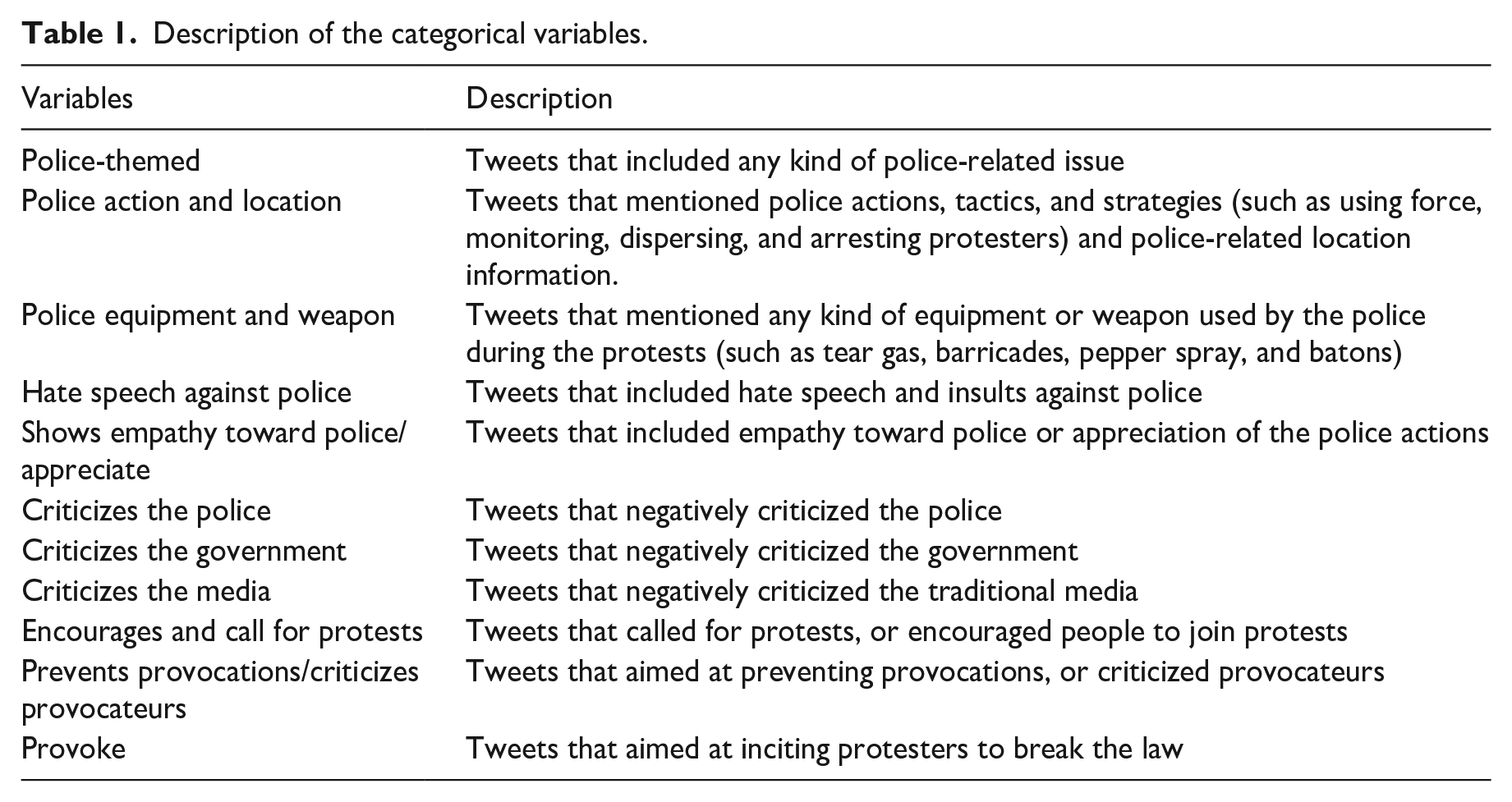
Earlier research on the use of Twitter during protest events used categorical variables to examine the content of the tweets (see Earl et al., 2013). We used a total of 11 categorical variables. Table 1 shows a detailed description of the variables. If a message’s content tended to fit more than one category, we counted it in all related categories. We also purposively selected a series of tweets to be quoted, so as to depict the course of the events. 2
Description of the categorical variables.
Findings
To explore the use of Twitter by Gezi Park activists, we first categorized tweets posted during the 6 days of the Gezi protests, and our methods and findings are largely in sync with other research on social movements and their use of social media platforms. Content analysis of Gezi activists’ tweets showed that Twitter was widely used to (1) organize the events, (2) mobilize protesters and resources, (3) disseminate information about the protests, protesters, and police forces, (4) create networks for cooperation, (5) address the needs of the protesters, and (6) prevent vandalism and provocations. In the first few days of the events, Gezi protesters expressed frustration and anger toward the police and government and argued the government appeared to have aimed at suppressing peaceful protests brutally. They claimed that police used excessive force against peaceful protesters. From the viewpoint of the protesters, excessive use of force was indeed the reason why a small peaceful environmentalist protest turned into a large, nationwide anti-governmental protest. A user posted a tweet which captured this type of reasoning and why the protests expanded:
2 June 2013, It was an environmentalist activity until the police attacked. Now it is one marching for freedom. (#direngeziparkı)
Recruitment
Gezi protesters used Twitter to organize marches and other events, as well as to recruit new participants. Tweets encouraged other citizens to join the protests and disseminated information about the times and locations of the events. The number of tweets that included calls for protests was highest on the first day in the dataset, then the number decreased gradually day by day except for 3 June (see Figure 1). The reason why the number increased on that day is probably related to the speech made by the then Prime Minister Erdogan. He threatened protesters by saying that his supporters could also take to the streets for counter-protests, and he was barely keeping the 50% of the voters—who voted for the ruling party—at home (Hurriyet Daily News, 2013). Protesters reacted against this speech by calling more people to join the protests. In the tweet below, a user encouraged people to join the protest after Erdogan’s threatening statement:
1 June 2013, Hey everyone! Come to Taksim
3
for protests! We should have more people here after the Prime Minister’s horrible statements . . . (#direngeziparkı)
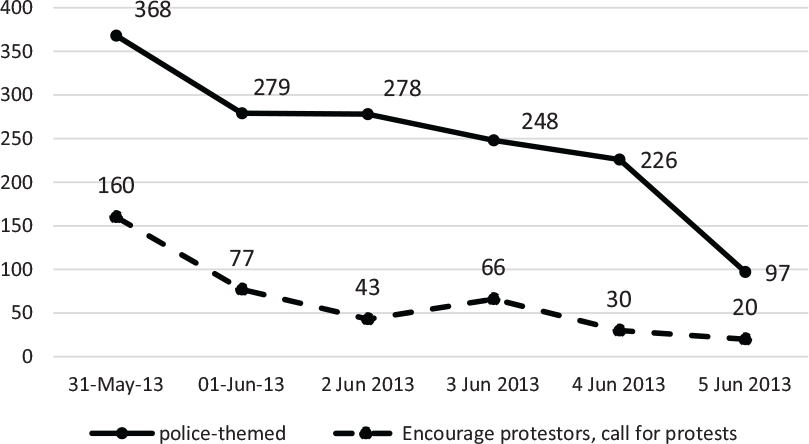
Number of police-themed tweets and tweets that encouraged and called for protests.
Solidarity
Protesters also used Twitter to build a social media network of solidarity during the protests. Under the #direngeziparkı hashtag, users identified the needs of the protesters and reached others who could fulfill their needs. They also organized physicians and lawyers through Twitter. A user appreciated the efforts of the users who organized lawyers to reach the protesters in custody by saying,
2 June 2013, Lawyers have arrived Bodrum Police Department. They are wonderful. They showed the power of social media. Let’s call it the “real media” (#direngeziparkı)
Information sharing
Twitter was widely used to disseminate information about the actions, locations, tactics, equipment, and weapons of police forces as well as to express an opinion about the police. Figure 1 below shows the number of police-themed tweets for each day that was examined. The first day in the dataset had the largest volume of police-themed tweets. Results showed that almost one of every six tweets was about the police on 31 May when the police raided the protesters’ encampment and forced them out of the area using tear gas and water cannons (Turkish Weekly, 2013). The number of police-themed tweets gradually decreased throughout the 6-day period. The first day in the dataset, 31 May 2013, was very intense in terms of police suppression. The number of encounters between the police and protesters might cause an increase in police-themed tweets. There might have been other factors that influenced the number of police-themed tweets. The results from the last day in the dataset supported this assumption; 5 June 2013, was a religious eid day, and there were neither large protests nor police attacks on this day in Istanbul. Although users continued to post tweets concerning police attacks in other parts of the country, there was a great decline in the number of police-themed tweets for that day.
Alternative media platforms
The protesters relied heavily on social media to disseminate information about the events, as they believed that the media was either censored or failed to cover the protests. Over the first day of the events, the media turned a blind eye to the protests and did not show interest in covering the protests until they faced severe pressure from the public. One user posted the following:
31 May 2013, The area is filled with tear gas, police and protesters. The only thing missing is TV cameras.
Mainstream media outlets began covering the events a few days after the beginning of the protests, but protesters were not satisfied with the ways the media portrayed their collective action and movement. They believed that the media predominantly showed protesters as vandals. Consequently, they kept criticizing the media for propagating government narratives. The inadequacy, unwillingness, or censorship of traditional media spurred a greater reliance on social media among the protesters. Their tweets showed a palpable sense of excitement among protesters about discovering new ways of increasing their voice, and publicizing their organized events, and encouraging others to join the protests. One user encouraged others to realize the power of social media:
31 May 2013, If you have a cell phone, you are the media . . . (#direngeziparkı)
Policing Gezi
We separately categorized police action- and location-related tweets as well as police equipment- and weapon-related tweets (see Figure 2). Their numbers were very close to each other for each day. And they both had a similar pattern to that of the police-themed tweets. The protesters criticized the police for acting against the protesters in a brutal manner, even those who were peaceful, during the events. The use of excessive tear gas and pepper spray by the police were the most common complaints among the protesters. In addition, protesters heavily criticized the aggressive tactics of the police forces especially during the first few days of the events. Some expressions such as “police violence,” ‘police brutality,’ and “police terror” were commonly employed by Twitter users to express their opinions as regards the police actions. They believed that their democratic demands were being ignored by the government, and they were deprived of the right to assembly and demonstration, which was guaranteed by the Constitution. They complained about the unjustified interventions of the police forces in response to the peaceful protests. The protesters used Twitter to publicize police-related violence, which was not covered by the media. One user expressed the following:
31 May 2013, We are like in a battlefield in the middle of Istanbul, civilians are wounded by police. We are subject to police violence. However, nobody would know anything if there was no Twitter.
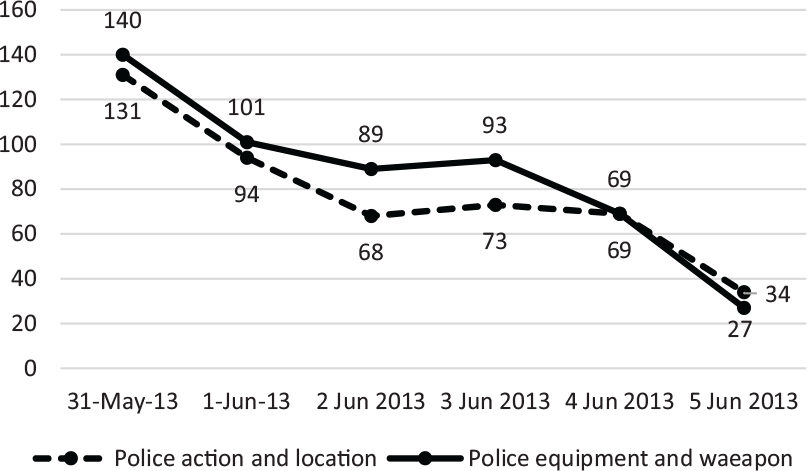
Police Action and Location/Police Equipment and Weapon.
Some of the criticism about using excessive force was directed at the government since the police operate under the jurisdiction of the Ministry of Interior in Turkey, as well as criticism of government’s authoritarian policies and practices. Results showed that during the first 3 days of the recorded dataset, criticism against police was numerically higher than criticism against the government (see Figure 3). During the last 3 days of the events, Twitter activity showed more criticism against the government than the police with a large increase in the amount of criticism against the government recorded on 3rd and 4th of June. Public speeches by the Prime Minister and the Deputy Prime Minister on those 2 days seemed to have caused the increase in the number of criticisms posted against the government.
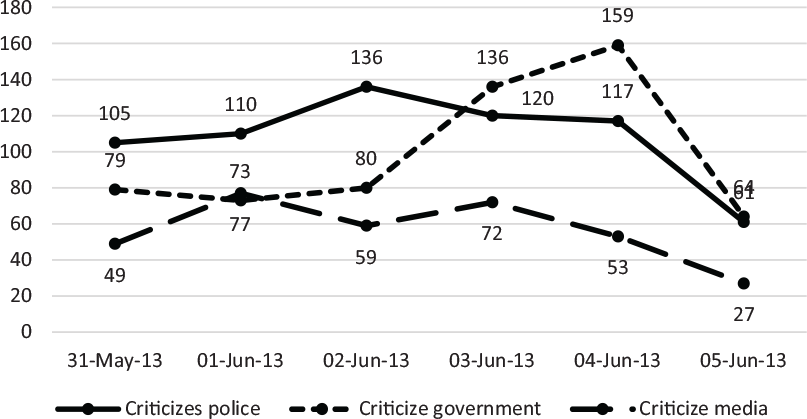
Tweets criticizing police, the government, or the media.
Keeping the peace
After the demonstrations, which first began as an environmentalist sit-in, the events turned into a nationwide anti-governmental protest, and some “extremist” groups joined the protests. Our analysis showed that users employed Twitter to warn the protesters about any possible violent groups and provocateurs. There were a very small number of tweets aimed at preventing vandalism or criticized provocateurs on the first day since “extremist” elements were not prominent at the beginning of the protests (see Figure 4). However, in the following days, there were significant amounts of Tweets posted to prevent vandalism and to increase awareness against provokers. Many users believed that violent groups hurt their cause and endangered their right to peaceful protests, and they posted tweets aimed at keeping peaceful protesters away from violent groups. They warned others not to be lured by the bait of the provokers. One user posted the following message:
3 June 2013, Those who vandalize are not resisters,
4
but provokers. Don’t be deceived. (#direngeziparkı)
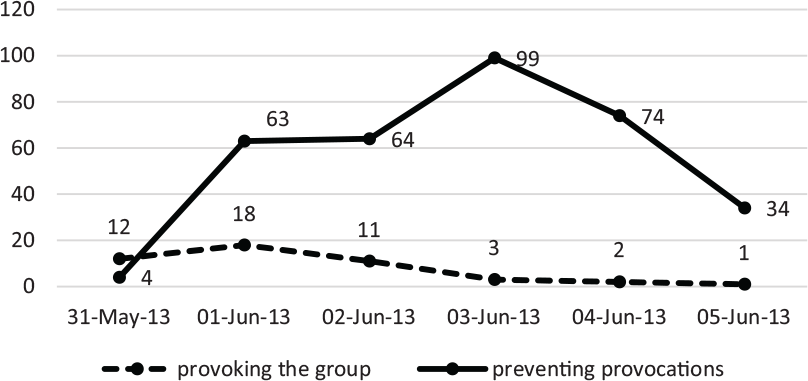
Preventing vandalism versus provoking the group.
Although the main location of the protests was Gezi Park, located in Taksim Square, some groups conducted protests outside of the protest area. Some of these groups even attempted to occupy the Prime Minister’s office in Dolmabahce. Needless to say, their attempt was not welcomed by law enforcement agencies, and harsh policing measures prevented the protesters from achieving their ends. The mainstream group did not support that attempt and criticized those “marginal” groups for fighting with police forces. Protesters used Twitter to calm the activists down and keep them in the Park. One user encouraged others to stay in the Park:
5 June 2013, Please just sit in the park, and enjoy the events. Our goal is to protest, not to fight with the police. Don’t take the bait of the provokers. (#direngeziparkı)
When violent groups participated in the protests and mixed with protesters, some caring protesters used Twitter to make people aware of the violent groups. A user warned others that provocateurs were already in Gumussuyu, and called on those protesters to turn back to Taksim:
4 June 2013, It is loud and clear that there are lots of provokers in Gumussuyu. Don’t stick around with them, and make your friends aware of them. Come here to Taksim! (#direngeziparkı)
The content analysis of the tweets showed that protesters succeeded in undermining the influence of violent groups over the protesters through Twitter. The hashtag #direngeziparkı was used as a social control mechanism that played a key role in shaping the behavior of the protesters. Positive and responsible posts helped protesters to refrain from becoming agitated and engaging in violent acts:
3 June 2013, We are having fun in Taksim tonight rather than clashing with police in Besiktas.
5
This is due to the success of Twitter.
Our content analysis also revealed that there were a very small number of tweets each day posted to entice the protesters to commit illegal actions, such as attacking police forces, and rendering police vehicles or equipment non-operational (see Figure 4). The low numbers of these may indicate that the users were generally not from violent groups.
Figure 5 indicated that a small number of tweets include hate speech and insults against the police. The largest volume of such tweets was on 31 May, as users reacted against the use of excessive force by the police to force them to leave the park. However, such tweets were very small in number. On the other hand, another small number of tweets included notes of empathy or appreciation toward the police. The number of those tweets was very small compared with the number of tweets that negatively criticized the police.
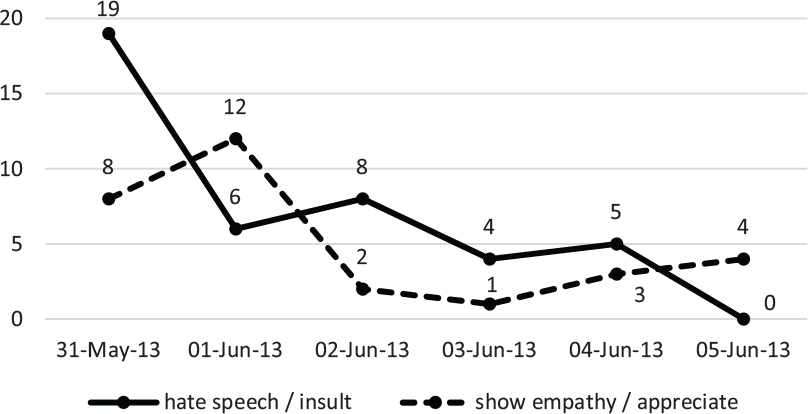
Hate speech/insult versus empathy/appreciation toward the police.
Conclusion and discussion
Twitter was used heavily and strategically by activists and participants in the Gezi Park protests. Their use of Twitter likely served to shape the contour and textures of the protest movement. Social media, namely Twitter, was used widely for the first time in Turkey effectively by activists in the Gezi Park protests. As described by emergent norm theory, use of Twitter formed and influenced new collective actions as events proceeded. The research results show that Twitter users posted messages during the protests (1) to organize the events, (2) to mobilize protesters and resources, (3) to disseminate information about the protests, protesters and police forces, (4) to create networks for cooperation, (5) to address the needs of protesters, and (6) to prevent provocations. Twitter played a significant role in keeping the demonstration in Istanbul peaceful by spreading the messages and increasing awareness of provokers and violent groups to keep the protests peaceful.
The 2013 anti-government protest series was a leaderless movement which brought people together from diverse backgrounds and walks of life. There were no individuals or groups that led the protesters, and collective action against government overreach took place as a grassroots movement without anyone or any group playing a leadership role. The mobilization and diverse cultural insights were the prominent motivation for individuals as it is described by social movement theory literature. The protests, however, were surprisingly well organized, which speaks to the effective use of social media for purposes of mobilizing people in a short amount of time. The content analysis of the tweets posted during the heydays of the demonstrations shows that the protesters mobilized hundreds, and even sometimes thousands of people, to gather for a demonstration within just a few hours. Similarly, the groups easily mobilized in response to the action and location of the police forces by sharing information about the police through Twitter. Such information sharing capabilities could be credited for helping the activists to keep control over the peaceful nature of their protests and organize accordingly.
The study demonstrates the deliberate use of Twitter by activists as a communication platform to counter mainstream media’s control over information flows. Similar to previous research on the utilization of SNSs, the Gezi Park protestors sought to counter traditional media’s narratives about the protesters. Traditional mass media usually favor status-quo since existing power structures provide material benefits for such media outlets (Rasul & Asim, 2014), and, in authoritarian countries, traditional mass media tend to negatively portray political protests. As Hamdy and Gomaa’s (2012) research indicate, coverage of protests in Egypt by government-controlled newspapers focused on the economic consequences of the protests, blamed the demonstrators for allegedly harming the economy, and depicted the popular protests as a foreign conspiracy. In a similar fashion, government-controlled media outlets in Turkey also ignored covering the democratic demands of protestors, and highlighted the violent encounters between police and the demonstrators and negatively portrayed the protests (Oz, 2016). For these reasons, SNSs constitute alternative tools for protestors to bypass authoritarian controls on information flows, challenge traditional media dominant narratives, and disseminate their messages.
Twitter also created a shared sense of identity and belonging among the protesters in the fight against what they perceived as injustice. During the events, protesters used Twitter to express their opinions about the policing of the protests, the reaction of the government, and the attitudes of mainstream media. Twitter users criticized the police, the government, and the media for what they perceive as injustice. They mostly criticized the police for harsh policing tactics and strategies. When users from a location started criticizing the police for their wrongdoings, users in another location reacted as if they were the subject of those wrongdoings. The users were aware that the police could not act independently from the government. They also criticized the government for enabling police repression although criticism of the government seemed to be fuelled by the speeches of Turkish politicians who railed against the protests and protesters.
Twitter was not only used to mobilize protesters but also to mobilize resources. Users created a kind of solidarity network through Twitter that identified protesters in need and also people willing to help. Effective and timely procurement and distribution of foods, equipment, and supplies to those protesters who did not leave the protest area and spent the nights there helped the protests to proceed continuously. Despite these interesting findings, we acknowledge some limitations of the present research. First, the data collection was limited to early stages of the protests. Second, we collected data posted with a specific hashtag for practical reasons. Although this hashtag was the most widely used hashtag during the events, it was not the only one. In future studies, other data analysis methods such as network analysis, profile examinations, and geographical information can be utilized to further understand the role of Twitter during the protests.
The findings shed more light on online activism and the use of social media to prop up social movements. Social movement theories have implied that one reason for failure in mass protests is the tendency toward groups collapsing into a conflict of interests over time, which was also shown in the Gezi Park protests. The tweets analyzed within this research reveal that after the engagement of extremists groups and provocateurs in the protests, fractions built up within the demonstrators in terms of judging the demolition of public goods and the use of explosive materials against the police. As a result of the vandalism caused by some extremists among the protesters, public perception about the protests may have been changed. Once public opinion was positive about saving the trees in Gezi Park and standing up to the government’s unjust decision about the construction in Taksim, it dramatically changed in the face of vandalism against the public goods and police vehicles over time. A majority of the protesters posted tweets to try keeping the demonstrations peaceful and being careful against countering the groups who tended toward vandalism. Some demonstrators posted pictures of these provokers condemning their actions and advised others not to support them. Finally, Twitter users achieved their goal of keeping the protests peaceful by eliminating and identifying the extremist groups as much as possible. The majority of the demonstrators did not support the extremists and tried to set goals at the beginning of the protests, such as saving the trees in Gezi Park and stopping the construction in Taksim Square. For these reasons, we conclude, Twitter and social media platforms wield a significant power in sustaining social movements and collective action by keeping protests peaceful.
Footnotes
Author’s note
Mehmet F Bastug is now affiliated with The University of Scranton, USA.

Notes
Author biographies
He is teaching and researching on User Experience Research and User Experience Design at the NIU.