




Abstract
Some scholars have argued that the rise of digital media and a “high-choice media environment” have facilitated selective exposure and led to opinion polarization among the public. Others, in contrast, argued that digital media facilitate incidental exposure to news, connections with weak ties, and the building of heterogeneous networks. This article contends that the polarizing influence of digital media is not always materialized. Rather, the immediate political context matters, and polarization effects of digital media are particularly likely to arise in times of heightened political conflicts. This article analyzes survey data derived before and during the recent Umbrella Movement in Hong Kong. The results show that political communication via social media was significantly related to extremity of political attitudes only during, but not before, the Umbrella Movement. The polarization influence is applicable to both people with and without a clear political orientation. Interpersonal discussion and news exposure also had polarizing effects on public opinion during the Umbrella Movement, suggesting that polarization effect is not unique to social media when the political context itself is polarizing.
Keywords
Introduction
The advancement of new media technologies over the past three decades has led to the proliferation of media channels and thus the formation of a high-choice media environment (Bennett & Iyengar, 2008; Prior, 2007). With the rise of digital and social media, people’s information environment is further individualized through the construction of online social networks (Rainie & Wellman, 2011). Against such developments, one major concern for political communication scholars is whether selective exposure and the principle of homophily would predominate, leading to the formation of “echo chambers” or “cyberbalkans” (Sunstein, 2002, 2009) in which people are exposed only to information favorable to one’s side. To the extent that people stop hearing the other side, democratic deliberation can be disrupted (Mutz, 2006). A more polarized public would emerge.
Extant empirical findings about the connection between online political communication and opinion polarization are mixed, however (Prior, 2013). Studies on online selective exposure (e.g. Iyengar & Hahn, 2009) are counterbalanced by studies on accidental or inadvertent exposure (e.g. Brundidge, 2010); research showing the extent of homophily in social media networks (e.g. Colleoni, Rozza, & Adam, 2014; Levi, 2012) also appears alongside research showing the positive relationship between social media use and network diversity (e.g. Kim, Hsu, & Gil de Zuniga, 2013).
This article aims at contributing to the literature by emphasizing the significance of the immediate political context in shaping whether digital media communications would lead to opinion polarization. Focusing on social media in particular, this article contends that the polarization potential of social media is not always realized to the same extent. Polarization effects arise mainly and particularly conspicuously when the society as a whole is already moving toward polarization within a context of heightened political conflicts.
Specifically, this article examines the implications of social-media-based political communication in the case of the Umbrella Movement in Hong Kong in late 2014. During the 79-day occupation movement, there was much societal discussion about a polarizing public and how digital media may contribute to polarization. There were also talks about people “unfriending” each other on social media due to clashing views about the movement. The Umbrella Movement, in other words, can be seen as a “polarizing context.” Drawing upon data from representative surveys, this article will examine how social media use relates to opinion polarization both before and during the movement.
Digital media, opinion polarization, and polarizing context
Concerns about audience fragmentation and the dissolution of the mass audience can be dated back to the early 1990s (Katz, 1996; Neuman, 1991). Channel proliferation was driven first by the growth of cable and satellite television, and then by the Internet and mobile technologies. As the number of media outlets grows, there is an increasing need for media outlets to differentiate among themselves by “going niche” (Bennett & Iyengar, 2008). When the offering of public affairs content is concerned, going niche is often accomplished by the abandonment of neutrality and the uptake of a clear political stance. Channel proliferation is therefore accompanied by the rise of opinionated programs and contents (Baum & Groeling, 2008; Feldman, 2011; Jamieson & Cappella, 2008).
The high-choice media environment filled with opinionated media makes it easier for citizens to exercise selective exposure. Various studies in recent years have reconfirmed people’s tendency to consume information and messages that would reinforce and/or defend their existing worldviews (e.g. Iyengar & Hahn, 2009; Muddiman, Stroud, & McCombs, 2014; Stroud, 2010). Furthermore, Holbert and Benoit (2009) showed that people’s consumptions of various media outlets are interconnected. Usage of a media outlet exhibiting a certain political predilection is positively related to usage of other media outlets exhibiting the same political predilection. In other words, many people apparently prefer staying in an echo chamber constituted by consonant media sources.
The preference for consonance exists also in interpersonal political discussions, as people tend to talk to like-minded others more frequently (Huckfeldt, Johnson, & Sprague, 2004). This also becomes the basis for the expectation of a generally high degree of homophily in the online arena (e.g. Colleoni et al., 2014; Suhay, Blackwell, Roche, & Bruggeman, 2014). Combined together, some scholars thus believe that polarization would be the overall result of online political communication (Sunstein, 2002, 2009).
However, the opinion polarization thesis was subjected to various challenges. Some scholars question the extent to which the online audience is fragmented into non-overlapping groups (Webster & Ksiazek, 2012). Some do not see selective exposure as overwhelmingly strong. While people may indeed prefer like-minded messages, they do not necessarily avoid counter-attitudinal messages (Garrett, 2009). Moreover, people can be inadvertently exposed to political information online (Kim, Chen, & Gil de Zuniga, 2013; Tewksbury, Weaver, & Maddex, 2001). As Brundidge (2010) explicated, inadvertent exposure can prevail in the online environment because of imperfect selective exposure strategies, non-avoidance of counter-attitudinal information, and the blurred boundaries and ease of movement between information sources in cyberspace. As a result, people’s online information diet can be much more heterogeneous than what the notion of echo chamber suggests.
Similarly, a preference for talking to like-minded others does not entail the lack of disagreement in interpersonal networks, largely because political views are seldom the most important bases for choosing friends, partners, and working environment (Huckfeldt et al., 2004; F. L. F. Lee, 2005). Social media, in particular, may facilitate exposure to divergent views because it is useful for building and maintaining large number of weak ties. Several studies have empirically demonstrated the linkage between discussion network heterogeneity and social media use (Hampton, Lee, & Her, 2011; kim, Hsu & Gil de Zuniga (2013); J. K. Lee, Choi, Kim, & Kim, 2014).
Furthermore, Messing and Westwood (2014) suggested that social media “socialize” the distribution and communication of public affairs information by facilitating the endorsement of information. When compared to source cue, endorsement cue is likely to be regarded by users as more informative about the quality of the shared content. Messing and Westwood’s (2014) experiments show that the presence of endorsement indeed renders source cue ineffective. The implication is that selective exposure based on pre-existing attitudes can be weakened in the social media arena.
Nevertheless, whether people would be exposed to a homogeneous or heterogeneous information diet online is only part of the story. Whether polarization would occur also depends on how people process the information at hand. Political communication researchers have provided ample evidence for motivated reasoning—the tendency for people to process information in ways to reconfirm their existing views (e.g. Gelpi, Roselle, & Barnett, 2013; Hart & Nisbet, 2012; Meirick, 2012). More directly pertinent to this study, J. K. Lee et al. (2014) found that network heterogeneity is associated with higher degrees of polarization among people who discuss politics frequently. They argued that biased information processing could be at work: the politically engaged people processed the discordant views in ways that reinforced their existing opinions. The findings from J. K. Lee et al. (2014) thus suggest that polarization may nonetheless occur even when people are exposed to a heterogeneous online information environment.
The mixed findings and arguments imply that, although social media may be seen as having the affordance to generate polarization, this “polarizing potential” of social media communication is not always realized. Hence, it would be useful to discern the conditions under which digital media may or may not polarize public opinion. For example, Harris, Morgan, and Gibbs (2014) examined the comments posted to online news articles published by a Utah newspaper and found that the comments tended to become, overall speaking, more moderate on the issue of immigration over time. As the authors argued, a trend toward moderation is more probable mainly when the issues are non-divisive. On such issues, people are less likely to engage in biased information search and processing. Accuracy goals may become more important than directional goals driving people’s reasoning. Meanwhile, Leeper (2014) showed that, in a high-choice environment, exposure to information would lead to polarization mainly among people with strong attitudes, and the driving force behind polarization is how these people evaluate the information rather than how they search for information. As Leeper (2014) puts it, “the strength of the public’s opinions appears to affect polarization far more than the information they choose or happen to receive” (p. 44).
Taking the cues from Leeper (2014) and Harris et al. (2014), this study ventures the argument that the polarizing effects of digital media communication tend to arise more conspicuously when a divisive issue becomes highly salient, producing an immediate context that is itself polarizing. The context is polarizing because of several reasons. First, when a divisive issue becomes highly salient, political elites would also take up the issue and send out signals regarding their positions. Citizens thus gain information about the supposed connections between their partisanship or ideological stances and the issue at hand (Haider-Market & Joslyn, 2013). This allows citizens to “line-up” on competing sides. Second, prominent debates about divisive issues in the media are likely to be accompanied by the rise of incivility in media discourses. Uncivil discourses are likely to be taken up by at least part of the public (Gervais, 2014), leading to heightened levels of incivility in public discourses in general, making the debates even more divisive.
Third, when an issue becomes highly prominent, people are likely to attach higher levels of importance to it and hence become more motivated to defend their own position on the matter. People are therefore more likely to engage in motivated reasoning and biased information processing (Leeper, 2014). Fourth, when a political issue receives substantial media attention and attains high levels of currency, political discussions may arise among acquaintances and friends who otherwise seldom talk about politics with each other. Hidden conflicts in values may become visible, and restructuring of social relationships may result (Baldassarri & Bearman, 2007; McVeigh, Cunningham, & Farrell, 2014).
In such a context, political communication via social media is likely to strengthen the tendency of polarization simply because it provides the platform for people to express themselves, engage in intensive political discussions, and share information and messages that can be highly uncivil. It does not mean that everyone engaging in online political discussions in such a context would intend to engage in online flaming. But it may not be easy to stay unaffected when there are enough people lighting and fanning the flames.
Social media in the Umbrella Movement in Hong Kong
The Umbrella Movement is a 79-day occupation protest campaign waged by Hong Kong people between September and December 2014, against the Chinese and Hong Kong Special Administrative Region (SAR) government on the issue of democratic reform. The background of the movement can be briefly summarized as follows.
While democratization in Hong Kong has been slow and stagnant for years (Ma, 2007), the National People’s Congress (NPC) of China passed a resolution on 29 December 2007, including the stipulation that Hong Kong can popularly elect the Chief Executive of the SAR government in 2017. But the exact electoral procedures were to be determined through a legislation process. Pro-democracy politicians suspected that China would not allow an open popular election. They worried that the electoral procedures would be set up in a way such that only candidates China finds approvable could stand.
Against this background, Benny Tai, a law professor at the Hong Kong University, proposed in early 2013 the idea of “Occupy Central” (OC). Conceived as a civil disobedience campaign, the plan is to occupy the main roads in the financial district of Central (Tai, 2013). 1 For the democrats, OC was arguably meant to be a threat forcing the Chinese government to make concessions on the electoral framework. Yet, China was adamant that it would not be held hostage by threats of “illegal protests.” On 31 August 2014, the NPC announced a highly conservative electoral framework for the 2017 election. Most notably, it stipulated that a candidate needs to obtain support from half of the members of the nomination committee to stand in the popular vote. Since the Chinese government has tight control on the membership of the committee, the framework effectively allows China to “pre-select” the candidates.
In response, the organizers of OC announced that the planned campaign would go ahead. After a week of university class boycotts and two days of student protests in front of the government headquarters, the proponents of OC announced the beginning of the action in the early morning hours of 28 September. Tens of thousands of citizens went to the government headquarters to support the occupiers. In early evening of the day, the police fired tear gas into the protesting crowd. The action not only failed to disperse the crowd; the live broadcast images of tear gas generated “mediated instant grievances” among the public (Tang, 2015), leading more people to go out. Within 24 hours, occupation spread to other districts. OC thus evolved into a form unanticipated by its original proponents. The international media labeled the protests the “Umbrella Revolution” based on images of protesters using umbrellas to protect themselves against the police’s pepper spray and tear gas. Local activists adjusted the term to Umbrella Movement, emphasizing that the protests did not aim at overthrowing the regime. This article also uses the term Umbrella Movement to refer to the whole protest.
University-conducted polls show that about 20% of the local public had gone to the occupied areas to support the movement. 2 Yet, there was no absolute majority in the general public supporting or opposing the movement. Polls conducted by the Chinese University of Hong Kong showed that, in October, 38% and 36% of citizens were supporting and opposing the movement, respectively. The corresponding percentages changed to 34% and 42%, respectively, in early December. 3 Against the background of a split-public, there was much social discussion about people having heated arguments with their friends and family and people “unfriending” others on social media. A protest onsite survey of the Umbrella Movement participants found that nearly 30% of the respondents had “unfriended” others because of the movement (F. L. F. Lee & Chan, 2016).
The Umbrella Movement is a suitable case for analyzing social media use and opinion polarization because, similar to the recent wave of occupation movements in other countries (Bennett & Segerberg, 2013; Castells, 2012), digital media constituted an important platform and tool for mobilization (F. L. F. Lee & Chan, 2016; P. S. N. Lee, So, & Leung, 2015). More broadly, past research has demonstrated the role of the Internet and social media in facilitating protest participation in Hong Kong (e.g. Chan & Lee, 2015; F. L. F. Lee, 2015a; Tang & Lee, 2013). Yet, few studies have considered seriously the fact that movement opponents can also actively engage in digital communication (Tsui, 2015), and there have not been studies about how social media shape the public opinion landscape in times of heightened social mobilization. Moreover, the fact that the movement was preceded by months of debates surrounding civil disobedience and OC (F. L. F. Lee, 2015b) allows an examination of how social media use related to attitude toward the movement both during and before the actual campaign.
The following analysis will be guided by several hypotheses and a research question. First, the characterization of the Umbrella Movement as a polarizing context leads to the following hypotheses about changes in public opinion in Hong Kong over time:
H1. Degree of opinion polarization among the Hong Kong public is higher in year 2014 when compared to preceding years.
H2. Public attitude toward the movement and the Hong Kong government has become more polarized over the course of the Umbrella Movement.
At the individual level, the polarizing effect of social media can be tested by examining the relationship between political communication via social media and extremity of attitude toward the Umbrella Movement. A positive relationship between the two would suggest an overall polarization effect of social media. Hence, the next hypothesis is stated as follows:
H3. Political communication via social media is positively related to extremity of people’s opinion toward the movement.
Although OC has been prominent in the news since early 2013, the intensity of public debates on democratic reform arguably increased over time and became particularly heightened during the actual occupation campaign in late 2014. In other words, the period before the occupation began can be considered as relatively less polarizing than the period of the actual campaign. Following the argument that the polarization effects of social media should manifest more strongly in a more polarizing context, H4 is stated as follows:
H4. The relationship between political communication via social media and opinion extremity is stronger during the Umbrella Movement than before the movement.
To establish the generality and robustness of social media’s polarizing effects during the Umbrella Movement, the analysis also examines whether social media communication related to extremity of people’s attitudes toward the targets of the movement. Specifically, the survey to be analyzed contains questions on people’s trust in several institutions: the Hong Kong police, the SAR government, and the Chinese government. Hence, H5 is set up:
H5. Political communication via social media is positively related to extremity of people’s level of trust toward the police and the government.
Finally, the analysis will examine whether the polarizing effect of social media use would vary across individuals. Specifically, people with clear political orientations—either pro-democracy or pro-government/pro-establishment in the context of Hong Kong—are more likely than those without clear political orientations (i.e. supporters of neither side of the main political divide) to exercise selective exposure and motivated reasoning. Hence, the polarizing effects of social media may be more prominent among the former group. Nevertheless, heated debates in a fragmented social media environment may compel even people without strong orientations to take sides. That is, in a polarizing context, people may still find themselves located within mainly pro- or anti-movement communication enclaves even without the intentional exercise of selective exposure. In this case, the polarizing effects of social media would be applicable to all. Hence, a research question is stated as follows:
Q1. Does the relationship between attitude extremity and political communication via social media vary between people with and without clear political orientations?
Data and method
Data used to tackle H1 and H2 were derived from publicly available poll results and discussed in the analysis section. Data used to tackle the other hypotheses and Q1 came from two surveys conducted in April 2013 and October 2014, respectively, that is, 3 months after Tai’s (2013) article about OC and right after the Umbrella Movement began. Both surveys were conducted by the Center for Communication and Public Opinion Survey at the Chinese University of Hong Kong and adopted the same sampling procedures. All telephone numbers from the 2005, 2007, and 2009 residential landline directories were compiled and had their last two digits removed. The full set of 100 double-digit figures from 00 to 99 was added back to the numbers in order to include non-listed numbers. Specific numbers were randomly selected by computer during the survey. The most recent birthday rule was followed to select the target respondent from a household. The target population was Cantonese speaking Hong Kong residents aged 18 years or above in the 2013 survey and those aged 15 years or above in the 2014 survey. The sample sizes were 814 and 802, and the response rates were 38% and 37% following American Association for Public Opinion Research’s response rate 3 (AAPOR RR3), respectively. The samples were weighted so that they match the population in age distribution, gender ratio, and educational levels. 4
Operationalization of key variables
Attitude and extremity of attitude toward OC/Umbrella Movement
The 2013 survey asked the respondents,
Recently, some people have proposed to strive for popular election of the Chief Executive in 2017 by “Occupy Central.” If the government put forward a proposal that many Hong Kong people do not accept, do you agree that one should use Occupy Central as a means to fight?
Answers were recorded by a 5-point Likert scale with 1 = “strongly disagree” to 5 = “strongly agree.” The question represents attitude toward OC (M = 2.46, SD = 1.33). Extremity of attitude toward OC was derived by folding the scale at its mid-point (M = 1.18, SD = .81). In the 2014 survey, attitude toward the movement and attitudinal extremity were similarly created based on the following question: “An occupation movement has occurred recently in Hong Kong. Do you support this occupation movement?” Answers were recorded with a 5-point Likert scale ranging from 1 = “strongly not support” to 5 = “strongly support” (attitude toward the Umbrella Movement: M = 3.06, SD = 1.47; attitude extremity: M = 1.23, SD = .81).
Social media use
In the 2013 survey, a question asked the respondents how much time they spent on “Facebook or other social networking sites” per day. Answers ranged from 1 = none at all to 5 = more than 3 hours. It represents time spent on social media and is used as a control variable (M = 1.48, SD = 1.29). Social media users were asked five follow-up questions: (1) how frequently they get public affairs or political information via social media, (2) how frequently they express views on public affairs or politics via social media, (3) how frequently they join groups related to public affairs or politics in social media, (4) whether they are connected to people from political parties, movement activists, or public affairs commentators through social media, and (5) whether they follow news about people from political parties, movement activists, or public affairs commentators through social media. Answers were registered with a 5-point scale ranging from 1 = not at all to 5 = very frequently/a lot. Answers to the five questions were averaged (α = .70) to form the index of political communication via social media, with people not using the Internet or not using social media scoring 1 on the 5-point scale (M = 1.39, SD = .59).
People’s social media use may be somewhat different during times of heightened mobilization. Therefore, three of the social media use questions in the 2014 survey—time spent, frequency of getting public affairs information, and frequency of opinion expression—were phrased as referring to “the past two to three weeks.” Other than this adjustment, the set of questions is the same as in the 2013 survey. That is, there is a single-item time spent on social media variable (M = 2.04, SD = 1.20), and a political communication via social media index was created by averaging answers to five questions (α = .70), with people not using the Internet or social media scoring 1 on the 5-point scale (M = 1.75, SD = .84).
Levels of trust and extremity of levels of trust toward the Hong Kong police, the Hong Kong government, and the Chinese government
Relevant variables are available only in the 2014 survey. Respondents were asked to indicate how much they trusted the three entities with a 0-to-10 scale (0 = absolutely not trust and 10 = absolutely trust). The three items will be used as controls in relevant analysis. Variables representing extremity of levels of trust toward the three entities were generated by folding the scale at its mid-point (extremity toward the police: M = 2.21, SD = 1.86; extremity toward the Hong Kong government: M = 2.23, SD = 1.80; extremity toward the Chinese government: M = 2.57, SD = 1.91).
Political orientation
The variable also exists only in the 2014 survey. A question asked the respondents if their political orientation leans toward the radical democrats, the moderate democrats, the centrists, the pro-establishment faction, the pro-business faction, and the pro-China faction. “The centrists” does not refer to an actual political bloc. It is only a category signifying “neutrality” between the two major political factions in Hong Kong: the democrats (the first two categories) and the pro-establishment (the last three categories). A dichotomous variable was created with 0 = “the centrists” or no valid answer (54.1%) and 1 = all others (45.9%). The variable signifies whether an individual has a clear political orientation or not.
News consumption and political discussion
In the 2013 survey, news consumption was the average of time spent per day watching TV news and reading newspaper, each measured with a 6-point scale (1 = not at all; 6 = more than an hour, r = .33, M = 3.82, SD = 1.30). News consumption was similarly measured in the 2014 survey, but the items refer to news use “in the past two to three weeks” (r = .29, M = 4.12, SD = 1.37). Political discussion was, in the 2013 survey, the average of people’s frequencies of discussing politics and public affairs with “family” and “friends,” with 1 = not at all and 4 = frequently (r = .55, M = 2.54, SD = .83). In the 2014 survey, political discussion was represented by a single item about whether the respondents had recently discussed the occupy movement with family or friends, with the answers ranging from 1 = not at all to 5 = very frequently (M = 3.11, SD = 1.17).
Other control variables include four demographics (sex, age, educational level, and family income), three dimensions of political efficacy (internal, collective, and external, each was the average of agreement with two 5-point Likert scaled statements), and past protest participation (an index created by a few items in each survey measuring respondents’ participation in a number of major protests as well as protests in general). Details of operationalization are omitted due to space limitation.
Analysis and findings
Opinion polarization before and during the Umbrella Movement
H1 and H2 predict increasing levels of political polarization in Hong Kong. Existing studies have adopted different ways to measure opinion polarization. Abramowitz and Saunders (2008), for example, created an ideological polarization index based on whether Americans consistently give liberal or conservative answers to a set of issue questions. Underlying the measure is the idea that a public is more polarized when people on the two sides of a political divide share fewer common views on specific issues. Polarization as ideological consistency is not directly pertinent to this study though. Another approach to opinion polarization, adopted by DiMaggio, Evans, and Bryson (1996), is to focus on the distribution of opinions on a question. A polarized distribution is a bimodal one with high levels of dispersion. These can be indicated by the variance and kurtosis of a distribution. Nevertheless, DiMaggio et al. (1996) did not create a single index of polarization.
This study’s approach is closer to DiMaggio et al.’s (1996), but it attempts to construct an overall index for polarization. Specifically, the study utilizes the results from the monthly polls on Hong Kong citizens’ evaluation of and trust toward the SAR government conducted by the Public Opinion Program (POP) at the Hong Kong University. 5 Both evaluation and trust were measured with a 5-point Likert scale. The polarization score is

where E1 = percentage of respondents at one extreme of the scale, and E2 = percentage of respondents at the other extreme of the scale.
The polarization score, in words, is the square-root of the product of two components: (1) the total percentage of people at the two extremes of a scale and (2) the evenness of the spread of the “extreme respondents.” These two components, when combined together, help capture the dispersion and bimodality of an opinion distribution. Each of the two components can range from 0 to 100. Hence, the polarization score, after square-rooting, also ranges from 0 to 100, with higher scores representing higher levels of polarization.
POP provided “half-year summaries” of citizens’ evaluation of and trust toward the SAR government. The formula was applied to the half-year summaries between 2003 and 2014. Figure 1 presents the trends. Hong Kong citizens’ opinion toward the Hong Kong government has indeed become more polarized over the years. The polarization score for trust toward the government fluctuated mainly between 10 and 15 between 2003 and 2005, but it reached 20 in the second half of 2012 and rose further in 2014. The polarization score for evaluation of government performance exhibited a similar trend.
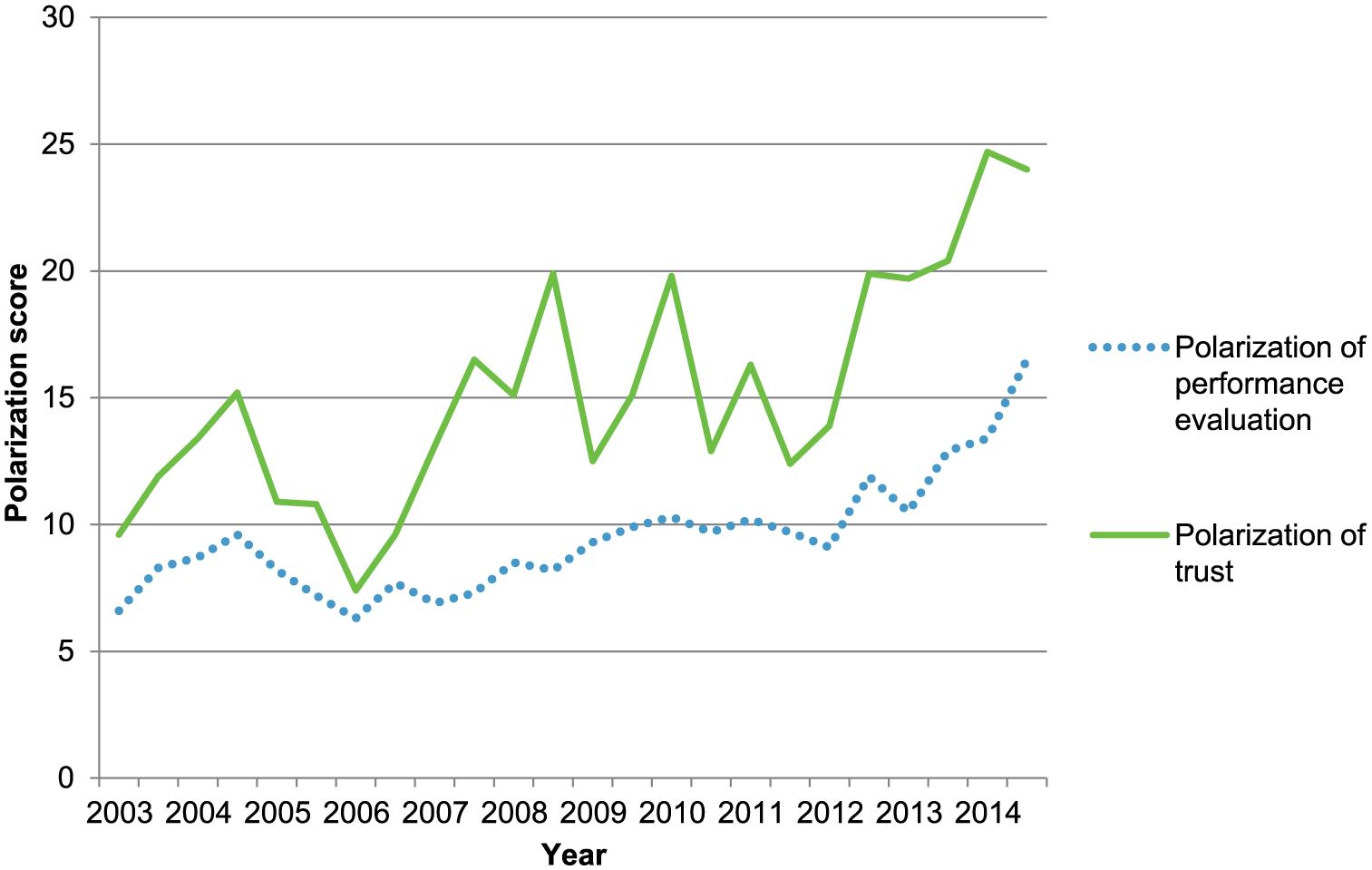
Degree of polarization of attitude toward the Hong Kong government, 2003–2014.
Statistically, there is a significant linear increase in polarization on both questions over time. A 1-to-24 “time” variable (as there are 24 data points) correlates significantly with both polarization scores (r = .79 and .74 for performance evaluation and trust, respectively, p < .001 in both cases). More directly pertinent to H1, on both questions, the average of the two polarization scores in year 2014 was significantly higher than the average of the other 22 scores from 2003 to 2013 in an independent samples t-test (t > 3.20, p < .001 in both cases). The findings thus support the hypothesis. Political polarization in Hong Kong was, historically speaking, at a high level when the Umbrella Movement occurred.
Was the public further polarized during the Umbrella Movement? Another set of polarization scores were calculated based on findings from the Center of Communication and Public Opinion Survey of the Chinese University of Hong Kong. The center conducted monthly polls about OC/the Umbrella Movement between September and December 2014. Table 1 summarizes the findings of two questions: (1) support for the movement, measured with a 5-point Likert scale, and (2) trust toward the Hong Kong government, measured with a 0-to-10 scale.
Degree of polarization during the Umbrella Movement.
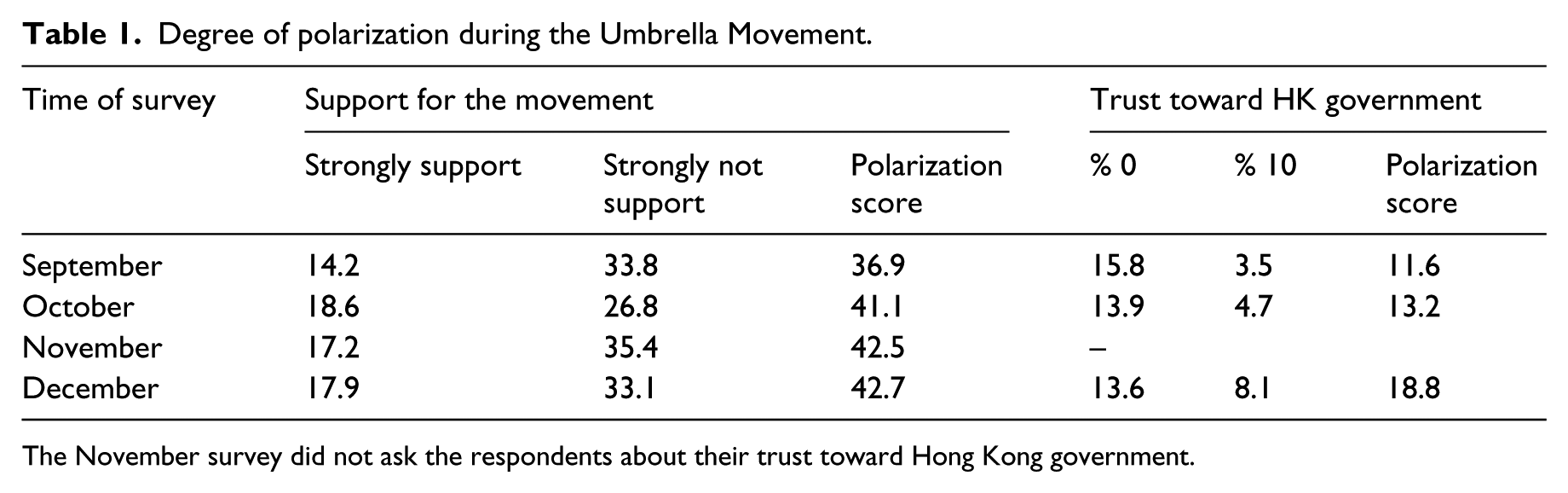
The November survey did not ask the respondents about their trust toward Hong Kong government.
The table shows that degree of polarization was on the rise on both questions throughout the movement. Polarization in attitude toward the movement rose from 36.9 in September to 42.7 in December, whereas polarization in trust toward the Hong Kong government rose from 11.6 to 18.8 in the same period. The findings are consistent with H2.
Admittedly, the increases are not substantial. But this is understandable because, as Figure 1 shows, the trend of polarization has started much earlier in Hong Kong. The limited number of data points also prevents the use of conventional tests of significance applied above. But for illustration, one may calculate the probability of the pattern of findings in Table 1. Focusing on movement support, the probability for four numbers to be rank-ordered in exactly one specific way—September the smallest, followed by October, November, and then December—is .042 (i.e. 1/4 × 1/3 × 1/2). If we focus on trust toward the government, the probability for three numbers to be rank-ordered in exactly one specific way is .167. The probability for the two sets of numbers to be rank-ordered in the expected manner simultaneously is smaller than .01. Following the probabilistic logic of hypothesis testing, we indeed have ground to claim that the findings support H2. On the whole, Figure 1 and Table 1 help establish the Umbrella Movement as a polarizing context.
Social media and extremity of attitude toward the Umbrella Movement
H3 and H4 are concerned with whether social media use relates to extremity of attitude toward the Umbrella Movement at the individual level. Multiple regression analysis was conducted to examine the hypotheses. Besides the controls and social media use, attitude toward the movement was also included as a control (because extremity of attitude would be conflated with attitude itself when the distribution on the attitude variable is lop-sided).
The first two columns of Table 2 summarize the results for the 2013 and 2014 surveys, respectively. The findings show that older people, people with higher levels of internal efficacy, and people who have participated in past protests more frequently tended to hold more extreme attitude toward the movement in both surveys. Political communication via social media obtains a positive coefficient in both columns. But the relationship is statistically significant only in the 2014 survey. In other words, there are strong evidences for the polarizing influence of political communication via social media only during the Umbrella Movement. Nevertheless, this study cannot provide a formal test of H4 because of various minor differences between the two surveys in the operationalization of political communication via social media and some of the control variables. Therefore, strictly speaking only H3 is supported. Yet, the findings are consistent with H4.
Predicting extremity of attitude toward the Umbrella Movement.
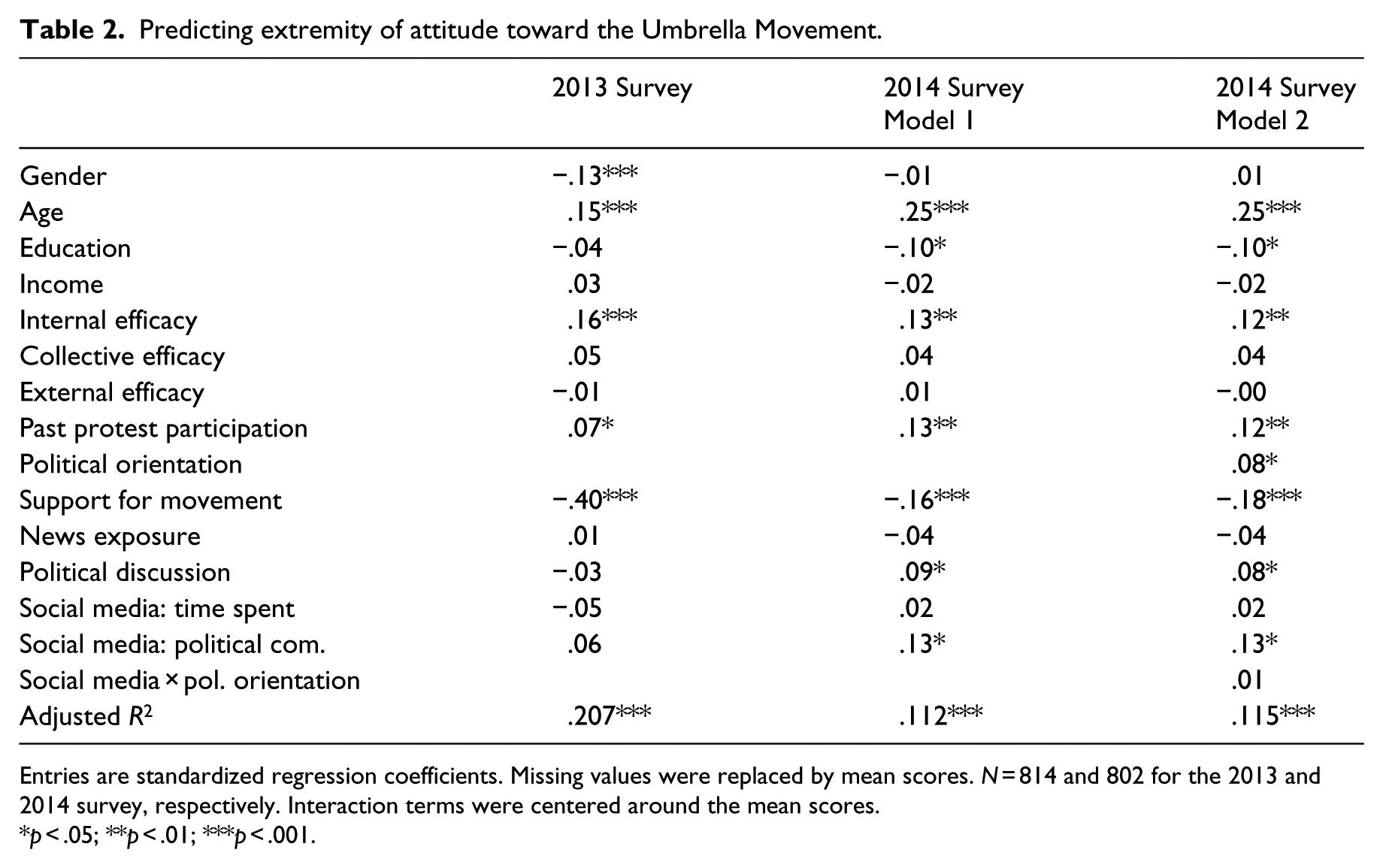
Entries are standardized regression coefficients. Missing values were replaced by mean scores. N = 814 and 802 for the 2013 and 2014 survey, respectively. Interaction terms were centered around the mean scores.
p < .05; **p < .01; ***p < .001.
Notably, time spent on social media does not relate to attitude extremity. In line with extant research, sheer time spent with social media has little impact on political opinions and behavior because people can use social media for a wide variety of purposes (Tang & Lee, 2013). More interestingly, in the 2014 survey, political discussion is also positively and significantly related to extremity of attitude toward the movement. This is consistent with the argument that political communication activities can become polarizing within a context of heightened political conflicts. In April 2013, interpersonal discussion is not significantly related to attitude extremity. The coefficient is even negative in sign.
Q1 asks whether the relationship between social media and attitude extremity would vary depending on whether people have a clear political orientation or not. We can only examine this research question with the 2014 survey. The third column shows the results of the regression model with the addition of political orientation and the interaction between political orientation and political communication via social media. The addition of the two variables does not alter the performance of other variables. Political orientation itself is positively and significantly related to the dependent variable. Understandably, people with a clear political orientation were more likely to locate themselves at the two extremes of the bi-polar attitudinal scales. But with the non-significant interaction, we cannot say that people with a clear political orientation engaged in more polarizing communication or their communication activities tended to produce more extreme attitudes.
Social media and extremity of attitude toward the police and the government
H5 predicts political communication via social media to relate to extremity of people’s attitude toward the police and the Hong Kong and Chinese government. The Hong Kong and Chinese government were the “targets” of the movement, whereas the police’s handling of protesters was highly controversial. If political communication via social media could lead to more polarized attitude toward the Umbrella Movement, it should also lead to more polarized attitudes toward the police and the government.
Taking the three extremity of trust variables as the dependent variables, multiple regression models were estimated. The predictors included the same as those in the third column of Table 2, that is, model 2 on extremity toward the movement for the 2014 survey. The results are summarized in Table 3. Political communication via social media is positively related to all three dependent variables although the coefficient fails to achieve statistical significance in the case of extremity of trust toward the Chinese government. But on the whole, the findings provide evidence about the robustness and generality of the polarizing effects of political communication via social media during the Umbrella Movement.
Predicting extremity of trust toward the police and the government.
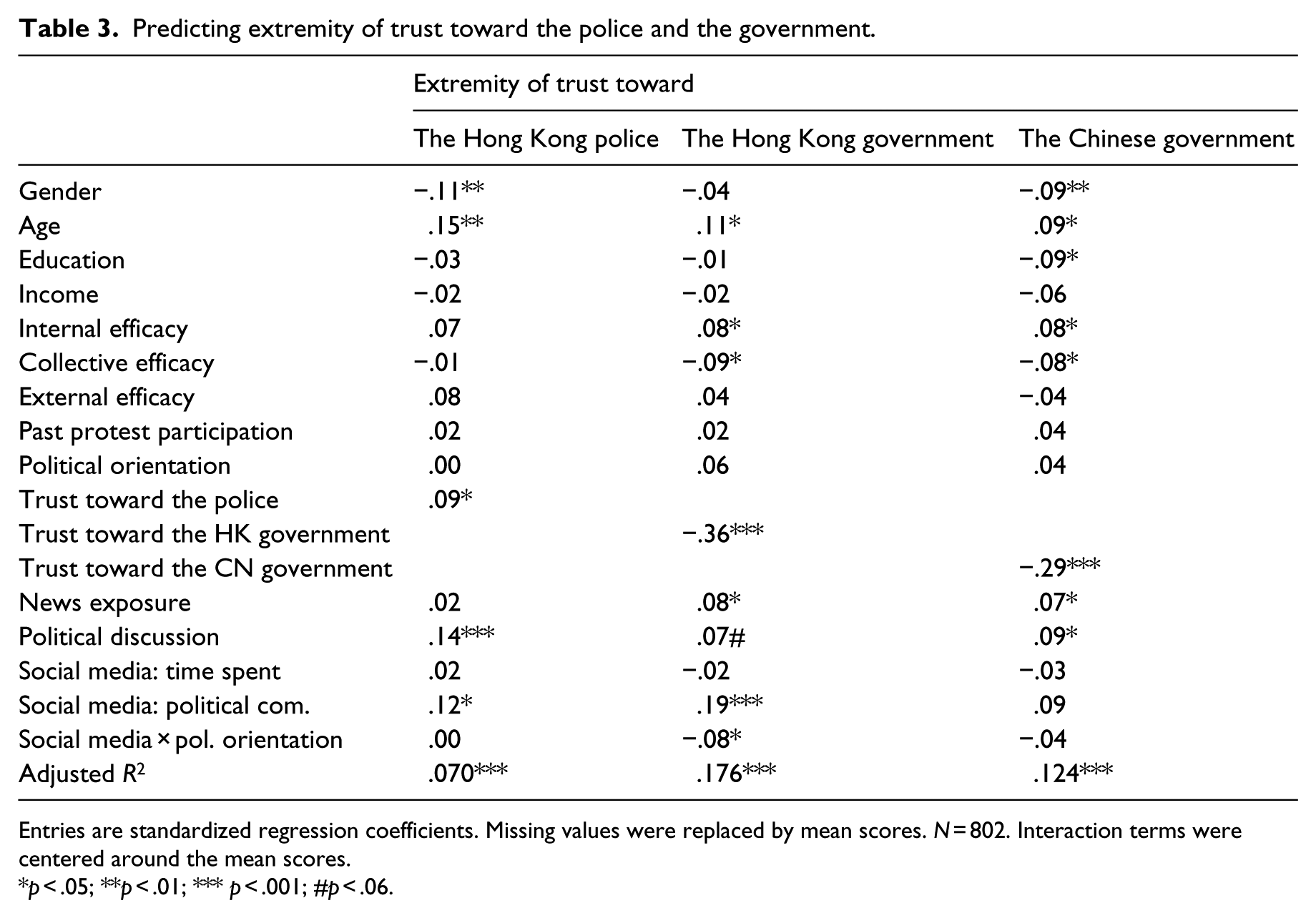
Entries are standardized regression coefficients. Missing values were replaced by mean scores. N = 802. Interaction terms were centered around the mean scores.
p < .05; **p < .01; *** p < .001; #p < .06.
Similar to Table 2, sheer time spent on social media does not relate to the dependent variables, while political discussion is positively related to all three dependent variables. In other words, political discussion is also consistently related to more extreme attitudes toward the movement and more extreme levels of trust toward the police and the government. More interestingly, mainstream news media exposure is also statistically significantly related to extremity of trust toward the Hong Kong and Chinese government. Combined together, the findings in Tables 2 and 3 suggest that, within the polarizing context of the Umbrella Movement, almost all kinds of political communication activities could be associated with more polarized political attitudes although the polarizing influences of interpersonal discussion and political communication via social media were relatively more consistent and robust.
Only one of the three coefficients for the interaction term is statistically significant, and the pattern is contrary to expectation. Further calculations based on the regression formula show that, among people without a clear political orientation, the predicted score on the dependent variable—extremity of trust toward the Hong Kong government—increases from 1.81 to 4.06 when level of social media political communication rises from the lowest to the highest point of the scale. Among people with a clear political orientation, the corresponding increase in the predicted score on the dependent variable is only from 2.29 to 3.17. 6 In other words, political communication via social media is related to extremity of trust toward the Hong Kong government among both people with and without a clear political orientation, but the polarizing influence of social media is stronger among people without a clear political orientation. Yet overall speaking, political orientation does not consistently moderate the polarizing influence of political communication via social media.
Conclusion and discussion
Analyzing survey data gathered at different moments of the Umbrella Movement in Hong Kong, this study shows that political communication via social media was indeed positively related to extremity of individuals’ attitudes toward the movement, the police force, and the Hong Kong and Chinese government. The findings thus consistently point to the polarizing influence of social media. Although there are reasons to see social media sites and the Internet in general as capable of facilitating opinion polarization (Bennett & Iyengar, 2008; Sunstein, 2009), this study does not see the polarizing influence of social media as being realized to the same extent at all times. Instead, its technological affordance may be manifested more strongly in a highly polarizing context. Hence, social media communication was expected to polarize the Hong Kong public particularly strongly in the case of the Umbrella Movement because the latter was a context of heightened political conflicts, that is, a context within which people were particularly motivated to exercise selective exposure and process information in a biased manner.
Three findings point to the importance of the immediate political context in shaping social media’s influence on public opinion. First, analysis of poll findings shows that degree of polarization of public opinion in Hong Kong has been on the rise over the years. Polarization of public opinion reached a particularly high level in 2014 and continued to rise throughout the Umbrella Movement. The trend toward polarization has to be understood in relation to increasing levels of social mobilization and counter-mobilization in the society at large (F. L. F. Lee & Chan, 2013), which is beyond the scope of this article to discuss. For this study, the findings establish the Umbrella Movement as a “polarizing context.”
Second, analysis of the April 2013 survey shows no significant relationship between political communication via social media and extremity of attitude toward the plan of OC. Although debates surrounding the proposed civil disobedience campaign have started in January 2013, the debates were relatively less salient and divisive in its earliest stages, and many citizens probably had yet to form clear and crystallized views on the topic. In other words, the findings show that political communication via social media was not inevitably polarizing in consequence in a relatively less divisive and polarizing context.
Third, the findings show that political discussion and mainstream news exposure were also related to more polarized attitudes during the occupation campaign. Such findings further strengthen the claim that the Umbrella Movement is a polarizing context and suggest that, within such a context, various kinds of political communication may all result in polarization. In other words, the relationship between political communication via social media and opinion polarization is not unique to social media. It is particularly noteworthy that both interpersonal discussion and social media communication are consistently related to extremity of several political attitudes. Social media are after all platforms for people to communicate with their friends and acquaintances. When political talk in general becomes polarizing, it is unsurprising to see social media communication to also become polarizing. These findings also suggest that, in a highly polarizing context, the technological affordance of social media is not necessarily crucial to understanding its polarizing effects.
Several limitations of the analysis need to be acknowledged. First, the comparison between the 2013 and 2014 survey results is informal. Hence, there was no formal statistical test for the hypothesis that social media communication is more polarizing during than before the movement. Besides, the analysis cannot ascertain if political communication via social media was associated with extremity of trust toward the police and the government in 2013. The problem of data availability is rooted in the fact that one could not have predicted the timing and scale of the Umbrella Movement beforehand. The set of analysis conducted in this article was not planned. But these caveats only affect claims about the contrast between the two surveys and their respective immediate contexts. They do not affect arguments about what happened during the Umbrella Movement.
Second, the cross-sectional surveys do not allow the demonstration of causality. One may wonder whether the relationship between political communication via social media and attitudinal extremity was the result of people with more extreme attitudes engaging in political communication more actively during times of heightened conflicts. This study cannot rule out the latter possibility. But if attitude extremity does drive people to talk to each other face-to-face and/or via social media, it would still imply that interpersonal and social media discussions are filled with or even dominated by discourses proffered by people holding more extreme attitudes. It would still imply that social media are likely to become platforms for the communication of polarizing discourses in times of heightened conflicts. And it is unlikely that the polarizing discourses would not have any impact on people exposed to or participating in it. Hence, the more probable scenario is that political communication and attitude extremity reinforce each other within a polarizing context.
Third, the analysis only demonstrates the overall relationship between attitude extremity and social media communication without probing into the mechanisms of polarization. Research about the polarizing influence of opinionated media or the Internet typically focus on the characteristics of the information environment (Bennett & Iyengar, 2008), people’s information selection behavior (Brundidge, 2010; Messing & Westwood, 2014), or people’s information processing strategies (Leeper, 2014). This study cannot offer a test of the relative importance of these factors. But other studies about the Umbrella Movement provide findings pertinent to the issue. F. L. F. Lee and Chan (2015), for instance, found that 89.3% of the Umbrella Movement protesters were exposed to anti-occupation views from acquaintances via digital media, and 41.9% were exposed to such counter-attitudinal views frequently. These findings point to a substantial degree of exposure to counter-attitudinal messages by people during the Umbrella Movement. It implies that, similar to Leeper’s (2014) judgment, how people process information was probably more important than the characteristics of the information environment or information search strategies in the present case.
Generally speaking, this article suggests that the polarization effects of a high-choice media environment or social media in particular need to be assessed with attention paid to contextual conditions. The high-choice media environment may indeed make selective exposure easier than before, but there are counter-balancing forces, such as the phenomenon of incidental exposure, that makes the contemporary mediated information environment more complicated than just being the combination of neatly demarcated echo chambers. Moreover, selective exposure and motivated reasoning can be matters of degree. People may not exercise selective exposure and motivated reasoning all the time. There can be situations—depending on the issues being considered, the social atmosphere of the time, or other factors—in which people are driven more by the accuracy goal than by the directional goal. But there are also situations where people are particularly motivated to defend their ego. This article suggests that a high-intensity conflict may instigate motivated reasoning. More broadly, it illustrates how considerations of the immediate political context can help us make sense of the presence or absence of polarization effects of political communication activities.
Nevertheless, this study can also be considered as showing that scholars’ concern about digital media’s polarization influence is not ungrounded. While this study sees the polarizing influence of social media as subjected to contextual variations, the empirical case does show that political communication via social media can contribute to political polarization when the context itself is polarizing. While digital media should not be considered as the initiator of the trend of polarization, they can be the accomplice in the process. Hence, the demise of professional mass media may still be regarded as a problem, as the society can be losing the kind of media outlets that might help counter the trend of polarization once the latter was set in place. Future studies can further conceptualize how contexts matter and compare the polarization influence of digital media in more cases. It could help ascertain how frequently the polarizing influence of opinionated media and/or digital media would arise. This could provide a more solid basis for us to judge the overall implications of a high-choice media environment on the formation of public opinion.