




Abstract
Six years have passed since China unveiled the Belt and Road Initiative (Yidai Yilu一带一路, formally called One Belt One Road), which was initiated to reconnect China with countries in Asia, Middle East, Europe, and Africa and to improve regional cooperation through better connectivity, enhanced trade exchange, and shared opportunity. By understanding the importance of Europe as the destination of both the “Belt”—a more developed inland connectivity and the “Road”—a more enhanced sea routes network; and observing the mixed information flow of acceptance—resistance, cooperation—dispute, and agreement—disagreement in different countries along the silk road, China Media Observatory of Institute of Media and Journalism, Faculty of Communication Sciences, at Università della Svizzera Italiana (Lugano) is editing this special symposium as a collection of the papers include studies of different media narratives that shape public understanding of Belt and Road Initiative and discuss how Belt and Road Initiative and China’s vision of connecting different stakeholders for international collaborations are reported in both legacy news media and social media.
Six years have passed since China unveiled the Belt and Road Initiative (BRI; Yidai Yilu 一带一路, formally called One Belt One Road), which was initiated to reconnect China with countries in Asia, Middle East, Europe, and Africa and to improve regional cooperation through better connectivity, enhanced trade exchange, and shared opportunity. According to the Chinese official sources, between 2013 and 2018, Chinese companies have directly invested over US$90 billions in countries along BRI and completed projects of a sum turnover of more than US$400 billions (Qing & Wang, 2019). The Center of Economy and Business Research (CEBR, 2019) predicted that BRI will boost world gross domestic product (GDP) by US$7.1 trillion per annum by 2040, benefiting different regions of the world with a remarkable GDP increase: East Asia (5%), Western Europe (5%), Central Europe (6%), and Central Asia (18%).
It is said that the BRI spans over 120 countries, includes 1/3 of world trade and covers 60% of the world population (World Bank, 2018). However, such a massive project did not really enter the public sight worldwide until the first Belt and Road Forum took place in Beijing in May 2017 (see Figure 1), and the news coverages of the topic slowly faded away again, despite that the second Forum took place in Beijing in April 2019. There is also a kind of discursive complexity about the initiative, which shed lights on the different definitions, such as the following:
The BRI is an ambitious effort to improve regional cooperation and connectivity on a trans-continental scale. The initiative aims to strengthen infrastructure, trade, and investment links between China and some 65 other countries (World bank, 2018).
China’s ambitious plan for linking Asia and Europe and Africa through new massive infrastructure projects (European Parliament, 2018).
The BRI is a systematic project, which should be jointly built through consultation to meet the interests of all, and efforts should be made to integrate the development strategies of the countries along the Belt and Road (National Development and Reform Commission, 2015).
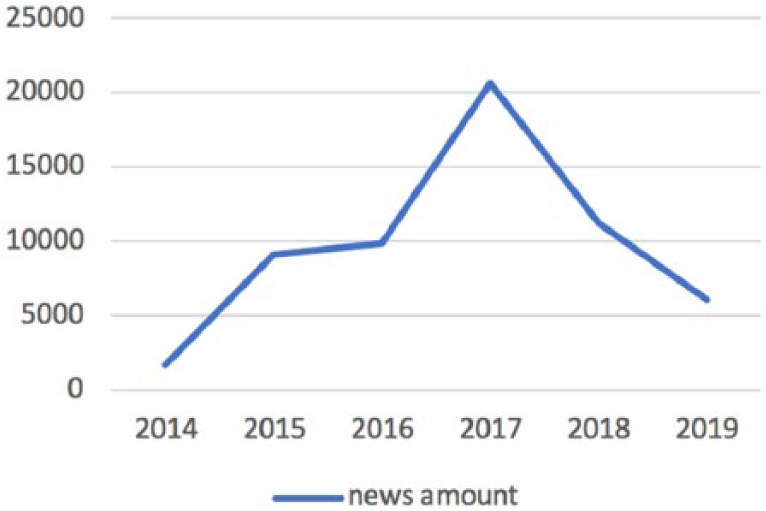
No. of news worldwide about BRI on Factiva (2014–2019).
While Beijing emphasizes on “interests of all” and “integration,” the West focuses on “China” and “ambition.” Such uncertainties of not understanding fully the inclusiveness of BRI, confuse countries that officially participate in the BRI and those that do not, in terms of different anticipation of the future collaboration with China and the future development and prosperity of Eurasia continent. This explains why when Italy announced to sign the Memorandum of Understanding on BRI cooperation as the first G-7 members in 2019, it caused significant tensions within the rest of the world, and especially within the European Union (EU).
Europe, as the destination of both the “Belt”—a more developed inland connectivity and the “Road”—a more enhanced sea routes network, has been framed into this massive initiative from the beginning. For over 140 years enchanted by the term of “silk road” (named by von Richthofen, ca. 1877), which first came into the awareness of the European public in the late 19th century, and over 700 years awareness about the far East since Marco Polo’s glorious voyage (ca. 1271–1295), BRI is not a brand-new concept to most of the Europeans. However, a general European attitude toward this initiative is still, somehow, fragmented, confused, and uncertain. The quantity of news about BRI in Europe follows the same trend as the rest of the world (see Figure 2), and the use of “New Silk Road” has been persistent despite the changes of the official Chinese discourse from “One Belt One Road” to “Belt and Road Initiative.” García-Herrero and Xu (2019) applied a big data analysis to access the global attitudes toward BRI, pointing out that EU member states are more positive about BRI comparing to non-EU countries which are direct recipients of BRI investment. However, in Zhang’s (2019, p. 248) qualitative analysis, most of the positive storytelling in Europe are generated by Russia and Eastern-Southern European countries, whereas suspicions remain high in Western European countries.
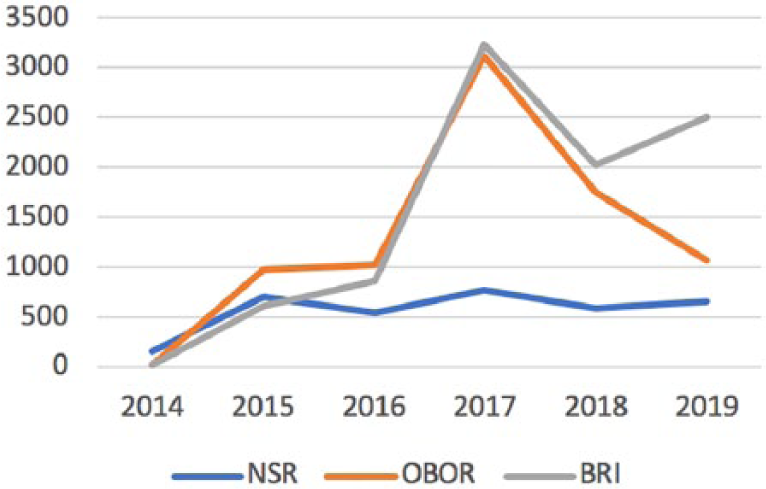
No. of news about BRI in Europe (2014–2019).
By observing the importance of Europe as the destination of BRI, and the mixed information flow of acceptance—resistance, cooperation—dispute, and agreement—disagreement in different countries along the silk road, China Media Observatory (CMO) of Institute of Media and Journalism (IMeG), Faculty of Communication Sciences, at Università della Svizzera Italiana (USI, Lugano) organized a preconference during the seventh European Communication Conference, European Communication, Research and Education and Association (ECREA) in October 2018 entitled The New Silk Road—Flow and Counterflow of Infor-mation between Europe and China. The goal of the event was bringing scholars from different European countries and China to discuss BRI and its regional and global impact.
On one hand, we wished to recall to the ancient silk road that initiated the first flow of communication and exchange in goods and culture between the Roman and Chinese empires. On the other hand, we wanted to rise discussions from the media and communication perspective to help a better mutual understanding between different European and Chinese stakeholders on different levels under the BRI framework.
The preconference indeed, gave us rewarding results. 16 scholars from China, Italy, Switzerland, Tuckey, Belgium, Spain, Romania and the United States, discussed a variety of topics on BRI mainly divided into four perspectives that are media analysis, regional/national dichotomy, conceptual genesis, and industrial. The event also benefited from Prof Yang Guobin, co-editor of Communication and the Public, who delivered a keynote talk on the role of ideologies, technologies, and strategies in the communication flow between China and the West, highlighting the crucial historical contribution of translation and consequently, why translation may serve as a viable model of communication.
Based on the successful organization of the conference, we decided to publish a collection of papers include studies of different media narratives that shape public understanding of BRI and discuss how BRI and China’s vision of connecting different stakeholders for international collaborations are reported in both legacy news media and social media. In line with the goal of Communication and the Public, we expect this special symposium to provide insights on different public discourse that include analysis of local knowledge, concerns, modes of arguments, value schemes, logics, and the like shared among ordinary people” (Hauser, 2011, p. 164). The three essays in this special symposium we finally present are a choice of the editors to go beyond the legacy news media—with a focus on Facebook, and beyond the classic Western European block—with a focus on Turkey.
The first essay from Fan Liang is a study about China’s official media’s promotion of BRI on Facebook. By collecting and examining thousands of posts of People’s Daily and Global Times relating to BRI, this study shows that China’s official media build distinct news topics and sentiments for the New Silk Road and its related countries to achieve the official goal of “spreading China’s voices” and “telling China’s stories.” Moreover, the analysis of audience engagement suggests that news topics and sentiment play different roles in encouraging Facebook users to like, share, and comment news stories about the New Silk Road. Drawing on public diplomacy, media bias, and audience engagement research,
The author suggests a new path to talk about China’s public diplomacy in the specific arena of social media, highlighting an underused method of analysis in media and communication studies (combining the dictionary-based and supervised machine learning) and approaching a topic which is academically and socially relevant. Furthermore, the analysis of BRI on Facebook is interesting for at least other three reasons: first, the fact that BRI contributed to produce more Facebook stories provided by China’s official media over time, although BRI is not highlighted in the reports by China’s news organization. Second, the stories focused on BRI countries obtained a minor coverage on China related news. This trend is surprising because one of the main goals of BRI is to create connection between China and countries involved in the BRI project. Third, Facebook users are more inclined to share positive news published on Facebook on BRI and to comment negative ones.
The second paper is contributed by Banu Dagtas, who reveals how Turkish mainstream newspaper discuss about BRI over 2 years between 2016 and 2017. By collecting news articles from nine newspapers that are pro-government, oppositional, social democratic, and liberal, the author presented a diversified picture of how Turkish press relocated BRI with respect to the country’s political, economic, and cultural attribution on globalization. Through a detailed critical discourse analysis, the paper discussed the dominant discourse from the Turkish president Erdoğan and his government as the main news actor that serves to legitimate both his authoritarian rule and his positive approach to China. Besides, a prevalence of “business discourse” is also identified in parallel to the government discourse in most of the selected news except the socialist and oppositional newspapers, and the “labor discourse” is only found from the socialist newspaper.
When we talk about Europe in a globalized network, we are often aware of a mix of different views and interests from different European countries toward international affairs, but we usually undermine the complexity within one country’s boundary. Turkey, in the case of BRI, stands out not only because of its geopolitical importance that links Central Asia, Mediterranean, and Southern Europe, but also its confusion of identity between Europe and Asia in the process of negotiating full membership to the EU for over a decade. By taking consideration of the privatization of the news industry in Turkey and the influence of neoliberalism that follows the Western “journalistic code,” this paper provided a grand view of competing narratives about BRI in this particular country that situated with a key position for the trade route between China and Europe. The overall-positive stance of the domestic media is forming a promising discursive environment that serves, both politically and economically, the goals of the Turkish government for further collaboration with China under the BRI framework.
The third contribution of this special symposium is contributed by Gokce Ozsu and Mutlu Binark, focusing on a thematic content analysis in main mainstream Turkish newspapers about China and BRI from May to July 2017. The paper aimed at understanding how Turkish press relocates BRI with respect to Turkey’s political and economic concerns about China’s alternative globalization path. Overall, the authors discussed the reasons for a limited critical press coverage on BRI and provided a critical analysis on the Turkish press by highlighting a lack of awareness on political, historical and economic importance of BRI.
Like the second paper, the third contribution also reflected to the fact how the Turkish press supports political Erdogan pragmatic vision on BRI and in general, on Sino-Turkish relationships with references to human rights issues in Xinjiang region as well as Syria, Qatar and Palestine problems. Overall, the work inspires two visions: on the one hand it helps us to understand how BRI is framed into the Turkish press, on the other hand it denounces a series of journalistic and political limitations of the Turkish press through the content analysis on BRI. The authors also demonstrated an insufficient production of BRI-related news and reports in general and suggested further future investigations about Turkey’s standpoint in joining and responding to BRI.
We realize this special symposium is with limited number of articles; however, we hope our contribution responds to what Xenos (2016) suggested in the inaugural issue of Communication and the Public that the goal of this journal is to “light a variety of unique research questions associated with areas of the word in which statehood itself is limited” (p. 10). This is why we selected two papers in Turkey as a “middle corridor” that links Asia with Europe along the new silk road, which often fell off sights of both the European and the Chinese public. This is also the reason we selected the paper on Chinese media’s promotion of BRI on Facebook, in order to elaborate the dominance of the reception-effects paradigm in communication through a solid empirical analysis and to understand “how message production reflects underlying traits and indicates actives processes” (Shah, 2016, p. 16).
Since its official announcement in September 2013, Beijing has undertaken a full range of media efforts to shape the discursive environment around BRI topics. However, from what we learned from various presentations of our preconference and reviews of different submissions to our special symposium, the European public respond differently to the crafted image of what Beijing wishes the world to see and understand BRI. Therefore, we wish this special symposium could help in developing a dialogue from at least two perspectives: first, the importance of Eastern European Mediterranean Countries, often underestimated in the BRI academic discussion as well as their forms of collaboration with Western European in exploring new markets in central Asia through (or against) the role of China; second, the importance of analyzing media reports to connect public awareness by linking different stakeholders in a larger context.
Further investigations in exploring the flows and the counter-flows of information between China and Europe should be continued both on a regional and a national level. Comparative analysis among different European media outlets should also always consider the roles play by the increasing flow of information coming from China over different legacy or social media platforms. Only by doing so, we could slowly draw a full picture of the information exchange along the new silk road, to identify media logic and the power relationship behind, as well as to discover the linkages and disconnections between messages and different targeted public. And eventually, we could contribute, as media and communication scholars, to improve mutual understanding among different public that are part of the BRI framework in a better-connected Eurasia continent.
Footnotes
Authors’ note
Gianluigi Negro is also affiliated with University of Siena, Italy.
