



Abstract
This article employs ‘critical discourse analysis’ to explore contending discourses around the ‘New Silk Road’ in Turkish newspapers. The press analysis covers the period 1 January 2016 to 31 December 2017. It includes pro-government newspapers (Sabah, Star and Takvim – liberal); oppositional newspapers (Birgün, Günlük Evrensel – socialist, Cumhuriyet – social democratic, Yeniçağ – nationalist right); one liberal newspaper (Hürriyet – non-aligned); and a semi-oppositional and Eurasianist title (Aydınlık). The dominant discourses of the newspapers sampled are mainly organized around recontextualizations of President Erdoğan’s statements on the New Silk Road and the Baku–Tbilisi–Kars railway. These discourses present the New Silk Road as promoting peace, security and prosperity (with Transport Minister’s statement of a prospective 31 trillion dollar market) and initiating a new era in relations with China. Only the socialist and oppositional newspaper Günlük Evrensel does not recontextualize Erdoğan’s statements within this framework. The oppositional/socialist Birgün and the oppositional/social democratic Cumhuriyet, however, raise some criticisms of the New Silk Road project. Erdoğan’s central position as the main news actor and the domination of his statements on the New Silk Road and the Baku–Tbilisi–Kars in the news discourse legitimate both his authoritarian rule and abuse power and his wish for rapprochement with China. The second foregrounding news discourse is the ‘business discourse’ – centred on investment, trade and market share, running in parallel to the government discourse in every newspaper analysed, except the socialist and oppositional newspapers Birgün and Günlük Evrensel. Only the socialist newspaper Birgün examines the New Silk Road from the side of labour. The Eurasianist party paper Aydınlık constructs the discourse of ‘strong defence of New Silk Road and China’.
Keywords
Introduction
The mainland of Turkey-Anatolia was an important part of the ancient ‘Silk Road’ connecting China to Europe, and now, as the ‘Trans-Caspian Corridor Line’ – or as it also known, the ‘Middle Corridor’ – it is once again a key connecting link along the ‘New Silk Road’ (NSR) complex of infrastructural projects initiated by the Chinese government, providing a bridge and crossroads between Asia and Europe.
This article explores contending discourses around the NSR in the Turkish press through an analysis of the coverage in newspapers employing the ‘critical discourse analysis’ (CDA) approach – mainly based on the works of van Dijk (1988a, 1988b, 1991, 1993, 2008, 2011). To determine the news discourses of the chosen titles, semantic analysis of the news texts is undertaken. First, the news topics and their themes are detailed, and then an analysis of the recontextualization of quotation patterns of government spokespeople is presented, followed by an analysis of lexical preferences as the rhetoric of the news.
van Dijk (2008) insists that ‘Discourse is not only analysed as an autonomous “verbal” object but also situated interaction, as a social practice, or as a type of communication in a social, cultural, historical or political situation’ (p. 3). According to van Dijk (2008), critical discourse studies (CDS) methods ‘specifically focus on the complex relations between social structure and discourse structures may vary or be influenced by social structure’. Fairclough and Wodak (1997) also make the description of the discourse parallel to van Dijk’s: ‘CDA sees discourse-language use in speech and writing-as a form of “social practice.” Describing discourse as social practice implies a dialectical relationship between a particular discursive event and situation(s), institution(s), and social structure(s), which frame it’ (p. 258).
CDS generally explores the systems and structures of ‘talk’ or ‘text’ that may depend on or vary as a function of ‘relevant social conditions of language use’ or may contribute to specific social consequences of discourse, such as ‘influencing the social belief of the audiences’ or ‘legitimation of power abuse’ (van Dijk, 2008). Specifically, CDS prefers to focus on ‘properties of discourse’ – such as the selection of specific speech acts with quotation patterns or lexical preferences – ‘that are mostly associated with the expression, confirmation, reproduction or challenge of the social power of the speaker(s) or writer(s) as members of dominant groups’ (van Dijk, 2008, p. 5).
In this study, examining the ‘legitimation of abuse power’ is particularly important since the current government, and specifically President Erdoğan, has been employing authoritarian power since 2011, together with the implementation of the neoliberal policies since 2002, leading to widening of social inequalities. At the same time, AKP governments have implemented the policies of Islamic reconfiguration of the society. In this context, securing and maintaining legitimation have to be continually worked on.
By 2018, the ratio of pro-government media had reached 95% as a result of the negative effects of the financialization period of 1983–2002 on media ownership and concentration. AKP governments had benefitted outcomes of this period by providing support for the media ownership that would be on their side, with state power and regulations. At the same time, there have been serious violations of media freedom, including the imprisonment and convictions of journalists together with the implementation of the Emergency Law, after the failed coup of 2016 and also the Turkish Penal Code.
The ‘April 16 Referendum’ (2017) 1 which instituted the ‘Turkish model’ presidency system – concentrating power in the president and reducing the power of the parliament without checks and balances – constituted a very radical change in the political system and made clear the polarization/division in politics and society. 2 It was/is not only debatable in terms of its outcome, but also in its application of the ‘Highest Election Authority’ on the day of referendum voting, which has been interpreted as an intervention of the Erdoğan and AKP government.
So, laws do not always guarantee legitimacy. Power abuse means the violation of fundamental norms and values in the interest of those in power and against the interests of others. Power abuse entails the violation of the social and civil rights of the people. In the area of discourse and communication, these rights include ‘the right to be (well) taught and educated, to be well informed, and so on’ (van Dijk, 2008, p. 19). Upholding these rights requires newspapers not to misinform or manipulate citizens but to present the full range of relevant information and viewpoints on central issues of public concern, drawing on a range of sources and not only on powerful institutions. Otherwise, they serve those who abuse power and the powerful by providing them with legitimation.
van Dijk’s (2008) argument, that ‘the illusion of freedom and diversity may be one of the best ways to produce the ideological hegemony that will be the interest of the dominant powers in society’ (p. 11), may serve as a basis for explaining legitimation in countries having relatively high degrees of media freedom. But where the pro-government media reaches a market share of 95% and many journalists are jailed as in the case of Turkey, the media begins to work as a ‘propaganda machine’ for President Erdoğan and AKP government under the name of ‘media diversity’. 3
It is against this essential political background that we need to explore and clarify the central questions posed by the aims and principles of CDA: ‘Who speaks on NSR and how?’ – Is it President Erdoğan and the AKP government as the dominant powers or journalists on behalf of the public? Do journalists confirm and reproduce the dominant discourses of Erdoğan and the AKP government and legitimate them or at least in some cases challenge them? Are Erdoğan and the AKP government the dominant forces shaping constructions of events and issues in the news texts or not? If this is the case, how far do journalists legitimate this domination by reproducing their discourses and recontextualizing their statements? Alternatively, do they challenge this domination by raising critical questions and giving space to alternative positions?
Under these main research questions, there are sub-questions: ‘Whether news reports question the capital accumulation behind the NSR and articulate the interests of labour or reproduce corporate rationales by defending the economic arguments in favour of the NSR?’ In order to explore these questions, two socialist dailies were included in the sample of newspapers chosen for analysis.
Before presenting the analysis of news discourses, however, it necessary to contextualize the debate around the NSR by briefly outlining the development of the project and Turkey’s relation to it.
The NSR: a short overview
The NSR, otherwise known as the ‘One Belt One Road’ (OBOR) project, combines an overland ‘Silk Road Economic Belt’ with ‘The 21st Century Maritime Silk Road’ to create a new trade and energy corridor linking Southeast Asia with Central Asia, the Middle East, Europe and Africa. It comprises a network of ports, roads, railways, airports, power plants, oil and gas pipelines and free trade zones.
It was first announced by the Chinese President Xi Jinping in 2013 in Kazakhstan. The total cost for China is estimated to be 900 trillion dollars with additional funding channelled through the Asian Infrastructure Investment Bank (AIIB) established by China and 57 founding member countries, including the United Kingdom, Germany, France, Italy and Australia, nations traditionally allied to the United States (McBride, 2015).
The official declaration of the NSR project announced that accomplishing the goals will require political coordination with the countries involved in the project; connectivity of facilities; infrastructure to link all sub-regions in Asia and link Asia, Europe and Africa; unrestricted trade; and financial integration through the AIIB and linking the people with cultural, academic and voluntary organizations (cited in Durdular, 2016; Akçay, 2017).
China has three immediate rationales for pursing the NSR project. The first is to boost the development of the Xinjiang region, which is in Western China and close to Central Asia. The declared aim is to counter the three perceived ‘evils’ of the region – religious extremism, separatism and terrorism – widely associated in Chinese official discourse with Islamic extremism (Brugier, 2014; Fallon, 2015; Szczudlik-Tatar, 2013). Xinjiang is currently ranked 25th among 29 provinces in development level (Brugier, 2014), with a large minority Muslim population of Uyghur Turks.
The second major rationale is to enhance China’s energy security. Ensuring regional stability is necessary to guarantee uninterrupted access to the gas and oil reserves of Central Asian countries, mainly Kazakhstan and Turkmenistan. It offsets reliance on unstable Middle East and sub-Saharan Africa suppliers and reduces its dependency on Russian energy (Brugier, 2014; Wang, 2016).
The third major rationale for the NSR is to thicken and accelerate the flow of Chinese goods into Western Europe and establish closer links to Central and Eastern Europe (Brugier, 2014; Szczudlik-Tatar, 2013). The economic ties established by shared infrastructural projects are increasingly supported by soft power initiatives to promote Chinese culture and values, represented by ‘the New Silk Road Institute Prague’ in the Czech Republic (Nobis, 2017).
Commentators have also pointed to wider geopolitical ambitions behind the NSR. Leverett and Bingbing (2016) assert that China wishes to be dominant in the Persian Gulf, while Deniz (2016) claims that China aims to establish a dominant presence across the Middle East and also in India. These ambitions are seen as central to China’s pursuit of its rivalry with Japan and the United States (Fallon, 2015) and its long-term aim of countering US influence (Leverett & Bingbing, 2016). Nobis (2017), emphasizing its pluralistic nature and its contribution towards a multipolar world and the strengthening of exchanges and mutual learning between different civilizations.
Turkey’s role in the NSR project
Improved access to mentioned markets involves both new sea and overland routes. In the new rail and road links, however, the pivotal points of entry into Europe are through Turkey, assigning it a strategic role. The new road route runs via Central Asia and Iran, through Turkey, into Europe via Venice–Rotterdam–London, in addition to the road leading to Europe via Russia.
With the Baku–Tbilisi–Kars (BTK) railway line, the Marmaray railway tunnel and the third Bridge in Istanbul/Turkey, ‘Middle Corridor’ is estimated to cut the Beijing–London transportation period from 45 to 15 days. Using this figure, this route has been promoted as an ‘uninterrupted railway between Beijing and London’ in the statements of Erdoğan and his government, a claim also endorsed by some scholars (Akbulut-Özpay, 2018; Üzümcü & Akdeniz, 2014).
The BTK project, which forms a corridor in the NSR, has importance both for Turkey’s trade with China and Central Asia and for the trade between Europe and Central Asia and China. The total length of the BTK railway line is 838.6 km – 76 km of the railway will pass from Turkey, 259 km from Georgia and 503 km from Azerbaijan (Akçay, 2017). These new infrastructural links signal a major shift in Turkey’s relations with China.
Collaboration on the NSR project has also increased China’s soft power presence in Turkey through the establishment of Confucius Institute to promote Chinese culture, together with conferences and cultural exchanges including the mutual organizations of interest groups.
Discursive Constructions of the NSR in the Turkish Press
Sampling
The sample of newspapers selected for analysis has been chosen to represent a range of political positions.
Three
Aydınlık is a party newspaper with roots in the Chinese Communist Party (CCP) and a defender of both
Hürriyet, previously part of the biggest Turkish media conglomerate, was widely seen as the ‘flagship’ of the Turkish press before the advent of the AKP government. Its position during the coverage period is widely accepted as neither ‘oppositional’ nor ‘pro-government’ – so I am treating it here as
In looking for
Yeniçağ belongs to the old extreme right tradition. It is now a defender of the influential oppositional party İyi Party and continues to support the ideology of the
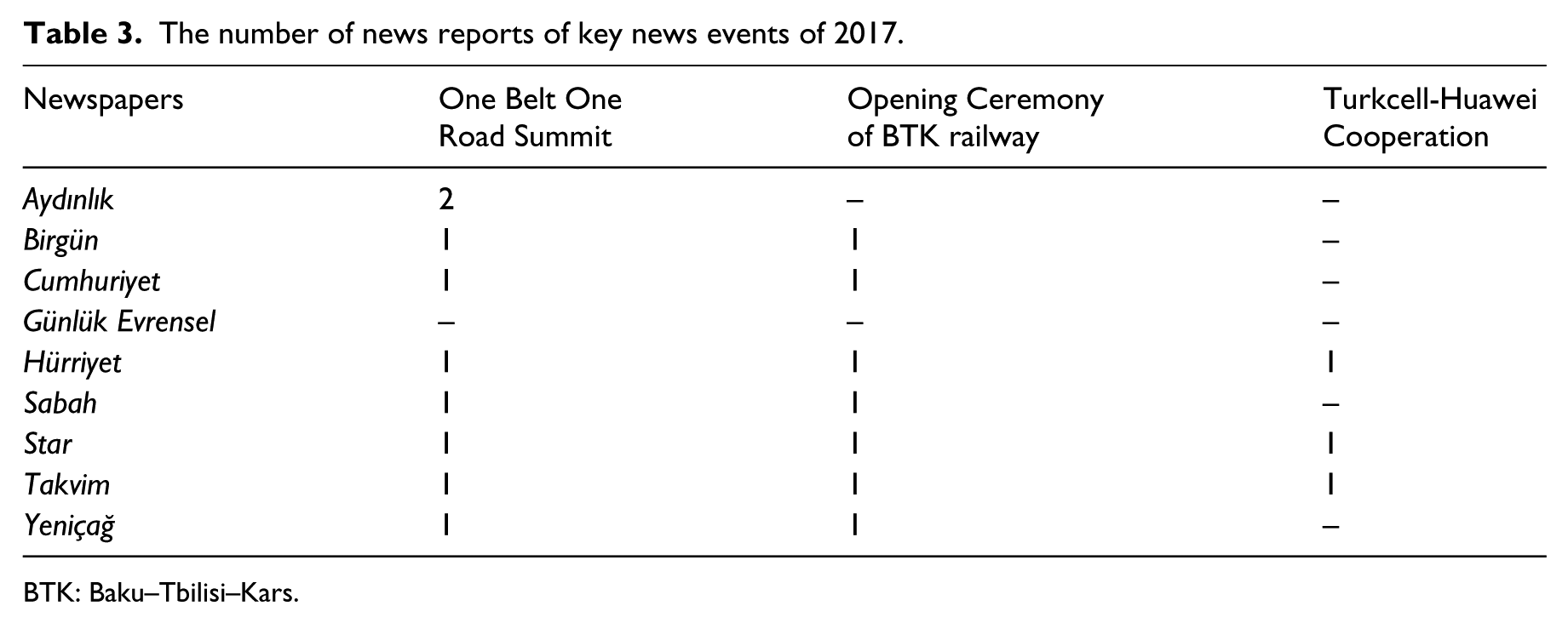
The analysis covers the period 1 January 2016 to 31 December 2017. The year 2016 saw the crucial ‘G-20 Summit’ in Hangzhou, China, on 4–5 September 2016, mainly covered by the Eurasianist title Aydınlık. In contrast, in 2017, two major news events were reported in nearly all the dailies over the sample period: (1) The OBOR Summit in Beijing, China (15 May 2017), and (2) the opening ceremony of the BTK railway (31 October 2017).
Although the statements of Transport Minister Arslan were quoted with several news reports, a third major news event of 2017 – announcing ‘Turkcell 4 -Huawei cooperation’ (16 May 2017, Turkey) – provided pro-government titles Sabah, Star, and Takvim and non-aligned Hürriyet with the opportunity to circulate his promotion of the NSR at the event, as opening a ‘31 trillion dollar market’.
The ‘OBOR Summit’ was covered by all the titles chosen, except Günlük Evrensel, with page 1 stories and news stories in the inside pages. The ‘Opening Ceremony of the BTK Railway’ was covered by all the chosen titles, except Aydınlık and Günlük Evrensel.
Over the sample period, the Eurasianist newspaper Aydınlık contained the highest number of qualifying news texts and commentaries – the full distribution of items is shown in Appendix 1. In this study, only news reports are analysed.
Semantic analysis of the news discourses
For the initial step in semantic analysis, all the topics of the news reports are itemized together with macrostructural topics of headlines, leads and macro-topics. ‘Macrostructures’ explain how newsmakers continuously and routinely summa-rize the myriad of source texts (other media messages, interviews, reports, or press conferences) that are used in the production of a specific news report … Macrostructures also explain why most readers usually only remember the main topics, that is, the higher levels of the macrostructure of a news reports (van Dijk, 1988a, p. 14).
It is suggested by critical news discourse studies (e.g., Teo, 2000; van Dijk, 1983, 1988a, 1988b, 1991) that the macrostructure embodies the ideology of the news. According to Teo (2000), as the highest topic within the macrostructure of the news, headlines include both knowledge of news event and their interpretation. According to van Dijk (1991), ‘… headlines are the subjective definition of the situation, which influences the interpretation made by the readers’ (p. 51).
When the topic derivation is evaluated, it is seen that all the titles, except the socialist Günlük Evrensel, cover the two major news events OBOR Summit in Beijing, China (15 May 2017), and the Opening Ceremony of BTK Railway (31 October 2017) as a shared news event. It is also observed that the majority of news items on the NSR employ ‘direct quotations’ from President Erdoğan and ‘recontextualizations’, using his statements in the macrostructures of headlines, sub-headlines, leads and macro-topics, ‘without direct quotations’.
‘Recontextualization’ operates mainly in the pro-government titles Sabah, Star and Takvim; non-aligned liberal Hürriyet; Eurasianist Aydınlık; oppositional nationalist Yeniçağ; and the lesser oppositional socialist Birgün. The oppositional-social democratic title Cumhuriyet uses direct quotation from Erdoğan and also employs statements from other actors. It is also observed that most news items on the ‘Turkcell-Huawei Cooperation’ event employ ‘direct quotations’ from Transport Minister Arslan.
Within CDA, ‘quotation patterns’ are interrogated as indicative of underlying structures of power, dominance and hegemony and in relation to processes of recontextualization (Fairclough, 2016; Reisigl & Wodak, 2016). As Teo (2000) notes, CDA concentrates on texts like news reporting and political interviews that describe ‘unequal encounters’ or embody manipulative strategies that seem neutral or natural to most people. In the case of news analysis, Teo (2000) underlines that ‘CDA is a critical, multidisciplinary approach which focuses on issues of prejudice, power, dominance and hegemony, and the discursive processes through which they are enacted, concealed, legitimated and reproduced in newspaper reporting’ (p. 13).
The third dimension of semantic analysis explored here focuses on the ‘lexical and overlexical preferences of the newspapers as a rhetoric of news’. Words manifest the underlying semantic concepts used in the definition of the situation. Lexicalization of semantic content, however, is never neutral: ‘The choice of one word rather than another to express more or less the same meaning, or to denote the same referent, may signal the opinions, emotions, or social position of a speaker’ (van Dijk, 1991, p. 53).
Lexical preferences as rhetorical dimensions of news texts may affect all structural levels of a text. But the most influential lexical preferences are usually seen at the macrostructures of the news texts – headlines and leads. According to van Dijk (1991), since headlines encapsulate the dominant meaning of a news event as decided by the newspaper, the words chosen have important ideological implications and they direct readers towards a particular interpretation.
Themes of the news topics
This section summarizes the news topics covered in the sample other than those related to statements by President Erdoğan and Transport Minister Arslan.
As mentioned earlier, the second major discourse, running in parallel to government discourses, in all the sampled newspapers outside the socialist newspapers Birgün and Günlük Evrensel is ‘business discourse’. This is organized around the ‘economic and business benefits’ of the Chinese investments and joint ventures stemming from Turkey’s role as a key connecting link within the NSR. It can be said that such ‘business discourse’ is parallel to and supportive of government policy of NSR. Only the socialist daily Birgün questions the NSR from the side of labour (16 May 2017, p. 5).
Aydınlık, Cumhuriyet, Hürriyet and Star newspapers relayed the hopes and wishes expressed by business groups that the NSR will increase trade and investment. The report in Cumhuriyet (17 December 2016, p. 9) announces the fourth conference on ‘Understanding China and Doing Business with China’, organized by TÜSİAD (Turkish Industry and Businessmen Organization) and Koç University, and the prominence on the agenda given to issues around trade and tourism between China and Turkey and the NSR project.
Again, news texts of Aydınlık (23 February 2017, p. 5), Cumhuriyet (23 February 2017, p. 9) and Hürriyet (23 February 2017, p. 9) announce the new partnership of the Chatham House and the Koç Holding which is one of the two biggest corporations of Turkey and will be the responsible institution supporting Turkey in the NSR project. And news text of Sabah (30 September 2017, p. 15) announces a new partnership of Chinese SUMEC and Turkish Smart Energy which is the leading company of renewable energy.
The third theme of the news topics focuses on the possible consequences of the NSR for Turkey’s international relations and for the changing composition of global power more generally. Specifically, in dailies Birgün and Günlük Evrensel, we see criticism of and opposition to the United States and United Nations. In the nationalist daily Yeniçağ, there are news topics which are critical to United States’ Central Asia politics.
A news text in Aydınlık (14 May 2017, p. 10) underlined the perceived importance of closer ties with China and Turkey’s role as a bridge between Asia and Europe within the NSR project by employing direct quotations from Asian experts from the most prestigious universities. Aydınlık also placed relations with China in the context of the changing composition of global power, with a (16 November 2017, p. 1) page 1 story about the German Der Spiegel’s cover page on the ‘Wake up’ call to the West, arguing that China had now left the United States behind but was not yet a hegemonic power.
Aydınlık’s oppositional position towards the United States is grounded in its support for Eurasia. This was made explicit in an item (20 May 2016, p. 13) reporting the opinion of a member of the International Relations Office of the Vatan Party – Adnan Akfırat – that the Unites States is aiming to build a ‘Second Israeli’ state under the name of ‘Free Kurdistan’ as a roadblock against the 21st Century Silk Road Economic Belt. The same argument was advanced by the Vatan Party Leader Perinçek and published by Aydınlık as a front page story (headline, 3 December 2017, p. 1): ‘Historical warning of Perinçek in Beijing: “If Kurdistan happens, the Silk Road would be prevented”’.
Birgün (22 August 2016, p. 5) recontextualized a story from the French paper I’Humanite, emphasizing the positive role that China might play in the Eurasian region, finding a solution to the jihadist insurgency in Central Asia and fostering development in the region with the NSR. This generally positive view of China’s leadership was endorsed by the socialist newspaper Günlük Evrensel with a (6 September 2017, p. 5) news story celebrating the peaceful and pro-stability potential of the NSR project, in the face of the United States’ aggressive international politics.
Cumhuriyet with its sub-headline ‘EU and Germany uncomfortable’ (15 May 2017, p. 7) foregrounds western European criticisms of the NSR, in the case of the implementation of free trade. Cumhuriyet also points out, first, that citizens’ rights may suffer with the NSR and, second, that it may have adverse environmental impacts (15 May 2017, p. 7).
The nationalist title Yeniçağ centres on the claim that with its investments in the NSR, China will try to take geopolitical control of Eurasia and move into the vacuum left by the failure of the United States to capitalize on the collapse of the Soviet Union (1 January 2017, p. 10).
An analysis of recontextualization: quotation patterns of President Erdoğan and Transportation Minister Arslan
Through selective source use, news beat routines and story topic selection, news media decides which news actors are being publicly represented, what is being said by and about them, and especially how it is said (van Dijk, 2008). van Dijk (2008) also underlines that ‘many power holders (as well as their talk) get routine coverage by the news media, and thus their power may be further confirmed and legitimated’ (p. 55).
According to the common professional code that underpins journalism routines, powerful actors are the most likely to be given the opportunity to voice their ideas (van Dijk, 2008). This argument is confirmed in the present analysis by the prominence given to statements from government leaders and voices from the business community. Their favoured position is conveyed through the use of direct quotation rather than paraphrase.
According to Teo (2000), quotation becomes a gate-keeping device that admits only those in positions of power and influence shutting out the opinions and perspectives of those deemed by society to be powerless. As he notes, ‘while the powerful are further empowered through quotation patterns that enhance their status and visibility, the systematic silencing of the powerless’ (Teo, 2000, p. 18).
Within the sampled newspapers, the pro-government titles Sabah, Star and Takvim; non-aligned Hürriyet; oppositional nationalist Yeniçağ; and, with lesser intensity, the Eurasianist Aydınlık, all make extensive use of direct quotations from Erdoğan’s speeches at the press conferences on the ‘OBOR Summit’ and ‘Opening Ceremony of BTK’ and to a lesser extent Transport Minister Arslan. But the titles mentioned above also employ Erdoğan’s statements in their headlines, sub-headlines and leads as macrostructure of the news which also represent the newspapers’ ideologies. As a consequence, Erdoğan’s discourse of NSR and BTK effectively becomes the newspapers’ discourses – in other words, Erdoğan’s statements are recontextualized.
As Fairclough (2015) notes, ‘“recontextualization” is the movement of parts or elements of interactions and texts out of the original context (so they are “decontextualized”) and into a different context (the “recontextualizing context”)’ (p. 38). It is part of a chain of ‘intertextuality’ linking the text to other texts in both the past and the present. According to Reisigl and Wodak (2016), in the process of recontextualization, ‘the element (partly) acquires a new meaning, since meanings are formed in use’ (p. 28).
Fairclough (2015) underlines that in the process of recontextualization, intertextuality and interdiscursivity in progress, what is important for the analyst is to ask ‘where they come from, where they go to, and how they get there’. News reports also have an important intertextual dimension: Newsmaking is largely based on the processing of large number of source texts, such as other news reports, press conferences, interviews, scholarly studies, and so on. Such intertextuality in news reports shows in various forms of citation and other references to other discourses. (van Dijk, 2008, p. 114)
As usual nowadays in the Turkish press, when newspapers use news agency sources with quotations from government representatives prominently featured as the basis for their news texts, we are faced with similar news reports. But when newspapers use the political statements of government representatives as headlines, lead and macro-topics without quotations, these statements are recontextualized and gain a new meaning: ‘They have become the discourse of the newspapers’. This is an instance of recontextualization as relay, where statements made in one context, political speeches, are transposed into another context, press presentation, without significant change or challenge.
Erdoğan’s statements with direct quotations are in the texts of shared news events of 2017, on ‘special position of Turkey in the NSR’ and ‘economic and cultural cooperation’. The shared news events of 2017 were not covered by Günlük Evrensel. Erdoğan’s press conference at the ‘OBOR Summit’ took place on 15 May 2017 – 1 month after the ‘April 16 Referendum’. One plausible explanation of Günlük Evrensel’s non-coverage is that it did not want to legitimize Erdoğan’s abuse power 1 month after the 2017 referendum.
Another oppositional title Birgün constructed the news article on the ‘OBOR Summit’ without any reference to Erdoğan. Its page 1 story and full page on the inside were based on China and NSR. In the case of the BTK news report, it is clear that Birgün uses the same source text together with other titles, based on the direct quotations from Erdoğan’s statements. And in its news text, Birgün also endorses the claim that ‘with BTK it will be possible to have an uninterrupted railway from Beijing to London’ (topic, 31 October 2017, p. 9).
Although Cumhuriyet (15 May 2017, p. 7) uses direct quotation from Erdoğan in its news text and presents Erdoğan’s major statement of the ‘London-Beijing uninterrupted railway’ with indirect reporting, ‘it is asserted that …’ (topic, 31 October 2017, p. 9).
The Eurasianist Aydınlık in its news text on the ‘OBOR Summit’ uses all the statements of Erdoğan with direct quotations. Aydınlık (15 May 2017, p. 1) also employs Erdoğan’s description of NSR as a ‘win win project’ in its sub-headline but without quotation. In this way Aydınlık recontextualizes Erdoğan’s statement giving it a new meaning – ‘making its own discourse’.
The oppositional nationalist title Yeniçağ’s ‘OBOR Summit’ and BTK (30 October, 2017) news reports are totally based on Erdoğan’s direct quotations. Yeniçağ’s main headline also reproduces Erdoğan’s statement: ‘It will destroy the terror’ (14 May 2017). At the same time, it uses some of Erdoğan’s other statements in headlines without direct quotations: ‘We want to move together with China and other countries on the road’ (14 May 2017). The other news report of Yeniçağ is also totally based on Transportation Minister Arslan’s statements. With its lead of ‘distance between China and Europe will be shortened’ without quotation (March 7, 2017, p. 6), Yeniçağ recontextualizes his statement.
Hürriyet uses Erdoğan’s statements as its headlines without direct quotations: ‘NSR is win win project’ and ‘Economic road against the terror’ (15 May 2017, p. 1); ‘Uninterrupted London-Beijing’ (31 October2017, p. 9). Sabah’s headlines also reproduce Erdoğan’s statements without quotations: ‘It will destroy the terror’ (15 May 2017, p. 1); ‘Middle Corridor of the World trade’ (15 May 2017, p. 9); ‘Uninterrupted connection of London-China’; ‘It will bring peace, security and prosperity’ (31 October 2017, p. 1).
In addition to the above ‘recontextualization of the Erdoğan’s statements’, the Star also uses a headline without quotation: ‘Alliance does not accept treason’ (15 May 2017, p. 1). It is explained with the sub-headline that it is a call to the United States related to YPG and FETO. 5 Takvim also features headlines on the same theme, again based on Erdoğan’s statement but without direct quotation: ‘The claim that Turkey is not fighting aganist ISIS is lie and slander’ (15 May 2017, p. 1); ‘Message to US: This work is prolonged’ (15 May 2017, p. 11).
The reports of Hürriyet (16 May 2017, p. 13), Star (16 May 2017, p. 8) and Takvim (16 May 2017, p. 8), announcing the cooperation of the biggest Turkish GSM company Turkcell and the Chinese Huawei, reproduce Transport Minister Arslan’s description of the NSR as ‘the 31 trillion dollar market’ with direct quotations.
Rhetoric of the news texts: analysis of lexical and overlexical preferences
Lexicalization and overlexicalization are also important devices revealing the ideological meanings carried by news discourse. Teo (2000) argues that using a surfeit of repetitious and quasi-synonymous terms, overlexicalization creates ‘over-completeness’ in the news discourse, suggesting that no further analysis and interpretation is needed. The choice of specific words may signal the ideologies of the speaker (van Dijk, 1988b).
News reports may use words that function as hyperboles (overstatements, exaggerations) or understatements, or word and sentence meanings that establish contrast or build a climax (van Dijk, 1988a).
Machin and Mayr (2015) underlie that van Dijk (2001) describes CDA precisely as the study of ‘implicit’ or ‘indirect meaning’ in texts. As van Dijk (cited in Machin and Mayr, 2015) explains, ‘Implicit information is part of the mental model of … text, but not of the text itself. Thus implicit meanings are related to underlying beliefs; but not openly, directly, completely or precisely asserted’ (p. 30). So the lexical and overlexical analysis of the news texts is central to uncovering implicit or indirect meaning.
The titles under analysis here have been divided into four main groups delineated earlier: pro-government, non-aligned, semi-oppositional and oppositional. In the pro-government titles Sabah, Star and Takvim and the non-aligned title Hürriyet, lexical and overlexical preferences are presented in the headlines, sub-headlines and leads, as a ‘recontextualization of Erdoğan’s statements’.
Pro-government titles
Sabah, Star and Takvim
The first set of lexical emphasis is based on Erdoğan’s discourses on the ‘OBOR Summit’ made on 15 May 2017. Most foregrounding of lexical preferences takes place in headlines, leads and sub-headlines as macro-topics of the news texts. These lexical preferences function as hyperboles–overstatements and exaggerations to reinforce the emphasis on the key ‘role of Turkey in the NSR’. The lexical preference of Sabah’s ‘Middle Corridor of the world trade’ (Erdoğan’s statement without quotation) (headline, 15 May 2017, p. 9) is one example of exaggeration of Turkey’s role in the NSR, since there is also another line passing from Russia. The lexical choice of ‘we tied Asia and Europe together’ in the Star taken from Erdoğan’s statement without quotation (sub-headline, 15 May 2017, p. 5) again exaggerates Turkey’s role (we) in the NSR. The word ‘we’ is intended to refer to the whole ‘nation’ and counter public complains about the very high cost of the new bridge in Istanbul and the fact that members of the public do not know it is a part of the NSR project.
Another major statement of Erdoğan at the ‘One Belt One Road’ summit is, ‘It will destroy the terror’ (Erdoğan’s statement without quotation) (Sabah, sub-headline, 15 May 2017, p. 9). Here again, with the use of the term ‘destroy’, we see the exaggeration of the role of NSR in solving the problem of the terror. Using the words ‘NSR of peace and stability’ (Erdoğan’s statement without quotation) in its headline, the Star (headline, 15 May 2017, p. 5) once again exaggerates the role of the NSR, evoking its ability to solve the problem of terrorism in contrast to the real situation of the ‘trade wars’ between the United States and China.
The second mode of lexical emphasis foregrounds the ‘importance’ of the ‘OBOR Summit’ by again applying exaggerations. Takvim labels Jinping, Putin and Erdoğan as ‘world leaders’ (lead, 15 May 2017, p. 11) with reference to the ‘OBOR Summit’s’ photo. Labelling Erdoğan as a ‘world leader’ places him in the same category as the heads of leading G-7 countries with manifest power within international politics. The lexical choice of ‘great meeting’ in Takvim (sub-headline, 15 May 2017, p. 11) again exaggerates the importance given to the meeting of the Turkish and Chinese presidents, and some of the ministers and state bureaucrats in the next day of the Summit. Takvim’s metaphor of a ‘new page’ in the sentence ‘a new page is opening with China’ (Erdoğan’s statement without quotation) (sub-headline, 15 May 2017, p. 11) refers to the much closer relationship with China in contrast with the past.
The third mode of lexical emphasis is overstatements about the BTK, based on Erdoğan’s statements at the opening ceremony. Sabah describes the BTK with the words ‘peace’, ‘security’ and ‘prosperity’ (Erdoğan’s statement without quotation) (sub-headline, 31 October 2017, p. 1). Here, we can ask the question, if it is a peace project, ‘why was Armenia not included?’ 6 The Star’s sub-headline features Erdoğan’s statement that ‘it will bring stability and prosperity’ (Erdoğan’s statement without quotation) (sub-headline, 31 October 2017, p. 1). Here, journalists can ask, ‘will the NSR bring prosperity for the laborers of the respective countries, or just for capital accumulation?’
Sabah’s overlexical preference of ‘uninterrupted connection from London to China’ (Erdoğan’s statement without quotation) (sub-headline, 31 October 2017, p. 1), Star’s lexical preference of ‘It links Beijing to London’ (Erdoğan’s statement without quotation) (sub-headline, 31 October 2017, p. 1) and Takvim’s overlexical preference of ‘uninterrupted railway networks from London to Beijing’ (Erdoğan’s statement without quotation) (lead, 31 October 2017, p. 1), all underline the importance of the Middle Corridor passing through Turkey. Here, we again face exaggeration, since there is also the line from Russia with comparable journey times, which freight trains have been using since 2015. These exaggerations based on the words used by Erdoğan and Transport Minister Arslan employ recontextualization to reinforce the colonization of the news discourse by government discourses.
The Star’s use of the verb ‘has revived’ in its lead ‘The historical Silk Road has revived with Baku-Tbilisi-Kars railway’ (31 October 2017, p. 1) again overstates the role of BTK and Turkey in the NSR project and parallels Erdoğan’s description. The overlexical preference of the Star’s ‘bridge of civilization from East to West’ (headline, 31 October 2017, p. 1) operates in the same way both to claim a central role for Turkey in the NSR and to reinforce Erdoğan’s discourse.
In the lead of the same news article, the meanings attached to the term ‘civilisation’ are amplified by referring to the historical ‘Silk Road’: ‘Peoples, cultures, geographies have embraced with the century’s project for the second time after the highway’ (Star, lead, 31 October 2017, p. 1). Here we face exaggeration not only of the BTK’s and Turkey’s role in the NSR but of the Silk Road, both old and new, as a central connecting thread linking diverse cultures. At the same time, foregrounding the cultural role of NSR is in tension with the Transport Minister’s claim that the ‘Target is to take share from 31 trillion dollar market’ (Sabah, headline, 20 May 2017, p. 15). By using this statement in its headline without direct quotation, the Sabah recontextualizes the Minister’s discourse.
The lexical choice in the Takvim headline, ‘they nail to the history’ (31 October 2017, p. 1), refers to the ‘historical moment’ made by beginning construction of the BTK railway line with the first nail; Sabah’s lexical preference of ‘“historical step” in the New Silk Road’ (lead, 31 October 2017, p. 1) (parallel to the Erdoğan’s statement of ‘we’re taking so important step for our future’) and ‘“the day of pride” on the Silk Road’ (Erdoğan’s statement without quotation) (headline, 31 October 2017, p. 17) are all again examples of exaggerations of Turkey’s role in the NSR. It is clear that such lexical preferences reproduce the government’s discourses. Sabah’s headline of ‘Three countries one heart joint success’ (31 October 2017, p. 1) refers to the regional cooperation of the Azerbaijan (Baku), Georgia (Tbilisi) and Turkey (Kars) as border countries with the BTK. The lexical preference of ‘one heart’ employs an informal metaphor to make exaggeration.
Non-aligned
Hürriyet
In the lexical preferences of Hürriyet, there are positive descriptions of NSR and BTK. Except for the headline ‘historical moment’ (31 October 2017, p. 1) which was used to describe the opening of the BTK and again exaggerates Turkey’s role in the NSR and the possible Chinese businessmen’s ‘investment’ in Turkey (headline, 19 July 2017, p. 13), all the other descriptions of the NSR in Hürriyet belong to Erdoğan’s discourses.
The other exaggerated descriptions of BTK and NSR in Hürriyet, taken from Erdoğan’s statements without quotations are the following: ‘London-Beijing uninterrupted’ (headline, 31 October 2017, p. 9), ‘win win project’ and an ‘economic road against terror’ (headline, 15 May 2017, p. 1). Reproducing Erdoğan’s discourse at the macrostructures of the news by applying his statements is again an instance of recontextualization.
Semi-oppositional title
Aydınlık
By examining the lexical preferences of Aydınlık, it is possible to say that it supports China and Eurasia politics and also Turkey’s alignment with China. To secure this ideological construction, Aydınlık builds a cumulative string of lexical preferences: ‘China and Turkey are writing a “new history”’ (main topic, 22 December 2016, p. 5); ‘“New era and strong partnership” between China and Turkey’ (headline, 14 May 2017, p. 1); and captioning the ‘OBOR Summit’s’ photo with ‘Jinping, Putin and Erdoğan are “side by side”’ (headline, 15 May 2017, p. 1).
The second mode of lexical emphasis in Aydınlık foregrounds the role of the NSR in stimulating ‘economic development’ and ‘securing peace’. In one lexical preference, China’s Western region of Sinciang (Xinjiang) is described as the ‘Rising star of NSR’ (headline, 29 May 2017, p. 11). The designation reproduces the Chinese government’s characterization in marked contrast to the extreme Turkish nationalists’ labelling of the region as ‘East Turkestan’ (Yeniçağ, macrotopic, 1 June 2016, p. 13) and the common public designation as the ‘Uyghur Autonomous region’, where the ethnic minority Uyghur Turks live. Describing the region as the ‘rising star of NSR’ aims to foster support for the NSR project in Turkish public opinion and can be evaluated as again indirect support for the AKP government’s NSR policy.
Other lexical choices employed in Aydınlık are ‘to invest’, which refers to ‘Chinese businessmen coming to Turkey to invest’ (headline, 19 July 2017, p. 5), and ‘peace’, paralleling the Chinese government’s official presentation of the NSR as a peaceful project (main topic, 19 July 2017, p. 5). Aydınlık also use the words ‘stability’ and ‘security’ with direct quotation from Perinçek, the leader of Vatan Party: ‘NSR has the target of stability and security … fighting with terrorism’ (topic, 3 December 2017, p. 1).
In common with other titles analysed, Aydınlık employs overlexical preferences to exaggerate Turkey’s role in the NSR: ‘This line (the Middle Corridor), which has a “big importance” as a continuation of the historical Silk Road’ (macro topic, 6 November 2016, p. 5). This recontextualizes a news topic taken from Der Spigel: ‘China, with a Silk Road of $ 900 billion, is a networked power with “roads, trains, ports and pipelines” to Europe’ (topic, 16 November 2017, p. 14). Since Aydınlık is a party paper on the side of Eurasianist politics, recontextualizing this story from Der Spigel makes it more immediately ‘visible’ and presents it to readers as if it is the ‘voice of Aydınlık’.
Oppositional titles
Birgün, Cumhuriyet, Günlük Evrensel and Yeniçağ
Although Birgün labels the NSR as a ‘magnificent project’ with a lexical preference presenting it as ‘so glorious indeed is a $ 900 billion investment’ (lead, 16 May 2017, p. 5), it questions the project from the side of ‘labour’ and ‘labourers’ with an overlexical preference at its lead, stating that ‘we have no idea what gains will be realized with regard to “labor and laborers”’ (lead, 16 May 2017, p. 5). Birgün at the same time claims that ‘China’s New Silk Road Project stands as a “serious alternative” to the US and the Western capital’ (topic, 16 May 2017, p. 5).
Birgün’s headlines employ an overlexical preference ‘China’s NSR wants to develop the regional capital peacefully to counter the current global capital-Chinese state capitalism’s globalism attack’ (16 May 2017, p. 5). When we evaluate this top macrostructure of news texts, we see a clear anti-imperialist stand. Birgün’s very positive presentation of the NSR pitches it as an alternative to the neoliberal turn in Western capitalism, but it still questions the position of labour and NSR’s claim of being respectful of the UN Charter.
Although Cumhuriyet also underlines the qualification of the NSR as ‘the biggest investment programme ever since the Marshall Plan’ with its overlexical preference (topic, 15 May 2017, p. 7) and lexical preference of ‘this century’s project’ (macro topic, 15 May 2017, p. 7), it also activates criticism towards the NSR with its lexical preferences: ‘Citizens who will suffer with the project’, ‘environmental issues’ (topic, 15 May 2017, p. 7); ‘EU and Germany uncomfortable’ (sub-headline, 15 May 2017, p. 7).
Günlük Evrensel constructs the meaning of the NSR by characterizing China’s role as ‘peaceful’ and labelling the United States as ‘aggressive’: ‘China is drawing a peaceful and pro-stability leadership profile with the New Silk Road project against the US aggressive international politics’ (topic, 6 September 2017, p. 5).
The oppositional title Yeniçağ labels the opening ceremony of BTK as an ‘historical opening’ (headline, 31 October 2017, p. 1) and claims that ‘The historical Silk Road has revived with Baku-Tbilisi-Kars railway’ (lead, 31 October 2017, p. 1), both meaning constructions parallel to government statements. With the lexical preference of ‘Turkey’s importance is increasing with China’s New Silk Road Project’ (topic, 1 January 2017, p. 10), Yeniçağ foregrounds its positive view of the NSR and Turkey’s relationship with China.
Conclusion
The dominant discourses of the newspapers sampled mainly recontextualize President Erdoğan’s statements on the NSR and the BTK railway together with statements by Transportation Minister Arslan. These discourses are promote the NSR as initiating a new era of relations with China advancing peace, security and a bulwark against terrorism, and prosperity, this last claim being underlined by the Transport Minister’s characterization of the initiative as creating a 31 trillion dollar market and with BTK Turkey is the Middle Corridor of the world trade. Only the socialist and oppositional newspaper Günlük Evrensel does not recontextualize the Erdoğan’s statements.
Erdoğan’s central position as the main news actor and the domination of his statements on the NSR and the BTK in the news discourses legitimate both his authoritarian rule and abuse power and his wish of rapprochement with China. Unlike the other newspapers sampled, in their overall approach to the NSR, the oppositional and leftist titles Birgün, Cumhuriyet and Günlük Evrensel do not legitimize the dominant discourses of President Erdoğan and the government.
Except for small nuances, however, all newspapers sampled were found to represent NSR positively. The oppositional and social democratic title Cumhuriyet refers to ‘the disturbances of the EU and Germany, the environmental problems with the NSR and the rights of civilians who may be harmed by the NSR project’. Alongside its description of the NSR as ‘magnificent’ and ‘so glorious’, the daily Birgün also questions the NSR in terms of ‘labour’ and ‘rights of labourers’.
The title Günlük Evrensel did not report the news events in which Erdoğan was the main news actor. The title Birgün never mentions Erdoğan in its news reporting of the ‘OBOR Summit’, but it reproduces Erdoğan’s discourse in its BTK news report. It is clear that this is due to the speed and dependency on the news source, a journalistic routine. In both news events, it is seen that the title Cumhuriyet implements the principles of public broadcasting.
All other newspapers legitimate Erdoğan and his government’s statements by reproducing their discourses. As we have seen, these titles do this, with their selection of news themes, by producing their news articles mainly with the direct quotations from Erdoğan and Transport Minister Arslan and by recontextualizing Erdoğan’s statements in their news reports and their lexical preferences.
It is seen that the nationalist title Yeniçağ, which is oppositional to the AKP government, also reproduces the discourses of Erdoğan and Transportation Minister Arslan and creates a kind of ‘national glorification’ in the NSR investments and Turkey’s key position on the NSR route between Europe and Asia.
The reason that Aydınlık, a Eurasianist Vatan Party newspaper, is considered semi-oppositional in this work is based on its opposition to the AKP government on internal political issues and support on foreign policy issues. The most important element of this support is the increasing closeness of the AKP government to China and Russia. As can be seen in the analysis, in addition to its different news stories, Aydınlık both constructs the news reports of Erdoğan’s statements around direct quotations and recontextualizes them with lesser intensity in comparison with pro-government titles.
As the analysis presented here has argued, Erdoğan’s discourses gain ‘new meanings (becoming newspapers’ discourses)’ by both direct quotations and recontextualization of his statements, particularly within the non-aligned Hürriyet and pro-government Sabah, Star and Takvim newspapers very intensively.
Hürriyet, labelled as non-aligned in this study, was described as the ‘flagship’ of the Turkish press before the AKP era. For this reason, Hürriyet’s legitimation of Erdoğan’s discourse and its representation of the NSR project ‘so positively’ are important. The title Hürriyet’s launch (in 1948) coincides with Turkey taking a place within the Western block.
Pro-government newspapers Sabah, Star and Takvim are already controlled by pro-AKP capital groups in terms of ownership, and it is no surprise that they legitimate Erdoğan by reproducing his discourse on NSR and BTK. But as representatives of the conservative section of society, their legitimation of ‘cooperation and close relationship between China and Turkish government’ is significant. Because of its communist past and its problems with the Uyghur Turks, China has enjoyed a very negative image in Turkish conservative and nationalist circles.
In pro-government titles Sabah, Star and Takvim, in non-aligned title Hürriyet and, with lesser intensity, in oppositional titles Yeniçağ and Cumhuriyet, after the primary reproduction of Erdoğan’s discourses, the second major discourse featured is ‘business discourse’ based on the increase in joint investments with China and the perceived economic benefits from the NSR. As shown in the analysis, this discourse was reproduced and reinforced in the reporting of the statements of Erdoğan and Minister of Transport Arslan with direct quotations and the recontextualization of the statements of Erdoğan in the macro structures of the news.
These newspapers had a liberal past and, but as of 2017, they foreground neoliberal discourses in their economy pages. In fact, AKP’s economic policies have been neoliberal since they came to power (2002). Since 2011, authoritarianism has been articulated to neoliberalism. The rapprochement with China and its reproduction ideologically by the media creates new tensions of authoritization for Erdoğan and his rule, within the context of the deep polarization of Turkish society. It is an important parameter of concern that leaving the Western bloc and turning towards the Eurasian bloc will make authoritarianism permanent and will increase it.
In the case of the news reports of the opening ceremony of the BTK railway, which is a part of the NSR, Erdoğan’s statement of an ‘uninterrupted road from Beijing to London’ was circulated in all titles except Günlük Evrensel. Also the title Cumhuriyet reported this statement as indirect reporting. While the trains departing from China reach almost all European countries, Erdoğan’s choice of the United Kingdom as a final destination is also significant in the construction of meaning. Erdoğan has tried to strengthen Turkey’s position in the NSR and its own position by pointing out that the China’s ultimate goal with the NSR is to increase its economic strength in relation to the United Kingdom as a world power.
One of the foregrounding discourses of all titles outside the Cumhuriyet about NSR is parallel to Erdoğan’s discourse on NSR, ‘it will bring peace and stability’. The point that unites pro-government titles (Sabah, Star, Takvim), oppositional socialist newspapers (Birgün, Günlük Evrensel) and the nationalist newspaper Yeniçağ and Eurasianist Aydınlık is ‘anti-American expansionism’ within the context of the trade war between the United States and China.
‘Anti-Americanism’ in Turkey from past to present is a subject for a separate study. May 2017 and October 2017, however, are significant dates, coming a year after the coup attempt in 2016. The idea that ‘America is behind every coup’ is a dominant view in Turkish public opinion. But it may be misleading to think that this formation of meaning in the oppositional press in 2017 is constant and inclusive. The opposition bloc against the AKP government led by the MHP (National Action Party) together with some sections of the press have been more positive about the US and Western bloc within the last 2 years. Moreover, nowadays, the AKP government seems to be engaged in intense dialogue and cooperation with the United States in the context of the geopolitical balances in Syria.
Finally, it is necessary to state that the pro-AKP media presence in Turkey, which reached 95% in 2018, is not legitimate for at least half of the society. In the local elections held on 31 March 2019 and renewed for Istanbul on 24 June 2019, the overwhelming pro-government media ownership failed to give the AKP the opportunity to win elections in major economically and socially developed cities, along with Istanbul and Ankara. Of course, there are other important reasons for the AKP’s loss of local elections in these big cities, apart from the influence of the media. In addition to these reasons, the impact of social media has been debated in the public opinion.
Footnotes
Appendix 1
The number of news reports of key news events of 2017.
| Newspapers | One Belt One Road Summit | Opening Ceremony of BTK railway | Turkcell-Huawei Cooperation |
|---|---|---|---|
| Aydınlık | 2 | – | – |
| Birgün | 1 | 1 | – |
| Cumhuriyet | 1 | 1 | – |
| Günlük Evrensel | – | – | – |
| Hürriyet | 1 | 1 | 1 |
| Sabah | 1 | 1 | – |
| Star | 1 | 1 | 1 |
| Takvim | 1 | 1 | 1 |
| Yeniçağ | 1 | 1 | – |
BTK: Baku–Tbilisi–Kars.
