




Abstract
The New Silk Road has been considered as China’s core foreign policy since 2013. This initiative is paralleled by the expansion of China’s official media on Western networking platforms like Facebook and Twitter. These projects indicate China’s ambitious plans for promoting its hard power and soft power. This study examines the news production and framing of the New Silk Road by China’s official media on Facebook, as well as predictors for explaining audience engagement with these news outlets. By examining 43,239 posts relating to the national initiative, this study finds that China’s media build distinct news topics and sentiments for the New Silk Road and countries involved in the policy to achieve the official goal of “spreading China’s voices.” Moreover, news topics and sentiment play significant roles in encouraging Facebook users to like, share, and comment on news stories about the New Silk Road.
The New Silk Road, or the Belt and Road Initiative (BRI), is regarded as one of China’s key foreign policies and infrastructural investments (Huang, 2016). The main goal of the initiative is to build various levels of cooperation between China and 65 countries in Asia, Europe, Middle East, and Africa. It is claimed that the New Silk Road is driven by China’s domestic economic challenges (Wen et al., 2017), and it proves China’s ambitions to promote “community of shared destiny” and eventually influence global order (Callahan, 2016). Since 2013, this national initiative has enabled China to promote its trade and investment with countries along BRI routes. As China is increasingly improving its connections with these BRI countries, however, relatively little attention has been granted to the role of news and information flows in promoting the New Silk Road.
Interestingly, the deployment of the New Silk Road is accompanied by the rise of China’s official media on Western social media platforms (e.g. Facebook and Twitter). China’s news outlets are becoming popular news sources on these platforms by producing English-language news and videos for audiences (Timmons & Horwitz, 2016). For instance, China Global Television Network (CGTN) has more than 90 million followers on Facebook, outnumbering CNN, Fox News, BBC, and other mainstream news media. Since Facebook is blocked in mainland China, the targeted audiences of these official media are global users instead of Chinese people. Notably, the publicly stated goal of the official media practice is to support China’s public diplomacy and encourage media Going-out by “Spread[ing] China’s voice well, [to] let the world know a three-dimensional, colorful China, and showcase China’s role as a builder of world peace” (“China’s State Broadcaster CCTV Rebrands International Networks as CGTN in Global Push,” 2016).
This study argues that the New Silk Road and media “Going-out” policy indicate China’s ambitious plans for strengthening its hard power and soft power around the world. However, it is still unclear how official media spread China’s voice and report China’s foreign policy on a global platform, as well as how global audiences engage with this media practice. While current literature on the New Silk Road usually focuses on its political and economic aspects, hardly any work has addressed the combination and interaction of hard power and soft power on Western networking platforms. The coverage of the New Silk Road by China’s media on Facebook, thus, provides the opportunity to understand how China produces and frames news stories for global audiences to achieve its goal and interest. On the one hand, the interaction between the New Silk Road and China’s media on Facebook helps explore how official media adopt soft power practices to improve the visibility and influence of China’s hard power around the world. On the other hand, this interaction also enables us to examine the effectiveness of China’s media “Going-out” policy on Western networking platform.
Thus, the goal of this study is twofold. First, this study draws upon media bias research (D’Alessio & Allen, 2000) to analyze how China’s official media build news topics and tones for the New Silk Road and countries involved. Second, using audience engagement scholarship (Trilling et al., 2017), this study examines the predictors of audience engagement with China’s official media on Facebook. In other words, this study attempts to explore: (1) news production and framing for the New Silk Road and (2) key predictors for explaining the popularity of news content. Doing so enables this study to explore news content produced by China’s media for the New Silk Road and BRI countries, and also explore factors affecting Facebook users’ engagement.
This study draws on original data from seven China’s official media on Facebook—CGTN, CGTN America, CGTN Africa, People’s Daily, Global Times, China Daily, and Xinhua News Agency. Using automated content analysis, this study identifies 43,239 news stories relating to the New Silk Road and BRI countries, and then examines news topics, news sentiment, and audience engagement factors. The results suggest that while China’s official media have paid more attention to the New Silk Road since September 2013, the coverage of this national initiative is not the main agenda on Facebook. Moreover, while China’s media build different agendas and frames for the BRI countries and other countries, they tend to focus on soft news rather than hard news on Facebook. Official media also attempt to highlight the positive aspects of international affairs and economy for BRI countries. Finally, Facebook audiences actively engage with China’s official media on Facebook by liking, sharing, and commenting. The results suggest that news topics, China-related news, and sentiment have significant relationship with these metrics. These findings shed light on understanding China’s media practice on Facebook and audience attentiveness with this practice.
Literature review
China’s media go global
China initiated its media “Going-out” policy in 2009, which is considered as a soft power and public diplomacy practice by China’s leadership to promote China’s global image and counterargue Western mainstream media (Thussu et al., 2017). This strategy encourages China’s official media to launch English-language channels and oversea newsrooms in North America, Europe, and Africa (Nyri, 2017; Wu, 2016). It has been noticed that China is using the “Going-out” strategy to build its international image as a peaceful and reliable partner and to achieve its national interests in international environment (Hartig, 2016). For instance, previous research has revealed that China’s media attempt to highlight China’s economic growth and connections with foreign countries and counter negative images of China in the Western mainstream media (Thussu et al., 2017).
However, the relatively nascent literature on China’s “Going-out” policy often concentrates on broadcasting networks in Africa, and we know little about the use of social media by China’s official media in a global context. Notably, the rise of China on Western social media is not a new phenomenon, since previous research has found that the Chinese government and citizens are increasingly embracing Western platforms like Twitter to distribute information and influence foreign audiences (e.g. Bolsover & Howard, 2019; Li & Rao, 2010). Scholars also find that China’s official media are increasingly using Twitter to distribute news stories for global audiences (Nip & Sun, 2018). Thus, analyzing the coverage of the New Silk Road offers the opportunity to expand our understanding of media “Going-out” policy in China.
The coverage of national initiatives: a media bias perspective
This study draws on the established literature on media bias to examine how China’s official media cover and frame the New Silk Road on Facebook. Doing so allows researchers to design a research framework that moves the traditional focus in mediated public diplomacy studies from the macro-level sites of observations of state policies to micro-level sites of observation where state interests may be expressed in the production and dissemination of news and information on a popular networking platform.
It is often alleged that the news media are not unbiased (Bennett, 2016). Journalists and editors may highlight or downplay some aspects of a story; thus, issues and players are portrayed in an unbalanced and slanted way (Eberl et al., 2017). In the Chinese context, the Chinese Communist Party (CCP) and the Chinese government control and censor the content of China’s official media (Shirk, 2011). The Chinese authority considers mass media as a tool to achieve its political goals and tasks (Qin et al., 2018).
Compared with commercial media, China’s official media must follow the official line set by the CCP and governments and contribute to regime stability and legitimacy through propaganda (Stockmann & Gallagher, 2011). Therefore, China’s official media do create media biases indicating the ideology and interests of the CCP and governments (Stockmann, 2011). Recent studies have revealed that China’s official media build different agendas and tones for China and other countries (Roberts et al., 2016). On global networking sites like Facebook and Twitter, the media bias implies China’s official goals in a global context (Nip & Sun, 2018).
China’s official media bias on Facebook
Based upon previous literature, this study identifies three types of media bias: coverage bias, gatekeeping bias, and statement bias (D’Alessio & Allen, 2000). First, coverage bias (visibility bias) refers to the relative amount of news coverage that an issue or actor receives, which is usually measured by comparing the length of reporting or the number of stories (D’Alessio & Allen, 2000). Scholars argue that news media can disproportionately produce more content for some issues or actors (Eberl et al., 2017). In this case, the official goal of China’s media on Facebook is to tell stories of China, and it is reasonable to expect that these media outlets produce more news stories for the New Silk Road. The rationale is that China’s official media need to amplify the visibility of the New Silk Road on Facebook to attract audiences’ attention and promote China’s foreign policy. Thus, this study hypothesizes:
Hypothesis 1 (H1). China’s official media produce more news stories for the New Silk Road and BRI countries on Facebook since 2013.
It is also important to examine the difference between BRI countries in terms of the number of news coverage, since China’s media may produce more news stories for certain countries. It is possible, for example, that some BRI countries received more news coverage from China’s media on Facebook, indicating that these countries might have strong connections with China. This difference could tell us which BRI country is more important for China. Hence, this study asks:
Research question 1 (RQ1). Which BRI countries receive the most news coverage from China’s official media on Facebook?
The second media bias—gatekeeping bias (agenda bias)—is the preference for choosing news stories from one party rather than others (D’Alessio & Allen, 2000). The concept is developed to explain the process whereby news professionals make certain issues more salient than others while ignoring other topics. In the current case, these official media should not only prioritize the New Silk Road news (H1), but also offer a distinct variety of topics for countries included in this project in contrast to other nations. The reason is that China’s media need to produce topics reflecting the features of the New Silk Road and BRI countries. It is possible that these media generate more international and commercial news for BRI countries, since these topics are related to the goal of the New Silk Road. Thus, this study asks:
RQ2. What news topics are produced by China’s official media for the New Silk Road and BRI countries on Facebook?
Moreover, it is reasonable to argue that China’s official media would highlight the connections between China and BRI countries on Facebook. In other words, the coverage of the New Silk Road should contain a higher proportion of China-related news, since this indicates the cooperation between China and BRI countries:
H2. China’s official media produce more China-related stories for the New Silk Road and BRI countries than other countries on Facebook.
Finally, statement bias (tonality bias) measures the process whereby news media frame stories for each side. A useful indicator used to capture this bias is news sentiment or news tone (Eberl et al., 2017). Previous studies have found that China’s official media often report the positive aspects of China’s topics (Roberts et al., 2016), and tend to cover negative aspects of foreign nations (Stockmann, 2011). It is reasonable to assume that China’s official media enunciate the positive attributes of the New Silk Road and muffle the negative attributes of BRI countries on Facebook. Since one way to promote the New Silk Road is to frame it as a positive project and cover the positive aspects of BRI countries:
H3. The news sentiment of the New Silk Road and BRI countries is more positive than the news sentiment of other countries on Facebook.
Predicting audience engagement on Facebook
As mentioned, the second goal of this study is to examine predictors affecting audience engagement with China’s media on Facebook. Currently, social media users can easily engage in news stories through a variety of actions including liking, sharing, commenting, and recommending (García-Perdomo et al., 2018). These online behaviors are considered as key metrics that indicate the popularity of news coverage on social media (Larsson, 2018).
Previous studies have identified various factors that could impact news sharing and other interactions, such as individual motivations, content characteristics, news values, and network structures (Valenzuela et al., 2017). This study focuses on content characteristics and news values (i.e. news topics and sentiment) to explain how Facebook users engage with the coverage of the New Silk Road. First, it is interesting to explore which news topic is popular on Facebook. Previous studies have found that news topics could affect whether users like or share certain news stories. For example, social media users tend to like or share soft news instead of hard news like international affairs and politics (Bright, 2016). Another factor that might influence audience engagement is China-related stories. As China’s media tend to portray China as a peaceful and reliable partner, it is possible that Facebook users are more likely to engage with news stories about China. Finally, scholars claim that news stories with positive sentiment are more shareable (Berger & Milkman, 2012), whereas others find that negative news is more likely to receive users’ recommendations on social media (Valenzuela et al., 2017). In this case, it is also important to examine how news sentiment affect audience engagement with China’s media. Therefore, this study asks:
RQ3. How news topics, China-related news, and news sentiment influence audience engagement with China’s official media on Facebook?
Method and data
This research draws on Facebook data to explore the hypotheses and research questions. The first phase of data collection was to determine China’s official media on Facebook. Three criteria were used to identify targeted media outlets (i.e. Facebook Pages): (1) the Facebook Page must be operated by China’s official media; (2) each media Page must be verified by Facebook; and (3) each Page should post substantive English-language content. By doing so, the author initially identified seven China’s media on Facebook. These seven media outlets include broadcasting media (CGTN, CGTN America, CGTN Africa), newspapers (People’s Daily, Global Times, and China Daily), and news agency (Xinhua). Thus, they covered the full range and diversity of China’s official news media operating on Facebook. In the second phase, the author used Facebook’s Application Programming Interface (API) to collect the full population of news content and data about audience attentiveness. The final data set was made organizing each media since the date of its creation (ranging from 5 November 2009 to 2 May 2013) to 30 June 2017. Overall, the data set includes 266,772 posts and related data (e.g. the number of likes, shares, and comments).
With recent advancements of computational methods, large amounts of textual data are increasingly available for descriptive and causal inference (Evans & Aceves, 2016). Broadly speaking, three approaches can be used to extract meaningful inferences from large-scale text collections: dictionary-based method, supervised learning method, and unsupervised learning method (Grimmer & Stewart, 2013). Specifically, dictionary-based method is nonstatistical endeavors that adopt predefined dictionaries to categorize a large corpus of texts (Young & Soroka, 2012). Supervised learning and unsupervised learning, in contrast, are both machine learning approaches. While supervised learning approach relies on known categories to train statistical models for classifying vast amounts of text-based data (i.e. text classification), unsupervised learning method can discover new or unknown categories (i.e. topic modeling). These computational methods have been employed to examine various topics in social sciences, including political discourse (Stewart & Zhukov, 2009), comparative politics (Lucas et al., 2015), newspaper coverage (DiMaggio et al., 2013), and social media posts (Barberá, 2014).
This study adopted dictionary-based and supervised learning approaches for large-scale textual analysis. After acquiring the 266,772 posts, the author adopted R to preprocess the texts (i.e. Facebook posts) to reduce the complexity of textual data. R packages quanteda and tm are adopted for preprocessing. The preprocess efforts included the following established data-mining steps: transforming text into corpus, removing stopwords, punctuation, common words, uncommon words, and stemming (Lucas et al., 2015). Then, texts are organized into a Document-Term Matrix (DTM) that each column indicates the occurrence of each word while each row is a news post.
To conduct dictionary method, the author created two nation-related dictionaries: a China dictionary and a BRI dictionary. Specifically, the China dictionary includes a list of words regarding China (Chinese location names, politicians, firms, celebrities, etc.) to identify China-related news. A Facebook post will be coded as China-related news if it contains one of these words. Similarly, the BRI dictionary includes a list of all BRI countries, capitals, and nationalities, which is used to identify whether a post mentioned the New Silk Road and BRI countries. Meanwhile, the author used the existing Sentiment dictionary for analyzing news tones (Young & Soroka, 2012). The sentiment dictionary includes 1709 words indicating positive sentiment and 2858 words indicating negative sentiment. R package quanteda is used to calculate news sentiment for each post. The algorithm first finds these words in news posts and then computes the average sentiment scores for each post.
In addition, this research adopted supervised methods to classify news topics. Notably, one approach used in supervised methods is “bag-of-words,” meaning that the word order in a document is irrelevant (Banks et al., 2018). In other words, word positions will be dropped in the analysis and only the frequency and occurrence of word are used for classification. It is worth to note, however, that some information might be removed in “bag-of-words,” since this approach simplifies text content and ignores the syntax of a sentence (Banks et al., 2018). In this study, the main goal of using supervised method is to classify social media posts into various news topics, and previous research has found that word frequencies alone can provide sufficient information for content classification (e.g. Banks et al., 2018; Welbers et al., 2017).
Based on previous literature (Bright, 2016), the author identified 14 news topics: accident and disaster, economy, politics and government, civil rights, military and terrorism, international affairs, law and crime, health, science and technology, sports, education, environment and nature, society and family, and culture and entertainment. Typically, the first seven topics are considered hard news items, while other topics are regarded as soft news. Supervised method can assign each Facebook post to 1 of 14 categories. Briefly, this approach included three steps. First, the author established a training set for machine learning. The training set was a random sample representing the corpus so that human coders can develop an interpretive logic system for algorithmic classification (Grimmer & Stewart, 2013). This research randomly selected 4000 posts from the original data set (see examples in Table A1), and then the author worked with a training coder to code these posts and tested intercoder reliability (Krippendorff’s α = .83). Second, these hand-labeled samples were used as training set to train the machine to learn a set of parameters and therefore assigned the remaining documents into the categories.
The research employed ensemble learning, which uses multiple learning algorithms to obtain better predictive performance (Aggarwal & Zhai, 2012). Four supervised learning algorithms were used for this study: Lasso and Elastic-Net Regularized Generalized Linear Models, Logistic Regression, Stabilized Linear Discriminant Analysis, and Random Forest. To evaluate the predictive performance, the author randomly split the coded samples into an 85% training set and 15% test set, and then compared the machine coding with human coding for the test set. If three out of four algorithms achieve agreement for classifying the post, then the result was considered as correct. Otherwise, the classification was false. The ensemble learning approach received 75% average accuracy rate for the test set, which is reliable for further research. Finally, the author employed the ensemble learning to classify all posts in the original dataset.
Results
The coverage of the New Silk Road on Facebook
H1 predicts that China’s official media produced more news stories for the New Silk Road and BRI countries since 2013. To explore this hypothesis, this study computes the number of news for the New Silk Road and BRI countries and compares them with other countries. Figure 1 shows weekly news posts for these two groups. Overall, China’s official media distributed limited news content before 2013 (less than 200 posts per week), and the number increased to approximately 250 for BRI countries and 500 for other countries between 2014 and 2016. Notably, while the amounts of other countries soared to more than 1000 per week since 2016, the number for BRI countries stabilized during this period. Figure 1 shows that China’s media outlets did increase the coverage of the New Silk Road, but these outlets posted more news stories for non-BRI countries. In fact, China’s official media produced news coverage for 184 countries on Facebook. Among these countries, the United States was the most important actor: 27,355 news posts were related to it. In addition, Russia (BRI countries), Japan, UK, and France were also critical countries receiving large amount of coverage from China’s official media. This result suggests that China’s media are increasingly using Facebook to circulate news for superpowers in the world, whereas reporting the New Silk Road is one of its topics.
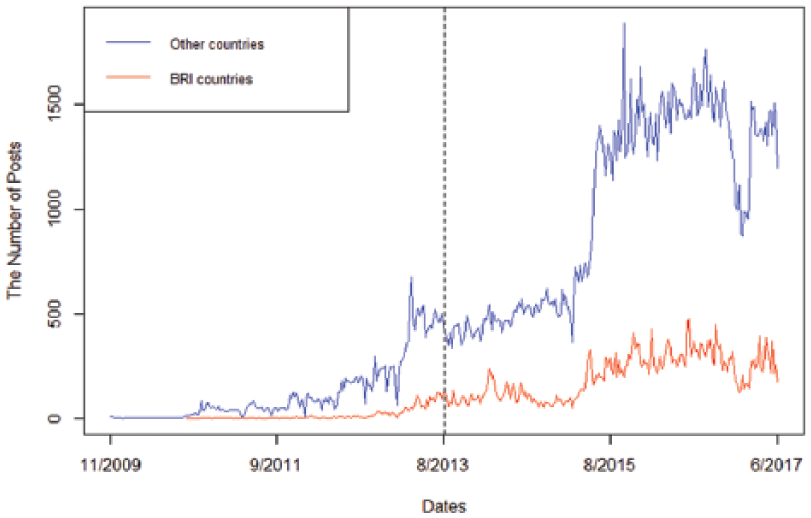
The number of news posts per week by BRI countries and other countries.
Furthermore, RQ1 asks which BRI countries obtain the most news coverage from China’s official media. To address this question, this study calculates the total posts each BRI countries received and then plots a map for these countries. Figure 2 illustrates that China’s official media distributed large amount of news reporting for Russia, Middle East, South Asia, and Southeast Asia, while Eastern Europe and Central Asia received limited coverage on Facebook. For instance, China’s news produced 7172 posts for Russia, followed by Oman (4911), India (4477), and Egypt (3712). However, countries like Moldova, Albania, Montenegro, and Bhutan received less than 100 news stories from China’s official media. The difference suggests that China’s official media were more likely to cover news for countries that are locally important and close to China.
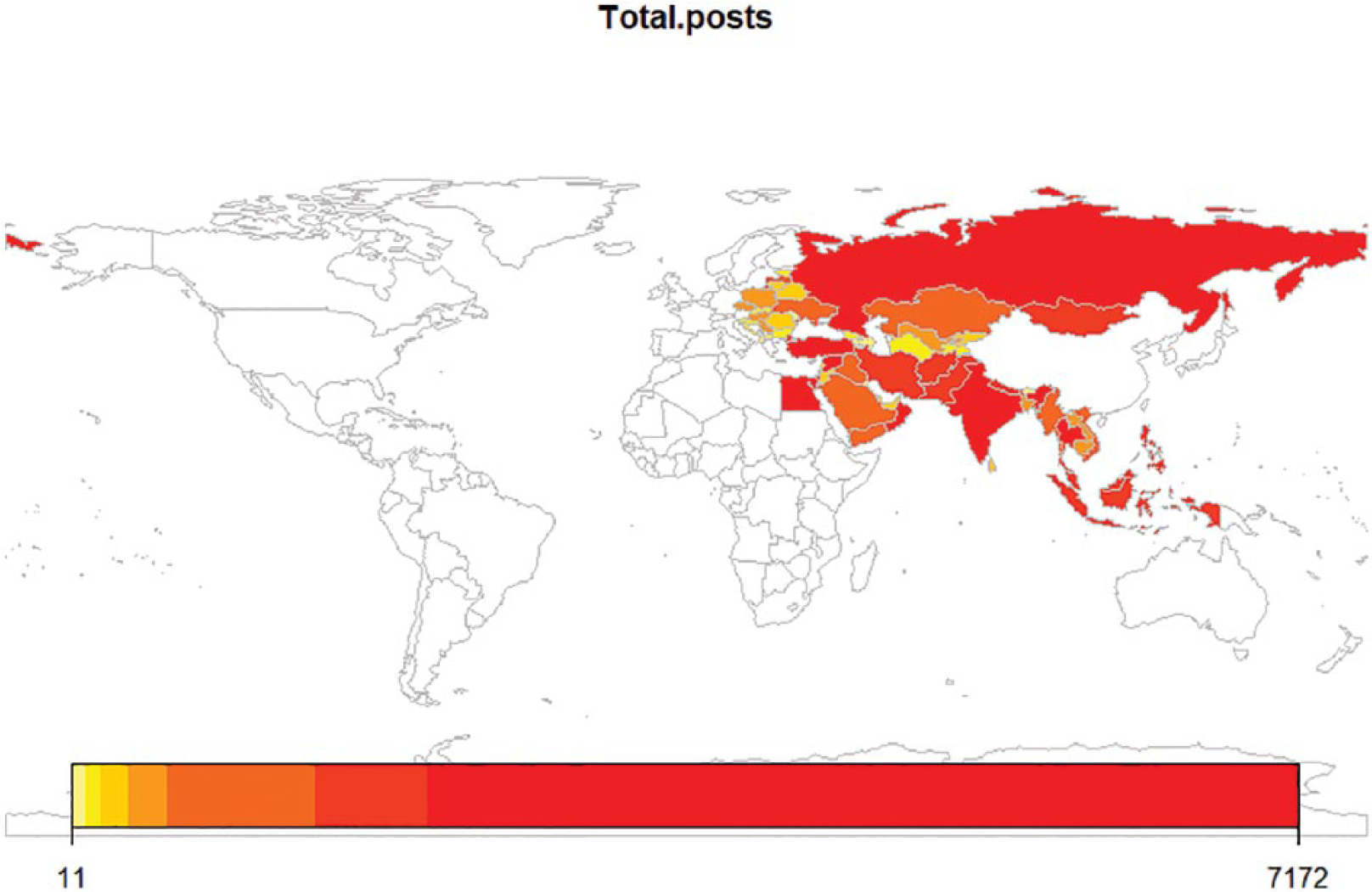
The amount of news for BRI countries.
In addition, RQ2 addresses news topics produced for the New Silk Road and BRI countries. Table 1 compares news topics between BRI countries and others. Obviously, these two groups had similar patterns: culture and entertainment, and society and family were the most popular news topics for both BRI countries and other countries, while civil rights, education, health, and science and technology were the least popular topics. These indicate that China’s news organizations created similar topics to attract Facebook users. Consistent with previous research, soft news and human interest were more likely to be posted by these official media than hard news like civil right and politics. However, Table 1 shows that China’s media also distributed distinct topics for these two groups. For instance, the coverage of BRI countries contained more accident and disaster, civil right, international affairs, and military and terrorism, and less stories about economy, education, and environment. Notably, the proportion of international affairs appeared in 20.3% of BRI countries news, which was one of the most popular news topics in this group. Similarly, news about military and terrorism was also popular topics for BRI countries (16.86%). In contrast, the coverage of other countries often focused on society and family (14.62%), and economy (13.25%).
The proportion of news topics by BRI countries and other countries.
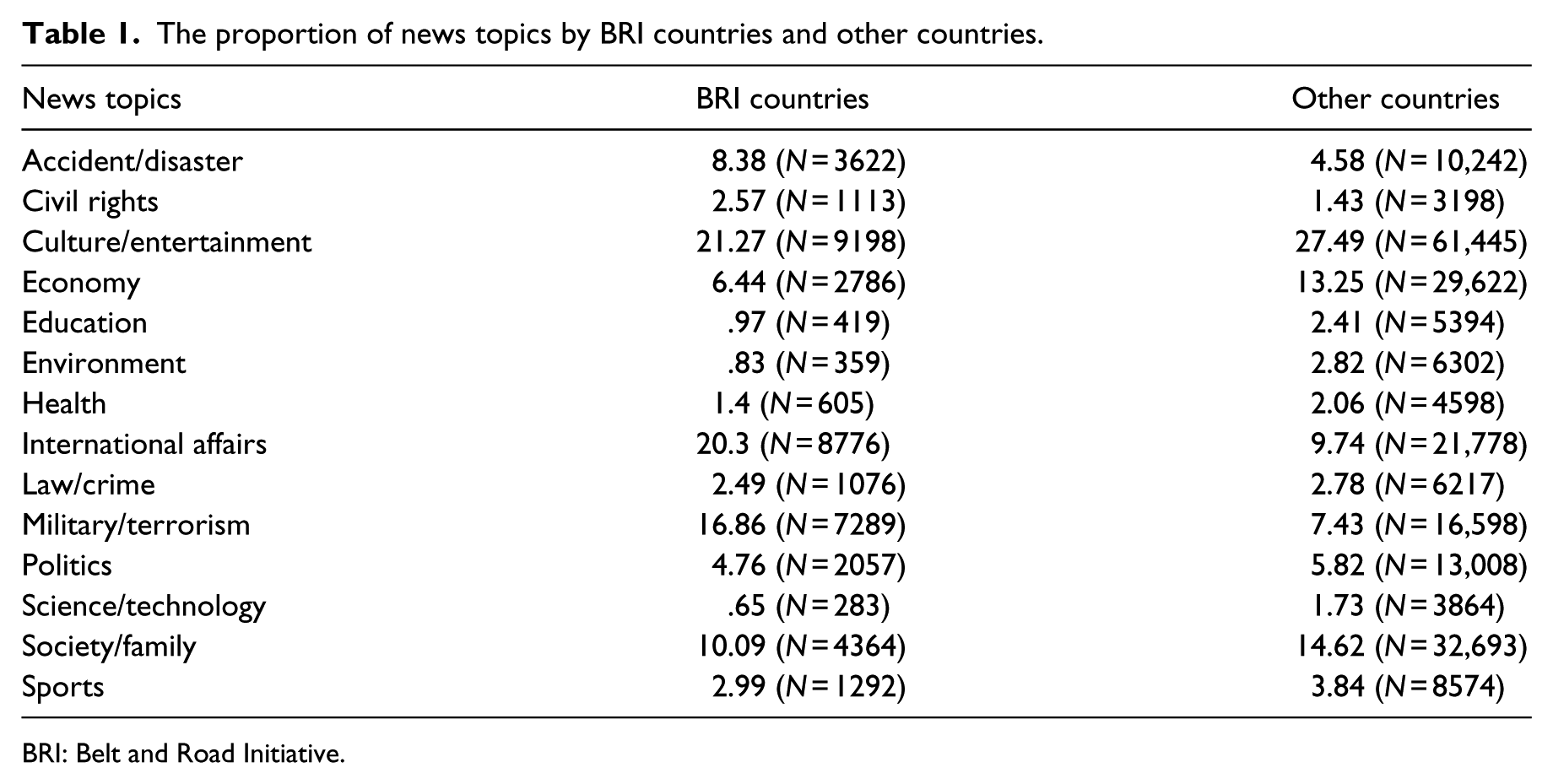
BRI: Belt and Road Initiative.
Moreover, H2 expects that China’s official media produced more China-related stories for the New Silk Road and BRI countries. To explore this hypothesis, this study compares the proportion of China-related news for BRI countries and other countries. The results suggest that certain topics (e.g. economy, international affairs, and environment) were more likely to receive China-related reporting than others like civil rights, politics, and military and terrorism. This finding indicates that China’s official media tended to promote China’s national branding and global images (i.e. China’s role as a builder of world peace) by connecting China with other countries’ economy, international affairs, environment, and education. Surprisingly, news stories regarding other countries were more likely to include China’s stories, compared with the coverage of BRI countries. For example, around 70% of education news about other countries had China-related content, while only 40% of BRI countries’ education stories contained China’s stories. One possible explanation is that the coverage of BRI countries contains a large proportion of accident/disaster and military, and China’s media are less likely to connect China with these issues. Thus, H2 is not supported.
To examine news sentiment for the New Silk Road and BRI countries (H3), this study plots sentiment scores for each news topic (Figure 3). In general, sports, international affairs, economy, and culture and entertainment had higher sentiment scores, while laws and crime, accident and disaster, and civil rights received negative sentiment ratings. Among these 14 topics, BRI countries achieved significantly higher ratings from three topics: sports (M = 1.07, SD = 2.62), international affairs (M = .92, SD = 4.86), and economy (M = .92, SD = 3.77). However, BRI countries had significantly lower sentiment in four topics: politics (M = .03, SD = 2.35), society and family (M = −.21, SD = 3.74), and military and terrorism (M = −1.08, SD = 2.43). Moreover, there had no statistically significant difference in other seven news topics. Hence, H3 is partially supported. These findings suggest that China’s official media tended to highlight the positive aspects of economy and international affairs for the New Silk Road and BRI countries.
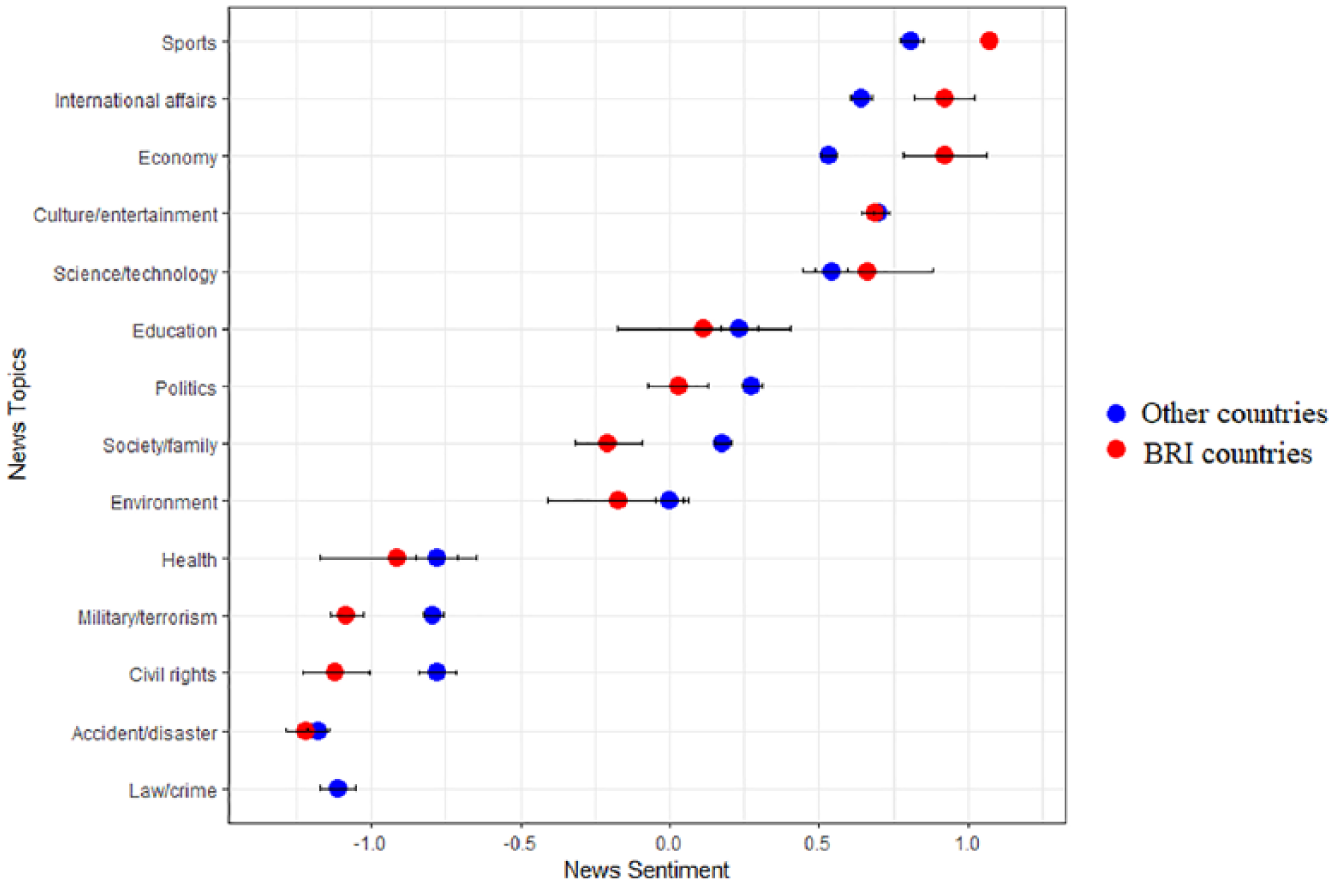
News sentiment (with 95% confidence intervals).
Predicting audience engagement with China’s official media
Furthermore, this study investigates audience engagement by examining Facebook likes, sharing, comments that the New Silk Road and BRI countries received. Overall, the distributions of these three metrics were similar in terms of showing very skewed patterns (Figure 4), suggesting that the majority of news about the New Silk Road and BRI countries received limited users’ attention whereas a few posts were widely liked, shared, and/or commented by Facebook users. The power law distribution is consistent with previous studies about audience engagement on social media platforms. This study has found that soft news including society and family, culture and entertainment, and science and technology was more likely to receive Facebook likes than hard news such as politics and law and crime. For instance, BRI countries received significantly more likes from news stories about society and family (M = 4077, SD = 10,604), economy (M = 1624, SD = 4553), international affairs (M = 1404, SD = 4405), and sports (M = 1759, SD = 8565). Similarly, soft news topics received more users’ sharing and comments than international affairs and politics. These results indicate that Facebook audiences actively engaged with soft news stories created by China’s official media.
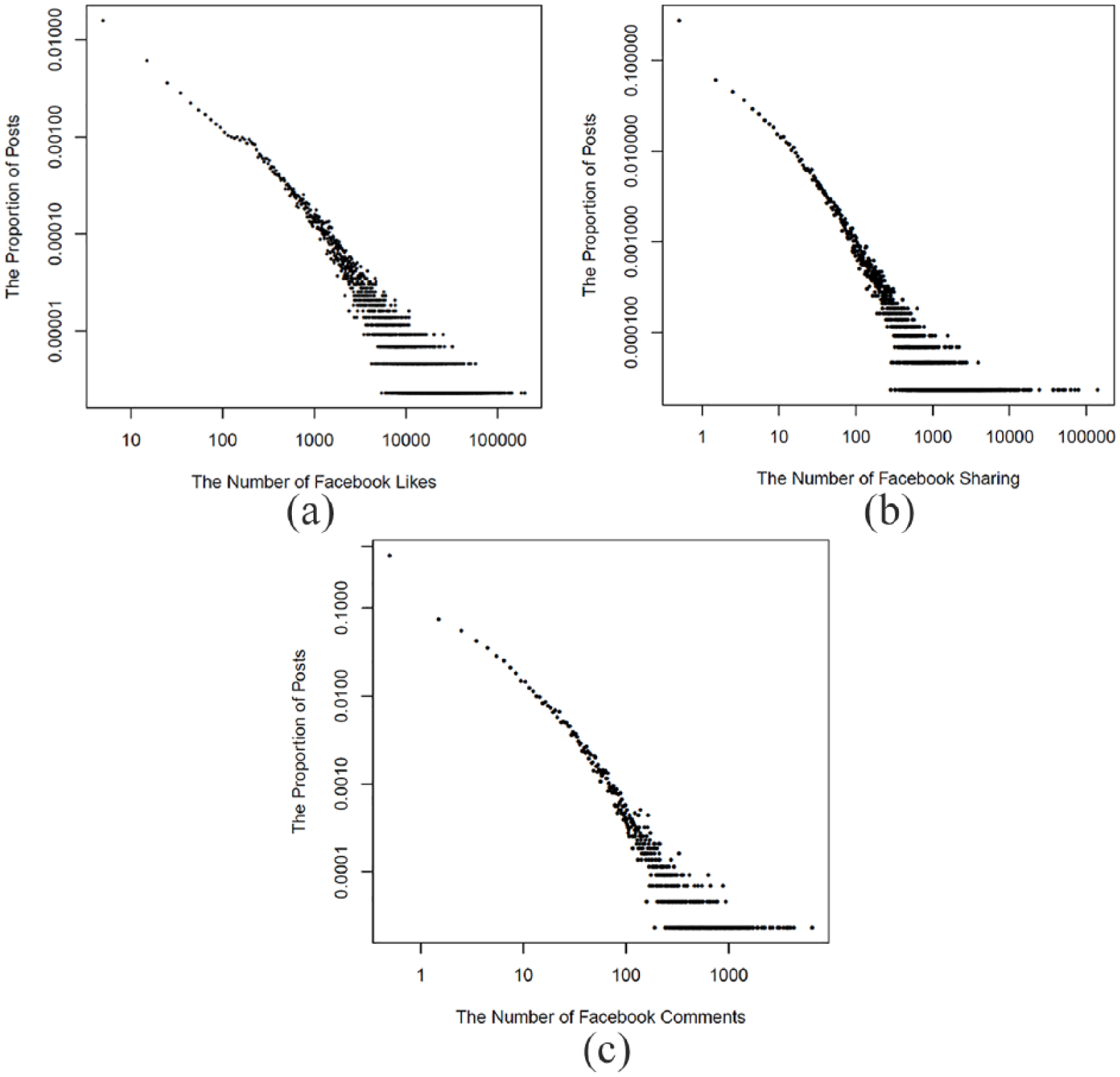
The distribution of Facebook: (a) likes, (b) shares, and (c) comments (BRI countries, log–log plots).
To address the predictors of audience engagement on Facebook (RQ3), this study estimates multivariate negative binomial regressions using 43,239 posts about the New Silk Road and BRI countries. The reason is that the dependent variables—likes, shares, and comments—only include positive integers and are right-skewed (likes: mean = 1987, median = 223, SD = 6704; sharing: mean = 114, median = 8, SD = 1159; comments: mean = 22, median = 3, SD = 104). Negative binomial regression is a suitable approach to model count data with overdispersion (Gardner et al., 1995). All predictors are entered in three negative binomial regression models to predict Facebook likes, shares, and comments, and audience engagement metrics are log-transformed when entering as independent variables.
To interpret the results, Table 2 reports the incidence rate ratios (IRRs) of negative binomial regressions. Generally, IRR is the ratio of two incidence rates, which can be interpreted as: one-unit increase in the independent variable leads to IRR% of expected count of the dependent variable. RQ3 asks how news topics, China-related news, and news sentiment influence users’ likes, shares, and comments on Facebook. Model 1 suggests that news stories about education, health, and society and family had positive and strong relationships with Facebook likes. For instance, news regarding health issues in BRI countries obtained 3.51 times as many likes as the baseline accident and disaster. However, hard news like economy, politics, and international affairs did not significantly change the number of likes.
Negative binomial regressions predicting Facebook audience engagement.
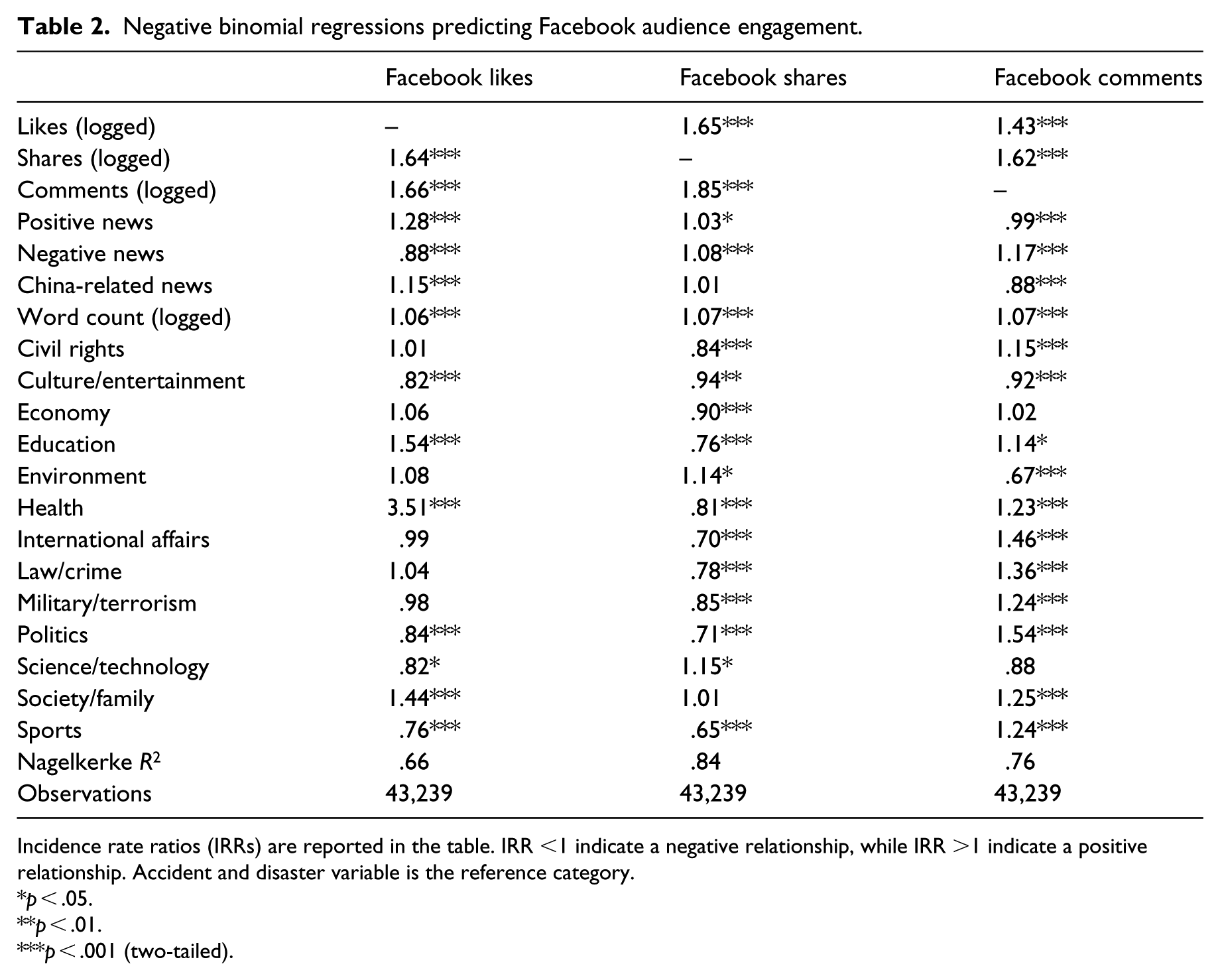
Incidence rate ratios (IRRs) are reported in the table. IRR <1 indicate a negative relationship, while IRR >1 indicate a positive relationship. Accident and disaster variable is the reference category.
p < .05.
p < .01.
p < .001 (two-tailed).
For Facebook sharing (Model 2), the interesting finding is that most news topics received less than 1 times as many shares as the baseline, and only environment, and science and technology had more Facebook shares. Thus, stories about accidents and disasters, environment, and science and technology were more likely to attract Facebook sharing, while other news stories were less likely to be shared by Facebook users. By contrast, Model 3 indicates that most news topics achieved positive association with Facebook comments. For example, news topics regarding international affairs had 1.46 times as many likes as the baseline. Therefore, the commenting behaviors of Facebook users were driven by various news topics.
In addition, China-related news achieved significantly positive result in Model 1 but had negative relationship in Model 3. In other words, while Facebook users were more likely to “like” a BRI news if it contained China’s stories, they were less likely to comment a post if it had China-related news. This finding demonstrates that China’s official media have attracted Facebook users’ attention and interest by increasing the number of Facebook likes for China-related news. However, Facebook users usually make comments for other countries’ stories rather than China’s issues. The mixed findings indicate that likes and comments are different audience metrics.
Finally, Table 2 shows that positive sentiment and negative sentiment have significant relationship with these three metrics. Specifically, Model 1 suggests that positive news obtained 128% of expected likes compared with the baseline (i.e. neutral news), while negative news received 88% of expected likes. In other words, global Facebook users were more likely to “like” positive news rather than negative stories. According to Model 2, both positivity and negativity achieved significant and positive results: positive news was shared 1.06 as many times as neutral news and negative news was shared 1.08 as many times as neutral news. Therefore, Facebook users were more willing to news stories containing sentiments. Interestingly, Model 3 shows that the directions of positivity and negativity were changed for news comments. Positive news received .99 times as many comments as the baseline, whilst negative news had 1.17 times as many comments as neutral news. Thus, negative news, rather than positive news, was more likely to encourage Facebook users to make comments. These findings indicate that positive sentiment and negative sentiment play different roles in explaining audience engagement. While positive content usually encourages users’ liking and sharing behaviors, negative information tends to increase users’ comments and shares on Facebook.
Discussion
While the New Silk Road is considered as one of China’s key foreign policies, much less attention has been paid to explore how China’s news media portray this initiative and how global audiences engage with the coverage of the initiative. As discussed, the New Silk Road indicates China’s intentions for strengthening its international influence and hard power, and the increased investments on Facebook also specifies China’s aspirations for promoting its soft power and global image. As China is becoming a significant player in international affairs, the interaction between its hard power and soft power needs more academic attention and scrutiny. This study, thus, examines how China’s official media produce news for the New Silk Road on Facebook and investigates what factors could explain audience engagement with these official news outlets. It is emergent to analyze news and information flows on an international level between China and countries involved in the New Silk Road, because this helps us understand not only the interaction between hard power and soft power but also the effectiveness of China’s media “Going-out” policy in the digital age. This study offers new directions and framework for understanding the coverage of a national initiative by China’s official media for global audiences, and contributes to soft power, media bias, and audience engagement studies.
First, this study contributes to scholarship about soft power practice by exploring how hard power is supported through soft power practices. Previous literature in this field often focuses on the effectiveness of soft power practice by Western states operating in non-Western states, little work has been done to examine the activities of non-Western states’ activities and innovations in the digital age. As a competing superpower, soft power and public diplomacy are the crucial capacities affecting China’s international leverage. Thus, this study expands the scope of this scholarship to current global realities. This study also aims to de-Westernize the scholarship by examining the interaction between China’s hard power initiative and soft power practice on Western networking platform Facebook. The results indicate that China’s official media have increased news production on Facebook since 2015, meaning that China attempts to promote its national-branding and global image by actively engaging with global audiences. In addition, while the New Silk Road and countries involved are considered as a key topic on Facebook, it is clear that China’s news outlets pay more attention to countries like the United States and Japan. These findings suggest that China’s media involve in promoting China’s hard power projects but also recognize the importance of major players across the world.
Second, the results shed light on China’s news production and framing from the perspective of media bias, which offers a new direction for understanding media “Going-out” policy on Western networking platforms and extends media bias scholarship. Rather than producing heavy-handed propaganda, this study finds that China’s media are becoming a leading player in global communication field by providing more soft news like culture and entertainment for both BRI countries and other countries. These findings further extend our understanding of China’s media practice on Facebook. Moreover, while media bias research usually emphasizes partisan media bias, the results of this study suggest that news media in non-Western country also generate media biases to reflect the state’s interests and goals. For example, the New Silk Road receives more positive sentiment from international affairs, sports, and economy, suggesting that China’s news media usually build different tones for BRI countries and others. This further indicates that China is employing soft power practice to promote its hard power by showing the positive aspects of international issues and economy for BRI countries.
Third, this study explores how Facebook users engage with news coverage produced by China’s media organizations, suggesting that news topics, China-related news, and news sentiment play significant roles in predicting audience engagement. Consistent with previous literature, soft news is more likely to receive users’ likes and shares on Facebook, compared with hard news like politics and international affairs. This explains why China’s official media tend to produce more soft news topics when the goal is to “spreading China’s voice” and “showing China’s role as a builder of world peace.” Previous research often suggests that social media users are more likely to engage with soft news, whereas news media usually focus on hard news (Bright, 2016). This study, however, finds that China’s media are less likely to produce this “news gap” since these news outlets cater to global audiences via spreading more soft news topics. Therefore, China’s media have become a sophisticated player on Western networking platform and Facebook audiences are actively engaging with this media practice.
These findings shed light on understanding the interaction of China’s hard power and soft power, as well as audience engagement with China’s soft power practice. The results of content analysis reveal that China’s official media are adopting its soft power practice to improve the visibility and positivity of China’s foreign policy on Facebook. More importantly, these media organizations are becoming skilled players on Western networking platforms by highlighting certain topics for global audiences. The audience engagement analysis further suggests that Facebook audiences are actively engaging with China’s media practice on Facebook.
This study concludes by noting some limitations. First, the automated content analysis employs “bag-of-words” so the order and position of each word is ignored in the analysis. While previous literature suggests that this approach is efficient in topic classification, it is possible that some latent topics and discourses may not be identified in this research. Second, this study combines all BRI countries and then compares them with other countries. While this approach provides interesting findings, it is possible that China’s official media might produce distinct topics and sentiments for these BRI countries. The third limitation is that it is unclear whether these official media interact with Facebook audiences. The scholarship of digital diplomacy claims that interaction and direct connections are key features when conducting diplomacy on social media. Thus, future research could explore the interaction between audiences and news media. Finally, this study does not investigate how China’s media compete with Western media on Facebook. It is argued that these media try to establish China’s discourse in global context. Hence, it is interesting to analyze how China’s media adopt the coverage of the New Silk Road to compete with other news media on Facebook.
In sum, this study provides evidence that China’s official media are using Facebook to cover and frame China’s national strategy and promote national branding. While previous literature in this field is primarily grounded in cases of Western democratic countries and traditional media, this study argues that it is urgent to understand China’s media practice on Facebook, because this case enables scholars to reexamine the existing theories and reconsider soft power and media bias from a comparative and global perspective. It is also important to clarify that this media practice is not alone: China’s official media are also employing other platforms like YouTube and Twitter to distribute news content and attract tens of millions of followers on these platforms. Meanwhile, some Chinese local governments (e.g. Jiangsu and Hunan) and commercial media (e.g. Yicai) are also emerging on Western social media platforms. Therefore, scholars should devote more attention to these investments to understand the strategies used by China to improve its soft power and global influence.
Supplemental Material
Appendix – Supplemental material for The New Silk Road on Facebook: How China’s official media cover and frame a national initiative for global audiences
Supplemental material, Appendix for The New Silk Road on Facebook: How China’s official media cover and frame a national initiative for global audiences by Fan Liang in Communication and the Public
Supplemental Material
Codebook-V2 – Supplemental material for The New Silk Road on Facebook: How China’s official media cover and frame a national initiative for global audiences
Supplemental material, Codebook-V2 for The New Silk Road on Facebook: How China’s official media cover and frame a national initiative for global audiences by Fan Liang in Communication and the Public
Footnotes
Funding
The author(s) received no financial support for the research, authorship, and/or publication of this article.

Supplemental material
Supplemental material for this article is available online.