




Abstract
Turkey and China are the countries that established their relations in the shadow of their ideological affiliation. Turkey constructed its multi-partied democratic regime as an implementation of Western-based democracy. However, this has not granted EU full-membership to the country, and Turkey has initiated alternative allies since mid 2000s. This shift of axis has turned into more enthusiasm after the failed coup d’état of 15 July 2016. The purpose of this study is to reveal how Turkish mainstream newspapers represent the Chinese alternative globalization project, “The Belt and Road Initiative” which was introduced in 2013 by General Secretary of the Chinese Communist Party, Xi Jinping. In order to frame the background information, we will first introduce the aims of the Belt and Road Initiative, and then summarize Turkey’s relation to China from two aspects: political and economic concerns. Following the overview of Turko-Sino relationship, we will focus on the Justice and Development Party’s foreign policy to grasp its pragmatic concern in relation to the Belt and Road Initiative. Based on the contextualization of Turko-Sino relations, we will conduct thematic content analysis of the news on the Belt and Road Initiative from May to July 2017 in mainstream Turkish newspapers. Our analysis brings into question how Turkish press relocates the Belt and Road Initiative with respect to Turkey’s political and economic concerns about China’s alternative globalism, Turkish foreign policy seeking for new allies as alternatives for the Western counterparts, and thus we will examine President Erdoğan’s influence on Turkish foreign policy. Based on our findings, we will discuss the reasons for insufficient coverage of the Belt and Road Initiative in Turkish mainstream newspapers.
Keywords
Introduction
Turkey and China are similar in terms of their origin of birth. Sharing the same steppes along the Silk Road, both countries experienced constant wars in ancient times, replaced by two distinct ideological camps in the 20th century. Currently, while Turkey is raising its critical voice against the West, especially US-led global hegemony, China is starting to offer a self-proposed globalization perspective to the world. The Belt and Road Initiative (hereafter, BRI) aims at restoring the historical Silk Road, the ancient trading roots in Eurasia, and creating a China-led trading and cultural and political network. However, given that the project incorporates mutual benefits and promotes the principles of cultural heritage and peace and development, it cannot be regarded just as a simple trading and culture cooperation. In fact, it offers a globalization perspective in the post-global era. To be more specific, China’s alternative globalization project consists of ideas, systems, and objects that comprise a tool kit for sustainable global governance, especially for developing countries. Opposing to the Western-oriented global order, Chinese perspective has been acclaimed as a non-hegemonic attempt, unlike the Western order. In parallel with this development, Turkey’s participation in the European Union seems to be a remnant and becomes a nostalgic memory for the Kemalist and secular population. Accordingly, Turkey needed a new influential story for the economic growth while evading fulfilling the basic democratic obligations and liabilities, requested by the European Union. First Shanghai-5 and then the BRI are argued to be the best alternatives for Western political orientation under the rule of President Recep Tayyip Erdoğan and the Justice and Development Party’s (JDP) governance. Since mid 2000s, Turkey’s search for alternative allies has been arguably formulated as a change of axis within the foreign policy and a pragmatic multiplication. Therefore, in this article, we analyze how the Turkish mainstream newspapers covered the BRI and related discussions during and after the 1st BRI Forum held in 2017 in Beijing. Thus, we will attempt to expose how the Turkish media’s attribution to the BRI is integrated with Turkey’s foreign policy’s concerns and its pragmatic approach to China’s alternative globalization project. At this point, we will first discuss China’s alternative globalization project – the BRI – to comprehend what it means. Then, we will summarize Turko-Sino relations to grasp Turkish mainstream news media’s framing of the BRI within the Turkish foreign policy’s interests by highlighting the JDP’s governance of the foreign policy.
China’s dream of alternative globalization
As we often say in China, a single flower does not make spring, while one hundred flowers in full blossom bring spring to the garden. All countries are closely linked and share converging interests. They should pool and share their strength. (Xi, 2014, p. 363)
In 2013, Chinese President Xi Jinping and Chinese Premier Li Keqiang both emphasized the need to build the Belt and Road, which can promote economic prosperity of the countries along the Silk Road and strengthen exchanges among different civilizations. The action plan of the China-proposed BRI was issued by the National Development and Reform Commission, Ministry of Foreign Affairs (MOFA), and Ministry of Commerce of the People’s Republic of China (PRC), with State Council authorization, on March 28, 2014. 1 China opened a special web portal 2 introducing BRI, just as MOFA did. The action plan explains BRI with respect to the Silk Road and details it’s being a route of commerce and communication between the East and the West. It defines the spirit of the Silk Road as “peace and cooperation, openness and inclusiveness, mutual learning and mutual benefit,” promoting the progress of human civilization, and contributing to the prosperity and development of the countries along the Silk Road. According to China, the Silk Road Spirit is both a historic and cultural heritage. Therefore, BRI is presented as a joint project that recreates the ancient Silk Road, connecting Asian, European, and African countries, and promoting mutually beneficial cooperation among the participant countries in new forms, based on a win–win understanding. At the beginning, instead of BRI, the project was called the Silk Road Economic Belt and the 21st-Century Maritime Silk Road Initiative. Following the Summit in May 2017, the Project has been renamed as “One Belt and One Road” (一带一路) (Yīdài yīlù) 3 (Miller, 2017).
The initiative, while putting emphasis on the growth of economic globalization, intercultural communication, and cultural diversity among the participant countries, is also aimed at promoting the free flow of trade and integration of markets. It, thus, strives to encourage the countries along the Belt and Road to develop economic policy coordination that benefits all. In fact, China seeks a new model of international cooperation and global governance, while highlighting world peace and mutual understanding, and thus renames globalization as alternative globalization. Alternative globalization means diversified, independent, balanced, and sustainable development among the participant countries, and it involves bringing the regions and people together to live in harmony, which is rooted in the Chinese conceptualization of living in the world, “All Under the Heaven” (天下).
4
China describes her role in alternative globalization as one bringing peace and development to humankind. It is possible to connect China’s discourse of alternative globalization with the revitalization of Confucianism and its concept of harmony, which occurs between individuals, within families, and between nations and states (Guo, 2004, pp. 78–79). These discursive practices are articulated and clearly operated by the Chinese government to promote the Chinese model of alternative globalization. According to Jean-Pierre Cabestan (2010), China has created her image as a “responsible great power” (p. 2), especially for the developing countries. In his speech on September 7, 2013, General Secretary Xi (2014) proclaimed that “China is committed to peaceful development and an independent foreign policy of peace. We respect the development paths and domestic and foreign policies pursued independently by the people of every country” (p. 316). Xi said that BRI is against US-centered globalization and its structural problems that have caused inequalities among the countries and that it aims to bring sustainable development to the world. The participant countries will have equal status and share resources fairly. At the opening speech of “The Belt and Road Summit,” delivered on May 14–15, 2017, Xi underlined that fair, acceptable, transparent global trade and investment are the core of BRI. Following the summit, in his speech at the opening of the 19th Chinese Communist Party (CCP) General Meeting, Xi, while emphasizing the success of socialism with Chinese characteristics and the realization of the Chinese dream
5
(Xi, 2017), explained the aim of BRI as follows: China champions the development of a community with a shared future for mankind, and has encouraged the evolution of global governance system. With this we have seen a further rise in China’s international influence, ability to inspire, and power to shape; and China has made great contributions to global peace and development. (Xi, 2017, pp. 6–7)
Yiwei Wang, criticizing Westrocentrism and binary opposition as a way of thinking, referred to China as an ancient civilization meant to end past hegemonies. To rise as more legitimate than the United States and Europe, China must set her goal as neither a superior firepower nor a discourse monopolizing power, as already done unreasonably and often not righteously by both the United States and Europe, but as a leader toward a better future for humanity where all civilizations could interact as peers in a healthier layout of voice and power. To achieve this goal, China has rearranged her own Asian heritage (Wang, 2015, p. xvii). Therefore, the countries especially those that are seeking new allies against Western hegemony, and the developing countries such as those in Africa, and South East Asia considered BRI as China’s alternative globalization project and China’s emphasis of Asian heritage as a tool kit for sustainable global governance and economic growth.
The uniqueness of Chinese governance is derived from the concept of “permission,” an inheritance from the Middle Kingdom era (Wang, 2015, p. 138), which explains how the harmonious world is created by balancing different interests, powers, and values. This model, the China model, is a contribution to the sustainability of humanity (Wang, 2015, p. 155). While Chinese government is applying the narratives of Middle Kingdom heritage and Confucianist definition of harmony (Brown, 2010, p. 88; Hess, 2010, pp. 52–54) as her discursive tools to achieve her dream, these narratives are seen by the neighboring countries as an alternative approach to globalization led by Western countries.
To achieve the Chinese dream briefly explained above, the Chinese government emphasizes research, innovation, and development, as well as military strengthening. We should also mention that apart from economic influence, the Chinese government has invested more heavily in cultural politics (Flew, 2016), following Xi’s address at the 19th General Meeting of the CCP: “The cultural soft power of China and the international impact of Chinese culture have been increased” (Xi, 2017). Furthermore, in the case of China, we should focus more on the overlap of cultural nationalism and Party-led state nationalism, although both have different motivations (Guo, 2004, p. 34), while considering the influence of BRI at the cultural diplomacy level. As Zamorano (2016) noted, cultural diplomacy, which was “initially linked to neocolonial expansion and to propaganda,” recently became a main instrument for attaining symbolic power by the governments (p. 176).
Historical overview of Turkey’s relations with China
Turkey and China both paid more attention to economic scale in establishing relations with each other. The cultural aspect of their relations has only recently been put on the two countries’ agenda despite their mutual heritage known as the Silk Road dating back to ancient times. In fact, the first bilateral relations were developed between Kemalist Turkey and Kuomintang China. Turkey’s participation in the Korean War in 1950 to promote the Western campaign was a stepping stone that caused a huge suspension in the relations as both countries fell into different ideological blocs then. In the meantime, although Turkey constructed its multi-party democratic regime as an implementation of Western-based democracy, this has not granted Turkey full membership in the European Union, and thus, one of Turkey’s most fervent intentions ever turned out to be an embarrassment that rather caused an identity crisis. As PRC has attended UN Security Council as a permanent member, Turkey established diplomatic relations with the PRC in 1971 following nearly two decades of refusal to recognize. All the NATO (North Atlantic Treaty Organization) members did so, likely upon American encouragement, to form a balance against the USSR. In the Cold War era, Turkey formulated its foreign policy mostly in line with its NATO member status. In the 1970s, when Turkey faced economic and political instability, the debates on a closer relationship with China revolved around the question of “whether the expected economic benefits would justify taking the political and ideological risks of recognizing [the] ‘Red China’” (Atlı, 2016, p. 7), following a pattern of alienation from the West. Nonetheless, Turkey’s recognition of China is, on one hand, a consequence of a pragmatic initiative in Turkish foreign policy, and on the other, a subsequent American encouragement. It could also be stated that it was an outcome of “relative autonomy” of Turkish foreign policy. Relatively pluralistic political climate of the 1960s caused Turkish foreign policy to expand toward the developing world, mainly China, India, and Pakistan, along with its Western-ally identity. This move has been regarded as an “optimal balance” (Gönlübol & Kürkçüoğlu 1987, p. 539) against Western orientation, or rather “relative autonomy of Turkish foreign policy” (Oran, 2001, p. 43), which is an implementation of Poulantzas’s concept of IR (international relations) theory. It was originally based on Althusserian structuralist criticism on the instrumentalist phase of state, reduced to the political form of dominant classes. Poulantzas cast doubt on this argument by remarking “political structures consist of the institutionalized power of the state and that political struggles therefore have the state as their objective” (quoted from Gulalp, 1987, p. 292).
Beijing’s political reforms and Ankara’s economic liberalization in the 1980s caused the two countries to seek new markets, and as a result, diplomatic and commercial traffic between both countries significantly boosted. The 1980s was a stage for bilateral subsequent visits that were rendered in both countries. As a consequence, in the 1980s, the Turko-Sino relationship grew mainly on economic basis and enhanced a positive climate leaving the ideological concerns behind, and the relations remained superficial until the beginning of the 21st century (Çolakoğlu, 2012; Zan, 2016).
Although the economic interests underlying the Turko-Sino relationship gained ground in 1980s, this gain did not move on to the 1990s as the Eastern bloc collapsed. This incident led Turkey to consider becoming a regional power and filling the power gap left by the former USSR. Thus, Turkey started to wield influence over the countries whose populations were mostly Turkic Muslim, in the name of disseminating what it called Turkish model. The slogan of “a whole Turkic world from [the] Adriatic to the Great Wall of China standing up” aptly summarized Turkey’s vision of Central Asia, even if not comprising the whole of its foreign policy. Based on this new foreign policy in 1990s, Turkish Presidents Turgut Özal and then Süleyman Demirel frequently mentioned the economic and cultural support given to the Uyghur community living in Xinjiang Uyghur Autonomous Region 6 (新疆维吾尔自治区) (Xīnjiāng Wéiwú’ěr Zìzhìqū) (XUAR) in China. Since then, MOFA and mainstream media have paid attention to the voices of the Uyghur opposition leaders. The Turkish media and politicians from both ruling and opposing parties called this issue “East Turkestan problem.” Consequently, the Uyghur community in Xinjiang has become the main political trouble among Ankara and Beijing governments (Atlı, 2016).
The Uyghur community in Xinjiang is considered as one of the biggest national security threats for Chinese government along with other sensitive topics such as Taiwan and Tibet’s status and Hong Kong. After the 1949 revolution, a significant number of the Uyghurs migrated from Xinjiang and initiated diaspora activism taking media coverage. The activities of the Uyghur diaspora have aroused sympathy among the far-right ultranationalists in Turkey and boosted lobbying against the reconciliation of Turko-Sino relationship. However, since 2000s Turkey have developed a new approach for both Russia and China, emphasizing respect toward both countries’ territorial integrity. After Beijing’s crackdown in Xinjiang in 2009, 7 Turkish Prime Minister Erdoğan (now President) called the crackdown as genocide. Despite that, Turkey has not carried on with a strong response such as giving note, but instead declared that Turkey would not interfere with China’s domestic affairs (Talbot, 2018). After a decade of Xinjiang oppression, now Ankara is not reacting against Beijing’s implementation of mass detention camps in the region, 8 due to the importance attached to BRI.
Turkish foreign policy under JDP governance
In the early 2000s following weak and short-lived coalition governments as well as the economic crisis, Recep Tayyip Erdoğan and his party, JDP, came into power in 2002. Since then, JDP has significantly transformed Turkish foreign policy with long-lasting results. Having come into power in 2002, PM Erdoğan and his JDP announced his 2023 political visions to mark the centennial anniversary of the proclamation of republic in Turkey. In this respect, Turkey’s foreign policy was formulated as “pro-active” in pursuing pro-EU policy and broadening to former Ottoman regions until the Syrian uprisings. Minister of Foreign Affairs, Ahmet Davutoğlu emerged as the leading figure theorizing on Turkey’s new foreign policy under JDP governance. His magnum opus, titled Strategic Depth (originally Stratejik Derinlik) (2001), a policy doctrine book only available in Turkish, reflected Davutoğlu’s former academic background as an IR professor and position in framing present-day Turkish foreign policy, which suggests incorporation of Turkey’s historical and cultural elements into foreign policymaking in the Islamic context. It also refers to the former Ottoman territories as “land [of] strategic depth” to be influenced in the neo-realistic sense, also called neo-Ottomanism, and as an antithesis to the supposedly ideological Kemalist perspective that alienated Turkish people from the Empire territories. In Strategic Depth, Davutoğlu does not make any special remark about China but considers Asia as a land in which significant events were happening, rapidly changing the world’s political-economic system, and states that Turkey had not benefited from this strategic value (Davutoğlu, 2001, p. 216). With Davutoğlu, whose understanding of foreign policy is based on neo-Ottomanism, Turkey started to increase the number of foreign missions, conduct a proactive diplomacy, and support the activities of Yunus Emre Institute as tools of soft power.
Under the rule of JDP, Turkey implemented a global and multifaceted foreign policy in Latin America, Africa, Middle East, and China (Ekşi & Erol, 2018, p. 18). According to Keyman (2009), Turkey had multi-dimensional roles and identity-based perceptions to implement as key components of capacity (p. 22). A senior diplomat and recent Presidential spokesperson Ibrahim Kalın (2011) wrote as follows: “Turkey’s newly emerging actors position themselves as active players demanding the global transformation of centre-periphery relations to create a more democratic and fair world-system” (p. 5). Subsequently, Turkish pro-activism has become a hegemonic attempt along with Erdoğan’s rhetorical attacks to the basic structures of the international system, often using this populist phrase: “The [whole] world is bigger than five [permanent members of UN Security Council].” Moreover, Erdoğan has used his postcolonial arguments strategically to engage non-Western regions. As argued by some experts, “Turkey demonstrates [ . . . ] that questioning of the colonial past of the international system and its (post)colonial present could also enable discourses that reproduce hierarchies and contribute to the continuation of exclusionary practices in the international system” (Çapan & Zarakol, 2017, p. 205). Moreover, Erdoğan’s effort to reach out to non-Western regions has also been argued as change of axis, 9 following long-lasting disappointment of the EU story, and represents Turkey’s pragmatic search for alternatives (Gönlübol & Kürkçüoğlu 1987). While Erdoğan focused on the rest of Europe to seek alternative allies, he also continued to pursue negotiations with his European counterparts about one of the most crucial contemporary issues, namely the refugee crisis. In the meantime, Erdoğan did not insist on being out of the Western establishment and maintained Turkey’s memberships in NATO and the Council of Europe. Although Turkish Republic has regarded the European Union as the most significant democratization project since its founding, it has not fully satisfied the conditions of accession so far. The country has raised its critical voice, insisting that the European Union has applied double standards for more than a decade. In particular Erdoğan’s attacks incorporating solid rhetoric toward the European Union have channelized Turkish vision into seeking alternative allies. This search of identity resulted in both reluctance and exhaustion regarding the European Union after “getting tired of waiting at the door of Europe”; meanwhile, the EU story has turned to a “Why not EU?” (Yaka, 2016) manner in the Turkish political elite. Turkey’s full membership would validate Kemalist modernization project’s success, but any failure would serve for Islamists and ultranationalists. As such, “foreign policy becomes an extension of domestic identity crisis and carries the signs of power struggle among separate groups with different identities” (Bozdaglioglu, 2003, p. 90). Thus, Turkey’s new vision of China is pragmatically positioned in a backup position to be operated in case the relations with the West falls. As Turkey moves away from the West, the “Chinese miracle” is claimed to be one of the favors of Erdoğan’s governance of both foreign policy and economics. Erdoğan has practically needed an achievement story of a growing economy, which challenges the argument that economic growth is dependent on human rights or liberal democracy. Kalın (2011) supported China’s response to Western criticism that economic growth is not possible without internalizing liberal-democratic values. Turkey has become a dialog partner of Shanghai Cooperation Organization, which was arguably “more to do with Turkish frustration with its Western identity than a commitment to bandwagon Russian and Chinese leadership” (Aras, 2017, p. 11). At this point, we eventually come across the main reason for the pragmatic interest of JDP government in China and China’s alternative globalization project, especially after the failed coup d’état in 15th July 2016.
It is also argued that Turkey’s enthusiasm for the project has two main economic reasons: more Chinese direct investments to be expected and Turkey’s consolidation itself as a transportation hub (Chaziza, 2016, p. 277) in the Middle Corridor. According to the Chinese government, Turkey’s place within BRI is as the “Middle Corridor,” where the coordination mechanisms in terms of railway transportation and port customs clearance for the China–Europe corridor are conducted. Turkish senior economist Fatih Oktay (2018) recognized the “Middle Corridor” as an opportunity for Turkey to provide new services and products to East and South Asian countries amid escalating trade wars and tightening custom regulations, in spite of globalization (p. 52).
President Erdoğan ambitiously summarized his visions in his speech in 2017 at the BRI Summit in Beijing. The excerpt below shows how he is in accordance with the Chinese perspective: Turkey wants to play a pivotal role in the Belt and Road Initiative as a geographical and cultural bridge linking East and West, as an indispensable partner of China. [ . . . ] The New Silk Road initiative [ . . . ] will benefit from bilateral, multilateral and regional cooperation, is put into practice in an understanding of “win-win.” This harmonious system in political and economic areas will herald a new era based on stability and prosperity. (Erdoğan, 2017)
In summary, Turkey’s current relations with China have the potential to develop in accordance with Turkey’s search for alternative ally even though this search is based on more pragmatic interests. Turkey will more likely track a fluctuating route in its relations with the West. This might result in Turkish foreign policy gaining more relative autonomy.
Framing of BRI in Turkish Newspapers: a thematic content analysis
The framing of China-related news stories by Turkish media is rather problematic, with underrepresentation, misrepresentation, or labeling. A few studies have analyzed Turkish news coverage of China in terms of either positive or negative framing (Ergenç, 2015), and news interpretation within social cognition (Gezgin, 2018). Ergenç’s (2015) study of news showed that the news coverage mostly tended to be neutral if Turkey did not have any interest in China. Gezgin’s (2018) study showed that the news about China had a very limited number of topics, such as male–female population imbalance, one child policy, made-in-China products, Xinjiang case, and air pollution. Also, the representation of BRI through media has rarely been researched. In one of those rare studies, Zhang and Wu (2018) show that the portrayal of BRI by British mainstream media is conflicting; China is represented as a significant player for global economy, along with authoritarian and geopolitical threat depiction.
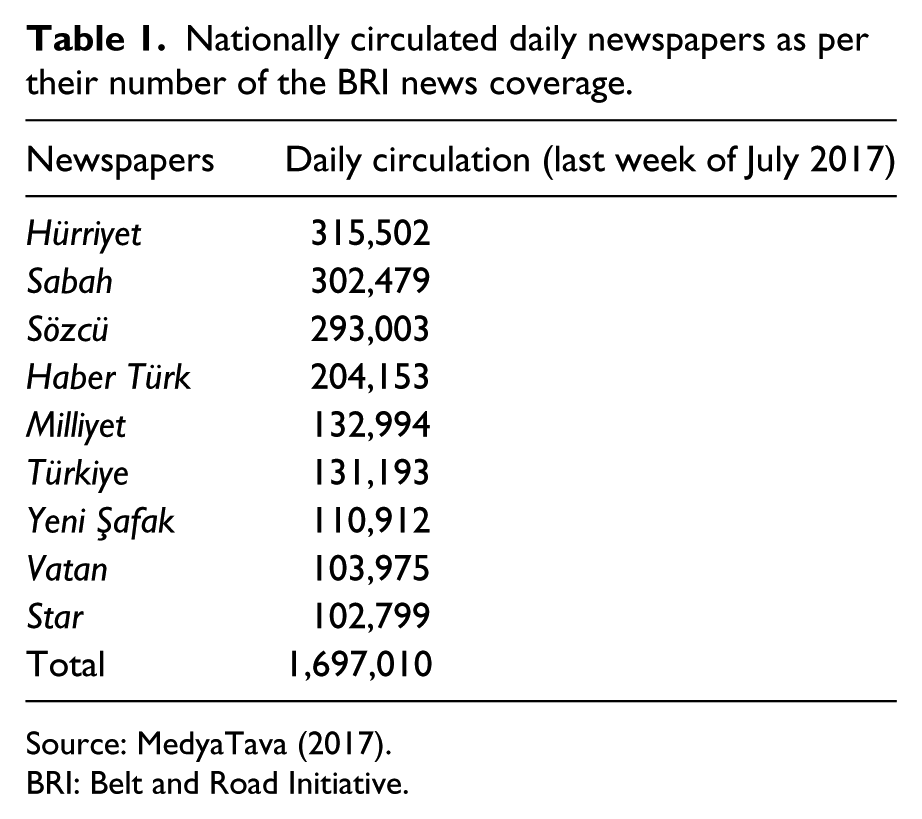
We conducted content analysis, described by Bernard Berelson (1952) as a research technique for the objective, systematic, and quantitative description of the manifest content of communications. Through conceptual content analysis, the dominant concepts, patterns, and repeated themes of news items are revealed in a descriptive approach (Hsieh & Shannon, 2005). Content analysis gives researchers the opportunity to combine unrelated materials with a logical link and then information is transformed into analyzable units (Krippendorff, 1980). Categorizing the main themes of news items reveals the manifest content of the texts and helps connect the themes with a macro-level discursive strategy, such as the dominant policy of the government. Our main research question is as follows: How have the Turkish mainstream newspapers represented BRI and in which context? Therefore, we thematically analyzed 59 news articles published in the print editions of national newspapers with a daily circulation of more than 100,000 copies. As the media coverage of BRI continued from the beginning of the Forum to almost the end of July, for the analysis, news items were selected from May 1 to July 31, 2017. The list of the newspapers (tabloids were omitted) is shown in Table 1.
Nationally circulated daily newspapers as per their number of the BRI news coverage.
Source: MedyaTava (2017).
BRI: Belt and Road Initiative.
According to MedyaTava (2017), an online network monitoring, the average of all newspapers sold for the last week of July 2017 was more than 3.2 million. Mainstream media in Turkey have always been vulnerable to government influence and journalistic autonomy. The Turkish media landscape has undergone numerous ownership takeovers that resulted in press–party parallelism, along with the elimination of media pluralism (Eldem, 2018). A traditional distinction of pro-government, anti-government, or mainstream is not applicable to Turkish media. Thus, we can only consider newspapers as mainstream based on circulation; in this study, we used the threshold of at least 100,000 copies sold per day. Therefore, the newspapers provided in the Table 1 do not represent every aspect of the Turkish political spectrum. However, we can say that most of the newspapers, except Hürriyet 10 and Sözcü, have pro-government stance and the ownership of these newspapers fully belonged to either JDP supporters or Islamic capital (Sözeri, 2018; Yeşil, 2016).
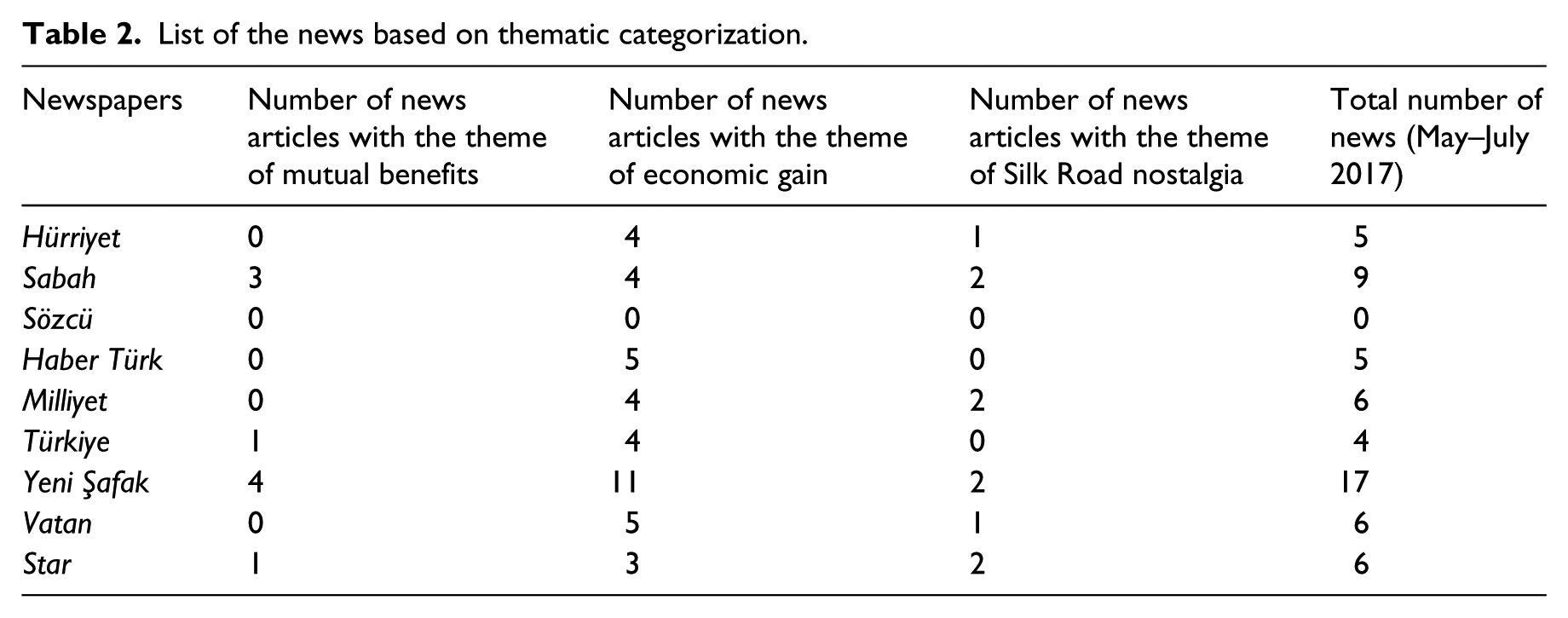
We claim that Turkish mainstream newspapers frame BRI within three main themes: mutual benefits, economic gain, and Silk Road nostalgia (See Table 2). Therefore, to reveal these themes and dominant framing, we analyzed the definitions, vocabulary, reference links, background information, and explanations regarding geographical and historical locations. The dominant framing of BRI and China in the news has been integrated into Turkish foreign policy, especially President Erdoğan’s self-determined foreign politics.
List of the news based on thematic categorization.
Mutual benefits
As an alternative globalization project, BRI locates itself in line with the criticism of the West by emphasizing win–win cooperation, mutual prosperity of the participant countries, and equality. The project also considers mutual benefits against Western hegemony. Thus, under this theme, news articles emphasized peace and development among the participant countries. Nine news articles (4 from Yeni Şafak, 3 from Sabah, 1 each from Star and Türkiye) were related to this theme, only consisting of 15% of the total and thus accounting for the least number of news. The news articles also seemed to be clustered at the time of Erdoğan’s trip to Beijing (all news, except one, was published between May 3 and 16). The news article titled “New Global Order to Be Risen in Beijing” (Yeni Şafak, May 3, 2017) reported on President Erdoğan’s future trip to Beijing to participate in the BRI Forum. The article also stated that globalization would be discussed in the context of mutual benefits and win–win concept. Another piece in Yeni Şafak, a full-length article on May 13 titled “Lifeblood of the 21st Century: One Belt and One Road Project,” defined the project as “an investment project located in an unprecedented market that matters [to] 1 billion people” as a “huge economic front against the US-led Atlantic system.” Another piece, titled “Mutual Development to Be Accelerated” (Sabah, May 14), was mostly about the Chinese ambassador’s statements. The article announced that Erdoğan would participate in BRI Forum in Beijing and the correspondent seemed to have asked this question by framing the event only by Erdoğan’s official trip. However, Ambassador Yu Hongyang’s comments focused on strategic relations between China and Turkey and the importance of mutual benefit and development. Another news item in Yeni Şafak (“The Manifestation of the New Global Order,” May 16) underlined the gist of the speech of President Xi: “BRI as an alternative against Western hegemony.” In Türkiye’s piece titled “China Gains Power Through Six Regions in the East” on July 11, the report indicated that “BRI [promises] global prosperity [as a] strategic cooperation project” for Turkey.
Economic gain
Economic gain mainly focuses on the economic interests that only benefit Turkey, in a narrowed scale. Turkey’s specific expectations from BRI such as the influx of more economic investments and containment of terrorism are the essence of this theme. In this respect, Turkish mainstream newspapers framed BRI from an instrumentalist approach, by underlining the progress in Turko-Sino relationships, the struggle against terrorism, Turkey’s significant location in the Middle Corridor policy, and the importance of the Chinese investments in Turkey. As it is clearly seen, Turkey’s approach to BRI was mostly based on Turkey’s alternative-ally seeking that would replace downgraded relations with the West. News related to the economic gain theme comprised the most frequent type, numbered 40 (68%) in all of the newspapers, except Sözcü.
In Vatan’s piece with the headline “Leap Forward of the Relations With China” on May 11, the reporting was framed with a direct quotation from Erdoğan during his flight to Beijing: “the BRI Summit could be a leap forward for the country’s relations with China”. Sabah’s report on May 15 quoted Erdoğan, in his response to questions from accredited journalists on his flight back to Turkey: “We are now going ahead rapidly along the route named the Middle Corridor of the New Silk Road Initiative. Our investments for the project will be greater.” Milliyet’s piece on May 14 covered Erdoğan’s opinion on the forum: “We will pursue supporting this project by opening a new economic phase with China,” which formed the headline; the article provided neither background information nor political emphasis.
In an article in HaberTürk on May 17, titled “Being on the Same ‘Road’ With China Changes the Order,” the report stated that Turkey was seeking alternative allies in lieu of its dependence on the European Union for foreign trade. This news item included a metonymy. In Turkish the expression “Yol/daş Olmak,” which literally means “being” on the “same road,” is associated with socialist values as the word “yoldaş” also means “comrade,” and the way this expression is used implies that seeking a new ally will change the “world order,” in other words, the Western hegemony. Metaphor and metonymy are often used together (Berger, 2005, p. 29). The previous news also used a metaphor: the word “order” carries an implication to the power games among the nation-states. An article in Yeni Şafak published on May 19, titled “We Are at the Center of the New Balance. The Countries in Our Region Cannot Be Away,” is another quotation from Erdoğan from his statement on BRI. Both the new world order and the new balance were frequently used to describe the alternative globalization project from the viewpoint of Turkish foreign policy.
The struggle against terrorism is another feature of this theme. Hürriyet’s report on May 15 quoted Erdoğan’s speech on the Summit, titled “Economic Road Against Terrorism,” and mainly underlined the necessity of cooperation against terrorism. For example, in Haber Türk published on May 14, Xi’s statement of “We Won’t Support Gülenists Anymore” was headlined. On the same day, in Milliyet, Xi was quoted stating, “We Stand With Turkey [against terrorism],” and in Yeni Şafak, “We Won’t Allow Threats Against Turkey.” On May 15, in Vatan, “[BRI will] Demolish Terrorism” was provided in the headline. Terrorism has been one of the topmost issues for both Turkish and Chinese politics, along with the Xinjiang case, which is the most sensitive topic in the relations. “The Initiative that will also teardown terrorism” was quoted from Erdoğan in the subheading, without emphasizing the Chinese perspective of Uyghurs as a rebellious ethnic group against China. From Erdoğan’s words, it can be inferred that BRI would also allegedly bring benefit to Turkey’s never-ending struggle against Kurdish separatists or his former domestic ally, the Gülenist organization. Terrorism has also been a top topic of the disputes between Turkey and the United States after the failed coup d’état. According to Erdoğan, military attitudes toward democratically elected parties also mean an arrogant approach toward the nation (Oral, 2015, p. 126) and against national will. Terrorism versus national will formulation has recently become one of the main dominant discursive strategies of the foreign policy.
Silk Road nostalgia
The Silk Road is widely used as a metaphor referring to the extent of BRI in both economic and cultural terms. Having a strong historical background, the revitalization of traditional routes is highlighted to create a network among countries located along the Road. Not only economic pragmatism but also historical and traditional background that dates back to the ancient times is stressed to legitimize BRI. The Silk Road metaphor represents the ancient steppes in which both peoples were trading and engaging in cultural exchange. This point is noted in the China Daily Türkiye magazine published in Turkish: Westerns critical approaches are quite normal, because they have no idea of the spiritual value of the Silk Road. However, it is impossible to negatively perceive a project whose name contains the phrase Silk Road. This phrase has been the only thing that caused China to be praised in Turkey in the recent years. (Demir, 2018, p. 25)
Through the Silk Road metaphor, news produced the feeling of nostalgia as well. The term nostalgia derives from the Greek word nostos, meaning “to return home” (Davis, 1979). On the production of nostalgia, Pickering and Keightley (2006) said that it “. . . arises only in compensation for a loss of faith in progress, and for what is socially and culturally destroyed in the name of progress” (p. 920). Our study identified 10 pieces of news in which the Silk Road was used as a nostalgic theme. In the reports in the Milliyet titled “Caravans to Be Prepared for the Silk Road” (May 16, 2017) and Vatan titled “Modern Caravan Project for the Silk Road” (May 16, 2017), Minister for Transportation, Maritime Affairs and Communication Ahmet Arslan’s proposal for his Chinese counterpart was covered. The proposal was a plan for a test drive of a 10-vehicle convoy to be undertaken along the full length of the Middle Corridor. The content of both news was almost the same. The Minister himself named his proposal as the “Caravan project” following his opinions on BRI: “The Modern Silk Road strategy connects Turkey with China via [the] Caspian Sea and Central [Asian] states.” The points worth debating in the context of Western centrism are the definition of the Silk Road as modern and comparison of the convoy with caravans. More interestingly, the images that represent BRI also associate with caravans and the ancient Silk Road. These images seemed applicable in terms of producing nostalgia while living in modernity. As Pickering and Keightley (2006) underlined, nostalgia does not only provide an ontological security in the past but also enables bearing the uncertainties of the present times (p. 921). The emphasis on the Silk Road nostalgia by political agents thus provides a secure land to handle the current political, social, and economic problems of Turkey. This discursive strategy thus engages the heroic and unquestionable past with today’s agenda and offers a very special definitions of situations to understand the agenda.
Other news from Milliyet reported Minister Ahmet Arslan’s words on Baku–Tbilisi–Kars railroad project, metaphorically called the Iron Silk Road, which was going to be officially initiated as Baku–Tbilisi–Kars railroad on September 2017. Here, the Iron Silk Road also has a nostalgic reference and produces the feeling of the past. Hürriyet’s news report on May 20 carried on the same discourse as the previous news, but referring to the fiber wiring investment along the Middle Corridor, by citing Minister Arslan’s speech: “We take [the] fiber corridor that connects the countries [seriously].” What is meant with the word connectivity here was the integrative manner of providing better relations between the countries, and it was also engaged with the Silk Road nostalgia. This time the Silk Road metaphor was used as a resource for a bright future. Similarly, Xi emphasized “community of common destiny” (Miller, 2017, p. 19).
Conclusion
The first point worth remarking is that Turkish mainstream media are not aware of the political, economic, and historical importance of BRI, as it is explained in the first part of this study. Instead, Turkish mainstream media frame BRI from the symbolic aspects within the mythic discourse of the Silk Road. The media have not recognized what China’s alternative globalization means, and they frame China’s dream with respect to the pragmatic engagement of Turkish foreign policy. Besides, it is clear that the news framing of BRI have been fully integrated into President Erdoğan’s hegemonic position in Turkish politics—the media directly quoted from President Erdoğan’s views about BRI and developed the news stories regarding Erdoğan’s approach to this issue. Second, we should mention that the insufficient number of BRI-related news is worth noting. The highest inconsistency can be seen in Yeni Şafak and Sözcü. The former, historically a pro-Islamist newspaper, produced 17 news articles, whereas the latter, the only anti-government newspaper with high circulation, published none. The reason Sözcü published no news regarding BRI is the terrorism investigation that Sözcü itself faced at that time. Third, another inconsistency can be seen among the themes in terms of news quantity. Economic gain, the theme with the highest quantity, was in line with Turkey’s pragmatic vision of BRI. 11 President Erdoğan paid an official visit to Washington immediately after participating in the Beijing Summit. Erdoğan may have been seeking to use BRI as leverage for disputes in anti-terror policies and extradition of terrorists with the United States, particularly after the failed coup d’état. This also shows that the vision of the Turkish foreign policy for BRI is marked by pragmatism. This pragmatic turn in the Turko-Sino relationships is highly visible in the news coverage about the Chinese alternative globalization project and BRI. News coverage is subsidiary to develop the legitimization of searching alternative allies, and functions as public diplomacy instrument. Despite the human rights problems in Xinjiang (Miller, 2017, pp. 58–72), the President Erdoğan and JDP government ignored the voices of the Uyghur community and stayed silent on this issue, in contrast to Turkey’s proactive foreign policy in Syria, Qatar, and Palestine. Moreover, during his visit to Beijing in 2nd July 2019, President Erdoğan said that Turkey stays committed to the one-China policy, emphasized that residents of various ethnicities living happily in Xinjiang Uyghur Autonomous Region thanks to China’s prosperity. Furthermore, Erdoğan said that Turkey will not allow anyone to drive a wedge in its relations with China. 12
At this point, we assume that if Erdoğan had not officially visited Beijing in 2017, the Turkish press might not have even considered BRI newsworthy. Covering BRI through Erdoğan’s trip is highly problematic, unsatisfactory, and is thus underrepresented. Ergenç (2015) argued that the main reason for the inconsistencies in China-related news framing is that Turkish public space is Western-oriented, which is the consequence of a Cold War legacy and Turkish journalists’ lack of knowledge about China and her politics as well as political economy. Furthermore, Turkish news media framed BRI directly as tied to Erdoğan’s political views on China, as it had done with other topics in Turkish politics.
Chinese soft power instruments in Turkey, such as Modern İpek Yolu and CRITürk, can offer a new space for acquiring information from a Chinese perspective. Moreover, if Turkey’s desire to welcome BRI is derived from seeking an alternative ally to balance superpowers’ influences, as it was implemented to take relative autonomy in détente, Turkey will be more inclined to adopt Chinese information sources, which is Beijing’s propaganda mechanism. Kamil Erdoğdu, senior editor for CRI Türk, stated in an interview, “In my opinion the best way to propagate is showing the truth. If you report the real situation of a country, you will be doing the best propaganda. If you exaggerate, it will be backlashed” (Gürsel & Kumanovalı, 2018). Hence, China’s discursive strategies will likely continue to be worth monitoring to compare with Turkish governmental discourse.
As a concluding remark, we should say that the new Presidential regime that came into effect in 2018 might alter Turkey’s foreign policy’s strategies and techniques. Turkish foreign policy now depends on President Erdoğan’s personal will and his populist strategies that incorporate anti-Western sentiments. Under the new regime, President Erdoğan is from now on entitled the right to appoint ambassadors with a single decree and shape the entire bureaucracy. We need to wait and watch what kind of discursive strategies are to be applied in Turkish foreign policy and media. The search for new allies by the new Presidential regime will soon orient the Turkish foreign policy toward alternative globalization project, which is directed by China. Turkish mainstream news media should not shy away from this change as well, and might be interested in covering the success stories of the Belt and Road Initiative.
