




Abstract
By employing digital soft power as a theoretical framework, this article examines the increasing role of domestic digital platforms in the New Korean Wave and their contributions to cultural diplomacy. It discusses the ways in which digital soft power becomes the primary vehicle in cultural diplomacy related to the Korean Wave. As there are tensions and conflicts between these private platforms and the Korean government, this article critically analyzes the crucial relations between these two major parties in executing cultural diplomacy and digital soft power. As its methodological framework, the utilization of social media by the Korean government, particularly by the Ministry of Foreign Affairs, was used. It selects the Ministry of Foreign Affairs’ Facebook posts between 1 January and 31 December of 2022 to determine the ways in which the Korean government utilizes social media as a soft power tool. It develops discourse analysis in tandem with the Ministry of Foreign Affairs’ Facebook posts to determine several major strategies the Korean government has advanced in the digital platform era.
Introduction
In the early 21st century, public diplomacy has been seen as the transparent means by which a nation-state communicates with people in other countries “for the purpose of promoting the national interest and advancing its foreign policy goals,” and in this traditional view, public diplomacy “meant the conduct of official relations, typically in private, between official representatives (leaders and diplomats) representing sovereign states” (University of Southern California Center on Public Diplomacy, n.d.). The concept of public diplomacy has changed. An earlier notion of public diplomacy was “direct communication with foreign people, with the aim of affecting their thinking and, ultimately, that of their governments” (Malone, 1985, p. 199); later, it also included cultural events and exchanges that are organized by non-governmental agencies and fans themselves. Not only the top-down approach but also bottom-up, voluntary, and active participation play a significant role in spreading popular culture and mediating public diplomacy.
Many countries worldwide have advanced their soft power strategies in tandem with public diplomacy in our contemporary society. Among these, Korea has noticeably developed its distinctive soft power due in large part to the Korean Wave and its utilization of digital technologies. In the digital media era, collaborative creativity from above, such as the Korean government and public institutions like the Korea Foundation, and from below, including cultural industries and digital fans, can utilize popular culture, mainly focusing on dramas, films, K-pop, and webtoons, but not excluding food and tourism, to make its origin nation, language, and culture attractive to global audiences and open possibilities for soft power (Y. N. Kim, 2021).
As foreign policy increases its reliance on a multitude of digital technologies and popular culture, not only separated, but also connected ones, digital soft power becomes one of the primary areas in actualizing public diplomacy. Digital technologies have worked as tools for mobilizing and capturing affect and emotion that have become central engines driving media culture and politics in the digital era (Ayhan, 2017; Boler & Davis, 2021; Y. N. Kim, 2021). Digital platforms have become primary players in cultural production, from the production of popular culture to the circulation and consumption of cultural content, since the late 2000s. They have now become significant apparatus to provide public diplomacy in the New Korean Wave context. For example, various K-pop idol groups have already utilized digital media, such as social media (e.g. YouTube, Facebook, and Instagram) and digital platforms (e.g. Netflix, Naver, and Kakao), which play a crucial role in enhancing Korea’s soft power.
A body of literature that has discussed the formation of digital technologies as a new digital power continuously grows, although more literature has concentrated on the general concept of soft power (Y. N. Kim, 2021; Kim & Jin, 2016; J. Nye, 2004). Research on the use of social media in public diplomacy has gained momentum, and there are a multitude of studies exploring the nexus between digital platforms and soft power (Huang & Wang, 2019, 2021; S. Y. Kim & Len-Ríos, 2023; Lee & Shahin, 2023; Manor, 2019; Shahin & Huang, 2019, 2021; Surowiec & Kania-Lundholm, 2018; Cowan & Arsenault, 2008). Among these, Huang and Wang (2019) discussed the ways in which the Chinese government has mobilized diplomatic Twitter (now X) accounts to build a communication network while pursuing external propaganda goals. Lee and Shahin (2023, p. 1) studied the reciprocal construction of national identity on Twitter by corresponding foreign missions between Korea and the United States and Korea and Japan. They argued, “tweets from the Korea–US dyad reproduce the two nations as allies, even as the United States is constructed as the ‘big brother’ to Korea’s ‘little brother,’ while the Korea–Japan dyad enacts and reinforces an adversarial relationship.” As such, unlike the early 2010s, an emerging line of research on digital diplomacy and soft power continues to offer new research agendas and theoretical implications in the global cultural politics that popular culture become a primary tool in enhancing national images and foreign relationships.
By employing digital soft power as a theoretical framework, this article examines the increasing role of domestic digital platforms in the New Korean Wave and their contributions to public diplomacy. It discusses how digital soft power became the primary vehicle in public diplomacy related to the Korean Wave. In particular, it analyzes why and how the Korean government and cultural industries utilize digital soft power to enhance national images and national branding. As there are tensions and conflicts between the Korean government, focusing on top-down strategies, and the private sector, including general people, emphasizing bottom-up participation, this article critically analyzes the crucial relations between these two major parties in executing public diplomacy and digital soft power.
Theoretical frameworks: digital soft power in the Korean Wave
Soft power has become one of the most important concepts and practices in public diplomacy in the early 21st century. From the Global North, like the United States, to the Global South, including China and Korea, many countries have advanced their popular cultures and leveraged cultural content to enhance their national images. Hollywood movies in the United States and various popular cultures in Korea are some of the significant examples connected to soft power and public diplomacy in these countries. In recent years, digital technologies, such as smartphones, social media, and over-the-top (OTT) platforms, have become some of the most significant tools and components of public diplomacy. As people heavily rely on various digital platforms, digital soft power—the utilization of digital technologies, including social media, in actualizing public diplomacy—has become one of the major strategies in public diplomacy (Bjola, 2015; Manor, 2019).
The notion of soft power was primarily articulated by J. Nye (2004, 2008), who argued that soft power co-opts people rather than coerces them, and soft power is the ability to entice and attract. Power is “the ability to influence the behavior of others to get the outcomes one wants. There are numerous ways to affect the behavior of others” (J. Nye, 2004). Military and economic power might get others to change their positions and attitudes. Hard power can rest on inducements (carrots) or threats (sticks). However, people can get the outcomes they want without obvious threats or payoffs (Erickson, 2012; J. Nye, 2004). In other words, the indirect way for people to get what they want has been called soft power: Soft power is more than just persuasion or the ability to move people by argument, though that is an important part of it. It is also the ability to attract, and attraction often leads to acquiescence. Simply put, in behavioral terms, soft power is attractive power. Soft power resources are the assets that produce such attraction. (J. Nye, 2004)
Hard power, like military power, has been a major driver in international relations; however, soft power gains in usefulness as many people are influenced by popular culture, often more than other sources. In this regard, Nye and Kim (2013, p. 32) argued: the soft power of any country rests primarily on three resources: the attractiveness of its culture, its political values when it lives up to them at home and abroad, and its foreign policies when they are seen as legitimate and having moral authority.
Numerous countries have continued to develop their popular cultures and used them as leverage for nation-branding and the national economy. The notion of nation branding is: a process by which a nation’s images can be created, monitored, evaluated and proactively managed in order to improve or enhance the country’s reputation among a target international audience. (Fan, 2010, p. 6, cited in Manor & Segev, 2015, p. 9)
Here: the image of a nation is what its people recognize and maintain as most central, enduring and distinctive about their nation. Reputation, on the other hand, is a form of feedback received from the outside world concerning the credibility of the nation’s identity claims. (Manor & Segev, 2015, p. 91)
What we have to understand is that soft power takes cultural content and combines them to create new long-term shifts in how people in other countries think about the country in question (Gibson, 2020).
More importantly, digital soft power as part of digital diplomacy—again, the use of digital technologies to promote nation-states’ values, ideas, and beliefs—has increased in importance in the early 21st century. As Bjola (2015, p. 4) aptly put it, digital diplomacy can be referred to “the use of social media for diplomatic purposes,” therefore, it “could change practices of how diplomats engage in information management, public diplomacy, strategy planning, international negotiations or even crisis management.” The advent of various digital technologies has shifted the ways in which soft power works in public diplomacy. In other words, “public diplomacy has altered due to the transformative nature of digital technologies” (Manor, 2019, p. 31). As international relations increasingly rely on digital technologies, the scope and range of soft power tools have expanded. In the contemporary form of international relations, various actors, both the public and the private, use new forms of digital technologies and networks with the purpose of promoting national interests (Rusakova et al., 2021).
In this context, current social media are major motivators of interaction across and within countries, as well as individual users. Many nation-states around the globe adopt digital technologies in tandem with popular culture to expand their national power in terms of attracting foreign visitors, investments, and supporters. Social media has become instrumental in attracting public engagement (Park & Lim, 2014). This implies that digital diplomacy pushes changes in diplomatic practice as it relates to the application of digital technologies, such as social media, big data, and artificial intelligence (AI), to the practice of diplomacy. Positioned in the top ranks of internet speed, smartphone penetration rate, and the global popularity of cultural content, Korea has arguably become a leader in the use of digital technologies in diplomatic practice, although Korea still needs to develop its digital soft power (Robertson, 2018).
As J. Nye (2020) points out later, “in today’s global information age, victory sometimes depends not on whose army wins, but on whose story wins. A good narrative energizes and attracts people. Hearts and minds matter.” Although military capabilities always matter, they are not sufficient. Instead: information provides power, and more people have access to more information than ever before, for good and for ill. That power can be used not only by governments but also by non-state actors ranging from large corporations to non-profits to criminals to terrorists to informal ad hoc groups. (J. Nye, 2020)
Previously, traditional media, including television, played a pivotal role in public diplomacy; however, with technological advances, soft power depends not only on government policies, but also “on the attractiveness of its civil society” embedded in digital society (J. Nye, 2020).
The success of soft power in the contemporary era is “the fusing of traditional tools of diplomacy and negotiation with the ability to harness the power and potential inherent in the new and emerging technologies that globalization has wrought” (Hallams, 2010, p. 541), as international relations and the practice of diplomacy have been deeply affected by digital transformations (Gosling, 2021). Digital diplomacy includes the use of digital technologies, such as social media platforms like Facebook, Twitter, and TikTok, by nation-states to enter into communication with foreign counterparts. Ultimately, using social media within public diplomacy has created the opportunity to have a real-time measurement of engagement. Digital technologies in relation to soft power em-power nation-states to exchange ideas, opinions, and values in a fast way (Gosling, 2021).
In the Korean Wave tradition, a handful of scholars (Ayhan, 2017; M. S. Kim, 2022; Kim & Jin, 2016; Nye & Kim, 2013) have paid attention to local popular culture as a source of soft power over the past decade. As Yoon (2023, p. 17) points out, “increasing discourses about Hallyu as a soft power resource in international relations have been influenced by, and have influenced, the ways in which the cultural wave is signified both in local and global contexts.” As is well-documented, the Korean government utilizes various popular cultures, such as dramas and K-pop, “as an effective way to create and sell a dynamic image of the nation through soft power, a cultural weapon to entice, attract, and influence international audiences without coercion” (Y. N. Kim, 2021, p. 29). The recent rise of Korean popular culture worldwide signifies Hallyu’s potential as a soft power resource that has an important impact on public diplomacy. The Korean government has had to develop Hallyu for the national economy; however, various actors, including cultural industries firms, have also paid attention to digital soft power. As the Korean Wave has become popular via social media and OTT service platforms, the government, cultural industries firms, and corporations, as well as global fans, have advanced strategic plans to utilize digital technologies to enhance their goals. Therefore, the current debates on digital soft power in tandem with the Korean Wave will shed light on our discussion on the role of the Korean Wave as a soft power tool in the digital media era.
Methodologies
As its methodological framework, it used a mixed-methods approach (content analysis and discourse analysis) to analyze how the Korean government has mobilized diplomatic social media accounts. Regarding content analysis, the utilization of social media by the Korean government, particularly by the Ministry of Foreign Affairs (MOFA), was used. It selected MOFA’s Facebook posts between 1 January and 31 December of 2022 to determine how the Korean government utilizes social media as a soft power tool. It monitored 382 posts that MOFA uploaded on Facebook during this period. Then, it coded and categorized these posts into a handful of areas by using a few keywords, such as foreign ministers’ visits to other countries, the publicity of MOFA, and the Korean Wave relevant activities. Several YouTube posts were also selected for comparison purposes between Facebook posts and YouTube posts.
In addition to content analysis, it conducted discourse analysis to understand the “systematic links between texts, discourse practices, and sociocultural practices” (Meraz & Papacharissi, 2013, p. 147, cited in Huang & Wang, 2019, p. 2990). It examined discussions of the Korean Wave and digital soft power by analyzing MOFA’s posts on social media platforms for meaning and rhetorical purposes, as well as discussions among Hallyu fans. In detail, through the discourse analysis of social media posts and user comments, this study delves into the ways in which the Korean Wave is represented as soft power for cultural diplomacy (see Yoon, 2023). In critical discourse analysis, it is vital to provide an analysis of the text and “further understanding of discursive and sociocultural practices” (S. Y. Kim & Len-Ríos, 2023, p. 102). As Fairclough (2003, pp. 23–24) pointed out, in critical discourse analysis, “the relationship between social events, social practices and social structures” is crucial. This means that it is essential to understand “the relationship between what is structurally possible and what happens, between structures and events,” as “their relationship is mediated—there are intermediate organizational entities between structures and events,” known as social practices (Fairclough, 2003, p. 24). Therefore, this study utilized critical discourse analysis in tandem with MOFA’s social media posts to determine several major strategies that the Korean government has advanced in the digital platform era. Ultimately, the current study’s methodologies combine the official Facebook page of MOFA, which was analyzed using content analysis and critical discourse analysis.
The advent of the Korean Wave in the digital era
The Korean Wave earned its name through the export of a few television dramas and films in Asia in the late 1990s. Starting in the early 2010s, Korea has rapidly increased its global reach. Therefore, people in both Western and non-Western countries can enjoy various Korean cultural content, such as dramas, films, K-pop, and webtoons. Over the past two decades, therefore, the Korean cultural industries have massively expanded their exports, from US$188.9 million in 1998 to US$10.5 billion in 2020. While online gaming has been the largest segment, K-pop and broadcasting are also important industries for the country’s foreign export (Ministry of Culture, Sports and Tourism, 2022). Unlike the early stage of the Korean Wave, local cultural industries have also expanded their target areas to Western countries in North America and Western Europe.
In recent years, the Korean Wave has shifted with the advent of digital infrastructure and capacity that transforms Korean cultural industries and accelerates a new mode of media production. In other words, since the early 2000s, Korea has advanced digital technologies as new growth engines for the digital economy. Made-in-Korea digital technologies, including high-speed internet, digital games, smartphones, mobile instant messengers, and webtoons, have penetrated the global markets. Many people around the world use Korean smartphones to enjoy K-pop and K-dramas while playing locally made-mobile games.
For example, two major instant mobile messenger apps—KakaoTalk and LINE—have played a primary role in spreading Korean cultural content as they facilitate global users to share information and enjoy various cultural programs. The two messenger apps are increasingly introduced to global users other than Asian diasporas, partly due to their convenient interfaces, cutesy designs and accessibility to other apps for Korean games and music. K-pop fans are especially accessing these two Korean-developed apps to get more intimate and immediate access to their favorite idols (Jin et al., 2021).
Korea has also witnessed the increasing role of digital platforms, including both domestic and global platforms. While a few American OTT service platforms, such as Netflix, Disney+, and Apple TV, began conducting business in Korea, a handful of local-based OTT service platforms, such as Wavve, Tving, Whacha, and Weverse, have competed with global OTT service platforms in cultural production. The growth of digital platforms, both OTT platforms and music streaming services in the cultural industries, has been related to the Korean Wave. One aspect is that global audiences enjoy Korean cultural content via OTT platforms. As Netflix has its service in more than 190 countries, global audiences easily access and enjoy Korean culture anytime and anywhere as long as they have Netflix accounts. The other is that OTT service platforms have increased their cultural production. Netflix has developed its original programs, such as Squid Game (2021), All of Us are Dead (2022), and The Glory (2022–2023), in Korea while purchasing licensing programs. At the same time, local OTT platforms, such as Watcha, Wavve, Tving, Coupang Play, and Seezn, compete with each other in the domestic cultural market while competing with global OTT platforms.
Meanwhile, various music platforms, including Hybe’s Weverse, have contributed to the growth of K-pop. Hybe, the entertainment agency for BTS, has the fastest-growing profits among entertainment companies thanks to its fully ready content and platform businesses (J. H. Kim, 2022). Hybe’s fan community platform Weverse “has changed the way people connect with others online by making it easier for fans to message each other regardless of which country they’re from.” Until a few years ago, “most K-pop artists used a Korean forum called fan café to communicate and share exclusive content with fans” (Devoe, 2019). Weverse is a global fandom platform, and as of March 2022, it has users in more than 200 countries and territories with 6.8 million monthly active users (MAU) (Farley, 2022; Jin, 2023). Digital platforms have increased their crucial roles in cultural production, which contributes to the growth of the Korean Wave. The recent Korean Wave is related to digital platforms as they are primary players in the chain of cultural production.
From the production of cultural content to the consumption of cultural programs, OTT platforms and streaming services have developed crucial roles, and global Hallyu fans have intensely relied on global digital platforms to enjoy Korean cultural content. Due to their global networks, local cultural production companies badly want to circulate cultural content via these digital platforms rather than only through local broadcasters. As global OTT platforms and streaming services are riding the Korean Wave, the Korean cultural industries must jump on the platform bandwagon to circulate local cultural content effectively. The government and the private sector have also had to advance their digital diplomacy strategies in the early 21st century.
The construction of Korean digital soft power
Contemporary soft power utilizing popular culture is related to public diplomacy in support of foreign policy goals (Mark, 2009), as popular culture has been confined to “the promotion of one nation’s culture abroad to strengthen relations with other nations” and “to enhance cooperation or to promote national interest” (Kozymka, 2014, p. 9). Popular culture implies “the exchange of ideas, information, art and other aspects of culture among nations and their peoples to foster mutual understanding” (Cummings, 2003, p. 1), and popular culture has been considered as the most important element of public diplomacy because culture as a tool of foreign policy is also a field of international relations (Kim & Jin, 2016).
What is significant is that the advent of digital platforms, both social media platforms and OTT platforms, has expanded opportunities for international content distribution and created new realms for cultural disposition. It is especially important for the global youth because “the rise of social media-oriented, individualized, mobile yet networked [MZ] generations creates a diverse, outward-looking, eclectic and distinguishable taste for transnational popular culture, deliberately disembedding themselves from the local cultural conventions of previous generations” (Y. N. Kim, 2021, p. 11). In the realm of the Korean Wave, Korean culture’s global expansion has integrated the production and promotion of cultural performers, such as K-pop idols and actors/actresses, through social media like YouTube, Twitter, and Facebook. K-pop has not established a routine presence in the mainstream media but connects with audiences through social media and streaming services that are less controlled by traditional gatekeepers and that accelerate instantaneous access to content.
Among these, YouTube is a major driving force of K-pop. Digital fandom has become a virtual knowledge community that is encouraged to connect with its idols and build the idol’s brand community on social media (Y. N. Kim, 2021): Digital fan communities can be seen as alternative spaces of identity in which a different voice can be raised, and a self can be expressed, contested, re-articulated, or re-affirmed about global cultural Others. K-pop and its fandom among digitally connected consumers can be a statement about their dispositions, dis/likings, and aspirations, not just reflective of the actual, present self but also formative of the desired, future self. (Choi & Maliangkay, 2015; cited in Y. N. Kim, 2021, p. 15)
In the early 21st century, diplomacy in general, especially soft diplomacy, relies on every aspect of digital technology, such as applications, websites, and social media. The social web has become a keystone in sharing and highlighting foreign policy priorities in many countries. While many countries in both the Global North and the Global South have developed soft power and relevant cultural diplomacy, this article compares Korea in the Global South with France in the Global North because these two countries have similar cultural industries in terms of revenues and cultural diplomacy directions. According to Price waterhouse Coopers’ data (2023), in 2022, France ranked at the 6th position with US$65.5 billion in the entertainment and media sector, while Korea ranked at the 7th position with $62.7 billion. Like Korea, France has also developed the government-led cultural promotion and cooperation policy initiated by the French Ministry for Europe and Foreign Affairs in order to strengthen the country’s intellectual and cultural outreach, while promoting and structuring sectors from cultural and creative industries, which is similar to Korean cultural diplomacy. For example: soft diplomacy is a way of sharing the main priorities of France’s foreign policy, established by the Ministry, with the general public in France and throughout the world. It also aims to promote France’s image and defend our economic, linguistic and cultural interests, harnessing the combined efforts of the Ministry’s central services and diplomatic network. (French Diplomacy, 2022)
Several actors within the Hallyu trend, including the Korean government, cultural industries companies, and cultural agencies, cannot miss the significant role of digital technologies in their soft power strategies. The everyday use of digital technologies and social media presents unprecedented opportunities for soft power (Y. N. Kim, 2021). The Korean Wave’s recent success has been connected to Korea’s leading position in digital technologies. The power of social media facilitates fanatical devotion to Hallyu artists who penetrate YouTube and dominate on TikTok, Instagram, and Weverse (Valeriano & Nissen, 2022). Artists use social media—especially video platforms—to amplify messages and create indelible images. Their efforts are complemented by the fans, who often act as highly professional marketeers for their bands on social media.
It is not easy to analyze the spread of Korean soft power without exploring the growth of digital technology. For example, in the realm of K-pop, social media platforms have facilitated K-pop’s global reach. Social media platforms especially provide global fans the opportunity to communicate with idols and individual artists anytime, which contributes to the expansion of Korean soft power. In a few Western countries, social media provides a means for the growth of Hallyu and “the resultant soft power” (M. S. Kim, 2022, p. 132). As various forms of social media became available around 2004–2007, the Korean government began considering the increasing role of social media and, thereafter, introduced numerous policy measures. Cultural industries corporations also developed new strategies to utilize social media to adjust to the rapidly changing media environment (Jin, 2018).
To begin with, the Lee Myung-bak government (2008–2013) focused on the convergence of popular culture and digital technologies, and later social media. The Lee government supported the development of “smart contents” given the rapid growth of smartphones and social networking sites (SNSs). The government announced its project to select a few consortiums and to provide financial support of up to US$5 million when smart gadgets producers, service companies, and content producers would work together to create smart content (Ministry of Culture, Sports and Tourism, 2010). The Contents Industry Promotion Committee (2011)—established in 2011—decided to sign contracts with a handful of global platforms to support the global service, localization, and marketing of Korean content, as social media/digital technologies have continued to grow to be significant outlets (Jin, 2018). The Lee government intensified its capacity to meet the shifting digital media-driven media environment. In its “Major Business Plan of 2012,” it expanded its strategic investment in new content areas that SNSs drive (Jin, 2018; Ministry of Culture, Sports and Tourism, 2011).
The Park Geun-hye administration (2013–2017) continued to emphasize the importance of social media. At the World Economic Forum annual meeting in 2014, Park emphasized the significance of social media for the Korean Wave, and Park believed popular culture has the power to connect people of different languages and different backgrounds. G.-H. Park (2014) said, the Korean Wave: is spreading rapidly across the globe. When Korean music recently paired up with YouTube, it became a global sensation. K-pop, Korean dramas and films are being greeted here and there and creating new added value. When the cultural values of each country are brought together with IT, the possibilities for generating greater added value become truly limitless.
Park also vowed to make more efforts to expand Korea’s cultural exchange programs with other countries as a way of contributing to world peace. In a congratulatory video speech at the Mnet Asian Music Awards (MAMA) in Hong Kong in December 2014, Park stated the Korean government has “set promoting culture as one of its key policy agendas.” She said that “the government believes culture opens hearts and brings happiness and peace to people around the world” (Korean Broadcasting System World, 2014).
Meanwhile, the Moon Jae-in government continued to utilize the Korean Wave. Moon brought famous idol groups and artists to a meeting with US President Donald Trump and hosted a friendship concert alongside his summit with French President Emmanuel Macron. When the Korean government arranged for: internationally known singers like Red Velvet and Baek Ji-young to perform at a concert in Pyongyang in honor of the first summit in 2018 between Moon and Kim Jong Un, the North Korean Leader, the concert attracted fans from around the world,
and this kind of event is not about Seoul lecturing foreign audiences on its policies—rather, the Korean government is tapping into genuine interest among global fans, as clips from the concert racked up a combined 3 million views and counting on YouTube. (Gibson, 2020)
As such, Korean public diplomacy has successfully tapped into fan networks and delivered positive, authentic messages to highly interested and engaged audiences. “Yet once a message goes online, public diplomats no longer control it—netizens can receive it, interpret it, and even manipulate it as they will” (Gibson, 2020).
The global popularity of BTS is a notable example of “the proliferation of Korean soft power via the savvy crafting of an image and a message that resonates across cultural boundaries” (Suntikul, 2019). The government website “Imagine Your Korea” provides a list of locations of BTS music videos and album covers, encouraging tourists to visit the sites to “recreate the scenes yourself, or simply bask in the knowledge that your bias [sic] was once standing in the exact same spot, breathing the same air, and seeing the same view” (Suntikul, 2019).
The Korean government, whether conservative or liberal in their political direction, has advanced various soft power strategies in tandem with celebrity diplomacy. Korea’s use of social media has continued to grow. Several government bodies have unique policies for utilizing social media to publicize their activities. However, it is vital to correctly evaluate the soft power discourse that the Korean government has advanced. For example, President Moon said at a meeting in March 2022, “Korea has become a country with a strong status in soft power, such as democracy, culture, healthcare, innovation, and international cooperation, in addition to economic and military power” (Shin, 2022), because it is also political rhetoric to publicize what the government has done. The following section mainly analyzes what the Ministry of Foreign Affairs, as a primary agent to advance digital soft power in foreign relations, develops as its digital soft power strategies, and consequently, their implications.
Korean government’s social media use for soft power
While numerous government agencies have developed their public diplomacy strategies, the Ministry of Foreign Affairs (MOFA) actively and strategically uses various social media platforms. MOFA has a Korean culture Facebook page, a public diplomacy YouTube portal, a Twitter account, and a public diplomacy website portal—all in Korean. The English language equivalents, such as the MOFA English language Facebook page or Twitter account, are limited in content depth and update frequency, and they attract little interest. Native speakers or those who have spent years learning Korean get at least working-level Korean language skills; therefore, MOFA’s Korean language portals are more popular than English portals. In the Ministry of Foreign Affairs, the Public Diplomacy and Cultural Affairs Bureau has been operating numerous social media channels by the name of “KOREAZ: All about Korea from A to Z.” KOREAZ delineates, “Please follow our official KOREAZ social media channels below and get the latest news, updates, videos and more on Korean history, culture, arts, traditions, government policy and other contemporary issues!” (Ministry of Foreign Affairs, 2020).
Among these, the YouTube channel, created in 2013, has 52,000 subscribers and 17.9 million visits as of 27 January 2023. Its Facebook post has 3.1 million followers, while its Instagram has 333,600 followers. The Twitter account, which was created in October 2013, has 20,000 followers, and the Ministry of Foreign Affairs has tweeted 2,453 events and activities. These accounts post similar images and texts in many cases, although MOFA posts various content due to the different characteristics of individual social media platforms. While YouTube focuses on visual images, Twitter emphasizes short texts. Facebook is relatively flexible in posting a few different photos and lengthy texts. Therefore, this current study selected Facebook as the primary social media platform to analyze MOFA’s public diplomacy activities.
The year 2022 was particularly important in recent Korean history, both politically and culturally. On one hand, Yoon Suk Yeol narrowly won the 2022 presidential election that took place on 9 March 2022, which changed the political agendas from liberal to conservative. On the other hand, Squid Game funded by and circulated on Netflix made a global sensation, as people in more than 90 countries watched the series. This incident became a turning point for the Korean Wave as many cultural creators fully started to develop their cultural content for global OTT platforms. Under these circumstances, MOFA had to advance new soft power strategies. It planned to publicize the new government’s activities, partially supported by the boom of Korean cultural programs in the global cultural sphere.
In 2022, MOFA uploaded as many as 382 posts on Facebook. In comparison, in 2021, the French embassies and consulates increased their social networking activity: 216 posts were active on Facebook and 189 on Twitter in 2022 (French Diplomacy, 2022). These data show Korea’s social media activities are relatively larger than that of France, and therefore, it is not dicey to claim that MOFA has been active in posting many events and activities on social media. The largest category is communicating about MOFA’s activities, such as foreign ministers’ visits to other countries and foreign embassies’ activities, which comprise 26.1% (100 posts). Various news pertinent to MOFA (57), the publicity of MOFA (35), and international meetings related to MOFA (22) also comprise a significant number of posts. Nevertheless, some of the major categories related to the Korean Wave, including cultural content, K-pop, travel, and food, are many and viral. Posts on cultural activities in many different countries amount to 53, and many people expressed their affinity to these posts (Figure 1).
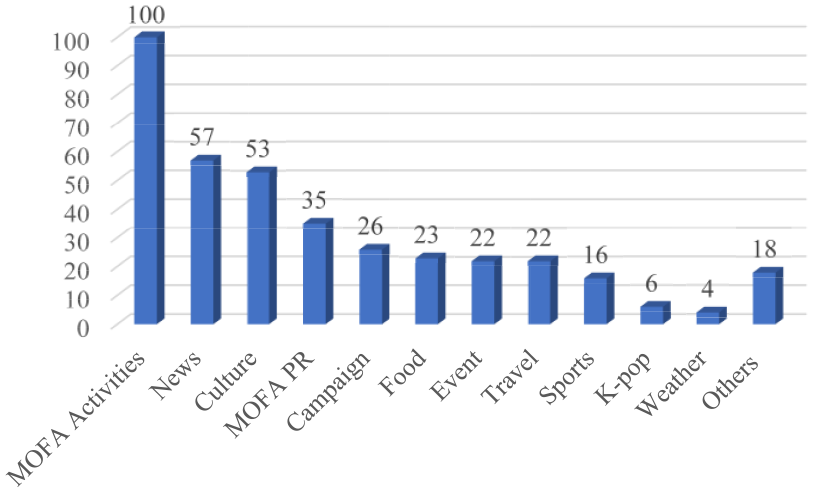
Number of posts on MOFA Facebook by activities.
MOFA’s Facebook account uploaded an interesting cultural event titled “K-Friends in Portugal!,” featuring young Hallyu fans in Portugal, on 5 January 2023. The post on Facebook states, “You can experience everything about #Korea from K-POP to K-Food! Let’s take a look at the ‘K-Friends Day’ event in #Porto!” (Figure 2). The same post on YouTube attracted 21,000 views as of 21 August 2023, and comments are very positive. For example, one viewer from India said, “I love south Korea I want to meet BTS and other K-pop groups in South Korea who are Indian army included me.” Another viewer from Pakistan expressed, “I am interested in Korea History. Korea is beautiful country.” As Shahin and Huang (2019) point out, digital diplomacy illustrates how the values and motivations of any country are reflected in the social media practices of their foreign missions, and MOFA’s social media use certainly achieves a positive public engagement.
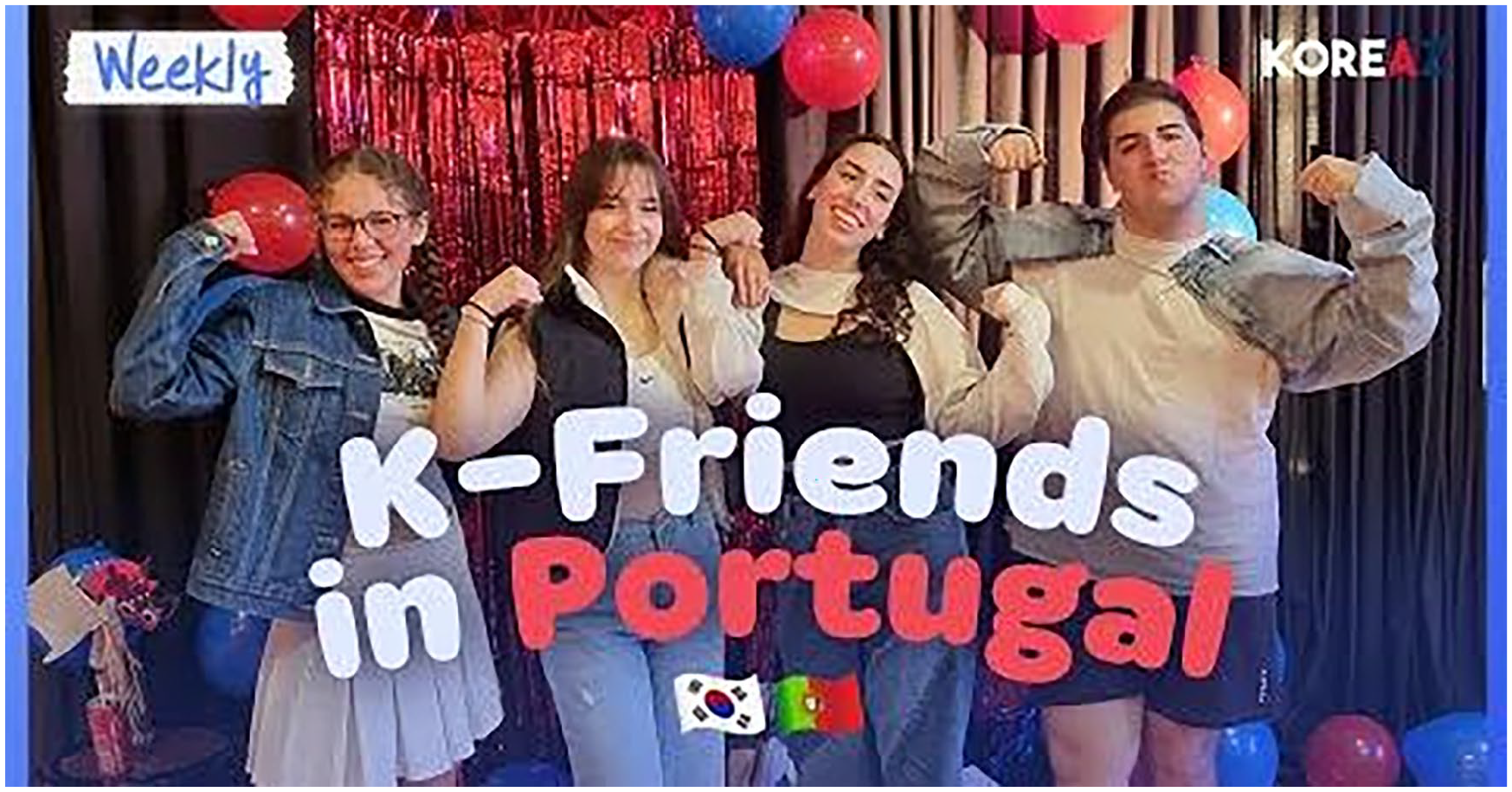
K-friends.
Prior to this, KOREAZ on 30 November 2022, posted a webtoon event with the title “K-pop, K-movie, and what’s next?” It states, “From K-pop and K-movies to K-#webtoons! Shall we take a look at the webtoon exhibition at the #Korean Cultural Center in #Thailand?” The number of clicks of like was more than 3100 on this post as of 22 August 2023, and some fans replied by saying “‘K-World Cup”’ and “K-reality show” (Figure 3). On YouTube, the same post garnered 43,438 clicks during the same period. Although this does not be huge, compared with K-pop idols like BTS and Blackpink, given that this post is uploaded by the government body. This kind of activity implies that “digital technologies influence the conduct of public diplomacy,” meaning “digital technologies facilitate public diplomacy activities” (Manor, 2019, p. 30).

Webtoon post.
Another interesting post is about K-pop, titled “K-pop is My Universe,” which was posted on 17 November 2022. It is about “The 11th K-pop World Festival that was held in #Changwon, #Korea! Let’s take a look at the stage filled with outstanding performers from all over the world!,” which 2600 people clicked Like as of 21 August 2023 (Figure 4).
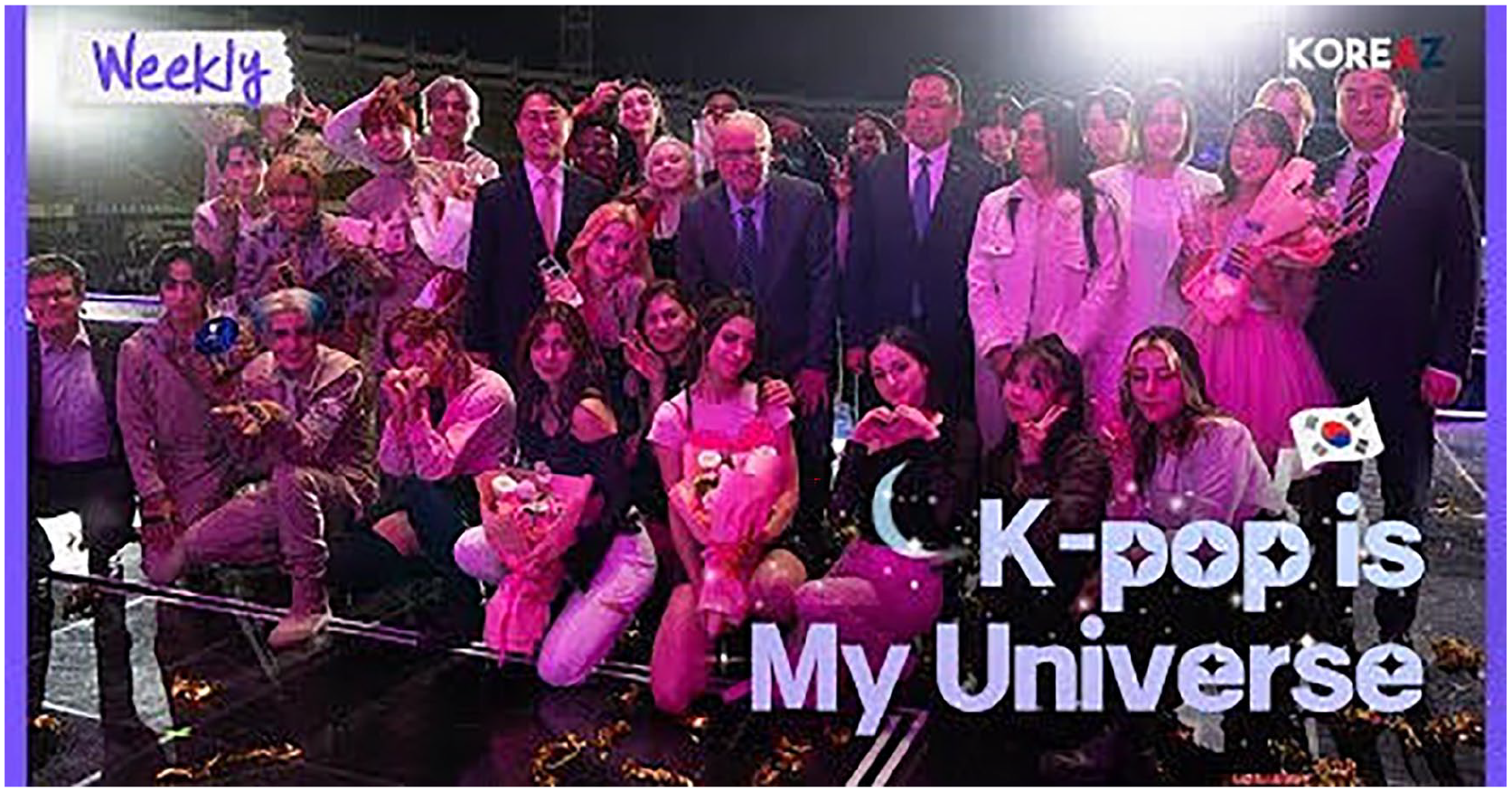
K-pop.
Due to COVID-19, the City of Changwon did not hold the festival for a couple of years; therefore, the festival was one of the most awaited global events. Only eight teams from a few countries, including Japan and Chile, competed for the champion trophy; however, global auditions were held in 85 countries around the world. About 5,000 teams participated in the regional qualifier alone, and only the teams that passed it were able to come to Changwon. This is one exemplary case of Korean soft power in the Korean Wave era. Ambassador Petko Draganov of Bulgaria, representing the diplomatic corps in Korea, said, “I was delighted that the Bulgarian team advanced to the finals,” and “I realized that K-pop amongst modern Korean popular culture was the best soft power” (E. S. Lee, 2022).
Again, these posts can be found on various social media portals, including YouTube and Twitter. Since social media accounts are managed by the same bureau at MOFA, social media content on various SNSs was similar. MOFA has not developed different content on different social media platforms. However, as Facebook has several different functions, including Like, Share, and Comment, many Facebook users can express their agreement, preferences, and feelings, which drives MOFA to post content that people around the world can potentially like or follow.
What makes MOFA’s soft power strategy unique is its utilization of everyday foreign people that can be seen in these posts on Facebook rather than celebrities. As discussed in tandem with Korean presidents’ soft power strategies, soft power related to social media has been connected to celebrity diplomacy, referring to the employment of famous individuals, including musicians, actors, and actresses, to publicize international causes and engage in foreign policy decision-making processes (Wheeler, 2016). For example, BTS and BLACKPINK have played a central role in celebrity diplomacy. Their attendance is expected to be a meaningful opportunity to expand communication with future generations and draw their sympathy on major international issues (J. Y., Oh, 2021).
MOFA has also utilized celebrities on several occasions; however, what MOFA attempts to advance is not directly related to celebrity diplomacy, as it also uses the public who enjoy Korean culture. Those people on Facebook and YouTube are broadly general audiences or specifically Hallyu fans, which means that MOFA does not use celebrities but general people to boost its national image. In this case, MOFA certainly prioritizes the general people’s acceptance of Korean popular culture and Korea as a nation-state.
The involvement of general people needs to be interpreted carefully. As discussed, public diplomacy should be the combination of government-driven top-down and private-driven bottom-up processes; however, the outcome did not achieve what it meant to be. MOFA’s implementation of social media as the nexus of MOFA—the government agency as the executor of a top-down process has been well-organized. In other words, MOFA’s soft power initiatives via social media imply the shift from a top-down soft power strategy to collaborative, engaged public diplomacy (Park & Lim, 2014). However, as general people’s participation in social media-driven events can be considered as a form of top-down strategy to better create rapport with the public, it is hardly said that MOFA fulfills a bottom-up process. A bottom-up, grassroots public diplomacy initiative might be programs run by ordinary citizens to connect with people from other countries, and MOFA still needs to facilitate the bottom-up process. The government may provide some necessary tools and budgets; however, the overall process must be organized and conducted by citizens or nongovernmental organizations (NGOs).
Of course, this does not mean general people’s participation is useless. Whether they are Korean fans or international fans, as ordinary people, they play a meaningful role in helping brand Korea. This also implies that, whether celebrity diplomacy or general diplomacy, public diplomacy can be practiced through collaboration between the government and the private sector, such as corporate actors and businesses. Beyond official promotional measures of the government, MOFA’s social media use exemplifies the power of grassroots “people-to-people” diplomacy in spreading soft power. People-to-people diplomacy happens when positive feelings about a nation or culture are spread through shared experiences between individuals across cultural divides (Suntikul, 2019). Social media functions both as a conduit for the distribution of content and also as a platform for communication and networking in a virtual community. It is essential for the government to make its communication accessible to people.
MOFA’s digital soft power and public diplomacy strategy cover the diplomatic network, as can be seen in MOFA’s attempts to enhance its diplomatic activities on various social media platforms. Ubiquitous social media creates new transnational groups and opens opportunities for manipulation by governments and others (J. Nye, 2004). Cultural creators and performers sometimes independently act as their countries’ civilian ambassadors, and their work should be considered as part of public diplomacy, regardless of their intention to collaborate with the government or not.
It is crucial to reinvigorate Korea’s public diplomacy and recognition that digital platforms should be at the forefront of efforts. As America’s public diplomacy strategy in tandem with digital technologies has taken the notion that “it is not whose Army wins, but whose story wins,” Korea must also ensure that “its public diplomacy efforts work in sync with its foreign policies” and that “words are backed by meaningful and appropriate actions” (Hallams, 2010, p. 570). In other words, “it is ultimately in the strength and appeal of the message, rather than the sheer volume of tweets, blogs and texts, that [Korea] will begin to shape—and not control—the narrative in a more favorable manner” (Hallams, 2010, p. 571).
There are a few caveats in actualizing digital platform-driven soft power strategies. Most of all: it has been established that the growth of the country’s ‘soft power’ correlates with the introduction of digitalization tools; however, soft digital influence can lead to negative consequences, namely the appearance and mass distribution of fake news, manipulation of the global agenda, and digital inequality. (Rusakova et al., 2021, p. 777)
Furthermore, “in a force of globalization, digitalization and interdependence, the Korean Wave is no doubt building a bridge of cultural connectivity and Korea’s strongest form of soft power, however with limitations and complexities” (Y. N. Kim, 2021, p. 31). Globalization and its associated digital technologies have made possible new forms of global nationalism that spread far beyond the borders of traditional nation-states (Starrs, 2013, cited in Y. N. Kim, 2021, p. 31). For many global fans, it is vital to access various cultural activities and events; however, they don’t like to witness government-initiated cultural events, which bring about the notion of cultural nationalism.
Another significant issue is the implication of digital soft power, which creates negative images rather than positive images. While “the catchy songs of BTS have teens worldwide singing along,” the images portrayed in Parasite and Squid Game do not help Korea enhance its national image as it is closely related to the dark sides of Korean society. More importantly, unlike American popular culture, which helps audiences see American values and ideologies, Korean cultural content sometimes hurts the government in selling Korean values, although it still helps mega-corporations like Samsung and Hyundai sell their products (Webb, 2021).
Meanwhile, digital diplomacy can be downgraded as “the practice of nation branding online is an ideological construct supported by the neoliberal ideology of the free market, embracing private interests, marketing goals, and commercial techniques for self-promotion” (Surowiec & Kania-Lundholm, 2018, p. 173). Although MOFA uses volunteer participants in various cultural activities, it indeed utilizes them as free sources of soft power, and therefore, their participation is not compensated. Digital diplomacy has become one of the latest developments in soft power and public diplomacy strategies. Unlike soft power policies that the government has mostly driven, digital diplomacy has potential to enhance not only the roles of both the public and private sectors but also collaborations between these two significant actors in foreign policy dramatically. As younger generations are digitally savvy, digital diplomacy is expected to continue to grow as the primary area that significantly advances public diplomacy attempts. However, it is crucial to avoid bringing the brand Korea to the fourth.
Conclusion and discussion
This article has discussed soft power and public diplomacy related to the Korean Wave in the digital platform era. By utilizing content analysis and discourse analysis in conjunction with MOFA’s use of social media platforms, it attempted to discuss the significant role of digital soft power and how digital soft power plays a pivotal role in practicing public diplomacy. Digital soft power is at the foundation of public diplomacy in the early 21st century, through which nations and private sector entities on the global stage mobilize their popular cultures or other cultural resources to build up positive images and opinions. The promotion of public diplomacy in tandem with the Korean Wave is: the shared purview of both governmental and nongovernmental actors, as illustrated in the complementary roles of the Korean government, which incentivizes the production and diffusion of Hallyu content through its policies and directives, and the private enterprises that produce and promote the content. (Suntikul, 2019)
In the early 21st century, digital platforms, including social media, play a crucial role in spreading Korean cultural content, and social media have driven the recent expansion of the Korean Wave. As social network sites and user-generated content sites have become new outlets for Korean popular culture, the Korean government’s cultural policy has shifted to adjust to a newly changing media environment. The government has developed several policy measures to promote the images of the nation-state through social media. A handful of cultural corporations have also developed global platforms to disseminate their content abroad directly via these platforms. Instead of only selling their cultural products, they advance new forms of distribution resources as global fans are shifting their consumption habits (Jin, 2018).
Korea has the potential to be a leader in using digital technologies in public diplomacy, as it ranks near the top of connectivity, smartphone penetration, and social media usage. Korea must be “an avid adapter—ready to build upon its strengths to upgrade and improve its public diplomacy for a new technological era”; therefore, “succeeding in the use of digital technologies in public diplomacy is arguably more important for South Korea than other countries” (Robertson, 2017), which has been actualized, although there are a few barriers. What is significant is that: digital diplomacy is only likely to grow in importance as a key lever of state power and a vital tool of [Korean] foreign policy, one cog in a large wheel that sits alongside the more traditional “hard” levers of state power,
and although digital diplomacy does have its limits, if used appropriately, digital technologies can play “an important part in reaching out and engaging” (Hallams, 2010, p. 571). Although many countries, both Western and non-Western, have developed their soft power, Korea has secured a strong stance due to the recent surge of the Korean Wave in the global cultural sphere.
In sum, the Korean government and the private sector, such as entertainment agencies, cultural creators, and cultural performers, have utilized Hallyu (and Hallyu fans) and digital technologies as sources for public diplomacy. Korea has utilized digital platforms to enhance its public diplomacy plan, and digital soft power has helped Korea improve its national image and potentially necessary economic growth more than other countries. In the future, “the trend towards constructing technology as a soft power instrument and as an instrument for economic development as such will continue, even accelerate in the post-pandemic world” in Korea and elsewhere (Cheregi & Bargaoanu, 2020, p. 25). Therefore, ensuring harmonious collaborations between the public and the private sectors may improve soft power and public diplomacy schemes.
Footnotes
Funding
The author(s) disclosed receipt of the following financial support for the research, authorship, and/or publication of this article: This paper was presented at the workshop, ‘Korean Public Diplomacy and Soft Power,’ held at UBC March 13-14, 2023, funded by the Centre for Korean Research.
