




Abstract
As a sound medium which once enjoyed a dominant status in Mao-era China, radio has undergone tremendous transformation over the past several decades. Throughout the history from socialist era to post-Mao-era China, radio has much to tell about listening as a social practice and about the formation of the public. This article asks how radio listening was defined and managed as a form of public engagement at different historical stages in Chinese Communist Party–led China through the prism of several aspects of radio listening, including radio as a material object, the location and the time of radio listening, and radio genres which dominated the time. We seek to identify the forces that shape the radio landscape, as well as the changing conceptions of listening and the public in China, as the nation transformed itself from a collectivized and communally oriented society to one featuring privatization, individualization, and globalization.
The understated sound medium of Chinese radio: an introduction
Despite the globalized “hegemony of vision” (Lacey, 2013) in media and communication landscape, studies on sound and listening have enjoyed a steady growth. The rising studies on radio have demonstrated the variety of radio practices and listening modes in different national contexts (e.g. Berland, 1990, 1993; Douglas, 2004; Englund, 2011; Fisher, 2016; Griffen-Foley, 2010; Hendy, 2007; Kunreuther, 2014; Lacey, 1996, 2013; Larkin, 2014). However, a prominent missing in the global scope is radio in the largest developing Asian country—China, which has transformed from one of the most underdeveloped country with low telecommunication presence to the world’s second largest economy featuring a wide range of telecommunication devices from the lowest end to the highest end (Pan & Ye, 2014; CNNIC, 2017). To today, with a few notable exceptions (e.g. Huang, 2013; Krysko, 2011; Lei, 2016a, 2016b; Lei, Gorfinkel, & Sun, 2016; Liu, 1964, 1975; Schurmann, 1968) in English literature, we know far less about Chinese radio soundscape and the specific forms and functions of listening at different historical stages. Like elsewhere, with the advent of television, radio in China has undergone a general shift from a dominant to a marginal medium. Nevertheless, while China remains an authoritarian country, the fast and vast economic, social, cultural, and technological transformations have produced a distinct radio-listening contour. Thanks to the further development of digital technology and social change, new forms of radio, and new ways of listening have emerged in contemporary China. They also throw into sharp relief the urgent need to understand questions about radio listening in China in historical terms.
Of all these accounts in studying radio worldwide, an outstanding perspective is the diverse interactions between radio listening and the formation of public(s) as public is a central conception in complicating the understanding of modernity (Taylor, 1992; Warner, 2002). Meanwhile, the discussion on what is public and how it is formed is impossible without an examination on the involvement of media in our time. When rethinking about the definition of public, Michael Warner (2002) identifies three notions. The first kind of public is the social totality of the people in general. The second kind of public refers to a concrete audience “bounded by an event or by the shared physical space” (Warner, 2002, p. 413). The third kind of public, in which media is a crucial actor, is what Michael Warner suggests “a social space created by the reflexive circulation of discourses” (Warner, 2002, p. 420). Media is indispensable in achieving this circulation in the public(s)-forming process which is self-organized with strangers as participants. Thus, we may be allowed to say, media have the capacity to constitute and maintain a common space where “people who never meet understand themselves to be engaged in discussion and capable of reaching a common mind” (Taylor, 1992).
Scholars with an interest in radio examine specifically on the relationship between listening and the formation of public(s), in particular, the latter two senses of public. We know from the existing work that sound functions as a constituent element of the public life and that listening is a form of public engagement among different groups in different nations (e.g. Berland, 1990, 1993; Douglas, 2004; Englund, 2011; Fisher, 2016; Kunreuther, 2014). Even in the same nation, how radio listening relates to the public evolves as a result of social and technological changes. We take the Britain which is well developed in its radio communication as an example to briefly outline the shift. According to Kate Lacey, throughout the 20th century, there is a history of shift from radio listening as a public and collective activity for civil purpose to the widespread privatization and domestication of radio listening for personal use (Lacey, 2013; Woodward, 2014). She argues that if public participation is crucial in promoting reciprocal discussions and cultivating informed citizens in a liberal democratic country, the shift in radio listening has weakened the capacity of listening as an active civil engagement and overshadowed the meaning of listening as a responsibility for the public good (Lacey, 2013; Woodward, 2014).
With a focus on China in this article, we attempt to historicize radio in relation to the formation of listening public(s) throughout the years since the founding of the Communist China in 1949. In many ways, the case of radio in China speaks to, yet at the same time, reveals the limitations of these insights mentioned above. Notions such as civil engagement, informed citizenry, and public good were indeed relevant to our understanding of radio in socialist China, but these concepts took on different meanings and resulted in distinct practices of listening. China is not a liberal democratic country, and yet radio in China has contributed to a democratization of everyday life since the launch of economic reforms in the late 1970s (Lei, 2016b). Therefore, engaging with the central point regarding sound as being constitutive of public life and listening as a form of public engagement, we ask in our article: In what shapes and forms does radio listening take place in various historical periods? How does radio listening as a public engagement work to engage and mobilize listeners in each political/social period, and in doing so, constituting them as a particular form of public? To pursue these questions, we seek to uncover the historically specific and local ways in which radio listening takes place, and we aim to examine myriad political, economic, cultural, social, and technological conditions which shaped them. Thus, for the purpose of this discussion and fully cognizant of the complexity within and continuity between them, we divide China into two general historical periods in this article—Mao-era China (1949–1976) and post-Mao-era China (1976–present)—with economic reforms as the dividing point. Ours is a historical overview of radio listening in China, outlining some of the very distinctive and important constituents of Chinese radio as a national, state-managed practice in an enormous sweep of Chinese 20th century history. Admittedly broad and sketchy in stroke, our main agenda is nevertheless clear and focused: we want to offer an account of radio as a key point of connection between listening and formation of the various notions of the public at various critical junctures of modern Chinese history.
In what follows, we first sketch the social and technological landscape inhabited by radio in the socialist decades. This is then followed by a discussion of how the political–economic logic of socialism produced a particular form of collective listening, and in doing so, shaping the formation of the public which shares common revolutionary goals and subject positions. We then move on to the post-socialist decades, which witnessed the deepening of privatization, individualization, and globalization. Focusing on one newly emerged radio genre and one radio channel—late-night talkback radio and drive radio—we point to social stratification and the consequent remaking of radio listening and the public in post-Mao-era China. In the conclusion, we chart the changing conceptions of radio listening and the public from Mao-era China to post-Mao-era China and discuss the implication for further studies.
An overview of the making of radio listening in Mao-era China
In socialist China, society was profoundly restructured to the extent that a traditional individual–kinship axis was replaced by an individual–state axis (Sun & Lei, 2016). Nationalization and collectivization redefined individuals’ relationship to each other, the society and the state, and provided the matrix under which the identity and everyday life of Chinese individuals were reorganized. The workplaces, including both the production commune in rural China and danwei (workplace) in urban China, became the most important milieu of socialization and identity formation. In rural China, the traditional kinship network and family relationships were redefined by the state with its socialist orientation. In the city, factory space included both the place of production and urban living complex, and workers worked and associated with each other both as co-workers and residential neighbors.
The early history of Chinese radio since its arrival in the early 20th century points to a number of ways in which its developments were shaped by myriad political, commercial, and social forms (Benson, 1996; Guo, 1986; Krysko, 2011; Zhao, 1982a, 1982b). When the Communist China was founded in 1949, China was, as Mao Zedong described it, “poor and blank” (yiqiong erbai) (Mao, 1956) and the development of sound technology in China was in its infancy. Its growth of radio form of mass media was severely lagging behind its Western counterparts, where radio was on the verge of being replaced by television as a dominant media in the domestic setting. Mao’s remark refers to both the lack of industrial infrastructure and an underdeveloped farming sector in China. His evocative use of the word “blank,” likening China to a blank piece of paper, is an assessment of the low level of development in the science and education sectors (Mao, 1956). To make things worse, due to China’s political and economic isolation from the world outside China, the importation of radio receivers and other technical equipment from overseas was largely terminated.
It is important to bear in mind that the Chinese Communist Party was interested in developing as well as controlling the nation. On one hand, it needed to gain the support of the nation in order to maintain the legitimacy of its leadership. On the other hand, as part of its nation-building agenda, it aimed to mobilize the nation to take part in productive activities such as agriculture and industrialization. The popularization of radio listening nationwide became a national priority, as China embarked on a journey of self-reliance in nation building and modernization (Zhao, 2008). The government encouraged innovations which may lead to enhanced capacity to grow its own radio industry. Central to this mandate of innovation is the question of how radio can reach as many people as possible, in the shortest span of time, over as vastest possible distance.
One key innovation was the construction of reception network (shouyinwang) (Hu, 1950). The project was aimed to connect individuals in different parts of the country to the political national center at a time where radio transmission and reception technology were in its early stage and when radio was not yet a common domestic appliance. The process involved the setup of a local “sound reception station” (shouyiinzhan) with the assigned radio receiver and the recruited local individuals as what is called “sound reception officers” (Zhou, 1987, p. 352). Sound reception officers were tasked with three responsibilities, that is, transcribing the news they heard, informing about the coming radio programs, and organizing a mass radio listening (Zhou, 1987, p. 352). Of all three tasks, the third one is vital in forming a listening public out of gathered individuals within the confines of a space such as a county-level government, a factory, a school, and a residential community or troops (Li, 2013; Zhou, 1987, p. 353). On important occasions, sound reception officers were dispatched to rural area with radio receivers, organizing a collective listening in a local town or village. For instance, during the Spring Festival of 1952, 195 sound reception officers in Zhejiang Province went to the rural area of this province with 135 radio receivers (Zhou, 1987, p. 354). In some places, more than 300 of peasants gathered around a radio receiver. They had to take turns to get closer to the radio receiver in order to have a clear listening (Zhou, 1987, p. 354).
The most significant innovation in the period of socialist radio is the widespread installation of wired loudspeakers, especially in rural China. Since the 1950s, as part of the nationwide project of collectivization, production communes replaced the individual family-based unit of farming rural China. To effectively reach the rural residents, the Central Broadcasting Bureau issued an edict in 1955, instructing provinces and local governments to establish wired radio network in rural China (Lu, 2014, p. 195). The implementation of the policy led to the sharp increase in the number of loudspeakers. While there were 900 loudspeakers in rural China in 1949, the number grown to 506,700 in 1956 and 941,200 in 1957 (Lu, 2014, p. 207). Installed in public places in local villages, loudspeakers proved to be the most efficient way of reaching rural residents since most households did not have a radio. The project of installing loudspeakers continued to the extent that some individual households also had a loudspeaker. Although the project was interrupted sometimes by political movements and economic austerity during the following years, the number of loudspeakers continued to grow, reaching 99 million in rural China in 1973 with 61.5% of the national rural households owning it (Lu, 2014). The sound of the loudspeaker was so ubiquitous that it is considered as the defining and sonically most evocative aspect of the socialist soundscape. In fact, in their attempt to capture the political and social mood of the country and the everyday experience of people who lived through the socialist era, film producers, such as those who produced To live (Huozhe), The blue kite (Lan fengzheng), and television dramas Snowflake dances (Xuehua nage piao), Our parents’ love and romance (Fumu aiqing), invariably turned to the sound of the loudspeakers. It was a most favorite strategy of authenticating a by-gone era, even though the object of the loudspeaker was absent from the mise en scène.
In socialist China, broadcasting served as the nation’s dominant means of speaking to both urban and rural residents equally. Both urban and rural residents were required to listen to news. As “the source of information and the primary definer of news” (Zhao, 2012, p. 150), the central government used the news to promulgate official policies, issuing laws and regulations, and publicizing (Figure 1). Reporting on national events and international affairs was also an integral part of the daily news. News from national radio station was mandatorily relayed on radio stations of various levels nationwide (Liu, Zhu, Sun, Chen, & Guo, 2010). Instead of individuals having autonomy and control over when to listen or not to listen, designated personnel such as workplace-based propaganda team members and rural leaders were responsible for switching on and off the collective-owned radio receivers and loudspeakers. In other words, radio news listening was an obligatory political activity, enabling the Chinese central authority to expand its spectrum of political control. Through the activity of radio news listening, previously ungoverned rural residents were interpellated into the collective vision of the nation and transformed into political subjects (Lei, 2016a).
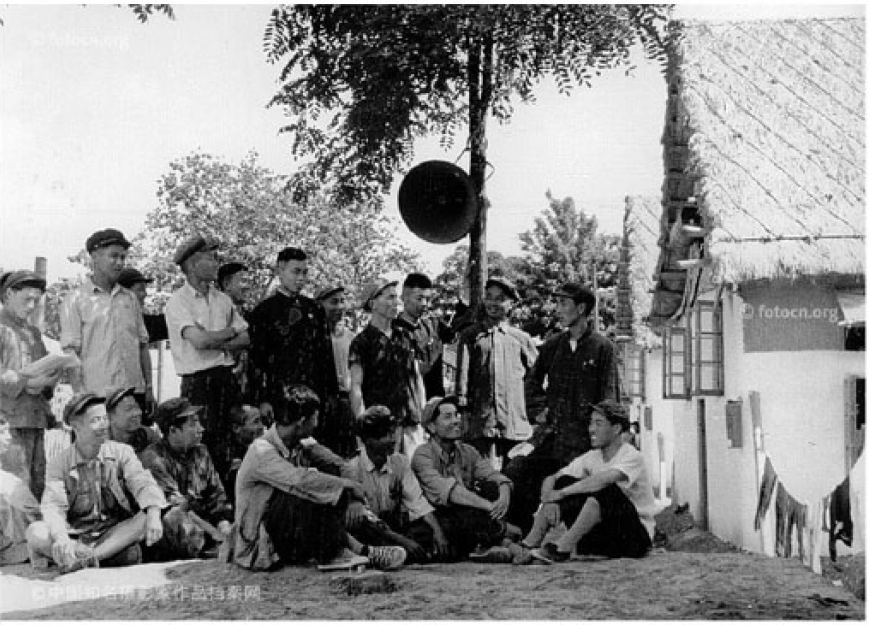
Gathering around a loudspeaker tied on the tree, construction workers in Nanjing city listen to the broadcast of the draft of the first Constitution of the People’s Republic of China in 1954.
Collective listening and the making of a patriotic, productive, and political public in Mao-era China
Not surprisingly, the dominant mode of listening in the socialist time, especially in the first decades of socialism, was collective or communal listening. Individual listening, which was possible only with the private ownership of a transistor radio, did take place, albeit only as a minor cultural practice. Collective listening was instrumental to the central government’s core mission of achieving political legitimacy, garnering popular support, and mobilizing people to partake in industrial and agricultural production among many of its political, social, and economic objectives. In what follows, we turn to two examples to illustrate how collective listening functioned to achieve these goals.
In April 1951, when the United States decided to rearm Japan as a military base in Asia, radio stations nationwide in China actively broadcast—live—local protests. Tianjin, a city next to Beijing, organized live broadcast of the local protest under the theme “sign to support the peace treaty, vote to oppose arming Japan” (Wu, 2012). Before the broadcast, preparations were carried out to guarantee a smooth broadcast and attentive listening. The day before the broadcast, the local official newspaper Tianjin Daily (Tianjin Ribao) published an announcement entitled “The live broadcast of the event of signing and voting will take place tomorrow—people from all walks of life in Tianjin are partaking the upcoming radio listening” (Wu, 2012, p. 110). Specific preparation for a large scale of collective listening included,
The municipal labour union assigned the task (the informing and the organizing of listening) to sub-level labour unions. Radio stations in the 108 factories in the city all actively checked radio receivers and amplifiers (to make sure they work properly) … The representatives of household registration services of the 6th district launched a competition in order to make sure that no one would be left out of the organized listening … The 141 enterprises under the supervision of the Industry and Trade Association planned to organize the collective listening of industrialists and merchants based on their aligned sector associations. (Tianjin Daily in Wu, 2012, p. 110)
This organized “listening event” in Tianjin proved to be highly effective in mobilizing the masses. Listeners responded to the on-air participants’ denunciation by shouting slogans such as “revenge for the dead” (wei sinanzhe baochou) and by pledging their commitment to build a strong China in order to fight against intruders (Wu, 2012, p. 109). This act of listening and participation united individuals and enabled them to imagine themselves as patriotic subjects of the nation.
Besides generating support on issues of national sovereignty and patriotism promotion, collective listening was also used to mobilize the workers and farmers to take part in myriad nation-building projects, ranging from productivity competitions in the industrial and agricultural sectors. We provide an example here to illustrate how factory served as a crucial site for collective listening in Mao-era urban China. In 1959, the Ministry of Machinery announced a new initiative aiming to increase the productivity in the iron and steel production sector. As part of this initiative, the Ministry sought to address the workers in the meeting hall of an iron and steel plant in Beijing. The purpose of the meeting was to inform workers about the government’s intention regarding this initiative, assign production tasks, encourage competition within the sector, and share strategies of increasing efficiency (Jixie Gongye Zhoubao, 1959). The ultimate goal was to mobilize all steel workers to achieve the goal of completing 3 years in advance the proposed output set for the second national 5-year plan. Presenters included the deputy minister of the Ministry of Machinery, the chairman of a branch of the national labor union, and a number of leaders from local steel factories (Jixie Gongye Zhoubao, 1959). Steel workers from this plant attended the meeting on site. This meeting was also broadcast live via radio, and collective listening was organized in steel plants nationwide, attended by steel workers and factory management groups. (Jixie Gongye Zhoubao, 1959).
As this example indicates, collective radio listening produced event/location-bounded publics, which were connected and abstracted to form a wider public nationwide. The frequency and the scale of collective listening increased during the Great Leap Forward 1 years (1958–1960). In 1958, 303 listening events were organized in 18 provinces to mobilize the public to participate in the socialist construction (Ha, 2014, p. 226). From April 1959 to April 1960, the national radio station jointed by a range of national departments and associations organized 19 listening events, which was estimated that millions listened to each time (Ha, 2014, p. 226). As economic development took priority, radio broadcasting nationwide tirelessly reported achievements of agricultural and industrial outputs, which later on were found to be grossly exaggerated (Ha, 2014, p. 227). While radio broadcasting attempted to form a nationwide public actively engaged in socialist construction, listeners were bombarded with propaganda. Radio played an indispensable role in mobilizing the masses and building up the momentum and energy which propelled the Great Leap Forward (Ha, 2014, p. 228). By 1960, hasty development policies of the Great Leap Forward and natural disaster combined to precipitate the fall of the national economy. Radio broadcasting also went into recession with the reduction in broadcasting hours and the closing of local radio manufactures (Ha, 2014, p. 233). When the national economy recovered in the years from 1963 to 1965, radio broadcasting sector bounced back somewhat, although it is clear that the role of radio as an instrument of class struggle became much more pronounced than previous years (Ha, 2014, p. 238).
During the Cultural Revolution (1966–1976), radio broadcasting became the main political instrument. As a consequence, listening became a way in which the national public was pressed into participating in endless political movements. Radios were the first site different political factions fought to control. What the public could hear on the radio and loudspeaker was filled with tension and struggle between political factions. In 1967, one of the first actions of rebel groups (zaofan pai), who claimed to represent the proletariat and crack down the emerging in-power bourgeoisie, was to occupy a radio station, announcing a power takeover statement to the public immediately to reveal the power change (Guo & Zhao, 2014). Power takeover over radio stations occurred all over the nation, and soon military control was activated to stop the chaos (Guo & Zhao, 2014). It was not until December 1967, when the central authority issued the decision on implementing military control over Central Radio Broadcasting Bureau, that ended what Chinese scholars Guo Zhenzhi and Zhao Yuming called “the anarchism in the radio system” (Guo & Zhao, 2014, p. 255). During this time, what listeners could hear from radio and loudspeakers featured a majority of political content on both national and local radio stations. As the new program schedule of China National Radio since February 1967 shows, the broadcasting time of political program increased to 72.1% from 48.02%, while that of the cultural and entertainment program reduced to 24.2% from 48.33% (Guo & Zhao, 2014, p. 257). The on-air political struggles continued in the following years with the emergence of Lin Biao Gang (Linbiao jituan) and the Gang of Four (Siren bang), both of which sought to control radio broadcasting in their power fights. During these years, the formation of a political public via mobilizing radio listening superseded that of an economically productive public. Radio was mostly an instrument of political campaigns, a vehicle of ideological contestation and a platform for factional politics.
Not only the strong presence of the state in Mao-era China shaped a kind of national and local listening public(s) constituted by the top-down on-air circulation of discourses, it also exerted its power on the act of “listening out” (Lacey, 2013) to foreign radio broadcasting. Listening to overseas radio broadcasting, especially those what is called “enemy radio broadcasting” (Ditai), was criminalized to prevent Chinese individuals from listening out via available radio sets. The range of enemy radio broadcasting included VOA, BBC, and radio broadcasting from Taiwan and later also expanded to include radio broadcasting from the Soviet Union when the relationship between China and the Soviet Union soured in the 1960s (Huang, 2010). The crackdown on listening to foreign radio broadcasting was most ruthless at times of political movements, particularly during the decade of the Cultural Revolution (1966–1976). However, despite this, the covert practice of listening to foreign radio broadcasting did not totally disappear. The sent-down urban youths (zhiqing) in Mao-era China were once one of these “listening out” groups. According to the account of China-based well-known literary author A Cheng, a radio receiver was one important item some of sent-down urban youths (zhiqing) possessed (A, 2009). A Cheng was sent to Yunnan province, where listening to foreign radio broadcasting was a common activity among his fellows (A, 2009). From the view of these listeners, listening to foreign radio broadcasting was more about accessing information and entertainment and less about resisting the listening regime imposed by the state. During the period when the global mobility was highly restricted, the listening out via radio did allow Chinese individuals in Mao-era China to participate in and form a transnational alternative public.
The individualization of radio listening and the stratification of the public in post-Mao-era China
It was not until the late 1970s when China ended the madness of the era and entered the era of economic reforms and Open Door Policy in 1978, and for three decades or so, has witnessed the profound social transformation. China Studies scholars, particularly in the fields of anthropology, sociology, and cultural studies (Ong & Zhang, 2008; Sun, 2015a; Yan, 2009), have consistently argued that social change in the reforms era is the consequences of several processes, the most important of which being privatization, individualization, and globalization. With the withdrawal of state from a number of key public goods and service sectors, market stepped in to dictate the logic of supply and demand in the health, housing, employment, and education sector (Ong & Zhang, 2008; Zhao, 2008). The outcome of privatization is both material and attitudinal. Individuals unmoored from previous collective structure were encouraged to pursue individual interests over collective ones, leading to what some scholars describe as Chinese individualization (Yan, 2009). In the meantime, as China became increasingly integrated into the global economic system and culture, the Chinese people, as caught up in the process of globalization as their counterparts elsewhere (Featherstone, 1990), draw on, as well as contribute to, myriad global cultural practices, media forms, and style of self-expressions.
These processes have profound impacts on class formation, gender relations, rural–urban relations, value orientation, ways of livings, and above all, interpersonal relationships.
A national policy which privileged economic development over social equity turned China into one of the most unequal and stratified countries in the world (Sun & Guo, 2013). During the decades of socialism, China’s rigid employment system meant that individuals stayed in one workplace more or less permanently. So, where this “iron rice-bowl”—secure and permanent employment—was abandoned, individuals found that their identities were shaped by the market. Meanwhile, the withdrawal of the state funding and the consequent privatization of the public social welfare (Ong & Zhang, 2008) shifted the responsibility of health care, education, and housing from the state to Chinese individuals. Chinese individuals were required to revalue their worth according to the market logic, both in their workplaces and personal life. Two newly constituted social identities which were largely unheard of in the Mao-era have emerged, embodying the polar opposite ends of the socioeconomic spectrum as a result of social stratification and class reformation in post-Mao-era. On one hand, rural-to-urban migrant workers have become the subaltern class (Sun, 2015b), bearing the brunt of China’s deepening social inequality. On the other hand, are the well-educated, socially mobile professional middle class in the Chinese city, whose consumption power and lifestyle have caught the imagination of the world.
Privatization in China has not only taken place in the domain of social goods and services but it has also transformed the ways individuals conduct themselves and relate to each other. With the shift from institutional person (danweiren) to social person (shehuiren) (Jiang, 1999; Zhu, 1994), Chinese individuals are disembedded from socialist values and mechanisms to reorient and reorganize themselves, looking for new ways and spaces in which they are able to survive and thrive. Unlike its western counterparts, the post-Mao Chinese individualization (Sun & Lei, 2016; Yan, 2009) took place without a welfare state. In many cases, the power of the self without social support leads to loneliness and disorientation (Ong & Zhang, 2008, p. 18). Individuals are motivated to seek information about the surrounding environment and guidance from all kinds of available resources (Ong & Zhang, 2008). Among all of these resources, the media is the most accessible and least expensive one for the public, across all social classes.
As radio receiver started to become widely affordable and radio receiver now a ubiquitous household item, individual listening has largely replaced collective listening. In the meantime, television entered the lives of ordinary people, posing a serious threat to the viability of the radio sector. Like Chinese media, the radio sector has also been forced to commercialize due to the withdrawal of the state funding (Lynch, 1999; Zhang, 2011). The outcome of this reform in the radio sector is a wide range of new channels producing a diversity of content, genres, and formats. Radio content in the style reminiscent of socialist production and orientation mostly disappeared, replaced by content such as economic information, popular music, and programs concerning personal issues to suit the interest stratification of a once nationalized listening public. Collective listening, a mode of socialization that is emblematic of the socialist China, is now replaced by a new listening public, comprised individuals grappling with their respective anxieties and aspirations. The entire population are stratified in terms of gender, class, and place and segmented along the line of taste and informational needs. Despite these differences, Chinese individuals shared one thing in common: they found themselves in greater need of pragmatic information and guidance. To give context to this change, we will discuss the emergence and development of one new radio genre and one new radio channel.
One of the earliest new radio formats which emerged in the reforms era was late-night talkback radio. As one of the most popular genres in the early 1990s, late-night talk drew in huge numbers of listeners by giving them something that was hitherto unimaginable: conversations and advice about personal issues such as sexuality, love, marriage, and family. The public were encouraged to call in, talk through their problems, and seek advice from the in-studio host and, sometimes, invited experts. Instances of the most popular programs included Accompanying until early morning (Xiangban dao liming) on Shanghai Oriental radio station, The sky in the night is not lonely (Yekong bu jimo) on Shenzhen radio station in southeast China, The date with the heart (Xinling zhi yue) on Hunan provincial radio station in central China, and Letters to the garden of love and sexuality (Yidianyuan xinxiang) on Zhejiang provincial radio station in east China.
Listeners to late-night talk radio were mostly displaced young rural–urban migrant workers who have left their hometown, families, and kinship networks to seek job opportunities in the city. As “strangers in the city” (Zhang, 2001), these lonely hearts found solace in the late-night talkback radio. It cost them nothing—all that was required was a radio receiver—yet it offered them a chance to pour their hearts out and seek emotional support. The voice-based communication of radio produced a sense of intimacy—however, temporary and illusory—and this sense of intimacy was precisely what was lacking in their everyday displaced and estranged life. As the hosts of these shows see it, late-night talkback radio became a place to sooth their hearts and minds (Shi, 2006; Wu, 2002). It delivers love, care, even a sense of belonging to individuals from one of the most disadvantaged social groups.
On one hand, listening to late-night talkback radio established a temporary yet intimate on-air space and time between the host and the caller. On the other hand, this exchange created another space, whereby individual listeners from disparate locations were let in on the secrets of a stranger, and in doing so, felt included in a mediated experience of sharing that is at once private and public. Besides rural–urban migrant workers, who found themselves systematically and socially excluded from urban life (Pun, 2005; Yan, 2008), urban people who were faced with love and marriage problems were also the intended listeners. Through this act of listening, individuals across the socioeconomic spectrum found comfort in knowing that they were not alone in experiencing a series of feelings—loss, disorientation, frustration, uncertainty, and vulnerability—which has emerged to define the emotional experience of people as the processes of privatization and individualization became further entrenched.
The popularity of late-night talkback radio was greatly diminished in the new millennium, as the Chinese television produces programs also started to offer advice on personal issues (Sun & Lei, 2016), and the Internet afforded intimacy in a more private and individualized way. However, although facing stiff competition from television and social media, late-night talkback radio remains attractive to some social groups. Some rural-urban migrant workers we met in the industrial zones of Shenzhen in August 2015 were still faithful listeners to some local late-night shows on love and emotion. Late-night talkback shows were also one of the favorite programs some female workers born in the 1980s in the hospitality sector of Beijing we met in October 2015 used to listen to. They dropped the listening either due to the interest shift to the Internet or work- and life-related full schedule.
While the collective listening in the socialist era consisted of workers and farmers who proudly identified themselves as the proletariat “vanguards” and the master of the nation, the practice of listening to the radio in the reforms era has been gradually growing into an experience associated with class restructuring. Drive radio, for instance, is a social artifact and cultural practice which came about in response to the rise of the urban professional property-owning middle classes. In the early 1990s, drive radio, which was named as traffic radio (jiaotong guangbo) showing its primary function to deliver traffic updates to the public, was set up as a channel on air in large cities such as Shanghai and Beijing (Huang, 1992; Wang, 2002). This is a period when taxis increased to become the main road users (Wang, 2003). Taxi drivers on the road were a dominant group in listening to drive radio for traffic information as well as other programs such as storytelling (pingshu) for entertainment. When China entered the 2000s with the rapid growth of private cars on urban road, drive radio has reoriented itself to seek private car owners and potential car buyers as its listeners. In 2012, there were over four million privately owned cars in Beijing alone (“Erlingyi’er Nianmo”, 2013). The content on drive radio ranges from practical items including traffic management, public policy, car purchasing, use, and repair services to programs with more substantial social and cultural forums. Drive radio has become an active site for cultivating and articulating the taste, sensibility, and identity of the middle class, in the process functioning as a new marker of social inclusion and exclusion.
One undisputable fact is that drive radio is growing more expressive and more sophisticated in participating in the shaping of a privatized, gendered, and stratified public with the unequal mobility. Drive radio produces their listeners as consumer citizens, who are eligible to join the sound space at their will and participate in the discussion about car-related issues, commercial, public, or social, via listening. The program of Car world (Qiche tianxia), which is a weekly program on Beijing drive radio, is just a case including a range of different themes each day. Listeners can hear the introduction and discussion about a new model of car on Monday. They can contact the program staff offline to join a group bargain deal which is promoted on Tuesday program if they are expecting a car. Listeners can also seek assistance from the program who would help to manage an investigation if they have a consumer complaint about private car purchase deals and the after-deal car repair and maintenance issues. Beyond the car purchase and daily use, on Wednesday, as a driver citizen, listeners can send in their opinions, contributing to the talk about public issues such as the regulations on private cars in the governmental efforts to clean the air. They can hear more information about mobility-based leisure and consumptions when domestic and international tourism is promoted on Friday. Saturday is a time when listeners can relax and lend their ears to the social chat the studio host and guests have about matters such as who the last person is you want sitting next to you when you are the driver.
Drive radio attempts to produce a commodified listening public, in which the middle-class taste and sensibility is expressed, delivered, and cultivated, either in the form of fancy car choices, or consumer rights to advocate their interests, or the vision and the physical reach of the world. In this case, radio sound acts as a commercial force to include individuals and families who possess any capital to live and perform as a middle-class member. With sufficient financial resource, the ownership and the use of a private car is a seductive condition in articulating the middle-class identity and participating in these class-based public (social) talks and leisure activities. Listening to drive radio could be thus considered as a strategic engagement to get closer to, achieve, or maintain a middle-class status. Going further from drive radio, in recent years, urban radio stations that include both provincial and municipal radio stations have renewed a former channel to what is called “private family car-oriented radio” (sijiache guangbo) (Cai, 2013), creating a separate listening space for private car owners and their families. While the commercialized radio is renovating itself to compose and enlarge a middle-class consumer public, the merry mood and affection in the soundscape cannot hide and perhaps just perfectly reveal the wide shared anxieties, insecurities, and uncertainties flowing across different classes throughout China (Wang, 2015).
A discussion: the changing conception of radio listening and the public from Mao-era China to post-Mao-era China
This article explores the changing formation of the public in China through the prism of Chinese radio since 1949. By identifying the political, economic, social, and cultural forces in shaping the changes and continuities in China’s radio sector, our discussion points to a variety of new as well as newly constituted roles assumed by the Chinese listeners. Our discussion shows that the once collectivized mode of radio production and listening in Mao-era China has been replaced by the commercialization of radio production and the privatization and individualization of radio listening. We have seen innovations and conventions in practices of radio production and listening in each historical era. The radio relay network and the use of loudspeakers in the socialist China, though a quintessential form of propaganda and top-down communication, represent a form of innovation. It warrants a special place in the history of radio as well as in our understanding of the formation of the public through media reception. Similarly, in the reforms era, resources—domestic and foreign, cultural and technological—have been mobilized and negotiated to produce content, formats, and genres capable of attracting an increasingly fragmented and stratified listening public.
Although radio listening in China has encountered a phenomenal shift from collective listening as a public activity to private listening as an individual activity, the forces, the purposes, and the processes that shaped the shift have at once distinguished and defined “Chinese characteristics” of radio listening and public forming from its western counterparts. In the Chinese case, the state played a determinant role in shaping the practices of radio listening in Mao-era China. As a form of public engagement, listening was central to the production of the Chinese state-defined political subject and collective identity. Certainly, the national wired radio network enabled a more democratized form of listening by making radio more accessible to the grassroots. Nevertheless, this democratizing potential was harnessed by the state to operate as an instrument of propaganda, delivering mandatory radio broadcasting to individuals. As the numerous collective-listening events in Mao-era China demonstrate, a public in the first place was bounded by occasions and locations. These visible publics were connected on air to constitute a wider listening public, in which the circulation of discourses was top-down, ruling out the possibility of a public as a social space that features the reflexive circulation. Even when individual listening was made possible with the further popularization of loudspeakers and radio receivers in the latter years, the Chinese radio sound produced nationwide in Mao-era China was aimed to maintain and enlarge the kind of top-down circulation for a wider inclusive listening public. Thus, listening was exercised as a political activity, made obligatory as a form of expression of one’s loyalty, and support for the Chinese Communist Party–led state. At the same time, due to the developmental nature of the Chinese state, radio listening was also employed to produce a public commitment to socialist construction and mobilize the maximum people to participate in material production and nation building. With both class politics and socialist construction centrally held and clearly articulated, the formation of the listening public was overwhelmingly shaped as well as interrupted by the negotiation in the political force. Thus, we can see a co-existence of three modes of listening publics, that is, a patriotic public, a productive public, and a political public throughout Mao-era China. Notwithstanding, it was a shifting contour, and which sound and which mode of listening public trumped over others were largely defined by the shifting priority negotiated by the top authority.
The demise of radio listening as a political obligation has not brought about a form of listening which is conducive to cultivating a public discursive space beyond the purview of the state in post-socialist China. Instead, with the Chinese state firmly in control of public life, radio listening in post-Mao-era China has been refashioned into a commercial, privatized consumer activity. The post-Mao neoliberal decentralization of radio broadcasting has produced a new wave of democratization in listening, associated with the commodification of listening. The post-Mao listening democratization has allowed individuals to listen to a diversity of products offered by radio broadcasting. But what has emerged is not an autonomous and independent space of public communication, whereby individuals can freely access radio as a public good and become members of the mediated public. Instead, radio sound in post-Mao-era China serves more as a force of exclusion, producing a range of social spaces whose boundaries are based on socioeconomic status. Either in search of intimacy or mobility, as the two cases demonstrate, listening to radio broadcasting has participated in the reformation of subaltern and middle-class consumer publics, facilitating their reorientation and relocation in the unchartered waters of the market economy (Ong & Zhang, 2008; Sun, 2014; Yan, 2009). In this sense, the emotional experience embedded in radio listening goes public and circulates among different class cohorts in post-Mao China.
Although listening in to Chinese radio is the main presence throughout the listening contour, listening out to overseas radio broadcasting in post-Mao China has been taking place constantly among individuals who are interested in looking for something alternative. With the loosening of the ban on listening to foreign radio broadcasting, radio services such as BBC, VOA, and Radio Australia became the popular spaces Chinese turned to on shortwave radio sets for news, English learning, and music appreciation in the years from 1980s to 2000s. While on contemporary Chinese radio, we find little chance yet to locate and form an acoustic space that is compatible with Michael Warner’s third notion of a public, the global digital service makes listening out to and participating in a transnational public much easier and more accessible for Chinese individuals. Radio service such as BBC, who is still highly regarded by Chinese for its objective and impartial broadcasting, could find its listeners among educated Chinese people in the urban landscape.
In the Chinese soundscape, a recent booming cultural phenomenon is the practice and the listening to what Kate Lacey calls “DIY radio” (Lacey, 2014, p. 81)—the digital platform–based sound service which has its parallels elsewhere worldwide. In technological terms, contemporary China has achieved a similar level of advance with developed countries in the telecommunication development. With digital devices in hand, private groups and individuals in China are engaging in producing and listening to new forms of digital sound services such as Himalaya FM (Ximalaya FM), Dragonfly FM (Qingting FM), and Lychee FM (Lizhi FM), challenging the conventional airwave-based definition of radio. These digital sound services allow individuals to play roles ranging from being the original producer or radio curator to that of radio aggregator (Lacey, 2014). These forms of “DIY radio” are articulating a potentially alternative soundscape, in which each individual can be a radio broadcaster as well as listener. Although not the focus of this study, the implications and impact of the digital production of radio involving individuals as producers and listeners warrant investigation in the future. Facilitated by the mobile digital technology, listening practices are bound to proliferate and diversify and are likely to pose further question of the changing nature of the listening public. It is a space well worth watching.
Footnotes
1.
Great Leap Forward was an economic and social campaign, which was aimed to transform China from an agrarian economy to a socialist society through rapid industrialization and collectivization in a short time. The campaign had a disastrous outcome, not the least due to its unrealistic goals, resulting in nationwide famine and economic recession.