




Abstract
As a recently emerged information service on the Chinese Internet, online public opinion analysis (网络舆情分析) is a type of service to monitor, assess, and synthesize online public communication through automated software and trained individuals. This article provides an industry overview of the rise of online public opinion in China and examines the political economy of the People’s Public Opinion Office. Second, this article looks at the marketing of the profession in news coverage, training materials, as well as published interviews with People’s Public Opinion Office’s managers and experts. Through a close reading of People’s Public Opinion Office’s published annual reports from 2007 to 2016 focusing on the issue of online rumor, this article delineates how the identification and prognostics of online rumor evolves with the State’s anti-rumor campaign that aims to forestall or pacify collective action. In sum, this article sets to examine the professionalization and industrialization of online public opinion analysis as a part of the co-evolutionary dynamics between the state and civil society in China. Using the government’s anti-rumor campaign as an example, this article critically investigates the mediating role online public opinion analysis plays in the “sausage factory” of public opinion gauging and monitoring, which sets the basis upon which policymaking process is guided and justified.
Introduction
As a recently emerged information service on the Chinese Internet, online public opinion analysis (网络舆情分析) is a type of service to monitor, assess, and synthesize online public communication through automated software and trained individuals. Online public opinion analysis services also come in forms of easily digestible briefings for their clients, be it government organizations or business (Bai, 2013). Emerged around 2007 and professionalized in 2008, this industry relies on many trained “foot soldiers”—online public opinion analyst, a profession equipped with expertise from multiple disciplines including statistics, media studies, journalism, and political science. Service provided by online public opinion specialists ranges from technical support for hardware and software, reputation maintenance and management, risk management, to crisis management (Bai, 2013). The increasing number of trained online public opinion analysts on the Chinese Internet since 2012 is often seen in light of the country’s draconian Internet censorship and control system (see, for example, Kaiman, 2014; Mozur, 2013). While these reports bracket the online public opinion analyst into the basket of Internet censors, another significant issue is the increasing integration of public opinion analysis into various levels of government policy and decision-makings, and what this means for the co-evolution dynamics between state-society animated by the Internet.
This article critically analyzes the emergence of the profession of the online public opinion analyst on the Chinese Internet within the context of the rising importance of online public opinion and the Chinese government’s increasing attentiveness to understand, guide, manage, and channel online public opinion as the Internet, especially social media and mobile communication, further enlarges the fora for civil society development. In particular, this article focuses on the case study of the country’s first public opinion office and the industry leader—People’s Public Opinion Office (人民舆情) of the People’s Online Corporation (人民在线), which is a subsidiary of People.cn. This article first provides an industry overview of the rise of online public opinion in China and then moves to examine the political economy of the People’s Public Opinion Office and its parent organization People.cn, as well as its founding history, revenue, and targeted audience. Second, I look at the marketing of the profession in news coverage, training materials, as well as published interviews with People’s Public Opinion Office’s managers and experts. Third, I conduct a close reading of the People’s Public Opinion Office’s published annual reports from 2007 to 2016, focusing on the issue of online rumor to delineate how the identification and prognostics of online rumor evolves with the State’s anti-rumor campaign that aims to forestall or pacify collective action. In sum, this article sets to examine the professionalization and industrialization of online public opinion analysis as a part of the co-evolutionary dynamics between the state and civil society in China (Jiang, 2016; Yang, 2003). Using the government’s anti-rumor campaign as an example, this article critically investigates the mediating role online public opinion analysis plays in the “sausage factory” of public opinion gauging and monitoring, which sets the basis upon which the policymaking process is guided and justified.
The rise of Internet public opinion in China
The Internet population in China has grown from 620,000 in 1997 to approximately 731 million in 2017 (53.2% of China’s total population) (China Internet Network Information Center, 2017). As more people are going online, the range of Internet uses also expands well beyond the initial email-dominated uses to a wide variety of social, economic, and political uses. Table 1 illustrates the most-used functions of the Internet identified by the surveyed population in the annual survey conducted by the Chinese Internet Network Information Center (CNNIC) from 1997 to 2013. While the proportion of search engines usage has remained stable over time, the social and entertainment functions of the Internet have surged over the years, which indicate that the Internet is increasingly a venue for myriad social interactions as well as for information seeking. Especially with the popularization of microblog since 2010 and the fast development of mobile communications, the Internet in China provides online space for users to vent, dissent, deliberate, and debate. As many have argued, the Internet in China has indeed created possibilities in bringing people together that would otherwise not have been possible (Harwit & Clark, 2006; Tai, 2006, p. 165).
Most commonly used web applications in 1999–2012.
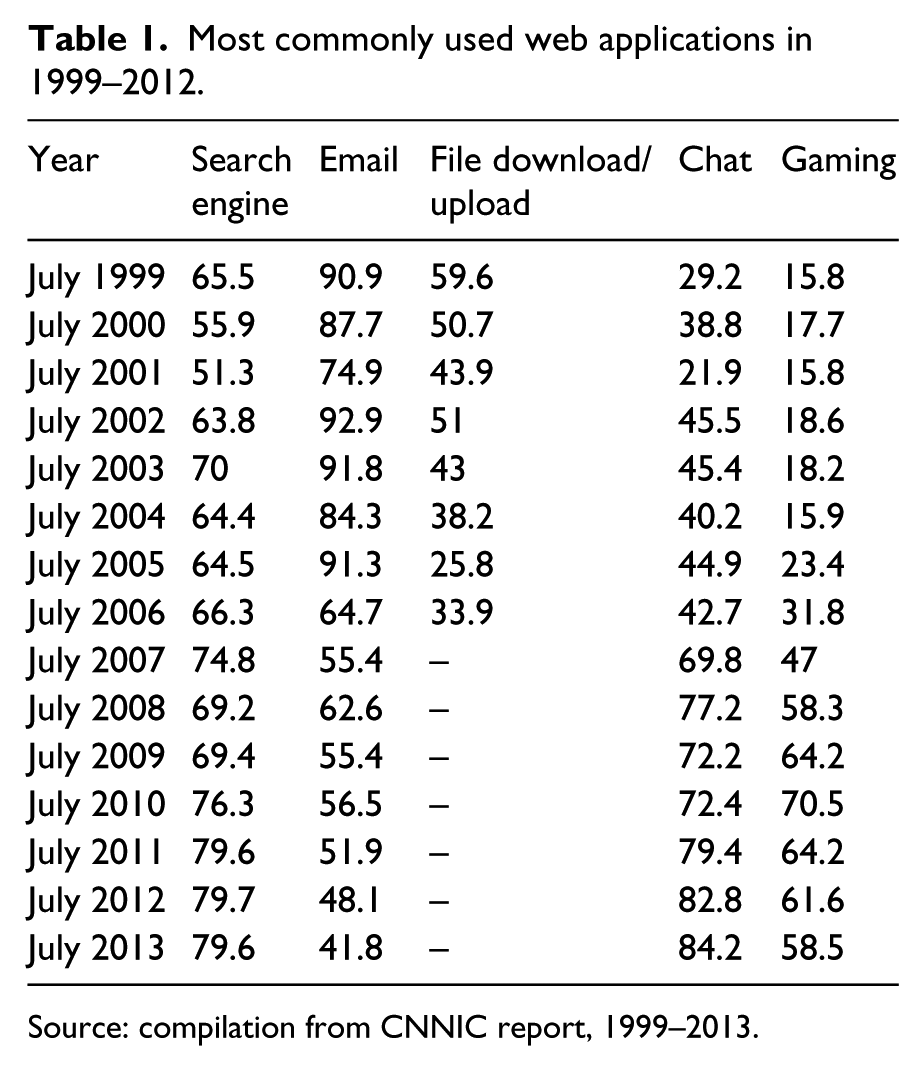
Source: compilation from CNNIC report, 1999–2013.
Meanwhile, the Chinese government is quick to react to the expansion of the Internet-enabled space for online discussion and is growing more attentive and alert to online public opinion at both the national and local levels. As “social stability” is deemed a paramount goal by the government, the fast speed of online communication posts challenges and also pushes the state to be more adept at harnessing the Internet as a means to communicate and connect with the public toward for the ultimate aim of building legitimacy. In June 2008, when addressing the Party’s news organization People’s Daily, then President Hu Jintao outlined the need to develop a “new pattern of public opinion guidance,” calling the government to be more proactive at channeling public opinion and further developing the ability to rapidly and accurately compile and analyze public opinion (Mackey, 2009). In fact, the establishment of “Media Opinion Monitoring Office” (now under the name People’s Public Opinion Office) in 2008 by People’s Daily is a quick response to Hu’s speech that acknowledges the powerful sway the Internet holds in generating influential public opinion (Yang, 2012). Again in 2010, the Chinese government articulated clearly its view toward the emergence of online public opinion in the White Paper, Internet in China: The opinions expressed by the public opinion are receiving unprecedented attention. The leaders of China frequently log onto the Internet to get to know the public’s wishes, and sometimes have direct online communication with netizens to discuss state affairs and answer their questions. It has become a common practice for governments at all levels to consult the public via the Internet before formulating policies of particular importance. (Information Office of the State Council, 2010)
In 2013, President Xi Jinping warns Internet forums, blogs, and Weibo as channels used by hostile Western forces to infiltrate China’s ideological sphere (Nip & Fu, 2016), and this further marks the “return of ideology” that characterized the Xi era (Yang, 2014). In the speech at the National Ideology and Propaganda Work Conference, President Xi Jinping embarked on a campaign to occupy the online public opinion battlefield (Creemers, 2017). In February 2016, President Xi Jinping revamped the Party’s “media work” and toured three Party media outlets Xinhuanet, People’s Daily, and CCTV. After the visit, Xi stated that Party’s media work should “stick to guiding public opinion on the correct path in every aspect and stage of their work” (Xinhua, 2016). In August 2016, the State Council promulgated the Circular on Further Improving Responses to Public Opinion in Open Government Initiatives, which further stipulates the importance of increasing vigilance to the spread of online public opinion and rumors that threaten social order and national interests, and calls for efforts to enhance and improve government’s response mechanism to online public opinion (State Council, 2016). The Circular also made clear that responses to public opinion are a yardstick for the government’s capability to govern. Indeed, as scholars show, different levels of government in China are growing more proactive and social media, such as Weibo, has been integrated into the government’s media tool kit for fine-tuning service delivery, social management, and legitimacy building (Esarey, 2015; Schlæger & Jiang, 2014).
Other scholars study certain pockets of netizens on the Chinese Internet that influence the formation of online public opinion. For example, Rongbin Han’s (2015) study on “voluntary fifty-center” sheds light on how, contrary to the state-deployed online commentators, certain constituency of netizens embark on the values of nationalism and rationality and undermine the moral and factual grounds of regime challengers, which ultimately work out to help stabilize the regime. Various scholarly studies on Internet commentators/fifty-cent party introduced in 2004 and professionalized in 2008 (Bandurski, 2008; Zheng, 2013), and Little Pink (Fang & Repnikova, 2017), also provide nuanced cases of either government-deployed or user-initiated systematic efforts to guide and influence public opinion on the Chinese Internet.
Scholars harbor different views to the Chinese government’s increasing vigilance toward online public opinion. The rather optimistic view is echoed by studies of individual Internet events (wangluo shijian) on Weibo. For example, Huang and Sun (2014) argue that Weibo plays an instrumental role in the development and dissemination of collective action and social movements both online and offline, arguing that Weibo is a “breeding ground for mobilization” (p. 98). Others argue that Weibo provides the government with an opportunity to benefit from popular knowledge about local disputes and protests and, by helping to spread news about its punishment of local officials, Weibo helps to enhance the central government’s legitimacy (Tong & Zuo, 2014). Opposing to the Internet-spawned optimism, some remain skeptical. Scholars like John Sullivan (2013) argue that claims about the democratic potential of Sina Weibo ought to be treated with caution, because as microblog users increasingly vent their discontent with various social ills online, the government is also growing more adept at harnessing information online to identify and neutralize threatening behavior. Hassid (2012) discusses the increasing level of the government’s responsiveness to Internet opinion and argues although this responsiveness can be seen as a good sign of hope for political change, the Party’s action might build and reinforce a new dictatorship—not of the proletariat, but of the commentariat (Hassid, 2012). Although Hassid does not point to the establishment of online public opinion analysts, his article pinpoints to some problems in the way the government (selectively) responds to public outcries online. Together, these studies demonstrate that competition and contestations in the field of online public opinion are intensifying on the Internet in China between different social political interests and actors, such as central and local governments, average Internet users, and various self-formed groups.
Research methodology
Documents analysis is the main research method employed in this article. To examine the political economy of the People’s Online Public Opinion Office, I consult various relevant documents and news sources, such as the publicly available People.cn annual reports for its shareholders, government’s procurement websites, as well as different news portals. These news coverage and published interviews shed light on the marketing and discursive construction of the profession. A thematic reading of People’s Online Public Opinion Annual Report (中国互联网络舆情分析报告) from 2007 to 2016 was conducted to examine how online rumor emerges as an issue on the Internet in China and in the agenda of government Internet policymaking. These reports provide a fairly comprehensive picture of the motivation, working progress, and problems identified by the Office. Compared with other reports generated by the People’s Public Opinion Office, these reports cover the nation-wide trends and online opinion assessment over a year. Although the People’s Online Public Opinion Office publishes many other issue-focused and monthly reports, the annual report is by far the most concrete and comprehensive overview within a given year. As a widely recognized and first-certified online public opinion organization in the country, the People Public Opinion Office also holds training programs and workshops for online public opinion analysts and it oversees the operation of many provincial online public opinion offices and provides annual rankings and assessment of their performance. Unlike other commercial companies, the People’s Online Public Opinion Office makes available its annual reports and the annual report is published in the Chinese Academy of Social Science’s (CASS) yearly Blue Book of China’s Society: The Society of China Analysis and Forecast, which further indicates its authority and officially recognized status.
Political economy of People’s Online Public Opinion Office
The job scope of the online public opinion analyst is defined by People’s Daily, the Chinese Communist Party’s official news outlet, as “to monitor online communication, synthesize them and present them in an easily digestible format and to inform those who have purchased such service” (Bai, 2013). The emergence of the online public opinion analyst as a career dated back to 2007. A number of companies that provide online public opinion monitoring software and services have mushroomed since then. Up to 2012, there are 68 online public opinion monitoring and analysis software recognized by the Software Service Bureau of the Ministry of Industry and Information (Bai, 2013). Although there is no official statistics on the size of the industry, current estimates range from RMB1 billion (online public opinion software market only) to RMB10 billion (Beijing News, 2014). Currently, online public opinion analysts are an institutionalized profession certified by the China Employment Training Technical Instruction Center (CETTIC). In 2013, it was reported that approximately 2 million individuals are currently working in this field, with a monthly salary of a minimum of US$1000 (China Radio Broadcaster Network, 2013). Individuals currently employed in this field mainly come from a journalistic and media-related background. However, there is still a huge demand for workforce and in 2012, 1.2 million CETTIC-certified online public opinion analyst professionals were in demand (Bai, 2013).
Table 2 indicates the purchase of online public opinion services listed on the central government’s procurement website. The government’s procurement website is a part of China’s e-government efforts to make available the products purchased by public funds through the tendering and bidding process. Table 2 shows the government’s purchase of the online public opinion management and analysis service from June 2014 till December 2014. Different levels of government, both regional and national, Party organizations, and government-owned enterprises are purchasing public opinion management and analysis service. Within the half-year alone, government organizations have purchased a total amount of RMB11,061,000 (approximately US$1 million) of online public opinion monitoring service.
Government purchase of online public opinion service.
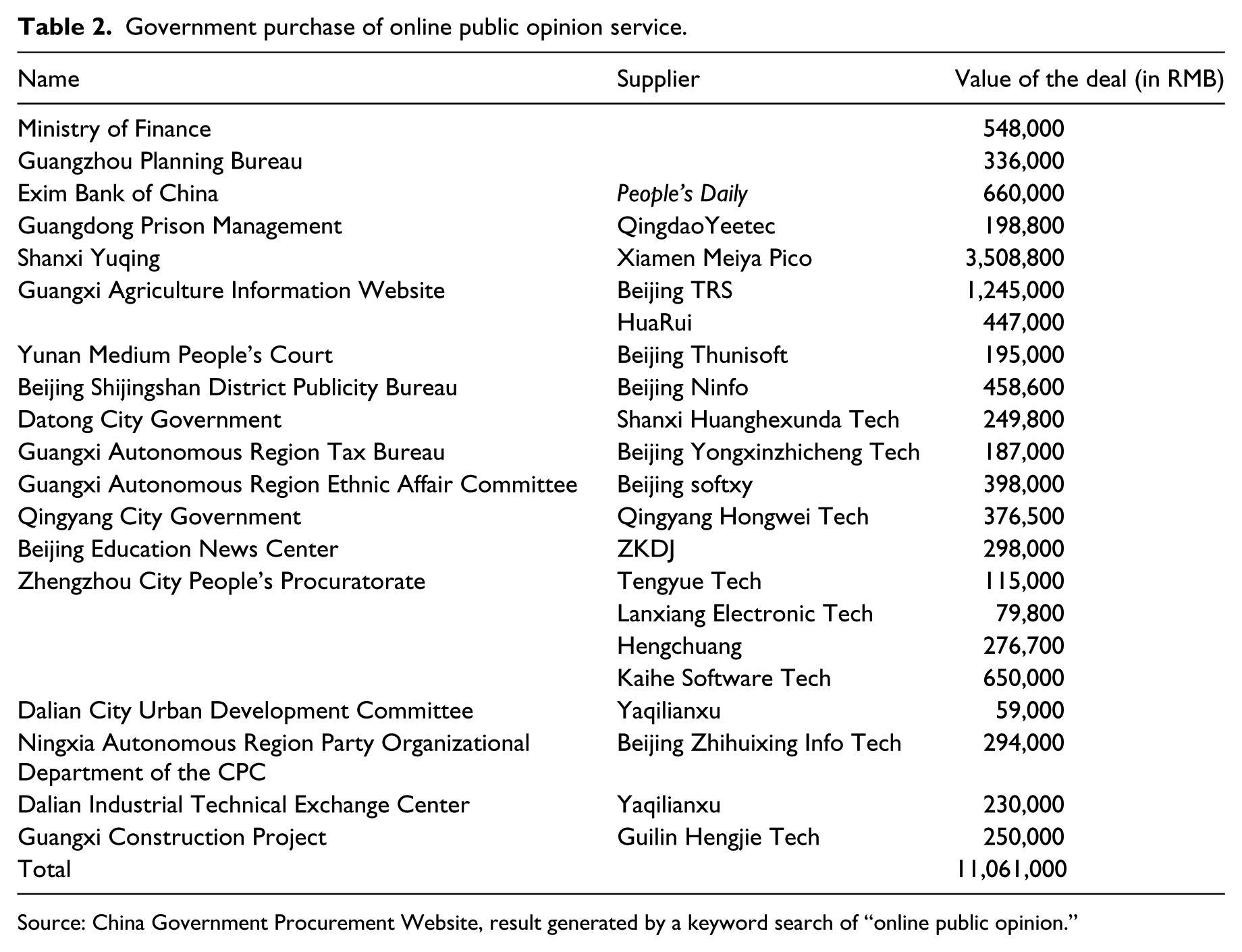
Source: China Government Procurement Website, result generated by a keyword search of “online public opinion.”
The training market for Online Public Opinion is also booming. The mandatory 5-day training that one has to receive before becoming a certified online public opinion management specialist costs RMB7800 (US$1260) (China.com.cn, 2013). It is reported that there are 12 sessions of training held across China and a total of 1050 individuals received training with 860 individuals who passed the exams and became a CETTIC-certified online public opinion analyst in 2013 (Southern Metropolis Daily, 2014). There are three main categories of institutions that offer online public opinion management services. Some well-established information technology and software companies, and public relations and marketing firms develop online public opinion monitoring software and service to capitalize on the new opportunities and expand their scope of business, such as the Founder Group, a publicly listed information technology company on Hong Kong Stock Exchange. Educational institutions and software companies also forged collaboration, such as Nanjing University- Gooni Online Public Opinion Monitoring and Analysis lab and the collaboration between one of China’s most prestigious universities Tsinghua University and Youxun Public Opinion Lab (Southern Weekly, 2013b). The Party’s news outlets also house online public opinion offices such as People’s Daily’s People’s Public Opinion Monitoring Office, and Xinhua News Agency’s Xinhua Online Public Opinion Office. They provide training programs and issue monthly publications on the trends of online public opinion. For example, the magazine Online Public Opinion (网络舆情), published by People’s Daily, is said to be the most expansive magazine on the market in China. Online Public Opinion has a subscription of 10,000 and is priced at an annual fee of RMB3800 (US$614) for its politics edition, RMB4800 (US$774) for politics and business edition, and RMB12,800 (US$2065) for the full package. The magazine also brands itself as “helping the political leaders and Party cadres understand the Internet” (帮领导干部看网) (Wang Luo Yu Qing, 2007).
Relationship with its parent corporation People’s Daily
Under Hu Jintao’s leadership, two documents issued in 2009 and 2011 1 set in motion the commercialization of state-owned news organization in pursuing the ambition to become a “global socialist cultural power” (Xin, 2017). In the quest to become a global socialist cultural power, publicly owned enterprises should become dominant and coexist with enterprises under other forms of ownership. People.cn and Xinhuanet became part of the state’s reform experiments to test the water. People.cn was approved by the Shanghai Stock Exchange to trade publicly in 2012. It is the first news organization in China to go public, People.cn initial public offering was a success and it raised RMB1.38 billion (US$219 million) in the IPO, triple the initial fundraising target, making People.cn worth nearly as much as the New York Times by that time (Rabinovitch, 2012). People’s Online Corporation, which houses the People’s Online Public Opinion Monitoring Office, is one of the subsidiaries of People.cn (People.cn holding 60% direct controlling share). People.cn offers business in three areas: advertising and promotional services, mobile value-added service, and information services, which includes online public monitoring service.
The founding of the People’s Online Public Opinion Office dated back to Hu Jintao’s address to People’s Daily in 2008 (People’s Daily, 2012). Since 2009, its revenue has undergone a phenomenal growth, reaching 165.8 million in 2016, as Table 3 shows. It has become one of the most profitable subsidiaries of People.cn and one of the fastest growing business areas for People.cn. The Chinese government has also invested heavily in researching and developing public opinion monitoring software and platforms. According to the annual report of People.cn, it received a government subsidy of RMB19 million in research and development of its online public opinion monitoring system.
Annual revenue of People’s Online Corporation.

Source: author’s compilation of People.cn annual reports.
Clients of People’s Online Public Opinion Monitoring Services are big state-owned enterprises and private businesses (such as China Mobile, Air China, Sinopec, Bank of China, and Didi Dache), government ministries and departments (Ministry of Education, Ministry of Commerce, and National Development and Reform Commission), as well as various provincial governments such as Shanxi and Guizhou. The People Online’s business encompasses an online and offline segment. The offline segment includes Online Public Opinion magazine, which sold more than 8000 copies in 2011 and the online segment includes the online public opinion monitoring system, Internet public opinion monitoring report, and consultant service (China Press and Publishing Journal, 2012). Compared with other subsidiaries of People.cn, which have stagnant or declining revenue, the online public opinion monitoring and analysis service is a successful commercialization move.
Marketing of the profession
Online public opinion analyst is legitimized through discursive construction which emphasizes the scientific rigidity and methods, objectivity, independence, and autonomy. The duty of online public opinion analysts is to help the government make scientifically informed decisions and democratizing the policymaking process (Zhu, 2015). In an internal debate about the role of public opinion analysts, the People’s Public Opinion Office Head Xinhua Zhu (2015) claims: public opinion work does not amplify the divergence of opinions but … thrives to represent fairly the opinions have been voiced and make clear the common grounds between different parties and reduce potential misunderstanding and misinterpretation.
Objectivity is highly valued for the profession and public opinion analysts cannot carry their own sentiments in reporting, especially in the choice of adjective words in reporting. Use of fabricated data is also against perceived professional standards. However, the type of objectivity the online public opinion analyst upholds differs from that of journalism: “news reporting … is to arrive at reality using first hand report whereas public opinion monitoring is clicking the mouse to recover society’s opinion through website data” (Zhu, 2015). Public Opinion analysts also distinguish themselves from Internet censors, instead, they claim to be the opposite: monitoring is different from surveillance … we are the public opinion institution inside the system, (we are) the objective third party observer between internet users, supervising and governance authorities, we do not meddle with the ecology of online public opinion … instead, we thrive to restore to the full extent of online public opinion and to facilitate conversation and bridging two sides. (Southern Weekly, 2013a)
Various promotional materials and statements of online public opinion services often market themselves as an “independent party” and play the role of “informant” and “consultant” for the government (Bai, 2013; Wang Luo Yu Qing, 2007). Overall, the framing of the profession by the state media and by companies themselves best resembles the role of “public intellectual,” a concept that Walter Lippmann (1957) envisioned in his seminal work Public Opinion. Although written in a vastly different context, Lippmann’s ideal of public intellectuals can be used as a framework of reference when conceiving the role identified by online public opinion analysts. For Lippmann, public intellectuals play an essential role in advising government officials. They stand at arm’s length from those who make decisions and their job is to present objective and comprehensive pictures of the world affairs, because stereotypes and limited attentions make it impossible for individuals to attend to all matters beyond their everyday life. Therefore, public intellectuals are essential to inform the decision-makers and to ensure the functioning of a healthy democracy. Similarly, the perceived role of public opinion analysis is also to democratize policymaking. Objectivity is also key in the operation of the job, as Lippmann implies that it is necessary to standardize and ensure transparency of the scientific methods they employed: “they would be able to use the same measure for the same things, be conscious of the comparisons, and be treated as competitors” and only through this, “the public intellectuals will be able to represent the unseen, the marginalized and events that are out of sight, the mute people, unborn people, relations between things and people” (p. 467). However, Lippmann conceives public intellectuals as a voice of the underprivileged and the underclass, while public opinion analysts do not explicitly align themselves in such way.
Locating the “public” in public opinion
The word “public” is a loaded term. As Justin Lewis (2001) states, the public always begs the question of inclusion and exclusion and the historical underpinning of the social conditions. Through examining the notion of public in its historical lineage, Lewis (2001) argues that: “the concept of the ‘public’ was therefore less a signifier of democracy than a shift in power toward an educated, property-owning middle class- as opposed to common people who could be collectively identified and dismissed as ‘the mob’- define who the public were” (p. 23). What constitutes online “public” in China, in this sense, is also a historical specific construction.
In fact, several scholars are concerned about the false equation of population online with the actual Chinese public (Hassid, 2012). With only 53.2% of China’s population online, opinions expressed online are skewed toward opinions of the male, urbanized, young, better educated, and economically better off than average. The People’s Public Opinion Office’s annual report clearly focused on such pocket of Internet users in China, and furthermore, it ignores the diversity within population online, especially in articulating the problem of online rumor. The report stated that the public online is overwhelmingly young and they tend to speak “freely and carelessly,” and this young, “depoliticized,” public tends to focus more on entertainment news rather than current affairs (People’s Daily, 2009). Moreover, the report states, these young people are “irrational like teenagers, easy to lose oneself among the distractions on the Internet, and unable to exercise rational self-control.” This portrayal hardly matches with findings from existing scholarly studies. For instance, Angela Xiao Wu (2015) argues that historically, the absence of the agentic user in narratives of the Chinese Internet may be a function of an unspoken fear of disturbances and divergence from the state-planned development of Chinese information society. People’s Public Opinion Office’s annual reports actually put a face out among many “faceless” Chinese Internet users, creating meaning and categorization that serves the regulatory agenda of the government’s anti-rumor campaign and the government’s vision to carefully manage and shape Internet uses. It thereby overshadows the diversity in the user demographics and the difference in Internet usage and takes the whole population online as the “public,” regardless of their socio-economic position and generalizes that overall, the public is prone to online rumors and is easily swayed by “harmful” information and thus needs to be controlled and guided, as it is stated: “the Party should seize the dominance in online public opinion, focusing on the methods and means of providing guidance, reinforce positive guidance and form positive online public opinion” (People’s Daily, 2010). This paternalistic vision of managing and guiding Internet use and consumption reflects the country’s long-standing interest in “opinion guidance” media policy, as well as in paving the way for the tightening of content regulation under the banner of “online rumor.”
It is based on this conceptualization of the public that the report advises the government on more effective public opinions guidance online as it stated in the 2010 report that: “the regulation of the Internet has to transform from law and regulation-based methods to more ideologies based … blocking information is easy and the public can be silenced temporarily, but deep down it will leave hatred and dissatisfaction towards the society and the government” (People’s Daily, 2010). This way of framing the public reflects the structural position assigned to the online public from the institutional point view. As Ien Ang (1991) argues, it renders the heterogeneous group of individuals into one addressable, attainable, winnable, a maneuverable “thing”—the object to be conquered (p. 19). The public opinion reports molded diverse Internet user groups into one that is at odds with the emerging vibrant, multifaceted, Internet youth culture that gives rise to new norms, critical thinking, and debater culture (Lagerkvist, 2010; Wu, 2015). Frank Pasquale (2015) reckons that as data and quantitative measure are used to measure individual in an increasingly algorithmic world, theorization and classifications do not discover an independently existing reality, they help, in part, to create it. This precisely describes the condition depicted in the articulation and creation of the “public” in the People’s Public Opinion Office’s annual reports, that the categorization of the “irrational public” is created for the purpose to be controlled and guided.
Knowledge generation about “public” and public opinion
In measuring public opinion, the annual report has employed a few different methodologies such as an issued-based analysis, case study, and polling. The annual reports of the People’s Public Opinion Office present the general trends of online public opinion by conducting keywords search on three of the country’s popular Bulletin Board System: Strengthen Nation Forum, which is an online discussion forum on People’s Daily website, Kaidi BBS, a subsidiary of the state-owned Southern News Corporation, and Tianya, one of the most active BBS founded in 1999. Some of the country’s social media platforms, such as the Chinese counterpart of Facebook—Renren and Kaixin, as well as Sina Weibo and Tencent Weibo—two of the most popular microblogs were added in 2013. The report tallied the number of posts gathered using keyword search on these websites. The higher the number of posts indicate the greater attention gained by certain social issues. Then public opinion analysts will ask the participants to vote in a survey to answer whether they are satisfied with the government’s reaction. The creation of these polling questions with which to record public opinion creates a significant gap between the public and their opinions as the questions are closed-ended questions. Through answering predefined questions, these polls deprive the public of the chance to voice their own opinions, as Justin Lewis (2001) criticizes “the public did not express itself, but was subject to a rational order dictated by the scientific procedures of measurement, evaluation, and precision” (p. 27). Furthermore, by rendering many unmeasurable aspects into numerical representation, these answers contribute to symbolic politics more than rational decision-making (Ang, 1991).
To further illustrate how through these polling mechanisms, certain policy issues are identified and knowledge about the public is generated in the case of the Chinese government’s anti-rumor campaign, online rumor and online celebrity and opinion leaders have been a key issue discussed in the People’s Daily’s annual reports from 2011 to 2015. The annual reports’ assessment for online rumors shifted from a fairly neutral tone to a negative one within these 3 years. In 2011, the report states that “only by allowing different opinions to compete with each other that the efficiency of the self-cleansing mechanism of online rumours can be maximized” (People’s Daily, 2011). In the same year, the People’s Public Opinion Monitoring Office suggested the government to take a hand-off approach and to increase transparency when a rumor breaks out. In 2011, online rumor was identified as an issue that requires more responses from the government. In 2012, People’s Online Public Opinion annual report’s assessment of online rumor took a sharp turn and reached a negative conclusion. The report bashed Weibo and its Twitter-like function of only allowing 140 characters, stating: “microbloggers usually listen half, understand a quarter, think zero but react double.” To minimize the “toxic” impact of Weibo, the report suggested that long posts and blogs should be fully utilized to clear the people’s mind (People’s Daily, 2012). Interestingly, this shift in perspective toward online rumor corresponds with the government’s regulation of online rumor by shifting the responsibility from government to individual Internet companies. On 20 March 2012, rumors about a coup in Beijing organized by allies of Bo Xilai were disseminated widely on Weibo. The Chinese authorities shut down 16 websites and detained six people responsible for “fabricating and disseminating online rumors” (Wade, 2012). Weibo was punished by the State Internet Information Office and was forced to shut down the comment function of its service for 3 days from 31 March to 2 April (China Digital Times, 2012). This temporary suspension of one of Weibo’s most important functions prefaced a new wave of clamping down on online rumors and defamations. Harsh punishment on Weibo triggered the Internet Society of China, the country’s industry self-regulation association, to release a Proposal Letter on Resisting Online Rumors, to carry forward a right social atmosphere, and to respect the government’s demand for real-identity authentication and consciously accept social supervision.
In 2013, the report stated that: “due to the lack of media literacy of online users, they are easily swayed by opinion leaders … they retweet rumours without fact checking and thus amplifies the negative impact of online rumours” (People’s Daily, 2012). This time, the report sees the problem of online rumor as problems of individual Internet users. In August 2013, the State Internet Information Office, a department under the State Council that directs, coordinates, and supervises online content, the Internet Society of China, and the Beijing Network Industry Association hosted the Online Celebrity Social Responsibility Forum. The Forum was broadcast live on the China Central Television Station (CCTV) during a prime time talk show. In all, 14 Big “V” Weibo users (verified users with more than 1 million followers) were invited. Following the televised discussion, the “Seven Baselines” were adopted as guidelines for online conduct by the Chinese Internet Conference—an event hosted by the Internet Society of China in September 2013 (Xinhua, 2013). The Southern Daily (2013) stated that greater social responsibility and “cleansing the online environment … requires Internet users’ self-discipline and self-censorship … while rejecting online rumours and spreading positive energy.” The Seven Baselines adopted at this time are not formal regulatory measures but more of a call for self-regulation among Internet users, especially among Weibo celebrities who are most vocal in online discussions. On 26 August 2013, an editorial in the People’s Daily stated that these online opinion leaders have become an amplifier of “big rumours” (大谣), given that their accounts are followed by millions of users and retweeted by millions (People’s Daily, 2013). Within a short period after the adoption of the guidelines, Weibo suspended 3773 accounts for running afoul of the Seven Baselines out of a total of 103,673 accounts punished for a range of “offences” (People’s Daily, 2013). The formulation of the Seven Baselines marked the apex of a full-fledged government crackdown on online rumors. A month later, a new legal “interpretation” was set out by the Supreme People’s Court and the Supreme People’s Procuratorate on 10 September 2013 that made it possible for the government to rely on provisions in Article 246 of China’s Criminal Law to deter and punish online critics (Lubman, 2013). The interpretation expanded the reach of Article 246’s definition of criminal defamation to specifically include online content. According to Article 246, “disseminating defamatory information through networks, especially when the posted content is reviewed over 5000 times, received 5000 clicks, or was reposted over 500 times constitutes a criminal offence” (People’s Daily, 2013). A 16-year-old boy, Yang Zhong, who publicly questioned investigators over the mysterious death of a karaoke club manager in Gansu Province on Weibo become the first victim after the promulgation of the new interpretation of the Criminal Law. He was accused of spreading online rumors with a Weibo post that was retweeted over 500 times and was sentenced to 3 years in jail but was soon released by Public Security authority under public pressure (Jacob, 2013).
In 2014, again, the Online Public Opinion Annual Report published by the People’s Online Public Opinion Office states that Internet companies should be held responsible for detecting and limiting the spread of online rumors: “website should be the gatekeeper for information flowing online and establish complaints report mechanism” (People’s Online Public Opinion Monitoring Office, 2014). In the following year, Weibo established its Party Unit and the Party Unit collaborated with Weibo celebrities and government Weibo accounts (Sina, 2017). In 2016, the word “online rumor” only appeared thrice in the Online Public Opinion Annual Report, indicating that compared with previous years, regulating online rumor has receded in its priority. Nonetheless, the report made a case for the return of editorial control for Internet companies that new media platform needs an “editor in chief,” to make choices and recommendations of information based on “mainstream value system” (People’s Online Public Opinion Monitoring Office, 2016).
The heightened concern of online rumors identified by the People’s Online Public Opinion Office and the launch of the Chinese government’s campaign to combat online rumors is a case in point to demonstrate the emerging dynamics as public opinion analysis is increasingly integrated into government policymaking. Policy promulgation over time corresponds with the People’s Public Opinion Office’s annual reports’ shifting depiction of which party should be held responsible for the negative influences of online rumors. These online public opinion reports and the government’s anti-rumor campaign mutually legitimate each other. In Justin Lewis’s (2001) words, polls are used to sell policy positions rather than construct them (p. 37). In the case of the regulation of online rumor, the dynamics between public opinion analysis and the government ministries demonstrated the obfuscation of the means and ends in policymaking, where creation of public knowledge about online rumors was to sell policy positions and to set the agenda for policymaking.
Discussions
To be able to gauge and monitor online public opinion swiftly and cost-effectively is a great boon for China’s leaders (Lagerkvist, 2005) and the Chinese government is increasingly integrating public opinion analysis and big data into the policymaking process. For example, in the regulation of the ride-hailing industry, the Ministry of Public Transportation employed online public opinion services to use big data to profile drivers and riders and incorporate these data into the policymaking process (People.cn, 2017). Under these policy directives, online public opinion analysts flourish and grow into a lucrative business and industry. News organizations in China, especially, are seizing opportunities to capitalize and develop their own online public opinion services. This is a business move for publicly traded news portals such as Xinhuanet and People.cn, because subsidiary online public opinion service can capitalize on the companies’ existing news service and other business segments (e.g. online discussion forums). Moreover, it is also a strategic move to build on the established status as the Party’s news outlet to appeals to various governmental and commercial organizations.
The popularity and commercial success of online public opinion analysts demonstrates the increasing power such service and organization commands in mediating and generating public knowledge about Chinese Internet uses and online interactions and in setting the agenda for policymaking. As a powerful toolkit employed by the government, public opinion analysis service has long-term impacts on policy promulgation. As Roger Creemers (2017) reckons, during 2012–2014, the Party has repositioned technology within its architecture of public power and seeks to deploy technology in a manner that renders society legible and predictable. In particular, data mining and online discourse analysis became cornerstones of stability maintenance efforts, as well as a lucrative business. Online public opinion analysis not only informs policymaking but also aims at preempting any contentions, conflicts, and social unrest, as this slogan captures: “to predict online public opinion like predicting the weather” (Oriental Morning Post, 2012). This also means the proactive reconfiguration of Internet governance in tackling problems of social stability maintenance and public opinion (Creemers, 2017).
These online public opinion annual reports, as an aggregate measure of how a very selective sample of Internet users perceive certain social political events, reinforces precisely what Nick Couldry terms “the myth of ‘us’.” The myth of “us” encourages us to believe that our gatherings on social media platforms are a natural form of expressive collectivity (Couldry, 2015). This is not new with the emergence of social media, but “part of a longer sequence of myths that have historically made sense of, indeed normalized, a certain organization of life and discourse in modern societies around centralized media institutions and the intense concentration of symbolic power” (Couldry, 2015, p. 609). The “public opinion” gathered through the People’s Online Public Opinion Office is only a piecemeal of the diverse cultures and appropriations on the Chinese Internet. These services take for granted that the tweets, posts, comments online—which contain only readable evidence, as a representation of what is going on in the society, a type of consensus among different imagined publics. As the case of anti-rumor campaign demonstrates, the online public opinion analysis service obfuscates the means and ends of policymaking, where the reports construct meaning and generalization that in service of, reinforces and legitimizes policymaking agenda. The statistical gauging and quantitative rendering of online communication in annual reports create malleable and controllable subjects for Chinese Internet policymaking.
The strategic way policymakers employ online public opinion analysis of online content as prominent indicators of social changes further reflects the centrality and reliance on media that “give us access to ‘what is going on’- for us as a society at a particular time- is so deeply entrenched that it is difficult to imagine our relations to media without it” (Couldry, 2015, p. 614). In fact, Nick Couldry (2015) raises the example of Weibo in China as a case in which no matter what its initial potential for citizens, it is now equally important as a platform for the Chinese government, for example, the censored transcripts of the Bo Xilai trial were broadcast, almost “live”- in a sense, Weibo is harnessed by the government as a form of “mass, live media” to broadcast such event. Merely capturing, scanning, and reading through online content masks many dimensions of offline networks and neglects a more contextualized understanding of the individuals behind the screen and communities online. Furthermore, the People’s Public Opinion Monitoring Report that used a number of posts, through keyword search to measure the level of online attention, reaffirms the fallacy that political attention will increase in step with the increase in political message production (Couldry, 2015, p. 616).
By examining the political economy, marketing, and professionalization of the online public opinion analyst, this article shed lights on one important actor in the co-evolutionary dynamics between the State and civil society—the online public opinion analyst. As the Chinese government increasingly integrates commercial public opinion service into its decision-making process, its social impacts have to be examined over a lengthy period of time. By using anti-rumor campaign as a case study, this article demonstrates that public opinion analysis legitimizes and reinforces the promulgation of the Chinese government’s move toward a more nuanced way of managing, guiding, and controlling online interactions in China.
Footnotes
1.
These two documents are Decision of the CPC Central Committee on Major Issues Pertaining to Deepening Reform of the Cultural System and Promoting the Great Development and Flourishing of Socialist Culture.