




Abstract
Given the paucity of studies on the communicative approaches employed by vice presidents in political public relations and studies on Africa in public relations, the current study analyzes how the Vice President of Ghana, Dr. Mahamudu Bawumia, enacted authenticity to construct his public image on Twitter. The study used Multimodal Discourse Analysis to analyze 161 tweets, finding the manifestation of cues of authenticity: ordinariness, consistency, immediacy, and intimacy in Dr. Bawumia’s display of strategic humility and respect, his commitment to technology and Information, Communication, and Technology in Ghana, and his leadership by example. We argue that he constructs the image of an exemplary, caring, trustworthy, pious, and proactive leader, which helps him to build social and political capital. Implications of our study for public communication are discussed.
Introduction
The landscape of political communication has undergone significant transformations in the past three decades, with the advent of Web 2.0 platforms, mainly social media, marking a pivotal shift. The rise of social media has fundamentally altered how politicians present themselves online and convey authenticity. In contrast to the era of traditional media, during which journalistic norms and practices shaped politicians’ self-presentations, the current social media age has afforded them direct communication routes to their publics, making it more convenient to present themselves as authentic (Fountaine, 2017; Shane, 2018). In addition, the rise of personality-centered politics and populism across the globe for electoral benefits has intensified the need for politicians to display authenticity (Kissas, 2020; Szebeni & Salojärvi, 2022).
Some scholars have defined authenticity as the genuine portrayal of one’s beliefs, principles, or self-image by politicians, demonstrated through accurate and sincere communication with their public audience(s), thereby constructing a true representation of themselves (Jones, 2016; Umbach & Humphrey, 2018). Originally more germane to traditional media, the burden of displaying authenticity in the political space has become more crucial for politicians due to the increased centrality of social media in recent decades. The successful communication of authenticity—and of centering authenticity in one’s self-presentations—enhances a politician’s perceived trustworthiness among their publics in any context, particularly in cyberspace, as they can establish connections, improve their relatability, and enhance their credibility by controlling their narrative online (Enli, 2015; Margaretten & Gaber, 2014; Parry-Giles, 2001). This means politicians not displaying authenticity on social media may lose crucial political capital. This risk may be the greatest of all for vice presidents because they are expected to support their president’s agenda narrative and simultaneously make themselves distinct, which can create strategic tensions.
While considerable scholarship exists on the communication approaches of presidents and legislators (Lin, 2024), scant attention has been paid to understanding the communication dynamics of vice presidents. Vice presidents are critical political figures yet have received less scholarly attention than presidents and other national-level politicians. Although very few studies have focused on them, they are crucial to governance, and their performance can have repercussions on the image of the presidents they serve and their administrations’ images. One fact that highlights their importance is that presidential candidates, for strategic electoral and governance reasons, select as their running mates prospective vice presidents whose qualities complement their own (Osei Fordjour, 2022). This is undoubtedly the case in Ghana, where the vice president is constitutionally tasked to chair the economic management team, a state committee overseeing the affairs of the nation’s economy. The Ghanaian Vice President leads critical diplomatic mediations and can act without the president. Finally, as is the case in the United States and many other nations, the Ghanaian Vice President takes over in the event of the president’s death or resignation.
All of this implies that vice presidents are influential politicians who, like all other 21st-century elected officials, must display authenticity in their self-presentation. This means that studying how vice presidents communicate on social media can provide valuable insights to scholars and practitioners of public relations, particularly political public relations and image building. 1 This article does so via a multimodal analysis that assesses the tweets of the current Ghanaian Vice President, Dr. Mahamudu Bawumia.
Dr. Mahamudu Bawumia
Dr. Mahamudu Bawumia, serving as the sixth Vice President of Ghana’s fourth republic, took office alongside President Nana Addo Dankwah Akufo-Addo, both members of the New Patriotic Party (NPP), on January 7, 2017. Their victory marked a significant turnaround, considering they had faced defeat in two consecutive elections against the now-main opposition party, the National Democratic Congress (NDC). Dr. Bawumia’s devout Muslim faith complemented President Akufo-Addo’s Christian beliefs (Osei Fordjour, 2024).
Initially underestimated within his party’s grassroots, Dr. Bawumia earned public favor by consistently criticizing the previous administration’s economic policies. His pivotal role as the Witness-in-Chief during Ghana’s first-ever nationally televised election petition heightened his national profile and solidified his importance within the NPP (Osei Fordjour, 2024).
Political commentators emphasized Dr. Bawumia’s significance in the NPP’s 2016 election triumph (Osei Fordjour, 2021). He actively endorsed the party’s manifestos, leading a dedicated campaign team to promote their promises of prosperity and equal opportunity. In addition, he fiercely criticized then-President Mahama’s administration, accusing them of economic mismanagement, excessive borrowing, currency devaluation, and high inflation rates through strategic political symposiums and speeches.
Since assuming office, Vice President Bawumia has emphasized religious tolerance and highlighted the similarities between Islam and Christianity, earning praise from religious leaders (“Bawumia is a friend of the church,” 2022). His focus on digital initiatives in various sectors, such as ports, blood delivery, and postal services, has earned him the moniker “digital Vice President” and widespread acclaim (“Ghana’s digital agenda can only be possible through inclusion of all—Bawumia,” 2021; Mensah, 2022).
Despite facing early scrutiny and criticism, including personal attacks on his marriage and competency in managing the economy, Dr. Bawumia has emerged as one of Ghana’s most popular vice presidents, thanks to his increased media presence and vocal engagement (“Bawumia’s second marriage collapsing over infidelity,” 2012). With a significant Twitter following of 744,009 (as of February 28, 2023) in the context of African politicians, Dr. Bawumia’s active social media presence and influence in Ghanaian politics make him a noteworthy subject for further study.
Political public relations and self-presentation in politicians’ image construction
Kiousis and Strömbäck (2011) define political public relations as The management process in which an organization or individual actor, for political purposes [and] through purposeful communication and action, seeks to influence and to establish, build, and maintain beneficial relationships and reputations with its key publics to help support its mission and achieve its goals. (p. 8)
This means that politicians’ constructions of their identity through self-presentations on platforms such as social media embody political public relations. Despite the term/concept being identified over a decade ago, few scholars have studied the purposeful communications of nations’ vice presidents, which leaves a gap in the political public relations literature.
Self-presentation can be defined as the intentional or unintentional display or portrayal of oneself through various channels of communication, including verbal language and nonverbal cues such as gestures and mannerisms, which occur both during particular instances or consistently over a period (Cooley, 1902/1964; Goffman, 1956). This means that self-presentation can be observed visually or verbally. Attrill-Smith et al. (2019) argue that the presentation of the self is strategically motivated to gain social acceptance and manage relationships. Self-presentation is a form of impression management that refers to “the process by which individuals attempt to control the impressions others form of them” (Leary & Kowalski, 1990, p. 34).
Particularly in the political space, leaders attempt to create desirable impressions or images in the minds of their crucial publics, such as voters and citizens, through self-description, nonverbal behavior, or props (Diedkova, 2024; Leary & Kowalski, 1990). According to De Munter (2023), the visual self-presentation of political suitability, leadership, and intelligence proved universally effective in appealing to voters through impression management. However, the researcher postulates that displaying trustworthiness and sympathy was not effective. This means that self-presentation is a public relations tool, particularly in the political sphere, where politicians seek to manage their impressions in the minds of their publics to build long-term relationships with them.
Image construction is central to how individuals or politicians manage their impressions or reputations. The present study adopts Strachan and Kendall’s (2004) definition of image construction as the use of “symbolic devices, which can be constructed with both visual and verbal messages, that provide a shorthand cue to audiences for the identification and enhancement of specific attributes of an individual, an organization, a phenomenon, or a cause” (p. 135). This means that image construction hinges on self-presentation, a form of impression management. Individuals or politicians can construct their image through communication or publicly displayed actions. In the 21st century, mediated platforms such as social media, which allow people to control how they present themselves, play a central role in constructing an individual’s image.
Authenticity, social media, and politics
Crucial political publics such as the media, voters, and internal party stakeholders demand authenticity from their politicians; thus, authenticity itself, or its display, can be a tool for building social capital. This study defines authenticity as the process where politicians create a “true self” or “ideal self,” reflected in their demonstration of beliefs, principles, or images that appear accurate based on public evaluation or expectations in a given context (Jones, 2016; Luebke, 2021; Umbach & Humphrey, 2018).
The display of authenticity has been linked to image construction, public perception, citizens’ confidence, and trust in political leadership by scholars such as Shane (2018) as well as Sisson and Bowen (2017). In contrast to the position of these scholars, others have argued that authenticity in politics is merely a social construct or even a tool; in their view, politicians construct, paradoxically, a “true self” evinced in the “accurate” demonstration of their beliefs, principles, or images, based on public evaluations or politicians’ perceptions of such evaluations (Alexander, 2004; Jones, 2016; Umbach & Humphrey, 2018). This means authenticity is based on behaviors and, therefore, can be strategically manufactured and curated.
Scholars who subscribe to the performance tradition of authenticity in political discourse have identified four main facets: ordinariness, consistency, intimacy, and immediacy (Enli, 2015; Luebke, 2021; Sheinheit & Bogard, 2016). Ordinariness is attributed to performances that portray politicians as regular individuals, just like other citizens; however, unlike (mere citizens), they have powers—and mandates—that regular citizens do not. Consistency refers to regularly and routinely repeated components of politicians’ communications (including message points, narratives, and opinions) over space and time (Hahl et al., 2018; Pillow et al., 2018). The intimacy facet of authenticity relates to the idea that the public is gaining an impression of the “real” private person behind the politician (Enli, 2015; Luebke, 2021). Finally, immediacy can be seen as communication that reflects the inner self to the public (Luebke, 2021). This facet of authenticity in political discourse is constructed with the instantaneous reflections of a politician’s thoughts in an uncensored or unnuanced manner (Gershon & Smith, 2020; Shane, 2018). In the present study, we adopt the performance tradition of authenticity because it allows us to account for the role of public relations practices and practitioners as politicians’—authenticity co-constructors.
Social media presents politicians with what Goffman calls the “stage” and “expressive equipment” to perform for their publics (1956, p. 18). This involves two parts: the front stage and the backstage. Politicians craft a public image through visible favorable actions for the audience (front stage) while concealing (i.e. placing in the backstage) less favorable traits or behaviors when in public settings (Goffman, 1956). As Goffman (1956) observed, self-presentation relies upon the skillful use of “impression management strategies,” meaning that politicians “no longer have to rely upon media coverage but can be an ongoing communication process controlled by the sender” (p. 90). We highlight a few studies examining how politicians construct an authentic image on social media.
Previous research on politicians’ construction of authenticity on social media
A few studies have examined how politicians construct authenticity to manage their reputations and relationships on social media. For instance, Fountaine (2017) analyzed the tweets of Nikki Kaye and Jacinda Ardern during New Zealand’s 2014 general election campaign. The author argued that the two politicians displayed authenticity through intimacy in different ways. For instance, whereas Kaye showed pictures of herself posing in front of her car, Ardern revealed her untidy interior seats. Fountaine argues that Arden constructed an image of relational politicians, which enhanced her likeability among their publics because her display of authenticity seemed more spontaneous. This shows that displaying authenticity affects the relationship between politicians and their publics. Despite Fountaine’s (2017) argument, other scholars in the United States and Europe have found that character/likeability alone does not translate to suitability for political office and can sometimes be confused with authenticity (e.g. De Vries, 2023; Rosenberg et al., 1986). These tensions imply that assessing the manifestation of authenticity in political communication remains a complex and nuanced endeavor.
Similarly, Kissas (2020) compared tweets by Donald Trump of the United States and Labor Party leader Jeremy Corbyn of the United Kingdom during their electoral campaigns in 2016 and 2017, respectively. The author observed that Trump enacted populist and patriotic ideologies in his tweets by posting photos of himself with men in uniform in front of military aircraft, displaying national flags, and using captions such as “I will stand with police and protect ALL Americans! #Debates2016 #MAGA.” Kissas (2020) argued that such ideological displays disguised Trump’s socioeconomic status and portrayed him as an ordinary citizen, making him appear authentic.
Kissas (2020) observed that Corbyn, by contrast, displayed populism through tweets that portrayed him as ordinary, including those with photos of himself taking the train or watching a soccer match, or by his use of captions such as, “In Swindon this morning talking about how a Labor government will transform Britain. Had to get the train as May (the Prime Minister) was using the helicopter.” Kissas argued that although the display of such ideologies portrayed them as authentic, Trump’s ideological performance was charismatic, while Corbyn’s ideological performances were melancholic. This illustrates the display of authenticity as invariably reflecting a politician’s “true self” or character, as shown in both Trump’s and Corbyn’s tweets. Furthermore, Kissas observed that although displaying authenticity through ideological performances can be effective, it can be more so for some politicians than others.
More recent studies have reinforced the salience of authenticity as a component of the image politicians construct in their social media communication and may also have an impact on a leader’s ideology. For example, in their study of visuals from Hungarian Prime Minister Viktor Orbán’s 2019 Instagram posts, Szebeni and Salojärvi (2022) observed that Orbán enacted authenticity by displaying ordinariness in his appearance by wearing loose-fitting shirts. The researchers also observed that he displayed consistency, immediacy, and intimacy by reinforcing his values, documenting daily activities, and sharing moments with his family. The authors argue that he constructed images of a steadfast, relatable, and reliable leader. Their findings highlight how a leader’s appearance and actions contain authenticity cues as well as how they can be consequential to image construction.
Similarly, Lacatus and Meibauer (2022) examined Boris Johnson and Donald Trump’s tweets during their election campaigns in 2019 and 2020, respectively. They found that both leaders employed authenticity cues by addressing issues that resonated with voters, such as economic challenges and border control. Through timely tweets, personal views, and consistency with their populist ideologies, Johnson and Trump projected authenticity. They concluded that whereas Johnson constructed an image of a leader in touch with the people, Trump constructed an image of a decisive leader. Lacatus and Meibauer (2022) suggest that the politicians’ right-wing populist approaches influenced their authenticity display, highlighting the impact of ideology on authenticity enactment.
Last, Sonnevend and Steiert (2022) analyzed German Chancellor Angela Merkel’s Instagram posts in three different phases of her administration (experimental, consolidation, and crisis communication). The researchers observed that the German Chancellor displayed authenticity through ordinariness embodied in her simple clothing choices, like regular pantsuits, and participation in semi-public leisure activities like hiking. Also, they argued that she displayed consistency in her visual poses and background. The authors claim that her self-presentation is rarely emotional because she avoids using immediacy and intimacy cues of authenticity, which allowed her to construct the image of a relatable leader. Comparing these findings to those of Lacatus and Meibauer (2022) and Szebeni and Salojärvi shows that politicians’ approaches to displaying authenticity have stylistic nuances.
These studies highlight how authenticity can be constructed; however, they are related to politicians in non-African contexts, and some are outside the context of governance, thus saying nothing about how African politicians construct authenticity on social media in the context of governance. We address this gap with this present study by answering the following research question:
RQ: How did Mahamudu Bawumia construct authenticity in his first year in office?
Social semiotic theory
The main argument of social semiotic theory is that meaning-making is a sociocultural activity involving language or communicative modes to create and negotiate meaning in different contexts (Kress & Van Leeuwen, 2006). Specifically, this theory highlights the centrality of understanding the social, cultural, and historical contexts in which signs or symbols are used and how these contexts shape their meaning.
Kress and Van Leeuwen’s (2006) social semiotic theory advances the position that signs and symbols such as photographs have three types of communicative meanings: representational, compositional, and interactive. Representative meanings are embedded in the photograph’s story; compositional meanings manifest in how the photograph is laid out; interactive meaning is how photographs resonate with a viewer. Four assumptions underpin the theory: (1) meaning-making is multimodal, which implies the simultaneous use of multiple elements such as writing, images, and action; (2) social contexts shape semiotic resources, which also indicates that cultural nuances inform the semiotic meaning; (3) signs are motivated by individual motives, meaning people consciously frame and display specific photographs to their audiences; and (4) the originator’s interest motivate their choice of signs, meaning the photographs shared by individuals have ulterior motives (Wong, 2019).
Researchers have employed the social semiotic framework to study various semiotic objects such as social media pages of non-profit organizations (Ben Moussa & Benmessaoud, 2021), various forms of political discourse (Machin & Van Leeuwen, 2016), and currency notes (Elbardawil, 2020). Wong (2019) posits that the framework is central to interpreting reality created through the simultaneous, imbricated use of visuals and text and highlights how they relate to broader societal discourses and ideology. Kress and Van Leeuwen (2006) also advance the argument that the framework allows researchers to speculate about the socio-political implications of the meaning. The present study will extend this approach, analyzing the Ghanaian Vice President’s multimodal tweets through public relations and image construction lenses.
Methods
This study takes a qualitative approach. The Vice President of Ghana is of interest to scholars of political communication because Ghana is considered the benchmark of democracy in Africa (Sikanku, 2022), so analyzing the vice president’s discourse on Twitter contributes knowledge to an area rarely studied. In addition, this study is of scholarly significance because, in the history of Ghana, two vice presidents have risen to become presidents, so Dr. Bawumia’s tweets are, in effect, the communications of a likely president.
Twitter (now X) has become an essential social media platform in the political space over the last 15 years. Since it was publicly introduced in 2006, scholars have described Twitter as the most utilized social media platform by politicians (Coe & Griffin, 2020; Jenkins et al., 2013). This has been attributed to the ease with which tweets spread and the ease of following political topics on the platform compared to others (Lukamto & Carson, 2016). This makes Twitter a useful platform for studying political communication. Although this was the case, Elon Musk’s $44bn takeover might negatively impact Twitter’s influence in political communication. Also, this study maintains the name Twitter throughout because it has a stronger brand image and greater recognition than the platform’s current name (X). Compared to other social media platforms, Twitter is the fourth most used social media platform in Africa (as of September 2023), and in Ghana, it is estimated that as of January 2023, about 1.17 million users were on the platform (Galal, 2023; Kwarteng, 2024). For the practice of political communication, scholars argue that, in addition to newspapers, television, and radio, over the past decade, social media platforms like Twitter and Facebook have become central to how politicians communicate (Osei Fordjour, 2024; Thompson, 2021), making them crucial for practical and theoretical insights.
In the present study, the unit of analysis is the tweet; specifically, our units of analysis will be the tweets on the official Twitter pages of the Vice President of Ghana, Dr. Mahamudu Bawumia (@MBawumia). This present study adopts Strachan and Kendall’s (2004) definition of image construction, which, to recap, is the use of “symbolic devices, which can be constructed with both visual and verbal messages, that provide a shorthand cue to audiences for the identification and enhancement of specific attributes of an individual, an organization, a phenomenon, or a cause” (p. 135). Strachan and Kendall further argue that image construction is a strategic way to reinforce favorable public perceptions and influence political attitudes, including decision-making, which makes it relevant for public relations.
We use a multimodal (photographs and captions) approach to this study because doing so provides more depth and insightful findings (Oyebode & Unuabonah, 2024; Taiwo & Oamen, 2018) than is possible when considering only one communication mode. Specifically, we employ the principles and practices of Kress and Van Leeuwen’s (2006) social semiotics, which foreground representational meanings. Representational meanings can be classified into narrative and conceptual meanings. Narrative meanings take cognizance of photographic events, actions, and change processes (Jewitt & Oyama, 2001). In contrast, conceptual meanings consider how the characters or actors in photographs are depicted in terms of “their class, structure, or meaning” (Kress & Van Leeuwen, 2006, p. 79).
This approach is reminiscent of the work of Chen and Gao (2014) in their analysis of movie posters in Asia and by Elbardawil (2020), who explored the representational meanings of Jordanian currency notes. Our study’s data set consists of tweets from January 7, 2021, to January 7, 2022, Vice President Bawumia’s first full year in office, a period that is crucial for establishing political credibility. Since this is a multimodal study, we considered tweets with still pictures and words. The pictures were considered because, compared to videos, they give instant impressions and are unambiguous, making them crucial for self-presentation/impression management in politics (Schill, 2012). Since our goal was to understand how the vice president enacted authenticity, we studied only photographs he directly tweeted and ones that included actions that directly involved him. Because this was the case, we excluded memes that Dr. Bawumia retweeted from our data set and tweets that contained only words. In total, we analyzed a total of 111 out of 161 multimodal tweets.
In our analysis, we first described the performances in the tweets, then justified why they represent authenticity based on the social-cultural context and literature related to authenticity; we then looked at the implications of such meanings (Berger, 2010). Employing this approach allows us to elaborate on the meanings produced by the tweets. We conceptualize authenticity in the current study regarding ordinariness, immediacy, consistency, and intimacy (Enli, 2015; Luebke, 2021; Sheinheit & Bogard, 2016). The researchers ensured consistency by conducting regular meetings to discuss and clarify instances of ambiguities in the coding process. In the next section, we analyze and discuss the discourse of authenticity in Dr. Bawumia’s tweets.
Findings
This study’s findings will be presented based on the four dimensions of authenticity identified by previous scholars (e.g. Enli, 2015): ordinariness, consistency, immediacy, and intimacy.
Ordinariness
In his tweets, Dr. Bawumia displayed authenticity through ordinariness in several ways, such as strategically displaying humility. He displayed humility before individuals with high social and political capital in such tweets. For instance, on April 4, 2021, which was Easter Sunday, Dr. Bawumia appeared in a white caftan and a white face mask. His hands are joined together, and his fingers are upright, with his posture slightly tilted like he is bowing, which is an act of paying homage, particularly in religious circles (see Figure 1). Before him is a man wearing a multi-colored cassock, a long, single-colored garment worn by some Christian clergy members, a black Gammarelli, a face mask, and a pair of dark glasses. Others are gathered around them, making the same gesture as VP Bawumia. The tweet’s caption reads,
As Christians worldwide commemorate the resurrection of Jesus Christ today, I, together with officials from government and the New Patriotic Party, joined the clergy and congregants of the Holy Trinity Cathedral of the Anglican Diocese of Accra for service. I urged the church to continue to pray for Ghana and its leaders for good governance and keep on living in peace with all, regardless of our diverse religious beliefs.
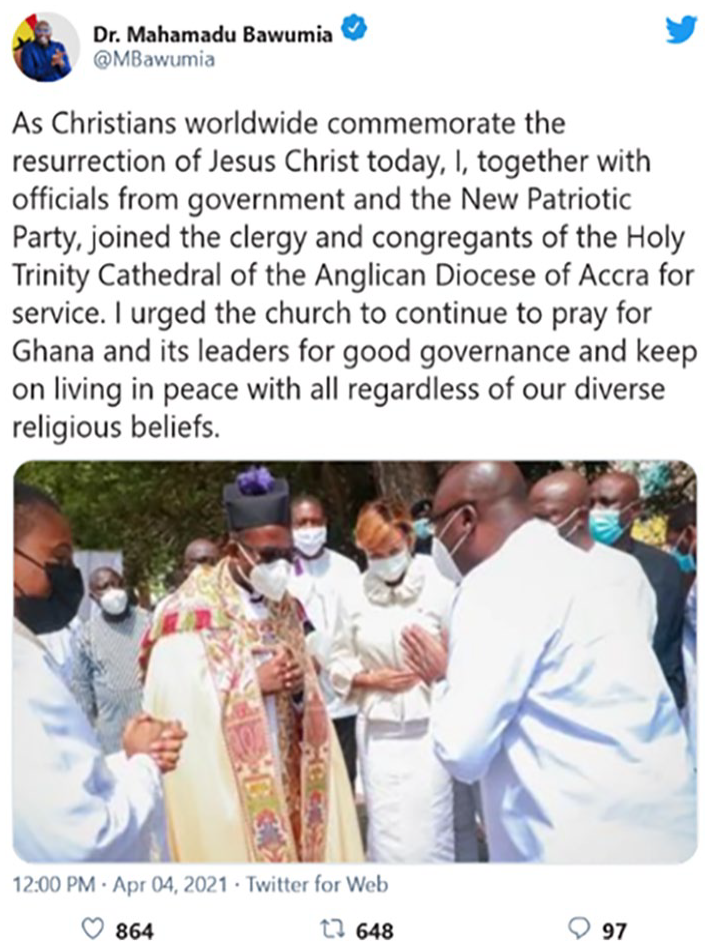
Dr. Bawumia with Rev. George Kotei Neequaye.
The caption and photograph give the tweet’s viewers a sense of place and an idea of the person wearing the cassock, Rev. George Kotei Neequaye, Dean of the Holy Trinity Cathedral in Accra.
Showing humility or respect to a religious personality such as Rev. George Kotei Neequaye, as a regular person would do, evokes the thought of ordinariness, a marker of authenticity (Luebke, 2021). The idea of showing respect to a society’s older or renowned individuals comports with the ideology of African traditionalism, making it an authentic performance (Kissas, 2020; Osei Fordjour, 2021).
In light of Dr. Bawumia’s Muslim background, paying homage to a renowned religious personality of a different faith helps him to construct an image of a religious liberal (or, at least, a religiously tolerant person). Also, his call for peace despite Ghana’s religious differences allows him to construct an image of a statesperson. This tweet, then, can be interpreted as a strategic way for Dr. Bawumia to connect with the nation’s Christian voters, particularly those in the Anglican Church, and enhance his image as a patriotic leader because he cares about cohesion in his country. This we call deferential ordinariness, which we believe is unique to the context of Africa based on social norms around displaying humility around people in religious or traditional authority.
In another tweet, on April 26, 2021, the photograph showed Dr. Bawumia wearing a cobalt-blue caftan with his hands clasped together. On his right is the Paramount King of the Ashanti traditional area (Asantehene), Otumfuo Osei Tutu II, smiling gently and dressed in colorful traditional clothing and jewelry. Behind them are the Asantehene’s entourage and Dr. Bawumia’s bodyguard, who is in a blue caftan (see Figure 2). The caption reads,
Happy 22nd Anniversary to Otumfuo Osei Tutu II on your ascension to the Golden Stool. You have been such a phenomenal leader! We appreciate your inspiration and coaching. May the coming days of your reign be even more fulfilling. We wish you all the best. Piaw Kotokohene!
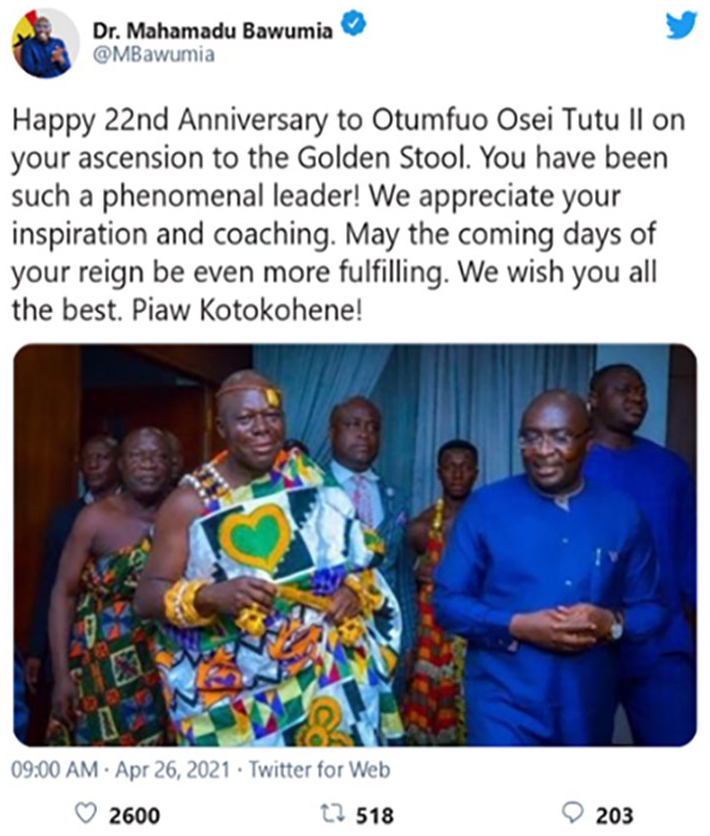
Otumfuo Osei Tutu II (from the left) with Dr. Bawumia.
The caption gives the photograph more perspective, informing us about Dr. Bawumia’s birthday wishes to the Asantehene.
Here, Dr. Bawumia displays ordinariness, a communicative manifestation of authenticity (Luebke, 2021), in two ways: in his posture and through the appellation he gives to the Asantehene. The gesture of clasping one’s hands together either in front or behind you shows respect in typical Ghanaian society, usually before older people or people with symbolic power. Dr. Bawumia demonstrates respect to the Asantehene by this act, just as any ordinary Ghanaian would. In addition, Dr. Bawumia acknowledges Asantehene’s inspirational and coaching role in his life and shows respect. Finally, his use of the expression “Piaw Kotokohene,” meaning “All hail the Porcupine King,” which is an appellation used to “butter up” the Asantehene, usually done by the Linguist, who is the King’s official interpreter or the Asantehene’s lower subjects, can be described as displaying an ordinary act. The tweet also has markers of traditionalism because it reinforces traditional Ghanaian values, such as imbuing the King with the highest authority in society.
By displaying such acts of authenticity in his tweet, Dr. Bawumia first constructs the image of a respectful leader by downplaying his status as vice president; that is, he still honors traditional authority. In addition, he constructs the image of a humble person. Showing such acts of respect and humility is a strategic way of building credibility. The Asantehene commands great respect in Ghana, and his symbolic endorsement can enhance a candidate’s electoral fortunes in national elections (Osei Fordjour, 2021). So, by associating himself with the Asantehene, Dr. Bawumia is building his political capital. More importantly, the Asantehene is paramount to the Ashanti kingdom, situated in the Ashanti region, a traditional stronghold of Dr. Bawumia’s political party (NPP). Since Bawumia seeks to be elected as flagbearer of the NPP, this can also be seen as connecting with his party’s electoral college members in the Ashanti region. Again, this is another form of deferential ordinariness.
Consistency
A salient tactic Dr. Bawumia acted on authentically was consistency, reinforcing his resolve to advance Information, Communication, and Technology (ICT) as well as digitization. Dr. Bawumia displayed authenticity by tweeting about the government’s initiatives and his role in promoting or implementing digital as well as (ICT) initiatives in different sectors of Ghana. For example, in a tweet he shared on March 24, 2021 (Figure 3), Dr. Bawumia appears in an office setting, wearing a blue caftan and a black face mask. He seems to be engaged in an intimate conversation with the former UK Prime Minister Tony Blair, who is wearing a dark suit with a tie and a white face mask. The caption reads,
I had a fruitful meeting with former British Prime Minister Tony Blair this afternoon at the Jubilee House. We discussed far-reaching public policy matters on digital technology, COVID-19 vaccine access, telemedicine, and greenhouse technology. Ghana has been on the path of significant digitization in recent years, and we are gearing up to leverage this to stimulate innovation and transformation.
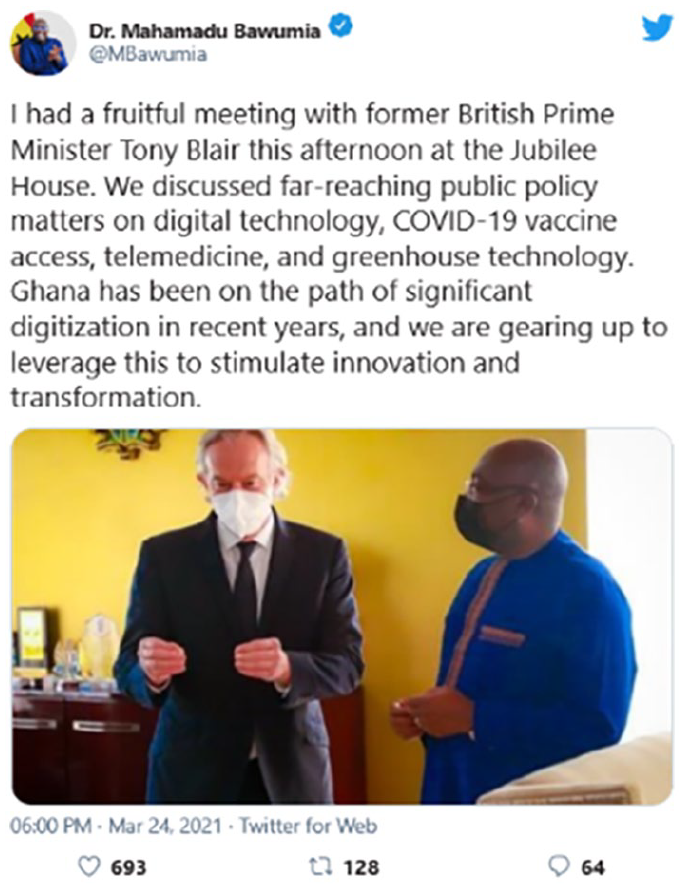
Former UK Prime Minister Tony Blair interacting with Dr. Bawumia.
The caption gives users an idea of what was discussed at the discussion, giving the tweet more meaning.
Dr. Bawumia displays authenticity here in two ways: through both consistency and intimacy. Since the tweet informs us that digitization and technology were some of the salient topics discussed, it conveys consistency because those topics have been championed by Dr. Bawumia over the years, earning him praise as the “digital Vice President” by sections of the public. So, such discussions are consistent with his social persona, which is a marker of authenticity (Hahl et al., 2018; Pillow et al., 2018). The office setting of their meeting is a non-public place synonymous with the enactment of immediacy because it gives the audience a sense of involvement in an event they may not have known about (Manning et al., 2016). Also, mentioning what transpired or what was discussed between the two leaders creates an aura of liveliness because it connects Dr. Bawumia with the users by giving them a sense of a shared “now” moment (Enli, 2015, p. 135).
Blair is now a global consultant who supports countries in addressing challenges they face through his not-for-profit organization, the Tony Blair Institute. By displaying such a tweet about himself in Blair’s company, Dr. Bawumia is constructing the image of leadership because he appears to be taking proactive steps by seeking advice from a more experienced global politician. This can also be described as a credibility-building strategy because by associating himself with a global political icon such as Tony Blair, Dr. Bawumia is also constructing an image of global leadership by association. The tweet enhances his pedigree as a politician and helps him build social capital. Displaying consistency in his resolve to create a digitized economy allows him to construct an image of trustworthiness.
Similarly, in a September 3, 2021 tweet, Dr. Bawumia appears in a navy-blue caftan, presenting a laptop to a woman in mauve and yellow Kaba, a celebratory traditional attire worn by women in Ghana (see Figure 4). The setting looks like a ceremonial one because there is a stage behind the participants, the presence of police personnel, and other individuals standing by. The caption reads,
At a brief but colourful ceremony at the campus of the St Mary’s Senior High School on Friday, September 3, I launched and handed over 350,000 laptops under the “One Teacher One Laptop” programme. This is in fulfillment of government’s pledge to equip Ghana’s teachers with the requisite ICT skills to prepare the next generation for the Fourth Industrial revolution.
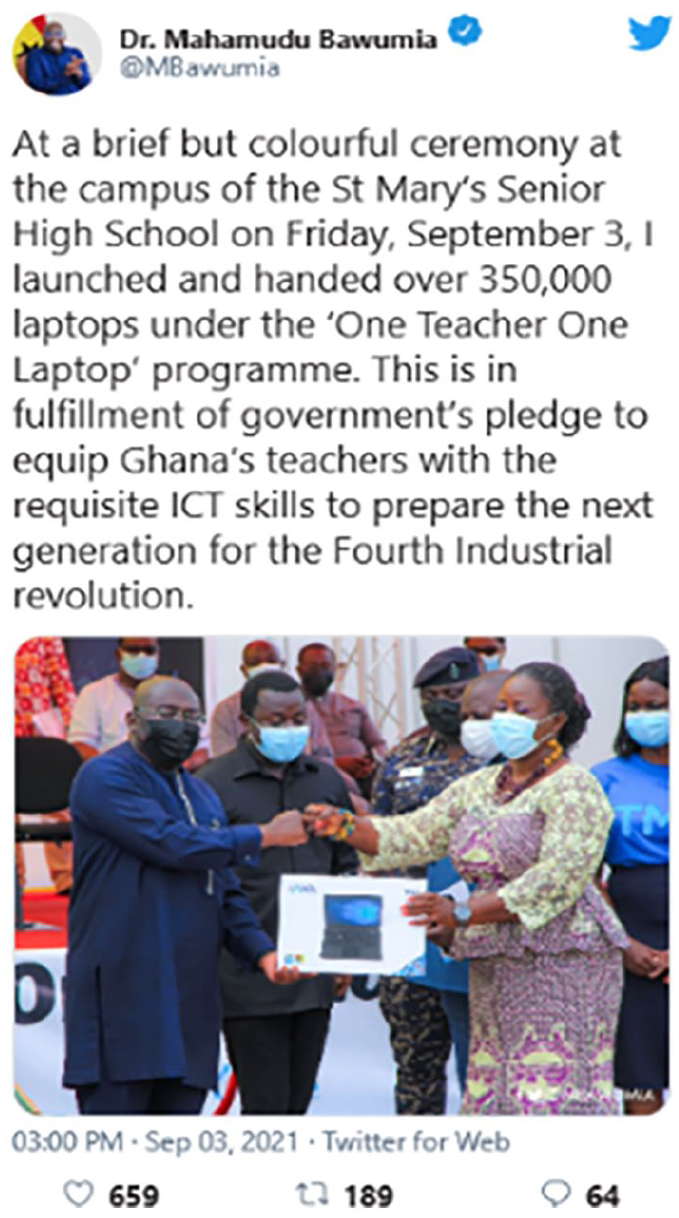
Dr. Bawumia presenting a laptop to a teacher.
The caption and the photograph work together to inform us about the ceremony’s purpose, giving the action a better meaning.
Authenticity manifests through consistency and immediacy. Dr. Bawumia’s consistency in promoting ICT helps him construct an image of a trustworthy leader because he is, metaphorically, walking the walk. More importantly, championing such an initiative for Ghanaian teachers is a strategic way of winning their support in future elections. Also, Dr. Bawumia’s use of the pronominal deictic “I” and stating the purpose for such an event evoke thoughts of liveliness, a display of authenticity through immediacy (Manning et al., 2016). The consistency facet of authenticity is constructed through Dr. Bawumia’s and the NPP government’s steady commitment to digitization and ICT (Hahl et al., 2018; Pillow et al., 2018). The teachers’ union is an influential group in Ghana that can tilt an election in a candidate’s favor. So, by this act, Dr. Bawumia is strategically endearing himself and the NPP Administration to Ghanaian teachers since vice-presidential communication can impact an administration’s relationships (Osei Fordjour, 2022). The tweet also reinforces the ceremonial function of the Vice President of Ghana, highlighting their importance. Overall, the detailed activities in his tweets are analogous to Hungarian Prime Minister Viktor Orban’s postings and photos about his activities on Instagram (Szebeni & Salojärvi, 2022).
Immediacy
Another salient manifestation of authenticity in Dr. Bawumia’s tweets was his display of immediacy, particularly in tweets about his participation in or supervision of national or government initiatives. For example, on April 12, 2021, Dr. Bawumia is pictured in a black caftan and a white face mask, observing a gentleman in a blue baseball cap and a brown backpack, putting a house number plate on a building. Other individuals are visible behind them, watching the action (see Figure 5). The caption reads,
I was at the Adentan Municipality to inspect the first phase of works on the ongoing installation of unique address plates on all 7.5 million houses and properties across the country. I also interacted with residents who had already received their unique address plates. The new addressing system, which leverages the existing GhanaPost GPS system, is made up of a unique house number, street name, digital address, and a QR Code containing the address details of the property. The address plates are being embossed free of charge for all properties. I indicated that this will provide us with a rich and unique database for all properties in Ghana, which, combined with data from the Ghana Card,
2
will inform policy formulation and implementation in our digitisation drive.
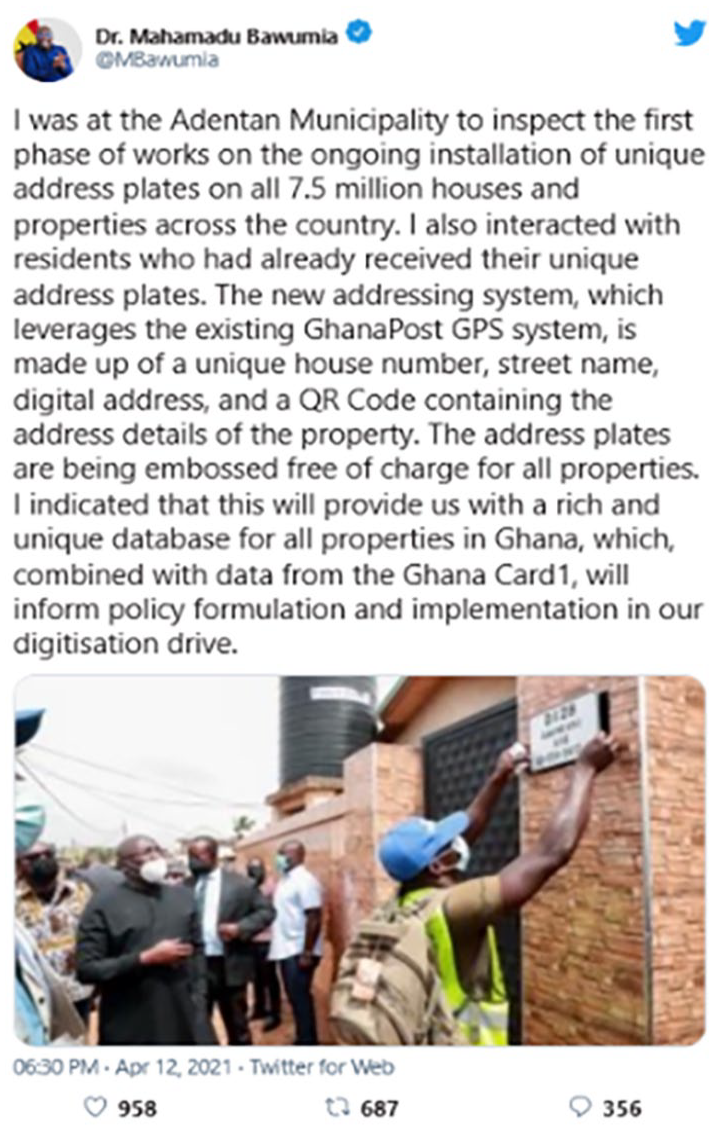
Dr. Bawumia supervising the digital address installation.
Dr. Bawumia constructs authenticity through immediacy by giving the viewers a “shared now” experience, as he displays a lively act, employs a pronominal dietic (by his use of “I”), and gives a sense of place and time (Enli, 2015, p. 135). Again, sharing his supervisory activity is reminiscent of Hungarian Prime Minister Viktor Orbán’s activities on Instagram (Szebeni & Salojärvi, 2022). Also, directly supervising the installation of digital address plates, as well as interacting with the residents afterward, evokes the thought of ordinariness because it portrays him as an average government worker by downplaying his role as vice president and humanizes him as one of the ordinary citizens (Luebke, 2021; Wood et al., 2016). Finally, he displays authenticity through consistency, as he has shown steady commitment in his previous narration and action toward Ghana’s digitization (Hahl et al., 2018; Pillow et al., 2018).
Dr. Bawumia constructs an image of leadership by showing that he has his eyes on ongoing government initiatives such as the digital address system. This also portrays him as a hardworking leader because he spearheads the initiative. Ultimately, it reinforces his commitment to digitization and his administration’s commitment. Finally, since digitization was one of the promises made by his administration, especially during his election campaign, it helped him construct an image of trustworthiness because he is now visibly delivering on those promises.
Similarly, in a tweet on June 11, 2021, Dr. Bawumia appeared in a multicolored fugu while holding a shovel, attempting to fetch sand. A green watering can and a man in a deep green uniform of the Ghana Forestry Commission are visible near him. There are other individuals behind him observing, and behind them is a canopy with the Ghanaian flag, which indicates that this is an official event (see Figure 6). The caption reads, “I joined President @NAkufoAddo and other dignitaries for the maiden ‘Green Ghana Day’ to plant at least five million trees in the country to protect our ecosystem. Congratulations to all who participated in this productive exercise across Ghana. #GreenGhana #LetsGoPlanting.” The caption gives the viewer of the tweet an understanding of the occasion and why Dr. Bawumia is holding the shovel.
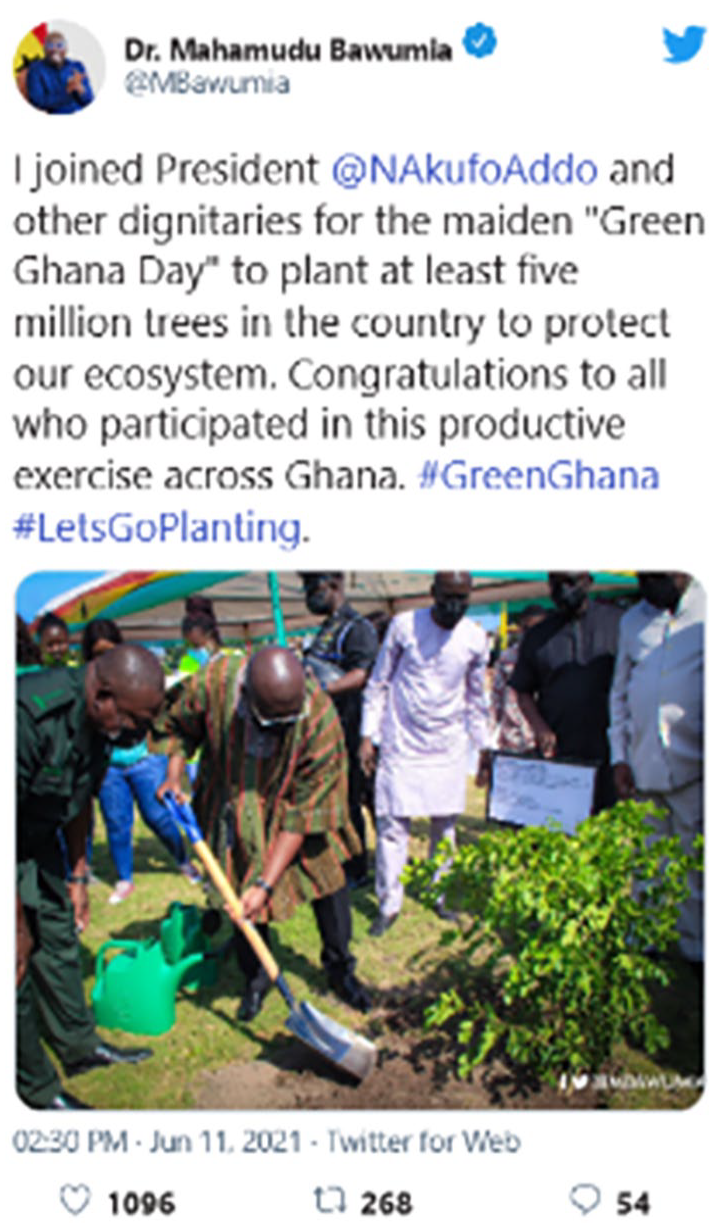
Dr. Bawumia planting a tree.
Dr. Bawumia displays authenticity through immediacy because he gives the viewers a “shared now” experience by providing live updates on an ongoing event, gives the users a sense of place, and employs the pronominal deictic “I” (Enli, 2015, p. 135). The tweet can also be described as evoking the thoughts of a people person, which is reminiscent of an ideological manifestation of authenticity (Kissas, 2020). Also, in leading by example—that is, by displaying a tweet of himself planting a tree as part of the “Green Ghana Day” initiative—Dr. Bawumia, through an act of participation in a nationwide initiative, shows authenticity through ordinariness because he is acting as a normal Ghanaian would, planting trees as part of the initiative (Luebke, 2021; Wood et al., 2016).
By wearing traditional attire such as the Fugu and participating in the nationwide “Green Ghana Day” initiative, Dr. Bawumia constructs the image of an exemplary leader and emotionally connects with the people because he appears like one of them, which is stylistically similar to the regular clothing choices adopted by German Chancellor Angela Merkel and Hungarian Prime Minister Viktor Orbán on Instagram (Sonnevend & Steiert, 2022; Szebeni & Salojärvi, 2022).
The tweet helps Dr. Bawumia build an image of a responsible leader, as the display of an act of planting trees evokes the thought of conserving the environment and, in doing so, protecting national resources. By mentioning the president in his tweet (@NAkufoAddo) and acknowledging the president at such an event, Dr. Bawumia implicitly acknowledges that the president holds similar sentiments about conserving the environment, enhancing the entire administration’s reputation.
Discussion and conclusion
We sought to understand how the Vice President of Ghana, Dr. Bawumia, constructed his image on Twitter using a combination of pictures and words. Our findings indicate that the vice president constructed authenticity through ordinariness, consistency, and immediacy to display strategic humility and respect, reinforce his commitment to technology and ICT in Ghana, and reinforce his leadership by example. Ultimately, Dr. Bawumia constructed the image of an exemplary, caring, trustworthy, pious, and proactive leader, which can help him build social and political capital among his publics.
The findings from our study have crucial implications for the praxis of public communication and public relations. From a practical perspective, this study highlights an African Vice President’s communicative approach to constructing his public image and ultimately managing his long- and short-term reputation, providing valuable insights into the practice of public relations. In addition, it expands the scope of the growing subfield of political public relations by showing the communicative approach employed by a vice president, a rarely studied but essential political role.
The findings suggest that ordinariness serves as a central component of authenticity, evident in how the Ghanaian Vice President has seemingly embraced it as a prevalent approach, often intertwining it with consistency and immediacy. Contrasting this with the practices of political figures in Europe (such as Merkel, Johnson, and Orban) and the United States (such as Trump), as noted by prior researchers (Lacatus & Meibauer, 2022; Sonnevend & Steiert, 2022; Szebeni & Salojärvi, 2022), in their studies of political leaders’ enactment of authenticity online underscores the global significance of employing ordinariness as a political impression management strategy across social media platforms.
Also, the findings reinforce the notion that authenticity is closely linked to the appearance and attire of politicians. This observation is underscored by comparing the strategic use of attire by Dr. Bawumia, notably his choice to wear the fugu, with the more commonplace attire of German Chancellor Angela Merkel wearing regular shoes and Hungarian Prime Minister Viktor Orbán’s loose attire, both aiming to cultivate an aura of ordinariness and connection with their constituents. This comparison illuminates the significant influence that political leaders’ attire and appearance can exert on their enactment of authenticity.
In addition, a plausible correlation emerges between the demonstration of authenticity and the political agenda. This connection becomes apparent when comparing Dr. Bawumia’s consistent promotion of tweets focusing on national initiatives such as Green Ghana Day, aimed at environmental conservation, as well as digitization and ICT initiatives, with the economic agenda rhetoric of U.K. Prime Minister Boris Johnson and the border control discourse of Donald Trump on Twitter (Lacatus & Meibauer, 2022). These comparisons suggest that political agendas serve as conduits for conveying authenticity.
The Ghanaian Vice President’s tweets starkly contrast with politicians in Western nations such as the United States and the United Kingdom, particularly regarding the issues addressed, actions taken, and affiliations. The influence of religion in Ghanaian and African politics is a significant factor, evident in Dr. Bawumia’s tweets as he acknowledges the role of religious leaders in enacting authenticity. In addition, issues like digitization/ICT development are more relevant in a developing context and are prominently featured. The use of honorifics to address traditional authorities, a common practice in Africa, is also observed in the case of Bawumia. These examples underscore the argument that sociocultural norms in a given context can significantly shape the expression of authenticity on social media platforms.
Notably, adding the prefix (Dr.) to his profile is part of Bawumia’s impression management, as it connotes authority and intellect, which benefits his image construction. Findings from this study also show that the prevailing cultural context influences how politicians communicate on social media. This manifests through the issues they raise or champion, their acts, and the people they associate with. For example, the role of religion in Ghanaian or African politics is quite important, and we see a manifestation of this in Dr. Bawumia’s tweets.
As we have shown, studying a vice president’s socially mediated communication can be used to gauge an administration’s policy priorities, as the findings highlight the government’s commitment to digitization and ICT. This means that vice-presidential communication on social media can be an essential source of information for the political publics, highlighting the need to conduct research in this area.
Theoretically, we incorporate the tradition of authenticity as a social construct (Enli, 2015; Hahl et al., 2018; Luebke, 2021; Pillow et al., 2018; Sheinheit & Bogard, 2016) to assess the communicative approach used by a vice president on Twitter. As a result, we show that authenticity, understood as a social construct, can be used in public relations. In addition, this study expands the conceptualization of ordinariness facet authenticity as a social construct to include deferential ordinariness. We describe this as presenting oneself in the company of individuals with substantial social and political capital, whose voices or endorsements can impact an individual’s fortunes in an election. Dr. Bawumia shared tweets of himself interacting with such individuals, including the Asantehene, the Paramount Chief of the Ashanti kingdom, and influential clergy members.
Since social semiotic theory has rarely been used in public relations studies, the present study also shows how this theory can be relevant to the praxis of public relations, as it can guide future research. We demonstrate how communicative modes, such as visuals and words used on social media, can be used to create and negotiate meaning, taking cognizance of the sociocultural as well as historical context. Finally, our study expands the use of Multimodal Discourse Analysis, which focuses on the use of words and photographs in research to study the communicative practices of a political actor, highlighting how the method can be helpful to studies in public relations.
The communicative approaches adopted by politicians to construct their image on socially mediated platforms are fundamental to political public relations and public relations more broadly. Scholars should dedicate more time to understanding this phenomenon, particularly in rarely studied parts of the world, such as Africa and other non-Western locations.
Also, displaying authenticity is globally relevant not just to politicians but also to brands and should be of interest to strategic communication practitioners, especially considering that authenticity is a social construct. Image is everything in reputation and relationship management in politics, so politicians and practitioners must work closely to construct culturally relevant and sensitive public images on mediated platforms such as social media, whose content spreads faster and reaches farther than traditional media.
As with any study, our study has limitations. First, we focused on how a vice president from a single African country communicated on social media to construct his public image. Future studies can expand on this foundation by comparing vice presidents—and holders of different elected offices—from different African countries. Moreover, our analysis was confined to a single social media platform, Twitter, which, while well-suited for political discourse, lacks the inherent visual nature of platforms like Instagram. In addition, our examination focused solely on posts made during Dr. Bawumia’s inaugural year in office. These limitations may have influenced the outcomes of our findings. Future studies can expand the scope by looking at more than one social media platform and/or using a more extended period.
Footnotes
Funding
The author(s) received no financial support for the research, authorship, and/or publication of this article.
