




Abstract
Understanding how people make sense of social issues is a fundamental aspect of communications research. In this piece, we apply theory from psychological anthropology to provide a new perspective on this core feature of communication and argue for the importance of considering culture in applied communications research. Drawing on a study of the implicit understandings and patterns of reasoning that Americans use to think about the process of aging and older adults, we show how the theory of cultural models can be applied to arrive at a deeper view of the ways in which members of the public make meaning of aging issues. We discuss the implications of this research for those communicating about aging and other social and scientific issues. The article provides information on public understanding that is directly pertinent to those communicating about aging and demographic change in the United States.
Introduction
The aging of America has become part of our national public discourse. From primetime ads designed to challenge and expand public opinion of older adults, to a bevy of powerful new research and statistics that document the changing patterns of America’s demographic make-up (Taylor, 2014), the “greying of America” has moved onto the nation’s policy agenda and into public conversation.
The discourse around demographic change both shapes and is shaped by (Gamson & Modigliani, 1989) deeper patterns of culture that structure how Americans think about the process of aging and older adults. Studying these deep cultural beliefs is vital to understanding the effects of this discourse on public opinion and public policy, and helping experts and advocates expand and shift public thinking about solutions to these issues. In this article, we explore the deeply held and highly shared assumptions and patterns of reasoning—what anthropologists call “cultural models” (D’Andrade & Strauss, 1992; Holland & Quinn, 1987; Shore, 1996)—that members of the public employ to make meaning of aging issues and older adults, and then compare these understandings to expert messages on aging and older adults to identify gaps and overlaps in understanding.
The goal of this applied research, which was conducted in collaboration with a coalition of eight leading national organizations on aging, 1 is to help those working on issues related to aging and older adults better communicate key points about the nature of the aging process, the multi-dimensional experiences (both positive and negative) of older adults, and the specific needs and implications of an aging society. Examining the differences in perspectives between experts and members of the public reveals the conceptual locations from which breakdowns in communication and translation are likely to derive. These fundamental schisms in the way groups approach an issue help us understand why certain aspects of expert understanding are particularly difficult to communicate and allow us to locate the set of expert concepts that are most in need of reframing work in order for them to be more available and applicable to members of the public. In short, the approach we describe here is focused on making expert perspectives on aging more accessible to those who are not experts on this set of issues. We acknowledge that this is one of many approaches to communicating about aging issues and that some of these approaches adopt a more “bottom-up” orientation—for example, working to better communicate the lived experiences of older adults in order to influence policy makers and policy making. We see these approaches as complimentary, and argue that both are likely necessary to achieve the policy shifts needed to better address aging issues in the United States.
Numerous studies across a range of disciplines have documented attitudes toward and stereotypes of aging and older adults in the United States, and the effect of such conceptualizations on support for aging-related policies (Cuddy, Norton, & Fiske, 2005; Huddy, Jones, & Chard, 2001; Hummert, Garstka, Shaner, & Strahm, 1994; Laditka et al., 2009; Miche, Brothers, Diehl, & Wahl, 2015; Silverstein, Angelelli, & Parrott, 2001; Zweibel, Cassel, & Karrison, 1993). Our work extends this rich and growing body of research by exploring the underlying assumptions and thought processes that inform the stereotypes, perceptions, talk, judgments, and opinions that other researchers have documented. Our goal is to explore not just what people say about the process of aging and older adults—that is, the traits they assign to the elderly or the stereotypical descriptors they employ—but the underlying cognitive models that support these opinions and structure how people think about these topics. In this sense, our work does not compete with but rather adds to existing literature on public opinions and stereotypes of aging by examining not just what people say, but how they think.
This cultural-cognitive approach to public understanding is important because of the connections between ways of thinking and effective ways of communicating. By considering the various ways that people are (and are not) able to think and reason about an issue, communicators can craft messages that do not just resonate with members of the public, but shape and expand how they think. These effective communications can avoid unproductive understandings, activate more productive ones, and elevate new ways of thinking that are better aligned with effective policy solutions to these issues. We argue, in short, that understanding culture’s effects on meaning-making is at the root of strategic framing and communications—and by extension, inextricably linked to efforts to advance effective public policies (Schram, 1995). Indeed, a number of researchers have asserted that negative conceptualizations of the aging process constrain our thinking about appropriate policy interventions and solutions (Kotter-Grühn, 2015; Miche et al., 2015). Our research focuses on and explores this phenomenon in greater depth.
As the process of aging forms a part of everyone’s experience, it is not surprising that members of the public bring a powerful set of cultural models to thinking about adult aging in the United States. Importantly, the research presented here suggests that there are aspects of public understanding that impede efforts to construct a policy environment that responds productively to the growing population of older adults in this country, and to the skills, capacities, and needs of older adults and their families and caregivers. These dominant ways of thinking include a set of decidedly negative and deterministic models about the aging process, as well as an overall sense of fatalism about what can and cannot be done on behalf of older adults in the United States.
Theoretical background
The research that we have conducted on public understanding of aging and older adults draws on a body of theory and methods from psychological anthropology that emerged in the late 1980s. Pioneered by some of the first psychological anthropologists, including Roy D’Andrade, Bradd Shore, Naomi Quinn, and Claudia Strauss, cultural models theory argues that in addition to the rich array of social institutions, symbols, and external aspects of our cultural worlds, culture exists in mind (Shore, 1996). This culture in mind can be conceptualized as a set of shared, durable, implicit, interrelated, and contextually cued mental models that members of a culture use to process and organize information, interact with others, and “make meaning” of their lives (Quinn & Holland, 1987). In 1967, Goffman wrote about these shared mental models (before they were called cultural models) as the common social understandings that facilitate interaction among members of a group by allowing them to draw implicitly on shared understandings of how the world works and how people conduct themselves in it (Goffman, 1967).
Several features of cultural models are particularly relevant to the research presented here. First, cultural models (as opposed to “cultural theories”—see D’Andrade, 1987) are implicit, or “referentially transparent” (Quinn, 2005, p. 3). Cultural models are also durable, although they maintain their potential to change and shift in dominance over time. The key to this apparent paradox between durability and changeability lies in the fact that cultural models are derived from experiences; that is, models that are “built on repeated experiences of similar sort become relatively stable, influencing our interpretations of subsequent experiences more than they are altered by them” (Quinn, 2005, p. 38).
The shared nature of cultural models is another key feature of this theory (Quinn, 2005). As D’Andrade explains, cultural models are the shared understandings and assumptions that allow things to be commonly taken for granted (D’Andrade, 1987). That is, people who share cultural models employ a common set of understandings and assumptions and, therefore, what appears to be taken for granted is, in fact, tacitly understood (Goffman, 1967). These shared assumptions become active as people engage in cognitive tasks like telling a story, explaining an event, defending an opinion, or “reasoning” (Quinn, 2005, p. 3). The cognitive activities that recruit these shared understandings are the key to the method employed in this and other studies to document and explore cultural models (D’Andrade, 2005).
Finally, the process of activating or recruiting one or a set of models is always contextual (Ewing, 1990; Kempton, 1991; Levine, 1984). That is, the activation of a model depends on the context at the time of meaning-making. The contextual nature of the activation of cultural models is key to understanding how people’s talk may evidence multiple, seemingly contradictory ways of “thinking” an issue. 2
Methods
Expert interviews
To distil expert messages on aging and older adults in America, we conducted 11 one-on-one, 1-hour phone interviews with advocates, policy experts, and researchers working on these issues. These interviews were conducted in August and September of 2014 and, with participants’ permission, were recorded and subsequently transcribed for analysis. The list of interviewees was compiled in collaboration with a panel of advisors representing a group of major organizations in the field of aging (see Note 2). The final list of interviewees was designed to reflect the diversity of disciplines and perspectives involved in work on aging and older adults. Six of the 11 experts worked in academia, and five worked in either advocacy or policy-related organizations. Areas of expertise included demographic change, public funding, subjective experiences of aging, caregiving, economic implications of aging societies, and ageism, among other topics. While we acknowledge that the selection of experts does not necessarily constitute a representative sample of disciplines and positions, it is consistent with our goal of communicating a set of key expert messages that represent the views of leading organizational voices in the field.
Expert interviews consisted of a series of probing questions designed to capture expert understandings about the particular needs and characteristics of older adults, the role of older adults in American society, the aging process itself, and the implications of an aging society for social, civic, and political institutions (see Appendix 1 for a list of sample questions). Expert participants were encouraged to explain their research, experience, and perspectives; to break down complicated process; and to simplify concepts and findings. Interviews were semi-structured in the sense that interviewers asked for elaboration and clarification, and encouraged experts to expand upon those concepts that they identified as particularly important.
Analysis employed a basic grounded theory approach (Strauss & Corbin, 1998). Common themes were pulled from each interview and categorized, and negative cases were used to refine themes within each category, resulting in a refined set of themes that synthesized the substance of the interview data. Following this analysis, a group of experts convened by the aging organizations that were our partners were provided with a draft version of the key expert content points of consensus. In a group feedback session moderated by a researcher, the experts were asked to identify important missing concepts, winnow content that was not of central importance, and refine existing messages. The expert view presented below includes these expert refinements and feedback.
Cultural models interviews
The cultural models findings presented below are based on 20 in-depth interviews conducted in four locations: Charleston, South Carolina; San Jose, California; Minneapolis, Minnesota; and Frederick, Maryland, in June and July 2014.
Cultural models interviews—one-on-one, semi-structured interviews lasting two to two-and-a-half hours—allow researchers to capture the broad sets of assumptions and understandings that participants use to make sense and meaning of a concept or topic area (Quinn, 2005). These interviews are designed to elicit ways of thinking and talking about issues—in this case, people’s most “top of mind” and dominant ways of thinking about the aging process; the experience of being older in America; the capacities, contributions, and needs of older people; the role that older adults play in society; and the implications of an aging population. As the purpose of these interviews was to identify and examine the cultural models that participants use to make sense of these issues, it was key to give them the freedom to follow topics in the directions they deemed relevant. Therefore, the researchers approached each interview with a set of areas to be covered, but left the order in which these topics were addressed largely to the participant. Moreover, because the goal was to distil people’s own thinking on these topics, the interviewer did not explicitly ask people to respond to specific pieces of expert content (although future phases of this research will test hypotheses about how best to encourage people to engage productively with expert understandings on aging). All interviews were recorded and transcribed with written consent from participants. Appendix 2 provides a sample of questions used in these cultural models interviews.
Recruiting a wide range of people, and facilitating talk about concepts introduced by both the interviewer and the interviewee, allows researchers to identify cultural models that represent shared patterns of thinking. Past work with cultural consensus modeling has demonstrated that groups that share broad cultural similarities, to a large degree, share many of the same basic implicit cultural models, even when diverse along more specific criteria (Weller, Romney, & Orr, 1987). The current study relies on the results of this research and culture and social theory more broadly (Gamson & Modigliani, 1989; Geertz, 1973) in assuming that, as members of a culture, individuals share deep and implicit ways of understanding. It is precisely the shared nature of cultural models—that is, the fact that they are broadly shared across members of a given culture—that allows for their identification from a relatively small sample of participants. The issue of sample size is further addressed by psychological anthropologist Roy D’Andrade, who notes that if a cultural model is shared by 95% or more of the population, then based on binomial probabilities one can expect that 92% of the model’s propositions will be agreed to by 18 or more of the respondents. The point here is that it is not surprising that a small sample shows high agreement about certain things if those things are highly agreed about in the whole population. (D’Andrade, 2005, p. 99, emphasis in original)
Participants were recruited by a professional marketing firm and were selected to represent variation along the domains of ethnicity, gender, age, residential location (inner city, outer city, and regional/rural areas up to 3 hours from city center), educational background (as a proxy for class), political views (as self-reported during the screening process), religious involvement, and family situation (married, single, with children, without children, age of children). The recruiting organization used existing databases that had been employed to field other studies and by using random digit dial methods to “cold call” individuals in study locations (Harlow & Hartge, 1983). Individuals were called and asked a series of questions to gather data necessary to create variation in the demographic variables mentioned above. Individuals who met the criteria were called back and given a general overview of the interview as well as information about time and location. All informants received additional information about the project at the time of the interview, both verbally and in writing, and provided written consent.
The final sample included 12 women and eight men. Eight of the 20 participants self-identified as “white,” seven as “black,” four as “Hispanic,” and one as “Asian.” Ten participants described their political views as “Middle of the Road,” six as “Liberal,” and four as “Conservative.” The mean age of the sample was 40 years old, with an age range from 21 to 64 years. Three participants were high school graduates, four had completed some college, eight were college graduates, and five had postgraduate education. Nine of the 20 participants were married, and eight were the parent of at least one child.
To analyze the interviews conducted with members of the public, we adapted techniques employed in cognitive linguistics and anthropology to examine how participants understand issues related to aging (Quinn, 2005; Strauss, 2005; Tenbrink, 2015). Two researchers started by independently analyzing transcripts to identify common themes across participants using a basic grounded theory approach (Strauss & Corbin, 1998). The two researchers identified 15 and 13 patterned discourses, respectively. These themes were evident in multiple places throughout interview transcripts as well as across the set of participants. Consistent with practices in cognitive analysis, to be classified as a theme, a pattern must be apparent in at least 18 (90%) on the 20 interviews (D’Andrade, 2005). Of the 28 themes identified, only one was dissonant with the other researcher’s analysis (and a second was collapsed into another pattern to reach consistency). This suggests a high degree of inter-annotator reliability.
These social discourse themes were then analyzed by the same two researchers for organizing assumptions and connections commonly made throughout individual transcripts and across the set. This part of the analysis looked at patterns in what was said (how concepts were related and linked in explanations) as well as what was not said (taken-for-granted assumptions and assumed steps in logic or explanations). There was also a high degree of redundancy between the two researchers in this analysis stage. Discrepancies were excluded, merged into existing categories or combined to generate new categories that better represented the data (Quinn, 2005; Strauss, 2005).
Quotes are provided as examples of specific findings. In this way, findings are characteristic of patterns in the data set, but are illustrated by a small number of participant quotes. This use of “exemplary quotes” is common practice in thematic analysis where the inclusion of a pattern is based on its representativeness of larger phenomenon in the data (Kempton, 1987; Strauss, 1992).
Results
Below, we first present the messages that compose an expert account of aging and older adult life in the United States. These messages represent points of consensus that experts on aging would like members of the public to be able to access as they think about aging and related policy issues. This is followed by an analysis of the cultural models that members of the public bring to understanding these same issues. Thus, the “expert view” refers to a set of key messages that experts wish to be able to communicate, while the public view refers to the deeply held, shared, and implicit patterns of thought that currently characterize public thinking about aging. We conclude with a discussion of the implications of this research for those communicating about aging issues and several promising areas for future research.
The expert view
What is aging?
Experts emphasized that aging is a normal and cumulative process that extends across the life course. They explained that aging is a part of our biological design and is distinct from disease and decline. This means that older adults can remain healthy and maintain high levels of independence and functionality—even while experiencing natural changes in vision, hearing, mobility, and muscle strength. Experts highlighted the fact that the process and experience of aging are grounded in, and shaped by, the complex interaction between social, cultural, economic, and other contextual factors.
What characterizes older adults?
Experts explained that, as a group, older adults vary greatly with respect to health, financial situation, and functional status. Adults over the age of 60 are living and staying productive longer, and represent the fastest growing segment of our population. This unprecedented trend represents a long-term shift in the age structure of our society. Older adults have an enormous economic and social impact on American society—an impact that is often not well accounted for in our discourse, media, and public policy.
What are the policy needs and implications of an aging society?
Experts emphasized that this increased longevity has opened up opportunities for many more years of civic, social, and economic contribution by older Americans, but that our society must make adjustments to our public institutions, policies, and infrastructure in order to best leverage these changes.
Specifically, experts recommended the following solutions:
Workplace policies should be restructured to allow people to work longer and with a greater degree of flexibility. These accommodations should extend not only to older adults, but to those in elder caregiving positions as well.
Public spending must be made more efficient to accommodate the aging demographic shift and provide for the health care and retirement income security needs of older adults.
Patterns of ageist discrimination need to be addressed so that older Americans can fully contribute to our civic and economic life.
Alongside other policy initiatives, Social Security must be strengthened to ensure retirement income security.
The nation needs to expand a well-prepared health care and geriatric workforce, and address the growing need for long-term care.
Better institutional and social supports must be provided for the more than 40 million people in the United States who provide unpaid care to family members and loved ones.
Greater investments must be made in research to better understand both the aging process and the implications of an aging population for our society.
The public view
Below, we present the cultural models that resulted from our analysis of interviews conducted with members of the general public.
The Ideal versus Real cultural model
Participants drew a strong distinction between the ideal of aging and the reality of the subject. They were able to talk quite positively about aging and older adults, displaying shared understandings of successful aging as being about the maintenance of self-sufficiency and activeness. However, consistent with early research documenting the pervasiveness of negative conceptualizations of aging (Cuddy, Norton, & Fiske, 2002; Hummert et al., 1994, 1995), this idealized way of thinking was always tempered by an ever-present recognition that, in reality, aging is a deterministic process of deterioration and isolation. In short, our research shows that while participants had and were able to hold an idealized picture of aging in their minds, this bubble is constantly and predictably perforated by what they see as a much more negative and inevitable process of deterioration. Analysis showed that the “real” aspect of this model was more dominant in shaping people’s thinking, and all participants came to settle into negative and fatalistic views about the subject of aging. The following is a more detailed picture of the way in which the Ideal versus Real cultural model works to structure people’s thinking about aging and older Americans.
The idealized part of the Ideal versus Real cultural model comprised the following three understandings.
Staying active and maintaining self-sufficiency
The picture of successful aging that dominated participants’ thinking is that of activity and, more importantly, self-sufficiency. When in the ideal mode of thinking participants talked at length about aging as a process that should be characterized by building, sustaining, and maintaining one’s capacity for activity and ability to care for oneself, manage one’s own affairs, and move with autonomy through the world. This represents a basic understanding that wellbeing entails the ability to manage one’s needs and functions without assistance from others. This aspect of the Ideal image of aging can be seen in the following excerpts from participant discussions:
When you think about that picture of wellness, what do you see?
That they’re physically in good shape. They can still get around by themselves. They still have a good part of their independence left. They’re able to just get up, enjoy life, go to their knitting club or the gym or things that really make them happy. I see a lot of grandchildren visits and different book clubs and stuff that you weren’t able to make time for while you were raising kids and were paying everything off. You just get to wake up and say “You know, today I’m going to spend all day at the beach,” or “Today, I’m going to spend all day hanging out with my cats.” That’s my picture of a good retirement and getting older—just being able to enjoy life and still having the mental and physical capacity to actually go out and do it.
—
I know three seniors—couples that are at my church—they still have their own home. They still own their own home. They still drive their own cars. One couple—I know for a fact that their daughter pays for them to have a maid. She comes in and she takes care of their home, but they still live there. They’re taking care of themselves. They’re in the “Happy Seniors” club at our church, and they’re doing positive things. They walk every week around the lake. They are very active.
Earning leisure
Another part of the Ideal image of aging is the understanding that life’s older years represent a time of freedom and relaxation after individuals have realized their primary responsibilities and labors in employment, raising children, paying mortgages, and the like. The older years were understood as the time in life when individuals should be free to travel, enjoy grandchildren and relationships, and engage in pursuits not afforded during middle age years: —
Accumulating wisdom
There was also a strong association across participants between age and wisdom. According to this part of the Ideal model, practical knowledge and wisdom are assumed to accumulate through life experiences and learning from mistakes: —
The ideals that participants had about what aging should look like were continually juxtaposed with a consistent sense that the reality of this process and stage in life is typically very different from the ideal. In the end, despite having the ability to think positively about aging, participant talk frequently settled on a more fatalistic understanding that, for most people, the ideal remains out of reach. We refer to these understandings as the “real” model of aging not to suggest that they reflect factually correct views, but because they capture participants’ perceived realities.
Deterioration and loss of control
By far the most dominant part of people’s thinking about the reality of aging was the association between aging and decline and deterioration. A large percentage of each participant’s discussion focused, in various ways, on the idea that as a person enters their older years, the attributes and capacities of the body and mind fade away. This idea was often associated with a strong sense of inevitability and the language of “loss,” “slowing down,” and “breaking down” dominated participants’ talk: —
The die is cast
Determinism was another strong component of people’s Real model of aging. When engaged in thinking about the realities of aging, participants frequently characterized the aging process as one in which identity, knowledge, skills, success, and other aspects of life become increasingly “fixed”: Doors of opportunity that were once open are now closed, and one’s capacity to change courses in life is reduced, if not completely eliminated: —
Digital incompetency
Participant discussion also focused on how older adults struggle to keep up to date with rapid changes in digital technology, and how this affects their employment prospects, family life, and ability to access resources and services. At a deep level, people work with the assumption that older adults lack fundamental competencies in using and deploying digital technologies, which contributes to a sense of older adults as living outside of the main currents of contemporary society: —
The Individualism cultural model
Across a broad spectrum of research topics, from child development to race and obesity, research has shown that Americans rely on a foundational cultural model of Individualism to explain why people experience the lives that they do (Hirschman, 2003; Kendall-Taylor, 2012; Lindland & Kendall-Taylor, 2012; Triandis, 1989). Thinking through this cultural model, people attribute to each person an essential quality of “self-makingness,” and hold each person accountable for his or her circumstances, achievements, and difficulties. Analysis showed clearly that this foundational individualist model is powerful in structuring the way that people think about aging and older adults. As a deep pattern of understanding, this individualism manifested itself in three dominant ways across our interview data.
Mind over matter
Applied to aging, the Individualist model structured the idea that “You’re only as old as you feel,” and that a person’s experience of aging is determined by attitude, willpower, and choices. This understanding asserts a high level of personal control over the aging process, and was the dominant way that participants explained individual variation in the aging process and its outcomes: —
Health individualism
The application of the Individualism model can also be seen in the way that participants talked about health—a dominant theme throughout the interview data. Participants applied the Individualism model to hold individuals responsible for their lifestyle decisions, and saw these choices—about diet and exercise in particular—as the primary factors shaping a person’s health and wellbeing in the older years: —
It is worth noting that there was very little talk about genetics as a determinant of people’s health during their older years. The lack of focus on genetics evidences the strength of the Individualism model in structuring thinking about this stage of life, and the ability of this model to mute attention to other factors that shape outcomes. Social determinants of health were rarely, if ever, evident in participant discussions.
Wealth individualism
The Individualism model dominated thinking about another topic that participants frequently brought up: wealth. Drawing on this model, participants held individuals responsible for the quality of their financial lives and income security. Participants explained that people need to assert control over their financial life, make smart decisions, and plan ahead for their older years. Such planning and decisions, participants explained, are key factors in shaping the results of the aging process and the wellbeing of older adults: —
The Us versus Them cultural model
The negative models of aging described above contribute to conceptualizations of older people as a separate and singular class—people who have lives and concerns that are set apart from “the rest of us.” The models of deterioration, stagnation, and incompetence set up a sense of older people as “others” who are objects of concern, pity, or worry: —
This underlying pattern of compartmentalizing older people was also evident in participant’s rhetorical stance vis-a-vis the aging process itself, particularly through the language of battling or working against that process. In this way, the prototype of the older person becomes the identity one must fight against: —
Both the language of “us” and “them,” and that of “fighting” and “working” against aging, suggest the extent to which a powerful model of separation and resistance structures thinking about the process of growing older.
The Modern Life Is Hard cultural model
Participants spoke frequently to the various ways in which life has become more difficult for older adults during the past several decades. They contrasted current experiences of aging with a more favorable past, when social, family, and economic conditions were more conducive to living well during one’s older years. Participants’ talk was frequently accompanied by an underlying tone of resignation, as if each of these trends in contemporary American life were a fait accompli, and all we can all do is make the best of them. This model of modern life as inherently more complicated and difficult than in previous generations is particularly visible in structuring the following three themes.
Dispersed family
Participants talked at length about changes over time in family structure—particularly around ideas of changing patterns of geographic mobility and relocation. There was a dominant and shared understanding that families today are more dispersed than in the past, and that this is a particular challenge for older family members, who are seen as needing special support. This trend was judged to be an unfortunate, but inevitable, part of a changing culture and society:
Economic and employment challenges
Participants also shared a sense that the economic landscape in the United States has changed for the worse over the past several decades, and that the financial challenges of growing older are more acute now than in the past. This sense of change is particularly evident around the topic of retirement and employment, as participants explained that, now more than ever, people have to work longer because of financial hardship: —
Social Security is doomed
Social Security loomed large in participants’ thinking about the older years. Participant thought of Social Security as a necessary system that is critical to most people’s financial standing during their older years, and all participants voiced support for the program and its value in supporting older Americans. Yet, the dominant assumption is that the system, because of financial mismanagement, is doomed and will not be there for future generations:
It [Social Security] might not be there when I get older.
Why would that be?
Because the government messed up with the money. Too many people are living longer. They didn’t expect that. So, it might not be there for me. If it is going to be there for me, it’s going to be smaller. So, I probably do have to get a job. I have to retire later than expected.
—
I know the government has actually borrowed money or taken money out of these funds to pay for other funds, or, in their infinite wisdom in the programs they have, they didn’t set aside money to go to Social Security. It went to other programs. Even though the money has been taken out, it still wasn’t going to that program. So, the money that people think should be in there for retirement isn’t going to be there in 20, 30 years—I don’t even know if it’s that long.
It is worth noting that this lack of faith in the viability of Social Security was supported by a deeper cultural model that dismisses the functions and efficacy of government in general. This pejorative model of government as a monolithic, inept, and corrupt “other” was easily cued in participants’ thinking. Finally, it should also be noted that participants understood Social Security narrowly: as retirement benefits for older Americans. The fact that benefits are also available to children and people with disabilities, for example, did not enter into how most participants understood the system of Social Security.
Solutions thinking
Participants came to three general solutions in thinking about how best to improve life for older Americans and the society of which they are part. These ways of thinking about solutions were structured by several key models identified above.
Solution no. 1: greater individual effort and planning
Considering the dominance of the Individualism model, it should come as no surprise that individual effort was thought of as the key to helping more people realize an idealized experience in their older years. As seen above, this focus on individual effort was frequently articulated through the use of metaphors, in particular those of battling or working against the aging process itself. Whether framed in terms of labor or combat, aging participants described aging as an opponent or obstacle that must be confronted by individuals with determination and discipline.
Solution no. 2: more information and education
The Individualism model seemed to structure a second solution that participants were able to offer and discuss. There was extensive discussion about the power of adult education, and the idea that older adults need to be made more aware—or, better yet, make themselves more aware—of the kinds of opportunities and services that are already “out there” for them. The underlying assumption seemed to be that the infrastructure to improve life for older Americans and meet their needs already exists. The problem lies, participants explained, in a lack of awareness of these services and effort to access them.
Solution no. 3: nothing can be done
Structured by negative models of the aging process, perhaps the most common way of thinking about ways to improve wellbeing for older adults was the idea that there is really nothing that can be done in the face of the inevitable decline of the body and society. Even while participants explained that individuals can battle against the aging process, they ultimately fell back on the idea that life on many fronts will become increasingly difficult for older Americans, and that there is very little that can be done about it.
Participant’s thinking about solutions was also fundamentally structured by what they were not thinking about around the topic of adult aging. In particular, three topics that are of heightened concern to experts were simply not evident in how participants talked about aging.
A demographic trend
As described above, experts are highly attuned to the fact that the US population is aging and that in the next few decades, an unprecedented percentage of the country’s population will be old. In contrast, participant thinking about solutions was largely not structured by an engagement with the overall aging trend in the United States. The result is that there was little awareness of or urgency around the idea that the country needs to be proactive in adapting its public and private systems to accommodate an increasingly older population.
Social determinants
In parallel with participants’ emphasis on private decision-making and planning was a notable absence of attention to social determinants and the ways that differential access to quality education, employment opportunities, and other social and economic factors shape life for older Americans. In general, factors of race, gender, residential location, or immigration status did not feature in the interviews unless directly introduced by a researcher. And, as seen above, while a person’s financial standing did feature prominently in participants’ talk, it was largely framed in terms of personal financial planning rather than more systemic and structural factors that shape wage, employment, and housing opportunities for many older Americans.
Ageism
Across the full breadth of our interviews with members of the public, the topic of discrimination against older people did not emerge. In contrast to the substantial empirical attention focused on the prevalence and effects of ageism (see, for example, Chasteen & Cary, 2015; Nelson, 2002), the reality that many older Americans find themselves consistently marginalized from participation and opportunities—in employment, civic life, recreational activities, housing, commerce, and other arenas—was simply not part of participants’ thinking about aging and older Americans.
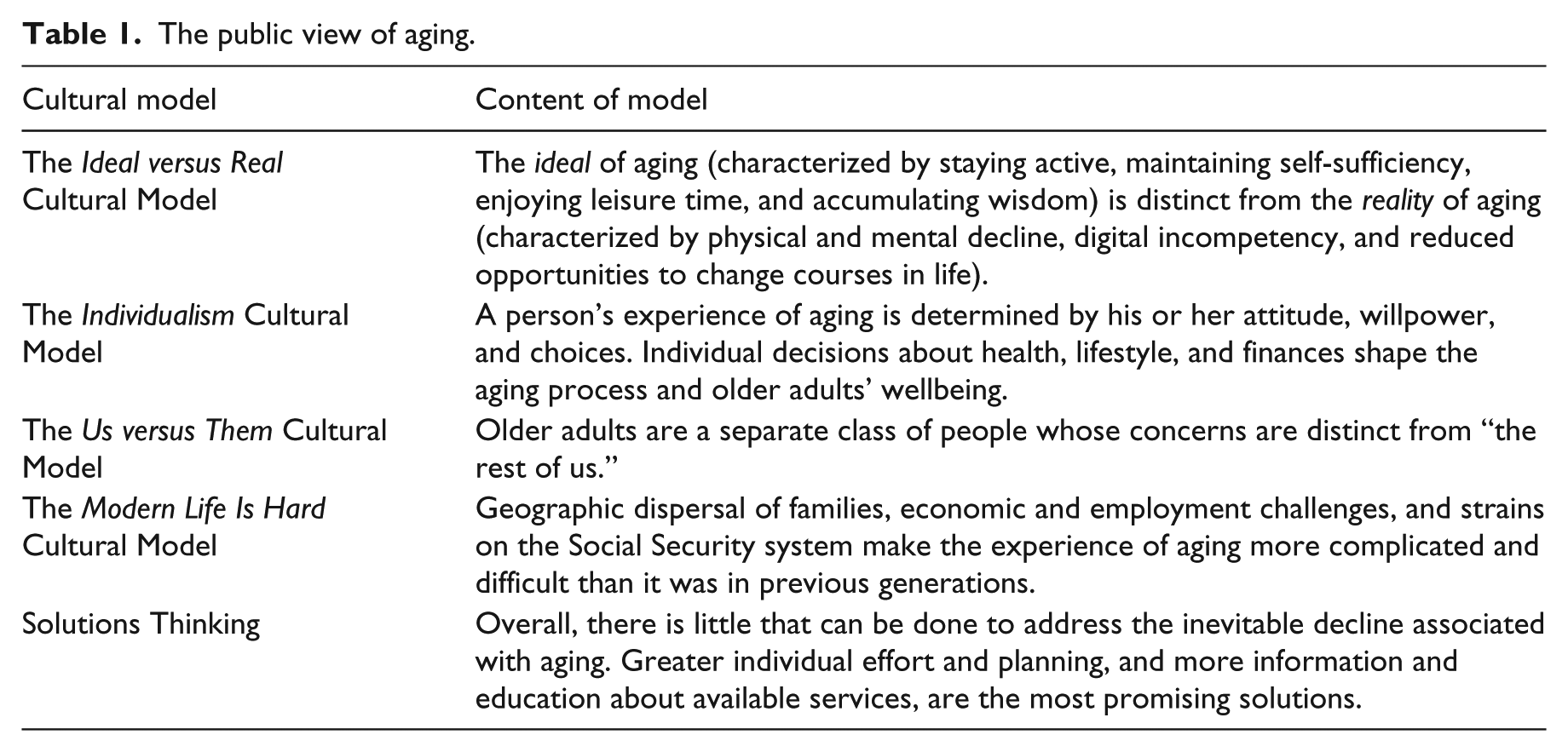
Table 1 summarizes the foundational elements of the public’s view of aging.
The public view of aging.
Discussion
This research adds to the rich body of research on stereotypes and perceptions of aging by exploring the underlying thought processes that structure these views. Our findings suggest a number of implications for those seeking to communicate more effectively about aging issues and the needs of older adults.
First, the Ideal versus Real model sets up a deep contrast between what the process of aging should look like and what old age actually entails. People’s focus on deterioration, in particular, suggests that ideal images of aging are fundamentally unachievable and unrealistic, and that most older Americans will not achieve the ideals of independence, activeness, and leisure. This pattern results in a dominant negative modeling of the aging process itself, well-documented in prior research (Cuddy et al., 2002; Hummert et al., 1994, 1995), and a tangible sense of anxiety about that process. Ironically, people’s fatalism and anxiety about the aging process also seems to mute their ability to think about efforts and interventions to improve the experience of adult aging (Kotter-Grühn, 2015), especially at the population and policy levels. Assuming that deterioration is inevitable, people will be less able to think productively about solutions and the pragmatic actions that could be taken to improve life for older adults, and society more generally. When the “real” dominates the Ideal versus Real construct, aging is understood as an inherently negative process about which little can be done.
As part of this Real thinking, the model of fixedness (“the die is cast”) is strongly deterministic, premised in naturalistic assumptions of decline and rigidity. What is missing from these ways of thinking is a more complex causal understanding of the aging process, and how it is contingent on multiple factors operating at both the personal and population levels (Settersten & Hagestad, 2015). To the extent that these deterministic models satisfy people as causal explanations, they may inhibit the public’s ability to think about what shapes the aging process and what can be done to better address aging issues (Kotter-Grühn, 2015).
Second, by attributing responsibility for healthy aging exclusively to older Americans as individuals, the Individualism model discussed above directs attention away from the idea of a larger collective responsibility to adapt public infrastructure in support of older Americans. While individual responsibility is certainly part of understanding aging and outcomes for older Americans, the application of this powerful cultural model threatens to make it the only factor that people are able to recognize, removing other important determinants of wellbeing from consideration. From a communications perspective, this Individualism model—and the ways in which it shapes thinking about health, wealth, and responsibility—represents a fundamental challenge to those communicating about aging as a public policy issue. As long as solutions are thought of as located in the domain of personal choice and behavior, efforts to lift support for collective and public solutions will be limited. Furthermore, the idea that older Americans simply need to be more aware of the opportunities that are already out there for them suggests that a necessary and sufficient aging infrastructure already exists, and that it is up to individuals to access it for themselves. In both ways, the Individualism model shifts attention away from the need to adapt, transform, and bolster our national infrastructure on behalf of older people, and away from those efforts as a matter of collective and public responsibility.
Third, separating older Americans off as “other” opens a space for thinking about the concerns and needs of older Americans as somehow distinct from those of the rest of us. This type of thinking also threatens to reinforce a zero-sum mentality wherein policy discussions around aging become characterized as fights for limited resources in which more for “them” means less for “us.” In short, the application of this model appears to make it difficult to see aging as a public issue.
Fourth, when the public enters into thinking that we are moving away from a past in which families were more connected, the economy was strong and Social Security was dependable, it is easy to fall back into the Ideal versus Real pattern of understanding, and to get caught up in the fatalistic perspective that results. The powerful sense that things used to be better—and are getting worse fast—threatens to disengage people from solutions-thinking as the inevitability of this perceived decline discourages people from seeing that there is anything meaningful that can be done to improve the situation. At a very basic level, this pervasive sense of fatalism contributes to a lack of engagement with efforts to address the aging of the American population. This way of thinking leads to the view that little can be done to counter the inevitable decline of adult aging. Furthermore, it asserts that we lack the collective will and ability to strengthen existing systems, like Social Security, on behalf of older people, or to develop new and innovative systems that support older wellbeing in general. In concert with Individual Effort thinking, the strong senses of fatalism which ran through our interview data pull people’s thinking away from productively engaging with public solutions to a shared, population-level challenge.
Finally, the fact that many Americans are not aware that the US population is aging is yet another challenge as this likely functions to lower the salience of the topic of aging overall, and sets people up to think about aging as a personal and family issue rather than as a shared national challenge. The lack of attention to social determinants likewise individualizes the topic and what should be done around it. In a similar way, to the extent to which participants did not see discrimination against older people as a problem, they were inattentive to the need for a policy-level effort to address that discrimination in a comprehensive and systemic way. In this case, the lack of consideration of ageism suggests that people don’t see a problem for which a solution is necessary.
Meeting the communications challenges documented here will require developing a set of strategies that can open up new ways of thinking about older adults and the aging process—so that aging is understood as both a personal process as well as a shared resource and opportunity, and so that older adults are viewed as central rather than marginal participants in civic life. This perceptual shift will necessitate developing and testing framing strategies that can background and mute understandings of deterioration, incompetence, “fixedness,” and dependency, and, instead, build and foreground countervailing models of shared responsiveness to the very real challenges and opportunities that the aging of the US population presents.
In addition to this general direction for communications strategy, current framing practices in the advocacy and scholarly fields should be empirically tested against other potential reframing strategies to determine whether existing practices are effective in achieving intended outcomes. There are a number of communications hypotheses that are embedded in the expert and advocacy discourse on this issue. These ideas should be subjected to empirical testing to determine their effects on key outcomes of interest. In addition, new framing hypotheses should be developed and tested for their ability to address aspects of public thinking that impede the translation of expert perspectives.
One promising strategy to explore is the effectiveness of integrating aging discussions into other issue domain discourse. As a topic, adult aging derives much of its importance from the ways in which it interacts with social and economic policy across a wide range of issues, including health care, housing, race, poverty, education, immigration, government, and human services. As such, there seems to be great potential in building communications strategies that make productive linkages between aging and other social issues.
The research presented here can be used to generate a set of recommendations for communicators working to increase the accessibility of expert information on aging and older adults. There are a set of practices that, because of the implications discussed above, seem counterproductive for communicating expert information. Communicators should avoid these practices:
Be careful not to over-cue individualism. Avoid cues like “choice,” “planning,” “control,” “responsibility” as these are likely to activate the individualism model and hamper people’s ability to appreciate systemic considerations of aging issues.
Our research also suggests that communicators should be wary of their use of images (and pronouns) that activate and reinforce the “us vs. them” pattern of thinking that we discuss above. We recommend avoiding visual and textual cues that “otherize” older Americans—even when these cues are unintentional.
We also recommend that those trying to make expert information more accessible avoid metaphors that are likely to activate zero-sum thinking about public resources. This would include language like “pools” of resources or “pieces of the pie” that may unintentionally lead people to conceptualize public resources as limited stores to be fought over rather than collections of resources that can be grown, expanded, or used in more synergistic and efficient ways.
Finally, we recommend that communicators actively avoid terms that are likely to cue people’s understanding that an aging population represents a “crisis.” Such terms—the “silver tsunami,” for example—are likely to reinforce the public’s senses of fatalism and determinism around aging issues and may actually depress rather than enhance efficacy.
In addition to these practices to avoid, our research points to a set of practices that can be used to increase the accessibility of expert information on aging. These include the following:
Communicators should be careful to show how context shapes individual actions and outcomes, for example, pointing out the contextual components of the decisions that individuals make that affect aging and outcomes of older adults.
Also in the explanatory vein, those translating expert concepts around aging should develop concise ways of laying out how various programs, interventions, and policies would lead to changes in outcomes. Our research points to the importance of focusing systemic interventions in these explanations, as members of the public need considerable practice in thinking at this level.
Along with systems level solutions, our research, and a long a rich literature on the importance of story and narrative in thinking and framing—one that spans from cultural psychologist Jerome Bruner (1991) to artificial intelligence scholar Roger Schank (1995)—suggests that effective translation requires developing and repeating stories about what it means to age in American society. Importantly, the research presented here points to the importance of having systems and supports serve as key characters in these stories as a way to expand the public’s current focus on individuals and behaviors in the cultural script on aging and older adults.
Instead of the crisis frames which are currently used to talk about demographic change, we suggest that communicators would be more effective in engaging members of the public in thinking about the changes that will be required to address the challenges of changing demographics if they can portray the future as a time for potential positive changes and social improvements.