



Abstract
Studying datafication focusing on the microlevel of everyday life poses epistemological and methodological challenges. Indeed, the black-boxed nature of algorithms makes data inaccessible and unintelligible to the researcher. Therefore, this paper aims to advance a methodological proposal for addressing the situatedness of datafication in everyday life by framing mediatised relations as a proxy for data relations. In particular, this research adopts a “non-media-centric” approach and frames families as communicative figurations. By reporting a qualitative longitudinal study on the datafication of childhood and family life involving 20 families with at least 1 child aged 8 years or younger in Italy and by employing a mixed method constructivist grounded theory methodology that includes network methods, we analyse three families as exemplary of different network articulations. Such an approach, we argue, can help materialise the mediatised relations through, about, and around data that emerge in contemporary family life.
Keywords
Introduction
Datafication is first and foremost an industry construct: a specific, data-driven business logic (Zuboff, 2015) that extends beyond the big tech companies and social media platforms to permeate ever-new domains – governance, labour, health, education, even the domestic. As a consequence, in such media- and data-saturated environments, we engage with the world through ‘data relations’ (Couldry and Mejias, 2019): namely relations and communicative practices that are mediated, sustained, and shaped by the digital technologies that extract data. In fact, our everyday activities ‘are not only increasingly dependent on data; these activities and experiences are also routinely converted into digital data’ (Burgess et al., 2022: 4).
Although many aspects of everyday life are increasingly datafied, most studies still address datafication mainly from a theoretical perspective. In their review of datafication research, Flensburg and Lomborg identify only ‘64 publications (equivalent to 14%) [that] focus on a micro-level everyday life’ (2021:13).
Studying the datafication of family life by following data flows and data traces remains empirically challenging: the black-boxed nature of algorithms makes data inaccessible and unintelligible to the researcher (Christin, 2020). To compensate for this structural limitation, we propose focusing on mediatised practices and relations as a proxy for data relations. More specifically, we will argue for the value of combining mixed method constructivist grounded theory methodology (MM-CGTM) with network methods so as to materialise the relationships through, about and around data that emerge in contemporary family life. We do this by focusing on 3 families from a group of 20 with at least 1 child aged 8 years or younger in Italy, who participated in a qualitative longitudinal study on the datafication of childhood and family life. In so doing, we aim to contribute to the line of inquiry that analyses datafication as situated in specific social contexts (Breiter and Hepp, 2018; Couldry and Hepp, 2017; Kennedy and Bates, 2017; Mascheroni, 2020), by providing a novel methodological approach grounded in a figurational analytical framework to mediatised relations as a proxy for data relations.
The challenge of situating data in the domestic space
The expansion of data-generating and data-driven technologies into almost all spheres of the social, and the pervasiveness of ‘data relations’ (Couldry and Mejias, 2019), even into the very intimacy of our homes, have pushed the normalisation of datafication further. This is particularly evident in families with children, where data relations are pervading practices and imaginaries of parenting and childhood to the point of being taken for granted and even becoming desirable, but not without some ambivalence and tension (Mascheroni, 2020; Mascheroni and Siibak, 2021). In spite of becoming ‘natural’ and invisible, data relations are entangled with a variety of social practices and, therefore, embedded in social contexts. However, although there is a growing consensus among researchers that datafication and its social consequences occur in specific material contexts and that datafication is experienced at the level of the everyday (Kennedy and Bates, 2017), the challenge remains to ‘analyze digital traces in a way that we can contextualise them within the figurations of humans that produce these sequences of ‘digital footprints’ but also use them as a means for social construction’ (Breiter and Hepp, 2018: 393).
Contextualising data relations represents a critical issue, especially in media-saturated homes. Yet, questions as to what kind of data are collected and how they are processed and reused to shape future data relations remain opaque and inaccessible to both users and researchers (Christin, 2020). Shedding light on this opacity may require the adoption of ‘methodological and epistemological proxies’ to situate datafication experience among different everyday socio-material contexts (Breiter and Hepp, 2018; Couldry and Hepp, 2017; Kennedy and Bates, 2017; Mascheroni, 2020).
This challenge is also reflected in the composition of studies about datafication. Indeed, the field is seemingly dominated by theoretical contributions (Flensburg and Lomborg, 2021), while empirical and methodological publications constitute only a minor proportion. Moreover, most studies focus primarily on the macro- and meso-level, while the microlevel of everyday life remains underinvestigated. Further, the majority of empirical studies employ qualitative methods, while quantitative and mixed methods are less common (Flensburg and Lomborg, 2021). More specifically, the bulk of research has adopted qualitative interviews, sometimes in combination with other methods such as observations, document analysis, and surveys. A similar articulation of research characterises studies concerning the datafication of family life, a field where empirical research is on the rise, while methodological contributions still constitute a minor component. Several studies have drawn upon interviews with parents and children (Das, 2023; Mascheroni and Siibak, 2021) inheriting the legacy of domestication studies (Silverstone et al., 1992) or even anthropology (Barassi, 2020). Other studies have relied upon quantitative surveys to assess the level of home media saturation (Pangrazio and Mavoa, 2023), as well as parents’ and children's perceptions of datafication and related practices and imaginaries (Mascheroni et al., 2020). Still, other scholarly perspectives underscore the materiality of digital technologies and the ‘situated liveliness of interactions brought about by and through digital data’ (Watson et al., 2022: 2) by employing visual methods, such as map drawing (Watson et al., 2022), and sensory methodologies (Pink, 2022; Lupton, 2017).
Mixed methods research appears still to be underemployed, which may represent a missed opportunity to bring together two different perspectives, namely, the focus on meanings and subjective experience conveyed by qualitative research and that on patterns and regularities enabled by quantitative surveys. In this regard, the use of mixed methods research could offer a more comprehensive understanding by exploring data relations within the domestic context from multiple, yet complementary, analytical perspectives (Creamer, 2021).
Our research aims to address these issues both from an analytical and methodological perspective. We make the argument that researchers can address the ‘silence’ and invisibility of digital traces in the context of the home and family everyday life by considering the mediatised relations that emerge from everyday domestication processes (Silverstone et al., 1992) as proxies for data relations. Given the contemporary home's media richness, the domestication of digital devices constitutes the first step for the media (and data) saturation of the domestic context. Everyday media practices are the backbone of mediatised relations, which represent a second layer on which actors’ relationships with the media and with each other take shape. Moreover, since datafication is a trend within deep mediatisation (Hepp, 2019), mediatised relations constitute a necessary but insufficient condition for data relations. A way to account for the complex layers of mediatised family practices in the context of pervasive data relations is through the notion of communicative figurations (Couldry and Hepp, 2017; Hepp and Hasebrink, 2018). Communicative figurations are characterised by a constellation of actors that are interwoven through practices of communication supported by a specific media ensemble based on a shared frame of relevance. In this sense, a family can be understood as a communicative figuration, for its members share a set of cultural values and norms (including values, norms, hopes, and fears about technologies) and interact through a distinctive communication repertoire that is based both on a given media ensemble and the family's own culture (Couldry and Hepp, 2017). Being essentially ‘non-media-centric’ (Couldry, 2012), a figurational approach to the datafication of family life moves actors and social practices to the foreground while highlighting the practices through which media are adopted in everyday life and acknowledging their situated nature.
At the methodological level, we argue that an MM-CGTM that combines qualitative interviews and network analysis – as will be described more in depth in the next section – provides a valuable means to outline how media are incorporated within each family figuration, despite some tensions and ambiguities, to materialise the mediatised relations within the home (emerging from everyday media practices) and reveal the patterns through which the data relations unfold in everyday life.
At its core, there is a phenomenological perspective that assumes everyday life, recognised as the critical site where the social is made and remade (Silverstone et al., 1992; de Certeau, 1984), to be the entry point for empirical analysis. A key goal of our research project, then, has been to gain access to households to develop a better understanding of how families with young children live with a variety of digital media through examining these practices of use-in-context. However, the private space of the home remains inaccessible for researchers aiming to characterise media practices through ethnographic observation (Kennedy et al., 2020). Therefore, we combined traditional qualitative methods, originating from media domestication studies, including interviews and map drawing, with quantitative ones, especially network methods. This integration aims to leverage the advantages of each methodology (while attempting to overcome their respective limitations). In so doing, it can provide deeper knowledge of the meaning-making practices through which digital media find a place in individuals’ and families’ everyday lives, thus illuminating the entanglement between practices and imaginaries, which is constitutive of datafication.
Based on this knowledge, we applied network methods to qualitative data to materialise and metricise the media practices within each family configuration, which could reveal the patterns of mediatised relations that sustain data relations within family life.
In this paper, we describe the application of this methodological process to three case studies to demonstrate its epistemological richness. Indeed, this analysis highlights the interdependency of mediatised and data relations with family culture and power structures within the domestic context. Therefore, empirical data from our project are used to illustrate the strength of this methodology and its ability to bring to the forefront a few focal analytical dimensions (e.g., power dynamics) in the study of datafication, mediatisation, and domestication.
The methodological proposal
As part of a qualitative longitudinal study on the datafication of childhood and family life, involving 20 families in Italy with at least 1 child aged 8 years or younger and 3 waves of data collection (N = 58 interviews), this study articulates an MM-CGTM-based research (Creamer, 2021) that integrates qualitative interviews and network methods. In line with Kennedy et al. (2020), we argue that the unique challenges presented by the multilayered nature of mediatisation and the home as a private space call for novel methodological approaches for the analysis of qualitative interviews.
This methodology ‘embeds a dialectical logic in the constant comparative method and grounded theory procedures to develop a midlevel theoretical framework or to elaborate an existing one’ (Creamer, 2021). MM-CGT entails a systematic approach to data collection and analysis that combines different sources of data and quantitative and qualitative analytical procedures (Charmaz, 2014) to achieve analytic density through the adoption of a multidimensional and multifocal approach (Creamer, 2021). Analytic density – which is essential to the iterative process of building knowledge – can be described as a conceptual understanding that interpolates different dimensions and perspectives to account for the complexities and dynamic evolution of social phenomena within situated contexts and circumstances (Mason, 2006). Moreover, grounded theory is particularly useful for studying datafication, as it ‘might help researchers to produce knowledge that escapes a universalistic reified vision of datafication detached from the lived experiences of the many social actors that deal with it’ (Mattoni, 2020: 268).
To demonstrate the value of this methodological proposal, we draw on the findings from the first wave of data collection in 3 families (Family 8, 13, and 18) – selected as case studies (see Table 1 for all participating anonymised families). The three families were selected because they are emblematic of three different possible figurations. Indeed, they differ not only in terms of their socioeconomic background, living conditions, family configuration, parents’ education and occupation, and media habits but also in their digital imaginaries and data practices.
Sample (N = 20) composition according to parents’ characteristics, family's SES, age and gender of the child selected for the analysis, and gender and age of siblings.

SES: socioeconomic status; y: year; m: month; M: male; F: female.
The remaining seventeen families were analysed by adopting the same procedure – refined and improved in light of this first application – to allow for a comprehensive comparison across the sample. Moreover, this combination of methods has been applied to the data collected during all three waves, producing three sets of maps for each family, that will help us account for the evolution of family figurations over time and in relation to new devices in the digital media ensemble.
Sample
Families (N = 20) were recruited in the metropolitan area of Milan via purposive and snowball sampling, which involved asking colleagues and acquaintances to share digital and printed flyers illustrating the scope of the project in both their workplace and online environments (Facebook or WhatsApp local parenting groups). Even if small, the sample comprises a diverse demographic range in terms of living conditions and occupations (adopted as a proxy of socioeconomic status), ethnic backgrounds, religious orientations, and family configurations (Widmer, 2021), such as single-child families, families with separated/divorced parents, and large families (four to seven children).
Design
The qualitative longitudinal research (QLR) adopts a MM-CGT design involving three waves of data collection from November 2021 to January 2023, all conducted in person 1 . The first wave (November–December 2021) set out to map each family's constellation of actors, their distinctive digital media ensemble, their media and data practices, and technological imaginaries through qualitative interviews with parents and children, observations, and visual methods. Families were interviewed at home according to the following protocol. First, parents and children participated in an ice-breaking activity (a card-sorting activity that children would complete with the help of their parents to talk about their everyday routines). Second, in line with a child-centred approach and ethical research with children (Noppari et al., 2016), children and parents were interviewed separately. One researcher followed the child in a toy and digital media tour (Plowman and Stevenson, 2013), in which the child was invited to show and document his/her favourite toys and digital devices by taking photographs; meanwhile, the second researcher interviewed parents about the family's media practices, parental mediation, their expectations and fears around digital media, and the Internet of Things.
During the second wave (April–May 2022), the researchers used the map-drawing method (Watson et al., 2022) to conduct group interviews at home. On a blank paper, parents and children were instructed to sketch the spatial configuration of their homes, visualise the digital media in each room, and indicate, with different colours or arrows, who mostly used which media and how some devices moved across various spatial trajectories throughout the course of a typical day. Afterwards, with interviewees prompted to verbalise their drawings, researchers and participants discussed their family routines and power relations around the use of both digital media and material space. At the end of this second round of interviews, parents were invited to fill in a digital media diary on the MeTag app for one week. They were asked to record the selected child's digital media consumption each day, documenting the device used (through a predefined list), the start time and duration of media use, the practice (e.g., playing video games), the context (e.g., the living room, bedroom, kitchen), and any fellow participants (e.g., parents, siblings, nanny, grandparents) (Mascheroni and Zaffaroni, 2022).
Finally, in the third and final visit (December–February 2023) the researchers and participants engaged reflexively on the findings of the first and second wave visualised in the ‘reflexive maps’, namely, the visualisations resulting from the application of network methods on the qualitative data previously collected. The aim of these maps was twofold. First, they served as a stimulus for interviewees to reflect on their mediatised relations and their evolution over time, as well as on the changes in the media ensemble, routines, practices, and even rules concerning media usage. Second, as the networks were realised iteratively throughout the entire research process, they helped generate analytical and theoretical insights and fostered researchers to reflect on underexplored aspects. These aspects are consistent with CGT's emphasis on reflexivity, theory building and critical inquiry (Charmaz and Thornberg, 2021).
Data analysis
Interviews were transcribed and analysed in MAXQDA. In line with CGT's principles (Charmaz, 2014), the data analysis was inductive, iterative, and comparative, involving several rounds of coding and meetings among the researchers. An interview transcript was initially selected and coded independently by each researcher in the research team. The resulting codes were compared to identify any discrepancies in data interpretation. After only minor differences were found and adjustments were made, a shared code book was adopted for the subsequent stages of data analysis, and each researcher proceeded autonomously. Then, the coded transcripts were aggregated into a single shared MAXQDA file. The researchers read and analysed the other transcripts while suggesting or discussing possible corrections and further interpretations. Finally, the lead researcher examined all the coded transcripts and finalised a second-level coding by revising codes and aggregating them into broader codes, summarising the main themes that had emerged from interviews – including daily routines, device biographies, digital skills, media ensemble, media practices, parental mediation, parenting, peer group, risks, scaffolding, school, screen time, sharenting, smart speakers, technological imaginaries, and coronavirus disease 2019 (COVID-19) impacts.
Afterwards, social network analysis (SNA) was incorporated within the qualitative research via the adoption of a mixed methods conversion design (Dominguez and Hollstein, 2014; Creswell and Plano Clark, 2011). Conversion designs are multistrand parallel designs that involve the transformation of data of one type into data of the other type for purposes of analysis: in this case, qualitative data were converted into numerical codes and re-analysed quantitatively (quantitising strategy) (Dominguez and Hollstein, 2014) via SNA. Accordingly, data from interviews with parents and children regarding media ensemble and media practices were converted into numerical codes and constituted the basis for the application of network methods (Neaigus et al., 1994; Bellotti, 2015). Directed bipartite networks were realised to describe the relationships between actors and the digital media ensemble within the household. Indeed, the two sets of nodes consisted of the family members and the devices forming the household's media ensemble. The links represent the actor–device connections and indicate who uses which devices. The following indices were calculated to identify the most relevant actors and media: the degree (k), reporting the number of actor–device connections; the weighted degree (w.k), which incorporates the relevance of each link by pondering its weight (see below); density (δ), indicating the level of adoption of the media ensemble expressed as the percentage of actor–device connections observed out of all potential links; and modularity (Q), which assesses the network's division into separate yet interconnected areas. For networks with parallel edges (i.e. edges that are incident to the same two nodes) – which arise from the fact that the same medium can activate different practices – these indexes were calculated by merging such links and keeping the maximum weight value as the baseline weight. To spatialise the networks, Yifan Hu was used as a layout algorithm in order to highlight complementarities.
To provide a deeper understanding of the various meanings given to digital media and media practices, from the perspective of actors, the weight of the edges – proxies of specific practices – was considered proportional to the level of relevance (low, medium, and high) attributed to a given medium during interviews. The significance was estimated from the codes by taking into account both the number of mentions of each device and the ‘sentiment’ attributed to practices involving it – namely, how that practice was affectively, relationally, and symbolically connotated (for example, as representing a means for bonding between parents and children or the empowering of the youngest members of the household through access to a medium).
Moreover, based on the codes concerning family media practices (including both parents’ and children's individual media practices and practices co-use), the links were categorised according to the classification by Couldry (2012, p. 35), which distinguishes three types: (a) media-oriented, describing actions that are directly oriented to a specific medium (such as watching a TV series); (2) mediated, describing practices that involve media without necessarily having them as their aim (as in mediated communication); and (3) media-conditioned, describing practices conditioned by the presence and the affordances of media (such as home automation enabled by smart home assistants). The percentage distribution of these media practices, accounting for the weight of each set of practices, was then calculated for each household. The rationale underpinning this categorisation is to assess how various moral economies, which encompass distinct technological imaginaries and parental mediation styles, manifest in a specific media practice repertoire that translates into a specific set of mediatied relations. Each repertoire can, in turn, also differ based on individual attitudes, family roles, and gender and generational trajectories. This helps to provide understanding of the cultural coordinates at the basis of mediatised and data relations.
For each case study, the networks realising the triangulating data from the interviews of the first wave of the QLR are shown (Figures 1, 2, and 3) and the indices reported (Table 2), together with the distribution of media practices within the household (Table 3).

Family 18's bipartite network of media ensemble and the actors of the family figuration. Note. The nodes’ size and labels are proportional to the degree; i.e. the number of connections. The thickness of the edges is proportional to the relevance of that media practice (low, medium or high) as emerged during the interviews. y.o: years old; pr: practices.

Family 13's bipartite network of media ensemble and the actors of the family figuration. Note. The nodes’ size and labels are proportional to the degree; i.e. the number of connections. The thickness of the edges is proportional to the relevance of that media practice (low, medium or high) as emerged during the interviews. y.o: years old; pr: practice.

Family 8's bipartite network of media ensemble and the actors of the family figuration. Note. The nodes’ size and labels are proportional to the degree, i.e. the number of connections. The ‘thickness’ of the edges is proportional to the relevance of that media practice (low, medium, or high) as emerged during interviews. y.o: years old; pr: practice.
Degree, weighted degree, density, and modularity for each case study.

Note. For each family member, only degree and weighted degree are reported, as these values correspond to the outdegree since the bipartite nature of the networks in analysis. The actors are ordered according to the values of these indices.
Percentage distribution of media practices for each case study.
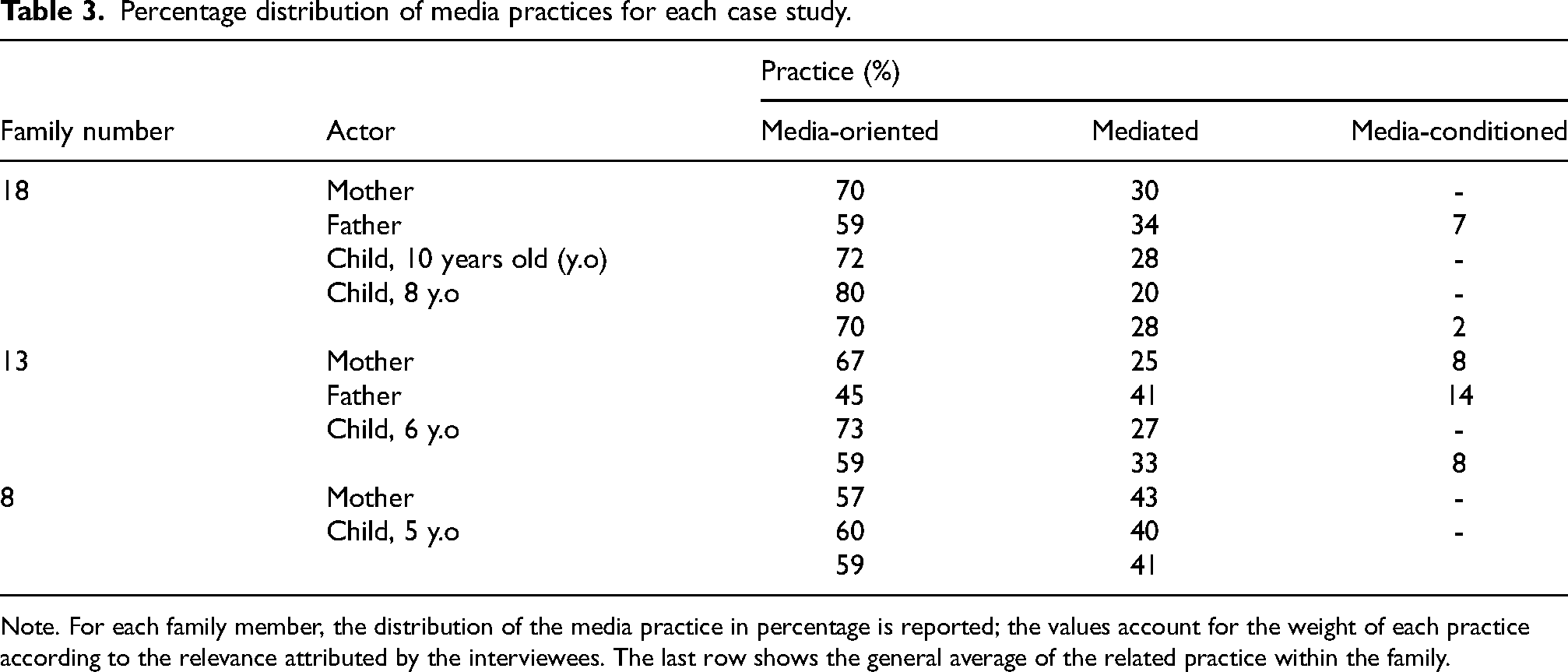
Note. For each family member, the distribution of the media practice in percentage is reported; the values account for the weight of each practice according to the relevance attributed by the interviewees. The last row shows the general average of the related practice within the family.
Empirical application
In this section, we describe the application of our methodological proposal to three case studies to show how an MM-CGTM that incorporates network methods can shed light on the situatedness of mediatised and data relations. We pay particular attention to the discussion of the household's culture and related media negotiations involving parents and children due to their relevance for family life 2 .
Family 18
Family 18 is composed of four members, with two female children aged 8 and 10 years, respectively, as of our first visit. Their 40-year-old mother is employed in her father's company, and their 41-year-old father works as a manager in a multinational logistics company and travels frequently for business. They live in a spacious two-storey apartment within a high-profile complex in a suburban residential area of the city.
Their media ensemble is varied and includes a smart speaker (Alexa), two game consoles (one of which is portable, the Nintendo Switch), two smart TVs, a TV with satellite channels, a smartwatch for the older daughter, one tablet owned by the parents – whose password is unknown to the children – and a kids’ tablet owned by the sisters, two laptops (the mother's current one and her old one), a connected toy (Pictionary Air), and one smartphone for each parent. This level of media saturation emerges clearly from the bipartite network of media ensemble and family members.
As the media ensemble is spatially distributed, this network allows us to visualise patterns of spatial differentiation. The left side of the graph depicts the area where the children can use digital media without parent or adult supervision, and the right side symbolises parents’ personal space. The common areas (living room and kitchen), where shared digital media are located (TVs, Alexa), are visible in the centre.
The intensity of the edges depends on each actor's affective and symbolic investment in a specific device. In fact, the edges connecting both adults and children to ‘owned’ and ‘personal’ media, which serve as identity resources and ways to validate status and agency within the family, are the strongest.
In addition, the children's everyday life emerged as consistently mediatised. This is well evidenced by the degree (k) and weighted degree (w.k) (k10y.o = 11, w.k10y.o = 18; k8 y.o = 10, w.k8 y.o = 19). The former informs about the actor – device connections and therefore the proportion of the media ensemble actually employed by each actor. The latter, taking into account the weight of each connection, incorporates also the emotional, affective, or relational investment in specific media. Indeed, the siblings try to empower themselves by getting access to as many devices as possible, therefore overseeing a large part of the family's media ensemble. Eva (8-year-old child, Family 18): We don’t use the computer very much: when the Nintendo runs out and I don't want to watch TV, I use [my mum's] laptop … I always have a backup. [laughs] Sara (Mother, Family 18): Now and then she tries to get it by herself yes … And mum doesn’t really want that much. Also because if she breaks that one there [the laptop] … it's not good at all! Eva: You have the phone anyway!!!
Conversely, the mother uses fewer media (k = 7, w.k = 16) on a regular basis: this may reflect a specific attitude towards technology – as she defined herself during the interview as a ‘non-technological type’ (Mother, Family 18) – or an underinvestment due to the need to keep up with childcare as the husband comes home late in the evenings and travels frequently. These differences are also mirrored in the particular set of practices, where the media-oriented ones are predominant (70% of the household's total practices), especially for the siblings (child 8 y.o = 80% and child 10 y.o = 72% of their specific set of practices), whilst mediated communication (28% of family practices) is mostly the adults’ prerogative. Indeed, the father uses digital media – smartphone, tablet, and even Alexa with the drop-in feature
3
– to stay in touch with family (34% of his repertoire) during business travels, while the mother reports chatting on WhatsApp with her cousins living in another region. In addition, the father (k = 8, w.k = 17), recognised as the technological expert within the family, is the only one involved in media-conditioned practices (2% of the household's overall practices) for the ‘micromanagement’ of the automation system enabling the smart home, such as light settings. In particular, the light setting sometimes generates conflicts because the mother, turning them on manually instead of by voice command, impairs their operation: Sara (Mother, Family 18): If I do it [turn the lights on] using the switch, then Alexa doesn’t listen anymore, and then my husband gets angry!
In summary, this family is characterised by a medium-to-high socioeconomic status, which is evident both in their living conditions and in the composition of their media ensemble. Their domestic environment provides ample space for each member and is equipped with a substantial number of devices (always up to date), including both shared (such as TVs and the smart speaker) and personal ones (such as the iPad owned by the parents or the educational tablet that the daughters can access freely). In this moral economy, media represent an asset that, for one, provides entertainment opportunities (especially for siblings) and, for another, allows them to maintain family ties with distant relatives or the father during his travels. Simultaneously, the media represent a realm of negotiation and conflict between the mother, charged with everyday parental mediation, and the children regarding access and usage rules, as well as between the spouses concerning the operational management of the media ensemble. The father and mother exhibit different technological orientations and imaginaries, which translate into distinct sets of practices and identity investments allocated on the various devices.
Family 13
The second family comprises a 41-year-old mother, who is a primary school teacher, a 49-year-old father employed as a geometer, and a 6-year-old boy who had just started primary school on our first visit. They live in a single-bedroom apartment, in a residential complex in an adjacent town which is part of the metropolitan area of Milan. Their large media ensemble ranges from game consoles (PlayStation 4 and Nintendo Switch, which served as a ‘bargaining tool’ and an ‘incentive’ to motivate the child to overcome the ‘challenges of starting school’ (mother, Family 13), smartphones, a tablet, a PC (assembled by a computer-savvy friend), and smart devices, such as Alexa, smart lights, and even a smart washing machine with a near-field communication connection. Still, the ensemble lacks a TV with a working signal. Indeed, as emerged during interviews, the parents chose to ‘disconnect’ during the first month of the COVID-19 pandemic due to ‘information nausea’ (Pamela, mother, Family 13). Since then, the TV has been used as a screen mainly for the child's gaming activities or, to a lesser extent, to watch movies via Google Chrome Cast via their Netflix account.
The spatial articulation of their media ensemble reveals a tripartite structure, also supported by the modularity score (Q = 0.4), which reflects the network's tendency to articulate into interconnected yet distinct and well-identifiable areas. Each part is the prerogative of a specific family member, and common devices (such as TV, Alexa, or tablet) serve as a ‘bridge’ connecting each of these separated areas.
The child, who is by far the most mediatised in his everyday practices (k = 8, w.k = 12), has access to the largest number of devices in the media ensemble (66% of total technologies) and reports the highest level of media-oriented practices (73% of his set of practices). Indeed, he spends many hours on the Nintendo Switch and the tablet, which are often used in combination to play Minecraft while listening to tutorials. The table, in particular, is perceived as the child's personal device: Pamela (mother, Family 13): Since he started using the tablet and playing with it – I don’t remember when exactly, maybe he was 3 or 4 years old – it just became his; nowadays, it's almost his.
This reflects a specific parenting culture and technological imaginary, conveyed especially by the mother, who considers digital skills as relevant for the future of her child (‘I’m not against the digital. I wanted him to grow up knowing how to use technology because the future is that way’ (mother, Family 13)). Although conforming to the social imperative to equip children with digital technologies to favour their future inclusion in the job market, the mother is indeed concerned with the negative effects of excessive media use, in line with the second, conflicting, social pressure imposed on parents: Pamela (mother, Family 13): He is often on the couch playing on the console while holding the tablet and listening to the tutorials. I mean, it's a bit of an addiction … Just the stereotype of a classic child addicted to video games. That's the way it is.
However, media-oriented practices are also communicative and mediated because they represent a means for relationship maintenance with the father – as football is a common passion, they play sports games together – and with friends, as they comment on games in real-time on WhatsApp video call.
Moreover, Family 13 expressed an interest in home automation, mainly driven by the father's media-conditioned practices (14% of his set of practices), such as smart-bulb installation and setting. In fact, the father is described as the one ‘fascinated’ by technology (k = 7, w.k = 12). Interestingly, the possibility of remote control enabled by smart home assistants represents an opportunity to increase perceived safety when away from home. In fact, after a theft during the summer holidays, the father became used to turning on the lights remotely to simulate being at home to disincentivise possible intruders. Finally, and consistently with what was observed in the previously discussed family 18, the mother uses fewer devices (k = 6, w.k = 9) and is mainly focused on media-oriented practices (67% of her repertoire), particularly on news searching or watching TV series.
In summary, in this family, whose economic resources are limited and living spaces constrained (with the son sharing the bedroom with his parents), media play a central role in family dynamics, albeit with some ambiguity. The parents provide the child with various digital devices, partly for empowerment purposes and partly to reduce conflict, but they do not establish explicit rules to regulate media use. The network analysis revealed that the child creates his own ‘media island’, where bridge devices hold different meanings and enable different practices for each of the parents. Concerning the mother, the primary mediator and caregiver, media have become an arena of negotiation and conflict, while to the father they serve as a means for relationship maintenance.
Family 8
The third and last case study regards a single-parent family consisting of a mother aged 41 years, working as a contract manager in a company producing design fabrics for furniture, and her 5-year-old son, living in a recently renovated apartment within a semi-central neighbourhood. After the parents’ separation in 2020, the child spends a few days a week with his father.
Accordingly, the child's media ensemble is distributed between the two houses of the parents, as shown by the bipartite networks of actors and media (even if the modularity score is not as high as that of the previous family). The right part of the graph depicts the father's area (which also includes the grandmother's devices), while the left accounts for the mother's area. In the former space, the child experiences a higher level of media-oriented practices, especially gaming (PlayStation 4 and Wii) and watching videos on YouTube on his father's or grandmother's smartphones. However, similarly to Family 13, gaming serves as a mediated practice for relationship bonding between father and son (27% of the total 40%). The father's permissive attitude towards digital media contrasts with the mother's restrictive mediation, which has arisen due to her child experiencing negative effects of both exposure to screens and deprivation of screen media: Letizia (mother, Family 8): And, when daddy was here – you remember that night [to the child]? It happened many times that daddy would play, unlocking the machines, with the PlayStation in front of him [the child] … After a while, he wanted to play with it too; however, I saw that afterward, his sleep was disturbed. So, I used to try to make him play just half an hour, at 7 PM, so that at 9, when he had to go to sleep, he [the child] was a little bit calmer. But not at 8:30, twenty minutes before he [the child] had to go to sleep…
This attitude is also reflected in the child's media practices within the mother's space, where he is allowed only to watch TV during snack time or before dinner and has access to a limited number of devices in comparison to his father's home (kchild−mother = 3; kchild−father = 4). In addition, the practice of singing together, mediated by the Bluetooth speaker, represents a means for affective bonding between mother and child analogous to the gaming shared with the father. Conversely, the mother (k = 4, w.k = 7) is engaged in a higher level of mediated practice (43% of her specific repertoire) in comparison with the parents in other families, which may suggest a specific use of media as a means of relationship maintenance.
To summarise, in this family, the child's media practices are a source of conflict for the recently separated parents. Different mediation styles, with the mother being more restrictive and the father more laissez-faire, result in distinct rules that apply within the boundaries of each moral economy and domestic space, as evidenced by the network structure. This also translates into a different repertoire of allowed practices and of the composition of the media ensemble accessible to the child.
Discussion and conclusions
In this paper, we address a challenge posed by the study of datafication in the context of everyday life by proposing an innovative approach for examining mediatised relations within the household as a proxy of data relations. Indeed, the empirical difficulties in studying and situating data traces can be attributed to their opacity (Christin, 2020) and thus necessitates the adoption of other standpoints and approaches for grounding datafication. Our proposal is articulated at both the analytical and methodological levels.
Analytically, we argue that adopting a non-media-centric perspective and framing families as communicative figurations (Couldry and Hepp, 2017; Hepp and Hasebrink, 2018) allows for an understanding of how mediatised relations emerge from media domestication practices and represent a necessary but insufficient condition for data relations. The dynamic and nuanced processes by which digital media and related data imaginaries are incorporated within everyday family life represent the milieu in which mediatised relations come to life. As technologies become appropriated within a family figuration depending on the family's specific values, imaginaries, and interests (Silverstone et al., 1992; Mansell and Silverstone, 1998; Berker et al., 2006), mediatised relations also become deeply influenced by the family's moral economy, which encompasses the fears and hopes regarding technologies, as well as media-related imaginaries and parenting cultures.
Concerning the present contribution, the empirical application covers some of these aspects for illustrative purposes. The first case (Family 18) shows how children negotiate access to the media to increase their agency and status within the family, while the second (Family 13) highlights the ambivalence of certain media-oriented practices, as they simultaneously represent a source of anxiety for parents worried for their son's excessive screen time and a means for the father and son to bond; finally, the third family (Family 8) suggests how different technological imaginaries and cultures elicit deep conflicts between parents over when and how to use devices, to the point of de-domesticating some of them. The various peculiarities of families translate into different patterns of mediatised relations and, consequently, of data relations. In the first two cases, where the home is highly media-saturated, mediatised relations elicit data relations that pervade the family figuration, involving both parents and children. Conversely, in the third case, the mother restricts the child's access to digital media, therefore limiting the process of the ‘conversion’ of her son's mediatised relations into data relations.
It must be then noted that family figuration results in a multilayered structure (developing from everyday media practices) in which mediatised relations form the first layer, which may or may not result in data relations. To provide another example, children may be allowed to play mobile games only offline (by setting the device to aeroplane mode) to avoid inappropriate advertisement and data gathering. This way, children's media practices translate into mediatised relations but not into data relations because parents intervene as ‘gatekeepers’. Therefore, we suggest that mediatised relations, as necessary but not sufficient conditions for data relations, serve as proxies for the intensity and embeddedness within the everyday life of data relations themselves. Indeed, the latter may be acted upon the former depending on cultural coordinates, such as parenting and mediation styles, as well as data and digital media imaginaries.
At the methodological level, this analytical approach translates into an MM-CGTM that incorporates SNA within qualitative research to materialise the mediatised relations within the home and reveal the taken-for-granted aspects of the datafication of everyday life. The flexibility and thick description enabled by CGT (Charmaz, 2014) provide an in-depth understanding, from the actors’ perspectives, of the continuous and dynamic meaning-making they engage in during daily digital practices. This way, interviews can help to reconstruct people's everyday experience of mediatisation and datafication.
Furthermore, network methods can describe the pattern of relationships connecting family members (Widmer, 2021, 2016) who are involved in specific media practices – each one with specific goals and modalities – that are articulated through the media ensemble and spatially distributed within the home and domesticated according to a specific culture. This can help to materialise the mediatised relations that constitute the very base of data relations.
In particular, our results show how adopting bipartite networks of actors and the media ensemble – where the links represent media-oriented, mediated, or media-conditioned practices that involve that medium (Couldry, 2012) – allows for the identification of the most relevant devices, actors, and practices that form the foundation of the mediatised (and eventually data) relations. Indeed, network analysis provides a set of metrics apt for this purpose, such as the degree (k) (i.e. the number of actor–device connections), which indicates the number of devices regularly employed by each family member, and the weighted degree (w.k) (i.e. the number of actor–device connections weighted by the intensity of each connection), that incorporates emotional, affective, or relational investments in specific media (as the weight was proportional to the relevance attributed by the participants in the interviews). These centrality measures can help to clarify the mediatisation of actors’ everyday lives, considering not only their access to the media ensemble but also the significance of the practices involving these media.
Moreover, distinguishing types of media practices can highlight the diverse coordinates of the moral economy and parenting culture at the base of mediatised relations. In this direction, the categorisation represents an analytical lens to account for variation. The distinction by Couldry (2012) helps to differentiate among practices that are focused on a specific medium with various aims: For entertainment, such as watching TV (media-oriented); for purposes that go beyond a specific device's original uses (mediated), for example, playing video games to spend time together; and still other practices that are made possible by the affordances of the medium itself (media-conditioned), such as the automation of light-bulb settings.
The application of this categorisation across the three case studies sheds light on recurrent aspects as well as specific figurative attitudes regarding mediatised relations. The children adopt the highest number of devices and are mainly engaged in media-oriented practices and, to a lesser extent, in mediated ones. Parents register a similar attitude even if they show the most pronounced involvement in media-conditioned practices (especially fathers), particularly within households with smart speakers enabling smart home automation (Family 18 and 13). Moreover, fathers were more engaged in mediatised practices together with their children than were mothers, who conversely acted as the main mediators of younger members’ everyday activities. This finding suggests a generational and gendered articulation of practices within the household, in line with previous studies (Livingstone, 1992), that is also embodied within mediatised and data relations. Furthermore, it must be noticed that the families were distinguished by their unique data and parenting cultures, as well as moral economies. Therefore, a similar distribution of practices and associated similar behaviours that result in specific sets of mediatised relations may have different meanings and be informed by different imaginaries.
Additionally, network analysis offers two further indices that provide insights into the mediatised structure of a family figuration: density (δ) (which estimates the level of adoption of the media ensemble by expressing it as a percentage of actor–device connections) and modularity (Q) (which considers the network's tendency to form separate but interconnected areas). Although density did not indicate there to be relevant differences across the three families, modularity did. This suggests a different capacity to articulate ‘areas of competence’ or even territories (Morley, 1986) and to generate insights that can be useful for the analysis of focal aspects within domestication, mediatisation, and datafication research, such as the gendered and generational trajectories that drive media adoption and consequently influence the figuration's structure of mediatised and data relations.
In conjunction with these indices, the resulting visualisations enable the materialisation of not immediately visible elements of the family configuration. For example, they provide insight into the patterns of spatial differentiation within the media ensemble distribution, thus highlighting the topologies emerging from the spatial surface of everyday life (Couldry and Hepp, 2017). In some cases, such as for Family 18, a geography seems to emerge, where the central part of the graph depicting the household's public spaces (living room, kitchen), in which devices are shared among members, stands in contrast with the external zones in which actors articulate practices through ‘personal’ and ‘owned’ media, whose use is sometimes forbidden to the other relatives, especially to children. In other cases, such as that of Family 13, the network depicts an n-partite structure (where n represents the number of actors), also evidenced by the modularity score, in which each family member exercises prerogatives over a portion of the media ensemble and shared devices situated within common spaces (i.e. living room), which serve as ‘bridging devices’ invested in both by media-oriented and mediated practices. This kind of geography was also apparent in the final case study (Family 13), in which the network accounts simultaneously for practices articulated within and outside the boundaries of the mother's home since the child experiences digital media more during the time he spends at his father's.
These findings suggest that the application of network methods to the microlevel starting from qualitative data (Dominguez and Hollstein, 2014; Creswell and Plano Clark, 2011) foregrounds the ‘situatedness’ of figurations (Mireia, 2016; Mason, 2006) by showing how mediatised relations (as proxies for data relations) are always embedded within a family frame of relevance. This, in turn, is contextualised in specific family configurations contingent upon distinctive socioeconomic and ethnic backgrounds, living conditions, and the family's constellation of actors (e.g., single-parent or single-child families) (Widmer, 2021), as emerged from the analysis of the three families. Drawing on case studies and comparative case analysis, this approach – although here articulated over a small number of cases but to be extended to the whole sample – instead of ignoring or excluding culture and context, attempts to introduce them in the explanation, overcoming one of the most often cited limitations of SNA (Dominguez and Hollstein, 2014). Thus, a ‘cross-contextual explanation’ is realised that enables us to understand the peculiarities and differences of each case, thus highlighting its situatedness (Mason, 2006). In addition, although this discussion is focused on the results of the first wave of data collection, the longitudinal comparison of data collected during the three family visits can show changes within the mediatised relations’ articulation and, in turn, of the data relations that can eventually transform the figuration itself (Couldry and Hepp, 2017). By doing so, this research design not only brings the actors to the front, as the literature on mixed methods and qualitative networks has emphasised (Bellotti, 2015; Crossley, 2010; Edwards, 2010; Fuhse and Mützel, 2011) but also presents the relevance of the contexts where figuration comes to life, an aspect still little investigated within datafication research (Flensburg and Lomborg, 2021)
Furthermore, qualitative interviews and network methods are complementary within an MM-CGT approach. Indeed, the visualisations resulting from SNA, developed from data collected during the first and second waves, can be employed as a stimulus to foster the reflexivity of both researchers and participants. In the former case, the networks – together with the related metrics – can generate new analytical and theoretical insights throughout the research process, leveraging the iterative and comparative principles at the base of CGT; in the latter case, the displays of networks can enable participant engagement (Vaughn and Jacquez, 2020) with mediatised relations and data relations in the digital-material context of their daily lives. Indeed, these networks were employed as ‘reflexive maps’ during the third and final family visit to stimulate discussion around the media practices, imaginaries, and norms rooted beneath the surface of daily life that contribute to confirm or negotiate the figuration's power and role balance.
For example, in Family 18, the maps elicited a discussion between the mother and the youngest daughter regarding the responsibility of charging and taking care of their brand-new personal devices. Similarly, the visualisation of the mediatised relations led the mother to talk about additional digital practices that were not explicitly mentioned before, such as the monitoring of steps through her smartwatch. As another example, the maps for Family 8 led the mother to emphasise her restrictive approach (highlighting that her son did not have access to all the devices in the house) and recognise the ‘dual-situatedness’ of her child's practices, of which she only had partial visibility.
This way, the maps constituted a tool for knowledge co-construction, as researchers and interviewees engaged in discussion while receiving feedback, thus revealing different perspectives in the dialogue concerning the findings and their articulation. Moreover, the maps can represent a kind of participatory research (Vaughn and Jacquez, 2020) but also a means to testing the effectiveness and epistemological value of this MM-CGTM design. Indeed, although the use of visualisations is positioned as a critical step in the analytical process (Onwuegbuzie and Teddlie, 2003), there is little guidance about their use in the development or refinement of theory, especially in mixed methods research (Plano Clark and Sanders, 2015) and much less in MM-GTM (Creamer, 2021). These reflexive maps represent a way to deepen an underexplored area (Buckley and Waring, 2013) in order to solve the complex and intricate puzzle that datafication poses to research.
In conclusion, with this study, even if limited to a small subsample, we have aimed to delineate an innovative methodological approach to studying the datafication of childhood and family life at the microlevel of daily life. Although the focus of this research project is on mediatised relations as proxy for data relations within a domestic context, we believe this approach can be extended beyond the home to understand how data relations reconfigure different communicative figurations. In fact, this approach is aimed at highlighting the situatedness of data practices and imaginaries – also addressing the relevance of spatial articulation of media (Morley, 1986, 2000) – and developing new tools for the empowerment of research to enhance the phenomenological richness of data practices in the diverse digital-material contexts of family life.
Footnotes
Declaration of conflicting interests
The authors declared no potential conflicts of interest with respect to the research, authorship, and/or publication of this article.
Funding
The author(s) disclosed receipt of the following financial support for the research, authorship, and/or publication of this article: This research was supported by Fondazione Cariplo (Bando Ricerca Sociale 2019).
