



Abstract
TikTok has shifted from a once marginal entertainment platform to an important channel of parliamentary communication, yet we still know little about who uses it intensively and why. We identify three sets of potential drivers: party incentives, behavioural persistence, and individual characteristics. Our analysis builds on a novel data set comprising the complete posting histories of all Members of Parliament (MPs) in Germany and the United Kingdom, covering activity from MPs’ first adoption in 2020 through the end of 2024 and linked to party- and individual-level characteristics. We combine descriptive analyses with zero-inflated negative binomial models with year fixed effects. Three findings stand out: First, party nicheness, a relational measure of the degree to which a party focuses on issues not emphasised by other parties, predicts higher posting volumes, with MPs from such parties producing more content than mainstream parties. Second, TikTok use is path-dependent: once MPs establish high (or low) posting levels, they tend to sustain them over time. Third, individual traits matter unevenly: prior platform experience and gender are associated with higher activity, while age and institutional position show no consistent effects. Our results shift the focus from stylistic repertoires to structural drivers of elite communication on TikTok and demonstrate that sustained activity is concentrated, persistent, and above all shaped by party incentives. The findings suggest that TikTok lowers entry barriers and expands political visibility, potentially re-engaging voters, yet its dynamics may also amplify polarisation by disproportionately incentivising fringe actors to be active on the platform.
Introduction
TikTok has rapidly evolved from a niche platform known for dance challenges and lip-syncing into a thriving arena of digital political communication (Cervi et al., 2023). In recent election campaigns across Europe, parties and candidates experimented with short-form video to reach voters (Battista, 2023; Cartes-Barroso et al., 2025; Poulakidakos, 2024; Solovev et al., 2025). For politicians, TikTok is particularly attractive because its user base is disproportionately young (Abidin, 2020), offering access to electorates that are often difficult to engage through traditional media (Wunderlich, 2025). Yet these campaign snapshots, while highlighting TikTok’s growing salience, do not reveal which factors shape activity on the platform over time. Sustained presence requires resources, strategic incentives, and behavioural persistence that are not evenly distributed across political actors.
Existing research on TikTok has focused primarily on communication styles once politicians are active, often relying on single-country case studies (Bösch, 2023; Cervi et al., 2023, 2021; Grantham et al., 2025; Prado & Coello, 2024; Solovev et al., 2025; Ureke, 2024) or focusing on narrow sets of pre-selected actors in comparative studies (Albertazzi & Bonansinga, 2024; Cartes-Barroso et al., 2025; González-Aguilar et al., 2023; Moir, 2023). What remains missing is a systematic account of who sustains activity on TikTok over time and why. Addressing this gap, we analyse complete posting histories of all MPs in Germany and the United Kingdom from 2020 to 2024, the first cross-national data set of its kind that captures sustained activity over time.
To better understand which factors may structure such activity, we also draw on insights from broader social media research. Studies of Facebook and X (formerly Twitter) highlight that individual characteristics such as age, gender, institutional position and platform experience shape MPs’ online activity (Dolezal, 2015; Karlsen & Enjolras, 2016; Vergeer & Hermans, 2013). MP participation is also highly skewed, with small minorities of hyperactive users and large majorities who remain inactive (Philipps et al., 2025). Once established, such routines often persist (Goh et al., 2019). Research further suggests that niche parties, defined by selective issue profiles that diverge from mainstream competitors, may benefit disproportionately from TikTok’s algorithmic distribution, which organises content around interest clusters rather than follower networks (Gerbaudo, 2024; Meyer & Miller, 2015).
We therefore structure our contribution around three sets of drivers: (1) party incentives, since niche parties may gain more from algorithmic distribution; (2) behavioural persistence, since prior activity strongly conditions current activity; and (3) individual resources and constraints, since experience, gender, and institutional role may affect willingness and capacity to produce content. TikTok’s video-centred production demands and distinctive distribution mechanisms, however, mean that these expectations cannot simply be assumed to transfer from other platforms. We therefore treat prior findings as hypotheses to be tested rather than settled assumptions.
Our contribution is threefold. First, we provide a systematic, cross-national analysis of sustained TikTok activity among MPs, drawing on complete posting histories across two parliamentary systems. Second, we shift the explanatory focus from adoption to intensity and persistence, capturing who sustains activity and why. Third, we integrate organisational strategies, temporal behaviour, and individual characteristics into a unified framework of structural drivers. In doing so, we extend broader debates on digital political communication and demonstrate how TikTok reshapes the conditions of visibility for political elites.
Political Communication on TikTok: Adoption, Stylistic Repertoires, and Platform Affordances
TikTok has rapidly grown into a central arena of digital interaction. Scholarship on its political use is expanding but remains dispersed across different research questions and traditions. Existing work can be grouped into three strands: research on adoption and political use, studies of stylistic repertoires, and analyses of TikTok’s distinctive affordances.
The first body of research examines who adopts TikTok and how consistently they use it. Studies of political parties in Spain (Cervi & Marín-Lladó, 2021) and presidential candidates in Peru (Cervi et al., 2023) show that even when parties and candidates across the political spectrum establish accounts, they often underuse the platform’s technical features, post irregularly, or discontinue their accounts altogether. These findings underscore that adoption is widely observed but does not automatically translate into sustained activity. Political actors may join TikTok for strategic reasons, but activity often drops off again. In Germany, the left-wing party The Left (Die Linke) and especially the far-right party Alternative for Germany (Alternative für Deutschland, AfD) built a strong TikTok presence early on (Solovev et al., 2025), whereas in the United Kingdom, the two major parties, Labour and the Conservatives, only rushed to open official accounts once the 2024 election campaign was underway (Schapals, 2024). These contrasting patterns suggest that adoption varies across contexts and party types, but current research remains confined to single-country case studies and selected groups of actors.
Building on this, a second body of research shifts attention from adoption to how politicians communicate once they are active on the platform. Studies of US actors show a tendency to adopt an explanatory, documentary style to communicate political issues, for instance posting selfie-style videos explaining legislative proposals or documenting campaign stops (Umansky & Pipal, 2023). In Australia and Greece, scholars emphasise efforts to project political authenticity by offering behind-the-scenes glimpses into their everyday routines (Grantham et al., 2025; Poulakidakos, 2024). In Zimbabwe, both the ruling party and the opposition exploited TikTok’s more playful affordances for political persuasion, by adapting traditions of song and dance to short-form video in ways that reflect the country’s cultural context. The opposition in particular used this politainment approach to mobilise young voters to register (Ureke 2024). Beyond these regional variations, a growing share of research concentrates on populist and far-right actors, who are often portrayed as particularly adept at exploiting the platform’s features. Here, researchers highlight address strategies that frame users as friends and create a sense of in-group belonging (Bösch, 2023) and the use of optimistic and inspirational appeals that convey a positive outlook on the future or the appreciation of national accomplishments (Albertazzi & Bonansinga, 2024) as key stylistic devices to engage audiences. While these contributions illuminate how repertoires circulate on TikTok, they say little about which types of actors sustain activity over time.
A third line of work instead emphasises why TikTok might be especially attractive for political communication by highlighting its structural features that make it unique in the social media ecology. TikTok departs from follower-based logics of other social media platforms through algorithmic content recommendation that concentrates user attention on the curated ‘For You Page’ that also regularly recommends videos with only a handful of views (Guinaudeau et al., 2022; Narayanan, 2023). This ‘virality-from-nowhere’ allows posts, even from accounts without prior audiences, to reach millions. The recommendation system lowers entry costs for newcomers and acts as an equalising force that “guarante[es] an audience for every post” (Guinaudeau et al., 2022, p. 469). Visibility on TikTok is organised around algorithmically inferred interest similarity and not chosen social ties, meaning that users are automatically assigned to streams of content rather than proactively opting into certain communities (Gerbaudo, 2024). Such interest clustering can increase depersonalisation and fragmentation of the public sphere, make it harder to find common ground, and potentially fuel political polarisation (Gerbaudo, 2024). The mobile-only interface further reinforces reliance on algorithmic curation by limiting users’ ability to moderate their own feeds (Entrena-Serrano, 2025). These features demonstrate why TikTok is distinct from other platforms, yet existing work does not show which political actors actually capitalise on these opportunities.
These three strands of research provide important starting points but leave open a central question. Adoption studies show that politicians across contexts experiment with TikTok, but activity often remains irregular and drops off over time. The contrasting patterns across countries and party types also raise broader questions about which actors are drawn to TikTok and with what implications for democratic competition. Work on stylistic repertoires demonstrates how political actors communicate once they are active, illuminating the repertoires broadcast and the kinds of actors seen as innovators. Yet this line of research presupposes politicians’ sustained presence and does not identify which types of actors consistently remain active. Research on affordances highlights what makes TikTok qualitatively distinct from other social media platforms, especially its algorithmic recommendation system and mobile-only interface, but still leaves open the question of which political actors actually take advantage of these features. What is missing is systematic evidence on which types of political actors maintain activity over time, and which structural factors explain variation in their sustained use. Our analysis turns to this question, focusing on party incentives, behavioural persistence, and individual resources as candidate drivers of political communication on TikTok.
Drivers of Political Activity on TikTok: Party Incentives, Persistence, and Individual Characteristics
Existing research on adoption, stylistic repertoires, and platform affordances offers valuable insights into how TikTok is used politically. Yet, as highlighted above, these studies do not explain which political actors sustain activity over time and why. To address this gap, we draw on broader social media research that consistently shows both party-level incentives and individual characteristics to be central drivers of online communication. Building on these findings, our analysis focuses on three potential sources of variation in TikTok activity: party incentives, behavioural persistence, and individual characteristics of MPs.
Party Incentives and TikTok Activity
Politicians’ social media behaviour is embedded in the organisational strategies of their parties (Pedersen, 2024). Parties differ in the extent to which they rely on digital communication, depending on their position in the political system and their access to traditional forms of visibility (G. Enli, 2017; Ernst et al., 2017; Van Aelst et al., 2017; Vergeer & Hermans, 2013). Parties with broad electoral appeal and central positions in the party system can often rely on established media coverage, whereas smaller or less central parties depend more strongly on direct communication with voters via online platforms (Jungherr et al., 2019). To capture these differences, we draw on the concept of nicheness.
In its original formulation, the concept of niche parties combined several criteria, including issue novelty, limited overlap with the traditional left–right dimension, weak class-based orientation, and the perception of being single-issue parties (Meguid, 2005, 2008). Subsequent work has argued for a more parsimonious approach, suggesting that many of these elements are better treated as empirical correlates rather than defining features of nicheness (Meyer & Miller, 2015). We follow the minimal-definition approach proposed by Meyer and Miller (2015). Their starting point is the relative issue emphasis within a party system. Parties primarily want to foreground their own issue priorities, yet they cannot set their agenda in a vacuum as they operate in a competitive market. They need to be responsive to voter demands as well as issue agendas set by their competitors, as ignoring them could risk electoral backlash (Green-Pedersen & Mortensen, 2015; Meyer & Miller, 2015). As a result, parties differ systematically in how they distribute attention across policy areas, producing more or less distinctive issue profiles. Niche parties are therefore defined relationally, by the distinctiveness of their issue emphasis compared to that of mainstream competitors (Meyer & Miller, 2015). Rather than seeking to approximate the median voter, niche parties emphasise a limited set of issues, such as environmental protection, EU integration, or social liberalism (Ezrow, 2010; Meyer & Miller, 2015; Wagner, 2012). While the general median voter is not of interest to niche parties, they do focus especially on the median within their own group of supporters (Ezrow, 2010).
The relevance of niche party identity for TikTok stems from the platform’s unique affordances. TikTok’s algorithm prioritises content alignment with user interests rather than follower networks, creating what Gerbaudo (2024, p. 2) terms “clustered publics.” This means that even actors with limited follower bases can achieve disproportionate reach if their content resonates with specific interest clusters, including users who would not typically follow political accounts. TikTok therefore provides fertile ground for niche parties to amplify their distinctive appeals and potentially revitalise engagement among segments of the electorate that feel underrepresented by mainstream politics.
We therefore examine whether niche parties are particularly likely to sustain activity on TikTok and expect that MPs from programmatically distinctive parties post more frequently than their mainstream counterparts:
RQ1: Do MPs from programmatically niche parties post more on TikTok?
Persistence and TikTok Activity
Beyond party strategies, behavioural persistence may also shape activity. Social media use is not just a matter of resources or strategy but also of routines. Research across online environments shows that communication activity is highly skewed, with small minorities of hyperactive users and large majorities of inactive or sporadic participants (Philipps et al., 2025). Such persistence patterns suggest that once politicians establish posting routines, these become self-reinforcing over time. Prior activity increases the likelihood of continued activity, as past engagement strengthens both motivation and ease of maintaining future output (Cowburn et al., 2025). This process was described by Goh et al. (2019) as habit formation in politicians’ online communication, where repeated digital communication becomes routinised and sustained. Once politicians establish posting habits, these tend to persist over time, while those who remain inactive are unlikely to suddenly become active.
On TikTok, persistence may be even more consequential. Because visibility on the platform is tied to the appearance of individual posts in algorithmically curated feeds, activity becomes a precondition for remaining visible. The platform’s recommendation architecture operates at the level of single posts instead of follower networks in which each upload competes anew for algorithmic exposure (Guinaudeau et al., 2022). A creator’s visibility fluctuates heavily across videos, which means users must continually re-enter the algorithmic lottery to sustain an audience. These features imply that periods of inactivity effectively remove users from circulation, whereas regular posting sustains presence in user feeds. Because inactivity erodes both algorithmic presence and audience familiarity, users who stop posting face steep re-entry costs, discouraging renewed engagement. TikTok combines low entry and high persistence pressure (Guinaudeau et al., 2022). The uniquely close linkage between production and distribution on TikTok creates strong path dependencies. Hyperactive MPs may consolidate their visibility, while those who stop posting are quickly forgotten by both algorithms and audiences:
RQ2: Does prior behaviour on TikTok predict subsequent behaviour?
Individual Characteristics and TikTok Activity
Finally, individual-level characteristics have long been recognised as shaping legislative behaviour and communication efforts. Social media, in particular, is often viewed as a tool of individualisation that places the individual politician rather than the political party at the forefront (G. S. Enli & Skogerbø, 2013; Tormey, 2015). Research on Facebook and Twitter, now X, consistently shows that age, gender, and institutional role are among the most important determinants of both adoption and intensity of use (Dolezal, 2015; Karlsen & Enjolras, 2016; Vergeer & Hermans, 2013). We therefore examine whether these familiar predictors extend to TikTok.
Age has been central in earlier work (Dolezal, 2015; Karlsen & Enjolras, 2016). Younger politicians are typically more willing to experiment with new platforms and more fluent in digital media practices (Bjørnå et al., 2022; Qi et al., 2025). Their generational proximity to TikTok’s core user base may further lower barriers to engagement. Furthermore, studies show that gender shapes incentives and risks for high-volume participation. Women face higher risks of online harassment, which may discourage visible activity on a platform built around virality (Collignon & Rüdig, 2020; Rheault et al., 2019). At the same time, female politicians have been shown to use social media strategically to counterbalance gender biases in traditional media and to increase visibility in male-dominated arenas (Sandberg & Öhberg, 2017). In addition, research shows that social media does not override party hierarchies (G. S. Enli & Skogerbø, 2013; Swalve et al., 2025). Party leaders and cabinet members may be expected to maintain visibility across channels and may receive professional assistance to do so (Karlsen & Enjolras, 2016), while backbenchers may have stronger incentives to embrace TikTok as a compensatory tool for limited exposure elsewhere (Jacobs & Spierings, 2016). By focusing on age, gender, and institutional role, we examine whether these established predictors of online activity also shape MPs’ use of TikTok:
RQ3: How do MPs’ characteristics relate to activity?
Data and Methods
To create our data set, we compiled comprehensive lists of sitting MPs in Germany and the United Kingdom, aligned with legislative periods since 2017. For each MP, we conducted systematic searches to identify corresponding TikTok accounts and collected metadata on gender, date of birth, mandate periods, and institutional roles such as party leadership or cabinet membership. To retrieve all posts for an MP, we followed a similar approach to that outlined in the Politok-DE data set (Ruiz et al., 2025). Specifically, we used our list of MP usernames on TikTok to scrape directly from the TikTok website, and bypassed the TikTok research API entirely. We followed a ‘repeated-snapshot’ approach, scraping at regular 1-week intervals. Each time, we added new posts to our database and skipped posts already known in the database. An advantage of this approach over a ‘single-snapshot’ approach was that we captured posts even when they were later deleted by the MP. Each MP user is considered active from the time of their first post, and we count all posts in subsequent years from this moment onward. Our searches confirmed that no MP in either country was active on TikTok before 2020, which defines the start of our timeframe. The resulting data set covers the complete TikTok activity of all active MPs in Germany and the United Kingdom between 2020 and 2024, making it the first cross-national data set of its kind. The data set contains 496 Members of Parliament (134 from the United Kingdom and 362 from Germany) who produced nearly 40,000 TikTok videos in total, including 8,348 posted by UK MPs and 30,873 by their German counterparts.
We focus on Germany and the United Kingdom as comparative cases because they are both consolidated parliamentary democracies with digitally active electorates, yet differ markedly in the broader communication opportunity structures. 1 Germany’s fragmented multiparty system fosters a competitive attention economy in which parties like The Left, Alternative for Germany, or the Greens (Bündnis 90/Die Grünen) seek new ways to differentiate themselves (Jungherr et al., 2019). This competitive environment creates strong incentives to experiment with emerging platforms like TikTok that offer these actors low-cost pathways to reach audiences beyond traditional media gatekeepers (Jungherr et al., 2019). By contrast, the United Kingdom’s majoritarian system concentrates competition between the Labour Party and the Conservative Party (Goes, 2018). Smaller parties such as the centrist Liberal Democrats, the Scottish National Party (SNP), or right-wing Reform UK (formerly Brexit Party) face much stronger structural barriers and fewer conventional routes to public exposure. TikTok is one of few alternative routes to visibility beyond the dominance of the two major parties. These contrasts reflect broader findings on campaign strategy in hybrid media systems (Schäfer, 2023) and party system saturation, where fragmented systems tend to favour niche actors with clearer brands, while concentrated systems privilege mainstream parties (Van De Wardt & Rooduijn, 2023). Comparing Germany and the United Kingdom thus allows us to test whether the same structural incentives drive TikTok activity under multiparty versus two-party-dominated competition.
Empirically, we proceed in two steps. First, we provide descriptive analyses of adoption trajectories, posting concentration, and party patterns. Second, we estimate multilevel zero-inflated negative binomial (ZINB) models with year fixed effects to explain annual posting volumes. This design is well-suited to our data because the dependent variable is overdispersed (Hilbe, 2011), and many MP-years contain no posts, producing excess zeros beyond what a standard negative binomial would predict. The zero-inflation component captures the probability of an MP producing zero posts in a given year, while the count component estimates posting intensity among active MPs. We include random intercepts at the MP level to account for the nested data structure and unobserved individual heterogeneity.
Operationalisation and Measurement: TikTok Activity and Its Drivers
Our dependent variable is a count of TikToks posted by individual MPs per year. As is common in political communication research on social media, we focus on posting frequency rather than secondary engagement metrics as a proxy for the amount that politicians invest in the communication on a channel (Fazekas et al., 2021; Hong et al., 2019). This choice is particularly suitable for TikTok, where the standardised short-video format produces comparable content across accounts. Unlike other platforms with more varied post types, TikTok’s standardised format makes posting counts a more consistent indicator of activity. Posting requires deliberate effort and therefore more directly reflects actors’ strategic communication activity. The yearly unit allows us to distinguish between sustained engagement and one-off communication spikes tied to specific events. Aggregating at the annual level also avoids the sparsity that would arise with monthly counts while preserving temporal granularity that would be lost if only overall totals were used.
To capture party-level incentives (RQ1), we include a continuous measure of party nicheness, following Meyer and Miller (2015). This measure reflects how distinct a party’s issue profile is compared to its competitors, moving beyond a simple mainstream/niche dichotomy. We treat nicheness as a programmatic dimension of party-level incentives. Our incentive argument focuses on issue-profile distinctiveness as one component of party incentives rather than a comprehensive account of party organisation. Formally, party


where
To capture behavioural persistence (RQ2), we include two lagged indicators of posting routines. First, we code whether an MP was a heavy user in the previous year. We identify heavy users by ranking MPs within each country by annual TikTok count and flagging the top decile. This produces a relative, year-specific threshold that adapts to platform growth. Second, we record whether an MP produced zero posts in the prior year. These measures allow us to test whether high activity or inactivity persist over time. This operationalisation reflects earlier findings that social media activity is highly skewed, with small minorities of hyperactive users and large majorities who remain inactive, and that established communication routines tend to persist rather than change suddenly (Goh et al., 2019; Philipps et al., 2025).
At the individual level (RQ3), we include variables for gender (binary), age in years, and TikTok seniority (measured as years since the first post). To assess institutional status, we add indicators for party or parliamentary group leadership and cabinet membership. These variables reflect the most consistently identified predictors of online activity in prior social media research as discussed above in the section Individual Characteristics and TikTok Activity. This allows us to test whether familiar predictors of social media use also explain MPs’ TikTok activity.
Descriptive Analysis
Before turning to the multivariate models, we provide an overview of MPs’ TikTok activity to contextualise our analysis. We then present descriptive evidence related to RQ1 (party impact) and RQ2 (behavioural persistence).
Overall Usage of TikTok
TikTok adoption has increased steadily among MPs in both Germany and the United Kingdom since 2020, yet at different levels. In Germany, adoption started earlier and reached higher levels overall, while in the United Kingdom it expanded rapidly only in the run-up to the 2024 general election (Figure 1). This suggests that TikTok diffusion has been shaped not only by platform dynamics but also by election calendars.
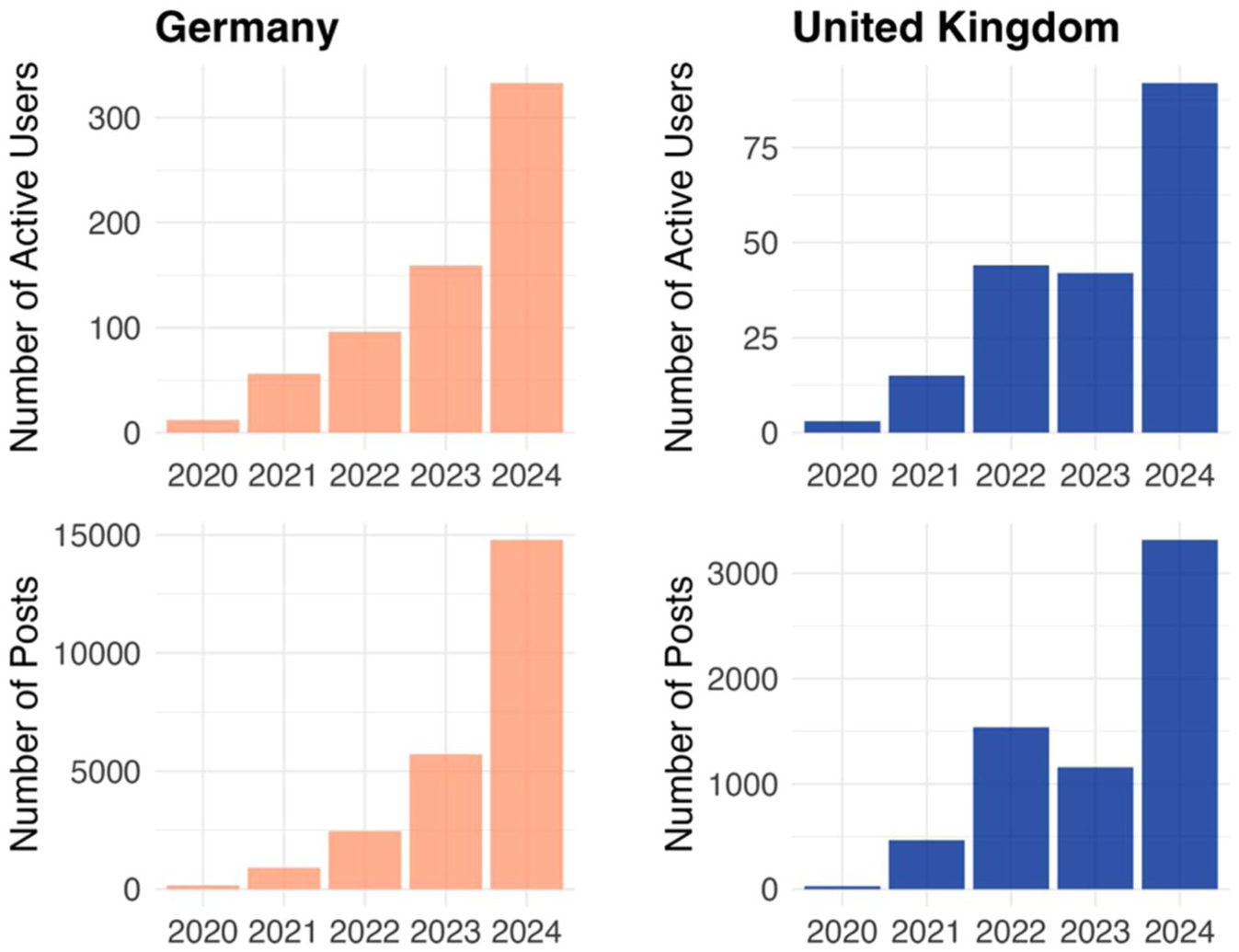
Expansion of TikTok use by MPs over time in Germany and the United Kingdom (2020–2024).
The number of early adopters among the German MPs was low; only 12 MPs had an active account in 2020, producing a mere 155 posts. Growth was modest at first, but once user numbers crossed into the triple digits in 2023, uptake accelerated sharply. By 2024, 333 MPs, over half of the Bundestag, were active, together producing 15,000 TikToks. This marks a shift from 2% to 52% of MPs in just 5 years. The United Kingdom exhibits a remarkably similar development, though starting from an even lower base. In 2020, only three UK MPs maintained an active TikTok account, posting just 28 TikToks. Adoption increased three- to fivefold each year until 2023, when growth plateaued, likely due to a ban of the app on all government devices in 2023 (Sabbagh, 2023). Adoption rebounded quickly to 92 active accounts in 2024, a thirtyfold increase in accounts within 5 years.
Posting activity scaled alongside adoption, but not one-for-one. In Germany, total output rose from 155 posts in 2020 to roughly 15,000 in 2024 – an increase that outpaced the rise in the number of active MPs, implying higher productivity among those who post. Posts per active MP climbed from approximately 13 (155/12) in 2020 to approximately 45 (15,000/333) in 2024, a more than threefold increase. In the United Kingdom, total output grew from 28 posts in 2020 to over 3,300 in 2024, with a surge in 2022, a temporary dip in 2023 (consistent with the device ban), and a campaign-driven rebound in 2024. Here too, intensity rose faster than adoption. Posts per active MP increased from approximately 9 (28/3) to approximately 36 (3,300/92), nearly a fourfold increase.
These patterns show that MPs did not merely adopt TikTok; those who posted also routinised and intensified their activity over time. Germany exhibits earlier normalisation and sustained scaling, while the United Kingdom shows a later, election-centred spike. These contrasts motivate our multivariate tests of party incentives (RQ1) and persistence (RQ2): are distinctive parties the ones driving higher volumes, and do early posting habits compound into sustained activity?
Party-Level TikTok Usage
The first research question examines whether programmatically niche parties are more active on TikTok. Descriptively, we approach this by comparing adoption and posting behaviour across parties in Germany and the United Kingdom (Figures 2 and 3).
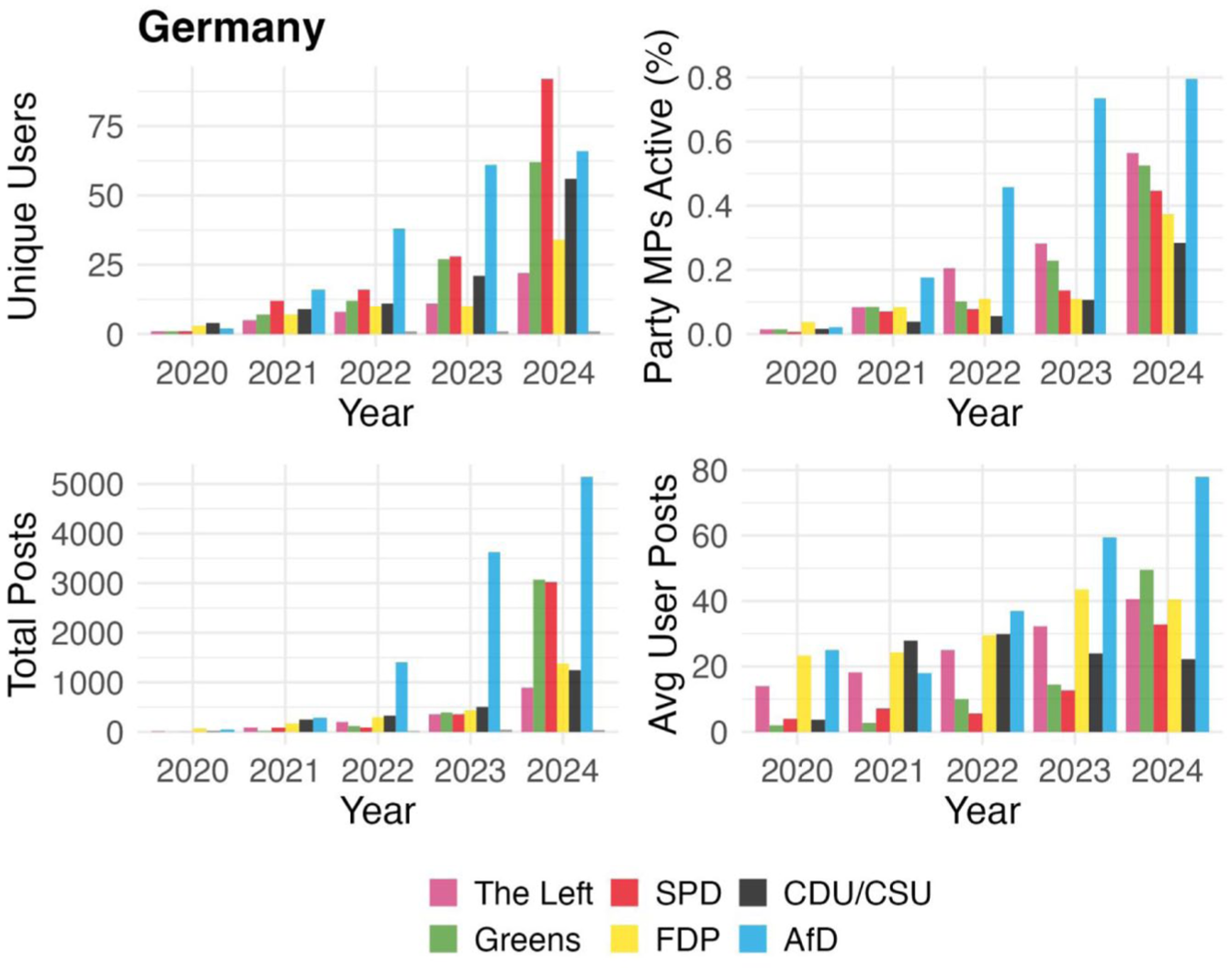
TikTok adoption and activity by party among MPs in Germany (2020–2024).

TikTok adoption and activity by party among MPs in the United Kingdom (2020–2024).
In Germany, adoption patterns reveal a clear divide between large mainstream parties and parties with more distinctive issue profiles. In particular, AfD developed a strong TikTok presence early on, reaching striking levels of saturation. By 2022, nearly half of AfD MPs were on TikTok, and by 2024 around 80% maintained an active account. The Left and the Greens also saw steady growth, surpassing the 50% threshold of active MPs by 2024. Mainstream parties, by contrast, expanded more cautiously. The Social Democratic Party (Sozialdemokratische Partei Deutschlands, SPD) overtook AfD in absolute numbers of accounts by 2024, but its adoption rate relative to party size remained far lower. The sister parties Christian Democratic Union of Germany/Christian Social Union in Bavaria (Christlich Demokratische Union Deutschlands/Christlich-Soziale Union in Bayern, CDU/CSU) showed similar caution, while the Free Democratic Party (Freie Demokratische Partei, FDP) maintained only moderate adoption without major scaling.
Posting activity mirrors these differences. AfD MPs consistently produced the highest output, surpassing all other parties combined in 2022 and 2023. By 2024, AfD also led in average posts per user, with active MPs producing more than 70 TikToks on average. Smaller parties including The Left and, in some years, the FDP also posted intensively relative to their size, sometimes rivalling AfD on a per-user basis, while large mainstream actors such as SPD and CDU/CSU lagged considerably behind. These patterns indicate that actors with a more distinctive issue profile not only adopted earlier but also relied more heavily on TikTok once active.
In the United Kingdom, adoption trajectories similarly highlight contrasts between the major parties and smaller actors. Labour scaled up most in absolute terms, with a sharp increase in 2024 when over 50 MPs joined TikTok in the run-up to the election. Conservatives, however, expanded only modestly, from 5 active MPs in 2021 to 16 in 2024, leaving adoption rates at just 6% of the parliamentary party. The Social Democratic and Labour Party (SDLP) was an early adopter. It already showed comparatively high proportional presence by 2022, and was later joined by the group of Independents that achieved proportional adoption rates around 50%. Over time, however, Reform UK not only caught up but overtook the other smaller actors as the most TikTok-saturated party relative to size.
Posting intensity reinforces this picture. While Labour produced the largest overall volume of TikToks in 2024, per-user activity remained modest compared to smaller factions. Conservative MPs, despite their limited numbers, posted intensively in the early years, leading in per-user output in 2022. Reform UK and Independent MPs, once active, also displayed disproportionately high per-user posting levels, consistent with a strategy of using TikTok as a core communication channel.
Taken together, the German and United Kingdom cases show that TikTok adoption and posting intensity vary systematically across parties. Programmatically distinct parties, such as AfD, The Left, the Greens, Reform UK, and the SDLP, were more inclined to experiment with TikTok, achieved higher proportional adoption rates, and posted more intensively once active. Mainstream parties eventually scaled up, particularly SPD and Labour, but did so more cautiously and with lower per-user intensity. Across both contexts, the descriptive evidence suggests that TikTok’s affordances favour parties with distinctive issue profiles and weaker access to mainstream visibility, providing support for our expectation in RQ1.
Heavy Users: Concentration of Activity
In this section, we explore persistence in TikTok activity, focusing on two aspects: the concentration of output among a small minority of highly active MPs and the durability of inactivity among others. This provides a descriptive foundation for RQ2, which asks whether prior posting behaviour predicts subsequent activity.
Figure 4 shows that TikTok output is not evenly distributed but strongly concentrated among a small minority of MPs. From 2021 onward, the top 10% of users consistently generated roughly 40% to 50% of all parliamentary TikToks in both Germany and the United Kingdom. The imbalance was particularly striking in 2021, when early adopters accounted for roughly half of all output. Although concentration declined slightly as more MPs joined in later years, a small core of hyperactive MPs continued to dominate TikTok communication through 2024, which is especially noteworthy since, as discussed earlier, the total volume of posts increased substantially in this time span. This demonstrates that overall parliamentary presence on TikTok is not only shaped by party-level strategies, but also by the disproportionate activity of a few individual MPs.

Concentration of TikTok activity among MPs.
Figure 5 shows that MPs who posted nothing in a given year were far more likely to remain inactive the following year. In Germany, around two-thirds of previously inactive MPs stayed inactive; in the United Kingdom, the share was close to 80%. By contrast, MPs who had posted at least once were much more likely to remain engaged. This suggests a strong path dependency. Once MPs fall silent, they rarely return.

Persistence of inactivity on TikTok.
Taken together, these descriptive findings reveal two forms of persistence. At the top, a small number of heavy users sustain disproportionately high levels of activity over multiple years. At the bottom, inactivity is also consistent, with many MPs dropping out after initial experimentation. Adoption and sustained activity therefore need to be distinguished. The mere presence of an account does not guarantee regular or meaningful participation.
Interim Conclusion: Findings From the Descriptive Analyses
As an interim conclusion, the descriptive analysis speaks directly to our research questions. For RQ1, niche parties emerged as especially active adopters. For RQ2, we find strong descriptive evidence of persistence, both in hyperactivity and inactivity. However, these results remain descriptive. To assess whether programmatic distinctiveness systematically predicts TikTok activity (RQ1), and whether behavioural persistence holds once additional explanatory factors are controlled (RQ2), we next turn to multivariate regression analysis. In addition, this allows us to examine our RQ3 and assess whether, and if so, which individual characteristics of MPs affect activity while holding all other factors constant.
Inferential Analysis: Testing the Drivers of TikTok Activity
The multivariate models form the core of our analysis, allowing us to test whether the descriptive patterns observed earlier hold once competing factors are accounted for. We estimate zero-inflated negative binomial models with year fixed effects, which address both the overdispersion of post counts and the large share of MP-years with zero activity. Figure 6 summarises the results as incidence rate ratios (IRRs) with 95% confidence intervals. A reduced version of the model without year fixed effects is presented below (Table 1). 4 The model explains 43% of the variance in posting frequency through fixed effects (marginal R2 = 0.43) and 97% when accounting for MP-specific intercepts (conditional R2 = 0.97). The very high conditional R2 indicates that most variance lies between MPs, reflecting stable individual differences in baseline activity. At the same time, the fixed effects alone account for over 40% of the variance, which is substantial for behavioural data and supports the theoretical rationale behind our variable selection. Overall, the model provides a strong fit and a solid foundation for the subsequent analyses.

Determinants of MPs’ TikTok activity: Incidence rate ratios from zero-inflated negative binomial model.
Effects of Party Nicheness, Behavioural Persistence, and Individual Characteristics on TikTok Activity.

Note. Values in brackets indicate standard errors. Significance levels: *p < .05, **p < .01, and ***p < .001.
Turning to RQ1 on party incentives, the models show that programmatic distinctiveness is systematically linked to higher levels of TikTok activity. MPs from parties with more niche issue profiles consistently post more than those from mainstream parties. The estimated IRR for party nicheness in the full model is 1.46 (see Table 1). This means that, holding all other variables constant, MPs from parties whose issue profiles are one standard deviation more distinct from the party system average are expected to post about 46% more TikToks than MPs from parties with average nicheness. For illustration, if an MP from an average party is predicted to post 50 TikToks a year, an otherwise similar MP one standard deviation higher on the nicheness scale would be expected to post roughly 73 TikToks. Because the nicheness variable is standardised within each country, one unit corresponds to one standard deviation relative to that country’s party system average. This effect is robust across both specifications, lending strong support to the expectation that TikTok’s algorithmic logic favours actors who seek to amplify distinctive issue profiles outside the mainstream.
For RQ2 on behavioural persistence, the models confirm that past activity is a powerful predictor of future activity. MPs who were heavy users in the prior year remain significantly more active than their peers, while those with zero posts in 1 year are far more likely to remain inactive in the next. The zero-inflated component of the model captures this latter dynamic by estimating the probability that an MP produces no posts at all in a given year (see Table 1). The large coefficient indicates that having been inactive in the previous year makes subsequent inactivity vastly more likely. In contrast, the count part models activity levels among those who do post. Here the incidence ratio of about 1.5 for a previous heavy user means that prolific posters in 1 year produce roughly 50% more TikToks in the following year than otherwise comparable colleagues (see Table 1). This combination of findings demonstrates that TikTok engagement is strongly path-dependent. Prolific posting and inactivity both tend to persist over time, making social media behaviour less a matter of one-off choice and more a matter of entrenched routines.
Finally, RQ3 on individual characteristics yields more limited effects. Gender and platform experience matter. Male MPs tend to post somewhat more frequently, and each additional year of TikTok seniority is associated with higher output. By contrast, neither age nor institutional positions such as cabinet membership or party leadership systematically affect posting intensity. This suggests that once party-level incentives and individual posting routines are taken into account, formal political roles carry little weight in shaping TikTok activity.
In sum, the inference analysis provides robust evidence for the two central dynamics highlighted in the descriptive section. Party nicheness systematically predicts higher posting activity (RQ1), and behavioural persistence is strong on both ends of the spectrum (RQ2). In addition, gender and experience matter, while institutional position does not (RQ3). These findings move beyond descriptive correlations and demonstrate that TikTok activity among MPs is structured above all by party-level incentives and entrenched individual routines, with only partial influence from individual characteristics. 5
Discussion and Conclusion
This study examined who sustains political activity on TikTok and why. By compiling the full posting histories of MPs in Germany and the United Kingdom between 2020 and 2024, we moved beyond the small-N, single-country focus of prior work and provided systematic, comparative evidence on how political elites engage with this fast-rising platform.
Three main insights emerge from our analysis. First, TikTok activity is strongly shaped by party incentives. MPs from niche parties post systematically more often than their mainstream counterparts. TikTok’s algorithm organises visibility around interest clusters rather than follower networks, which creates structural advantages for actors with distinctive programmatic profiles. In practice, the platform rewards specialisation and distinctiveness, offering an alternative route to visibility for parties that might otherwise be crowded out of mainstream media attention.
Second, TikTok use is shaped by behavioural persistence. MPs who develop routines of prolific posting tend to remain heavy users, while inactivity proves equally persistent. Adoption may be widespread, but sustained activity is not. Account creation alone overstates real engagement. Much of parliamentary TikTok output comes from a small group of committed producers. Engagement is therefore path-dependent, structured less by one-off choices than by entrenched routines.
Third, individual characteristics matter selectively. Gender, prior platform experience, and histories of heavy posting are associated with greater activity, while age and institutional position show no consistent effects. This suggests that formal political roles carry little weight once party incentives and behavioural routines are taken into account.
These insights resonate with, but also nuance, existing research on Facebook, Twitter/X, and Instagram. First, our finding that TikTok activity is strongly shaped by party incentives aligns with cross-platform studies showing that party affiliation is a key driver of politicians’ social media adoption and use, and that these effects vary across platform audiences and communicative logics (Larsson, 2023; Quinlan et al., 2018). In contrast to much of this work, we operationalise party incentives via programmatic nicheness, a party-level characteristic that has received comparatively little attention in research on politicians’ platform adoption and activity. Second, the persistence dynamics we document for TikTok resonate with prior work. Similar to studies of Facebook and Twitter/X use among MPs (Larsson & Kalsnes, 2014), we observe a highly skewed participation pattern with a small number of heavy users. Our longitudinal models extend prior habit-formation work (Goh et al., 2019) by showing that both heavy posting and inactivity are self-reinforcing over time, indicating path-dependent platform use. Unlike much existing research that documents participation patterns at specific points in time, our analysis explicitly focuses on sustained activity over time. Finally, our results suggest that TikTok participation is less strongly associated with age or institutional status than with accumulated platform-specific experience and routinisation. In this respect, our findings mirror recent evidence for Twitter/X and Facebook reported by Cowburn et al. (2025), highlighting the importance of learned platform practices.
These findings extend research on digital political competition in three ways. First, they provide systematic, cross-national evidence that both party incentives and individual persistence structure TikTok use across parliamentary democracies, spanning both multiparty systems and two-party-dominated contexts. Second, they shift attention from stylistic repertoires of populist communication to the broader structural mechanisms that make TikTok especially attractive for niche parties. Third, they demonstrate that descriptive adoption rates alone are misleading, since sustained activity is unevenly distributed and strongly shaped by prior posting behaviour.
While our analysis provides robust evidence on party and individual drivers of TikTok use, it also opens several avenues for further inquiry. We focused on posting frequency as the clearest indicator of investment, but future research could integrate content style, audience reach, and engagement outcomes. Extending comparisons beyond Germany and the United Kingdom would help to assess how far these patterns travel across different institutional and cultural contexts. Finally, as platform governance evolves, the interaction between party incentives and algorithmic rules remains a critical area for future study.
For democratic competition, our findings carry a double edge. On the one hand, TikTok lowers entry barriers and opens new avenues of visibility for niche actors. This may broaden representation and even re-engage citizens who previously felt excluded from mainstream politics. It also provides a channel through which first-time voters, often difficult to reach via traditional media, may encounter political content aligned with their interests and potentially spark forms of politicisation that might not have occurred otherwise. On the other hand, the same dynamics that favour outsider voices also risk amplifying polarisation by disproportionately rewarding actors on the political fringes.
TikTok is no longer peripheral in parliamentary communication. Its affordances restructure opportunities for visibility, rewarding issue distinctiveness and communication routines. Whether this reconfiguration broadens political inclusion or reinforces fragmentation depends on how parties, politicians, and platforms themselves shape its future trajectory.
Supplemental Material
sj-docx-1-sms-10.1177_20563051261432483 – Supplemental material for Incentivised Engagement: How Party Characteristics and Individual Factors Shape Politicians’ TikTok Use
Supplemental material, sj-docx-1-sms-10.1177_20563051261432483 for Incentivised Engagement: How Party Characteristics and Individual Factors Shape Politicians’ TikTok Use by Merle Huber, Sebastian Block and Tomas Ruiz in Social Media + Society
Footnotes
Acknowledgements
We are grateful for the research support of our student assistant Martyna Wojnarowska.

Funding
The authors received no financial support for the research, authorship, and/or publication of this article.
Declaration of conflicting interests
The authors declared no potential conflicts of interest with respect to the research, authorship, and/or publication of this article.
Supplemental material
Supplemental material for this article is available online.