



Abstract
Restrictive eating disorders (EDs) have among the highest mortality rate of any psychiatric disorder. To date, little research has investigated the role of digital media in sharing ED experiences and promoting recovery for autistic individuals, despite high autism rates among those with EDs and the potential for social media (SM) to provide resources and support for adolescent girls and young women living with EDs. Given this gap, we undertook an exploratory study to assess content pertaining to autistic people’s difficulties with food and eating on the leading SM app TikTok. We identified four main themes: (a) EDs and autism; (b) cognitive, sensory, and behavioral dimensions of autistic eating and body issues; (c) social, cultural, and economic aspects of autistic people’s food challenges; and (d) self-reported role of TikTok in autistic individuals’ coping with food/eating difficulties. Our study contributes several novel findings to research on digital media, mental health, and marginalized populations.
Keywords
Introduction
There is growing clinical awareness of the complex relationship between gender, autism, and eating disorders (EDs; e.g. anorexia nervosa, bulimia nervosa, binge eating disorder) (Field et al., 2023). Autism is a behavioral, biological, and cognitive phenomenon characterized by strengths and impairments, including challenges navigating social expectations, variations in communication capabilities, and the ability to focus intensely on interest topics (Fletcher-Watson and Happe, 2019). Due to multiple factors, autistic people show an elevated risk of mental health conditions including anxiety, depression, and EDs, particularly the restrictive forms (Gotham et al., 2015). Access to early effective treatment is critical, especially as restrictive EDs have among the highest mortality rate of any psychiatric disorder (Arcelus et al., 2011). Both autism and EDs are gendered conditions; autism largely presents in boys and men (estimated 3:1 male-to-female ratio; Loomes et al., 2017), while epidemiological studies have reported a female-to-male ratio ranging from 2:1 to 10:1 across EDs (Culbert et al., 2021). Although the underlying reasons why are unclear, autistic people are overrepresented among those with EDs. Only 2% of the general population lives with autism (Dietz et al., 2020), but an estimated 20–30% of women and girls with anorexia are autistic (Westwood and Tchanturia, 2017).
Among adolescent girls and young women broadly, social media (SM) use has emerged as an important risk factor for EDs, particularly the use of highly visual social media (HVSM) such as Instagram and TikTok (Holland and Tiggemann, 2016). Research suggests that certain online communities (e.g. “pro-ana” or pro-anorexia groups) may further encourage EDs (Rodgers et al., 2016). 1 Online platforms, however, also offer psychosocial benefits by supporting ED recovery outside of the clinical establishment (Bohrer et al., 2020) and providing diverse representations of individuals with EDs (Au and Cosh, 2022). Qualitative studies have suggested that individuals in ED recovery actively curate their SM feeds to support positive wellbeing while navigating algorithmically driven risk of exposure to content harmful to recovery (Hockin-Boyers et al., 2021; Nikolova and LaMarre, 2023). Strategic use of SM by people with or at risk of EDs is a research area that merits further attention. Moreover, the evidence base of research on SM and EDs primarily includes White, cisgender, non-disabled individuals, and from industrialized nations. Researchers are exploring the relationship between SM and EDs among marginalized racial, cultural, and gender-diverse groups (e.g. Feuston et al., 2022; Howard et al., 2017). Disability, though, has been largely overlooked as a demographic variable (Longhurst et al., 2024).
To date, investigations of the contextual role of SM for sharing ED experiences and promoting recovery for autistic individuals are lacking. Given that autistic young people are known to use SM to discuss challenges associated with obtaining, receiving, and adjusting to an autism diagnosis (Alper et al., 2025), SM may similarly enable conversations about the complexities of EDs and other comorbid conditions (e.g. anxiety) among this population. As of 2024, short-form video hosting service TikTok is one of the SM platforms most widely used by teenagers and young adults, though adoption and accessibility is not uniform globally. Sixty-three percent of those aged 13–17 years in the U.S. report using it, including 19% of teen girls who say they are on the app “almost constantly” (Pew Research Center, 2024). TikTok appeals to young people for various reasons, including the short length of videos, ease of viewing autoplay content, and algorithmic adaptability to mood and interests (Radesky et al., 2023). As such, this article presents an exploratory study assessing content pertaining to challenges with food and eating on TikTok among autistic people (primarily though not exclusively women, girls, and non-binary youth) and contributes novel findings to research on digital media, mental health, and marginalized young people (e.g. Charmaraman et al., 2022).
Literature review
We begin by reviewing the current state of research on SM use and ED support among adolescents and young women, documented difficulties with food and eating in the autistic population, and the role of SM in mental health support for young autistic people.
SM use and ED support among adolescents and young women
SM use, and particularly the use of HVSM, has been associated with increased body image concerns and ED symptoms for adolescent girls and young women due in part to the preponderance of thin-ideal imagery on digital platforms (Harriger et al., 2022). Although scarce, evidence suggests that TikTok exposure may be a detrimental influence on the eating concerns of young women (Dondzilo et al., 2024; Fiuza and Rodgers, 2023). Although much of the available research has focused on effects and harms, some work has centered on how online communities may both facilitate and complicate ED recovery (Au and Cosh, 2022; Sjöström et al., 2024). Content analyses of SM recovery spaces and online forums (e.g. ED-related forums on Reddit; Bohrer et al., 2020) have highlighted the strong presence of posts suggesting ongoing active ED symptomatology (Goh et al., 2022). Engaging in certain SM activities, such as taking selfies, may be detrimental to user recovery (Saunders et al., 2020).
Regarding TikTok, the platform can be a means to access ED information (Greene et al., 2023) and informal mental health support (Schaadhardt et al., 2023). Individuals who experience negative effects of TikTok on their self-esteem may be more likely to view both pro-ED and pro-recovery content through active searching and algorithmic recommendation (Pruccoli et al., 2022). In addition, a substantial proportion of ED recovery posts on TikTok also focus on dietary restriction (Greene and Norling, 2023). Thus, additional work identifying how TikTok can support ED recovery by serving as an informal online forum tool (though one not designed primarily for discussion by topical hierarchy; boyd and Ellison, 2008) is warranted.
Food issues and EDs in the autism population
Outside of EDs, autistic people commonly report difficulties related to food and eating starting in childhood (Cermak et al., 2010). Autistic preferences for routines can influence favored foods, including those routinely chosen (“same foods”) or reliably available (“safe foods”) (Marí-Bauset et al., 2014). People on the spectrum often experience gastrointestinal issues, leading to food selectivity (Holingue et al., 2018). Sensory processing plays a significant role in their food challenges (Kuschner et al., 2015). Stimming, or self-stimulatory behaviors that block out extra sensory stimuli or provide extra sensory input, commonly involve the hands (e.g. fidgeting, clapping) and can manifest in food-related stims (i.e. repetitive eating) (Cobbaert and Rose, 2023). Autistic individuals may have increased or decreased reactivity to sensory input, leading them to seek or avoid certain sensations while eating (e.g. smell, texture) (Petitpierre et al., 2021). Many also experience difficulties with interoception, or how the brain identifies, interprets, and integrates internal stimuli such as hunger and thirst (Craig, 2002).
EDs may present uniquely in autistic people and clinical presentations are often missed by standard assessments (Brown and Stokes, 2020). Overlapping traits between EDs and autism include difficulties with flexible thinking and emotional processing (Bullivant and Woods, 2020). EDs in this population span clinically established diagnoses (e.g. anorexia) as well as newer EDs including avoidant/restrictive food intake disorder (ARFID) (Harshman et al., 2021) in which severe food intake restriction is unrelated to negative self-image or a desire for thinness. Body image and weight concerns are less central in the development of anorexia among autistic women compared to non-autistic women (Brede et al., 2020). Intuitive eating, a common target for decreasing ED symptoms and risk (Tylka and Wilcox, 2006), may be inaccessible to autistic people because it relies heavily on interoception (e.g. feeling full). Autistic women in ED recovery report treatment dissatisfaction due to inattentiveness to their autism-related needs (Babb et al., 2021). “Camouflaging” and “masking” (i.e. autistic people’s self-suppression of visible autistic behaviors) may lead autistic women in treatment to mimic compliance (Brede et al., 2020).
Autistic youth mental health and social support online
For autistic young people, SM presents a complex set of opportunities and challenges for their well-being (Alper, 2023; Gillespie-Smith et al., 2021). Asynchronous and editable communication provides greater control and relieves social pressures (Jedrzejewska and Dewey, 2022), but the multimediality of digital platforms can also cause sensory overload and difficulty interpreting emotional intent (Pena et al., 2023). Online peer-to-peer information sharing is particularly important among young people from minoritized groups who may find traditional health-information-seeking tools to be biased or inappropriate (Milton et al., 2023). Each SM platform has unique affordances (i.e. the ongoing interplay between social and technical possibilities) (Bucher and Helmond, 2017) that make certain conversations about mental health more or less visible to users.
TikTok is a complicated space for mental health and youth well-being (Avella, 2024). Health misinformation is frequent (Aragon-Guevara et al., 2023; Samuel et al., 2024; Yeung et al., 2022). Despite this, TikTok can be an important site for autistic users to express frustration with medical institutions (Alper et al., 2025). In their analysis of autistic hashtag networks on TikTok, Wang and Ringland (2023) found that discussion of comorbid conditions including EDs were central to these networks, suggesting that such discussions are valued by the autistic TikTok community. We build upon Wang and Ringland’s call to delve deeper into concerns surfaced by young autistic users by posing the following research questions: How do autistic TikTok creators express their relationship to food, eating, and EDs through their video content, and how do commenters discuss food, eating, and EDs in response to the videos of autistic TikTokers?
Methods
We received institutional review board approval from Northeastern University to conduct this work, after which the first author created a new TikTok account. Data collection and analysis occurred in two stages and involved the gathering of publicly available TikTok videos and up to 100 comments on each post. For stage 1, we took an exploratory approach as part of a broader project on autistic TikTok (or #autisktok) (Alper et al., 2025). Our initial corpus consisted of 639 TikTok videos and 23,081 comments identified via an Instagram account that reposted “actually autistic” TikTok posts from a gender and racially diverse set of users. In stage 2, we used purposive sampling to collect a more focused set of TikTok videos using (a) hashtags related to autism, eating, and/or EDs discovered during stage 1 (e.g. #autismfoodproblems) and (b) relevant search words (e.g. eating), alternative ED hashtags with misspellings to avoid ED content moderation (e.g. #edsheeranrecoveryy, #edrec0very), and other code words (e.g. €D, ËD, e ting disorders) combined with more general autism-related hashtags (e.g. #actuallyautistic, #autizzy). 2
Drawing upon recommended strategies (e.g. Zulli and Zulli, 2022), we used a combination of free and paid automated tools (e.g. Python scraper, video exporter), as well as manual data entry (e.g. on-screen text transcription). All data were securely stored on an institutional account. While we redact usernames, we employ direct quotes and refer to individuals using their preferred identity labels when applicable (e.g. gender pronouns in user profiles; racial self-identification via emoji). 3 Our data set included TikTok posts in which autistic people discussed their relationship to food and eating in video and/or written commentary and comments in which individuals discussed their own relationship to food and eating in reaction to a video. We excluded videos and comments in which people discussed others’ relationship to food/eating (e.g. a non-autistic parent talking about an autistic child). Non-English videos and posts were excluded, as was content from those explicitly stating that they were not autistic.
Data analysis took place from Spring through Fall 2023 and combined quantitative descriptive analysis (e.g. most-used hashtags) and qualitative reflexive thematic analysis (e.g. collective familiarization with data prior to coding) (Braun and Clarke, 2022). This enabled patterns of meaning to emerge in a grounded manner (Glaser and Strauss, 1967) while recognizing researchers’ active role in knowledge production. In stage 1, two undergraduate research assistants conducted an initial round of thematic coding, generating a combination of inductive and deductive codes (Charmaz, 1983). With respect to researcher positionality, it is important to note that for stage 2, three additional research team members with lived experiences of being neurodivergent and/or having had an ED reviewed the data and analysis. Those team members then developed new codes/categories and refined existing ones in an iterative process (Strauss and Corbin, 1998). Each generated an initial set of themes then met collectively to further develop, review, define, and name them.
Findings
In stage 1, 16 TikTok posts and 189 comments met the inclusion criteria. In stage 2, an additional 241 posts and 8993 comments were identified. Nearly half the comments (47%, n = 4046) met the criteria, leading to 257 videos and 4235 comments in total. The sample includes videos from 186 unique TikTok posters, with 1–6 videos each. Posters had an average of 78,000 followers (range = 4–1.3 million). Videos received an average of 20,000 likes (range = 0–830,600) and 227 comments (range = 0–5562). Videos and comments were posted from March 2019 to December 2023. Demographically, 78% of posters were feminine-appearing and/or used feminine pronouns (n = 199), 7% were masculine-appearing and/or used masculine pronouns (n = 17), and 16% appeared to be or used pronouns identifying as non-binary/gender non-conforming (n = 41). Seventy-three percent of posters appeared or identified as White (n = 187) and 27% as non-White (n = 70). 4 Videos used a mean of 9 hashtags per post (range = 0–38), with the most popular food/eating-related ones being #safefood (n = 28), #safefoodsautism (n = 24), and #autismandfood (n = 22).
We identified four main themes, each with 3–4 related topics (Table 1). Three themes pertained to TikTok conversations regarding autistic people’s food and eating. These were (a) EDs and autism; (b) cognitive, sensory, and behavioral dimensions of autistic eating and body issues (i.e. individual factors); and (c) social, cultural, and economic aspects of autistic people’s food challenges (i.e. structural factors). Another theme centered on (d) the self-reported role of TikTok in influencing food/eating among autistic people. Although a few autistic TikTokers in the sample reported that food posed no problems for them (e.g. “am I the only autistic that really loves new foods? i can never relate to these [videos]:(”), the data overall suggest not only that this group has a complicated relationship to eating but also that TikTok may contribute to their experiences in ways they describe as both helpful and unhelpful ways. TikTok is a unique space for detailed data gathering around ED issues for autistic individuals in a large-scale public manner (in a way that smaller-scale qualitative methods such as interviews and focus groups may not), while also shaping the possible directions of such conversations due to the platform’s affordances.
Themes and topics: discussion of food, eating, and eating disorders on autistic TikTok.
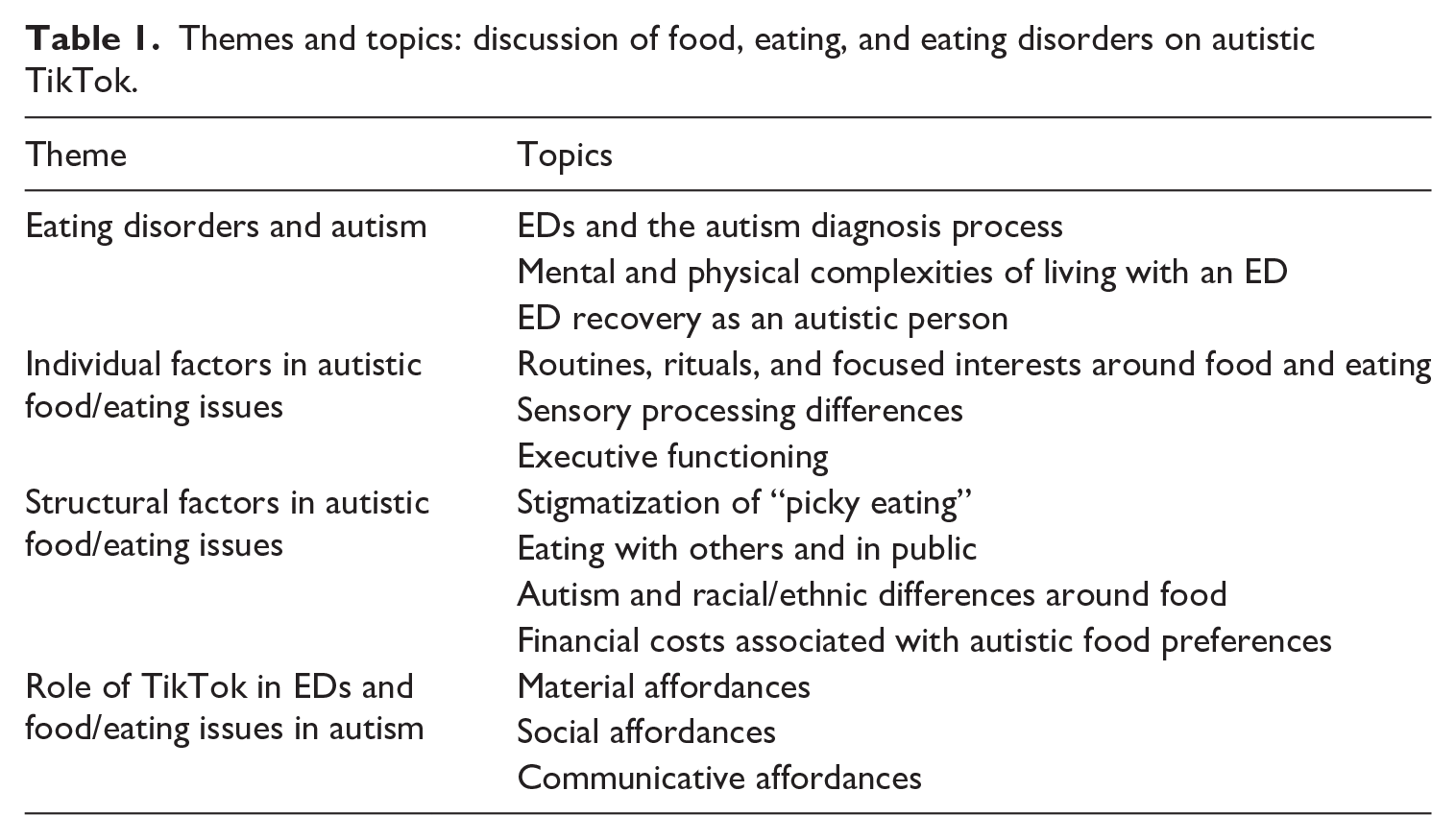
ED behaviors and autism
We found three topics pertaining to autistic people’s personal reflections on EDs. One was EDs and the autism diagnosis process. TikTokers expressed confusion over whether their experiences represented EDs, autism, or being autistic with an ED (e.g. “When I realized I was autistic and have adhd I questioned whether I ever had an eating disorder like I was treated for or was just undiagnosed ND [neurodivergent]”). Other autistic people noted that having an ED would explain their challenges with food and eating (e.g. “learning that having arfid is actually an ED and not just a quirky aspect of autism rly knocked me out”). Others suggested that their ED history helped them to understand themselves as autistic and/or to receive an autism diagnosis (e.g. “If it hadn’t been for my ED I never would have been dx’d as adhd or Autistic.”). Several autistic people complained that they had sought an ED diagnosis but experienced discrimination and were turned away due to their weight (e.g. “I haaaaaate eating and I know I have ARFID (I’ve lost a significant amounts of weight [due] to it) but no one will diagnose me cause I’m a fat woman  ”).
”).
Autistic TikTokers also discussed the mental and physical complexities of living with an ED, including feelings of fear (e.g. “seeing the numbers go down on the scale is a high. I’m scared to eat anything solid because I know it’ll make the number go up fast”). In one video, a White-appearing autistic woman lip syncs to a song with the lyrics “Sometimes when I’m lonely I sit and think about her,” with “her” being a reference to herself with an ED. Others discussed the comorbidity of their autism and EDs with other conditions including anxiety and food allergies/intolerances (e.g. “Im autistic with severe IBS [irritable bowel syndrome] and my body tells me not to eat”). Certain drugs and medications reportedly impacted autistic TikTokers’ EDs (e.g. “also so many adhd meds or anxiety meds, have side effects of suppressed appetites, which makes it incredibly hard to eat bc you don’t feel hungry”).
The relationship between EDs, sensory dysregulation, and body image generated discussion, including the unique presentation of EDs with comorbid autism. Some described the impact of their sensory processing on their ED symptoms. This included being highly sensory seeking and using binge eating as a stim (e.g. “yup. only recently realized eating was a stim for me. like, no wonder I have a hard time not eating when I’m not hungry.”). Being highly sensory avoidant could also lead to food restriction (e.g. “I 100% learned to just not eat when my only food options were something I couldn’t eat bc of sensory issues”). Several individuals noted they perceived their ED to be atypical because it was not tied to body image (e.g. “crying bc i have an eating disorder not because i want to be small, but because i hate food and this explains all of it”). Others said that their sensory processing challenges affected their body dissatisfaction (e.g. “my sensory issues got tied up with my body issues. I hate feeling my stomach because I feel fat or vice versa?? idk”).
The third ED-specific topic was ED recovery as an autistic person. Autistic TikTokers expressed frustration over clinicians whose treatment did not account for autism (e.g. “WHEN I TRY TO EXPLAIN HOW SALAD IS A SAFE FOOD FOR ME . . . AND THEY ASK IF IM ON A DIET. . . ASFGHJKL”). They also critiqued intuitive eating as based on neurotypical bodily intuition. In response to a TikTok post about a study on EDs in women on the spectrum, a commenter noted that “I had never thought about how intuitive eating is not likely the best solution for those of us with poor interoception.” TikTokers on the spectrum also discussed social challenges with recovery outside of treatment. One commenter shared that “my masking made me very compliant and i had a very very hard time when i left.” The comments included in this theme highlighted the intersecting nature of EDs and autism in terms of symptom maintenance, as well as the specificities of ED presentation in autism and implications for successful identification, treatment, and management.
Cognitive, sensory, and behavioral dimensions of eating and embodiment in autism
Even without explicit mention of EDs, autistic creators on TikTok and commenters on their videos had much to say about their embodied experiences of eating and related cognitive, sensory, and behavioral challenges. A major discussion topic was autistic people’s routines, rituals, and focused interests around food and eating. One dimension was same foods and safe foods. For example, in one video, a Latino autistic man films himself cooking tacos while humming happily to explain how some people on the spectrum “find a lot of comfort in eating the same thing everyday.” Having a safe food provided autistic people with an easy way to ensure caloric consumption (e.g. “Hmmm when food sounds unappealing my safety food is white rice, and imitation crab meat.”). Food affinity could also overlap with having a highly focused or “special” autistic interest in food (e.g. “For like three years pasta was my special interest AND my safe food.”).
However, autistic TikTokers also expressed downsides to same/safe foods, such as when a presumably “safe” food suddenly engendered disgust. In one video, a White autistic woman discusses her cessation of eating a food she had been consuming daily because one day “the  ICK hits.” Another concern was non-nutritious safe foods being central to one’s diet (e.g. “and then a lot of the foods that ARE ‘safe’ aren’t very good sources of nutrients or protein or other necessities
  ”). Reliance on a limited set of food options could also be disruptive when restaurant menus and grocery ingredients changed (e.g. “Lunchables used to be one of my safe foods but one time The meat in it wasn’t cut and was just a chunk of meat and I wanted to cry and throw up”). While this was an inconvenience for some, the inability to eat a same or safe food could lead to a full abstention from eating for others. Multiple references appeared to preferring to “starve,” “skip the meal,” “barely make myself eat once a day,” and “chugging water” due to same/safe food unavailability.
In addition to food items, autistic people on TikTok shared preferences, rituals, and routines around food preparation and presentation. This included a dislike of foods touching on a plate (e.g. “it irks everyone on the dining table that i use 3 different plates but that’s the only way i can eat  ”), eating at specific times (e.g. “yesterday I had a three hour meltdown because I ate my dinner half an hour later than I usually do”), and eating food in a methodical manner (e.g. “I eat the least appealing thing first unless I like everything equally. Then I eat one bite of each thing til the last bite is a tiny bit of it all.”). There was a noted preference among autistic TikTokers for ordering food from the kids’ menu, eating using children’s utensils and plates, and sometimes consuming food meant for young children (e.g. “I use baby spoons for most liquid or semi solid foods”).
Sensory processing differences also shaped autistic TikTokers’ food intake. Many reported eating favored food as highly pleasing to their senses, causing them to express joy through noise and movement (e.g. “My boyfriend and I are both autistic and we basically have dance battles when we eat together lmao”). Foods deemed safe were commonly “beige,” starchy, and did not overwhelm taste receptors. In one video, a White autistic woman uses a digital filter that cycles through different foods before landing on buttered noodles, and she continuously chooses that. Autistic TikTokers also reported avoiding foods and preparations that caused taste and textual aversions (e.g. “food textures are one of my biggest sensory issues!!!! i get so upset that i can’t eat pudding or jello because my mouth is like ‘how dare u’”). Some expressed fears over accidentally eating expired foods that had gone bad (e.g. “leftovers that have been in the fridge more than 2 days are no good  ”). Besides food, aversions extended to utensils and serving ware (e.g. “Big spoon taste too much like spoon”).
As with the unavailability of safe/same foods, sensory processing challenges could also lead to autistic TikTokers limiting consumption (e.g. “It is waaay too often that I have to order nothing but a side of fries and a cup of whatever soup sounds most palatable and eat less than half of it.”), sometimes to the point of not eating (e.g. “Textures and smells make food difficult for me. I don’t eat for days sometimes”). With respect to interoception, some experienced bodily dissociation with hunger cues (e.g. “daily I am annoyed that I have to feed this meat robot to stay alive. it just feels like a chore.”). Others made adaptations to eat (e.g. “Oatmeal, yogurt and ensure are the only things keeping me alive at this point  ”). Struggles with executive functioning similarly made it hard for autistic TikTokers to eat enough (e.g. “I’ve only had 1 meal a day for like a week now instead of my usual 2/3 because I just cant function atm.”). Menu ordering, food shopping, and cooking proved difficult due to the required mental load (e.g. “I feel hungry but very overwhelmed about what to eat.”). Thus, several sensory, behavioral, and cognitive issues related to autism were described as related to eating difficulties.
Social, cultural, and economic aspects of food and eating issues in autism
Besides the individual level, TikTokers on the spectrum discussed structural dimensions of their food and eating. Social factors spanned societal, interpersonal, and relational dynamics. One topic was the stigmatization of being judged as a “picky eater” and not as someone with valid access needs around food (e.g. “she eats like a toddler is a comment I get a lot ”). Having strong food preferences could stress personal relationships (e.g. “For me being autistic I’m a very picky eater and I’m worried to [be] in a relationship or if I get married and my wife makes something I don’t want”). Autistic TikTokers recalled negative childhood interpersonal exchanges with family members around food (e.g. “My parents get mad at me bc there are so many foods I just like can’t eat. They don’t understand and it’s so frustrating”), with several reporting trauma from parents forcing them to eat (e.g. “As an adult, im now trying the bad sensory things that always caused me issues. If i hadn’t been forced, i might’ve tried to push myself more.  ”). Receiving positive support by loved ones could also reduce pressure (e.g. “My sister would sneak food off of my plate to make it look like I ate. It meant the absolute world to me.”).
Eating with others and in public could additionally be socially taxing. They reported negative experiences with restaurant staff (e.g. “ive been told i cant order off the kids menu as an adult  ”). Some masked their disgust of food when eating with others (e.g. “It makes me feel like I’m missing out on enjoying my meal, but I don’t want to be rude, so I just try to mask it.”), while others suppressed expressions of sensory pleasure. A Black autistic man in one TikTok video acted out a scene in which he holds back his stims while eating in public but openly stims when eating in private. Dining in restaurants could also be overwhelming sensorially, to the point of making it challenging to share a meal out. In one video, a non-White appearing autistic non-binary person shares why they find it healthy for their focus and mind-set to dine independently: “I’ve taken to dining out alone so I can focus fully on the experience of food and savouring it.”
In addition to these social aspects of autistic eating challenges, TikTokers also described cultural and economic factors shaping their personal experiences with food, including the intersection of autism and racial/ethnic differences around food. Non-White appearing autistic TikTokers challenged the notion that same/safe foods were bland or beige, highlighting how cuisines and culinary traditions associated with their ethnic and racial backgrounds were full of flavor (e.g. “The fact that soul foods make up a good bunch of my safe foods  ”). Economically, the costs associated with accommodating autistic food preferences also could be prohibitive (e.g. “i hate every food rn but sushi.. the thing is i can’t afford it
  so i just buy lay’s [potato chips].”). These conversations on TikTok highlighted the sociocultural and financial dimensions of autism and EDs, and the way in which these factors shaped experience in positive and negative ways.
TikTok as mediator in autistic experiences of eating and food difficulties
Finally, TikTok both enabled autistic people to discuss their eating challenges and mediated their relationship to food. With respect to mediation, we draw on the framing provided by Livingstone (2009: 7) that “the media mediate, entering into and shaping the mundane but ubiquitous relations among individuals and between individuals and society,” and that digital platforms mediate relations with the self and others through their specific logics, or affordances (Hutchby, 2001). Through its design and technical features, TikTok’s material affordances made visible certain ideas about autism, autistic people, and their eating. Autistic TikTokers discussed feeling surveilled through algorithmically suggested videos on the “for you page” (or FYP) (e.g. “I swear if this is the way I figure out I might in fact have an actual eating disorder”; “Wow, fyp is really calling me out today, huh? I whined yesterday about being out of my specific cheese snack.  ”). Others questioned the platform’s role in pathologizing food preferences. One commentor complained, “you have got ppl self diagnosing based off the food they like [which] are the most common foods ever.” TikTok also provided autistic users with expressive multimedia tools to draw an audience. In one video, a Black autistic woman in ED recovery educates viewers through on-screen text as to why autistic people like herself are more likely to have EDs, capturing viewer attention by layering the text over video footage of herself pole dancing.
TikTok also offered social affordances for finding connection among autistic people with eating struggles. Users provided support for others in ED recovery (e.g. “Hi! I’m also in ed recovery and relate to this insanely. If you need or want support or a fellow friend my dms are open, Goodluck  ”). Autistic TikTokers also brought others into their ED recovery journeys and filmed themselves eating (e.g. “come eat with me while I challenge a food that used to be a fear of mine when I was deep in my Ed.”). The app’s communicative affordances for creating and circulating information about autism-related food issues reportedly affected interactions online and offline. TikTokers asked for and shared autism-specific eating and cooking tips. For example, a Black autistic woman in one post documented “what I eat in a day as an autistic person who has had a very weird relationship with food but is actively working on it,” including showing her audience a textured water bottle that motivates her to stay hydrated due to its pleasant tactility. TikTok also reportedly drove informed conversations with clinicians (e.g. “Hey this is blowing my mind and I’ll be discussing this with my therapist, thank you so much for sharing!”). Materially, socially, and communicatively, TikTok’s affordances mediated autistic users’ food and eating experiences.
Discussion
To bridge the gap in work on SM use and self-reported ED experiences and recovery among autistic adolescents and young adults, we undertook an exploratory, descriptive study on the role of TikTok in enabling adolescents and young adults on the autism spectrum to share challenges with food and eating with online audiences of autistic and non-autistic individuals. Both autistic people and those with EDs frequently experience denial of their bodily sensations from others, and finding individuals online who recognize the validity and duality of those experiences can be highly emotionally gratifying. We found TikTok to be both a forum for and mediator of discussions around food issues and EDs in autism, echoing prior qualitative work on the intersection of TikTok and ED recovery with non-autistic populations (Sjöström et al., 2024). We identified content that explicitly mentioned EDs, as well as content reflecting struggles with food and eating that exist more broadly among autistic people. Conversations about the social, cultural, and economic aspects of autistic food/eating issues overlapped with cognitive, sensory, and behavioral factors shared in the sample. We found mentions of multiple significant factors underlying EDs among autistic girls and women, such as sensory dysregulation and need for routine, and less discussion of issues of common focus for the neurotypical population with EDs as they intersect with SM, such as body image difficulties. Thus, researchers should investigate the varied ways that SM may play a role in ED development and treatment for autistic people. We discuss below several theoretical, conceptual, and practical applications of this work, with the goal of better identifying targets for prevention, policy, and practice that minimize ED risks and support ED recovery among the autism population.
TikTok and collective knowledge at the intersection of autism and EDs
TikTok allowed for collective knowledge production regarding the intersection of EDs and autism among those on the spectrum, including sharing information about diagnosis, symptoms, and sensory specificities, but not without drawbacks. Many described how getting an ED diagnosis (such as ARFID) could be biographically illuminating (Tan, 2018) by offering a retrospective explanation of their past challenges with food. Through seemingly personalized algorithmic recommendation, TikTok promotes not only the “platformed diagnosis” (Alper et al., 2025) of autism but also additional comorbid conditions. In line with scholarship on “folk theories of algorithmic recommendation” (DeVito et al., 2017), autistic users identified concerns about identification with autism being reduced to a matter of taste on TikTok (both in terms of taste receptors and aesthetic standards), with the algorithm selectively choosing features to associate with both autism and EDs.
Content including mentions of severe food intake restriction could also potentially have adverse effects on EDs and body image among autistic TikTok viewers, pointing to a need for additional investigation. Autistic teenagers can be adversely impacted by SM posts in which disordered eating is disguised as ED “recovery” (Bullivant and Woods, 2020). TikTok content promoting child-like eating and body ideals may also be problematic. Our sample included numerous posts and comments about autistic adults eating kids’ meals and preparing food as if for a child. There are valid reasons as to why such content might appeal to autistic TikTokers related to sensory sensitivity and gastric upset. However, autistic individuals with or at risk of developing a restrictive EDs may be especially vulnerable to SM content promoting adult restriction of caloric intake by mimicking children’s behavior, including thinness “challenges” like fitting into child-sized clothing and eating baby food (Jackson et al., 2021).
Online community and the circumvention of medical ableism
In addition, our analysis revealed how TikTok as an online community allowed for those living with autism and EDs to circumvent a lack of professional and accessible resources by sharing tips and recovery information. Autistic women commonly enter ED treatment without a diagnosis only to receive one during treatment (Babb et al., 2021), a gendered aspect of medical ableism highlighted in our sample. Challenges with autism-inclusive ED treatment noted here are tied to broader gaps in appropriate mental health services for autistic people (Crane et al., 2019). TikTokers also highlighted several misconceptions about autism. For instance, with respect to the social dimensions of food/eating challenges, autistic people noted that they preferred to eat alone not from social disinterest but being sensorially overwhelmed, as previously described (Park-Cardoso and da Silva, 2021).
Autistic TikTokers with and without an ED diagnosis adapted cooking and food diary content trends on SM to serve fellow autistic audience members, often in response to stigmatizing food-related exchanges with clinicians, friends, and family members. The “what I eat in a day” (WIEAD) videos in the sample differ from popular WIEAD videos on SM (Davis et al., 2023). While many creators of the latter use WIEAD to promote “clean” eating, autistic TikTokers used the genre to model eating and meal planning for viewers who struggle with adequate food intake. The basic visual presentation of same foods and their mundaneness in the sample was a departure from the spectacles of attention-grabbing food common on SM (e.g. #foodporn; Dejmanee, 2016). Autistic users listing their safe foods in the video comments turned the app into a specialized recipe and shopping list discovery engine. They offered support for community members to eat food while using as few spoons as possible, literally (as utensils for making simple meals) and figuratively (“spoons” as energy in disability parlance) (Miserandino, 2003).
SM and feedback to improve clinical care and research
TikTok could additionally be used by autistic people with EDs to communicate back to health professionals, caregivers, and researchers by drawing attention to overlooked issues and undervalued perspectives. Autistic TikTokers with EDs, for example, criticized intuitive eating as a recommended recovery strategy. As there were various mentions of ADHD in the autism/ED sample, TikTokers highlighted an underexamined area for future theoretical research into a three-way intersection in these diagnoses that might complicate diagnosis and treatment. The relationship between negative body image, ED development, and SM use in autism should be more fully explored, as several individuals noted that that body image was not tied to their ED. Although commenters stated that they would share posted content about food/eating issues with their doctors, additional research should validate the extent to which this occurs. Our analysis highlighted commonalities in the experience of EDs between autistic and non-autistic people (e.g. fatphobia in restrictive ED diagnosis), but also surfaced divergences, such as a higher likelihood of gastrointestinal issues among autistic people (Vissoker et al., 2015). More comparative research (e.g. experimental studies) is needed to identify similarities and differences in how HVSM may impact autistic and non-autistic people with EDs.
Finally, we would be remiss to not mention limitations to our study, as well as additional research directions. As we did not empirically study the impact of TikTok use on ED development among the autism population, we are not able to assess such effects, and additional work in that area is warranted. Future work should also examine discussions of autism and food/eating challenges internationally, including non-English speaking populations. Although our sample mostly included and addressed women and girls, more work is needed on gender non-binary autistic individuals and autistic men.
Our current study of food and eating issues shared on autistic TikTok contributes novel insights for research on digital media, mental health, and marginalized populations. In addition, findings highlight the need to develop resources tailored to individuals with intersecting vulnerabilities without privileging neurotypicality in ED treatment and recovery.
Footnotes
Funding
The author(s) disclosed receipt of the following financial support for the research, authorship, and/or publication of this article: This study was funded through a TIER 1 Grant from Northeastern University.
