




Abstract
While TikTok has established itself as a new platform for political communication, its role during elections remains understudied by researchers. In this article, we present a content analysis of actor dynamics and ideological content characteristics on TikTok during the early phase of the 2022 election campaign in Sweden, combined with an analysis of how political orientation and utilization of TikTok’s platform features impact user engagement. Results reveal that party youth organizations had a prominent presence during the campaign, while traditional party actors were less established. TikTok tends to lean toward right-wing content, with right-wing praise being a significant predictor of user engagement. Semiotic resources such as stickers and emoticons but also added music, were widely used platform features, but these features had no or weak negative effects on user engagement. Added speech, particularly when praising right-wing politics, positively influenced user engagement, suggesting the importance of verbal communication on a platform characterized by multimodal experimentation.
Introduction
The video-sharing social networking app TikTok, launched in September 2016, has grown immensely over the past few years, establishing itself as a major player in the competitive market of social media platforms (Kaye et al., 2022; Newman, 2022). While mainly known for user-generated content of light entertainment character, particularly young users posting videos of themselves dancing or performing other talents, political actors are starting to recognize its potential for reaching citizens who are not available on older platforms such as Facebook, Instagram or X/Twitter (Cervi et al., 2023; Medina Serrano et al., 2020; Moir, 2023; Zamora-Medina et al., 2023). In the Nordic region, journalists have recently pointed to TikTok as a potential factor driving political change. For instance, during the 2022 Danish national election, politician Alex Vanopslagh (party leader of the Liberal Alliance), gained attention on TikTok by adopting a communication style characterized by humor, self-irony, and role-plays in which he satirized his political opponents, reflecting new “extremely effective means of reaching young voters” (Slyngborg Trolle & Korsager Nielsen, 2022). Further north in the same region, Finnish voters saw right-wing populists win the 2023 election battle on TikTok, mobilizing “young men” in a counter-reaction to “woke politics,” “cancel culture,” and “intersectional feminism” (Salo, 2023). A similar pattern was identified by Swedish newspaper Aftonbladet, where reports prior to the 2022 Swedish election suggested that the right-wing populist party, the Sweden Democrats, “wins the TikTok match by walkover” (Bejmo, 2022).
While these news reports do present relevant insights into the role of TikTok during elections in the Nordic countries, we perceive a lack of systematic scholarly work on the extent to which politicians and political parties leverage the platform during elections. Moreover, previous research suggests that other social media platforms have played an important role in the advancement and success of right-wing populist parties (e.g., Engesser et al., 2017; Gerbaudo, 2018), which calls for an assessment of the impact of right-wing populism on TikTok as well. Addressing this research gap is important because contemporary political actors operate in a hybrid media environment where new techniques are employed to specifically reach the “young demographic” of the “TikTok community” (Kaye et al., 2022, p. 171; Zamora-Medina et al., 2023).
Focusing on the case of Sweden, where access to mobile phones even among very young people, have contributed to a widespread use of TikTok (Nordicom, 2022) and where politicians have shown themselves to be quick to adapt their communication strategies when new platforms appear (Larsson, 2016), the aim of this article is to explore actor dynamics and ideological content characteristics on TikTok during an early phase of the 2022 election, using the hashtags #val2022 and #val22. Moreover, we assess the impact political orientations and utilization of TikTok’s platform features has on user engagement. Sweden has, as discussed subsequently, undergone radical political change, due to the elective success of the far-right/right-wing populist party the Sweden Democrats, transforming the entire national political landscape, which makes Sweden a particularly interesting context of study.
In the upcoming literature review, we provide a framework and a series of research questions for the study at hand by first discussing the professionalization of political communication before moving on to an overview of research pointing to tendencies of increasing political right-wing dominance on social media. The literature review then proceeds with a more specific discussion on TikTok and its features, before wrapping up with a section on the studied Swedish context. Following our methods chapter, we present our results and offer a final discussion of our findings.
The Professionalization of Political Communication
Social scientific inquiry often involves the classification of empirical material into specific analytical categories or ideal types. With regards to political communication, the seminal contribution by Blumler and Kavanagh (1999) suggested that it can be fruitful to think about the development of such communication in different ages, each characterized by specific communication technologies. Much like for previous suggested ages (Blumler & Kavanagh, 1999) or phases (Magin et al., 2016) of political communication, the proposed current fourth age is characterized by the use of specific communication technologies (Bennett & Pfetsch, 2018). While television was and still is among the more important campaigning tools as cemented during the third age (Blumler, 2016), a series of communication technologies have essentially come and gone and left their respective marks on the practice of electioneering. Indeed, “changing media habits” (Bennett & Pfetsch, 2018, p. 244) point to the suggested fourth age to be chiefly characterized by the use of social media platforms such as the one under scrutiny here. Authors have noted such a shift, with attempts of finding a starting point for the fourth age reaching back to 2008 (Bene et al., 2022). Regardless of the precise starting point, we nevertheless expect that in the time passed from the oft-referred to Obama 2008 election (Lilleker & Jackson, 2010), political actors around the world have adapted their social media activities to fit not only with network media (Klinger & Svensson, 2015) or social media (Van Dijck & Poell, 2013) logics but also with their national election cultures (Karlsen, 2013). For our current case country of Sweden, comparably early research looking into the ways in which political actors utilized platforms such as X/Twitter and Facebook showed haphazard, hesitant or even conservative tendencies at the hands of parties and politicians (Larsson, 2013; Larsson & Moe, 2013). By contrast, later insights into such uses implied more organized, synchronized and sometimes sophisticated efforts (Larsson, 2015, 2020) with political actors utilizing the aforementioned platforms to larger extents, moving beyond a broadcasting logic of campaigning to degrees rarely seen in earlier years. Taken together, these tendencies can be seen as reflective of processes of professionalization in relation to political campaigning. While a precise definition of professionalization appears to have been notoriously difficult to pin down (Lilleker & Negrine, 2002; Tenscher, 2013), many conceptualizations tend to include aspects of increased use of communication technology at the hands of political actors (Strömbäck, 2007; Vergeer & Hermans, 2013). While political actors particularly in the Nordic region have proved to adopt new technologies relatively fast, little is known concerning their presence in public discussions on TikTok, or what other actors that utilize TikTok for campaign purposes. Indeed, as hashtags are open and available to use for anyone with an account on the specific platform, we take an open approach to our assessment of the types of actors taking part in the hashtagged activity studied here. Hence, we ask
Research Question 1 (RQ1). What was the distribution of actor types using the #val22 and #val2022 hashtags during the 2022 election campaign?
Social Media and Right-Wing Dominance
Political communication on social media has become an intrinsic part of election campaign strategies in a series of political contexts. However, the ability of political party actors to gain visibility and to make substantial impact on public discourse during election campaigns by means of social media is still an open question worth scrutiny. While the discussion above has focused on the professionalization of party communication, mounting evidence suggests that social media platforms have been more advantageous for right-wing populist actors (henceforth RWP) compared with left-wing populist actors or actors connected to mainstream political parties (e.g., Engesser et al., 2017; Krämer, 2017; Moffitt, 2016). Not only do social media platforms provide RWPs with online spaces for political messages that are often harder to spread in the public sphere due to the gatekeeping function of legacy media—but right-wing populist messages also seem to be better suited to the communicative structures and platform features of social media compared with mainstream political messages (Ekman & Widholm, 2024a). Some researchers suggest that there is an “elective affinity” between social media and political populism, meaning that “social media have favored populist against establishment movements by providing the former a suitable channel to invoke the support of ordinary people against the latter” (Gerbaudo, 2018, p. 746). Indeed, social media offers a direct communication channel to voters that are typically not recipients of conventional political journalism produced by legacy media outlets. Relatedly, social media platforms make unorthodox and even controversial political messages and styles of expression visible to new audiences. In this article, focusing on the Swedish political context, we use a definition of populist parties provided by the PopuList (Rooduijn et al., 2023), which views populist parties as those who “endorse the set of ideas that society is ultimately separated into two homogeneous and antagonistic groups, ‘the pure people’ versus ‘the corrupt elite’, and which argues that politics should be an expression of the volonté générale (general will) of the people.” In Sweden, the right-wing populist party the Sweden Democrats is the only party that qualifies to the PopuList (Rooduijn et al., 2023).
Recent studies point to the particular style of right-wing populist online communication as the dominant factor for user engagement rather than populist political topics. Although this also differs depending on national context, it seems to be dependent on how established RWP actors have become within the specific political system (Hameleers et al., 2021). Recent research focusing on election campaigns in a Nordic context shows that right-wing political parties, including right-wing populist varieties, are more successful in engaging users on Facebook compared with their competitors (e.g., Larsson, 2020; Schwartz et al., 2023). In addition, research shows that RWP parties in four Nordic countries—Sweden, Denmark, Norway, and Finland—also hold the strongest position on Instagram and X/Twitter as well (Schwartz et al., 2023). These findings corroborate the inference that the political communication style of right-wing political parties (including RWPs) suits the platform logics of social media, where negative affective political styles, including criticism and negative campaigning, tend to generate more engagement than more conventional political communication. In other words, the communication strategies of right-wing populist actors are well-suited to the negative affective political styles that generate more engagement on social media platforms. However, TikTok is still a highly understudied platform when it comes to political orientations and user engagement during elections. Hence, we ask
Research Question 2 (RQ2). What parties received most praise in TikTok posts using the #val22 and #val2022 hashtags?
Research Question 3 (RQ3). What parties received most criticism in TikTok posts using the #val22 and #val2022 hashtags?
Research Question 4 (RQ4). What impact did praise for and criticism against left-wing and right-wing parties and actors have on user engagement?
Platform Features and Their Implications for User Engagement
All social media platforms feature structural opportunities and constraints that users encounter when interacting with them. To a large extent, these are grounded in technological design or what scholars refer to as “digital architecture” (Bossetta, 2018) or more specifically “platform features” (Bucher & Helmond, 2018), that offer a set of predetermined routes for user behavior that people draw on—intentionally or unintentionally—when interacting with a platform. According to Bucher and Helmond (2018), users interact with platforms by utilizing their affordances, referring to the perceived set of actions linked to the features of a specific platform. While affordances that emerge from people’s interactions with platforms may vary between different user demographics (Hase et al., 2023; Hayes et al., 2016), the platform features we are interested in are in contrast more stable entities, serving as the material basis for affordances. The unique set of platform features characterizing, for example, Facebook, Instagram, or TikTok, constitute the foundation for what has been described as distinctive “social media logics,” encompassing aspects such as programmability, popularity, connectivity, and datafication (Van Dijck & Poell, 2013).
In the study at hand we are interested in how users utilized TikTok’s platform features during the Swedish election, and moreover how these features can be used to predict a video’s popularity. Programmability is thus central to our study, since it sets the boundaries for structural choices made by users, and in the longer run the possibilities for action that actors utilize in their attempts to boost their popularity and connectivity through content creation. Previous studies suggest that the way actors, such as politicians, news organizations, or citizens, adapt their communication to platform features impinges on their capacity to reach out to preferred target groups effectively (Jost, 2023; Schwartz et al., 2023). Hence, such adaptations of communication practices changes not only the styles and modes of political discourse, but more generally what is said and how. A prominent example is the news industry, for which TikTok has been described as a platform well-suited for brand-building, while it is less useful for interactive or breaking news coverage, demanding a longer format and greater editorial control (Hase et al., 2023).
In comparison with other social media platforms, TikTok shares with Instagram a prime focus on visual communication (Hase et al., 2023). With emphasis on short video formats that allow for a great deal of multimodal experimentation, TikTok has developed a niche that has influenced the platform features of several of its competitors, as reflected in the development of Instagram “Reels” and “Shorts” on YouTube (Abidin, 2021). Aside from its visual aspect, defining features of TikTok are the possibilities to express political messages through music, speech acts, semiotic resources, and through re-mixing of other actors’ content. In terms of music, users can select from a vast library of tunes or upload their own, giving rise to sound memes and dance and lip-syncing practices that are typical of many videos on the platform (Cervi et al., 2023). Indeed, music has long served as an inspiration for political communication, with politicians using it to add popular appeal and cultural context to their campaigns (Street, 2013). On TikTok, users can find a suitable song for a particular message using the platform’s music search function. Speech, just like music, can be added to images and videos, a feature that can be linked to TikTok’s strong performative side. TikTok users can be considered as “active presenters of political information” and each user becomes a “performer who externalizes personal political opinion via an audiovisual act” (Medina Serrano et al., 2020, p. 264). TikTok’s platform features drive users toward playful participation, role-plays, and current research suggests that this is reflected also in how individual politicians use the platform through personal “politainment” and brand-building (Cervi et al., 2023; Moir, 2023; Vijay & Gekker, 2021).
Similar to other visual platforms such as Instagram, TikTok offers a broad range of creative semiotic resources that users can utilize to make videos appear more fun and appealing. Prominent examples are emoticons, stickers, and text that can be used to communicate a particular political message. TikTok users often draw inspiration from the textual flexibility of contemporary meme culture, where the use of text can be filled with new meaning as it travels between different social groups online (Mortensen & Neumayer, 2021; Zulli & Zulli, 2022). It has been argued that TikTok’s design does not prioritize interpersonal connections in the same way as many other social media platforms do. While it offers traditional features such as user profiles, followers, likes and comments, the content flow is primarily centered around an algorithmic system that prioritizes creative and collaborative content rather than simply relying on the number of followers a user has. The collaborative nature of TikTok comes to the fore through the central role of re-mixing and replication of other users’ content. Zulli and Zulli (2022) therefore argue that “imitation” is a fundamental principle guiding user behavior on the platform.
While the previous research reviewed above indicates that utilization of platform features may make videos more attractive, we still do not know much about which specific features are most important in terms of generating reactions among users. Hence, we ask
Research Question 5 (RQ5). What was the salience of platform features such as music, speech, semiotic resources, and re-mixing of other users’ content in the sampled videos, and to what extent did the utilization of these platform features impact on user engagement?
A further important aspect to include in a study of this kind, in our view, is the extent to which the content includes political issue frames. Within the context of TikTok, we see issue frames as posts articulating specific policy problems, for example, energy prices or migration, which may also be anchored to proposals for their solutions. Hence, an important aspect that issue frames bring is clarity with regard to how political actors position themselves vis-à-vis specific subject matters (Dekavalla, 2018; Eberl et al., 2020). Scholars point to issue frames as central to the democratic discourse since they—when communicated truthfully—are useful for citizens in their decision-making, although the effects of such frames on public opinion remain disputed academic terrain (Peterson & Simonovits, 2018). While Swedish politics have become increasingly mediatized and not least more personalized over time, subject matters rather than candidate traits are still dominating the agenda during elections (Johansson et al., 2023). TikTok remains unstudied in this regard, hence we ask
Research Question 6 (RQ6). What was the salience of issue frames in TikTok videos tagged with #val22 or #val2022?
Research Question 7 (RQ7). To what extent do political issue frames impact on user engagement?
New Ideological Frontiers in the Swedish Campaign
The entry of the right-wing populist party, the Sweden Democrats, into the national parliament in 2010 has resulted in a significant transformation of Sweden’s party system. In fact, the voting turnout for the Sweden Democrats has increased in every election since their debut in the 1988 national election (Valmyndigheten, 2023). For many years, Swedish parties, irrespectively of their ideological orientation, rejected all forms of cooperation with the Sweden Democrats due to the party’s background in the Swedish neo-Nazi movement. However, the growing support for the party has led some liberal and conservative parties in parliament to reconsider their relationships with the party. Hence, leading up to the 2022 election, two entirely new blocs had crystallized. Based on the voter support of the 2018 election, the black constellation looked as follows: A center-left bloc comprising the Left Party (8%), the Social Democrats (28.3%), the Green Party (4.4%), and the Center Party (8.6%), was opposed to a right-wing/conservative bloc comprising the Moderate Party (19.8%), the Christian Democrats (6.3%), and the Sweden Democrats (17.5%). This transformation constitutes one of the greatest changes in the Swedish party system in many decades (Demker & Odmalm, 2022). During the first 6 months of 2022, the period we study here, Sweden had a one-party government led by Prime Minister Magdalena Andersson of the Social Democrats.
Methods for Data Collection and Analysis
This study deploys a quantitative content analysis (Krippendorff, 2018) of TikTok videos dealing with Swedish election. The classification of content is then combined with an analysis of video metadata, revealing engagement patterns among users of the platform. We utilized a software called 4KTokkit downloader to gather our sample, using the two most prevalent election hashtags on the platform: #val2022 (#election2022) and #val22 (#election22). These hashtags were selected following the examples of previous, similar studies looking at common hashtags for political discussion in relation to Swedish elections on other social media platforms (e.g., Robinson, 2023). As the hashtags proved to yield attention also on TikTok, this choice was deemed suitable.
Our data collection process allowed us to not only download videos but also to identify unique URLs for each video, which was necessary for the collection of metadata performed in a second stage. We limited the time period to 6 months spanning 1 January 2022 to 30 June 2022. The period could be said to represent an early phase of the campaign, where the parties sought to find their key communicative positions vis-à-vis their major competitors as the more intensive phase approached. Indeed, with election day on 11 September, studying online activity outside of the main election campaign in this way can provide useful insights into the prioritizations of political actors. The data collection ended up in a total population (N) of 1,189 videos (duplicates appearing on both hashtags excluded). The period under investigation was not the election campaign’s most vigorous phase, but the data can reveal interesting insights into how TikTok a new platform was utilized in a stage of the campaign characterized by uncertainty regarding the specific agendas that the parties were about to push in the more intensive phase closer to the election. Inspired by previous sampling procedures in visual political communication (Ekman and Widholm, 2017), we utilized systematic random sampling. The sample size was set to n = 500 (42%) out of a population of N = 1,190 videos. This was considered a sufficient sample size in relation to recommendations in the content analysis literature (Krippendorff, 2018).
To address the research questions concerning the role of actors (RQ1), we coded for the presence or absence of the following actor types: private persons, since they constitute the majority of users on the platform (Kaye et al., 2022); party youth organizations, since TikTok has a young user demography that such organizations cater to (Vijay & Gekker, 2021); individual politicians and party based accounts, since we expected both to occupy prominent positions given social media exposure is vital in current election campaigns (Larsson, 2020); and legacy media actors, since journalists and news institutions always are keen to establish a presence on new platforms, in this case adapting their election coverage to the reigning social media logic (Newman, 2022). We included a sixth dummy variable for accounts that did not belong to any of the above-mentioned actor types.
To address the research questions about ideological orientations (RQ2, RQ3) we constructed dummy variables measuring presence or absence of (1) praise of right-wing parties, (2) criticism of right-wing parties, (3) praise of center/left-wing parties, and (4) criticism of center/left-wing parties. There are of course other ways to express political orientation, but since our study period is an election period, we decided to focus on party references (including references to party representatives) since they are the key players during election campaigns.
For the coding of platform features (RQ5), we chose to focus on the four main features that we identified in the literature review. Music is a fundamental part of the TikTok experience, and to use popular songs and sound bites as part of the communication can therefore potentially strengthen the visibility and impact of political messages (Cervi et al., 2023). Speech allows users to express opinions through their own voice, but it is also intimately intertwined with the central role of performativity on the platform, where users seek to gain influence by taking on different speech roles and in their communication (Moir, 2023). Those who prefer nonverbal political communication can contextualize their messages by adding text and various semiotic resources such as symbols, and emoticons to the videos (Zamora-Medina et al., 2023). Re-mixing, at last, allows users to react to and build on what other users create, which has been described as an important dimension of TikTok’s dynamic and intertextual platform vernacular (Zulli & Zulli, 2022). The presence of (1) music, (2) speech, (3) semiotic resources, and (4) re-mixing were coded dichotomously for each video. There is no golden standard to lean on when analyzing platform features quantitatively, and we do not claim to offer a holistic approach. There are platform features that we do not cover in this study, such as the green screen option that allows users to act in front of a background image, or face filters that are difficult to detect through manual coding.
To address the research questions concerning the role of political issues (RQ6 and RQ7), we coded dichotomously for presence versus absence of political issue framing in the videos. Issue frame was defined as videos expressing views or comments on specific political subject matters.
The coding was performed by a research assistant and to ensure reliability, an inter-coder agreement test on a random sample of videos was conducted (n = 50). We used Krippendorff’s alpha (α) to calculate reliability for all coded variables with the following results: Account profile (α = .88); Political issue (α = .96); Political praise (α = 1); Political critique (α = .97); Added music (α = 1); Added speech (α = .95); Re-mixing (α = .81); Symbols and emoticons (α = 1). The test hence demonstrates high inter-coder reliability, as indicated by all Alpha coefficients exceeding the critical threshold of .8 (Krippendorff, 2018).
Data collection from social media is a volatile process—platform owners are constantly tweaking their algorithms and changing the ways in which researchers are allowed to access data (Theocharis & Jungherr, 2020). TikTok is no different—at the time that the data collection for the study presented here was undertaken, no official API such as those previously offered by Twitter (Twitter, 2021) and Meta (Garmur et al., 2019) had been opened to interested scholars. As such, other approaches had to be adopted to further our current interests (Bruns, 2019; Freelon, 2018). Using the URLs identified by the process described above, we made use of the traktok R package which takes URLs to specific TikTok videos as its input and provides outputs in the form of metadata (such as the number of “Digg counts” and comments) for each video (Gruber, 2022). Using video URLs, the data set containing the results from the content analysis as described above was merged with the data set containing meta data.
Much like for other social media platforms, TikTok users enjoy a multitude of ways that they can engage with videos such as those under scrutiny here. Beyond an indication of how many times a video had been played, our data allowed for insights into how many Diggs, shares and comments a specific video had received at the time of data collection. While the latter two varieties are recognizable from other social media services, Diggs can essentially be compared with likes in that they appear in the context of TikTok as a heart shaped button reminiscent of the “paralinguistic digital affordances” discussed by Hayes and co-authors (Hayes et al., 2016). For other platforms, likes have been pointed to as more popular than other forms of engagement (Koc-Michalska et al., 2020), presumably because the “one-click activity of “liking” a post is less involved than writing a comment” (Muñoz & Towner, 2017, p. 298). Comparing Diggs to likes, we thus focus on the number of Digg counts to gauge the popularity of posts (as discussed in three research questions). While the precise, situated meaning of the Digg button must be considered as highly dependent on each individual user (Driscoll & Walker, 2014; Eberl et al., 2020), we nevertheless expect Diggs to function largely as likes—as “popularity cues” (Porten-Cheé et al., 2018) driving further attention to a specific TikTok video. The total number of “Diggs” for the 500 videos in our sample was 872,620, with a mean of 1,745 (SD = 7,788). The video generating most digs received 106,200 such interactions.
We address our research questions in the subsequent results section. Beyond descriptive statistics, we make use of negative binomial regression (following the recommendation of Koc-Michalska et al., 2020) in relation to RQ4, RQ5, and RQ7, gauging for the effects of ideological orientations and utilization of platform features on video popularity as defined above.
Results
In Figure 1, we present the distribution of actor types (RQ1) in our sampled TikTok videos, posted during the first 6 months of 2022. Private persons constitute the largest group, which is hardly surprising given that they also represent the most substantial group of users more generally.

Classification of actor types.
Overall, political actors account for more than a quarter of all accounts. However, an equally important finding is that party youth organizations constitute a very important subgroup among political actors—it was significantly larger than both the political parties and individual politicians. The very young group of users that dominate on TikTok in Sweden—of which the majority are not even allowed to vote—is an important backdrop to these figures. None of the Swedish party leaders had an account on TikTok in the period leading up to the 2022 election. This can be compared with platforms such as X/Twitter, Instagram, YouTube, and Facebook which evolved relatively fast into established spaces for election campaigning among politicians in Sweden (Ekman & Widholm, 2017, 2024b; Larsson, 2016; Larsson & Moe, 2013). Hence, our results indicate that despite its growing popularity, TikTok was not extensively utilized for professional political communication among elected representatives in the same way as seen on other platforms. It is also noteworthy that media companies and journalists seldom used the election hashtags. This is interesting, given that they usually are among the first to establish a presence on new platforms (Newman, 2022).
Turning to ideological orientations of the election hashtags, we found that they were dominated by right-wing perspectives. As is evident in Figure 2, right-leaning political parties received far more political praise in the videos than center left-parties did (RQ2). The Sweden Democrats and the Moderate Party were the parties that received most of the praise, followed by the Liberal Party. Taken together, the right-wingers received 64.6% of all praise, while the center/left parties received 35.4% of the praise. Noteworthy is also that the Social Democrats, Sweden’s largest party which also constituted the government at the time, received very little praise, less than both the Left Party and the Green Party, despite them being significantly smaller in terms of public support.

Percentage (N) of posts containing criticism and praise toward political parties.
While the right-wing parties received considerable praise, we found a similar pattern concerning political criticism (RQ3). Center-left parties received significantly more political criticism (79.1% of the critical videos were directed against them) compared with the right-wing parties (20.9%). The Social Democrats was by far the most criticized party, which can be related to the fact that they were in government alone, yet with support from other parties of the center-left block. The Sweden Democrats stand out in the sense that they received a lot of praise but also a great deal of criticism, however far from the levels of the Social Democrats. The Left Party seems to have occupied a unique position in the sense that it received relatively much praise, but almost no criticism. Overall, however, it is clear that the election campaign on TikTok was tilted toward the right on the political spectrum.
When it comes to the salience of issue frames (RQ6), we found that 56% of the videos addressed specific political issues, for example, rising fuel prices, criminality, and migration which were topics appearing frequently also in legacy media during the election campaign (Johansson et al., 2023). Hence, we found that political issue frames was a salient feature of the #val22 and #val2022 hashtags, despite that official party accounts were scarce.
Platform Features and Predictors of User Engagement
Turning to platform features (RQ5), we found that semiotic resources such as added text, symbols, stickers, and emoticons stood out as the most salient feature, appearing in 84.6% of the videos. The second most frequent feature was added speech, accounting for 57.2%. TikTok is often described as a platform for music; this was also the case during the Swedish election campaign, with more than half of the sample (50.8%) making use of the music feature. However, editing/re-mixing was used very rarely, with only 1.2% of the videos utilizing this feature. These patterns are important to keep in mind, when interpreting their significance for user engagement.
Figure 3 features the results of a negative binomial regression where the Digg count for each video served as our dependent variable. A series of independent variables constructed as dichotomies were employed based on the content analysis as discussed previously. To address RQ4, RQ5 and RQ7, the impact of these variables is visible in the figure—specifically, green circles suggest a positive impact, while red circles indicate a negative influence.
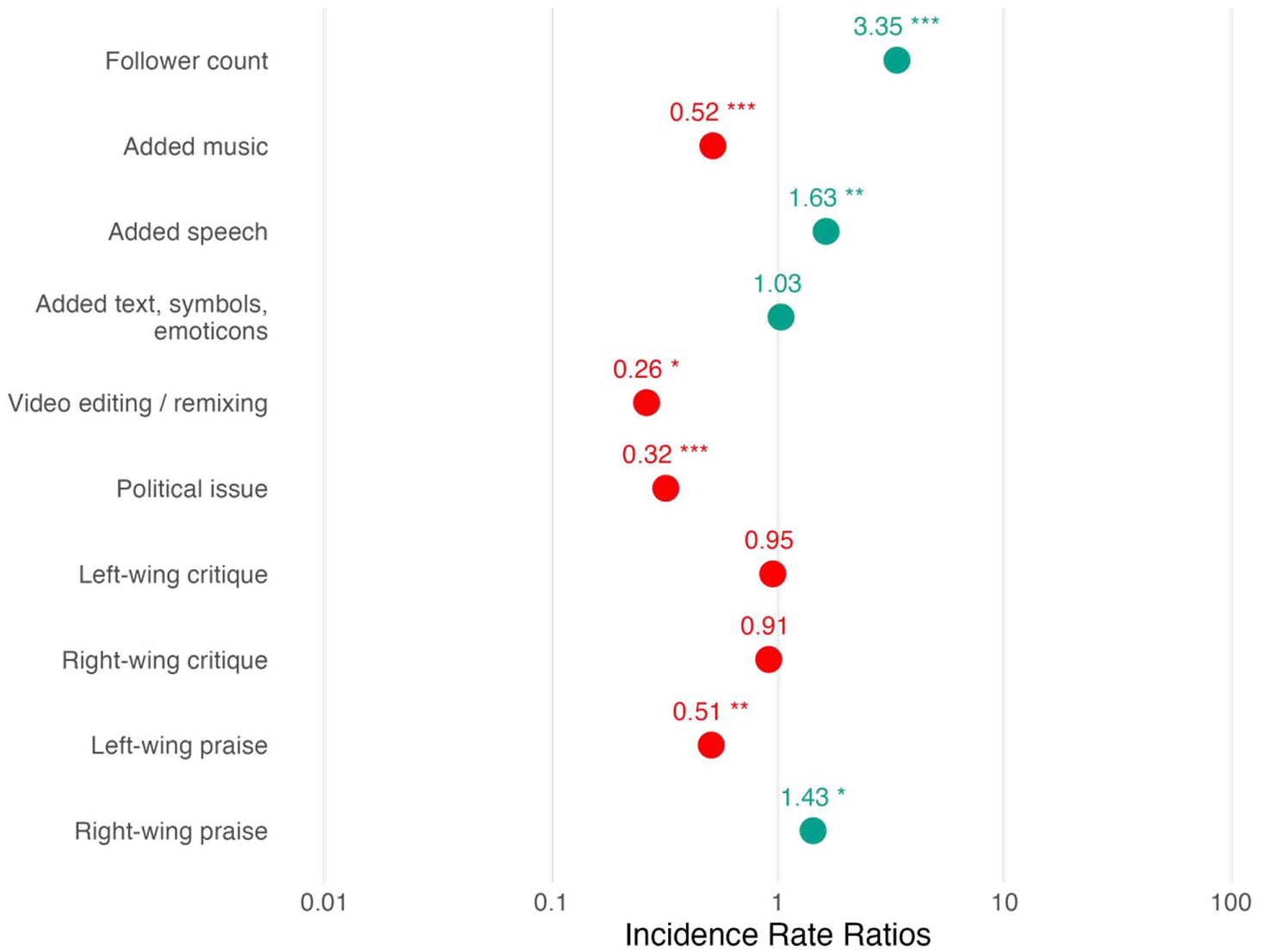
Negative binomial regression predicting Digg counts.
Starting with Follower count, the model provides us with the not very surprising results that the more followers a specific account had at the time that the specific video was posted, the higher the Digg count of that video. Slightly more surprising, perhaps, are the results emerging from the following four variables—Added music, Added speech, Added text, symbols, emoticons, and Re-mixing. Taken together, these four variables gauge different aspects of the ways in which the TikTok videos studied here featured adaptation to platform features. Indeed, the results presented in Figure 3 suggest that while added speech contributes to a higher amount of Diggs, negative significant or positive nonsignificant effects emerge in relation to the remainder of these four variables, suggesting that adaptation to the functionalities of a particular platform—the “platformization” (Bene et al., 2022) of communication—might not always lead to increased engagement.
While our selection criteria for the videos studied here was that their textual descriptions contained a hashtag related to the 2022 Swedish election might lead one to expect that the Political issue variable would emerge as positive, the results presented here suggest the opposite, with a negative significant effect on user engagement (RQ7).
The four final variables—indicating whether or not videos included praise or critique for right- and left-wing political actors, respectively—were included in relation RQ4—detailing what impact praise and criticism toward the left and right had on user engagement. As can be seen in Figure 3, while none of the critique variables emerged as significant, the variable indicating Left-wing praise suggested a significant negative effect, while the Right-wing praise variable emerged as a significant positive predictor.
Concluding Discussion
A growing body of research focusing on the political role of TikTok frequently highlights its unique platform features, suggesting that they represent a unique environment for political communication. This article has illuminated the degree to which distinctive platform features were employed by users during the Swedish election campaign, and moreover what effects they had on user engagement. In terms of semiotic resources, features such as added text, symbols, stickers, and emoticons were extensively used, pointing to a visually and symbolically charged communication environment, a characteristic that has been identified also in previous work (Kaye et al., 2022). Music also emerged as a prominent feature in our sampled videos, with nearly half of all users incorporating this feature. Paradoxically, our findings suggest that semiotic resources, along with music and re-mixing features, had no or weak negative effect on user engagement. This challenges the established perception of TikTok as a music-driven platform and invites further investigation into the dynamics of user engagement in political contexts such as elections. Contrastingly, added speech emerged as a significant factor positively influencing user engagement, particularly when it was associated with praise for right-wing politics. This underscores the importance of verbal communication on a platform overwhelmed by a multimodal fusion of music, visual symbols, and text that may appear vague and indistinct to users. Verbal messaging may also be linked to the salience of issue frames in the videos, an aspect of political information environments that—when communized truthfully—can serve an important democratic function for citizens in their decision-making during elections (Peterson & Simonovits, 2018).
The influence of right-wing content in the Swedish election campaign on TikTok corroborates recent insights on the campaign role of TikTok provided by journalists in neighboring countries such as Finland and Norway (Yle, 2023; DR, 2022). In particular, the salience of criticism toward the Social Democrats, and praise of the Sweden Democrats that we have identified, seems to validate the bulk of research that shows advantages for far-right actors on social media platforms (Engesser et al., 2017). Since far-right parties tend to attain an adversarial position toward legacy media (Ekman & Widholm, 2024a), finding alternative communication channels, including new ways to package political discourse in appealing ways, has been a key strategy for them. The demographic characteristics of TikTok users (Vijay & Gekker, 2021) also mean that far-right actors reach potential voters that do not follow traditional sources of political information, most notably news journalism—and therefore are not susceptible to legacy media’s general critique of such parties.
Overall, our results must be interpreted in light of the types of actors posting on the platform. It is obvious that TikTok is still an emerging medium for political communication in Sweden. Hence, the results do not say much about whether political elites will utilize the platform more systematically in the future, although party youth organizations had a salient position among actors posting, of which at least some will be future representatives of the parties. If TikTok follows the same trend as platforms such as Facebook, X/Twitter, or Instagram, it will soon be absorbed by political parties and normalized as a daily professional communication tool. One prerequisite for such a shift to occur, however, is a change in the demographic composition of users. Political messages rarely have long-term effects, especially not in a time when Swedish citizens to a greater extent than ever act as swing-voters, changing their voting behavior from one election to another (Martinsson & Andersson, 2022). It is therefore not likely that political actors will invest significant resources in a platform where the majority of users do not have the right to vote. To date, TikTok’s power primarily stems from its influential design, which has introduced a new communicative aesthetic also on other platforms. However, to influence voters, the content must migrate to other platforms and reach other user bases as well. We suggest that future studies focus more strongly on how political elites utilize the platform, preferably by going beyond election hashtags and instead strategically monitor selected accounts of high relevance. A study of a later phase of the campaign is also needed, since politicians’ communication efforts usually intensify closer to an election.
Footnotes
Declaration of Conflicting Interests
The author(s) declared no potential conflicts of interest with respect to the research, authorship, and/or publication of this article.
Funding
The author(s) disclosed receipt of the following financial support for the research, authorship, and/or publication of this article: This work was supported by Riksbankens Jubileumsfond (grant P21-0158).
