




Abstract
Since the global virality of the ‘Renegade’ dance on TikTok and beyond in 2020, concerns regarding the erasure of Black girls have been noted. This paper extends the conversation by considering how Black girls and teenagers may continue to wrestle with visibility and suppression even within a more intimate in-group community of Black TikTokers. In this paper, we assemble an original corpus of TikTok posts purposively sampled from #BlackGirlTikTok and apply content analysis guided by critical technocultural discourse analysis. Our findings reveal that the dominant discourse on #BlackGirlTikTok focused on embodied self-care (i.e. body and beauty care, health and wellness) and Black popular culture (i.e. audio memes, parlance), constituting a niche community for users to commune. However, despite the nomenclature of the hashtag, the users dominating the community were overtly Black women rather than Black girls or teenagers, thus raising issues of visibility, competition, and suppression within the in-group community.
Keywords
Introduction
In February of 2020, The New York Times profiled Jalaiah Harmon, a 14-year-old Black girl from Atlanta, Georgia who had created the most popular dance on the internet in years: the ‘Renegade’. At that time, the Renegade challenge was viral on TikTok and largely associated with Charlie D’Amelio, a white teenage girl from Connecticut with millions of followers (Lorenz, 2020). Harmon's origin story was relatively unknown to the public, and both users and mainstream media credited D’Amelio as the creator instead. In the days after Harmon's profile was published, she was invited to perform at the NBA All-Star game. Yet, D’Amelio and another popular TikTok user named Addison Rae Easterling had already been invited to perform the Renegade at the weekend's Slam Dunk Contest event just a day before Harmon's was scheduled. This vignette captures the entanglements of visibility on social media, recognition and crediting of creative labor, and the potential opportunities that follow (or are missed) when creators are rightfully (or not) acknowledged for their work. Regrettably, Harmon's experience is but one in a long string of young creators vying to be credited for their craft. It is in this vein that this article considers the issue of invisibility and erasure experienced by Black teenage girls on TikTok.
The Renegade dance controversy instigated a larger conversation about Black TikTok users being overlooked by the public, particularly Black teenage girls who had been responsible for many of the trends and challenges that were sweeping the United States. This includes Keara Wilson, creator of the ‘Savage’ dance, and Layla Muhammad, creator of the ‘Twerkulator’ dance. Both trends gained popularity after the Renegade, and like Jalaiah Harmon, Keara Wilson and Layla Muhammad were eclipsed as the original creators by others (Samuel, 2021). In response to the continuous misattribution and erasure of creative labor, Black TikTok users staged campaigns, calling attention to issues of visibility through alleged shadow bans (i.e. the suppression of user content by platforms), censorship, and miscredit. In 2020, in response to the alleged suppression of content related to Black Lives Matter, user Lex Scott organized a protest branded the ‘#ImBlackMovement’, which included a ‘blackout’, wherein users changed their profile picture to an image of a ‘Black Power’ (Elassar, 2020). In 2021, Black TikTok users organized again, this time via a coordinated refusal to create dances to rapper Megan Thee Stallion's viral single, ‘Thot Shit’ (McClay, 2021). Rather than post dances, users made videos relaying their experience with content being ‘stolen,’ or about not being credited when their dances became popular. This gesture was a ‘strike’ calling out mistreatment and contributing to a larger discussion of invisibility that Black users have responded to through collective action.
This article uses this context as an entry point to ask, ‘where are all the Black girls on TikTok?’, contextualizing in-group community building by Black girls on TikTok in the face of this pattern of invisibility in popular media. The creation of online communities is made possible through forms of creativity produced on platforms – what Jean Burgess (2007) describes as ‘vernacular creativity’ or the online remediation of creative practices that emphasize the everyday. This framework supports the proliferation of numerous genres of content that appeal to different audiences. For example, YouTube has millions of videos across a wide range of categories, including game live-streaming, mukbang, makeup tutorials, children toy reviews, ASMR, and more. While these ‘granular-level audience niches’ (Poell et al., 2022: 135) – originally referred to as ‘taste communities’ in Lynch (2018) – form around shared interests, they also overlap with markers of social identity. Black Twitter is an example of this kind of in-group online community. André Brock (2020: 123) describes Black Twitter as ‘a public group of intentional Black Twitter users’ who engage in conversations about Blackness through certain cultural and digital commonplaces. The discourse happening within Black Twitter ranges from overtly political to humorous and is framed through a shared racial identity.
Scholarship on TikTok has similarly explored niche and in-group communities organized through hashtags. This includes communities based on interests and pursuits like #WitchTok (Barnette, 2022), #WellnessTok (Sweeney-Romero, 2022), #GriefTok (Eriksson Krutrök, 2021), and #BookTok (Guiñez-Cabrera and Mansilla-Obando, 2022); or those based on personal identities and affiliations like religion in #JewTok (Divon and Ebbrecht-Hartman, 2022), sexuality in #TransTok (Rochford and Palmer, 2022), or race and ethnicity in #ItalianTok (Froli, 2022), #LatinxTok (Jaramillo-Dent et al., 2022) and #AsianTok (Lee and Lee, 2023). This study approaches #BlackGirlTikTok as a similar in-group community by asking two questions:
How is content tagged with #BlackGirlTikTok expressive of a particular social identity? How are Black girls and teenagers occupying space and engaging within this online in-group community?
In order to answer these questions, we conduct a content analysis of 100 videos under the hashtag #BlackGirlTikTok. As expressed in our research questions, we are interested in analyzing not only who is visible in these videos, but how content is related to a particular social identity. In this paper, we provide an overview of scholarship that informs our study of Black girls on TikTok, specifically on Black digital culture, Black Girlhood studies, visibility on social media, and platform affordances. We then detail our methodology – rooted in Critical Technocultural Discourse Analysis (CTDA) – including the purposive sampling of our data from the #BlackGirlTikTok hashtag, qualitative coding of a specific set of elements in the posts, and our consideration of ethical concerns. In our findings and discussion, we highlight the thematic contents that dominate the #BlackGirlTikTok stream of discourse on TikTok, which often focused on embodied self-care and Black popular culture via the savvy use of trendy audio memes and parlance. We offer that while the network and discourse on #BlackGirlTikTok operates as a ‘homespace’ (Martinez, 2022) for users to commune and develop a niche community, Black girls are not the primary users who are visible on the hashtag stream. This relative ‘invisibility’ of Black girls on the hashtag points to the contentious homogenization of Black female experiences that negates the perspectives of children and teens.
While adult Black women seem to dominate the hashtag in visibility and in discourse, we theorize that they deploy the parlance of ‘girls’ not to represent their actual age, but in a posture of feminine solidarity where connection is connoted through linguistic intimacy. On the one hand, it reveals further erasure in this in-group formation wherein Black girls are unable to structure a digital space contingent on age; on the other hand, it exposes an intentional construction of community building by Black women with a younger generation in mind. This study demonstrates the limitations of the term ‘girl’ both in pop and digital culture wherein the term's overuse limits the visibility for the positionality of children and adolescents, while also exemplifying the capabilities of platforms to construct community and visibility.
Literature review
Black digital culture
Scholars across disciplines have produced a wealth of research on the interplay between race and technology. This research reclaims and develops Black digital culture, highlighting how racism and inequality are encoded in certain technologies lauded as neutral (Hamilton, 2020). This includes critiques of colorblind approaches to the internet (Daniels, 2015), research focused on the digital divide and a deficit model of racial minorities’ technology use in the United States (Gunkel, 2003), and research on the commodification of race and racism on the internet (Nakamura, 2002).
Safiya Noble (2018) introduced the notion of ‘algorithmic oppression’ to explain how racism and sexism are reinforced in algorithmically driven software and fundamental to the web rather than glitches in the system. The reproduction of these logics is accepted because they are seen as credible and consistent. Similarly, Ruha Benjamin (2019) uses the ‘New Jim Code’ to describe how new technology reflects and reproduces inequality. Benjamin maintains that this discrimination is deepened and harder to contest because these systems are promoted as objective or benevolent. André Brock (2020) contends that these instances of ‘weak-tie online racism’ are informed broadly by Western technoculture which is inherently anti-Black and both produces and justifies racial inequality in digital spaces. This context makes online communities crucial – especially for historically marginalized groups.
In fact, regardless of these conditions, Brock and others insist that Black digital culture and practices persist with vitality, energy, and joy. Black people have used the internet for their own means to cultivate online communities. Scholarship on Black digital culture across platforms has focused on the ways that the internet and social media are used for social justice endeavors like the movements for Black lives (Freelon et al., 2016) and Black feminism (Childs, 2022; Gray, 2017; Jones, 2019; Steele, 2021a), the translation of Black culture with the affordances of social media (Florini, 2014), and quotidian joy and in-group humor (Taylor, 2022).
Emerging scholarship on Black digital culture on TikTok ranges on a variety of topics, including the use of technological affordances to evade racialized forms of surveillance (Peterson-Salahuddin, 2022), the agentic feminist praxis of Black women who use dance and music to cultivate a space of pleasure (Steele, 2021b), and the connection between content with Black cultural expressions like gospel music (Ingram, 2023). Scholars have also focused on the appropriation of Black content, such as the #SavageChallenge (Davis, 2022) and the subsequent protests (Ile, 2022) mentioned in the introduction of this article, in addition to legal approaches to content theft (Johnson, 2021). Additionally, there has been attention to the use of TikTok as a space of resistance by Black girls (Martinez, 2022) – a thread extended in this study through analysis of subcultures constructed around #BlackGirlTikTok.
Black girlhood studies
Given that this study is interested in Black girls on TikTok, our work is further animated by Black Girlhood Studies. Scholars within this field have acknowledged the ways that Black girls are often absent from academic literature. Ruth Nicole Brown writes that those ‘privileged to be in a consistent relationship with Black girls and research on Black girlhood… will be immediately dissatisfied by literature that frames being Black and female as the problem…that defines Black girlhood as absence’ (Brown, 2013: 8). Similarly, Beverly Daniel Tatum (1997) cites a limited discussion of racial or ethnic identity in young people's development within psychology which she states has historically privileged the experience of white, middle-class children. Black Girlhood Studies scholars seek to intervene in this gap by engaging with Black girlhood as a positionality and starting point for research on a variety of topics, including identity development (Spencer and Markstrom-Adams, 1990), education (Fordham, 2016), mental health and personal development (Buckley and Carter, 2005; Muhammad, 2012), and consumer culture (Chin, 2001).
Scholars have also engaged with Black girls’ digital culture, complimenting research in the preceding section. Firstly, Black girls are not exempt from discrimination within technological systems. Safiyah Noble's (2018) primary case study revolved around the results yielded when searching for ‘black girls’ on Google. Noble details the derogatory and sexually explicit text on the first page of results which reproduced narratives that demean not only Black girls, but other Black women and non-white girls. As a symbol of meaning-making, search engines, and technology at large, extend histories of oppression that exist in the media. Yet, despite these destructive ideologies, Kisha McPherson argues that ‘social media offers an opportunity to circulate a broader and more diverse range of images and messages to challenge traditional tropes characterizing Black girls and women’ (McPherson, 2019: 236). Black girls reclaim and create positive representations of themselves through digital media. For example, Aria Halliday (2020) locates twerking videos uploaded by Black girls on digital platforms as a celebration of pleasure and self-expression.
Ashleigh Greene Wade (2022) draws on archives of Black girlhood to demonstrate that the operationalization of social media extends a larger tradition of Black girls’ media participation and production, connected especially to the Black press. Black girls’ digital practice also encourages community building with other Black girls. Wade explores this formation of online communities as ‘digital kinship’ which she defines as a ‘relational practice through which familial ties – with both origin family and chosen family – are established and/or maintained through digital technologies’ (Wade, 2019: 81). Black girls connect with family and friends, documenting their lives and support networks, and controlling a space of their own. This framework is a digital version of scholarship on Black girls’ place-making, such as ‘Black girl cartographies’ in education research (Butler, 2018). Wade (2019) reveals that digital kinship is shaped by offline relationships, an assumed shared experience amongst their network, and the surveillance they are under by adults at home and school.
The concept of digital kinship is similar to Wendyliz Martinez's (2022) articulation of TikTok as a ‘homespace’ for Black girls. This ‘homespace’ enabled Black girls to utilize joy as a means of resistance against capitalist narratives around productivity and celebrity during the COVID-19 pandemic. Homespace is a variation of cultural theorist bell hook's (1990) ‘homeplace’ which describes Black women's shaping of domestic households as communities of radical resistance to white supremacist patriarchal capitalism. hooks traces homeplaces historically, and as systemic racism and sexism have persisted, homeplaces have continued to be important in cultivating subjecthood and vitality for the Black community (see McTighe and Haywood (2018) for a conceptualization of front porches as Black feminist resistance and knowledge production). Homespaces retain the importance of community, care and resistance, but add a dimension of digital context – which is the focus of our study. We thus contribute to the scholarship about Black girls’ digital culture by framing #BlackGirlTikTok as a potential form of digital kinship and homespace for users. This form of community is crucial in the face of issues around visibility on TikTok and other social media platforms.
Visibility on TikTok
Notions of visibility have shaped scholarship on the behavior of social media users. Taina Bucher (2012) explores how the algorithmic architecture of Facebook's newsfeed structures practices in pursuit of visibility, through which users are granted subjectivity and voice. Bucher argues that because visibility is scarce and at the discretion of algorithms, users are trained to behave in particular ways that discipline and regulate their conduct. Not conforming to the algorithm warrants punishment or the threat of invisibility.
On TikTok, internet celebrity, algorithms, and platform features shape visibility and attention economies (Zulli, 2018). Crystal Abidin writes that ‘TikTokers have had to rely on repeated attempts, observed patterns, and gut feelings to figure out how the algorithm works, how to please the platform to facilitate their visibility, and how to have their popularity grow’ (Abidin, 2020: 85). While these logics speak to a desire for popularity in the creator economy, everyday practices of navigating visibility are informed by the perceptions of casual users, conceptualized as an ‘algorithmic imaginary’ (Bucher, 2017), ‘algorithmic gossip’ (Bishop, 2019), ‘algorithmic folklore’ (Savolainen, 2022), ‘algorithmic awareness’ (Issar, 2023), and ‘algorithmic folk theories’ (DeVito et al., 2017; Gelman and Legare, 2011; Karizat et al., 2021). Users learn about platforms as they interact with them, and these ideas around algorithms fuel counteractive measures to manufacture visibility – especially among historically marginalized groups or around non-normative content (Duffy and Meisner, 2022). Our focus on #BlackGirlTikTok is developed through an attention to how users navigate visibility on social media, and the skillful use of platform affordances in order to construct a community where they are centralized and most visible to others in their in-group.
Platform affordances and manufactured visibility
The affordances of social media shape the actions of end-users, developers, and advertisers (Bucher and Helmond, 2017) as well as construct distinct cultures to attract users (Taylor, 2023) who adopt or reject platform affordances for their purposes. For example, hashtag use on Twitter has been studied in relation to Black users forming in-group community and discourse (Brock, 2020; Sharma, 2013; Taylor, 2022) and forms of digital activism related to social justice (Bonilla and Rosa, 2015; Jackson et al., 2020; Nacher, 2021). Research on TikTok's affordances include considerations of how the personalized algorithm allows users to recognize parts of themselves in the content on their For You Page (FYP) (Lee et al., 2022), and how other digital affordances like in-app editing and sound encourage imitation and a memetic culture (Zulli and Zulli, 2020).
Scholarship connecting visibility, activism, and TikTok similarly highlight hashtags as a means to make information easily locatable to garner attention. For example, Hautea et al. (2021: 5), studying climate activism and affective affordances on the platform, maintain that TikTok encourages users to tag content to heighten visibility, one of those strategies being generating their own unique hashtags. They join others in discussing the platform logics of TikTok which shapes users’ behavior, such as ‘circumscribed creativity’ highlighted in Kaye et al. (2022). There are also numerous case studies on the deployment of affordances to produce group visibility, including the #FoxEyeChallenge (Zhao and Abidin, 2023) which circulated anti-racist work by East Asian users, and #BlackLivesMatter (Krutrök and Åkerlund, 2023) which highlights content on police brutality by both Black and white users. This paper combines an interest with platform affordances and group visibility, exploring how Black girls construct group identification and in-group community building through the collective hashtag use of #BlackGirlTikTok.
Methodology
This study's methodology is rooted in Critical Technocultural Discourse Analysis (CTDA), conceptualized by André Brock (2016: 1012) as a ‘multimodal analytic technique for the investigation of internet and digital phenomena, artifacts, and culture.’ CTDA is a critical and cultural approach that accounts for both the material and symbolic elements of technological artifacts, and relevant cultural theories or social practices that frame digital spaces. We will expand on the theoretical components in our discussion.
Data collection process
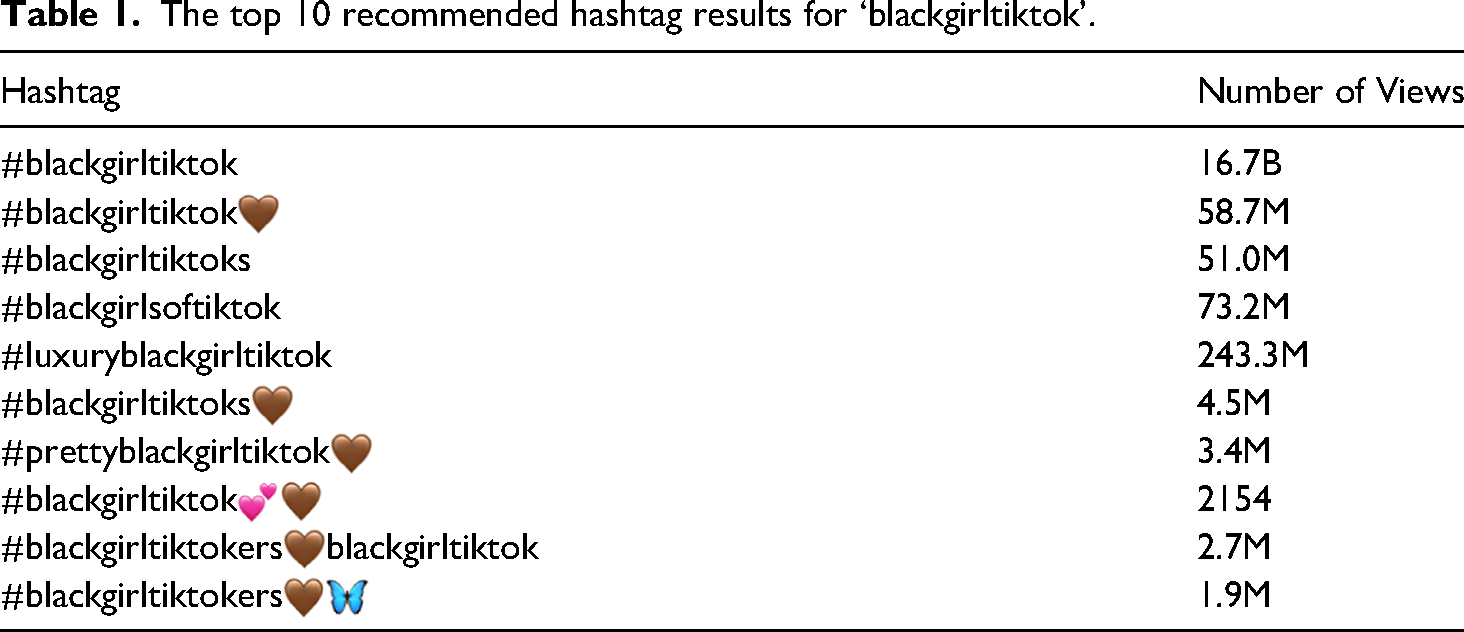
To carry out this study, we conducted a content analysis of the top 100 TikTok videos using the hashtag #BlackGirlTikTok. From a visual survey of the content on the hashtag, we observed that the top 100 videos were largely representative of the mainstream discourse on #BlackGirlTikTok. This sample was also methodologically manageable for our close qualitative reading of posts. On 10 November 2023, we searched the phrase ‘black girl tiktok’ on the app version of the platform on a tablet device, specifically selecting the ‘hashtag’ category of search results which provided videos that explicitly use the desired terms as a hashtag. The search yielded many results with different variations of the terms. #BlackGirlTikTok was the simplest result (excluding any additional words or emojis) and had the most views at the time of collection (16.7 billion). Table 1 shows the ten recommended hashtags in the search results.
The top 10 recommended hashtag results for ‘blackgirltiktok’.
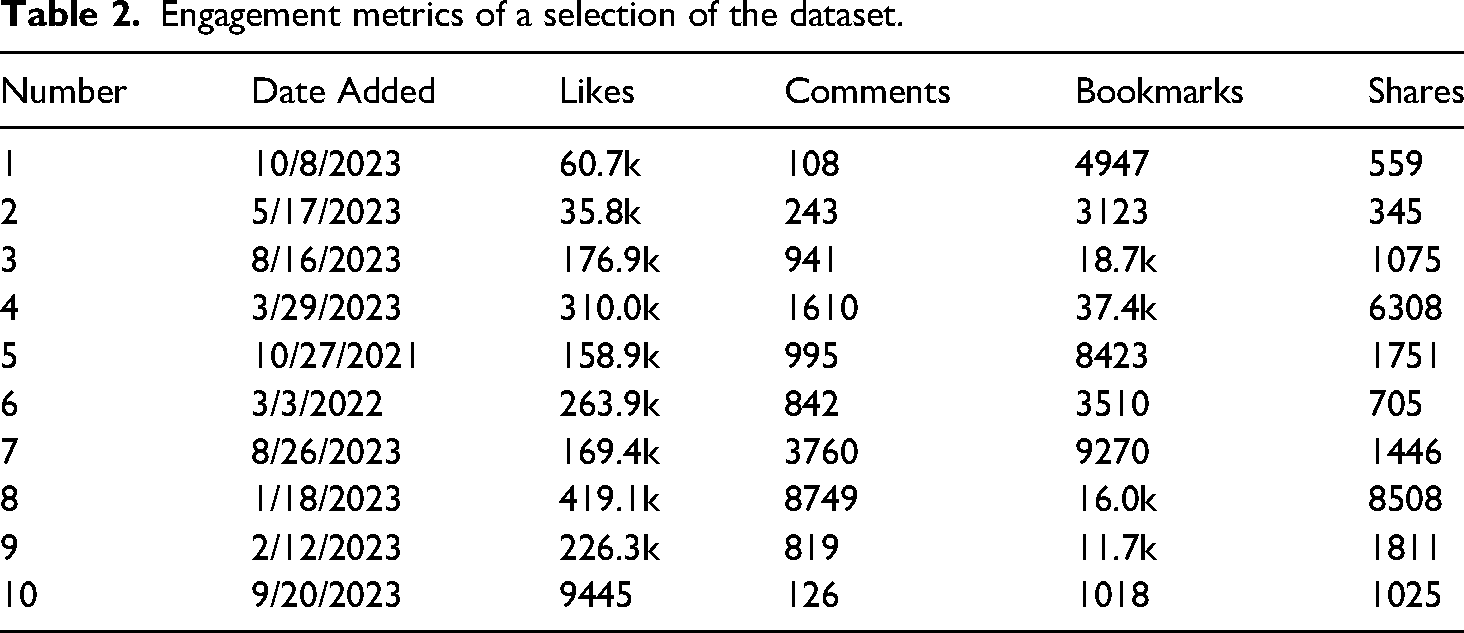
We manually coded the content analysis across several categories – engagement metrics, visual elements, audio memes, and hashtags. We analyzed this content independently and video information was inserted into a spreadsheet in the order that they appeared in the search. In order to account for video variability and shifts within the search, all 100 videos were coded in-app on the same day. The engagement metrics included the date posted and the number of likes, comments, bookmarks, and shares (see Table 2 for the engagement metrics for a selection of the dataset). Visual elements included the identifiable demographic elements of the user(s) in the video (i.e. gender, race, approximate age), locations (i.e. whether geotagged or hashtagged) and the genre of video content (i.e. tutorials, reviews, comedy skits, vlogs, or hauls). We also noted the text overlay or captions when available. On TikTok, sound is privileged over image as both an organizing principle and means of driving engagement. These ‘audio memes’ consist of snippets of songs or spoken dialogue that can be used and remixed by users (Abidin, 2020). To determine the popularity of sounds, we visited the corresponding page which showed the number of posts associated with it. We also took note of hashtags used in addition to #BlackGirlTikTok. Because the demographics of our empirical data refers to ‘Black girls’ as users under the age of 18 who appear to be of African descent or phenotype, an additional category especially relevant to this study was markers of age, labeled as ‘teen’, ‘adult’ or ‘undetermined.’ We used several markers for estimation including tattoos or drinking, high school settings, events or wearing uniforms, owning businesses, working corporate jobs, or mentions of family. There were also several users who explicitly mentioned their age, making some determination more straightforward. ‘Undetermined’ was used when we could not estimate a user's age.
Engagement metrics of a selection of the dataset.
Ethical concerns and limitations
Studying social media data raises ethical concerns, and scholars have considered dilemmas with maintaining subjects’ privacy. This includes work on gray data (Rambukkana, 2019) and cautions the spreading or amplifying of harm to participants (Bruns et al., 2020). It also includes concerns specific to TikTok, especially given that many users are minors (Kanthawala et al., 2022), the demographic that this study analyzes. Researchers’ solutions to these concerns include ‘ethical fabrication’ (Markham, 2012) situated in this study as anonymizing individuals and not including usernames in the dataset. Although we contextualize #BlackGirlTikTok as an in-group community that generates visibility, and have established that in our corpus of data users tended to use features such as hashtags and memetic templates to signal their visibility-seeking intentions (see Abidin, 2020), as scholars we are conscious of their privacy and status as potential minors.
Additionally, given the focus on content made by and for Black teenage girls, a limitation of this study is that the account used to collect data was a ‘general’ one used by an adult, rather than a ‘minor’ account controlled by a guardian via the ‘Family Pairing’ feature (TikTok, 2023a). When signing up for a TikTok account, individuals are asked for their date of birth. This determines the content and capabilities of a user's account as all TikTok users must be above the age of 13 (TikTok, 2023a). Guardians can manage teenage users’ accounts through a myriad of controls including daily screen time, discoverability, push notifications, and more. One function of guardian control that is also available to general accounts is the restricted mode, which limits content with mature topics (TikTok, 2023b). To stimulate content available to a teenage demographic, we set the account to restricted mode prior to data collection. While this does not fully replicate the account of an actual teenager, the data bears relevance for how Black girls utilize #BlackGirlTikTok to create an online in-group community for themselves that is also discoverable by outsiders. Other account settings include the first author's location in the United States, which aligns with our focus on users in this region. We do not seek to analyze content across continents or speak to a global trend or culture, though future research could do so.
Findings and discussion
All the individuals visible in the videos collected were perceived as Black and female, and from various locations (see Appendix). As stated in the methodology section, it is impossible to determine the exact age of users. Thus, the estimations of ‘teen’, ‘adult’ or ‘undetermined’ were based on markers that could indicate age or explicit reference to a users’ age. Within the dataset, there were 62 videos categorized as ‘adult’, nine as ‘teen,’ and 29 as ‘undetermined.’ From this, it is clear that Black teenage users are actually not the most visible on the videos collected in the #BlackGirlTikTok hashtag.
Users were shown doing a variety of activities, including: dancing, getting dressed, reviewing beauty tools, talking about visits to the gynecologist, vlogging hair appointments, lip-synching to audio memes, doing ‘hauls’, talking about their experience with therapy, and more. While these genres have no explicit connection to specific racial identities, the content was clearly made for a specific racial and gendered audience. In one video, a user gives a review of a blow dryer and specifically talks about how it works with thicker hair textures in comparison to looser hair that is natural to other races. Other hair tutorials provided step by step instructions to do styles like weaves or braids used by many Black women and girls. Non-Black users may not have the same everyday experience with or knowledge of this style and thus, their content is fitting for an in-group community.
There were several audio memes included in the dataset. Most of the songs used were by Black Pop, Rap, and R&B artists such as Rihanna, Saucy Santana, Beyonce, Pop Smoke, Drake, Tems, SZA, Doja Cat, and others. Many of these sounds were popular and used in thousands of other videos. For example, one video included a snippet of ‘Barbie World (with Aqua)’ by Nicki Minaj and Ice Spice, a sound used in 1.6 million other videos on TikTok. Other spoken dialogues were comedic, dramatic, and from popular culture artifacts. For example, two videos included sound bites from the ‘Real Housewives of Atlanta’ reality television series, which follows the lives of a group of Black women living in Atlanta, Georgia (IMDb, n.d.). The inclusion of these audio memes shows a particular cultural knowledge that is assumed to be shared by others, signaling that their inclusion acknowledges an ‘imagined audience’ for users (Marwick and Boyd, 2010). Those who use the hashtag #BlackGirlTikTok may assume that viewers will recognize these elements of Black popular culture, though their content can be seen by those who do not have the same cultural knowledge.
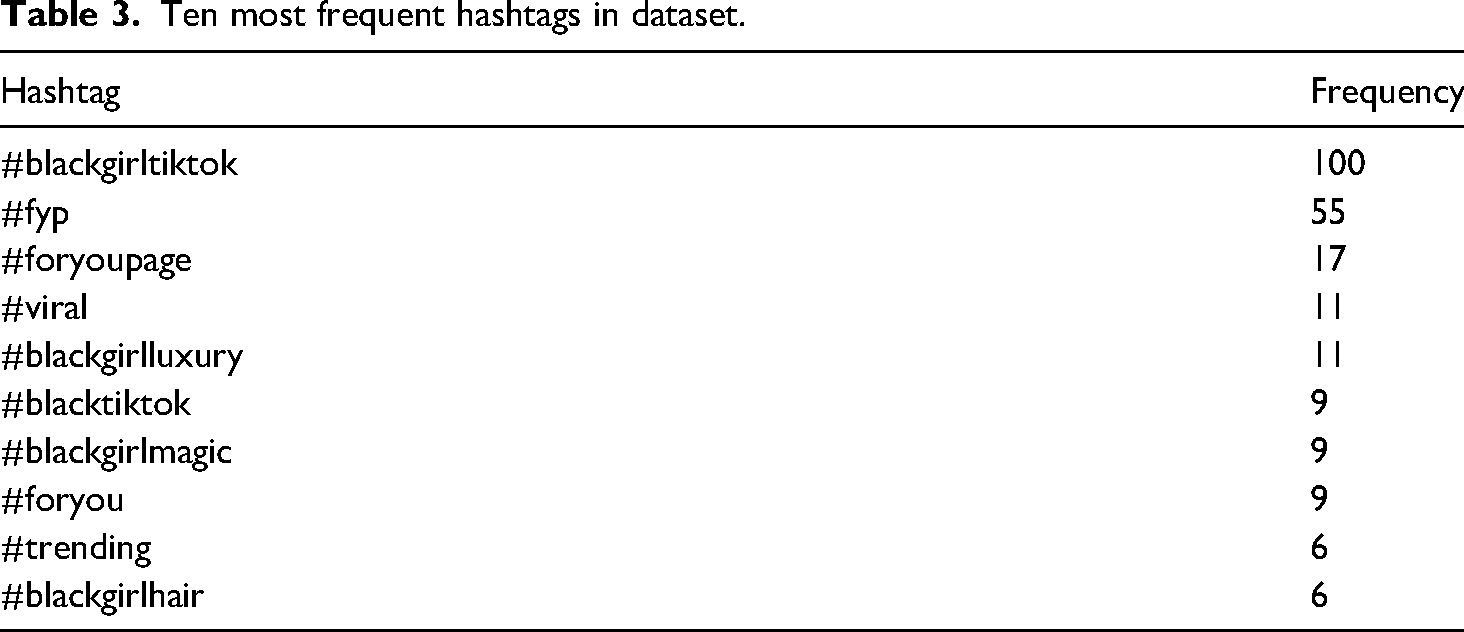
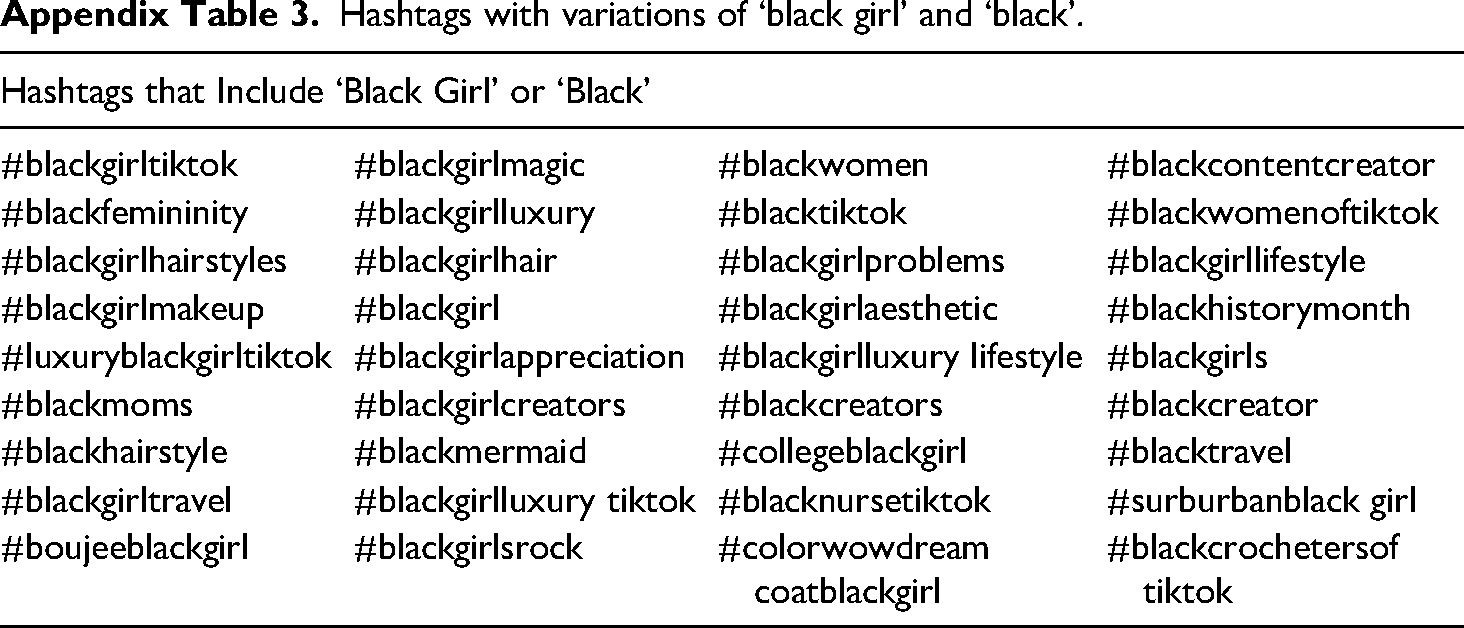
Three-hundred and seventy-six hashtags were used in the dataset and represent the various genres of content. #BlackGirlTikTok was the most frequently used, but there were hashtags of similar variations of ‘black girl’ or ‘black’, that signaled other niche interests or genres of content, and location (see Appendix). Though most of the hashtags were only used once, the most frequent ones outside of identity markers flagged visibility (See Table 3). While these hashtags identify content by genre and are used to gain visibility within the For You Page, #BlackGirlTikTok further connects users to a wider community based on racial and gendered identity.
Ten most frequent hashtags in dataset.
Though #BlackGirlTikTok is used by Black teenage girls to create visibility for their content, Black women of all ages also use the hashtag. The overrepresentation of Black women in #BlackGirlTikTok is demonstrative of scholarship regarding the erasure of a positionality specific to Black girlhood (Brown, 2013; Tatum, 1997) and a praxis in which Black women center the interests of themselves and a broader community – here, Black women and girls. In this section, using the critical and cultural approach of CTDA, we expand on the implications of this study's empirical findings, namely a failure to identify an in-group of solely Black girls, within a discussion of Black Girlhood Studies and digital Black feminism.
#BlackGirlTikTok as homespace
Firstly, #BlackGirlTikTok operates as a ‘homespace’ (Martinez, 2022) and an illustration of ‘digital kinship’ (Wade, 2019) because it includes content made by and for Black girls. TikTok's platform affordances enable all the videos tagged with #BlackGirlTikTok to be grouped together. This content is made and accessed by people with various niche interests (see Appendix Table 1) and who are from different places (see Appendix Table 2). Users can access a community similar to #BookTok (Guiñez-Cabrera and Mansilla-Obando, 2022) or #WellnessTok (Sweeney-Romero, 2022). This emphasis on a racial and gendered positionality is clear not only in the phrase ‘black girl’ that is included as a hashtag in every video, but also in the different audio memes used in the dataset.
There were several spoken word audio memes that explicitly talk about ‘black girls,’ whether it was introducing them to ‘Black Girl Luxury TikTok’ or looking for others interested in things like farmer's markets, art galleries, and picnics. One popular instance, read as a poem and used in 2390 other videos, was full of positive affirmations for Black girls, saying: Dear Black girl. It's your style. Your smile. The way you light up a room when you walk in. Because your skin is coated in melanin. It's your laugh. The swag in your voice when you talk. Keep shining. Keep grinding. Hold your head up high. Live your life with pride Black girl.
Those who include this audio meme and others, or tag #BlackGirlTikTok, are broadcasting this message to a community of Black girl users – using these platform affordances to articulate a certain cultural alignment (Zeng and Abidin, 2021) or have a ‘cultural conversation’ (Clark, 2015). Their desired audience may be Black girls that they know on the platform as well as users in other locations, forming connections across time and space. Yet, this community is not exclusive only to Black teenage girls but also engages with Black women.
Invisibility within #BlackGirlTikTok
As we note, alongside the use of the #BlackGirlTikTok hashtag, Black girls on TikTok often also use other visibility-seeking hashtags like ‘#FYP’ and ‘#trending’, they adapt to timely and viral audio memes and discursive memetic templates, and even directly address viewers to engage with their post. However, our findings also uncover that it is adult Black women who are the dominating presence on #BlackGirlTikTok, outnumbering Black girl users in the space, which consequently results in a degree of invisibility of Black girls using the hashtag and in the discourse. ‘Black Girl’ is thus not a direct reference to age, reflecting the use of the categorization in popular culture to refer to both Black girls and women. For example, Black Girl Code is an organization designed to mentor African American girls interested in computer programming (Noble, 2018), and ‘Black Girl Magic’ is a phrase articulating the positive self-expression and celebration of Black girlhood and womanhood that has been commodified by corporations to entice Black women consumers (Tounsel, 2022). #BlackGirlTikTok similarly resonates with both Black women and girls, and this conflation of the experiences of both adults and youths has the potential to overshadow Black girls’ specific positionality. It would seem then, that in addition to creating visibility for their own in-group, they must also combat being visible in comparison to Black women.
Like Black women, Black girls deal with struggles related to race, class, gender, sexuality, and other aspects of their identity. This attention to experiences based on numerous identity markers is complementary to the emphasis on intersectionality within Black feminist scholarship. Legal scholar Kimberlé Crenshaw (1989) offered the notion of ‘intersectionality’ as a framework to understand how race and gender are not mutually exclusive, but interlock and animate the experience of Black women. Additional markers of identity further complicate how oppression functions as multidimensional. Sociologist Patricia Hill Collins (2000) also uses the language of intersectionality to describe ideological oppression of Black women along the lines of race, class, gender, and sexuality.
However, because Black girls are also children, they have a lived experience that differs from adults, and this means that the use of Black feminist frameworks potentially has gaps in accounting for this part of their lives. The scholarship that focuses on Black girls in educational contexts, for example, examines their experience as students, whereas a Black feminist perspective would focus on Black women who are teachers. Ashley Smith (2019: 24) explains that the experience of Black women can be useful in understanding the oppression that Black girls face, but it can also lead to an ‘over-essentialized and homogenized description of Black girls’ experience.’ In this process, Black girls are ‘adultified’ (Ferguson, 2002) and denied elements that afford them the chance to exist as children.
While TikTok's restricted mode algorithmically filters out any explicit content, videos tagged with #BlackGirlTikTok focused on adult themes such as budgeting for bills, motherhood, or working a corporate job – themes that are irrelevant to Black girl users who are at a different stage of life. The invisibility of Black girls in this digital space reflects offline practices that Black Girlhood scholars are describing. Without clearly marked boundaries, Black girls can have a difficult time expressing their adolescence (Currie, 1999) and the same could be said for discourse under #BlackGirlTikTok. Given the erasure of Black girls from trends highlighted at the start of this paper, this invisibility has higher stakes for community building efforts by Black girls who are overshadowed by Black women. This usage by Black women, however, should be discussed in context with digital Black feminism which highlights the community building efforts of Black women for themselves and their community.
#BlackGirlTikTok as digital Black feminist praxis
Most of the users visible in #BlackGirlTikTok are Black women who use the hashtag in addition to others like #BlackWomen, #BlackWomenofTikTok and #BlackTikTok (see Appendix Table 3). In the previous section, we contextualized the invisibility of Black girls in our findings, and now we will inversely read the visibility of Black women in conversation with Black feminism – specifically digital Black feminism. Catherine Knight Steele (2021a: 67) describes digital Black feminism as a framework that centralizes Black women in conceptualizations of technoculture. Rather than suggest that Black women are inhabiting a space not meant for them, what can digital Black feminism help in uncovering about their visibility? Steele outlines five principles of this framework: prioritizing agency, reclaiming the right to self-identity, centralizing gender nonbinary spaces of discourse, creating complicated allegiances, and inserting a dialectic of self and community interests. We find the principles of agency and self-identification especially useful in this context, the first involving acts of production in digital spaces and the latter enabling public performances of the self online. By posting on TikTok, Black women are exercising their agency in cultivating a space for their interests, and the affordances of hashtags allows them to name this space and self-identify by race.
In Steele's articulation of digital Black feminism she locates the Black beauty shop as a safe harbor for Black women, girls, and nonbinary folks, and then offers the ‘virtual Black beauty shop’ as an extension of this physical space into digital spaces. The virtual Black beauty shop is similar to the ‘homespace’ framework used by Wendyliz Martinez (2022) introduced earlier, but is defined in relation to Black adult women. Though Black women are at the helm of this space, they are inclusive of all genders or ages. Black women may primarily function as owners and clients in the Black beauty shop, but there are also Black girls who sit and learn from those who are older than them. In a similar vein, when Black women partake in the discourse on #BlackGirlTikTok, their act represents a desire for community building with the next generation in mind, creating an intergenerational dynamic with Black girls that co-exist with the issues of visibility explored in this paper.
In her exploration of their creative process, Aria Halliday (2022: 4) writes that Black women cultural producers ‘envision the necessary tools of Black girl development’ in popular visual and material culture. Black women work against sexism and racism to create intentional products and narratives for younger audiences. In the context of #BlackGirlTikTok, this framing brings an additional level of intentionality on the part of Black women. In one video, a Black woman talked about posting content for both Black women and girls: My page is geared towards fully black women and girls FIRST! I am never going to apologize for it. #blackwomen #blackgirltiktok #OOTD.
Here, through the emphasis on a desired audience, we see an explicit desire to prioritize Black girls and women. Further, the inclusion of both hashtags demonstrates this user's intentionality. Videos of Black women doing makeup tutorials, sharing food recipes, giving natural hairstyle tips, or providing product reviews is content that is useful for Black girls in the present or in their future as adults. By using the hashtag, Black girls can find a representation of Black womanhood that is made by Black women. The visibility of Black women in #BlackGirlTikTok is thus a praxis of digital Black feminism that serves both individual and community interests. Their presence is crucial to the ‘homespace’ represented in our data.
Conclusion
This study started by asking ‘Where are all the Black girls on TikTok?’, imagining #BlackGirlTikTok as a platform affordance that enabled Black teenage girl users to gather in the face of erasure in mainstream culture. To answer this question, we conducted a qualitative content analysis of 100 videos using #BlackGirlTikTok. Within this sampling, we found content across many niche interests and users of various ages. Thus, this study concludes with a discovery that ‘Black girls’ in #BlackGirlTikTok is not used in the literal sense, but as a signpost for an in-group community of both Black women and girls. The hashtag emerges as a space for knowledge sharing through identity and gender, but not age. #BlackGirlTikTok is mostly intergenerational and there is very little space or allowance for intra-generational exchange.
On the one hand, the invisibility of Black girls is conducive to a wider issue identified by Black Girlhood scholars in the lack of prioritizing Black girl's positionality as children – here the crowding of the hashtag by adults over girls. On the other, the framework of digital Black feminism and the creative practices of Black cultural producers highlight an intentionality of the Black women visible in the online in-group community formed around #BlackGirlTikTok. The nuance of this conclusion is made possible by the flexibility of CTDA and blending of empirical and theoretical approaches to digital culture. This study contributes to research on in-group communities based on identity, and digital spaces inhabited by Black girls. Given the limitations of this study, however, scholars capturing a larger dataset may find different patterns as content is never static and always updated. Additionally, due to the emphasis in Black Girlhood studies scholarship on empowering Black girls to take part in research which centers them, future work should engage Black girls on TikTok about their own unique experience and not be based on our perception. This includes hashtag practices, whether they care if Black women share in the online space that is #BlackGirlTikTok, and if the use of other qualifiers in hashtags enable more specificity in the content that they post and engage with in ways that bring them content that they favor and make them feel seen.
Footnotes
Funding
The authors disclosed receipt of the following financial support for the research, authorship, and/or publication of this article: This work was supported by the Australian Research Council, Andrew W. Mellon Foundation (grant number DE190100789, G-2112-11902).

Author biographies
Zari A. Taylor is a critical cultural studies scholar and faculty fellow at New York University's Alliance for Public Interest Technology. She researches popular and internet culture, specifically the interplay between influencers, race and beauty with technology and social media platforms.
Crystal Abidin is a digital anthropologist, ethnographer of vernacular internet cultures and professor at Curtin University. She researches influencer cultures, online visibility, and social media pop cultures especially in the Asia Pacific region, and has published over 80 articles and chapters on various aspects of internet celebrity and vernacular internet cultures.
Appendix
Hashtags with variations of ‘black girl’ and ‘black’.
| Hashtags that Include ‘Black Girl’ or ‘Black’ | |||
|---|---|---|---|
| #blackgirltiktok | #blackgirlmagic | #blackwomen | #blackcontentcreator |
| #blackfemininity | #blackgirlluxury | #blacktiktok | #blackwomenoftiktok |
| #blackgirlhairstyles | #blackgirlhair | #blackgirlproblems | #blackgirllifestyle |
| #blackgirlmakeup | #blackgirl | #blackgirlaesthetic | #blackhistorymonth |
| #luxuryblackgirltiktok | #blackgirlappreciation | #blackgirlluxury lifestyle | #blackgirls |
| #blackmoms | #blackgirlcreators | #blackcreators | #blackcreator |
| #blackhairstyle | #blackmermaid | #collegeblackgirl | #blacktravel |
| #blackgirltravel | #blackgirlluxury tiktok | #blacknursetiktok | #surburbanblack girl |
| #boujeeblackgirl | #blackgirlsrock | #colorwowdream coatblackgirl | #blackcrochetersof tiktok |