



Abstract
Digital platforms have facilitated body-positive discourses that challenge appearance norms, yet these often intertwine with postfeminist elements, creating paradoxes that both resist and reinforce hegemonic ideals. By deploying computationally assisted critical thematic analysis across 1915 #RejectBodyAnxiety posts on RedNote, this study reveals both the breadth—the full variety of user-generated discursive elements and their articulation patterns—and the depth—the discursive meanings configured through these articulations, of this feminist digital activism site. The findings show that body-positivity discourses under #RejectBodyAnxiety are profoundly reconfigured through their articulation with localized postfeminist formations and platform-mediated empowering mechanisms, reframing body positivity as ideal positivity—a postfeminist discourse that refines hegemonic beauty ideals by shedding their extreme traits (Selective Subversion) and making them appear attainable (Tactical Conformity), thereby transforming them into seemingly positive forms. While fostering empowerment, this discourse risks new exclusions, marginalizing some women and intensifying postfeminist contradictions. Tracing these sensibilities through social media, the study highlights their new forms in non-Western contexts and underscores the need to address emerging discourses in body image promotion.
Introduction
Global concerns about body dissatisfaction and related health issues have been widely critiqued as products of hegemonic discourses on gendered body ideals, which reinforce narrow beauty standards and intensify pressures on women (Cohen et al., 2020; Riley et al., 2022). In response to these issues, body-positive (BOPO) hashtags have emerged on social media platforms as markers of everyday feminism (Pruchniewska, 2019). Especially, #bodypositivty amassed 12.4 million posts on Instagram, where a broad base of participants engages through personalized user-generated content (Darwin & Miller, 2020; Tylka, Wood-Barcalow, 2015).
While BOPO hashtags offer a promising feminist expression, scholars argue that postfeminist contradictions often pervade such discourse, inadvertently reinforcing hegemonic ideals (Gill, 2007; Riley et al., 2022). These contradictions can come from external influences like advertising or backlashes, or from contradicting messages within the discourses themselves. Recent empirical evidence on BOPO hashtags suggests that internal contradiction of discourses appears more critical, as dominant Western BOPO expression not only overwhelmingly relies on sexualized and objectified body selfies to exemplify self-empowerment (Lazuka et al., 2020) but also promotes positive attitudes without addressing how such change can be achieved—thereby ironically reinforcing appearance-centered ideals and placing more pressures on women (Fabello, 2016).
Despite existing insights, advancing the study of how postfeminist discourses emerge within digital activism through BOPO hashtags requires developing robust methodologies to capture the breadth—the full variety of user-generated discursive elements and their articulation patterns—and depth—the discursive meanings configured through these articulations—of these narratives within hashtag feminism, while also extending research beyond Western contexts to embrace a more global perspective. This study addresses these gaps by examining feminist and postfeminist entanglements within #RejectBodyAnxiety – a BOPO hashtag with over 540 million views on RedNote (Xiaohongshu, 小红书) by March 2024—to explore how distinct sociocultural and platform conditions in East Asia may foster alternative BOPO trajectories and postfeminist tensions. By conceptualizing postfeminist contradictions as articulations of diverse discursive elements, this study enables an empirical examination of their dynamics—first capturing the discursive breadth—the distribution and clustering of user-generated elements—through hashtag co-occurrence network analysis and the open-coding stage of critical thematic analysis (CTA), which identified seven patterns of body-positivity discourse, and then exploring the discursive depth—the meanings and potential contradictions underlying these patterned clusters—through the closed-coding stage of CTA, which revealed two postfeminist sensibility patterns and informed the synthesis of the overarching “idealized positivity” discourse.
By analyzing how everyday body positive expression is mediated in non-Western platforms, this study contributes to feminist scholarship’s call for deeper exploration of transnational digital feminism (Banet-Weiser et al., 2020) and shed lights on how postfeminist sensibilities in digital media configure possibilities for reimagining body image and recalibrate the contours of female agency.
The Postfeminist Contradiction in Hashtag Feminism
Hashtag activism—the use of hashtags to challenge the status quo—is a form of digital activism that has been widely leveraged to advance feminist causes (Clark-Parsons, 2021; Jackson et al., 2020; Mendes et al., 2018). It often takes the form of discursive activism (Shaw, 2016), where large-scale personal narratives construct counter-discourses that challenge dominant power structures (Kermani & Hooman, 2024; Sinpeng, 2021), such as raising awareness of gender violence (Suk et al., 2024). Rather than being coordinated by formal, membership-based feminist organizations, this large-scale discursive action operates through the logic of connective action (Bennett & Segerberg, 2012), as participation emerges spontaneously in response to meme-like action frames circulating across networks—frames that are emotionally resonant, personalized, and readily shareable.
It is precisely this logic that underpins successful hashtag feminism—such as #WhyIStayed and #MeToo—with the hashtags themselves serving as key action frames that link individual affect to a broader sense of collective womanhood and invite the first-person narratives (Yang, 2016). The activation of these diverse, personalized expressions enables hashtags to function not only as a continually evolving discursive archive that provides enduring frames of reference for interpreting and contesting gendered power relations (Clark, 2016), but also as a bottom-up platform for vernacular creativity (Burgess, 2006) that could foster creative counter-discursive forms.
However, this logic also risks enabling hashtag feminism to reproduce the very power structures it seeks to challenge, as individuals’ modes of self-expression are often shaped by existing norms and ideological formations (Foucault, 1972) and further conditioned by platform algorithms and rules (Cotter, 2019). As a result, seemingly oppositional ordinary voices may remain embedded within these structures, inadvertently reproducing dominant meanings and sustaining existing power arrangements (Bouvier & Way, 2021).
In hashtag feminism, this paradox may be further intertwined with postfeminism—a sensibility widely circulated and continuously reconfigured in society (Genz & Brabon, 2017; Gill, 2007), whose diverse versions share a core emphasis on encouraging women to see themselves as autonomous, choice-bearing individuals entitled to self-empowerment through personalized everyday practices (Riley et al., 2017), while how empowerment is defined and pursued may vary across configurations (Genz & Brabon, 2017).
By reframing empowerment as self-defined, postfeminism thus opens up a “third way” (Genz, 2006) between patriarchal and feminist scripts—embracing the language of empowerment while detaching it from the prescribed list of feminist “dos” and “don’ts” (Genz & Brabon, 2017). Although this shift toward self-defined, individual-level practices of empowerment may resonate more broadly, it also creates new avenues for reinforcing patriarchy—the very ideology that feminism seeks to challenge. The limitations of postfeminist discourse are evident not only in the marginalization of structural critique and collective struggle (Gill, 2017), but also in the framing of patriarchally aligned practices as forms of empowerment—for example, early postfeminism circulated in 1990s Television programs repeatedly articulated the notions that women’s success lies in performing femininity—largely figured through slimness and sexuality and sustained by self-discipline informed by the “right” consumer advice—as long as it appears freely chosen—thereby reinforcing the very structures that sustain women’s subordination (Gill, 2007).
Moreover, such practices also tend to continually rearticulate empowerment in ways that align with shifting sociocultural norms to maintain their cultural legitimacy—for instance, in the new iteration of postfeminism, or postfeminism 2.0, dieting is reframed not as the pursuit of slimness, but as a path to aesthetic or moral purity (Riley et al., 2022). This reflects what Walsh and Boyle (2017) call a “wicked discourse,” characterized by internal contradictions and continual reconfigurations that resist conventional critique. These dynamics are often intensified in hashtag activism, warranting a topological approach to trace how postfeminist discourse mutates and consolidates—analyzable through the lens of discourse theory (Laclau & Mouffe, 2014).
Tracing Postfeminism Through Hashtag Co-occurrence
Rooted in critical realism, discourse theory defines discourse as a system of signification that not only describes but also constructs reality (Foucault, 1972; Howarth, 2000). This occurs through articulation: the contingent linking of concepts and ideas to produce meaning (Hall, 1980; Lauri & Lauri, 2024). Discourses thus form evolving topologies of interrelated elements. At their center are nodal points—privileged signifiers that partially fix meaning (e.g. self-empowerment in postfeminism)—around which moments (secondary signifiers) are organized (Laclau & Mouffe, 2014). While certain articulations may sediment into taken-for-granted knowledge, they remain contingent and open to reconfiguration (Howarth, 2000).
While the mapping of articulations and disarticulations within a topology allows researchers to inductively uncover how hegemonic meanings are legitimized and where disruptions might occur (Howarth, 2000), applying this framework to hashtag activism presents specific challenges. The scale and personalization of user-generated discourse on social media often mean that many key discursive nodes and their articulation patterns only become visible through recurrence across large volumes of posts, making them difficult to capture through case-based analyses on small posts, which cannot process such breadth.
Computational methods such as semantic network analysis help address this breadth by processing large-scale corpora, but they often risk flattening the depth of discourse-level articulations. As semantic network analysis typically parses linear text into individual words as analyzable units—identifying cross-text patterns through co-occurrence frequencies (Kostygina et al., 2021; Segev, 2022)—elements like “reject body anxiety” are fragmented into separate tokens, often isolating the syntactic and rhetorical links that give them coherence. Moreover, it is difficult to determine whether the keywords identified through semantic network analysis reflect what social media users intended to emphasize as the main themes of their messages.
By contrast, hashtags offer a tractable entry point for semantic analysis to map discourse-level articulations at scale. As keywords prefixed with “#,” they are as easily extractable as individual words, yet unlike isolated terms, they can range from single words to full sentences—thereby encapsulating complex discursive positions in a compact form (Yang, 2016). Moreover, the “#” prefix transforms a string into a framing device (Meraz & Papacharissi, 2013), as it signals users’ framing intentions and allows hashtags to function as nodal points of discourses, anchoring them within broader contexts. Their dual capacity—as user-defined thematic markers and collectively recognized classificatory devices, or folksonomies (Zappavigna, 2015)—hashtags to simultaneously capture fine-grained individual discursive intent while stabilizing meaning across posts, thereby supporting the tracing of both the depth and breadth of discourses on social media platforms.
Specifically, when co-occurring within the same post, hashtags establish structured connections between discourse-level elements—enabling the mapping of articulation patterns not merely between words, but between thematically charged nodes. For instance, the juxtaposition of #Ferguson with #Egypt or #Palestine in the same posts recontextualized local protest within a global geopolitical frame (Bonilla & Rosa, 2015). This capacity is further enabled by their routine co-use on visual platforms like RedNote, where posts in our #RejectBodyAnxiety dataset averaged 14.72 hashtags.
Therefore, this study first employs network analysis to generate hashtag co-occurrence networks as an initial framework mapping the general breadth of large-scale articulation patterns within the body positivity (BOPO) hashtag movement. However, without qualitative interpretation anchored in the primary text, this mapping risks flattening the depth of the movement, since many key discursive devices—such as those unfolding through context-dependent tone or narrative progression—may not be captured through hashtags, and even tagged elements still require contextual validation of their discursive positioning (Segev, 2022). To address these limits, we further conduct critical thematic analyses (Chen & Lawless, 2025) of posts associated with the identified hashtag co-occurrences, adding depth to our understanding of the hashtag movement, particularly the circulation of postfeminism within it.
#RejectBodyAnxiety and Hashtag Feminism on RedNote
Although BOPO movement has been mostly examined in Western context, it is important to study BOPO movements in East Asia, where women report higher levels of body dissatisfaction, dieting, and body shame than West (Stojcic et al., 2020), with rigid beauty norms deeply embedded in local aesthetic regimes—such as China’s “pale, young, slim” (白幼瘦) (Liu & Li, 2024)—reinforced by viral social media trends like the “A4 waist” and “iPhone legs” challenges (Westcott & Ge, 2016).
In this study, we trace postfeminist discourse through the lens of BOPO hashtag activism—used here as an umbrella term for global efforts to resist narrow body ideals and promote positive body image (e.g. body acceptance), without being limited to Western-centric hashtags or what Darwin and Miller (2020) identified as “Mainstream Body Positivity”, characterized by body-confident selfies. Specifically, we focus on RedNote—one of China’s leading social platforms and a major site for hashtag feminism (Gu et al., 2024)—particularly on #RejectBodyAnxiety, a BOPO hashtag that emerged on the platform in 2020 and follows its typical “reject + [target]” feminist formula (e.g. #StopMenstrualShaming) (Gu et al., 2024). 540 million views by March 2024—far surpassing other BOPO-specific hashtags such as #AntiBodyAnxiety (50 million) and #GoodbyeBodyAnxiety (under 10 million)—and having already been widely recognized in both academic and media discussions (Lang et al., 2023; Zhang et al., 2024), this hashtag serves as an ideal case for capturing the dominant BOPO dynamics in a non-Western context.
Moreover, RedNote’s distinct cultural and political embedding—together with its unique sociotechnical features (e.g. a female-dominated user base, a norm of zhongcao-style experience sharing, a restricted post-level shoppability, and the rise of video notes)—may further shape how BOPO is constructed in breadth and depth, thereby making it a crucial site for examining how postfeminist sensibility is reconfigured across transnational and emerging media environments.
Sociopolitical Environment of RedNote
Unlike Western platforms such as Instagram, which operate within Anglophone-centered, globally oriented, and market-driven neoliberal platform environments shaped by Silicon Valley (Fan, 2024; Ju, 2022; Liu & Yang, 2022; Sun & Ding, 2024), RedNote is predominantly operated within the Chinese context. It’s relatively homogeneous, China-based user base remains largely insulated from cross-cultural interactions (before the 2025 TikTok refugee influx; Xiao & Zhang, 2025) and is situated within the government-led pole of the bifurcated global platform order between China and the United States.
Such a configuration may require bottom-up feminist articulations on RedNote to navigate stricter state supervision while remaining closely attuned to localized moral and cultural sensibilities to gain visibility. For example, state-directed platform regulation may encourage BOPO expressions that align with “state-aligned soft activism” (Sun & Ding, 2024) and discourage the visibility of upper-body-revealing imagery, as reported on Douyin (Xing, 2025).
Likewise, the platform’s racial and cultural homogeneity may yield a form of body-positivity that, though oppositional in intent, remains constrained by the narrower bodily ideals of East Asian beauty culture, limiting the visibility of more deviant body types—types that may be more forcefully articulated on platforms where cross-racial dynamics enable greater disruption, such as Fat Positivity rooted in Black feminist politics (Darwin & Miller, 2020), yet how such dynamics are concretely articulated on RedNote remains an empirical question.
Sociotechnical Features of RedNote
Gender Composition
The vast majority of RedNote users are Chinese, and about 70% identify as female (Guo, 2022). Some of the postfeminist contradictions widely observed on more gender-balanced Western platforms were misogynistic appropriation of feminist discourse through hashtag hijacking (Banet-Weiser & Miltner, 2016) and the tendency for body-positivity content to gain visibility by catering to the male gaze through sexually suggestive imagery (Mahoney, 2022). As RedNote users are mostly female, these postfeminist contradictions might be less pronounced in RedNote’s female-dominated environment. This dynamic may also intersect with state-led governance, promoting less revealing content and pursuing soft activism.
Platform Culture
Unlike Instagram—which, as Zappavigna (2016) notes, is centered on social photography, where images are primarily used to present a self-meant to be admired by others (Maclean et al., 2022; Mahoney, 2022)—RedNote centers on sharing authentic, experience-based recommendations, that is, zhongcao (种草) culture (Hongchen et al., 2025; Wang et al., 2022; Xiaohongshu, 2021; Yap, 2024; Yi & Xian, 2024) and has been widely recognized as a peer-endorsed repository of practical everyday knowledge (Hua & Liang, 2024). This cultural orientation, in turn, may allow body-positivity expressions on the platform to move beyond the merely visual revaluation of non-normative bodies as “positive”—a pattern characteristic of Instagram (Cohen et al., 2020; Darwin & Miller, 2020)—articulating why such positivity could be justified and how it might be achieved. For instance, rather than simply repeating motivational slogans, creators may go a step further by sharing techniques they have personally tested, and effectiveness then could be collectively assessed by viewers in the comments, much like other practical practices on the platform, such as sharing empirically verifiable product reviews and shopping recommendations (Guo, 2022).
Affordance
While individual creators on Instagram can monetize their posts by tagging or linking products (Eulenstein, 2021; Instagram, n.d.-b)transforming the platform into a highly shoppable space (Hund & McGuigan, 2019) and potentially exposing body-positivity discourse to consumerist co-optation (Cwynar-Horta, 2016)—on RedNote, such privileges are limited to business accounts, and individual users, including those officially recognized as brand partners, are excluded from them (Wei, 2023; Xiaohongshu, 2024). This restriction may, in turn, encourage creators to focus less on explicit product promotion and more on peer-oriented authenticity and mutual guidance, for example, even when their content essentially involves recommending products, creators often present them as items already embedded in their own everyday routines as ordinary users and display them across frequent, shared, and practical scenes of daily life familiar to their audiences (Wei, 2023).
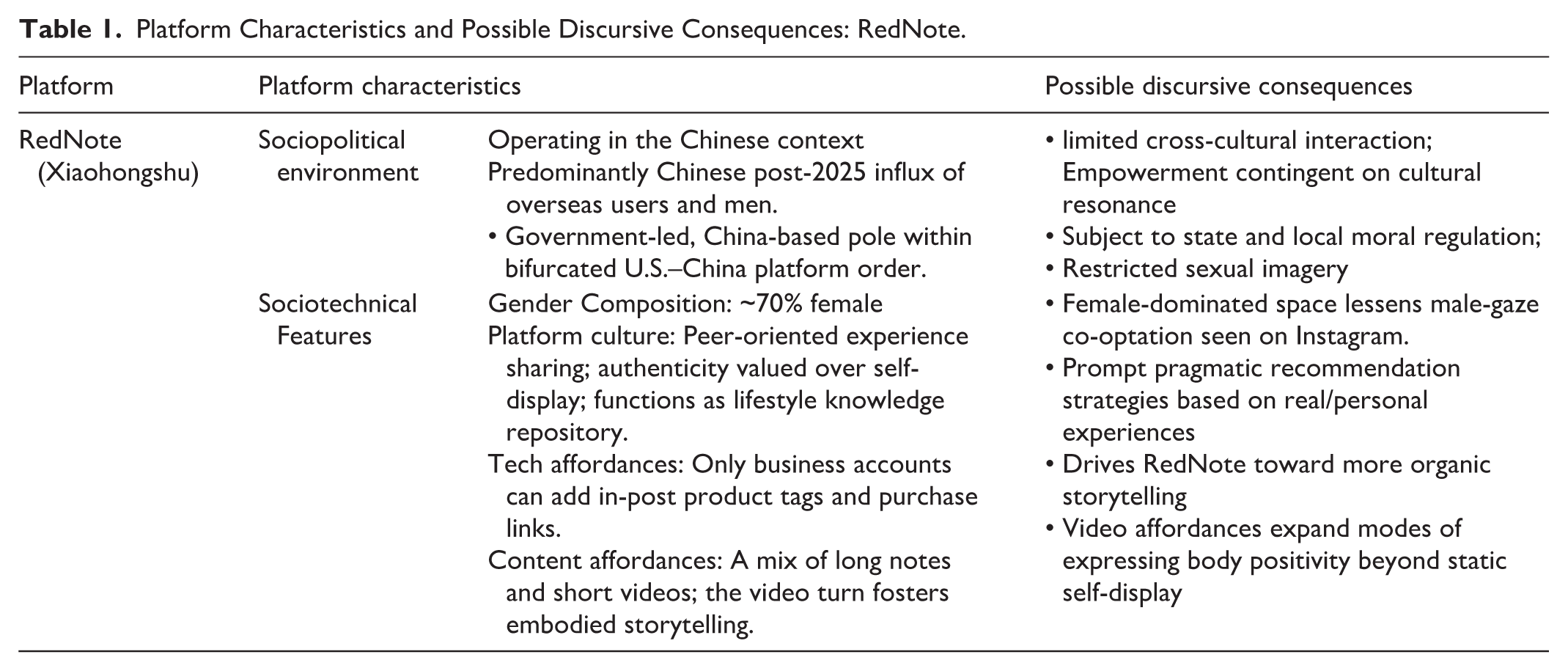
Besides, while earlier analyses primarily focused on photo-based BOPO Post (Vandenbosch et al., 2022), both platforms have in recent years experienced a distinct video turn, allowing users to upload clips exceeding 60 s (Xiaohongshu, 2020; Instagram, n.d.-a). As video enables meaning to unfold temporally through motion, sound, and narration, this shift may foster new ways of constructing body positivity—for instance, making it easier to express bodily positivity through the body’s capabilities and activities rather than sexualization when the body’s purpose and movement remain in view, as suggested by a recent study of BOPO videos on TikTok that found lower levels of objectification than earlier Instagram-based research (Harriger et al., 2023). Yet whether video has become the dominant medium for BOPO posts—and how popular video-based BOPO elements are articulated—remains unclear, as most analyses still use coding schemes for static imagery and rarely account for posts’ actual visibility or circulation (Harriger et al., 2023). This highlights a methodological imperative to integrate network and qualitative analyses to capture the evolving articulations of body positivity on RedNote abductively. As increasingly video-based expressions surpass earlier image-centric forms in scope and complexity, an abductive approach may be better suited to capture this complexity than the predefined coding frameworks commonly employed in prior research on static imagery. Table 1 summarizes the sociopolitical and sociotechnical features of RedNote.
Platform Characteristics and Possible Discursive Consequences: RedNote.
Based on our theoretical framework and existing literature, we propose the following research questions:
RQ1. Who are the participants engaging with
RQ2. What
RQ3. How is postfeminist sensibility reconfigured through body-positivity discourses within #RejectBodyAnxiety posts on RedNote, and what broader implications does this hold for global postfeminist discourse?
Method
Data Collection
Since RedNote does not provide a research-accessible API and its app displays algorithmically personalized feeds that vary across users (Wan et al., 2025; Zhai, 2025), we instead used the hashtag’s public web page, which requires no login and presents a uniform, non-personalized list for all users, ensuring the universality of the dataset. To capture the widely endorsed BOPO discourse during our study period, we anchored our data collection in the “most popular” section of the #RejectBodyAnxiety main page. From 18 to 24 April 2024, we conducted daily data collection at 11:00 p.m., recording all posts that were visible on the section homepage at the time of each collection rather than posts published during that period. This approach helped mitigate daily fluctuations and provided a more stable representation of the overall pattern of popular discourse. In total, 1915 unique posts were collected, published between 11 June 2021 and 24 April 2024.
Data Analysis
Hashtag Co-occurrence: Examining the Breadth of the #RejectBodyAnxiety
To map the discursive breadth of #RejectBodyAnxiety, we began with a descriptive analysis of articulating subjects (authors) and articulated elements (hashtags) (RQ1), followed by a hashtag co-occurrence network analysis to trace frequently co-occurring hashtags and infer the preliminary contours of discursive articulation (RQ2). This approach has been widely used to map and interpret large-scale online discourse, such as the “Make America Great Again” movement or e-cigarette debates (Eddington, 2018; Kostygina et al., 2021).
The co-occurrence network was implemented in Python using the NetworkX framework, which functioned as an automated program to execute user-defined procedures for constructing and processing network data (Hagberg et al., 2008). Consistent with previous studies (Eddington, 2018; Kostygina et al., 2021), hashtags were represented as nodes, and their co-occurrence as edges. As #RejectBodyAnxiety was a shared hashtag across all posts, it was removed from the network to avoid artificially inflating connectivity between otherwise unrelated hashtags.
Since the structure of the co-occurrence network could not be predetermined, we applied two weighting strategies in parallel to provide complementary views of which articulations gained symbolic prominence within the assemblage: (1) The frequency-based model treats each co-occurrence of a hashtag pair in a post as contributing 1 to the corresponding edge, regardless of differences in post visibility. While straightforward, this model can misrepresent which articulations are genuinely salient when the dataset contains extensive use of repetitive or formulaic hashtag co-use across large volumes of low-engagement posts. For instance, a pair appearing in 100 posts with zero likes would receive a cumulative weight of 100—outweighing another that appears once in a post with one million likes, which would count as only 1. (2) The engagement-weighted model multiplies each co-occurrence by the number of likes the corresponding post received, therefore downscaling the weight of hashtag pairings that are mass-applied across low-visibility posts, while highlighting articulations that emerge in widely circulated content.
We present the engagement-weighted network results in the Results section, while the frequency network results are reported in Appendix B. We used the Louvain algorithm for community detection because it is computationally efficient, supports weighted networks, and does not require all clusters to be fully connected (Blondel et al., 2008). The algorithm uses a greedy optimization to maximize modularity—effectively identifying groups of hashtags that frequently co-occur with one another but rarely with those outside their group (Suarez et al., 2025). This makes it especially suitable for hashtag co-occurrence networks, where loosely connected or even disconnected clusters often reflect niche discursive patterns rather than noise. While newer algorithms, such as Leiden, improve internal cohesion by enforcing fully connected communities (Traag et al., 2019), such structural consistency is more relevant for diffusion or infrastructure networks. In contrast, Louvain better captures the semantic diversity and expressive fragmentation inherent in platform-based discourse.
Before conducting the semantic network analysis, we merged synonymous hashtags that convey the same meaning in Chinese but differ only in word choice or capitalization, such as #微胖女生” and #微胖女孩 (both translated as #MidsizeGirls), and #GirlsTalk and #girlstalk. Merging them prevents redundant nodes and ensures that the network reflects meaningful conceptual relationships rather than superficial linguistic variations.
Critical Thematic Analysis: Examining the Depth of the #RejectBodyAnxiety
While hashtag co-occurrence network analysis inductively identifies hashtag clusters and broader frameworks, their discursive meanings remain indeterminate without contextual reading (Adriaansen, 2024). We therefore integrated these insights into a follow-up critical thematic analysis (CTA) of the top 200 most-liked posts—capturing 88% of total likes—to examine how users articulate meanings that reinforce or challenge dominant cultural ideologies (
Critical thematic analysis (CTA) is a critical qualitative approach developed by Chen and Lawless (2025) as an extension of reflective thematic analysis (RTA; Braun & Clarke, 2006). Reflective thematic analysis does not predefine coding categories based on theory; rather, it proceeds through open coding guided by theoretical sensitivity. Consequently, it is data-driven rather than theory-driven, relying primarily on inductive rather than deductive reasoning (Braun & Clarke, 2006; Braun et al., 2019).
Building on this foundation, the first phase of CTA—open coding—adopts the core logic of RTA, following its conventional procedures to inductively identify recurrent patterns in the data without relying on predefined categories (Braun & Clarke, 2006; Nowell et al., 2017). This data-driven approach is particularly well suited for capturing emergent themes in online discourses and has been widely recognized and applied in prior studies (e.g. Clark, 2016; Harmer & Lewis, 2022). In our study, it enables the inductive exploration of body-positivity claims articulated in posts under #RejectBodyAnxiety and the ways these claims are supported or contested across user interactions.
The second phase, closed coding, further identifies the broader ideologies that become evident through the recurring patterns uncovered in the previous phase, thereby extending the initial thematic analysis into a critical practice that offers an empirical means to trace and understand, as Chen and Lawless (2025) describe, “what ideologies, positions of power, or status hierarchies are recurring, repeated, and forceful”—a methodological contribution that responds to long-standing critiques of critical research as lacking empirical grounding (Chen & Lawless, 2024). Applied to our dataset, this phase reveals how postfeminist ideologies are articulated, negotiated, and reconfigured within the Chinese digital context, and how they endow unequal social relations with a new language of empowerment and choice, thereby obscuring structural inequalities beneath individualized narratives of autonomy. For instance, when patterns of body-positivity discourse repeatedly center on a particular category of women, this suggests that postfeminist notions of self-empowerment are being redefined around socially acceptable forms of femininity embodied by this specific group—thus normalizing new hierarchies and marginalizing other subject positions.
To better align with our dataset and research objectives, we used hashtag co-occurrence results from prior network analysis as reference points to help identify—and avoid overlooking—potentially important discursive elements and their articulation patterns in large-scale unstructured data, thereby rendering our CTA approach computationally assisted. Two researchers first independently conducted initial open coding of the 200 most liked RedNote posts, examining all available text, captions, thumbnails, and videos in their original Chinese. They then engaged in collaborative discussions to reach alignment on what patterns are evident in the data regarding the advocacy orientations and supporting strategies of body positivity, as well as how these patterns could be named and defined as interpretable themes. The subsequent closed coding phase followed the same approach: each researcher first coded independently, then participated in joint discussions to reach alignment on the identification and naming of patterns regarding how the previously identified body positivity patterns were linked to postfeminist sensibilities.
Although all RedNote posts analyzed in this study were publicly accessible, we acknowledge that public visibility does not necessarily mean that users anticipated being identifiable in research contexts (Townsend & Wallace, 2016). Following Townsend and Wallace’s (2016) emphasis on contextual privacy and the risk of re-identification, when presenting illustrative examples, we anonymized usernames, replaced original images with AI-generated simulations, and semantically translated and rephrased quoted texts across languages to prevent re-identification.
Results
The Breadth of #RejectBodyAnxiety
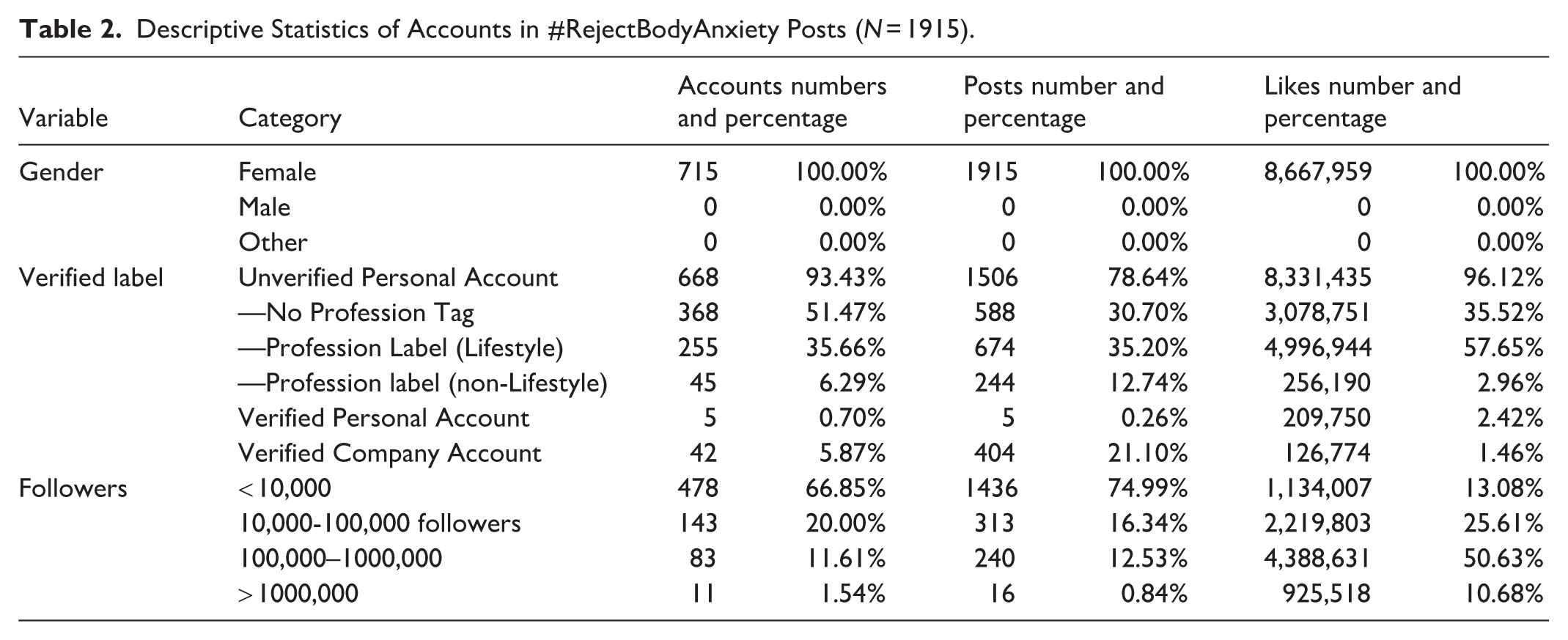
To map the discursive breadth of #RejectBodyAnxiety, we first identified the main participants of the movement. The results confirm that at the account level, the movement is overwhelmingly driven by grassroots female creators rather than elite or institutional actors, validating its relevance to our theoretical focus on everyday, bottom-up articulations of postfeminism. Among 715 accounts, all self-identified as female; 93% were individuals without verified professions who contributed 79% of posts and received 96% of total likes. No celebrities or feminist organizations were identified, and 86% of accounts had fewer than 100,000 followers. 85% of personal accounts that self-identified their interests were lifestyle creators (n = 255), especially in fashion, fitness, and beauty, generating 35% of posts and 58% of engagement. Table 2 summarizes the user information of those who participated in the #RejectBodyAnxiety movement.
Descriptive Statistics of Accounts in #RejectBodyAnxiety Posts (N = 1915).
In addition, we found that among all 1915 posts, 1541 were video notes, indicating that short videos rather than images have become the dominant form of BOPO discourse.
At the hashtag level, we identified 4095 unique hashtags spanning body descriptors (e.g. #MidSize), aesthetic styles (#ChineseStyle), empowerment (#Confidence), daily life (#MyDailyLife), and commercial products (#HipLiftPants). Despite the high frequency of commercial hashtags like #HipLiftPants, they received limited endorsement, whereas non-commercial hashtags—such as #130Jin, #WomenPower, and #ClassicBeauty—dominated high-engagement posts. Table 3 summarizes top 20 hashtags and their frequencies in posts.
Top 20 Hashtags by Weighted and Raw Frequency in the #RejectBodyAnxiety Posts.

Community detection identified 14 clusters in the engagement-weighted hashtag co-occurrence network and 9 in the frequency network. Figure 1 visualizes the hashtag co-occurrence network, with each cluster distinguished by a unique color. These 14 clusters were further synthesized into eight thematic frameworks based on the common meanings: (1) mid-size outfit, (2) confidence and empowerment, (3) mukbang, (4) body shaping, (5) mid-size aesthetics, (6) dressing freedom, (7) fitness and dieting, and (8) size critique. Table 4 illustrates the eight thematic frameworks and their associated hashtag co-occurrence clusters in the engagement-weighted networks (see Appendix B for frequency network results).

Visualization of the weighted hashtags co-occurrence network.
Community Detection Results Based on Engagement-Weighted Hashtag Co-occurrence Network.

Of these, only the hashtags associated with the Confidence and Empowerment theme closely aligned with Western feminist discourse identified in previous literature (e.g. Caldeira, 2023). Others—such as Mid-Size Aesthetics, Mukbang, and Size Critique—diverged by incorporating locally viral, culturally grounded elements, such as #130Jin, which refers to 143.3 lb as a representation of midsize in China. Together, these themes accounted for approximately 45% of the weighted network.
Thematic frameworks that lacked explicit resistance—and in some cases upheld beauty hegemony, such as Fitness and Dieting—remained visible within the hashtag co-occurrence network. Still, some thematic frameworks directly related to commercial-driven discourses, such as Body-Shaping Products, were less visible in the hashtag co-occurrence network weighted by the number of likes, suggesting low-impact.
Notably, five of the eight frameworks centered on body size descriptors—especially “midsize” (微胖, a Chinese term literally meaning “slightly fuller”), which appeared across clusters and ranked high in degree centrality (see Table 4). Rather than collectively challenging the objectification of body size, the midsize category draws new boundaries—affirming only certain bodies while marginalizing those deemed too large to be considered “not fat.” Although it warrants further contextual unpacking, the prominence of midsize suggests the pervasive influence of postfeminist discourses within the #RejectBodyAnxiety movement.
The Depth of #RejectBodyAnxiety
To gain a deeper understanding of #RejectBodyAnxiety, we identified seven recurrent patterns of discourse through open coding of the 200 most liked posts—each legitimizing body positivity from a distinct perspective and closely aligning with, and substantiating, a framework identified in previous community detection (RQ3). Table 5 provides a summary of the seven discourses and illustrates how they are linked to clusters of hashtag co-occurrences.
Results of Critical Thematic Analysis on the Top 200 Posts.

Note. Four posts (.04 M likes) did not fit into the above categories. These applied alternative strategies related to the above ones—three featured Mubarak, and one showcased the creator’s collection of plus-size figurines to express support for body inclusivity. However, due to their limited presence and low user engagement, we did not establish separate categories for them.
Of the 200 most liked posts, 133 (66.5%) reflected patterns of discourses that reconfigure hegemonic beauty ideals by unveiling and counteracting their extreme features. The “counteracting toxicity” mode (n = 51, 25.5%, 2.43M likes) comprised short videos depicting girls’ struggles to find the right size in shopping malls due to unrealistic beauty standards, aligning with the size critique cluster identified in the quantitative analysis. The “proud exposure” mode (n = 22, 11%, 0.84M likes) corresponds to the confidence and empowerment cluster, showcasing posts that celebrate rather than shame bodies. The “self-disclosure” mode (n = 10, 5%, 0.31M likes), also within the confidence and empowerment cluster, reveals the imperfect, behind-the-scenes side of beauty creators, further exposing extreme beauty standards. Finally, the “aesthetic reframing” mode (n = 55, 27.5%, 2.66M likes), associated with the mid-size aesthetic cluster, highlights alternative beauty styles that challenge hegemonic ideals.
In contrast, 63 posts (31.5%) reflected patterns of discourse that strategically engaged with rather than rejected hegemonic beauty ideals. The “effortless shaping” mode (n = 26, 13%, 0.47M likes) —linked to the body-shaping product cluster—depicts women who do not meet ideal body standards using shaping products to remain fashionable. The “strategic styling” mode (n = 27, 13.5%, 0.7M likes), associated with the midsize cluster, presents outfit guides for women outside the idealized body frame. Finally, the “fitness inspiration” mode (n = 10, 5%, 0.19M likes), tied to the fitness and diet cluster, promotes body transformation as a means of aligning with hegemonic ideals.
These patterns were further distilled through closed coding into two postfeminist operations, informed by postfeminist literature: Selective Subversion and Tactical Conformity. Selective subversion refers to practices that superficially challenge dominant beauty norms while still operating within their parameters, what Gill (2007) and McRobbie (2008) describe as a form of complicit resistance typical of postfeminist sensibilities. In contrast, tactical conformity captures instances where engagement with hegemonic ideals is strategic and pragmatic, making beauty standards appear more attainable rather than dismantling them (Dobson, 2015; Gill, 2008).
Among 200 most liked posts, four posts fell outside the two identified patterns, instead depicting individuals enjoying food (n = 3) and suggesting that indulging in meals is more rewarding than fixating on body ideals, or showcases the creator’s collection of Valala dolls (n = 1), a popular line of Chinese designer toys representing plus-size girls, as a gesture of support for plus-size women. Given their limited presence and low engagement, we chose not to establish a separate category for these posts.
Selective Subversion
Among the four subgroups of Selective Subversion, “counteracting toxicity” uses creative videos to expose the absurdity of the toxic aspects of beauty standards in the Chinese context. In contrast, “aesthetic reframing” and “proud exposure” focus on affirmation, challenging the thin-centric ideal through creative self-representation of midsize creators, showing that larger bodies (primarily mid-size) can also embody beauty. “Self-exposure” features seemingly ideal creators revealing their imperfections, debunking the myth of the “perfect body.”
A notable and unexpected finding is that “aesthetic reframing” re-regulates bodies by aligning with widely respected aesthetic traditions that valorize fullness. This is primarily realized through dramatic transformation videos, where plus-size creators, typically unappreciated under the thin ideal, appear in meticulously styled forms that embody alternative beauty ideals, such as the curvaceous aesthetics of the Tang Dynasty and classic painterly aesthetics. This aligns with the hashtag co-occurrence pattern identified in the Midsize Aesthetic cluster. Figure 2 demonstrates an example of aesthetic reframing.

Example of aesthetic reframing.
Even in “proud exposure”, which most closely aligns with the Western mainstream BOPO framework, body positivity is not conveyed through sexualized or overly exposed bodies but is articulated through creative verbal articulation, anchoring confidence in wit, spontaneity, and intellect, alongside moderately revealed bodies. For instance, one creator opens her video declaring, “I’m going to rock the streets with my belly on display,” before striking confident poses on a beach. In a playful twist, she interacts with a Chinese voice assistant, Xiaodu, whose name phonetically echoes “belly porch” (小肚). Calling out “Xiaodu!” prompts the assistant’s response, “I’m here,” at which point she gleefully pats her belly as if affirming its presence and value. Figure 3 illustrates an example of Proud Exposure.
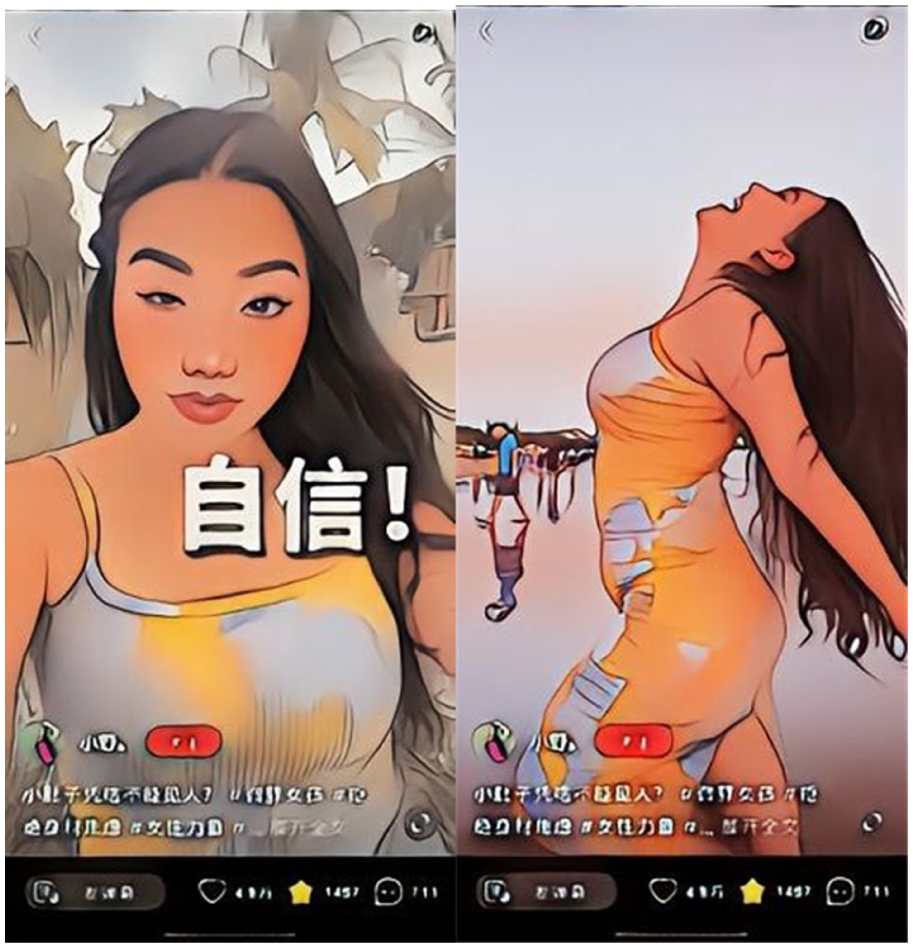
Example of proud exposure.
Another key distinction of selective subversion is its engagement with critiques of external structures and expressions of anger, which are considered rare in Western body-positive discourse (Riley et al., 2022, p. 7). This is most evident in “counteracting toxicity.” These critiques often take the form of toxic scenario reenactments—such as a slender female comedy animator satirizing restrictive sizing by showing how she could only find fitting clothes in the large dog apparel section or performative rebuttals, like a lean female fitness creator lifting three larger men to mock some Chinese boyfriends’ excuse that their girlfriends are “too heavy” for a princess carry. Some posts even trigger chains of critique on broader gender inequality in China in comment sections, as shown in Table 5.
These patterns embody Selective Subversion, emphasizing individualized empowerment and conformity to beauty standards over collective resistance to body objectification. For instance, although “aesthetic reframing” promotes more inclusive beauty standards, high-visibility posts rely heavily on alternative beauty standards constructed through meticulously curated styling and controlled aesthetics. This pursuit of visibility reinforces a normative ideal that remains impractical for most viewers, even creators. A notable example is a plus-size influencer who, after briefly embracing Tang Dynasty aesthetics, shifts to documenting her weight loss journey.
Similarly, while “proud exposure” moves beyond standard body selfies through creative expression, its bold displays are largely confined to inaccessible spaces to ordinary Chinese Females like beaches or exotic locations, which also explains why the “Freedom to Dress” hashtag cluster intersects with tags like #StickyWaterfall and #ChiangMai. Its reliance on exaggerated gestures and performative confidence often frames empowerment as exclusive to highly extroverted women, making it feel unattainable to many.
Likewise, “counteracting toxicity” extends body positivity into structural critique but ultimately gravitates toward safer, culturally acceptable expressions. This is evident in the most widely engaged posts, where #RejectBodyAnxiety and hashtags referencing toxic beauty standards (e.g. #PaperThin, #BMStyle) are strategically embedded within viral RedNote hashtags like #TooReal (80.17 billion views) and #MentalStateFine (2.59 billion views), a pattern also shown in the hashtag cluster Size Compliance (See Figure 1). These hashtags gain visibility because they align with postfeminist sensibilities, channeling critique through humor, aspiration, and culturally accepted femininity rather than confrontation. This articulation not only amplifies reach but also disciplines discourse, reinforcing engagement within emotionally palatable boundaries that ultimately uphold the status quo (Orgad & Gill, 2019). Besides, the critique is overly concentrated on challenging the most extreme ends of toxic thinness ideals, which often stigmatize MidSize bodies as fat, leaving larger bodies unsupported and further marginalized through sisterly reassurances to the MidSize group—such as “You are not fat!”
Moreover, the absence of overt sexualization even within “proud exposure,” the moderation of collective critique in “counteracting toxicity” and “self-disclosure,” and the adaptive strategies evident in “aesthetic reframing” together reveal how RedNote’s sociopolitical and sociocultural environment, shaped by state-guided moral governance, a largely homogeneous female user base, and deeply entrenched beauty ideals such as “pale, young, slim,” interacts with these discourses. These factors collectively channel body-positivity expressions toward Selective Subversion, where empowerment is pursued through self-regulation and aesthetic conformity rather than overt resistance to normative body ideals.
Tactical Conformity
Among the three patterns of Tactical Conformity, “strategic styling” promotes styling techniques that achieve an idealized body shape without altering one’s form, often through transformation videos of ordinary creators in everyday outfits. “Effortless shaping” promotes shaping products like shapewear or dietary fiber chewable tablets, which require physical modification but are presented as effortless. “Fitness inspiration,” while contrasting with others by promoting effort to meet ideal appearance standards, differs from traditional discourse by linking exercise to a healthier approach that separates it from body anxiety, with some posts even asserting true peace of body through this approach.
These patterns illustrate a form of Tactical Conformity, whereby strategic engagement with hegemonic ideals sustains their appeal by making beauty standards seem attainable rather than exposing or dismantling them. The most dominant pattern under this theme, “strategic styling,” bears resemblance to classic Western postfeminist elements such as the TV makeover paradigm (Gill, 2007), but it also diverges in significant ways. Rather than relying on expert authority, it thrives on grassroots participation enabled by social media platforms. Ordinary creators act as visual fitting models rather than expert guides, offering relatable, replicable examples for viewers. This shifts the dynamic from aspirational instruction to peer-to-peer inspiration, enabling faster and more direct imitation than traditional makeover formats.
This model is further supported by what can be described as an “inclusive body-matching network.” Through hashtags such as #130jin (representing a specific weight metric) and #SlimmingEffect (signaling desired outcomes), users can find style references tailored to their body type and goals—reducing the need for trial and error. Figure 4 illustrates a typical example of this practice in action.

Example of an inclusive body-matching network.
This further explains the discursive role of body size categorization and datafication hashtags identified in the previous hashtag co-occurrence network (see Table 4). This highly pragmatic postfeminist sensibility not only introduces new makeover paradigms but also distinguishes itself from the commercialization prevalent in Western postfeminism and body-positive hashtags. Unlike overt advertising, popular outfit styling and product recommendation posts align with RED’s “zhongcao” culture—experience-based personalized endorsements that omit direct product links and often leave out brand names, prompting interested users to seek details in the comments.
While the prior analysis of the full dataset shows that corporate accounts flood the platform with formulaic shapewear posts—overtly commercial, template-driven content that superficially engages with body positivity—only one ranked among the dataset’s 200 most-liked posts, reinforcing that widely favored content integrates seamlessly rather than merely capitalizing on #RejectBodyAnxiety. This may also explain why “fitness inspiration,” so influential in Western contexts, gains little traction here. Compared to the tangible, practice-driven strategies of “strategic styling,” fitness inspiration’s motivational rhetoric feels hollow, with users often responding skeptically—such as in a post where a young mother showcased her rapid postpartum weight loss, prompting a comment: “With everything you’re doing, how do you even have time to take care of the baby?”
Although tactical conformity strategies appear to reduce reliance on intensive body work by offering lighter or more desirable alternatives, they merely shift the pressure from body modification to other forms of appearance work. This is evident in phrases found in some posts, such as “competing in aesthetics is better than competing in body shape.” Unlike body work, which has measurable limits like weight or size, aesthetic refinement has no clear endpoint, potentially drawing users into an endless cycle of beauty competition. While social media affordances make aesthetic knowledge and practices more accessible, they primarily benefit those already closer to conventional beauty standards—potentially widening the gap for more marginalized groups.
The limited presence of fitness-inspiration content, coupled with the proliferation of “effortless shaping” and “strategic styling” recommendation videos on RedNote, underscores how China’s distinctive sociopolitical and sociotechnical conditions mediate body-positivity discourses. Rather than framing bodily transformation through discipline and self-surveillance, RedNote creators often emphasize attainable, everyday strategies consistent with the platform’s zhongcao ethos of peer-based recommendation and experiential sharing. The platform’s affordances further enable these dynamics: restrictions on direct product monetization and its reputation for authentic, community-oriented communication encourage users to frame body positivity through mutual guidance rather than competitive display.
The growing dominance of video-based formats amplifies this participatory ethos. Videos allow creators to narrate personal routines, demonstrate styling techniques, and discuss emotional struggles in real time, transforming body-positivity expression from static self-presentation into interactive, process-oriented storytelling. This temporal and embodied form of communication aligns with RedNote’s supportive platform culture, where viewers frequently respond with empathy, encouragement, and shared experience. Yet this positive and pragmatic platform culture also channels feminist energy toward “strategic styling”—the pursuit of aesthetic manageability and self-optimization—rather than toward collective critique of normative beauty ideals. As a result, body positivity on RedNote often manifests less as resistance to hegemonic norms than as their negotiated recalibration within culturally and politically permissible boundaries.
Discussion
This study examines the breadth and depth of the #RejectBodyAnxiety movement on RedNote to explore how large-scale, bottom-up hashtag feminism in China inadvertently produces and circulates postfeminist discourses. Through hashtag co-occurrence network analysis and critical thematic analysis, we investigate how discursive elements and their patterns of articulation reveal emerging postfeminist discourses within hashtag feminism.
Our findings demonstrate that regrading to the breadth, #RejectBodyAnxiety has introduced diverse, personalized body-positive discourses shaped by creators’ varied backgrounds. The open coding of critical thematic analysis highlights the need to move beyond reliance on the Western body positivity patterns, which often centers on confident body selfies and have been criticized for emphasizing the “what” without addressing the “how” or “why.” Highly engaged posts using #RejectBodyAnxiety offer new methods and perspectives for thinking about the body—providing the “how”—while also critiquing the hegemonic punishment of non-ideal body types—offering the “why.”
At the same time, regarding the depth, however, both selective subversion and tactical conformity—the key themes characterizing #RejectBodyAnxiety discourses—are associated with postfeminist sensibility. These discourses largely individualize efforts to counter body objectification or offer alternative body and aesthetic standards that ultimately place users within a new framework of hegemonic expectations. This is evident in patterns such as the disproportionate prominence of #Midsize and related body attribute hashtags in the hashtag co-occurrence network.
The seemingly distinct discourses within the #RejectBodyAnxiety movement—identified through hashtag co-occurrence and critical thematic analysis—ultimately converge to sustain a postfeminist body discourse: “ideal positivity.” This discourse selectively absorbs critique, softening the anxiety-inducing extremes of hegemonic beauty ideals to make them appear more attainable (Selective Subversion), while offering practical strategies that frame this pursuit as achievable and anxiety-free (Tactical Conformity), thereby transforming them into seemingly positive forms. Figure 5 illustrates ideal positivity and demonstrates how the seven patterns of body-positivity discourse—and the two postfeminist sensibilities embedded within them—articulate this ideal.

Ideal positivity.
In addition, the findings reveal that RedNote’s sociopolitical and sociocultural environment plays a constitutive role in shaping how body-positivity discourses are articulated and disseminated on the platform. The relative absence of overt sexualization, the moderation of collective critique in “counteracting toxicity” and “self-disclosure,” and the adaptive strategies evident in “aesthetic reframing” collectively reflect the influence of state-guided moral governance, a largely homogeneous female user base, and deeply entrenched beauty ideals. These intertwined factors channel body-positivity expressions toward Selective Subversion, in which empowerment is enacted through self-regulation, modest self-expression, and aesthetic conformity rather than direct resistance to normative body ideals.
Moreover, the limited presence of fitness-inspiration content, alongside the proliferation of “effortless shaping” and “strategic styling” recommendation videos, underscores how China’s distinctive sociopolitical and sociotechnical conditions mediate the articulation of body positivity. Rather than centering bodily transformation through discipline and self-surveillance, RedNote creators foreground attainable, everyday strategies aligned with the platform’s zhongcao culture of peer-based recommendation and experiential sharing. The platform’s affordances reinforce this orientation: limited monetization mechanisms and a culture of authenticity foster expressions of mutual guidance over competitive display, while the increasingly video-based format amplifies participatory, narrative, and affective dimensions of body-positivity communication.
Video affordances, in particular, enable creators to demonstrate personal routines, styling techniques, and emotional reflections in real time, transforming static self-presentation into dynamic, process-oriented storytelling. This temporal and embodied form of expression aligns with RedNote’s supportive and community-driven platform culture, where users frequently respond with empathy, encouragement, and shared experience. Yet this positive and pragmatic orientation also redirects the feminist movement toward Tactical Conformity rather than collective critique of hegemonic beauty norms. Consequently, body positivity on RedNote often manifests not as resistance but as a negotiated recalibration of dominant ideals within the boundaries of sociopolitical permissibility and cultural acceptability. Our analysis thus highlights both the flexibility and transnational nature of postfeminist sensibilities, as well as how RedNote and Chinese postfeminist articulations reconfigure these sensibilities within localized sociopolitical and cultural contexts.
Another key contribution of our study is accounting for hashtags’ actual influence using an engagement-weighted hashtag co-occurrence network. Understanding which narratives genuinely resonate in social media spaces is crucial in examining effective strategies to promote body positivity and challenge beauty hegemony. For example, formulaic commercial content accounted for a substantial share of posts yet attracted little engagement in our study, which limited its resonance with users. This underscores the need to prioritize engagement metrics (e.g. likes and shares) over post volume when evaluating hashtag movements.
While the body positivity discourse identified on RedNote often reflects postfeminist contradictions, it also reveals the movement’s adaptability and potential for transformation—particularly considering the rising prominence of the #RejectBodyAnxiety campaign. Moving forward, it will be essential to continuously monitor, interpret, and reimagine emerging body narratives—especially those that move beyond traditional frameworks—while critically addressing their limitations. Such efforts are vital for cultivating more inclusive and transformative body positivity discourses that meaningfully advance feminist goals.
Conclusion
This study contributes to scholarship on hashtag activism and body positivity by analyzing the breadth and depth of postfeminist discourses in the #RejectBodyAnxiety movement. However, several limitations remain in this study. First, despite focusing on one of China’s most prominent body positivity hashtags, the study does not capture the full spectrum of BOPO discourse, which may unfold under different hashtags. Second, while likes were used as a proxy for resonance, user engagement may reflect diverse motivations and does not necessarily indicate endorsement of body-positive discourses. Third, while RedNote’s cultural–political context and techno-social configuration may have fostered the spread of this pragmatic postfeminist sensibility—showing patterns not highlighted in earlier Western-centric BOPO research—the study does not include a direct empirical comparison with Western platforms. Hence, our conclusions mainly extend existing understandings of postfeminism and body positivity in the Chinese digital context, rather than serve as direct evidence of cross-cultural difference.
Future research could explore other body-related hashtags to better capture the broader discursive terrain, extend the dataset across longer timeframes to include the latest dynamics, and incorporate interviews with RedNote creators to gain deeper insight into their discursive strategies. Experimental studies may also help assess how different forms of exposure to these narratives influence users’ body image perceptions.
Despite its limitations, this study reveals new iterations of postfeminism, showing that its key contradictions stem not from external forces such as commercial appropriation or misogynistic participation, but from the empowerment-oriented infrastructures of hashtag activism themselves. Through collective mechanisms of inclusion—such as the “body-matching network” and other participatory infrastructures that amplify collective agency—these systems make body positivity no longer dependent on overturning or fully conforming to dominant beauty ideals. Instead, it is redefined as a pragmatically attainable ideal that enables individuals to pursue an idealized appearance without undermining positivity itself—what we term ideal positivity. This operates through two interrelated tactics: selectively softening the most extreme elements of the ideal (Selective Subversion) and employing subtle, easily manageable techniques—rather than the strenuous bodily discipline of earlier postfeminism—to appear closer to it (Tactic Conformity). While seemingly more inclusive, this process merely redistributes oppression: in the Chinese context, legitimizing mid-size bodies while further marginalizing larger ones and shifting disciplinary power from bodily labor to more elusive forms of aesthetic work, reinforced and naturalized through user-generated hashtags whose vernacular creativity amplifies local resonance around these ideals.
Although RedNote’s female-dominated user base, authenticity-based recommendation logic, limited shoppability of posts, and its embedding within China’s distinctive sociopolitical environment may all contribute to the articulation of this pragmatic postfeminist sensibility, our findings suggest similar discursive dislocation (Laclau & Mouffe, 2014) in the legitimacy of feminist discourses—including body positivity—can be observed across other global contexts, whose legitimacy, once grounded in rejecting unattainable and oppressive ideals (Cohen et al., 2020), is now being unsettled by platform-based infrastructures of empowerment, thereby opening new possibilities for the reconfiguration of postfeminism—although the extent of this reconfiguration may vary depending on different platforms and their broader social contexts.
Supplemental Material
sj-docx-1-sms-10.1177_20563051261419392 – Supplemental material for “You Are Not Fat”: The Postfeminist Contradiction in #RejectBodyAnxiety—A Computationally Assisted Critical Thematic Analysis
Supplemental material, sj-docx-1-sms-10.1177_20563051261419392 for “You Are Not Fat”: The Postfeminist Contradiction in #RejectBodyAnxiety—A Computationally Assisted Critical Thematic Analysis by Lei Chen, Kun Zhou and Sang Jung Kim in Social Media + Society
Footnotes

Ethical Approval
No ethical approval was required for this research, as no human participants were involved.
Consent to participate
No informed consent was required, as this research involved no human participants.
Author Contributions
Lei Chen: Conceptualization, Methodology, Analysis, Writing – original draft, Writing – review & editing, Data curation, Visualization.
Kun Zhou: Formal analysis – Qualitative Coding, Writing – original draft.
Sang Jung Kim: Writing – Review & editing.
Funding
The authors disclosed receipt of the following financial support for the research, authorship, and/or publication of this article: This research was supported by the Arts and Humanities Initiative (AHI) program at the University of Iowa.
Declaration of Conflicting Interests
The authors declared no potential conflicts of interest with respect to the research, authorship, and/or publication of this article.
Data Availability Statements
The data supporting the findings of this study are available from the corresponding author upon request.
Author biographies
References
Supplementary Material
Please find the following supplemental material available below.
For Open Access articles published under a Creative Commons License, all supplemental material carries the same license as the article it is associated with.
For non-Open Access articles published, all supplemental material carries a non-exclusive license, and permission requests for re-use of supplemental material or any part of supplemental material shall be sent directly to the copyright owner as specified in the copyright notice associated with the article.
