




Abstract
In 2017, the MeToo hashtag spread across the globe. However, it showed limited success in the Japanese Twittersphere and instead inspired local initiatives such as #WeToo and #Furawādemo (“flower demo”). To understand this reformulation, we analyzed 15 interviews with Japanese social media users and 119 Japanese newspaper articles. The results corroborate the framework we label VTM (values, topics, media), suggesting that an intersection between perceived Japanese values, the topic’s gendered and sexual nature, and media affordances explain the movement’s local development. While perceived Japanese values clash against those associated with #MeToo, new formulations “soften” the protest by blending in values such as reserve and harmony. Overall, we show how perceptions of popular values rather than values as essential orientations shape activism. Finally, we discuss the study’s implications for understanding cultural variance in cyberactivism, highlighting how divergent notions of “safe space” shape such movements.
Introduction
In late 2017, the #MeToo movement lit up Twitter with personal testimonies about sexual harassment and violence. While the movement propagated from the United States to many parts of the world, the hashtag did not diffuse widely in the Japanese Twittersphere (e.g. Anderson and Toor, 2018; Dalton and Norma, 2022), the platform’s second-largest market after the United States with roughly the same number of daily active users (Heath, 2022). To elevate the conversation on sexual violence in Japan, some local activists rebranded the hashtag with plural pronouns in English, #WeToo and #WithYou (O’Mochain, 2020). In addition, #Furawādemo—a hashtag in Japanese and a transliteration of “flower demo”—was coined. This latter movement, which is still active, started as a street protest against controversial court rulings on sexual violence (Kitahara, 2021) and its online manifestation typically features photographs of flowers and demonstrators. Against this background, we ask: Why did #MeToo not culminate in a deluge of personal testimonials in Japan and instead inspire numerous offshoot initiatives such as #Furawādemo?
While a growing body of research has examined hashtag feminist activism (e.g. Clark, 2016; Keller et al., 2018; Mendes et al., 2018), its focus remains primarily on Western contexts (Quan-Haase et al., 2021). The literature examining the #MeToo movement in Japan is limited in scope. Addressing this gap, the current study aims to understand the localization of cyberactivism by looking into the multiple forces that shape the #MeToo movement in one country.
We hypothesize that the weak presence and transmutation of #MeToo in Japan can be explained by what we name the VTM (values, topics, media) framework. Values are broadly defined as core beliefs about the desirable, which serve as principles that direct social actors’ evaluations and behavior (Rokeach, 1973; Schwartz, 2012). Yet in line with the social constructionist approach (Berger and Luckmann, 1966), we seek to understand values not as essential entities but as social constructs, claiming that people act according to values they perceive as socially accepted. In other words, people align with what they believe are the values of the generalized other (Mead, 1934) which in turn helps to reinforce those values. In this process, “individual’s perceptions of their culture’s consensual beliefs” produce “culturally typical actions and thoughts” (Zou et al., 2009: 580). Regarding the topic of the #MeToo movement, we hypothesize that perceptions of sexual and gender issues contribute to the transformation of activism. Hashtag activism cannot gain momentum without voluntary participation on social media platforms. While Twitter is a global platform, its affordances—broadly understood as the dynamic relationship between people and technological features—are context- and culture-dependent (Davis, 2020). We thus assume that local perceptions about speaking out on the medium and attendant privacy concerns may have also shaped the propagation of personal stories.
In what follows, we first survey work on cultural values and attitudes toward privacy, gender, and sexuality in the Japanese context. After presenting the study’s methods, we show how the VTM framework helps explain the reluctance to adopt #MeToo in its initial viral format, as well as its local reformulations. We conclude by suggesting that the model can explicate the articulation of transnational social media movements in specific local contexts.
Literature review
“The theory of Japaneseness (Nihonjinron)” and its circulatory function
What makes Japan unique and what it values as a society has long been one of the country’s most popular publishing topics (Funabiki, 2002), with more than 2000 books on the topic published before the turn of the 21st century (Aoki, 1990). In addition, a plethora of academic studies have focused on Japanese values and “value-charged cultural behavior” (Lebra, 1976), consistently highlighting harmony (e.g. Bellah, 1957; Creighton, 1990; Whiting, 2009; Wierzbicka, 1991), collectivism (Hamaguchi, 1985; Markus and Kitayama, 1991; Triandis, 1995), conflict avoidance (Abe, 1995; Clancy, 1987), and conformity (Miller and Kanazawa, 2000) as crucial to Japanese culture.
The literature also calls attention to the interplay between these values. For example, Bellah (1957) claims that harmony and the maintenance of collectivity are realized through conformity and conflict avoidance. Similarly, indirect and ambiguous communicative styles are connected to societal homogeneity and striving to maintain harmony. According to this perspective, “individuals may hold their own view, but, in the interests of group harmony, should not express it if it conflicts with the opinions of others” (Clancy, 1987: 215). Hierarchy has also been posited as a governing principle of social relations in Japan, with the equilibrium around power rankings regarded as contributing to stability (e.g. Hofstede and Soeters, 2002; Nakane, 1967).
As the first industrialized country outside the West, Japan has constantly questioned its position in the world and tried to establish its identity in contrast to other countries. The construction of a unique Japanese identity was supported through the production and consumption of mass culture books (Funabiki, 2002) that also served as the basis for cultural nationalism (Yoshino, 1992). Various scholars have expressed criticism of such popularized theories of Japaneseness, questioning its essentialism, as well as the political, ideological, and commercial interests feeding it (e.g. Befu, 2001; Kubota, 2003). Regarding gender, criticism has been directed against the national identity narratives that associate “agents of change in the public sphere” with masculinity and “sources of nurturing love,” and “the bearers of tradition” with femininity (Morris-Suzuki, 1998: 137). Concerning postcolonial discourse, Iwabuchi (1994) argues that a notion of Japaneseness helps maintain national unity vis-a-vis the West through a process where Western Orientalism and Japanese self-Orientalism symbiotically feed each other. Moreover, as popular texts shape people’s understanding of themselves and the world around them, people may internalize notions of “Japanese uniqueness” and match behavior to perceived cultural values, circularly re-enforcing and perpetuating these values. In this process, they enact self-fulfilling prophecies in cultural stereotypes and identity formation (Vignoles, 2018), especially in comparison to other cultural groups (Schwartz et al., 2014).
Values and social media use in Japan
Beyond the general body of work on Japanese cultural values, a much smaller volume of studies focused on the intersection between those values and social media platforms. These latter studies suggest that users perceive various platforms to operate on different values and express themselves accordingly. For example, contrasting individualism and collectivism, Harihara (2014) finds that people who identify as individualistic are more likely to use Twitter, and the effect is greater when they perceive other people around them as individualistic. Similarly, Takahashi (2014) suggests that on the Japanese social media mixi and LINE, people carefully express themselves so as not to deviate from the norms and values of multiple uchi (inside a group), whereas Twitter allows soto (outside group) modes of communication where they do not have to be concerned with others’ reactions. These studies align with so-called individualistic patterns of participation on Twitter. For example, Hallinan et al. (2021) show an extensive focus on self-related goals in Japanese New Year’s resolution tweets. Acar and Deguchi (2013) found that Japanese students tend to tweet about themselves, explaining this behavior by the anonymity and loosely connected networks facilitated by Japanese Twittersphere, which, unlike direct interpersonal communication, allow for expression without worrying about social norms. Similarly, Nozawa (2012) asserts that “nobodyness” underpins virtual communication in Japan, where the anonymous self rather than the identifiable self is preferred. Indeed, this anonymous mode of communication, detached from existing social groups, liberates people from “the exposure sensitivity of the outer self” (Lebra, 1983: 193), which leads to concerns over what other people will think about one’s behavior.
Such sensitivity to exposure translates to strong notions of privacy, in the sense of people’s control over information about them (Rössler, 2004). Concerns over digital privacy shape how social media in general, and Twitter in particular, is used in the Japanese sphere (Tominaga et al., 2018). A steady stream of reports and studies (e.g. Sōmushō (Ministry of Internal Affairs and Communications Japan), 2014) has shown that social media users in Japan prefer anonymous communication more than their counterparts in other countries. For example, at the dawn of the social media age, researchers found that Japanese users preferred more anonymity than Americans after analyzing a news forum (Morio and Buchholz, 2009) and Myspace (Bovee and Cvitkovic, 2009). Hashimoto et al. (2011) reported that Japanese respondents worry about sharing photographs of their faces online the most (85.2%) among 10 countries across Asia, Europe, and the Americas. As detailed below, these perceptions and behaviors are intensified when the subject matter intersects with sexism and misogyny.
Sexism and misogyny in Japan
Essentially, sexism can be treated as an ideology that maintains the hierarchical social order and preserves control over women on the basis of gender. As such, it often “distinguishes between ‘good’ and ‘bad’ women, by the lights of their conformity to patriarchal norms and values” (Manne, 2017: 263). In cyberspace, sexist practices materialize as aggression, harassment, and abuse directed toward women (e.g. Banet-Weiser and Miltner, 2016; Jane, 2014; Mantilla, 2013).
Patriarchy in its modern form and accompanying misogyny have solidified in Japan through the process of nation-building and industrialization (Morris-Suzuki, 1998; Nakamura, 2021), alongside rapid economic growth in the latter half of the last century (Ueno, 1991). As in the West, sometimes women are projected as caring mothers (Tama, 2001) and other times sexualized, with the commodification of eroticized sexual violence naturalizing heinous crimes and leading to victim-blaming (Burns, 2005). In addition, the observance of harmony through modesty is required more for women than men (Iwao, 1993). This tendency is evident even in the 21st century, when a book by an achieved woman advising other women to stay polite and refrain from releasing anger became a commercial success, a tendency ascribed to “the public’s appetite for books on traditional values” (Wallace, 2007).
The judiciary system fortified these values in the first court case on sexual harassment, where a judge deemed that the plaintiff’s behavior disrupted harmony and reduced the monetary compensation she received (Shokuba, 1992, as quoted in Muta, 2008) because “the strict cultural code . . . expects Japanese women to be generous, tender, modest, and reserved” (Muta, 2008: 57). A quarter-century later, Shiori Itō, a female journalist who accused a male senior journalist of sexual assault and was featured repeatedly in English-speaking media as a symbol of the #MeToo movement in Japan, faced severe backlash (O’Mochain, 2020) and was constantly framed as a “bad citizen” and a “hysterical slut” (Starkey et al., 2019), forcing her to move out of Japan for her safety. Itō’scase epitomizes persistent cultural norms that punish and blame women who speak up, and signal to sexual violence survivors that they should feel ashamed (Tan and Liu, 2022; Tsunoda, 2013). Still, Japanese women are looking for activist venues to raise their voices, a process we explore in the next section.
From “me too,” to #MeToo, to #Furawādemo and #WeToo
Even within the United States, the story of “me too” can be told as one of cultural migration. Tarana Burke, an African-American women activist, coined the phrase in 2006 to provide Black and Brown women with a space to heal from gender-based violence. Burke traveled across the United States, speaking in workshops and panels about the power of empathy between survivors as a source of empowerment and change (Burke, 2017). A decade later, in the wake of the allegations of sexual misconduct by Hollywood producer Harvey Weinstein, American actor Alyssa Milano ignited the transformation of the slogan into a viral hashtag. Milano proposed mobilizing #MeToo to share personal testimonies of sexual violence, and social media was immediately flooded with stories of harassment and abuse, with the hashtag tweeted nearly a million times within 48 hours (CBS, 2017).
#MeToo was valorized as a successful case of “hashtag activism,” which unearths the collective voice of the marginalized and provides a framework to highlight everyday experiences (e.g. Bennett and Segerberg, 2012). Feminist hashtags often produce “affective solidarity” (Hemmings, 2012) that connects participants and turns social mobilization into a “feminist meme event” (Thrift, 2014).
The hashtag, which was successfully taken up in many countries, was not as widespread in Japan (e.g. Sen, 2020), but did inspire several hashtag variations in attempts to gain more visibility and popularity. First, #WeToo was coined by a newly founded activist group and employed to stress the aspect of solidarity (Mori and Oda, 2018). Second, #WithYou was initiated by a group of activists to show solidarity with a woman TV reporter who accused a top bureaucrat of sexual harassment and faced severe backlash (Mishima et al., 2018). Finally, the Furawādemo movement began as a street rally in 2019 in response to a series of court acquittals in sexual assault cases and has since evolved into a combination of street rallies and digital representation organized by the #Furawādemo, together with the #WithYou, #WeToo, and #MeToo hashtags (Dalton and Norma, 2022; Kitahara, 2021). These new formulations acted as anchors of combined online and offline activities, with ongoing demonstrations across Japan providing “safe spaces” for women to share their pain and anger, support each other, and speak up. Such formulations, according to Miura (2021), aligned the local movement with Tarana Burke’s original envisioning of “me too” as a space dedicated to healing and the exchange of empathy. Similarly, Lilja (2022) characterized the Furawādemo movement as an important moment in recent Japanese activism and as a breeding ground for new resistance organizations.
The initial #MeToo campaign’s silence in Japan was reported by various media outlets and drew some scholarly attention. O’Mochain (2020), for example, notes that the movement did not evolve into a broad grassroots campaign in Japan, mentioning multiple possible causes such as the lack of education and legal protection, gender inequality, and the eroticization and commodification of the topic. Some argue that the movement in Japan was suppressed due to an emphasis on group harmony, and others problematize the limited local media coverage (Dalton and Norma, 2022; Donohue, 2020; Hasunuma and Shin, 2019; Lee, 2022).
While such studies provide important insight into several aspects of #MeToo marginalization in Japan, none have attempted to present a more holistic explanation that encompasses both the failing initial hashtag and local reformulation efforts to resuscitate it. Addressing this gap, we propose a systematic approach to studying the movement, utilizing local data and the aforementioned VTM framework.
Method
This study builds on interview data from a larger cross-cultural project of five languages about values and social media posts in various genres. From November 2020 to January 2021, we conducted 20 semistructured interviews via Zoom in Japanese with Japanese residents, who were recruited through a global public opinion research firm, reflecting a balance of genders and a range of ages and educational backgrounds. For this specific study, we showed 15 participants (see Appendix 1 for a breakdown), a sample set of three English #MeToo tweets with translations and another set of three local #Furawādemo versions in Japanese and asked them about the values they associate with the movement and their perception of Japanese values (see Appendix 1 for the list of questions). The interviews were recorded, transcribed, translated into English, and then analyzed as described below.
To substantiate the interview data, we collected 474 articles with the keyword “MeToo” from four national Japanese newspapers published between 2017 and 2020 (Asahi, Mainichi, Nikkei, and Yomiuri). While these newspapers are written in Japanese, MeToo in alphabet form was used with its translation (watashi mo) or transliteration (mītsū), allowing us to search the database by “MeToo” to collect those articles. We reviewed their full text and selected for our sample only articles that explained why people are reluctant to speak up (n = 119).
We applied a qualitative thematic analysis (Lindlof and Taylor, 2019) to analyze the interview and newspaper data. Following recent developments in the grounded theory approach (see Kelle, 2007), we combined previous theoretical groundings (and an emphasis on the three dimensions of the VTM framework) with constant inspection of the data. Several rounds of coding and category development and refinement resulted in the identification of recurrent themes, which we used for final coding (see Appendix 1 for a survey of these categories, alongside selected examples). Data collection and the initial analysis were conducted in Japanese by the first author (a native Japanese speaker). The other English- and Japanese-speaking authors joined the analysis at the second stage, with translated materials constantly examined against the Japanese version to ensure analytical reliability.
Findings
As detailed below, our findings indicate that the VTM framework provides a deeper understanding of the #MeToo reformulation in Japan. Perceived values, the nature of the topic, and the medium’s affordances interact to direct the rejection of the #MeToo format of personal testimony and the embrace of the localized formats. First, we found that the people’s perceptions of values expressed in #MeToo tweets contrasted with those of Japanese culture, while the local formulation of the #Furawādemo was evaluated as “softening” the protest by blending in acceptable Japanese values. Second, the gender-related aspects of the topic, which pivots around misogynistic victim-blaming and the framing of sexuality as a “dirty” taboo, disincentivized speaking up online and also explain some characteristics of the new formulations. Finally, regarding the medium, data indicated two elements—privacy and impression management—that oriented users to remain anonymous, in a way more compatible with the digital Furawādemo movement.
Perceived values
The overarching finding regarding the first facet of our model is that the #Furawādemo can be analyzed as a “compromising” strategy that negotiates the perceived clash between #MeToo and Japanese values. In what follows, we will demonstrate this argument regarding two types of values: communicative and societal. Communicative values (Shifman, 2019; Trillò et al., 2022) apply to desired modes of communication (namely, perceptions of how people should express themselves), whereas societal values reflect broader ways of relating to others (Rokeach, 1973; Schwartz, 2012).
Communicative values
Our first overarching finding relates to the perceived clash between the communicative values associated with the #MeToo movement, which was portrayed as releasing strong emotional appeal, and the reserve and conflict avoidance associated with perceived Japaneseness (see Figure 1). This opposition was echoed in the reasons given by respondents and commentators for the limited successes of the #MeToo hashtag in Japan. Interestingly, the communicative values associated with #Furawādemo were closely associated with perceived Japaneseness.
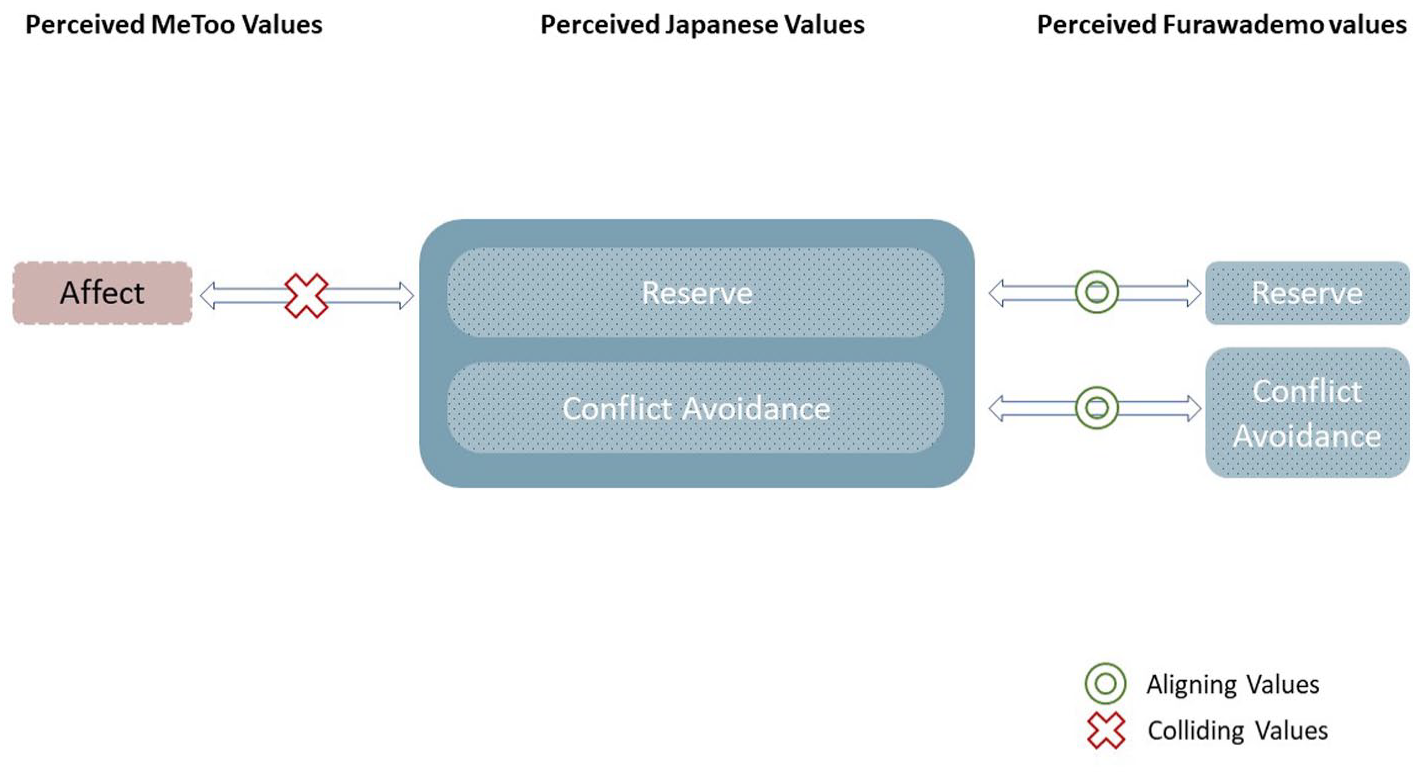
Perceived communicative values.
Respondents described #MeToo as emotionally intense or led by affect. This type of affective communication was depicted as contradicting the Japanese communicative style of reserve, which encompasses humble attitudes (hikaeme, kenkyo, okuyukashī), remaining calm (ochitsuki, rēsē), and passivity (shōkyokuteki, medatanai) due to social pressure to be docile (otonashī). Reserve was also emphasized as quelling activism. For example, Daiki stated that Japanese are “reserved (hikaeme),” while non-Japanese are “outspoken.” In a Mainichi article, university lecturer Hiroki Arai pointed out that the anger which prompted the #MeToo movement is considered bad and cannot be shared. This scholarly remark resonates with the framing of Makoto, who claimed, “Japanese people have always lived by holding everything back . . . which has been regarded as virtuous.” Considering that revealing too much emotion, particularly negative or unsettling emotions, may cause conflict, our sources stressed that Japanese communication prefers amicable settlement to confrontation. Tomoko, who saw a set of #MeToo tweets, guessed that Japanese people would not share such tweets because they prefer not to expose things that could result in a fight.
The #Furawādemo posts, in contrast, were understood as aligning with the perceived Japanese values of reserve and conflict avoidance. Respondents described such posts’ communicative style as soft (sofuto, yawarakai, nagomu), gentle (yasashī), modest (okuyukashī, hikaeme), and calm (shizuka). For example, they mentioned that “anger was not expressed” to avoid hurting someone (Daisuke), and posters were not engaging in a fight (Tomoko and Yumiko), highlighting conflict avoidance. They also claimed that the local version of the protest used a specific communicative strategy: raising one’s voice modestly to avoid conflict, with the choice of flower photos orienting “peaceful settlement” (Yumiko). Flowers’ “vague” (Naomi), “obscured” (Yōko), and “indirect” (Makoto) expression softened the mode of making claims, which was interpreted as uniquely “Japanese.” Such qualities, as discussed further below in the gender section, can also be associated with femininity, deepening the explanation of the uptake of modified protest forms.
Societal values
Beyond desired modes of communication, respondents invoked mismatches between societal values associated with #MeToo and Japanese culture (see Figure 2). We identified two layers of such clashes: first, courage and autonomy on the one hand, and conformity/group emphasis, homogeneity, hierarchy, and endurance on the other hand. Second, change in opposition to harmonious stability. Here again, the #Furawādemo representation was seen as merging #MeToo and Japanese values and, as such, mediating between them.
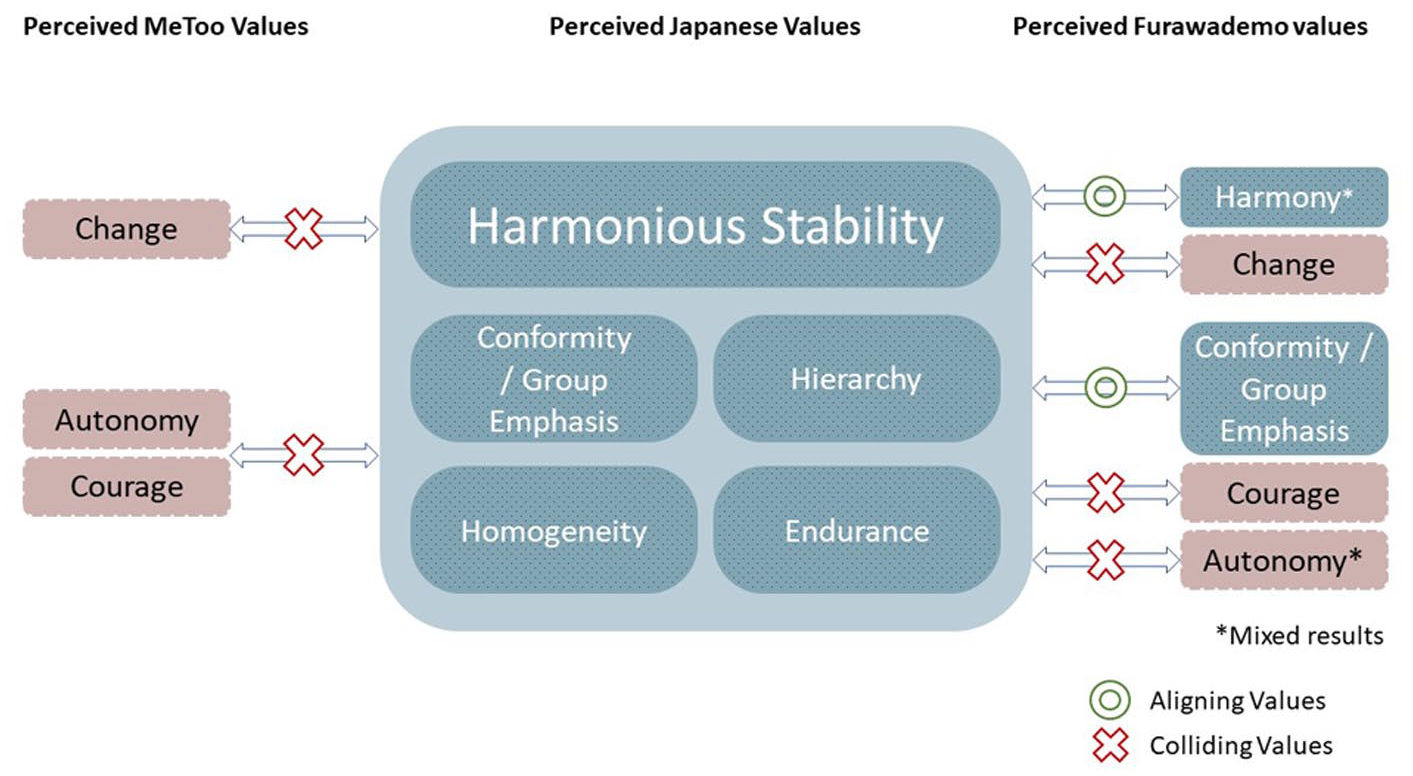
Perceived societal values.
Concerning the first main clash, the societal values ascribed to #MeToo primarily attend to individual attitudes, focusing on participants’ courage and autonomy in relation to the group. Kenichi, for instance, said the activists “value autonomy, wanting to decide on their own accord.” Yet, respondents distanced themselves from such attributes. Daiki and Ai concurred that although they thought posters were courageous (yūki), they would never be able to do that. In contrast to autonomy and courage, a set of four interwoven values—group emphasis/conformity, homogeneity, hierarchy, and endurance—were invoked as Japanese values that may have hindered the movement. First, group emphasis and conformity were framed as two sides of a particular cultural tendency. Group emphasis, which refers to prioritizing the group over the individual, was framed positively in the interviews as “care for others and not to be too assertive” (Ai) and “make mutual concessions” (Daiki). Conversely, conformity refers to following the standards and norms that are expected by a group and was framed negatively as “go along with the herd” (Kenta) and “follow the general flow” (Sakura). The metaphors of the flock and the flow refer to something amorphous or “things taken for granted (atarimae),” which are considered “hard to say no to” (journalist Shiori Itō quoted in Asahi), thus stymying #MeToo.
Next, entangled with conformity is the value of homogeneity, which was presupposed to underlie society even though not everyone was fond of it. Shigeru claimed that homogeneity allows people to navigate the community with ease, while Ai and Yōko blamed society for not tolerating dissimilarity. Daisuke showed his conflicting views; he hates homogeneity yet feels secure simultaneously. Similarly, homogeneity was suggested as a reason for squashing #MeToo. As Daisuke claimed, “People are criticized for being different” and, therefore, they “avoid saying something different with their real name” online.
Third, various commentators and laypersons quoted in the newspapers blamed the rigid hierarchy in Japanese society for dissuading survivors from speaking up. An intercultural consultant, Rochelle Kopp, argued in Asahi that strong hierarchical relationships keep lower-ranking individuals silent out of fear of retaliation. While at the explicit level hierarchy was not invoked clearly as a Japanese value among our interview participants, one of the respondents, Daiki, mentioned that “in school or at work, it’s quite difficult to express opinions because the teacher or the boss is absolute [authority].”
Finally, endurance was invoked as a Japanese value. For instance, Makoto said it was virtuous that “tears, anger, and sadness” were “endured and digested internally” rather than displayed in public. Tomoko praised this value, explaining that “Japanese women can endure and be patient.” Nonetheless, the emphasis on endurance was used to explain the suppression of activism and the prevalence of sexual harassment in general, as found in comments such as “patience is considered good and those who speak up lose out” (a 44-year-old male company worker quoted in Asahi) or “[I was told that] I didn’t have enough patience” (Shiori Itō quoted in Mainichi).
Reading #Furawādemo, this tension between courage and autonomy on the one hand and conformity, hierarchy, and endurance on the other reveals a complex picture. Autonomy was recognized in a mixed way. On the one hand, Kazuko applauded the survivors for “starting to speak up” because “until recently . . . most women just stayed silent.” Daisuke also suggested that participants expressed the desire to create a world where everyone lives freely without obedience. On the other hand, two interviewees noticed posters’ hesitation in achieving autonomy. Daiki said, “It’s like they want to express an opinion but are hesitant to say it out loud.” Tomoko questioned the choice of “beautiful” flowers to symbolize the movement and circumvent affective messaging and voiced, “they are holding back in some way. I wonder why they must be so careful of other people’s feelings.” Similarly, conformity and association with the group were identified as governing the local version of the movement. For example, Naomi explained that its participants might have employed terms such as “everyone,” “together,” and “all of us” to effectively engage with and inspire others. She also interpreted the pictures of multiple flowers as representing others and not self-focused, which resonates with Daisuke’s remark that posters framed the issue as social rather than personal.
The second main clash was between the values of change and harmonious stability. The change was associated with #MeToo, as Ai replied that #MeToo tweets reflect the values of enacting change by making a claim. In his essay in Asahi, award-winning writer Ryō Asai argued that change, including this form of activism, frees people from “the cursed vocabulary of ‘this is what it is’ and ‘common sense of society.’” In contrast to change, the value we refer to as “harmonious stability” culminates in maintaining a peaceful social order over time. The two values constructing this compound—stability and harmony—have different normative valences. While the former was invoked as a way of preserving the status quo, an unfavorable but inevitable corollary of other values such as conformity, endurance, and homogeneity, the latter was assigned as socially desirable and quintessential to Japanese behavior. Yet, both serve as powerful explanations for the absence and reformulation of #MeToo.
Throughout our corpus, stability manifested as silencing victims in three main ways. First, people accept the status quo because they believe “nothing can be done” (college student quoted in Asahi). Second, they perceive the world around them as valuing stability, and thus, they participate in the silencing of the victims. For example, Asahi quoted two women whose companies silenced them to maintain stability. Third, the silence was preferred to protect personal security or professional stability. As gender studies professor Kazue Muta said, “They may feel that by laughing it off they can protect their position better” (quoted in Asahi).
Last but not the least, the value of harmony—peaceful harmony (wa), balanced harmony (chōwa), and harmonious cooperation (kyōchō)—was invoked in the interviews as a Japanese value. Harmony is achieved through caring and respecting each other without egoistic assertiveness (Ai and Daiki), such as people responding to government requests to stay home voluntarily to prevent the pandemic (Kenichi). Still, many explained that harmony comes with drawbacks such as the lack of self and blind obeisance to orders (Shun), the lack of diversity (Ai), and even a “totalitarian mindset” (Kenichi). In this sense, harmonious stability is probably the most telling overarching concept to describe the suppression of #MeToo, as speaking up is framed as harming the harmonious stability of companies and society in general.
While harmonious stability was framed as contrasting with #MeToo, the value of harmony was invoked in positive relation to #Furawādemo through various interpretations, from conflict avoidance to care for others. For example, Daiki analyzed flower pictures as reflecting harmony, as they “soften” the strong messages and thus minimize the possibility of offending someone. Such photographs convey that posters are concerned about other people’s feelings and value harmony. To Daisuke, the flowers symbolized a society where “everyone can bloom in their own way . . . while caring for each other.” Makoto expressed a similar sentiment: “It’s about the importance of individual flowers. If we don’t care about each flower, the entire flower bed or flowers may be hurt.”
Topic
Zooming out, we found that perceived values interact with the topic and medium, leading to the rejection of #MeToo and embrace of localized forms such as #WithYou and #Furawādemo. Our analysis of the topic applies to two main domains highlighted by various commentators: misogyny and sexuality.
The most potent manifestation of misogyny in our corpus is victim-blaming. When breaking the silence, women are blamed for “their fault” (psychiatrist Takako Konishi quoted in Asahi) or smeared for “dragging men down” (sociologist Toshiyuki Tanaka quoted in Mainichi). Women from all walks of life—from a teenage girl to an actor—noted they faced or saw victim-blaming, including hateful online harassment. Interestingly, victim-blaming was sometimes depicted as particularly strong in Japan, often in contrast to the West. One example is a Mainichi reporter Haruka Udagawa, who wrote, “victim-blaming abounds on the Internet, highlighting the difference in awareness between Japan and abroad where #MeToo was shared.” Against this backdrop, two interviewees, Hiroshi and Ai, explained that the rampant victim-blaming online led #Furawādemo posters to choose flower pictures or tweet a general call for action instead of personal testimonies to hide their identities and avoid criticism. Indeed, #Furawādemo was interpreted as a way of speaking up while avoiding victim-blaming.
Misogyny, while not explicitly identified as unique to Japan by most interviewees, also reinforces sexist moral codes, pressuring women to conform to normative conducts and roles such as “modest behavior” (Izumi Inao, a consulting company executive, quoted in Nikkei) or to value obedience and endurance. For example, in a Mainichi article, Professor Muta said, “Japanese women are taught from an early age to follow the will of others and be obedient,” so it is hard to say no. Women themselves try to avoid being framed as a deviant or “unbecoming woman” (Manne, 2017), annoying and troubling (mendō) (an Asahi reporter, Tomoko Yamashita, and a Mainichi editorial writer, Yōko Fukumoto), emotional (a financial industry professional quoted in Mainichi), and not feminine (a Mainichi reporter, Ayako Oguni). The act of speaking up was denounced by women who believe it violates gender norms and disrespects the values of conformity and obedience, as reported by two activist women (Mainichi and Asahi). Interestingly, traditional femininity was noticed in the choice of the symbol of the Furawādemo movement: flowers. Sakura summarized, “I think they chose flowers because they are feminine.” According to our interviewees, the “softness” (Yōko) and “fragile petals” (Naomi) of flowers connotated femininity.
The second point raised concerning the topic was its sexual nature and its perception in society as a “dirty” taboo. Journalist Shiori Itō shared her analysis that “sexual assault is considered taboo,” so “people in Japan are hesitant to speak up” (Asahi). In the interview, Naomi also called it “taboo” and mentioned, “an underlying cultural thing . . . makes Japanese people reluctant to speak out about sexual violence.” The #Furawādemo was again considered as a softening or compromising mode of communication since it allows participants to avoid victim-blaming (Hiroshi and Ai) and being deemed “dirty” (Daisuke). Moreover, one of the interviewees (Daiki) suggested that clean and beautiful (kirei) flowers mitigated the “dirtiness” of the topic.
Media
The last avenue contributing to the relative quietness of #MeToo in Japan relates to the medium through which it is circulated, and, more specifically, the affordances of Twitter in the Japanese context. Of these, our respondents flagged two elements: privacy and impression management. Regarding privacy, the most prominent theme in the responses, interviewees observed that #Furawādemo participants frequently concealed their identities and even #MeToo posters in Japan typically remained anonymous. In general, interviewees voiced a preference for online anonymity and noted that Japanese social media users generally want to stay anonymous (particularly on Twitter). A strong sense of privacy was articulated by Daiki, who explained that it bothers him when strangers know his personal details. First and foremost, the risk associated with crime was cited as a basis for anonymity preference. For instance, Ai, who uses Twitter anonymously, said that she is afraid of showing her face online because she was taught about crimes and dangers associated with her digital footprint at school. Shun also contended that he did not share his family photos due to this risk and guessed that the Japanese, compared to Americans, have a stronger sense of privacy. Fear of ostracization and upsetting others were additional reasons to stay anonymous. Kenta’s Instagram account is private because he “doesn’t want to disturb others” when he happens to come under attack online (enjō).
Next, several responses focused on impression management on social media. Daisuke feared having his online identity fixated on activism, noting that those who share food photos rather than strong beliefs are considered harmless and have easier lives in Japan. This sentiment was shared by Ai, who confessed that she did not want to be perceived as a woman who posts something “difficult,” which is considered “bad,” and by Shun, who uttered that he “cannot” share any posts related to activism and politics because he believes it is “disadvantageous” to be labeled as “left-winger.” Similarly, Kenta said if he posts activist tweets, “people around him” regard him as “a weirdo.” Other than avoiding sharing anything provocative, Yōko proposed creating a new account dedicated to activist topics such as climate change or LGBT rights as an impression management tactic. Quite a few users saw digital activism as a mode of participation that could ruin the online self-image they have developed over time and should thus be avoided.
Discussion
This article set out to place transnational social media discourses within the local Japanese context through the VTM framework, which offers insight on the rejection of personal testimonies typical to #MeToo and the embrace of vernacular configurations. Of the three components of this model, the “perceived values” component is the most complex one to decipher. At first glance, the interviews and newspaper articles provide a coherent set of explanations for the absence of #MeToo and its reformulation. Perceived Japanese values such as obedience, endurance, and conformity clash sharply with the values people detected in the #MeToo movement such as courage, autonomy, and change. As a result, the #Furawādemo (as well as other local formulations) is positively evaluated as a version that, on the one hand, stresses the core value of change and, on the other hand, “softens” the protest by blending in values perceived as more acceptable in Japan such as reserve and conformity.
However, there is a catch. Most participants explained that their reluctance to participate in the #MeToo protest was not out of disagreement with the movement. In fact, all the women that we interviewed, as well as most of the men (six out of eight), expressed appreciation toward it, typically depicting posters as “courageous.” Yet, they said they were afraid of, and thought other people were fearful of, retaliation and isolation, given their perception of Japanese values and the risk of hateful cyberbullying. As such, our data suggest that activism is not limited by values as essential orientations (principles people believe in) but by prevalent perceptions of dominant values (principles that people believe other people believe in). In this sense, it is telling that several participants repeatedly invoked notions associated with how popular books frame “Japanese values,” such as “Japanese culture is that of shame” (Makoto and Kazuko) and “[people] value harmony (wa)” (Ai). Perceptions of social values become self-fulfilling prophecies where people actively “perform” the values that they think others will appreciate and, in so doing, reinforce those values. In other words, popular ideals control actors’ behavior by being internalized and used as a frame of reference for understanding themselves and the world around them.
While we have so far examined each of the three VTM components separately for analytical clarity, we argue that they intertwine and feed each other to shape feminist activist discourses. At the intersection of values and topic (gender), a prevalent perception is that Japanese women should uphold the values of reserve, conflict avoidance, endurance, and conformity even more than men and thus should not speak up. These perceived Japanese values disarm feminists from dissenting against sexism and bringing change against hierarchical gender order. Therefore, while the #MeToo movement expressed digitally networked solidarity (Clark, 2016) in what Hemmings (2012) called the “moment of affect—anger, frustration, or even rage,” in Japan such sentiments were toned down for the sake of “harmonious stability.” Another intersection is between values and the medium, particularly value-laden practices around self-presentation and privacy. Throughout the interviews, users revealed how much of their online behavior is driven by sensitivity to the gaze of others. One interviewee asserted that he would refrain from posting anything political since doing so would mean “declaring his identity,” leading him to “make a stir.” Another said that during the COVID-19 pandemic, she stopped posting on Instagram because she was afraid of being criticized for posting pictures taken outside. The fundamental underlying norm binding interviewees was the fear of others online, which was presented both in positive terms (“we like preserving harmony”) and negative (“we have to be conformist”). This fear helps explain the suppression of #MeToo in its viral format and its reformulation in various hashtags that allow people to express protest and solidarity without exposing personal stories and identities.
Concluding remarks
By way of conclusion, we wish to present three arguments regarding our theoretical framework and empirical findings. We first discuss the applicability of the VTM framework for wider contexts and then relate to the implications of our findings for thinking about local reformulations of social movements.
First, we contend that our framework allows researchers to study digital activism from local perspectives. As such, it may help investigate how other instances of hashtag activism, such as #MeToo variants of #NousToutes (#WeAll) and #YoTeCreo (#IBelieveYou) or rallies for racial and environmental justice, are used in local contexts. In each case, researchers could investigate how the intersection of specific perceptions of values, attitudes toward the topic, and social media contextual affordances shape civic engagement. For instance, the Japanese Twittersphere is not devoid of successful hashtag activism. In protest of the proposed revision of the law, which would allow the administration to promote their favorite candidate to the country’s top prosecutor, the hashtag #Kensatsuchōhō-kaisēan-ni-kōgi-shimasu (#I-protest-the-proposed-revision-of-the-Public-Prosecutors-Office-Law) was tweeted 4.7 million times (Kyodo News, 2020; Toriumi, 2020). The topic’s political and legal nature, its polite speech form, and its advocacy for maintaining the status quo may explain its success. Another example is a viral feminist hashtag protesting company rules requiring women to wear high heels in the workplace, #KuToo—a triple pun referencing #MeToo, the Japanese word for pain (kutsū), and shoes (kutsu). This hashtag, together with an online petition campaign to the government and augmented media attention, led to changes in rules in multiple major companies (Junxiao, 2021). Despite the misogynistic backlash online, its relative success may be attributed to the foregrounding of health and safety values when highlighting the physical damage caused by high heels, the focus on accusing the government and companies rather than individuals, and the less-sexual nature of the topic. While these are only two cases, they exemplify the complexities associated with feminist activism in Japan, as well as the merits of our framework.
A second broad implication of this study relates to how we conceptualize absence and presence in cross-cultural studies. In our case, we started the journey with a notion of absence, the lack of adaptation of a practice documented in many other contexts. Yet, while the question of why the format of personal testimonials was not adapted in Japan informed our research design, the understanding that Japanese activists chose to raise their voices in a different way, which is not a compromised or inferior format compared to the viral version, was equally important. What we ultimately found is that people are looking to speak up in what they perceive as culturally effective ways. The pictures of colorful flowers, decoded as practices of collective visual solidarity and mutual care, hint at the vernacular dynamics of activism beyond personal testimonies typical to US-based forms of hashtag feminism. Thus, rather than a story of absence, this can ultimately be seen as a story of new forms of presence “found in translation.”
Finally, these new forms of presence can be associated with new articulations of “safe space” encouraging women to express their rage and pain, support one another, and speak up without fear. Similar to what Boyd and McEwan (2022) noted about African American women compared to white women in the United States, women in Japan seem not to hold enough societal power for their stories to be heard and believed. Against this background, what is burgeoning among Japanese feminist activists is an initiative to build a “safe space” by using #WeToo and #WithYou in place of #MeToo, signaling “we hear, believe, and support you.” The Furawādemo street rally and its migration to #Furawādemo provide a space to “just gather without raising a loud voice” with a signboard #WithYou (Kitahara, 2021:22). As such, this movement combines two contrasting attributes that Lang (2019) associates with “me too” and #MeToo: an effort to create a healing and supportive space for survivors themselves and an initiative to make the narratives of sexual violence survivors more visible to the larger public, with the former taking the forefront. Acknowledging these various articulations of safeness, healing, and awareness raising would be valuable for inspecting developments of hashtag feminism across the globe.
Alongside its contributions, this study has several limitations that we hope future studies will address. First, our limited sample size prevented us from analyzing the intersection between perceptions of the movement and demographic variables such as age and education. Further large-scale studies may add nuance to the findings presented here, revealing, for instance, generational differences in the perceptions of these protests. Second, we did not interview people who shared #MeToo and #Furawādemo posts. Such interviews could help us understand local formats of hashtag activism by asking about motivations for posting and considerations when deciding on storytelling content and formats. Third, the qualitative methods we used can be supplemented by ethnographic studies, surveys, or experiments, which would enable scholars to further examine the mechanisms underpinning the association between perceptions of prevalent values and their performance. Fourth, further case studies featuring divergent cultural values, topics, and platforms can evaluate the model’s generalizability. We hope this research can serve as a stepping stone to analyzing vernacular forms of social media protests, which continue to reformulate themselves beyond borders.
Footnotes
Appendix 1
Acknowledgements
We are grateful to three anonymous reviewers and to our colleagues Blake Hallinan, Tommaso Trillò, and CJ Reynolds for their valuable comments on this paper. We would also like to thank Adam Ota for his help in collecting and transcribing the data and David Bortz for his graphical assistance.
Funding
The author(s) disclosed receipt of the following financial support for the research, authorship, and/or publication of this article: This project has received funding from the European Research Council (ERC) under the European Union’s Horizon 2020 research and innovation program (grant agreement No 819004).
Author biographies
