




Abstract
This article presents an exploratory analysis of feminist practices on Portuguese Instagram, questioning how online feminisms are represented on Instagram, in light of its conventions, aesthetics, and popularity logics. Starting from a theme-oriented dataset – collected using the hashtags #feminismoportugal (feminism Portugal), #igualdadedegénero (gender equality), #naopartilhes (don’t share it), and #portugalmaisigual (a more equal Portugal) – this research analyses 294 posts, created by 101 users. Combining a qualitative close reading with the use of digital tools for visual analysis, this article explores how these Instagram feminist practices look like, what dynamics they encompass, and how they relate to the aesthetics and popularity logics of Instagram. Within this plural hashtag landscape, the aesthetics of online feminism goes beyond the dominant cultural imaginaries that link Instagram to photographic content, with long written text emerging as a key site for sharing feminist knowledge – both in captions and in graphic compositions. These graphic compositions have become part of the popular cultural imaginary of a feminist ‘genre’ on Instagram, combining Instagrammable aesthetics with educational content for accessible informal learning. Yet, feminist practices on Instagram are also subjected to the dominant social media logic of popularity, leading to a strategic mobilisation of attention to seek visibility and engagement, albeit to limited success.
Keywords
Introduction
Digital and social media platforms, amongst them Instagram, have become an integral part of contemporary everyday lives, being used not only for entertainment but also as a way to engage with everyday politics (Highfield, 2016). Within these contexts, the understanding of politics expands beyond the realms of governments and established political actors. Rather, this broader understanding of politics encompasses also the experiences of ‘ordinary’ people engaging in everyday social media practices, paying attention to how their political concerns can be framed around and alongside personal interests and concerns. Social media is thus a heterogenous arena where political content co-exists and is deeply enmeshed with more personal, mundane, or aesthetically oriented content.
Initially conceived as an aesthetically oriented platform, dedicated to photo and video-sharing, Instagram is currently one of the most popular social media platforms worldwide, counting with over one billion users (WeAreSocial, 2021a), and has become an important site for political and feminist debates. In Portugal, the geographic locus of this research, Instagram is the third most used social media platform (excluding direct messaging platforms, eg WhatsApp) (WeAreSocial, 2021b). However, despite this popularity, the ways in which the conventions and vernaculars of Instagram shape political, feminist, and activist discourses on the platform are still under-researched (Caliandro and Graham, 2020), with existing research often privileging platforms such as Twitter or Facebook. As different social media platforms facilitate different modes of political expression (Keller, 2019), it becomes essential to explore how feminist cultures co-exist with and draw on Instagrammable aesthetics. In addition, centring Instagram as a site of study also foregrounds questions regarding the relationship between politics and economics of visibility, as efforts of dissemination and circulation of feminist information on Instagram are informed by the same logics of popularity and shareability that govern the use of Instagram at large.
Political practices within social media often take the shape through hashtag activism (for example, Jackson et al., 2020). As such, this article focuses on feminist practices on Portuguese Instagram through an exploration of its feminist hashtag landscape. These practices and their aesthetics are still under-studied within the Portuguese context. The feminist history of Portugal was marked by the fascist dictatorship of Estado Novo and its conservative Catholic foundations. During the dictatorship, feminist organising was repressed, and, within revolutionary circles, feminist actions were often subsumed to anti-fascist struggles. After the fall of the dictatorship, on 25 April 1974, feminist activist gained wider expression – campaigning for legal abortion, sexual liberation, protection against domestic violence, and expanding to incorporate intersectional concerns and LGBTQ + rights (Tavares, 2008). However, Portuguese feminism has been largely dominated by ‘state feminism’ and institutional policy making (Santos and Pieri, 2020), rather than by grassroots movements and bottom-up mobilisations. Furthermore, the legal progress that was achieved was not necessarily accompanied by cultural change, as feminist issues can still be received with significant resistance (Simões and Silveirinha, 2019: 2).
In this context, until recently, the uptake of online feminism in Portugal seemed to have had a marginal adoption. Even movements and hashtag campaigns that garnered a lot of attention internationally, like the #MeToo movement, were unable, at the time, to gain wide public expression nationwide (Garraio et al., 2020). Research about online feminist and activist practices is also sparse. The work of Campos, Simões and Pereira (2018), for example, explored how digital and online tools are incorporated in the practices of young activists engaged with a wide range social, ecological, or political causes. And Campos and Sarrouy (2020) addressed how youth political participation can be constructed using a variety of aesthetic languages and contents, including sounds, performances, visual artefacts, and digital contents. However, research by Marôpo, Torres da Silva, and Magalhães (2017) showed that despite a significant presence of pages promoting women’s rights and gender equality on Facebook in Portugal, these tended to accrue low metrics of engagement.
More recently, discussions surrounding issues of sexual harassment and the #MeToo movement in Portugal have started to garner larger public attention, triggered by a new series of public accusations (Ropio et al., 2021). The increasingly polarised political climate, with the rise of far-right politicians with anti-feminist discourses (Santos and Roque, 2021), has also led to online debates, thus making research on online feminisms is ever more topical and necessary. Furthermore, as will be seen throughout the article, these Portuguese online feminist practices are deeply enmeshed with transnational feminist discourses, debates, and global Instagrammable conventions, thus eliciting considerations that cut across different local contexts.
This article departs from the exploratory research question: how are online feminisms represented on Instagram, in the context of Portuguese feminist hashtags? This allows us to explore how these practices look like, what dynamics they encompass, and how they relate to the aesthetics and popularity logics of Instagram.
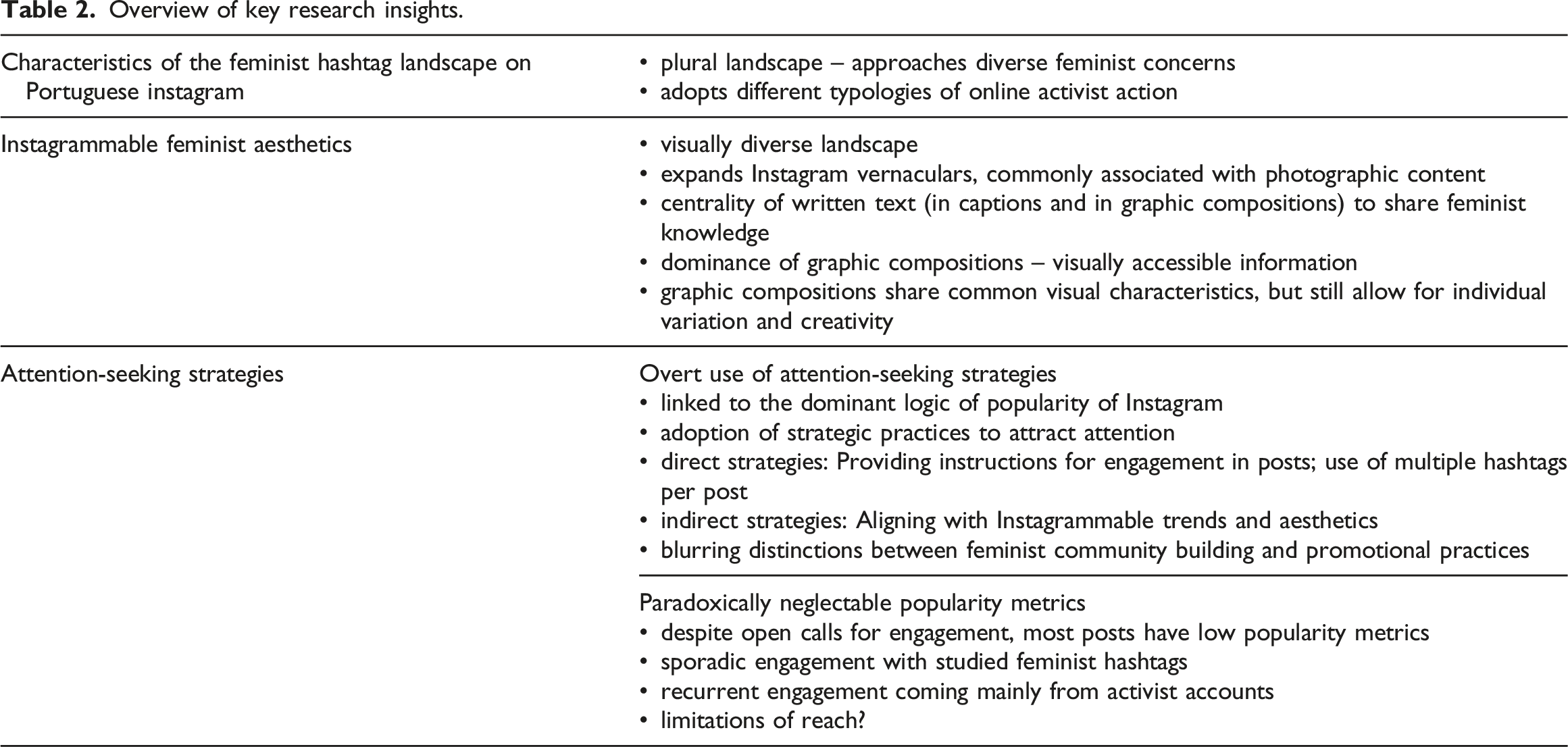
Following the present introduction, the article presents its theoretical grounding and underlying feminist media studies framework. The next section introduces the research’s methodological approach. We then offer a brief snapshot of the studied feminist hashtag landscape. After this contextualisation, the article presents its findings, starting with the exploration of the aesthetics of feminist posts on Portuguese Instagram. The following section explores how feminist posts are enmeshed with the use of engagement-seeking strategies, recognising, however, the paradoxically negligible metrics of engagement observed in many of the studied posts. Finally, the article concludes with an overview of its key insights, briefly reflecting on the limitations of the study and positing avenues for further research.
Contextualising online feminisms
This research is grounded on feminist media studies perspective (Van Zoonen, 1994). Drawing on the field of cultural studies, feminist media studies seek to explore issues of media representation and their relationships to the politics of gender, sexuality, and other intersecting identities. This perspective often centres everyday media practices, recognising their enmeshment with wider social and cultural dynamics (Van Zoonen, 1994: 131–134). This attention has been extended to study the relationship between feminisms and digital media – analysing, for example, mediated popular feminisms (Banet-Weiser, 2018), how online feminisms are shaped by platform vernaculars (Keller, 2019), or the relationship between social media’s attention economy and activist practices (eg Tufekci, 2013), amongst many others.
Feminist and activist practices on social media are often discussed alongside the notion of fourth-wave feminism (eg Chamberlain, 2017; Munro, 2013). Fourth-wave feminism is commonly understood as a continuation of earlier feminist practices and strategies. It is marked, however, by the deliberate adoption of the affordances of digital and social media for engaging in feminist dialogue, consciousness-raising, organising, fundraising, or information dissemination. Online feminisms can thus rely on collective action and organised movements, reminiscent of traditional feminist mobilisations. But it opens space to practices of everyday feminism (Pruchniewska, 2019), allowing ‘ordinary’ people (ie not activists, career politicians, or celebrities) to engage with politically oriented content, learn complex vocabulary and concepts on issues of gender and sexuality, or to produce their own feminist content. Online feminist practices can thus also draw on the historically established do-it-yourself tactics for feminist and cultural activism (Drueke and Zobl, 2018: 137), including the use of art and aesthetics. While online feminism opens space for more personal, individualised and tangential expressions of gendered politics (eg Caldeira et al., 2020), it is also important to recognise that the popularisation of feminisms can also be accompanied by postfeminist discourses (eg Gill, 2016) – which simplify feminism by reducing it to individualised notions of empowerment, or even commercial interests, while disregarding collective action and systemic issues.
Within the study of online feminisms, practices of hashtag activism (eg Jackson et al., 2020) have been a particularly central topic of research interest, in part due to hashtags’ ability to place individual posts in the context of broader public conversations (Bruns and Burgess, 2015: 15). Hashtags can be strategically used to spread content related to social justice and to mobilise collective action. They can be used by both individuals and collectives, ‘ordinary’ users and activists, thus allowing for the visibility of a wide array of political actors (Jackson et al., 2020).
However, feminist practices can differ across social media platforms, being shaped by their different conventions and vernaculars (Keller, 2019). As such, when considering feminisms taking place within an aesthetically oriented platform like Instagram, it is also important to recognise the tradition of feminist activist art. As Mary Jo Aagerstoun and Elissa Auther (2007) note, feminist activist art has been used for decades both to criticise existing structures of power and to participate directly in efforts to enact structural change. Using a wide range of media and approaches – from performance, photography, to billboards and guerrilla postering – feminist artists sought to expose systemic sources of inequalities, take a stand, posit alternatives, and espouse progressive feminist tenets of equality and inclusiveness. Feminist arts have also a history of adopting collaboration, audience participation or community-based forms of artistic creation (Aagerstoun and Auther, 2007: viii) that can find echoes in contemporary social media practices. Drawing on these influences, contemporary politics and feminisms online can thus take multiple forms, both visual and textual, including hashtag activism, memes, and personal posts. (Marwick, 2019: 319).
Within these contexts, creating public visibility for social justice issues, as well as for marginalised groups or identities, can thus be understood as a central strategy to create social and cultural change (Whittier, 2017). Social media posts and campaigns can be seen as increasing the visibility of feminist issues. However, visibility on social media is dependent on a logic of popularity (Van Dijck and Poell, 2013). As will be explored in the article, this can lead to the adoption of practices of algorithmic activism (eg Treré, 2018; Tufekci, 2013) that seek to strategically mobilise social media posts and audiences’ attention.
Methodology
Overview of the studied hashtags.
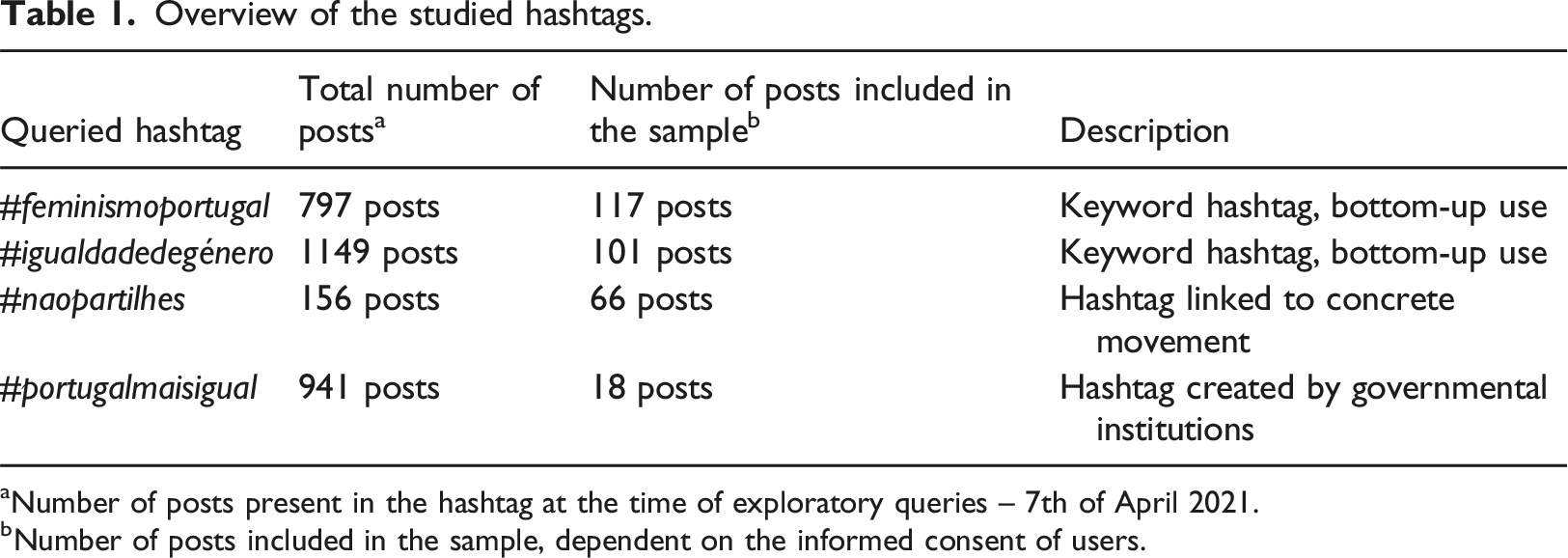
aNumber of posts present in the hashtag at the time of exploratory queries – 7th of April 2021.
bNumber of posts included in the sample, dependent on the informed consent of users.
The selected hashtags were queried once a week, during five consecutive weeks between April and May 2021. In the first week, we identified the 100 most recent posts present on each hashtag and in the following weeks, all new posts were identified. To request informed consent, all users who posted on these hashtags were contacted, and informed about the research, its objectives, the extent of the data collection, and given assurance of their privacy rights. In line with Instagram’s expectations of use, the users were contacted via Instagram Direct Message, using an Instagram profile that clearly identified the researcher and provided contact details. To ensure the privacy of participants, no usernames are used in this article and no individual images are reproduced.
A total of 101 users agreed to participate in the research, providing their written consent through Instagram Direct Message. 294 posts were collected, dating from October 2020 to May 2021. The uneven distribution of posts between the queried hashtags (see Table 1) reflects, in part, the difficulties in contacting the institutional users who dominated hashtags such as #portugalmaisigual. As such, the analysis is not representative of the full scope nor size of the hashtags as they are searchable on Instagram, rather of the sample of users who consented to participate in this research.
For each post, we collected information on the date of publication, type of profile, likes, numbers of likes, views, and comments, captions, hashtags used, and type of post. Each post was also screenshotted. This data was collected manually, to counter the technical limitations of automated data collection and to ensure ethically-conscious practices of data minimisation.
As introduced earlier, this research was grounded on a feminist media studies perspective (Van Zoonen, 1994), which favours the use of qualitative and interpretative research strategies to explore the politics of gender in media. We conducted a qualitative close reading (Ruiz De Castilla, 2017) of each collected post and its caption. Close readings are often used within feminist media studies to critically analyse varied media objects (including images and videos), seeking to explore how media texts reveal meanings about the social world (Harvey 2020: 39–42). The deep familiarisation with the studied dataset was facilitated by the manual process of data collection. We then looked attentively through each collected post and their captions, noting their content, as well as taking analytical memos with emerging interpretations (Maxwell and Chmiel, 2014). These interpretations were further analysed considering the existing scholarship in the field, in order to create an interplay between the data, the concepts, and the broader literature.
This qualitative approach was combined with the use of digital tools, including Google Spreadsheets and ImageSorter (Visual Computing, 2018), for an exploratory analysis, identifying emerging patterns and visual conventions. Incorporating digital methods allowed us to develop a multi-directional iterative research process – insights identified through digital methods within the relatively large dataset led us back to theoretically relevant posts for further in-depth qualitative analysis, and vice-versa. This multimodal qualitative approach, focused on both the textual and visual content of each post, is suited to the affordances and cultures of use of Instagram (Highfield and Leaver, 2015), allowing the exploration of the diversity of content and meanings associated with feminist cultures within Instagram.
Overview of key research insights.
A snapshot of the plural landscape of feminist hashtags on Portuguese Instagram
Before diving on the exploration of the aesthetics of online feminisms on Instagram, it is essential offer a brief overview of the type of content present in the studied dataset. Even though the dataset was thematically united by the four queried hashtags concerned with issues of feminism and gender equality, its content highlighted the presence of a multiplicity of feminisms co-existing within the Portuguese feminist landscape on Instagram. We identified 1341 unique hashtags appearing in conjunction with the four queried hashtags. These hashtag – as well as the posts captions and visual content – addressed a wide range of issues, including gendered violence, mental health issues, differences between sex and gender, motherhood and gender roles in parenting, sex positivity, feminist literature and media, work equality, body positivity, black feminism, cyberbullying, fatphobia, amongst others. This variety can point to the co-existence of disparate visions of feminism; however, it could also be read as a recognition of the intersectional character of feminist struggles (Crenshaw, 1991).
This diverse content also addressed different geographical contexts. Some of the studied posts focused specifically on the Portuguese context, addressing issues related to national elections, specific legislation proposals, local events, or Portuguese feminist histories. However, a lot of the studied content seemed to draw on a transnational feminist imaginary, exploring concepts that are not locally bounded, but rather part of wider feminist discourses and debates, and, at times, even foregrounding topical international events, for example the widely mediatised murder of Sarah Everard in the UK. As will be explored below, this transnational feminist and Instagrammable imaginaries are also reflected in the adoption of recognisable popular aesthetics and strategies that are used worldwide.
The studied feminist content on Instagram was also employed for a variety of purposes and can be seen as reflecting different typologies of online activist action. These included, for example, the use of social media for information dissemination purposes, with posts being used as a tool for feminist non-formal education (Simões et al., 2021), presenting complex feminist concepts and histories or dispelling common misconceptions about feminism in a more accessible format both in terms of their reach and the language used (Munro, 2013: 25). Posts could also put forward direct calls to action and efforts to mobilise feminist communities, through the promotion of both in-person and online feminist events. Or, drawing on practices of everyday feminism, be used to share lived personal experiences of gendered inequalities and of feminist engagement (Pruchniewska, 2018: 811–812). On the other hand, the content contained in the studied dataset also encompassed the circumvention of openly feminist and political discourses, employing instead an individualistic, empowerment-driven, can-do tone reminiscent of the highly mediatised practices of popular feminism and postfeminism (Banet-Weiser, 2018; Gill, 2016). This positive affective tone also fits with the trend towards idealised and aspirational content that shape the dominant aesthetics of Instagram (Leaver et al., 2020). In this way, we can understand the uses of Instagram for feminisms in Portugal as plural, addressing both national and transnational issues, overtly activist issues and tangentially feminist concerns, which can manifest in both in long captions, in the images themselves, or through a combination of both, as will be further explored in the next section.
Exploring Instagrammable feminist aesthetics
Paralleling the diversity of feminist perspectives and practices observed in the previous section, our multimodal analysis of the aesthetics of feminist posts on Portuguese Instagram also revealed the existence of rich visually diverse feminist content.
Users’ perceptions of a given social media platform are shaped by their socio-technological and imagined affordances – that is, the technological and material features of the platform, alongside its negotiations with users’ expectations, practices, norms, perceptions, and misperceptions about a particular platform (Nagy and Neff, 2015) – and its dominant platform vernaculars – its communicative styles, grammars, and logics (Gibbs et al., 2015). In the case of Instagram, these perceptions and imaginaries are still commonly associated with photographic content (Manovich, 2017). Yet, photographs, as single elements devoid of any overlaid text or graphic compositions, were not the prevalent type of content in the studied sample. Some posts shared photographs as an integral part of its educational content, such as portraits of important feminists in Portuguese history, or a series of documentary-style photographs representing the experiences of the largely female lower class essential workers, like hospitals’ cleaning and cooking staff. However, photographs often appeared as expressive or symbolic illustrations to accompany long written captions about feminism. These could be photos taken by the users – such as photographs of themselves, other people, objects, landscapes – but also photos created by other people or even stock photos (not always credited in the posts). In a similar vein, hand-drawn and digital illustrations were also used in the sample to accompany feminist captions. This shift in communicative centrality from images to longer written texts in the captions seems to reflect a change in the expected affordances of Instagram. Due to the design of the platform, the image is the element viewers encounter first and that commands more attention. Yet, in these posts, the caption becomes a key site for sharing feminist knowledge.
Similarly, although self-representations and selfies are commonly associated with the platform vernaculars of Instagram (Rettberg, 2014), these were rather rare in the studied sample. Self-representations were often framed as empowering, accompanied by self-love hashtags, such as #meaceito (I accept myself) or # iamworthy, or accompanied by motivational sentences. Self-representations can also be allied to the sharing of personal stories and experiences of gendered inequality briefly addressed in the previous section, as exemplified by a user who, after sharing her experience as a survivor of domestic violence on both Instagram and on national television, posted a black and white self-portrait with her mouth symbolically covered with tape, calling for more people to come forward and denounce experiences of gendered violence. Even when such self-representations were not overtly visually or descriptively linked to feminist issues – for example, with a selfie of a plus-size woman with a caption celebrating the start of Spring – these representations become tangentially linked to feminism through the use of hashtags such as #feminismoportugal or #femaleempowerment.
However, the dominant platform vernaculars of Instagram are not static. They are negotiated by the platform’s users who creatively repurpose its technological affordances to allow for newer modes of expression (Gibbs et al., 2015: 257–258). We aggregated the studied posts by colour, using the digital tool ImageSorter, to explore the dominant visual aesthetics associated with the studied thematic dataset (Pearce et al., 2020: 171). This revealed the dominance of graphic compositions that combined colourful backgrounds with overlayed text, and, at times, also including other visual elements such as photographs, illustrations, or little graphic elements to add visual interest (see Figure 1). All posts in the dataset, sorted by colour. Visalization created with ImageSorter. Blurred to respect the privacy and anonymity of the participants.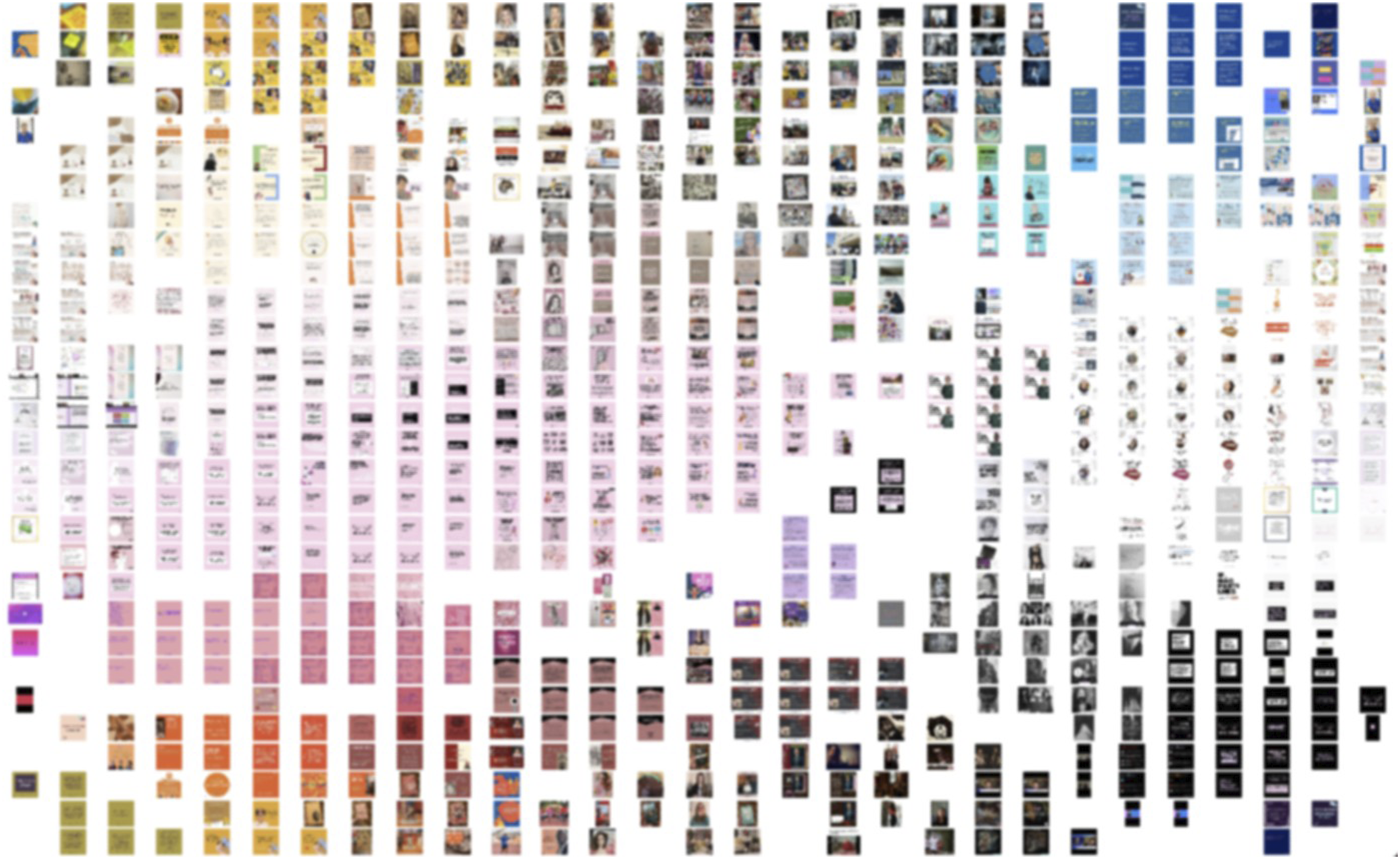
Building on traditions of feminist art introduced earlier (Aagerstoun and Auther, 2007; Drueke and Zobl, 2018: 137), this feminist use of graphic compositions on Instagram also brings to mind the idea of design activism (eg Markussen, 2013; Thorpe, 2008). Design activism centres the relationship between aesthetics and the political by employing visual design practices to promote social change, raise awareness of existing issues and inequalities, and question the constraints of the reigning systems of power (Markussen, 2013: 38). Ann Thorpe (2008: 11) identifies some of the ways in which design activism can take shape – for example, the use of demonstration artefacts that showcase positive alternatives to the current status quo; the creation of protest artefacts, confrontational materials that seek to prompt reflection on existing injustices; or as acts of information and communication, rendering information in easy to interpret visual systems. Although most design activist projects defy a neat categorisation into circumscribed categories (Markussen, 2013: 40), these can be helpful to think the many feminist uses of Instagram addressed in the previous sections and how these can take aesthetic shape. As Marwick (2019) notes, we can understand these online feminist practices building upon and drawing on feminist efforts of the past. In this way, we can see these graphic compositions as drawing on earlier feminist and activist visual media and imagery, such as educational newsletters, zines, informational flyers, or posters – as for example with posts serving as informational posters for a range of feminist events, such as art festivals, talks, or roundtables, visually providing practical information, including dates, times, invited guests, locations or, alternatively, zoom links.
Drawing back on the uses of Instagram for non-formal feminist education (Simões et al., 2021) introduced in the previous section, these graphic compositions are often framed by popular media as aiming to make educational content more accessible, and an entry point into complex political topics and concepts (Guerrero, 2020). In the studied sample, this was exemplified by posts introducing concepts like internalised misogyny, victim blaming, consent, or women’s mental load, amongst others. Yet, these graphic compositions still allow for diversity in terms of their content – including not only these aforementioned educational posts, but also motivational quotes, media recommendations, etc.
Most compositions make quite deliberate use of text and typography on the slides, in order to grab viewers’ attention and present their messages in easy to grasp manners. Text is usually de-constructed into smaller blocks, or even as bullet points. Different visual weights are given to create an immediately visible structure between different sections of the text, much like it’s done in graphic design products like posters. These strategies point to a general awareness, whether conscious or not, of basic graphic design principles, revealing a degree of aesthetic literacy. Posts that fail to incorporate these principles, for example graphic compositions that are quite text-dense, stand out as less suited to the constant scrolling of Instagram, less instantly readable in the small formats of these square compositions. Alongside the text, these compositions also enabled the sharing of feminist information in the shape of visual representations of statistics, with graphs and infographics, often accompanied by a final slide with sources, references, resources, and recommendations, thus showing a concern with maintaining a sense of scientific credibility and legitimacy of these feminist claims that end up reproducing some of the structures and conventions of formal academic learning.
Social media cultures can often adopt shared references and genres (Literat and Kligler-Vilenchik, 2019). In this case, the use of graphic compositions as a way to share visually appealing yet informative images that call for social change has been recognised by several popular media outlets (including the Washington Post, Vice, and Vox) as a genre linked to Instagram feminist practices, as well as social justice-minded social media practices more broadly (eg Ables, 2020; Guerrero, 2020; Nguyen, 2020). Although graphic compositions can exist as single-image posts, these are often grouped in Instagram carrousel posts that allow up to 10 photos and videos in a single post, and have been termed as ‘social justice slideshows’, ‘PowerPoint activism’, or ‘Swipe-Through Activist Guides’. These popular articles address the use of these graphic compositions mostly in US contexts and alongside highly mediatised activist movements, such as the 2020 Black Lives Matter protests. We can observe similar aesthetics and strategies used in the studied Portuguese posts.
Using tools like Canva or other easy to use digital design applications, users can create these eye-catching graphic compositions, intended to catch Instagram users’ attention and prompt them to read the text (Nguyen, 2020). The adoption of Instagrammable aesthetics is often understood as a requirement of the platform and necessary to gain popularity (Caldeira, 2021). In this way, echoing findings from studies in other social media platforms (Hutchinson, 2021: 40), we can interpret this adoption of a careful and attentive aesthetic as a strategy to attract attention by aligning socially minded issues with the dominant Instagrammable aesthetic principles that have already proven popular in the platform. This link between aesthetics and popularity is further reiterated by Instagram guides that offer tips for users to grow their online presence (eg Warren, 2020). As an example, as we can observe in Figure 1, the dominant colour pallets within the studied sample tended towards light, soft, or pastel tones, particularly soft pink. Much like the feminist Instagram photographs analysed by Rosa Crepax (2020), these graphic compositions also adopt a pastel and ‘girly’ aesthetic that is currently popular on Instagram.
Some Instagram how-to guides online (eg Warren, 2020) thus present the use of these social justice graphic compositions as an ‘Instagram Aesthetic Trend’ to follow in 2021 – placing alongside other visual trends such as using Reels or adding animated elements or hand-drawn layers on top of photos. Social justice graphic compositions are presented as something to be strategically co-opted by brands to align with the currently popular practices and, as all trends, as something that might rapidly change rather than as something with lasting political impact. As Caliandro and Anselmi (2016) explored in the context of brand cultures, Instagram favours imitative practices and the repetition of certain established aesthetics. Much like they explore in their concept of memetic brands, these social justice graphic compositions are also created with awareness of other similar posts and share common characteristics in terms of their aesthetic, conventions, and content. In this way, we can see the visual consistency of this genre as an expansion of this memetic logic to the realm of memetic feminist imaginaries, in which the conventions of graphic educational posts are replicated (often casually or even unconsciously) by various users, albeit allowing for a degree of individual variation that reflects their vernacular creativity. At times, the graphic nature of these posts was overtly embraced and used in less instrumental, more playful ways, as a way to emphasise its political message, as in the case of a post that used low contrast text, white on an off-white background, with the message ‘Gender Equality’ to create a visual pun on the difficulty of reading the text: ‘Hard to see? You can’t see what does not yet exist. But there are ways to fight for it’.
Recognising attention-seeking strategies within Instagrammable feminist content
Expanding on the relationship between Instagrammable aesthetics and popularity, this section further explores how feminist posts on Instagram can become enmeshed engagement-seeking strategies. Despite its political aims, it is important to acknowledge that social media activism takes place in commercially oriented platforms, where attracting attention and visibility is an essential part of their dominant premises and logic (Hutchinson, 2021; Van Dijck and Poell, 2013). Furthermore, current forms of popular feminism are also predicated on being widely visible and accessible, circulating within a broader economy of visibility (Banet-Weiser, 2018). Feminism on social media is thus subjected to the same pressures to ensure popularity and success within the platform, often relying on strategies of individualistic promotion that can be seen as conflicting with the collectivistic goals of feminist movements (Pruchniewska, 2018: 812).
In the current media-saturated attention economy attention is seen as a scarce resource (Goldhaber, 1997), and social media practices are often accompanied by difficulties to attract and sustain visibility (Hutchinson, 2021: 48). Establishing a solid social media presence on these platforms is seen as requiring efforts of personal branding and promotion. This also applies to social justice movements, as attention can be strategically mobilised to advance and ensure visibility for social justice messages through practices of algorithmic activism (eg Treré, 2018; Tufekci, 2013). In order to reach large audiences, social media feminisms rely on the same metrics of popularity – likes, followers, comments, etc. – that rule social media at large. These metrics ensure visibility for its political message, but they also signal the increasing popularity of such content, which in turn, in a feedback loop, lead to more visibility (Banet-Weiser, 2018: 10–11).
In this way, social justice-minded and feminist posts often reproduce the same attention-seeking strategies that are commonly used by traditional social media influencers across the globe. Attention-seeking strategies and visibility tactics can become embedded in the production process of these social justice-minded posts and indissociable from the content itself (Hutchinson, 2021: 35). The reiteration of Instagrammable aesthetics, seen in the previous section, can be also read as aligned with this effort to capture attention, as it reproduces popular visual conventions that already proven able to attract engagement and social media likes.
However, while engagement-seeking efforts are often obscured on Instagram, in an attempt to create an illusion of organic engagement and popularity (Fiers, 2020), in the studied sample these efforts often took quite overt forms. Posts tended to use multiple hashtags, on average 12 per post, usually positioned in a dense block of hashtags appearing at the end of the caption. This can be read as an attempt to direct attention, as hashtags are important tools to draw and boost visibility and exposure on social media, often employed strategically for political expression (Literat and Kligler-Vilenchik, 2019: 1991).
These attention-seeking strategies can also be more directly embedded in the visual content and captions of the shared posts. For example, carrousel posts are commonly recognised as a format that is generally unsuccessful at sustaining the attention of Instagram users and conveying information, as users often fail to go onto the next slides (Nguyen, 2020). To counter this, several of the studied posts included overt instructions, on the captions and in the images themselves, on how to engage with these carrousels, urging viewers to “swipe left to know more.” Likewise, some posts incorporated instruction lists for users to engage with the posts, accompanied with graphic representations of the respective icons to click on Instagram: “Enjoyed this content? Save it to read it later. Send it to someone. Comment your thoughts. Give it some love.” In this way, the decision to share long-form knowledge through carrousel posts combines both feminist, aesthetic, and popularity-driven considerations.
As achieving feminist visibility and success becomes enmeshed with platforms’ attention metrics, these posts can thus be read as both seeking to genuinely advance feminist causes and self-promotional. Feminism and online self-promotion thus stand at an uneasy relationship, as the manifest attention-seeking and self-branding strategies that are required to gain popularity seem to distance feminism from a sense of ‘authenticity’ that still holds a lot of cultural value (Banet-Weiser, 2012). Authenticity is often perceived as something that is outside consumer culture and its commercial interests (Banet-Weiser, 2012: 10). In this way, feminism is often redefined in order to conciliate the collectivist values of feminist movements with the popularity and visibility driven social media logic of Instagram, in order to more closely align with the individualistic values of postfeminism and its ethos of personal success (Pruchniewska, 2018: 811). As Banet-Weiser (2018: 22–23) highlights, it is important to remain critical whether this search for visibility is taken as a means to an end, to advance social causes, or whether it becomes an end in itself, with the drive for popularity of feminist content becoming the sole political action taken.
Acknowledging negligible popularity metrics and sporadic feminist participation
Despite the presence of open calls for engagement in the studied posts, as explored in the previous section, it is important to acknowledge and engage with the fact that, for most posts, the amount of attention and engagement they attracted tended to be quite low – with a median number 1 of 24 likes and one comment per post. While there are numerous users sharing feminist content on Portuguese Instagram and on the studied hashtags, these observations seem to suggest that most posts have limited reach.
Even though the studied sample counted with posts from 101 unique users, recurrent posting was largely dominated by a few accounts, both in terms of quantity of posts and metrics of received engagement. In the case of the studied sample, only 37 participants shared posts using the queried hashtags two or more times, thus signalling a more sustained interest in engaging with feminist topics online – most of these posts were shared by activist accounts and accounts from established organisations or institutions, rather than by “ordinary” users. The remaining 64 users only posted a single post using any of the queried hashtags – and 25 of the posts shared by these users were made in the context of International Women’s Day, thus being circumscribed to an engagement with concrete celebrations or points of theme-oriented activity. This sporadic engagement with feminist hashtags reflects Highfield’s (2016: 3) observation that while social media users occasionally engage with politics, these topics might not necessarily be a regular concern nor part of their everyday social media practices. Likewise, the engagement with these posts, in terms of like and comment numbers, also tended to be concentrated around a small number of key accounts. The most liked posts in the studied sample were created by only 14 unique users, many with activist accounts. This reiterates findings from previous studies on social media platforms like YouTube, that showcase how attention is often concentrated around a small minority of highly visible key users (Hutchinson, 2021: 40).
As seen in the previous section, social media practices are dependent on an attention economy and ruled by logics of popularity (Van Dijck and Poell, 2013). As such, even though anyone can create and share content on Instagram, attracting and maintaining attention – reified through high engagement numbers – presents more difficulties and requires continued efforts (Hutchinson, 2021: 48). Maintaining such effort might not be achievable, nor of interest, for most Instagram users. Furthermore, these sporadic engagements with feminist topics on Instagram, accompanied by low engagement numbers, can also be understood in light of a certain hesitation to share political content, noticeable amongst ‘ordinary’ Instagram users (Caldeira, 2021: 11–12). This hesitation can come from a fear of receiving backlash, but, as some one of the analysed posts exemplified, can also reflect feelings of inadequacy, positing feminist engagement as something to be done by more ‘expert’ people: ‘I was not going to speak about this today, I swear. (…) I was going to leave the celebration of this day [International Women’s Day] for people more (and better) equipped for this issue’.
Conclusion
As an aesthetically oriented platform, Instagram combines personal, mundane, entertainment, and visually appealing content with its increasingly central role in the contemporary experience of everyday politics (Highfield, 2016). Amongst the varied social issues addressed in the platform, feminist politics occupy a particularly popular position (Banet-Weiser, 2018). Taking Portugal as the geographic locus of the research, this article explored how online feminisms are taking shape within Instagram, exploring their dynamics, aesthetics, and their relations to the logics of popularity that govern the use of Instagram at large. While this article focuses on feminist practices on Portuguese Instagram, it is important to recognise that local concerns – reified, as some of the studied posts exemplified, in discussions about national politics or feminist histories – are not only enmeshed with wider transnational feminist discourses and debates, but also adopt aesthetics and strategies that are reproduce globally popular Instagrammable conventions and transgress the boundaries of feminist ‘genres’, being a part of the platform’s vernacular and commercial cultures at large.
The feminist landscape of Portuguese Instagram is plural and multi-layered, encompassing both overtly activist content and tangentially feminist concerns. The studied posts not only approached diverse feminist concerns and approaches – ranging from issues of gendered violence, mental health issues, cyberbullying, to engagements and recommendations of feminist media – but were also employed for a variety of purposes – from informal education, to activist calls for action and community mobilising, sharing personal testimonies, but also vague feel-good messages.
Similarly, Instagram’s feminist content also tended to be quite visually diverse. Even though Instagram’s imagined affordances and dominant platform vernaculars (Nagy and Neff, 2015; Gibbs et al., 2015) are commonly associated with photographic content, this type of content represented only a minority amongst the studied sample. Photographs, as well as illustrations, tended to appear as expressive or symbolic illustrations, accompanying long written texts about feminism. In this way, written text, both in captions and in the graphic compositions analysed in this article, emerge as a key site for sharing feminist knowledge and to engage and explain often complex feminist ideas, histories, concepts, or issues.
The studied sample was dominated by feminist graphic compositions that combined colourful backgrounds overlayed with text, in an emerging Instagrammable aesthetic particularly linked to the popular imaginaries of the feminist ‘genre’ on the platform. These aesthetically-pleasing compositions aim to attract user’s attention to social issues. Evoking practices of design activism (eg Markussen, 2013; Thorpe, 2008), these compositions visually hierarchise information for accessible reading, enabling feminist informal learning opportunities (Simões, Amaral and Santos, 2021) and potentially serving as an entry point into complex political topics. However, these compositions rely on and reinforce memetic feminist imaginaries, being created with awareness of other similar posts, sharing common visual characteristics, albeit allowing for a degree of individual variation and creativity.
Feminist practices on Instagram are embedded in a commercial environment ruled by a dominant logic of popularity (Hutchinson, 2021; Van Dijck and Poell, 2013). Attention becomes strategically mobilised to ensure visibility for feminist social causes (Tufekci, 2013), as users seek to ensure high metrics of popularity, in terms of likes, followers, shares, or comments. These attention-seeking strategies are often embedded in the posts themselves (Hutchinson, 2021), whether through more indirect strategies of repetition of popular Instagrammable aesthetics, or through more direct practices, such as adding multiple hashtags to each post to boost visibility, or including instructions on how to engage with the post, calling on viewers to save, share, comment, and like the posts. These strategies thus blur the distinction between genuine calls to spread awareness of feminist issues or display solidarity and more cynical promotional practices to boost the engagement metrics that drive algorithmic visibility and popularity.
However, despite the centrality of these open calls for engagement, it is interesting to note that for most posts in the studied sample the amount of attention and engagement they attracted tended to be quite low. Most users shared feminist content quite sporadically, often in the context of concrete celebrations, and most engagements tended to be concentrated around a few key users, the majority with accounts mainly dedicated to activist content. As these observations point to, the sustained effort needed to achieve and maintain a popular feminist Instagram account might not be achievable, nor of interest, for most Instagram users.
Social media platforms like Instagram should be recognised as enabling diverse engagements with feminisms, yet it is important not to fall into utopian discourses that overstate its reach and its potential impact. Rather, the power of Instagrammable feminists should be understood as liminal and symbolic (Papacharissi, 2016: 321), opening up the space for feminist conversations and new collective imaginaries. As Keller (2016: 269) puts it, online feminisms allow for the creation of new structures of feeling, circulating imaginaries of feminist political agency, power, progress, and excitement.
Finally, we must also engage with the limitations of this study. Firstly, we must openly recognise and embrace the qualitative and interpretative stance that guided this study. Informed by a feminist media studies perspective, we recognise and embrace the subjectivity inherent in the research process. We sought to account for this by adopting a self-reflexive and methodologically rigorous approach. We believe that this qualitative approach allowed us to foreground the detail and nuance contained in online feminist practices. However, further studies that adopt distinct methodologies, including multi-methodological and quantitative approaches, would help to explore different angles of the studied phenomenon, allowing for complementary interpretations to emerge. Secondly, the studied sample cannot be taken as representative nor generalisable, but rather as an illustrative sample suited for an exploratory and largely qualitative analysis. This study adopted an ethically-conscious approach, as such its data collection relied on the informed consent of participants. This excludes the analysis of political expressions of private users, as well as users that were difficult to reach (as, in this case, is exemplified by institutional users who, due to bureaucratic procedures, failed to respond to the call for participation in a timely manner). Likewise, the methodological decision to use hashtags as the starting point for the collection of the theme-oriented dataset also limited the scope of the studied online feminist practices. Feminist conversations often occur outside the public visibility of hashtags – in non-hashtagged posts, Instagram Stories, or in private online conversations. As such, this study does not claim to provide a full picture of feminisms on Instagram. However, recognising these limitations thus opens new avenues for further research, such as the exploration of online feminisms in different Instagram features, in different social media platforms, and in different local contexts.
Footnotes
Declaration of conflicting interests
The author(s) declared no potential conflicts of interest with respect to the research, authorship, and/or publication of this article.
Funding
The author(s) received no financial support for the research, authorship, and/or publication of this article.
