



Abstract
This study argues that in China’s digital sphere, online misogyny functions less as a gateway to extremism and more as a structural hub for systemic discontent. Drawing on opportunity structure theory, our mixed-methods approach combines computational analysis of posts from Baidu Tieba (n = 91,026) with in-depth interviews (n = 27). We find that “Gendered Insults” exhibits the highest betweenness centrality, acting as a structural bridge connecting disparate frustrations. Women-targeting topics are both speakable and resonant within the community, anchored by a self-deprecating “sewer mouse” masculinity that navigates opportunity structures. Interviews reveal that when political opportunity structures remain closed while discursive and mediated (legacy platform) opportunities stay relatively accessible, misogyny becomes a functional language for channeling widespread socioeconomic anxieties. We conclude that in this context, misogyny operates not as a starting point for radicalization but as a core organizing principle for the socially disillusioned. This suggests that divergent structural conditions produce different mechanisms.
Introduction
How do alternative interests and voices navigate opportunity structures when fringe communities face constraints? We examine this question through the lens of online misogyny, a form of digital hatred targeting women. Certain men position themselves as victims in narratives that construct blame frameworks against feminists, amplifying these attributions through social media and online communities to form cross-platform, networked hate ecosystems (Banet-Weiser & Miltner, 2016; Jane, 2018). Western empirical research conceptualizes online misogyny as a “gateway” or early warning signal to broader extremist ecosystems, an entry point to larger hate networks (Díaz & Valji, 2019; Weiss et al., 2025).
The “misogyny-as-gateway” hypothesis may have limitations when explaining similar phenomena in non-Western contexts. In China, anti-feminist discourse frequently combines with strong nationalist and xenophobia sentiments, framing feminism as “Western progressive ideological infiltration” (Huang, 2023). Previous research suggests these groups’ discussions would “progress from anti-feminism to other hate perspectives.” However, under extensive discourse governance, anti-feminist discourse consistently flourishes over other politically contentious topics (Liao, 2024). This reveals a research gap: in environments where disseminating fringe viewpoints faces political and economic obstacles, does misogynistic discourse follow a different logic?
This study proposes the concept of “misogyny as structural hub” to address this gap. We examine “sun ba” on China’s Baidu Tieba, where, over a decade, a casual community within this BBS-style legacy platform evolved into what media reports identify as a prominent female-hostile space (Southern Weekly, 2023). This raises a theoretical puzzle: why do certain platforms enable misogyny’s structural dominance over other fringe discourses? We argue that under the coupling of political, mediated, and discursive opportunity structures, the primary constraint lies not in where to speak, but in what content can be retained. Within this configuration, rather than users necessarily progressing from anti-feminist stances to other extremist positions, it is more plausible that women-targeting topics persist and re-emerge because other issues face higher structural constraints. The community constructs masculinity through self-deprecating “sewer mice” imagery rather than Western-style dominance fantasies, seeking solidarity through shared grievances while desiring institutional fairness.
To present these findings, this paper employs a mixed-methods approach combining computational analysis of posts (n = 91,026) through LLM-assisted topic modeling and discourse opportunity metrics with in-depth interviews (n = 27). We map topic networks and quantify discursive opportunities through prevalence, linguistic complexity, and engagement patterns, revealing which discourses achieve structural advantages. Interviews illuminate how users navigate closed political opportunities by channeling frustrations through relatively permissible gender discourse. The study’s core contribution lies in proposing “misogyny as structural hub” to complement the “misogyny as gateway” framework in contexts where opportunity structures systematically constrain alternative expression. We demonstrate how closed political opportunities produce misogyny’s centrality as a convergence point for diverse grievances, providing culturally resonant language for articulating anxieties about class and status that cannot be directly expressed. This extends opportunity structure theory from offline political mobilization to digital hate discourse formations, illuminating how institutional, discursive, and mediated constraints jointly shape which topics achieve organizational dominance in alternative communities.
Literature Review and Research Questions
Misogyny and Manosphere in Alternative Communities
Misogyny has deep historical roots (Manne, 2017), yet the digital sphere has unprecedentedly amplified the visibility and dissemination of such behavior, rendering online misogyny as a form of networked gender-based hate speech and behavior targeting women (Jane, 2018). Misogynistic discourse and practices often congregate and ferment within specific online spaces. Scholars term this peripheral, loosely regulated digital spaces digital fringe/alternative communities (Rieger et al., 2021), including anonymous forums like 4chan and Telegram, extremist subreddits, and various independent forums.
Misogyny-related communities collectively constitute the Manosphere: a loose network of blogs, forums, and podcasts whose core participants include Men’s Rights Activists (MRAs), Pick-Up Artists (PUAs), involuntary celibates (incels), Men Going Their Own Way (MGTOW), and other anti-feminist groups (Ging, 2019). While different groups emphasize distinct grievances, their core ideology uniformly positions men as feminism’s victims and feminism as a male-hating movement (Marwick & Caplan, 2018). This alternative awakening to “truth” is characterized as Red Pill philosophy within communities (Ging, 2019), producing misogyny and male supremacism discourse.
Misogynistic discourse encompasses gender-discriminatory abuse, objectification of women as sexual objects, threats of bodily or sexual harm, assertions of women’s intellectual and capability inferiority, justifications for violence against women (including rape myth promotion and victim-blaming), and comprehensive efforts to denigrate feminism (terms like “feminazi”) (Dehingia et al., 2023). Research notes that when facing external scrutiny, these communities adjust terminology to evade censorship, developing more covert jargon while maintaining hateful referents (Dafaure, 2022). For instance, some Reddit misogynistic groups invented new epithets to continue attacking women after specific slurs were banned, generating playful yet violent slang and memes for internal communication (Massanari, 2017). Language recoding fundamentally aims to normalize extreme hate speech, assimilating new members, and achieving intergenerational community transmission (Scotto di Carlo, 2023). As Banet-Weiser and Miltner (2016) argue, such networked misogyny signals that contemporary misogynistic discourse has transcended isolated forums or individuals, evolving instead into a networked ecosystem of gender-based hostility.
The expansion of networked misogyny underscores platforms’ critical mediating role. When mainstream platforms (like X and Reddit) prioritize traffic monetization while neglecting misogynistic content moderation, or when their culture and governance embed gender bias, they provide “safe zones” for misogynistic behavior (Massanari, 2017), intensifying the platformization of misogyny (Liao, 2024). Western Alt-Tech platforms like Gab and Parler often use “free speech” rhetoric to attract users deplatformed from mainstream platforms for rule violations, including numerous misogynists and far-right actors (Rieger et al., 2021).
Against this backdrop, existing research’s primary contribution reveals the growing convergence between the Manosphere and broader far-right ideology. A prevailing theoretical account posits that misogyny often constitutes a gateway or pipeline guiding members toward broader extremist worldviews (Díaz & Valji, 2019; Weiss et al., 2025). This simple attribution framework—“male status loss with feminists as culprits” (Marwick & Caplan, 2018)—smoothly transitions to far-right conspiracies like “racial replacement” and “cultural decay” (Lewis, 2019). Consequently, the Manosphere is viewed as a recruitment and radicalization venue for broader extremist movements, with misogynistic rhetoric frequently intertwining with racism and conspiracy theories, integrating into populist and anti-multicultural political agendas (Stern, 2022).
The “misogyny-as-gateway” hypothesis implies causality, but is premised on relatively open marketplaces of opinion that enable Western users’ ideological radicalization, where mobilization and expression can manifest as civic protest outcomes (even reactionary ones). Evidence suggests the relationship between misogyny and far-right attitudes may not be causal but only tightly complementary (Mamié et al., 2021; Weiss et al., 2025), indicating that the gateway framework warrants supplementation and contextualization. We identify an alternative possibility: in closely governed Global South contexts (and increasingly worldwide), when other forms of fringe extremist expression face obstacles, gender issues as a starting point may not find further outlets—what forms of attribution and internalization emerge instead? Existing literature inadequately explores misogynistic discourse’s structural role in these specific environments, leaving urgent research space for understanding alternative communities’ discourse organization logic under different censorship regimes.
(Anti-)feminism in China’s Digital Spaces
Digital feminist consciousness in China emerged in the 2010s and gained prominence following the 2018 #MeToo movement, which encouraged Chinese women to publicly oppose sexual harassment (Lin & Yang, 2019). Unlike Western counterparts who advocate gender equality through activism, Chinese digital feminism primarily promotes feminist consciousness through literary and discursive construction (Chang & Tian, 2021). For instance, comedian Yang Li’s 2021 satirical content about masculinity went viral but faced widespread male user backlash (Zhang & Zhou, 2023).
Following nationalist and xenophobic alignment, the Chinese anti-feminism demonstrates similar attribution patterns to the Western manosphere. Gender equality arguments raised by women are frequently framed as conspiracies initiated by “Western hostile forces” to destabilize Chinese society (Huang, 2023). Anti-feminist influencer continuously spread narratives portraying Chinese feminists as unpatriotic and foreign-backed, further delegitimizing feminist voices in China’s digital spaces. In discourse construction, misogynists label feminism as “pastoral feminism” and “traitors,” similarly employing “male victimization” narratives to depict gender equality as Western hostile cultural infiltration (Y. Wang & Chang, 2023). Anti-feminist efforts prove effective, even attracting some women to oppose feminism, viewing it as destructive to female solidarity, and suspecting its commercialization (Y. Wang & Chang, 2023). The platformization of misogyny thus manifests as dual strategies: digital platforms rely on inflammatory content for traffic while maintaining neutral administrator postures to balance governance risks; authorities leverage this to dissolve potential tensions while disciplining gender performance through official media statements like “de-feminization” (opposing effeminate screen portrayals) (Liao, 2024).
However, Chinese content governance typically constrain activism with negative consequence potential rather than specific viewpoint adherence (King et al., 2013). If misogyny generates intense social conflict, authorities still oppose it. For instance, in June 2025, a misogynistic game faced official media criticism and platform bans. Therefore, what the existing literature terms “state-sanctioned misogyny” (X. Han, 2018) is more accurately state-tolerated (temporarily) misogyny, as potential consequences remain unassessable. Within this gray zone, Chinese anti-feminist communities also require linguistic recoding to evade censorship, including inventing offensive metaphors like “female dogs” and “xxn (little fairy)” to enhance internal identification while escaping automated review (Ye & Zhao, 2023). Female communities respond by similarly attaching to nationalism and state propaganda strategies: for example, Chinese-characteristic feminism avoided confrontation with misogyny by proposing pink feminism that actively embeds “little pink” patriotic rhetoric, or disseminating the #SeeFemaleWorkers movement (L. Han & Liu, 2024; Y. Wang & Tavmen, 2025).
Based on the above, Chinese anti-feminist communities resemble Western alt-right communities, providing basic comparability for discussing misogyny modes. For instance, Yang and Fang (2023) found Chinese social media platforms filled with groups promoting racial, regional, and gender hatred alongside enthusiasm for Sino-Western political conspiracies, ideologically positioning them as far-right members. However, it must be emphasized that China’s understanding of left-right semantics likely inverts Western meanings: under the goal of maintaining socialist governance primacy, groups advocating liberal governance and market economics are labeled “rightist,” while those emphasizing statist order and cultural conservatism are termed “leftist” (Beattie et al., 2022). This inverted spectrum is functionally convergent with Western value appeals rather than genealogically homologous (Mulvad, 2018). Therefore, as Yang and Fang (2023) suggest, Western alt-tech and right-wing concepts require careful application to China. We advocate for “alternative communities (or fringe communities)” to replace far-left or far-right ideological concepts.
China’s Baidu Tieba provides a compelling site for examining these dynamics. Launched in 2003, Tieba employs a non-algorithmic BBS-style architecture, aggregating users into countless discussion boards called “ba” through keyword searches (Figure 1). At its peak, it boasted 200 million monthly active users in 2012. However, with the rise of algorithm-driven platforms like Douyin (TikTok), Weibo, and Xiaohongshu, Tieba is now regarded as a legacy platform with diverted attention. Under stringent internet regulation, certain Tieba boards still harbor discourse rarely seen on other platforms (Sixth Tone, 2023; Southern Weekly, 2023). Recent research (Wu & Fitzgerald, 2024) also indicates that Tieba users may be more inclined toward social movements and nationalist activities, suggesting that Tieba retains an alternative role in China’s internet ecosystem.
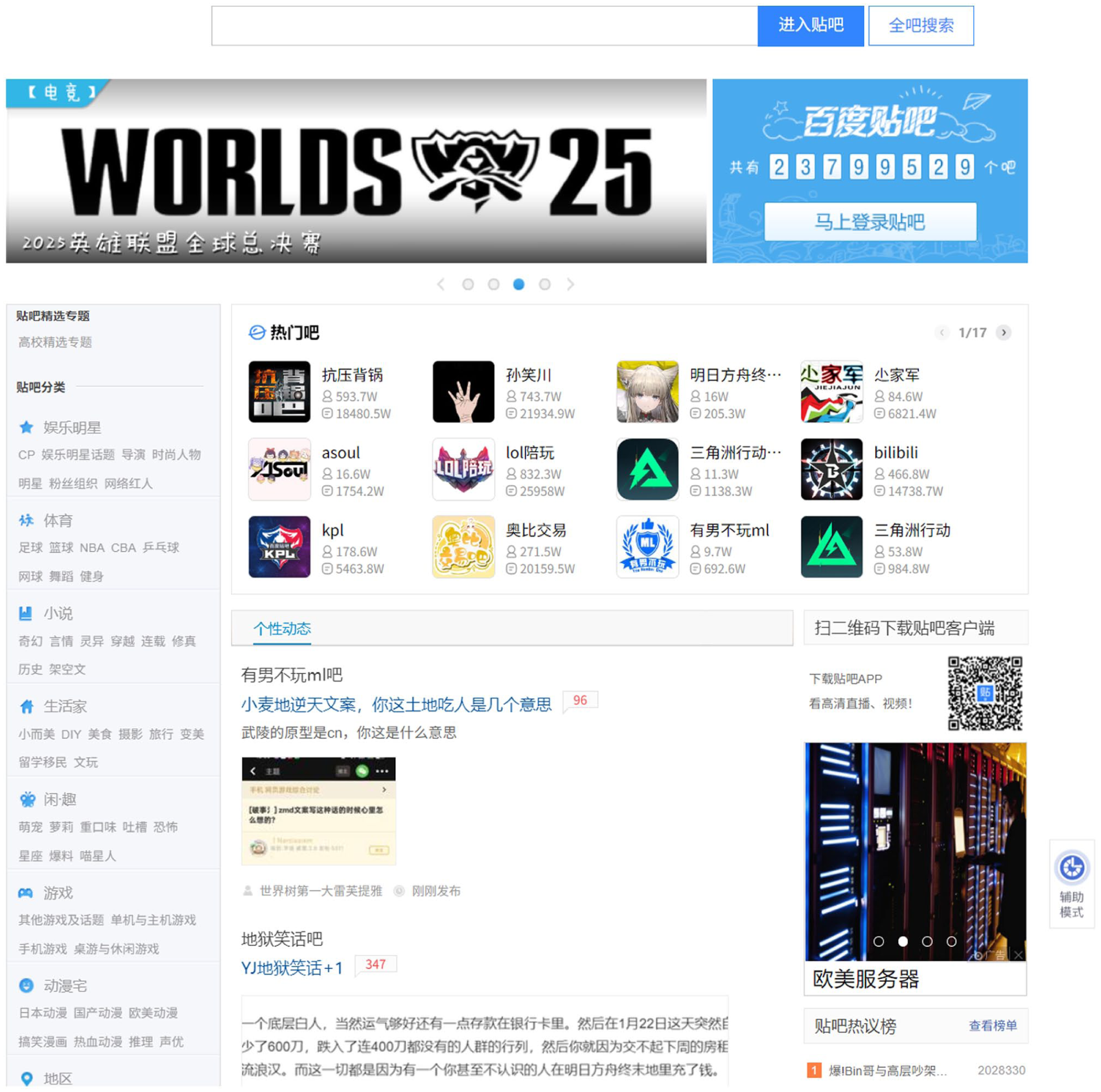
Tieba’s homepage interface (2025).
Among these, Sunxiaochuan ba (hereafter “sun ba”) presents a theoretically generative case. Originally created as an interest community around a Chinese esports’ streamer, sun ba has evolved into one of Tieba’s five most active boards with 7,013,871 followers and 205,635,534 posts as of May 2025. Crucially, this community exhibits a striking discursive transformation: while it once featured casual discussions about gaming and daily life, it has become widely recognized in Chinese media and public (Sixth Tone, 2023; Southern Weekly, 2023) as a prominent female-hostile community where gender-antagonistic content flourishes. Yet preliminary observation reveals discussions still encompass diverse themes—technology, politics, economics, regional discrimination, and nationalism coexist alongside gender-antagonistic content.
This duality makes sun ba analytically valuable not merely as a representative misogynistic community in China, but as a representative community on Tieba as an “outdated” platform. Our research interest is not to prove its misogyny, but to explain a deeper structural question: why has misogynistic discourse, rather than other equally present fringe or hateful discourses (such as regional discrimination or nationalism), ultimately gained overwhelming “discursive dominance” in this community? This puzzle directs attention toward how social structure filters and channels expression, shaping which themes become organizationally central rather than peripheral.
Considering Alternative Communities From the Perspective of Opportunity Structure
Since the 1970s, opportunity structure, originally a concept in social movement studies, has been used to explain how disadvantaged groups navigate institutional constraints to achieve collective goals (Eisinger, 1973; McAdam, 1983). Classic political opportunity structure (POS) theory focused on state system openness, elite divisions, and ally availability as external conditions facilitating mobilization (Tarrow, 1996), positing a relatively linear logic: favorable political conditions enable organized mobilization leading to collective action.
While this framework proved insightful, it has faced substantial criticism. Goodwin and Jasper (1999) argued that POS suffers from structural bias, marginalizing culture, emotion, and agency as channels through which opportunities are translated into action. The theory’s causality assumption, that movements emerge because opportunities open, proved inadequate for explaining collective expressions not oriented toward state confrontation. Meyer and Minkoff (2004) further warned that POS risked becoming “a sponge that soaks up every aspect of the social movement environment,” requiring further specification of how opportunities are perceived and interpreted by actors.
These critiques catalyzed theoretical expansion beyond institutional politics. Recognizing POS limitations in capturing cultural and communicative dimensions, Koopmans and Statham (1999) introduced discursive opportunity structure (DOS), focusing on how narrative beliefs gain success through public sphere selection. Koopmans and Olzak (2004) subsequently studied right-wing violence in Germany, operationalizing DOS through three dimensions: visibility (media attention and public exposure), resonance (degree of reactions from various actors), and legitimacy (normative support from authorities or publics). Their framework emphasizes that opportunities are no longer subversive political moments awaiting organized exploitation, but rather selective mechanisms inherent in discursive environments, permitting certain discourses and action patterns to survive and diffuse more easily, ultimately leaving behind specific community formations or protest foci.
As digital communication transformed social movement landscapes, media and communication scholars developed mediated opportunity structure (MOS) to analyze how communication infrastructures shape collective action possibilities (Cammaerts, 2012). Cammaerts (2012, 2015) conceptualized MOS as comprising three interconnected substructures: discursive opportunity structure (collective identity), media opportunity structure (mass media access), and networked opportunity structure (ICTs). MOS indicates that discourse must diffuse through mass media or technological mediation while expanding the scope of collective action itself. While offline movement remains relevant, the works of Koopmans and Cammaerts have shown that online identity construction and self-narration have become achievable goals within opportunity structures, legitimizing analyses of online communities.
The integration of these opportunity structures depends on specific contexts. We argue that misogyny and other alternative communities in digital contexts operate at the intersection of political constraints, discursive selection choices, and platform mediation, necessitating an integrated structural approach. Traditional political, social, and economic analytical frameworks (POS) prove insufficient because they presume political targets and organizational capacity. The alternative public sphere sometimes lacks institutionally oriented political goals, manifesting collective expression primarily through discourse production and consumption (Cammaerts, 2012). To examine what action costs communities face (political dimension), which discourses survive (discursive dimension), and how they diffuse (mediated dimension), and how these jointly constrain and enable fringe expression, requires constructing a multidimensional analytical framework. Specifically, applying this framework to China in contrast with the West enables us to understand how divergent opportunity structures (open vs. closed) channel similar social grievances, ultimately shaping community formations with different pathways and demands.
Synthesizing the above discussion, discourse production constitutes the primary form of collective expression in alternative communities. We thus begin with the most observable layer, topical discourse, operationalizing Koopmans and Olzak’s (2004) discursive opportunity structure framework through visibility, resonance, and legitimacy dimensions.
Political and mediated (particular social network platforms) channels explain why and how users congregate here to express these messages. We employ interviews to trace users’ experiences and beliefs:
Methodology
To achieve both exploratory and explanatory objectives, we employed a mixed-methods approach combining in-depth interviews with computational analysis to address the above questions. We acknowledge that sun ba represents an instrumental case study (Stake, 1995) rather than a statistically representative sample of all Chinese misogynistic communities or Tieba forums. Our analytical goal is theoretical generalization, using this case to refine opportunity structure theory’s explanation of the relationship between misogyny and other fringe topics.
Data Collection
To investigate users’ experiences and beliefs in sun ba, we employed in-depth interviews. Through purposive and snowball sampling, we recruited 27 participants until theoretical saturation (see Supplemental Appendix A): 26 forum users (23 males and 3 females) aged 18–37 years (M = 23.0, SD = 5.1) with forum experience ranging from 0.4 to 18 years (M = 7.6, SD = 4.6), and 1 platform operator. User interviews were conducted via online meeting software from November 2024 to March 2025 in Mandarin, averaging approximately 43 min. The operator interview was conducted in September 2025. All participants were informed of research purposes and signed consent forms. We committed to anonymizing recordings and collecting no traceable personal data. Interviews were semi-structured, addressing why users utilize sun ba, how they interact and express on the platform, and their views on mainstream misogynistic and alternative discourse within the community.
Second, we collected publicly accessible data from sun ba on Baidu Tieba to examine its discourse ecology and topic associations. Using a Python-based script that accessed open webpages without authentication, we retrieved 91,026 public posts (including titles, body text, and reply counts) from January 1 to April 30, 2025. Data collection automatically ceased when the forum’s interface began redirecting all subsequent requests to the platform homepage, indicating the end of accessible content. According to public reports (Guancha, 2025), sun ba was later ordered to rectify in late May 2025, suspending posting and replying functions. Our dataset thus represents a relatively complete public snapshot of this community during that period.
Data Analysis
Topic Modeling
Recognizing limitations of traditional topic modeling methods (LDA and BERT), including limited short text processing, reliance on word co-occurrence while ignoring contextual semantics, and extensive manual parameter tuning (Mu et al., 2024; H. Wang et al., 2023), we propose LLM-ANTMN, a three-stage framework integrating large language model understanding with clustering evaluation. This approach offers critical advantages for analyzing Chinese online discourse: LLM’s zero-shot semantic understanding excels at interpreting networked slang, metaphors, and coded language prevalent in alternative communities, whereas BERT’s smaller training corpus struggles with such linguistic complexity. Inter-coder reliability (Cohen’s κ) between LLM-ANTMN-generated topics and trained human coders reached 0.89, demonstrating robust semantic validity. Technical replication details, reliability testing procedures, and comparative performance against BERT are provided in Supplemental Appendix B. The framework contains three core steps:
Stage 1: Topic Generation. Utilizing GPT-4o, a globally representative large language model version, for zero-shot topic generation, extracting semantically clear topic labels from raw text through designed prompt engineering. Setting the temperature parameter to 0 ensures output consistency, requiring each document to generate no more than five topics, with each topic limited to no more than three Chinese words.
Stage 2: Topic Merging. A three-stage optimization process determined the optimal topic set: (1) Coarse screening (k = 10–300, step 50) using Calinski–Harabasz index and Inertia metrics; (2) Fine-interval screening (k = 50–100, step 10) with silhouette coefficient, CH index, and Davies-Bouldin index; (3) Semantic verification (k = 80–90, step 2) through Jaccard distance, BERT similarity, and manual review, yielding k = 84 as optimal.
Stage 3: Topic Network Analysis. Following ANTMN methodology (Walter & Ophir, 2021), topics were treated as network nodes with connections weighted by co-occurrence strength. The Louvain algorithm identified communities, clustering related topics into frame packages.
Discursive Opportunity Metrics
To address RQ1, we operationalize Koopmans and Olzak’s (2004) three dimensions for the closed community context. Visibility is measured through two indicators: modeled topic frequency (which discourses persist in community discussions) and discourse complexity. Lower linguistic complexity indicates topics requiring less evasive encoding to avoid censorship, signaling relative speakability. We calculate complexity using a Chinese linguistic complexity algorithm based on the AlphaReadabilityChinese framework (Lei et al., 2024), which combines semantic clarity (noun specificity) and coherence metrics. Technical details are provided in Supplemental Appendix C. Resonance and legitimacy are measured through reply counts, reflecting internal recognition in this homogeneous community (Sunstein, 2002).
Interview Materials
For 27 in-depth interview transcripts, we primarily employed “reflexive thematic analysis” grounded in constructivist epistemology (Clarke & Braun, 2014) for coding and interpretation. Analysis was conducted using NVivo 11 software, aiming to deeply explore users’ motivations, processes, and specific experiences in using misogyny as topic substitution, understanding their agentic choices under closed opportunity structures. This study combines computational and qualitative analysis for methodological triangulation (Denzin, 2012). Specifically, discourse patterns (what) revealed by computational methods like ANTMN are given meaning and depth through explanations (why) provided by in-depth interviews. Interview sample size followed thematic saturation principles, stopping data collection when new interviews no longer generated new core themes (Fusch & Ness, 2015).
Findings
Before presenting the findings, Table 1 provides definitions of community-specific terms used throughout the following section.
Glossary of Key Community Terms.

Mapping Discourse Topics in Sunxiaochuan Ba
Addressing RQ1, we present topic modeling and community network analysis for sun ba. Table 2 displays the top 10 topics ranked by centrality metrics among the 84 identified topics.
Top 10 Topics by Structural Centrality in Sunxiaochuan Ba.
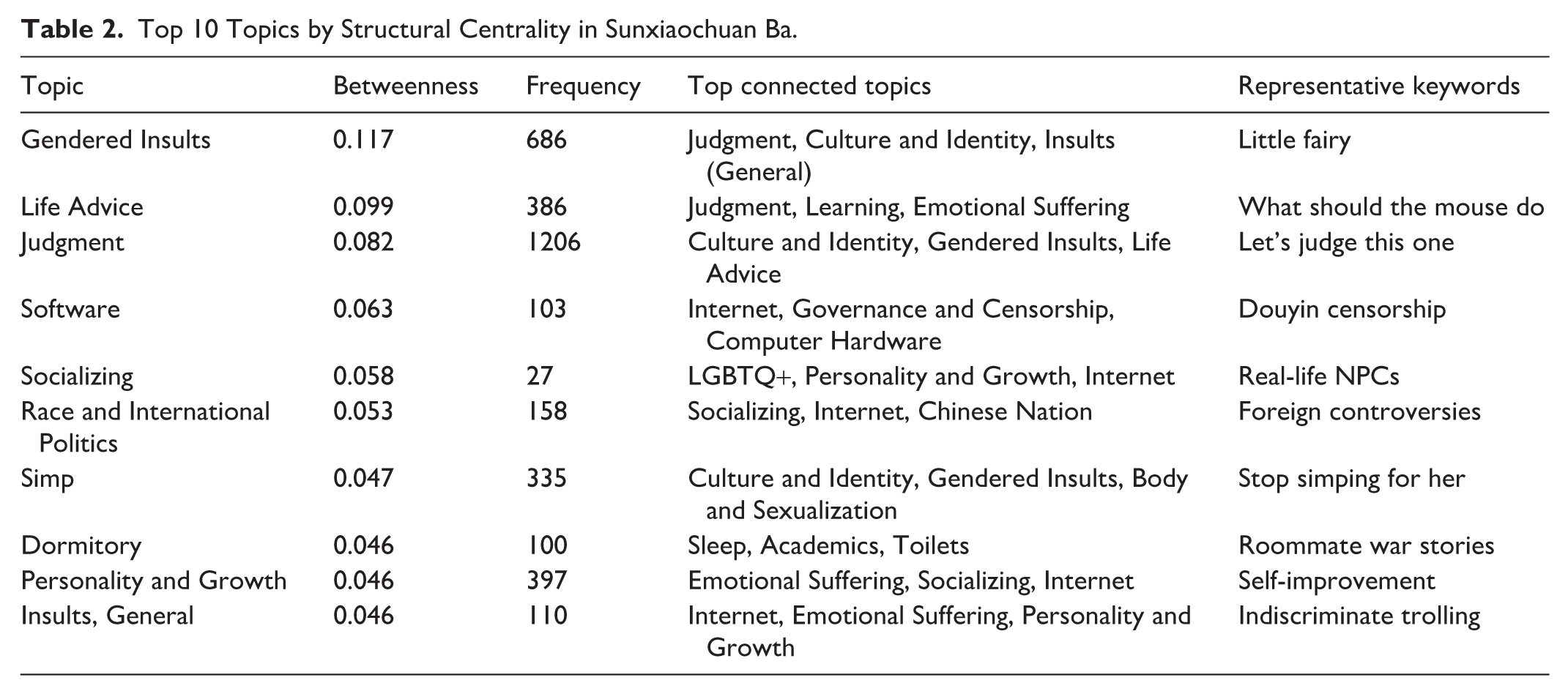
Network analysis reveals “Gendered Insults” as the most structurally important topic, exhibiting the highest betweenness centrality (0.117), indicating its role as a crucial bridge connecting different thematic communities. Other high-betweenness topics include “Life Advice” (0.099), “Judgement” (0.082), “Software” (0.063), and “Socializing” (0.058). Notably, both gender-critical discourse (“Gendered Insults” and “Judgement”) and personal development content (“Life Advice” and “Personality and Growth”) serve as key connectors in the discourse network. Complete metrics for all 84 topics are available in Supplemental Appendix D.
Table 3 lists the community islands to which these topics belong, while Figure 2 visualizes the topic network.
Eight Identified Communities and Constituent Topics of Sunxiaochuan Ba.


Topic network visualization of Sunxiaochuan ba.
A key bridge term here is “Mouse” (鼠鼠, shǔ shǔ), a self-deprecating metaphor for users as social outcasts “living in the sewer.” Using phrases like “For a mouse like me. . .” (鼠鼠我啊. . .), members adopt this identity to comment on social order or share personal failures for group evaluation. This evaluation mechanism sometimes transcends personal levels, embedding into broader but contentious state narratives through discussions of “Regional Discrimination,” “Chinese Nation,” “Race and International Politics,” and “Japan and South Korea.” For instance, overlaying comments on Western or other Asian women’s activities, amplifying and maintaining misogynistic emotions through nationalism and cultural defense frameworks. Overall, Community 1’s core involves regulating gender to maintain its perceived social order.
To validate which discourses achieve visibility and resonance/legitance within sun ba, we examine how two visibility indicators, topic prevalence (frequency) and discourse complexity, relate to audience engagement across all 84 topics. We categorize topics for visual analysis into three groups: women-targeting topics (green), encompassing direct gender-antagonistic and female-objectifying themes; political contentious topics (red), including discussions on governance, nationalism, and identity politics that bear resemblance to Western far-right discourse; and other topics (gray, where preceding themes are less thematically dominant).
Figure 3 plots topic frequency against audience engagement (measured by reply counts). Women-targeting topics dominate Quadrant I (high popularity and high engagement): “Judgement” leads with the highest frequency (z = 3.89) and strong engagement (z = 1.51), while “Gendered Insults” demonstrates both substantial prevalence (z = 2.22) and engagement (z = 1.10). “Appearance” (frequency z = 1.38) and “Culture and Identity” (z = 2.79) similarly attract high participation. In contrast, fringe political topics scatter across the lower quadrants. “Regional Discrimination” and “Japan and South Korea” show negative frequency (z = −0.69, z = −1.32) and engagement (z = −0.35, z = −1.44), while “Governance and Censorship,” despite moderate prevalence (z = 1.18), generates negative engagement (z = −0.40). This distribution reveals that women-targeting discourse not only persists in community discussions but actively mobilizes participation, whereas politically sensitive content remains marginal in both presence and resonance.

Topic prevalence and audience engagement in Sunxiaochuan ba.
Figure 4 examines discourse complexity as a second visibility metric. Women-targeting topics cluster in Quadrant II (low complexity, high engagement), indicating they require minimal linguistic encoding to evade censorship. “Girlfriend” exhibits the highest engagement (z = 3.14) with very low complexity (z = −1.11), followed by “Female Relatives” (engagement z = 2.79, complexity z = −0.25) and “Breakup Issues” (engagement z = 2.43, complexity z = −1.58). Conversely, fringe political topics concentrate in Quadrant IV (high complexity, low engagement): “Regional Discrimination” requires the most evasive encoding (complexity z = 3.54), while “Japan and South Korea” (z = 2.49) and “Law and Justice” (z = 1.42) similarly demand complex linguistic camouflage yet generate minimal engagement. Notably, “Feminist Critique” shows exceptionally low complexity (z = −2.17) yet negative engagement (z = −0.89), suggesting that while abstract ideological critique faces few censorship barriers, it lacks the affective intensity to mobilize participation compared to emotionally visceral topics like “Gendered Insults.”

Discourse complexity and audience engagement in Sunxiaochuan Ba.
In summary, the forum’s topic structure reveals converging patterns across network topology and discursive opportunity dimensions. While topics associated with alt-right discourse (“Regional Discrimination,” “Race and International Politics,” and “LGBTQ +”) exist within sun ba, they remain structurally peripheral with low connectivity, embedded within cultural or technological discussions rather than forming coherent ideological communities. This marginalization indicates users’ strategic avoidance of high-risk political speech. In contrast, “Gendered Insults” exhibits the highest betweenness centrality and extensive cross-community connections, suggesting diverse conversations invariably channel through women-targeting discourse. The visibility and engagement analysis substantiates this structural centrality. Women-targeting topics achieve dual advantages: high prevalence in community discussions and minimal linguistic encoding demands, simultaneously generating substantially higher engagement than contentious alternatives. Topics like “Girlfriend” and “Female Relatives” cluster in the low-complexity, high-engagement quadrant, whereas political topics require complex linguistic camouflage yet produce minimal resonance.
These patterns suggest that gender may function as a relatively permissible boundary topic within constrained opportunity structures, but the mechanisms through which this structural centrality emerges require deeper investigation. The following sections examine these dynamics.
Navigating Political and Mediated Opportunity Structures: Why Here, Why This?
Following the discursive mapping, in-depth interviews trace how users perceive and navigate the political and mediated opportunity structures that shape their affordance and topic retention, addressing RQ2.
The emergence of sun ba as a hub for misogynistic discourse is the outcome of a multi-layered filtering process inherent in China’s constrained opportunity structure. This structure systematically closes off certain expressive channels while leaving others, such as misogyny, as a path of least resistance. First, all public discourse on Chinese social media must pass through the primary filter of a closed political opportunity structure. A recurring interview theme involves sharp political topic expression facing stricter content moderation, constituting users’ primary constraint within opportunity structures. Meanwhile, objectively changing social conditions intensify pressures on young people, while the need for expression remains constant or even increases. They clearly understand certain topics constitute “unspeakable” ultimate red lines. Interviewee 1 explained post-deletion experiences bluntly: “If I really expressed myself, I probably wouldn’t dare speak. Mainly content criticizing current government. . . basically impossible to publish, and your account gets banned.” Interviewees universally perceive direct political commentary as the most heavily moderated, highest-risk behavior across Tieba and the entire Chinese internet.
Platform insiders confirm these filtering mechanisms. Interviewee 27, a platform operator, described the moderation hierarchy: political content receives primary attention through automated keyword filtering followed by manual review. This governance pattern is common across Chinese platforms, characterized not by proactive patrols (given the massive scale of platform content) but by reactive responses to user reports. Whether political posts that pass automated filtering are tolerated depends on context—specifically, whether viewpoints touch upon real-world contexts. Interviewee 26, also active in covert political boards like “Park Chung-hee ba,” described this dilemma: “In Park ba and Xiao Wang ba, anything involving real cases can’t be posted. . . you can discuss political economics, Marx’s philosophy, Western society, but can’t involve modern Chinese historical events.” To express viewpoints within uncertain censorship standards, users in explicitly political ba adopt more complex, nearly publicly unreadable textual encoding methods, controlling content circulation and preventing outsider reports (Ye & Zhao, 2023). Comparatively, despite some slang and argot, sun ba’s discourse complexity equals or falls below that of other ba covertly discussing political ideologies, pornography, and ethnic hatred, possessing relative speakability (Supplemental Appendix E). This viability is not user-chosen but structurally produced: the outcome of filtering mechanisms that systematically close some channels while leaving others relatively open.
While political opportunities remain closed, the differential opening and closure of mediated channels filter certain residual opportunities into existence. First, platform governance structures differentially affect discourse viability. Interviewee 27 noted that on Weibo and Xiaohongshu, where female users predominate, misogynistic content generates high user reports requiring platform intervention. Conversely, while Tieba’s governance officially prohibits hate speech, such content persists in its male-dominated user base due to lower reporting rates. This dynamic reflects how content survival depends on audience composition and reporting propensities. Gendered platform segregation reflects deliberate choices. Members attribute women as both victims and perpetrators of platform capitalism. As Interviewee 1 stated, platforms like Weibo and Xiaohongshu “belong to little fairy (women)” and are despised:
“Weibo and Xiaohongshu are women’s ‘cesspits.’ Tieba is men’s cesspit. So naturally I should stay in men’s cesspit.”
According to public reports from Xiaohongshu (2025) and Weibo (2024), women aged 13–34 comprise 70% and 55% of users, respectively, with over half concentrated in China’s tier-1 and tier-2 cities. By contrast, platform operators report that over 70% of Tieba’s active users are male, younger on average than Xiaohongshu and Weibo users, with notable participation from lower-tier cities. Consequently, the few female users in sun ba are driven by curiosity-driven consumption rather than ideological alignment. They are not “Chinese women who hate feminism” as described by Y. Wang and Chang (2023), with interviewees clearly expressing support for gender equality. Facing male user hostility, they hide gender identities (changing gender account settings) to avoid harassment or maintain detached attitudes, viewing misogynistic content as spectacle.
Second, Tieba’s mediated opportunities further derive from two structural affordances that insulate discourse from external scrutiny. As public attention shifted toward algorithmic platforms, Tieba transitioned from mainstream visibility to relative obscurity—an attention migration that paradoxically provides shelter for fringe expression. In addition, Tieba’s materiality creates structural invisibility: its BBS-style interface and name-dependent access system require users to know exact ba names to enter. This architecture creates relatively insulated internal structures compared to feed-based platforms. Interviewees praised several key technical features of Tieba, see Table 4. They perceive the forum’s “outdated” structure as ideal for “deep discussion.” As Interviewee 11 stated, “Definitely the forum is most suitable [for deep discussion]. . . Douyin and Weibo. . . they’re too superficial.”
Key Technical Features of Tieba by Interviewees.

Channeled by political censorship and platform mediation, misogynistic discourse emerges as one of the few intense, grievance-based expressive forms that can thrive. This phenomenon does not necessarily stem from users strategically selecting women as a substitute target for the state. Rather, it is a consequence of an opportunity structure that renders other channels for grievance expression too costly or inaccessible. The persistence of misogynistic content on legacy platforms then cumulatively attracts a secondary aggregation of interested users. As Interviewee 15 noted: “People. . . must have a window for venting; if reality doesn’t permit it, they will definitely vent online.”
Users also positively evaluate the affordances of this surviving channel.
“Sewer Mouse”: Negotiating Opportunity Structures Through Strategic Weakness
Addressing RQ3, we analyze how the “shushu” (mouse) identity embodies negotiations of multi-layered opportunity structures, shaping distinctive masculinity and validating why misogyny functions more as a structural hub rather than a gateway to broader extremism. Technical details are in Supplemental Appendix F.
Topic co-occurrence network analysis reveals (Figure 5) that “mouse” serves as a central node connecting multidimensional issues from personal life (educational experiences, romantic relationships, family interactions) to social structural levels (economic conditions, racial cognition). Notably, the network lacks positive topics related to success, achievement, or dominance, displaying distinctly “frustration-centered” discourse patterns. “mouse” self-identification as low-status males is bound to a series of negative experiences including economic difficulties, emotional setbacks, family conflicts, and personal failures.
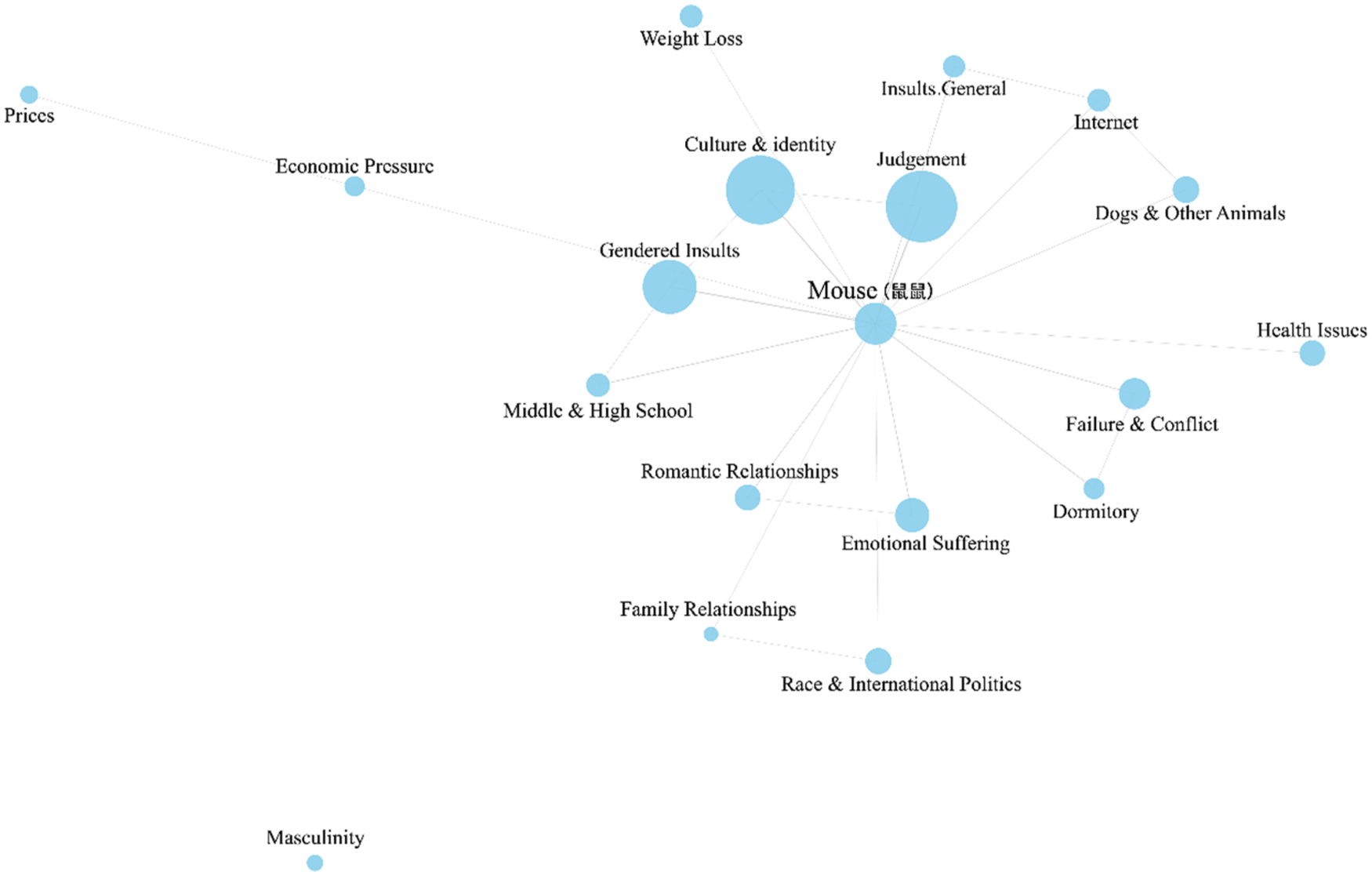
Topic co-occurrence network of “shushu” (mouse).
Emotional co-occurrence network analysis shows (Figure 6) that expressions around “mouse” are predominantly negative. High-frequency co-occurring vocabulary includes lingering sadness, uncomfortable, bored, confused, feel inferior, overly sensitive, repressed, anxious, heartbroken, disgusted, and angry. Small amounts of “LOL” and “laugh” expressions exist, possibly indicating processing negative emotions through humor or self-deprecation. Positive emotional vocabulary occupies relatively peripheral network positions with weaker connection strength.

Emotional co-occurrence network of “shushu” (mouse).
Self-deprecating discourse patterns are ubiquitous in sun ba’s daily posting. Users narrate life difficulties, social anxieties, and emotional failures from “mouse” first-person perspectives:
Based on discourse-network mapping and interview analyses, we confirm that “shushu,” the community’s core identity discourse, is a strategic adaptation to intersecting structural constraints. Emerging collectively shows how opportunity structures shape both the speakability and the identity claimable.
Under closed political opportunity structures, direct critique of governance, economic inequality, or institutional injustice invites significant risks, foreclosing users’ ability to position themselves as political opponents. The “sewer mouse” metaphor instead provides a safe channel, expressing grievances through self-deprecation of personal inadequacy rather than systemic critique. Interviewee 7’s statement reveals how this identity dissolves internal class hierarchies while avoiding confrontation with external power structures, echoing Scott’s (1990) concept of “hidden transcripts” where subordinates perform weakness publicly while maintaining internal dignity:
I particularly love that everyone calls themselves mouse. Here there’s no worship of knowledge, no wealth gap. We’re all mouse in the black, stinking sewers. (Interviewee 7)
Second, the forum’s legacy platform status and BBS-mediated sociotechnical affordances allow this subcultural identity to evolve beyond mainstream algorithmic amplification, minimizing regulatory attention. Unlike hypermasculine postures on high-visibility platforms that attract media coverage and critical influxes, the “mouse” identity’s self-deprecating character appears to reduce regulatory scrutiny. Interviewee 27 (platform operator) confirmed that self-mocking content, given its humble and ambiguous expression, rarely meets evidentiary thresholds even when reported, persisting within governance systems that nominally prohibit hate speech.
Critically, the “mouse” identity achieves discursive legitimacy by positioning users as victims. This strategic self-positioning resolves a fundamental tension: how to sustain misogynistic discourse when overt hostility toward women faces increasing social and platform sanctions? By claiming “sewer” status as society’s most abject position, users construct moral standing to criticize women without appearing privileged or threatening. This explains why the discourse achieves both speakability (visibility) and active circulation (resonance and legitimacy).
Comparison with Western masculinist communities reveals how differential structures produce divergent masculinity constructions and misogynistic functions. While Western manosphere communities include self-identified “losers,” their dominant strands emphasize dominance, success, and superiority through “alpha male” or “Chad” archetypes that valorize strength, wealth, and sexual conquest (Ging, 2019). In contrast, “mouse” discourse leaves minimal space for assertive masculinity. Members deconstruct rather than engage in gender competition, embracing “beta fate” and normalizing it through collective identity. This divergence reflects different opportunity structures: Western contexts permit liberal masculinist discourse with fewer political constraints, facilitating dominance fantasies, while Chinese contexts render such assertive postures risky, favoring submissive ones.
In addition, Western masculinist communities explicitly advocate social change through men’s rights activism, far-right politics, or calls for societal restructuring (Marwick & Caplan, 2018). sun ba users display no such mobilizational demands, focusing on shared abjection rather than collective organizing. This reflects both closed political opportunity structures, making activism risky and mediated opportunity structures (Tieba’s marginality), sustaining expressive communities without requiring external action.
We therefore conclude that the “mouse” identity’s strategic weakness internalizes the impossibility of escalation. Rather than “temporarily weak, eventually strong” (gateway logic), it represents “accepting weakness as permanent condition” (terminal hub). Users are neither actively selecting misogyny as a stepping stone nor accidentally lingering here. They are channeled toward and satisfied within this space because systemic constraints render it a functional equilibrium: ventilating multiple frustrations while minimizing risk. Even if users desire further radicalization, opportunity structures obstruct such trajectories. Misogyny persists as the maximum permissible intensity, making it a terminus, see Figure 7.

Misogyny as a structural hub within the triple opportunity structure.
Conclusion and Discussion
Conclusion
Through 27 in-depth interviews, LLM-driven topic modeling of 91,026 posts, and discourse opportunity analysis, this study demonstrates how misogynistic discourse achieves structural centrality in China’s constrained digital environment. Network analysis reveals “Gendered Insults” exhibits the highest betweenness centrality, bridging diverse conversational clusters from personal frustrations to cultural commentary. Discourse opportunity metrics substantiate this structural position: women-targeting topics dominate both prevalence and engagement while requiring minimal linguistic encoding to evade censorship, whereas fringe political topics remain marginal despite complex linguistic camouflage. Interviews reveal users navigate opportunity structures by channeling suppressed political and socioeconomic grievances through relatively permissible gender discourse. The “sewer mouse” masculinity constructed within this space enables sustained expression through strategic self-deprecation rather than confrontational assertion. These findings indicate that within China’s regulated digital environment, online misogyny operates as a structural hub rather than necessarily a gateway to broader extremism.
Discussion
The study’s first contribution refines the relationship between misogyny and broader extremist ecosystems. Existing research, primarily grounded in Western contexts, conceptualizes misogyny as a gateway or pipeline guiding members toward far-right ideologies (Díaz & Valji, 2019; Weiss et al., 2025). Our findings do not refute this possibility but contextualize its scope. In relatively open political environments where expression and mobilization face fewer constraints, misogyny may indeed function as an entry point to broader radicalization pathways. However, in closely governed contexts characterized by closed political opportunities, report-driven platform governance, and relative tolerance for gender-antagonistic discourse, misogyny becomes a convergence point where multiple grievances stabilize. Users do not necessarily choose to remain in misogynistic spaces. Rather, opportunity structures fail to provide viable outlets for escalation or diversification. The “structural hub” logic thus supplements rather than replaces the gateway hypothesis, illuminating how different configurations of political, discursive, and mediated constraints produce divergent trajectories for networked hate.
This study provides a culturally heterogeneous community portrait for global misogyny research, enriching the understanding of this phenomenon’s local manifestations. Unlike Western manosphere communities characterized by aggressive, power-seeking masculinity driven by alpha male and red pill ideologies (Dafaure, 2022; Marwick & Caplan, 2018), Sunxiaochuan ba members construct collective narratives centered on “sewer mice.” This highly self-deprecating identity comprehensively favors incel-style beta or omega masculinity, deconstructing rather than aspiring to dominance. Members seek empathy and solidarity through shared experiences of personal failure while subtly directing grievances toward broader social equity concerns. This “strategic weakness” may constitute self-protection, diminish regulatory risks while establish marginalized masculinity as a form of moral authority (Connell & Messerschmidt, 2005). Such patterns suggest that anti-feminist representations are not globally uniform. Individual large male communities may emphasize incel identities while expanding discussions to covert social critique, potentially common across Global South contexts.
This paper extends opportunity structure concepts from classical social movement theory to explain alternative community expression in digital spaces. Traditional political, social, and economic frameworks (McAdam, 1983; Tarrow, 1996) presume institutionally oriented goals and organizational capacity. Our framework recognizes that alternative publics often lack such orientations, pursuing collective expression primarily through discourse production and consumption (Cammaerts, 2012). Integrating political opportunity structures (what action costs communities face), discursive opportunity structures (which discourses survive), and mediated opportunity structures (how discourse diffuses) enables analysis of how these dimensions jointly constrain and enable fringe expression. We operationalize discursive opportunities through visibility (topic prevalence and linguistic complexity), resonance (engagement patterns), and legitimacy (internal recognition), demonstrating empirically how opportunity structures filter expression into specific forms. As mainstream attention shifts toward algorithmic platforms, legacy infrastructures like Tieba paradoxically become mediating resources that alternative communities can utilize precisely because they are “outdated.” This framework illuminates how opportunity structures shape not only whether collective expression occurs but what forms it takes and which discourses achieve organizational centrality. Future research explaining digital alternative community mobilization should further examine opportunity structure theory’s explanatory potential across varied regulatory regimes.
Computationally, this study introduces the LLM-ANTMN framework, which integrates large language models’ semantic understanding with topic model network analysis to process complex networked discourse. This design directly responds to recent calls in computational social science for incorporating LLMs to enhance text-analysis capacity (Ziems et al., 2024). Compared to traditional methods limited in handling metaphorical language and coded expressions, this approach excels at interpreting slang and euphemisms prevalent in alternative communities. We provide replication procedures using a classic model version (GPT-4o) to ensure transparency. However, LLM-ANTMN’s sensitivity across different model versions and these models’ potential biases require further evaluation. Researchers should assess consistency across multiple LLM implementations and validate outputs against human coding to mitigate algorithmic bias risks.
While this study focuses on China, comparison with South Korea reveals the contextual specificity of the “structural hub” logic. In South Korea, where anti-feminist backlash similarly intensifies, misogyny operates under different opportunity structures. President Yoon Suk-yeol’s 2022 campaign explicitly mobilized male resentment by promising to abolish the Ministry of Gender Equality, demonstrating how open political systems enable misogyny to function as a direct electoral strategy rather than a substitute discourse (Jenkins & Kim, 2024). Anti-feminist movements achieve policy influence through organized activism and institutional access. This contrast suggests our framework is likely to apply when three conditions converge: stringent constraints on political expression, relative tolerance for gender discourse, and lack of legitimate outlets for other grievances. In open systems, misogyny remains pervasive but serves ideological mobilization not structural substitution. China’s case thus illuminates how closed opportunity structures channel diverse discontents through available pathways, producing misogyny’s centrality as a systemic outcome.
Our findings do not endorse misogyny as a “safety valve” deserving tolerance. Acknowledging that misogynistic discourse reflects socioeconomic frustrations and political voicelessness does not diminish its tangible harms to women or justify regulatory inaction. Treating misogyny purely as content moderation overlooks its nature as a symptom of deeper structural failures. Yet, suppressing it without addressing root causes risks displacing rather than resolving grievances. We advocate for integrated interventions that simultaneously reduce harm and reshape structural conditions. Platform governance should enforce zero tolerance for targeted harassment and direct threats while using algorithmic de-amplification rather than outright removal to reduce misogynistic content’s circulation. Critically, platforms must support alternative content addressing economic anxiety and social alienation without scapegoating women, providing non-gendered outlets for legitimate grievances (Gorwa, 2019). This approach confronts misogyny’s real damage to women’s digital safety and public discourse quality while avoiding strategies that merely push discontent into more hidden or radicalized spaces.
Two limitations remain. First, as exploratory research, this study provides descriptive analysis including community topic modeling, supplemented by in-depth interviews for explanation. Worth further investigation is whether misogyny is a form of meta-alternative? This requires testing strict causal relationships between censorship intensity and topic shifting, which future research could verify through multi-period difference-in-differences models or user trajectory tracking. Second, the samples focus on explicit posters in a single Tieba. Future research could expand to Weibo, Douyin, or Telegram groups while incorporating high-intensity violent misogynistic communities for comparison, further testing the explanatory legitimacy of misogyny as a structural hub.
Supplemental Material
sj-docx-1-sms-10.1177_20563051261417300 – Supplemental material for Misogyny as a Structural Hub: Unveiling a Mode of Opportunity Structure for Chinese Alternative Communities
Supplemental material, sj-docx-1-sms-10.1177_20563051261417300 for Misogyny as a Structural Hub: Unveiling a Mode of Opportunity Structure for Chinese Alternative Communities by Luming Zhao, Jinzhuo Liu and Xinyan Wang in Social Media + Society
Footnotes
Acknowledgements
The authors thank the editor and anonymous reviewers for their constructive feedback. We also extend our gratitude to the 吧友 (BaYou, members of the Tieba community) who participated in this study and openly shared their insights.

Funding
The authors received no financial support for the research, authorship, and/or publication of this article.
Declaration of conflicting interests
The authors declared no potential conflicts of interest with respect to the research, authorship, and/or publication of this article.
Data availability statement
The data used in this study are available upon request.
Supplemental material
Supplemental material for this article is available online.
Author biographies
References
Supplementary Material
Please find the following supplemental material available below.
For Open Access articles published under a Creative Commons License, all supplemental material carries the same license as the article it is associated with.
For non-Open Access articles published, all supplemental material carries a non-exclusive license, and permission requests for re-use of supplemental material or any part of supplemental material shall be sent directly to the copyright owner as specified in the copyright notice associated with the article.
