




Abstract
We now live in an age of unhidden gender wars where direct violence occurs within online and offline spaces. These online spaces on Facebook, Twitter or Instagram become venues for attacks on gender and woman’s rights, as well as its intersection with race and ethnicity. Such online hate expressions and networked harassments channelled towards women provide clues for us, social scientists, to understand the underlying dynamics/nature of misogyny. In this paper, by studying the online misogynistic narratives developed around the Istanbul Convention as a counter movement, I aim to highpoint the conservative and polarizing discourses that frames gender-based violence as acceptable in Turkey. More specifically I show how Twitter can be used as a platform for anti-feminist and misogynistic groups, aiming violence and hostility directly at women and their rights. As these tweets illustrate, the right-wing populist and anti-gender discourses and conservative and authoritarian politics, are being implemented on many fronts and social media is one of them.
Introduction
As Castells (2007: 238) argue, information is an essential source of power and counter-power, where battles take place “over the minds of the people”. Internet as a communication platform allows for such battles to happen. It serves as a medium where social actors impose their vision and ideas over others and negotiate power relations in the form of domination or counter-domination. Taking Chafetz and Dworkin’s (1987) outlook on counter-movements, I argue that the emergence of anti-feminist groups challenge and resist feminist movement – that became large and effective in the pursuit of women’s goals. In this paper, by focusing on the anti-feminist mobilisation on social media, I will demonstrate the relationship between technology, communication and counter-power reflecting opposing values and interests and even engaging feminist actors in conflict.
Across Europe, the anti-feminist groups are mobilising against the advancement of women’s status in political, educational as well as occupational arenas. They operate in a new technological framework and within online spaces. They use new forms of communication and social media platforms like Facebook, Twitter, or Instagram. According to Banet-Weiser and Miltner (2016: 172), popular misogyny with its ‘anti-female violent expression circulates to wide audiences on popular media platforms’. This, in turn, not only facilitates ‘ways to misogynis [e] political and economic culture’ (Banet-Weiser and Miltner 2016: 172) but also allows for the normalisation of violent threats, violence against women and even the rape culture. Such online hate expressions and networked harassments channelled towards women provide clues for us, social scientists, to understand the underlying dynamics/nature of misogyny. In this paper, by studying the online misogynistic narratives developed around the Istanbul Convention, I aim to highpoint the conservative discourses that frame gender-based violence as acceptable in Turkey.
Opposing Istanbul convention
The Istanbul Convention is the Council of Europe Convention on preventing and combatting violence against women and domestic violence. The Istanbul Convention supports a zero-tolerance policy for family violence and provides a set of requirements for the signatory nations such as outlawing forced marriages, female genital mutilation, stalking, forced sterilisation as well as so-called honour killings (Gunes 2019: 2). Turkey signed the Istanbul Convention in 2011 and ratified in 2012 1 and pulled out of the convention in 2021 2 as the paper was being written. Since its ratification of the Istanbul Convention, more than 15,000 women have been killed in Turkey 3 . This high number of femicide is despite the changes in the Turkey’s Family Protection Law (No. 4320) and the enactment of the Law to Protect Family and Prevent Violence against Women (Law No: 6284). As the feminist lawyers and women’s organisations were discussing the potential weaknesses of the Law No: 6284 and looking for ways to improve it in order to combat violence against women, the Turkish government started considering withdrawing from the Istanbul Convention altogether.
According to the deputy chair of the Justice and Development Party (AKP) Numan Kurtulmuş – ratifying the Istanbul Convention was a mistake in the first place. He stated that: “I am saying as a person, who has read the Istanbul Convention repeatedly, has also read this in English and worked on it. The signing of the Istanbul Convention was really wrong.” (Daily News, 2020)
4
.
The We Will Stop Femicides Platform (Kadın Cinayetlerini Durduracağız Platformu), on the other hand, sees withdrawing from the Istanbul Convention a threat which would lead to violence against women and LGBTI (lesbian, gay, bisexual and transgender people, intersex) communities
5
. As women’s groups in Turkey lobbied continuously both nationally and internationally via social media platforms as well as through street protests, they pointed out to the high number of femicides in Turkey. The ‘black and white picture challenge’ was among the many protests women’s activists used to gather international attention. The challenge began after 27-year-old Pinar Gultekin’s femicide on 16 July 2020, by her ex-boyfriend in the south-western city of Mugla. The challenge advocated Instagram users to post a black and white picture of themselves to stand in solidarity with murdered or missing Turkish women who occupied the front pages of newspapers in black and white. The challenge quickly became worldwide, and thousands of women posted their pictures and urging others to do the same as form of sisterhood, empowerment and support for the Istanbul Convention. While the women’s groups gained international support and recognition with their campaign, the anti-Istanbul convention groups also started to emerge (also referred as anti-Convention groups). They raised their voices stating that the Istanbul Convention was misused to enforce Western gender ideology, promote homosexuality and bring an end to the traditional Turkish family. Their concerns were legitimated by the state officials and used as an excuse to withdraw from the Istanbul Convention. This is apparent in the following quote of Kurtulmuş: “When our people have such an expectation, we cannot stay indifferent to this. As we have duly signed it, then it would be possible to duly withdraw from it
6
”.
In this paper, by looking at the conservative oppositional group’s online activism, I will explore the factors that contribute to hindering gender equality developments in Turkey. This paper is thus an attempt to explore the misogynistic discourses used while lobbying against the Istanbul Convention and its gender equality mission. By studying the dialogues of the anti-Istanbul Convention groups, I will draw on the broader context of anti-feminism and the anti-gender movement of the government in power. In other words, I will show how this case of gendered online harassment and online misogyny in Turkey ‘is a reflection of the cultural understanding of gender and women’s inferior place in society’ (Koirala 2020: 48) as well as the anti-gender political agenda. For this I will examine the tweets sent under the hashtag #Istanbulanlasmasiihanettir (#Istanbul convention is treachery) by the anti-Istanbul convention groups. The paper will end by discussing how networked misogyny can serve as a contributing factor for gender inequality and gender-based violence.
Networked misogyny and war against gender equality
This paper follows the assumption that the digital media platforms facilitate dissemination of ideologies. More specifically, it argues that the counter feminist movements in the digital sphere in Turkey not only help spread anti-gender ideologies, but also serves to normalise their radical views into mainstream discourses. Graham and Graff (2016: 27) talks about how white extremists ‘leverage the affordances of the digital environment to disseminate their ideology [and how] they find ways to communicate with people who do not expressly commit to extremist ideology’. He refers to this online communication inter-ideological mingling and argues that hashtags facilitate such ‘mingling’ on Twitter and that this is done via blending and joining (Graham and Graff 2016: 27). Twitter then serves as a counter platform where alternative norms are applied and counter-hegemonic narratives are formed, and extremist ideological positions are strengthened. It is these alternative norms that bring together the members of the counter movements. As Adams and Roscigno (2005) asserts, it is sometimes a common hashtag that helps creating a united identity and feelings of belonging to a certain ideology. This in return serves as potential for recruiting more supporters and a sense of solidarity. Bostdorff (2004: 341) in their work, talks about how community is built ‘through opposition to other groups and through angry, persistent messages of hate that discourage dissenting points of view’. The Klan websites in the United States for instance, he argues, facilitate the emergence of in-group identities, notions of solidarity and support dissemination of their beliefs to larger groups.
The study of such online counter movements comes with the acknowledgment of online communities not as ‘mere virtual entities, but instead real and complex social formations that have a concrete influence on the life of their participants’ (Caliandro (2018: 554). This view captures such communities as sharing an online culture, which according to Castells (1989) means tracking them across online platforms. These online communities as they shape social formations and everyday discourses, the everyday discourses and the general political atmosphere also structure what is created in these digital platforms. These networks that have elements of connective action with ‘loose organizational linkages, technology employments, and personal action frames’ serve more as ‘advocacy organizations facilitating personalized protest networks’ (Bennett and Segerberg 2012: 757).
Social media not only allows for free expression and speech, but also opens possibilities for the ‘polarization of public debate, aggressive styles of communication, and the silencing effects of online harassment’ (Nadim and Fladmoe 2019: 1). In fact, through online misogyny and online hate, social media serves to promote structural inequality and gendered violence, where women become the target (Jane 2014a and Jane 2017). Online harassment, cyber-bullying and gender-trolling are all terms referring to the use of social media to ‘harass, harm or ridicule other person using either a fake or real identity’ (Koirala 2020: 47). As Jane (2014b) puts it, the online hate channelled towards women is ingrained in the longstanding misogynistic discourses that view men as superior to women.
The anti-gender discourses used to harass others online serves to reinforce the patriarchy and victimise women. Though such discourses might be like the offline ones, its anonymous nature and potential to reach wider audiences makes the networked misogyny a challenge. I refer to these being networked as they exist and communicate through online mobilization and coordination. It is a product of what Castells (1986) refers as a culture of ‘real virtuality’ where there is a flow of capital, information, technology, images as well as organisational interaction.
Like Korkut and Eslen-Ziya (2016) argues, discourses are powerful tools that actively construct reality while forming representation. In other words, discourses are created while ascribing meaning to events that happen, which forms identities as well as social relations. Similarly, the misogynistic narratives created, and shared online help support or even construct actuality. Once they are expressed in the form of images, videos, or tweets they become utterances of political desire or statements that the crafter aspires to publicly share (KorkutMcGarry et al. 2021). Therefore, the online expressions serve as a powerful tool to construct discourses of the future in a political sense. It becomes the platform where ideologies are disseminated as well as legitimated (Burul and Eslen-Ziya 2018). Therefore, the online harassment and misogynistic discourses shared on social media contribute to the existing male dominated – patriarchal – power structures. According to Jane (2017: 48):
‘Gendered cyberhate has the potential to cause emotional, social, financial, professional and political har, in that – among other consequences – it can constrain women’s ability to find jobs, market themselves, network, socialise, engage politically and partake freely in the sorts of self-expression and self-representation regarded as key benefits of the Web 2.0 era’.
The gendered cyberhate then clearly has consequences outside the digital space, harming and negatively impacting women and posing a threat to gender equal political goals via online anti-gender lobbying is one of them.
Across the globe online misogynism functions as resistance to feminism and feminist reforms. These patriarchal, masculinist and conservative groups attack reforms related to gender equality, gender-based violence and sexual assault. As Wojnicka (2016: 37) states, such groups advocate the ‘interests of white, heterosexual men, including fathers in particular, while promoting traditional, hegemonic definition of masculinity and femininity and thus the reestablishment or defence of particular gender relations’. Hence, their resistance is against the feminist led struggles to promote the autonomy and equality of women and ending gender-based violence. The anti-feminist and anti-gender rhetoric shared online in turn carries these anti-gender discourses to the surface, making them accessible to a wider public and even guiding mainstream politics. In this paper, by focusing on the anti-Istanbul Convention discussions in Turkey, I will demonstrate the shared canons of these online performances and their resemblance to the government’s anti-gender discourses.
Misogyny in context: Gender rights and inequality in Turkey
Based on Bianet’s report, in the first 10 months of 2017 in Turkey, men killed 242 women and girls, raped 77 women and harassed 207 women; in addition, 286 girls suffered sexual abuse and 338 women were subjected to violence 7 . Since Bianet’s 2017 report, violence against women is not only increasing but is being normalised. This is happening even though gender-based violence has been in the political agenda of women’s NGOs (non-governmental organisations) since the early 1980s and a focus of Turkish governments. Although the Turkish government has been implementing laws and regulations to combat gender-based violence, its conservative stand and familial approach continues to support patriarchal family and gendered division and discursively support gendered roles and even violence against women. This was clear in AKP Mayor of Ankara Melih Gökçek’s statement: “If the mother is raped, so what? Why should the child die? Let the mother die 8 ” in a television programme when discussing the rape victims’ right to have an abortion. He later went further and blamed the women for being raped in the first place and said: “A woman should be moral so that she is never obliged to have an abortion 9 ”. Similarly, Ayhan Sefer Üstün, AKP deputy and Chairman of Human Right Commission in the Parliament claimed that: ‘The rapist is more innocent than the victim who has an abortion 10 ’.
Such anti-abortion polemics regarding rape victims are impeccable examples of AKP’s conservative and discriminatory discourses that became even explicit since their second round of elections. Although in the early 2000s the AKP government was interested in emphasising its pro-liberal stand in its support to European Union (EU) membership (Coşar and Yeğenoglu 2011), since 2007 the party’s neoliberal-conservativism within socio-cultural and political spheres became visible. This is mostly due to the Ottoman-Islamist nostalgia and religious conservatism that AKP’s nationalism is fed from (Çınar 2008). AKP is leading what Coşar and Yeğenoglu (2011: 557) refer as “a new mode of patriarchy exemplified in the intertwining of neoliberal, nationalist and religious politics. The AKP refers to this ‘new mode’ as the New Turkey, where populist discourses support traditional family as an institution and the gendered roles within them – women as mothers and wives and men as bread winners and heads of households. This was clear in President Erdoğan’s statement where he uttered that a woman rejecting motherhood is ‘deficient’ and ‘incomplete’ and urged women to have at least three children
11
. Similarly, he called on Muslims to refrain from using contraception and to have as many children as they can: “no Muslim family should consider birth control or family planning”
12
.
As Korkut and Eslen-Ziya (2016: 13) contend, such narratives uttered set the grounds for AKP’s populism and their majoritarian – and I add masculine/patriarchal – understanding of politics These narratives in turn serve as the discursive governance (Korkut and Eslen-Ziya 2011, Korkut and Eslen-Ziya 2016, Korkut and Eslen-Ziya 2017), where the AKP government defines women as the submissive gender and mothers as those whose work should only be at home: “You cannot make women work in the same jobs as men do, as in communist regimes. You cannot give them a shovel and tell them to do their work. This is against their delicate nature
13
”.
Through such discursive governance the AKP sets their public agenda, where public discourses play a critical role in circulating as well as legitimating function, especially in authoritarian political settings like in Turkey (Burul and Eslen-Ziya 2018). Such discourses in turn shape masculinities within the Turkish culture and legitimate violence towards women, femicide and child abuse, as Kandiyoti (2016: 111) describes the ‘soaring levels of gender-based and societal violence… not indicative of a securely entrenched patriarchy but of a crisis in the gender order and the polity more generally’. Kandiyoti (2016: 109) introduces the term ‘masculinist restoration’ where patriarchy is threatened and entails pressure to continue its existence. “Women’s rising aspirations and determined male resistance create a perfect storm in the gender order that manifests itself in both semi-official attempts to ‘tame’ women and uphold men’s privileges (contra the letter of written laws, hence attempts at by-passing and eroding them), and in the unofficial excesses of street-level male violence (which the judiciary often meets with leniency).” (Kandiyoti 2016: 110)
The recent emergence of misogynistic anti-gender mobilisation around men’s rights and discourses of male victimisation over child custody and matrimony payments, as well as the anti-Istanbul Convention protests, is part of this masculinist restoration. The online activism against Istanbul Convention is a good illustration of the recent mobilisation of conservative male resistance. In the following sections, by studying the tweets sent under #Istanbulanlasmasiihanettir (#Istanbulconventionistreachery) hashtag, I will be able to highlight the narratives they are using in such masculinist restoration.
Method
Here I should note that, I am fully aware of the limitations of both the server used (i.e. not reaching out to the collective data set) and the claims of “truth” made via the analyses of the captured data (i.e. ‘objective’ interpretations of the data) (for more details see: Weller et al. 2014 and Caliandro 2018). However, here I intend to understand how the meaning making proceed on digital platforms, and in this paper, I do this by placing technology use into specific online behaviour (Marwick 2014). More specifically my goal is to, dwell upon the presence of anti-Istanbul convention mobilisation, or networking on Twitter. Though the Tweets gathered in this paper may be incomplete and the search function imprecise, or Twitter may be used by only small number of people – my objective here is to make sense of user’s practices, and their construction of reality, and their understanding of what Istanbul Convention is. For this, I follow Caliandro (2018: 553) footsteps and employ digital methods where I use Twitter data ‘not so much as an object of study, rather as a source of new methods and languages for understanding contemporary society’.
Illustrating both the process of anti-gender mobilisation online and the categories emerging from the captured tweets.
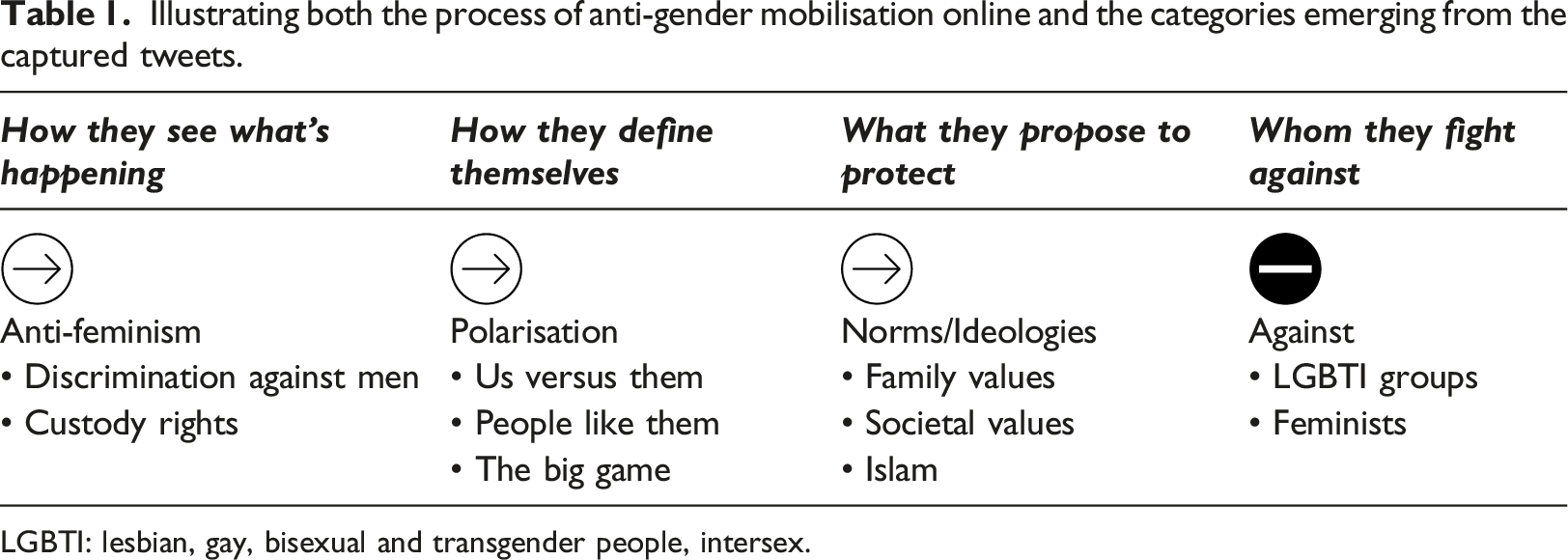
LGBTI: lesbian, gay, bisexual and transgender people, intersex.
Technology, misogyny and digital activism
Many accomplishments were achieved thanks to the women’s movement in Turkey and their diligent networking and lobbying (see Arat, 2012; Aldıkaçtı, 2013; Davis and Lutz, 2000; Diner and Toktaş, 2010; Eslen-Ziya, 2013, Eslen-Ziya and Kazanoglu, 2020; Grünell and Voeten, 1997; Ketola, 2013; Tekeli, 1992 for further discussion on women’s struggle in Turkey). As the women’s mobilisation to combat violence against women grew stronger, so did the patriarchal conservatism. According to Banet-Weiser and Miltner (2016: 171), this is due to the ‘precariousness of ‘toxic masculinity, a (heterosexual) masculinity that is threatened by anything associated with femininity’. Once these men feel their masculinities are endangered or vulnerable, they respond in a ‘macho and violent manner’ (ibid.) and they form anti-feminist, anti-gender counter movements.
Anti-feminist counter-movements (Chafetz and Dworkin 1987) emerge as a backlash movement on gender and feminism, and they resist change. They have the goal to preserve the status-quo and guard traditional social values. For instance, the men’s movement across Europe mobilised against the advancement of women’s status in political, educational as well as occupational arenas, once they started perceiving women’s movement as a threat. They mainly lobbied for fathers’ custody rights and alimony payments where divorced single fathers were constructed as the victim of feminist worldview (Flood 2004; Kimmel 2004; Messner 1998). They blamed feminist movement for disrupting their social and occupational status. They wanted to “turn back the clock” (Chafez and Dworking 1987: 37) to the better world where men had power over women, what Graff (2020) refers as the conservative nostalgia against progressive hope across the globe. In this section by bringing forth the online activism of anti-Istanbul Convention groups via Twitter, I will demonstrate the networked misogyny and online gender wars taking place in Turkey with that very same conservative nostalgia.
Anti-feminism
The first category constructs and defines the events around the narrators of the tweets, how they see what the Istanbul Convention represents for them and why they would like Turkey to leave it. The main objection of the opposition group is shaped around gender equality and the definition of gender as a social construct. They believe that the Istanbul Convention imposed a definition of gender that was not compatible with the Turkish culture and norms. Here they assume that the Convention was talking about biological sex, instead of gender, and that it would encourage same sex marriages and recognise rights to transgender people. Hence, they argued that the Istanbul Convention will disrupt the cultural and religious texture of the Turkish nation. This was evident in the below meme that was shared on Twitter. It argued that Istanbul convention and its agenda were sponsored by the West:
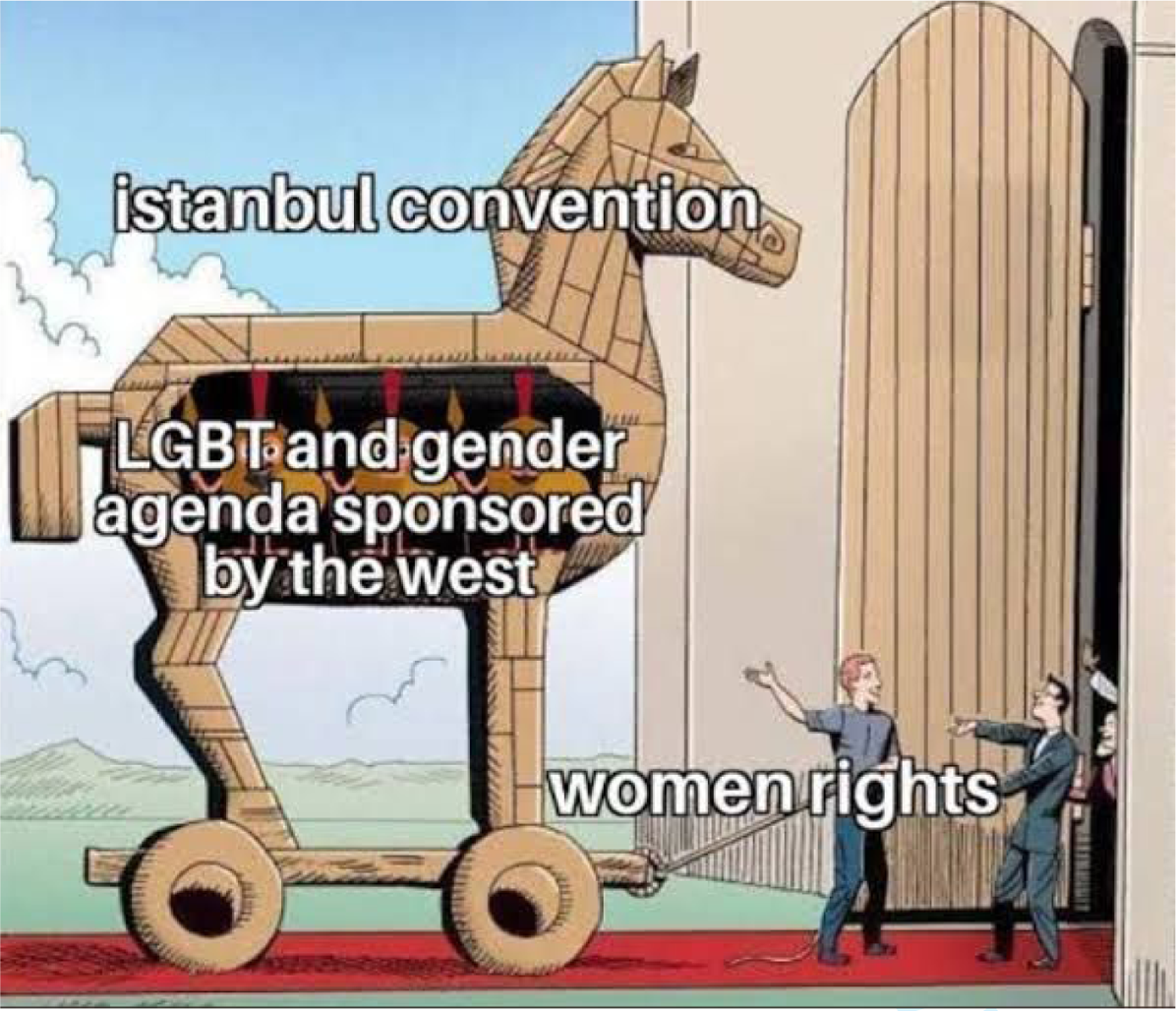
The gender-phobia they display relies on the conservative perspective that gender ideology is a lie constructed by the feminists and LGBTI groups that do not wish the Turkish nation to thrive. Such view is also supported by President Erdoğan’s following utterances: ‘Our religion regards motherhood very highly…and feminists do not understand that they reject motherhood 14 ’.
The gender-phobia in turn presents family, religion and traditional values as discourses to which feminists object. This is apparent in one of the videos widely shared and re-tweeted among the anti-Convention supporters. The video was originally in Russian, created for President Vladimir Putin’s political campaign, but the anti-Convention groups adopted it by adding Turkish subtitles and shared by writing: Is this the family you want to be? #Istanbulconventionistreachery (04. August. 2020).
The video takes part in an orphanage in Russia where a young boy is displeased upon finding-out that his new adopted mother is actually a trans person who presents a gift to the boy in a black dress. The video moreover depicts the antipathy of the woman working at the orphanage. As the gay couple hugs, the video ends by asking: ‘Is this the Russia you will choose? Decide the future of the country. Vote for the amendments to the constitution’
15
. Such tweets sharing this Russian ad argued that the Istanbul Convention is promoting gender ideology that would lead to gay marriages and that is why it should be opposed: Whoever defends homosexuality and regards LGBT people as legitimate, be God’s curse on them...Amen. #Istanbulconventionistreachery (04 August 2020).
Hence, they perceive support for the Istanbul Convention as leading to what they see as immoral behaviour, excessive abortions and childlessness that would eventually bring an end to the Turkish nation. For this they shared the below meme “Istanbul convention will kill” (Istanbul sözleşmesi öldürür) widely:
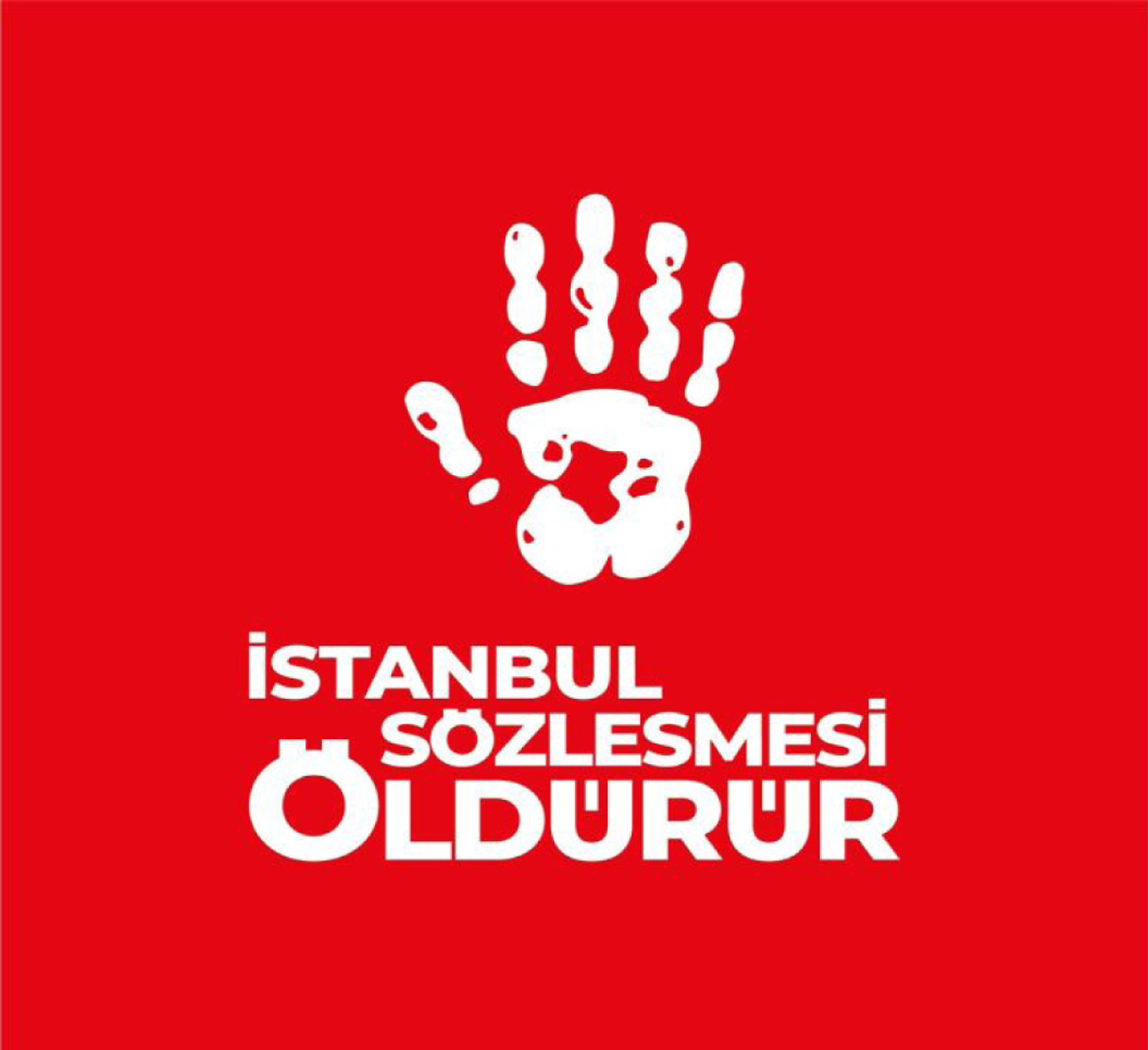
In these tweets, they targeted the law no. 6284 under the Convention, which aims to protect women from domestic violence, by arguing that it one-sidedly favours women. They argued that women played the ‘violence card’ to accuse men, or ‘to get rid of their husbands’. The following tweet clearly depicts such perception: Said she was raped, but when found virgin she said, ‘I made it up’. This is what happens if you devalue the man and take women’s testimony as fundamental. #Istanbulconventionistreachery (06. August. 2020).
Via these misogynistic tweets, the anti-Convention supporters not only construct the political environment but also set the grounds for distinguishing themselves from the so-called others. This in turn enables the spread of what Ozduzen and Korkut (2020) refer to as mundane polarisation where polarisation on social media curtails from the everyday interactions of people.
Polarisation
The tweets analysed clearly depict a ‘us vs. them’ distinction, where those who support the Istanbul Convention and gender equality are seen as traitors to the nation. Such polarisation has been constructed and supported by President Erdoğan and AKP officials, especially since the Gezi Park protests in 2013. The Gezi Park protests started when the government wanted to cut down the trees in Gezi Park to build a shopping mall. In reality, it was a response to the anti-gender and authoritarian ruling of the AKP government (KorkutMcGarry et al., 2021). During the protests, President Erdoğan clearly depicted the protestors as them (traitors) and the AKP voters as us (supporters). Such polarisation in Turkey became stronger as time passed. This polarisation also exists in the tweets sent by the anti-Convention supporters, but this time it seems to involve not just AKP supporters and opponents but women and LGBTI groups in general: Talking about a law in a state that implements a law that does not protect women from women and only protects women from men.! To denounce men as potential criminals, the consequences of putting women against men unfortunately results in murder…#Istanbulconventionistreachery (04. August. 2020).
As argued by Ozduzen and Korkut (2020), such online polarisation is both a consequence and response to the anti-gender mobilisation of misogynist groups. In fact, the online platforms like Twitter, while sharpening the polarisation between anti and pro Convention groups, at the same time allows these groups to confront each other. In fact, the analysed tweets reveal the replies of anti-Convention supporters to tweets from Istanbul Convention lobbyists and women’s activists. The below tweet is an example of such an exchange, where the anti-Istanbul Convention supporters tweeted about the feminist groups’ demands for having the Istanbul Convention and their arguments that without the Istanbul Convention violence against women would increase. The below tweets argue that: as violence exists today with the Convention, it is the Convention that is causing the violence: It’s six of one and half dozen of the other…#Istanbulconventionistreachery (04. August. 2020). Istanbul convention will keep you alive? on the contrary, it will kill you. This is apparent in the news you shared. …#Istanbulconventionistreachery (07. August. 2020). The contract that has been implemented since 2011 did not keep the woman alive but killed her. After the convention the men were crushed before justice. When he could not see justice, he ensured his own justice. Moreover, a few men took their own lives. …#Istanbulconventionistreachery (07. August. 2020).
Such a view is no different than AKP officials who did not believe in the Istanbul Convention. For instance, Kurtulmuş argued that: The thesis of ‘Domestic violence would increase in the absence of the Istanbul Convention’ is also wrong. Equality of opportunity for women and men is currently one of the most basic issues of our custom within the Turkish law system
16
.
As the anti-groups clashed with the feminists defending women’s rights, the polarisation between such groups sharpened.
Norms, values
The analysis of the anti-Convention tweets revealed mostly three ideologies shaped around family values, societal values and Islam. Istanbul Convention is a Betrayal to Our Religion, Family and Society! #Istanbulconventionistreachery (07. August. 2020). We say no to this convention aimed at disturbing family order #Istanbulconventionistreachery (07. August. 2020).
As also depicted in the image shared on Twitter, they argued that Istanbul Convention, by bringing rights and freedoms to women, aims to wipe out the family (aile in Turkish) altogether.
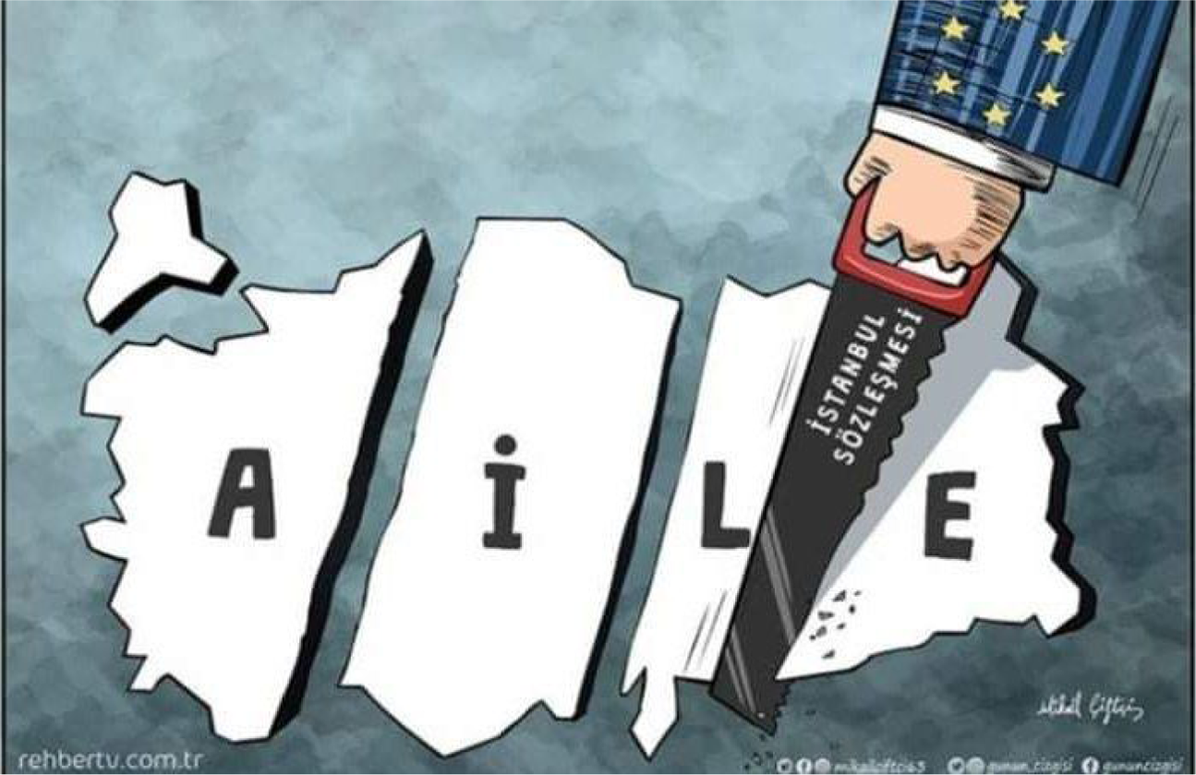
This in turn, they argued, would lead to an end of the Turkish nation. This is in fact like President Erdogan’s popular public discourse on three children as a goal for families. As indicated by Korkut and Eslen-Ziya (2016), the three-children slogan of President Erdoğan, starting as early as the 2002, has been the marking point of the population debate in Turkey: “This slogan serves to frame socio-economic and socio-political dimensions of the population number and link it to future Turkish prosperity, identity, and power. Erdoğan articulated his ideas in an issue area that can plausibly be seen as not mattering much to the Turkish public before his interventions. Erdoğan encourages his audience to view the issue of having children in his own terms, reminding people to contribute to the fertility and fecundity of the Turkish nation” (Korkut and Eslen-Ziya 2016: 561).
Erdoğan clearly depicts these population decline narratives as a threat to societal values and norms. Such population politics deliberately emphasises the role of women as mothers and the importance of family for the future of the Turkish nation: “one child means bankruptcy, two children mean bankruptcy, three children merely mean stagnation
17
”
As the governance relies on slogans and lacks substantive policy (Korkut and Eslen-Ziya 2016: 561), it is not to our surprise that the anti-Convention narratives are also encouraged by the AKP officials. As Kurtulmuş stated: There are two issues in this convention which we do not approve of. First is the gender issue and the other is sexual orientation issue. There are also other issues but these two have been the concepts which have played into the hands of LGBT and marginal elements. They have taken refuge behind these concepts
18
.
Against
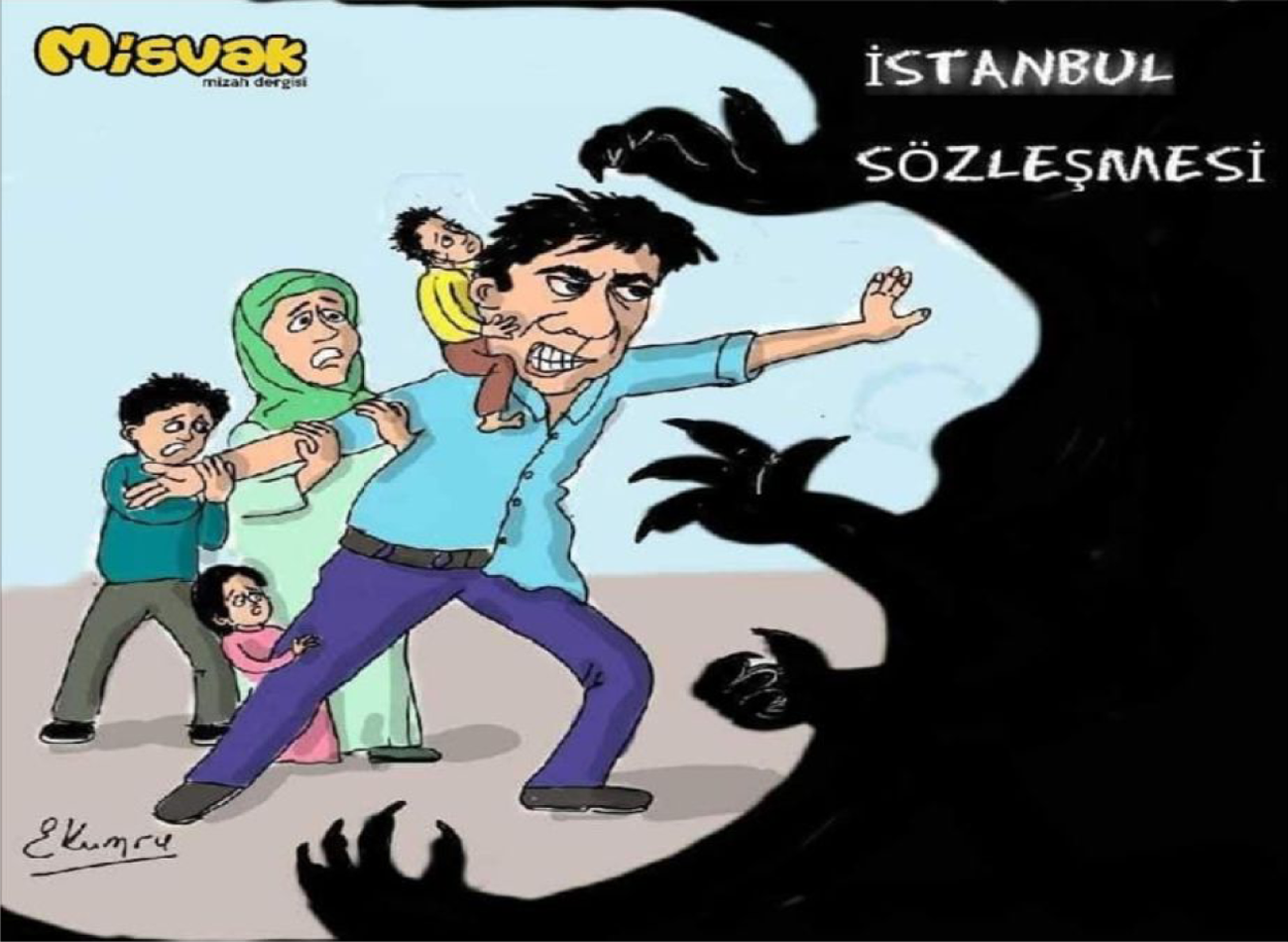
As illustrated in Table 1 and described in this section, the anti-Convention groups on social media construct and re-construct their misogynistic identities and at the same time create the public discourse of what is normal or abnormal. The below image that was shared widely on Twitter for instance was from a conservative weekly magazine Misvak 19 . It portrayed a heroic father trying to protect their family from the evils of the Istanbul Convention.
For example, as they see an LGBTI family as immoral or depict homosexuality as abnormal, they preserve the heteronormative ideal order. As these groups lobby against the claims of ‘unjust’ laws covering alimony payments and child custody, they accuse women of taking advantage of the Convention: The # Istanbul convention was in effect for 9 years. But the killings continue to increase. You are struggling with your inexhaustible sensual feelings, not women! Until we achieve our goal #Istanbulconventionistreachery (07 August 2020). It turned out that she falsely accused her husband to get his house #Istanbulconventionistreachery (05. August. 2020).
According to Kandiyoti (2016: 108), as the normal becomes the taken-for-granted and natural reality it will have ‘grave consequences of ‘normalisation’ of violence’. In other words, to protect the gender order or guard traditionalism, violence becomes the norm. This is sustained by the subjective sentence reductions provided for the perpetuators because they display ‘good behaviour’ by simply wearing a tie to the court or expressing their guilt. Once such normalisation mechanisms are constructed then anti-gender discourses are endorsed to further polarise women’s rights advocates and misogynist groups.
Establishing networked misogyny and withdrawing from the convention
On the early hours of 20 March 2021, President Erdoğan issued a decree stating that Turkey will be withdrawing the Istanbul Convention and on 1 July 2021, pulled out of Istanbul Convention. Erdoğan’s statement was followed by the declaration of the Directorate of Communications, defending the decision
20
. Their claim for withdrawing from the Convention was: The Istanbul Convention, originally intended to promote women’s rights, was hijacked by a group of people attempting to normalize homosexuality–which is incompatible with Türkiye’s social and family values. Hence, the decision to withdraw (Directorate of Communications, 2021: 1).
These concerns were in fact very similar to the description of the Convention by the anti-Convention groups online. The Directorate defended their choice to withdraw by providing examples from other countries like Bulgaria, Hungary, Czechia, Latvia, Lithuania and Slovakia:
Türkiye is not the only country who has serious concerns about the Istanbul Convention. Six members of the European Union (Bulgaria, Hungary, Czechia, Latvia, Lithuania and Slovakia) did not ratify the Istanbul Convention. Poland has taken steps to withdraw from the Convention, citing an attempt by the LGBT community to impose their ideas about gender on the entire society.
Hence, we see a direct link between the online misogynist discourses shared online and its reflection on the general policy level and vice versa. As presented earlier in Table 1, the government, similar to the online anti-Convention groups, stated that they see the Convention as having the intention to break families and Turkish societal values. They clearly saw the Convention as promoting LGBTI groups’ wishes, and feminist organisations as helping them in this process. In doing so, the ruling party not only provided and/or supported anti-gender equality discourses, but also by blaming the feminist groups’ mobilisation for the Convention, depicted an us versus them divide. Hence, the anti-gender mobilisation within the government was similar to the categories emerging from the captured tweets.
According to Aksoy (2021: 1), this withdrawal gave Erdoğan and the ruling party-political advantages to further stay in power. She states that it was a tactic to ‘re-energize the conservative voter base which has been dissatisfied with the economic downturn…’. Consequently, ‘leaving the Convention [was] a symbolic gesture to his base’. Second, Aksoy argues this was an attempt for Erdoğan to find new allies with ‘ultraconservative voters, who enthusiastically back the withdrawal from the Istanbul Convention’. Therefore, withdrawing from the Convention has been used as, what Aksoy (ibid) calls, a ‘bargaining chip for a possible electoral alliance in the future’. Third, Aksoy states that in order to ‘bolster his image as a wilful leader, the Turkish president has intensified the level of repression by suppressing democratic civil society organisations that dare to challenge his rule’. Then, the link between the online misogynistic debates and their narratives of the AKP government in power, as illustrated in Figure 1, depicts how conservatism is politically networked and shapes our everyday lives. Establishing networked misogyny.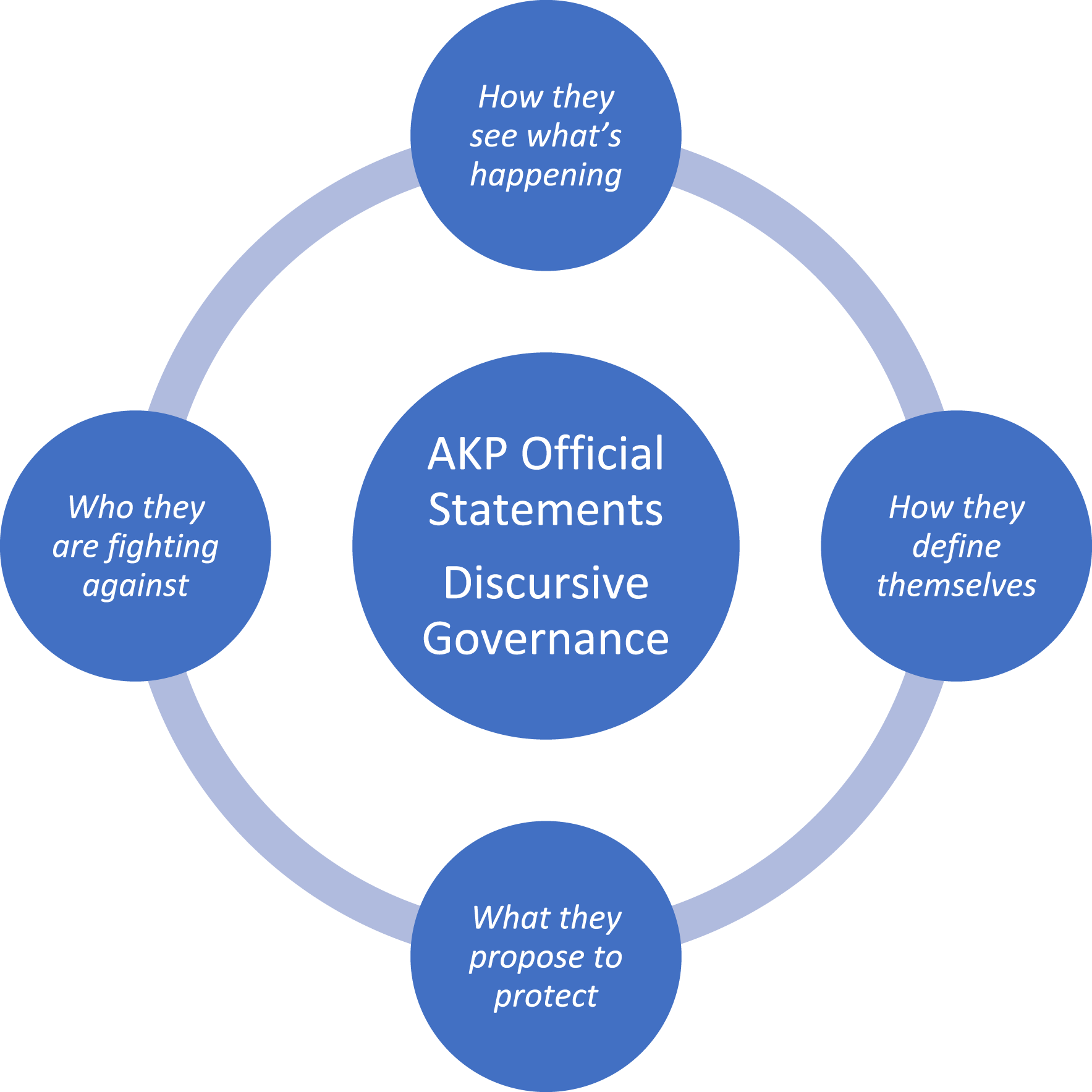
Conclusion
In this paper by studying the elements of networked misogyny, I highlight the link between the online misogynistic debates and their similarities to the narratives of the AKP government in power. I discuss how the digital media platforms facilitate dissemination of ideologies, where the counter feminist movements in the digital sphere help spread anti-gender ideologies and normalise their radical views into mainstream discourses. I further converse how these misogynistic discourses were networked due to their anonymous nature and potential to reach wider audiences. As illustrated in Figure 1, the overall investigation of the anti-Istanbul convention tweets shared on social media put forward the conservative discourses discussed at political level. As Banet-Weiser and Miltner (2016) argue, in order to grasp and combat anti-genderism and misogyny in its networked forms, it is necessary to study it as a whole with its links to the larger patriarchal conservatism. More specifically, I show how Twitter can be used as a platform for anti-feminist/misogynistic groups, aiming violence and hostility directly at women and their rights. As these tweets illustrate, anti-gender discourses and conservative and authoritarian politics are being implemented on many fronts and social media is one of them.
Also, the tweets clearly depicts that these anti-feminist groups perceive feminist mobilisation and feminism as a threat. This, according to Chafetz and Dworkin (1987), qualifies them as counter social movements, because they mobilise to resist change and aim at preserving the status-quo. As these anti-feminist groups lobbied against the Istanbul Convention, they also lobbied for fathers’ custody rights and alimony payments where divorce single fathers were constructed as the victims of a feminist worldview. They believe that the feminist movement will disrupt their social and occupational status. Thus, they mobilise as an attempt to ‘convince the authorities and bystander publics to turn back the clock’ (Chafez and Dworkin 1987: 37). This is what Graff (2020) refers to as the emergence of conservative nostalgia against progressive hope across the globe and this was also evident in the Turkish case.
As the discursive governance of AKP was setting the public agenda, these anti-feminist and misogynist groups re-constructed and shaped masculinities and legitimated violence towards women, femicide and child abuse. This in return serves to – what Kandiyoti (2016) refers as – to restore masculinities, where the threatened patriarchy fights to survive. As shown in this paper, the emergence of online misogynistic anti-gender mobilisation around men’s rights and anti-Istanbul Convention protests is part of such attempt to restore conservative masculinities. In other words, the online activism of anti-Istanbul Convention groups via Twitter, exhibit the networked misogyny and online gender wars taking place in Turkey as a counter movement against feminism. This is the emergence of conservative nostalgia against progressive hope and gender-equality in Turkey.
Footnotes
Acknowledgements
I would like to thank the editors of Convergence and the anonymous reviews received on this paper. I dedicate this work to the women in Turkey who have been victims of femicide.
Declaration of conflicting interests
The author(s) declared no potential conflicts of interest with respect to the research, authorship, and/or publication of this article.
Funding
The author(s) received no financial support for the research, authorship, and/or publication of this article.
