



Abstract
This article examines the phenomenon of cloud parenting in China, considering the affective mechanisms in sharenting and commodification of wanghong children facilitated by the platform affordances. We select five child wanghong accounts that are active on Douyin for case studies, along with corresponding audience interviews. We find that Douyin’s creation affordances enable child wanghong to create a family affection aesthetic. At the same time, audiences detect and decode emotional cues, especially children’s expressions and parent-child interactions, and use these signals to feel authenticity instead of rationally verifying it. Through this affective inference, audiences and child wanghong co-shape emotional authenticity. Cloud parenting emerges as a series of platformized affective practices normalized into data labor and consumption. We argue that in a platformized affective economy, guardians, cloud-parenting audiences, and the Douyin platform are complicit in producing and exacerbating the commodification of wanghong children. Douyin functions not merely as a content distribution platform but as an affective infrastructure that organizes, amplifies, and commodifies children’s emotions and family affection.
Introduction
Sharenting has become increasingly prevalent on social media platforms, including Instagram, YouTube, Douyin, and TikTok. While these practices provide new modes of visibility for family life, they have raised concerns regarding children’s digital labor, privacy, and lived experiences, drawing attention from scholars, journalists, and the public (Chen, 2023; Shomai et al., 2024). For those genuinely attentive to children’s well-being, the risks associated with children’s involvement in sharenting are readily apparent. However, from the audience’s perspective, most followers express support or admiration for the parenting practices displayed by family influencers while significantly overlooking children’s digital labor and real experiences (Abidin, 2017). Sharenting operates as an affective process that enables the production of motherhood and family as communicative formations embedded in the digital context (Lazard et al., 2019). Affect plays a crucial role in shaping the emotional dynamics between sharenting influencers and their audiences.
While much of the existing scholarship has examined sharenting in Western contexts, China provides a distinctive case where the audience’s affective engagement has crystallized into the phenomenon known as “cloud parenting.” The term “cloud parenting” refers to a new techno-mediated social phenomenon in which users imagine or conceive themselves as relatives of the wanghong children that they follow. The term “cloud” originates from cloud computing, emphasizing digital participation that is detached from physical space. Audiences do not merely observe or “monitor” the growth and development of their chosen wanghong children; they emotionally engage through platform features, offering advice, sharing their bubbling gaiety, and even financially supporting them.
The cloud parenting trend is deeply embedded in China’s broader wanghong economy, which the hyperplatformization of Chinese technology companies has propelled (Craig et al., 2021). This process has rendered China’s wanghong economy uniquely dynamic, with its growth driven by the accelerated adoption of information and communications technology (ICT) and mobile technology. The influence is particularly evident in the rapid expansion of the e-commerce sector, in which the wanghong economy is heavily involved. China’s e-commerce market is three times the size of the United States and continues to grow at an annual rate of 27%, leading some to argue that “as China goes, so goes the global e-commerce market” (Lipsman, 2019). Within this landscape, Douyin has emerged as a dominant player. In 2024, Douyin’s e-commerce Gross Merchandise Volume (GMV) reached approximately 3.43 trillion yuan, making it the third largest e-commerce platform in China (Kuaikeji, 2025). Douyin has also become the most widely used venue for child wanghong to circulate content, attract followers, and generate revenue. On average, child wanghong on Douyin achieve monthly cumulative sales exceeding 850,000 yuan (Fushu Lab, 2023). As such, child wanghong have become important players in both the Douyin platform economy and China’s wanghong industry.
Despite the growing body of scholarship on sharenting, scholars call for a deeper examination of the affective mechanisms of audience engagement (Marôpo et al., 2025). At the same time, Douyin, the most influential short video platform in China, provides a critical site for examining how platform affordances facilitate the commodification of wanghong children. Building on these concerns, this article examines five case studies of famous child wanghong who consistently produce short videos on Douyin and how their followers experience and emotionally engage in cloud parenting. The research goal is to understand how the Douyin platform, guardians of children, and audiences’ affective engagement complicitly produce the commodification of wanghong children.
Sharenting, Authenticity, and Commodification of Children
Sharenting can be defined as the practice whereby parents or other guardians, including celebrities, influencers, wanghong, and ordinary users, publicly share information and representations of parenting or children on social media (Blum-Ross & Livingstone, 2017; Tosuntaş & Griffiths, 2024). Research on the sharenting of parent influencers, family influencers, and child wanghong active on social media platforms is situated within the field of influencer and wanghong economies.
A central concept in influencer and wanghong studies is authenticity, which constitutes a key strategic advantage in achieving commercialization (Duffy & Hund, 2015; Marwick, 2013). Here, authenticity is not an essentialist notion of absolute truthfulness; instead, it refers to creators’ cultivation of authentic impressions that foster intimacy and connection with a niche group of followers (Abidin, 2016; Marwick, 2015). Authenticity distinguishes influencers and wanghong from traditional celebrities, who rely primarily on top-down mass-mediated fame (Duffy, 2017). In practice, authenticity presented by influencers is orchestrated, curated, and carefully managed. For example, on platforms centered on images, text, and long-form videos, authenticity is often performed through the practice and aesthetic of “calibrated amateurism,” where influencers deliberately craft contrived authenticity by portraying “the raw aesthetic of an amateur” (Abidin, 2017, p.1). In addition, authenticity serves as an organizing principle of self-branding, as influencers present their “real selves” on social media platforms, thereby bridging private and public life while blurring the lines between personal and commercial expression (Banet-Weiser, 2012). These practices demonstrate how content creation and commercial activities intersect within a social media environment structured by affect and publicity (Gandini, 2016). Importantly, even when content is not objectively authentic, its perception as authentic by audiences can have a profound impact, highlighting the significance of the audiences’ subjective experiences (E.-J. Lee, 2020; J. A. Lee & Eastin, 2021). Within these perceptions, affect plays a central role, as emotions shape how authenticity is interpreted and engaged with in digital communication (E.-J. Lee, 2020).
The authenticity proposition in sharenting is even more complex than in the case of adult influencers because children often lack the skills to create and edit high-quality content independently, and parents play a decisive role in shaping sharenting content (Van Den Abeele, Hudders, et al., 2024). Scholars identify a “parental authenticity paradox” in kidfluencers’ authenticity management, describing a tension between children’s desire and the content parents ultimately decide to post, as parents must balance children’s identities, parents’ desired representations, audience expectations, and commercial partners’ requirements (Van Den Abeele, Hudders, et al., 2024). For family influencers on YouTube and Instagram, content often combines “anchor” videos that highlight talents and creativity with “filler” material about domestic lives, reinforcing the aesthetic of “calibrated amateurism” (Abidin, 2017). On TikTok, however, sharenting typically centers children as protagonists and frequently documents children’s daily lives, performances, emotional reactions, or skits. KidTok can be understood as an extension of sharenting on other platforms. However, its short-video format, non-chronological sequencing, and less explicit amateur performance aesthetics necessitate further analysis of authenticity under specific platform affordances (Abidin, 2020).
Existing scholarship reveals the entanglement between sharenting and the commodification of children. In influencer economies, parents’ self-branding practices convert children’s images into digital capital, generating relatability and followers’ engagement, as well as economic value (Ågren, 2023). Children’s images, identities, behaviors, and growing experiences are managed and strategically deployed by parents to create brand and economic value (Abidin, 2021; Van Den Abeele, Hudders, et al., 2024). For instance, on the Nancy YouTuber platform, through doll reviews, unboxing of commodities, and self-promotion, children internalize digital labor norms (Ruiz-Gomez et al., 2022). Brands encourage momfluencers to include children in sponsored content, assuming that children’s cuteness can drive effectiveness. In these contexts, children function less as autonomous subjects and more as affective devices to foster audience engagement and market trust (Van Den Abeele et al., 2025). Similarly, influencers who feature their mother or father identity embed their children into lifestyle and sharenting videos, thereby fostering authenticity and self-branding while simultaneously commodifying family relationships (Campana et al., 2020; Jorge et al., 2022).
Sharenting practices have raised profound ethical concerns. The commodification of children in commercial sharenting also implicates questions of the exploitation of child labor (Abidin, 2021; Ågren, 2023; Ruiz-Gomez et al., 2022). Besides, parents’ use of pregnancy apps, wearables, and social media posts transforms children into data subjects from infancy, normalizing forms of “intimate surveillance” in which parental monitoring and disclosure of children are framed as acts of care under the guise of affection and protection (Leaver, 2017). Furthermore, ethical issues such as children’s informed consent, conflicts between parental and child intentions, the exposure of children’s privacy, the long-term implications of digital traces, and the erosion of children’s autonomy are also of concern (Blum-Ross & Livingstone, 2017; Jorge et al., 2022; Van Den Abeele, Hudders, et al., 2024; Van Den Abeele, Vanwesenbeeck, et al., 2024).
In the Chinese context, English-language scholarship has begun to address sharenting in relation to localized practices and cultural frameworks. For example, mom vloggers on Douyin and Xiaohongshu, often stay-at-home mothers, share daily parenting experiences, from household routines to educational advice, in pursuit of financial gain, social connection, and self-validation. Their sharenting is thus a commercialized practice that extends beyond mere documentation of lives (Zhou et al., 2023). There is also a tension between parents’ intentions and children’s autonomy. While Chinese mothers often frame sharenting as a form of memory-keeping, adolescents perceive it as parents’ attempt to showcase achievements (Zhu et al., 2025). Moreover, sharenting in China can be understood within the context of distinctive cultural understandings of privacy, as the Chinese term for privacy connotes secrecy and often carries negative connotations, making sharenting less a matter of privacy violation than a tacit negotiation between parents and children (Zhu et al., 2025). Other scholars find cultural specificities shape sharenting practices in China. For example, Jiang (2023) analyzes sharenting practices involving mixed-blood children on Douyin, identifying three racialized representation strategies of performances of Eurasianness, Chineseness, and cosmopolitanism. These strategies commodify children’s racialized identities and reinforce global racial hierarchies in the digital sphere (Jiang, 2023). Zhao (2024) investigates overseas Chinese parents’ sharenting practices on Douyin and argues that these diasporic parents shape imaginaries of superior overseas parenting and are positioned within neoliberal discourses of individualized parental responsibility.
These studies in the Chinese context expand the scope of sharenting scholarship beyond the West, illuminating both enduring issues, including children’s digital labor and parents’ disrespect for children’s autonomy and the commodification of children, and broader ideological concerns, such as racial hierarchy and neoliberalism. However, the affective mechanisms underpinning audience perceptions of authenticity and their engagement with sharenting wanghong in China remain underexplored. From an affective economy perspective, this article focuses on child wanghong active on Douyin (analogous to KidTok accounts on TikTok) to examine how the platform’s socio-technical affordances shape the construction and perception of authenticity in cloud parenting, facilitating the commodification of wanghong children.
Affect and Platform Affordances
Building on Zelizer’s (1985) seminal argument that, under shifting political, economic, and social conditions, children came to be recognized as sacred and emotionally priceless beings exempt from labor, Ågren (2023) demonstrated how Scandinavian Instagram influencers reproduce this “sacred child” ideal. By representing images of children with love and happiness, influencers capitalize on children’s emotional value to elicit affective responses from followers and enhance relatability (Ågren, 2023). Affect can be understood as intensity or a dynamic, relational force that connects bodies (Massumi, 2015). As children’s images circulate as memes, their affective qualities, such as cuteness and cringeness, generate unpredictable responses of affective publics, entangling the memeability and the commercialization of children (Marôpo et al., 2025). The emotional and economic fields are deeply intertwined in practices of commercial sharenting.
A parallel strand of research highlights users’ affective engagements with platform features, particularly algorithms. Encounters with algorithms shape what Bucher (2017) terms the algorithmic imaginary, through which users’ moods, affects, and sensations are produced and modulated, while simultaneously playing a generative role in molding the algorithm itself due to the platform’s feedback loop. Yin (2020) found that platform metrics, including play counts and trending positions, become affective objects, evoking pride and frustration of idol fans in an algorithmic culture. Affect is not just embedded in content but generated and shaped by platform infrastructures.
With the rise of TikTok and Douyin as dominant social media platforms, scholarship has increasingly explored their socio-technical affordances from the perspective of affect. Drawing on Ash (2012)’s concept of “affective design,” Brown et al. (2024) found that TikTok enables young people to mobilize humor, whimsy, and juxtaposition, which mediate their sharing of traumatic events such as the Australian bushfires. Similarly, TikTok affordances enable women to negotiate intimacy and vulnerability, articulating ordinary affects and knowledge that are marginalized in popular music culture (Muchitsch, 2024). Lin et al. (2023) conceptualized TikTok as a cultural form of neuro-images, where affect is both an individual experience and the outcome of the algorithmic infrastructure, creating fluid identities and unstable temporalities. This idea resonates with Papacharissi’s (2015) argument that affect is not only personal but also generative and inherently political. Research has shown how TikTok amplifies affective dynamics in diverse forms of civic and political engagement, from climate activism and feminist mobilization to anti-vaccination activities (Brown et al., 2024; Hautea et al., 2021; Kim et al., 2024; Lin et al., 2023; Lünenborg & Backes, 2025). Given that Douyin and TikTok are co-evolving digital platforms that share very similar digital infrastructures despite operating in different markets and under distinct governance systems (Kaye et al., 2021), this article applies existing research on TikTok affordances to the Douyin platform.
In the Chinese context, Douyin’s affective economy is similarly inseparable from its socio-technical affordances. Ahmed (2004) argued, “emotions work as a form of capital: affect does not reside positively in the sign or commodity, but is produced only as an effect of its circulation” (p.120). Douyin’s distinctive affordance design and multimodal short-video aesthetics shape how affect is generated, circulated, and monetized. This makes it critical to examine the practices of sharenting and cloud parenting in Douyin digital culture. Specifically, studying how affect and emotion circulate between child wanghong short videos and audiences participating in cloud parenting allows us to understand how Douyin’s affordances facilitate the commodification of wanghong children within a platform-specific affective economy.
Method
In this article, we bring together the processes of authenticity construction and affective engagement, as well as platform affordances, to address the central question: How do Douyin affordances facilitate the commodification of wanghong children in an affective economy? We pose two subquestions: First, how is emotional authenticity constructed and negotiated between child wanghong and audiences through the emotional aesthetic embedded in short-video content? Second, how do audiences participate in cloud parenting, and in which ways does their affective engagement lead to the commodification of wanghong children?
This study employed a multi-method qualitative design that integrated case studies and audience-centered interviews. This dual approach enables us to trace how authenticity is co-constructed across production and reception processes rather than treating it as an isolated phenomenon. We conducted case studies of five child wanghong accounts on Douyin: “Yaoyiyaoxiaoroubao,” “The Two of the Zhu Family,” “Brother Kun and Little Potato,” “Saigon A Cat,” and “Ebao” (see Table 1), all of which speak Chinese. We selected these cases based on three considerations: (1) sustained visibility; (2) representational diversity in content types, ranging from documentary-style depictions of everyday life to scripted narratives and character-led situational dramas; (3) observable variation in production techniques, including levels of post-production, staging, and narrative fictionality. Before engaging in sharenting, these accounts were ordinary users, posting no content or only sharing their daily lives, and had few followers. Given that the children in cases are preschoolers or in the early years of elementary school, and thus generally cannot independently create or edit content, the term “child wanghong” is used in this article to refer to situations where the guardian is the primary decision-maker, thereby avoiding unnecessarily lengthy expressions.
Popularity and Video Type of the Child Wanghong Cases on Douyin.
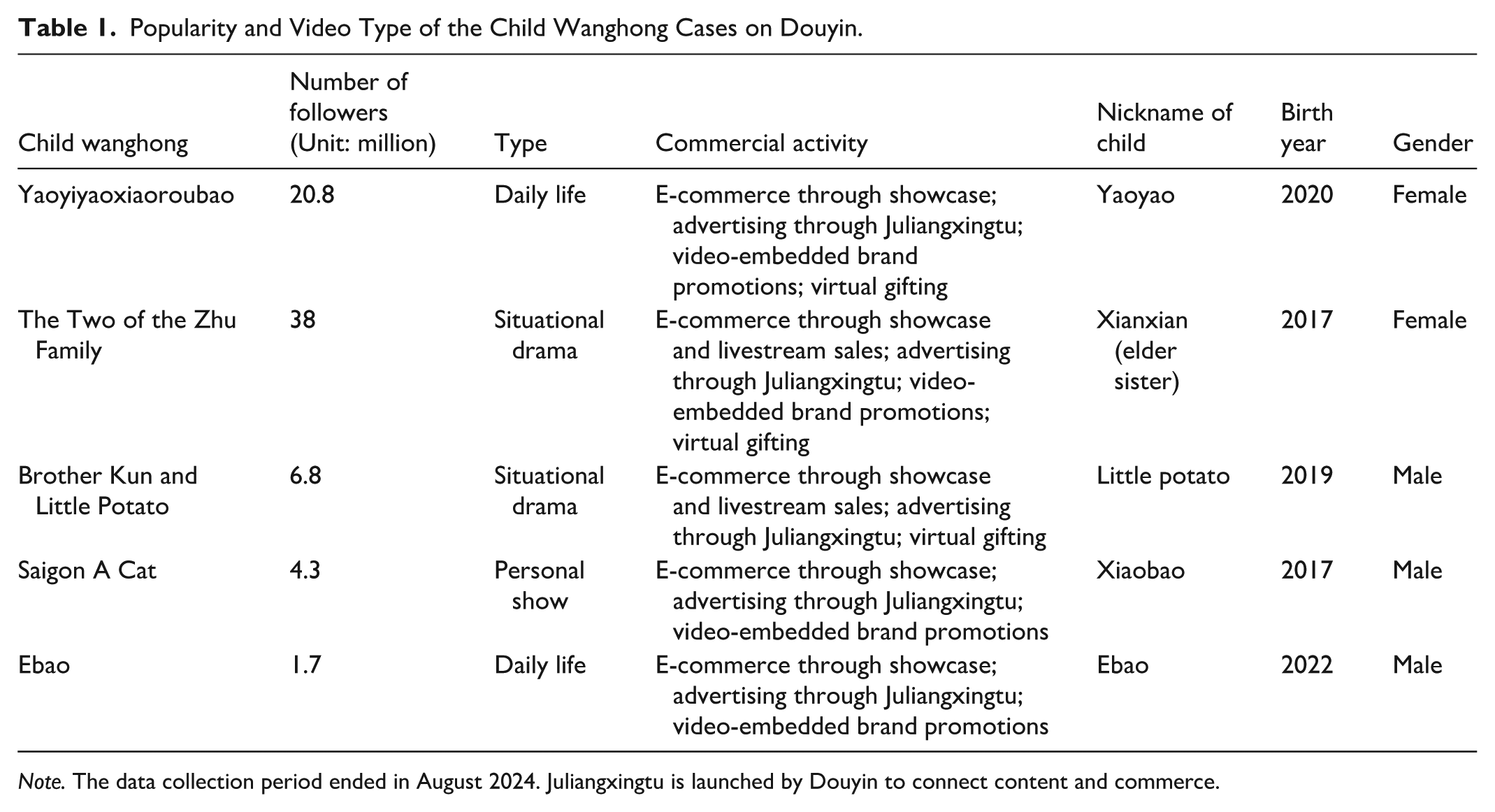
Note. The data collection period ended in August 2024. Juliangxingtu is launched by Douyin to connect content and commerce.
Besides, from January to April 2024, we conducted 21 in-depth interviews with followers of child wanghong who engage in cloud parenting (see Table 2). These interviews involve their experiences in cloud parenting, their perceptions and judgments regarding the authenticity of child wanghong, and the significance of cloud parenting in their lives. All interviews were conducted in Chinese, and the quotations cited in this article were translated into English by the authors.
Interviewee Information.

All interviews were conducted with informed consent, and the pseudonyms of the interviewees were used in quotations. The investigation and data collection process received approval from the Academic Ethics Committee of the School of Art and Communication at Beijing Normal University.
Results
Family Affection Aesthetic and Creation Affordances
Across the five selected cases, three recurring types of short videos emerged. (1) Situational dramas, where children and parents perform stories together, and the style is usually humorous and cheerful. (2) Daily life content, which presents the ordinary activities of wanghong children, including their learning, playing, and eating. (3) Personal shows feature wanghong children actively showing their personal charisma and expressing thoughts around a specific theme, including their imitation of Douyin memes, vlogs, and personal expressions on trending topics. Wanghong children exhibit greater initiative in personal shows compared to daily life content. The theme of domestic life is prevalent in the three types of short videos. While each child wanghong generally adheres to a single type to form a distinctive style, many of them that feature situational dramas and personal shows also create daily life content. This content may appear in the early stages of their posting or be intermittently included later. This blending of content types can exacerbate confusion when perceiving the authenticity of child wanghong.
Child wanghong’s aesthetic choices are inseparable from Douyin’s affordances. The app’s built-in tools, including templated effects, trimming, filters, hashtags, and collections, enable ordinary users to create and curate content with minimal technical expertise (Kaye et al., 2021). The guardians make strategic use of the vertical full-screen display, optimized for scrolling on the algorithmic recommendation page of users, and rely heavily on tight framing and close-ups, which visually intensify facial expressions and emotional dynamics. In nearly all videos, family interaction serves as the anchoring narrative frame, foregrounding family affection as an affective hook.
In situational dramas, the guardians choose to preserve real-life family roles to reinforce authenticity. A widely liked video from “The Two of the Zhu Family” narrates Xianxian and her father humorously negotiating with her mother for money to go to the supermarket, ending with them receiving only two one-yuan coins. The playful family interaction conveys warmth and affection. Similarly, “Brother Kun and Little Potato” produced an edited video where the boy playing with blocks is asked by his mother for lucky money. The mother posed a hypothetical scenario to the boy about her potential hospitalization in old age. A twist—his joking wishes for her to “suffer a little”—briefly shifts the tone, accompanied by a background sound of laughter. The topic around lucky money reflects familiar Chinese New Year experiences, resonating with audiences and evoking their shared experiences of affection. These situational dramas are filmed in domestic interiors, including living rooms and bedrooms, reinforcing a sense of naturalness and family closeness. Post-production features further amplify emotional cues. “The Two of the Zhu Family” features 11 laughter sound effects in the aforementioned 97-second video, typically following the girl’s delivery of a witty remark. At the same time, “Brother Kun and Little Potato” inserts six such effects in the 93-second video. In addition, they use hashtags, such as #Xianxian’sInterestingDiary (籼籼的趣味日记) and #MotherSonDaily (母子日常), which avoid explicitly labeling the content as scripted, thereby softening the performance nature of the scenes and blurring the boundaries between fiction and everyday life.
Daily life content emphasizes physical expressiveness, cuteness, and exaggerated emotion in children. For “Yaoyiyaoxiaoroubao,” the mother frequently zooms in on her daughter’s chubby cheeks, smiling faces, and exuberant laughter in rural environments, to showcase emotionally contagious behaviors, including laughing, crying, and making funny faces. Sometimes, parents show the girl playing outdoors, covered in mud, constructing an image of unstrained freedom and innocence that contrasts with the high-pressure upbringing associated with urban childhood. The term “happy” appears more than 80 times in video captions between 2022 and 2024, repeatedly framing the child’s demeanor as cheerful and carefree. These captions implicitly suggest that the parents prioritize the girl’s happiness and cultivate a loving family atmosphere, reinforcing the ideal of an idyllic childhood. A similar logic is evident in the case of “Ebao,” where emotional authenticity is built through depictions of filial tenderness. The little boy dutifully eats visually unappetizing meals to protect his mother’s feelings. These narratives anchor maternal devotion and children’s emotional responsiveness as moral virtues. Hashtags such as #HumanCubGrowthRecord (人类幼崽成长记) and #CuteBaby (萌娃), used by the two accounts, further reinforce cuteness as an affective quality to appeal to adult audiences (Dale, 2017).
For personal shows, “Saigon A Cat” centers on a round-faced little boy whose emotional attachment to a comfort item named “Abeibei,” a pillowcase he has used since infancy, symbolizing family love and emotional security. In one vlog-style short video, the boy shares how his parents accept and even celebrate the birthdays of “Abeibei” and repair it when it is damaged. When it was irreparably torn, his mother transformed the fabric into a custom pillow, ensuring it would continue to accompany him in his life. The boy’s oral copy personifies “Abeibei,” conveying its “inner activities” to the audience, while the video connects various home scenes within the family. In post-production, the video is complemented by a tender background music that enhances the emotional depth and appeal of the narrative. In these stories, the parents are portrayed as providing empathetic security, meticulous care, and love, evoking a sense of nostalgia and emotional resonance in the audience. “Saigon A Cat” has created an “Abebei” collection featuring more than 40 short videos that have been viewed a total of over 450 million times. This account flexibly uses hashtags like #90sBabyRaising (90后带娃), #ParentChildDailyLife (亲子日常), and #HumanCubGrowthDiary (人类幼崽成长记) to highlight parent-child interaction and the boy’s endearing qualities.
The guardians of child wanghong employ three strategies to construct emotional authenticity utilizing Douyin’s affordances. First, emotional expression is intensified through captions and copywriting that explicitly frame affective interpretation. Second, children’s facial expressions are emphasized through camera techniques and the vertical full-screen display, which is an essential affordance for users’ affective experiences and immersion (Schellewald, 2023). Parents highlight their children’s angelic faces and infectious laughter, echoing that Scandinavian Instagram influencers capitalize on innocent and sacred images of children (Ågren, 2023). These depictions align with established “child schema” features, such as large heads, round faces, and big eyes (Glocker et al., 2009), which elicit strong affective responses from adults (Dale, 2017) and are often commodified in memes (Marôpo et al., 2025). Third, post-production techniques, such as filters and sound effects, further enhance emotional resonance.
Ultimately, children’s emotional expressions and displays of family affection operate as naturalized affective resources that anchor authenticity and relatability. Family affection, as a form of capital, circulates between child wanghong and their audiences and is transformed into economic value. Research demonstrates that adults exhibit a truth bias toward children’s verbal and nonverbal expressions, assuming innocence and honesty (Saykaly et al., 2017; Talwar et al., 2006, 2015; Zanette et al., 2023). Similarly, trust in children’s genuineness occurs in cloud parenting, where audiences treat children as innocent, truthful, and incapable of deceit and view the reactions of wanghong children as spontaneous and genuine. Children’s reactions can act as indicators of the audience’s authenticity judgment. At the core of the aesthetic of child wanghong is the display of sincerity and beauty of family affection, which enhances the authenticity of short videos and arouses emotional resonance among audiences who project their own experiences and feelings onto the content. While Douyin’s user-friendly editing tools enable creative participation for ordinary users, they simultaneously impose constraints that lead to aesthetic convergence, a pattern described as “circumscribed creativity” (Kaye et al., 2021). Child wanghong utilize Douyin’s affordances to produce different content types, yet consistently cultivate a family affection aesthetic, forging resonance and affective engagement from their audiences.
Affective Inference and Emotional Authenticity
The aesthetic design of child wanghong on Douyin emphasizes the display of family affection to enhance authenticity and resonance. For audiences who engage in cloud parenting, the mutual love presented between parents and children serves as a powerful indicator of emotional authenticity, allowing audiences to connect deeply with child wanghong.
Presenting authenticity differs from narrative non-fiction. The fictionality of child wanghong’s situational dramas is reflected in their storylines, including young children speaking highly socialized sentences that align with adult cognition, as well as plot twists. Daily life content may also incorporate elements of fiction, making it challenging for audiences to discern between staged scenes and authentic moments. At the very least, parents can rearrange content through editing. Personal shows often require wanghong children to present content with a theme in front of the camera, which may be either improvised by the children, fictionalized and arranged by their parents, or a combination of both. Child wanghong deliberately do not clarify the fictionality of their performances, bringing real feelings and affection to the characters’ actual family roles, thereby blurring the audience’s perception of authenticity.
The loyal audience’s perception of the authenticity of child wanghong differs from merely considering objective factors, such as the extent of video editing, the factual accuracy of depicted events, and the actual family circumstances. For example, regarding the situational drama videos that are performative, they also perceive emotional authenticity and familial love. In the case of “Brother Kun and Little Potato,” the interviewee AY (March 17, 2024) expressed his conviction on the authenticity of the child wanghong: If there is a big gap between their actual life and what is shown in front of the camera, can so many followers pay attention to and love them? A child’s state cannot deceive.
In their opinion, the affection between wanghong children and their parents is deemed authentic. The roles of children and parents are considered “sincere,” as described that where a “sincere” performer “believes in the impression fostered by their own performance (Goffman, 1959, p. 10)” without manipulating the audience for personal gain. They believe that the emotional states and responses exhibited by wanghong children in their interactions with parents are natural; that is, they “cannot deceive.” AY (March 17, 2024) added that: I like the interaction between them. I noticed that the little boy didn’t mind his mother’s intervention when he was playing or doing other things. This state is difficult for many parents to achieve. Their family atmosphere is what I yearn for the most.
By leveraging the mental and emotional states of wanghong children as “evidence,” audiences who engage in cloud parenting construct a narrative that harmonizes the children’s lives both in front of and behind the camera. They imagine, reason, and complete a family steeped in authentic affection and love, constructing an emotional authenticity narrative about child wanghong. As BJS expressed (April 14, 2024): From the short videos of Saigon A Cat, we can see the warmth of their daily life. What impressed me most was that the boy often prepared surprises for his mother.
Moreover, L (February 24, 2024) shared that: Whenever the family is together, there is love. It can be felt that the father and mother love Ebao very much and can take time to play with him. Once the boy spilled yogurt on the floor, his mother did not blame him but let him clean it up himself. I feel that the boy is emotionally stable partly because his parents are also emotionally stable.
Furthermore, interviewee (January 17, 2024) expressed her view: Yaoyao is sensible sometimes and funny sometimes. In one video, she and her grandmother appeared. It seems that her grandmother cannot eat spicy food, so she said it was not spicy and then gave it to her grandmother. They had a great relationship.
In authenticity evaluation, while some fully trust the authenticity of child wanghong videos without any manipulation, most loyal followers acknowledge that the short videos of child wanghong are to some extent designed or pre-planned, or at least some of the videos are designed. In the interviews where we discussed concerns about potential performances by their preferred wanghong children, the loyal audiences expressed their trust in the emotional authenticity of child wanghong in a concessional manner. They often mentioned passing remarks like “even if the children are performing,” indicating a compromised authenticity judgment based on emotional perception. Interviewee Luc (March 15, 2024) shared her insights on the designed aesthetic of child wanghong short videos and the performances of wanghong children: I like all Xianxian’s videos. This video is relatively early, and I think she said it herself at this time, and it did not seem to be designed. There are many interesting things in life, but they may not have enough ideas if they frequently create videos. Some videos created now may include design elements, as the children are older and can act. Children were adorable when they were younger, and interesting things can happen inadvertently. Even if the videos are designed, they are loving and happy. Even if they are designed, they fit the character’s personality in all aspects, and are still very interesting.
Most audiences participating in cloud parenting acknowledge that the guardians pre-plan designs for their short videos and coach the children accordingly. However, Douyin’s affordances constitute an ambient emotional atmosphere that elicits pre-cognitive feelings and moods (Schellewald, 2023). In an affective state, audiences perceive sincere affection from the short videos and believe in the emotional authenticity of child wanghong. Authenticity assessment thus becomes a compromised, emotionally dominated process in which perceived family affection functions like a “filter” that softens skepticism. Rather than scrutinizing the family conditions and narrative plausibility, audiences engage in affective inference; that is, they detect and decode emotional cues, especially children’s expressions and parent-child interactions, and use these signals to feel authenticity instead of rationally verifying it.
A constructivist perspective suggests that authenticity on social media is both personally defined and socially constructed (Beverland & Farrelly, 2010; J. A. Lee & Eastin, 2021), arguing that the perception of audiences also plays a role in the consensual construction of authenticity. The guardians utilize Douyin’s creation affordances to create a family affection aesthetic that arouses audiences’ resonance. At the same time, audiences engage in a hasty, lowered standard and compromised judgment of authenticity, accepting scripted and edited scenes as emotionally “authentic” as long as they evoke family love. Douyin’s creation affordances enable child wanghong accounts to create a family affection aesthetic, while audiences not only capture emotional cues and perceive the authenticity of child wanghong but also co-shape the emotional authenticity through affective inference. The emotional dimension of authenticity becomes central to audiences’ affective engagement and the shaping of their cloud parenting practices.
Commodification of Wanghong Children
Douyin offers users business models that include in-app advertising, e-commerce, and virtual gifts. The child wanghong cases analyzed in this study actively utilize Douyin commercial affordances to earn revenue (see Table 1).
At the same time, as Douyin’s algorithms recommend and disseminate their content, the family affection portrayed in child wanghong short videos becomes circulating capital, with audiences’ love stuck to it. Shaped by Douyin creation affordances, the images and emotions of wanghong children are central to constructing a family affection aesthetic. Audiences’ emotional attachment is normalized into specific orientations that encourage consumption and reinforce distinctions between “insiders” and “outsiders.” Some audiences even articulate feelings like guilt for not consuming enough for their preferred child wanghong. For example, DCDC (January 16, 2024) mentioned that she had only given “all small gifts, not many rewards” during a livestream, describing her cloud parenting practices as “freeloading (白嫖),” a term connoting self-deprecation and irony about insufficient financial contribution. She added with embarrassment, “I am ashamed to admit that I do not give enough gifts to Yaoyao. I will give more next time.”
Love for child wanghong allows audiences to form a distinction between supporters and “others” who criticize or question their preferred child wanghong. When news media or the wider public challenge the participation of children in commercial sharenting, cloud-parenting audiences often defend the parents, invoking the Chinese proverb “There are no wrongdoing parents.” The stance emphasizes both the sincerity of parental love and the assumed rationality of parenting practices. Several interviewees echoed this sentiment (BJLCY, Stone, XGYW, NL, 2024). As BJLCY (January 26, 2024) stated: There are many voices, such as some people saying that Yaoyao’s mother utilizes her daughter to make money and does not let her go to school, saying that she does not care whether her child will have a diploma in the future. However, where in the world are there parents who do not love their children and do not care for them? It is purely unreasonable.
In defending the parents of child wanghong, audiences identify critics as “anti-fans” and refute them through comments and private messages. Such actions also defend the legitimacy of children’s participation in commercial sharenting. Grounded in immediate affect and perceived authenticity, most audiences regard child wanghong’s commercial activities as reasonable and “innocuous” (无伤大雅), believing that the parents are simply striving to earn a livelihood. As Stone (January 17, 2024) said: His mother or father updates the family, going shopping and taking him to get injections. The family atmosphere is ideal. They share the daily life of their child, not simply consuming the child or using the child to seek benefits. Now, some wanghong may not even have children, and they perform in front of the camera, which makes me very uncomfortable. I do not like those who are very showy, especially those couple bloggers who hold the camera and talk about love every day, which is fake at a glance. As long as the parents guarantee the children’s privacy and safety, I feel that moderate commercialization is acceptable.
In this way, as family affection circulates as capital on Douyin, wanghong children’s images and emotions are simultaneously commodified. Enabled by the platform’s affordances, the affective economy of cloud parenting safeguards and ensures this circulation, continuously expanding its value. This dynamic reflects that affect is both a raw material and a productive force under contemporary capitalism (Negri & Hardt, 1999). Parents, audiences, and the Douyin platform complicitly facilitate and exacerbate the commodification of children.
Cloud Parenting
Facilitated by Douyin’s affordances, child wanghong accounts create a family affection aesthetic of short videos. These short videos become accessible, fragmented, and condensed “family emotion capsules,” which act as suppliers of emotional value, defined as “the perceived utility acquired from an alternative’s capacity to arouse feelings or affective states” (Sheth et al., 1991, p. 161). Cloud-parenting audiences do not merely view representations of wanghong children and family life; rather, they co-construct the emotional authenticity with child wanghong. Encounters with the platform and child wanghong short videos generate audiences’ affective force and potential, positioning affect as both the medium and the outcome of these interactions.
Cloud-parenting audiences often develop a keen interest in child stars or adorable children. After browsing these contents across diverse media platforms, they access the content of their chosen child wanghong, including short videos and live streams, under the Douyin “Recommendation” tab. In addition, they can utilize the “Special Attention” feature to stay informed about the activities of their chosen children, ensuring timely participation in their livestreams and interaction with them. By enabling Douyin pop-up notifications in their mobile settings, followers can receive alerts. Furthermore, they can engage with child wanghong through features such as liking, commenting, and collecting. They may also join fan groups to interact with the guardians of wanghong children, obtain timely information, and access bonus content. Intriguingly, the guardians set conditions for joining their Douyin groups based on platform functions, including factors such as the duration of continuous following, follower level, number of comments, and whether being a member of e-commerce livestream rooms, to entice audiences to engage in interactions, contribute to the data growth actively, and consume.
By simply sliding their fingers across touch screens, cloud-parenting audiences can derive pleasure and relaxation on Douyin without having to visit Disneyland in person. These audiences experience vicarious satisfaction, akin to actual parenting, and a sense of healing, aligning with contemporary societal needs to alleviate pressure and anxiety. Vicarious experiences are studied in the research fields of news, documentaries, and health communication (Ahern et al., 2004; Bourne et al., 2013; Hernández et al., 2007; Liu & Liu, 2020). The occurrence of vicarious experiences stems from witnessing and affective involvement with observed objects. During cloud parenting, parental and non-parental audiences can experience a pleasurable state of absorption and immersion, which “starts from inherent and intensive forces of involvement” (Mühlhoff & Schütz, 2019, p. 237). They feel happy, joyful, and proud of every aspect of their daily lives, every little expression, and every growth of their favorite wanghong children, irrespective of their prior experiences in child-rearing. Besides, they revisit their childhood through the life clips of child wanghong, experiencing a nostalgic joy. The loving atmosphere portrayed in child wanghong short videos allows audiences to immerse themselves in a world of affection, momentarily escaping the burdens and pressures of reality. The interviewee, BJLCY (January 26, 2024), precisely described the significance of cloud parenting, “Cloud parenting is a calming agent for my anxious life and the pistachio of the mundane days.”
From experiential and practice perspectives, cloud parenting exhibits five key characteristics. First, perceived emotional authenticity is the affective core of cloud parenting. Second, it provides the vicarious emotional experiences and rewards associated with actual parenting, such as satisfaction and happiness. Third, it meets broader society’s emotional needs for a sense of healing, which aligns with “structures of feeling” that describe the collective mood in the living conditions of human beings in contemporary society (Williams, 1977). Fourth, it entails audiences’ participation in consumption and data labor, which is the practice of utilizing platform features to produce data to express love toward the objects (Yin, 2020). Finally, these audiences rarely identify themselves collectively as real parents, recognizing their role as “spectators” and “outsiders” compared to the actual family members of child wanghong. They derive emotional gratification without bearing actual parental responsibility.
Taken together, cloud parenting in the Chinese context can be understood as a series of platformized affective practices, including viewing, data labor, and consumption, enabled by platform affordances and powered by instant affect. These practices are anchored in the co-construction of emotional authenticity between audiences and child wanghong, with emotions circulating as a source of value. The consequence is directional: cloud parenting fuels the commodification of wanghong children through both direct consumption and capitalizing on children’s emotional expressions as part of Douyin’s affective economy.
Conclusion: Affective Affordances and Commodification of Children
This article examines how Douyin, as an affective infrastructure, shapes the aesthetic of child wanghong short videos and their cloud-parenting audiences’ affective inference on authenticity. These affective mechanisms constitute the capitalization of children’s emotions and the commodification of wanghong children. First, we examine how the guardians strategically utilize Douyin’s creation affordances, including vertical full-screen presentation, copywriting, and post-production features, to amplify children’s emotional expressiveness and the atmosphere of parent-child interaction. They create three primary short video types: situational dramas, daily life content, and personal shows, constructing a family affection aesthetic that blurs the line between scripted performance and authentic recording. Then, from the audience perspective, we find that rather than scrutinizing family situations and narrative plausibility, audiences engage in affective reference: detecting and decoding emotional cues, particularly children’s expressions and parent-child interactions, and using these signals to perceive authenticity rather than rationally verify it. Audiences participate in the construction of the emotional authenticity of child wanghong through affective inference, and this emotional dimension of authenticity becomes central to audiences’ affective responses and the shaping of cloud-parenting practices. Third, we explore the commercial affordances of Douyin, transforming child wanghong’s family affection into circulating capital. The love from cloud-parenting audiences is normalized and manifested in data labor and consumption. Simultaneously, they rationalize the commodification of wanghong children while defending the commercial activities of child wanghong. Finally, cloud parenting on Douyin demonstrates how audiences’ emotional investment in child wanghong is both a source of their emotional fulfillment and a driving force behind the commodification of children.
These findings illustrate how platform affordances mediate affective dynamics and the affective mechanism in commercial sharenting. Douyin’s creation affordances, seemingly designed to lower the threshold for content production, simultaneously intervene in and shape the emotionally expressive aesthetic of child wanghong short videos. From the perspective of the guardians, they utilize Douyin’s affordances to realize their goals, including improving economic conditions and social status. However, this seemingly “positive” agency aligns with the logic of platform capitalism, where users’ creation and aspirations are subsumed into the broader mechanisms of datafication and capital accumulation (Srnicek, 2017). In Douyin’s affective economy, the love from cloud-parenting audiences is transformed into data labor and consumption. These audiences not only legitimize but also actively defend the commercial activities of child wanghong, often engaging in online confrontations with critics. Their tolerance for, or indifference to, the commodification of wanghong children arises from affective involvement enabled by Douyin affordances. The emotional satisfaction and healing that audiences experience, coupled with their intimate yet responsibility-free connections to wanghong children, are inseparable from Douyin’s “affective design” (Ash, 2012). Through interfaces and features that stimulate and modulate users’ affective capabilities, the platform fosters an immersive emotional experience that prioritizes short-term sensory pleasure and comfort. As Schellewald (2023) found, Douyin’s algorithm-driven logic represents a shift from social media toward media sociality, where interaction is organized around consumption and emotional resonance rather than interpersonal connectedness. In this sense, Douyin functions not merely as a content-sharing or social platform but as an affective infrastructure that organizes, amplifies, and commodifies affect and relationships. Douyin’s affective infrastructure produces an affective economy centered on stimulating users’ emotional experiences and instant affective engagement. Facilitated by the affordances, cloud-parenting audiences, and guardians, complicitly produce and intensify the commodification of wanghong children.
This article demonstrates how the commercial affective infrastructure in China, exemplified by Douyin, mediates sharenting practices. More importantly, it addresses the expanding phenomenon of the commodification of children on social media platforms. Acknowledging the inescapable limitations of this exploratory research, future research should conduct comparative analysis across diverse cultural and regional contexts to examine whether similar affective and commodification mechanisms operate in other parts of the world or within transnational media flows.
Footnotes
Consent to Participate
All interviews were conducted with informed consent, and the pseudonyms of the interviewees were used in quotations. The investigation and data collection process received approval from the Academic Ethics Committee of the School of Art and Communication at Beijing Normal University.
Funding
The authors received no financial support for the research, authorship, and/or publication of this article.
Declaration of conflicting interests
The authors declared no potential conflicts of interest with respect to the research, authorship, and/or publication of this article.
Author biographies
 .
.