



Abstract
This article explores a series of parody videos on Douyin that satirize the “greasy man” (油腻男), a gendered figure embodying performative masculinity and everyday misogyny in Chinese digital culture. Primarily produced by young women, these videos employ audiovisual mimicry and exaggerated affect to stage a gendered counter-performance. Drawing on affect theory, gender performativity, and gaze theory, the study employs digital ethnography and critical visual analysis to examine how these parodies reproduce and disrupt dominant masculine norms. Analysis of audience engagement through comment sections reveals the emergence of affective publics that negotiate humor, critique, and resistance. The findings highlight how parody on Douyin functions as a memetic and oppositional practice, challenging hegemonic masculinity and contributing to broader discussions of digital activism, platform feminism, and the politics of the gaze. This study advances understanding of how affect and humor intersect in social media spaces to articulate gendered critiques and collective affective mobilization.
Introduction
Women have long been subjected to the disciplinary force of the gaze – scrutinized, categorized, and regulated through a lexicon of stigmatizing labels: slut, bitch, old hag, bossy. These are not neutral descriptors but instruments of social control, designed to shape behavior and enforce conformity. Internalizing such judgments, women are compelled to navigate an impossible terrain of self-surveillance, constantly adjusting to an ever-shifting standard. Yet what unfolds when this visual power is redirected – when women begin not only to resist being seen, but to see back? As bell hooks 1 (1992) powerfully asserts, “there is power in looking” (p. 115). This paper begins at precisely that moment of reversal, examining how female creators on Douyin deploy parody, irony, and performance to enact a counter-gaze – one that disrupts normative masculinity and reclaims visual and affective agency.
In recent years, on the Chinese short-video platform Douyin, a genre of parody videos led by female creators has garnered widespread attention. A cluster of male archetypes has become frequent targets of parody and imitation, reflecting complex gendered anxieties and social tensions. Central among these is the figure of 油腻男 (yóunì nán, “greasy man”), a composite persona embodying a range of interrelated traits including 猥琐 (wěisuǒ, “creepy” or sexually intrusive behavior), 死装 (sǐzhuāng, excessively performing affected or outdated masculinity), 爹味 (diēwèi, “dad vibes,” denoting patronizing, paternalistic attitudes), and 普信 (pǔxìn, “overconfident” with inflated self-regard). Rather than discrete categories, these terms overlap and intertwine within the broader cultural construct of the “greasy man,” encapsulating a multifaceted critique of certain hegemonic masculine performances.
This paper conceptualizes Douyin videos parodying “greasy men” (油腻男) as a distinct form of gendered parody situated within networked visual culture. Rather than targeting specific individuals, these videos exaggerate recognizable masculine archetypes – aloofness, bravado, entitlement – to expose their performative and constructed nature. In Butler’s (1990) terms, parody destabilizes gender by repeating its norms with comic excess, revealing masculinity as an imitation without origin. At the same time, these performances are deeply memetic: they circulate through replication, variation, and emotional resonance, forming what Shifman (2013) and Baishya (2021) describe as mimetic chains. As such, these parody videos operate at the intersection of critique and play, combining audiovisual stylization with affective repetition to contest hegemonic masculinity in everyday digital life.
These performances are deeply embedded in the technological and cultural ecologies of short-video platforms like Douyin and its international counterpart, TikTok. While Douyin and TikTok operate under distinct regulatory and geopolitical regimes (Ai et al., 2023), they share nearly identical interfaces, features, and affordances – such as short-form video templates and algorithmic curation (Lee & Abidin, 2023; Matsuda-Rivero, 2025). This shared platform logic facilitates a translocal convergence of user practices and content genres. Indeed, many memetic trends and aesthetic forms circulate fluidly between the two platforms, shaped by their similar architectures and user incentives rather than by their institutional differences. As such, this study treats Douyin and TikTok as part of a connected short-video ecosystem, while remaining attentive to contextual specificities when necessary.
Within this broader ecology, the rise of greasy-man parody videos offers a critical window into how gendered affect, visual humor, and digital performance intersect. This paper asks: How do parody videos of “greasy men” (油腻男) on Douyin function as a form of gendered counter-performance and affective resistance to everyday misogyny in contemporary China?
Gender Norms and Power on Social Media
Feminist scholars have long critiqued how women’s participation in social media is shaped by visibility politics and gendered norms. Kanai and Dobson (2016) observe a shift from early optimism about digital media’s liberatory potential to an environment where women’s online identities are increasingly branded, sexualized, and regulated. Drawing on Banet-Weiser (2012), they note how self-branding and self-exposure function both as avenues for capital and mechanisms of discipline, subject to public policing and harassment (Herring & Stoerger, 2014). As Dobson (2015) shows, this produces a contradictory affective economy: women are encouraged to display femininity while simultaneously shamed for doing so. Such research demonstrates how social media intensifies disciplinary pressures on women by exposing them to an ever-watchful networked gaze.
At the same time, videos displaying masculinity reinforce traditional gender stereotypes from another angle. For example, Tanner and Gillardin (2025) examines how “sigma male” videos on TikTok embody toxic communication styles that reinforce hegemonic masculinity. These videos deploy humor, aggression, and the denigration of feminine or queer traits to circulate a “ready-to-think” schema – a framework that simplifies and naturalizes dominant gender hierarchies under the guise of relatability and viral appeal. Although some studies note that emergent forms of hybrid masculinity (Bridges, 2014; Demetriou, 2001; Foster & Baker, 2022) destabilize conventional boundaries by adopting feminized aesthetics, they also indicate that these videos do not fully displace masculine privilege.
On a more positive note, research on LGBTQ+ users highlights how sexual minority creators strategically deploy social media to manage identity and resist normative expectations. For instance, Ai et al. (2023) investigate how queer Douyin creators in China navigate platform constraints through selective self-presentation and coded signaling. Buss et al. (2022) show that transgender users actively curate not only their own posts but their digital environments across platforms to support self-expression and mental well-being. Duguay (2023) frames TikTok as a site of queer technoculture, where features like looping video, stitching, and hashtags foster ephemeral, expressive publics that subvert heteronormative logics (Warner, 2002).
Taken together, these studies underline how digital participation is never neutral: it is always inflected by gendered power, and at the same time, it provides resources for parody, mimicry, and resistance.
Gendered Parody and Mimicry in Digital Culture
Parody operates as a central mechanism in digital participatory culture, particularly within the meme economy, where mimicry and repetition function simultaneously as modes of expression and critique (Boxman-Shabtai, 2019; Jenkins et al., 2013; Shifman, 2013). While prior studies emphasize how user-generated content often reproduces dominant norms – especially in male-dominated digital arenas that privilege affective recognition over critical reflection (Christian, 2010; Gal et al., 2016) – we can understand parody not merely as replication but as a site for interrogating those norms. Drawing on Judith Butler’s (1990) concept of gender performativity, gendered identities emerge through repeated stylized acts rather than stable essences, making them inherently contingent and open to disruption. Parody’s exaggeration or deliberate “failure” exposes these contingencies, producing critical spaces where dominant gender norms can be unsettled rather than reinforced.
In digital meme cultures, this potential is magnified: repetition, remixing, and circulation amplify the cracks in normative gender performances. Baishya’s (2021) notion of memetic visuality further clarifies how digital memes, through chains of audiovisual repetition, embed affective and political critique in ways that conventional analyses may overlook. When marginalized voices – such as female users on Douyin – mobilize these circuits, they do more than entertain. Their hyperbolic performances of figures like the “greasy man” (油腻男) transform parody into a tactical intervention: the amplified caricature destabilizes hegemonic masculinity and foregrounds its performative fragility. In this sense, digital parody functions both as cultural commentary and as a performative practice that actively negotiates gendered power relations.
Douyin/TikTok as a Site for Resistance
TikTok has evolved into a platform where entertainment intersects with identity negotiation, affective mobilization, and subtle forms of resistance. Its distinctive affordances – duets, lip-syncing, and point-of-view storytelling – enable what Cervi and Divon (2023) term “playful activism,” where political critique is embedded within humor and affective micro-performances. These dynamics resonate with Bennett and Segerberg’s (2012) notion of “connective action,” emphasizing fluid, personalized, and emotionally resonant forms of political engagement that operate without centralized leadership.
Yet, these affordances are always contextually mediated. In China, queer creators on Douyin navigate a heteronormative environment by performing irony, aestheticized gestures, and partial disclosure, fostering community while simultaneously managing state and social surveillance (Ai et al., 2023). Zhao and Abidin’s (2023) concept of “gesticular activism” further illuminates how Asian TikTokers leverage embodied audiovisual styles – such as the “Fox Eye Challenge” – to stage viral critiques of racialized norms within algorithmically structured attention economies.
Parody emerges as a particularly salient mode of resistance, linking humor, mimicry, and affective critique. Drawing on Hutcheon (2000) and Bakhtin (1982), participatory culture enables marginalized users to perform subversive mimicry that exposes the contingency of dominant discourses (Boxman-Shabtai, 2019). This logic extends to feminist and intersectional practices on the platform, as seen in “hashtag feminism” (Mendes et al., 2019) or Kamran’s (2023) account of working-class Pakistani women negotiating digital purdah, where acts of subversion are entangled with compliance and platformed social norms.
At the same time, TikTok’s algorithmic logic and sociotechnical precarity complicate these practices. Users face suppression, harassment, and the circulation of misinformation, illustrating that resistance on the platform is inseparable from risk (Jalli, 2025; Literat & Kligler-Vilenchik in Lee & Abidin, 2023). Seen through this lens, Douyin/TikTok operates as an affectively charged and ambivalent space, where resistance, identity work, and sociopolitical precarity intersect, demanding nuanced theoretical and empirical attention.
Affective Economy, Gender Performativity, and the Gaze
This study draws upon three interrelated theoretical frameworks to analyze the gendered politics of parody videos on Douyin: Sara Ahmed’s theory of affective economy, Judith Butler’s theory of gender performativity, and the concept of gaze as developed by Laura Mulvey, Michel Foucault, and bell hooks.
Sara Ahmed (2004) introduces the concept of affective economy to explain how emotions circulate between bodies, signs, and objects, thereby binding individuals to social collectives and ideologies. Rather than viewing emotions as private psychological states, Ahmed argues that they function as forms of social and political contact: “we need to consider how they work, in concrete and particular ways, to mediate relationships between the psychic and the social, between the individual and the collective” (Ahmed, 2004, p. 119). Emotions such as disgust, laughter, and anger do not reside within subjects but are “sticky”: they accumulate meaning and value as they circulate through bodies, media, and social contexts, adhering to particular figures, ideas, or groups. In the context of Douyin’s parody videos, affect operates as a crucial medium through which gender critique is articulated. The figure of the “greasy man” (油腻男) becomes a sticky object of collective aversion, ridicule, and laughter. These videos circulate emotions that evoke affective alignment among viewers against specific masculinities. In doing so, they produce what Ahmed terms “affective economies”—networks in which emotions actively construct social hierarchies and cultural boundaries. Through humorous imitation, these videos not only mock but also redirect affective investments away from hegemonic masculinity toward a shared sensibility of resistance and critique.
Affect theory thus foregrounds how parody mobilizes collective emotions, but these affective circulations are inseparable from the performative nature of gender. Judith Butler’s (1990) theory of gender performativity challenges the notion of gender as a fixed or inherent identity. Instead, Butler (1990) contends that gender is “an identity tenuously constituted in time – an identity instituted through a stylized repetition of acts” (p. 191). Gender is not something one inherently is but something one repeatedly does. These performative acts are regulated by cultural norms and expectations but are never fully stable or complete. For Butler, parody serves as a critical mechanism through which the constructed nature of gender is revealed. By exaggerating gender norms, parody exposes their fictive quality: “The parodic repetition of gender exposes . . . the illusion of gender identity as an intractable depth and inner substance” (Butler, 1990, p. 187). In the Douyin videos examined here, the imitation of “greasy man” behaviors – mansplaining, patronizing speech, overconfident flirting – functions as a parody of masculine performativity. The excessive and humorous nature of these reenactments produces what Butler calls “subversive laughter,” revealing masculinity not as essential or natural but as a fragile, contestable performance.
If affect explains how emotions circulate and bind publics, and performativity explains how gender is repeatedly done and undone, the gaze illuminates how these dynamics are patterned through gendered asymmetries of looking. Laura Mulvey’s (1975) seminal concept of the male gaze demonstrates how mainstream visual culture, particularly classical Hollywood cinema, constructs the female figure as an object of heterosexual male desire. This gaze positions women as passive objects to be looked at and consumed, thereby reinforcing patriarchal power structures. Mulvey argues that the male gaze functions simultaneously as a source of visual pleasure and as an instrument of power – affirming male subjectivity while rendering female bodies into objects of fetishistic scopophilia. This dynamic sustains gendered asymmetries in both cultural representation and social relations.
Alongside these external modes of viewing, Michel Foucault’s (1977) concept of disciplinary power draws attention to how individuals internalize surveillance and regulate themselves through an internal gaze. Women, positioned as perpetual objects of visibility, become both watchers and the watched of their own bodies, performances, and affective expressions. This internalized gaze operates as a subtle yet pervasive mechanism of self-surveillance and discipline, reinforcing gendered behavioral norms even in the absence of direct observation. Extending this discussion into the affective domain, Ahmed (2014) shows how emotions “stick” to certain bodies, gestures, and labels, producing affective atmospheres of shame, anxiety, or fear that delimit what is felt to be possible or permissible. In this sense, the male gaze functions not only as a visual structure but also as an affective one, conditioning how women inhabit space, express identity, and navigate both social and digital life.
Building on this foundational work, bell hooks (1992) politicizes the gaze by examining Black women’s critical responses to marginalization and misrepresentation within white-dominated visual regimes. She emphasizes that the oppositional gaze is a politicized act of resistance, through which Black women reclaim agency by refusing passive spectatorship and instead actively scrutinizing and challenging oppressive images and narratives. This gaze subverts dominant visual orders by exposing and contesting mechanisms of racialized and gendered oppression. While hooks’ theorization is groundbreaking, this article takes a more radical step by demonstrating how female video creators on Douyin not only question but also actively reverse this gaze. These creators employ parody and exaggeration to enact an active, performative gaze that targets and satirizes hegemonic masculinity – most explicitly embodied in the figure of the “greasy man” (油腻男). This inversion unfolds across several dimensions: the exposure of performative masculinities to a critical female gaze that is otherwise complicit or silenced in everyday life; (2) the re-inscription of male gazes directed at women under female spectatorship, producing complex affective responses that both unsettle and demystify hegemonic masculinity; (3) the rearticulation of male sexualized performances not as objects of desire but as targets of ridicule and parody; and (4) the internalization of this critical female gaze by some male viewers, who modify their behavior in response.
Together, these perspectives provide a critical lens for examining how parody videos both draw upon and disrupt gendered norms: they generate humor and amusement while simultaneously channeling everyday affects such as fear, discomfort, and frustration with harassment or mansplaining. In this way, parody becomes a site where affect, performativity, and the gaze converge to expose and resist hegemonic masculinity.
Digital Ethnography
This study employs a digital ethnographic approach to examine how parody videos of “greasy men” (油腻男) are encountered, interpreted, and affectively circulated on Douyin. Digital ethnography allows researchers to explore the cultural meanings embedded in online content, not only by analyzing posted materials but also by attending to how platforms algorithmically shape user experiences (Pink et al., 2016; Postill & Pink, 2012).
Rather than conducting systematic keyword searches from the outset, the researcher’s initial engagement with Douyin was embedded in everyday media use. Videos were primarily encountered through the platform’s recommendation algorithm, shaped by the researcher’s prior viewing behaviors and interactions (Xu & Bailey, 2024). This approach reflects the logic of algorithmically curated feeds, where content “finds” users rather than the other way around (Bucher, 2018). It also mirrors how most Douyin users engage with the platform – through affective encounters embedded in habitual scrolling, ambient consumption, and casual interaction (Bareither, 2021).
The data collection process spanned approximately 28 months, from early 2023 to mid-2025. During this period, I conducted ongoing observational participation (Postill & Pink, 2012), identifying notable trends, saving representative videos, and analyzing recurring visual patterns. Videos were encountered both passively – while casually browsing Douyin, where I liked, bookmarked, and then downloaded or screen-recorded content that appeared relevant or interesting – and actively, through keyword searches (e.g., “油腻男,” “猥琐男,” “死装男,” and “爹味男”) to retrieve additional material. In total, I downloaded 100 videos along with approximately 700 accompanying comments, enabling repeated viewing and detailed coding.
Selection criteria included relevance to the “greasy man” theme, high user engagement (likes, shares, comments), and representativeness of recurring performative patterns. Each video was watched multiple times to attend both to audiovisual form and affective circulation. Comments were read and coded for affective responses such as humor, cringe, irritation, or admiration, with patterns recorded in a research log for subsequent thematic analysis. This hybrid approach – combining algorithmic exposure with active search and curation – aligns with evolving digital ethnographic strategies that emphasize both platform-driven immersion and researcher reflexivity (Pink et al., 2016).
Importantly, this research adopted a nonintrusive observational mode. I did not interact directly with content creators but analyzed publicly available videos, comment sections, and engagement metrics (likes, shares, reposts). This strategy is consistent with ethical guidelines for studying public-facing social media content (Markham & Buchanan, 2012), ensuring both rigor and respect for user privacy.
In addition to digital ethnography, the study draws upon critical visual analysis (Schroeder, 2006) to examine how audiovisual elements – such as gesture, costume, spatial framing, facial expression, and editing techniques – construct and critique gendered subjectivities. This enables a nuanced interpretation of how parody videos visually articulate affective critique and perform counter-narratives to hegemonic masculinity.
Ethical Considerations
This research follows established ethical guidelines for digital ethnography and visual media studies. All analyzed videos were publicly available on Douyin and posted by creators who function as public figures within the platform’s ecology. In line with existing scholarship on platform visibility economies (Zhao & Abidin, 2023), usernames and avatars of video creators have not been anonymized. This decision acknowledges creators’ intentional participation in public discourse and the reputational and affective labor they invest in cultivating platform visibility (Lee & Abidin, 2023).
In contrast, greater ethical care was taken with user-generated comments. Since commenters often operate under semi-anonymous or pseudonymous identities – and may not anticipate their words being cited in academic contexts – all usernames and avatars in comment sections have been anonymized. This dual approach respects the differentiated visibility of platform participants: it recognizes the publicness of influencer content while minimizing risks to casual or unintended contributors (Cervi & Divon, 2023).
Outline of Analysis
The analysis is organized into two parts. The Findings section sketches three empirical typologies of the “greasy man” – the Narcissistic Performer, the Paternal Mansplainer, and the Lewd and Unkempt – figures that function less as stable categories than as descriptive entry points. The Discussion section then turns to three interwoven threads: Affective Responses and the Emotional Politics of Watching; Parody, Performativity, Undoing Gender; and Reverse Gaze as Counter-performance and Playful Activism. These threads read the typologies through the theoretical lens of affect theory, gender performativity, and the gaze, tracing how empirical practices and conceptual vocabularies fold into one another. It is worth noting that the distinction between findings and analysis is never absolute: the Findings section already contains moments of interpretation, while the Discussion necessarily returns to and reconfigures elements of the empirical.
The Narcissistic Performer
One of the most salient affective dimensions of the “greasy man” (油腻男) persona is embodied in what might be termed the narcissistic performer – a figure obsessed with self-image, performative masculinity, and the illusion of charm (see Figure 1). This archetype frequently appears among young men, particularly university or high school students, who deliberately adopt aloof, brooding, or flamboyant postures in order to project emotional depth, aesthetic refinement, or sexual magnetism. Rather than emerging from genuine confidence, these behaviors are carefully curated displays designed to capture attention – especially that of young women – through what Butler (1990) would call the citational performance of masculinity.
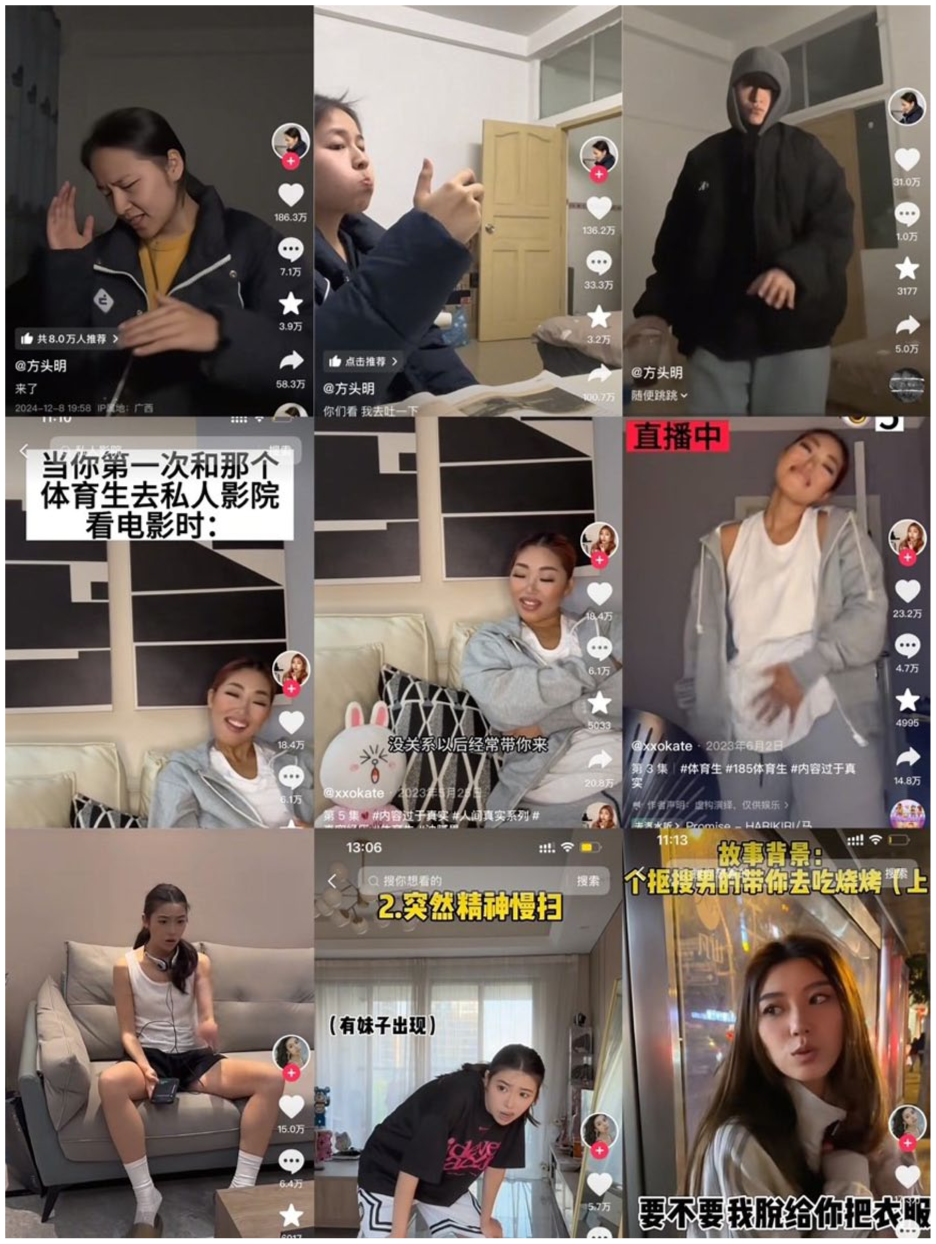
Screenshots of “The Narcissistic Performer” archetype on Douyin.
In parody videos on Douyin, female creators meticulously mimic these stylized masculinities, exposing the affective labor embedded in their performance. With ironic exaggeration, they reproduce familiar gestures: gazing into mirrors while caressing their own faces, dramatically flipping through books, air-shooting basketballs in front of girls, or offering to remove their jackets with theatrical gallantry. Some videos are situated in symbolic everyday settings – cinemas, classrooms, basketball courts, livestreams – underscoring how masculinity is staged as ambient charisma in both public and intimate spaces.
A particularly rich sub-genre involves the mimicry of schoolboys’ daily routines – turning the classroom into a site of exaggerated masculine self-display. These performances replicate highly specific bodily acts: jumping to slap the door frame upon entering, striding down the aisle with practiced swagger, exchanging middle fingers with friends from other classes, stealing glances at female classmates, or inspecting their appearance using a compact mirror hidden in a textbook. Even mundane actions – drinking water, yawning, or resting one’s head – are performed with a self-conscious awareness of being watched. As one creator jokingly put it, “From the fingertips to the corner of the mouth, every inch of skin is performing.”
Audience responses to these parody videos reflect a layered spectrum of recognition, amusement, and affective engagement. Many comments fall into the category of exaggerated affirmation, underscoring how convincingly the performer embodies the “greasy man” persona (see Figure 2). For instance, one top comment reads, “The most masculine man on all of Douyin has returned” (242 K likes), while another declares, “A real artist. Just standing there, and he’s already a man” (53 K likes). Another widely liked remark, “Did you grow one for real?” (2.8 K likes), rhetorically questions whether the female creator has actually grown male genitalia – an intentionally crude but hyperbolic way of affirming the performance’s realism and gender-crossing effectiveness. Such comments do not merely applaud technical mimicry; they also point to the high recognizability and saturation of these gendered performances in everyday life. Viewers often note the precision of specific details, as in: “You captured the entire back row of the classroom” or “Even the white Nike socks were accurate – how did you get it so right?” (29 K likes). These reactions demonstrate how parody, by replicating micro-gestures, styling cues, and embodied attitudes, activates a collective archive of social memory – especially among young audiences familiar with such masculine displays in school or online settings.

Screenshots of comments on the “Narcissistic Performer” archetype on Douyin.
Alongside exaggerated affirmations, another cluster of responses expresses affective discomfort through humorous revulsion (see Figure 3). These comments articulate a sense of bodily or emotional aversion toward the parodied masculine traits, often framed as exaggerated sensory reactions. For example, one viewer writes, “My hair feels greasy just watching this” (43 K likes), a comment that translates visual discomfort into a tactile, almost visceral experience. The comment does not necessarily reject the video itself, but rather reflects the unsettling accuracy of what is being mimicked. In a similar vein, some remarks combine sarcasm with exaggerated disapproval. One widely circulated comment states, “Do you hate yourself after filming this?” (62 K likes), a line that humorously frames the performance as so effectively grotesque that it might produce self-loathing in the performer herself. Another viewer remarks, “I suddenly feel sad thinking my son might act like this one day – I don’t even want to breastfeed him anymore” (3.6 K likes), exaggerating maternal dismay to highlight the undesirable nature of the behaviors being parodied.
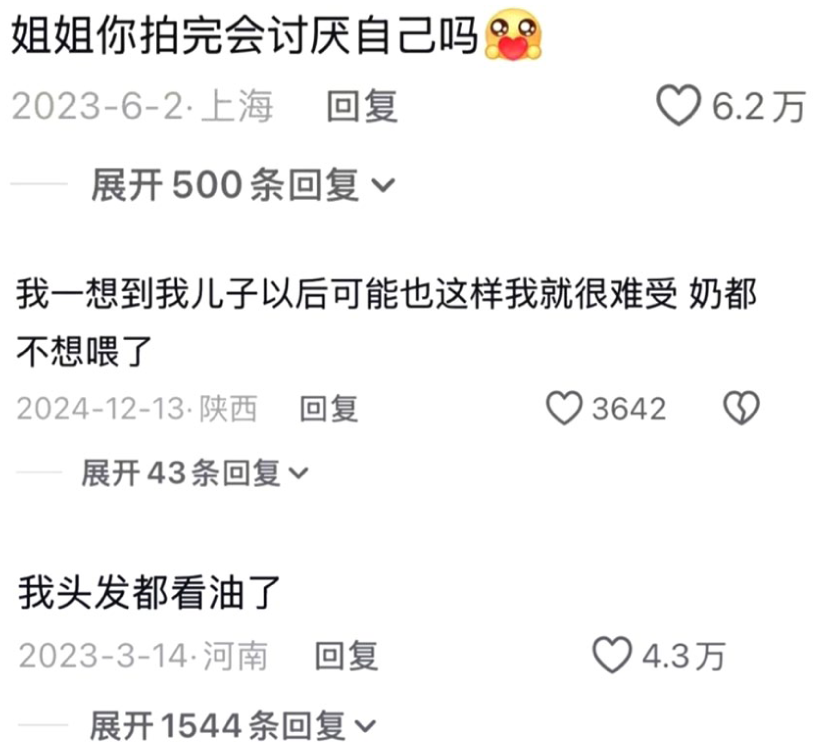
Screenshots of comments on the “Narcissistic Performer” archetype on Douyin (2).
A third set of responses comes from male viewers, who engage with the parody videos not with defense or dismissal, but with unexpected moments of self-recognition, embarrassment, and even behavioral reflection (see Figure 4). Unlike the typical comment cultures of online masculinity – often characterized by irony, denial, or aggression – these responses suggest a more vulnerable and introspective reaction to the reverse gaze. For instance, one male commenter writes, “I used to act like this – how disgusting.” Another confesses, “Now I understand why I’ve been so off-putting lately.” A more emotionally charged admission states, “I owe all my exes an apology – I didn’t know I looked this ridiculous.” These comments indicate that the videos have not only succeeded in rendering masculine performances visible, but have also prompted male viewers to reposition themselves as the object of observation and judgment.

Screenshots of comments on the “Narcissistic Performer” archetype on Douyin (3).
The Paternal Mansplainer
Another manifestation of the “greasy man” archetype is the paternal mansplainer: a middle-aged male figure who adopts a condescending tone, assumes epistemic superiority, and frames his authoritative stance as a form of emotional care (see Figure 5). Unlike the first category, which primarily parodies young men in school or romantic contexts, videos in this category mimic men of a certain age who seek to assert their status, competence, intellect, experience, or achievements – though these claims to status are often modest or inflated.

Screenshots of “the paternal mansplainer” archetype on Douyin.
These videos often use a one-person, two-role format to simulate scenarios in which a confident middle-aged man “mentors” or “advises” a professional woman – for example, a female golf player receiving unsolicited tips laden with subtle sexual innuendo under the guise of expert guidance. Other videos simply imitate the speech content, tone, and mannerisms typical of these men. The speech content includes examples of male supervisors delivering authoritative mansplaining, with phrases such as “I told you not to talk back” or “Just listen to me, I know what I’m doing,” often punctuated by awkward English expressions intended to signal professionalism – e.g., “Let me test you.” Similarly, some sketches portray older men on blind dates making patronizing assumptions about women’s preferences: “I think girls like you enjoy romantic little things,” or “You probably like cooking, don’t you?” They also reinforce traditional gender roles with statements like, “Being a mother is the most noble role in the world. Only when you become a mother can you become a truly mature woman.” In some instances, videos dispense with dialogue altogether, relying solely on the mimicry of facial expressions and gazes to convey this archetype’s characteristic attitudes. Such nonverbal performances often feature eye-rolling, self-important looks, and scrutinizing glances that communicate a sense of entitlement and condescension.
Audience comments on videos parodying the paternal mansplainer tend to cluster into four broad types. First, many viewers express strong identification with the accuracy and authenticity of the performance (see Figure 6). For instance, one highly liked comment states, “This is divine greasiness. Heaven gave her oil” (258 K likes), a witty adaptation of the idiom “Heaven gave him talent.” Other comments praise the precise use of typical expressions, such as “‘Are you sure you want to do this?’ is so typical,” or “That line ‘Is she a model? Great figure’ hits the mark perfectly,” and “As soon as she’s rejected, he says ‘Young people are too impulsive,’ so typical.” Some viewers offer mild critiques (see Figure 7), noting missing details: “It’s almost there; usually when a woman says she’s a golf coach, the ‘dad-bod’ man reflexively says ‘Let me test you.’”
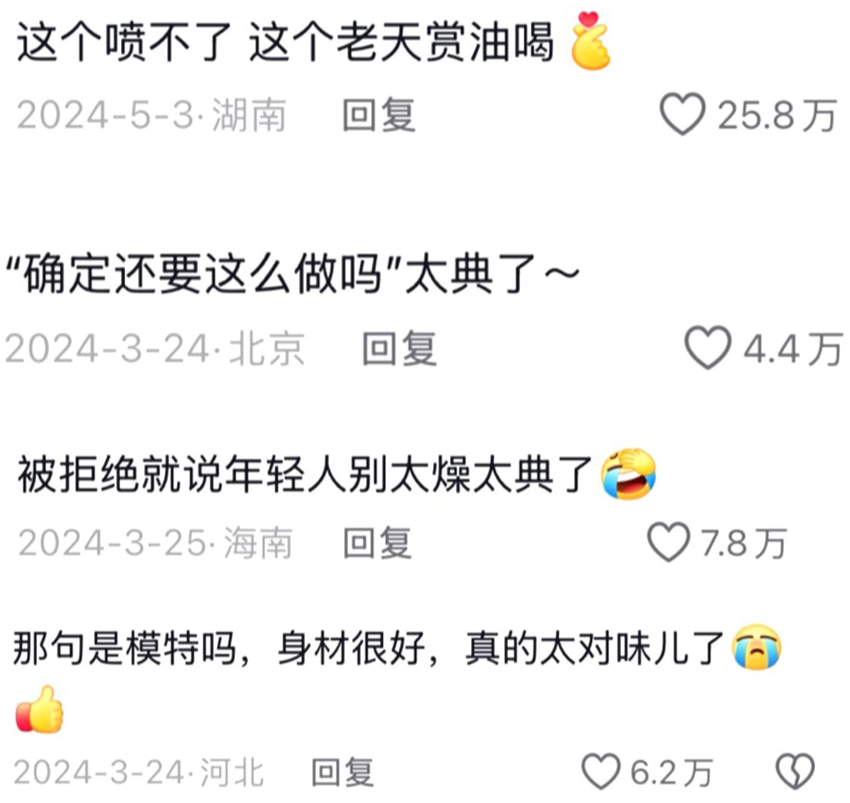
Screenshots of comments on the “the paternal mansplainer” archetype on Douyin.

Screenshots of comments on the “the paternal mansplainer” archetype on Douyin (2).
A second common form of commentary takes the shape of humorous complaints that simultaneously express discomfort and amusement. Popular remarks include ironic pleas for relief (see Figure 8), such as “Insert an ad, I need a break” (41 K likes), “Bro, maybe just cut to a sponsored segment?” (8 K likes), or “Please stop . . . I’m begging you,” often accompanied by meme stickers like “stop.stop.” These comments suggest that the parodied persona is so disturbingly accurate that viewers would rather endure advertisements than continue watching. Some humorously note the performer’s apparent enjoyment of the role, for example, “She’s clearly enjoying this performance – she doesn’t care if we die watching” (81 K likes). Others shift the blame entirely onto the male figure being parodied, as in “This woman is out for revenge on society” (99 K likes).

Screenshots of comments on the “the paternal mansplainer” archetype on Douyin (3).
Third, a notable subset of comments adopts a playful, tongue-in-cheek tone to convey feelings of being harassed or violated by the depicted behavior (Figure 9). Expressions such as “Feels like I was groped all over,” “Creepy vibes from afar is still sexual assault,” and “What a ‘thoroughly satisfying’ sexual harassment” illustrate how the parody evokes affective responses akin to discomfort or violation. These comments highlight the emotional potency and social critique embedded in the videos’ representation of paternalistic, condescending masculinity.
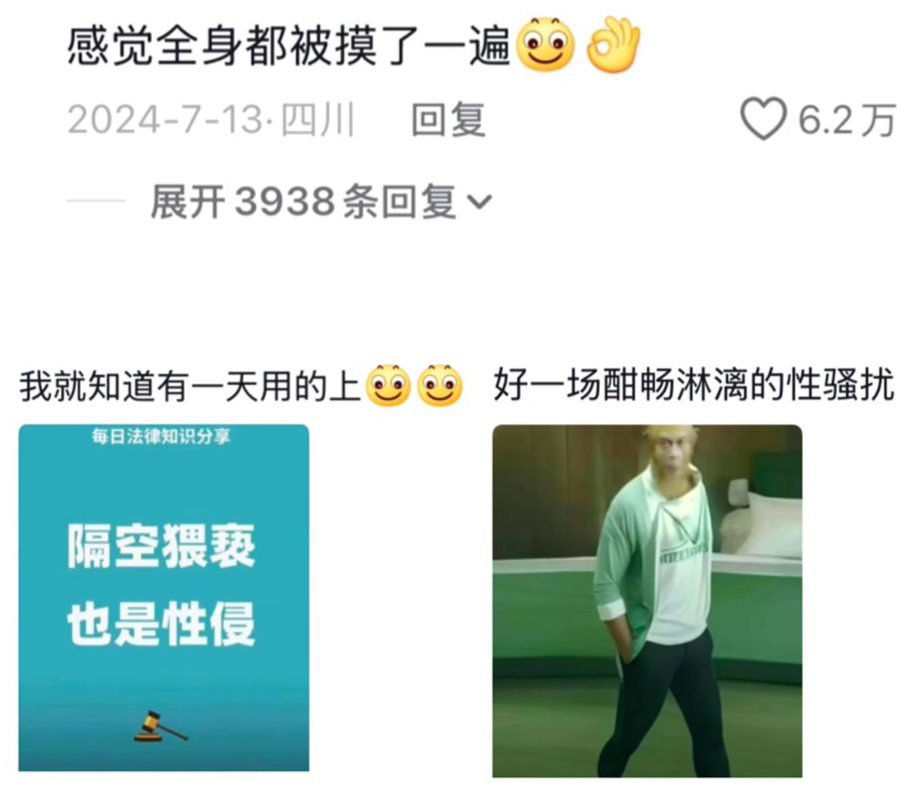
Screenshots of comments on the “the paternal mansplainer” archetype on Douyin (4).
The final category of comments includes self-reflective responses from male viewers. One notably candid comment states (Figure 10), “I’m a man pushing forty, and I watch every episode to check if any of my gestures match hers. I correct myself instantly” (112 K likes). Similar to the male viewers’ comments shown in the previous section, this remark exemplifies how some men engage with the parody not only as humorous entertainment but also as moments of critical self-awareness. They recognize and actively distance themselves from the paternalistic behaviors being satirized. Such responses reveal the potential of these videos to provoke reflection on gendered conduct and contribute to subtle shifts in masculine self-performance.

Screenshots of comments on the “the paternal mansplainer” archetype on Douyin (5).
These confessions illustrate what Foucault (1977) describes as the internalization of disciplinary power, where individuals begin to self-monitor in anticipation of being observed and judged. In this context, the “reverse gaze” functions not only as a form of critique but also as a mechanism of behavioral feedback – inducing micro-level self-corrections driven by the fear of being perceived as one of the “greasy men.”
The Lewd and the Unkempt
The third category of the “greasy man” persona is characterized by lewdness and unkempt appearance. embodied through a combination of sexual creepiness, social boundary violations, and visible neglect of bodily presentation. Videos portraying this type generally depict middle-aged men who are sloppy, disheveled, and repulsive, lacking any sexual charm yet exuding a creepy, leering demeanor that makes viewers uncomfortable. This figure is often associated with the “底层” (lower-class) male subject. Another dominant affective register within this persona combines sexual creepiness, violations of social boundaries, and visible neglect of bodily presentation.
The third category of the “greasy man” persona centers on the affective register of lewdness and bodily neglect. This figure is typically depicted as middle-aged, disheveled, and physically repulsive – overweight, unshaven, and conspicuously unkempt. Lacking any conventional sexual appeal, he nonetheless exudes a creepy, hypersexualized demeanor that makes viewers visibly uncomfortable. Often coded as so-called “底层” (lit. ‘bottom-tier’), a colloquial term in Chinese discourse referring to men perceived as occupying the lower rungs of social and economic hierarchies, this character is marked by a combination of sexual creepiness, social boundary violations, and a visible abandonment of self-presentation norms.
The visual construction of this type relies on exaggerated yet eerily familiar tropes (see Figure 11). Characters frequently appear with oily comb-overs or center-parted hair plastered to the scalp, or wear wigs mimicking balding heads. Their attire includes wrinkled polo shirts with popped collars, ill-fitting suits with fake designer belts, or stained undershirts paired with slippers. Props such as a faux-leather briefcase tucked under the arm, a clinking keychain hanging from the waist, or a thermal mug and cheap cigarettes complete the look.
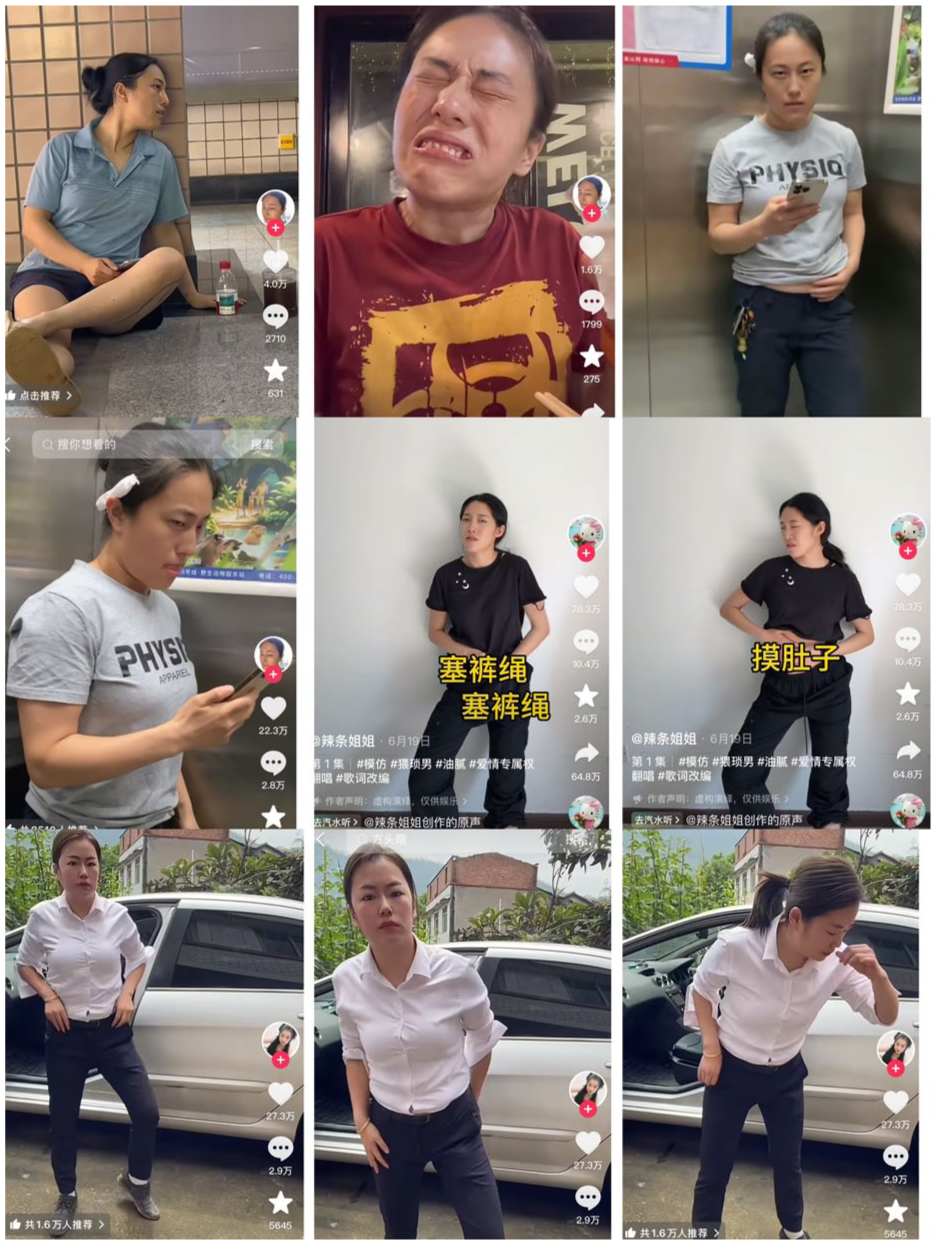
Screenshots of the “the lewd and the unkempt” archetype on Douyin.
Behavioral and gestural cues intensify the discomfort. Performers mimic lewd mannerisms such as licking their lips, winking exaggeratedly, spitting, and fake-sniffing loudly. They engage in leg-jiggling, adopt slouched postures, pick their teeth, exaggerate pelvic movements, and use invasive gazes to size up women. In one widely circulated video (223 K likes), a character attempts to flirt in an elevator, leaning in far too close, making suggestive eye contact, and performing micro-gestures like combing greasy bangs with his fingers or adjusting his belt over a protruding belly.
Audience reactions to this category of videos echo those found in the previous two sections, falling into two primary types. First, many viewers comment on the uncanny realism of the performance, recognizing the gestures as eerily familiar (Figure 12). For instance, one popular comment states, “Please stop. When the elevator opened, I actually thought you were that kind of man” (5.6 K likes). Another notes, “The way he tugs at his crotch is exactly like my husband – I honestly don’t understand why he keeps doing that.”
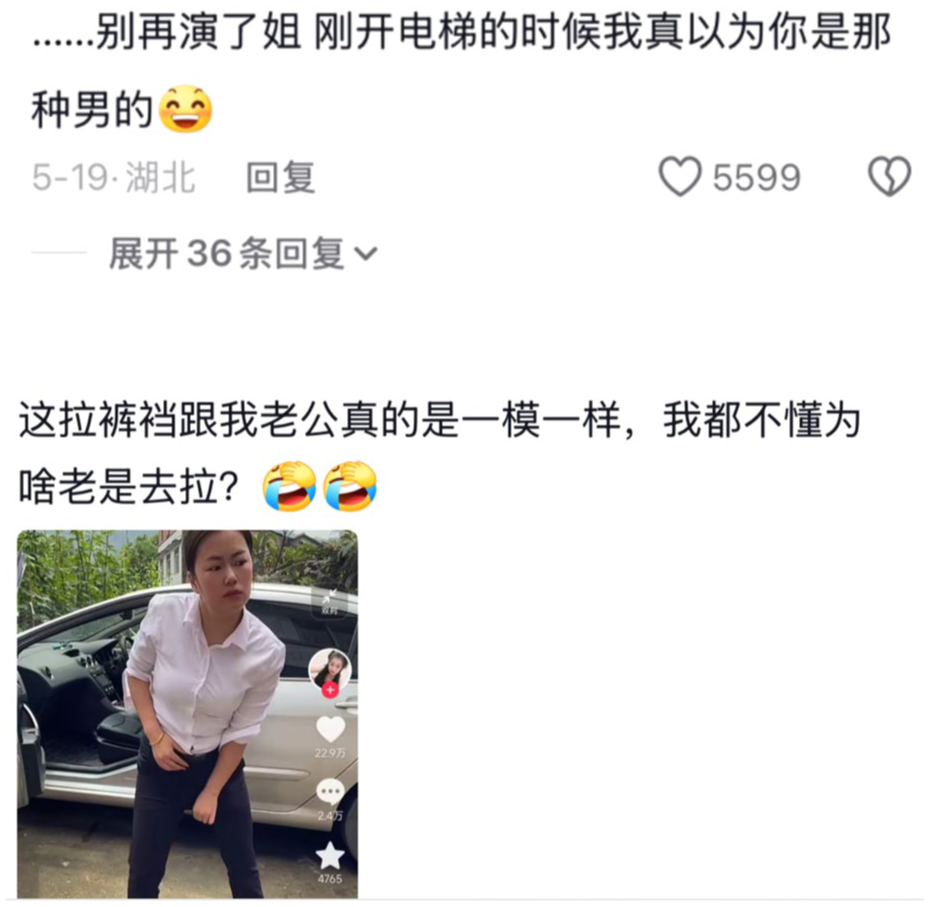
Screenshots of comments on the “the lewd and the unkempt” archetype on Douyin.
Others describe an unsettling sense of being harassed: “Stop blowing smoke, sis – I feel violated just watching this through the screen.” (Figure 13)

Screenshots of comments on the “the lewd and the unkempt” archetype on Douyin (2).
However, distinct from the responses to the previous two male types, this section features a notable rise in expressions of genuine fear and discomfort (Figure 14). Rather than just cringe or secondhand embarrassment, many viewers articulate visceral unease: “Sis, I’m really scared this time” (62 K likes), and “If I saw this in real life, I literally wouldn’t dare to get into the elevator.” Another widely liked comment makes a striking comparison: “Fang Tou Ming belongs to the campus type – I can handle him. But Fang Tou An feels like a street guy. I’m actually scared he’d slap me if I ignored him” (69 K likes).

Screenshots of comments on the “the lewd and the unkempt” archetype on Douyin (3).
Such comments underscore how the performance moves beyond parody into the realm of embodied threat, provoking not just laughter or critique but a deeply affective reaction shaped by everyday experiences of gendered vulnerability.
Affective Responses and the Emotional Politics of Watching
The Douyin parody videos analyzed above do not merely elicit laughter – they catalyze a wide spectrum of affective responses ranging from amusement and secondhand embarrassment to visceral dread and gendered rage. These emotional reactions are not incidental but participate in what Sara Ahmed (2004) terms affective economies, in which emotions do not reside within individuals but circulate between bodies, signs, and surfaces, shaping collective imaginaries and social alignments. In this economy, affect does not reflect interior states; it produces social attachments and boundaries, and parody becomes one of the key modes through which such attachments are organized.
Across comment sections under these videos, we witness affect in motion: irony (e.g., users asking for an ad break), cringe (such as “My hair feels greasy just watching this”), fear (“I wouldn’t dare enter that elevator”), and even trauma (viewers saying they felt harassed). These are not isolated sentiments but illustrate Ahmed’s idea of nonresidence: emotions acquire social force not because they belong to any one individual, but because they circulate through culturally recognizable figures. The greasy man becomes a sticky signifier – a composite body formed through repetition, parody, and collective irritation. He is not merely mocked; he is recognized, cringed at, feared, pitied, and anticipated as a familiar affective type.
Importantly, the greasy man functions not as an individual transgressor but as a metonym: a stand-in for a wider structure of gendered power and affective injury. As Ahmed (2004, p. 118) notes, certain bodies come to be read as “the origin of bad feeling” simply by appearing in proximity to the normative subject. In this case, the overconfident mansplainer, the leering uncle, and the self-congratulatory “dad-vibe” figure each attract collective irritation not due to personal behavior alone, but because of the emotional histories and power dynamics they evoke. Parody animates these figures into being – but what it reveals is the ordinariness of injury. As Ahmed reminds us, the ordinary is fantastic: the “threat” lies not in deviation, but in the banal, everyday performance of masculinity that suddenly, through parody, becomes hyper-visible and unbearable.
This affective surfacing is not politically neutral. On platforms like Douyin, as Hautea et al. (2021) point out, creators operate within affective publics – algorithmically assembled communities where shared emotional responses, rather than rational arguments, become the basis for connectivity. The mockery of greasy men thus becomes a digital ritual of emotional alignment: not only a critique of masculinity, but a collective articulation of what it feels like to live under its everyday microaggressions. Here, parody operates as affective labor: viewers’ reactions (“I’m scared”; “This feels like harassment”) are not just responses but part of how the algorithm amplifies and sustains visibility. The affective intensity of parody is thus inseparable from the platform’s infrastructure, which privileges emotional engagement as a driver of virality.
In this way, the parody of greasy men becomes a site of emotional intensity that does cultural work. It visualizes and circulates gendered affect in ways that are both cathartic and politically meaningful. As Ahmed (2004, p. 119) reminds us, “emotions work by sticking figures together (adherence), a sticking that creates the very effect of a collective (coherence).” Viewer comments exemplify this process: a digital commons of shame, fear, rage, and bitter amusement, where humor is saturated with trauma and recognition is tinged with disgust. The emotional politics of watching, then, is not simply about what we see but about how what we feel binds us to others, aligns us against certain bodies, and situates us in relation to power.
Reverse Gaze as Counter-performance and Playful Activism
This section demonstrate how I conceptualizes the “reverse gaze” in Douyin’s parody videos of “greasy men” (油腻男) as a multimodal visual and affective practice, enacted predominantly by female creators through parody, exaggeration, and irony. Building on Mulvey (1975), Foucault (1977), Ahmed (2014), and hooks (1992), I extend these frameworks by demonstrating how female creators actively reverse the gaze, transforming everyday, often overlooked, gendered violences into visible, collective critique.
First, the reverse gaze exposes performative masculinities – such as mansplaining, affectation, and self-aggrandizement – to a critical female gaze that is typically marginalized in daily interactions. Female spectators shift from passive observers to active participants, deriding, commenting, and reshaping these performances. Through this process, they co-construct affective counterpublics in which humor, critique, and shared frustration intersect, resonating with Baishya’s (2021) notion of “light critique.” Here, parody functions not merely as entertainment but as a grassroots mechanism that visualizes and organizes resistance to hegemonic masculinity, highlighting participatory, vernacular forms of subversion that existing scholarship has overlooked.
Second, the parodies reinscribe male gazes under female spectatorship, rendering visible their invasive and objectifying dimensions. By exaggerating behaviors such as unsolicited stares or performative virility, these performances elicit affective responses – including discomfort and apprehension – that demystify hegemonic masculinity. This goes beyond hooks’ (1992) concept of the oppositional gaze, which primarily captures Black women’s direct critical engagement with the gaze; my analysis shows a more radical redirection, whereby the female gaze is actively reversed onto the original “gazer.” In doing so, parody in digital media transforms everyday gendered microaggressions into amplified, observable critique, thereby attenuating symbolic power.
Third, while some previous studies (e.g., Xu & Tan, 2021) have examined the female gaze directed at men, this gaze has generally been framed in terms of sexual desire. Such representations often align with consumerist logics – evident in fan culture – thereby co-opting feminist perspectives rather than fostering a critical stance. By contrast, videos that parody the “greasy man” on Douyin go beyond this, producing a distinctly critical gaze toward masculinity.
Fourth, certain male viewers internalize the critical reversed female gaze, monitoring and adjusting their behavior to avoid embodying the “greasy man” archetype. This illustrates Foucauldian disciplinary power (Foucault, 1977) in digital contexts, extending the theory by showing how surveillance and self-regulation emerge through peer-mediated, participatory media. Resistance and internalization coexist, highlighting the complex dynamics of affective governance in online spaces.
Crucially, this reversal arises from grassroots creativity rather than elite feminist discourse. Ordinary young women, armed with mobile phones and shared humor, enact a collective female gaze that destabilizes patriarchal norms. Their political power lies not in ideology but in what Papacharissi (2015) describes as a “politics of affect,” where laughter, recognition, and irritation form connective tissues of digital publics. Algorithmic amplification on Douyin (Hautea et al., 2021) enables these parodies to circulate widely, transforming everyday irritations into shared, affective critique. In Baishya’s (2021) terms, this is “resistance light in tone but serious in intent,” demonstrating a novel, participatory mode of playful activism that both applies and extends classic theories of the gaze.
Parody, Performativity, Undoing Gender
These Douyin parody videos not only resist the gendered structure of the gaze, but also destabilize the ontology of masculinity through performative exaggeration and parody. Drawing on Judith Butler’s (1990) theory of gender performativity, these performances do more than mock specific male behaviors: they expose masculinity itself as a fragile, culturally scripted identity, constituted through repeated acts rather than a pre-existing essence.
As Butler (1990) writes, “there need not be a ‘doer behind the deed,’ but that the ‘doer’ is variably constructed in and through the deed” (p. 195). Masculinity, like gender more broadly, does not precede its performance; it is enacted through gestures, styles of speech, and modes of occupying space. The Douyin videos exploit this logic by reproducing masculine acts in overblown, parodic forms, thereby detaching the act from the actor and revealing masculinity as a set of cultural scripts available for repetition, citation, and subversion. In doing so, these performances enact what Butler (1990) terms the “pastiche-effect of parodic practices,” in which the original and the copy mutually illuminate the artificiality of the supposed authentic identity. These examples illustrate how digital parody can operationalize Butler’s abstract concepts, showing in concrete terms how masculinity is constructed, performed, and destabilized in everyday online interactions.
This undoing of masculinity is further amplified through vernacular digital cultures, where performance, identity, and affect are entangled with everyday platform practices. As Lee and Abidin (2023) note, online spaces facilitate “everyday politics at the micro level,” where users negotiate intersectional identities through casual posts, memes, and affective gestures. The parodic enactments of greasy men on Douyin therefore operate simultaneously as personal performance and socially situated media practice, shaped by platform affordances, algorithmic amplification, and audience engagement (Bhandari & Bimo, 2020; Abidin et al., 2022). Parody here is both intimate and structural: it manifests in humor and critique, yet also reflects broader cultural negotiations of gender and power. This dual lens highlights my argument that digital parody serves as a bridge between individual agency and structural critique, enabling a nuanced understanding of how masculinity is both enacted and challenged in contemporary media.
For Butler (1990), parody “can serve to reengage and reconsolidate the very distinction between a privileged and naturalized gender configuration and one that appears as derived, phantasmatic, and mimetic – a failed copy” (p. 195). Female creators exaggerate behaviors such as mansplaining, aggressive flirtation, and ostentatious posturing, revealing these performances as stylized repetitions already estranged from any authentic masculinity. The mimicry produces a double exposure: the original is shown to be artificial, and the copy amplifies that artificiality into farce. The political potential of these videos lies in what Butler describes as the “subversive laughter” that accompanies parodic failure, a form of humor that functions not as mere entertainment but as critique, undoing the authority of gender norms by refusing their seriousness and playing with the very signs meant to secure identity.
Whereas Butler’s framework, drawing on drag performances, theorized parody as exposing the performative and unstable nature of gender itself – most visibly through the parody of femininity – my analysis shifts the focus to show how female creators mobilize parody to destabilize masculinity in particular. What I add to Butler’s account is an emphasis on gendered reversal within digital vernacular culture. In the Douyin videos I analyze, this dynamic is inverted: masculinity itself becomes the object of parody, estrangement, and subversive laughter. This shift matters, for it reveals that hegemonic masculinity is not simply a stable gazer of others but a fragile performance, vulnerable to being gazed at, mocked, and undone. Such reversal not only critiques individual “greasy” men but also unsettles the symbolic order that demands “man” and “woman” as coherent protagonists of compulsory heterosexuality.
In this sense, Douyin parody videos transform ordinary gendered microaggressions into amplified, shareable critique. These carnivalesque reenactments of masculine failure extend Butler’s theory into the terrain of digital culture, where grassroots creators weaponize humor, irony, and exaggeration to multiply gender possibilities, destabilize hegemonic masculinity, and reveal its phantasmatic nature. In doing so, I offer a theoretical reflection that bridges Butler’s notion of performativity with everyday digital practices in China, showing how online parody expands and radicalizes the conceptual terrain of gender critique.
Conclusion
Parody videos of “greasy men” (油腻男) on Douyin illuminate how digital vernacular practices can unsettle gendered hierarchies of visibility and power. Rather than reiterating elite feminist discourses, these grassroots performances demonstrate how humor, irony, and everyday creativity operate as affective infrastructures of critique. What emerges is not only a reversal of the gaze but also the formation of micro-political publics that mobilize laughter, irritation, and recognition as connective forces.
The significance of these practices lies less in immediate structural transformation than in their capacity to reconfigure the everyday coordinates of looking and being looked at. In this reorientation, masculinity is no longer the stable locus of vision but a fragile script open to mockery, exposure, and undoing. More importantly, such parody cultivates what Ahmed (2014) calls “affective economies”: circulating intensities that bind participants into solidarities, however fleeting. These collective gestures exemplify a politics of affect, in which small acts of parody ripple outward into larger imaginaries of resistance.
As hooks (1992, p. 116) insists, the gaze can be a practice of world-making: “Not only will I stare. I want my look to change reality.” In the playful reversed gaze of Douyin parody, we glimpse this possibility – where everyday irritations are reframed as critique, and critique becomes an opening toward alternative feminist futures.
Footnotes

Funding
The author received no financial support for the research, authorship, and/or publication of this article.
Declaration of conflicting interests
The author declared no potential conflicts of interest with respect to the research, authorship, and/or publication of this article.